Two weeks ago, Rob Kall posted an interview with me on OpEdNews. It centered on my book, The Magic Glasses of Critical Thinking: seeing through alternative fact & fake news. I had great fun doing the show. Here it is.
Tag: Mike Rivage-Seul
Think Critically about Syria, Skripal, and Building # 7 Before It’s Too Late: Apply “The 9/11 Principle”
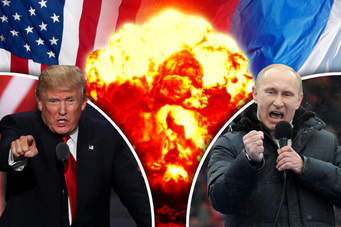
What level of evidence of an opponent’s criminal state activity justifies sanctions, diplomatic expulsions, retaliatory bombings, conventional war or even the risk of nuclear war? The question finds urgent relevance amid unsubstantiated charges of chemical weapons use by the Assad government in Syria and in the light of wild accusations against Vladimir Putin of Russian responsibility for the poisoning of double-agent Sergei Skripal and his daughter Yulia.
In my new book, The Magic Glasses of Critical Thinking: seeing through alternative fact and fake news, I offer a whole series of criteria for answering questions of evidence and judgment of guilt.
“Magic Glasses” is a term coined by the late comedian and social activist, Dick Gregory for habitual critical perspective that refuses to go along with group-think imposed by American oligarchs and propagated by the mainstream media (MSM). For Gregory, critical thinking was like donning a pair of spectacles that reveal things as they truly are, not as the oligarchs and their publicists would have us see them.

Chief among the criteria I offer in my own Magic Glasses is what might be called the “9/11 Principle.” It enjoys new relevance in the light of a recently-filed petition for a grand jury hearing about the true causes of the destruction of the 3 World Trade Center buildings on 9/11/01. The 54-page petition with 57 exhibits was submitted on April 8th by the Lawyers’ Committee for 9/11 Inquiry. The principle states that:
Since 9/11/01, any evidence for enemy-state wrongdoing (such as use of chemical weapons or alleged assassinations) must surpass the level of the evidence routinely dismissed by the U.S. government indicating that the World Trade Center destruction of 9/11/01 was the result of controlled demolition rather than of fires caused by planes crashing into the structures.
My 9/11 Principle and its implied relationship to Assad, Skripal and the attack on the World Trade Center is found in the final chapter of The Magic Glasses. There I attempt to appropriate Noam Chomsky’s propaganda model of mainstream media (MSM) which identifies its function as not that of seeking truth, but of defending government policy despite the facts.
In the case of designated enemies, Chomsky explains, merely circumstantial evidence, hearsay, and the work of discredited intelligence agencies is all that’s required to establish guilt and justify retaliation. Moreover, responsibility for the alleged misconduct will be attributed to the highest level possible.
This syndrome finds its most recent expression in the just mentioned cases of alleged Syrian use of chemical weapons, and in the Skripal poisonings. In both cases, long before the dust had settled, the Trump administration on the one hand, and Theresa May on the other quickly drew conclusions condemnatory of designated enemies (Syria in Trump’s case, and Russia in May’s) before standard criminal investigations were allowed to unfold. In each case, guilt was linked directly and immediately to the relevant head of state – Bashar Assad and Vladimir Putin.
Contrast such premature judgment with MSM coverage of alleged U.S. crimes. There smoking guns are always demanded. And then if the “gun” is found, responsibility for its use is routinely assigned to the lowest official available. Abu Ghraib represents a case in point. Crimes that were later traced to the oval office itself were originally presented as the work of a few low-ranking bad apples.
More to the point, consider the official story of 9/11. That Washington-sanctioned account has carried the day for more than 16 years despite problematic evidence ignored or dismissed by government investigators. That’s the evidence undergirding the case submitted by the Lawyers Committee for 9/11 Inquiry. It includes:
* The historical facts that no steel-framed building in the history of the world has ever fallen as the result of even the most intense fires burning in some cases for days on end.
” Yet three such buildings fell on a single day after a few hours of localized conflagration.
” World Trade Center Building #7 was not struck by aircraft; yet it too fell into its footprint like Building #1 and Building #2 in fewer than 10 seconds after a relatively few hours of fire.
” Larry Silverstein, the owner of WTC Building #7 is heard on tape admitting that he and an unnamed NYC fire official decided to issue the order to “pull” the building in question. Using the language of demolition engineers, where to “pull it” means to initiate the final demolition process, Silverstein says,
“I remember getting a call from the fire department commander telling me they were not sure they would be able to contain the fire. I said, ‘You know, we’ve had such terrible loss of life, maybe the smartest thing to do is just to pull it. And they made that decision to pull. Then we watched the building collapse.'”
* The scientific fact that Jet fuel (the medium responsible for ignition of the fires in question) cannot produce fires whose temperatures can cause steel to melt.
* The evidentiary fact that widespread traces of thermite explosives were found amid the wreckage of the collapsed WTC buildings.
* The procedural fact that thorough investigation of the WTC debris was prevented by an inexplicably hastened and immediate removal of crime scene evidence following the buildings’ destruction.
In the light of the differences between government and MSM treatment of alleged crimes of the U.S. government on the one hand and of designated enemies on the other, let me repeat my 9/11 principle. It states:
Since 9/11/01, any evidence for enemy-state wrongdoing (such as use of chemical weapons or alleged assassinations) must surpass the level of the evidence routinely dismissed by the U.S. government indicating that the World Trade Center destruction of 9/11/01 was the result of controlled demolition rather than of fires caused by planes crashing into the structures.
Please note that the principle does not take a position on the question of responsibility for the dastardly events of 9/11. Instead, it merely:
* Suggests that for the sake of fairness, balance, logic, and consistency, the same standards of behavior must be applied to designated enemies as that applied by U.S. officials to their own conduct. (This is Chomsky’s Principle of Universality that any child can understand.)
* Underlines the high bar set by authors of the official 9/11 story and of their disinterest in answering the still-open questions surrounding the event.
* Implies that no retaliation in the form of sanctions, bombings or (much less) declarations of war should ever take place in response to alleged crimes of designated enemies unless evidence exceeds that denied or rejected out of hand (as conspiracy theories) by proponents of the official story of the September 11th attacks.
* Means that belligerent responses to recent chemical weapons attacks or to alleged assassinations are virtually impossible to justify.
* Consequentially renders the question of war effectively moot.
In fact, no war justifications since the Second Inter-Capitalist War have met the standard set by the 9/11 principle. And even if the opponents of renewed 9/11 inquiry should block the initiative of the Lawyers Committee for 9/11 Inquiry, their very act of denial will only raise the bar the principle sets even higher.
By offering its Ten Rules similar to the 9/11 Principle, The Magic Glasses of Critical Thinking attempts to clarify issues such as those inspired by the Assad accusations and the Skripal case. It also is meant to spur practical conclusions including:
* Extreme skepticism of any governmental claims based on circumstantial evidence.
* Absolute refusal to endorse any retaliation towards Russia without an incontrovertible “smoking gun” established by an independent agency conducting thorough investigation and presenting its findings to the United Nations.
* Insistence that the evidence in question be concrete, undeniable, and as easy to recognize as a building falling into its own footprint in fewer than 10 seconds.
* Massive street demonstrations against the American and British oligarchs, “intelligence” agencies, and arms manufacturers whose financial interests are recklessly rushing the world towards nuclear annihilation.
I and my book are desperately appealing to the American public to put on Gregory’s magic glasses and see the fall of Building #7 as the prescient image of what the oligarchy is about to inflict on our homes, offices, schools, factories, businesses, hospitals, and churches.
Following Dick Gregory, we must see things as they are – and act accordingly before it’s too late.
Press Release: The Critical Thinking Manual Progressive Teachers Have Been Waiting For: My New Book
Mike Rivage-Seul has just published the book progressive teachers have been waiting for to ground their post-secondary courses on critical thinking. Available on April 17th from Peter Lang Publishing, the book is called The Magic Glasses of Critical Thinking: seeing through alternative fact and fake news.
Rivage-Seul is an emeritus professor of peace and social justice studies at Berea College in Kentucky, where he taught for more than 40 years. He publishes a monthly column in the Lexington Herald-Leader.
His approach to critical thinking – to education itself – should be familiar to progressives. It starts from the position that the purpose of such process is not primarily to interpret the world, but to change it. Therefore, critical thinking and education should not be neutral. It should equip students with the tools they need for social activism.
Magic Glasses summarizes what Rivage-Seul considers the most important insights he gathered over his years of travel and study throughout Europe and especially in the Global South – specifically in Brazil, Nicaragua, Cuba, Costa Rica, Honduras, Mexico, Zimbabwe, South Africa, and India, as well as in Israel-Palestine.
“As you can tell by the title,” Mike says, “The Magic Glasses could hardly be timelier. The concept comes from the great comedian and social activist, Dick Gregory. He spoke of critical thinking as functioning like a set of spectacles. They confer special insight enabling their wearers to see things quite differently from what is considered ‘normal.’
“However, Gregory warns that the glasses come with three rules. The first is that once you put them on, you can never take them off. The second says that once you put them on, you can never see things the way everybody else does, but only as they truly are. And the third is that you can never force anyone else to wear them.”
In other words, Rivage-Seul’s book might be a dangerous read. For instance, he echoes Global South scholars by seeing sinister intent in the Declaration of Independence’s celebrated statement that “All men are created equal.” With those same scholars, he refers to World War II as the “Second Inter-Capitalist War,” and sees the United States as currently occupying the same global position that Adolph Hitler aspired to attain – with similar effect.
“I’ve been wearing Gregory’s magic glasses for years,” Mike says. “They’ve shaped my all my teaching and have often got students mad at me – at least at first. And you should read some of the comments my newspaper columns get! It’s all because I constantly apply the ten rules for critical thinking that my book explains.”
Those rules include: (1) Reject Neutrality, (2) Reflect Systemically, (3) Select Market (as the root of political differences), (4) Suspect Ideology, (5) Respect History, (6) Inspect Scientifically, (7) Connect with Your Deepest Self, (8) Quadra-sect Violence, (9) Detect Silences, and (10) Collect Conclusions.
As a result of employing those guidelines, Rivage-Seul understands U.S. history, terrorism, the renewed nuclear arms race, world hunger, trade agreements, immigration, Black Lives Matter, and other hot button issues in ways that end up being 180 degrees opposed to the mainstream.
“I’m in good company though,” Mike observes. “I’m trying to channel the spirit of the world’s great critical thinkers. Think about it. None – not Jesus, the Buddha, not Gandhi, Martin Luther King, Dorothy Day, Thomas Merton, or Helen Keller – was neutral. They weren’t worried about ‘balance’ or offending anyone. For them, speaking truth to power and living with the results were all that mattered.
“I’m hoping that my book falls into that tradition.”
That social activist tradition is indeed developed in The Magic Glasses. And each point is illustrated with movie clips from films such as Traffic, The Post, Avatar, Sausage Party, The Distinguished Gentleman, Good Will Hunting, American Sniper, Captain Phillips, American History X, War Dogs, Bulworth, and even with the Broadway musical, Hamilton.
In sum, The Magic Glasses of Critical Thinking represents and attempt to supply secondary and post-secondary teachers with a complete syllabus for a course on critical thinking that will help students radically revision their world in ways that inevitably challenge all of their preconceptions.
As such, Rivage-Seul’s book on critical thinking is not only the one progressives have been waiting for, it’s a page-turner as well. As Rob Kall, the editor-in-chief of OpEdNews puts it in his endorsement:
“I love this book. It’s brilliantly written by a very wise man who’s been serially enriched by spending time with some of the world’s greatest visionaries. And he shares what he learned from his conversations with them. The book is addictively readable. I started to skim the book to see if it was worth putting my time into and found I couldn’t stop reading. Michael Rivage-Seul brings sparkling vivacity to the potentially dry topic of critical thinking. As one who has interviewed hundreds of visionaries, I found this book to offer new perspectives and ways of seeing-which is what building critical thinking skills is all about. This book offers so much more than what its title, at first glance suggests. Have a taste and you, will like me, find yourself wanting to consume all the courses of this delicious meal.”
Notes for a Home Church: Why The Church as We Know It Is Dead (Pt 2 in series of 4)

In my last posting, I announced the first meeting of a house catholic (i.e. open to all) church. It will take place this Saturday, the day after Donald Trump’s inauguration, at 5:00 in Peggy’s and my home, 404 Jackson St.
I also mentioned that friends of mine wondered why, noting that the church as we know it is dead.
To be honest, I find their point hard to deny. As already noted, the institutional church is pretty much in extremis. If it disappeared entirely, most of our lives would be little affected. There’s good reason for that. The church has little to do with the historical Jesus, who (in contrast to the one worshipped in our churches) remains extremely relevant to this age of Donald Trump and its ushering in of fascism.
Let me explain
Jesus never intended to found a church. As James Carroll has pointed out recently in his Christ Actually, the Master was a prophetic reformer of Judaism. He remained a Jew to the end of his life. It was beyond his purview even to conceive of belonging to or persuading others to embrace a religion other than a reformed Judaism.
The same was true for his immediate followers. As shown in the Acts of the Apostles, they met in their homes to “break bread” [as was the signature practice of Jesus himself (see below)]. However, they also continued to congregate in the Temple and in local synagogues. Even Paul remained a good Jew. His work with “Gentiles” was with non-Jewish converts to Judaism. His concern was not to burden them by requiring circumcision and kosher diet of such “God-Fearers” wishing to embrace the Jesus Wing of Judaism. John Dominic Crossan and Marcus J. Borg have argued persuasively about this in The First Paul.
As I’ve indicated in my own book, The Emperor’s God, the Jewish Jesus-Community at Jerusalem was led by Jesus’ brother James the Just. Its members were effectively wiped out or driven into exile in the year 70, when the Romans utterly destroyed Jerusalem and its Temple. The resulting Jewish diaspora (refugee Christians among them) spread throughout the Roman Empire. There Christian concern for the poor drew numerous (typically impoverished) non-Jews into their orbit. Largely variant interpretations of Jesus’ identity subsequently emerged – some strictly Jewish, other gentile, some pro-Empire, others Empire-resistant.
In fact, four basic understandings of Jesus came out of the hodgepodge: (1) Jesus was a completely human prophet like John the Baptist, (2) he was a human being who eventually became divine, (3) he was from the beginning a God who pretended to be human, and (4) Jesus was from the outset somehow fully God and fully human.
It was the latter interpretation that eventually prevailed as “orthodox.” The other three interpretations (along with additional opinions) were labeled “heretical” and suppressed, often quite violently.
In the early 4th century, the non-Jewish, “orthodox,” and pro-empire factions within Christianity rose to prominence. That was after Constantine issued his Edict of Milan in 313. It made Christianity legal in the Roman Empire. Then in 325 Constantine himself convened the Council of Nicaea. Its Nicene Creed effectively transformed Jesus into a Roman God – above history, thoroughly Roman, and no longer Jewish. As such, he was not a threat to Rome or any other regime willing to dispense rich favors on the church. By 381, under the Emperor Theodosius, Christianity had become the official religion of the Roman Empire. As the pro-empire faction of Christian leaders consolidated their power, the historical Jesus and his specifically Jewish concerns were lost forever.
Even more tragically, following the collapse of the Roman Empire in the early 5th century, the Church gradually stepped into the breach and took over its functions. Increasingly, popes resembled emperors, cardinals became “princes of the church,” bishops aspired to princely rank, and priests often fell into the role of religious hucksters hawking spiritual favors such as forgiveness of sins and “indulgences” in exchange for money.
Throughout the process, what gave priests their authority was the power the church claimed for them to “transubstantiate” bread and wine into the body and blood of Christ. Their ability to forgive sin in the sacrament of penance consolidated their influence. It rendered them indispensable for those wishing to get to heaven after death – which was for Catholics the whole point of life. Without such powers, priestly authority would have vanished.
None of that is to say that the Church sold its soul to empire entirely. Over the centuries, there were plenty of reform movements. Beginning around the 3rd century, the Desert Fathers rejected the growing worldliness of the Church. Franciscans in the 13th century followed in that tradition. Then came the great Protestant Reformation in the 16th century.
Key to the latter was the denial of priestly status or authority. Luther, Calvin, Zwingli and others undercut the priestly class by correctly recognizing that neither Jesus nor the apostles were priests. In fact, the reformers said, any special priesthood was a compete aberration for Christians. If anything, in virtue of baptism, all Christians are priests. They were empowered to forgive one another’s sins. There was no need for the sacrament of penance. Moreover, all the reformers agreed with St. Augustine who taught that belief that a priest’s words could change bread and wine into the literal body and blood of Christ was absurd and cannibalistically repugnant.
Modern biblical scholarship has proven the Reformers correct on most counts. As Garry Wills has argued in Why Priests?, outside the obscure Epistle to the Hebrews, Jesus is nowhere in the New Testament identified as a priest. Instead he is consistently portrayed as a lay person – a prophet extremely critical of priests and their work. When St. Paul lists the charisms, gifts or offices found within the Christian community, nowhere on his list of 16 separate categories does he mention “priest” – much less of a power to change bread and wine into Christ’s body and blood or to forgive sins in “confession.”
Well, if the Eucharist is not a ritual intended to miraculously render Jesus present in the host and chalice, what is it? And what is the meaning of Jesus’ words at the Last Supper: “This is my body . . . this is my blood . . . Do this in remembrance of me?”
We’ll take that up in next Tuesday’s posting – Part 3 in this series.
The Poor Know More than the Rich: Paulo Freire on What the Impoverished Can Teach Us All (Personal Reflections XV)

Our world is characterized by an ongoing “conflict” (not to say “war”) waged by the rich and powerful against the poor and politically powerless. It’s all an inheritance of colonialism, which did not disappear after World War II. Instead, colonialism simply took other more sophisticated forms. As J.W. Smith puts it, the system changed from “plunder by raid” to “plunder by trade.” The enduring point is to keep the wealth and power where it’s been since the onset of the colonial era – with the plundering powers (Europe and the United States) which have systematically robbed the resources of the former colonies whose populations today (unsurprisingly) constitute the world’s poor.
One cannot be neutral in the conflict just referenced; one must take sides. As our friend and mentor Paulo Freire put it, “Washing one’s hands of the conflict between the powerful and the powerless means to side with the powerful, not to be neutral.”
My forty-plus years of travel, teaching, and scholarship in the Global South (Brazil, Nicaragua, Costa Rica, Guatemala, Honduras, Mexico, India, Zimbabwe, South Africa, and Cuba) have taught me the truth of Paulo’s words. Not to decide is to decide – in favor of the status quo.
When sides are consciously taken with the poor and oppressed, a whole counter-narrative emerges that rarely gets a hearing in the United States whose official policy favors the rich and powerful. The counter-narrative about history, economics and politics comes from the underclasses that so concerned Paulo Freire and the liberation theologians I’ve studied with in the countries I’ve just mentioned as well as in the U.S. and Europe.
But here’s the Freirean point: the counter-narrative of the poor is more comprehensive and informed than the one typically pedaled in the United States. In fact, the U.S. story (pretending to be neutral) is actually the product of one-sided “banking” model of education that endorses oppression as normal and inevitable.
Let me explain.
Paulo Freire famously contrasted what he called the banking concept of education with “education for critical consciousness.” In the banking model, teachers make deposits of knowledge into the “accounts” of passive, unsuspecting students. What they learn is mostly irrelevant to their everyday lives. However it amounts to the “official story” which remains unquestioned and explains the given order as normal and good.
On the other hand, education for critical consciousness “problematizes” the students’ own reality and asks them to come up with solutions to real dilemmas: for example, their own hunger, its causes, and how to escape it. In the process they learn how the world works and come up with strategies to change their immediate experience.
Freire also made key distinctions about the stages of consciousness typically passed through by learners among the world’s majority poor and oppressed. Normally, he said, students begin with the resigned attitude that “to be is to be under the oppressor.” They see no exit from their poverty and life’s circumstances. From there they pass to a second stage: “to be is to be like the oppressor.” They take the rich and powerful as their role models. They want to be like them – rich and successful. Finally, if they persevere in the growth process, poor students arrive at a stage where they realize that “to be is to be neither oppressor nor oppressed.” In that stage they start taking active and proactive measures against their own poverty and oppression. They work to change the world.
[BTW: Part of my quarrel with Lin Manuel Miranda’s “Hamilton” (which is where these reflections began) is that it reflects Freire’s second stage of consciousness – to be is to be like the Oppressor. In the play, African-American and Hispanic actors literally pretend to be their white oppressors; they actually celebrate the ones who enslaved and exterminated their ancestors – the ones who excoriated Native Americans in the Declaration of Independence and who wrote slavery into the U.S. Constitution.]
Towards accomplishing the task of changing the world, the poor have an epistemological privilege in their analysis of life in general. Though typically far less formally educated than the rich, their perception and analysis is characteristically more comprehensive and accurate. They might not be able to make the historical references or to employ the academic jargon; they might not use complete sentences or be grammatically correct, but simply put, the poor know more about life.
Why? Think about it for a minute.
Those of us who are rich and/or comfortable have very limited experience and awareness. Our communities are pretty much siloed and gated. As a result, we can live without consciousness of the poor at all. Wall Street execs rarely really see them. The poor are located in different parts of town. Most even in the middle class never enter their homes or schools. The comfortable have no experience of hunger, coping with rats, imminent street crime, living on minimum wage, or cashing in Food Stamps. Even if they notice the poor occasionally, the comfortable can quickly dismiss them from their minds. If they never saw the poor again, the rich and middle class would continue their lives without much change. In sum, they have very little idea of the lived experience of the world’s majority.
That becomes more evident still by thinking of the poor outside the confines of the developed world who live on two dollars a day or less. Most in the industrialized west know nothing of such people’s languages, cultures, history, or living conditions. I’m talking about “enemies” living in Syria, Iraq, Somalia or Yemen. Even though our governments drop bombs on such people every day, they remain only abstractions. That is, few of us know what it really means to live under threat of hellfire missiles, phosphorous bombs or drones. Similarly, we know little of the actual motives for “their terrorism.” Syria could drop off the map tomorrow and nothing for most of us would change.
None of this can be said for the poor and the victims of bombing. They have to be aware not only of their own life’s circumstances, but of the mostly white people who employ them, shape their lives, or drop bombs on their homes. The poor serve the rich in restaurants. They clean their homes. They cut their lawns. They beg from them on the streets. The police arrest, beat, torture and murder their children.
If the U.S., for example, dropped off the planet tomorrow, the lives of the poor would be drastically altered – mostly for the better. In other words, the poor and oppressed must have dual awareness. For survival’s sake, they must know what the rich minority values, how it thinks and operates. They must know more about the world than the rich and/or comfortable.
That’s why when the poor develop “critical consciousness,” (like Malcolm X or Mumia Abu Jamal) their analysis is typically more comprehensive, inclusive, credible, and full. They have vivid awareness not only of life circumstances that “make no difference” to their comfortable counterparts; they also have lived experience of life on the other side of the tracks.
However despite such comprehensive knowledge, the critically conscious poor and their representatives find little place in mainstream analysis which comes overwhelmingly from white, well-to-do, and university-educated men.
This is why I’ve learned to give scant credence to mainstream media (MSM) explanations of the world and always takes pains to understand reality from the viewpoint of the epistemologically privileged poor and oppressed – found outside the MSM. Those viewpoints are more comprehensive and informed.
Such Freirean insights are, I think, worth thinking about.
(Next week: My study of liberation theology in Brazil)
Churches, Popes, Women, and the “V” Word (Sunday Homily)
![thevaginamonologues[1]](https://mikerivageseul.com/wp-content/uploads/2013/02/thevaginamonologues1.png)
Readings for 5th Sunday in Ordinary Time: Is. 6:1-2a, 3-8; Ps. 138: 1-5, 7-8; I Cor. 15: 1-11; Lk. 5: 1-11. http://www.usccb.org/bible/readings/021013.cfm
Have you ever seen Eve Ensler’s “Vagina Monologues?” A few years ago that series of dramatic readings was presented at Berea College where I taught for 37 years. The readings were as provocative as the play’s title. All of them reflect the unique experience of being woman that most of us Christian males find so difficult to understand, especially after so many years of brain-washing at the hands of predominantly male clergies.
Significantly, Ensler refers to that particular churchly indoctrination in the prologue to her text. There she quotes Gloria Steinem who recalls:
“In the sixties, while I was doing research in the Library of Congress, I found a little known treatise about the history of religious architecture which blithely stated a thesis, as it were known by everybody, to the effect that the traditional shape of most patriarchal buildings of worship imitates the female body. Thus, there is an external entrance and another internal one, the labia majora and the labia minora; there is a vaginal central nave, which leads to the altar; there are two curved ovarian structures on either side; and finally, in the sacred center is the altar or uterus, where the great miracle takes place: men give birth.
“Though this comparison was new for me, it opened my eyes with a shock. Of course, I thought. The central ceremony of the patriarchal religions is nothing else but the ceremony in which men take control of the “yoni” power of creation by giving birth symbolically. It is no wonder that male religious leaders state so often that we human beings are born in sin … because we are born from female tummies. Only by obeying the rules of the patriarchy can we be “reborn” through men. It is no wonder that priests and pastors decked out in long vestments sprinkle our heads with a fluid that mimics the waters of birth. It is no wonder that they give us new names and promise us we will be reborn in eternal life. It is no wonder that the male priesthood attempts to keep women far removed from the altar, just as we are kept far removed from control of our own powers of reproduction. Whether symbolic or real, everything is aimed at controlling the power that resides in the female body.”
Talk about provocative! Here Ms. Steinem is claiming that creative power is focused chiefly in the female body, though men obviously have an ancillary role in the begetting of life. Because their role is so obviously secondary, a primary male purpose in organized religion, Ms. Steinem says, is for men to alienate or steal the vastly superior womanly power of life and to control it – against women themselves.
Patriarchal religion accomplishes its task by dressing men up like women. It has them sprinkling their congregations with the waters of birth introducing them to “eternal life.” This form of life is held to be more important than physical life, and male pastors claim to control it to the exclusion of women. The prerequisite for women’s access to life eternal is that they adopt the rules of the exclusively male priesthood especially those connected with female powers of reproduction centered in the woman’s body whose architecture the male priestly domain of church actually mimics.
I bring all of that up because today’s liturgy of the word is so obviously male-centered in a very misleading way. Together with Ms. Steinem’s reflections, the readings of the day suggest why someone like our present Pope Benedict XVI along with Christian pastors of many denominations participate so enthusiastically in what has been called a 21st century “War on Women” and why the pope is so afraid of women priests.
Female priests might inspire women to recognize their inherent superiority over men in terms of centrality to the life processes (both physical and spiritual) that the patriarchy struggles so mightily to control. If women were allowed the leadership that their biology suggests, what would become of the male-centered church – of the male-centered world?
Today’s liturgy of the word tries to keep us from asking such questions. It begins with a description of God in highly masculine terms centered in the macho realm of palace and court. God is depicted as “king.” He (sic!) is “Lord.” He inspires fear and awe. He dwells in a smoke-filled room surrounded by all the trappings of power and might. Like the prophet Isaiah, those who appear before him feel small and ashamed of the very words that come from their lips.
This, of course, is the image of God we’ve been offered from the cradle. (Can you imagine how different we’d feel personally, ecclesiastically, nationally and internationally if the familiar image of God were a mother nursing her child? Would you feel any different towards such a Mother God? – Remember, it’s all just symbolism. And the image of God that’s come to dominate arises from one of the most patriarchal traditions in the history of the world.)
The male-centeredness of today’s readings continues in the selection from Paul’s first letter to Christians living in Corinth. It’s a key passage because Paul is trying to establish his identity as an “apostle,” even though he never met Jesus personally. Paul bases his claim on the fact that Jesus appeared to him just as he did to the other apostles. So he says “Remember what I preached to you:” Christ died for our sins. He was buried and raised on the third day. He appeared to the 12, then to 500 “brothers” at once, then to all of the apostles, and finally to Paul himself.
There is so much interesting in this summary of Paul’s preaching. What, for instance, happened to Jesus’ words and deeds? Paul’s gospel begins with Jesus’ death! What about Jesus’ life which revealed the character of God as compassionate and “womb like?” (See Marcus Borg, Meeting Jesus again for the First Time, chapter 3.)
However, even more to the point is Paul’s omission of the fact that according to ALL of the accounts of Jesus’ resurrection appearances in the canonical gospels, Jesus’ first appearances were to women, not to men!! (Remember Jesus’ appearance to Mary Magdalene in John 20:1-18?) Using Paul’s logic, doesn’t that establish the primacy of women in the church – and in the priesthood? The misogynistic Paul doesn’t want to go near that question. And neither does the equally misogynistic Pope Benedict XVI.
And then we have today’s gospel selection from Luke. It’s the call of the first apostles. According to Luke, Peter, James, and John are the first to follow Jesus. That leaves us with the usual impression that Jesus called only men.
Omitted from our vision is the fact that according to Luke himself (8:3) there were “many women” taking an active part in the Jesus Movement. Besides Jesus’ mother Mary, we know the names of some of them: Mary Magdalene, several other Marys, Suzanne, Salome, Martha and Mary of Bethany, Joanna. . And the roles of these women weren’t confined to preparing food and washing clothes.
In the first Christian communities, men and women met and worshiped together. Both men and women preached the message of Jesus with the same authority, and both men and women presided at the celebration in remembrance of their crucified Master. Like the men, the women had representation and decision-making power in the communities as priests and bishops.
That was even true of the communities of Paul. Paul himself taught that “In Christ there is no male or female” (Galatians 3,28). With this claim he legitimized the active participation of women in the first Christian communities. Also, he makes emphatic mention of many women in his letters and lavishly praises their work. For example, he mentions by name the deaconess Phoebe (Romans 16,1), Junia (Romans 16,7), Prisca, Julia, Evodia and Sintece, all of whom he called his “collaborators” (Philippians 4,2). He also mentions Claudia, Trifena, Trifosa, Prisca, Lyida, Tiatira and Nympha of Laodicea. Of the 28 persons to whom Paul accords special praise in his letters to the early churches, 10 are women!
All of that changed in the 4th century, when Christianity lost its soul and became the official religion of the Roman Empire. Then Christianity adopted for good the courtly vision today’s first reading affirmed: macho-kings, courts, palaces, smoke-filled rooms, men dressed like women, denigration of women’s bodies, men trying desperately to affirm their superiority against all the evidence of biology, life’s processes, Jesus’ own example, and women’s traditional roles as nourishers, healers and spiritual counselors.
Let’s talk about how women might take back those roles both in church and in politics. How do we “get to” someone as closed as Benedict XVI? How do we get to our bishops and priests? How do we get to our own acquiescence to the misogyny of our church and culture?
(Discussion follows)
Mali for Dummies (Part Two: Mali)
![th[7]](https://mikerivageseul.com/wp-content/uploads/2013/01/th7.jpg)
On Monday we saw that U.S. interest in the 3rd world (i.e. the former colonies) follows the pattern identified by J.W. Smith of the Institute for Economic Democracy. That pattern holds that:
1. Any former colony (or group within that entity) attempting to break for economic freedom
2. By establishing government representing the interests of its own people rather than those of the former Mother Country
3. Will be accused of terrorism or communism
4. And will be overthrown by military intervention
5. Or by right wing (often terrorist) elements from within the local population
6. To keep that country within the ex-mother country’s sphere of influence
7. So that the former colonists might continue to use the country’s resources for the invaders own enrichment,
8. And that of the local elite.
Following that sequence, U.S. and E.U. interest in Mali is driven by resource concerns, not by zeal for democracy or anti-terrorism. It is also motivated by competition with China for the resources in question (uranium, oil, and gold among others).
The indigenous Tuaregs represent an obstacle to the desired U.S. and E.U. access to those resources. The Tuaregs are secular Muslims – i.e. not fundamentalists desiring to impose Sharia Law. Since achieving independence from French colonialism in the early 1960s, the Tuaregs have been seeking independence from the artificially created Mali. Tuaregs want control of their own territory and its resources, presumably with the option of selling them to China. In fact, the Tuareg want their own country (Azawad). Presumably, Azawad would eventually be co-extensive with the Tuareg People who spill over into parts of neighboring Niger, Algeria and elsewhere in the region.
The Tauregs see Mali’s government as the puppet of France facilitating alienation of Azawad’s valuable resources from the Tuareg People to benefit France, the E.U. and U.S. To achieve liberation from such western control, the Tuaregs have organized a rebel army, the NMLA (National Movement for the Liberation of Azawad).
In its drive for independence and control of its own resources, the NMLA was supported by Muammar Gaddafi. As a “Pan Africanist,” Gaddafi was a proponent of ‘Africa for Africans” and generally opposed continued control of the continent by the U.S. and Europe. (This was a principal reason for western demonization of the man.)
Many Tuaregs were part of Gaddafi’s army. And after its dissolution (with major intervention by the U.S. and E.U.), these Tuareg fighters returned to Northern Mali with many of Gaddafi’s sophisticated weapons. Their heavily armed participation in the Tuareg struggle enabled the NMLA to make strong headway against the government of Mali, thus causing concern to its European and American sponsors about unfettered access to the region’s uranium and other resources. In fact the NMLA gained complete control of Northern Mali, declared their rebellion successful and announced withdrawal of Azawad from Mali. As far as Azawadians were concerned, the rebellion was over.
It was not over however for the U.S. and France. In response, they facilitated a military coup to replace Mali’s president (seen as ineffective against the Tuaregs), substituting in his place a U.S.-trained military general. His new government [allied with the U.S. and E.U. (led by France)] encouraged Muslim jihadists (otherwise considered “terrorists” by the West) to rebel against the NMLA so as to weaken its hold on the country’s North. According to western sources, chief among the Muslim jihadists is AQIM (al-Qaeda in the Islamic Maghreb).
AQIM successes have created a cover for France (with support from the U.S.) to intervene directly in Mali under the claim of prosecuting its “war on terrorism” against the AQIM it had just used for its own purposes up north. However, the real intent of the intervention (as it has been for 500 years) is resource transfer to the E.U. and U.S.
And that’s where most of us dummies came in. The story never changes, and we’ll fall for it every time: We’ll also be expected to dumbly foot the resulting bill and eventually accept austerity measures to pay for it.
 About Things That Matter