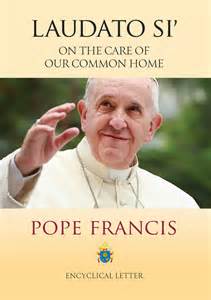
“Laudato Si’” and Its Preferential Option for the Poor (Part Three): the Guiding Principle for Restructuring the World Economy

option for poor

This is the last installment in a three-part series on Pope Francis’ new encyclical, Laudato Si’. It attempts to place in historical perspective what might well be the most important document yet produced in the 21st century. It also tries to explain the meaning and centrality of the encyclical’s guiding principle, its “preferential option for the poor.”  This third part addresses the meaning and centrality of that option.

In his critique of capitalism-as-we-know-it (reviewed in Part Two of this series), Pope Francis called explicitly for “structural change” in the world economy.  He said, “Let us not be afraid to say it: we want change, real change, structural change.”

But what “structural change” does the pope have in mind?

Evangelii Gaudium and Laudato Si’ offer the answer. Their “preferential option for the poor” provides the guiding principle and turns the present economic order exactly on its head. This implies that if the present order is possible, so is its opposite.

That is to say that the present neo-liberal order is structured according to a “preferential option for the rich.”  Its sponsoring question is how can we make sure that the banks, corporations, and 1% prosper? Economists explain such concern by various “trickle-down theories.”  If priority is accorded the welfare of the rich, the theorists say, the wealth produced will trickle down creating a “rising tide that lifts all boats.”  [The pope rejects such theories out-of-hand as historically disproven. In “Evangelii Gaudium” he even calls them homicidal (53), ineffective (54) and unjust at their roots (59).]

By way of contrast, the pope’s “preferential option for the poor” begins at the bottom of the economic pyramid. Its sponsoring question is how can we insure that farmers have land, that workers have jobs, and that everyone is decently housed?

Laudato Si’ goes even further. It expands moral concern beyond human beings to all forms of life. It asks how we can insure the survival of the planet in the face of global warming, water and air pollution, massive extinctions, disappearance of rainforests, wasted food, waste in general, uncontrolled urbanization, rampant crime and loss of human meaning.

None of this means abandoning market dynamics altogether.

It does mean, however, controlling them according to the principle some have expressed in the words, “as much market as possible and as much planning as necessary.” This means maximizing market forces, but controlling them as necessitated by prioritization of the needs of the poor including the environment – once again by the preferential option for the poor.

In practice this entails at least the following: governments (1) intervening in the marketplace to insure the rights of all to jobs with living wages, housing, education, and health care, along with land for small farmers, (2) similarly regulating market forces to protect the global environment and all life forms from the most primitive to the highest, and (3) thereafter turning economies over to carefully monitored and controlled market forces.

Impossible you say? Not at all. To repeat: if economies can be structured according to a preferential option for the rich, they can be restructured to prioritize the needs and rights of the poor and the environment.

That’s the Global South hope and conviction Laudato Si’ embodies: another world is indeed possible.

Conclusion   

Will Laudato Si’ have its desired effect? That, of course remains to the seen. However, it undeniably has in Pope Francis a powerful proponent.

That is, despite remaining Stalinist skepticism, Pope Francis might well be the most powerful man in the world. Certainly, he is the planet’s most influential moral leader. What empower him, of course, are not the military divisions in which Josef Stalin placed confidence, but his extraordinary consciousness of the unity of all creation expressed repeatedly in his every pronouncement and especially in his recent encyclical. What sets him apart from the Obamas and Putins of the world is his equally unusual courage, compassion, charisma, and credibility.

Additionally, the pope has surpassing constituency. He heads a community of 1.2 billion followers. And this does not even count the untold millions of non-Catholics who admire him and his thought leadership.

With such support, the powerful message of Laudato Si’, and his plans to bring that message to the U.N. and U.S. Congress in September, as well as to influence the Climate Summit in Paris next September, who knows what changes will result? Who knows how he will influence the U.S. general elections in 2016?

In other words, Francis may stand on the brink of surpassing the stature of Leo XIII and John Paul II in terms of changing the world.

Defenders of the old order are already shaking in their boots.

“Laudato Si’” and Its Preferential Option for the Poor (Part Two): Pope Francis’ Critique of Capitalism

Dung of Devil

This is the second installment in a three-part series on Pope Francis’ new encyclical, Laudato Si’. Overall, the series attempts to place in historical perspective what might well be the most important document yet produced in the 21st century. It also tries to explain the meaning and centrality of the encyclical’s guiding principle, its “preferential option for the poor.”  This second part addresses Pope Francis’ critique of capitalism-as-we-know-it.

Pope Francis’ Critique of Capitalism

The first entry in this series on Laudato Si contextualized the significance of its author’s origins in the Global South. It argued that till Francis, Catholic social teaching had largely focused on Western and Eastern Europe. The social pronouncements of Italian popes were largely concerned with the problems of Western Europe and the threatened loss of the working class to the allures of socialism and communism. Beginning with Leo XIII’s Rerum novarum, the Italians set the stage for the introduction of Europe’s extensive welfare state.

With the election of a Polish and subsequently of a German pope, papal focus shifted to Eastern Europe and the dethroning of communism there. Pope John Paul II and his right hand man, Josef Ratzinger (later to become Benedict XVI) cooperated with the Reagan administration (and specifically with the CIA’s William Casey) in facilitating the collapse of the Soviet Union.

With that demise achieved, it appeared to most that capitalism had won a definitive victory. Corporate globalization stood virtually unchallenged.

However, all of this changed with the ascent of Argentina’s Jorge Bergoglio to the papal throne in 2013. As the first pope from Latin America, Pope Francis has repeatedly called capitalism’s “final victory” into question. No longer focusing on Europe (western or eastern), he shifted focus to the Global South, to the poverty colonialism and unfettered capitalism had caused there.

He focused on connections between deregulated markets and the rape of the Earth Mother indigenous Catholics of the Andes called Pachamama. Without apology, he espoused a “preferential option for the poor,” and spoke clearly about the rejection of the neoliberal globalized order lionized by the corporate elite.

Such sentiments were nowhere more clearly expressed than in the speeches delivered by Pope Francis during his summer “homecoming” trip to Latin America. In written form, they were evident in his landmark encyclical on the environment, Laudato Si’ and in his Apostolic Exhortation, Evangelii Gaudium.

Addressing the World Meeting of Popular Movements in Santa Cruz, Bolivia, Francis traced today’s global problems back to their origins in European colonialism beginning in 1492. But he also identified new forms of colonialism exercised through corporations, loan agencies, “free trade” treaties, and imposition of “austerity measures.”

Such actors and policies subordinate states to outside powers which also exercise control through misguided policies ostensibly aimed at controlling drug trafficking, political corruption, and terrorism. More subtly, external powers colonize, destroy local cultures and foster cultural uniformity through communications monopolies, which the pope described as “ideological colonialism.”

“Let us say NO to forms of colonialism old and new,” he said.

The pope was completely outspoken. He went on to criticize capitalism-as-we-know-it as “an invisible thread” connecting problems of world poverty, worker exploitation, landlessness among farmers, homelessness, and destruction of the natural environment. That system imposes the mentality of profit at any price without concern for its impact on displaced peasants and workers or for its destructive effects on “Mother Earth.”

This is indeed capitalism-as-we-know-it.

The system, he said “is by now intolerable: farm workers find it intolerable, laborers find it intolerable, communities find it intolerable, peoples find it intolerable … The earth itself – our sister, Mother Earth, as Saint Francis would say – also finds it intolerable.”

Though some have criticized the pope for stepping outside his area of competence, his condemnation of the reigning economic system is specifically biblical, theological, and moral.

Like the prophets of the Jewish Testament, he identifies “the existing system” with idolatry, the most serious of biblical sins. In his strongest condemnation yet, Francis quoted the 4th century sage, Basil of Caesarea, calling today’s capitalism “the dung of the devil” – i.e. the excrement of evil personified. Stronger language can hardly be imagined.

Theologically, Francis echoed Latin America’s liberation theology speaking Christian faith as “revolutionary,” because it challenges “the tyranny of Mammon.” The existing system, the pope said, “runs counter to the plan of Jesus.” He said the system now in place and Jesus’ hoped-for Kingdom of God have different aims.

Morally, then, the pope called working against capitalism-as-we-know-it – “working for just distribution of the fruits of the earth and human labor” – a “moral obligation.” For Christians, he said, “it is a commandment.” Here the pope echoed what he said in “Evangelii Gaudium,” where he identified the struggle for social justice and participation in political life as “a moral obligation that is “inescapable.”

(Next installment: the “other world” Francis sees as possible)

NYT Criticism of Pope Francis’ Encyclical: an Early Right Wing Response

Limbaugh

In Sunday’s New York Times, Ross Douthat offered a critique of Pope Francis’ new encyclical, “Laudato Si’.”  His piece was entitled “Pope Francis’ Call to Action Goes beyond the Environment.”

The op-ed is valuable since it offers a preview of the right-wing critiques of “Laudato Si’” (LS) that we’re likely to hear over the next few months. Let’s consider them one-by-one.

To begin with, the author is correct. Pope Francis’ encyclical does go far beyond climate change. It is brilliantly overwhelming in its breadth of scope which sees climate chaos as but one symptom indicating that the present world system is fundamentally unsustainable.

Other symptoms include deforestation and loss of wetlands (8), “water poverty” and infant mortality (28), species extinction (33), over-fishing (40), destruction of coral reefs (41), uncontrolled urbanization (44), food waste (50), the north’s “ecological debt” to the global south (51), debt crises in general (52), war (57), information manipulation (54), desertification (89), cruelty to animals (92), economic domination by unproductive financial interests (109), resource depletion (111), dangerous market-driven production of GMOs (134), secret negotiations of trade deals (135) and human anxiety, loss of purpose and of human community (110).

Additionally there are related problems of  human trafficking, organized crime, the drug trade, commerce in blood diamonds, and the fur of endangered species . . . buying and selling of organs of the poor for resale or use in experimentation. . . and the elimination of children because they are not what their parents wanted (123).

In the pope’s vision, all of these problems are interconnected. In fact, that’s the basic thesis underlying the Francis tour de force: EVERYTHING IS INTERCONNECTED (42, 117, 120, 137, etc.). At root what causes the problems are the unregulated nature of free markets, blind reliance on technological development, and excessive anthropocentrism (LS Chapter 3). Causes are rooted in “the lie” which denies that there are any limits to economic growth (106).

What are needed to combat such manifestations are radical changes in the ways humans live, produce and consume (23). Francis says we need a “bold cultural revolution” – a recovery of values and great goals that have been swept away by human “delusions of grandeur” (114).

Not surprisingly, the pope finds such values and goals embodied in the Judeo-Christian tradition, its teachings about divine ownership of creation, human stewardship of the same, and its unswerving reverence for all forms of life, from the least to the greatest (Chapter Two). All life forms, the pope teaches, from algae to human embryos and the planet itself have intrinsic worth. None of them should be treated as insensate instruments put on earth for human profit and pleasure.

On Douthat’s analysis, such reflections might be all well and good. However, they represent only one viewpoint. And this brings us to the right-wing arguments against the pope’s analysis that we can anticipate over the next months. They have to do with papal negativism, the success of the market in eliminating poverty, the Catholic approach to overpopulation, and the capacity of future technological development to solve the planet’s problems.

For starters, Douthat calls the pope’s approach “catastrophism.” The other viewpoint – evidently Douthat’s own – he terms “dynamism.”

Dynamists are far more optimistic than the pope. They believe that the market and technological advances will possibly head off what the pope sees as inevitable catastrophe especially for the world’s poor absent that earlier-mentioned bold Cultural Revolution.

Coming from his dynamic perspective, Douthat argues that (1) poverty is diminishing world-wide, (2) overpopulation (spurred by the Catholic vision of marriage and fecundity) plays an important role in the problems the pope enumerates, and (3) who knows, the pope could be wrong: technology and the market just might automatically solve the world’s problems.

On the pope’s holistic analysis, each of such conservative arguments fails miserably.

The first (that world poverty is diminishing) is questionable on two counts.

First off, Douthat’s thesis is based on a World Bank study showing that “extreme poverty” as opposed to normal poverty is diminishing. (Normal poverty is defined as an income of $2.00 per day.)

While it’s true that incomes among the world’s poorest have risen from .87 cents per day in 1981 to $1.25 in 2005, the number of people living in normal poverty has remained unchanged over that same period. Moreover, the number of humans living in the “unspeakable conditions” of normal poverty would actually have risen sharply over the same period were it not for the economic development of China, whose improvement cannot be explained by unfettered markets as championed by neo-liberal apologists.

Secondly, Douthat’s approach to poverty misses the pope’s point about including the devastation of the natural environment in definitions of poverty. Given the earlier cited list of problems addressed in the pope’s encyclical, it is impossible to argue that world poverty is diminishing. As he puts it so delicately, humans are turning the planet into a pile of filth (21). Impoverishing nature means growth in world poverty.

Douthat’s second defense of the “dynamic” vs. the “catastrophic” approach – the one about population – is similarly short-sighted. The pope addresses it head-on. In effect he admits that there are too many people in the world – but not the ones Douthat has in mind.

Douthat is thinking about the masses in the global south. By contrast, Pope Francis’ focus is on the global north – the United States and Europe. His implication is that there are indeed too many people. But they are Americans and Europeans whose ecological footprint is far more devastating than the footprint of the poor living in Latin America, Africa and South Asia. The world cannot sustain people living the lifestyle of Americans and Europeans.

The pope writes: “To blame population growth instead of extreme and selective consumerism on the part of some, is one way of refusing to face the issues. It is an attempt to legitimize the present model of distribution, where a minority believes that it has the right to consume in a way which can never be universalized, since the planet could not even contain the waste products of such consumption” (50).

Additionally, Douthat does not address the good economic reasons the world’s impoverished have for contributing to the population pressures the columnist finds so disturbing. Simply put, those reasons center around the absence of social services and benefits Americans and Europeans take for granted, but which conservatives continually rail against.

The impoverished need large families because their economies remain largely agrarian, and each additional child represents another field hand. They need children to provide additional income where jobs provide no government-mandated living wage. They need many children to insure that at least one will survive to care for them in their waning years. They need family members to replace them as income-earners where the government provides no workers’ compensation for injuries sustained on the job, or where there is no government-provided health care.

In short, Americans and Europeans have small families because of urbanization and the government “programs” representing their countries’ “social wage.” Absent income supplements like adequate minimum wages, social security, and health care, large families make complete sense. Or as Barry Commoner put it in 1976, poverty breeds overpopulation and not the other way around.

As for Douthat’s final Pollyanna expression of faith in undirected markets and technology, they are just that “Pollyanna.” Surprisingly (especially for a Republican), they represent a refusal to accept Pope Francis’ call for what GOP members claim to prize so highly – personal responsibility.

Like the interconnectedness of all reality, the call to responsibility is a recurring theme in “Laudato Si’” (e.g. 64, 67, 78, 105, 118).

Moreover, Douthat’s simplistic approach to technology fails to deal with Pope Francis’ key point that technologies are not neutral. Their development and use is largely controlled by the world’s rich and powerful. Francis writes: “We have to accept that technological products are not neutral for they create a framework . . . dictated by the interests of certain powerful groups” (107).

In effect, then, placing hopes in technological development equates with naïve surrender to the very people principally responsible for our planet’s “unprecedented situation” (17).

In the end, Ross Douthat’s loaded categories “Catastrophists” vs. “Dynamists” are misleading. More accurate classifications would be “Ecologists” vs. “Atomists.” Pope Francis is an ecologist. He sees the interrelatedness of all reality and the interrelatedness of all reality with Ultimate Reality. His approach is holistic.

Meanwhile, Douthat is an atomist. In his op-ed nothing seems to be connected.  He can’t see the relative meaninglessness of the categories “extreme poverty” contrasted with the unspeakable conditions of normal poverty. He’s oblivious to the fact that Americans and Europeans represent the planet’s true excess population. His faith in blind markets and future technological developments are slices of pie in the sky.

Pope Francis would say it is out of line with our culture’s best insights and values. It is entirely irresponsible.

(Sunday Homily) Why Listen to Pope Francis on Climate Change? He’s A Prophet in Our Midst

http://https://youtu.be/XlHb_9rJSjw

Readings for 12th Sunday in Ordinary Time: JB 38: 1, 8-11; PS 107: 23-26, 28-31; 2COR 5: 14-17; LK 7:16; MK 4: 35-41.

Thursday Pope Francis published his long-awaited encyclical on the environment and climate change. The document is called Praised Be: on the Care of Our Common Home (PB).

Today’s liturgy of the word is perfectly synchronized with the encyclical’s release. Its elements emphasize God’s sovereignty over nature, its overwhelming beauty and might, the power of Christ-Consciousness to save from nature’s fury, and the new order of God’s Kingdom proclaimed and embodied in the Master from Galilee. Moreover, in articulating today’s themes, the humble Pope Francis distinguishes himself as a “great prophet,” in whom “God has visited his people” – the refrain in today’s Alleluia Verse.

Begin by considering the readings; afterwards we’ll turn to the encyclical and to Pope Francis’ prophetic status.

In our first reading, God speaks to Job sitting on a dung hill like the “pile of filth” into which, the pope says humans are turning the earth (PB 21). Like us, Job is trying desperately to figure out why bad things are happening to his world. Significantly, the Divine One speaks out of a storm and declares God’s sovereignty over nature – its seas with its threatening waves, the sky with its dark clouds, storms with their winds, thunder and lightning.

That theme of God’s sovereignty over nature is picked up in today’s responsorial which emphasizes the fearful might of the world’s oceans. Psalm 107 calls the sea an “abyss” – a threatening black hole. It is the work of the Lord who on the one hand causes storms to arise, but on the other restores calm to the waves and brings relieved travelers back to safe haven. Again, it is God, not humans who controls nature – a major theme of Praised Be.

Then in today’s Gospel selection Jesus calms the sea when it threatens to sink the boat he and his friends are using to travel to the “other shore.”

It’s the identity of Jesus’ followers as “Other Christs” called to do what Jesus did that is emphasized in today’s reading from Second Corinthians. There the apostle identifies Jesus as the herald of a completely new reality. The old order is no longer relevant, Paul says; it has entirely passed away. It’s that reality that followers of Jesus’ Way are to embody and usher in.

All of the themes in today’s liturgy of the word find echo in Pope Francis’ encyclical. Consider them one-by-one:

  • God’s Sovereignty over nature: Here Francis bluntly states that the pervasive understanding that God gave humans power of dominion or destruction over the earth “is not a correct interpretation of the Bible” (67). According to Francis, God denies any pretense of absolute ownership: “The land shall not be sold in perpetuity, for the land is mine; with me you are but aliens and tenants.” (Leviticus 25:23).
  • Nature’s overwhelming beauty and might: The very title of the pope’s encyclical reflects this point. “Laudato Si” are the first words of a prayer composed by Francis’ namesake, the great Italian mystic, Francis of Assisi, identified by the pope as the patron of ecology (10). Of St. Francis the pope writes, “Like it happens when we fall in love with someone, every time that Francis looked at the sun, the moon, the smallest animals, his reaction was to sing, sharing in the glory of all the other creatures. . . he entered into communication with all of creation.” At the same time the Pope Francis argues that today’s climate chaos with its fearful storms, droughts, and extreme temperatures represents the earth protesting against “the violence that exists in the human heart, wounded by sin.”
  • The power of Christ-consciousness to save us from nature’s fury: St. Francis, the pope notes, was a mystic like Jesus of Nazareth (98). He had Christ-consciousness. It allowed him, like Jesus, to speak to elements that most humans understand as impersonal (98). So like Jesus speaking to the wind and waves in today’s Gospel, Francis conversed with animals and regarded the sun as his brother and the moon as his sister. Only the adoption of such sensitivity and reverence, the pope says, can restore balance to our planet (11).
  • The new reality to which we are called: “An economic and technological development that does not leave the world a better place and with an integral superior quality of life cannot be considered progress” (194). So Francis proposes a new model beyond the worship of the “free market.” Its exact shape must be worked out through a process of international dialog (180). However it necessarily includes an international body with legislative power to control excesses of production and consumption connected with unfettered capitalism.”

In providing such clear direction, Pope Francis’ encyclical solidifies his identity as a “great prophet.” As it turns out, he is the only world leader capable of turning the planet around. His power combines the exact virtues required for such a herculean task:

  • Consciousness: Pope Francis’ consciousness is unique. Virtually alone among world leaders, he sees climate change, poverty, morality and spirituality as inextricably interconnected.
  • Courage: Among his peers, Francis’ courage is unparalleled. By comparison the “leader of the free world” (not to mention climate change denialists) looks like a timid child bowing and scraping before the world’s wealthy few – indecisive about Keystone XL and arctic drilling. Moreover, the pope intends to take his message of interconnection directly to the lion’s den. He will speak not only to the United Nations, but will confront a U.S. Congress largely hostile to his position on climate chaos.
  • Credibility: As a scientist with an advanced degree in chemistry and as titular head of the Pontifical Academy of the Sciences, Francis has access to the world’s finest scientific minds. He has done his homework. He addresses not just climate change, but problems undeniably caused by human activity – “water poverty,” food waste, waste in general, overfishing, destruction of coral reefs, human trafficking, income gaps between the global north and south, the rampant elimination of innumerable species, and war.
  • Charisma: The world loves Pope Francis. No other world leader more widely admired or more capable of influencing people regardless of nationality or creed. It is interesting to see Catholic politicians like Jeb Bush, Rick Santorum, Paul Ryan, John Boehner, and Bobby Jindal speak condescendingly about a religious leader’s forays into fields “beyond his expertise” – as if they were better informed and could out-Catholic the pope. This is a battle they cannot win.
  • Constituency: Pope Francis is the leader of 1.2 billion Roman Catholics. There are more than 70 million Catholics in the United States – not to mention the millions of non-Catholics who admire the pope. Can you imagine what would happen world-wide (politically and environmentally) if even a small percentage of them took the pope’s words to heart? What if they radically changed their behavior (and voting) patterns to save the planet for future generations and prevent the poor from suffering the worst effects of industry-induced environmental degradation?

Praised Be leaves none of us off the hook. Rather the virtues just enumerated provide guidelines for each of us. As Paul’s “other Christs” and as humans in general (62) we are called to “Franciscan”:

  • Consciousness: Each of us can become expert. Just reading Praised Be will take us a long way in that direction. Do your part for the planet; read the encyclical now. It is the best, most comprehensive and accessible text available on the most important issue facing our world. (Good supplemental reading is This Changes Everything by Naomi Klein.
  • Courage and credibility: Good information breeds these qualities. Like the pope we all need to fearlessly confront our uninformed, misinforming, head-in-the-sand politicians and demand that they serve us, our planet, children and grandchildren. Enough of letting them confuse us with their obfuscations.
  • Charisma: Few in the world can claim anything like Pope Francis’ charisma. But his fearless outspoken truth-telling is contagious and can infect us all by association. We must follow his example and use our innate talents to spread the message of Praised Be.
  • Constituency: Whether Catholic or not each of us needs to join Pope Francis’ constituency. In my own parish, our Peace and Social Justice Committee plans to buy copies of his encyclical for every parishioner over the age of 16. Beginning in September (about the time of the pope’s visit to the U.S.) we’ll initiate a parish-wide study of the encyclical. We’ll gather to watch Francis’ speeches to the U.N. and our Congress. Praised Be provides a foundation for turning every Catholic Church into a peace and social justice dynamo.

Again, today’s Alleluia Verse proclaims “A great prophet has risen in our midst. God has visited his people.” Today Pope Francis is that prophet. That’s why we should listen to him and follow his example.

About Last Night: Romero Event a Huge Success!

Fiesta

It was the best event our parish has experienced in my 40 years of membership there. Around 225 people attended. I’m talking about our celebration of Oscar Romero’s beatification.

There was even a miracle! After a dreary day of clouds and threatening rain, the sun came out exactly at 5:00 as everyone assembled.

There were smiling faces (young and old, Hispanic and Anglo), children chasing each other across the parish lawn, reunions of friends including former pastors, loud Mexican music, a great DJ, dancing, embraces, back-patting, handshakes, laughter on all sides, an abundance of homemade food, buy-in on the parts of everyone, beautiful table cloths and tents with white folding chairs, and energy that wouldn’t stop.

I’ve never heard more enthusiastic singing in St. Clare’s. The church roof seemed in danger of just flying off into space. The choir was magnificent, enthusiastic, and well-prepared; it was backed by horns, guitars, drums and beautiful vocals.

Never before have the Hispanic and Anglo communities interacted so seamlessly. The program was beautifully printed, the sound system flawless. Songs and hymns alternated between Spanish and English. Everything was translated beautifully.

“This is the best thing we’ve ever done!” was the euphoric refrain.

Our new bishop, the Franciscan, John Stowe, was there unpretentiously in his friar’s garb and scarlet skull cap. He was everything we hoped for – arriving half an hour early, mixing effortlessly, and staying afterwards to enjoy the rich variety of desserts and sweet drinks served under the tents.

His Spanish is beautiful, and he was careful to translate everything he said. He spoke of the Guadalupana, of his own visits to El Salvador, of Oscar Romero’s heroism, and of the martyr’s influence on his own life. He challenged us to follow the archbishop’s example of commitment to the poor and voiceless. He referenced liberation theology, and ended his remarks shouting “Viva Oscar Romero!”

As for my own remarks I was so worried about . . . .  The audience was so attentive.

My former teaching associate and good friend, Ann Butwell, translated everything sentence-for-sentence. She was wonderful. Afterwards I was told that a college student said he had never heard such a radical speech, but that the words were welcome. And that’s what I felt from the entire audience; though I’m sure a good number of listeners were scandalized.

Nonetheless, I let it all hang out. I spoke of the cruelty of U.S. policy in El Salvador, its support of the elite minority, its death-squad strategy there and in Iraq. I spoke of John Paul II and Benedict XVI and their reluctance to advance Oscar Romero’s canonization. I asked the audience to imagine 1.2 billion Catholics becoming true peacemakers and dissuading their sons and daughters from joining the military. I suggested we should rain books, schools, and hospitals on perceived enemies rather than bombs and hellfire missiles.

The first time I mentioned Pope Francis, everyone applauded.

All of that taught me something. People are ready to hear strong words and critical thoughts even in church. It’s the same experience I’ve had in the classroom, both in Berea College and among the American fundamentalist students when I taught liberation theology in a Latin American Studies Program in Costa Rica.

There’s a new spirit in the air; people are ready for the truth. They’re ready for change, despite the power and money trying to convince us that the old spirit with its falsehoods and denials are universally accepted as “common sense.”

Here in Kentucky – in St. Clare’s parish – we find ourselves in a Kairos (a special time of God’s grace). But our window’s opening is small, and we must act quickly to take advantage of the opportunities for meaningful change in the church and in society at large.

It’s true; Bishop Stowe is absolutely channeling Pope Francis. That’s wonderful.  But Bishop Stowe is young (49 years) and will soon be moving on to a bigger stage. Meanwhile Pope Francis is old and will soon be known as Pope St. Francis. Who knows what disasters might succeed their periods in office?

But think of the moment we have:

  • The parish Peace and Social Justice Committee has just sponsored the most wonderful event in the history of our local church. (Even before last night, remarks I’ve heard overestimate the size and activity of our twenty-person group.)
  • As a result of the Romero event, the committee enjoys a higher profile than it’s ever had.
  • So the community is likely to be receptive of the events the Committee has been considering around the publication of Pope Francis’ encyclical on climate change later this month. Those activities include buying copies for everyone in the parish, discussing the encyclical in pre-Mass “Sunday Schools” next September and staging screenings and discussions of the pope’s speeches delivered to the U.S. Congress and U.N. during his visit that same month.
  • Meanwhile, we’re in a national election cycle, and our planned events around climate change will raise consciousness (and questions) about candidates’ positions on that pivotal issue. It all may influence the way people vote.

The pope, Bishop Stowe, the success of the Romero event, the pope’s encyclical, his visit to the United States, the coming national elections, the crisis of climate chaos, and the enhanced status of the St. Clare Peace and Social Justice Committee – it’s all coming together.

We must seize the moment!

Pope Francis Beatifies Oscar Romero: No More Bullsh*t!

bullshit

I’ve been agonizing about this little talk I’m to make tomorrow evening at the beatification celebration of Oscar Romero of El Salvador. Everybody will be there: parish members, guests from other churches (Protestant and Catholic), former pastors, and John Stowe, our brand new bishop.

So I’ve been boring my friends (and readers of this blog) with draft after draft. To begin with, my worries have centered on the writing concerns I’ve inflicted on my students over the years. You know, the ones about having a sharp thesis, a clear preview of the points to be made, good follow-through on those points, and a strong conclusion.

More than that, however, I’ve fretted about possibly offending my audience. I mean, if I really articulated what I think must be said about Oscar Romero, many listeners might just turn me off. “Too political,” they’d say, “inappropriate,” “polarizing,” “ranting.” I’ve been warned against all those things. (In any case, I’ve been told by a prominent member of my church that “90% of the people are offended by what you write in the Lexington Herald-Leader every month!”)

Yes, I’m worried.

But then I thought of Dan McGinn, a mentor of mine during my doctoral studies in Rome. Like me, he was (but Dan still is) a priest in the Society of St. Columban. He was always refreshingly outspoken and unfailingly called things by their names.

Dan was fond of saying that if he ever “made bishop,” he’d put a special motto on his coat of arms. [Every bishop has a coat of arms with his motto at the bottom. For instance, the motto of the new bishop (John Stowe) heading our diocese of Lexington, Kentucky is “Annunciamus verbum vitae” (We proclaim the word of life.)] Well, Dan said that if ever made bishop, the motto under his coat of arms would be “No more bullshit!”

Bottom line is: I’ve decided to follow Dan’s implicit advice and throw caution to the winds. I no longer know exactly how my talk will come out. But I intend to say something like the following:

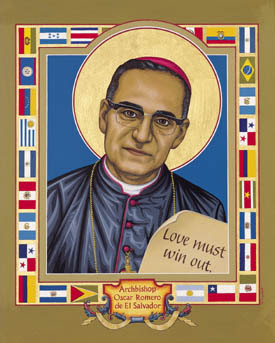
Oscar Romero

Good evening.

I’ve been asked by the parish Peace and Social Justice Committee and by the Lenten “Joy of the Gospel” Study Group to say a few words reminding us of why we are here.

Of course, we’re here to celebrate the beatification of Blessed Oscar Romero, the martyred archbishop of San Salvador in El Salvador. But why should we care?

We should care, I think, because Romero’s beatification personifies and embodies Pope Francis’ basic call in “The Joy of the Gospel.” There the pope summons the entire church to reform, to be converted, to repent, and be transformed. Nothing can remain as it has been, the pope says. The church must become relevant to the problems of poverty, inequality, and war that afflict our world.

So I suggest that the pope’s decision to beatify Oscar Romero dramatizes the pontiff’s exhortation.

But which side should we take in a politically polarized world? Which side are we on?

The side of the poor, the pope says. And by that he doesn’t mean greater generosity in making up our Christmas baskets or giving an extra dollar in Sunday’s second collection. He means doing what Oscar Romero did – what Jesus of Nazareth did.  He means identifying with the poor, their ways of seeing the world. He means refusing to support our culture’s favorite way of dealing with them – treating them with “tough love,” depriving them of life’s basics, waiting for wealth to “trickle down,” and when push comes to shove, killing them (whether that’s in Ferguson, Baltimore, Bagdad or Palestine).

In other words, Oscar Romero provides a case study of the kind of conversion and relevance the Holy Father urges us to embrace.

Like most of us – I speak for myself – Oscar Romero started out uncritical and unquestioningly patriotic. Until he was 60 he supported a system that had 1% of El Salvador’s population controlling 90% of its wealth. He sided with his county’s police and military which were at war with its own people to keep things that way.

He bought the line that those opposing the system were communists. So while his country was on fire, his sermons addressed the usual banalities: the afterlife, heaven, hell, and individual salvation.

The United States supported El Salvador’s government too. All during the 1980s, it gave its military more than one million dollars a day to fund what was called “the El Salvador option” for defeating the country’s insurgency. It was a “death squad” solution which killed everyone who might be connected with the insurgency – teachers, union organizers, social workers, priests and nuns. The slogan of the military’s “White Hand” death squad was, “Be a patriot; kill a priest.”

That slogan took on new meaning for Archbishop Romero when his good friend, the Jesuit, Rutilio Grande, was martyred by the White Hand. Grande was killed because El Salvador’s government saw how he lived among and served peasants and slum dwellers sympathetic to the insurgents. So they considered him a terrorist.

In reality, Father Grande was entirely motivated by the Gospel. He had come to see the world from the viewpoint of the poor. That was the essence of Jesus’ message, he said – good news for the poor. In the gospels, Grande found, Jesus not only saw the world from the viewpoint of the poor, he identified with them becoming one of them. He shared the values and characteristics of the poor that El Salvador’s rich despised.

For instance, Jesus’ skin was black or brown, not white like the elite of El Salvador. Jesus was dirt poor. He was conceived out-of-wedlock by a teenage mother. He was an immigrant in Egypt for a while. He belonged to the working class. His hands were calloused; his clothes were sweat-stained. Jesus liked fiestas and was accused of being a drunkard, possessed by the devil, and friend of sex workers. He was harassed constantly by the police and died a victim of torture and capital punishment, because the occupation forces of Rome considered him a terrorist.

That was the Jesus Rutilio Grande worshipped and preached – a Jesus completely like the people he served.

And so the “White Hand” or “The Secret Anti-Communist Army” (or one of those death squads) killed him – along with 75,000 other El Salvadorans. (Imagine the impact of those deaths in a country of just 6 million people!)

Grande’s death profoundly changed Oscar Romero. He said, “When I saw Rutilio lying there dead, I knew I had to follow his path.” And he did.

Archbishop Romero began speaking out against the government, army and police. He saw that the soldiers fighting against peasants and poor people weren’t heroes, but misled and brainwashed victims. Just before his death, he fairly shouted at them in a final homily: “No soldier is bound to follow orders that contradict the law of God. Don’t you see; you are killing your own brothers and sisters? . . . I beg you; I implore you; I order you: stop the repression!”

Those words sealed San Romero’s fate. The next evening while celebrating Mass for nuns in a hospital chapel, a sniper got him too. He became the first bishop to be murdered at the altar since Thomas Beckett at the beginning of the 12th century.

That’s the Romero story. It’s the story of a churchman converted late in life to centralizing peace and social justice concerns. And that’s the “Joy of the Gospel” connection. In that Apostolic Exhortation, the pope calls us to a similar centralization. The beatification of Oscar Romero reinforces that message.

To understand all of that, you have to grasp one shocking fact: Oscar Romero was killed by Catholics. And when he was murdered, there were fireworks and celebrations in the neighborhoods of El Salvador’s elite. These people were friends of the Vatican.

As a result, Pope Francis’ predecessors (John Paul II and Benedict XVI) were not anxious to canonize the archbishop. He was too polarizing, they thought. He too clearly took the side of the poor in their struggle with the rich. They even wondered if he had been duped by the communists.

And besides, how could Romero be classified as a martyr? After all, martyrs, by definition are defenders of the “true faith” against non-believers. But (again) Romero was killed by Catholics and hated by people who went to Mass each Sunday and believed all the right things about abortion, contraception, gay marriage, and divorce.

So John Paul II and Benedict XVI blocked Romero’s canonization and put the process on hold.

Francis has removed the block. Do you see what that implies?

It implies that “the true faith” is Romero’s faith. Its hallmark is identification with the poor in their struggle for justice — not those other narrow “moral” concerns. The true faith addresses issues like the justice of our economic system, wide disparities between the rich and the poor, and an economy based on war. It addresses climate change as a moral problem. All of these are themes central to “The Joy of the Gospel.”

Can you imagine what would happen to our state if the diocese of Lexington followed Romero’s example and became famous and distinguished as “that little peacemaking diocese in Central Kentucky” that everyone’s talking about?

Can you imagine what would happen in Berea if St. Clare’s worked closely with Union Church and cooperated to become as outspoken as Oscar Romero about issues of economic justice, racial and gender equality, war and peace?

Can you imagine what would happen in the world if 1.2 billion Catholics adopted Archbishop Romero’s spirit? What if Catholics on principle decided to absolutely reject war as a solution to the world’s problems and adopt economic justice instead? What if (in effect) we decided to drop books, hospitals, and schools on our perceived enemies instead of bombs and drone “hell fire”?

This evening, as you listen to the words of Oscar Romero during our celebration, please keep those questions in mind. They are vital to our faith.

What I’m saying is that all of us should care about Oscar Romero. He remains relevant to us; he challenges us today.

Archbishop Romero, Pope Francis, and Jesus Himself call us to radical change – to take sides. In effect, Oscar Romero’s beatification raises that old question: “Which side are you on?”

What’s your answer?
(Sunday Homily) Pentecost: the Spirit of Jesus in Pope Francis & Oscar Romero!

Romero poverty

Today is Pentecost Sunday, sometimes called the “Birthday of the Church.”

Significantly, Pentecost’s vigil (yesterday) is the day the church has chosen to “beatify” Oscar Romero, the martyred archbishop of San Salvador, who was assassinated in El Salvador on March 24th, 1980. His beatification (the final state before canonization or sainthood) took place there yesterday.

The co-incidence of the two anniversaries is full of meaning for a community of faith desperately in need of rebirth.

Politically speaking, the unblocking of San Romero’s beatification process by Pope Francis represents the pope’s call to appropriate Jesus’ Spirit of Life and leave behind all traces of the political conservatism that characterized most of the archbishop’s life. Pope Francis calls us to boldness, radicalism and outspoken partisanship on behalf of the world’s poor. That’s the Spirit of Jesus, he says. It’s the Spirit Oscar Romero eventually embraced.

To get what I mean, please join me in reflecting on (1) Roman Catholic conservatism – at least as I currently experience it, (2) the conversion of Oscar Romero to the radicalism of liberation theology’s “preferential option for the poor,” and (3) the directions for similar change given by Pope Francis in his “Joy of the Gospel.” Following those directions, I argue, promises his church a New Pentecost.

I The Irrelevance of the Catholicism I Experience

To begin with, consider the Catholic Church I experience each week. Its present form is a construction of the reactionary popes, John Paul II (1978-2005) and Benedict XVI (2005-2013). I consider their papal reigns disastrous.

Because of their counter-reforms, my local parish not only ignores the progressive initiatives of the Second Vatican Council, it gives every indication of attempting to reverse them in the minds of my fellow parishioners.

In fact, the documents of Vatican II are rarely referenced in our church. Their place has been taken by the conservative invention, The Catechism of the Catholic Church.

“Masses” from one week to the next show almost no variation or planning. Everything seems rote. Sermons are full of clichés about heaven and churchy bromides. Not a word connects the Radical Jesus with Ferguson, Baltimore, Iraq, drone warfare, torture, the LGBTQQ struggles, or climate chaos. To introduce such topics might “upset” some people, so they’re completely ignored.

No such sensitivity, however, is displayed regarding conservative issues concerning abortion, gay marriage or climate change. The latter is almost never mentioned, while the former issues (abortion and gay marriage) are highlighted at every opportunity. Our diocesan newspaper, The Crossroads, communicates the distinct impression that good Catholics are good Republicans and vote accordingly.

II Oscar Romero’s Pentecost

For most of his life, Oscar Romero would have been comfortable in my local church.

Remember, Monsignor Romero started out conservative in every sense of the word. To a large extent, that’s why he was appointed archbishop in 1977. Romero was considered safe. He was patriotic. He unquestioningly supported his country’s military. He looked on the widespread rebellion of the poor in El Salvador with great suspicion. He considered the would-be revolutionaries communist subversives.

And yet, the archbishop had this close friend on the opposite end of the political spectrum. He helped Romero grow. That friend was Rutilio Grande. Grande was a Jesuit who took seriously his vow of poverty.

So Father Grande moved out of the parish rectory and lived with the poor. He knew first-hand their struggles, their family break-downs, their unemployment, hunger, low wages, and harassment by local police.

Worse still, Grande knew the Salvadoran military’s strategy for defeating the country’s impoverished insurgents. It was simply this: kill everyone who might possibly be sympathetic to rebel forces. That meant most of the country’s non-elite. It meant many of their parish priests. For Rutilio Grande, the slogan of the White Hand death squad represented an everyday reality and threat: “Be a patriot; kill a priest.”

Eventually, of course, the White Hand killed Rutilio Grande himself.

It was his martyrdom that pushed Oscar Romero over the edge and radicalized him. He utterly abandoned his conservatism. He would later say, “When I looked at Rutilio lying there dead, I thought, ‘if they have killed him for doing what he did, then I too have to walk the same path.’” (The “they” Archbishop Romero referred to was his own government, its military, and their backers in the United States.)

So Archbishop Romero started listening to the poor. He attended their “biblical circles,” where peasants shared their thoughts about Sunday gospel readings.

Once after listening to simple farmers sharing thoughts about “The Parable of the Sower,” the archbishop stood up without comment and walked away from the group. The local priest followed him and asked anxiously, “What’s the matter, Monsignor, did something offend you?”

“No,” the archbishop responded, “quite the opposite. It’s just that I think I’ve heard the Gospel of Jesus today for the first time.”

In other words, the archbishop discovered that when poor people read the Bible, they see things that remain invisible for conservatives comfortable with whiteness, patriarchy, and empire.

Jesus was none of those things, the archbishop realized. He was brown or black, poor, a victim of empire, and counter-culturally open to the viewpoints and experience of women. Those were the Master’s viewpoints. They deeply influenced how he saw the world.

More specifically, Jesus stood on the same ground as El Salvador’s poor (and the poor of the Global South). He was born out-of-wedlock to a teenage mother. He was an immigrant in Egypt for a while. He was a working man with calloused hands and sweat-stained clothes. He loved fiestas. His friends, people said, were drunkards and prostitutes. Rabbis expelled Jesus from the synagogue, and thought he was diabolically possessed. Even his family questioned his sanity. Jesus became a vagrant without visible means of support. He lived under an oppressive empire. Imperial authorities saw him as an insurgent and terrorist. He ended up on death row, a victim of torture and of capital punishment.

All those characteristics, Archbishop Romero realized, described Another Jesus that to him was far more compelling, inspiring and faithful to the gospels than the abstract and other-worldly Jesus elaborated in the theological texts that guided his doctoral studies in Rome.

So Romero concluded that the poor knew Jesus more deeply and authentically than he ever could. (They had what scholars called a “hermeneutical privilege.”)

Even more, the Jesus of the Poor revealed Another God who alone can save our world from the path to destruction we’ve embarked upon. (And this is where Pope Francis’ continuity with Romero’s vision comes in.)

III Pope Francis’ Pentecost

Like the converted, Spirit-led Oscar Romero, Pope Francis does not shy away from radicalism, controversy or partisanship in the name of social justice. In fact, the pope identifies the struggle for social justice and participation in political life as “a moral obligation” that is “inescapable” [“Joy of the Gospel” (JG) 220, 258].

And the pope walks his talk. Think about his:

  • Part in negotiating an end to U.S. policy towards Cuba, despite what Miami Cubans might think.
  • Recognition of the Palestinian state in the face of objections from Israel and its supporters.
  • Identification of the Palestinian Authority’s Mahmoud Abbas as an “angel of peace” over the same objections.
  • Famous “who am I to judge” statement about homosexuality.
  • Unblocking of canonization procedures for Oscar Romero, the patron saint of liberation theology.
  • Embrace of liberation theology’s “preferential option for the poor.”
  • Planned encyclical on climate chaos, even over objections by U.S. Republicans and their think tanks like the Heartland Institute.
  • Stated intention to influence the Paris Climate Summit next December.

Yes, (in U.S. terms) the pope has not been afraid to alienate Republicans and give the distinct impression that their agenda is largely incompatible with Christian faith.

I’d even go so far as to say that “The Joy of the Gospel” is like a manifesto against Republican approaches to social issues. I mean, JG:

  • Condemns wide disparities in income (188).
  • Advocates redistribution of wealth (189)
  • Rejects trickle-down economic theory as illusionary and entirely dysfunctional (54).
  • Sees unfettered markets as homicidal (53), ineffective (54), and unjust at their roots (59).
  • Demands market regulation as indispensable (56).
  • Views “each and every human right” [including education, health care, and “above all” employment and a just wage (192)] as intimately connected with “defense of unborn life” (213).
  • Presents environmental protection as a moral imperative (215, 216).
  • Dismisses war as incapable of combatting violence which the pope sees as caused by “exclusion and inequality in society and between peoples” (59).

Conclusion

It will no doubt offend some in my parish to read these words. But that’s the point of Pentecost, isn’t it – to shake us up?

After all, Jesus offended the conservative members of his parish-equivalent. Romero offended conservative Salvadorans and conservative U.S. “Americans.” Pope Francis makes no bones about offending Jewish Zionists, Miami Cubans, U.S. Republicans and climate change deniers.

The Spirit of Life is not conservative. It is not imperial. It wants everyone to survive and thrive – especially the ones the dominant order rejects as unworthy.

In those senses, It makes a preferential option for the poor.

Seven Things You Might Have Missed about Lexington’s New Catholic Bishop

Stowe

At the beginning of this month, Father John Stowe was installed as the new bishop of Lexington’s Roman Catholic diocese. As such he embodies the long reach of Pope Francis, who, in his Apostolic Exhortation, ‘The Joy of the Gospel” (JG) announced his determination to fundamentally reform the church.

There the pope said, “In this Exhortation, I wish to encourage the Christian faithful to embark upon . . .  new paths for the Church’s journey in years to come” (JG 1). Francis called for “. . . conversion which cannot leave things as they presently are” (25).

Early returns indicate that in Bishop Stowe, Pope Francis has appointed a change agent like himself intent on implementing the pope’s program whose essence might be described as prioritizing the needs of the poor.

That prioritization was presaged even before Bishop Stowe’s official installation on May 5th. It was evident the night before at the vespers ceremony and reception at Christ the King Cathedral in Lexington, where the bishop-elect showed himself to be a master of symbolic communication.

In fact, the new bishop has sent at least seven clear signals that he and the pope are on the same page and that Lexingtonians can expect a welcome emphasis on social justice themes.

During the ceremony, then bishop-elect Stowe:

  1. Announced a “new chapter” for the Catholic Church in Lexington. The phrase, which appears in the first paragraph of Francis’ “Joy of the Gospel,” was evidently chosen to indicate the bishop’s endorsement of the pope’s agenda.
  2. Said that the new chapter would emphasize service of the poor. Yes, worship would also be prioritized, he promised. However, even liturgy could never ignore poverty in our midst.
  3. Demonstrated that conviction by prioritizing Spanish (the language of so many of the poor among us) throughout the vespers liturgy – in readings, responsorials, and hymns. In his own remarks, then Bishop-elect Stowe spoke each paragraph first in English and then in Spanish translation. At other times, his initial thought came in Spanish followed immediately by an English translation.
  4. Invoked the example of Jesus as the foundation for emphasizing service of the poor. Jesus himself was impoverished, the bishop said. He was an working man, a carpenter with dirty hands who enjoyed friendship with fishermen and sinners. He accompanied the oppressed and finished his life as a criminal on death row. The authenticity of Jesus’ resurrected presence was certified by display of his body wounded by imperial forces.
  5. Specifically identified other excluded and marginalized groups as the focus of his ministry: overlooked Appalachians, refugees from the Congo, the sexually abused (a clear reference to the Church’s pedophilic scandal), and exploited workers. The church, Bishop Stowe said, must identify with brothers and sisters of that kind or “it isn’t much of a church.”

Outside the vespers introductory ceremony, it was disclosed that Bishop Stowe:

  1. Has a special devotion to Oscar Romero, the martyred archbishop of El Salvador, who is considered the patron saint of liberation theology – which interprets Jesus’ gospel from the viewpoint of the poor and oppressed.
  2. Has decided to abandon residence in the plush quarters of the episcopal mansion. Instead he’s locating among his confreres in a community of retired priests.

It is this last action, more than the others, that signals Bishop Stowe’s intention to channel Pope Francis for us not just in words, but in deeds and life-style.

These are seven good reasons to hope that the new bishop will indeed not “leave things as they presently are.”

Oscar Romero’s Message: Another God Is Possible; Another God Is Necessary!

PROMO9
PROMO9

(This is the second in a three-part series on our parish’s upcoming celebration of the beatification of San Oscar Romero which will take place on May 23rd. The event will be observed in Berea’s St. Clare’s parish on June 3rd, when our new bishop, John Stowe, will join us.)

In the previous installment of this mini-series inspired by the upcoming beatification of El Salvador’s Oscar Romero, I offered a thumb-nail sketch of the great archbishop’s life. Romero’s witness has been inspiring for many, including Lexington’s new bishop, John Stowe. (As I said, think of the thoughts that must have coursed through the bishop’s mind as he celebrated Mass recently at the very altar where Oscar Romero was shot. We look forward to his sharing those thoughts on June 3rd when he joins our local church to celebrate Monsignor Romero’s beatification.)

In fact, Monsignor Romero’s story should be encouraging to each of us because of its life-changing implications. It connects perfectly with the message of Pope Francis in his “Joy of .the Gospel.” Both tell us that political and spiritual transformation is not only possible; it is necessary to save our world.

First of all consider the example of Oscar Romero. His change was profound both politically and religiously. In both dimensions, he became a radical, like Jesus of Nazareth.

Remember, Monsignor Romero started out conservative in every sense of the word. To a large extent, that’s why he was appointed archbishop in 1977. Romero was considered safe. He was patriotic. He unquestioningly supported his country’s military. He looked on the widespread rebellion of the poor in El Salvador with great suspicion. He considered the would-be revolutionaries communist subversives.

And yet, the archbishop had this close friend on the opposite side of the political fence. He helped Romero grow. That friend was Rutilio Grande. Grande was a Jesuit who took very seriously his vow of poverty.

So the priest moved out of the parish rectory and lived with the poor in their barrio slums. He knew first-hand their struggles, their family break-downs, their unemployment, hunger, low wages, and harassment by local police. Those became his issues, his context for interpreting the Gospel of Jesus.

Even more, Grande knew the Salvadoran military’s strategy for defeating the country’s impoverished insurgents. It was simply this: kill everyone who might possibly be sympathetic to rebel forces. That meant targeting most of the country’s non-elite. It meant butchering many of their parish priests. For Rutilio Grande, the slogan of the White Hand death squad represented an everyday reality and threat: “Be a patriot; kill a priest.”

Eventually, of course, the White Hand killed Father Grande himself. It was his martyrdom that pushed Oscar Romero over the edge and radicalized him. He utterly abandoned his conservatism. He would later say, “When I looked at Rutilio lying there dead, I thought, ‘if they have killed him for doing what he did, then I too have to walk the same path.’” (The “they” Archbishop Romero referred to was his own government, its military, and their backers in the United States.)

So Archbishop Romero started listening to the poor. He attended their “biblical circles,” where peasants shared their thoughts about Sunday gospel readings. Once after listening to simple farmers sharing thoughts about “The Parable of the Sower,” the archbishop stood up without comment and walked away from the group. The local priest followed him and asked anxiously, “What’s the matter, Monsignor, did something offend you?”

“No,” the archbishop responded, “quite the opposite. It’s just that I think I’ve heard the Gospel of Jesus today for the first time.”

This is where Romero’s Other Gospel, Other Jesus, Other God comes in. The archbishop discovered that when poor people read the Bible, they see things that remain invisible for people like us who tend to be white, comfortable, patriarchal, and supportive of empire.

Jesus was none of those things, the archbishop realized. He was brown or black, poor, a victim of empire, and counter-culturally open to the viewpoints and experience of women. Those factors constituted the Master’s standpoint. They deeply influenced how he saw the world.

More specifically, Jesus stood on the same ground as El Salvador’s poor (and by extension, the poor of today’s Global South). He was conceived out of wedlock by a teenage mother. He was an immigrant in Egypt for a while. He was a working man with calloused hands and sweat-stained clothes. His friends, people said, were drunkards and prostitutes. Rabbis expelled Jesus from the synagogue, and thought he was diabolically possessed. Even his family thought he was insane. Jesus became a vagrant without visible means of support. He lived under an oppressive empire. Imperial authorities saw him as an insurgent and terrorist. He ended up a victim of torture and of capital punishment.

All those characteristics, Archbishop Romero realized, described Another Jesus that to him was far more compelling, inspiring and faithful to the gospels than the abstract and other-worldly Jesus elaborated in the theological texts that guided his doctoral studies in Rome.

So San Romero concluded that the poor knew Jesus more deeply and authentically than he ever could. (They had what scholars called a “hermeneutical privilege.”)

The Jesus of the Poor revealed that Other God who alone could save El Salvador. Fidelity to that same Jesus can save our world from the path to destruction we’ve embarked upon. (And this is where Pope Francis’ continuity with Romero’s vision comes in.)

Francis too has chosen to prioritize the experience and understanding of the world that belong to its poor. In doing so, he challenges our very idea of God. He evokes the Other God who alone can save us from the abyss.. For the pope, God is not neutral, but stands with the poor in their struggles against oppression. What does it mean, he asks implicitly, that God chose the poor, oppressed and despised as the primary site of his Self-revelation?

It means the poor of the world are God’s Chosen People. That answer has led Pope Francis to be the voice of the voiceless. And he does so even at risk of being called a communist. In this, he’s like Dom Helder Camara the late and sainted bishop of Recife in Brazil. Dom Helder said, “When I give food to the hungry, they call me a saint. When I ask why the hungry have no food, they call me a communist.”

Pope Francis does more than ask Dom Helder’s question. In his Apostolic Exhortation, “The Joy of the Gospel” (J.G.), he answers it. I’ll tell you what causes poverty, he says. It’s the reigning economic system that is homicidal (J.G. 53), and unjust at its roots (59). It’s allegiance to the “trickle down” ideology of the rich – a theory that has never worked (53). The world really belongs to the poor, the pope insists (57). The rich who refuse to return to the impoverished what is rightfully theirs are robbers and thieves (57). The rights of the poor take precedence over those of private property (189).

The pope’s choice to be the voice of the voiceless extends to the environment as well to impoverished humans. Watch for his encyclical on climate change to be published sometime next month. There he’ll surely give voice to the planet’s animals, plants, mountains, forests, rivers, and oceans. In the face of climate change, he warns us, “God always forgives. Human beings sometimes forgive. But nature never forgives.” So what’s the proper response to the challenges of Oscar Romero, Pope Francis, and (we hope) Bishop Stowe? As I see it, proper response entails:

  • Leaving behind the safety of contemporary Christianity’s conservative ways.
  • Committing to a path of parish renewal and personal faith development intent on acquainting ourselves with the biblical God of the poor.
  • Viewing the world and its conflicts from below – from the viewpoint of the Other Jesus embraced by Monsignor Romero – from that of unwed mothers like Miryam of Nazareth, of immigrants, the mentally unbalanced, sex workers, the homeless, insurgents, terrorists and those being water-boarded and executed by the state.
  • Recognizing that with 1.2 billion members world-wide, a Catholic Church attuned to the spirits of Oscar Romero and Pope Francis has unlimited potential for changing the world.
  • Embracing that change as our collective vocation.
  • Abandoning pet convictions that national allegiance, military action, and trickle-down theories will solve our world’s problems.
  • Embracing the Other Jesus of the poor
  • His Other God
  • And the Other World that Oscar Romero, Pope Francis, and Jesus proclaim as the very essence of God’s Kingdom.