(Sunday Homily) Pope Francis’ Prophetic Warning on Climate Change: Repent or Else; the Time Is Short

Pope-in-Philippines

Readings for 2nd Sunday in Ordinary Time: JON 3: 1-5, 10; PS 25: 4-9; I COR 7: 29-31; MK 1: 4-20; http://usccb.org/bible/readings/012515.cfm

Last week, Pope Francis offered a preview of his eagerly anticipated encyclical on climate change – to be published next June or July. While visiting the Philippines, the country most devastated by climate chaos, it wasn’t that the pope merely joined the chorus of scientists, environmental activists, and those who heed them. He went much further, promising to transform the issue of climate change from a debate topic trivialized on Fox News into a matter of “faith and morals” (The phrase used by Catholics to define the area within which the pope has overriding authority.)

In doing so, Francis follows the traditions of prophets like Jonah and Jesus – each centralized in today’s liturgy of the word. Both prophets called for repentance (change of thought and action). However, the repentance they summoned pales in comparison to what the pope evidently has in mind.

Yes, the pope is a contemporary prophet. At this moment in history, he is arguably the most powerful ever in terms of his consciousness, courage, credibility and constituency. He literally embodies our best hope for “saving the world.” So it’s incumbent on progressives to heed, highlight and support his efforts.

With that in mind, consider today’s readings about prophetic warnings and how to respond.

The first recalls the message of the Bible’s fictional character Jonah. He’s a reluctant ethnocentric prophet forced by God to call Israel’s mortal enemy, Nineveh, to repentance. “Forty days more and Nineveh shall be destroyed” Jonah proclaimed with some delight.

Ultimately though, Jonah’s ethno-centricity is frustrated when against his desires, the Ninevites quickly and unexpectedly take his message to heart, change their ways, and God repents “of the evil he had planned.” In this way, the Divine One showed God’s character as depicted in today’s responsorial. There the psalmist says that (unlike Jonah) God is compassionate, loving, kind, good, and upright. God guides humble sinners on the path of truth – i.e. reality as it is, not as humans would like it to be.

Jesus’ proclamation was similar to Jonah’s, but without that prophet’s nationalist limitations. As depicted in today’s gospel reading, Jesus’ basic message was a call to profound change: “This is the time of fulfillment,” he said. “The Kingdom of God is at hand. Repent and believe in the gospel.” That notion of fulfillment and the nearness of God’s Kingdom introduces a profound element of hope to complement Jesus’ summons to repentance.

Like the Ninevites in the Jonah story, Peter and Andrew, James and John take Jesus’ words to heart profoundly altering their lives. They leave their former employment as fishermen abandoning their nets, their fathers’ boats and hired men. They follow instead a penniless itinerant preacher and community organizer, adopting his life of complete dependence on others for daily sustenance.

In today’s second reading, Paul shows that the early church embraced Jesus’ message. “Time is running out,” Paul warns. It’s time to prioritize the Kingdom even before family, emotional ups and downs, attachment to property — and to the world as it is. Paul is uncompromising in his perception of the profundity of change “repentance” calls for.

However the apostle’s perception is nothing like the lack of compromise called for by the historically unprecedented crisis of climate change. And this brings me back to Pope Francis and the promise of his prophetic consciousness, courage, credibility, and constituency.

Begin with Francis’ consciousness. He alone among our elected thought “leaders” recognizes contemporary historical patterns – the links between climate change, capitalism, its neo-liberal order, corporate power, income inequality, poverty, colonialism, and a host of other problems (including absence of universal education and health care). For Francis, climate change is not merely one issue among many. It is the frame which makes evident the solutions to those other issues.

More than this, the pope has the uncommon courage to identify without equivocation the cause of such problems – neo-liberal capitalism. He says what politicians like President Obama and other heads of state (with the exception of Raul Castro of Cuba) find impossible to say. Their dependence for survival on billionaires and plutocrats render them impotent before the ideologies of unfettered markets and their “trickle-down” theories. By contrast Pope Francis terms the latter homicidal (53), ineffective (54) and unjust at their roots (59). (Parenthetical numbers refer to sections of “The Joy of the Gospel.”)

Additionally while speaking the unspeakable, the pope enjoys tremendous credibility. With the exception of neo-liberalism’s intractable apologists, the world loves and embraces the man. His efforts to distance himself from the traditional luxurious papal lifestyle, his honesty in responding to difficult questions, his humility and genuine love for the poor make him our century’s most credible moral leader.

And finally, there’s the pope’s constituency. Unlike prophets before him (including Jesus of Nazareth) sheer numbers give Pope Francis unprecedented power to change the world. Jonah’s potential respondents to his calls for repentance were only inhabitants of the city of Nineveh. In today’s gospel reading Jesus’ respondents were four simple fishermen: Peter, Andrew, James and John. Eventually, only a minority of poor Palestinian peasants took to heart Jesus’ words. By contrast, and in virtue of his office, this pope’s constituency is trans-national and world-wide. There are 1.2 billion Catholics on the planet the pope calls “Mother” and “Sister.”

Evidently Francis’ plan is to use his credibility to courageously spread his consciousness and widen his constituency. He plans to do so in five steps. He will (1) publish an encyclical (the most authoritative form of communication at his disposal), (2) convoke an ecumenical meeting of world religious leaders, (3) presumably secure from them a statement paralleling his encyclical’s conclusions, (4) present that statement in his speech to the United Nations in September, and (5) attempt in doing all of that to influence the conclusions of this year’s Climate Summit in Paris two months later.

That’s prophetic activism unparalleled in the recent history of the papacy.

And what specifically is entailed in the repentance necessary to save our Mother? Of course, to share the pope’s vision, we await details in the forthcoming encyclical. However, today’s liturgy of the word points us in the general direction. In the meantime, secular prophets like Naomi Klein fill in the challenging details.

General directions include (as Paul says in today’s second reading) transcending emotions like fear-inspired denial. They include willingness to cut family ties (i.e. narrow nationalism), re-examining our career paths, attachments to property and neo-liberal dreams of unlimited consumption and getting rich.

Specific repentance is more radical than any of our politicians dare articulate. According to Klein, author of This Changes Everything, that’s because our planet has reached “decade zero.” Denialists have led us to squander the leeway we had twenty-five years ago. If we don’t decisively alter within the next ten years our path of production and consumption, the planet’s temperature is bound to rise 4 to 6 degrees Celsius. However, according to climate scientists, any rise beyond 2 degrees will make disastrous climate change irreversible. And that will result in disastrous droughts, water shortages, typhoons, flooding, wildfires, and crop losses with whole cities under water and Islands swallowed by the sea.

To avoid such disasters, required repentance includes:

  • Rejecting the neo-liberal myth that has shaped our world over the last 35 years.
  • Replacing it (the pope will say) with the biblical vision of the Kingdom (proclaimed by Jesus in today’s gospel reading). God’s Kingdom is characterized not by competition and privatization, but by cooperation, sharing, prioritizing the needs of the poor and respecting the earth as commons.
  • Setting aside neo-liberalism’s fetish about regulation, and setting bold national policies guided by clear goals, a strictly imposed time table, and severe penalties for non-compliance.
  • Implementing corresponding policies to cut annual emissions in the industrialized world by 8- 10%.
  • Recognizing that exchange of myths means rejection of market-driven models of untargeted economic growth.
  • Redesigning our cities and redistributing population to eliminate long commutes between home and work.
  • Investing massively in light rail and other means of public transportation so that commuters might travel efficiently and free of cost.
  • Similarly subsidizing renewable sources of energy – solar, wind, geothermal, and biomass.
  • Turning the roof of every available building into an energy plant.
  • Respecting the rights of indigenous people under whose lands so much carbon deposit remains.
  • Eliminating by law, controlling by strong regulation or penalizing by heavy taxation industries that are wasteful and/or destructive of the planet such as arms manufacturers, the fast-food industry, GMO firms, and middle-man industries like health insurance.
  • Dealing with climate impact and damage according to “the polluter pays” principle. This recognizes that the 500 million richest people on the planet are responsible for 50% of the world’s pollution and that the U.S. military is by some estimates the largest single consumer of petroleum in the world.
  • According to “the polluter pays” principle, withdrawing from foreign wars, cutting the military budget by at least 25% and making the rich 1% pay their fair share of taxes.
  • Tolerating as necessary increased taxes on everyone, except the poor.
  • Drastically reducing the amount of energy each of us consumes.

You get the idea. The agenda necessary to save our planet from “the evil Nature has planned” is challenging indeed. But it contains that surprising element of hope Jesus signaled when he termed “repentance” as “good news” and “fulfillment.”

After all, our destructive way of life is anything but fulfilling. On the other side of the repentance just described is a cleaner, healthier, less stressful life with full employment, more leisure, greater equality, and harmony with one another and our world.

That’s the vision behind the pope’s courageous prophetic work. It deserves our undivided attention and support.

Pope Francis’ Compelling Revolutionary Vision: What Progressives Have Been Waiting for (Sunday Homily)

Pope Bergoglio

Readings for Second Sunday of Advent: IS 11: 1-10; PS 72: 1-2, 7-8, 12-13; ROM 15: 4-9; MT 3: 1-12 http://usccb.org/bible/readings/120813.cfm

Recently articles in OpEdNews (my favorite on-line news source) have been full of revolutionary themes. For instance, Chris Hedges informed us of an invisible revolution simmering and about to erupt. It will be driven, he said, by widespread discontent with wages, wealth disparities, militarism, and climate change denial.

Then in his viral BBC interview, comedian Russell Brand called for revolution stimulated by everyone’s recognition of the futility of politics as we know it. No one should vote, he said; the system is too broken to be improved at the ballot box.

On the other hand, Senator Bernie Sanders’ revolution would be based wider participation in political processes, with everyone voting. That would overcome reactionary moves that disenfranchise voters and empower moneyed interests to determine electoral outcomes against the popular will.

Calling us back to reality, Robert Becker advised that any revolution at all is highly unlikely, since no one on the left offers compelling direction or revolutionary vision.

At the time of its publication, that last remark seemed apt. No world leader capable of mobilizing millions had yet emerged.

However all of that changed two weeks ago. The compelling direction and revolutionary vision whose absence Mr. Becker correctly lamented indeed materialized in an ironically unlikely form – a pronouncement of the Roman Catholic papacy.

On Tuesday November 26th, Pope Francis published his Apostolic Exhortation, Evangelii Gaudium (The Joy of the Gospel). It represents the most articulate and detailed “vision” of a revolutionary future yet offered by anyone actually capable of producing results in the street and at the ballot box.

That is, as a member of the world’s super-elite, and virtually above reproach and easy dismissal by his fellow aristocrats, the pope’s pronouncement demands serious consideration. This is especially true on the parts of the bishops and clergy who weekly have before them captive audiences voluntarily come together to meditate upon, pray about, and attempt to internalize the gospel vision which the pope describes as focused on the poor, peace, social justice and on the structural causes of violence, war and terrorism. Moreover, these themes, the pope insists, should be driven home in homilies at Sunday Mass, since such leitmotifs represent the inescapable essence of the Judeo Christian tradition.

Today’s liturgy of the word provides a case in point. It articulates the revolutionary vision and compelling direction the pope finds throughout the Bible. It’s a utopian vision that courageously connects peace with social justice and environmental consciousness.

Consider the first selection from the prophet Isaiah. It directly links peace and social justice – for the poor and oppressed who in Isaiah’s day and our own are typically ignored. By way of contrast, Isaiah’s concept of justice consists precisely in judging the poor and oppressed fairly and not according to anti-poor prejudice – in Isaiah’s words, not by “appearance or hearsay.” (No room here for “Stop and Frisk,” or “Shop and Frisk!”)

Not only that, but according to the prophet, treating the poor justly is the key to peace between humans and with nature. It produces a utopian wonderland where all of us live in complete harmony with nature and with other human beings. In Isaiah’s poetic reality, lions, lambs, and calves play together. Leopards and goats, cows and bears, little babies and deadly snakes experience no threat from each other. Most surprising of all, even believers (Jews) and non-believers (gentiles) are at peace. (Today’s excerpt from Paul’s Letter to the Romans seconds this point. He tells his correspondents to “welcome one another” – including gentiles – i.e. those the Jewish community normally considered incapable of pleasing God.)

Today’s responsorial psalm reinforces the idea of peace flowing from justice meted out to the “least.” As Psalm 72 was sung, we all responded, “Justice shall flourish in his time, and fullness of peace forever.” And again, the justice in question has the poor as its object. The psalmist praises a God and a government (king) who “rescue the poor and afflicted when they cry out” – who “save the lives of the poor.”

In his own time, the lack of the justice celebrated in today’s first three readings infuriates Jesus’ cousin, John the Baptist. Today’s gospel reading has him excoriating the religious leaders of his day as a “brood of vipers.” Unmistakably clothed as a prophet – in garments that absolutely repudiate fashion and the pretenses of his effete opponents John reminds us of the simple lifestyle adopted by Francis I. John lambasts the Scribal Establishment which had identified with the occupation forces of Rome. As opposition high priest, John promises a religious renewal that will lead to a new Exodus – this time from the power of Rome and its religious collaborators.

As part of today’s revolutionary theme, it’s important to emphasize the Exodus dimensions of Matthew’s description of John. The Baptist is presented as preaching and baptizing specifically outside the temple and sphere of the priests. In fact, John appears in the wilderness – in the desert. For Jews, this would not only have evoked overtones of their great myth of national origin. It would also have signaled a subversive significance in John’s work. After all, the “desert” or “wilderness” was the place where contemporary resistance movements were spawned. (I imagine that if the Romans had the power, they would have “droned” John and his followers in a “signature strike.”)

Do you see what I mean about harnessing the revolutionary power of the Bible’s myth, poetry, utopian visions, and preferential option for the poor? It’s all there in Isaiah, Psalm 72, in Paul’s letter to the Romans, and in Matthew’s portrait of John. And if we look with the eyes of Pope Francis, we can find those themes every Sunday. It’s powerful stuff, I’m sure you agree. And the pope not only sees that himself, he has called 1.2 billion inhabitants of this planet to recognize it along with him and act accordingly.

The action Francis recommends is particular. It consists in combatting a form of capitalism that he describes as systematized murder. He rejects “trickle-down” theory, and demands interference in the out-workings of markets in the name of the common good. The pope calls Catholics and others of good will to recognize access to food, education, and healthcare as human rights.

And the pope does all of this without demanding sophisticated comprehension of history, economic theories, or detailed social analysis.

Instead he relies on the power of myth, poetry, God-talk, and biblical focus on a divine preferential option for the poor and Jesus’ vision of God as universal parent.

All of that is there in today’s liturgy of the word. For any with eyes to see, it’s there every Sunday to assuage our hunger for “vision” and “direction.”

It’s time for progressives to follow the lead of Pope Francis. He’s calling us to set aside our pseudo-sophistication that has intellectuals rejecting the Bible’s power to mobilize huge masses of people. That is, we must reclaim the powerful mythology of the Bible and lay aside our practical disdain for story, myth and symbol. That’s where we’ll find our missing “vision and direction.”

I find that promising, invigorating . . . and somehow ironic.

Dives & Lazarus: a liberation theology catechism (Sunday Homily)

Lazarus

Readings for the 26th Sunday in Ordinary Time: AM 6: 1A, 4-7; PS 146: 7-10; ITM 6: 11-16; LK 16: 19-31 http://usccb.org/bible/readings/092913.cfm

Today’s liturgy of the word provides us with a catechism of liberation theology – Christianity’s most important theological development in the last 1500 years, and the West’s most important social movement of the last 150 years.

I have come to those conclusions over a period of more than forty years studying liberation theology. My interest began in Rome during my graduate studies there, 1967 through 1972. There I first heard Peru’s Gustavo Gutierrez speak. (Fr. Gutierrez is considered the father of liberation theology.)

Subsequently I read Gutierrez’s book, A Theology of Liberation (1971) and was completely taken by it. Reading the book gave me the feeling that I was hearing Jesus’ Gospel for the very first time.

You might ask, what is liberation theology? To answer that question fully, please look at my blog entries under the “liberation theology” button. I’ve written a series on the question. In my blogs, you’ll find that I always define it in a single sentence. Liberation theology is reflection on the following of Christ from the viewpoint of the world’s poor and oppressed. That’s the class of people to which Jesus himself belonged. They constituted the majority of his first followers.

When read from their viewpoint, accounts of Jesus’ words and deeds – the entire Bible for that matter – take on depths of meaning and relevance to our contemporary world that are otherwise inaccessible to people like us who live in the heart of the wealthy world. From the viewpoint of the poor, God passes from being a neutral observer of earth’s injustices to an active participant with the poor as they struggle for justice here on earth. Jesus becomes the personification of that divine commitment to the oppressed. After all, he was poor and oppressed himself. The Roman Empire and its Temple priest collaborators saw to that.

My interest in liberation theology deepened as my teaching career developed at Berea College in Kentucky from 1974 to 2010. There I was encouraged to continue my study of liberation theology. So I spent extended periods in Brazil, Nicaragua, Costa Rica, Honduras, Guatemala, Cuba, Mexico, Zimbabwe, South Africa, India and elsewhere studying under liberation theologians, dialoging and publishing with them. The poor in all of those countries were suffering from the aggression the United States directed against them.

Meanwhile at Berea, I found the conclusions of liberation theologians validated by the college’s very fine scripture scholars. They had almost no acquaintance with liberation theology, and yet what they were teaching perfectly harmonized with its central tenets. It’s just that they stopped short of drawing what seemed to me the obvious political conclusions from their work.

More specifically, Berea’s scholars identified the Exodus (Yahweh’s liberation of slaves from Egypt) as God’s original and paradigmatic revelation. The whole tradition began there, not in the Garden of Eden. Moreover, the Jewish prophetic tradition emphasized what we now call “social justice.” Even more, Jesus of Nazareth appeared in the prophetic tradition, not as a priest or king. Jesus directed his “ministry” to the poor and outcasts. The Gospel of Luke (4: 18-19) has Jesus describing his program in the following words:

“The Spirit of the Lord is upon me, because he has anointed me to bring good news to the poor. He has sent me to proclaim release to the captives and recovery of sight to the blind, to let the oppressed go free, and to proclaim the year of the Lord’s favor.”

After his death, Jesus’ followers continued along those lines. They lived communally, having sold all their worldly possessions and distributed the proceeds to the poor.

All of that finds vivid expression in today’s liturgy of the word. As I said, it’s a kind of catechism of liberation theology. The reading from Amos the prophet describes the sin that most offends God – wealth disparity in the face of extreme poverty. Amos decries a “wanton revelry” on the part of the wealthy that sounds like the “American Way of Life” or the “Lives of the Rich and Famous” that we Americans find so fascinating. The prophet describes a rich class that lives like King David himself – in luxurious houses, overeating, drinking wine by the bowlful, and generally ignoring “the collapse of Joseph,” i.e. the poverty of their country’s most destitute. For that, Amos says, the rich will ultimately suffer. All their wealth will be confiscated and they will be driven into shameful exile.

In railing against the rich and defending the poor, Amos was calling Judah back to the worship of Yahweh whose attributes are described in today’s responsorial psalm. There God is depicted as loving the just and thwarting the ways of the wicked. The psalm describes Yahweh as securing justice for the oppressed, giving food to the hungry, and setting captives free. He gives sight to the blind and protects resident aliens, single mothers and their children.

Then today’s excerpt from 1st Timothy outlines the characteristics of those who worship that God by following in Jesus’ footsteps. They keep the commandment which is to do unto others as we would have them do unto us. According to St. Paul, that means pursuing justice and living with devotion, faith, love, patience, and gentleness.

Finally, the gospel selection from Luke chapter 16 dramatizes the sinful relationship between rich and poor and the destinies awaiting both. Luke tells the story of the rich man and “St. Lazarus” who is honored by the poor throughout Latin America.

It is significant that Lazarus is given a name in Jesus’ parable. Usually we know the names of the rich, while it is the poor that remain anonymous. Here matters are reversed. To remedy this anomaly, tradition has assigned the wealthy man a name. He’s called Dives, which is simply the Latin word for rich man.

For his part, Lazarus is quintessentially poor, hungry, and lacking medical care. His sores are open and the only attention they receive are from dogs that lick his wounds. Meanwhile, Dives seems completely unaware of Lazarus’ presence, though the beggar is standing at his very doorstep. Within the sight of Lazarus, the wealthy one stuffs himself with food to such a degree that the scraps falling from his table would be enough to nourish the poor beggar. But not even those crumbs are shared. How could Dives share? He doesn’t even know that Lazarus exists.

So the two men die, and things are evened out. The rich man goes to hell. We’re not told why. Within the limits of the story, it seems simply for the crime of being rich and unconsciously blind to the presence of the poor. For his part, Lazarus goes to the “bosom of Abraham,” the original Hebrew patriarch.

Lazarus is rewarded. Again, we’re not told why. Within the story, it seems simply because he was poor and Yahweh is partial to the poor, just as he was to the slaves God intervened to save when they were starving in Egypt.

Seated with Abraham, Lazarus feasts and feasts at the eternal banquet hungry people imagine heaven to be. Dives however is consumed by flame in the afterlife. Fire, of course, is the traditional symbol of God’s presence, or purification, and of punishment. This seems to suggest that after death, both Dives and Lazarus find themselves in the presence of God. However what Lazarus experiences as joyful, Dives experiences as tormenting.

And why? Simply, it seems, because Dives was rich, and Lazarus was poor.

Does the parable tell us that what awaits us all after death is a reversal of the economic conditions in which we now find ourselves? The first will be last; the last first. The rich will be poor, and the poor will be rich. That in itself is highly thought-provoking.

In any case, Yahweh is presented as champion of the poor in this parable, just as in the reading from Amos, in today’s responsorial psalm, and in Paul’s letter to Timothy. And according to liberation theologians, that’s the central characteristic of God throughout the Judeo-Christian tradition. God is on the side of the poor and hates obscene wealth disparity.

You can well imagine how such insight inspired the poor and oppressed throughout the world when it emerged as “liberation theology” following the Second Vatican Council. Poor people everywhere (and especially in Latin America) took courage and were inspired to demand social justice from the rich who had been ignoring them in the New World since the arrival of Columbus 500 years earlier. In fact, Liberation theology motivated social movements more powerfully than any thought current since the publication of the Communist Manifesto in 1848.

And that’s why the reigning empire, the United States of America took action against liberation theology. It initiated what Noam Chomsky calls “the first religious war of the 21st century.” It was a war of the United States against the Catholic Church in Latin America – yes against the Catholic Church. The war killed hundreds of thousands of priests, nuns, lay catechists, social workers, union organizers, students, teachers, and journalists along with ordinary farmers and workers.

Today’s liturgy of the word reminds us not to let the United States have the final word. We are called to divest ourselves of our wealth and to take notice of St. Lazarus at our gates. God is on the side of the poor, not of the rich.

The Rich Are Funny (Sunday Homily)

Rich Man

Readings for 25th Sunday in Ordinary Time: AM 8:4-7; PS 113: 1-2, 4-8; I TM 2:1-8; LK16: 1-13 http://usccb.org/bible/readings/092213.cfm

Jesus loved telling stories that made fun of rich people. He’s at it again in this morning’s gospel.

You can imagine the delight such parables brought Jesus’ audiences of poor peasants, fishermen, beggars, prostitutes, and unemployed day laborers. They surely chuckled as he spun tales about “stewards” who couldn’t dig a hole in the ground if their life depended on it or who were mortified at the very thought of begging. They’d laugh about rich landowners storing up grain and dying before they had a chance to enjoy their profits. They knew what Jesus meant when he mocked pathetically avaricious landlords getting angry when their money managers failed to increase their bank accounts while the boss was away attending parties. They’d shake their heads knowingly when Jesus mocked heartless employers who reaped where they didn’t sow.

Jesus’ listeners would have found today’s story especially entertaining. After all it featured an accountant who cheated his wealthy employer. And then the rich guy ends up appreciating the accountant’s dishonesty. Men and women in Jesus’ audience would have nudged each other and smiled knowingly at the tale.

“That’s the way those people are,” they’d laugh. “They’re so dishonest; they can’t help appreciating corruption in others, even when it means they’re getting screwed themselves!

“Yeah, the rich stick together,” the crowds would agree. “Their greed and dishonesty is the glue. They know: today it’s you getting caught with your hand in the till. Tomorrow it might be me. So let’s not be too hard on one another.

“Ha, ha, what a joke they are!”

In today’s first reading, the prophet Amos uses a different tactic to decry the rich. Instead of humor, Amos straight out lambasts them for “trampling on the needy,” and exploiting poor farmers. They’re so eager to make money, Amos charged; they can’t wait till the Sabbath ends so they can resume their dirty work. Then first chance they get, the crooks manipulate currencies and rig scales in their favor and short-change the buyer. They sell shoddy products and underpay workers. God will never forget such crimes, Amos angrily declares.

Our responsorial psalm agrees with the prophet. The psalmist reminds us that God is not on the side of the rich, but of the poor. In fact God so honors the lowly that (S)he considers them royalty. “He seats them with princes” the psalmist says. Yahweh rescues the lowly from their greedy exploiters.

So Jesus ridicules the rich with humor, while Amos wrings his hands over their crimes with righteous indignation. Both approaches highlight the basic truth put so memorably by Jesus when he says in today’s reading from Luke that we have to choose between money and the biblical God who champions the poor. It’s one or the other. We can’t serve two masters.

“So be like the rich guys in today’s story,” Jesus adds with a twinkle in his eye. He searches the crowd for the pickpockets, the “lame” and “blind” beggars. He looks for the hookers and tax collectors.

“Stick together,” he says. Then he winks. “And that dishonest money you depend on . . . Spread it around and help us all out.

“Better yet, give it to the Resistance Movement and you’ll get one of those rich guys’ houses when the Romans are gone and the Kingdom comes.”

Everyone laughs.

Fire from Heaven: “Collateral Murder,” Bradley Manning and Edward Snowden (Sunday Homily)

Readings for 13th Sunday in ordinary time: I Kg. 19:16B, 19-21; Ps. 16: 1-2, 5, 7-11; Gal. 5:1, 13-19; Lk. 9: 51-62. http://usccb.org/bible/readings/063013.cfm

The film clip you have just seen has been dubbed “Collateral Murder.” It chronicles a series of attacks by the U.S. Army in Baghdad on July 12, 2007. The attacks directed 30 mm cannon fire at a group of nine to eleven mostly unarmed men – apart from one who carried an AK-47 and another who was holding a grenade launcher. Two in the group were war correspondents for Reuters News Service. Their cameras were mistaken for weapons. After the attack took place, Iraqi civilians arrived on the scene and attempted to aid the wounded. They too were killed. Children in the van which their father stopped to help were also shot. The film was taken by a camera mounted on the gun sights of two AH-64 Apache helicopters.

In 2007, Reuters requested the footage of the airstrikes under the Freedom of Information Act. Their request was denied. Instead the military reported that the shooters in the film had come under attack and were following strict Rules of Engagement.

However in April of 2010, U.S. Army Private, Bradley Manning, released the footage (along with other revealing documents) to the internet whistle-blower website, WikiLeaks. Manning said he wanted to expose crimes whose details routinely crossed his desk as a U.S. Army Intelligence officer. His intention was to bring those specifics to the attention of the American people, and stimulate debate about U.S. military policy and tactics. He judged that policy and its implementation to be largely immoral and contrary to international law. This was true, he said, especially in the criminal war in Iraq which the U.S. entered on false pretenses against a nation that represented no threat to its well-being. Manning found especially shocking the cavalier chatter of those he saw as murderers. Manning’s action also implied that Iraqi citizens had the right to arm themselves against such aggressors brutally invading their sovereign country without provocation.

For his trouble, Private Manning was arrested in July 2010 and held in solitary confinement for more than a year in the Marine Corps Brig in Quantico, Virginia. His treatment there was described as “torture” by more than one international human rights agency. In February of 2013, Manning pleaded guilty to 10 of the 22 charges against him. He is currently being tried for alleged crimes that could bring a sentence of life imprisonment and even the death penalty.

I bring those details up this morning because inflicting death from the skies seems particularly relevant to our readings about Elijah and Jesus. There the concept of “fire from heaven” is associated with Elijah, invoked by James and John, and rejected by the non-violent Jesus. The readings raise questions about Christians’ routine support for wars – especially illegal ones – and about our attitudes towards prophetic disturbers of our peace such as Bradley Manning and (most recently) Edward Snowden. Snowden, of course, is the CIA employee who recently leaked details of mass surveillance programs directed against ordinary citizens like you and me. The programs appear to violate Fourth Amendment protections against unreasonable search and seizure.

You see, all of them – Elijah, Jesus, Manning, and Snowden have been judged by the State to be trouble-makers. In fact, Elijah was specifically called “the troubler of Israel” by King Ahab (I Kg. 18:17). In retort Elijah replied as perhaps Pvt. Manning would to President Obama. The prophet said in effect, “Now there’s a case of the pot calling the kettle black. You, dear King (or Mr. President), are the real trouble-maker. I am merely pointing that out.”

It was later on, when Ahab’s successor, his son Ahaziah, sent soldiers to arrest Elijah, that the prophet called down fire from heaven to kill the fifty arresting officers. Elijah was a fierce man.

That’s the way James and John wanted Jesus to be. It was the way they imagined God to be – fierce, vengeful, and blood-thirsty. It’s the way unquestioning supporters of “our troops” appear to picture God today. But Jesus refused to reprise Elijah’s vengeance. He rejected the prophet’s violent conception of God.

Instead, the divine as embodied in and described by Jesus is more reminiscent of the Yahweh who appears in today’s responsorial Psalm 16. There God is described as the protective refuge of the afflicted, the one who holds human destiny in his loving hands, the God who shows the way to fullness of life and lasting joy. Jesus’ God was not a war God. Instead, the divine for Jesus evoked self-sacrifice in the face of attack.

All of this means that the cost of discipleship for the followers of Jesus is high – especially when speaking truth to political power as both Elijah and Jesus made a habit of doing.

Jesus says as much in this morning’s gospel. Discipleship, he insists, requires adopting Jesus’ own posture of non-violent resistance which rejected the “fire from heaven” approach of Elijah, James and John. It entails being decisive, leaving home and family, crossing borders, and in the end not having anywhere to rest one’s head. Once we put our hands to that plow, Jesus says, there must be no turning back.

Regardless of their spiritual motivation, that in fact is the price being paid today by Bradley Manning and Edward Snowden as they oppose tyranny in the spirit of Elijah, but especially of the non-violent Jesus.

To put it in terms of Paul’s Letter to Galatia, both Manning and Snowden are living “according to the Spirit.” They are engaged in non-violent resistance to acts of deceit and murder. They are serving Truth and opposing “the father of lies.”

God is truth. Or as Gandhi put it, “Truth is God.” Living according to God’s truth means resisting “flesh,” which was Paul’s term for the way of the world that Jesus found so offensive. To repeat, that is what Pvt. Manning and Edward Snowden are doing. And they are paying the price Jesus said was inevitable in this morning’s gospel. They are homeless and hunted by the same kind of arrogant powers that were mobilized against Elijah and Jesus.

Few of us have the courage of a Manning or Snowden. At the very least, however, they deserve our support against those who would turn our world into the Surveillance State so presciently described in George Orwell’s 1984. Manning and Snowden have put their hand to the plow, and for them there is no turning back.

Recently in my travels I saw a sign in the airport reading, “If you see something, say something.” I thought, “Yeah, unless the one you’re reporting is your boss, the President or the head of the CIA, or other officials engaged in mayhem like that portrayed in ‘Collateral Murder’.” Then if you “say something” you’ll be called a terrorist, traitor and thief.

Tellers of truth like Elijah, Jesus, Bradley Manning and Ed Snowden saw what is true, reported it, and suffered the consequences which are always the lot of prophets. They opposed fire from the sky. They all live(d) according to the Spirit and rejected business as usual (“flesh”).

Thank God for all of them! My God give us the courage to support them and follow their examples!

Are 50% of Us Cowards in the Face of Terrorism? (Sunday Homily)

Fear

Readings for 12th Sunday in Ordinary Time: Zec. 12:10-11; 13:1; Ps. 63: 2=6, 8-9; Gal. 3: 26-29; Lk. 9:18-24. http://new.usccb.org/bible/readings/062313.cfm

Recently Colonel Lawrence Wilkerson called you and me cowards. He said at least 50% of us fall into that category. We’re scared out of our wits, he says.

Wilkerson is the former chief of staff to Colin Powell when Powell served as U.S. Secretary of State. (The Colonel campaigned for Barack Obama in 2007.)

Wilkerson was talking about our compliance with the “War on Terror” in general and our acceptance of most anything our government and its “spineless leaders” decide to do – always justified by ”9/11.” Everything is permitted, we’re told, because our overseers are keeping us safe. We should trust them.

That’s nonsense, Wilkerson charged.

The Colonel was referring to support for the wars in Iraq and Afghanistan, as well as drone operations, torture and detainee abuse. He was talking about widespread invasions of privacy like those exposed last week by Edward Snowden – the whistleblower who revealed that the government is eavesdropping on our phone calls and e-mails on a daily basis.

Most of us are persuaded that all of those measures are necessary to “save” us from terrorists who are supposedly lurking behind every crime, threatened plot and alleged conspiracy.

Here are Wilkerson’s actual words. Consider them in the light of today’s liturgical readings:

Did you hear that? Wilkerson is pointing out that relatively few people have lost their lives to terrorists in our “homeland.” In fact, far more have been killed in auto accidents. (And, I might add, infinitely more find themselves threatened by global warming.) We do virtually nothing about climate change. We don’t outlaw automobiles or super highways. Yet we spend billions each day to defeat an essentially invincible “enemy” responsible for a comparatively few casualties.

Terrorism cannot be defeated, Wilkerson reminds us. The best we can do is minimize its occurrence. In fact, it is preferable to have active terrorists on the loose and plotting against the United States than to violate international law by keeping the innocent in prison.

Nonetheless, efforts to defeat terrorists are not only depleting our national treasury; they are turning the U.S. into a Third World country. We’re pouring money down the rat hole of weapons and war while our infrastructure and social programs decay and vanish. In a word, counter-terror initiatives are fundamentally changing the traditions the U.S. claims to stand for. In effect, by trying to save our lives, we are losing what makes life meaningful.

Today’s liturgy of the word addresses such folly. It helps us face the question: are we cowards like half of our compatriots or courageous like Jesus and Zachariah? Are we prepared to face the extremely remote possibility of death at the hands of terrorists rather than resort to the unending violence of an eternal unwinnable war against a relatively insignificant threat?

Consider that question in the light of this morning’s gospel.

Luke tells us that Jesus has just emerged from a period of solitary prayer. That experience has evidently brought the Master face-to-face with his fundamental God-identity – an identity Paul tells us in the second reading, is shared by all of us who are, the apostle reminds us, “children of God” just like Jesus. Since we exist “in Christ,” Paul implies, we can learn something from the experience of Jesus and from the attitudes he expressed in his words and actions. We should be able to see ourselves “in Christ.”

In any case, our Lord has just encountered the God within. According to the responsorial from Psalm 63, that God is not only powerful and glorious, but our ultimate source of help, support, and joy in life’s greatest difficulties. For that God each of us should be thirsting, the Psalmist says, like parched ground for water. In fact, God’s kindness is more valuable than life itself. Or as the psalmist puts it, God’s kindness is “a greater good than life.” This seems to mean that it’s more important for believers to be kind (i.e. non-violent) than to survive.

With those insights in mind, Jesus decides to share them with his disciples. So he asks a leading question about identity: “Who do the crowds say that I am?” (Jesus really wants his friends to face who they are!) The disciples have a ready response. Everyone is talking about Jesus. “Some say you are John the Baptist returned from the dead,” they say. “Others say you are Elijah or one of the prophets come back to life.”

“But who do you say I am?” Jesus insists.

Peter speaks for the others. “You are God’s anointed,” he says – “the Messiah.”

Jesus knows what Peter has in mind. For a Jew living under the Roman jackboot, “Messiah” could mean only one thing – the leader of The War against Rome.

So Jesus says, “Don’t call me that! I am not the Christ you imagine! No, I’m a human being like the rest of you.

“Yes, I’m as much against the Roman enemy as you are.” Like the ‘Son of Man’ in the Book of Daniel, I reject all the enemies of our people in the name of Yahweh our God. I am a patriot just like you – and the prophet Daniel. But rather than use violence to conquer our enemies, I am willing to lose my life even if it means crucifixion at the hands of Rome. They cannot kill my real Self; I will rise again and again despite the way they terrorize us all. In the final analysis the God within all of us cannot be defeated.

“And there’s more. All of you must all be prepared to follow my example – even if it means rejection by the religious establishment and a cross imposed by our foreign enemies. In fact, I tell you all, anyone who tries to save his or her life will lose it.

“Don’t you realize that by killing others, you are killing your Self? You are murdering the God within. But those who follow my example of non-violent resistance will actually save their Selves. They will preserve their in-born unity with the divine core shared by all of God’s children. Don’t be afraid to follow my example of non-violent resistance. You will emerge victorious in the end.”

That, I think, is what Jesus means in this morning’s gospel with his talk about losing life and saving it, with his words about denying self and carrying one’s cross. Suffering, terrorism, and even national enslavement are not the end of the world.

Yes, even national enslavement! The prophet Zachariah makes that point in today’s first reading. Writing at the end of the 6th century BCE, he addresses an Israel defeated and enslaved in Babylon for more than 50 years. They survived, he reminds them. And somehow they’re better off than before. They’ve been purified as if by a gushing fountain.

Of course, Colonel Wilkerson’s point about terrorism is that nothing like national defeat is threatened by “terrorists.” Once again, terrorists’ threats to our homeland are remote and relatively insignificant.

Instead, it is our country’s response to terrorism – our efforts to “save ourselves” – that threatens us with defeat. According to Jesus and Zachariah, accepting life’s lessons administered by a foreign enemy might even lead to national purification.

Paradoxically, however, doomed efforts to save our lives through violence will bring about the end we so fearfully seek to avoid.

As Jesus himself put it: “. . . those who want to save their life will lose it, and those who lose their life for my sake (that is, as a result of living ‘in Christ’) will save it.”

That sort of insight and the courage to follow Jesus can only come from the kind of deep prayer which Jesus exemplified in Luke this morning. They come as well from the meaningful sharing of bread and wine at the heart of today’s liturgy.

Please pray with me that our cowardice might be overcome by Jesus’ courage, by prayer and the Eucharist we share.

Some Interesting Comments on My Blog Postings

Friends have been so generous in not only reading what I post here, but in taking time to comment on the postings. In case you may have missed them, here are some comments of particular interest:

Jim Cashman sent me this video by way of comment on “Unconditional Support for Israel: Not even God would pass that test!”

Tzanchan 77 commented on “’Unconditional Support for Israel: Not even God would pass that test!”

Ah yes, Christians who butchered us for centuries now preaching to us about morality and how to defend ourselves. Perhaps you might do a review of the story of the town of Jedwabne in Poland during World War 2 when the good Catholics of that town brutalized their Jewish neighbours and then shoved them all into a barn and burned them alive. Not that long ago, Now, we have our tiny slice of land and you won’t even allow us that. My Mother and her family got quietly onto the cattlle cars. She survived if you can call it that, the rest of the family didn’t. Now we say, the hell with you, we will no longer go quietly.

BRS commented on “Lincoln:” A first-rate second-rate film”:

This seems like a pretty tough review of one of the best movies of
the year and an unfair critique an individual universally recognized
as one of the great presidents in American history. Who says it’s one
of the best movies of the year? The people who review movies. Who says
Abraham Lincoln is one of the best Presidents of all time? Anyone who
knows anything about American history.

You’re quite right that Lincoln’s priority was preserving the Union
and I think Spielberg was pretty explicit about communicating that in
his film. What was also clear, to me at least, was that Lincoln was a
really gifted and savvy politician who didn’t have to push for an end
to slavery but chose to when he saw an opportunity. Now, you’ve argued
that the main explanations for this were political and economic. That
northern industrialists to whom he was beholden figured out that
sweatshop labor was cheaper than owning slaves. That the future of the
economy was in low-wage labor and industrial production, railroads and
mining. I don’t know if that’s accurate or not. What I do know is that
Lincoln made the push to end slavery after being re-elected, which
suggests there was little to be had in terms of political gain. Did
ending slavery make economic sense too? It probably did. I don’t know
why any of that matters though. It didn’t change the result. The war
ended and so too did slavery. Now, if you were to read Doris
Kearns-Goodwin’s book, Team of Rivals, from which the movie Lincoln
was adapted, you’d learn that, for Lincoln, ending slavery was as much
about principle as politics and as much about morality as the economy.
Of course preserving the Union was his priority. And, of course,
ending slavery was a secondary consideration driven by moral, economic
and yes, political, imperatives. What’s news about that though? And
what movie did you watch in which that wasn’t clear?

Your argument then, seems to be, Okay, President Lincoln preserved the
Union and ended slavery in America for all time. But, because there
were not entirely noble political and economic considerations and
factors at work (in addition to moral and human ones which you don’t
address) that makes Lincoln a second rate president? I just don’t
follow that.

Second rate means mediocre or inferior in quality or value. It is not
a term to be used lightly and certainly not one you would expect to be
associated with a great –and very human– President like Abraham
Lincoln or an award winning film maker like Steven Spielberg.
Having said all of that, it was fun to read your review of this film. I do hope you will keep submitting topical movie reviews –in addition to your other entries– for all of your readers and followers to enjoy and discuss.

Bill Wilson commented on “The Trouble with Prophets”

There is an additional tragedy about prophets in addition to the fact that we either demonize or ignore them. We pervert their message with terrible consequences. The perversion of the original message Moses mediated to the Hebrews gave us the annihilation of whole communities, if the Torah and the Judges are to be believed. The perversion of Jesus’ message gave us the slaughter of Jews, Moors, native Americans and dissenting Christians, and a residual caste system that co-opts the Gospel and brooks no dissent. The perversion of Marx gave us Stalin, Pol Pot, Mao, Cousescou, et al. It’s almost as if the divine call to justice, mercy and compassion has a built-in self-destruct mechanism.

I think it was Peguy who said, “God writes straight with crooked lines.” Sometimes I think God is using mirror writing of a type that is ultimately indecipherable to us…Paul’s “mirror” on steroids, the reverse side of the tapestry, which will ultimately prove unintelligible on either side. Pardon the cynicism, but I was just rejoicing that Mahoney, however belatedly, has been barred from ministry only to learn from folks far less naive than I, that this move probably contains a major act of revenge by the Opus Dei gang against the cardinal’s liberal record on social issues.

Winston Leyland commented on “Marx and Jesus: The trouble with prophets”

Good article on prophets, Mike. To those mentioned can be added the names of Daniel Berrigan, Thomas Merton (especially in his anti war writings), Oscar Wilde, Harvey Milk and many others. And what a prophetic and catalytic young man was Aaron Swartz.

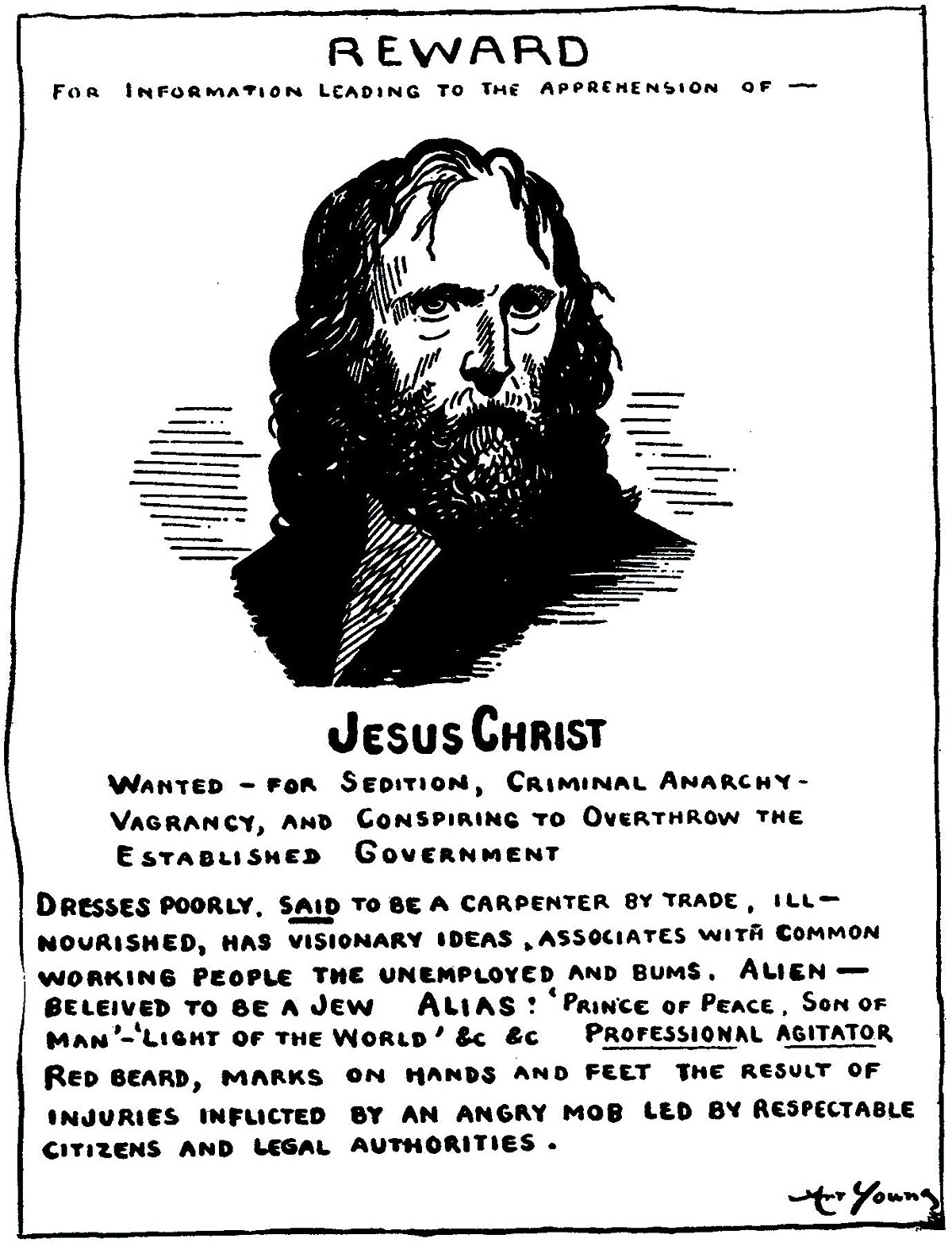
Marx and Jesus: The Trouble with Prophets

00-art-young-jesus-wanted-poster-he-stirreth-up-the-people-1913

Readings for 4th Sunday in Ordinary Time: Jer. 1: 4-5, 17-19; Ps. 71: 1-6, 15-17; I Cor. 12: 31-13; Lk. 4: 21-30 http://www.usccb.org/bible/readings/020313.cfm

I remember when my ideas about prophecy changed – when I really began to understand the term’s implications. I was a graduate student in Rome – already a priest – and completing my doctoral studies at the Academia Alfonsiana on the Via Merulana there in the “Holy City.” I was taking a class in I’ve forgotten what. But my professor (a German Redemptorist as I recall) got my attention during one of his lectures by referring to Karl Marx as “the last of the great Jewish prophets.” That was in 1970 at the height of the Cold War, and I had been reading Marx and about the then-flourishing Marxist-Christian dialog. I realized that my professor was right.

Marx of course was a Jew like Jesus, and Jeremiah who are centralized in today’s liturgy of the word. Like them, Marx was totally absorbed by questions of social justice for the poor and exploited. He was pretty much penniless, like most prophets, and spent his time thinking, writing, speaking, and organizing workers against exploitive employers. He was also highly critical of organized religion and its idols.

Marx’s insight (shared with the biblical prophets) was to realize that both Judaism and Christianity worshipped idols more often than the God of Israel. And by that he meant “gods” who not only justified an oppressive status quo, but who anesthetized the workers and unemployed to the fact that they were indeed oppressed by the capitalist system. Marx called such idols “the gods of heaven.”

We’re all familiar with what he meant. These idols are worshipped each Sunday – usually from 11:00 to 12:00 in what a theologian friend of mine used to call the “be kind to God hour.” You can encounter the “gods of heaven” any day at any hour on Cable television’s Channel 3 or in most Catholic Churches any Sunday morning. “God” there is concerned with correct worship, with bows, genuflections, and with correct terms such as “consubstantial,” “chalice,” “with thy spirit,” “under my roof” and so on. The stories or mythology upholding such idols have to do with “Jesus as your personal savior,” with “going to heaven,” and with avoiding hell.

Marx was also critical of what he called the “gods of earth.” They’re what people worship all those days and hours when they’re not in church. They include Capitalism, “America,” Nationalism, National Defense, Homeland Security, the Military, Money, and Profit. The issues of this God focus on sexuality: contraception, abortion, and same-sex marriage. This God is a War God – always on the side of “America.” He’s celebrated in songs like “The Battle Hymn of the Republic” and “Proud to Be an American.” He is the protector of “religious freedom” understood as privileging Christianity over other faiths while preserving tax exemptions worth billions each year. He blesses the bishops’ “Fortnight for Freedom” concerned as it is with protecting such benefits.

Marx’s prophetic work made him extremely popular with working classes. It was not uncommon for a worker to request that he be buried with a copy of “The Communist Manifesto” placed on his chest.

At the same time, Marx was vilified as the devil himself by factory owners, businessmen, bankers, and the professors and politicians representing their interests. Defenseless against such “education,” most of us have accepted such defamation of this last of the great Jewish prophets.

You see, that’s the trouble with prophets like Marx, Jesus and Jeremiah. They have to take on the “powers and principalities” of their cultures. They must swim against the torrential stream of public opinion.

In today’s first reading, Jeremiah is informed of his lot. But he must “man-up,” he’s told. He must steel himself to confront the “whole land,” along with kings and princes, priests and people. All of these, he’s warned, will fight against him. Nevertheless, God will make of Jeremiah a ‘fortified city,” a “pillar of iron,” and a “wall of brass.”

I suppose God followed through on those promises. But that didn’t prevent Jeremiah from being imprisoned, tortured, and left for dead.

Of course, the same thing happened to Jesus from the beginning to the end of his public ministry. He was vilified, demonized (literally!) and defamed.

That process begins for Jesus in today’s selection from Chapter 4 of Luke’s gospel. As we saw last week, he returns to his hometown of Nazareth and criticizes his neighbors’ narrow nationalism. In today’s episode his neighbors try to kill him. Later on, of course, Jesus goes more public. Like Jeremiah, he takes on his nation’s priests and scribes, princes and king. Ultimately his words and deeds threaten the Roman Empire itself which classifies him as a terrorist. Together those powers and principalities (national and international) not only defame Jesus the way Jeremiah and Marx were defamed; they actually kill him just as so many prophets have been killed from John the Baptist and Paul to Martin Luther King and Gandhi.

All of them – Jesus, Jeremiah, Gandhi, King, Paul and Marx – followed the same “prophetic script” whose inevitable directive prescribes that no prophet is accepted in her or his native place. It’s easy to see why. It’s because their “native place” bears the brunt of their prophetic words.

Meanwhile, it’s easier for outsiders to recognize prophets. The “outsiders” who concerned Jesus were the uneducated, poor, and unclean. However, even those seem to turn against him this morning. It’s unlikely that there were any rich or powerful resident in Nazareth – a place scripture scholar Ched Myers describes as “Nowheresville.”

Few of us are rich and powerful. Yet we’ve been schooled by those entities to reject prophets who speak in our name and defend our interests – those belonging to our “native land” to use the words of this morning’s gospel. It’s as though we’re looking at reality in that “darkened mirror” Paul wrote about in today’s excerpt from his letter to Corinth. The darkened mirror not only turns things backward, but it’s smudged with the fingerprints and dirt of ignorant and/or perverse propagandists.

The trouble – the trouble with prophets – is that most of us have bought into all that anti-prophet propaganda. So we hate Karl Marx without realizing that he’s on our side and speaks for us. We honor the Martin Luther King who has been reduced to a “dreamer,” but not the MLK who described the United States as the most violent and destructive country in the world. We don’t remember the King who was slandered as a communist and encouraged to commit suicide by the FBI and the COINTELPRO program.

We’re willing to stand by while Wikileaks journalist Julian Assange is persecuted by the governments of Great Britain and the United States. We presume that Bradley Manning is guilty of treason because our government, (despite its record of lies and heinous crimes) says so. We wonder what all the fuss is about Aaron Swartz.

These are the prophets of our time who, like Jesus, do not find a sympathetic hearing in their native place. It might be time to embrace them as our own and see what difference that makes in the way we look at the world and our country. The examples of Jeremiah, Jesus, and Paul — and the hopes of the world’s poor and victims of U.S. wars — beg us to do so.

Jesus as Self-Hating Jew!

Readings for Third Sunday in Ordinary Time: NEH 8; 2-6, 8-10; Ps. 19: 8-10, 15; I Cor. 12: 12-30; Lk. 1:1-4; 4: 14-21 http://www.usccb.org/bible/readings/012713.cfm

Last week I published an editorial on my blog site that was picked up by the Lexington Herald-Leader (http://www.kentucky.com/2013/01/19/2482073/ky-voices-the-chosen-people-are.html) and by OpEdNews (http://www.opednews.com/articles/Unconditional-Support-for-by-Mike-Rivage-Seul-130118-813.html.) It was about Chuck Hegel and the criticism he has endured from the American Israel Public Affairs Committee (AIPAC) and people like Elliot Abrams, the former Undersecretary of State for Human Rights in the Reagan administration.

Hegel had been nominated for Secretary of Defense by President Obama. Abrams and the others had criticized the nominee for being insufficiently supportive of Israel and therefore unfit for the “Sec Def” position. Hegel’s critics were looking for “unconditional support” for Israel, and didn’t find it in President Obama’s candidate. Their criticism was so effective that Hegel has since been forced to apologize for his past criticisms of the Jewish-Zionist Lobby.

Many Christians probably felt vindicated by Hegel’s groveling before his Jewish critics. After all, they might reason, Israel is God’s Chosen People; they deserve unconditional support.

However, today’s liturgy of the word underlines the point I tried to make in my op-ed: the phrase “God’s Chosen People” does not primarily refer to a national entity, but to the poor and oppressed.

Biblically speaking, it is true that Israel did fit that profile at the time of its origin – in Egyptian slavery (13th century B.C.E.) – and later during its captivity in Babylon (6th century B.C.E.). They were oppressed as well as when Israel was under the control of the Assyrians (8th century), Persians (6th century), Greeks (2nd century), and Romans (1st century). Then, precisely as oppressed, they were the object of God’s special love and protection.

At Mt. Zion, Moses enshrined in the law protection of people like them – slaves, widows,orphans, immigrants, the imprisoned, and the poor.

That’s the Law that the scribe, Ezra is recorded as reading to the people for hours in today’s first reading. They had just returned from exile in Babylon. For them “The Law” (the first five books of the Bible) was a source of joy and strength. After all, those books recounted what for Jews was the liberation of all liberations – from Egypt under the leadership of the great rebel hero, Moses. With Ezra in charge, they were celebrating the end of a long and painful experience in the geographical area that is now “Iraq.” Ezra reminded the assembled people that in their return to the Promised Land, they were experiencing Exodus all over again. Indeed, he said, it was a time for celebration – eating rich meats and drinking sweet drinks.

Today’s second and third readings pick up on Ezra’s theme – that God favors the poor and oppressed. However both Jesus and Paul do so emphasizing the point that Yahweh’s favored ones are not always Jews. When Jesus said that in his hometown synagogue, it enraged his former neighbors. (Their response reminds me of Elliot Abrams and the AIPAC demanding “unconditional support” for Israel.)

By the way, did you notice the strangeness of the reading from Luke’s gospel today? It starts out with the very first verses of Luke, verses 1-4. There the evangelist announces his intention – to carefully draw on the oral traditions of eyewitnesses and present an orderly researched account of what Jesus said and did.

But then the reading suddenly jumps ahead to Luke chapter 4 and presents Jesus’ preaching in his hometown synagogue in Nazareth. That gives the impression that Jesus’ first significant act was that Nazareth sermon. Perhaps it was – since Luke’s “infancy narratives” belong more to the realm of poetic imagination than of history.

Today’s reading also leaves out the response of those who heard Jesus’ words in Nazareth. (And that’s where the theme of “chosen people” becomes relevant.) Verses 22-30 tell us that the Nazarenes were outraged by Jesus’ implied criticism of Jews and his openness to non-Jews. After all, he had charged that prophets like Elijah and Elisha found more receptivity to their work in Lebanon (Sidon) and Syria than they found among Jews in Israel.

“Who does this guy think he is?” the Nazarenes asked indignantly. “We know his family; he’s nothing special. Yet here he is speaking critically about his own people! He must be one of those ‘self-hating Jews’.” Luke says Jesus’ hometown citizens were so outraged that they tried to kill him. (Chuck Hegel is in good company!)

Jesus’ words before the Nazarene’s attempted assassination do not merely underline the identity of God’s chosen as the poor and oppressed rather than exclusively the Jews. The words are also central in terms of Luke’s definition of Jesus’ entire project. In fact they connect that project with God’s very identity as described throughout the Jewish Testament particularly by the prophet Isaiah whose words Jesus quotes: “The Spirit of the Lord is upon me, because he has anointed me to bring good news to the poor. He has sent me to proclaim release to the captives and recovery of sight to the blind.”

Did you notice the importance of the word “because?” It absolutely identifies the “Spirit of the Lord” with Ezra’s good news to the poor about release from captivity and recovery of sight? Jesus is saying we know that “The Spirit of the Lord is upon” him because he brings good news to the poor, those in captivity and the blind. Jesus goes on to say that his commitment to the poor is what will define his entire mission. (The implication here is that anyone who brings good news to the poor, those in captivity and the blind embodies the Spirit of God.)

Today’s excerpt from Paul’s letter to the Greeks in Corinth continues that theme of Isaiah, Ezra, and Jesus. Only Paul does so in terms of a familiar yet powerful metaphor – what he calls the “Body of Christ” enlivened by the “One Spirit” of God. For Paul followers of Jesus constitute the way the Master is present today long after Jesus’ death. As that presence, we are Jesus’ hands, feet, eyes, ears, and tongue. And Paul specifically says it makes no difference whether one is Jew or Greek, slave or free, male or female.

What does make a difference though is one’s social standing. Paul goes out of his way to say that the “less honorable” and the “less presentable” in Christ’s body are to be more honored and cared for than the more presentable and more honorable according to the standards of the world. The weaker parts, he says are somehow “more necessary” than the stronger parts. This could hardly be a clearer reference to the poor and those who are normally neglected and looked down upon. Here Paul is following the thrust of Jesus’ words and deeds by turning the social order upside-down. The poor and oppressed come first in God’s order.

Today’s readings are calling us to grow out of our nationalism that understands Jews or Americans as God’s favorites. They call us to become citizens of the world – or in Jesus’ words to be cured of our blindness.

He wants us to finally see, the readings suggest, that the Jews as such are not God’s people. Neither are Americans. In God’s eyes, (despite the protests of our politicians and talking heads) our country is not the greatest in the world. For in the body of Christ there is neither Jew nor Greek, American, Afghani, Iraqi or Cuban.

Instead, true followers of Christ recognize that our allegiance belongs to the Body of Christ. This means that our care should be showered on the widows, orphans, undocumented immigrants, beggars, and social outcasts – LGBTQs, victims of AIDS, mothers on welfare, and on Mother Earth herself. These are the poor and oppressed. These are God’s people.

Our presence at this Eucharist represents our pledge to put the needs of those groups and individuals before our own.

Given the numbers of those who claim to be Christian, if we followed through on that pledge, how drastically different our world would be! Don’t you agree?

Unconditional Support for Israel? Even God Couldn’t Pass that Test!

Bible

In last week’s debate about Chuck Hegel’s nomination for Secretary of Defense, the phrase “unconditional support for Israel” surfaced as the expressed or implied criterion for Senate approval of nominee Hegel. Individuals like Elliot Abrams and organizations such as the American-Israel Public Affairs Committee (AIPAC) implicitly used that criterion to criticize the nominee for failing to offer such support despite Mr. Hegel’s unblemished record of voting for Israel’s interests. In doing so the AIPAC and its allies were evidently hoping to find receptive ears in the conservative Christian community which typically constitutes Israel’s strongest support-group on the grounds that the Jews are God’s “Chosen People.”

However, even passing acquaintance with the Bible shows that God himself (sic) never offered “unconditional support” of Israel, nor did the prophets, or Jesus of Nazareth. In fact, the Bible’s stories are largely accounts of Israel’s infidelities, of prophetic criticism of those failures, of their severe punishment by God. (Prophets, of course, were routinely denounced, persecuted, and killed for not offering unconditional support to the Jewish state.)

Usually divine punishment came in response to neglect and mistreatment of those who arguably represent God’s real “chosen people,” viz. the poor and oppressed – the widows, orphans, and resident immigrants. In fact, it might be argued that the Jews were God’s chosen people only insofar as they made up a paradigm of the poor and oppressed when Jacob’s descendents were enslaved in Egypt and exiles in Babylon. Given that understanding, the Palestinians today far better fit the profile of “chosen people” than do Zionist Jews.

Imagine the changes that would take place in U.S. domestic and international politics if Christians adopted the understanding of chosen people as the country’s and world’s poor and oppressed. Imagine if they demanded that nominees for Secretary of Defense or of President (!) show evidence of unconditional support for inner city children, the homeless, LGBTQs, AIDS victims, and the billions on our planet living on less than $2 a day. Imagine if they recognized Mother Earth herself as oppressed by U.S. consumption patterns and demanded the reforms necessary for her unconditional support.

If Christians made such demands (as we should), our country, our world would be an immeasurably better place. Because we do not, but concentrate instead on a nationalistic understanding of chosen people, Christians end up aggravating the world’s problems rather than pointing the way to solutions.

It’s time to change, read the Bible through the eyes of the poor and oppressed, and make demands accordingly.