The U.S. Is Indeed the Great Satan (Shaytan): Muhammad as Liberationist Prophet

Satan

(This is the second in a series on Islam as liberation theology and Muhammad as a prophet for our time. The series is inspired by Karen Armstrong’s “Muhammad: Prophet for Our Time” (London: Harper Perennial, 2006)

To understand Islam as liberation theology, it is important to place Muhammad in his historical and economic context. That setting shares important elements with the world’s current socio-economic circumstances shaped by an ethic of corporate globalization which ignores responsibilities for the world’s most vulnerable. Contextualizing Muhammad also helps us understand why Muslims consistently describe the United States as “the Great Satan,” or more accurately as the Great Shaytan.

Begin by trying to understand early seventh century Mecca. By the time the prophet had received his call, Mecca was already a prosperous focal point for Arabian culture. It had remained independent of control by both the Byzantine and Persian Empires which were then fighting for regional supremacy.

However, both empires found the hostile desert terrain of the Arabian Peninsula too forbidding for them to concern themselves with the area’s mostly Bedouin population. Moreover those constantly moving herds-people resisted domination in virtue of their fierce independence and absolute commitment to their tribes and ancestral ethos.

Bedouin culture lionized the karim – the tribal hero who was courageous, arrogant, violent and vengeful.The karim ideal was absolutely generous (not to say profligate) in dealing with his own people, but ruthless with others who were always considered inferior and expendable. Mired in chronic circumstances of scarcity, the karim economy required periodic wealth-redistribution in the form of “acquisition raids” on neighboring clans. Those attacks considered normal and necessary by the standards of the time, were careful to pillage but not kill – if only to avoid reprisals and vendettas.

In the 7th century, all of this was changing with the emergence of a strong commercial class interested in maintaining inter-tribal peace for purposes of facilitating business interactions. Hence, the merchant class developed a culture and ethos markedly different from the Bedouins’. Peace and order became much more important to doing business than they had been to Bedouin tribes struggling over scarce pastures. So conflict, violence, vendetta and vengeance were outlawed. Acquisition raids were particularly taboo.

This need for pragmatic peace was intensified by new technology related to commerce. The recent invention of a saddle for camels had dramatically increased the volume of goods capable of being transported. Consequently the quantity of foods, sandalwood, fabrics, spices and other products sold throughout the Arabian Peninsula increased dramatically. This impacted Muhammad’s birthplace (Mecca) in especially powerful ways.

Long since, Mecca had been important to Arab merchants. A “miraculous” water source (Zamzam) had been discovered there making it a natural stopping point for caravans circulating among a series of markets set up around the periphery of the Arabian Peninsula. A temple (Kabah) identifying the spring as a divine gift had been erected and included representations of all tribal deities from across Arabia. The final market of the year was held in Mecca and tribal merchants celebrated with inclusive “ecumenical” religious rites at the Kabah. There circumambulations of the Kabah helped the pilgrims integrate their mercantile journeys around the Arabian Peninsula into the divine scheme of things.

With all of this, Mecca became the logical location for a new religion emphasizing an empire-resistant trans-tribal Arab unity focused on peace and non-violence. At the time of Muhammad’s birth, there was great expectation of an Arabian prophet to crystalize such often-unspoken religious aspirations coherent with Mecca’s commercial and religious standing.

Before that would happen however, a downside to cultural dominance by the commercial class emerged. Slowly but surely tribal ties with their ancillary ethos were weakened. Ancestrally established obligations towards the widow, orphan, and infirm members of the community became less pressing and even rejected. Tribal arrogance reasserted itself in a new form of self-sufficiency that implicitly (and at times explicitly) denied the need for what we today would call “social justice.”

All of this strongly impacted the young Muhammad. True, he was born into one of Mecca’s leading commercial families. However, it had recently fallen on hard times. Muhammad himself had been orphaned early on. He was handed over to a series of clan care-takers who lovingly trained him in the ways of business and commerce. Though able strong and charming, Muhammad struggled to find his place in Mecca’s bustling marketplace. He would never forget those early struggles or his (non) status as an orphan. The poor would be centralized in his new religion.

At last, Muhammad improved his economic life by marrying a wealthy widow and businesswoman called Khadija. (In a culture that encouraged polygamy, she always remained his favorite wife.) It was Khadija who served as the prophet’s main support, confidante and advisor as he experienced his surprising call to become the prophet his culture generally expected.

Muhammad’s vocation story is reminiscent of similar accounts of Jewish Testament prophets. In a cave, he’s seized by God’s Spirit experienced (in Rudolf Otto’s terms) as fascinans et tremenda. The Spirit commands him to “recite.” (Qur’an means “recitations”).

Muhammad objects; he is unworthy. He is no orator or poet; he can’t even read or write. Yet he is literally pressed into the service of Allah and begins reciting sutras of extraordinary beauty and depth of meaning – even by exalted Arab standards of poetry. After an initial experience of this type, he is abandoned by the Spirit for a period of two years, only to have it return with even greater insistence and frequency. It would remain with him for 23 years, leading him to speak out on all manner of community problems.

The thrust of the prophet’s revelations was profoundly counter-cultural. It contradicted not only tribal arrogance, but also the ostentatious profligacy of the karim as well as the self-sufficiency of the commercial classes. Instead, Muhammad’s faith called for humility, service of others, complete submission (the very meaning of the word “Islam”), and care for the poor and weak.

Belief was to be backed up by action – almsgiving was centralized. But there were also ritual reminders of Islamic commitment. Five times each day Muslims were to adopt the position of a slave before Allah – on believer’s knees, prostrate, with forehead touching the ground. With all of this, it is no wonder that the first Muslims (like the first Hebrews and Christians) came from the poorer classes, with women more receptive than men.

Islam as conceived by Muhammad was inclusive and tolerant of other faiths – especially the ones just mentioned. Along with the rest of the Arab world, Muhammad deeply admired Judaism and Christianity for having their own Sacred Scriptures. Now with the emergence of the Qur’an, Islam joined that club as well. The notion of converting sisters and brothers in faith was a foreign concept for Islam’s great prophet.

Because of its counter-cultural thrust, the rest of Muhammad’s story is one of rejection and persecution by the guardians of the status quo. Muhammad is driven into exile in Medina. But eventually he returns to Mecca. His trans-tribal faith succeeds in uniting the Arab world conferring upon it a unifying power that is subsequently used by others the way Christianity was used by Christendom’s “Holy Roman Empire.” Islam becomes the unifying force behind an Islamic order that stretches from the Himalayas to the Pyrenees.

All of this is to say that imperial Islam (like the imperial Christianity that began under Constantine in the 4th century) is out-of-keeping with the faith of its founding prophet. Social justice, care for the poor, and recognition of transcendent human community, are not.

In the eyes of contemporary Muslims, all of this makes Muhammad particularly relevant to their situation in a world dominated by corporate globalization. As in the prophet’s day, globalization’s celebration of self-sufficiency contradicts Islam’s basic values of community, compassion and care for society’s most vulnerable.

As the leader and embodiment of the values that run so counter to Islam’s basic thrust, the United States is viewed as “Shaytan” (which is often translated for us simply as “Satan”). For Muslims however, Shaytan is not the prince of demons as he appears, for instance, in Dante’s Inferno. Instead, Shaytan is “the great deceiver,” whose promises mislead, corrupt and immiserate those who believe them.

In fact, while promising peace, prosperity, and happiness, the elevation of commercial values to a position of supremacy in the moral hierarchy could not be (in Muslim eyes) more deceptive and disastrous. Without care for society’s poor and vulnerable, commercial values lead to individualism, competition, war and unhappiness.

No wonder the U.S. is identified with Satan!

(Next: Islam and Violence)

In Praise of Persistent Women like Medea Benjamin, Elizabeth Warren, and Amy Goodman (Sunday Homily)

Widow-and-Unjust-Judge

Readings for 29th Sunday in Ordinary Time: EX 17: 8-13; PS 121: 1-8; 2 TM 3:14-4:2; LK 18: 1-8; http://usccb.org/bible/readings/102013.cfm

Medea Benjamin is a peace activist and founder of Code Pink. In May of this year, she interrupted a speech by President Obama about the closing of Guantanamo Bay. Four times during his speech, she reminded the president that as chief executive he had the power to close the prison as he had promised during his campaign of 2008. The president was forced to acknowledge Benjamin’s point, but held that the issue was more complicated than she made it out to be. Clearly her outspokenness called for great courage and exposed to an international audience President Obama’s failure to keep his word. It pressured the president to change policy.
_____
Elizabeth Warren is the Democratic Senator from Massachusetts. Elected to the Senate in 2012, she is the first female senator from Massachusetts. Ms. Warren is a tireless consumer advocate and the first female Senator from Massachusetts. During her campaign, she called attention to the hypocrisy of “self-made men” claiming they owed nothing to government or community to explain their success. She said,

“There is nobody in this country who got rich on his own. Nobody. You built a factory out there — good for you. But I want to be clear. You moved your goods to market on the roads the rest of us paid for. You hired workers the rest of us paid to educate. You were safe in your factory because of police forces and fire forces that the rest of us paid for.….Now look. You built a factory and it turned into something terrific or a great idea — God Bless! Keep a Big Hunk of it. But part of the underlying social contract is you take a hunk of that and pay forward for the next kid who comes along.”
_____
Amy Goodman is a television journalist and host of “Democracy Now: the War and Peace Report” – a daily news hour on the Pacifica Radio and Television network. In the face of mainstream media’s refusal to cover significant grassroots events and issues, Ms. Goodman’s program has been called “probably the most significant progressive news institution that has come around in some time” (by professor and media critic Robert McChesney.) In addition to OpEdNews, “Democracy Now” is an invaluable daily source of information for the well-informed. It is an example of what can be accomplished for peace and social justice in the face of overwhelming odds.
_____

Keep in mind the examples of Medea Benjamin, Elizabeth Warren, and Amy Goodman as we attempt to understand today’s liturgy of the word. Our readings raise the issue of prayer, and what it means (in Jesus’ words) to “pray always without ceasing.”

Actually, the readings compare what might be termed “men’s way of praying” with women’s. At least in today’s readings, men pray that God might intervene to slaughter their enemies. In contrast, the woman in today’s gospel confronts the power structure of her day as her way of praying. That is, she persistently works to bring her world into harmony with God’s justice.

Take that first reading from Exodus. . . . Did it make you raise your eyebrows? It should have. It’s about God facilitating mass slaughter. It tells the story of Moses praying during a battle against the King of Amalek. It’s a classic etiology evidently meant to explain a chair-like rock formation near a site remembered as an early Hebrew battleground.

“What means this formation?” would have been the question inspiring this explanatory folk tale. “Well,” came the answer, “Long ago when our enemy Amelek attacked our people, Moses told Joshua to raise an elite corps of fighters. During the course of the ensuing battle, Moses watched from this very place where we are standing accompanied by his brother Aaron and another friend called Hur.

Moses raised his hands in prayer during the day-long battle. And as long as he did so, Joshua’s troops got the better of Amalek’s. But Moses would get tired from time to time; so he’d lower his hands. When he did so, Amalek’s troops got the better of Joshua’s.

“To solve the problem, Aaron and Hur sat Moses down on this stone you see before us. They held up his arms during the entire battle. That strategy saved the day. Joshua won his battle “mowing down Amelek and his people.”

So here we have a God who responds to ad hoc prayers and reverses history so that one group of his children might “mow down” another group of people he supposedly loves. Hmmm. . . .

In today’s gospel, Jesus has another approach to prayer. For him, prayer is not an ad hoc affair – about changing God’s mind. Rather, praying always represents the adoption of an attitude that consistently seeks justice for the oppressed. Praying always means living from a place that won’t let go of justice concerns like those that drive Medea Benjamin, Elizabeth Warren and Amy Goodman.

To illustrate that point for his own time, Jesus tells a comic parable about a persistent woman. (Remember, he’s speaking to people who have no power in a legal system, which, like ours favors the wealthy and powerful.)

“Imagine a judge,” Jesus said. “He’s like most of the judges we know. He doesn’t give a damn about the God of the poor, and he doesn’t care what people like us think of him.” (Already Jesus’ audience is smiling seeing a funny story coming.)

“But then along comes this widow-woman. Like all of us, she’s poor, and as usual, the judge pays no attention to her.” (Jesus’ audience recognizes the syndrome; they nod to each other.)

“But this woman’s a nagger,” Jesus says. (Now his audience is snickering and chuckling.)

“She just won’t let go. And she’s strong and aggressive besides. She comes back day after day insisting that she get justice against her adversary. And as the days go by, she gets more and more insistent – and threatening. So much so that the judge starts getting worried about his own safety.

(Laughter from the crowd . . .)

“’While it is true,’ he says to himself, ‘that I neither fear God nor respect any human being, because this widow keeps bothering me I shall deliver a just decision for her lest she finally come and strike me.’”

In other words, this macho judge is afraid of this poor widow; he’s afraid she’ll come and beat him up!

Can you imagine Jesus saying that without smiling broadly – and without the crowd roaring in laughter?

Anyway, here’s Jesus point: “If an unjust judge responds to the prayer of the poor like that, how do you suppose the All-Parent will respond when we ask for justice? The All-Parent will respond swiftly, Jesus says, because that’s who God is – the one who (as Martin Luther King put it) has established an arc of history that bends towards justice.

Prayer, then, is about reminding ourselves of that fact, trusting and having faith that in the long run justice and truth will prevail. Taking that position in the face of overwhelming evidence to the contrary, takes great faith that’s harder and harder to find.

So Jesus ends his parable with the rhetorical question, “When the Son of Man returns, do you think he’ll find that kind of faith anywhere?”

What I’m suggesting here is that today we’re more likely to find that kind of faith, that kind of prayer, that kind of persistence in women rather than men. The example of social activist Medea Benjamin encourages us to find our voices in defense of the voiceless in U.S. prison camps throughout the world. Politician, Elizabeth Warren, calls us to pray always by calling into question received truths like those surrounding “self-made men.” Amy Goodman and her “War and Peace Report” inspire us to renounce ideas of God that call us to “mow our enemies down.”

Thank God for persistent women! We men have an awful lot to learn from them.

Islam as Liberation Theology: Muhammad as a Prophet for Our Times (Part One)

Islamic World

I remember as I was finishing my teaching career of 36 years at Berea College in Kentucky that I experienced a spectacular failure regarding Islam.

In the light of the then-recent events of 9/11/01, I had moved that all students be required to study Islam either in a separate required course or as part of an already existing course (on writing or Western Civilization). After a brief discussion, my proposal was put to a vote. It received two (!) “Yeas” and about 148 “Nays” from a faculty of 150. “Next order of business . . . “

Despite going down in flames like that, I still think my proposal was a good one. That’s because ignorance of Islam lies close to the heart of our country’s highly questionable (not to say bogus) “War on Terror.”

Even more importantly, as a liberation theologian, I see “Islamists” as part of world-wide movement of poor people to use their religious traditions as a force for freedom rather than control and slavery. In fact, I consider this movement as the most important intellectual and social development since the writing of the Communist Manifesto in 1848. Grasping that fact and the true nature of Islam should be Job #1 for teachers and peace advocates.

Perhaps, like the Berea faculty, you find that assertion difficult to buy. And why shouldn’t you? Even in its Christian form, “liberation theology” has been misrepresented and distorted beyond recognition. Why shouldn’t we expect even more of the same for its Islamic counterpart?

So let me explain. Begin with the context of my proposal.

Once again, it came in the immediate aftermath of 9/11. On all sides Islam was being vilified as foreign, primitive, terrorist, and anti-female. U.S. military personnel regularly desecrated the Koran.

And their leaders like Lt. Gen. Wm. G. Boykin, were asserting the superiority of “our God” over “their God.” Republicans who otherwise ridiculed feminists as “femi-nazis” suddenly became champions of women’s liberation as they attacked Islam for preventing women from driving cars and wearing mini-skirts.

All of that made me suspicious. I knew a little about Islam from my poor attempts at teaching an introductory course part of whose intent was introducing freshman students to “world religions.” We had read Huston Smith’s The Religions of Man. If nothing else, Smith taught me that Islam, Judaism, and Christianity are sister faiths. There is no distinction between “their God” and “our God.” All three were “religions of the book.” At the very least, all recognized Jesus as a great prophet.

I had also taught Malcolm’s Autobiography. His embrace of Islam had called my attention to the attraction of Islam for poor people as an alternative to enslaving interpretations of Christianity. Malcolm’s passion for the Nation of Islam easily connected with my own for liberation theology – i.e. with the reading of the Judeo-Christian tradition from the perspective of those committed to the welfare and destiny of the world’s poor.

I remembered that somewhere in the literature of liberation theology, I had read that Islam was today’s most prominent example of a ”religion of the poor and oppressed.” As such Islam was influencing far greater numbers of the world’s poor than had Christianity’s liberation theology which was largely defeated by the U.S. military in what Noam Chomsky has called “the first religious war of the 21st century.” That religious conflict had pitted the U.S. government against the Catholic Church in Latin America.

Understanding Islam as today’s foremost expression of the liberating power of faith made the 1979 uprising in Iran a movement inspired by “liberation theology.” It did the same thing for other movements for liberation throughout the Asia and Africa. With all their triumphs and distortions, they too were movements against colonialism and its neo-colonial aftermath. In the name of God, they all stood against the exploitation and oppression of the East by the West.

That’s true, of course, for our contemporary “Arab Spring.” After all, did you think all those students and others protesting in Tahrir Square had suddenly left behind their devotion to Islam? What do you think motivated them? Had they suddenly become secularists? More obviously, what moved the “Islamic Brotherhood” to oppose the U.S. puppet Mubarak? Or why do you think the Egyptians elected the Brotherhood to lead their country?

Obviously, the motivation was largely found in Islam and in the realization that their faith as exemplified in the life and writing of the prophet Muhammad champions the Arab world’s poor in their struggle against the rich who have hijacked both Christianity in the West and Islam in the East.

It’s that liberationist understanding of Islam that the West must distort and vilify just as it did Christian liberation theology when it threatened to radically alter the political landscape of Latin America from the Medellin Conference of 1968 to the assassination of El Salvador’s most prominent liberation theologians in 1989.

It’s time to set the record straight in no uncertain terms. (That after all was the thrust of my proposal that evening on the faculty floor.) Reading Karen Armstrong’s Muhammad: Prophet for Our Time can help. In fact, Armstrong’s book would be required reading in the course I proposed. Without ever mentioning liberation theology, it reveals Muhammad as the champion of the poor and oppressed that Christianity’s liberation theology shows Jesus to have been.

(More about this in next Monday’s post.)

Why Am I Here in India? (Sunday Homily)

Religion in India

Readings for 28th Sunday in Ordinary Time: 2 KGS 5: 14-17; PS 98: 1-4; 2TM 2”8-13; LK 17: 11-19. http://usccb.org/bible/readings/101313.cfm

My wife and I have been in India now for six weeks. Peggy’s working as a Fulbright researcher at the University of Mysore here in the country’s south. I’m here . . . I’m only now realizing why.

To tell the truth, I had come to India more or less reluctantly. I mean since retirement I had traveled a great deal including six months in Costa Rica, five months in South Africa, and now the prospect of 4 ½ months here in India. So perhaps understandably, I was feeling tired of living out of a suitcase.

I wondered then, why Life, why life’s circumstances had brought me here to what many consider the “Soul of the World” – an ancient culture with deep, deep spiritual roots?

I thought about that for a long time. Then I concluded that the opportunity here is absolutely golden for spiritual growth.

That’s why I’m here then, I concluded. Life is telling me I need to grow and break away from patterns of living and thought that have unconsciously become too comfortable and stifling.

And what resources there are in India for assisting in that project! There are spiritual masters here, teachers of meditation and yoga. (For example, Sunday I have an appointment with a Past Life Review teacher.)

In addition, Indian food (not my favorite) challenges me to adjust my palate. Cows walk the streets. Dress is different as well. Music too seems completely foreign (but delightful), as Peggy and I have discovered in attending a kind of “Indian Woodstock” festival of traditional Indian chanting, drumming, flute and violin playing during the two-week festival of the god Ganesh. And the traffic. . . . I’ve never seen anything as wild. No rules at all that I can see. I doubt if I could learn to drive here.

All of this is forcing me to expand my horizons and break away from what spiritual masters here call “samskaras” – habitual patterns of perceiving, thinking and living.

That’s what spiritual masters do for a living – they challenge old ways of thinking. It’s what the prophet Elisha did in this morning’s first reading, and what Jesus does in today’s gospel selection. Both readings reveal God’s love for those our cultural norms classify as strange and even evil.

Our first reading centralizes the prophet, Elisha, who worked in Samaria for 60 years in the 9th century BCE. That, of course, was a full 100 years or more before Samaritans emerged as Israel’s bête noir.

Nonetheless, it is true that Naaman may have been even more detestable to Elisha’s contemporaries than Samaritans eventually became to the Jews. That’s because Naaman was a captain in the army of the King of Aram who at the very time of the officer’s cure was attacking Elisha’s homeland. Elisha’s cure of Naaman would be like extending free healthcare to a known al-Qaeda “terrorist” today.

In other words, Naaman is a foreigner and an enemy of Elisha’s people. On top of that he’s a leper, which supposedly further marks him as an object of God’s disfavor. Despite all these disqualifications, the greatest prophet in Israel cures him.

The narrative’s point: there is indeed only one God, and that God loves everyone, even our designated enemies. That was a stretch for the people of Elisha’s time. It’s a stretch for us.

Still, the point is picked up in today’s responsorial psalm. Remember the refrain we sang together this morning: “The Lord has revealed to all the nations his saving power.” According to the psalmist, then, God is not tied to one land. God’s saving power is evident in every place on earth. As the psalmist put it, “All the ends of the earth have seen God’s salvation.”

God belongs to everyone. Everyone belongs to God.

By Jesus’ time, nearly 800 years after Naaman’s cure, Israel still wasn’t buying that message. In fact, they had narrowed God’s presence to particular locations within the land of Israel. Orthodox Jews believed God was present on the Temple Mount in Jerusalem, and could only be really worshipped in the Temple there. Samaritans, on the other hand, believed that the place to worship Yahweh was on Mt. Gerizim, where they said Abraham had nearly sacrificed his son, Isaac.

In other words, Samaritans embodied a sectarian battle among the descendants of Abraham over where to worship God – was it on the Temple Mount or on Mount Gerizim?

Jesus completely ignores the debate. He cures a Samaritan along with nine other lepers – presumably all Jews.

The story is simple: the lepers approach Jesus. He tells them to “show yourselves to the priests.” It’s not clear what Jesus had in mind. Some say there was a law requiring cured lepers to be certified by the priests. Others say Jesus’ intention was to confront the priests, to assert his identity (as his mentor, John the Baptist had done) as the people’s high priest.

In any case, the lepers leave in search of the priests, and on the way are cured. As we well know, only the Samaritan leper returns to thank Jesus. Why? Was it that the priests had persuaded the others not to return, since they were convinced that Jesus was possessed?

On the other hand, the priests would probably have refused to see the Samaritan, because of their deep prejudice.

So the Samaritan turns out to be the hero of the story, not the priests or those who listen to them. Just like Naaman, the one in the story most open to God was the character most alienated from reigning cultural norms.

And that brings me back to my opening point – to my hopes about India. Recently I was reading an article by an Indian scholar of religion who identified Jesus as an Indian yogi. The author suggested that the reason the priests and the people of Jesus’ time and culture could not understand him was that his approach to life and God was completely alien to them.

It was a mystical philosophy more akin to the Far East – to India – than to Middle Eastern Palestine. Put briefly Jesus’ mystical philosophy can be summarized in the words “Aham Sarvum! Sarvum Aham!” –“I AM ALL. ALL is ME.” In fact, Jesus’ basic approach can be summarized as follows:

1. There is a spark of the divine within every human being.
2. That spark can be realized, i.e. energize every aspect of our lives in the here and now.
3. It is the purpose of life to live from that place of divine presence.
4. Once we do so, we will recognize God’s presence in every human being and in all of creation.

Or as John the Evangelist has Jesus say:

1. “I am in the father, and the father in me.” [John 14.10]
2. “I am in my father, and ye in me, and I in you.” [John 14.20]
3. “I and my Father are One.” [John 10.30]

In other words, the guru (Jesus), the disciple, and God are all One. Separation of God and Her creation is nothing but illusion (MAYA). ALL IS ONE.

All of this confirms for me what I’ve learned from Eknath Easwaran, my Indian teacher of meditation over the last 15 years: at their summit all the world’s Great Religions come together in the mystical vision just articulated.

If all of this is true, what does all of this mean for us today? I think this at least:

• There are many ways to understand God.
• Sectarianism is foreign to the Divine Reality.
• God loves our mortal enemies and performs miracles on their behalf just as God did in the example of Naaman.
• More specifically, God loves al-Qaeda fighters and the ones we call “terrorists” just as much as (S)he does us. Our enemies represent God’s presence and so do we. We should treat them as though this were true.
• God loves those we classify as unclean, unworthy, ungodly, and untouchable.
• More specifically, God loves people with AIDS; God loves the foreigner, the outcast. They represent the presence of God and so do we. And because of our tendency to reject them, they are somehow closer to God than we are.
• It’s good to step outside the reach of our culture’s categories, at least once in a while.

Dives & Lazarus: a liberation theology catechism (Sunday Homily)

Lazarus

Readings for the 26th Sunday in Ordinary Time: AM 6: 1A, 4-7; PS 146: 7-10; ITM 6: 11-16; LK 16: 19-31 http://usccb.org/bible/readings/092913.cfm

Today’s liturgy of the word provides us with a catechism of liberation theology – Christianity’s most important theological development in the last 1500 years, and the West’s most important social movement of the last 150 years.

I have come to those conclusions over a period of more than forty years studying liberation theology. My interest began in Rome during my graduate studies there, 1967 through 1972. There I first heard Peru’s Gustavo Gutierrez speak. (Fr. Gutierrez is considered the father of liberation theology.)

Subsequently I read Gutierrez’s book, A Theology of Liberation (1971) and was completely taken by it. Reading the book gave me the feeling that I was hearing Jesus’ Gospel for the very first time.

You might ask, what is liberation theology? To answer that question fully, please look at my blog entries under the “liberation theology” button. I’ve written a series on the question. In my blogs, you’ll find that I always define it in a single sentence. Liberation theology is reflection on the following of Christ from the viewpoint of the world’s poor and oppressed. That’s the class of people to which Jesus himself belonged. They constituted the majority of his first followers.

When read from their viewpoint, accounts of Jesus’ words and deeds – the entire Bible for that matter – take on depths of meaning and relevance to our contemporary world that are otherwise inaccessible to people like us who live in the heart of the wealthy world. From the viewpoint of the poor, God passes from being a neutral observer of earth’s injustices to an active participant with the poor as they struggle for justice here on earth. Jesus becomes the personification of that divine commitment to the oppressed. After all, he was poor and oppressed himself. The Roman Empire and its Temple priest collaborators saw to that.

My interest in liberation theology deepened as my teaching career developed at Berea College in Kentucky from 1974 to 2010. There I was encouraged to continue my study of liberation theology. So I spent extended periods in Brazil, Nicaragua, Costa Rica, Honduras, Guatemala, Cuba, Mexico, Zimbabwe, South Africa, India and elsewhere studying under liberation theologians, dialoging and publishing with them. The poor in all of those countries were suffering from the aggression the United States directed against them.

Meanwhile at Berea, I found the conclusions of liberation theologians validated by the college’s very fine scripture scholars. They had almost no acquaintance with liberation theology, and yet what they were teaching perfectly harmonized with its central tenets. It’s just that they stopped short of drawing what seemed to me the obvious political conclusions from their work.

More specifically, Berea’s scholars identified the Exodus (Yahweh’s liberation of slaves from Egypt) as God’s original and paradigmatic revelation. The whole tradition began there, not in the Garden of Eden. Moreover, the Jewish prophetic tradition emphasized what we now call “social justice.” Even more, Jesus of Nazareth appeared in the prophetic tradition, not as a priest or king. Jesus directed his “ministry” to the poor and outcasts. The Gospel of Luke (4: 18-19) has Jesus describing his program in the following words:

“The Spirit of the Lord is upon me, because he has anointed me to bring good news to the poor. He has sent me to proclaim release to the captives and recovery of sight to the blind, to let the oppressed go free, and to proclaim the year of the Lord’s favor.”

After his death, Jesus’ followers continued along those lines. They lived communally, having sold all their worldly possessions and distributed the proceeds to the poor.

All of that finds vivid expression in today’s liturgy of the word. As I said, it’s a kind of catechism of liberation theology. The reading from Amos the prophet describes the sin that most offends God – wealth disparity in the face of extreme poverty. Amos decries a “wanton revelry” on the part of the wealthy that sounds like the “American Way of Life” or the “Lives of the Rich and Famous” that we Americans find so fascinating. The prophet describes a rich class that lives like King David himself – in luxurious houses, overeating, drinking wine by the bowlful, and generally ignoring “the collapse of Joseph,” i.e. the poverty of their country’s most destitute. For that, Amos says, the rich will ultimately suffer. All their wealth will be confiscated and they will be driven into shameful exile.

In railing against the rich and defending the poor, Amos was calling Judah back to the worship of Yahweh whose attributes are described in today’s responsorial psalm. There God is depicted as loving the just and thwarting the ways of the wicked. The psalm describes Yahweh as securing justice for the oppressed, giving food to the hungry, and setting captives free. He gives sight to the blind and protects resident aliens, single mothers and their children.

Then today’s excerpt from 1st Timothy outlines the characteristics of those who worship that God by following in Jesus’ footsteps. They keep the commandment which is to do unto others as we would have them do unto us. According to St. Paul, that means pursuing justice and living with devotion, faith, love, patience, and gentleness.

Finally, the gospel selection from Luke chapter 16 dramatizes the sinful relationship between rich and poor and the destinies awaiting both. Luke tells the story of the rich man and “St. Lazarus” who is honored by the poor throughout Latin America.

It is significant that Lazarus is given a name in Jesus’ parable. Usually we know the names of the rich, while it is the poor that remain anonymous. Here matters are reversed. To remedy this anomaly, tradition has assigned the wealthy man a name. He’s called Dives, which is simply the Latin word for rich man.

For his part, Lazarus is quintessentially poor, hungry, and lacking medical care. His sores are open and the only attention they receive are from dogs that lick his wounds. Meanwhile, Dives seems completely unaware of Lazarus’ presence, though the beggar is standing at his very doorstep. Within the sight of Lazarus, the wealthy one stuffs himself with food to such a degree that the scraps falling from his table would be enough to nourish the poor beggar. But not even those crumbs are shared. How could Dives share? He doesn’t even know that Lazarus exists.

So the two men die, and things are evened out. The rich man goes to hell. We’re not told why. Within the limits of the story, it seems simply for the crime of being rich and unconsciously blind to the presence of the poor. For his part, Lazarus goes to the “bosom of Abraham,” the original Hebrew patriarch.

Lazarus is rewarded. Again, we’re not told why. Within the story, it seems simply because he was poor and Yahweh is partial to the poor, just as he was to the slaves God intervened to save when they were starving in Egypt.

Seated with Abraham, Lazarus feasts and feasts at the eternal banquet hungry people imagine heaven to be. Dives however is consumed by flame in the afterlife. Fire, of course, is the traditional symbol of God’s presence, or purification, and of punishment. This seems to suggest that after death, both Dives and Lazarus find themselves in the presence of God. However what Lazarus experiences as joyful, Dives experiences as tormenting.

And why? Simply, it seems, because Dives was rich, and Lazarus was poor.

Does the parable tell us that what awaits us all after death is a reversal of the economic conditions in which we now find ourselves? The first will be last; the last first. The rich will be poor, and the poor will be rich. That in itself is highly thought-provoking.

In any case, Yahweh is presented as champion of the poor in this parable, just as in the reading from Amos, in today’s responsorial psalm, and in Paul’s letter to Timothy. And according to liberation theologians, that’s the central characteristic of God throughout the Judeo-Christian tradition. God is on the side of the poor and hates obscene wealth disparity.

You can well imagine how such insight inspired the poor and oppressed throughout the world when it emerged as “liberation theology” following the Second Vatican Council. Poor people everywhere (and especially in Latin America) took courage and were inspired to demand social justice from the rich who had been ignoring them in the New World since the arrival of Columbus 500 years earlier. In fact, Liberation theology motivated social movements more powerfully than any thought current since the publication of the Communist Manifesto in 1848.

And that’s why the reigning empire, the United States of America took action against liberation theology. It initiated what Noam Chomsky calls “the first religious war of the 21st century.” It was a war of the United States against the Catholic Church in Latin America – yes against the Catholic Church. The war killed hundreds of thousands of priests, nuns, lay catechists, social workers, union organizers, students, teachers, and journalists along with ordinary farmers and workers.

Today’s liturgy of the word reminds us not to let the United States have the final word. We are called to divest ourselves of our wealth and to take notice of St. Lazarus at our gates. God is on the side of the poor, not of the rich.

On Not Returning to Daddy: Heretical Reflections on the Prodigal Son (Sunday Homily)

Chelsea Manning

Readings for 24th Sunday in Ordinary Time: EX 32: 7-11, 13-14; PS 51: 3-4, 12-13, 19; ITM 1: 12-17; LK 15: 1-32. http://usccb.org/bible/readings/091513.cfm

A few weeks ago, Chelsea Manning (formerly known as Bradley Manning) was sentenced to 35 years in prison for blowing the whistle on the U.S. military and the officials who run it. In her job in Military Intelligence, Ms. Manning came across thousands of documents and videos exposing war crimes routinely committed by U.S. troops and their superiors. She released more than 700,000 of those documents in the hope that they would start a national dialog about the morality of the War on Terror. For her trouble, Ms. Manning was tortured for months. Following a court martial, she has been imprisoned instead of the criminals she reported.
_____

Last May, Edward Snowden, a data analyst working for Booz Allen Hamilton, the National Security Agency and the CIA, released a trove of documents revealing that the U.S. government has been spying on all U.S. citizens. Those spying on us have been secretly reading our e-mails and recording our phone conversations.

Such intrusion stands in blatant violation of the Fourth Amendment of the U.S. constitution which reads: “The right of the people to be secure in their persons, houses, papers, and effects, against unreasonable searches and seizures, shall not be violated, and no warrants shall issue, but upon probable cause, supported by oath or affirmation, and particularly describing the place to be searched, and the persons or things to be seized.”

Mr. Snowden released the documents to start a national conversation about the justification for secretly suspending such constitutional guarantees. For his trouble, he was threatened with arrest and imprisonment by the very agents whose alleged crimes he was exposing. Mr. Snowden is now living in Russia where he has been given temporary political asylum. His asylum has largely been justified by the fear that if returned to the U.S. he would suffer the torture and mistreatment inflicted on Chelsea Manning.
_____

Please keep the Manning and Snowden cases in mind as we reflect on today’s gospel selection.
_____

Didn’t we just recently read the Parable of the Prodigal Son at Mass?

I checked.

Well, yes, if you count the 4th Sunday of Lent less than six months ago. In fact, this famous story repeats so many times in our Liturgies of the Word that most of us know it nearly by heart.

Personally, I must confess a bit of boredom with the tale. It even crossed my mind to skip a homily this week, and simply refer my readers back to last Lent’s reflections.

But on second thought, allow me to take another shot at it with the Manning and Snowden cases as background. This time I’ll take my cue from John Dominic Crossan’s book The Power of Parable: how fiction by Jesus became fiction about Jesus. There Crossan suggests challenging Luke’s parable as excessively patriarchal. After all, the story is about a bad boy who realizes the error of his ways and returns home to daddy and daddy’s patriarchy with its familiar rules, prohibitions, and tried and true ways of doing things.

But what if the prodigal left home and never looked back? Would he have been better off? Would we be better off by not following his example as described today by Luke – by instead separating from the patriarchy and never looking back?

The French intellectual Andre Gide actually asked that question back in 1907 when he wrote “The Return of the Prodigal Son.” In his version, Gide expands the cast of the parable’s characters to five, instead of the usual three. Gide adds the father’s wife and a younger son. The latter, bookish and introspective, becomes the story’s central figure who escapes his father’s walled estate never to return.

According to Crossan, Gide tells his version of Jesus’ parable through a series of dialogs between the returned prodigal and his father, his older brother, his mother, and lastly, his younger brother. In his dialog, the father reveals that the older brother is really in charge of the father’s household. According to daddy, the brother is extremely conservative. He’s convinced that there is no life outside the walls of the family compound. It’s the older son who must be obeyed there.

For his part, the older brother, reinforces what the father said. “I am his sole interpreter,” the elder son claims, “and whoever would understand the father must listen to me.” In other words, the elder brother has owned the authority which the father has surrendered to him. (Doesn’t that sound a lot like the male hierarchy’s claims within the church in relation to the Bible? It’s also reminiscent of our government’s position regarding the Constitution. Our president’s interpretation is the only valid one.)

Then the mother comes forward. She tells the prodigal about his younger brother. “He reads too much,” she says, and . . . often perches on the highest tree in the garden from which, you remember, the country can be seen above the walls.” One can’t help detect in the mother’s words a foreboding (or is it a suppressed hope) that her youngest son might go over the wall and never come back.

And that’s exactly what the younger son decides to do. In his dialog with the returned prodigal, he shares his plan to leave home that very night. But he will do so, he says, penniless – without an inheritance like the one his now-returned brother so famously squandered.

“It’s better that way,” the prodigal tells his younger sibling. “Yes leave. Forget your family, and never come back.” He adds wistfully, “You are taking with you all my hopes.”

The younger son turns for the door. His brother cautions him, “Be careful on the steps . . .”

Gide’s version of Jesus’ parable makes me think of Chelsea Manning and Edward Snowden, and how in these pivotal times they have followed the youngest son in Gide’s parable as he goes over the wall into the unfamiliar realm of uncertainty, danger, and creative possibility.

In both cases, making that move required great courage. It meant escaping the safety and comfort that the confines of the patriarchy provide. Today Chelsea Manning sits in Leavenworth Prison in a far different “America” than the one she was trying to save. Snowden lives in exile in Russia without any hope of return to the country he too was attempting to help. In Manning’s case, leaving the father’s estate even meant transcending the patriarchy’s strict boundaries around sexual identity.

Because of the courage of Manning and Snowden we’re all better off and the patriarchy is weakened.

What does all of this mean for us as we reconsider Jesus’ overly-familiar parable in the light of Gide’s retelling? I think it might mean that we must:

• Be courageous and think for ourselves even about values seemingly endorsed by Jesus.
• See that patriarchy and male values of power, prestige, profit, individualism, competition, violence and war represent the roots of our world’s problems.
• Recognize that comfort in “our father’s house” is not good for us, our children or the planet.
• Do all we can to reject the patriarchy and its values and never look back
• Value people like Mr. Snowden and Ms. Manning as exemplary heroes showing us that it is indeed possible to leave “Our Father’s House” and its values for the sake of God’s Kingdom or however Snowden and Manning might understand the new reality to which they summon us.
• Appreciate the symbolic importance of Chelsea Manning’s rejection of military machismo in favor of the feminine world and its values of inclusion, community, and cooperation.
• Admit that our male-dominated church is a central part of the reigning system of patriarchal dominance along with its exclusively male understandings of God as Father. Act accordingly.
• Always be careful on the steps.

Everyone Likes a Good Joke: Jesus Makes Fun of Pharisaical Hypocrites (Sunday Homily)

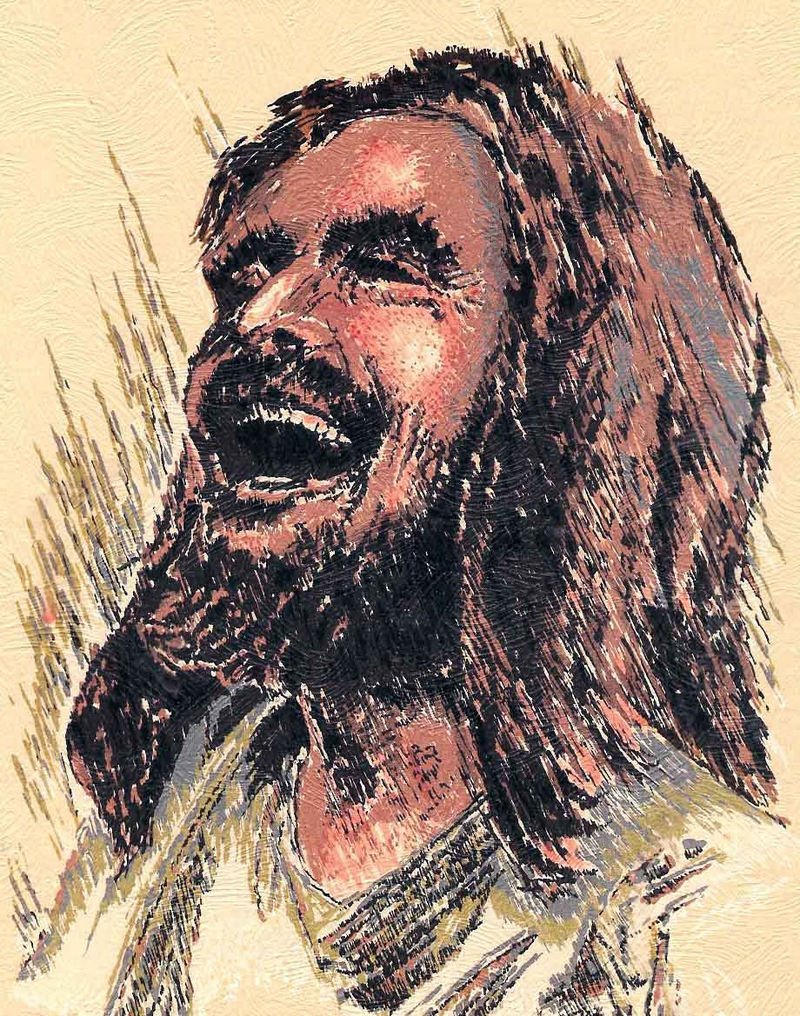
laughing Jesus

Readings for 22nd Sunday in Ordinary Time: SIR 3: 17-18, 20, 28-29; PS 68: 4-5, 6-7, 10-11; HEB 12: 18-19, 22-24A; LK 14: 1, 7-14. http://usccb.org/bible/readings/090113.cfm

In this morning’s gospel, Jesus finds himself invited for dinner to the home of a Pharisee. All present, Luke tells us, are watching Jesus closely. No doubt, they’re keeping an eye on his disciples too. And they don’t approve.

After all, like Jesus, his disciples are mere riff-raff. But at least Jesus is the reputed peasant-rabbi. Everyone’s talking about him. And investigating Jesus is the whole reason for this dinner. So for the moment at least, the Pharisees are willing to cut him some slack.

His hangers-on however are a different story. They’re rough. They smell of fish and sweat, and have no manners. And yet, as Jesus’ friends, they’ve been placed towards the head of the table in places of honor. Granted, they feel out of place, but for that very reason they are enjoying themselves tremendously. You can imagine their rough jokes and loud laughter.

Yes, the Pharisees are watching Jesus and his friends. But obviously, Jesus has been watching them as well. He knows they are expecting some words of wisdom. So . . . he tells them a joke. And the joke’s on them. It contains a sharp barb.

“Thanks for inviting us to this banquet,” Jesus begins. “Unaccustomed as we are . . .” He pauses and smiles. “That’s quite generous of you. After all, none of us can repay your kindness. We are homeless people, as you know. We’re unemployed too, so we are in no position to return your kindness.

The best I can do is offer you some wisdom. So let me tell you what I’ve been observing here.

“Evidently,” Jesus goes on, “it’s your custom to adopt the humility recommended in the biblical Book of Sirach. I can’t tell you how impressed I am; I’m edified by your piety. I mean, you have clearly taken to heart the words of the sage, Jesus ben Sirach – what he said about being humble, especially if we are ‘great’ as all of you are here, I’m sure.”

Jesus eyes his listeners. He can tell that they are waiting for the penny to drop. So he drops it.

“I can see that when you come into a place like this, you take the lowest place available.” With this, Jesus stands up bows his head, stoops his shoulders and slumps towards the lowest place at table. He laughs.

“That way,” the Master continues, “our host, of course, is obliged to publically invite you to a more honored position at table. ‘Friend,’ he’ll say, ‘come up higher, and sit in the place you’ve merited not down there with the unwashed and poor.’”

Now Jesus is standing. He throws out his chest and strides towards the seat right next to his pharisaical host. He chuckles again. “That enables you,” Jesus continues,” with great protestations of unworthiness, to take your ‘rightful’ place at table. Your stock has risen in everyone’s eyes.

“So congratulations are in order,” Jesus says. “All of you have learned your lessons well. You’ve just created a show, and have actually exalted yourself by pretending to be humble. In a sense, you’ve received your reward.”

Jesus is seated now and looking intently at everyone. Their mouths are open with shock.

“So here’s my wisdom, friends. . . . Your ‘humility’ is not what Sirach was recommending. In fact, it’s a form of pride and self-promotion.

“Instead, real humility is this: when you throw a party like this one, invite the poor, the lame and the blind, and then serve them. Place them at the head of your table and treat them as honored guests. People like that can’t or won’t repay you. But in fact, YOU OWE THEM.” Jesus fairly shouts those last three words.

“I’m telling you the truth,” he says. And humility is nothing but the truth.”

Jesus pauses, but he hasn’t finished yet. “You see, those belonging to what you consider the Great Unwashed are actually God’s favorite people. Recall what the psalmist said about them in Psalm 68. He said God is the Father of orphans; he’s the defender of widows, of prisoners, of the homeless, and of farmers without land.”

Jesus is quiet now; his smile is broad and friendly. He searches the faces of his table companions one-by-one.

Then he turns to his host and adds.

“To be fair, my friend, you yourself are on the right track. By inviting us today, you’ve shown that you already understand what I’ve been saying. As I say, none of us can repay you, and yet you’ve invited us to this abundant table. We are sincerely grateful.

“But don’t think that you’ve somehow performed an act of charity by your invitation. No, it’s an act of justice – of compensation to make up for what you have stolen from the poor by underpaying them and taxing them heavily. In supporting the poor and even the “lazy,” you are simply imitating our generous God.

“I mean the earth and its produce are all gifts from God. No one has earned them. No one owns them but the creator. If you have food, then, you are obliged to share it with the hungry – even with those unwilling to work. As difficult as it might be to understand, that’s simply the divine dispensation.

“The earth and the life it supports have been freely given to everyone – even to people like me and my friends who refuse to work and live from the alms of friends like you. No one deserves life or food more than anyone else. So in effect, you are obliged to do what you’ve done.

(Homilist’s note) None of this needs commentary from me.

What’s your commentary?

Combat Greed (and illness): Boycott McDonald’s, Wal-Mart, Subway . . . (Sunday Homily)

McDonalds

Readings for the 18th Sunday in Ordinary Time: Ecc. 1:2, 2: 21-23; Ps. 90; 3-6, 12-14, 17; Col. 3: 1-5, 9-11; Lk. 12: 13-21. http://www.usccb.org/bible/readings/080413.cfm

This week’s liturgy of the word focuses on greed, its idolatrous nature, and how death (the Great Leveler) puts greed in stark perspective.

According to the prophet, Qoheleth, the shortness of life renders “empty” (vain) any life devoted to amassing wealth. Life is not about money, Paul agrees in this morning passage from Colossians. It’s about following Jesus by bringing forth our true Self which is identical with the God who dwells within each of us. But our time for doing so is short. As the Psalmist puts it in today’s responsorial, our days are numbered; that realization alone, he says, should give us wisdom. Then in today’s gospel selection, Jesus contrasts such wisdom with the foolishness of human surrender to the economics of growth. Paul even terms such greed “idolatry,” the ultimate biblical sin.

Those readings have driven me to think about greed in my own life. It makes me think about my own approaching death and what I do each day to hasten its arrival. At the public level, I’m driven to consider today’s headlines about fast-food workers and the difference in pay between them and their ultimate bosses. It makes me think about resisting greed at both levels (personal and corporate) in very practical, effective ways. Let me explain.

Last week I traveled from our summer home in Michigan back to our permanent residence in Berea, Kentucky. When I arrived home, the cupboard was bare – no food. So I set out to get something to eat for supper. Problem was, our local health food store, “Happy Meadows,” was closed.

Fast food options like McDonald’s, Wendy’s, and Subway called to me. Despite nearly forty years of sharing board with a dedicated vegetarian, the urge to eat meat is still strong. However, I was too haunted by what I’ve learned from “Food Inc.” and similar films, books and articles. Their images of factory farms and the cruel mistreatment of cattle, pigs, and chickens can never be erased from my consciousness. In their light, eating dead animals raised on feed lots and super-cramped pens, and then killed for my platter almost turned my stomach. I just couldn’t bring myself to eat meat.

I remembered that Walgreens and Rite Aid sold packaged fast food. So I went to the drugstore to look around. As I probably should have foreseen, the food offerings there were . . . well, highly drugged. I mean I easily found non-meat offerings on the Walgreens shelves – items like Kraft Mac & Cheese; I found vegetarian frozen pizza, and other similar items. But they were mostly full of fats. And as I looked at some lists of ingredients, I found many I couldn’t even pronounce. Chemicals were often high up on the lists, meaning their presence was rather intense. “Why would I put that stuff in my body?” I thought. “Do I want to get fat and sick?” So I walked out still hungry, still searching for something to eat.

I drove to Subway remembering their veggie sub. The young man behind the counter asked, “May I help you?”

“Just looking,” I said.

I scanned the brightly lit menu over his head. There it was, the Veggie Sub. Should I get the six-inch or the twelve-inch? I looked at the young man again. There he was with his plastic gloves in place smiling and eager to serve me.

Then I remembered. This kid is making $7.35 an hour. Whether he’s aware of it or not, his comrades all across the country are striking to double that wage to $15.00 an hour. They’re walking off the job in places like New York City, Chicago, St. Louis, Milwaukee, Kansas City, Detroit and Flint, Michigan. They’re demanding not just a living wage but the right to unionize. Unionization would mean the end of the Fast Food Industry’s routine practice of “short-working” employees, i.e. preventing them from putting in enough weekly hours to qualify for the benefits that come with full-time employment.

Those striking workers don’t want me here, I thought. So I turned on my heel and left.

Soon I found myself cruising the aisles of Save a Lot. I bought some pasta, and some sauce. I picked up a head of broccoli (Dole! Ugh!). I returned home to throw my supper together.

The little episode helped me come face-to-face with greed – again the topic of today’s liturgy of the word. I had to confront my own greed and that of the corporations that dominate our culture.
My particular greed manifests itself at least three times a day at the table. There my actions say a whole lot: I want meat. I want its flavored grease. I want salt. I want sugar. I want convenience. I want instant gratification.

My spiritual teacher, Eknath Easwaran, would say all of that means, “I want a heart attack. I want diabetes. I want cancer. I want to die as soon as I can.”

My well-ingrained tendencies also imply that “I don’t care about justice or workers who put in forty hours or more (often on two or more jobs) and who still cannot put together a dignified life without Food Stamps. I don’t care that they want to unionize and they’re asking me to boycott McDonald’s, Wal-Mart, and other corporate giants who underpay their workers while amassing obscene fortunes for themselves.

To those workers (and their bosses), the words of Qoheleth apply:

“Here is one who has labored with wisdom and knowledge and skill,
and yet to another who has not labored over it,
he must leave property.”

Usually, these words are taken to apply to the rich who are thought to labor long hours without really enjoying life. In the end, they leave their property to their heirs who benefit from their now-deceased relative’s work.

However, with the Bible’s overwhelming “preferential option for the poor,” I think the words apply even more fittingly to workers like the one in Subway and those in McDonald’s, Wal-Mart, Wendy’s, etc. Those “associates” labor with wisdom, knowledge and skill and then get underpaid. The wealth they produce (their property) goes to their fat-cat bosses. Meanwhile the rest of us are forced to subsidize those fat-cats by making up the difference (in food stamps, Medicaid, WIC Programs, etc.) between the wages the bosses pay their workers and the true living wage those workers deserve.

Yes, so-called “welfare programs” are more directed towards the rich than the poor. For working people such “welfare” should be replaced by a living wage.

Qoheleth says such selfishness and greed creates empty lives, anxiety, sorrow, grief and sleepless nights for all concerned both rich and poor.

A friend of mine constantly reminds me that little can be done to change the world. We just have to go along with the way things are, he often says. Sometimes I think he’s right.

However, today’s liturgy of the word reminds us that he might not be completely correct. At least we can do something about underpaid fast food and big box workers. That’s not trivial. We can relieve the “vanity,” the emptiness of their lives by joining them in their efforts to unionize and achieve a living wage.

We can abstain from the products of McDonald’s, Subway, Wal-Mart and similar corporations – and perhaps even become more healthy in the process.

Our presence here at the Lord’s Supper says we’re willing to do that, so that all may share in the gift of God’s bread with dignity and joy.

Am I right in saying that? What do you think?
(Discussion follows.)

We Are Called to Atheism by Abraham and Jesus! (Sunday Homily)

drone victims

Readings for the 17th Sunday in Ordinary Time: Gn. 18:20-32; Ps. 138:1-3, 608; Col. 2:12-14; Lk. Ll:1-13. http://www.usccb.org/bible/readings/072813.cfmhttp://www.usccb.org/bible/readings/072813.cfm

Today’s readings about Abraham bargaining with God and about Jesus teaching his followers to pray raise some vital questions about God’s personality and existence. Abraham’s compassionate God seems to conflict with the warlike God who appears elsewhere in the Bible.

So who’s right? Should we be afraid of God? Or can we trust him? Is God warlike and punitive or kind and forgiving? If he’s our “Daddy” (that’s what “Abba” means in Jesus’ prayer: “Our Daddy who transcends everything”) does our experience show him to be abusive or loving? Today’s readings help us wrestle with those questions. In fact, they call us to a holy atheism.

But before I get to that, let me frame my thoughts.

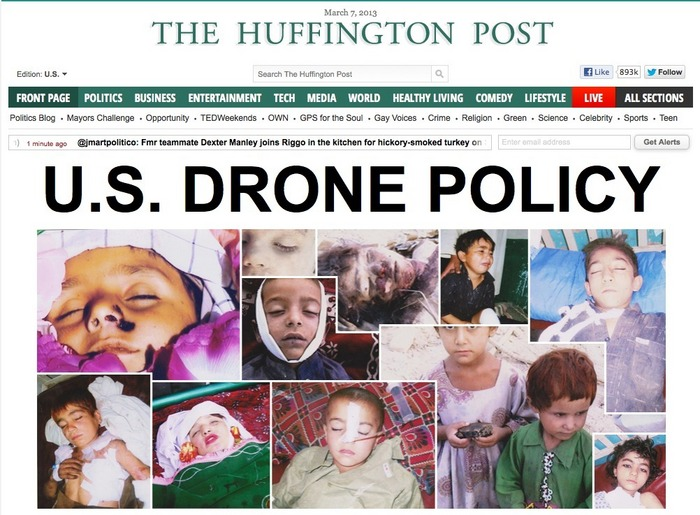
Last week the government of Pakistan released a classified document revealing that scores of civilians had been killed in dozens of CIA drone strikes between late 2006 and 2009. That period mostly covered the final years of the Bush administration. However as we all know, such strikes have increased under the presidency of Barrack Obama.

Citing the leaked report, the London Bureau of Investigative Journalism said “Of 746 people listed as killed in the drone strikes outlined in the document, at least 147 of the dead are clearly stated to be civilian victims, 94 of those are said to be children.”

Meanwhile, the United States has consistently denied that significant numbers of civilians have been killed in drone strikes. It claims that “no more than 50 to 60 ‘non-combatants’ have been killed during the entire, nine-year-long drone campaign.” Our government argues that such numbers are tolerable because the strikes protect Americans from the terrorists actually killed in the drone operations.

That’s the logic our government has adopted as it represents our country where 78-85% of the population claims to follow the one who refused to defend himself and gave his life that others might live. The logic of most American Christians says that killing innocents – even children – is acceptable if it saves American lives. Apparently, that’s the American notion of salvation: better them than us.

However that way of thinking is not what’s endorsed in today’s liturgy of the word. (And here I come back to those questions I raised earlier about God’s personality and existence.) There in Sodom and Gomorrah, Yahweh refuses to punish the wicked even if it means that as few as 10 innocents would lose their lives in the process.

Better-us-than-them is not the logic of Jesus who in teaching his disciples to pray tells them that God is better than us. God gives bread to anyone who asks. Yahweh acts like a loving father. He forgives sin and gives his children what they ask for. In fact, God shares his Spirit of love and forgiveness – he shares Jesus’ spirit of self-sacrifice – with anyone who requests it.

Elsewhere, Jesus says something even more shocking. Yahweh doesn’t even prefer the good over the wicked, he says. He showers his blessings (not bombs!) on everyone. Or as Jesus himself put it, God makes the sun rise on the virtuous and the criminal; his rain benefits those we consider evil as well as those we classify as good (Mt. 5:45). We should learn from that God, Jesus says, and be as perfect like him (Mt. 5:48). In fact, we should consider no one “the enemy” not even those who threaten us and kill us even as Jesus was threatened and killed (Lk. 6: 27-36).

How different is that from the way most of us think and act? How different is that from the God we’ve been taught to believe in?

Yes, you might say, but what about those other passages in the Bible where God is fierce and genocidal? After all, the Great Flood must have killed many good people and even children. And God did that, didn’t he? What about his instructions (more than once) to kill everyone without distinction. For example the Book of Joshua records: “Thus Joshua struck all the land, the hill country and the Negev and the lowland and the slopes and all their kings. He left no survivor, but he utterly destroyed all who breathed, just as the LORD, the God of Israel, had commanded (Joshua 10:40). What about the Book of Revelation, which many Christians argue predicts God’s total destruction of the world? What about that violent, pitiless, threatening God? Is that the “Abba” of Jesus?

Good questions. They’re good because they make us face up to the fact that the Bible is ambiguous about God. No, let me put it more strongly. The Bible isn’t just ambiguous about God. It’s often plain wrong – at least If we adopt the perspective of Jesus and Abraham in today’s readings.

After all, Abraham’s God is not genocidal; Joshua’s is. Jesus’ God is not genocidal; Joshua’s is. Those Gods are not compatible. One of them must be false. Or as Jack Nelson Pallmeyer writes in his book Is Religion Killing Us? “Either God is a pathological killer or the Bible is sometimes wrong about God.”

Today’s readings show us that both Abraham and Jesus agree.

The Abraham story is about a man gradually rejecting Nelson’s Psychopath in the sky. Israel’s furthest back ancestor comes to realize that God is merciful, not punitive or cruel. Or as the psalmist puts it in today’s responsorial, God is kind, true, and responsive to prayer. God protects the weak and lowly and is distant from the powerful and haughty. In today’s reading from Genesis, we witness Abraham plodding slowly but surely towards that conclusion.

It’s the realization eventually adopted by Jesus: God is a kind father, not a war God. If Abraham’s God won’t tolerate killing 50 innocent people, nor 45, 40, 30, 20, or even 10, Jesus’ God is gentler still. That God won’t tolerate killing anybody – not even those threatening Jesus’ own life.

All of that should be highly comforting to us. It has implications for us, politically, personally and liturgically.

Politically it means that followers of Jesus should be outraged by anyone connecting Jesus with our country’s perpetual war since 9/11, 2001. A drone program that kills the innocent with the targeted flies in the face of Abraham’s gradually-dawning insight about a merciful God. The war itself makes a complete mockery of Jesus’ total non-violence and the words of the prayer he taught us. Those supporting “America’s” “better them than us” attitude are atheists before Jesus’ God and the one depicted in the Abraham story.

Personally, what we’ve heard this morning should drive us towards an atheism of our own. It should cause us to review and renew our understandings of God. Impelled by today’s readings, we should cast as far from us as we can any inherited notions of a pathological, punishing, cruel, threatening and vindictive God. We need that holy atheism. Let’s pray for that gift together.

And that brings us to today’s liturgy. In effect, we’ve gathered around this table to hear God’s clarifying word, and symbolically act out the peaceful world that Jesus called “God’s Kingdom.” We’ve gathered around this table to break bread not only with each other, but emblematically with everyone in the world including those our culture considers enemies.

I mean if God is “Our Father,” everyone is our sister, everyone, our brother. It’s just that some couldn’t make it to our family’s table today. But they’re here in spirit; they’re present around this altar. They are Taliban and al-Qaeda; they are Iraqis, Afghanis, Yemenis, and Somalis; they are Muslims and Jews; they include Edward Snowden and Trayvon Martin. They include those children killed in U.S. drone strikes. They are you and I!

All of us are children of a loving God. Jesus’ “Lord’s Prayer” says that.

Now that’s something worth celebrating.

When the Government Turns Criminal: Edward Snowden and the Good Samaritan (Sunday Homily)

Snowden

Readings for 15th Sunday in Ordinary Time: DT. 30: 10-14; Ps. 69: 14, 17, 30-31, 34, 36-37; Col. 1: 15-20; Lk. 10: 25-37. http://www.usccb.org/bible/readings/071413.cfm

In his recent book about the parables of Jesus (The Power of Parable: How Fiction by Jesus Became Fiction about Jesus), John Dominic Crossan poses the question: What happens to your world when the “best” people act badly and only the “worst” do what is right?

That scenario seems to be playing itself out in the case of Edward Snowden.

Snowden, you recall, is the NSA contractor and CIA employee who last month disclosed a vast secret program of U.S. government spying on its own citizens and on individuals, corporations, and governments throughout the world.

The program (Prism by name) seems to violate the Fourth Amendment of the U.S. Constitution which reads: “The right of the people to be secure in their persons, houses, papers, and effects, against unreasonable searches and seizures, shall not be violated, and no Warrants shall issue, but upon probable cause, supported by Oath or affirmation, and particularly describing the place to be searched, and the persons or things to be seized.”

Snowden made his disclosures three months after James Clapper, the Director of U.S. intelligence had denied its existence in testimony (under oath) before the Senate Committee overseeing the U.S. intelligence program. Snowden’s disclosures also followed hot on the heels of President Obama’s publically expressed concern that China was illegally spying on the U.S. in exactly the same way (though on a smaller scale) that the U.S. turns out to have been spying on China and its own allies.

For his troubles in exposing such lies, hypocrisy, and violations of the Constitution, Snowden himself has been designated a spy, traitor, and enemy of the United States – categories applied to its worst enemies. As a pariah in his own country, he has fled the United States and sought asylum in various countries including China, Russia, Cuba, Nicaragua, Venezuela, Ecuador, and Bolivia. Snowden (and human rights organizations such as Amnesty International) alleges that if extradited to the U.S. he is unlikely to receive a fair trial, but instead to be tortured and indefinitely imprisoned like other whistleblowers such as Bradley Manning.

All of the countries just mentioned have histories less-than-friendly to U.S. interests, which they have each described as criminally imperialistic. Other “good” countries such as France and Germany have (under great pressure from the United States) refused Snowden asylum.

Meanwhile, James Clapper has not been charged with perjury, and President Obama has managed to deflect attention away from constitutional violations to the search for the fugitive Snowden.

In other words, the Snowden Affair presents us with a “Spy,” “Traitor,” and “Terrorist Sympathizer” obeying his conscience in his exposure of government crime. He has done the right thing. Meanwhile, the President of the United States, himself a constitutional lawyer, has been caught violating the Constitution, and the Director of Intelligence has been exposed as a perjurer. And on top of that, friendly countries often lauded by the United States as models of democracy refuse to respect International Law governing asylum seekers. Only the “bad countries” are willing to honor that law.

In this situation, the question Crossan posed earlier finds uncomfortable relevance: “What happens to your world if a story records that your “best” people act badly and only your “worst” person acts well?”

As I said, Crossan asks that question in the section of his book commenting on “The Good Samaritan” which is the focus of the gospel selection in today’s Liturgy of the Word.

The parable, of course, is very familiar. Almost all of us know it nearly by heart. Typically sermons find its point in simply calling us to be “follow the Samaritan’s example, treat everyone as your neighbor, and help those you find in trouble.”

That’s a good point, of course. But Jesus’ own intention went beyond simply providing an example of a good neighbor. More profoundly, it focused on the hypocrisy of “the good” and the virtues of designated enemies. As such, the story calls us to transcend those socially prescribed categories and look at actions rather than words of both the “good” and “bad.”

More specifically, the hero of Jesus’ story is a Samaritan. According hero status to such a person would be unthinkable for Jesus’ listeners. After all, Samaritans were social outcasts belonging to a group of renegade Jews who (by Jesus’ time) had been separated from the Jewish community for nearly 1000 years. They had also polluted the Jewish bloodline by intermarrying with the country’s Assyrian conquerors about 700 years earlier.

Jews considered Samaritans “unclean;” they were traitors, enemy-sympathizers, heretics and even atheists. They rejected Jewish understandings of Yahweh and the Temple worship that went along with it.

And yet in the story, Jesus finds the Samaritan to be more worthy, more pleasing in God’s eyes than the priest or Levite. That’s because the Samaritan’s actions speak much louder than the word “Samaritan” would allow. He is compassionate; so Jesus approves.

In the meantime, the priest and the Levite lack compassion. Their actions condemn them.

They say that slightly more than 50% of the American people think Edward Snowden is a traitor and spy. And this despite the fact that his accusers have advanced no evidence to that effect – and despite polls that indicate a solid majority believing that the government’s surveillance program is objectionable if not clearly unconstitutional.

Today’s parable invites us to reconsider – not just Snowden, but our very understanding of the world and its categories of “good” and “evil.”

Perhaps we’re looking for the real criminals, traitors, spies, and terrorists in exactly the wrong places.