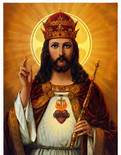
The Church’s Disastrous Domestication of Jesus (Sunday Homily)

King of the Universe

Readings for the feast of “Our Lord Jesus Christ, King of the Universe”: 2 SM 5: 1-3, PS 122: 1-5; COL 1: 12-20; LK 23: 35-43. http://usccb.org/bible/readings/112413.cfm

Today the Catholic Church celebrates the feast of “Our Lord Jesus Christ, King of the Universe.” The contrast between the feast’s grandiose title and the readings prescribed for the occasion illustrate a basic reason behind the irrelevance of the church (and Jesus) to the post-modern world. It’s irrelevant to the social and economic transformations necessary to redeem the church’s overwhelmingly Third World membership from globalized oppression.

The contrast I’m referring to involves the great makeover of Jesus of Nazareth changing him from the leader of an anti-imperial revolutionary movement into a pillar of the exploitative status quo.

Let me put it this way: through 4th century sleight of hand, the Jesus who sided with the poor and those oppressed by empire – the one who promised a new heaven and earth belonging to the simple and poor, and who was executed as a terrorist by Rome – was made to switch sides. He was co-opted and domesticated – kicked upstairs into the royal class. He became not only a patron of the Roman Empire, but a “king” complete with crown, purple robes, scepter and fawning courtiers.

Following that transformation, kings and popes (now themselves transformed into gaudy temporal rulers) claimed to govern by divine right on behalf of Jesus as his representatives and vicars. In this way, the poor and oppressed (who then and now constitute the world’s majority) lost their paradigmatic leader, example and advocate. Jesus became instead a key part of the apparatus oppressing them.

Reza Aslan’s recent best-seller, Zealot, attempts to rescue the revolutionary historical Jesus from the distortions of the royal classes just mentioned. Aslan connects his salvage project specifically with today’s account of Jesus’ crucifixion in Luke, Chapter 23. In doing so, the author pays particular attention to Jesus’ cross, to the Roman inscription identifying Jesus as “King of the Jews,” and to the dialog between Jesus and the two “thieves” presented as sharing his fate.

According to Aslan, all three – cross, inscription and dialog – mark Jesus as a dangerous revolutionary “terrorist” rather than a domesticated upholder of the given order. That terrorist remains as threatening to today’s dominant empire, the U.S.A., as he was to imperial Rome. So he continues to be erased from history and by “feasts” like today that mask his true identity.

Take the cross first. It was the mode of execution reserved primarily for insurrectionists against the Roman occupation of Palestine. The fact that Jesus was crucified indicates that the Romans believed him to be a revolutionary terrorist. How could it have been otherwise, Aslan asks? After all, Jesus was widely considered the “messiah” – i.e. as the one, like David in today’s first reading, expected to lead “The War” against Israel’s oppressors.

Moreover, he proclaimed the “Kingdom of God,” a highly politicized metaphor which could only be understood as an alternative to Roman rule. It would return Israel, Jesus himself promised, to Yahweh’s governance and accord primacy to the poor and marginalized. The Romans drew logical conclusions. Put otherwise, the Roman cross itself provides bloody testimony to the radical threat the empire saw personified in Jesus.

That threat was made specific in the inscription the Romans placed over the head of the crucified Jesus. It read, “King of the Jews.”

Typically, those words are interpreted as a cruel joke by the Roman procurator, Pontius Pilate – as if he were simply poking fun at those who saw Jesus as the worthy successor of Israel’s beloved King David.

However, according to Reza Aslan, nothing humorous was intended by the inscription. Instead it was a titulus. Every victim of crucifixion had one – a statement of the reason for his execution. The motive for Jesus’ crucifixion was the same as for the many others among his contemporaries who were executed for the same crime: aspiring to replace Roman rule with home rule – with an Israel governed by Jews instead of Romans. The titulus on Jesus’ cross, along with the cross itself identify him as the antithesis of what he eventually became, a Roman tool.

And then there are those two thieves. Aslan says they weren’t “thieves” at all. That’s a mistranslation, he points out. A better translation of the Greek word, lestai , would be “bandits” – the common designation in the first century for insurrectionists. And there probably weren’t just two others crucified the day Jesus was assassinated. There may have been a dozen or more.

And, no, the whole world wasn’t watching either. As scripture scholar John Dominic Crossan observes, Jesus would have represented hardly a blip on the screen of Pontius Pilate. And Jews would have averted their eyes from the spectacle depicted in this morning’s gospel. They wouldn’t want to see “one more good Jew” suffering the fate of so many heroic patriots.

In this context the dialog between Jesus and two of the terrorists crucified with him takes on great significance. Actually, it documents the beginning of the process I described of changing Jesus’ image from insurrectionist to depoliticized teacher.

Think about it. Luke’s account of Jesus’ words and deeds was first penned about the year 85 or 90 – 20 years or so after the Roman-Jewish War (66-70 C.E.). By then the Romans had utterly defeated the Jews, destroyed Jerusalem and its temple as well as slaughtered the city’s population including practically all of the eyewitnesses of Jesus’ messianic campaign. Virtually the only Christians left standing were foreigners – gentiles living in population centers like Rome, Alexandria and Antioch. Few of these had any understanding of or sympathy for Judaism much less for Jewish politics and its liberation movements.

Besides that, in the war’s aftermath, both Jews and Christians sought to distance themselves from the socio-political expectations that had brought on the disaster of the Jewish War. So Judaism tried to transform itself from a Temple-centered religion to one focused on the local synagogue and rabbinic teaching – both overwhelmingly concerned with simply preserving the culture and identity of a people in diaspora.

For their part, Christians became anxious to show the Roman world that it had nothing to fear from their membership.

One way of doing that was to distance the dying Jesus from the Jewish insurgents and their terrorist actions against their oppressors. So in Luke’s death-bed dialog among three crucified revolutionaries, one of the terrorists admits that Jesus is “under the same sentence” as he and his comrade in arms. Given what Aslan said about crucifixion, that fact was undeniable. All three had been sentenced as insurrectionists.

But now comes the distancing between Jesus and Israel’s liberation movements. Luke has the “good thief” (read good terrorist) say, “. . . indeed we have been condemned justly, for the sentence we received corresponds to our crimes, but this man has done nothing criminal.”

In other words, Luke (writing for a post-war Roman audience) dismisses insurrection as “criminal,” and removes Jesus from association with such crime – a fact endorsed, Luke asserts, by insiders like the honest lestai crucified with Jesus. Luke’s message to Rome: the killing of Jesus was a terrible mistake; he meant no harm to Rome. And neither do we, his followers.

Loss of the radical revolutionary Jesus is not a trivial matter in terms of Christianity relevance to a world ruled by a nation that styles itself as Rome’s worthy successor. Like its ancient archetype, the U.S. (and a majority of first-world Christians) found the historical Jesus so threatening, that it determined that Jesus’ followers deserved the same fate as their crucified Master. For this we have the evidence of the war that the U.S. fought against liberation theology when it first emerged following the conclusion of the Second Vatican Council (1963-65).

Liberation theology committed the unforgiveable sin represented by this homily. It was guilty of connecting the Jesus of history described by scholars like Aslan to post-colonial independence movements and struggles against the neo-colonialism spearheaded by the U.S. and its oligarchical clients in the Third World.

In that struggle Pope John Paul II and his henchman, Josef Ratzinger, threw in their lot with a neo-imperial Ronald Reagan. It was deja-vu all over again: Reagan as Pilate and J.P.II and Ratzinger as the temple priesthood. It was the deja-vu of the church melding its interests with Rome towards the end of the 4th century.

More specifically, the two reactionary popes looked the other way and actively supported Reagan’s policies that assassinated hundreds of thousands of Christians (200,000 in Guatemala alone!) who found the radical Jesus threateningly relevant to their struggles in Latin America, Africa, and South Asia.

To balance liberation theology’s threat, Reagan patronized Evangelical Christians who eventually morphed into the Tea Party. It finds Aslan’s understanding of Jesus anathema. Meanwhile, John Paul II and Ratzinger “cleaned house,” eliminating every single progressive bishop from the hierarchy and transforming seminaries into hot houses to nurture a pre-Vatican II reactionary clergy.

Recently Pope Francis delivered a long-winded, very general and content-less speech to the National Council of Bishops in Brazil. That group used to head a church that was a hot-bed of liberation theology I’ve been describing here. The term was never mentioned in the new pope’s remarks. Instead, he presented John Paul II and Pope Ratzinger as champions of Vatican II.

He’ll have to do better than that to fulfill his aspiration towards making the church relevant to the poor he professes to care so much about.

He’ll have to confess the Church’s sins against liberation theology and revive the cult of the historical Jesus – instead of the depoliticized imperial “King of the Universe” today’s feast calls to mind.

If They Won’t Work, Let the Rich Starve! (Sunday Homily)

Work Eat

Readings for 33rd Sunday in Ordinary Time: MAL 3: 19-20A; Ps. 98: 5-9; 2 THES 3: 7-12; LK 21: 5-9. http://www.usccb.org/bible/readings/111713.cfm

Today’s readings appear to centralize “the end of the world.” So you can expect your preacher this morning to focus on the after-life, pie-in-the-sky, and all the “Left Behind” nonsense that has become the staple of Christianity ever since the 4th century.

Expect them to point to natural disasters, “plagues” like the AIDs pandemic, and the wars of choice so near and dear to our politicians – as signs that the end is near, that God is pissed, and we’d better repent and accept Jesus as our personal Lord and savior.

And, Oh yes, there’s Paul’s dictum in today’s reading from Second Thessalonians “. . . if anyone was unwilling to work, neither should that one eat.” Expect that one to evoke anti-welfare themes of bootstrap self-sufficiency, references to God-helps-those-who-help-themselves, and easy references to “welfare queens.”

I’m not kidding, 2 Thessalonians 3: 10 is a favorite of the Christian right. North Dakota congressman, Kevin Cramer, used it recently to justify his vote to cut nearly $40 billion from the Food Stamp program that keeps the children of poor families from starvation, along with the elderly and disabled. Tea Part darling, Michelle Bachman, did the same thing. When trying to get her party’s nomination for president, she said, “Our nation needs to stop doing for people what they can and should do for themselves. Self-reliance means, if anyone will not work, neither should he eat.”

It’s all so tiresome and predictable.

The right loves embracing Paul’s out-of-context remark. Tea Baggers love ignoring Jesus’ feeding thousands free of charge. It’s as if Jesus’ parable about sheep and goats in Mt. 25 didn’t base everything on a practical recognition of his identification with the hungry, thirsty, homeless, imprisoned, and ill-clad. The right loves “tough love.” It loves apocalypse.

But, of course, there’s not a trace of “tough love” in Jesus’ treatment of the poor. And “apocalypse” is not about the end of the world. It’s about unsustainability. The word apocalypse means “unveiling.” It’s about “revelation” in that sense – making evident what’s hidden about the world and who’s in charge. Apocalypse affirms the unsustainability of empire. Radical change is inevitable.

Apocalypse emerged a few centuries before the birth of Jesus. To convey its message of impending radical change, it employed stock images of natural catastrophe, plagues, wars, earthquakes, and portents involving the sun, moon, and stars. The change would be cosmic.

The audience of this strange literary form was empire’s victims. It was meant to encourage the poor and dispossessed, the unemployed, sick, widowed and orphaned – not the rich and well-off. Apocalypse assured the poor that all systems of oppression end in flames whether they’re Egyptian, Assyrian, Babylonian, Persian, Greek, or Roman. (Those are the global giants that oppressed Israel at one time or another in its history.) Where are they today? They’ve been swept away by the tide of history. And the apologists for “Eternal Rome” find themselves somewhere in antiquity’s dustbin.

So it’s ironic that apocalypse should be embraced by conservatives and their rich patrons – by those who want to keep things as they are. Things do not have to be that way. And “by God,” they won’t be! That’s the message of apocalypse. A new era is dawning, and you’d better be on the right side of history or you’ll lose out. Being “left behind” means supporting the old order that’s doomed.

The problem is that right from the beginning, believers took literally the cosmic and highly poetic symbolism of apocalypse. (We always get in trouble for being too literal.) That’s the attitude that caused Paul to tear his hair out in today’s second reading. Some in the early Christian community took the imminence of this expectation so seriously that they even stopped working.

What was the point of work, they reasoned? Everything was about to change profoundly by God’s intervention. That made human work meaningless. All believers had to do was sit back and wait for Jesus’ triumphant arrival. Eat, drink, be merry, and whistle past the graveyard in the meantime.

Those are the people Paul addresses in this morning’s excerpt from Second Thessalonians. He’s clearly exasperated. He says, “Look I’m working. And I’m the one responsible for your believing in Jesus’ Second Coming! Get real, people. Go back to work. Stop sponging off the community. Instead, be like me and do your part to bring about the new order we all expect. “

Paul’s words bring to mind the people who refuse to work today because they deem apocalyptic expectations divinely ordained or “natural.” And I’m certainly not referring to welfare queens.

Instead, I’m talking about people so committed to the old order that (with Margaret Thatcher) they’re convinced that “There is no alternative,” even though the “inevitable order” they support threatens the very survival of their own grandchildren. So they do what must be done to perpetuate what in God’s eyes is unsustainable.

Such “busy-bodies” refer to their endeavors as “work,” but in reality, their occupations represent a refusal to work. That is, if we identify that term with what contributes to life and the establishment of the Kingdom community Jesus proclaimed.

On this understanding, involvement in the military and the military-industrial complex is certainly not work. Neither is labor in financial market casinos or in the health-insurance and fossil fuel industries and their nuclear power counterparts. Advertising, fashion, professional sports, or much of what we refer to as “education” and journalism might also qualify as anti-work. Such occupations are not only highly questionable in terms of building up human community and protecting the planet. They are often positively destructive. Their purpose is to ward off or distract from the impending Big Change promised by the great unveiling.

Do I mean followers of Jesus should renounce such “work?” Yes I do. Or at least, we need to work to bring about a world where such occupations are not rewarded with pay – i.e. with a ticket to overconsumption even in terms of food and drink. And, to quote St. Paul, if arms manufacturers want to continue their anti-work as inevitable, let them starve! The world will be better off.

What about the unemployment caused by such radical change? It’s simple: share the remaining work. Make sure everyone is working – say for four hours each day, or three days a week, or six months each year. Get everyone to work building or rebuilding infrastructure, paving highways and covering rooftops with solar cells, and cleaning up the dump sites where all our toxic waste has been buried.

Think of the freedom such changes would create for building up God’s kingdom – to play, to garden, write, converse, make love, raise our children, and do all the things that make us human!

“Totally unrealistic” you say? Precisely! Apocalypse is by nature unrealistic. It calls us to work for an entirely different order we can hardly imagine. It calls us to reclaim our humanity from the insanity of destructive anti-work.

I’ll bet you won’t hear much of that from your preacher today!

Dives & Lazarus: a liberation theology catechism (Sunday Homily)

Lazarus

Readings for the 26th Sunday in Ordinary Time: AM 6: 1A, 4-7; PS 146: 7-10; ITM 6: 11-16; LK 16: 19-31 http://usccb.org/bible/readings/092913.cfm

Today’s liturgy of the word provides us with a catechism of liberation theology – Christianity’s most important theological development in the last 1500 years, and the West’s most important social movement of the last 150 years.

I have come to those conclusions over a period of more than forty years studying liberation theology. My interest began in Rome during my graduate studies there, 1967 through 1972. There I first heard Peru’s Gustavo Gutierrez speak. (Fr. Gutierrez is considered the father of liberation theology.)

Subsequently I read Gutierrez’s book, A Theology of Liberation (1971) and was completely taken by it. Reading the book gave me the feeling that I was hearing Jesus’ Gospel for the very first time.

You might ask, what is liberation theology? To answer that question fully, please look at my blog entries under the “liberation theology” button. I’ve written a series on the question. In my blogs, you’ll find that I always define it in a single sentence. Liberation theology is reflection on the following of Christ from the viewpoint of the world’s poor and oppressed. That’s the class of people to which Jesus himself belonged. They constituted the majority of his first followers.

When read from their viewpoint, accounts of Jesus’ words and deeds – the entire Bible for that matter – take on depths of meaning and relevance to our contemporary world that are otherwise inaccessible to people like us who live in the heart of the wealthy world. From the viewpoint of the poor, God passes from being a neutral observer of earth’s injustices to an active participant with the poor as they struggle for justice here on earth. Jesus becomes the personification of that divine commitment to the oppressed. After all, he was poor and oppressed himself. The Roman Empire and its Temple priest collaborators saw to that.

My interest in liberation theology deepened as my teaching career developed at Berea College in Kentucky from 1974 to 2010. There I was encouraged to continue my study of liberation theology. So I spent extended periods in Brazil, Nicaragua, Costa Rica, Honduras, Guatemala, Cuba, Mexico, Zimbabwe, South Africa, India and elsewhere studying under liberation theologians, dialoging and publishing with them. The poor in all of those countries were suffering from the aggression the United States directed against them.

Meanwhile at Berea, I found the conclusions of liberation theologians validated by the college’s very fine scripture scholars. They had almost no acquaintance with liberation theology, and yet what they were teaching perfectly harmonized with its central tenets. It’s just that they stopped short of drawing what seemed to me the obvious political conclusions from their work.

More specifically, Berea’s scholars identified the Exodus (Yahweh’s liberation of slaves from Egypt) as God’s original and paradigmatic revelation. The whole tradition began there, not in the Garden of Eden. Moreover, the Jewish prophetic tradition emphasized what we now call “social justice.” Even more, Jesus of Nazareth appeared in the prophetic tradition, not as a priest or king. Jesus directed his “ministry” to the poor and outcasts. The Gospel of Luke (4: 18-19) has Jesus describing his program in the following words:

“The Spirit of the Lord is upon me, because he has anointed me to bring good news to the poor. He has sent me to proclaim release to the captives and recovery of sight to the blind, to let the oppressed go free, and to proclaim the year of the Lord’s favor.”

After his death, Jesus’ followers continued along those lines. They lived communally, having sold all their worldly possessions and distributed the proceeds to the poor.

All of that finds vivid expression in today’s liturgy of the word. As I said, it’s a kind of catechism of liberation theology. The reading from Amos the prophet describes the sin that most offends God – wealth disparity in the face of extreme poverty. Amos decries a “wanton revelry” on the part of the wealthy that sounds like the “American Way of Life” or the “Lives of the Rich and Famous” that we Americans find so fascinating. The prophet describes a rich class that lives like King David himself – in luxurious houses, overeating, drinking wine by the bowlful, and generally ignoring “the collapse of Joseph,” i.e. the poverty of their country’s most destitute. For that, Amos says, the rich will ultimately suffer. All their wealth will be confiscated and they will be driven into shameful exile.

In railing against the rich and defending the poor, Amos was calling Judah back to the worship of Yahweh whose attributes are described in today’s responsorial psalm. There God is depicted as loving the just and thwarting the ways of the wicked. The psalm describes Yahweh as securing justice for the oppressed, giving food to the hungry, and setting captives free. He gives sight to the blind and protects resident aliens, single mothers and their children.

Then today’s excerpt from 1st Timothy outlines the characteristics of those who worship that God by following in Jesus’ footsteps. They keep the commandment which is to do unto others as we would have them do unto us. According to St. Paul, that means pursuing justice and living with devotion, faith, love, patience, and gentleness.

Finally, the gospel selection from Luke chapter 16 dramatizes the sinful relationship between rich and poor and the destinies awaiting both. Luke tells the story of the rich man and “St. Lazarus” who is honored by the poor throughout Latin America.

It is significant that Lazarus is given a name in Jesus’ parable. Usually we know the names of the rich, while it is the poor that remain anonymous. Here matters are reversed. To remedy this anomaly, tradition has assigned the wealthy man a name. He’s called Dives, which is simply the Latin word for rich man.

For his part, Lazarus is quintessentially poor, hungry, and lacking medical care. His sores are open and the only attention they receive are from dogs that lick his wounds. Meanwhile, Dives seems completely unaware of Lazarus’ presence, though the beggar is standing at his very doorstep. Within the sight of Lazarus, the wealthy one stuffs himself with food to such a degree that the scraps falling from his table would be enough to nourish the poor beggar. But not even those crumbs are shared. How could Dives share? He doesn’t even know that Lazarus exists.

So the two men die, and things are evened out. The rich man goes to hell. We’re not told why. Within the limits of the story, it seems simply for the crime of being rich and unconsciously blind to the presence of the poor. For his part, Lazarus goes to the “bosom of Abraham,” the original Hebrew patriarch.

Lazarus is rewarded. Again, we’re not told why. Within the story, it seems simply because he was poor and Yahweh is partial to the poor, just as he was to the slaves God intervened to save when they were starving in Egypt.

Seated with Abraham, Lazarus feasts and feasts at the eternal banquet hungry people imagine heaven to be. Dives however is consumed by flame in the afterlife. Fire, of course, is the traditional symbol of God’s presence, or purification, and of punishment. This seems to suggest that after death, both Dives and Lazarus find themselves in the presence of God. However what Lazarus experiences as joyful, Dives experiences as tormenting.

And why? Simply, it seems, because Dives was rich, and Lazarus was poor.

Does the parable tell us that what awaits us all after death is a reversal of the economic conditions in which we now find ourselves? The first will be last; the last first. The rich will be poor, and the poor will be rich. That in itself is highly thought-provoking.

In any case, Yahweh is presented as champion of the poor in this parable, just as in the reading from Amos, in today’s responsorial psalm, and in Paul’s letter to Timothy. And according to liberation theologians, that’s the central characteristic of God throughout the Judeo-Christian tradition. God is on the side of the poor and hates obscene wealth disparity.

You can well imagine how such insight inspired the poor and oppressed throughout the world when it emerged as “liberation theology” following the Second Vatican Council. Poor people everywhere (and especially in Latin America) took courage and were inspired to demand social justice from the rich who had been ignoring them in the New World since the arrival of Columbus 500 years earlier. In fact, Liberation theology motivated social movements more powerfully than any thought current since the publication of the Communist Manifesto in 1848.

And that’s why the reigning empire, the United States of America took action against liberation theology. It initiated what Noam Chomsky calls “the first religious war of the 21st century.” It was a war of the United States against the Catholic Church in Latin America – yes against the Catholic Church. The war killed hundreds of thousands of priests, nuns, lay catechists, social workers, union organizers, students, teachers, and journalists along with ordinary farmers and workers.

Today’s liturgy of the word reminds us not to let the United States have the final word. We are called to divest ourselves of our wealth and to take notice of St. Lazarus at our gates. God is on the side of the poor, not of the rich.

Jesus Would Have Supported al Qaeda Sooner than the U.S.! (Sunday Homily)

jesus  terrorist

Readings for 23rd Sunday in Ordinary Time: WIS 9:13-18B; PS 90: 3-6, 12-14, 17; PHMN 9-10, 12-17; LK 14: 25-33. http://usccb.org/bible/readings/090813.cfm

Did you have trouble with today’s gospel reading? I did. Frankly, it makes me wonder about Jesus’ attitude towards violence and armed attempts to overthrow foreign occupation forces like the Roman legions in Palestine – or American armed forces in Afghanistan or their authoritarian clients in Israel, Egypt, Bahrain, Yemen and elsewhere.

I wonder: whose side would Jesus be on in today’s War on Terrorism? I doubt it would be “ours.” Certainly, Jesus was not on the side of Rome. Instead, he was clearly sympathetic to Rome’s armed opponents. That makes me suspect that he would also have sided with those our own government deems “terrorists.”

What do you suppose that means for us and our politics?

Before answering, think about Jesus’ words in today’s selection from Luke. There Jesus is not telling us to love our enemies. He’s saying that we must hate! Yes he is. And the objects of our hatred must be our family members, down to our spouses and children. According to Jesus, we must even hate our own lives!

That’s pretty outspoken, hyperbolic, radical and edgy. In fact, his words make clear why the Romans and their Jewish collaborators in the Temple would have seen Jesus as an insurgent and terrorist. In any case, he was surely not the apolitical, domesticated preacher tradition later made him. He was not blissfully unaware of or uncaring about the searing resentment his people shared about Rome’s occupation of the land whose only sovereign in their eyes was Yahweh.

Yet Jesus’ words today also make it clear that he was not a violent revolutionary like the many other “messiahs” who sprang up in his 1st century context. As Reza Aslan points out, Jesus was not like Theudas, Hezekiah the bandit chief, Judas the Galilean, Menahem, Simon son of Giora, Simon son of Kochba and the rest.

Still today’s gospel makes it clear that there was genuine cause for concern about Jesus and his followers among the Romans and their Jewish clients in the Temple.

To begin with there were those “great crowds” Luke describes as following Jesus everywhere. In revolutionary situations, masses of people thronging about a charismatic troublemaker are reason for serious concern. According to U.S. standards under American Empire, it’s enough for local armed men in suspect locations to merely assemble to justify their being droned. And, of course, we know that at least some of Jesus’ disciples were armed (MK 14:43-52). Presumably others in the “large crowds” carried weapons as well. They would not have been viewed any more kindly by Roman occupation forces than their U.S. equivalents.

Then, listen to Jesus’ rhetoric as recorded by Luke. There’s all that talk about hating everyone near and dear to us that I already mentioned. That’s the second time we’ve encountered such language from the Prince of Peace in the last few weeks. Remember what we read a month ago about his coming not as a peacemaker, but to create division between children, their parents and in-laws? In MT 10:34 Jesus even said specifically that he had come to bring the sword. “I come not to bring peace” he said, “but to bring a sword.” If he actually said those words, how do you think they would have been understood by Roman and Temple authorities?

However, Jesus’ most dangerous statement this morning is the one about willingness to be crucified in order to qualify as his disciple. In occupied Palestine, those words had nothing to do with patiently bearing life’s inconveniences. No, in Jesus’ context, they could only be about opposing Rome and its Jewish collaborators.

Again, it is Aslan who reminds us that crucifixion was the mode of torture and execution the Romans reserved for insurgents. So in a Palestine where rebels were crucified almost every day (sometimes hundreds at a time), Jesus’ words could mean only one thing: his followers must join him in opposing Roman occupation of their Holy Land and in doing so virtually seal their fates.

But then comes the non-violent “catch.” Opposition to imperial occupation of the homeland might be the duty of every patriotic Jew, Jesus implies. But that doesn’t necessarily mean violent opposition. Calculate well, Jesus says – like a man building a tower. Realize whom we are opposing. We’re talking about Rome. Its legions can mobilize 20,000 well trained and heavily armed troops on a moment’s notice. At best we have less than half that number. To avoid suicide, we must “sue for peace” like a wise king threatened by a superior force. In other words Jesus counsels a prudent non-violence to avoid a bloodbath.

Bishop Oscar Romero made a similar recommendation to the revolutionary forces of El Salvador (the FMLN) in the 1970s. He said he could surely sympathize with the anger of the FMLN towards the United States and its puppet regime in El Salvador. He could understand why peasant farmers might see violent revolution as their only option in fighting brutal forces of “order” which wantonly tortured and murdered women, children, and the elderly, along with teachers, social workers, union organizers, priests, nuns, and other resisters.

No doubt Romero would say the same today about young Egyptians opposing the U.S.-supported military dictators in their own country, or about similar insurgents in the U.S.-controlled countries I’ve already mentioned.

But, Romero said, such violence is suicidal in the face of the billions in arms supplied such forces of oppression by the United States. Better to resist non-violently. At least then, the inevitable ensuing bloodbath (the modern equivalent of crucifixion) will be smaller in scope.

In 1st century Palestine, Jesus was not the only one employing such non-violent reasoning. According to John Dominic Crossan in his book, The Power of Parable, strong non-violent movements of resistance to Rome characterized Jesus’ context.

These movements were sandwiched between two epochs of extremely bloody opposition to Rome. The first occurred exactly in the year of Jesus’ birth, 4 BCE. That was the year the Roman client, Herod the Great, died. Jewish freedom fighters seized upon the resulting leadership vacuum as an opportunity to rise up against Herod’s Roman patrons. Jewish insurgents captured the city of Sephoris, the capital of Galilee. In response, the Romans razed the city to the ground and killed everyone who might be associated with the rebellion. Jesus’ family in nearby Nazareth was lucky to escape.

The second period of extremely violent resistance to Rome occurred about 40 years after Jesus’ crucifixion – just before the gospels of Mark, Matthew and Luke were composed. This time the Jews rose up against the Roman occupiers throughout Palestine. The Roman response? They utterly sacked Jerusalem itself, destroying its temple, and killing virtually all those who had heard Jesus’ words and witnessed his deeds.

In between those fierce chapters, Crossan says, there was a period of non-violent resistance to Rome. That’s when Jesus traversed Palestine and spoke so memorably about God’s Kingdom. According to Crossan, Jesus’ era represented a period of “massive, well-organized, unarmed, nonviolent resistance against Rome.”

That’s the probable context for Jesus’ shocking words this morning.

There’s so much more that could be said about all of this. To fill in the blanks, read Crossan’s book, along with Aslan’s Zealot, which recently topped the New York Times Best Seller list.

For today it’s sufficient to note the implications of Jesus’ shocking words. Personally, I’m so glad the church makes us face them. They show that Jesus was far more complex regarding violence than he’s usually made out to be. These difficult readings open a conversation that would otherwise be unthinkable.

Going forward, the conversation might well address the following questions:

• What difficulties do we have with realizing that Jesus situation vis-à-vis Rome was extremely similar to that of today’s “terrorists” vis-à-vis the United States and that Jesus himself was considered a terrorist?
• Is the “War on Terror” a real war or merely empire once again defending its right to plunder, torture, and kill with impunity?
• How is it that U.S. citizens end up supporting massive U.S. violence against “terrorists,” but that we find the latter’s much less injurious response (like the “Boston Marathon Massacre”) so horrendous?
• Put otherwise, how is it that U.S. citizens generally support the wars of their country which Martin Luther King described as “the greatest purveyor of violence in the world today,” while demanding pacifism on the parts of those whom the U.S. attacks.
• Do the ones our government calls “terrorists” have the right to defend themselves against what Edward Herman has termed the “wholesale terror” of the U.S. and its allies? (See his book, The Real Terror Network.)
• Which terrorists do we support – our government and its brutal military or their victims?

What other questions do the readings raise – for you?

How about my reflections?

(Discussion follows)

Is God Speaking to Us through Our Muslim Enemies? (Sunday Homily)

Allah-the-only-true-god

Readings for 20th Sunday in Ordinary Time: Is. 66: 18-21; PS. 117: 1-2; HEB. 12: 5-7, 11-13; LK. 13: 22-30. http://usccb.org/bible/readings/082513.cfm

Messages from God can come from the most unlikely places – even from our enemies and those our culture considers inferior and evil. That’s the teaching I find in today’s liturgy of the word. There God speaks to Babylonians through Jews, and to Romans through Christians. This suggests to me that God might be evangelizing Americans today through Muslims.
_____
Consider our first reading from Isaiah.

Imagine yourself a Babylonian in the 6th century BCE. You belong to an empire – one of the most powerful nations the world has ever seen.

In 586 your people conquered a small insignificant nation called “Israel.” Its leaders have been taken captive, and for more than three generations (586-516) have remained prisoners of your country. They are your enemies. You despise them as inferior, superstitious and violent.

Now towards the end of the 6th century, one of their “holy men,” someone called “Isaiah,” claims that those captives, those refugees, those “fugitives” as Isaiah calls them, are agents of the single God of the Universe. They have been sent specifically to call you away from your polytheistic worship of your Gods, Anshar, Ea and Enlil, and to recognize that there is only one God. They call him Yahweh. This God has special care specifically for refugees, slaves and outcasts in general.

For you, recognizing that entails releasing the prisoners your government has held captive for so long.

Even more, Isaiah says you and your proud people are being called to actually worship that God of refugees, political prisoners, and slaves! That means putting their needs first, while subordinating your own.

As Babylonian, you find all of this incredible and obviously insane.
______
Now to grapple with today’s gospel selection from Luke, imagine that you are a Roman living towards the end of the 1st century CE.

You belong to an empire recognized to this day as the greatest the world has ever known. As with the Babylonians more than 500 years earlier, Palestine and its Jewish people are provincial possessions of the empire; they are your captives. Roman legions continue to occupy Palestine whose haughty people resist their occupiers at every turn.

“Jews are nothing but terrorists, every one of them,” you think.

Among the most infamous of those terrorists was a man called Jesus of Nazareth. You’ve learned that he was a Jewish peasant crucified by Rome about the year 30 CE. You’ve heard that a new kind of religion has formed around that so-called “martyr.” In fact, his followers acclaim him by a title belonging to the Roman emperor alone – Son of God. To you that sounds absolutely seditious.

In any case, this Jesus asserted that the God he called “father” was blind to people’s national origins. He told a parable (in today’s gospel) whose refrain from a thinly veiled God figure was, “I do not know where you are from.” Apparently Jesus meant that in God’s eyes no nation – not even Rome – is superior to any other.

You wonder, was Jesus blind? No nation superior to any other? Did Jesus not have eyes to see Rome’s power, its invincible army, and feats of engineering – the aqueducts, the roads, the splendid buildings and fountains?

According to Jesus, Israel itself is not above other nations in the eyes of God. Nor are his own followers better than anyone else. Even those who drank with him and shared meals with him could not on that account claim special status in God’s eyes.

In fact, the only “superiors” are what Jesus called “the least” – his kind of people: artisans, peasants, the unemployed, beggars, prostitutes, lepers, immigrants, women and children. As in today’s reading from Luke, Jesus calls these people “the last.” In God’s eyes, they are “the first,” he said. Meanwhile those who are first in the eyes of Rome, Israel, and even of his followers end up being outcasts.

Worse still, many Romans, especially slaves and criminals, are embracing this new religion. Some in the Empire’s capital city are already worrying that if not stopped, this worship of an executed criminal from a marginal imperial province might undermine the religion of the Roman Gods, Jupiter, Mithra and of the emperor himself.

How absurd, you think, that Romans could be schooled in matters theological by riff-raff, Jews, and terrorist sympathizers.
_____

Finally, imagine that you are an American today. Many think that your country is the proud successor of Babylon and Rome. In fact, the United States may have surpassed Rome’s greatness. Certainly, it has the most powerful military machine the world has ever known. It has the capacity to destroy the earth itself, should its leaders take that decision.

Some attribute America’s greatness to its embrace of the faith of Jesus of Nazareth and to its partnership with Israel, the biblical People of God. As a result the U.S. has become the light of the world, the “city on a hill that cannot be hidden” (Mt. 5: 14-16). America can do no wrong.

This is not to say that its leaders aren’t fallible. They make their share of mistakes and even commit crimes. Yes, they torture, support dictators across the planet, imprison a higher percentage of their citizens than anyone else, drop atomic bombs, even threaten the extinction of human life as we know it, and have declared a state of permanent war against virtually the entire world.

But as a nation, the United States, you continue to believe, is idealistic; it stands for democracy, freedom and equality. As a result, America continues to enjoy God’s special protection.

Nevertheless, there are those in your midst who say that none of this is true. They are like the descendants of Abraham, Isaac and Jacob living in 6th century Babylon. They are like the first Christians who refused allegiance to Rome. They are the foreigners found in U.S. prisons all around the world – in places like Guantanamo Bay and Abu Ghraib.

By and large, those prisoners, those (in Isaiah’s terms) “fugitives” and exiles share a religious faith (Islam) that is as difficult for most Americans to understand as it was for Babylonians to understand Jews or for Romans to understand Christians. The faith of those held captive by America today is largely the faith of poor people called “terrorists” by your government – just as were the Jews and early followers of Jesus.

However, closer examination shows that Allah is the same as the Jewish God, Yahweh. Moreover Muslims recognize Jesus as the greatest of God’s biblical agents.

With that in mind, you realize that Muslims routinely invoke their faith to resist U.S. imperial rule. And they are critical of the use of Judaism and Christianity to justify oppression of their brothers and sisters in Palestine, Iraq, Afghanistan, Pakistan, Yemen, Bahrain, Somalia, throughout the rest of Africa and elsewhere.

Could it be that these exiles, captives, fugitives, “terrorists,” might be your empire’s equivalents of 6th century Jews in relation to Babylon and of 1st century Christians vis-a-vis Rome? Could they possibly be God’s agents calling us Americans away from heartless imperialism and to the worship of the true God (even if called “Allah”)?

Are our Muslim captives reiterating the words of Jesus in this morning’s gospel: God is oblivious to people’s national origins and to physical ties to Jesus? The Master “does not know where we are from” even if we’ve shared table with him. It makes no difference if we’re Jews or Christians, Babylonians, Romans, Americans, or Muslims.

Only the treatment of “the least” is important in God’s eyes. And for us Americans, those “least,” those “last” happen to be the poor of the Islamic world against whom our government has declared permanent war. And what is their God’s demand? It’s simple: Stop the war on us and our religion!

Is their God – our God – trying to save us – and the planet from the crimes of American Empire?

The fates of Babylon and Rome hang over us all like Damocles’ sword.

Would Jesus Celebrate July 4th?

american-jesus-195x300

Readings for 14th Sunday in Ordinary Time: Is. 66: 10-14c; Ps. 66: 1-7, 16, 20; Gal. 6: 14-15; Lk. 10: 1-12, 17-20. http://www.usccb.org/bible/readings/070713.cfm

Sometimes I wonder if I’m on the right path. Do you ever think that about yourself? I’m talking about wondering if your whole “take” on the world is somehow off base.

My own self-questioning has been intensified by my blogging over the last 15 months. For instance I recently wrote a piece on why I refused to celebrate the 4th of July. My thesis was that the U.S. has lost its way, turned the Constitution into a dead letter, and made its claims to democracy meaningless. We are rapidly moving, I said, in the direction of Nazi Germany. All of that is contrary to the Spirit of 1776. So there’s no point in celebrating Independence Day as if Edward Snowden and Bradley Manning didn’t exist.

One person kind enough to comment said she lost all respect for me as a result of what I had written. Others have told me that my message is just a poor man’s left-wing version of the ideological nonsense spouted by Sean Hannity and Rush Limbaugh. Even people close to me have referred to what I write as diatribes, screeds, and rants. I hope that’s not true.

What is true is that as a theologian, I’m attempting to write “About Things That Matter” (as my blog title puts it) from a self-consciously progressive (i.e. non-conservative) perspective – or rather from a theological perspective that recognizes that following Jesus is counter-cultural and requires a “preferential option for the poor” — not the option for the rich that “America” and its right wing versions of Christianity embrace.

I adopt this position in a national context that I recognize as anti-gospel – materialistic, individualistic, extremely violent, and pleasure-oriented. Or as my meditation teacher Eknath Easwaran says, our culture refuses to recognize that we are fundamentally spiritual beings united by the divine core we all share. At heart, we are 99% the same in a culture that tells us we’re 100% unique. Jesus’ values are not the American values of profit, pleasure, power, and prestige.

Instead what Yeshua held as important is centered around the Kingdom of God – a this-worldly reality that turns the values of this world on their head. The Kingdom embodies a utopian vision that prioritizes the welfare of the poor and understands that the extreme wealth Americans admire is a sure sign that those who possess it have somehow robbed others of their due.

As a possessor of extreme wealth myself (on a world-scale) each time I read the gospels – or the newspaper – I feel extreme discomfort. In other words, it’s Jesus’ Gospel that makes me think I’m on the wrong track. But it’s not the one critics have in mind when they suggest I temper my positions.

Instead, consideration of Jesus’ words and deeds convince me that I’m not radical enough. I do not yet occupy a position on the political spectrum respectful enough of the poor. I’ve forgotten that life outside God’s Kingdom (“Jerusalem”) is “Exile” in God’s eyes (as today’s first reading recalls). The liberation from slavery referenced in this morning’s responsorial psalm has lost its central place in my spirituality.

Our culture might say, that by all this I mean that I’m not far enough “left.” Be that as it may. The truth is that insofar as my daily life doesn’t reflect Jesus’ utopian values, I should feel uncomfortable.

Today’s second and third readings reinforce my discomfort. They highlight the conflict between the values of Jesus and those of “the world” – of American culture in our case. In fact, the world finds it hard to understand Jesus’ real followers at all. And why not? For all practical purposes, our culture denies the very existence and /or relevance of spirituality to everyday life – at least outside the realm of the personal.

In today’s excerpt from his Letter to Galatia, Paul says the world considers the Christian life not even worth living. That’s what Paul means when he says that in Christ he is crucified to the world (i.e. in the world’s opinion). He means that as far as the world is concerned, he as a follower of Jesus is already dead because of his rebellion against the values of Rome. Crucifixion, after all, was the form of torture and capital punishment reserved for insurgents against the Empire.

But then Paul turns that perception on its head. He writes that his accusers are wrong. In reality, it is life lived according to Roman values that is not worth living. Paul says, “As far as I’m concerned, the world has been crucified.” He means that what Rome considers life is really death – a dead end. It constitutes rebellion against God’s Kingdom, the antithesis of Rome.

In today’s Gospel selection Jesus describes the lifestyle of those committed to God’s Kingdom. He sends out 72 community organizers to work on behalf of the Kingdom giving specific instructions on how to conduct themselves. They are to travel in pairs, not as individuals. (Companionship is evidently important to Jesus.) Theirs is to be a message of peace. “Let your first words be ‘peace’ in any location you frequent,” he says. He tells his followers to travel without money, suitcase or even shoes. He urges them to live poorly moving in with hospitable families and developing deep relationships there (not moving from house to house). They are to earn their bread by curing illness and preaching the inevitability of God’s Kingdom which the world routinely rejects as unrealistic.

Jesus’ followers are to spread the word that the world can be different. God should be in charge, not Caesar. Empire is evil in God’s eyes. So peace should replace anger and violence; health should supplant sickness; shared food and drink should eliminate hunger. Those are Jesus’ Kingdom values.

And the world rejects them. Not only that, Jesus’ “lambs among wolves” imagery recognizes that the world embodies an aggressive hostility towards followers of Jesus. It would devour them – so different are its values from the Master’s.

So maybe it shouldn’t surprise any of us when we’re accused of being extreme – as communists or utopians or hippies – if we’re attempting to adopt the values of Jesus.

After all, they thought Jesus was crazy. They thought he had lost his faith. They considered him a terrorist and an insurgent.

Then in the fourth century, Rome co-opted Jesus’ message. Ever since then, we’ve tamed the Master.

As our culture would have it, Jesus would have no trouble celebrating July 4th.

Am I mistaken?

Fire from Heaven: “Collateral Murder,” Bradley Manning and Edward Snowden (Sunday Homily)

Readings for 13th Sunday in ordinary time: I Kg. 19:16B, 19-21; Ps. 16: 1-2, 5, 7-11; Gal. 5:1, 13-19; Lk. 9: 51-62. http://usccb.org/bible/readings/063013.cfm

The film clip you have just seen has been dubbed “Collateral Murder.” It chronicles a series of attacks by the U.S. Army in Baghdad on July 12, 2007. The attacks directed 30 mm cannon fire at a group of nine to eleven mostly unarmed men – apart from one who carried an AK-47 and another who was holding a grenade launcher. Two in the group were war correspondents for Reuters News Service. Their cameras were mistaken for weapons. After the attack took place, Iraqi civilians arrived on the scene and attempted to aid the wounded. They too were killed. Children in the van which their father stopped to help were also shot. The film was taken by a camera mounted on the gun sights of two AH-64 Apache helicopters.

In 2007, Reuters requested the footage of the airstrikes under the Freedom of Information Act. Their request was denied. Instead the military reported that the shooters in the film had come under attack and were following strict Rules of Engagement.

However in April of 2010, U.S. Army Private, Bradley Manning, released the footage (along with other revealing documents) to the internet whistle-blower website, WikiLeaks. Manning said he wanted to expose crimes whose details routinely crossed his desk as a U.S. Army Intelligence officer. His intention was to bring those specifics to the attention of the American people, and stimulate debate about U.S. military policy and tactics. He judged that policy and its implementation to be largely immoral and contrary to international law. This was true, he said, especially in the criminal war in Iraq which the U.S. entered on false pretenses against a nation that represented no threat to its well-being. Manning found especially shocking the cavalier chatter of those he saw as murderers. Manning’s action also implied that Iraqi citizens had the right to arm themselves against such aggressors brutally invading their sovereign country without provocation.

For his trouble, Private Manning was arrested in July 2010 and held in solitary confinement for more than a year in the Marine Corps Brig in Quantico, Virginia. His treatment there was described as “torture” by more than one international human rights agency. In February of 2013, Manning pleaded guilty to 10 of the 22 charges against him. He is currently being tried for alleged crimes that could bring a sentence of life imprisonment and even the death penalty.

I bring those details up this morning because inflicting death from the skies seems particularly relevant to our readings about Elijah and Jesus. There the concept of “fire from heaven” is associated with Elijah, invoked by James and John, and rejected by the non-violent Jesus. The readings raise questions about Christians’ routine support for wars – especially illegal ones – and about our attitudes towards prophetic disturbers of our peace such as Bradley Manning and (most recently) Edward Snowden. Snowden, of course, is the CIA employee who recently leaked details of mass surveillance programs directed against ordinary citizens like you and me. The programs appear to violate Fourth Amendment protections against unreasonable search and seizure.

You see, all of them – Elijah, Jesus, Manning, and Snowden have been judged by the State to be trouble-makers. In fact, Elijah was specifically called “the troubler of Israel” by King Ahab (I Kg. 18:17). In retort Elijah replied as perhaps Pvt. Manning would to President Obama. The prophet said in effect, “Now there’s a case of the pot calling the kettle black. You, dear King (or Mr. President), are the real trouble-maker. I am merely pointing that out.”

It was later on, when Ahab’s successor, his son Ahaziah, sent soldiers to arrest Elijah, that the prophet called down fire from heaven to kill the fifty arresting officers. Elijah was a fierce man.

That’s the way James and John wanted Jesus to be. It was the way they imagined God to be – fierce, vengeful, and blood-thirsty. It’s the way unquestioning supporters of “our troops” appear to picture God today. But Jesus refused to reprise Elijah’s vengeance. He rejected the prophet’s violent conception of God.

Instead, the divine as embodied in and described by Jesus is more reminiscent of the Yahweh who appears in today’s responsorial Psalm 16. There God is described as the protective refuge of the afflicted, the one who holds human destiny in his loving hands, the God who shows the way to fullness of life and lasting joy. Jesus’ God was not a war God. Instead, the divine for Jesus evoked self-sacrifice in the face of attack.

All of this means that the cost of discipleship for the followers of Jesus is high – especially when speaking truth to political power as both Elijah and Jesus made a habit of doing.

Jesus says as much in this morning’s gospel. Discipleship, he insists, requires adopting Jesus’ own posture of non-violent resistance which rejected the “fire from heaven” approach of Elijah, James and John. It entails being decisive, leaving home and family, crossing borders, and in the end not having anywhere to rest one’s head. Once we put our hands to that plow, Jesus says, there must be no turning back.

Regardless of their spiritual motivation, that in fact is the price being paid today by Bradley Manning and Edward Snowden as they oppose tyranny in the spirit of Elijah, but especially of the non-violent Jesus.

To put it in terms of Paul’s Letter to Galatia, both Manning and Snowden are living “according to the Spirit.” They are engaged in non-violent resistance to acts of deceit and murder. They are serving Truth and opposing “the father of lies.”

God is truth. Or as Gandhi put it, “Truth is God.” Living according to God’s truth means resisting “flesh,” which was Paul’s term for the way of the world that Jesus found so offensive. To repeat, that is what Pvt. Manning and Edward Snowden are doing. And they are paying the price Jesus said was inevitable in this morning’s gospel. They are homeless and hunted by the same kind of arrogant powers that were mobilized against Elijah and Jesus.

Few of us have the courage of a Manning or Snowden. At the very least, however, they deserve our support against those who would turn our world into the Surveillance State so presciently described in George Orwell’s 1984. Manning and Snowden have put their hand to the plow, and for them there is no turning back.

Recently in my travels I saw a sign in the airport reading, “If you see something, say something.” I thought, “Yeah, unless the one you’re reporting is your boss, the President or the head of the CIA, or other officials engaged in mayhem like that portrayed in ‘Collateral Murder’.” Then if you “say something” you’ll be called a terrorist, traitor and thief.

Tellers of truth like Elijah, Jesus, Bradley Manning and Ed Snowden saw what is true, reported it, and suffered the consequences which are always the lot of prophets. They opposed fire from the sky. They all live(d) according to the Spirit and rejected business as usual (“flesh”).

Thank God for all of them! My God give us the courage to support them and follow their examples!

Are 50% of Us Cowards in the Face of Terrorism? (Sunday Homily)

Fear

Readings for 12th Sunday in Ordinary Time: Zec. 12:10-11; 13:1; Ps. 63: 2=6, 8-9; Gal. 3: 26-29; Lk. 9:18-24. http://new.usccb.org/bible/readings/062313.cfm

Recently Colonel Lawrence Wilkerson called you and me cowards. He said at least 50% of us fall into that category. We’re scared out of our wits, he says.

Wilkerson is the former chief of staff to Colin Powell when Powell served as U.S. Secretary of State. (The Colonel campaigned for Barack Obama in 2007.)

Wilkerson was talking about our compliance with the “War on Terror” in general and our acceptance of most anything our government and its “spineless leaders” decide to do – always justified by ”9/11.” Everything is permitted, we’re told, because our overseers are keeping us safe. We should trust them.

That’s nonsense, Wilkerson charged.

The Colonel was referring to support for the wars in Iraq and Afghanistan, as well as drone operations, torture and detainee abuse. He was talking about widespread invasions of privacy like those exposed last week by Edward Snowden – the whistleblower who revealed that the government is eavesdropping on our phone calls and e-mails on a daily basis.

Most of us are persuaded that all of those measures are necessary to “save” us from terrorists who are supposedly lurking behind every crime, threatened plot and alleged conspiracy.

Here are Wilkerson’s actual words. Consider them in the light of today’s liturgical readings:

Did you hear that? Wilkerson is pointing out that relatively few people have lost their lives to terrorists in our “homeland.” In fact, far more have been killed in auto accidents. (And, I might add, infinitely more find themselves threatened by global warming.) We do virtually nothing about climate change. We don’t outlaw automobiles or super highways. Yet we spend billions each day to defeat an essentially invincible “enemy” responsible for a comparatively few casualties.

Terrorism cannot be defeated, Wilkerson reminds us. The best we can do is minimize its occurrence. In fact, it is preferable to have active terrorists on the loose and plotting against the United States than to violate international law by keeping the innocent in prison.

Nonetheless, efforts to defeat terrorists are not only depleting our national treasury; they are turning the U.S. into a Third World country. We’re pouring money down the rat hole of weapons and war while our infrastructure and social programs decay and vanish. In a word, counter-terror initiatives are fundamentally changing the traditions the U.S. claims to stand for. In effect, by trying to save our lives, we are losing what makes life meaningful.

Today’s liturgy of the word addresses such folly. It helps us face the question: are we cowards like half of our compatriots or courageous like Jesus and Zachariah? Are we prepared to face the extremely remote possibility of death at the hands of terrorists rather than resort to the unending violence of an eternal unwinnable war against a relatively insignificant threat?

Consider that question in the light of this morning’s gospel.

Luke tells us that Jesus has just emerged from a period of solitary prayer. That experience has evidently brought the Master face-to-face with his fundamental God-identity – an identity Paul tells us in the second reading, is shared by all of us who are, the apostle reminds us, “children of God” just like Jesus. Since we exist “in Christ,” Paul implies, we can learn something from the experience of Jesus and from the attitudes he expressed in his words and actions. We should be able to see ourselves “in Christ.”

In any case, our Lord has just encountered the God within. According to the responsorial from Psalm 63, that God is not only powerful and glorious, but our ultimate source of help, support, and joy in life’s greatest difficulties. For that God each of us should be thirsting, the Psalmist says, like parched ground for water. In fact, God’s kindness is more valuable than life itself. Or as the psalmist puts it, God’s kindness is “a greater good than life.” This seems to mean that it’s more important for believers to be kind (i.e. non-violent) than to survive.

With those insights in mind, Jesus decides to share them with his disciples. So he asks a leading question about identity: “Who do the crowds say that I am?” (Jesus really wants his friends to face who they are!) The disciples have a ready response. Everyone is talking about Jesus. “Some say you are John the Baptist returned from the dead,” they say. “Others say you are Elijah or one of the prophets come back to life.”

“But who do you say I am?” Jesus insists.

Peter speaks for the others. “You are God’s anointed,” he says – “the Messiah.”

Jesus knows what Peter has in mind. For a Jew living under the Roman jackboot, “Messiah” could mean only one thing – the leader of The War against Rome.

So Jesus says, “Don’t call me that! I am not the Christ you imagine! No, I’m a human being like the rest of you.

“Yes, I’m as much against the Roman enemy as you are.” Like the ‘Son of Man’ in the Book of Daniel, I reject all the enemies of our people in the name of Yahweh our God. I am a patriot just like you – and the prophet Daniel. But rather than use violence to conquer our enemies, I am willing to lose my life even if it means crucifixion at the hands of Rome. They cannot kill my real Self; I will rise again and again despite the way they terrorize us all. In the final analysis the God within all of us cannot be defeated.

“And there’s more. All of you must all be prepared to follow my example – even if it means rejection by the religious establishment and a cross imposed by our foreign enemies. In fact, I tell you all, anyone who tries to save his or her life will lose it.

“Don’t you realize that by killing others, you are killing your Self? You are murdering the God within. But those who follow my example of non-violent resistance will actually save their Selves. They will preserve their in-born unity with the divine core shared by all of God’s children. Don’t be afraid to follow my example of non-violent resistance. You will emerge victorious in the end.”

That, I think, is what Jesus means in this morning’s gospel with his talk about losing life and saving it, with his words about denying self and carrying one’s cross. Suffering, terrorism, and even national enslavement are not the end of the world.

Yes, even national enslavement! The prophet Zachariah makes that point in today’s first reading. Writing at the end of the 6th century BCE, he addresses an Israel defeated and enslaved in Babylon for more than 50 years. They survived, he reminds them. And somehow they’re better off than before. They’ve been purified as if by a gushing fountain.

Of course, Colonel Wilkerson’s point about terrorism is that nothing like national defeat is threatened by “terrorists.” Once again, terrorists’ threats to our homeland are remote and relatively insignificant.

Instead, it is our country’s response to terrorism – our efforts to “save ourselves” – that threatens us with defeat. According to Jesus and Zachariah, accepting life’s lessons administered by a foreign enemy might even lead to national purification.

Paradoxically, however, doomed efforts to save our lives through violence will bring about the end we so fearfully seek to avoid.

As Jesus himself put it: “. . . those who want to save their life will lose it, and those who lose their life for my sake (that is, as a result of living ‘in Christ’) will save it.”

That sort of insight and the courage to follow Jesus can only come from the kind of deep prayer which Jesus exemplified in Luke this morning. They come as well from the meaningful sharing of bread and wine at the heart of today’s liturgy.

Please pray with me that our cowardice might be overcome by Jesus’ courage, by prayer and the Eucharist we share.

“The Walking Dead” R Us (Sunday Homily)

The-Walking-Dead

Have you been following the cable TV series “The Walking Dead?” It’s already in its fifth season, and at one point at least, it was the most-watched dramatic telecast series in basic cable history. I see the show as connected with today’s readings about widows, dead children, and how to bring the dead back to life.

In the TV series, sheriff’s deputy, Rick Grimes, awakens from a coma to find a changed world. The apocalypse has happened. Normal life has broken down completely, and the world is dominated by zombies. They are flesh-eaters or “biters.”

So Grimes becomes a “walker” (i.e. a survivor as opposed to a zombie) as he sets out to find his family. Along the way he encounters many other like himself. Those encounters and the flight from the zombies, whose bite is infectious, constitute the premise of each show’s episode.

Many reviewers have attributed the popularity of “The Walking Dead” to its reflection of life in our 21st century. They see our own world largely populated by people who if not walking dead themselves, are at least asleep on their feet.

And it’s worse than that. Today’s walking dead, they say, actually live off the flesh of others. That’s because what we call “life” depends on economic and military systems that cause the hunger-related deaths of people in far off countries as well as the destruction of Mother Earth.

That is, we’re dependent on those who supply us with cheap food, housing and clothes, while the commodities’ producers themselves are paid insufficiently to keep body and soul together. The result is that 21,000 children under five die each day from diarrhea and other absolutely preventable causes. In a sense, according to these critics, when we eat cheap food, we are actually eating those children.

And yet, most of us are totally unaware. As zombies we don’t think about the children whose lives we devour. Our vacant eyes see only the superficial – as though dollar signs had taken the place of our eye-balls. We’re taught to value only what those dollar signs see and measure. Dollar signs can’t penetrate below surface appearances. They isolate us from fellow-felling.

We are the walking dead. Think about that the next time you watch the series.

Can the Walking Dead process be reversed? Today’s liturgy of the word suggests that it can if we follow the examples of Elijah, Paul and Jesus.

Elijah, you recall, was the great prophet of Israel who lived during the 9th Century BCE. In today’s reading from the First Book of Kings, Elijah has found refuge in the home of a widow. The widow’s child, who is young enough to be sitting in her lap, dies from unexplained causes – probably associated with hunger.

The widow immediately blames the prophet. She evidently thought that giving refuge to a “man of God” would protect her from misfortune. She complains, “Why have you done this to me, O man of God.”

Apparently stung by the widow’s complaint, Elijah uses a strange ritual to restore life to her child. Three times he stretches himself on top of her little son while praying, “Let breath return to this child.” Suddenly the widow’s son starts breathing again, and Elijah restores him to his mother.

What was the meaning of his ritual? Was Elijah somehow identifying with the dead toddler? Was he doing something like mouth-to-mouth resuscitation?

Hold those questions.

We encounter another widow and her son in today’s reading from Luke. It has Jesus meeting a funeral procession. The crowd is accompanying a widow who has lost her only son. Unlike the case confronted by Elijah, this son is older – Jesus calls him “young man.”

And Luke takes time to mention that the crowd following the coffin was large. Might it have been one of those “demonstration funerals,” we’re used to seeing in Palestine, Iraq, and Afghanistan? I mean where victims of occupation armies use the occasion to express anti-imperial rage. Remember, Jesus’ Palestine was occupied by Rome. And Nain (where this miracle took place) was in the Galilee, a hotbed of anti-Roman insurgency.

I raise the question because in revolutionary settings like Jesus’, occupation forces (like the ones created by the U.S. in Iraq and Afghanistan) routinely identify young men of military age as legitimate targets for the occupiers. The foreign troops kill such men in what our government calls “signature strikes.” I mean this particular widow’s son might well have been killed by Rome. In that hypothesis, Jesus’ restoration of life to the fallen insurgent would have had great political import in terms of Jesus’ relation to the resistance.

In any case, Jesus’ act certainly had important social meaning in the context of Israel’s patriarchy. The mother after all is a widow. And in her male-dominated society, she’s left entirely without means of support. No wonder she is crying.

Jesus is touched by the woman’s tears. Luke says he was filled with compassion for the widow. “Do not weep,” he says. And he touches the coffin. Then Jesus addresses the corpse, “Young man, I tell you arise.” Immediately, Luke tells us, the young man sat up and “began to speak.”

What do you suppose were his first words? Maybe he shouted the Aramaic equivalent of “Viva la revolucion!” or “God is Great!” We’re only told what the people in the funeral procession said, “A great prophet has arisen in our midst. God has visited his people!”

Paul recalls his own visit from God in today’s second reading. And in Paul’s case, there is no doubt that his visit was associated with rejection of empire. Paul had worked for Rome, he reminds his readers. Or more accurately, he worked for the Sanhedrin, the Jewish court that cooperated hand in glove with Palestine’s occupiers.

The Sanhedrin had used Paul to hunt down Jesus’ followers. The court wanted them dead for the same reason they and Palestine’s occupiers had wanted Jesus dead – because both they and Jesus were seen as part of the Jewish resistance to Rome. So Paul was hunting down his fellow-Jews and turning them over to the Sanhedrin. In other words, Paul was a widow-maker. He was a killer of the sons belonging to the widows he made.

Then came Paul’s famous conversion on the road to Damascus. He had a vision and heard Jesus’ voice asking, “Why are you persecuting me?” Those words told him that Jesus and the widows Paul was making, as well as the widows’ sons he was killing, were identical. There was a Jesus-presence in all of them, Paul realized.

What do these readings mean for us today?

I’m suggesting that they yield principles for us as we seek escape from the zombie consciousness that prevents us from seeing our own cannibalism and widow-making as walking dead shuffling through those aisles in Kroger and Wal-Mart.

Do we wish to return to the land of the living? Elijah says, identify with those 21 thousand children our eating habits devour each day. Stretch yourselves over their dead bodies, the prophet suggests. Breathe life back into them. Identify with the children is the Elijah principle.

Do we want to walk the path of Jesus rather than the one dictated by our culture? Let compassion be your guide, Jesus suggests. Compassion for widows and orphans was Jesus’ guiding principle as it was for all the great biblical prophets.

And that includes compassion for our widowed Mother Earth. The patriarchy has abandoned her. She has been left to fend for herself and she watches her offspring die. I mean, species after species is disappearing at the hands of the same economic and military systems that kill those 21,000 toddlers each day. Our widowed Mother Earth needs our compassion too. Jesus’ example calls us to action impelled by that sentiment.

And what action might that be?

Paul’s conversion supplies an answer this morning. Stop cooperating with empire, it tells us. Eat lower on the food chain. Stop shopping in the big boxes. Resist the wars empire depends on to keep those boxes filled. Stop honoring the military and encouraging sons and daughters to “sacrifice” themselves on behalf of the corporations that require war and widow-making to retain and increase market shares.

In summary, today’s readings call us away from business as usual. They tell us that we don’t have to be zombies. They ask us all to leave behind our lives of lethargy and sleep. The readings invite us to imitate Elijah and his identification with a dead child. They ask us to be like Jesus in his compassion for a suffering single mom. Paul tells us to dis-identify with empire. The readings urge us to become “Walkers” on the Jesus path of compassion.

Gil Rosenberg’s Anniversary, Jesus’ Pentecost (Sunday Homily)

Gil

Readings for Pentecost Sunday:Acts 2: 1-11; Ps. 104: 1, 24, 29-30, 31, 34; I Cor. 12: 3B-7, 12-13; Jn. 20: 19-23. http://www.usccb.org/bible/readings/051913-pentecost-mass-during-day.cfm

A couple of weeks ago Peggy and I were blessed to attend an extraordinarily powerful spiritual gathering. It was at the home of June Widman, a friend of ours in Berea, Kentucky who lost her husband, Gil Rosenberg, in a tragic car accident one year earlier (See my “In Memoriam” blog entry for Gil under the “Personal” button just below this blog site’s masthead). Our friend’s daughter and son (Jessie and Greg), some co-workers and friends like us were all present at this commemoration potluck. There were about 20 of us in all.

Before eating we gathered in a circle. The “priest” among us – a former Mercy Sister who has a real gift for this sort of thing – started us off reminding us of why we were there and of how quickly (and painfully) the intervening year had passed. There were some readings – most moving for me “Death” by Pablo Neruda, read in both English and Spanish. A recorded musical selection followed.

And then people began sharing memories of Gil – an extraordinarily beloved member of our church community in Berea. (His funeral had been attended by an overflow crowd rarely seen in our Catholic church – and this for a man who was himself Jewish, though a faithful attendee at weekly Mass along with June and their children.) Gil was smart, quick-witted, and very funny. A teacher at a local community college, he was also a soccer and basketball coach for many of our children. Everyone loved him.

And that’s what we talked about. But more than that, Gil’s friends told stories of how they continued to experience his presence during the past year. People told of actual “conversations” they had with him (mostly humorous) as they faced problems or were taking themselves too seriously. They told how memories of Gil’s quirky wisdom helped them muddle through otherwise overwhelming circumstances. It was entirely inspiring.

The whole experience made me think of that first Pentecost experienced by Jesus’ followers after his resurrection. What happened then stemmed from an attempt on their part to keep Jesus’ memory alive. That’s what June and the rest of us were going for in relation to Gil as well. And like June’s gathering (and like Gil himself), Pentecost blended Jewish and Christian elements. “Pentecost,” of course, was originally a Jewish feast. It was celebrated fifty days after Passover.

Whereas Passover celebrated the Exodus from Egypt, Pentecost (seven weeks later) commemorated the giving of God’s Law at Mt. Sinai. Also called “the Feast of Weeks,” Pentecost was a harvest festival like our Thanksgiving. And like the Passover, the feast drew Jews from all over the world to Jerusalem and its Temple. The evangelist, Luke, takes time to make this point. He lists Parthians, Medes, and Elamites, inhabitants of Mesopotamia, Judea and Cappadocia, Pontus and Asia, Phrygia and Pamphylia, Egypt and the districts of Libya near Cyrene. He refers to travelers from Rome, both Jews and converts to Judaism, Cretans and Arabs.

Because of the events recorded in today’s readings, Christians have come to consider Pentecost the “birthday of the Church.”

I used to think of Pentecost as taking place among Jesus’ disciples (the 11 apostles and about 110 others, they say, including many women) who had stayed in Jerusalem following Jesus’ death and resurrection simply awaiting the coming of the Holy Spirit. However, now that seems unlikely.

Jesus’ followers and inner circle were poor working people. They needed to earn their daily bread. Even John 21:3ff indicates that following the tragic (and later hopeful) events in Jerusalem, several of them returned to Galilee to resume their labor as fishermen.

Then as the feast of Pentecost approached, they must have decided to return to Jerusalem along with all those other pilgrims I mentioned. No doubt they wanted to re-experience “on location” their final hours with Jesus, even returning to the “Upper Room” to do what June and the rest of us did a couple of weeks ago in commemorating Gil on the anniversary of his death. Surely they wanted to break bread together as Jesus had told them to do – but there in the Upper Room. That would make it truly special.

So they returned to Jerusalem at some risk to their own safety. Luke tells us that they kept the doors locked because they were afraid of the same powers that had arrested, tortured and executed Jesus. After all, Jesus’ disciples had been responsible for circulating the rumor that their Teacher was not really dead. They told their friends that he somehow survived the Roman’s attempts to eliminate him. He was alive.

Evidently, word of that “resurrection” had gotten back to officials of the Sanhedrin – the Jewish court whose members were collaborators with the Romans, working with them hand in glove. The Jewish sell-outs well remembered how the carpenter from Nazareth had “stirred up the people” (Lk. 23:5) with his message about God’s revolutionary “Kingdom.” They especially recalled how just before his execution, he had entered Jerusalem to popular acclaim and led that notorious demonstration in the Temple.

As a result of all that, the people took Jesus for their messiah, which meant he was the enemy of Rome and collaborators like the Sanhedrin members. If word got out that “He lives!” the trouble could well start all over again during the Pentecost feast. So the Sanhedrin mobilized its brutal police to hunt down the members of Jesus’ Galilean terrorist gang and solve the Jesus problem once and for all.

Despite such threat, Jesus’ followers gathered in the Upper Room (or perhaps, some scholars say, it was even in the Temple). There in that place so full of memories, they must have recalled the Master’s words and deeds, and how he continued to influence them even in his apparent absence. I’ll bet their stories were just as dear and humorous as June’s friends’ recollections of Gil.

Then suddenly (in John’s version of the Pentecost event) Jesus is standing there in their midst. He tells them not to worry about the police. “Peace be with you,” he says twice. Jesus shows his friends his pierced hands and wounded rib cage. Don’t be worried, he implies, they can kill you and torture you, but like me, you will not really die.

Then Jesus breathes on them all, and they receive his own Spirit – of forgiveness and discrimination in the sense of discernment. His spirit, Jesus promises, will instruct them about forgiveness — and about what they should never overlook. He tells them to continue his work despite any threats from Rome and its collaborators.

Luke’s version of the same event is recorded in the familiar story from Acts which we heard in today’s first reading. Luke calls on imagery from Exodus – wind and fire – to describe the transforming event of Pentecost. Instead of Jesus appearing personally to bestow his Spirit, Luke says the Spirit came in the form of a mighty wind. It was like the wind that dried up the Sea of Reeds in the Exodus. The Spirit came in the form of “tongues of fire” like the pillar of fire that led the Israelites during the dark nights that followed the initial euphoria of liberation from Egypt.

In both cases (John and Luke), the result of receiving Jesus’ Spirit is the same. The disciples are literally encouraged. Their fear entirely disappears. Doors are unlocked. Jesus’ friends are suddenly are out in the street. And everyone can understand the import of their words: Jesus lives! Everyone can understand because Jesus’ message (as always) is about the Kingdom of God. No matter where people come from, famished stomachs speak the same language of hunger. Calloused hands speak the same eloquent “sign language.” Mothers weep the same tears for their sons tortured and victimized by empire.

According to Jesus’ Spirit, it’s the Romans and their collaborators, not Jesus’ followers, who have reason to fear. Their days are numbered. God’s kingdom is at hand. Once again, Jesus lives! The old order is about to be overturned. The first will be last; the last, first. The rich will be poor; the poor, rich. Those laughing now will find themselves in tears; those in mourning will at last find joy.

In their sheer numbers of converts (3000 says Luke that very first day) the crowds from all over the Jewish world protect Jesus’ friends from the Sanhedrin police. We can picture the lawmen on the edges of the crowd rendered powerless by the crowd’s solidarity.

And what’s to be learned from that first Pentecost experience? Could it be that we must keep Jesus’ memory alive – as the prophetic preacher of God’s Kingdom in the here and now, not in the sky somewhere after death? (Shouldn’t that be the purpose of our weekly gatherings for worship and the Lord’s Supper?) Is the lesson of today’s feast that believers must insist on speaking in language that anyone can understand – the language of the working classes, the hungry, and of mothers in mourning? Is it that a measure of the truth of our beliefs is the degree of threat we feel from empire and its collaborators as a result of the beliefs we fearlessly profess? Is it that followers of Jesus should refuse to accept division but unite instead with a solidarity that protects us from the same forces of empire and its collaborators that threatened Jesus’ first followers?

The truth is that there’s much to learn from Pentecost. June’s and her children’s devotion to Gil Rosenberg along with his friends’ recollections and experiences of Gil’s “real presence” remind us of the nature and purpose of that first Pentecost gathering. It was not only to recall what Jesus said and did in terms of resistance to Rome and its oppression on a macro-level. For us it can also be about creating Kingdom in our personal lives and with our families as Gil himself did. Besides bringing gifts of forgiveness, the Holy Spirit was the basis of Gil’s humor, non-conformity, attention to the needs of the exploited, and refusal to take himself (or others) too seriously.

If we open ourselves wide, we too can receive all of those gifts. The Spirit can make us fierce advocates of God’s Kingdom. It can help us overcome our very selves, along with our fears of the Empire, its police and religious collaborators.