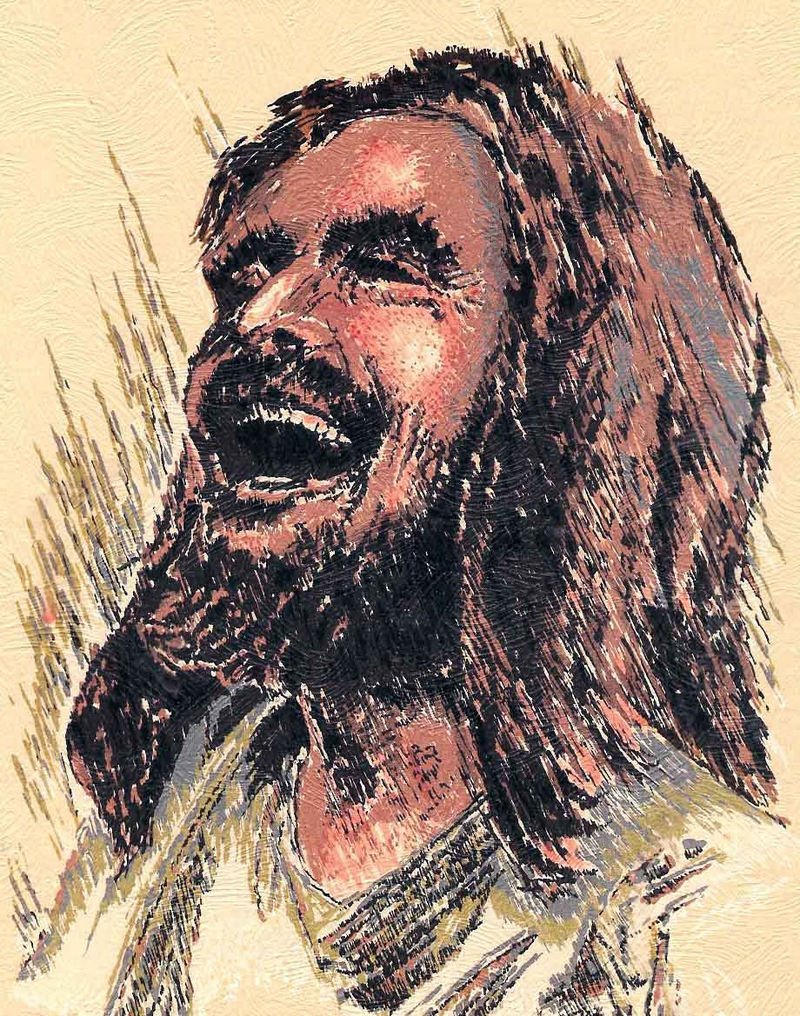
Everyone Likes a Good Joke: Jesus Makes Fun of “Humble” Religious Hypocrites (Sunday Homily)

Readings for 22nd Sunday in Ordinary Time: SIR 3: 17-18, 20, 28-29; PS 68: 4-5, 6-7, 10-11; HEB 12: 18-19, 22-24A; LK 14: 1, 7-14.

[What follows is a dramatic re-creation of Luke’s rather abstract account of Jesus’ dinner at a Pharisee’s home. (See the narrative here.) While Luke seems to have the Master recommending impossible (for Jesus) hypocrisy and self-promotion, the re-creation seems more probable and gets at Jesus’ real message about the Kingdom of God and its preferential option for the poor.]

In this morning’s gospel episode, Jesus finds himself invited for dinner to the home of a Pharisee. All present, Luke tells us, are watching Jesus closely. No doubt, they’re keeping an eye on his disciples too. And they don’t approve.

After all, like Jesus, his disciples are mere riff-raff. But at least Jesus is the reputed peasant-rabbi. Everyone’s talking about him. And investigating Jesus is the whole reason for this dinner. So for the moment at least, the Pharisees are willing to cut him some slack. He’s sitting near his hosts towards the head of the table.

His hangers-on however are a different story. They’re rough. They smell of fish and sweat, and have no manners. And yet, as Jesus’ friends, they’ve been granted a place at table — down towards the end. Even there, they feel out of place, but for that very reason they are enjoying themselves tremendously. You can imagine their rough jokes and loud laughter.

Yes, the Pharisees are watching Jesus and his friends. But obviously, Jesus has been watching them as well. He knows they are expecting some words of wisdom. So . . . he tells them a joke. And the joke’s on them. It contains a sharp barb.

“Thanks for inviting us to this banquet,” Jesus begins. “Unaccustomed as we are . . .” He pauses and smiles. “That’s quite generous of you. After all, none of us can repay your kindness. We are homeless people, as you know. We’re unemployed too, so we are in no position to return your kindness.

The best I can do is offer you some wisdom. So let me tell you what I’ve been observing here.

“Evidently,” Jesus goes on, “it’s your custom to adopt the humility recommended in the biblical Book of Sirach. I can’t tell you how impressed I am; I’m edified by your piety. I mean, you have clearly taken to heart the words of the sage, Jesus ben Sirach – what he said about being humble, especially if we are ‘great’ as all of you are here, I’m sure.”

Jesus eyes his listeners. He can tell that they are waiting for the penny to drop. So he drops it.

“I can see that when you come into a place like this, you take the lowest place available — down there where my friends are.” With this, Jesus stands up bows his head, stoops his shoulders and slumps towards the lowest place at table. He laughs.

“That way,” the Master continues, “our host, of course, is obliged to publicly invite you to a more honored position at table. ‘Friend,’ he’ll say, ‘come up higher, and sit in the place you’ve merited not down there with the unwashed and poor.’”

Now Jesus is standing. He throws out his chest and strides towards the seat right next to his pharisaical host. He chuckles again. “That enables you,” Jesus continues,” with great protestations of unworthiness, to take your ‘rightful’ place at table. Your stock has risen in everyone’s eyes.

“So congratulations are in order,” Jesus says. “All of you have learned your lessons well. You’ve just created a show, and have actually exalted yourself by pretending to be humble. In a sense, you’ve received your reward.”

Jesus is seated again and looking intently at everyone. Their mouths are open with shock.

“So here’s my wisdom, friends. . . . Your ‘humility’ is not what Sirach was recommending. In fact, it’s a form of pride and self-promotion.

“Instead, real humility is this: when you throw a party like this one, invite the poor, the lame and the blind, and then serve them. Place them at the head of your table and treat them as honored guests. People like that can’t or won’t repay you. But in fact, YOU OWE THEM.” Jesus fairly shouts those last three words.

“I’m telling you the truth,” he says. And humility is nothing but the truth.”

Jesus pauses, but he hasn’t finished yet. “You see, those belonging to what you consider the Great Unwashed — like my friends — are actually God’s favorite people. Recall what the psalmist said about them in Psalm 68. He said God is the Father of orphans; he’s the defender of widows, of prisoners, of the homeless, and of farmers without land.”

Jesus is quiet now; his smile is broad and friendly. He searches the faces of his table companions one-by-one.

Then he turns to his host and adds.

“To be fair, my friend, you yourself are on the right track. By inviting us today, you’ve shown that you already understand what I’ve been saying. As I say, none of us can repay you, and yet you’ve invited us to this abundant table. We are sincerely grateful.

“But don’t think that you’ve somehow performed an act of charity by your invitation. No, it’s an act of justice – of compensation to make up for what you have stolen from the poor by underpaying them and taxing them heavily. In supporting the poor and even the “lazy,” you are simply imitating our generous God.

“I mean the earth and its produce are all gifts from God. No one has earned them. No one owns them but the creator. If you have food, then, you are obliged to share it with the hungry – even with those unwilling to work. As difficult as it might be to understand, that’s simply the divine dispensation.

“The earth and the life it supports have been freely given to everyone – even to people like me and my friends who refuse to work and live from the alms of people like you. No one deserves life or food more than anyone else. So in effect, you are obliged to do what you’ve done.”

(Homilist’s note) None of this needs commentary from me.

What’s your commentary?

P.S. You might be helped in formulating your thoughts by this short interview of scripture scholar, Reza Aslan, by Russell Brand. In the exchange, Aslan explains how Jesus, the Buddha, and Mohammed were more interested in economics than in theology. They were economic radicals intent on turning their societies upside-down. None of them intended to found a new religion.

The Ten Commandments: God’s and The Donald’s (Sunday Homily)

trump-commandments
Readings for 6th Sunday in Ordinary Time: SIR 15: 15-20; PS 119: 1-2, 4-5, 17-18, 33-34; I Cor 2: 6-10; MT 5: 17-37.
The emphasis in today’s liturgy of the word is on the wonders of God’s law. “Keep the commandments; no one has a license to sin,” the first reading from Sirach intones. “Walk blamelessly in God’s law; observe its decrees; delight in its wonder,” sings the psalmist in today’s responsorial. And then in the Gospel reading Jesus presents himself as the defender of even the least of the commandments. Break the least, he says, and you’ll be least in God’s Kingdom.
On hearing all of this, I couldn’t but squirm on behalf of Christian Trump supporters who respect what they consider God’s Word. After all, The Donald seems to live by his own rules. And those guidelines don’t seem to have much to do with the Bible’s Ten and the delight, joy, and fulfillment today’s readings suggest infallibly result from observance of the Decalogue. Or as comedian, Bill Maher put it during the campaign season, “It’s hard to bring up the Ten Commandments when your candidate has spent most his life breaking all of them.”
On the other hand, Richard Dawkins, a sworn enemy of Christianity has formulated his own Ten Commandments. Ironically, Dawkins’ rules are more in harmony with today’s delight-full estimation of God’s Law. In fact, they seem more worthy of Christian support than the one’s Mr. Trump apparently lives by.
So just for fun, in the light of today’s readings, let’s contrast the two sets of commandments, and see what we can learn. It might be that Dawkins’ natural law commandments are more promising in terms of Nature’s delight, joy and peace than what we hear implicitly proclaimed by casino king Donald Trump and his Christian followers.

Begin with Mr. Trump. Here’s how humorist Neel Ingram compared the Bible’s Ten Commandments with what seems to be their Trumpian counterparts. (Ingram hosts a website called Chewing The Fat With God). Using Trump’s own words, Ingram writes:

Commandment 1: You shall have no other gods before Me.

Commandment 1 (Trump Edition): I won the popular vote… I’m really smart. I have the best words. Best words. Believe me.

=-=-=-=-=-=-=-=

Commandment 2: You shall not make for yourself a carved image of Me.

Commandment 2 (Trump Edition): You shall not publish unflattering photos. Giant portraits are okay if they’re of Me. For Me.

=-=-=-=-=-=-=-=

Commandment 3: You shall not take the name of the Lord your God in vain.

Commandment 3 (Trump Edition): You shall not mock me, the ratings machine, Donald J. Trump, or I will declare you boring and unfunny. Bigly.

=-=-=-=-=-=-=-=

Commandment 4: Remember the Sabbath day, to keep it holy.

Commandment 4 (Trump Edition): I proclaim a National Day of Patriotic Devotion in my honor. A great day. Best day.

=-=-=-=-=-=-=-=

Commandment 5: Honor your father and your mother.

Commandment 5 (Trump Edition): My parents… great people… truly great… great, unbelievable parents. I’m a really good father. My children really like me — love me — a lot.

=-=-=-=-=-=-=-=

Commandment 6: You shall not murder.

Commandment 6 (Trump Edition): Murder is a terrible crime. Don’t murder. Murder’s not good. Bad!

=-=-=-=-=-=-=-=

Commandment 7: You shall not commit adultery.

Commandment 7 (Trump Edition): Adultery — I don’t think it should be done. Don’t screw around unless she’s hot as sh*t and you think you’ll get away with it.

=-=-=-=-=-=-=-=

Commandment 8: You shall not steal.

Commandment 8 (Trump Edition): Don’t steal. Do a deal. My whole life I’ve been greedy, greedy, greedy. I’ve grabbed all the money I could get. I’m so greedy.

=-=-=-=-=-=-=-=

Commandment 9: You shall not bear false witness against your neighbor.

Commandment 9 (Trump Edition): False witnesses are like fake news. Media can’t be trusted. Serious bias — big problem! Sad.

=-=-=-=-=-=-=-=

Commandment 10: You shall not covet anything that is your neighbor’s.

Commandment 10 (Trump Edition): Don’t covet. I’m really rich. When you’re really rich there’s nothing to covet. Except p*ssy. When you’re a star you can do anything. Grab them by the p*ssy. It’s amazing. Terrific.

=-=-=-=-=-=-=-=

Mr. Trump’s outrageous profanity aside, now take a look at what today’s readings have to say about God’s law. All of them (and especially Jesus’ words) suggest that “God’s Law” has nothing to do with Mr. Trump’s guiding principles. Neither is it written in stone. Instead, God’s commandments are enshrined deep in the human heart. And human happiness is impossible without observing that law which in its essence is no different from nature’s law.

That’s the line Richard Dawkins takes. Beginning with The Golden Rule, he lists his Ten Commandments in the following words:

  1. Do not do to others what you would not want them to do to you
    2. In all things, strive to cause no harm
    3. Treat your fellow human beings, your fellow living things, and the world in general with love, honesty, faithfulness and respect.
    4. Do not overlook evil or shrink from administering justice, but always be ready to forgive wrongdoing freely admitted and honestly regretted.
    5. Live life with a sense of joy and wonder
    6. Always seek to be learning something new
    7. Test all things; always check your ideas against the facts, and be ready to discard even a cherished belief if it does not conform to them.
    8. Never seek to censor or cut yourself off from dissent; always respect the right of others to disagree with you.
    9. Form independent opinions on the basis of your own reason and experience; do not allow yourself to be led blindly by others.
    10. Question everything

Dawkins also has something to say about that fraught area of sexuality which evidently so concerns D.T. and his Christian friends. But whereas The Donald emphasizes power and exploitation while his friends emphasize prohibition and suppression, Mr. Dawkins’ commandments stress the joy and freedom centralized in today’s readings. Dawkins writes:

  1. Enjoy your own sexual life (as long as it does not harm to others), and let others enjoy their sexual lives in private according to their own inclinations which in any case are none of your business.
    2. Don’t discriminate against or oppress anyone because of their sex, race or (insofar as possible) species.
    3. Don’t indoctrinate your children. Teach them to think for themselves, how to weigh evidence, and how to disagree with you.
    4. Respect the future beyond the temporal limits of your own life.

Now those laws are “delightful,” wouldn’t you agree? They seem to make sense because they reflect human nature and nature’s laws. Their observance could bring the world together rather than tearing it apart on the basis of supposedly revealed religious dogmas.

That’s what Roman Catholic (but suspended) theologian, Hans Kung thinks. He says that such a “global ethic” is necessary to finally end the armed conflicts that characterize our age. Towards that end, Kung has articulated four principles: (1) International peace is impossible without peace between religions; (2) there can be no inter-religious peace without inter-religious dialog; (3) there can be no inter-religious dialog without agreement about a global ethic, and (4) our world cannot survive without such an ethic that is universally accepted.

The United Nations seconds Dr. Kung. It boils down his desired global ethic to just four basic “commandments”: (1) Don’t kill; (2) Don’t rape; (3) Don’t lie, and (4) Don’t steal.

Could it be that Christians have more to learn about God’s law from an atheist than from the authoritarian so many Christians and Christian pastors evidently support?

In any case, while the latter promises eternal conflict, the former holds hope of dialog, mutual understanding, and cessation of hostilities.

The choice is ours: Trump’s self-serving law or God’s law written in our hearts.

A Pope and a Pimp Went into St. Peter’s to Pray (Sunday Homily)

Pharisee_and_the_Publican
Readings for 30th Sunday in Ordinary Time: SIR 35: 12-14, 11-18; PS 34: 2=3, 17=18, 19, 28; 2 TM 4: 6-8, 16-18; LK 18: 9-14. http://usccb.org/bible/readings/102713.cfm

“A pope and a pimp went into St. Peter’s to Pray.” That’s the way scripture scholar, John Dominic Crossan, conveys the shock that must have been felt by Jesus’ audience when he opened this morning’s gospel parable by even joining the words “Pharisee” and “tax collector” in the same sentence. It’s like putting “pope” and “pimp” together. It jars the ear. And why would a pimp be praying at all?

Nevertheless, Jesus begins: “A Pharisee and a tax collector went up to the Temple to pray.” Customarily homilists use this parable to reinforce conventional wisdom about pride and humility. The Pharisee was proud, they say. The tax collector was humble. Be like the tax collector.

I however think there’s something much more challenging and fundamental going on in this parable. The focus of Jesus’ story is not pride vs. humility. It’s about rejecting the Pharisee’s conventional morality. The parable even calls us to scrap conventional wisdom about pride and humility.

More positively, the story is a summons to enter God’s Kingdom by identifying with the poor and despised. It also explains why the conventionally good simply cannot enter the Kingdom of God.

Let me explain.

Think in terms of popes and pimps. Popes are generally respected people. They’re religious leaders. Wherever they go, crowds flock around them just to get a glimpse, a blessing, or possibly even a smile or touch.

Pharisees in Jesus’s time enjoyed similar respect with the common people. Pharisees were religious teachers and textbook examples of conventional morality. They usually did what the one in today’s gospel said he did. They kept the law. The Pharisee in today’s reading was probably right; chances are he wasn’t like most people.

Generally Pharisees, were not greedy, dishonest, or adulterers. Or as their exemplar in Luke put it, he was not like the tax collector alongside him in the Temple. Pharisees gave tithes on all they possessed – to help with Temple upkeep.

On the other hand, tax collectors in Jesus’ day were notorious crooks. Like pimps, they were usually despised. Tax collectors were typically dishonest and greedy. They were adulterers too. They took advantage of their power by extorting widows unable to pay in money into paying in kind.

In other words, the Pharisee’s prayer was correct on all counts.

But, we might ask, what about the tax collector’s prayer: “O God, be merciful to me, a sinner?” A beautiful prayer, no?

Don’t be so quick to say “yes.”

Notice that this tax collector doesn’t repent. He doesn’t say, like the tax collector Zacchaeus in Luke’s very next chapter, “Look, half of my possessions, Lord, I will give to the poor; and if I have defrauded anyone of anything, I will pay back four times as much (LK 19:8). There is no sign of repentance or of willingness to change his profession on the part of this particular crook.

And yet Jesus concludes his parable by saying: ”I tell you, the latter (i.e. the tax collector) went home justified, not the former. . .” Why?

I think the rest of today’s liturgy of the word supplies an answer.

Look at those readings again. They’re all about God’s partiality towards the poor, oppressed, orphans, widows and the lowly – those who need God’s special protection, because the culture at large tends to write them off or ignore them. Typically, they’re the ones conventionality classifies as deviant. The Jewish morality of Jesus time called them all “unclean.”

However all of them – even the worst – were especially dear to Jesus’ heart. And this not because they were “virtuous,” but simply because of their social location. Elsewhere, Jesus specifically includes tax collectors (and prostitutes) in that group. In MT 21: 38-42, he tells the Pharisees, “Prostitutes and tax collectors will enter God’s Kingdom before you religious professionals.”

More specifically, in this morning’s first reading, Sirach says that the poor, oppressed, orphans, widows and the lowly are the ones Yahweh fittingly pays attention to. That same theme appears in the refrain we all sang together in today’s responsorial psalm, “The Lord hears the cry of the poor.”

As a result, those who simply belong to that category – the poor and oppressed – are “justified” in virtue of their social (non) status. The word “justified” means “made just” – or fit to enter God’s Kingdom where justice is the order of the day.

Similarly justified are the non-poor who imitate Sirach’s “God of Justice” by conscious identification with those considered “sinners” by the prevailing culture. Those who humble themselves in that way are like Sirach’s “God of justice” who hears the cry of the oppressed, the wail of the orphan, the prayer of the lowly. Or (again) as our responsorial psalm put it today: “The Lord hears the cry of the poor.”

But why would a good person like the Pharisee be excluded from God’s Kingdom? Does God somehow bar his entry? I don’t think so. God’s Kingdom is for everyone.

Rather it was because men like the Pharisee in the temple don’t really want to enter that place of GREAT REVERSAL, where the first are last, the rich are poor, the poor are rich, and where (as I said) prostitutes and tax collectors are rewarded.

The Pharisee excludes himself! In fact, the temple’s holy people wanted nothing to do with the people they considered “unclean.” In other words, it was impossible for Pharisees and the Temple Establishment to conceive of a Kingdom open to the unclean. And even if there was such a Kingdom, these purists didn’t want to be there.

Let’s put that in terms we can understand in our culture.

Usually rich white people don’t want to live next door to poor people or in the same neighborhood with black people – especially if those in question aren’t rich like them.

Imagine God’s Kingdom in terms of the ghetto. Rich white people don’t want to be there.

But ironically, according to this morning’s readings – according to Jesus – the “undesirables” who live there are the ones to whom the Kingdom of God belongs. They are the favorites of the God who Sirach says is “not unduly partial to the weak.” Rather God is fittingly partial to them as the Sirach reading itself and the rest of today’s liturgy of the word make perfectly clear!

This means that any separation from God’s chosen poor amounts to excluding oneself from the Kingdom white Christians spend so much time obsessing about.

So today’s readings are much more radical than usually understood. The parable of the Pharisee and the tax collector – of the pope and the pimp in St. Peter’s – is not an affirmation of conventional morality. It rejects such ethnocentric hypocrisy! Jesus’ parable is not even about approving conventional wisdom concerning pride and humility.

As always with Jesus’ teachings, it is about the Kingdom of God – about those who belong and those who exclude themselves.

In practice, this realization suggests for starters that:

• It’s no badge of honor to subscribe to conventional morality or conventional wisdom.
• Christians are called to be counter-cultural – more in solidarity with those we associate with pimps than with popes.
• For “Americans” this means discounting middle class morality and (white) “family values” as criteria of faith.
• According to Jesus, by itself such conformity actually excludes one from participation in God’s promised future.
• Instead authentic faith means living a life of solidarity with the poor – making their issues our own.
• Hence Christians should be in the forefront of movements on behalf of the poor.
• For example, rather than joining “devout Catholics” like Paul Ryan in leading crusades to cut back food stamp programs, we should be applying pressure to expand them.
• The same holds true for public housing, Medicaid, Social Security, and voting rights.