Animal Farm Revisited

I just reread George Orwell’s Animal Farm. That was because I was trying to help my 11-year-old grandson understand the “isms” portrayed in the book, which his class has been assigned for reading and discussion. I’m talking about Marxism, communism, capitalism, socialism, mixed economy, and fascism. They’re all there. And at its early stage of development, my grandson’s class is trying to understand what those terms mean with the aid of Orwell’s allegory.

So, let me try to explain them one-by-one, and then draw some simple conclusions about Orlando’s Orwellian project.

Economic Systems

To begin with, Marxism (simply defined as the philosophy of Karl Marx), hangs over the book like the specter he and Friedrich Engels warn about in the first line of their “Communist Manifesto.” That philosophy holds that (1) capitalism necessarily exploits the working class and the natural environment, (2) workers will rebel against such exploitation substituting socialism for capitalism, and (3) socialism will eventually evolve into communism.

That’s the basic story of the animal farm allegory. A drunken Farmer Jones runs Manor Farm without concern for the pigs, horses, donkeys, chickens, cows, ducks, dogs, cats, and even rats. All the latter live under the capitalist system with its (1) private ownership of the means of production (Manor Farm itself), (2) free and open markets (where eggs and milk are sold), and (3) unlimited earnings (all horded by Farmer Jones). Under that arrangement, Jones gets rich while the animals find themselves overworked, underfed, and highly resentful.

So, they revolt against their master and take over his farm, even changing its name from Manor Farm to Animal Farm. They replace Farmer Jones’ capitalism with socialism which is the exact opposite of capitalism. It’s about (1) public (i.e. community) ownership of the means of production, (2) controlled markets, and (3) earnings limited by considerations of human welfare – reinvesting profits above that into improving community life.

At least in the beginning, all that works out quite well because the animals are guided by a “North Star” ideal called communism (expressed in their popular anthem “Beasts of England”). Communism is an unrealizable ideal (like the Kingdom of God) that guides the planning of socialists. It shoots for (1) abundance for all, (2) consequent elimination of economic classes, and (3) no need for a state (i.e. for a central authority to impose on entire communities the will of the dominant class, be it capitalists or workers).

Eventually however, the Animal Farm project finds itself threatened by a counter-revolution led by Farmer Jones and his fellow capitalists who want to reverse the gains of the animals’ socialism and reclaim their lost private property. Together the dispossessed capitalists launch violent attacks on the socialist experiment. They kill and maim the Farm residents. They destroy their infrastructure (most notably a windmill that would provide electricity for Animal Farm giving workers there with more leisure, light, warmth, and power for labor-saving machinery).

Eventually too, the leadership of the commune realizes that it needs goods and services that it cannot provide for itself, such as iron, nails, and paraffin oil. This realization causes the community to move from a socialist economy to a mixed economy. Mixed economies combine the best features of capitalism and socialism. They incorporate (1) some private ownership and some public ownership of means of production, (2) some free markets and some controlled exchanges, and (3) earnings which though limited allow capitalists to earn profit.

For a while, this new system works. However, Animal Farm leadership becomes so comfortable with their former sworn enemies (the capitalists led by the lawyer, Mr. Whymper) that the community governors gradually identify more with their outside trading partners than with the Animal Farm community. They end up dressing like the capitalists and adopting their ways (such as drinking previously forbidden alcohol, sleeping in luxurious beds, excluding animals from their meetings, and adopting the practice of capital punishment).

All of this enrages Animal Farm residents not only against the capitalists, but against their own increasingly repressive leadership. Rebellion simmers once again on the farm. The capitalists and their Animal Farm allies feel threatened causing them to institute a system of fascism (i.e., capitalism in crisis featuring a union of interest and policy between government and capitalists). Fascism might be defined as (1) capitalism in crisis, (2) forced on resentful workers by a police state and (3) blaming the system’s dysfunctions on “the usual suspects,” viz., communists, socialists, Jews, non-whites, immigrants, and sexual “deviants.” In the case of Animal Farm, Snowball the Pig is a stand-in for all the latter. He’s blamed for everything!

Conclusion

So, what’s the bottom line of Animal Farm? Many see it as a diatribe against socialism and communism illustrating the old saw: “Communism is great in theory, but it doesn’t work in practice.”

Perhaps more discerning conclusions would be that:

  • The book illustrates the clear superiority of socialism over capitalism. The animals were much happier under communal ownership of the means of production than under Farmer Jones.
  • However, capitalists do not give up easily. They inevitably launch counter revolutions involving mayhem, murder, and cynical property destruction – all aimed at making workers dissatisfied with their new situation.
  • Capitalists can also buy off socialist leaders with money, gifts, prestige, and privilege causing them to identify more with their former enemies than with the people they are supposed to serve.
  • Revolution is not a one-off affair. It is a constant process always in need of periodic renewal.
  • Or as Thomas Jefferson put it: “Every generation needs a new revolution.”

Why the U.S. Cannot Compete with China in Africa or Anywhere Else

This week, Joe Biden summoned 49 African presidents to D.C. for an international conference.

In doing so, the administration offered assurances (through National Security spokesperson, Jake Sullivan) that in contrast to previous gatherings, it would not scold or lecture Africa’s leaders about not obeying U.S. demands, e.g., in the United Nations. (There, by the way, just recently African leaders had to endure something like a schoolboy’s dressing-down when many abstained from supporting American resolutions condemning Russia’s invasion of Ukraine.)  

Rather, Sullivan claimed that this time the purpose of the conference would be to listen respectfully to the leaders in question and to help them work out solutions to the continent’s problems on their own terms. Participants would be treated, Sullivan pledged, with respect and as equals.

The reason for the change in attitude? It’s that the United States finds itself currently locked in mortal competition for global influence with its chief rival, China. And, of course, that includes Africa.

There, the U.S. seeks not just access to the continent’s vast mineral and other resources, but also to Africa’s strategic geographical position and its market of over 1 billion consumers. The United States also wants to prevent spread of Chinese influence into what it and its European partners continue to understand as their inviolable post-colonial domain. For those reasons, it’s important to enter into agreements with nations such as the Democratic Republic of the Congo, with South Africa, Libya, Egypt, and Kenya.

But if that’s its goal, the United States has a problem that renders it virtually incapable of competition with China in Africa – or anywhere else for that matter.

I’m referring to U.S. ideology and its history.

As the world’s chief proponent of economic neoliberalism, the ideology of the United States makes it all but constitutionally unwilling to accommodate anything that smacks of socialism.

Relatedly, the U.S. track record shows that wherever there’s a whiff of leftist state ownership, market control, or increased taxes on the elite, Americans will predictably apply sanctions, engage in regime change, or even assassinate, or invade. Think of Egypt’s coup that stopped the Arab spring in its tracks. Think of Ghaddafi’s ignominious fate and of Mrs. Clinton’s epitaph on his behalf, “We came, we saw, he died. Ha, ha!”

All of Africa – all the Global South – remembers such disgraceful interference with their national aspirations.

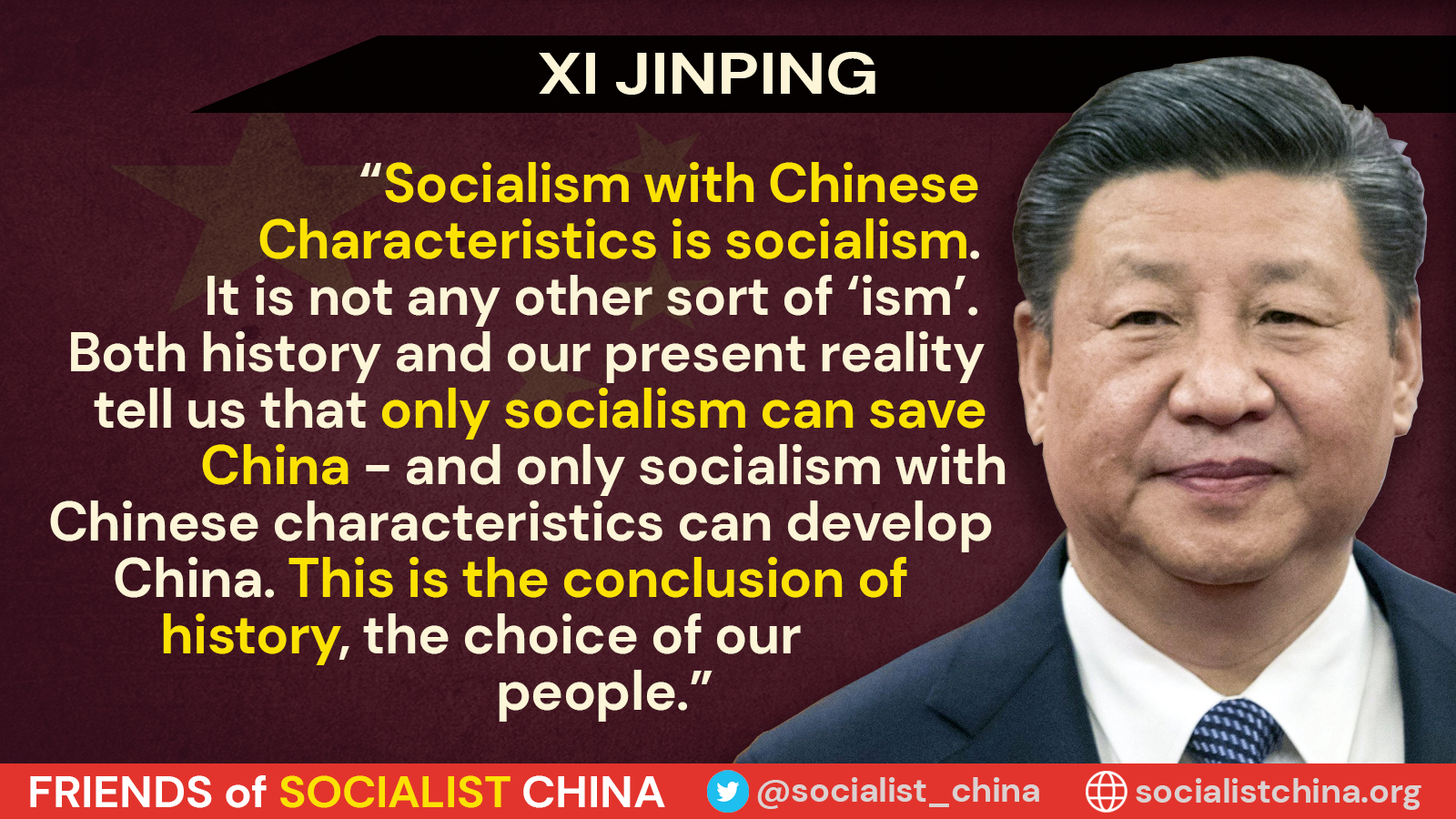
On the other hand, the People’s Republic of China is hampered by no such limitations. After all, it is run by a party that calls itself “communist.” That party describes its own economy as “socialism with Chinese characteristics.” Its mixed economy has a huge section owned and controlled by the government. Its private sector is tightly regulated. China therefore has no quarrel with public ownership, market regulation, or with taxing the rich. It loves socialism.

Additionally, China’s track record has it freely cooperating with neo-liberal regimes, with despot kingdoms, and with other states aspiring to socialism. Compared with similar arrangements with the United States, China’s loan contracts, Belt-and-Road projects, and other agreements generally come with far fewer if any strings attached.   

So, if an African country wants to follow China’s suit of socialism, its leaders will not have to fear sanctions or regime change, much less assassination or invasion from its international economic partner.

To repeat: that’s not the case in dealing with the United States. And that’s why the latter will never triumph in its Global South competition with China!   

Economic Systems: Notes on My Conversation with My 13 year-old Granddaughter

Last evening, my granddaughter, Eva (who’s about to celebrate her 14th birthday) and I had a remarkable hour-long conversation about economic systems. The topic was the focus of one of the classes she’s taking here in Spain, where the government is run by a coalition of socialists and rechristened communists (in a party called “Podemos” (“Yes, We Can!”). Whereas in the United States one can hardly use the word “socialism” without suffering opprobrium, I’ve learned that it’s the opposite here in Spain. Discussing socialism in clear and objective ways is de rigueur in school.,

Since Eva’s classes are in Spanish (and she’s only been here a couple of months), she had a hard time understanding the thrust of her teacher’s remarks and of observations by her fellow students.

So, Eva asked me about the differences between capitalism and socialism — a topic I’ve taught about and have tried to simplify or years and years.

She was very attentive as I shared what I know. Afterwards, we promised to continue the discussion. And to that end, I made up the following notes on the similarities and differences between capitalism, socialism, mixed economies, Marxism, communism, and fascism. I promised Eva that if she just understood and memorized what appears below in bold, she’d be streets ahead of most college students (and many professors!).

I sent her the notes with the following message:

Dearest Eva,

Really enjoyed our discussion last evening. It drove me to compose the attached summary for you. Please study it. Bring your questions the next time we get together for a chat. Learn as much of it as you can. THERE WILL BE A QUIZ!  I’ll expect ready answers to my questions. 

Love,

Baba

Economic Systems

Key Terms

Means of production = what produces consumer goods, viz., land, mines, forests, factories, oceans

Markets: Places where goods are sold and bought

Free Markets: No regulation. Anything (including people) can be bought and sold

Open Markets: Anyone can be a buyer or seller regardless of age or other restrictions

Earnings: Profit, income, wages. . ..

I

Capitalism

(An Economic System comprising the following elements)

1.Private ownership of the means of production

2. Free and open markets

3. Unlimited earnings

[In its pure form, this type of “free market capitalism” exists only in the illegal black market, where the Mafia, for example, sells anything (or anyone) without regulation or paying taxes. Note also that the three points indicated above summarize the ENTIRE economic program of the U.S. Republican Party that always seeks PRIVATIZATION, DEREGULATION OF MARKETS, AND LOWER TAXES.]

II

Socialism

(The opposite of capitalism. It is an economic system comprising the following elements)

  1. Public ownership of the means of production
  2. Controlled or regulated markets
  3. Capped or otherwise limited earnings (e.g., by income taxes).

[In its pure form, socialism does not and never has existed. That’s because ALL economies represent mixtures of capitalism and socialism. That is, they are “mixed economies.” The question is, “mixed in favor or whom — the rich or the poor?”]

III

Mixed Economies

(Economic systems embodying some elements of free market capitalism and some of socialism featuring the following elements)

  1. Private ownership of some enterprises and public ownership of others [e.g., in the U.S. the government (i.e., the public through their elected representatives) is the country’s biggest landowner (through its national park system); it also owns the U.S. postal system, and the rail system. In many other “capitalist” countries, governments also own electrical grids, energy sources (such as oil), water supplies, and transportation systems (like airlines).
  2. Some free and open markets and some that are regulated. [For instance, in the U.S., regulations insist that minors cannot buy tobacco products or alcoholic drinks. Restaurants must maintain standards of cleanliness or risk being closed by government authorities. The same with food factories.]
  3. Limited earnings usually by a “progressive” income tax (meaning that those with larger incomes pay in taxes a higher percentage of their income).

Economies can be mixed in favor of entrepreneurs as in the United States (offering them government subsidies, tax breaks, and deregulation) or in favor of workers as for example in Cuba or China (offering them free healthcare, education, subsidized food and housing, etc.)

IV

Marxism

(The philosophy of Karl Marx, who was a socialist and a communist — see below.) His analysis held that

  1. Capitalism necessarily exploits workers and the environment [“Necessarily” because the market system has workers competing with one another for scarce jobs. They therefore bid one another down as they seek employment until they end up working for the lowest wage possible. Also, few entrepreneurs seeking to maximize profits will ever voluntarily add costs to their production by protecting the environment (e.g., by adding scrubbers to their smokestacks or filters cleansing any effluents pouring into nearby rivers). Those who do protect the environment voluntarily drive up their costs of production and will be undersold and driven out of business by competitors lacking environmental consciences.]
  2. The workers will inevitably rebel against such exploitation, replacing capitalism with socialism.
  3. Socialism will eventually evolve into communism.

V

Communism

(A vision of the future embraced by some socialists.) All communists are socialists; some socialists are communists, most are Marxists who envision a future with

  1. No classes (rich or poor)
  2. No state (because they see the state as enforcing dictatorships – either the “dictatorship of the capitalists” (whereby a small body on boards of directors decide unilaterally on what is produced, where it is produced, and what to do with the profits) or the “dictatorship of the proletariat” (Marx’s term for the working class). Under the envisioned proletariat’s dictatorship, workers, e.g., through their labor unions, and as co-op owners of the means of production decide what to produce, where to produce it, and what to do with the profits.
  3. Abundance for all

VI

Fascism

Police state capitalism. It is the form capitalism (or more accurately an economy mixed in favor of entrepreneurs rather than workers) tends to assume when it is threatened by socialist movements or by other malfunctions such as falling profits, widespread unemployment, high inflation, etc. It is:

  1. Capitalism in crisis
  2. Enforced on workers by police and military forces
  3. Blaming “the usual suspects” for capitalism’s malfunctions (e.g., Jews, Muslims, terrorists, socialists, labor unions, communists, immigrants, asylum seekers, non-whites, women, the disabled . . ..)

Remember: THERE WILL BE A TEST!!

Russia & China Vs. NATO (aka “The Machine That Destroys Humanity”)

Here’s a little experiment on my part — me sharing some thoughts about the world without writing them down. Just reflecting on life. Let me know if you think this is a good medium. More importantly, let me know your own thoughts on the topic I’m addressing. Thanks.

Cuba Develops and Will Share Its Five Vaccines

Yesterday, on “Democracy Now,” Amy Goodman reported good news for the poor countries of the Global South. In the news headline portion of her show , she said, “Cuba has pledged to donate 200 million doses of its COVID-19 vaccine to low-income countries in the Global South. The move was announced at talks hosted by the Progressive International and was heralded as a possible ‘historic turning point’ in the pandemic.”

You’d think that the announcement would be welcomed and celebrated everywhere and be given at least as much press coverage as the one-day protests in Cuba reported so breathlessly last November 15th. However, no such general celebration occurred. Even on “Democracy Now,” the story went undeveloped beyond the just-quoted headline. Meanwhile, in contrast to its hysteria over Cuban protests last fall, the U.S. government itself has been totally silent about this potentially game changing development.

Nevertheless, according to international health experts, Cuba’s achievement could make vaccinations much more available for example to 1.3 billion Africans whose continent has seen only 7% of its population receive even a single vaccination dose. (And this in contrast to 70% vaccination rates in richer countries.)

According to reports even on CNBC’s online source, the five Cuban vaccines in question:

  • Are a uniquely Cuban development among the former colonies
  • Have been administered in three doses to a higher percentage (86%) of Cuba’s 11 million people than in most of the world’s richest countries
  • Are not dependent on expensive mRNA technology using instead a “subunit protein” variety – like the Novavax vaccine
  • Are cheap to produce
  • Require no special refrigeration
  • Enjoy 90% effectiveness against all strains of COVID 19
  • Will have no patent restrictions on their recipes shared with low-income countries
  • Will be made available to them virtually at cost
  • Are a tribute to Cuba’s legendarily efficient health care system

Currently, Cuba’s prestigious biotech industry is awaiting approval for its vaccine developments from the World Health Organization. That approval is expected early this year. According to Helen Yaffee of the University of Glasgow, “. . . many countries and populations in the global south see the Cuban vaccine as their best hope for getting vaccinated by 2025.”

As for cost and distribution issues, John Kirk, professor of Latin American Studies at Dalhousie University in Nova Scotia added, “The objective of Cuba is not to make a fast buck, unlike the multinational drug corporations, but rather to keep the planet healthy.”

But in news cycles dominated by pharmaceutical corporations that refuse to waive intellectual property rights to their largely publicly funded products, such contrasting humanitarian consciousness goes mostly underpublicized and by such silence, denied.

Denial like that prevails despite the appeals for sharing vaccine recipes by the World Health Organization itself supported by civil society groups, trade unions, former world leaders, international medical charities, Nobel laureates and human rights organizations.

Part of the reparations due Cuba for 60 years of economic embargo and for silence about its achievements is to at last recognize its socialism as a force for global humanitarianism much more beneficial to the world than international capitalism.


Chapter 26: “Post Mortems: Gierek & Myles Reflect on the Execution Class”

Joaquin Phoenix as Jesus in “Mary Magdalene” (played by Rooney Mara) — highly recommended

This is Chapter 26 of my novel, The Pope’s Secret. For previous chapters, just scroll down.

Pentecost Sunday Homily: Don’t Support the Hong Kong Protesters

Readings for Pentecost Sunday: ACTS 2: 1-11; PSALMS 104: 1, 24, 29-34; I CORINTHIANS 12: 3-7, 12-13; JOHN 20: 19-23

Today is Pentecost Sunday – the originally Jewish harvest festival that comes 50 days after Passover. The day’s readings remind us that from the beginning Jesus’ Jewish followers were working-class internationalists. Despite their lack of what the world calls “sophistication,” they recognized a unified divine order where barriers of language, nationality, and differentiating wealth were erased.

Before I get to that, let me connect that central fact with perhaps the prominent international and class-based concern in our contemporary context. I’m referring to the demonstrations in Hong Kong and an emerging new cold war between the United States and China. Our Pentecostal readings suggest we should be standing with the Chinese government and not with our own.

China and Hong Kong

Last week I shared a summary of an important debate about China between Matt Stoller and Kishore Madhubani. The debate’s question was: Is China merely a competitor of the United States or is it an adversary or even an enemy? Doesn’t China’s suppression of free speech and free press, of religion and of democracy make it an enemy?

My article held that, all things considered, China is a more genuine defender of human rights than the United States. I won’t repeat my argument here, but it turned on the distinction between bourgeois human rights (private property, contract observance, free speech, free press, and freedom of religion) and socialist rights to work, food, shelter, clothing, health care, and education.

Since the publication of my column, its relevance was highlighted by renewed demonstrations in Hong Kong. There despite a COVID-19 lockdown with its social distancing requirements, demonstrators came out in force last Sunday. They were protesting against new legislation in the territory that would allow officers of the law to arrest protestors for speaking out against the local government or authorities in Beijing.

Whom to Support?

So, the question became how should progressives respond? Even granted the distinctions between bourgeois and working-class rights, shouldn’t leftists seeking consistency and coherence, be on the side of the Hong Kong protestors? After all, they’re described as “pro-democracy.”

Despite such description, my answer would be a resounding “No.”

The main reason for my saying that is related to the class concerns reflected in the above distinctions between bourgeois and working-class rights. The fact is, all demonstrations are not the same. Some are organized against oppressive systems such as capitalism and its prioritization of wealth accumulation and contract obligations on the one hand and its marginalization of workers’ needs to eat, be decently clothed and housed, and to have dignified work and a healthy environment on the other. The Yellow Vest Movement in France and the Water Protectors’ demonstrations against the Keystone XL Pipeline in North Dakota offer examples of protests against capitalist exploitation.

In contrast, other demonstrations are reactionary and directed against specifically working-class reforms. Participants typically support colonialism and imperialism. The thousands in the streets of Hong Kong and Venezuela offer prime examples of such protests.  Hong Kong protestors’ waving of Union Jacks signals their preference of the status quo ante of British colonialism. Their appeals for U.S. intervention (with U.S. flags unfurled) express support for imperialism.

(Of course, especially under the guidance of foreign interventionist forces such as the CIA and its sister National Endowment for Democracy (NED), other lower-class social forces such as unemployed and underpaid workers (Marx’s lumpen proletariat) can also be organized by their betters to direct their anger at the class enemy of their bourgeois organizers — in this case, the Chinese government in Beijing.)  

The bottom line here, however, is that to be consistent, progressives must oppose not only prioritization of wealth accumulation by financiers, but also anything connected with colonialism and imperialism.    

To repeat: not all demonstrations, not all clamoring for “human rights” are created equal.  Class-consciousness provides an indispensable tool for distinguishing the causes and demonstrations that progressives should support from those we should oppose.

Pentecost Readings

With all of that in mind, let’s turn our attention to the readings for this Pentecost Sunday. Let’s read them with the same class consciousness I’ve just referenced. Here are my “translations.” You can examine them here to see if I got them right.

ACTS 2: 1-11: Fifty days after Jesus’ New Manifestation as one with all the poor, executed and other victims of imperialism, his fearful working-class followers suddenly found themselves filled with the same consciousness Jesus had. They internalized the Master’s conviction that poor people like themselves could embody his vanguard consciousness heralding the completely new world order Jesus called God’s “Kingdom.” Suddenly on fire and filled with courage, these poor, illiterate fishermen electrified huge crowds from “every nation under heaven.” Despite language barriers their impoverished and oppressed audience understood that God was on their side.

PSALMS 104: 1, 24, 29-34: Jesus shared his Spirit with the poor in order to renew the face of the earth – this earth (not heaven above) filled with magnificent creatures of all types. They’ve all been put here to make everyone (not just the wealthy) happy and joyful. We who identify with the poor are entirely grateful.

I CORINTHIANS 12: 3-7, 12-13: It is the Holy Spirit of Jesus that makes us recognize that he, not any oppressive Caesar, is in charge here on earth. The Spirit’s gifts have been given for the Common Good not for private gratification or foreign control. In fact, all of us are one – as if we comprised a single body. Nationalities are irrelevant. Slavery of any kind is completely passé.

SEQUENCE: So, may we too receive Jesus’ Spirit this very day. May we recognize it in the poor, in our hearts, in the light of our new understanding, in the gifts we’ve received, and in just rewards for our labor. Yes, we’ve been wounded, desiccated and made to feel guilty. We rejoice to know that poverty and misery are not the will of some God “up there.” The Holy Spirit’s will is abundance for all. Thank you!

JOHN 20: 19-23: Following his execution, in his New (resurrected) Manifestation, the meaning of Jesus’ execution by empire became apparent. Having internalized his Spirit, his friends recognized his wounds as badges of solidarity with the poor, tortured victims of imperial powers. They threw off guilt and embraced world peace instead.

Conclusions

Think of today’s readings as they relate to Hong Kong. . . Though recorded two generations after the fact, the Jerusalem events portrayed were extraordinarily revealing. They had people of the lowest classes (no doubt, under the watchful eye of Rome’s occupying forces) – probably illiterates – claiming to be spokespersons for God. And this, not even two months after the execution of Jesus the Christ, who had been executed as a terrorist by Roman authorities. What courage on their part!

The readings, then, remind us of whose side the biblical All Parent is on. In contemporary terms, it’s not the side of financiers, bankers, imperialists or colonialists. Rather, it’s the side of those the world’s powerful consider their sworn enemies – the poor, illiterate, unemployed, underpaid, tortured and executed victims of colonialism and empire.

However, those latter categories represent the very classes that socialism (even “with Chinese characteristics”) rescued from their landlord oppressors in 1949 and that have been under western siege there ever since. Under socialism, the impoverished in China are the ones who have seen their wages and standard of living massively improve over the last thirty years.

Improvements of this type under communist leadership are totally unacceptable to the United States and the “allies” it has absorbed into what it proudly describes as its empire. That empire always opposes socialism and will stop at nothing to make it fail.

Such realizations lead to the following observations about Hong Kong in particular:

  • As shown by the display of Union Jack and American flags and by signs invoking the intervention of President Trump, the demonstrations in Hong Kong are neo-colonialist, neo-imperialist and neoliberal in their understandings of human rights.
  • They are seeking the bourgeois “democratic rights” that overridingly prioritize private property and the integrity of commercial rights over the socialist rights championed by the Chinese Communist Party—food, shelter, clothing, jobs, health care, and education.
  • The fact that ex-CIA chief, Mike Pompeo, is leading the charge in Hong Kong should give everyone pause. (This, especially in the light of Pompeo’s boast and endorsement of “lying, cheating, and stealing” as CIA standard operating procedure.)
  • In fact, and on principle, any Trump administration defense of human rights should probably drive those with social justice concerns to defend the other side.   
  • Or at the very least, Pompeo’s and the Trump administration’s diverse response to demonstrations in Hong Kong on the one hand and to the (working class) Yellow Vests in France and to indigenous Water Protectors in North Dakota on the other, should raise serious questions.

Closing Note

The bottom line here, however, is that all demonstrations and protests are not created equal. The Pentecost gathering in Jerusalem was a poor people’s international meeting of “every nation on the face of the earth.” It celebrated the Spirit of a poor worker who was a victim of torture and capital punishment by imperial Rome. Its claim was that the Divine World Spirit is on the side of the imperialized, colonized, tortured and executed. “Socialism with Chinese characteristics” is far more in line with that tradition than is neoliberal capitalism.

Progressive followers and/or admirers of Jesus the Christ should keep that in mind as they watch events in Hong Kong unfold.

Trump Has Not Out-lefted the Left: It's What Fascists Do

So now the word in the mainstream media (MSM) is that Donald Trump has successfully co-opted the so-called “American left.” After all, they tell us, he’s implemented Universal Basic Income (UBI); he’s promised to set up government hospitals to treat COVID-19 patients; he’s proposed delayed foreclosures and evictions and has strengthened unemployment measures for laid-off workers. Unwittingly, we’re told, he has become a “socialist.” And worst of all (for his opponents) under that new identification, his approval ratings have risen.

Does this mean he’ll be reelected next fall even though his handling of the coronavirus crisis has been abysmal? Remember: he mocked it at first. The testing kits he promised still haven’t materialized. And, as usual, his pathological duplicity makes it impossible for anyone to know what’s really going on in the man’s little head. Do his promises mean anything, or will they be rescinded tomorrow?

Nonetheless, there’s a grain of truth in his latest manifestation as socialism’s champion.

Additionally, if we understand fascism as “capitalism in crisis”, Trump’s co-optations can be unmasked as mirroring faithfully those of his forebears in that system. And finally, there’s hope to be found in the president’s rising numbers.

Trump’s Socialism

To begin with, it must be acknowledged that all of the above (UBI, government-sponsored healthcare, policies preventing homelessness, and unemployment insurance) are indeed key planks in any socialist platform.

At the same time, it is also true to say that the president has very little choice in the matter. History has shown that in circumstances like these, heads of state interested in self-preservation and regardless of their ideological propensities, best serve their interests by intervening in the marketplace on behalf of their official constituents.

Put otherwise, the crisis at hand has once again exposed the fact that capitalism’s regular-as-clockwork systemic dysfunctions can only be remedied by socialist programs. (There are no exceptions to that rule.) That’s because government-coordinated socialism is far more efficient in addressing pressing crises than the necessarily disjointed, atomized and uncoordinated capitalist responses. This has been demonstrated most recently by China’s quick success in dealing with COVID-19.

In reality, however, Trump’s proposals are far from genuinely socialist. To begin with, ALL of them are emphatically temporary. His version of UBI are intended to last a month or two; his government hospitals are narrowly targeted at coronavirus patients (all others are still on their own and at the mercy of giant health insurance and pharmaceutical conglomerates); the evictions and foreclosures will resume when the current crisis has passed. Republicans will also reprise their attacks on unemployment insurance (and Social Security) when and if we return to “normal.”

By way of contrast, socialism’s remedies are permanent; they represent once-and-for-all transformations of the reigning economic system. Socialism is about Medicare for All, affordable housing, rent-control, job guarantees and adequate wages.

Moreover, socialism is an international movement of working-class people. Its philosophers — those who favor the working classes instead of their exploiters — are the ones our educational system of indoctrination has taught us to hate. We’ve been taught to despise Karl Marx, but to love Milton Friedman. Despite our ironic distaste for them, our class’ philosophers have always addressed themselves to “the workers of the world.”

Today’s socialists recognize what the coronavirus crisis has laid bare, viz. that even apart from present circumstances, we’re all in this together. Socialists also see clearly that our common enemy is the greed and self-centeredness that globalized capitalism itself has forced on our employers. Without heartless devotion to the “bottom line,” virtually none of those we work for would ever survive under free enterprise competition that rewards and necessitates starvation wages for so many and environmental devastation for us all. The system has made our employers our mortal but largely unrecognized enemies.

Trump’s Fascism

As opposed to socialism’s internationalism, Trump is a nationalist. Recall his inaugural proclamation, “From now on it’s only going to be America First, America First.” Nothing could be further from the ideals of citizens of the world. That is, insofar as circumstances have forced socialism upon him, Herr Trump is a National Socialist.

And that’s exactly what the fascists who came to power in the 1930s were. They were National Socialists in contrast to the international socialists and communists they hated so fiercely. In fact, Trump’s nationalism and his attempts at co-opting socialist policies to mollify a rebellious populace represents his tearing a page right out of Mein Kampf.

Think about it. As already mentioned, fascism is best defined as “capitalism in crisis.” Or as Benito Mussolini described it more exactly, fascism is corporate capitalism united with state power. In ultimate form, it enforces its order through a police state armed against its traditional enemies, viz. communists, socialists, labor organizers, Jews, non-whites, the disabled, immigrants, gypsies, etc. All those scapegoats receive blame for the inescapable inefficiencies and dysfunctions of the newly christened old system. All of them found places in fascism’s death camps.

Why then the name-change in the 1930s? Why the “National Socialist German Workers’ Party?” It’s because the Great Stock Market Crash of 1929 and the depression that followed had completely discredited capitalism. No one wanted to be associated with it any more than (until recently) people wanted to be associated with socialism and Marxism after the fall of the Berlin Wall. Following the Crash everyone, left and right, claimed to be some kind of socialist.

It’s similar today, even though the name itself is not yet so much in fashion. Still, socialist policies are much in favor among the American people. A solid majority wants Medicare for All. The Fight for $15.00 minimum wage is extremely popular among wage workers. In this age of climate chaos, environmental protection laws receive widespread approval. The same is true for free college education and forgiveness of student loans. And Social Security remains the most popular program ever instituted by the federal government.

More particularly, at this time of corona crisis, people need money to pay their bills. They want those monthly checks. Under the threat of COVID-19, they don’t want to worry about deductibles and co-pays. They need rent relief.

Hope behind Trump’s Ratings

All of that is hopeful. Any rise in Trump’s approval ratings because of the policies just reviewed reveal that Americans favor what the Republican Party is ideologically incapacitated to provide. Republicans will never permanentize the programs we all want.

And if they do, that’s o.k. too. Whether a red administration or a blue one meets genuinely human needs is beside the point.

More likely, however, the temporary programs currently receiving approval simply describe for true socialists (whether they embrace the name or not) the policy trajectories they must follow, propose, fight for and finally implement. Now’s the time to insist on a Green New Deal.