Returning to Rome: Redrawing My Map of God and the World

I am back in Rome — a city that once formed me more deeply than I knew at the time. This time Peggy and I will be here for three months visiting our diplomat son, his wife, and our three little granddaughters.

More than fifty years ago, as a young priest, I walked these same streets believing I stood near the center of the Christian world. Rome felt solid, ancient, authoritative. Theology here carried the weight of centuries. I absorbed its categories, its rhythms, its confidence. That was soon after Vatican II (1962-’65). I was only beginning to question the map I had inherited.

Now, decades later, I find myself returning not as a defender of that center nor as its adversary, but as someone who has been slowly reshaped by teachers, students, and experiences far from these stones. Being here again has stirred gratitude — and reflection. I see more clearly how much of my life has been an apprenticeship in learning to redraw the map I once took for granted.

Learning to Turn Things Over

To begin with, my teachers here in the Eternal City were dynamite in terms of creatively upsetting my theological and even political certainties. I think especially of Magnus Lohrer and Raphael Schulte at the Atheneum Anselmianum on Rome’s Aventine hill. That first year in Rome, lectures at the Anselmo were in Latin. Regardless, Lohrer and Schulte called all my categories into question. They had me seriously reading non-Catholic theological giants for the first time. I brought it all home to unending lunch and dinner debates with the fifteen or so young priests (who were also pursuing terminal degrees in Rome) at our Columban house on Corso Trieste 57.

But the deepest fissures in my theological and political certainties came after Rome – in Brazil, Nicaragua, Cuba, and especially in Costa Rica, where Peggy and I became fellows at the Departamento Ecumenico de Investigaciones, a liberation theology think tank. The center of it all was Franz Hinkelammert who became not only my teacher, but colleague and friend. As an economist and theologian, he adopted critical thinking as his own central category.

I remember telling him, somewhat playfully, that I thought I had figured out the method behind his approach to the discipline: he seemed always to take what passed as “common sense” and quietly invert it with exquisite historical,  philosophical, and theological insight. Markets are described as free. Economic growth is described as necessary. Sacrifice of the vulnerable is described as realistic. He would simply ask: who benefits? who suffers? what “god” is being served?

He smiled when I said that — a smile that felt less like approval and more like invitation. He was not urging me toward cynicism. He was urging me toward attentiveness.

Under his influence, I began to recognize how easily societies sanctify their own arrangements. The market can become providence. National security can become destiny. Even theology can become a cloak for power. What I once called realism I learned to approach more cautiously.

That habit of questioning did not make me certain. It made me slower to accept easy answers.

Learning to Relocate the Center

Another teacher, Enrique Dussel, unsettled me in a different way. I first met him in Brazil during a seminar specifically on liberation theology. The cream of the crop – theologians I had been reading for years – were there.

I still see Dussel at a whiteboard, sketching a world map from memory. He did not begin in Athens, as my education had. He began in Egypt. He traced the movement of civilizations across Asia. He lingered over China’s long intellectual and cultural history before Europe entered the frame at all.

“Wherever I lecture,” he would say, “people repeat the same historical story: ancient, medieval, modern.” Then he would perceptively add, “That story is not universal. It is European.” Leonardo da Vinci’s futuristic drawings were lifted straight from Chinese engineers.

I felt enlarged listening to him. The world was older and more intricate than the timeline I had inherited. Europe’s achievements remained real, but they were no longer singular or central in the way I had assumed.

After his lectures, I found myself trying to reproduce his map — not because I wished to argue, but because I wanted to see as he saw. His point was not so much to diminish Europe, as to free history from provincial boundaries.

That lesson stayed with me. Once you realize that a “center” may simply be a perspective, you become cautious about every center — political, economic, even theological.

Encounters in the Global South

My years of teaching in the United States and traveling in Latin America and other parts of the Global South deepened that reorientation. Theology in Brazil, Nicaragua, El Salvador, Honduras, Cuba, and Mexico was not an abstract discipline. It was bound up with hunger, repression, resilience, hope.

Through thinkers like Pablo Richard and Elsa Tamez, I saw how scripture could sound different when read from below rather than from established centers of power. Through Rosemary Ruether, I came to see how deeply gendered our language about God and authority has been. Helio Gallardo showed how The United States’ regime change policies prevented human development throughout the Global South. Vandana Shiva widened my awareness of how economic systems scar both land and people in the name of progress. And Dom Hélder Câmara reminded me, in his gentle way, that charity without justice leaves underlying structures intact. He famously said, “‘When I give food to the poor, they call me a saint. When I ask why the poor have no food, they call me a communist.’

None of these encounters destroyed my faith. They complicated it. They forced me to acknowledge that what I had once regarded as neutral theology was often shaped by social location and power.

Over time, I began to describe myself not simply as Catholic, bus as belonging to the Church’s “loyal opposition.” I still claim that designation. I did not wish to abandon the Church. I owed it too much. But I could not ignore its entanglements with empire or its silences in the face of suffering.

I learned that loyalty without critique can drift toward idolatry. But critique without love can harden into bitterness. Holding both has never been simple.

The God I Was Taught — and the God I Pray To

Returning to Rome has also stirred memories of the God-image that accompanied my early formation.

God was Creator, Lawgiver, Judge, Punisher (even Torturer!). Sin was pervasive. Conscience was vigilant. That framework gave me seriousness and discipline. It also sometimes fostered fear and self-scrutiny that felt heavier than grace.

Over the years, influenced by the teachers I have named and by the communities I have encountered, that image loosened. I began to see how easily our political imaginations shape our theology. A hierarchical society imagines a hierarchical heaven. An imperial culture imagines a commanding deity.

Genesis says something simpler and perhaps more daring: we are clay, animated by breath. Clay is not flawless. It is vulnerable, shaped by experience, capable of cracking and reforming. The problem in Eden is not embodiment but mistrust — the suggestion that God is withholding, that God is threatened by human growth.

Slowly, I found myself praying less to a divine Auditor and more to a Life-Giver. Paul’s contrast between Adam and Christ came to sound less like courtroom procedure and more like two ways of being human: hiding in shame or standing in trust.

That shift did not happen overnight. It came through study, mistakes, conversations, disappointments, and, occasionally, grace.

Sitting in Trastevere

Recently, sitting in Santa Maria in Trastevere, I felt the weight of all these strands all at once.

Trastevere was once a district of the marginal — dockworkers, Jews, early Christians. Yet the Church that took root among them eventually learned to speak the language of empire. The basilica’s golden mosaics shimmer above centuries of compromise and devotion alike.

The Church, I realized again, is both clay and gold.

So am I.

If my children sometimes experience my positions as strong or unsettling, I understand. They did not sit in those classrooms. They did not travel in those communities. They did not hear those lectures. My convictions were not born of sudden rebellion. They accumulated slowly, sometimes against my own initial resistance.

I do not claim to see perfectly now. If anything, these teachers made me more cautious about certainty. They taught me to ask whose voices are missing, whose suffering is hidden, which assumptions have gone unquestioned.

Returning to Rome does not feel like a triumph. It feels like a reminder. A reminder of where I began. A reminder of how much I was given. A reminder of how much I had to unlearn. And a reminder that any map — even the one I now hold — remains partial.

Clay, Breath, and Ongoing Revision

The longer I live, the less interested I am in appearing marble. Marble is impressive, but rigid. Clay is humbler, more exposed, more capable of change. Genesis names us clay. The Spirit breathes.

If there has been a “crime,” it was never Rome itself. It was the temptation to mistake any center — any institution, any system, any theology — for the whole.

The teachers who shaped me did not hand me a new dogma. They handed me a way of seeing: turn the claim over, redraw the map, listen to the margins, be wary of sanctified power, hold loyalty and critique together.

Rome, with all its beauty and ambiguity, is a fitting place to remember that.

I return not to condemn, nor to congratulate myself for having moved beyond something, but to give thanks for the long, unfinished work of being reshaped.

The map has been redrawn more than once in my life. It may yet need redrawing again.

For now, I remain grateful — for Rome, for the margins, for the teachers who widened my world, and for the breath that continues to animate clay.

From Italy

Greetings from Rome!

Apologies for not attending to my blog for so long.

I’ve been busy getting ready for this two-month trip as well as rehabbing from my knee operations and another unexpected surgery. I’ve also been preoccupied with Tarot readings for an increasing number of clients – not to mention readings for my immediate family.

All six of us (including my son-in-law) have birthdays in the span of a single month – from September 6th to October 5th. And this year I’ve decided to give each family member a 10-card Tarot reading. It’s been a lot of fun, but has taken time, since each reading (including visual representations of each card) runs to about a dozen pages.

With that behind me, I can now return to blogging.

So, again, greetings from the Eternal City.

Peggy and I are here visiting our son Brendan, his wife Erin, and their three children, Genevieve (4), Madeleine (2), and Sophie (8 months). We want to get to know those kids.

You may recall that Brendan works for the State Department. He operates out of the embassy in Rome and is doing quite well following previous postings in Mexico, Afghanistan, and Pakistan.

You might also realize that in a sense, this visit represents my “return to the scene of the crime.” I mean, as a newly ordained priest, my first assignment was to get my doctorate in moral theology here in Rome. So, between the years 1967 and 1972, I obtained my licentiate in systematic theology at the Atheneum Anselmianum and that doctorate at the Academia Alfonsiana.

Those five years changed my life.

Having educated me for 12 years (from a callow high school freshman in Silver Creek, New York to an ordained priest in Milton, Massachusetts) the intent of the Society of St. Columban (my sponsoring organization) was for me to return from Rome and teach moral theology in its major seminary.

However, studying post-Vatican II theology and living abroad for five years radically changed my world vision and understandings of God, Jesus, church, priesthood, politics, etc. Consequently, without my knowing it, the rector of our Rome house eventually wrote to the Columbans’ Superior General that I was “too dangerous” to teach in the organization’s major seminary.

So much for that.

In any case, I’ve written about all that elsewhere in these pages behind the “personal” button in my blog’s table of contents.

I won’t bore you with repetition.

So let me do so instead by simply noting that:

  • We’re here.
  • We’ve been generously received by our hosts.
  • The grandkids are a lot of fun.
  • I’ve forgotten most of my Italian (confusing it with similar languages I’ve learned in the meantime, viz., Portuguese and Spanish).
  • At this very moment, Peggy and I find ourselves aboard a high-speed train heading from Rome to Turin, where we’ll attend a conference on the world’s food system.
  • Afterwards, we’ll spend three nights in Venice.
  • Then we’ll return to Rome and the adventures that await us there and elsewhere in the country.
  • And oh (by the way) around Thanksgiving and our planned trip home, the two of us will return to Spain’s Granada for a week. That’s where we spent about a year in 2022-23. It will be great to reconnect with friends there.

Till next time arrivederci!        

Abraham & Yeshua Correct My Primitive Understandings of God

Readings for the 17th Sunday in Ordinary Time: Genesis 18: 20-32; Psalm 138: 1-8; Colossians 2: 2-14; Romans 8: 15bc; Luke 11: 1-13.

My remarks this Sunday will be brief. All day yesterday, I worked hard on a revision of my letter to my granddaughter, Eva. Recall that last Thursday she left for a two- week service project in Panama. That made me want to help her understand her context and how it related to U.S. history and even to U.S. support for the war in Ukraine. You can find that revised text here. I published it on OpEdNews where I’m a senior editor.

But even as this Sunday is running out (It’s now 5:00 in the afternoon) I find myself unable to resist reflecting on the extraordinarily beautiful readings for this 17th Sunday in Ordinary Time (as if these times could in any way be described as “ordinary!”).

My inability to shut my mouth is sparked by the fact that this Sunday’s readings speak directly to my lifelong struggle to free myself from a very primitive understanding of God inflicted on me (and so many others) by my strict Catholic upbringing. Thankfully, today’s readings end up offering liberation from that understanding.

I mean, here I am a would-be theologian formally trained in that discipline for 12 years in the Catholic seminary, and for five years in Rome till I got a doctorate in moral theology. And then I taught theology-related courses for 40 years at Berea College — all the time studying liberation theology with some of its greatest proponents in Italy, Germany, Brazil, Costa Rica, Nicaragua, Honduras, Mexico, Zimbabwe, South Africa, and India.

And though it’s true that all that study long since caused me to change my idea of God INTELLECTUALLY, I must confess that PSYCHOLOGICALLY and EMOTIONALLY, I’ve struggled to liberate myself from an idea of God inflicted on me initially by the good Sisters of St. Joseph (whom I still love and admire) at St. Viator’s Elementary School on Chicago’s Northwest side. (I went to school there from 1946 to 1954.)

It was an idea of God as strict patriarch, law giver, and judge. Yes, he (sic) was one who judges, condemns, and punishes especially any transgressions connected with sex.

(Do any of you share my experience?)

Anyway, that idea was driven even deeper by my pre-Vatican II seminary training in the Society of St. Columban by the wonderfully good and sincere Irishmen who taught me there from 1954-1967. But at least until Vatican II (1962-’65) they too were captives of this Great Judge who (in retrospect) I now see as closer to a devil figure than the Divine One manifested in Yeshua of Nazareth — along, of course, with the Buddha, Krishna, Mohammed, and untold (literally) indigenous religious figures.

I’m pleased to say that my post-Vatican II studies in Rome (1967-’72) liberated me from my primitive conceptions — at least, as I said, intellectually. Ironically, I was saved there (and in my late seminary years) from “God” (or should I say “Satan?”).

Well, it’s that more angelic Divine One replacing the diabolic Great Punisher who receives welcome emphasis in today’s lessons. Please read them for yourselves here. Then check out my “translations.” I hope I got them right.

I know that I’ve joyfully tried to capture their liberating spirit.

Genesis 18: 20-32

Imagine a man,
A human being,
Mere dust and ashes
Proving himself 
More moral,
More just,
More compassionate,
Than his entire tribe
And even
(It seems)
Than God Himself!

That was 
Our Ancient Father
Abraham
Who incredibly
Defied his 
Vengeful people 
And persuaded
Its wrathful 
War God
Not to massacre
The 50,000
Of arch-enemy Sodom
If only 
10 innocents
Could be found
Among them.

Now there
Was a great theologian! 

Psalm 138: 1-8

Yes,
Abraham replaced
Israel’s unforgiving 
Warrior God
With a loving Parent,
Responsive to human need,
Truthful and kind,
Especially to the oppressed
Protecting them 
From all harm.

That Great
 All Parent
Indeed merits
Praise and thanks.

Colossians 2: 2-14

And imagine
That Great Parent
Further manifesting
Compassionate divinity
Even more fully
Than Abraham.

Yes,
It happened in Yeshua,
The precious expression
Of God’s boundless
Forgiveness
Though our transgressions
Might be greater
Than Sodom’s
And condemned 
By merciless human law
Even demanding
Our execution
As it did Yeshua's.

Romans 8:15bc

Far from
A cruel War God,
Yeshua said
We could
Call such a 
Source of Life
Daddy!
Yes “Daddy!”
Halleluiah!!

Luke 11: 1-13

That’s what
Yeshua meant
When his friends
Asked for 
A prayer like John’s.

"Say this," 
The Master replied:
“Papa, we love you,
Keep all of us
Safe,
Well fed,
Debt free, just, 
Unthreatened,
And filled
With your Spirit.

"The One
Who always gives
Good Gifts
(Never stones or snakes)
Inevitably responds
To a simple prayer 
Like that
Or even a silent one
Breathed 
Only from 
Your heart’s 
Holy Spirit." 

Isn’t that great? Far from being a harsh Patriarch, Judge and Punisher, Yeshua’s Yahweh (and Abraham’s at least in this tale) is more like a soft loving Mother, one who frees from reactionary human laws, and who loves, appreciates, and rewards.

We can’t hear too much of that.

Hallelujah indeed!

Talkin’ Guitar Blues

This is the first song I ever played in public. That was back in 1965 when I was still in the seminary, a year before I was ordained. On our patron saint’s feast day, St. Columban’s Day (November 23rd), we always put on some kind of show. “Old timers” (far younger than I am now) would sing their favorite songs. I remember that our moral theology prof, Tom McElligott, would sing “Mick McGuire” every year. Well, believe it or not, on this particular St. Columban’s Day, I had the gall to perform this little ditty. Later on, it became my signature party piece. I’ve done it a million times. (Still can’t get it exactly right!)

80th Birthday Reflections Part 6: Political Order

Just in case readers might have forgotten: my project in this series of reflections on the occasion of my 80th birthday is to illustrate Richard Rohr’s observation about human growth in terms of the “three boxes” into which, he says, everyone’s personal growth trajectory more or less fits. According to Rohr, if we’re lucky, the first part of life is characterized by order, the second by disorder, and the third by reorder. In those terms, I’ve been very lucky.

I’ve tried to illustrate that luck in previous entries in this series. There I briefly described how I mostly benefitted from a highly ordered life starting in a very Catholic household with loving parents. Those years included nine years of education in St. Viator’s Catholic school on Chicago’s northwest side. Then, I shipped off at the age of 14 for a monk-like, highly regulated existence in a seminary preparing teenagers for a life of celibacy and service to God. In St. Columban’s minor seminary in Silver Creek, New York, we were already being shaped to convert what we understood as pagans in foreign missions like Korea, the Philippines, Burma, and Japan. 

So far, my story has taken me from my family home in Chicago and subsequently in Warrenville, Illinois to that seminary in Silver Creek. From there I attended a corresponding college seminary in Milton, Massachusetts. I then completed a novitiate-like “spiritual year” in Bristol, Rhode Island. That was followed by four years of “graduate” scripture and theological studies back in Milton. Then finally, following my ordination in 1966, I completed my formal education with five years of doctoral studies in Rome, Italy. By then, I was 32 years old.

When I left my story off, I was in the middle of telling about those halcyon years in Rome.

My hope is that sharing such reflections might help me better understand my own journey as I enter my ninth decade. In the process, it would be wonderful if readers would also be stimulated to similarly examine their own transitions from order to disorder and hopefully to the ongoing process of reorder.

In any case, I want this particular blog entry to help me (and anyone mildly interested) better understand my own political development. Recounting its story will stretch me far beyond Rome to most of western Europe. It will then take me to more than 40 years of teaching (and learning!) at Berea College in rural Appalachia. Sabbaticals and other travel opportunities sponsored by Berea ended up peppering my journey with subsequent long stopovers in Brazil, Nicaragua, Costa Rica, Guatemala, Honduras, Zimbabwe, South Africa, Israel, Jordan, Egypt, India and Cuba. At each of those stops, I learned political lessons that have informed and shaped my life. I’ve been lucky indeed.

But let me begin at the beginning.

My parents were basically apolitical. As a truck driver, my father was a Teamster Union member, but he never betrayed any corresponding political consciousness. (I just remember that he didn’t like paying union dues.) My mother sometimes spoke of her preference to “vote for the man, not the party.” Together, both mom and dad claimed to be Independents rather than Democrats or Republicans. However, their leanings were clearly towards the GOP.

Apart from that, my first recollection of a significant political thought came when I was a freshman in the high school seminary (1954-’55). We were off at some sort of day of recollection at a nearby rival seminary. And older priest (I’ll bet he was about 50!) was onstage giving a keynote address. In its course, the old man remarked for some reason that the dropping of atomic bombs on Hiroshima and Nagasaki (a decade earlier) amounted to the most heinous crime in human history.

I was completely shocked. At the time the McCarthy hearings were in full swing. Anti-communism was in the air. I wondered, “Why would a priest say something so unamerican? Was he perhaps a communist? Surely no priest could be a communist.”

My question was framed like that because at the time, anti-communism was in the very air all Americans breathed. After every Mass, we all offered specially mandated extra prayers “for the conversion of Russia.”

The sentiment invaded our minor seminary with a vengeance. The Columban Fathers had just been expelled from China by the 1949 Communist revolution. So “Old China Hands” returning from “fields afar” addressed us frequently about their experiences with such evil incarnate. They told us that the communists hated the Virgin Mary and her rosary. That was enough for any of us. Nothing could be eviler than that.

I remember that during one study hall on May 2, 1957, one of my most admired teachers who was monitoring the session came by my desk and whispered, “A great man died today.” He was referring to Wisconsin Senator Joseph McCarthy.

Politically speaking, that was the world I grew up in. I had no idea what communism was other than an anti-God, anti-Mary worldwide conspiracy by absolutely evil people.

Again, cut off as we were from the news and unexposed to any historical information other than that conveyed in standard (boring) history books, no wonder my political formation was so narrow. Everyone’s was.

It was also no wonder that when I cast my first ballot for U.S. president (1964), I voted for Barry Goldwater. I did so not only because of strict “American” indoctrination, but also because I greatly admired my mother’s brother, my uncle Ben. Of all my relatives, I thought he had the most respectable job. He worked in some capacity at Chicago’s First National Bank; he went to work in suit and tie each day. [Everyone on my father’s side of the family were laborers – brick layers, bartenders, plumbers and general construction workers. One of them was a bookie. (I remember him showing us one day his basement with a whole array of phones connected with his work.)]

So, in my desire to be more informed and sophisticated politically – more like Uncle Ben – I had long conversations with him about issues of the day. He steered me towards the Republicans and criticism of the Civil Rights Movement and Vietnam War resistance.

For instance, in 1967, when Martin Luther King voiced his searing criticism of U.S. aggression in southeast Asia, I thought, “It might be well and good for him to speak about civil rights for blacks, but now he’s gone too far. What does he know about foreign policy and Vietnam?”

That was the state of my political consciousness when I went off to Rome at the age of 27.

And that’s precisely when political disorder set in to complement the theological disorder I’ve already described.  

(Next time: the particulars of political disorder)

80th Birthday Reflections Part 3: Roman Disorder

The Anselmo, where I studied my 1st 2 years in Rome

I knew NOTHING about politics when I arrived in Rome. I knew little about the world. I knew even less of women. All of that was about to change.

Understand that in all those spheres, I had been cooped up in the seminary hothouse since I was 14. For years, we had no access to newspapers. And it wasn’t till after Vatican II that we were even allowed to watch TV news each night. As a result, I was very uninformed about a world that I was taught to consider not worth caring about. (After all, we were here on this planet to pass a test and prepare for heaven.)

With the Columbans, the saving grace was that we returned home each year for Christmas and summer vacations. So, the divorce from the world wasn’t complete. My family [my loving mother and faithful father (a commercial truck driver), my brother and two sisters] kept me more or less sane and in touch. The six of us lived in a tiny two-bedroom house that had my sisters sleeping in the same room and my brother and me sleeping on a pull-out couch in the living room. (I’m sure life was easier for them all when I wasn’t taking up so much space.)

During summer vacations, I worked for a couple of years in a gas station learning about cars and mechanics. Then, when I was 18, I took a summer job at a golf course not far from my family home now in Warrenville, Illinois. I worked there on the grounds crew every summer till I was ordained – and even a little bit afterwards.

Working at Arrowhead Golf and Country Club was a delight. Sometimes I could hardly believe that I was getting paid for that kind of labor (cutting grass, laying sod, felling trees, changing cup locations on the greens, working on small engines . . .) in such an idyllic setting. The job also allowed me to play golf for free. That was fun, but despite decent athletic ability, I was never able to master that highly frustrating game. (I continue to work on that.)

As for women. . .  They represented completely forbidden territory. “Custody of the eyes” was the order of the day. However, I do remember being fascinated by one of the girls who worked at Arrowhead’s lunch counter. I made sure to order from her during our grounds crew’s lunch half-hours each noon. I recall that she was also to be present at a year-end party I was invited to. But I decided for that reason not to attend.

With that kind of background, I flew off to Rome in 1967 taking up residence in the Columban house on Corso Trieste 57. Suddenly I found myself in a house with about 15 other young student-priests. They came from Ireland, Great Britain, Scotland, Australia, Tasmania, and New Zealand; two of us were from the U.S.

Our house was headed by an Irish Columban rector and his Irish assistant. In residence too was a retired Irish bishop from Vietnam. (Such recollections make me recall that most of my teachers over my 12 seminary years spoke with brogues – quite understandable, since the Society of St. Columban had been founded in Ireland.)

My first impressions of my new community were that its members were much more sophisticated and better-informed in every sphere than I was. These guys were good. Conversations revealed that they even knew more about U.S. history and politics than me.  I found that embarrassing.

So, I started reading – no, I started studying – Time Magazine. I couldn’t wait for each week’s edition. Eventually, I won one of our periodic light-hearted quizzes we all took (and joked about) on current issues.

As for academic life in Rome, I was soon faced with an important decision – which of the Roman theological universities to attend? Ironically, even though seminary education had required four extra years of scriptural and theological study following “graduation” from college (with a bachelor’s degree in philosophy) we had nothing to show for those added four years – no master’s degree, nothing. Instead, I suppose, our degree was ordination itself – something (in the eyes of the church) much more valuable than a mere graduate degree.

In any case, before I could enroll in moral theology courses at the prestigious Academia Alfonsiana, I had to get the equivalent of a master’s degree (a licentiate) in systematic theology. The question was where?

I had two choices. One could get me the degree in one year at a school called the Angelicum. The other option was to study for two years at what I learned was (at that time) the best school in Rome – even better than the gold-standard Gregorian Institute – viz. the Atheneum Anselmianum. I chose the latter, even though in those early Roman days, I wanted to get back to the states as soon as I could. (Little did I know that I’d soon be wanting to extend, rather than shorten my time in Rome. Even my eventual five years there would seem far too short.)

If I thought I was out of my depth when I met my housemates in Rome, imagine my feelings at the Anselmo.  Classes were in Latin. Students were fluent in Greek; they referenced New Testament texts in the original language. And if I was intimidated by the theological, classical, and general knowledge of those on Corso Trieste, that was nothing compared with the international students I was thrown in with there on Rome’s Aventine Hill. They came from all over the world – from every continent. I was especially impressed by the Italians, Spaniards, Africans, Indians, and Latin Americans. In seminars, some were so fluent (in Italian, English, Latin, Greek, and of course their native tongues) that it sounded like they had written down everything they said before speaking. I was really impressed (and frankly intimidated).

And my professors!  Wow. They were so inspiring, even in Latin. Two in particular, both German, impressed me greatly. (I continue to remember them prominently in my prayers each day and I find myself tearing as I write these words.) One was Magnus Lohrer; the other Raphael Schulte.  I’m so indebted to them for the knowledge, passion, interest, and joy in learning that they communicated and transmitted. I decided that I wanted to be like Magnus Lohrer!

Significantly in terms of this account of order and disorder, my licentiate thesis centralized the topic of “Ecclesia Semper Reformanda” – the always necessary reformation of the church.

(More about Rome and its welcome disorder next time.)

80th Birthday Reflections Part 2: Disorder Enters My Highly Ordered Life

In 1962, disorder began to enter my life. Its cause was the Second Vatican Council started by Pope St. John XXIII. Out of the blue, it seemed, he decided to reform the Catholic Church – to “open some windows,” he said to the modern world. And with that decision, my life was changed forever – but not overnight.

As a basically conservative person, I initially resisted Vatican II – or at least some aspects of it. I liked the church the way it was. Everything there was so clear and certain.

But now, they were introducing English to replace the Latin Mass. The priest celebrant was turned around and faced the community. Guitars replaced organs. And the music became folksier and less solemn. All of that was fine and rather exciting.

But then, colleagues of mine became critical of things like our nightly Benediction of the Blessed Sacrament, priestly vestments, and Thomas a Kempis’ The Imitation of Christ. (I loved that book.) The seminary chapel was radically remodeled so that the tabernacle now moved to the side, looked like a huge treasure chest. It had been designed, we were told, by a Jewish artist. I wondered, “How can someone who doesn’t share our faith in the Eucharist create art that reflects centuries of reflection on Jesus’ Real Presence in the eucharistic elements?” I remember writing a long screed in defense of The Imitation of Christ.

That was at the beginning. But gradually, I became persuaded. More progressive and better-read classmates and elders influenced me. One of them prevailed upon the dean of students to have our library subscribe to The National Catholic Reporter (NCR). It was fascinating.

But most influential of all were my classes in Sacred Scripture and theology. Our scripture professor was Eamonn O’Doherty. He was wonderful. He taught us about text criticism, form criticism, redaction criticism and more. For four years and line by line we went through biblical texts that I came to see as richer than my literalist, fundamentalist mind was ever able to imagine. What I had learned about poetry from Fr. Griffin when I was a college freshman and sophomore enabled me not only to understand what the scholars were saying, but to find my own textual meanings as well.

And then there were the theology classes. Their focus changed from preoccupation with bland traditional manuals written in Latin to actual books by controversial authors like Teilhard de Chardin, Bernard Haring, Hans Kung, Ivan Illich and Edward Schillebeeckx. I remember being greatly impacted by the latter’s Christ the Sacrament of the Encounter with God as we studied it under the guidance of another of our great professors, John Marley. Fr. Marley was a liturgist who helped us all develop sensitivity to the history and profound meanings associated with public worship and sacrament.

We were reading non-Catholic authors as well – something completely unheard of before John XXIII. I found Paul Tillich especially powerful.  I actually discovered sympathy with the Great Reformers we had previously been taught to dismiss and even despise. I read everything I could from the psychologists Erich Fromm, Rollo May, and Carl Rogers.

Yes, my ordered, predictable world was coming apart. Along with my seminary colleagues (and professors!!), I was questioning more and more – accepted doctrines such as papal infallibility, moral teachings on contraception, abortion, the uniqueness of the church itself, the role of priests, and, of course, mandatory priestly celibacy.

I remember reading an article in the NCR about “reluctant celibates.” Those were actual and would-be priests who felt called to the priesthood but unenthusiastically accepted the celibacy requirement without having an actual vocation to the celibate state.  

I feared I fell into the reluctant celibate category. Before my ordination to the diaconate, I discussed this with my spiritual director. We agreed that it was probably just a matter of pre-ordination jitters.

So, come December 22, 1966, I was finally ordained along with nine classmates – three of whom I had been with since my first year in the high school seminary. After 12 seemingly interminable years, I had finally reached my goal. However, by now I was a Vatican II product. The new theology and my scripture studies influenced every aspect of my priesthood from my homilies and the way I celebrated the Eucharist. Eventually, it shaped the way I dressed and the length of my hair; I even flirted with a moustache and beard.

I was at last on fire academically. During my final semester in Milton, I was honored with a request to teach an adult education class in a Boston parish. The topic was Vatican II and the Bible. I relayed to my class of 30 adults – some twice my age and more – exactly what I was learning under Eamonn O’Doherty. They loved it. The class was a great success. I was discovering that I could teach. And I loved that too.

So, I was delighted when my first priestly assignment was not to Korea, the Philippines or Japan, but to continue my studies in Rome. My Columban superiors wanted me to get a doctorate in Moral Theology there, so I could come back to Milton and teach in the seminary.

Rome still smoldering from the conflagrations set by Vatican II (’62-’65), held wonderful and unexpected surprises that would continue the disorder that I (and the entire world at the time) was coming to embrace.

[Next installment (still on disorder): Rome challenges me to grow up in every sphere – intellectual, political, and personal.]

In Memoriam: Dan McGinn

I got word that a very important person in my life died on March 6th. His name is Fr. Dan McGinn. Like me, he was a member of the Society of St. Columban. Dan was 15 years older than me. He came from Council Bluffs, Iowa. Before I met him, he had been a missionary in Japan for seven years. I studied with him in Rome from 1968 through 1972.

Dan and I hit it off as soon as he arrived at Corso Trieste 57, my second year in Rome. There, while I was studying moral theology at the Academia Alfonsiana, he worked in the Vatican – at the Secretariat for Non-Christians.

Dan usually sat directly across from me at our long dining room table, where the 20 or so men stationed with us in Rome ate three times each day. Three of us were Yanks, the others were Micks, Aussies, Brits and New Zealanders.

It was there that we all had such lively and memorable conversations about our studies, the church, theology, politics, and world events in general. Dan usually took great delight in playing the provocateur. The resulting discussions were intense. In fact, I’ve never experienced anything as consistently stimulating since those heady days following the Second Vatican Council (1962-’65).

Dan used to say that if he ever became a bishop (fat chance!), he’d do the expected and adopt an episcopal coat of arms for himself. He never described the shape of the shield he’d design.

But he was clear about the motto he’d have emblazoned on the banner below it. It would read, he said, “No More Bullshit!”

That was the kind of priest Dan was. He was a rebel. And, I guess, so was I. In many ways, I wanted to be like Dan. I considered him my mentor.

More than anything else, he taught me how to say Mass. I remember the first time I concelebrated with him in our chapel at the Columban house. There were probably five of us participating, and Dan had the lead role. He astonished me. He made the whole thing up.

No reading of prayers. No following the prescribed and inviolable eucharistic scripts. Instead, everything was ad-lib. For instance, even at the consecration – the most sacred part of the Mass – Dan said something like: “On the night before he died, Jesus was there in the Upper Room eating supper with his friends. He took a piece of bread and broke it like this (Dan broke the host) and asked them, ‘Do you see how I’m breaking this bread? This is the way my body will be broken for you. Yes, I love you all that much. This is my body which will be given up for you.’”  The form varied each time Dan said it.

It all struck me as so natural – as the way the Mass must have been celebrated before the Roman obsessive-compulsives established such complete control. I resolved then and there that I’d celebrate my Masses like Dan from then on. And that’s what I did.

Even when I got back to the states and worked in Kentucky for the Christian Appalachian Project (CAP), that’s the way I celebrated Mass. And, like me, most of the people in the parishes I served there found it all so natural, very meaningful and completely acceptable. Even now, I marvel that I got away with that.

Dan also helped me when (towards the end of my time in Rome) I found myself re-evaluating my decision to remain a priest. I broke the news to him during a retreat we were on together at the Mundo Migliore Center at Roca di Papa on the edge of Rome. I remember walking together and discussing my “crisis,” and Dan’s advising that it might be a good idea for me to do a year of discernment before taking a final decision. I followed his advice and spent that year I just mentioned working in central Kentucky with the Christian Appalachian Project.

After I finally left the active priesthood and was working at Berea College, I spoke with Dan a few times on the phone. He told me once that he thought President G.W. Bush was “absolutely the worst we’ve ever had.” (At the time, of course, neither of us knew it could go down-hill a lot  further.)

During those years, I also got on Dan’s mailing list for the poetic political commentary he wrote on what amounted to his blog. Then, at the reunions the Columbans held every three years or so at their former seminary-turned-retirement-home in Bristol Rhode Island, I visited Dan each time I attended – once with my wife, Peggy. At one point he was volunteering as a docent at a local museum.

My last encounter with Dan McGinn came last summer during our most recent Columban reunion. By then he was confined to a nursing home. He no longer remembered me, nor our time in Rome. I found that both sad and threatening. He had been so bright, so engaged, so witty and daring. I admired him so.

With that deep admiration, dear Dan, I send you off. Thank you for your friendship and for being such a good priest. Thank you for teaching me how to celebrate Mass. Thank you for your kind guidance. Know that I’ve tried to adopt your motto as my own. I’m trying to remain, like you – committed to a “no more bullshit” life. You succeeded at that for sure! Thanks again.

My Personal Journey from Ethnocentrism towards World Centrism (8th in series on critical thinking)


worldcentrism

[In this series, I’ve been describing my personal development as a critical thinker. I’ve been using the matrix supplied by Ken Wilber who understands human growth as advance through the stages of egocentrism to ethnocentrism and (for some) to world centrism and even cosmic centrism. Each one of these stages, I’ve been arguing, recognizes its own set of “alternative facts.”]

My ethnocentrism grew alongside the first stage in personal development described here last week as “egocentrism.” Ethnocentrism meant that I was fiercely Catholic. For me, that was my primary group identification, my tribe. At this stage, in terms of critical thinking, no other denomination, and certainly no other religion had anything to do with truth that really mattered. All Protestants were simply wrong and destined for hell. For me, that was a fact.

Such conviction stuck with me and grew after I entered St. Columban’s Minor Seminary in Silver Creek, New York (40 miles west of Buffalo) at the age of 14. The seminary belonged to the Society of St. Columban – a missionary group founded in Ireland in 1918 as the Maynooth Mission to China. Its calling involved converting Chinese “pagans” who without our ministries, we all believed, would themselves be bound for hell – another fact.

At this stage, my second ethnocentric form of allegiance was to my country. I remember being confused during a “day of recollection” that our entire seminary (about 100 students) attended at a corresponding institution run by the Passionist Fathers in nearby Dunkirk, New York. That was around 1955, only 10 years after the conclusion of World War II. A rather elderly priest from the host seminary gave some kind of keynote talk. In its course, he described the dropping of atomic bombs on Hiroshima and Nagasaki as “the most immoral acts in history.” I was shocked and entirely confused. Was this man a communist or what?

My suspicions were aroused by the fact that missionaries on leave from assignments in the “Far East” often regaled us with stories of the evil communists who had by then driven our men and other foreigners from China following Mao Tse-Tung’s revolution in 1949. Communist Marxists hated the Blessed Virgin, we were told. That was enough for me. Communists were evil incarnate.

Similarly, those who opposed them at home were correspondingly virtuous. One evening in 1957 during study hall, one of my most admired professors who was proctoring the session, passed by my desk and whispered, “A great man died today.” He was referring to Senator Joseph McCarthy who died on May 2nd of that year.

In 1964, at the age of 24 I cast my first ballot for president. I voted for Barry Goldwater. That shows how ethnocentric I was. In terms of critical thinking, my proud and sincere guideline was “My country right or wrong.” My facts were those of Mr. Goldwater, the Catholic Church, Joseph McCarthy, and J. Edgar Hoover.

World Centrism Emerges

My horizons started broadening in 1962. It was then that I began accepting “alternative facts” soon after Pope John XXIII convened the Second Vatican Council (1962-’65).  

That represented the thin end of a wedge that would gradually change forever what I considered true. The Second Vatican Council seemed to call my most cherished beliefs into question. It recognized that Protestants were “Separated Brethren” rather than enemies surely destined for hell. The notion of priesthood was widened to include their notion of priesthood of the faithful. Council theologians also problematized conceptions of church as the “perfect society” as well as papal infallibility. That in turn led to conclusions about an “ecclesia semper reformanda” (i.e. a church in need of continual reformation). Mandatory celibacy was criticized as an impediment to personal growth among the clergy. Seminary curricula like the one I was following in St. Columban’s Major Seminary were disparaged for their narrowness and tendencies to indoctrinate rather than educate.

Initially I resisted all of that in the name of my faith and tradition. But my ethnocentrism was under assault.

Rome

My resistance though couldn’t last. Following ordination, I was sent to Rome to secure my doctoral degree in moral theology. So I left the seminary hot house, where I had spent my formative teen age and early adult years. Suddenly, I found myself in an international atmosphere that in every dimension was so much more sophisticated than anything I had previously experienced. Rome’s context was still electric in the immediate aftermath of Vatican II. And the Council’s spirit was reflected in the courses I took at the Athenaeum Anselmianum and Academia Alfonsiana. In their light, my secure notions of theological truth underwent continual challenge.

Gradually I found it all quite liberating.

However, on the political front, it was shocking and embarrassing. Remember, these were the late ‘60s. The anti-war movement was in full swing, along with the struggle for Civil Rights and women’s liberation. It was the era of “Troubles” in Ireland. Martin Luther King and Bobby Kennedy were both assassinated in 1968. My last year in Rome (1972), George Wallace was shot, and the Palestinian group, Black September, terrorized the Olympic games in Munich.

Meanwhile, I was living in the Columban residence on Corso Trieste with about 15 other young priests all pursuing graduate work. Two of us were American. The others came from Ireland, England, Scotland, and Australia. Our conversations over meals revealed to me my narrowness of perspective. All my colleagues were better informed than me. They even had a superior grasp of U.S. history.

I resolved to remedy that and gave myself a crash course in current events courtesy of Time Magazine. I even ended up winning our small community’s annual political literacy contest. However, that sort of knowledge turned out to be quite superficial.

Gradually, especially because of my theological studies, I was drifting more and more leftward.  In the field of theology, I frequently challenged my colleagues about the humanity of Jesus, the faults of the church, and the whole idea of trying to convert “pagans” from Buddhism, Hinduism and Islam to Christianity.

None of that sat well with superiors in the Society of St. Columban. Towards the end of my stay in Rome, I was informed that plans had changed. Whereas the whole purpose of sending me to Rome had been to prepare me to teach in our major seminary, I was now considered too “dangerous” for that. I would be sent to Mindanao in the Philippines instead.

For the first time, I considered leaving the priesthood.

Politically, I became similarly alienated. It stemmed from my thought that if what I had been taught about God, the Church and even Jesus were untrue, if I could question the pope, whom I had always considered infallible, why not the U.S. government? Daniel Ellsberg’s publication of The Pentagon Papers in 1971 sealed the deal. Now I strongly opposed the War in Vietnam. I became a McGovern Democrat.

My journey towards world-centrism advanced. In terms of my evolving criteria for critical thought, I could already see that leaving ethnocentrism behind would mean expecting challenge.

Waking Up To the Real Nature of the Bible (Personal Reflections Pt. X)

Merk

I don’t exactly remember what I thought about the Bible before beginning its formal study the year after receiving my B.A. in Philosophy (1961),

Ironically, although I had been in the seminary all those years (since 1954) the formal study of “religion” hadn’t at all been central in. the curriculum.

Yes, we attended Mass every day (and twice on Sundays). And there were all those daily chapel activities and devotions: morning and evening prayer, afternoon rosary, “visits” to the Blessed Sacrament before and after meals, nightly Benediction, conferences by the seminary spiritual director, etc. There were also those inspirational readings I mentioned accompanying breakfast and lunch in the “refectory.”

But formal study pretty much concentrated on languages (Latin, Greek, and French) and normal secular studies associated with high school, on the one hand, and on the other, college courses associated with a Philosophy Major.

So by the time I began the formal four year (and post-grad) theological curriculum (1962) my understanding of such matters, including the Bible was fairly uninformed. I’m sure I thought the Bible was the very word of God valid for all time.

That began to change with exposure to the teachings of Fathers Eamonn O’Doherty and Jack Moriarity, both of whom introduced us to modern scripture scholarship which emphasized the history behind the Hebrew and Christian Testaments. They introduced us to form criticism and redaction criticism as well.

Form criticism made us aware that the Bible is filled with various kinds of literature. Literary forms found there include myth, legend, debate, fiction, poetry, miracle stories, birth accounts, letters, apocalypse, annals of kings, law, riddles, jokes, parables, allegories, etc.  None of that, really, is history as we understand it. And if we read poetry, for instance, as if it were history we’ll commit huge interpretational errors.

Just realizing that can change one’s entire approach to the Bible. It did mine.

I remember sitting each day for classes in “Old” and “New” Testament in our aula maxima on the second floor or our Major Seminary on 1200 Brush Hill Road in Milton, MA. The entire student body – those about to be ordained, and the three classes behind them – took those classes together. There were probably sixty of us. So I found myself edified (and intimidated) by the good students among my elders whose questions and observations always seemed so sage, perceptive, and sometimes daring.

For a long time, I pretty much kept quiet. But the wheels were whirring at top speed inside my head. For a biblical literalist like me, it was all hard to swallow

For instance, I recall the day during our study of the Gospel of Luke that the penny dropped for me that the Three Wise Men never existed. It was all a “midrash,” we were told, on the part of the gospel’s author (whose real identity remains unknown). Midrashim, it turns out, are usually fictional stories meant to elucidate particular biblical texts or beliefs.

“Say what?” I thought. “The next thing you’ll be telling me is that the resurrection never happened.”

Well, that day never came – from the actual teachings of my Scripture Profs. But it sure did for me. So I remember one day screwing up the courage to ask Father Eamonn about it in class. I asked, “Is it possible, Father, that gospel stories about what’s called the ‘resurrection’ of Jesus were also simply creations of the early Christian community to reflect their gradually dawning consciousness that Jesus’ words were true: ‘Whatever you do to the least of my brethren, you do to me’ and ‘Wherever two or three are gathered in my name, I am there in their midst?’ In other words, might the resurrection, like the tale of the Three Wise Men also be a midrash?”

I awaited Father O’Doherty’s answer with bated breath. Perhaps my question wasn’t clear enough, I feared.

Well, the question was clear enough. Father O’Doherty paused a few moments. Then he responded: “No,” he said. And that was the end of it! He moved on.

Now that might give you the impression that Father Eamonn wasn’t a good teacher. Quite the contrary. I’m confident in saying that nearly all of my peers recall him as their most influential Prof during our four years of theological training. I agree with them. Eamonn imparted to us not only essential facts about the Bible, but an entire approach that stuck with us all.

In my case, his classes provided me better than any other a firm basis for what I would learn in Rome during my doctoral studies there (1967-’72). – and for what I internalized subsequently as I continued my studies with liberation theologians in Brazil, Costa Rica, Nicaragua and elsewhere in the  developing world. Of course, I’ll have more to say about that later.

But for now, I must tell you about Father O’Doherty’s teaching method. Again, it proved extremely effective. However, it’s not the sort of thing you’ll find in the best treatises on pedagogy.

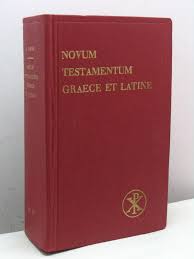
The other day, I was looking at the basic primary source text we used in his New Testament classes.  It’s Augustinus Merk’s Novum Testamentum Graece Et Latine (pictured above). It’s the entire New Testament in its original language, Greek on one side of the page and Latin on the other. Originally published in 1948, its footnotes are filled with scholarly critical apparati. – mostly pointing up and evaluating variant readings of the Greek texts. I[n itself, that’s interesting. We were actually dealing with texts very close to the originals (none of which, it turns out, have survived. Instead all we have are copies of copies of bad copies. But that’s another story.)]

Besides the text itself, what was even more interesting to me were my notes in the margins of each page. Each was jam-packed with cursive scribblings in my smallest possible handwriting – so small, in fact, that I needed a magnifying glass to review some of them last week.

And that was evidence of Father O’Doherty’s teaching method. It involved (1) his lecturing to us each day reading mostly from his notes, (2) our transcribing notes as fast as we could, pausing occasionally for someone to ask questions, (3) Our transferring those notes into the margins of the relevant texts during out study periods, and (4) Recopying those detailed marginal notes onto exam papers in response to our teacher’s exam questions.

To me, in retrospect, that sounds pretty much like what the great Brazilian educator, Paulo Freire, excoriated as “Banking Education” – where teachers make deposits into the “accounts” of students who subsequently make withdrawals at exam time to purchase good grades.

But here’s the funny part: it worked! Father Eamonn wasn’t a particularly dynamic teacher. But what he taught us was so interesting and well-organized that we learned important lessons from a process that seems like pure regurgitation. Put that in your pedagogical pipe and smoke it!

Ask any of my peers. All of us love Eamonn. And we remain grateful to him to this day.

(Next Week: a full account of what I learned about the Bible over the years – in two dozen points)