
Following our arrival in Tuscany on the first leg of our journey to India, our extended family had some medical problems, one of them serious.
Less seriously, I ran out of a medication I’ve been taking. More seriously, my wife, Peggy, contracted a virulent case of poison ivy. Most serious of all, Carla, my daughter’s au pair from Mexico, came down with appendicitis. Each of these incidents highlighted the superiority of the Italian medical system to what we have in the United States, and the direction we must take to improve our healthcare procedures.
Begin with my running out of pills. . . . I tried to get my prescription filled before leaving the states. Since we’ll be gone for nearly 5 months, and I need to take one pill each day, I decided that I’d buy180 pills from my local Rite Aid. My doctor gave me the “script” without any trouble. However, my pharmacist informed me that I needed my insurance company’s O.K. to cover the cost. That would be about $100 for 30 pills, with my co-pay being $8.00.
So one month before leaving home, I phoned my insurance company. After three phone calls by me and a couple by my pharmacist – all preceded by lengthy and repetitious “conversations” with an automated responder – permission was granted.
However when I actually tried to obtain the pills just before departure, neither I nor my pharmacist was able to do so. There was no record of the previously granted permission. So the process had to start all over again, and I had no time to spare.
More phone calls . . . . More conversations with machines . . . . Lengthy arguments with “representatives” and their supervisors. . . . More than an hour wasted . . . . In the end, permission refused.
By contrast, when I arrived in Tuscany, I tried to get the prescription filled at the local pharmacy. After complimenting my Italian, the pharmacist simply asked “How many boxes do you want?”
“How much will they cost?” I asked.
“Six dollars a box,” came the reply.
“I’ll take two for now,” I answered.
I gave the pharmacist the money. She gave me my two boxes of pills. She never asked to see a prescription. I went on my way wondering about the $102 dollars somehow “saved” in the transaction.
And then there’s the case of my wife’s poison ivy. She came down with that after doing some yard work just before leaving our home in Berea, Kentucky. It was pretty severe – so much so in fact that her arms swelled and the rash covered both of them and had spread to her face, neck and torso.
So off to the pharmacy she went. She obtained some anti-rash skin cream there. When that proved ineffective, she visited the walk-in clinic attached to the pharmacy. She joined the line of about 10 people waiting to see the doctor about their varying ailments.
When her turn came, Peggy was examined, and the doctor prescribed some pills – 2 different kinds. They were purchased at the neighboring pharmacy for a total of about $20.00.
Problem solved. No cost for the doctor’s visit. No insurance cards or discussion of money. No phone calls to the insurance company, its machines, “representatives,” and supervisors. No paper work. Hmm. . . .
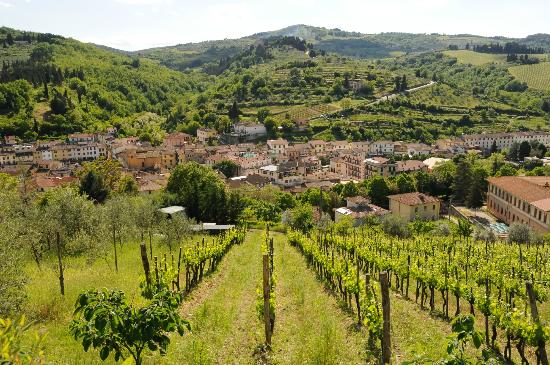
Carla came down with appendicitis just before we arrived in Panzano, the small town in the Chianti region of Tuscany where we were staying.
After experiencing severe stomach pains, she went to the pharmacy’s walk-in clinic, was quickly diagnosed and whisked off to the hospital in Firenze by ambulance.
They operated immediately. Before admitting her to the operating theater, the administration asked only to see Carla’s passport, for identification purposes. Afterwards, she was hospitalized for three full days. She was released with a simple “arrivederci” and an appointment to return in a week’s time to remove her stitches. Once again there was no discussion of money or payment. And, according to Carla, her treatment was top notch.
By the way, she wasn’t using Mexico as a point of comparison. She had experienced a gall bladder operation in Connecticut about a year earlier. She’s still receiving bi-weekly communications from the hospital about payments and insurance coverage.
Recently former President Bill Clinton, the so-called “Secretary in Charge of Explaining Sh*t,” spoke about the inferiority of the U.S. medical system and how curing its ills would benefit the economy.
It’s the most expensive system in the world, he remarked. Our country spends 17.9% of its gross domestic product on health care. Yet the U.S. is ranked (at best) about 25th in terms of its quality. Italy and France are far ahead of it.
Do you want to transform the economy Clinton asked? Reform the medical system, and reduce the share of GDP devoted to health care to the level achieved by Switzerland and the Netherlands – about 12%.
“The difference between 17.9 percent and 12 percent is $1 trillion a year,” Clinton said. “A trillion dollars that could go to pay raises, or to hire new employees or to make investments that would make our economy grow faster or to provide more capital to start small businesses or to expand others or to support diversifying and strengthening agriculture. You name it. A trillion dollars is a lot of money to spot our competitors in a highly competitive global economy.”
To implement Clinton’s recommendation, it would be necessary to introduce a Single Payer health care system into the U.S. President Obama wanted to move toward that system when he pledged to make a “public option” part of Obamacare. That meant, of course, giving people a choice between the ultra-expensive and globally inferior system we endure in the U.S. on the one hand, and something like the Italian system my family has just experienced on the other.
However, to please his opponents, Obama quickly took the public option off the table even before negotiations about health care reform began.
Bankrolled by Big Pharma and the insurance lobby, Obama’s opponents knew that most of us would choose what we’ve experienced in Italy over the inefficient, bureaucratic, and budget-busting monster that’s ruining our economy.
 About Things That Matter