In Memoriam Rev. John Rausch (1945-2020)

Peggy and I were shocked Sunday night when we received the stunning news that Fr. John Rausch, a very dear friend of ours, had died suddenly earlier in the day. John was a Glenmary priest whom we had known for years. He was 75 years old.

At one point, John lived in a log cabin below our property in Berea, Kentucky. So, we often found ourselves having supper with him there or up at our place. John was a gourmet cook. And part of having meals with him always involved watching his kitchen wizardry while imbibing Manhattans and catching up on news – personal, local, national, and international. Everything was always interspersed with jokes and laughter.

That’s the kind of man John was. He was a citizen of the world, an economist, environmentalist, prolific author, raconteur, and social justice warrior. But above all, John was a great priest and an even better human being full of joy, love, hope, fun, and optimism.

Yes, it was as a priest that John excelled. Everyone who knew him, especially in the progressive wing of the Catholic Church, would agree to that. Ordained in 1972 [just seven years after the closure Vatican II (1962-’65)] John never wavered in his embrace of the Church’s change of direction represented by the Council’s reforms.

According to the spirit of Vatican II, the Church was to open its windows to the world, to adopt a servant’s position, and to recognize Jesus’ preferential option for the poor.  John loved that. He was especially fervent in endorsing Pope Francis’ extension of the option for the poor to include defense of the natural environment as explained in the pope’s eco-encyclical, Laudato Si’. (To get a sense of John’s concept of priesthood and care for the earth, watch this al-Jazeera interview that appeared on cable TV five years ago.)

His progressive theology delighted John’s audiences who accepted the fact that Vatican II remains the official teaching of the Roman Catholic Church. So, as two successive reactionary popes (John Paul II and Benedict XVI) subtly attempted to reverse conciliar reforms, and as the restorationist priests and bishops they cultivated tried mightily to turn back the clock, John’s insistence on the new orthodoxy was entirely refreshing.

I remember greatly admiring the shape of John’s homilies that (in the spirit of Pope Francis’ Evangelii Gaudium) were always well-prepared and followed the same pattern:

  1. He’d begin with two or three seemingly unrelated vignettes involving ordinary people with names and usually living in impoverished Appalachian contexts.
  2. For the moment, he’d leave those word-pictures hanging in the air. (We were left wondering: “What does all that have to do with today’s readings?”)
  3. Then, on their own terms, John would explain the day’s liturgical readings inevitably related to the vignettes, since Jesus always addressed his teachings to the poor like those in John’s little stories.
  4. Finally, John would relieve his audience’s anxiety about connections by perfectly bringing the vignettes and the readings together – always ending with a pointed challenge to everyone present.

The result was invariably riveting, thought-provoking and inspiring. It was always a special day whenever Fr. John Rausch celebrated Mass in our church in Berea, Kentucky.

Nevertheless, John’s social justice orientation often did not resonate with those Catholics out-of-step with official church teaching. These often included the already mentioned restorationist priests and bishops who harkened back to the good old days before the 1960s. Restorationist parishioners sometimes reported Fr. Rausch to church authorities as “too political.”

But Fr. Rausch’s defense was impregnable. He was always able to appeal to what he called “the best-kept secret of the Catholic Church.” That was the way he described the radical social encyclicals of popes from Leo XIII’s Rerum Novarum (1891) through Pius XII’s Quadragesima Anno (1931), Vatican II’s Gaudium et Spes (1965), and Pope Francis’ Laudato Si’ (2015).

John was fond of pointing out that all of those documents plus a host of others were consistently critical of capitalism. They favored the demands of working classes, including living wages, the right to form labor unions, and to go out on strike. Other documents were critical of arms races, nuclear weapons, and modern warfare in general. “You can’t get more political than that!” John would say with his broad smile.

All that perseverance on John’s part finally paid off when his local very conservative bishop was at length replaced by a Franciscan friar whom I’ve described elsewhere as “channeling Pope Francis.” I’m referring to John Stowe whose brown-robe heritage had evidently shielded him from the counter-reforms of the two reactionary popes previously mentioned.

When Bishop Stowe assumed office, he evidently recognized John as a kindred spirit. He respected his knowledge of Appalachia and his desire to connect Church social teachings with that context.  So, the new bishop asked John to take him on an introductory tour of the area. John was delighted to oblige. He gave Bishop Stowe the tour John himself had annually led for years. It included coal mines, the Red River Gorge, local businesses, co-ops, social service agencies, local churches, and much more. John became Bishop Stowe’s go-to man on issues involving those represented by the experience.

But none of that – not John’s firm grounding in church social teaching, not his success as a liturgist and homilist, not his acclaimed workshops on economics and social justice, not his long list of publications, nor his advisory position with Bishop Stowe – went to John’s head.

He never took himself that seriously. He was always quick with the self-deprecating joke or story.

In fact, he loved to tell the one about his short-lived movie career. (I’m not kidding.)  It included what he described as his “bedroom scene” with actress Ashley Judd. It occurred in the film, “Big Stone Gap.” I don’t remember how, but in some way, the film’s director needed a priest for a scene where Ms. Judd was so deathly ill that they needed to summon a member of the clergy. John was somehow handy. So, he fulfilled the cameo role playing himself at the bedside of Ashley Judd. (See for yourself here. You’ll find John credited as playing himself.) Right now, I find myself grinning as I recall John’s telling the tale. It always got a big laugh.

Other recollections of John Rausch include the facts that:

  • For a time, he directed the Catholic Committee on Appalachia.
  • He also worked with Appalachian Ministries Educational Resource Center (AMERC) introducing seminarians to the Appalachian context and its unique culture.
  • He published frequently in Catholic magazines and authored many editorials in the Lexington Herald-Leader. John’s regular syndicated columns reached more than a million people across the country. 
  • He had a strong hand in the authorship of the Appalachian bishops’ pastoral letter “At Home in the Web of Life.”
  • He led annual pilgrimages to what he called “the holy land” of Appalachia as well as similar experiences exploring the culture and history of the Cherokee Nation.
  • He was working on his autobiography when he died. (I was so looking forward to reading it!)

More Personally:

  • He graciously read, advised, and encouraged me on my own book about Pope Francis’ Laudato Si’.
  • I have fond memories of one Sunday afternoon when he invited me to a meeting in his living room with other local writers. We were to read a favorite selection from something each of us was working on.
  • John often came to my social justice related classes at Berea College to speak to students about Appalachia its problems, heroines and heroes. (Of course, to my mind, John ranked prominently among them.)
  • He gave a memorable presentation along those lines in the last class I taught in 2014. John was a splendid engaging teacher.

Peggy and I are still reeling from the unexpected news of this wonderful human being’s death. For the last day we’ve been sharing memories of John that are full of admiration, reverence, sadness – and smiles. It’s all a reminder of our own mortality and of the blessing of a quick, even sudden demise.

Along those lines, one strange thought that, for some reason, keeps recurring to me is that John’s passing (along with that of another dear friend last month) somehow gives me (and John’s other friends) permission to die.

I don’t know what to make of that. It might simply be that the two men in question (like Jesus himself) have gone before us and shown the way leading to a new fuller form of life. Somehow, that very fact makes the prospect of leaving easier. Don’t ask me to explain why or how.

Thank you, John.   

Dives & Lazarus: a primer on liberation theology

Readings for the 26th Sunday in Ordinary Time: AM 6: 1A, 4-7; PS 146: 7-10; I TM 6: 11-16; LK 16: 19-31 

Today’s liturgy of the word provides us with a virtual catechism of liberation theology – Christianity’s most important theological development in the last 1500 years, and the West’s most important social movement of the last 150 years.

I have come to those conclusions over a period of more than forty years studying liberation theology. My interest began in Rome during my graduate studies there, 1967 through 1972. There I first heard Peru’s Gustavo Gutierrez speak. (Fr. Gutierrez is considered the father of liberation theology.)

Subsequently I read Gutierrez’s bookA Theology of Liberation (1971) and was completely taken by it. Reading the book gave me the feeling that I was hearing Jesus’ Gospel for the very first time.

You might ask, what is liberation theology? To answer that question fully, please look at my blog entries under the “liberation theology” button. I’ve written a series on the question. In my blogs, you’ll find that I always define it in a single sentence. Liberation theology is reflection on the following of Christ from the viewpoint of the world’s poor and oppressed. That’s the class of people to which Jesus himself belonged. They constituted the majority of his first followers.

When read from their viewpoint, accounts of Jesus’ words and deeds – the entire Bible for that matter – take on depths of meaning and relevance to our contemporary world that are otherwise inaccessible to people like us who live in the heart of the wealthy world. From the viewpoint of the poor, God passes from being a neutral observer of earth’s injustices to an active participant with the poor as they struggle for justice here on earth. Jesus becomes the personification of that divine commitment to the oppressed. After all, he was poor and oppressed himself. The Roman Empire and its Temple priest collaborators saw to that.

My interest in liberation theology deepened as my teaching career developed at Berea College in Kentucky from 1974 to 2010. There I was encouraged to continue my study of liberation theology. So, I spent extended periods in Brazil, Nicaragua, Costa Rica, Honduras, Guatemala, Cuba, Mexico, Zimbabwe, South Africa, India and elsewhere studying under liberation theologians, dialoging and publishing with them. The poor in all of those countries were suffering from the aggression the United States directed against them.

Meanwhile at Berea, I found the conclusions of liberation theologians validated by the college’s very fine scripture scholars. They had almost no acquaintance with liberation theology, and yet what they were teaching perfectly harmonized with its central tenets. It’s just that they stopped short of drawing what seemed to me the obvious political conclusions from their work.

More specifically, Berea’s scholars identified the Exodus (Yahweh’s liberation of slaves from Egypt) as God’s original and paradigmatic revelation. The whole tradition began there, not in the Garden of Eden. Moreover, the Jewish prophetic tradition emphasized what we now call “social justice.” Even more, Jesus of Nazareth appeared in the prophetic tradition, not as a priest or king. Jesus directed his “ministry” to the poor and outcasts. The Gospel of Luke (4: 18-19) has Jesus describing his program in the following words:

“The Spirit of the Lord is upon me, because he has anointed me to bring good news to the poor. He has sent me to proclaim release to the captives and recovery of sight to the blind, to let the oppressed go free, and to proclaim the year of the Lord’s favor.”

After his death, Jesus’ followers continued along those lines. They lived communally, having sold all their worldly possessions and distributed the proceeds to the poor.

All of that finds vivid expression in today’s liturgy of the word. As I said, it’s a kind of catechism of liberation theology. The reading from Amos the prophet describes the sin that most offends God – wealth disparity in the face of extreme poverty. Amos decries a “wanton revelry” on the part of the wealthy that sounds like the “American Way of Life” or the “Lives of the Rich and Famous” that we Americans find so fascinating.

The prophet describes a rich class that lives like King David himself – in luxurious houses, overeating, drinking wine by the bowlful, and generally ignoring “the collapse of Joseph,” i.e. the poverty of their country’s most destitute. For that, Amos says, the rich will ultimately suffer. All their wealth will be confiscated and they will be driven into shameful exile.

In railing against the rich and defending the poor, Amos was calling Judah back to the worship of Yahweh whose attributes are described in today’s responsorial psalm. There God is depicted as loving the just and thwarting the ways of the wicked. The psalm describes Yahweh as securing justice for the oppressed, giving food to the hungry, and setting captives free. He gives sight to the blind and protects resident aliens, single mothers and their children.

Then today’s excerpt from 1st Timothy outlines the characteristics of those who worship that God by following in Jesus’ footsteps. They keep the commandment which is to do unto others as we would have them do unto us.

According to St. Paul, that means pursuing justice and living with devotion, faith, love, patience, and gentleness.

Finally, the gospel selection from Luke chapter 16 dramatizes the sinful relationship between rich and poor and the destinies awaiting both. Luke tells the story of the rich man and “St. Lazarus” who is honored by the poor throughout Latin America.

It is significant that Lazarus is given a name in Jesus’ parable. Usually we know the names of the rich, while it is the poor that remain anonymous. Here matters are reversed. To remedy this anomaly, tradition has assigned the wealthy man a name. He’s called Dives, which is simply the Latin word for rich man.

For his part, Lazarus is quintessentially poor, hungry, and lacking medical care. His sores are open and the only attention they receive are from dogs that lick his wounds. Meanwhile, Dives seems completely unaware of Lazarus’ presence, though the beggar is standing at his very doorstep. Within the sight of Lazarus, the wealthy one stuffs himself with food to such a degree that the scraps falling from his table would be enough to nourish the poor beggar. But not even those crumbs are shared. How could Dives share? He doesn’t even know that Lazarus exists.

So, the two men die, and things are evened out. The rich man goes to hell. We’re not told why. Within the limits of the story, it seems simply for the crime of being rich and unconsciously blind to the presence of the poor. For his part, Lazarus goes to the “bosom of Abraham,” the original Hebrew patriarch.

Lazarus is rewarded. Again, we’re not told why. Within the story, it seems simply because he was poor and Yahweh is partial to the poor, just as he was to the slaves God intervened to save when they were starving in Egypt.

Seated with Abraham, Lazarus feasts and feasts at the eternal banquet hungry people imagine heaven to be. Dives however is consumed by flame in the afterlife. Fire, of course, is the traditional symbol of God’s presence, or purification, and of punishment. This seems to suggest that after death, both Dives and Lazarus find themselves in the presence of God. However what Lazarus experiences as joyful, Dives experiences as tormenting.

And why? Simply, it seems, because Dives was rich, and Lazarus was poor.

Does the parable tell us that what awaits us all after death is a reversal of the economic conditions in which we now find ourselves? The first will be last; the last first. The rich will be poor, and the poor will be rich. That in itself is highly thought-provoking.

In any case, Yahweh is presented as champion of the poor in this parable, just as in the reading from Amos, in today’s responsorial psalm, and in Paul’s letter to Timothy. And according to liberation theologians, that’s the central characteristic of God throughout the Judeo-Christian tradition. God is on the side of the poor and hates obscene wealth disparity.

You can well imagine how such insight inspired the poor and oppressed throughout the world when it emerged as “liberation theology” following the Second Vatican Council. Poor people everywhere (and especially in Latin America) took courage and were inspired to demand social justice from the rich who had been ignoring them in the New World since the arrival of Columbus 500 years earlier. In fact, Liberation theology motivated social movements more powerfully than any thought current since the publication of the Communist Manifesto in 1848.

And that’s why the reigning empire, the United States of America took action against liberation theology. It initiated what Noam Chomsky calls “the first religious war of the 21st century.” It was a war of the United States against the Catholic Church in Latin America – yes against the Catholic Church. The war killed hundreds of thousands of priests, nuns, lay catechists, social workers, union organizers, students, teachers, and journalists along with ordinary farmers and workers.

Today’s liturgy of the word reminds us not to let the United States have the final word. We are called to divest ourselves of our wealth and to take notice of St. Lazarus at our gates. God is on the side of the poor, not of the rich.

“It’s Over” for the Catholic Church and Its Abusive Clergy

Pedophilia cartoon

Readings for 32nd Sunday in Ordinary Time: I Kgs. 17: 10-16; Ps. 146:7-10; Heb. 9: 24-28; Mk. 12: 38-44

Last Thursday, the editors of The National Catholic Reporter (NCR) published an open letter to all bishops in the United States. The letter’s topic was the fallout surrounding the clerical abuse scandal. Its theme was “it’s over” – a refrain repeated seven different times in the document.

The repetition is relevant to the Gospel readings for this 32nd Sunday in Ordinary Time, the episode of the “Widow’s Mite.” The story summarizes the attitude of Jesus towards clerical corruption in his own day – and in our own.

After visiting Jerusalem’s temple just before his own execution, Jesus concluded that Judaism as represented there had no future. His words and actions expressed his clear conclusion, “It’s over!” He gives up on the temple system. His despair tempts me to give up on the Catholic Church.

Before I get to that, let me fill you in about the NCR letter and the apparent meaning of its catchphrase which implies that the Catholic Church has no more future than the Jerusalem temple Jesus cursed.

“It’s over,” the editors said because:

• The clerical abuse scandal has brought the church to rock bottom.
• This is a question of such rot at its heart that the corruption threatens the very identity and unity of the Catholic Church not only in the United States, but worldwide.
• The feds have now entered the picture ordering chancery officials not to destroy the paper trail they’ve been hiding for more than 50 years.
• Abusers and their enablers have been recognized as federal criminals.
• The bishops have nowhere left to hide. Like the king in the familiar fable the bishops and clergy all stand naked before the world; we all realize that they have no clothes. They have lost moral authority.
• Even Washington’s Cardinal McCarrick abused boys and seminarians for decades.
• And the cover-ups go right to the top – to the Vatican itself. The hastily-sainted John Paul II “let wolves roam his flock” because of his falsely inflated idea of a “heroic priesthood” to which no one can any longer subscribe.
• Blaming gay priests for the crisis is so obviously yet another diversionary attempt to block the fundamental reforms required in a clerical culture that has demonstrated a basic ignorance of human sexuality.
• So is blaming Pope Francis who alone among recent popes has exhibited the courage to confront the problem and to remove from office clerics even at the highest levels of the hierarchy.
• The only reason for belated confessions of guilt on the part of bishops is that they have at last been caught with their pants down (literally!) beginning as far back as 1985.
• Without relentless journalistic investigation, clerical abuse would have continued unimpeded and remained covered-up.
• As a result, apologies, studies, conferences, and spiritual retreats for prayer and meditation all ring hollow.
• Only very fundamental changes have any hope of saving the church.
Absent such transformation, it’s over!

And that brings me to the familiar story of today’s Gospel reading, “The Widow’s Mite.” Contrary to what you’ve been told, it’s not about the widow’s generosity. It’s about her exploitation by a clergy every bit as corrupt as the popes, bishops and priests we’ve just been discussing.

As Mark tells it, Jesus and his friends are visiting Jerusalem for the Passover Feast during the final week of his life. They are in the Temple. On the previous day, they had all taken part in (and perhaps led) a demonstration there against the temple priesthood and its thievery from the poor. I’m talking about Jesus’ famous “cleansing of the temple.” Soon the temple priesthood and scribal establishment will offer a reward of thirty pieces of silver for information leading to Jesus’ arrest. Judas will find himself seriously considering collecting that reward.

In the meantime, Jesus continues his on-going instruction about the corruption of the Temple System. In the episode before us, he takes a position, Mark says, “opposite” the temple treasury. The treasury was the place where Jews paid the tithe required by the law as interpreted by the priesthood that Jesus despises. It was a “flat tax” applying the same to rich and poor.

Ever class-conscious, Mark points out that “many rich people” somehow made it clear to all that they were putting in large sums. Then a poor widow came along and furtively put in a penny. Jesus calls attention to the contrast: “large sums” vs. “two small copper coins, which are worth a penny.”

“It’s all relative,” Jesus says. “Truly I tell you, this poor widow has put in more than all those who are contributing to the treasury. For all of them have contributed out of their abundance; but she out of her poverty has put in everything she had, all she had to live on.” Jesus then leaves the temple in disgust.

The standard way of treating this reading runs like this: (1) The widow in the Temple donated to the temple priests “all she had to live on” and was rewarded with Jesus’ praise; (2) follow her example (3) donate generously to your priest and you will be richly rewarded either here, in heaven, or in both places.

That’s a standard treatment we have all heard. However, it has severe problems. To begin with, it ignores today’s responsorial from Psalm 146. That excerpt from Psalms sets a back-drop for the entire Liturgy of the Word and provides a key for interpreting not only today’s reading, but the entire Bible. The psalm reminds us that the poor are God’s Chosen People. God’s concern for the poor is not with their generosity towards God but with God’s securing justice for them. As the psalm says, God gives food to the hungry, sets captives free, gives sight to the blind, protects immigrants, and sustains the children of single moms. God loves those concerned with justice for the poor, the Psalm says. God loves prophets like Jesus. On the other hand, God thwarts the ways of the wicked – those who, like the scribes and high priests, exploit God’s favored poor.

With all of that in mind, we are alerted to circumstances in today’s gospel story that summon us to interpret it differently from the standard line.

We are reminded that the episode takes place in an elaborate context of Jesus’ assault on the temple system. In effect, the context is Jesus’ symbolic destruction of the temple itself. Yes, there was that “cleansing” I referenced. But there was also Jesus’ prediction of the deconstruction of the building itself. “Not one stone will be left here upon another; all will be thrown down” (MK 13:1-2). Then there was that strange incident of Jesus cursing a fruitless fig tree as he was entering the temple precincts (11:12-14; 20-24). The fig tree was the symbol of Israel. Here again Jesus pronounces a judgment on an entire system that had become corrupt and forgetful of the poor who are so central to God’s concern.

That judgment is extended in Jesus’ teaching immediately before the episode of the widow’s mite. Again, Jesus takes a position “opposed” to the temple treasury and says, “Beware of the scribes . . . They devour widows’ houses and for the sake of appearance say long prayers.”

With Jesus’ warning ringing in their ears, a case-in-point, a poor widow, arrives on the scene. She pays her tithe – the flat tax – and leaves penniless. Jesus can take no more. He calls attention to the hypocrisy and injustice of the whole situation and leaves the temple in disgust. For him, in the words of the NCR’s Open Letter, “It’s over!”

And that returns me to my own questions about my commitment to the Catholic Church. Increasingly and reluctantly, I’m feeling that’s over too. Having just moved to the Northeast (Westport, CT), I’ve been searching for a community that honors the progressive teachings of the Second Vatican Council (1962-’65) – still the church’s official teaching – with its emphasis on social justice, engaged homilies, ecumenism, and vibrant liturgies.

So, I did an online search for “progressive Catholic Churches near Westport.” The search came up empty – except for a site denouncing progressive Catholicism. Nonetheless, a friend directed me to a church in Norwalk (a 15-minute drive from my new location). I joined a men’s group that meets in the church basement each Saturday morning at 7:00 to discuss the next day’s liturgical readings. However, I soon discovered that one of the ground rules for discussion is “No politics!”

That so leaves me out! The world is burning. And critical, liberationist readings of the Jesus tradition offer perhaps our best hope of putting out the raging fire. Where else but church do hundreds of people come together in every community across the country to ponder questions of goodness, truth, and their relationship to Ultimate Reality? Yet good-willed men are told: Don’t connect this with that.

Why continue?

Until that sort of thing changes, for me it is indeed over. And in leaving in disgust, I’m following the example of Jesus himself.

The Salvation of Our Country and Church Comes from Iranians and Mexican Immigrants (Sunday Homily)

Readings for 4th Sunday in Lent: 2CHR 36:14-16, 19-24; PS 137:1-6; EPH 2:4-10; JN 3: 14-21

NAFTA

Today’s liturgy of the word reminds us to look for salvation in unexpected places. In fact, it strongly suggests that the very ones our culture despises, and our church relegates to second class status have been chosen by God to save us. Specifically, I’m talking about Iranians relative to our country and Latin Americans in relation to the church.

Take Iranians first. (They are called “Persians” in today’s first reading.) There, one of them (King Cyrus) is identified in Chronicles as Judah’s “messiah” or anointed. The identification is given even though Cyrus was not a Jew, but an adherent of Zoroastrianism, a religion even more foreign to Judaism than Islam. Yet according to Chronicles, this Iranian king was God’s servant chosen to end Judah’s long exile in Babylon (modern day Iraq). That’s what I mean by salvation coming from an unexpected place.

Then in the second reading from Ephesians, Paul refers to Jesus of Nazareth in those same Cyrusian terms. Jesus is the Christ, God’s anointed, Paul says – and an unlikely “Christ” at that. After all, the Nazarene was the son of an unwed teenage mother; an refugee-immigrant in Egypt at the beginning of his life; a working stiff rather than a priest or scholar; possessed by the devil (according to the religious establishment); a drunkard and whore-monger according to those same sources; an enemy of the temple and state; and a victim of torture and of capital punishment in the form reserved for terrorists. Nevertheless, just as Cyrus brought Judah back from their 70 year-long exile in Babylon, Paul says, Jesus, the executed criminal, brought all of us back from the metaphorical death caused by living according to the deathly standards of the world. In Paul’s eyes, those standards obscure the gifts of God by convincing us that we have to earn life rather than accepting everything as God’s gift. Or as Paul puts it: “salvation is not the result of works,” but of God’s graciousness.

That graciousness (John the evangelist reminds us in today’s Gospel reading) is unending; it covers all the bases, has no exceptions and lasts forever. It turns each of us into Christs – into God’s only son (or daughter) – into saviors of the world. In other words, each one of us is the unlikeliest Christ of all.

O.K. each of today’s readings tell us to look for salvation in unexpected places – even within ourselves. But what are we post-moderns to understand by “salvation” itself? Think about it. The answer should be clear both in terms of country and church. In both spheres our condition can only be described as absolutely desperate and in need of deliverance.

Politically, we’re currently like lemmings rushing headlong towards the final precipice. Under the aegis of the organization Noam Chomsky calls “the most dangerous in the history of the world,” our Republican “leaders” are in denial about the greatest peril the human race has ever faced. Here I’m referring to climate chaos that threatens to deprive our grandchildren and even us and our children of the most basic necessities of life.

Besides that, our rulers insist on developing nuclear arsenals whose destructive power boggles the mind. And they seem extremely anxious to unleash them. The U.S. commander in chief has gone so far as to wonder aloud, “If we have nuclear weapons, why can’t we use them?” If we’re not looking for salvation from all of that, we must be asleep entirely.

And as for faith . . . My own Christian community, the Catholic Church, it is in dire need of salvation too. It is crumbling before our eyes.

My parish in Berea, Kentucky is a case in point. There we’ve had a series of restorationist pastors hell-bent on reinstating the pre-Vatican II order I grew up in during the 1940s and ’50s.
Clericalism is their watchword and guiding vision. Outside the sanctuary, they wear birettas and cassocks. While celebrating Mass they seem rule-bound, uncreative, unthoughtful, and totally oblivious not only to the reforms of the Second Vatican Council, but to Pope Francis’ more recent summons to radical change as described in his Apostolic Exhortation, The Joy of the Gospel (JG), and in his eco-encyclical, Laudato Si’ (LS).

As a result of such backwardness, church numbers are dwindling drastically. Parishioners I’ve seen at Mass every Sunday over my 46 years at St. Clare’s have gone missing. Alternatively, and like my own children, they have joined the ranks of the second largest denomination in the country – Former Catholics. Loyal progressives in my parish are at their wits’ end wondering how to cope with leadership tone-deaf to their desperate voices.

My own response has been to recognize what theologian and church historian, Figueroa Deck has identified as the “sleeping giant” of Latino Catholicism. That has me attending our parish’s Hispanic Mass at 11:00, rather than the increasingly reactionary and Euro-centric Anglo Mass at 9:00. I “go to the eleven o’clock” not only to escape the deadly retrogression of 9:00 a.m. antiquarianism, but in subconscious recognition, I think, of the fact that our Hispanic parishioners represent the cutting, salvific edge of the Catholic Church.

For decades now, the Latin American Church has embodied Catholicism’s most vital element.That’s personified in Pope Francis himself, our first Latin American pontiff, who I’m told is rejected by our current parish leadership – the same way Washington rejects Latin American immigrants.

Francis, of course, comes from Argentina. He’s followed the lead of Latin American theologians of liberation with his adoption of Jesus’ own “preferential option for the poor.” That entails recognition that the poor (including, most prominently, our immigrant population) know more about the world than our rich leaders – or even than us in more comfortable classes.

I mean, immigrants possess a version of what W.E.B. Dubois called “double consciousness,” while the rest of us see only one side of what’s occurring before our eyes. On the one hand, the daily observation of the undocumented (as our motel cleaners, nannies, gardeners, construction workers, and fellow parishioners) tells them what it means to be a white American. On the other, they know intimately the experience of exclusion by those same whites.

Immigrants know how the economy works for whites, and how it excludes browns and blacks. They know that rich capitalists and their money enjoy absolute freedom to cross borders, regardless of the negative impacts such mobility might (and does!) have on Global South economies. At least subconsciously, migrant workers recognize the simultaneous contradiction of their being excluded from such mobility, despite the fact that labor is an even more important part of the economic equation than capital. So even though the law (created by the rich) forbids them, immigrants vote with their feet to claim the rights the system unjustly denies them. Our “immigration problems” are the result.

The double consciousness of immigrants can be salvific for the church. If its expressions are heeded, they can save the church. As expressed by our Hispanic Pope Francis, the undocumented in our midst call us to a church where (in the words of The Joy of the Gospel) we cannot leave things as they presently are” (JG 25), but must include new ways of relating to God, new narratives and new paradigms (74).

Similarly, in the world of politics, Iranians (the descendants of Chronicles’ Cyrus the Great) inspired this time by Islam are calling us to changes in foreign policy. They implore us to just leave them (and their oil) alone. Ironically, their desire is that they be liberated from a kind of Babylonian captivity that places them under the jackboot of the United States and (still more ironically) Israel.

What I’m suggesting is that the descendants of Cyrus are still God’s instrument of our salvation. So in our present desperate context, are marginalized Catholic immigrants whose presence reminds us of Pope Francis’ wisdom and of the penetrating understanding of life that comes from refugees and the immigrants our government’s free trade policies create on the one hand, while refusing them sanctuary on the other.

Both bring us the new ways of relating to God, the new narratives and the new paradigms salvation requires.

Why the Church? (Sunday Homily)

Sisters

Readings for Ascension Sunday: Acts 1: 1-11; Ps. 47: 2-3, 6-9; Eph. 1: 17-23; Lk. 24: 48-53

After binge-watching The Keepers last weekend, it’s difficult for me not to connect Ascension Sunday with the church as depicted there. Apart from the fascination stemming from the horrific events portrayed, the docuseries depicts a Catholic Church that has all but disappeared.

Before the 1970s, priests and women religious were plentiful. At my parish, St. Viator, on Chicago’s Northwest Side, our Viatorian priests all living together in the rectory were Fathers Fitzpatrick, Ranahan, Ryan, Burke, and Devereux – along with Brother Kelzer. In addition, women religious dominated our school. Every year a different Sister of St. Joseph of Carondelet taught me there. To this day, I remember them daily in my prayers: Sisters Helen Clare, Mary Jane, Loyola, Rose Anthony, Mary Paul, Cyril, Rita Marie, and Irma. My mind can still see them at daily Mass where their community filled three long pews. It seemed like there were about 20 of them.

Then came Vatican II (1962-’65), and that was the end of that. With the great reforms, everything was called into question: the nature of the church itself, the priesthood, the communal religious life. Priests and nuns left their “consecrated lives” in droves.

Observation of today’s “feast day,” the Ascension of Jesus, was part of it all. Time was when Jesus’ Ascension was celebrated on Thursday as a “holy day of obligation.” That phrase meant that Catholics were obliged to attend Mass on Thursday just as they were on Sunday. To miss Mass on such a day was to commit a “mortal sin.” And that meant that if you died before “going to confession,” you would be condemned to hell for all eternity.

So until the years following the Second Vatican Council, Catholics would fill their churches on Ascension Thursday in the same numbers (and under the same threat) that made them come to Mass on Sundays. That’s hard to imagine today.

I suppose that difficulty is responsible for the transfer of the commemoration of Jesus’ “ascension into heaven” from Thursday to Sunday. I mean it wasn’t that the church changed its teaching about “holy days of obligation.” It didn’t. Catholics simply voted with their feet. They stopped believing that God would send them to hell for missing Mass on Ascension Thursday or the feast of the Blessed Virgin’s Assumption (August 15th), or All Saints Day (November 1st) or on any of the other “holy days.” Church once a week was about as much as the hierarchy could expect.

But even there, Catholics stopped believing that God would punish them for missing Mass on Sunday. So these days they more easily attend to other matters on Sunday too. They set up an early tee time or go for a hike in the woods. Afterwards they cut the lawn or go shopping at Wal-Mart. That kind of “servile work on Sundays” or shopping used to be forbidden “under pain of sin” as well. And once again, it isn’t church teaching that has changed. Catholics have just decided that the teachings don’t make sense anymore, and have stopped observing them.

And apparently they do so in good conscience. So you won’t find them running to confession after missing Mass or working and shopping on Sunday. In fact, that’s another way Catholics have voted with their feet. For all practical purposes, they’ve stopped believing in Confession – and largely in many of the mortal sins they were told would send them to hell – like practicing contraception or even getting a divorce.

I remember Saturday evenings when I was a kid (and later on when I was a priest). People would line up from 4:00-6:00, and then from 7:00 -9:00 to “go to Confession.” And the traffic would be steady; the lines were long. No more! In fact, I personally can’t remember the last time I went to confession. And no priests today sit in the confessional box on Saturday afternoons and evenings waiting for penitents to present themselves.

What I’m saying is that the last fifty years have witnessed a tremendous change in faith – at least among Catholics. Our old faith has gone the way of St. Christopher and St. Philomena and “limbo” all of which have been officially decertified since Vatican II.

In fact, since then the whole purpose of being a Catholic has become questioned at the grassroots level. More and more of our children abandon a faith that often seems fantastic, childish and out-of-touch. Was Jesus really about going to heaven and avoiding hell? Or is faith about trying to follow the “Way” of Jesus in this life with a view to making the world more habitable for and hospitable to actually living human beings?

That question is centralized in today’s liturgy of the word. There the attentive reader can discern a conflict brewing. On the one side there’s textual evidence of belief within the early church that following Jesus entails focus on justice in this world – on the kingdom. And on the other side there are the seeds of those ideas that it’s all about the promise of “heaven” with the threat of hell at least implicit. The problem is that the narrative in today’s liturgy of the word is mixed with its alternative.

According the story about following Jesus as a matter of this-worldly justice, the risen Master spent the 40 days following his resurrection instructing his disciples specifically about “the Kingdom.” For Jews that meant discourse about what the world would be like if God were king instead of Caesar. Jesus’ teaching must have been strong. I mean why else in Jesus’ final minutes with his friends, and after 40 days of instruction about the kingdom would they pose the question, “Is it now that you’ll restore the kingdom to Israel?” That’s a political and revolutionary question about driving the Romans out of the country.

Moreover Jesus doesn’t disabuse his friends of their notion as though they didn’t get his point. Instead he replies in effect, “Don’t ask about precise times; just go back to Jerusalem and wait for my Spirit to come.” That Spirit will “clothe you in justice,” he tells them. Then he takes his leave.

Presently two men clothed in white (the color of martyrdom) tell the disciples to stop looking up to heaven as if Jesus were there. He’s not to be found “up there,” they seem to say. Jesus will soon be found “down here.” There’s going to be a Second Coming. Jesus will complete the project his crucifixion cut short – restoring Israel’s kingdom. So the disciples who are Jews who think they’ve found the Messiah in Jesus, return in joy to Jerusalem and (as good Jews) spend most of their time in the Temple praising God, and waiting to be “clothed in Jesus’ Spirit” of liberation from Roman rule.

The other story (which historically has swallowed up the first) emphasizes God “up there,” and our going to him after death. It’s woven into the fabric of today’s readings too. Here Jesus doesn’t finally discourse about God’s kingdom, but about “the forgiveness of sin.” After doing so, he’s lifted up into the sky. There Paul tells his readers in Ephesus, he’s enthroned at the Father’s right hand surrounded by angelic “Thrones” and “Dominions.” This Jesus has founded a “church,” – a new religion; and he is the head of the church, which is his body.

This is the story that emerged when Paul tried to make Jesus relevant to gentiles – to non-Jews who were part of the Roman Empire, and who couldn’t relate to a messiah bent on replacing Rome with a world order characterized by God’s justice for a captive people. So it gradually turned Jesus into a “salvation messiah” familiar to Romans. This messiah offered happiness beyond the grave rather than liberation from empire. It centralized a Jesus whose morality reflected the ethic of empire: “obey or be punished.” That’s the ethic we Catholics grew up with and that former and would-be believers find increasingly incredible, and increasingly irrelevant to our 21st century world.

Would all of that incredibility and irrelevance change if the world’s 2.1 billion Christians (about 1/3 of the world’s total population) adopted the this-worldly Jesus as its own instead of the Jesus “up there?” That is, would it change if Christians stopped looking up to heaven and focused instead on the historical Jesus so concerned with God’s New World Order of justice for the poor and rejection of empire?

Imagine if believers uncompromisingly opposed empire and its excesses – if what set them apart was their refusal to fight in empires’ wars or serve its interests. How different – and more peaceful – our world would be!

A sensitive discerning reading of today’s liturgy of the word, a sensitive and critical understanding of Jesus’ “ascension” presents us with that challenge. How should we respond?

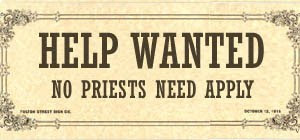
“No Priests” Is the Remedy for the Priest Shortage: Notes for a Home Church (Pt. 4 of 4)

helpwanted

A friend of mine recently told me, “If you’re trying to initiate something new (like reclaiming my priesthood) and the response isn’t ‘Hell yeah!’ you’re probably on the wrong track.”

Well, I haven’t yet heard many “Hell yeahs!” in response to my efforts to (as I said here) re-appropriate my priesthood and start a house church in Berea, Kentucky.

Oh, my very good and generous friends have humored me by showing up on Saturday evenings. But even the closest of them have made it clear that they were doing so out of a sense of duty, rather than enthusiasm.

On top of that, my own reflection on our gatherings has been less than “Hell yeah!” And that’s led me to think that perhaps the whole form of Eucharistic gathering (Mass) might be passé. Certainly, as Garry Wills has pointed out in his book Why Priests? “priesthood” as we’ve known it is beyond recall.

That’s not surprising, since the office of priest turns out to be foreign in the experience of the early church. In fact, no “priest” is mentioned In the accounts of Eucharistic meals found in the first two centuries of Christianity [e.g. in the Dialog with Typho and First Apology of Justin Martyr (100-165)]

Instead, we find mention of a presider – a proestos in Greek – whose function was to stand in front of the congregation, call it to order, and keep the meeting on track. That’s what proestos (the Greek word for the presider at the Eucharist) literally means – the “stander-in-front.”

“Priests” came in much later – and definitively after Christianity became the official religion of Rome. Then, as mentioned earlier, the Christian Eucharist took on the trappings of Roman “mystery cults,” like for instance the cult of the Sun God, Mithra, a favorite of the Roman army, whose birthday was celebrated each year on December 25th.

Mystery cults worshipped gods and goddesses like Mithra, Isis, Osiris, and the Great Mother. All of them descended from heaven, lived on earth for a while, and then ascended back to heaven. From there they offered eternal life to followers who in at least one cult ate the divine one’s body under the form of bread and drank his blood under the form of wine to attain eternal life.

Does that sound familiar?

Of course, it does, because that’s what Jesus became under the aegis of Rome. And priests were part of the syndrome. The new Christian Holy Men dressed up like their mystery cult counterparts, and performed a liturgy so similar to the pagan sacred meal rituals that most Romans probably couldn’t tell the difference.

Nonetheless, the pagan cults were eventually swallowed up entirely by Christianity, and believers were left with a ritual that resembled neither Jesus’ “Lord’s Supper” nor a blood sacrifice. Even the bread stopped looking like bread, but more like a plastic wafer.

But the priests remained, accompanied by an ideological lore that justified their existence by claiming that:

  • Jesus was a priest.
  • His apostles were the first Christian priests.
  • In fact, Jesus’ right-hand man, Peter, was the first pope.
  • Priests were necessary to forgive sin.
  • And to offer what was now called “the holy sacrifice of the Mass.”

Such convictions meant that priests became separated from ordinary Christians. The cleric’s alleged power to miraculously change bread and wine into the body and blood of Christ did that. Performing the miracle seemed to be something between priests and God. Mass was often “celebrated” by the priest alone accompanied by an altar boy.  Even in public, Mass rubrics had the priest facing away from the congregation in a sanctuary fenced off from the congregation by a “communion railing.” There priests completed their duties more or less in secret and using a language (Latin) that few besides the clergy could understand.

Mandatory celibacy also contributed to the otherness of priests. Largely to protect church property from priests’ heirs, the requirement became de rigueur for all priests in the Roman dispensation after the 12th century. Priests were so special that contrary to Jesus’ specific teaching about calling no man “Father” (MT 23:9), they could assume that title for themselves (as in referencing the pope as “Holy Father.”).

Priests signified their specialness by even dressing differently from other Christians – with the pope assuming all the trappings of the Roman Emperor.  Eventually, ecclesiastical life revolved entirely around the “clergy.” They alone were allowed to preach and even touch the sacred elements.

In all of this, the “faithful” were reduced to the role of spectators at priestly cultic events. All such rituals centered on the “Host” consecrated at Mass, and afterwards taking on a life of its own in its “tabernacle,” or displayed for “benediction” in a monstrance, which was sometimes carried ceremoniously in Eucharistic processions.

All of that changed with the Second Vatican Council (1962-’65), when the Church of Rome finally caught up with the Protestant Reformation. The Council recognized the “priesthood of the faithful” that Martin Luther had celebrated. Vatican II also described the Eucharist as a “sacred meal,” rather than simply as a “holy sacrifice.” The altar became a “table” and was turned around and moved closer to the people. More and more frequently, liturgical periti (experts) at the Council described the priest as a “presider.” Lay people were allowed to touch and distribute the sacred elements. Council fathers recognized Jesus’ “real presence” not simply in the Eucharist, but also in Sacred Scripture and in the community they referred to as the “Pilgrim People of God.”

Meanwhile the “search for the historical Jesus” that had begun in earnest with the work of Albert Schweitzer in 1906 took a giant leap forward with the emergence of liberation theology and its adoption by CELAM (the Latin American Bishops’ Conference). Liberation theology was reflection on the following of Christ from the viewpoint of the poor and oppressed, especially in the former colonial world.  It recognized Jesus as a poor peasant like his Third World counterparts. He was seen as thoroughly Jewish and as a resister to Roman Imperialism.

Far from being a priest himself, he was a foe of priests and all they stood for.

Such developments – Vatican II, its theological and liturgical reforms, new insights about the historical Jesus, and re-evaluations of the priesthood itself –  brought priests down from their pedestals; their office became déclassé. With their own baptismal priesthood affirmed, the faithful felt empowered. They spontaneously stopped “going to confession.” Priests everywhere experienced identity crises. Mandatory celibacy entered full debate. As a result, thousands of priests worldwide left the priesthood to marry.

In response, the hierarchical church tried to backpedal. While recognizing the teaching of Vatican II as its own official teaching, the long reign of Pope John Paul II (1978-2005) followed by that of Benedict XVI (2006-2013) gave Vatican II Catholics the feeling that the hierarchy’s honoring of the Council was mostly lip-service.

John Paul II and Benedict systematically replaced cardinals and bishops who had taken to heart the Second Vatican Council’s reforms. The reactionary popes also packed the College of Cardinals (who would elect future popes) with conservatives, made it more difficult for priests to “return to the lay state,” suppressed liberation theology, silenced and removed creative theologians from teaching posts, returned Latinisms to the Eucharistic liturgy, cooperated with neoliberal political regimes, and were generally backward-looking.

Perhaps most importantly, formation programs in Catholic seminaries took a sharp turn to the right. The priests who emerged from them showed little sympathy for conciliar reforms. They displayed ignorance of modern scripture scholarship or awareness of ecumenical theology, as well as any inclination to connect the Gospel with contemporary issues other than abortion or gay marriage.

Such rightward drift came to a sudden and unexpected halt with the election of Pope Francis, an Argentinian, and the first Global South pope in the history of the church. Ordained in 1969, Francis is a product of the Second Vatican Council and inevitably influenced by liberation theology, which was largely a product of Latin America.

His Apostolic Exhortation, “The Joy of the Gospel” (JG, 2013) was seen as his manifesto announcing an acceleration of Vatican II reforms. It called for a “new chapter” in the history of the Catholic Church and for the church to embark on a “new path” on which things could not be left unchanged (JG 25). Preaching had to improve, he said (135-159). The roles of women needed expansion (103-4). Outreach was necessary to Christians of other denominations who share unity with Catholics on many fronts (246). And the struggle for social justice and participation in political life was an inescapable “moral obligation” (220,258).

As for priests, Francis’ Exhortation continued the clerical downgrading implied in Vatican II reforms. The priesthood, the pope taught, represents simply a church function. It is a service not necessarily distinguished in dignity, holiness, or superiority from those rendered by other baptized Christians (204).

And there’s more. Recently, Leonardo Boff (a Brazilian liberation theologian silenced under John Paul II, but reinstated by Pope Francis) spoke glowingly of the current pope. “He is one of us,” Boff said – presumably referring to liberationist Catholics. In any case, Boff went on to speculate that Francis is about to address the Brazilian priest shortage by making possible the reinstatement of the country’s thousands of laicized priests. Boff also conjectured that the pope might be on the brink of allowing women to become deacons. Both changes would represent giant steps towards eliminating mandatory celibacy for priests and towards ordination of women.

CONCLUSION

But is any of those measures sufficient for resolving the priest shortage – or for addressing the irrelevance of the church noted at the beginning of this series of four essays? I doubt it.

That’s because the very bases of priestly powers are in practice no longer believable. I’m referring to the quasi-magic ability to turn bread and wine into the body and blood of Christ, and the authority to forgive sins in the sacrament of Penance. On these two functions, hangs all priestly authority and the entire special identity of the Catholic clergy.

And like the Protestant Reformers before them, many adult, thinking Catholics can no longer accept either. As we have seen, scripture scholars have shown that neither power enjoys biblical endorsement. They are inheritances from post-first century fundamentalists who lacked sensitivity to the rich symbolism of the words attributed to Jesus in the Christian Testament.

As explained earlier, that rich symbolism finds in a loaf of bread a wonderful image of the human condition. Its single reality summarizes it all. Bread is the product of seed, earth, sun, rain, and human labor. When shared it miraculously creates and sustains human community. Wine is similar. Throughout his life, Jesus celebrated the community that such simple elements manifest. His teachings reinforced that basic insight. He was a prophet, a spiritual master, and a religious reformer who preferred rough illiterate fishermen over pretentious, exclusive priests. That was a radical and liberating message.

The Protestant reformers saw all of that quite clearly. And so they did away with priests who insisted on being separate and special, while being honored with titles Jesus forbade.

All of this means that the reforms of Vatican II didn’t go nearly far enough. Pope Francis is correct. To survive, the church must embark on that “new path” he called for.  There nothing can be left unchanged (JG 25). The roles of women need expansion (103-4). Ecumenical cooperation with other denominations and religions must be centralized as well as the struggle for social justice (220, 258). Until all Christians in close cooperation with Muslims, Buddhists, Hindus, New Agers, and atheists cooperate to attack injustice, the survival of the world itself is in doubt.

Evidently, Pope Francis himself has not perceived the implications of his brave words. Certainly, church leaders have not. It remains for the rest of us to take the lead.

Taking that lead was the thought behind my initial “Hell yeah!” to the idea of house church.  


On Re-appropriating My Priesthood


Ordination[1]

I’m so appalled at the prospect of a Donald Trump presidency and the threats it poses to everyone and everything I care about:  the environment and climate chaos, avoidance of nuclear war, victims of torture and false imprisonment, Muslims, drone attacks, wealth disparities, women’s reproductive rights, people of color, the LGBT community, our public school system, the right to privacy, human rights in general, labor unions – my children and my grandchildren.

In fact, as I’ve written recently, a Trump presidency portends the dawning of a Fourth Reich, where the victims of incineration will be not only Jews, but all of us, as the White House teems with climate change deniers whose policies threaten all species and the continuity of human life itself.

So the question is, what can we do about it? What talent does each of us have to respond to Trumpism? As parents and grandparents, teachers, writers, counsellors, school board officials, musicians, public speakers, church members, and public citizens, what does each of us have to offer these unprecedentedly dangerous times.

My own answer is my priesthood.

Only gradually and reluctantly have I come to that conclusion. After all, 40 years ago I exited the Catholic priesthood, got married and raised a family of three outstanding children. I remained active in my local church. And as a professor at Berea College and associate of Costa Rica’s Ecumenical Research Institute (DEI), I continued my role as a theologian with a doctoral degree from Rome’s Academia Alfonsiana. For years I taught in a Latin American Studies Program that took students to Nicaragua, Guatemala, and Cuba. In those capacities, I wrote books and articles and offered courses connected with liberation theology.  However, I resigned myself to my role as lay person – a member of the church’s “loyal opposition.”

And the opposition was absolutely called for. Over the years I’ve found myself dismayed as two consecutive regressive popes (John Paul II and Benedict XV) waged a vicious campaign against liberation theology and systematically removed from the hierarchy and Catholic seminaries progressives and theologians like me. The result over the two generations has been the production of a largely reactionary Catholic clergy who long for the good old days before the Second Vatican Council (1962-’65).

So as a lay person, I’ve often found myself sitting passively in my pew while rebelling internally against the reintroduction into the Catholic liturgy Latinisms and even Latin itself. I’ve listened uncomfortably to well-intentioned priests offer ill-prepared pious platitudes in their homilies rather than reflections connected with the historical Jesus and his relationship to the problems that householders like me face in our private and public lives. And, to speak truly, I was blaming them unfairly. After all, how could they possibly offer what their retrenched seminary training prevented them from receiving?

Still, it struck me as ironic that hundreds of people in my parish come together for about 2 hours each Sunday to reflect on their most dearly held (Gospel) values, but come away having barely tapped into the unlimited power for changing their personal lives and the world itself that those values supply. What a waste, I thought – not only for the parishioners directly involved, but for the world.

Then came a breath of fresh air reminiscent of Pope John XXIII’s famous “opening of windows” more than 50 years ago. Argentina’s Jorge Bergoglio became Pope Francis – a man intent on recovering the spirit of Vatican II. Deeply influenced by the liberation theology his predecessors had warred against, he published “The Joy of the Gospel” (J.G.) and then his eco-encyclical, Laudato Si’ (L.S.). Both publications were bolstered by unprecedentedly honest and refreshing public statements. (Who can forget his question about homosexuality: “Who am I to judge?”)  Francis not only called the church to profound reform; he called the world itself to a “bold cultural revolution.”

As for church reform, Francis called for a “new chapter” in the history of the Catholic Church and for the Church to embark on a “new path” (J.G. 1, 25) on which things cannot be left as they presently are (25). He called for new ways of relating to God, for new narratives and new paradigms (74). He wanted new customs, ways of doing things, new times, schedules, and language (27) — with emphasis on better prepared and delivered homilies (135-159).

Despite (lamentably) continuing to exclude women from the priesthood, the pope ordered the church to expand their roles in church life.  He recognized women as generally more sensitive, intuitive, and otherwise skilled than men (103, 104).

Clearly, then, the pope was speaking (as he said) not primarily to pastors and bishops, but to everyone (33). Decisions about change, he said, should be guided by the principle of decentralization (16, 32). They should be made at the parish level, because parishes are more flexible than Rome or the local chancery, and more sensitive to the specific needs of local people (28). The inventiveness of local communities should not be restrained, he said, but limited only by the openness and creativity of the pastor and local community (28). Such decisions should be respected by local bishops (31).

As for connecting the gospel with world issues, Pope Francis identified the struggle for social justice as “a moral obligation” that is “inescapable” (220, 258). He saw “each and every human right” (including education, health care, and “above all” employment and a just wage) as intimately connected with “defense of unborn life” (192, 213). He also completely rejected war as incapable of combatting violence caused by “exclusion and inequality in society and between peoples” (59). Pope Francis rejected unfettered markets and the “trickle down” ideologies as homicidal (53), ineffective (54), and unjust at their roots (59).

In Laudato Si’ the pope issued an urgent call to the Church and the world to address issues connected with human-caused climate chaos.  In this the entire encyclical (see my book, Understanding Laudato Si’: a Discussion Guide) might be seen as a complete rejection of Trumpism and of the entire Republican Party’s denial of that problem.

So, once again: what to do about it?

Experience shows that the anti-Vatican II clergy resistant to Pope Francis remains incapable of responding either to the latter’s Apostolic Exhortation (J.G.) or to his eco-encyclical (L.S.). Much less has it demonstrated a willingness to address the issues of political-economy, racism, sexism, homophobia, xenophobia, war, torture, etc.  raised by the emergence of Trumpism. (Once again, it is wrong to blame the clergy for this. Their training has made effective response impossible.)

So I’ve decided to do something about it myself. I’ve decided to reactivate my priesthood.

Honestly, I have to admit that the process of doing so began about 5 years ago following my retirement after 40 years of teaching at Berea College. It was then that I set goals for myself. One of them was an ill-formed, vague resolve to “reclaim my priesthood.”

As a preliminary step, I started a blog. Its center piece was the publication of a “Sunday Homily” each week. The reflections tried to connect world events, personal, and family problems with each Sunday’s liturgical readings.

Eventually, my homilies were picked up by OpEdNews – a completely secular progressive news source run by a Jewish editor. Over the years, I’ve published more than 200 such homilies covering Catholic lectionary readings for all three liturgical cycles. The result has been the creation of a kind of cyber community of readers that averages 1600 views of each reflection every week.

Now, in view of the crisis of Trumpism, I’ve decided that my contribution to resistance will be to translate that cyber community into a real-time assembly of faith. It will actually attempt do something to implement Pope Francis’ summons to church reform, and address in particular issues connected with climate chaos.

What I’m proposing is not a Protestant or even an ecumenical gathering. Rather my call is to an alternative Catholic “parish” in my town. Of course, this is not unusual; most towns of any size have more than one Catholic parish. Though specifically Catholic, all people will be welcome – Catholics, Protestants, atheists . . . In particular, “drop-outs” from our local community of faith are encouraged to join.

I imagine the gathering will be very simple – nothing of a show or performance. Rather, people will gather in my home (to begin with). We’ll sing or chant for a while, read the week’s liturgical selections, and share reflections. Afterwards we’ll gather at the dining room table for a brief Eucharistic breaking of bread followed immediately by a pot-luck meal. The week’s meeting will conclude with a planning session outlining activities for the coming week to resist the inroads of Trumpism.

All of this reminds me of the activities of Dietrich Bonhoeffer’s “Confessing Church” in the 1930s when Lutherans and others decided they had to do something to resist Hitler’s fascism. What I’m proposing here is an analogue, where people of faith call on their tradition to confront fascism’s re-emergence.

I’m convinced that only resistance fortified by deep faith can effectively combat that reincarnation. And even if only two or three join me in this proposal, I’m determined to go through with it. After all Jesus did say: “Wherever two or three are gathered in my name, I am there in their midst” (MT 18:20).

Pope Francis: Please Write That Encyclical against War!

Just War

Readings for 6th Sunday after Easter: Acts 15:1-2, 22-29; Ps. 57: 2-3, 5, 6, 8; Rev. 21: 10-14; 22-23; Jn. 14: 23-29.

Last week, David Swanson, the author of War is a Lie shared an interview with the great Jesuit peace activist, John Dear. The latter had just returned from Rome where he participated in a conference convoked by Ghanaian Cardinal Peter Turkson. Cardinal Turkson authored first versions of Laudato Si’, Pope Francis’ landmark encyclical on the environment. He is often mentioned as a possible future pope.

Father John (who doesn’t like to be called “Father Dear”) reported the conference as “unprecedented.” That’s because activists, theoreticians, and scholars of Peace Studies ended by recommending (in a document over the signature of Cardinal Turkson) that Pope Francis publish another encyclical – this one repudiating the Church’s centuries-long endorsement of Just War Theory.

That theory, of course, lays out principles for judging whether or not a given armed conflict might be justified.

The Turkson document repudiated the idea that modern warfare might ever be justified. This is not only because of the terrible destruction caused by modern weaponry, but because, in fact, 90% of casualties of today’s wars end up being innocent civilians. For those reasons, the conference in Rome recommended that Pope Francis not only repudiate war itself, but discourage Catholics from participating in modern military forces.

Imagine what would happen if Pope Francis were to accept those recommendations – especially on top of his denunciations of capitalism-as-we-know-it, his firm embrace of environmentalism, and his statements about homosexuality (“Who am I to judge?”). Catholic radicals would love it, liberals would be inspired. Conservatives who often identify faith and the military would be shocked and scandalized.

Where would you come down?

Think about that question in the light of today’s readings. Think about what “radical,” “conservative” and “liberal” mean for us as individuals and community members in our faith tradition. How would Jesus be classified? What about Paul? What would they say about entirely rejecting the idea of just wars?

Today’s Liturgy of the Word gives us a clue. It presents us first of all with an example of a key conflict between religious conservatives and radicals within the first century infant church. Paul, Barnabas, Silas and Barnabas lead the radical-to-liberal wing. Peter and Jesus’ brother, James are the leaders of the conservatives.

Paul and his friends come from the gentile world. Their concern is to make Jesus both understandable and acceptable to non-Jews. For their audience, circumcision and dietary restrictions (like not eating pork) represent great obstacles to accepting Jesus’ “Way.”

On the other hand, Peter and Jesus’ brother, James, are Jews through and through. They remember the importance of full observance of the law within the Jewish tradition. They recalled for instance that during the second century Seleucid persecution of the Jews under Antiochus IV Epiphanes, many Jews gave their lives rather than eat forbidden foods. Faced with Paul and his colleagues, the conservative faction wondered: were those lives sacrificed in vain? And besides, circumcision was the identifying mark of Jewish manhood. What good follower of the biblical God set that all-important commandment aside?

The issue is so serious that it provoked a meeting of church leaders – what scholars call the “Council of Jerusalem.” Like Vatican II (1962-’65) it called together church leadership to discuss burning issues of the day and to make changes that responded effectively to what Gaudium et Spes called the “signs of the times.”

Today’s gospel reading implies that leaders could come together with confidence because of Jesus’ promise that his Holy Spirit would continue teaching the church even after he is gone. The Spirit would remind the church of what Jesus himself taught – and more besides.

According to today’s readings, it was the “more besides” that the Jerusalem conservatives were resisting. They didn’t deny, of course, that Jesus himself was a Jewish prophet. (It was Jesus’ prophetic radicalism that angered the Scribes and high priests.) Jesus frequently placed love and compassion above God’s most important commandment, the Sabbath law; he associated with the “unclean;” he even befriended and worked miracles for gentiles. Jesus was never bound by the letter of the law as were his conservative opponents.

At the same time however, Jesus was Jewish to the end. He had no intention of founding a new religion. He was a Jewish reformer. No one could deny that. Jesus didn’t revoke the Law. He simply gave it an enlightened, more humane interpretation. He himself had been circumcised!

It was with these understandings that the Council of Jerusalem convened. And according to Luke, the author of Acts, it was a battle royal. Luke says the meeting was filled with “dissension and debate.”

What we find in today’s first reading is the final decree of the Council of Jerusalem. Concerning circumcision, it says “never mind.” As for dietary restrictions, they could be ignored. The Council was concerned with not placing unbearable burdens on converts. In other words, it couldn’t have been less conservative. The Holy Spirit was leading them in the opposite direction.

The Council of Jerusalem is reputed to have happened no more than 30 years after the death of Jesus. But by the time John of Patmos writes his book of Revelation at the end of the first century, look where his church had come. His vision of the “New Jerusalem” which we read about in today’s second reading doesn’t even have a temple. Jerusalem without a temple?! The city is founded not on the 12 patriarchs of Israel, but on the 12 apostles. How radical is that!?

I suppose what I’m saying is that Christians shouldn’t be afraid of radical change in matters of faith. It’s our tradition – right from the beginning.

In fact, in today’s gospel, John has Jesus say specifically that we should not be agitated or fearful. Rather, our hearts should be filled with peace because of our reliance on the Holy Spirit. John’s Jesus teaches that the Spirit’s presence guarantees the community is moving in the right direction, even when the Spirit’s teachings shock and scandalize – as long as it’s moving towards Jesus’ compassion, love, and ease of burden. The guarantee remains even when the Spirit’s guidance seems to dilute what many consider essential – like circumcision, dietary laws and the Jerusalem Temple.

What “essentials” is the church being called to set aside today? Priestly celibacy? An all-male priesthood? Prohibition of contraception? Are any of these really essential?

And what about just war? Are John Dear and Cardinal Turkson right about its absolute unacceptability to followers of Jesus? Could Jesus ever endorse atomic bombs, drone strikes, cluster bombs, or any of today’s wars that end up claiming mostly civilian victims?

If we fear to say “No” to any of those questions, we should keep Jesus’ words in mind: “Don’t be afraid or agitated; the Holy Spirit guides.”

The bottom line: today’s readings teach that there is no future in timid conservatism. Instead we are called to Christian radicalism (or going to the root of things). The Holy Spirit is that root.

And so we can pray with confidence: “Holy Spirit, in our world racked by war, inspire Francis to write another encyclical. Let him surprise and shock us one more time. Wake us up as a community of faith! Move us towards compassion, love and ease of burden as you did the Jerusalem Council.

We believe that under your guidance, we can never go wrong!”

Vatican II: My Alarm Clock Rings (Personal Reflections IX)

Vatican II

These weeks I’ve been trying to trace the origins of my own awakening to the necessity and power of critical thought.  I’m doing so even though the reaction of many kind enough to read my blog might be “Who cares?” From them, I beg indulgence.

However when the “who cares” thought occurs to me, I think, “I’m writing especially for my children (Maggie, Brendan, and Patrick) who might some day care – even if not now. I’m writing for some students at Berea College (where I taught for 40 years) and whose tuning into this blog suggests they might still be interested. Same goes for the hundreds of Evangelical college and university students whom I ended up teaching in the Latin American Studies Program (LASP) in Costa Rica where I worked off and on (as “Don Mike”) for more than 20 years.

So allow me to continue.

I was saying that insofar as any “awakening” has occurred in my life, it has happened in a world that I’ve gradually discovered to be mostly the opposite of what I’ve been taught by well-meaning parents, teachers and public figures in the United States. I don’t hesitate to say that in very important ways, most of what they taught me as “right” turns out to be wrong. Most of their “truths” I’ve come to see as falsehoods. And I’m referring to some of the most important aspects of life – women (yes, I list them first on purpose!), God, religion, history, and politics.

In that context, as I attempted to show last week in the case of my English professor, Father James Griffin, I experienced many caring people (especially Sisters of St. Joseph and professors within the Society of St. Columban) who while not necessarily exemplifying critical thought in the political sphere, encouraged me to think critically about poetry, literature, and the Bible at a time when the term “critical thinking” had not yet come into vogue.

Certainly, all of them were critical in a small but important aspect of the wider sphere because they were operating within the context of the Catholic Church. In the United states of  the ‘40s,‘50s and ‘60s the Church still found itself on the defensive before a population still prejudiced against it. So while the Church was trying desperately to fit in as Super American, it did so while defending its religious beliefs against hostility directed towards “Papists.” It was important for us to root for Notre Dame on fall Saturday afternoons. It was an act of cultural resistance.

My journey towards genuine critical thinking took giant strides when after finishing my undergraduate degree in philosophy, I entered the major seminary. “The Major’s” six-year curriculum comprised the final two years of undergraduate work in philosophy and was completed by four years of post-grad theological studies culminating with my ordination to the priesthood at the age of 26 in Milton, Massachusetts. (Thereafter, as you’ll see, I was sent to Rome for five more years of work towards my doctoral degree in theology.)

Actually, I don’t remember benefiting much from my philosophy major. However (paradoxically as I show here) one of my most memorable and in some ways influential professors was Fr. Norbert Feld. He taught us metaphysics and cosmology. Turns out that way back then in the early ‘60s Norbie was a precursor of today’s right wing Republicans. He was a fan of William Buckley and The National Review. He’d endlessly ridiculed “liberals” and even (as I recall) Pope John XXIII’s social encyclical, Mater and Magister (“Mother and Teacher,” 1961).  The encyclical’s title referred to the roles of the “Holy Mother Church” in the pursuit of social justice. In that connection, I remember Fr. Feld’s reading an excerpt from Buckley’s critical National Review article called, “Mater Si, Magister No!”

In fact, Norbie’s only “philosophical” utterance that sticks with me was his observation about Rene Descartes (1596-1650) – one of the great heroes of the Scientific Revolution. Norbie said Descartes “didn’t know his head from his elbow.” That shows you what Catholics even in the ‘60s thought about the “modern world.”

Despite all of that and in some strange way, Father Feld played a role in awakening me to the importance of politics. His right wing harangues did something to convince me that Barry Goldwater deserved my first vote for president. Still even at this late stage (21 or 22) I found myself content to slumber. I didn’t really see what all the fuss was about.

Even my theological studies those last four years in the major seminary didn’t make much impact at first. They were dry as dust and for me represented just one more hurdle blocking my way to the goal I wanted more than anything else –  to become a priest.

Then Pope John called the Second Vatican Council (1962-1965) and everything changed.

Suddenly, the Eucharist was celebrated entirely in English.  The seminary chapel was remodeled with the altar facing the congregation. The tabernacle (no longer located on the “Eucharistic Table”) now found its place off to the side quite distant from the altar.  Instead of a small golden cask, it became a huge wooden treasure chest meant to resemble the Ark of the Covenant. It was designed by a Jewish artist. (I remember engaging in heated debate about its appropriateness. “How could someone who did not even share the Catholic tradition,” I argued, “make a meaningful artistic statement about the Eucharist?”

Guitars now replaced organ music. We were singing songs that sounded like the Kingston Trio or Peter Paul and Mary.

Even more importantly, we left aside those dusty theological manuals that had been the basis of our boring studies. We were now reading protestant theologians. And all of a sudden theology was interesting – even exciting.  We were also reading the works of Edward Schilebeeckx’s  (Christ the Sacrament of the Encounter with God )as well as works by Hans Kung, Ives Congar, Teilhard de Chardin and other contemporary (mostly European) theologians.

We who had been cooped up in the seminary for so long were now allowed to travel at night together to the Paulist Fathers Lecture Series in Boylston Square. There we listened to scholars like Andrew Greely and Barnabas Ahern.

Ahern’s lecture about “The Human Jesus” impressed me tremendously. It changed the way I thought about Jesus. The talk’s central image was a “what if” analogy between Jesus and Pope John XXIII. “What if by night Pope John stole out of the Vatican precincts and in disguise travelled across the Tiber into Trastevere to consort with and teach the poor there as one of them?”  Jesus did something like that, Ahern argued – using his powerful grasp of modern scripture scholarship to make the point.

I was so impressed that the next day I sat down at my Olympus typewriter and wrote out the whole talk virtually verbatim from memory. Subsequently, I used it again and again to share Ahern’s insights with congregations I served. It was the best lecture I had ever heard.

However it’s not that I was yet completely comfortable with all the new things I was hearing. Ahern’s words were one thing, but I was uncomfortable with questioning issues I had thought long since resolved — papal infallibility and even mandatory priestly celibacy. We were now having constant though informal debates about those things. I remember once writing a “learned” essay in defense of Thomas a Kempis’ The Imitation of Christ. My classmates and others thought it too medieval and out-of-date. I loved the book and defended as if it were the Bible itself

But then, even the Bible, I found out, needed thoughtful critique. My most influential professor in the Major Seminary taught me that. And the evidence shook me to my foundations. (More one that topic next week)

How I Became I Child of the Sixties – Thank God! (Personal Reflections Pt. II)

Hippie Art 

The craziness my children see in me isn’t simply knee-jerk. It was a long time in coming and accompanied by a lot of internal resistance.  

In fact, I’m the product of an extremely conservative upbringing. True: I come from a working class family where my dad (a truck driver) was a member of the Teamsters Union. And my parents both claimed to be “Independents” who voted for “the man not for the party.”  However, deep in their hearts, they were, I believe, Republicans. Nonetheless, politics wasn’t a big concern in our family. As a result, I grew up without clear ideas about differences between Democrats and Republicans.  

And then my formal education took over.  It occurred entirely within the Roman Catholic Church, one of the most reactionary forces in the world. That meant Catholic grammar school from K thru 8, then 12 years of seminary training, followed by 5 years of graduate school in Rome, where I received a doctorate in moral theology in 1972. All that time I don’t remember a single teacher who wasn’t either a nun (for the first 9 years) or priest (for the rest). The intense 26 years of indoctrination didn’t end till I was 32.  

The process was entirely apolitical even though virulently anti-communist. Throughout high school and the first years of college, we weren’t allowed to read newspapers or watch television. Luckily we had Christmas and summer vacations at home, where I lived with my family and worked with ordinary people (for me at a Sinclair gas station and later with the grounds-keeping crew on a golf course). I was suspicious of the Civil Rights Movement and of anti-war protestors. Throughout our years of training, missionary members of my order, the Society of St. Columban returned from China, Burma, the Philippines, and Korea with tales of communist atrocities. Communism, we were told, was the world’s worst evil.  (I remember the day Joseph McCarthy died. One of my seminary professors told me, “A great man died today.”

No wonder I ended up being a Republican myself.  I cast my first vote for Barry Goldwater.  

In the seminary I wasn’t a great student until my freshman year in college. I tried hard. But I remained pretty much a high “B” student.  I did well in languages – especially Latin, which was extremely important in those days, but also in Greek and French.

Outside of class, I was obedient and pious, so I always ended up being the equivalent of “the head boy,” which we called “Class Senior,” and eventually “Senior of the House.”  Till college (and long afterwards) my real interests were basketball, baseball, running, ice hockey, and (to some extent) football. If it hadn’t been for sports, I don’t think I would have survived the seminary.

Then as a freshman in college I met Fr. Jim Griffin, the most important teacher in my life. He finally awakened my inner student in a serious way. Father Griffin was tough: unmerciful in his criticism of our writing, and unsympathetic about excuses of any kind. He was a worldly, Renaissance man who loved poetry, classical music – and golf. Father Griffin enkindled in me a love for the kind of music I had always resisted, for art, drama and for poetry which till then I thought of as somehow unmanly. Most significantly he exposed me to what is now called “critical thinking” and to the art of literary criticism. (The latter joined with exposure to modern scripture scholarship subsequently gave me courage to trust my own analysis of biblical texts.) I am forever indebted to Jimmy G. who died about 15 years ago. I remember him every day in my prayers.

That was the other important element of my education – I mean exposure to modern scripture scholarship.  Here I must mention my second most important teacher, Eamonn O’Doherty. Over our four years of State-side post-grad theological studies (for which we received no additional degree) Eamonn helped us understand text criticism and form criticism. To this day that orientation remains the firm foundation of what I’ve learned since from the Jesus Seminar and liberation theologians (more about that later).

As for politics, a turning point came for me in Rome where I finally escaped the seminary hothouse. My real education began there as I was exposed to new thought and ways of looking at the world I had never considered before.  It was all so new to me after all those years cooped-up in the seminary. During two summers I traveled on my Vespa through Italy, Yugoslavia, Austria, Germany, Poland, France, Spain, England, Scotland, Ireland. I also studied German for two sessions at the University of Vienna. In 1970 and ’71, I spent two one-month periods in Ireland, where I was a delegate at the “Chapter” of my order which was rewriting its constitution.  Two of my summers I returned to the U.S. and worked as a priest in St. Augustine’s parish in Culver City CA. From the day I arrived in Rome, I began seeing the world in an entirely new perspective.

In “the Holy City,” it didn’t take me long to discover that the dozen or so young priests I was living with (from Ireland, England, Australia, New Zealand) at Corso Trieste 57 were much more advanced than I was in their understanding of the world – and of theology. I remember feeling embarrassed about that and determining to catch up. I became a voracious reader.

That was 1967, right after the conclusion of the Second Vatican Council which had ended two years earlier. The city, the church and its theological universities were still electric with the new ideas the Council represented. Everything was up for grabs. Everyone was calling the unquestionable into question: the church, the priesthood, mandatory celibacy. My student colleagues (mostly priests at the Atheneum Anselmianum and Academia Alfonsiana) were generally quite critical of the United States. They came from all over the world – Europe, Africa, Latin America, Australia, the Middle East . . . I was playing basketball for a minor league affiliate of the Roman pro team (Stella Azzurra) — scrimmaging the pros, interacting with my Italian teammates, fans, and officials. It was all so very exciting. I found myself reading all the important books, rethinking everything, and debating my friends endlessly.

It was the sixties! Back home the Civil Rights and anti-war movements were in full swing. Even from Rome I felt the influence of the Democratic Convention in 1968, the secret bombing of Laos and Cambodia, Jane Fonda’s visit to Vietnam. . . .  Martin King was shot, then George Wallace, and Bobby Kennedy. “What kind of country do you come from?” my friends asked. “What’s wrong with America?” Like other Americans, I was wondering that myself.

There is so much to tell. But I’ll cut to the chase. . .

A year or so before leaving Rome, I had already nearly decided to leave the priesthood. But before doing so, I requested from my sponsoring missionary group, the Society of St. Columban, a year of discernment. I had changed so much that I was suddenly perceived as too radical. I was no longer pious obedient Mike. So my superiors decided not to assign me to seminary teaching as they had originally planned. Instead, they wanted me to take up missionary work in the Philippines. However since that would involve even more (language) schooling, I asked to be given a more immediately pastoral assignment. After all, at 32 years of age and six years into my priesthood, I still didn’t really know what it meant to work full-time as a pastor.

My request was granted. I was assigned to work with the Christian Appalachian Project (CAP) in Kentucky.

(Part Three: next Tuesday)