Three Simple Questions about Brexit & NATO for Y’s Men of Westport and Wise People Elsewhere

Our Y’s Men of Westport/Westin (CT) and its Current Affairs Discussion Group has decided that the focus of its next meeting will be Brexit (British exit from the European Union) and the future of NATO (the North Atlantic Treaty Organization).

The Y’s Men umbrellas a group of 400 or so retired men who meet weekly for fellowship and informative programs on community and national concerns. Its clever name comes from some association with the YMCA that has never been clearly explained to me.

In any case, one of the Y’s Men’s many subgroups meets bi-weekly to discuss world issues precisely like Brexit and NATO. That topic was chosen because at the time of its selection, NATO was holding its 70th anniversary meeting in London.  Meanwhile, Great Britain was looking forward to a General Election on December 12th, which would once again centralize the Brexit issue.

In preparation for the meeting, the leader of the Current Affairs Group shared numerous articles with us. One was entitled “12 Questions about Brexit You Were Too Embarrassed to Ask.” Others were drawn mainly from the New York Times, the Washington Post, the Wall Street Journal, and The Economist.  They detailed further information about Great Britain’s attempt to withdraw from the international trade agreement known as the European Union. Other articles asked the question whether or not NATO should or should not be dissolved.

As it turns out, both issues are intimately connected with questions of borders and immigration. After all, the European Union has virtually erased borders across the continent to facilitate what it terms its “four freedoms.” These include free movement of goods, services, capital, and people. Meanwhile NATO is also and obviously a multinational body. In fact, it treats member states as one. According to its central policy, an attack on any single member is considered an attack on all.

So, with those two issues in mind (borders and immigration) let me pose three questions related to Brexit and NATO. They are intended not only for Westport’s Y’s Men, but for thoughtful people in general.

Here are the questions:

  1. Are you in favor of absolutely open borders for people?
  2.  Are you in favor of absolutely open borders for multinational corporations (MNCs) and/or military operations?
  3. What’s the connection between Brexit and borders on the one hand and NATO on the other?

Open Borders for People

So, what about immigration and open borders? Should foreign workers be allowed to cross unrestrictedly from one country to another as they currently are under the European Union rubric?

To this question, I’m quite confident that most people’s initial answer would probably be “no.”

At least that’s what 52% of Great Britain’s voting population said last March when asked whether or not their country should remain within the European Union. By most accounts, disapproval of the Union’s policy of unrestricted immigration lay behind the votes of those approving exit from the EU.

That’s because open borders in Europe have led to massive relocations of population across frontiers that were closed in the pre-EU world. Such migrations especially intensified “foreign” presence in Great Britain whose borders had already long been open to immigrants from the country’s former colonies, e.g. India and Pakistan.  Add to these the climate and war victims who have also found refuge in Europe in general including Great Britain, and you’ll begin to understand why many there might rashly blame their growing sense of lost national identity exclusively on the European Union. Boris Johnson has given voice to such discontent.

And all of that stands to reason, doesn’t it?  That’s true even for those of us who (unlike the British) have not actually experienced free movement of people from one country to another. We can hardly imagine a world without passports, visas, or government control of entry or exit. It all sounds like a recipe for anarchy and chaos.

In our context, it would mean, for instance, that low wage workers could enter the United States and take our jobs. Our way of life would be completely upended. Our culture would be profoundly and unacceptably altered as well.

No, I’d venture to say that open borders are completely unacceptable to most of us.  That’s why conservatives can get away with constantly ridiculing opponents of Mr. Trump’s border wall as advocating “open borders.” Life without borders simply doesn’t make sense. It’s clearly threatening to most Americans. And it’s largely the lived experience of open borders that has driven Great Britain out of the European Union.

Open Borders for MNCs

Yet despite our objections to free movement of people, most of us take for granted open borders for transnational corporations. We do and so does Mr. Trump! So, I’m quite confident in predicting that the answer of most Y’s Men to my second question would be “yes” — at least implicitly. “Yes, I approve of free movement of capital from one country to another. And yes, (in the case of NATO) I approve of attacks on other countries even though those forays pay no attention to borders.” Or (perhaps more accurately) the “wise” response might be: “Well, I’ve never thought about that.”

The latter response comes from the fact that on the face of it and for most of us, the movement of capital and of armies seems somehow harmlessly abstract and less devastating than the unrestricted movement of people. Moreover, we’re taught that treaties like the EU, NAFTA (North American Free Trade Agreement), CAFTA (Central American Free Trade Agreement) and the proposed TAFTA (Transatlantic Free Trade Area) are good for us because they create jobs. So, why not allow transnational companies like Exxon, Wal-Mart, Monsanto, Ford Motor, Kennecott Mining, Weyerhaeuser Lumber, Ralston Purina, and Del Monte to cross borders freely?

The answer to that query comes loud and clear especially from the Global South – from indigenous tribes, Mexicans, Hondurans, Guatemalans, or Salvadorans. They shout: “Free movement of capital is far more devastating to us than you’ve experienced in the European Union or imagine in North America. Free movement of capital destroys more jobs than it creates. It’s the main reason behind what you describe as your ‘immigration crisis.’”

Their evidence? Mom and Pop stores are driven out of business by Wal-Mart. Millions of campesino farmers are forced off their land when, for instance, Ralston Purina lobbyists persuade the U.S. government to dump subsidized corn on the Mexican market. The displaced farmers are forced off the land and driven into urban slums. Food consumption patterns are altered by McDonalds. Indigenous tribes have burial sites dug up and defiled by Exxon’s oil pipelines. Rain forests are cut down indiscriminately by Weyerhaeuser regardless of the impact on ecosystems and climate. Entire ways of living and interacting with nature and community are disrupted and thrown into chaos.

But that’s not the end of the devastation wreaked by the open borders most of us take for granted. NATO and its de facto leader, the U.S. military, demonstrate little to no respect for borders either. Think about it. Despite international laws to the contrary, those military entities claim the right to indiscriminately cross national frontiers to bomb and drone wherever they see fit — and without the required approval of the United Nations. In the recent past they’ve done so on a large scale in the former Yugoslavia, as well as in Afghanistan, Iraq, Libya, Syria, and Ethiopia. We don’t even know where they’re bombing; borders make no difference to them.

And the chaos produced by such disregard of borders is unbelievable.  As its result, homes, schools, hospitals, churches, synagogues, mosques, stores, warehouses, factories, water, sewage, and communication systems lay in ruins across the planet.

The NATO Connection

But what’s the connection between all of this and NATO?  The short answer is that a disbanded NATO represents a source of funding for remedying the just noted deficiencies of free trade agreements like the EU, NAFTA, CAFTA, and TAFTA.  

To begin with, those defects can only be remedied satisfactorily by democratizing them to protect jobs, cultures, and local social values. And that will cost a lot of money. That’s because true reform demands that all stakeholders (not merely corporate representatives, lawyers, bureaucrats, and politicians) be present at the renegotiating conference table. This includes trade unionists, environmentalists, and groups representing the specific rights of indigenous peoples, women and children. All those affected must have equal voice and vote. Nothing else will work. Nothing else is just.

Yet, if all stakeholders have voice and vote, they will predictably complicate matters. (Democracy, remember, is messy.) Predictably, they’ll make demands that will radically restrain the freedoms of the corporations involved – even to the point of rendering unworkable the type of trade pacts we’ve come to know.

For instance, (and perhaps most crucially) workers in places not only like Greece and Italy, but in Mexico and Central America will require the same freedom their employers enjoy to move to where the money is. Developed world workers will demand compensation for their lost jobs. Everyone will vote for the unrestricted right to unionize. They’ll want seats on corporate boards of directors. At the same time, environmentalists will demand industrial technology that is clean and non-polluting. They’ll want waste and chemical dumps along with polluted rivers and aqua firs repaired. Those whose towns, homes, churches, schools, and hospitals have been destroyed by NATO wars will want them rebuilt. They’ll demand compensation for the needless deaths caused by the bombs, drones, planes, tanks, and military personnel employed in the service of corporate-friendly trade pacts.

Again, all of that will take money – lots of it!

And the source of the money should be NATO. It must be dissolved. And its annual funding must be diverted to meet the working class demands just listed.

After all, the organization has outlived its usefulness. Its enemies have disappeared. The Soviet Union (the very raison d’etre for NATO) vanished 30 years ago. Moreover, announcements that the Russians are coming once again and that a new Yellow Peril is on the horizon are nearly laughable.

In fact, when those threats are examined, they turn out to be only pale reflections of standard practices the United States has engaged in since the conclusion of the Second Inter-capitalist War.

Take Russia first. Its “crimes” include:

  • Interference in the 2016 U.S. elections
  • Alleged cyber-attacks
  • Dissemination of “fake news”
  • Aggression against the Ukraine
  • Annexation of Crimea

China’s alleged threat is represented by:

  • Its repression of democracy in Hong Kong
  • Its attempts to take over the world through its Belt and Road Initiative
  • “Stealing” intellectual property of U.S. corporations
  • Its jailing of Uighurs and other Muslim minorities

To repeat: “crimes” like those have been central (and on much larger scales) to United States policy for the past 75 years and more.

For instance, since 1823 under the Monroe Doctrine, the United States has routinely claimed the right to intervene militarily in its “backyard” (all of Latin America) whenever it perceives any undue foreign influence in the region. All during the 1980s, the U.S. invoked Monroe to counter Russian influence in Central America.

Yet, the U.S. insists that Russian military action in the Ukraine and Crimea (which arguably remain parts of Russia) is a threat to world peace. And this even though the new leadership in Ukraine promises to seek membership in NATO in clear violation of a 1990 agreement that the alliance would not expand eastward. In fact, NATO bases currently surround Russia. If the U.S. claims Monroe Doctrine protection for itself, logic demands honoring parallel claims by Russia.

Similarly, immediately following the fall of the Soviet Union, the United States interfered in the Russian electoral process to ensure that Boris Yeltsin would be elected president there. And U.S. interference in electoral processes world-wide is beyond dispute.

The bottom line here is that Russia is only doing in its backyard what the United States has long practiced in its own backyard and across the world.

The case is similar with the alleged Chinese threat. Remember, Hong Kong is not in China’s backyard; it is indisputably part of China itself. Moreover, if the U.S. and its NATO allies were implementing their own Belt and Road Initiative, they would be trumpeting it as an example of their generosity and openhanded foreign aid.

As for China’s alleged stealing of intellectual property . . . As Vijay Prashad has noted, such ownership is a fiction concocted by industrially developed countries to guarantee that their former colonies will remain in situations of extreme dependence and relative poverty. The concept of intellectual property ignores the essentially communal nature of human knowledge. For instance, concepts foundational to modern science (such as the links between the Vedic zero in the east and imaginary numbers in the west) are part of the world’s intellectual commons. To pretend otherwise itself constitutes an act of intellectual larceny.

In fact, reverse engineering has long been the backbone of industrial development everywhere in the world including the United States as it strove during the 19th century to catch up with its European competitors. It is inevitable that workers and states will attempt to understand and replicate rather than purchase the technology they are asked to operate.

Conclusion

With all of the foregoing said about trade agreements, military spending and the artificially manufactured threats posed by Russia and China, it now becomes possible to recognize that the Global North has no enemies. And in turn, that realization frees up huge caches of money already there, allocated, and set for diversion towards correcting the defects of so-called free trade agreements – even like the European Union.

The money’s to be found in the NATO budget; it’s also there in Pentagon allocations.  (In fact, just last week, the U.S. Congress set aside more than $2 billion each day for military purposes, even though the prime reason for doing so has completely disappeared from the world stage.)

So, the answers to my original questions might well be these:

  1. No:  Immigrants should not be allowed to move unrestrictedly from one country to another
  2. Unless that freedom is extended to MNCs. Or to reverse the assertion: MNCs should not be allowed to move unrestrictedly from one country to another unless labor is accorded the same freedom.
  3. A disbanded and now pointless NATO can provide any funds necessary for democratizing otherwise one-sided trade pacts like the European Union, NAFTA, CAFTA, and TAFTA.

Do you agree?

Reflections on A Meeting about 5G

About a week ago, I wrote a piece about the fifth generation of cellular technology (5G). Then, as promised there, just this morning Westport’s Ys Men’s Global Issues group met to discuss the topic and the advisability of adopting 5G according to the “fast track” schedule advocated by the Trump administration and by telecom giants like Verizon and Sprint. An unprecedented number of men attended indicating the perceived importance of the issue. The resulting conversation was lively, passionate, and thought-provoking.

To begin with, there was general recognition that:

  • None of us (not even those identified as “experts”) knows from our own research a lot about 5G capability or threats.
  • We are therefore dependent on the word of scientists
  • But shouldn’t rely on biased “researchers” employed by the tech companies.
  • We don’t actually need an internet or phone service 100 times faster than the ones we now have. (More quickly downloaded movies and enhanced gambling options simply aren’t worth it.)
  • Since corporations and alliances between them and government have lied to us in the past (e.g. about asbestos, auto safety, tobacco and cigarettes, and climate change) we would do well to be skeptical about 5G’s mammoth advertising campaigns.

Nevertheless:

  • Discussants recognized a certain “technological imperative,” i.e. endorsement of the idea that if human beings can do something, they not only will, but somehow must do it.
  • Think of where we’d be, some said, if we listened to the Luddites, to those who feared introduction of electricity, or warned us about air travel causing our blood vessels to burst.
  • We may “need” 5G to protect us militarily from the Chinese or Russians who, if they develop it first, might use it against us to destroy our cities, collect our trade and military secrets, or control us in other ways.
  • Introduction of 5G promises untold numbers of jobs and profit stimulation for corporations and entrepreneurs.

In all, there seemed little concern about:

  • Health risks, which seemed to be dismissed by some as paranoid.
  • The horrendous implications of decimating or eliminating huge populations of bees.
  • Nineteen-eighty-four type surveillance and crowd control used against good citizens like us who might one day feel obliged to take to the streets to oppose minority control of our lives by our own government and by corporations – just as citizens are currently doing in so many places across the planet.
  • Along those lines, one member knowledgeable about the technical aspects of 5G, admitted that similar technology can indeed be used to disperse crowds, nearly boil the blood of protestors, and has been known to kill bee populations necessary for human food supply.

Questions to Ponder: Did Monday’s conversation reveal a deeply 20th century mode of thinking that for the sake of survival we must outgrow? That is, did it:

  • Demonstrate a 20th century conviction that imagines all international relations in terms of “us vs. them” – for example us against the Russians and Chinese – as though cooperation between nations is inherently impossible?
  • Abandon any idea that the world could be fundamentally different from what we now experience — that another world is possible?
  • Reflect a de facto willingness to commit suicide in the name of “progress” – as though we have no choice, capability, or responsibility of choosing differently?
  • Implicitly admit that perhaps such outmoded thinking condemns our children and grandchildren to a hopeless future, because old people like us (who, let’s face it, are now in control) cannot or will not think differently?
  • Trust excessively our own government, military and corporations?
  • Ignore the possibility that capitalism as we know has run its course?
  • Prove unwilling to imagine the superior efficiency of a centrally planned, but democratically controlled socio-political system organized cooperatively rather than competitively?

At the end of today’s meeting, one member acknowledged the interesting and productive nature of the conversation I’ve just capsulized. He suggested that our next meeting continue the thread. Although his proposal did not carry, all of us can be assured that we haven’t heard the last of this debate. For better or worse, we will eventually have to answer the “questions to ponder” indicated above.

Put the Brakes on the 5G Revolution Before It’s Too Late

Over the last year, since we’ve moved to Westport, CT, I’ve been an active member in a group of retired men. It’s somehow associated with the YMCA and is catchily called “The Ys Men.” Most of the members are former CEOs, lawyers, artists, scientists, academicians, small businessmen, local politicians, and otherwise smart people and community leaders. As such, they represent the epitome of community wise men.

The group has a membership of over 400. Over 200 of them show up for weekly Thursday morning meetings, where we enjoy coffee, donuts, time to meet and greet, and invariably have outstanding speakers. The Ys Men also sponsor many activities including golf, a book club, tennis, bocce, pickle ball, sailing, music appreciation (jazz and classical) and outings to restaurants, theaters, museums, and sporting events. It’s great fun.

Since joining, I’ve been part of a Current Events Discussion Group that meets every other Monday from 8:30 a.m. to 9:45. Usually about 50 men show up. We’ve unpacked issues like the war in Syria, China’s Belt and Road initiative, France’s Yellow Vest movement, and developments in India and Turkey. I always try to contribute to the discussion. At the end of each meeting, participants suggest and vote on the topic for the gathering to follow.

Last week, I proposed that for the November 18th meeting, we discuss a film I had recently seen “5G Apocalypse: Extinction Event.” And my motion carried. So, in less than two weeks, we’ll discuss what I consider one of the most disturbing documentaries I’ve ever come across. You can access it here. What follows is the result of viewing the film several times and reading related material. It’s made me skeptical about the 5G rollout.

The Film Itself

“5G Apocalypse: Extinction Event” addresses the advent of the Fifth Generation (5G) of cell phone technology, which it portrays not only as a severe health threat, but as a menace to our freedom as citizens of a constitutional democracy.

The documentary actually makes three arguments. The first is that 5G technology even as presented by industry and government represents a severe threat to human and environmental health. The second is that those same representations are false; 5G technology emits not only supposedly harmless radio waves, but undeniably harmful radar and microwaves far beyond acceptable levels. The documentary’s third argument is that such emissions secretly generated from s.m.a.r.t. products are ultimately weaponized for purposes of crowd-control – to track people’s movements and subdue them in case of insurrection.

In developing those points, “Extinction Event” presents on the one hand the pro-5G testimony of Federal Communications Commission chairperson, Tom Wheeler, his successor, Ajit Pai, as well as other spokespersons from corporations such as Verizon and Motorola. On the other hand, it offers damning critique from a long array of scientists, military personnel, investigative journalists, politicians, and activists calling attention to the extreme dangers of 5G technology.

The Apparent Debate

As presented in the film, the proponents of the new technology stand united in fast tracking its implementation. We are in a race, they argue, with China, India, and the European Union for getting on top of this latest communications phenomenon. If our competitors (especially Chinese) prevail, it will mean we have ceded to foreigners the capacity to dominate the globe not only economically, but politically.

However, if successful with their proposed rush to market, Americans instead of the Chinese, Europeans, Indians or Russians will emerge in the dominant position just referenced. But, according to Wheeler, Pai and industry spokespersons, success hinges on the government suspending its regulatory power and upon cutting through “red tape” that would otherwise hinder the new technology’s rollout. Here “red tape” refers to delays caused by human and environmental impact studies.

In other words, industry leaders’ haste to secure competitive advantage rules out any government oversight as well as public debate about health and surveillance implications of 5G. One advocate even suggests suspension of the Tenth Amendment of the U.S. Constitution, which assigns all (regulatory) powers to the states or people unless expressly delegated to the Federal Government.

In exchange for such laissez-faire measures, industry representatives promise a utopian future of high-speed internet, enhanced global connections – and billions of dollars in profit for the communications giants.

By way of contrast, critics of the new technology warn of an impending apocalypse. Hundreds of peer-reviewed studies, they say, indicate that 5G technology will:

  • Install cell towers and antennas at the rate of 250 per square mile exposing every inch of the earth to harmful radiation 100 times that of current exposure
  • Cause cellular stress, increased risk of cancer, genetic damage, reproductive issues, memory loss, and Alzheimer’s syndrome
  • Threaten to kill pollinators such as bees and to render the earth’s very soil infertile
  • Change the migratory patterns of birds
  • Make weather predictions more difficult
  • Dwarf the threat to human health represented by tobacco and cigarettes

Of course, the cigarette analogy recalls for 5G resisters the power of harmful industries to hire and mobilize scientists, academicians and the mainstream media to advance “alternative facts” contradicting the alleged consensus of their counterparts. In the case of the 5G controversy, critics point out, such dissenting studies generally appear in the mainstream media alongside ads sponsored by Verizon, AT&T, and other phone giants with vested interests not only in this new technology, but in selling it to an unsuspecting public.

For instance, in May of this year, The New York Times published an article by William Broad entitled “Your 5G Phone Won’t Hurt You but Russia Wants You to Think Otherwise.” As its title indicates, the piece advanced a theory that 5G concerns are part of a Russian plot to secure advantage for their version of 5G technology in the global marketplace. Accordingly, Broad attacked RT America, the U.S-based TV news channel funded by the Russian government, as though it were the major source raising concerns about the dangers of 5G.

The Times report goes on to identify critics of 5G as “a few marginal opponents” who mistakenly identify radio waves as “radiations.” According to Broad, opposition criticism does not appear in reputable journals, but in “little-known reports, publications and self-published tracts, at times with copious notes of dubious significance.”

Broad, however, does not mention the contrary position divulged in The Scientific American. Much less does he reference the longest and most thorough study of the question performed by the National Toxicology Program which is run by the U.S. Department of Health and Human Services. After two years of investigation, the latter concluded that there is “some evidence” of adverse health effects caused by 2G and 3G cell phones. Presumably, 5G technology would provide further evidence.

Ignoring all of that, Broad argues that radio waves used in cell phones are relatively harmless. This is because they lie at the end of the electromagnetic spectrum directly opposite the harmful rays, such as ultraviolet and x-rays, which in high doses can indeed damage DNA and cause cancer.

In response, 5G critics argue that Broad’s rationale too easily dismisses not only serious studies, but also the undeniable fact that radio waves do in fact represent “radiation.” And while such emissions do come from radio waves at the more benign end of the electromagnetic spectrum, they are not without negative health effects – as already noted by Rudolf Steiner in 1924. Moreover, as emitted from portable phones and ubiquitous antennae, cell phone radiation takes place very close to phone users and is backed up by powerful micro and macro towers. As a result, there is a lot more cumulative radiation.

In fact, according to “5G Apocalypse,” international standards for acceptable levels of cell phone radiation are already in place. Cell phones need 0.2 billionths of a microwatt per centimeter squared to operate at all. At 0.05 microwatts per centimeter squared, psychologists have noted behavioral problems in children aged 8-17. The level of 0.1 already enters an area of “extreme concern.” At 4.0 billionths of a microwatt, cell phone users exhibit difficulties with memory and learning. Cellular DNA damage occurs at 6.0. Smart meters reach a level of 7.93 billionths of a microwatt per centimeter squared.

With all of this in mind, Switzerland, Luxemburg, and Lichtenstein cap permissible levels at 9.5. The level is 10 in China, Poland, and Russia. Nonetheless, the United States and Canada allow levels of 600-1000 microwatts per centimeter squared – i.e. tens of thousands of times higher than those known to adversely affect human health.      

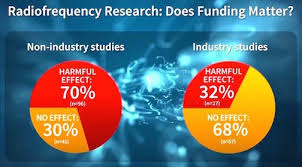
In the end, Broad’s argument seems vulnerable to accusations of having selected its data from those industry studies whose conclusions (as noted in “5G Apocalypse”) differ sharply from non-industry research regarding the harmful effects of radio-frequency emissions. As pictured below, seventy percent of non-industry studies find radio-frequency radiation harmful. In contrast, 68% of industry studies find it harmless.       

/var/folders/h8/h2q627nn53d1t08030blvf140000gn/T/com.microsoft.Word/Content.MSO/3A855E5D.tmp

The Hidden Debate

But that’s not the end of the debate outlined in “5G Apocalypse.” Far from it. Instead, there’s another dimension that is largely ignored in the mainstream media. It involves deliberate falsification of the nature of radiofrequency emissions from the proposed system along with sinister intent on the part of government authorities.

To begin with, the 5G radiations in question do not issue merely from relatively benign radio waves (which, as indicated above have their own problems). They also include radar and intense microwaves expressly intended for military operations against rebellious civilians.   

In fact, the system’s technology is directly modeled on military microwave counterparts originally intended for crowd control and psychological warfare. As portrayed in “Extinction Event,” 5G technology enables all police operations requiring an electromagnetic base to be executed with greatly increased efficiency. This includes constant surveillance and crowd dispersal. The video even goes so far as to describe 5G as a weapons system masquerading as a modern efficiency technology.

As such, the film argues, 5G fits neatly into the military-industrial-complex (MIC) model that Dwight Eisenhower warned against as he left office in 1961. It embodies omnipresent weapon capability available to the MIC minority to control an otherwise unmanageable majority. The technology’s omnipresence promises to send signals from stoves, refrigerators, heating units, microwave ovens, computers and printers. In other words, signals will emanate from any s.m.a.r.t. device. According to “Extinction Event,” the latter acronym should stand for “secret military armament in residence technologies.”

Conclusion

So, how are we to interpret the 5G controversy? Are the opponents of the new technology simply Luddites who reflexively oppose all technological advance? Are they conspiracy theorists in tin foil hats? The telecommunications industry and mainstream media would have us think so.

Despite their efforts however, here’s what we know for certain:

  • U.S. Government proponents of 5G technology (like the Trump administration’s FCC chairperson, Ajit Pai) have deep ties to telecommunications industry.
  • In view of its practice of incessant prevarications, the Trump administration has negative credibility.
  • Similarly, corporate America has been frequently caught in lies and cover-ups that endanger consumers (e.g. in relation to cigarettes and tobacco, climate change, and automobile safety).
  • For the sake of profit, huge corporations such as IBM, Bayer, Ford Motors, and AIG Insurance have shameful records of supporting the most virulent strain of fascism in Nazi Germany. Historically speaking, they routinely support repressive military regimes and place profits ahead of human freedom, democracy, and welfare.
  • Currently they and their counterparts have millions of dollars at their disposal to fund alternative research and sponsor unlimited articles and advertising to advance their agendas and discredit their critics.
  • Those critics have no such resources.

Besides all of that, we also know for certain that:

  • The improvement of the human condition represented by 5G technology is marginal at best. The present speed of our computers is actually quite adequate to meet human need.
  • “We” the people are not in competition with the Chinese for 5G superiority.
  • Instead, it’s the telecommunications giants whose bottom lines and quest for patents make it imperative for them to win the race for 5G control.
  • No matter who wins that race, 5G technology (if proven safe and beneficial) will eventually arrive for everyone on the planet who can afford it.
  • Enough red flags have been raised by credible scientific studies to justify further human and environmental impact studies by qualified independent researchers.
  • A whole array of cautionary scientists, activists, and political leaders are merely calling for slowing down the rush into an unknown future. In the interests of protecting human health, their grandchildren and the environment, they want further study.

Finally, those expressing caution point out that a safe alternative to 5G technology already exists. It takes the form of publicly financed fiber optics. Such alternative:

  • Buries the main source of harmful radiation
  • Requires very little energy per data packet.
  • Goes only where it is needed
  • As a result, offers a high level of privacy and safety as opposed to more hackable, omnipresent 5G arrangements
  • Is ultra-reliable
  • Moreover, a publicly financed fiber-optic alternative eliminates the market-driven “technological imperative” fueled by an imagined race for patents and profit.
  • In the final analysis, that race is the only reason for accelerating a process in dire need of further study and proper oversight.

In summary, advocates of an accelerated, unregulated 5G rollout make it sound like it’s a national imperative for “us” to beat the Chinese in some race into a promising future that will somehow exclude us if they get there first. However, history and the desire of telecommunication giants to bypass environmental and human impact studies show that they are not really concerned about our lives or those of our children and grandchildren, much less of animals and plants. On the contrary, they care principally about profit and are willing to sacrifice all the rest for a healthy bottom line. The rest of us must face the fact that it’s not “us” but multinational corporations like Verizon, Sprint, AT&T, Motorola, and T-Mobile who need to win their race for patents and billions in profits.

Instead of all this great hurry, it’s better to slow down, do the necessary study, take these momentous decisions out of the hands of profiteers, and look before we leap.