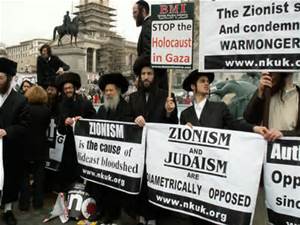
The entire world stands aghast at the cruelty of Israel’s vicious and illegal collective punishment of Palestinian civilians for the perceived “crimes” of Hamas – the group of Palestinian resisters committed to the expulsion of illegal Zionist occupiers from the Palestinian homeland.
Today’s liturgy of the word implores the Zionists to abandon their butchery.
It also challenges Christians to denounce such ethnic cleansing and to withdraw the last vestiges of support for a group that more resembles their former Nazi persecutors than the “People of God” celebrated in the Hebrew Bible.
At the same time, today’s readings support rabbi Michael Lerner in cautioning Hamas against its policy of violent resistance. Though many of us would agree that Hamas’ tactics are understandable and often justified by principles of self-defense, today’s Gospel reading identifies them as counterproductive and ultimately harmful to the very people Hamas seeks to defend.
Instead, Jesus suggests that violent resistance should be replaced by greater reliance on more subtle and patient strategies. Such strategies are reflected in the three basic themes of today’s readings. They emphasize (1) the power of God expressed in leniency and forgiveness, (2) the futility of violent response to unwanted foreign presence, and (3) resistance that takes the form of patient trust that God’s forgiving power will prevail. In succession, the themes suggest challenges for Jewish Zionists, Palestinians, and Christians.
Begin with the first reading from the Jewish Testament’s Book of Wisdom. It is particularly relevant to Zionist Jews. The reading says explicitly that God’s power is not expressed in violence but in leniency to all, Jew and non-Jew alike.
That theme is repeated in today’s responsorial psalm with equal relevance to Zionists. There God is described as belonging to all nations. The divine Spirit, as Paul insists in today’s second reading, dwells within all humans regardless of nationality. It is slow to anger, good, forgiving, abounding in kindness.
From this, Jewish wisdom insists that the “People of God” must in turn be kind, lenient and forgiving to all – presumably even to their worst enemies. There is no room here for exceptions involving the indigenous tribal people of Palestine.
The second theme of today’s liturgy enjoys direct relevance to contemporary Palestinians. Whether they are Muslims or Christians (and many are Christians), they also recognize the Bible as the Word of God. I point to Palestinian relevance because this second theme addresses the question of resisting illegal occupation.
That is, Jesus’ parable of the weeds planted by an enemy in a landlord’s field can be read as addressing the Roman occupation forces encumbering Israel during Jesus’ lifetime. [According to John Dominic Crossan, Matthew’s allegorizing of Jesus’ parable – making it about the end of the world – is more reflective of the situation of the Jewish diaspora (following the destruction of Jerusalem in 70 CE) than of the actual revolutionary situation of Jesus’ own day.]
In occupied Israel, the suffocating Roman presence was as unwelcome, alien, and destructive as weeds in a garden or field. It was like the presence of basically European Zionist colonizers who have encumbered Palestinian land since their colonial invasion in 1948.
The question was how to deal with such odious foreign presence. Zealot revolutionaries had their answer: Uproot the weeds here and now. Take up arms; assassinate Romans and their collaborators; drive them out mercilessly. Be as cruel and vicious as the Romans.
Jesus’ response was different. As a non-violent revolutionary, he could surely understand the more apocalyptic strategy. After all, much of his teaching expressed sympathy to the Zealot cause which included land reform, debt forgiveness, and expulsion of the hated Roman occupation forces. Many scripture scholars even identify possibly five members of Jesus’ inner circle as Zealots themselves.
But Jesus’ Parable of the Weeds is more prudent and sensitive to civilian casualties than the strategy of the impatient Zealots – or that of Hamas.
When the landlord’s workers ask, “Should we uproot the weeds?” Jesus’ landlord answers: “No, if you pull up the weeds you might uproot the wheat along with them.”
In other words, Jesus agrees with El Salvador’s Oscar Romero and with Brazil’s Dom Helder Camara that revolutionary violence, though understandable (and justifiable on the grounds of just war theory), is imprudent at the very least.
This is because when faced with a vicious, overwhelmingly armed oppressor (like the Zionist state) resistance inevitably leads to state terrorism – to the war crime of collective punishment impacting women, children, the elderly and disabled. At the very least, that’s why Jesus eschews Zealot violence.
How then respond to illegal occupation like Rome’s in the 1st century or Israel’s over the last more than 60 years?
Jesus’ response? Be like mustard plant, he says. Be like yeast in flour. Both puzzling recommendations are relevant not only to Palestinians, but to Christians who wish to help their brothers and sisters in Palestine against the Zionists-turned-Nazis.
First of all think of the puzzlement that must have struck Jesus’ listeners. Jews didn’t have much use for yeast. They preferred unleavened bread. Neither would any farmer sow mustard seeds in her field or garden. The mustard plant was like kudzu – itself a kind of weed that eventually can take over entire fields and mountainsides while choking out other plants weeds or not. The mustard plant was unstoppable.
So Jesus is saying:
* The Romans are weeds in your garden.
* Don’t try to uproot them.
* That will only lead to slaughter of the innocent.
* Rather become weeds yourselves – like the mustard plant which is much more powerful than simple Roman (or Zionist) weeds.
* Resist the Romans by embodying the Spirit of God that is slow to anger, good, forgiving, abounding in kindness.
* Only imitation of Wisdom’s God can defeat the evil of imperialism.
What does that mean for Christians wishing to express solidarity with Palestinians against their cruel oppressors? At least the following:
* Reject U.S. militarism in general as counterproductive, since fully 90% of the casualties it inflicts in war are civilians.
* To bring about change, be instead like the yeast a homemaker puts into 60 pounds of flour, “infecting” the greater culture by non-violent resistance rather than seeking to destroy enemies.
* Recognize the Zionists for what they are: an outlaw European “settler society” illegally occupying Palestinian land.
* Take sides with Palestine’s indigenous tribal People.
* Recognize them for what they are: “the Jews’ Jews” – treated by Zionists in the same way the Nazis treated Jews in Germany.
* Petition the U.S. government to withdraw its support of Israel (more than one million dollars per day) unless the Zionists obey UN Resolution 242 and abandon the occupied territory while tearing down the odious Wall of Shame protecting the illegal Zionist settlements.
* Support boycotts of Israel’s products by not buying them and by urging our churches and places of business to do the same.
Surely Jesus’ Way of non-violent resistance, forgiveness and love of enemies will strike many (non-believers and believers alike) as unrealistic. But according to the faith we Christians pretend to embrace, Jesus’ Way is God’s way.
But then perhaps we think we’re smarter and more realistic than Jesus — or God?

 About Things That Matter