Herbert Marcuse, Walter Benjamin and the Teachings of the Hunchback, Paul of Tarsus

hunchback

This is my 4th blog entry connected with a course I’ve been taking in New York City for the past 7 weeks. The course is called “The Frankfurt School and the Paradoxical Idea of Progress: Thinking beyond Critical Theory.” It’s taught by the great critical theory scholar, Stanley Aronowitz and has been a great joy for me. I love the subject; my classmates are very smart, and Stanley is . . . well, Stanley. He’s provocative, delightfully quirky, and extremely sharp even after the stroke that (at his age of 85) has confined him to a wheelchair. It’s a great privilege studying with him. As you can see from my previous blogs here, here, here, and here, the course readings from Theodore Adorno, Herbert Marcuse, and Walter Benjamin have been challenging. The ones analyzed below are equally so. This week, my responses are to Marcuse’s Eros and Civilization, and to a brief essay from Walter Benjamin called “Theses on the Philosophy of History.”

___________________________________________________________________

Herbert Marcuse, Walter Benjamin and the Teachings of the Hunchback Paul of Tarsus

What is the basis of critical thinking? Is it rationality? Is it logic? No, it’s theology.

That, at least, is the implied argument of the critical theorists, Herbert Marcuse and Walter Benjamin. For them, the foundation of critical thought is what economist and liberation theologian, Franz Hinkelammert (the convener Costa Rica’s Critical Thinking Group) terms “the critique of mythic reason.” That is, the foundation of critical thought for Marcuse and Benjamin is myth involving interaction between human beings and the divine or ineffable transcendent. Marcuse’s preferred mythology is Greek. Benjamin suggests that his derives from the Judeo-Christian tradition in general and from St. Paul in particular.

The purpose of what follows is to summarize and offer some brief commentary on the relevant arguments of both Marcuse and Benjamin. To do so, this essay will first of all place Marcuse’s use of mythology within the context of his more general argument as outlined in his Eros and Civilization. Marcuse’s thought will then be compared with that of Walter Benjamin as expressed in his “Theses on the Philosophy of History,” with each Benjamin’s highly poetic 18 theses “translated” into more straight-forward prose. The essay will conclude by arguing that Benjamin’s theological approach is more effective than Marcuse’s in terms of critical theory. It will add, however, that Benjamin’s use of the Judeo-Christian tradition stops short of the depth achieved by Hinkelammert’s commentary informed by the theology of liberation – and in particular by Hinkelammert’s analysis of the writings of Paul of Tarsus whose thought he identifies as the root of what has come to be known as critical theory.

Eros and Civilization

Herbert Marcuse’s seminal Eros and Civilization attempts to elaborate the critical implications of Freud’s psychoanalytic theory (245). In doing so, it builds on the model of repression so brilliantly explained by Freud in his own Civilization and its Discontents. Marcuse connects Freud’s theory of the inevitable conflict between civilization and its laws on the one hand, and the fundamental human drive for complete happiness on the other.

With Freud, Marcuse identifies that drive with the Greek word Eros understood on his view, as much more expansive than mere sexual love (205). In doing so, Marcuse acknowledges the term’s mythological roots. Even more, Christian theologians might find theological overtones in his use of Eros which arguably makes the drive for complete happiness equivalent to “God” as described by the author of the Christian Testament’s First Letter of John which identifies God with love itself (I JN 4:7-21).

In the process of stating his argument, Marcuse critically reviews the stages of human development shared by all human beings from birth, through early family life, education, employment, marriage, later family life, and death.

Marcuse notes that throughout those stages, humans gradually internalize restrictions on the self-centered drives (especially sexual) common to all humans. Such restrictions are necessary for the ordering of human community that avoids Hobbes war of each against all. Nevertheless, Marcuse finds that the social control required for such order soon develops into “surplus repression” far beyond that required for rational order (35, 37, 87f, 131, 235).

In the light of that reality, Marcuse’s overriding question becomes how to identify and escape excessive control that ends up serving the interests of dominant few, while immiserating all others. The chief misery imposed by those classes is that of alienated labor which requires that humans spend most of their lives performing (and recovering from) mind-numbing and body-destroying activities that have little or no intrinsic value (45).

Again, in order to answer his question about exiting this situation, Marcuse traces the origins of surplus repression. It begins, of course, in the family with a child’s relationship to his parents, especially (in the west’s patriarchal culture) with one’s relationship to father. Following the pattern of Freud’s myth of the primal horde, male children begin their lives confronted with a father who unreasonably imposes surplus repression upon them. His excessive demands cause rebellion paralleling that described in the Primal Horde myth (15). However, in most cases, rather than actually murdering the father, rebellion usually takes the form of sexual deviation from patriarchal restrictions.

Deviation from sexual restrictions is especially important, because (in the words of Erich Fromm) “Sexuality offers one of the most elemental and strongest possibilities of gratification and happiness.” Moreover, “. . . the fulfillment of this one fundamental possibility of happiness” of necessity leads to “an increase in the claim for gratification and happiness in other spheres of the human existence” (243). In other words, the human sexual drive represents the spearhead of Eros, the fundamental life force. That basic drive, Marcuse argues, lurks at the heart of all rebellion against civilization’s super-repression.

Eros differs from sexuality in that it is far less focused on genitalia (205). Even more, it locates its contested terrain on the fields of myth, art, philosophy, liberating education, and play.
Play proves especially important for Marcuse, because (in contradiction to society’s demands for productivity – and its “performance principle” expressed in alienated labor) “play is unproductive and useless precisely because it cancels the repressive and exploitative traits of labor and leisure” (195). It manifests existence without anxiety or compulsion and thus incarnates human freedom (187).

As noted earlier, the repressed human drive towards such liberation finds expression in philosophy, art, folklore, fairy tales, phantasy, and myth. Marcuse finds the latter especially expressive in the cases of Orpheus, Dionysius, Prometheus, Narcissus, Pandora. Accordingly, he devotes two entire chapters (8 &9) to analysis of Greek mythology. Myths provide instances of phantasy’s expression that “speaks the language of the pleasure principle, of freedom from repression, of uninhibited desire and gratification” (142).

Nevertheless, phantasies based on Greek mythology, though preserving the truth of “The Great Refusal” (to be entirely controlled by alienated labor), remain according to Marcuse’s analysis, “entirely inconsequential” in terms of actual resolving the problem in question (160).

In other words, while Marcuse focuses on a divine Eros in a promising way, he throws up his hands regarding the question of how to talk about its liberating reality to those for whom the very Greek mythology he finds so meaningful lacks resonance. He similarly characterizes folklore, fairytale, literature and art as also insignificant in terms of yielding a reality principle that realistically provides liberation from the “surplus repression” of the one that prevails (160).

This leads to the question: if Greek mythology is so ineffective, then why spend two chapters on the subject? Why did not Marcuse instead explore the liberating dimensions of the mythology of the Judeo-Christian tradition with which so many in the West can indeed identify? It might even be said that for the 75% of “Americans” who identify as Christian, their religious tradition amounts to a kind of underlying popular philosophy that supplies meaning for their lives. Therefore, finding and describing connections between that tradition and liberation from surplus repression would hardly be “inconsequential.”

Clearly, Marcuse was aware of such possibilities. His friend and Frankfurt School colleague, Erich Fromm, had already identified them in his The Dogma of Christ also published (like Eros and Civilization) in 1955. Moreover, Marcuse himself references such possibilities in Eros and Civilization, although he doesn’t elaborate the allusion. There, he observes:

“The message of the Son was the message of liberation: the overthrow of the Law (which is domination) by Agape (which is Eros). That would fit in with the heretical image of Jesus as the Redeemer in the flesh, the Messiah who came to save man here on earth. Then the subsequent transubstantiation of the Messiah, the deification of the Son beside the Father would be a betrayal of his message by his own disciples – the denial of the liberation in the flesh, the revenge on the redeemer. Christianity would then have surrendered the gospel of Agape-Eros again to the Law . . .” (69-73)

Here Marcuse introduces a crucial distinction between the actual teachings of Jesus of Nazareth on the one hand and his “transubstantiation” from a human being into the very equal of God. Beforehand, Marcuse says, Jesus was actually a heretic, an earthly Messiah intent on liberating actually existing human beings from oppressive legal systems. His followers, however gradually transformed his liberating Gospel of Agape-Eros into an instrument enforcing a super-repressive Law.

Having opened this promising door of critical analysis, Marcuse unexplainedly leaves it ajar without pursuing its promise.

Benjamin’s 18 Theses

In his final entry in Illuminations: Essays and Reflections, a collection of Walter Benjamin’s works reflecting his work as a critical theorist, Walter Benjamin ventures into the realm of Judeo-Christian theology that Marcuse so carefully avoids. Benjamin does so in the context of offering a series of eighteen theses on historical materialism and its philosophy of history. By the way, I take “historical materialism” to mean the philosophical conclusion holding that historical experience creates ideas rather than ideas creating historical experience.

Following this conclusion, Benjamin presents a highly contextualized approach to history wherein each of the latter’s moments is shaped by all previous ones as well as by prevailing ideologies and the historian’s own experience of life.

In other words, the writing of history is not simply a matter of recording events that unfolded in time understood as homogenous and empty of cultural influences and repercussions from what came before. Neither is it merely a matter of recording the past for the sake of preserving disconnected memories. Rather, historiography has the social purpose of shedding light on present dangers and crises for purposes of discovering exits from such existential threats.

Crucially for Benjamin (as already indicated), historical method is not only materialistic in the sense just referenced; it is also highly theological. As we shall see, Benjamin’s very first thesis in his list of 18 makes this point by suggesting Pauline theology as the guiding force of critical thought. Subsequently, virtually every thesis in the author’s list contains some reference to elements such as: theology itself (253), redemption, Messianic power, Judgment Day, the kingdom of God, spiritual things (254), good tidings, the Messiah, redeemer, Antichrist (255), theologians (256), angels, Paradise (257), monastic discipline, friars, meditation, Protestant ethics (258), savior (259), mysticism (261), Messianic time (263), the Torah, and prayer (264).

Moreover, like medieval religious practice, Benjamin’s theses are intended to turn the attention of readers away from the world and its affairs – but this time as described by traitorous politicians entrapped by a stubborn belief in the religion of progress (258). In fact, given Benjamin’s theological interests (4, 253) it is easy to interpret his theses on the philosophy of history as attempts to reinterpret theology in the service of historical materialism.

All of this may become evident in the following summaries of each our author’s 18 theses:

Thesis I: In an atmosphere of smoke and mirrors, and guided by theology, critical thought in the form of historical materialism promises inevitable victory over its opponent – viz. automated technology. And this, despite the latter’s deceptions that distort and reverse perception of reality into its mirror-opposite.

Thesis II: Historical materialists agree that Past (lost opportunities), Present (attempts to reverse those losses) and future (refusal to deal with the consequences of present action) exist in dynamic dialectical relationship captured by the words of history, redemption, and envy.

Thesis III: It is true that no event is insignificant in the long course of history. However, the significance of particular events can only be known at history’s conclusion.

Thesis IV: Despite apparent setbacks in workers’ struggles against ruling class domination, the long arc of history bends towards the victory of the poor and oppressed, because their subtle courage, humor, cunning and fortitude are more powerful than the gross tools of their oppressors.

Thesis V: Historical materialists (vs. mere chroniclers of past events) realize that recollection of past events is valuable only insofar as those events relate to and illuminate the present.

Thesis VI: The threats represented by ruling class attempts to reduce traditions about the past to tools supporting conformism must be resisted so that the past’s recollection might serve resistance and liberation instead.

Thesis VII: Historians who recount history without connecting it to present existential threats serve the interests of the world’s rulers (past and present) who steal the spirit and artifacts of those they’ve subdued. Historical materialists swim against that current.

Thesis VIII: History must reflect the “pedagogy of the oppressed,” which makes us aware of the changes necessary to overcome the perennial state of danger that has always characterized human existence and its struggle against oppression, which even its opponents treat as inevitable.

Thesis IX: As history’s messengers (angels), historical materialists perceive “progress” as responsible for an unending series of catastrophes. Ironically however, the devastating power of those very calamities prevents historical materialists from successfully alerting audiences to their own loss and lack of perception.

Thesis X: The accepted understanding of history (as a detached chronicling of the past) only serves traitorous politicians who have surrendered to fascism with its uncritical belief in progress, its manipulation of the masses, and its totalitarian structures.

Thesis XI: The conformity of the German working class is grounded in the conviction that “progress” includes and benefits its members. Alienated and enslaving factory work has been dignified by this belief. However, contrary to the convictions of “vulgar Marxism,” technology need not destroy, but could actually enhance and make nature more fruitful.

Thesis XII: It is angry recollection of the past rather than concern for the future and future generations that inspires resistance and rebellion in the working class which is the real repository of meaningful history.

Thesis XIII: Any valid critique of the Social-Democratic concept of progress (as anthropocentric, boundless, and irresistible) must be context-based rather than ignorant of historical context – as is the common Social-Democratic understanding of history.

Thesis XIV: Since only the present moment (the mystical nunc stans) is real, any consideration of the past has value only insofar as it sheds light on the present always characterized by ruling-class domination.

Thesis XV: Revolutionary holidays stop the ongoing continuum of history at decisive junctures – eternalizing the moment of liberation like the clocks simultaneously stopped by bullets on the first evening of fighting in the French Revolution, July 1789.

Thesis XVI: In contrast to historicists, historical materialists experience the present not as a transition to the future, but as an end in itself shaped by past events.

Thesis XVII: Unlike historicism, materialist historiography is not merely additive and does not treat time as homogenous, empty and inexorably in motion. The materialist approach is more contemplative, since it allows thinking (and therefore time) to stop so that history’s flow might be perceived as a unified whole. This pause and perception enables the historian (and his audience) to identify history’s underlying oppression and to uncover openings (past and present) for revolutionary change as the overriding project of one’s life.

Thesis XVIII: Humankind’s 50,000-year stature in a 14 million-year-old universe is nearly insignificant. As a result: (A) Alleging causal connections between historical events remains highly speculative (though any given present is both influenced by the past and contains intimations of a salvific future) and (B) the Jewish concept of time (as fundamental openness to a better future) is helpful here, since it is neither empty nor homogenous, nor magical.

Franz Hinkelammert’s Reading of Benjamin

Analyzing the story recounted in Benjamin’s first thesis on the philosophy of history, liberation theologian, Franz Hinkelammert specifically connects Benjamin with Paul of Tarsus and with critical theory. In doing so, Hinkelammert advances the theory of this brief review, viz. that theology constitutes the foundation of critical theory.

In fact, Hinkelammert considers Paul as the West’s first critical thinker. As such, Paul’s thinking, Hinkelammert argues, anticipates critical theory’s historical materialism, universalism, anarchism, and identification of the messianic function of the world’s poor and oppressed (Hinkelammert: La malidicion que pesa sobre la ley: Las raices del pensamiento critico en Pablo de Tarso. Editorial Arlekin. San Jose, Costa Rica, 2010. 16). More specifically, Hinkelammert recognizes the apostle as the hunchback pulling the strings of the puppet (historical materialism) in Benjamin’s cryptic parable (pictured above) recounted in the opening lines of “Theses on the Philosophy of History.”

Hinkelammert justifies doing so on the basis of the following observations:

• By his own admission, Benjamin’s basic orientation was decidedly towards the biblical past.
• He lamented that the biblical “wizened” founders of modern thought remained hidden and out-of-sight (Benjamin 253, Hinkelammert 23).
• In one of Benjamin’s surviving fragments, the latter’s closest friend, Gershom Scholem, celebrated Paul as the most notable example of a revolutionary Jewish mystic (Hinkelammert 14).
• Like the hunchback in Benjamin’s story, Paul suffered from some kind of physical deformity as described in II COR 12:7-9.
• Benjamin description of the parable’s puppet as wearing “Turkish attire” reminds us that its hidden alleged puppet-master, St. Paul, came specifically from Tarsus which is located in modern day Turkey (Hinkelammert 15).
• Other commentators like Jacob Taubes have found the presence of Paul’s thinking prominent not only in Benjamin, but in the most important currents of modern thought including that of Freud and Nietzsche. (The latter by the way, signaled support for this review’s thesis by villainizing Paul for the apostle’s anarchism, defense of the poor and oppressed, and prefiguration of Marx and of historical materialism) (16).
• Above all, Paul’s criticism of Law as the sin of the world, prepared the way for critical theory’s criticism of market law and of the state as the armed force imposing the will of the ruling class on the oppressed majority (17). For both Paul and critical theorists, complying with an oppressive law remains completely immoral (18).

Conclusion

Tellingly for this review’s thesis – that theology is the basis of critical theory – Hinkelammert points out that after Benjamin’s suicide in 1940, his fragment “Capitalism as Religion” came to light. The fragment drew a direct line from orthodox Christianity to capitalism whose system and ideology, Benjamin argues, replicates point-by-point (in secular terms) the elements of medieval Catholic orthodoxy.

However, according to Hinkelammert, Benjamin failed to note, much less exploit, the critical difference between such orthodoxy and the original message and praxis of the thoroughly Jewish prophet, Jesus of Nazareth. Had he done so, Hinkelammert observes, Benjamin would have strengthened his conclusion about the connections between Paul and historical materialism, since the teachings of St. Paul followed so closely those of the radical prophet and mystic Jesus of Nazareth.

In the end, it is Paul’s critique Law as well as the apostle’s anarchism and defense of the poor that prefigures the elaborations of Marx and Freud as understood by critical thinkers Benjamin and Marcuse. Only by embracing Paul’s influence, Benjamin correctly observes, can historical materialism claim its assured destiny as victor over the technological automaton intent on destroying us all.

Contemporary critical thinkers and activists would do well to heed Benjamin’s advice. They would do well to join liberation theologians in exploiting the popular power of a reinterpreted Judeo-Christian tradition that supports subversion, anarchism, and the hermeneutical privilege of the poor.
Film & YouTube as Means of Revolutionary Production

Walter Benjamin

This is the third essay I’ve written for a course on critical theory I’m taking under Stanley Aronowitz at the People’s Forum in New York City. It’s a response to a piece written by Walter Benjamin (pictured above) entitled “The Work of Art in the Age of Mechanical Reproduction.”

___________________________________________________________________

Film & YouTube as Means of Revolutionary Production

As we complete the first third of our course, “The Frankfurt School and the Paradoxical Idea of Progress: Thinking beyond Critical Theory,” I’m beginning to see the logic behind the progression of our assigned readings so far. To my surprise I’m also perceiving more clearly the vital connections between our course and the book on critical thinking that I published in the middle of April.

My book is called The Magic Glasses of Critical Thinking: seeing through alternative fact and fake news. Written specifically to introduce advanced secondary students as well as college freshmen and sophomores to easily-understood critical theory, Magic Glasses centralizes structural (especially economic) analysis along with ideological distinctions and historical considerations in the form of Ten Rules for Critical Thinking.

The rules are deduced from the work of liberation theologians at a think tank in San Jose, Costa Rica, where my wife, Peggy, and I have worked on-and-off since 1992. The study center is called the Departamento Ecumenico de Investigaciones. Until recently, it was headed by Franz Hinkelammert, a leading economist and liberation theologian who now leads The Critical Thinking Group also located in San Jose. His many books are generously peppered with references to Frankfurt School authors.

Drawing on Hinkelammert and others, and in the spirit of our reading from Benjamin, my Magic Glasses also forges connections between contemporary politics in this age of Donald Trump in terms of an unmistakable world-wide drift towards fascism. But even more to the point of this week’s reading assignment, Magic Glasses highlights film as a tool for awakening within students their latent revolutionary consciousness.

With all of that in mind, what follows will first of all briefly connect this week’s assignment from Walter Benjamin with our previous readings from Theodor Adorno on “Progress” and “On Subject and Object.” Secondly, this review will present my summary of our third reading, Benjamin’s essay, “The Work of Art in the Age of Mechanical Reproduction.” There he identifies film as “the most powerful agent” for facilitating the work of contemporary mass movements. Though warning of its dangers, he sees it as a tool for raising consciousness and catalyzing political praxis. My brief essay will conclude by illustrating Benjamin’s points with my own teaching practices as reflected in the book referenced above.

Reading Connections

Our first two readings from Adorno emphasized vital points about human beings in general and critical thinkers in particular. Contrary to biblical teachings and the analysis of Enlightenment thinkers like Immanuel Kant, Adorno insisted that human beings were not created fully-fledged.

Instead, they are products of evolution; they are works specifically “in-progress” importantly shaped by their historical and material contexts. As such, their fate is still undetermined and might well end in failure – even in the extinction of the human race. Technological development does not guarantee human progress. Rather, uncontrolled it actually threatens the very survival of our race.

Only progress understood as a development of critical consciousness paralleling technical advance and given direction by the very victims of merely mechanical progress, can save us. Salvific consciousness of this kind liberates its possessors to employ technology in the service of human development rather than for its destruction.

In other words (and this brings us to Adorno’s “On Subject and Object”), a major task of critical thinking is to facilitate the transformation of those who use technology from objects to subjects – into conscious agents employing technology in the service of human liberation.

Put more concretely, technological gadgets like radio, movies, television, computers, and I Phones can easily objectify or reify unconscious users and stealthily shape their lives and thinking. Transformed into subjects, the gadgets themselves can turn those who use them into unthinking objects and deprive the unwary of their essential identity as conscious agents directing their lives towards specifically human purposes. Once again: according to Adorno, those purposes centralize the liberation of those whom the structures of capitalism routinely objectify and deform into oppressed, marginalized, despised, and humiliated sub-humans.

So, how exactly do Adorno’s abstract generalizations about technology’s power to captivate and transform human beings into objects shake down in concrete, historical terms?

Benjamin’s Essay

The question brings us to Walter Benjamin’s essay, “The Work of Art in the Age of Mechanical Reproduction.” There, the author confronts his readers with stark political choices inherent in technological “progress.” That choice, Benjamin argues, is principally between fascism on the one hand and communism on the other.

However, before he gets to that decision, Benjamin delineates the status questionis. He reviews the history of mechanical reproduction. The Greeks knew exceedingly few forms of mechanical duplication. Reproductions took the form of stamped coins for commercial use, along with bronze and terra cotta artifacts. Other forms of mechanical reproduction followed. They took the shape of wood cuts, the printing press, lithographs, photographic negatives, and movie films including sound recordings. (We might add that “progress” continues today in the forms of computers, I Phones, digital cameras along with associated social media.)

Each development in the list just itemized profoundly impacted human beings in Adorno’s terms, specifically as objects and as subjects.

On the one hand and objectively speaking, the developments in question often straightened the horizons of those interacting with the resulting products. As Benjamin puts it, a reproduced piece of art detached from the history of its production and ownership lost its uniqueness. It lost its “aura” – the halo connecting it to time and space beyond the context of its immediate user. Thus, one viewing a Greek statue of Venus might have no idea of its original value as an object of religious veneration, much less as an object of condemnation by the medieval church which considered it an idol. Moreover, the decontextualized observer would typically remain detached from the history of the statue’s ownership and of the monetary value given it in various contexts.

Even more importantly in terms of reifying naïve observers, Benjamin points out that objects of art produced in mass quantities can be used to propagandize viewers-turned-consumers. This is especially true in the case of photography appearing in magazines and even more so with film. In magazines and newspapers, de rigueur captions actually tell people what their eyes should be seeing. Movie images change so quickly that (for the unaware) successive frames in effect give meaning or interpret the ones preceding them. Assaulted by rapidly changing figures and scenes, the viewer has no time to analyze her or his past or immediate experiences.

In this way, photography and film, especially when coordinated by the ruling classes become perfect vehicles for propaganda and the spread of ideology. Germany’s fascists (in power at the time Benjamin penned this essay in 1936) were quick to recognize the potential of this new technology. Accordingly, they utilized the new visual arts for purposes of brain-washing and massive indoctrination – even employing film to glorify war as the apotheosis of human development. Anticipating their later U.S. counterparts, the Nazis effectively convinced the uncritical that “being all you can be” involves killing one’s fellow human beings and utterly destroying their property in “beautiful” acts of murder, mayhem, and self-immolation. Carried to its logical conclusion, such human objectification, Benjamin warned, leads inexorably to envisioning the apex of human development as mass suicide. (The subsequent development of nuclear weapons and dawning awareness about anthropogenic climate chaos may well prove him to be prophetic.)

Yes, without doubt, Benjamin is correct in expressing serious reservations about the objectifying dangers of art in the age of mechanical reproduction. However, there’s another side to the coin he describes. By its virtue, human subjects as such can also seize the apparatus of such duplication and employ it for purposes of human liberation. Thus:

• Widespread reproduction of art works has turned everyone into a critic.
• Or into film actor of sorts
• Similarly, (and even more-so with the advent of the internet) virtually everyone can discover “an opportunity to publish somewhere or other comments on his work, grievances, documentary reports,” etc.
• And (I would add) the capability of YouTube to excerpt clips from Hollywood films and from documentaries enhances possibilities for critical teachers to (in Benjamin’s words) “promote revolutionary criticism of social conditions, even of the distribution of property.”

And that brings me back to The Magic Glasses of Critical Thinking: seeing through alternative fact and fake news.

Magic Glasses

There I use YouTube clips of classic and contemporary films to illustrate each of my ten rules for critical thinking which include (1) Reflect Systemically, (2) Select Market (as an organizing principle), (3) Reject Neutrality, (4) Suspect Ideology, (5) Respect History, (6) Inspect Scientifically, (7) Quadra-Sect Violence, (8) Connect with Your Deepest Self, (9) Collect Conclusions, and (10) Detect Silences. Film clips featured in the book come from films such as Traffic, The Post, Avatar, Sausage Party, The Distinguished Gentleman, Good Will Hunting, American Sniper, Captain Phillips, American History X, War Dogs, Bulworth, and the Broadway musical, Hamilton.

The clips, lasting no more than ten minutes each, have been selected to connect directly with my ten rules. Because of their brevity, and if students missed the point or wanted to see the clip again, any film excerpt can be viewed again with nothing lost in terms of class time. This ability to extract and repeat overcomes Benjamin’s objection about film images whose rapid succession prevent careful analysis or reflection.

Here is an example of what I’m talking about. It comes from Good Will Hunting. There the Matt Damon character, Will Hunting himself, is interviewed for a position in the National Security Agency. He’s asked why he shouldn’t take the job. Hunting responds:

Will’s answer is, of course, ironic. However, his response provides a good example of the kind of critical analysis that can be stimulated by short film clips. This one raises questions about connecting contemporary issues into a coherent whole. Will Hunting traces the effects of an anticipated assignment at the NSA from his desk there, to a war involving senseless carnage, a friend’s participation in that war, oil prices, environmental destruction on a massive scale, unemployment problems in the U.S., job loss to cheap Third World labor, and to corrupt politicians, who avoid military service, while somehow managing to get elected to the highest office in the land.

In terms of stimulating critical thinking, all the teacher has to do is ask students, “What did you see?”

Conclusion

I suppose what I’m saying here is that I found Walter Benjamin’s essay not only helpfully coherent with previous readings in our course; I also found his words about film and its use in stimulating critical thinking encouraging in terms of my own thoughts and praxis as a teacher and author.

Against Individualism: a Review of Theodore Adorno’s Essay “On Subject & Object”

Army

This is the second “homework” essay that I’ve written in connection with a course on critical theory that I’m taking at The People’s Forum in New York City. As I mentioned last week, the course is taught by Stanley Aronowitz and is called “The Frankfurt School and the Paradoxical Idea of Progress: Thinking beyond Critical Theory.”

This week’s reading, our second from Theodore Adorno was entitled simply “On Subject and Object.” It was extremely abstract and difficult to understand. So, during the class I proposed the following question for Stanley. I said,

“I truly admire Adorno’s brilliance. And I appreciate how spending hours trying to decipher his meaning can yield a satisfaction and kind of pleasure for intellectuals who enjoy solving world-puzzles. In addition, I recognized that the expenditure of such time and effort can certainly lead one to think more deeply and to appropriate insights that might not emerge from grappling with more easily understandable prose.

However, who besides the intellectuals just mentioned can suffer these texts? Who, besides the exceedingly few, has the energy to endure them? Their ideas are obscured, not clarified, by references, vocabulary, and tone that comes off as pretentious, elite and even obscurantist.

If they are truly interested in world-changing praxis (as critical theorists claim) why write like this, rather than in a more accessible manner?”

Stanley’s response to me was direct. He said, “The text is so difficult because Adorno is writing for me, not for you.” He went on to explain that our author was actually quite adept at writing for ordinary people in very engaging ways. Adorno frequently spoke on the radio during the 1930s, and was very popular. However, when authoring essays like “On Subject and Object,” his audience turned out to be philosophers familiar with the entire works of Kant, Heidegger, Hegel, Freud, Marx, and others. Stanley himself falls into that category — I, not so much. Hence my difficulties and those of my classmates.

In any case, and for what it’s worth, here is my attempt to “translate” into concrete language what I understood from grappling with this Adorno text myself.
______________________________________________________________

The Need for Greater Objectivity
(A review of Adorno’s “On Subject and Object”)

In our contemporary culture, the forces of capitalism, advertising, and consumption all lionize individualism. Standing out from the crowd, doing-your own thing, and writing your own story are sold as paramount forms of being human. Outside one’s own family, any kind of collectivism is perceived as a threat.

Even the military claims to be a vehicle empowering enlistees to “be all that you can be.” In the end, however, those who sign up inevitably discover that all the army allows them to be are pawns whose highest aspiration is not individual development, but reduction to sameness, conformity, and blind obedience in the service of an organization whose main purpose turns out to be killing and breaking things.

Apparently, it’s the same for everyone. In psychological terms, those the culture has encouraged to be autonomous subjects – whatever their line of work – are reduced to objects not only on the job, but at home and even in their recreational activities. We all end up doing what we’re told within parameters that stifle (in Theodor Adorno’s words) pure spontaneity and originary apperception. That is, our systemic structures frustrate what we’re told is our absolutely dynamic principle (255).

But is that our fate as humans – universal objectification and individual frustration (247)? Why is it so difficult to be a subject and so easy to be reduced to object-hood?

In his essay “On Subject and Object,” Adorno takes up those questions. In short, his answer is, “Well, it’s complicated . . .” (245). You see, he argues, individualized subjectivity (as understood by the dominant culture) isn’t all that it’s cracked up to be. In fact, it leads to isolation, self-captivity and ultimately to the domination of others (246, 252, 257).

However, there is another form of subjectivity –one more authentic than encouraged by our culture – that recognizes a dialectical relationship between subjectivity and objectivity. Appropriating that subjectivity, so to speak, should be our life’s objective.

Moreover, being an object should not be entirely vilified. Ironically, and properly understood, it should be embraced as humankind’s salvation, as the prerequisite for achieving authentic subject-hood and the peace we all desire. To achieve peace, Adorno observes, the individual must selectively subordinate self to collective (247). In that dialectical process of on-going give-and-take between subjectivity and objectivity, lies our salvation.

In other words, “On Subject and Object” is written against the popular understanding of overriding individualism. Adorno’s basic argument is that the individual cannot be understood apart from society. This is because the individual is actually the product of society – and this according to the insights provided by linguistic analysis, evolutionary theory and biology, along with reflection on personal experience, philosophy, and, above all by critical theory.

Adorno considers those sources one-by-one.

• Language: Adorno begins his analysis linguistically. He points out that what we call “subject” is intelligible only in its relationship to “object.” Or more clearly put, the very terms “subject” or “individual” make sense only in relationship to humanity at large. Similarly, any reference to a particular person as such presupposes the concept of human species from which subjects distinguish themselves. Even personal names such as “Stanley” or “Michael” are employed to separate the individuals so-called from presupposed others. In other words, our very language reveals a dialectical relationship between individuals and society. The dialectic suggests that the collective is more important than generally recognized in our highly individualistic culture (245).
• Evolutionary biology supports that suggestion. Contrary to origin myths found in all cultures, human beings did not emerge full-fledged (246-247, 258). Rather (as works-in-progress) they developed gradually from lower forms of life. Even then, and for millennia, their primary identification remained with group, clan, or tribe (258). Only gradually did any concept of individual emerge. And only in the last few centuries, with the surfacing of capitalism – with the emergence of homo oeconomicus – did individualism and its ideological emphasis on subject become primary (248). Put otherwise, evolutionary biology testifies to the fact that any notion of subject contains within it a certain objectivity; deep down, it has a core of object (250). The subject was produced by the collective.
• Personal experience as a primary criterion of truth (252, 254) supports the relevant conclusions of evolutionary biology. For years in childhood and adolescence, none of us can really fend for ourselves, but are dependent for survival on family and tribe. Confronted by a hostile environment, human beings are much more ill-equipped to survive than other creatures. Instead, we require a kind of rudimentary social cooperation with others of our species even to defend ourselves from less developed counterparts. All of this signals a priority of species over individual subjects (258).
• Philosophy since the Enlightenment has obscured such primacy. The “Copernican turn” of Immanuel Kant emphasized human subjectivity as never before (251, 254). Till Kant, conventional wisdom typically imagined the process of knowledge as the result of a knowing subject confronting an object “out there” (246). For Kant, however, inborn categories of knowledge fundamentally shaped all objects perceived by the subject in question. In a sense, then, on Kant’s analysis, the human subject actively constituted reality (255).
• Critical Theory, however, along with the general sociology of knowledge has called Kant’s radical subjectivity into question. True: critical theorists (like Adorno himself) agree that human beings do in fact interpret reality according to subjective categories. However, those categories themselves are produced by society. Specifically, and increasingly since the middle of the 18th century, they have been manufactured by capitalist ideology (248, 250-254). That ideology has deformed humans into individual subjects pure and simple. On the one hand, it has made them captives within themselves (252, 257). On the other, it has set them against the collective as they seek to impose their sovereign wills upon the group (246). War is the unavoidable upshot.

Conclusion

Adorno is interested in peace, not war (247). Yes, he wants to affirm subjectivity, spontaneity and originary apperception as our absolutely dynamic principle. However, on his view, absolutizing the subject over-against the collective fetishistically reifies and deforms human beings (251). It sets them against each other and creates a tragic situation where it is indeed possible for army propagandists to convince the young that they can reach their highest potential by killing their brothers and sisters and by destroying the latter’s homes, schools, churches, hospitals and factories.

Only by de-emphasizing individual subjectivity, by recognizing the priority of human community, by retaining a dialectical understanding of subject’s relationship to object, and of individual to species, can such tragedy be averted.

What We Call “Progress” Might Kill Us All: How to Avoid That Catastrophe (Theodor Adorno’s Essay on Progress)

Progress

Here is the essay I promised to share a few days ago, when I wrote about the class I’m taking at The People’s Forum in NYC. The assignment was to read Theodor Adorno‘s essay “On Progress.” Our teacher, Stanley Aronowitz, assured us that we’d have a difficult time understanding it. He was right. It took me about half and hour to read each page. Not wanting to forget what that taught me, I immediately wrote the following abstract and essay to record my understanding of the piece. This is the sort of essay I liked my students to write about reading assignments I gave them. (The references are to page numbers in Adorno’s Critical Models.) See if my efforts makes sense to you. I’m still not sure about the accuracy of what I’ve written here. So, for what it’s worth . . .

Abstract

This essay describes the complex reasons behind the widespread confusion surrounding the concept of progress. The confusion finds its roots in the Genesis creation myth, in Augustine distinction between the City of God and its earthly counterpart, in the secularization that followed the Augustine’s distinction, and in the inherently unjust principle of exchange centralized in bourgeois capitalism.

These influences gradually emptied “progress” of its transcendent and spiritual community content reducing it to a notion of mere material advance among atomized individuals.

Adorno predicts that in the end, since material progress is inseparably connected to an exploitative capitalist system, those inevitably harmed by the injustices of the system’s exchange principle will rebel in the name of their own shared humanity. Thus, capitalism’s victims turn out to be the engines of spiritual progress understood as specifically human growth in communal consciousness concerning the unity of all creation.
___________________________________________________
____________

My Unassigned Essay After Struggling with Adorno’s Reflection “On Progress”

“You can’t stop progress!” That’s been the mantram of conventional wisdom leveled against Luddites, the Amish and back-to-nature hippies as long as I can remember. Actually, the slogan reaches back much further – to at least the 18th century when “enlightened” Europeans routinely published works like Condorcet’s “Sketch for a Historical Picture of the Progress of the Human Mind.” Hot on the heels of the scientific revolution, the idea was that for humans, the sky’s the limit.

The evidence supporting that apparent truism has often seemed irrefutable. Examples like the steam engine, radio, telephone, automobile, television, computers, the iPhone, and GMOs have all been marshaled to demonstrate the irresistible upward trajectory of human civilization.

In the face of such beneficial innovation, surely, no one would argue that we’re not better off, would they?

Actually, yes – among them, the great critical theorist, Theodor Adorno (1903-’69). He, along with other members of the Frankfurt School, have contended that the signs of progress like those just itemized can actually signal its opposite — a decadence that appears irreversible and fatal to us all. The innovations demonstrate a decline based on a truncated understanding of human nature and of progress itself.

In terms updated to fit the post-modern context, signs of decadence and decline include the universal government surveillance made possible by computers and iPhones. Then there are the interminable wars intensified beyond measure by supersonic jets – among the most lethal weapons of mass destruction ever devised. There is the replacement of innumerable seed varieties by corporate-controlled GMOs that arguably aggravate rather than remediate world hunger. Worst of all, there’s the ghastly phenomenon of global warming facilitated by the unrestrained capitalist production – the very engine of post-modernity’s vaunted progress. In fact, climate scientists predict with great certainty that the inseparable tandem of unchecked global warming and technical progress will inevitably spell the end of human life as we know it. In other words, progress is at times its own opposite (Adorno 148).

What then about the notion itself? Why is the concept of progress so ambiguous (141)? How are we to define it? And what is its true nature? Is it, according Condorcet’s understanding, a matter of total human advance (159)? Or is its reality confined to the category of technical innovation?

What about the human spirit within us all and in the collective? Does it progress in any way?
And how do we make sure that progress doesn’t destroy us all?

All of these are the questions addressed Adorno’s essay on pages 143-160 of Critical Models. Its understanding of progress comes down on the side of praxis derived from expanded awareness, rather than of ambiguous technical invention.

To begin with, Adorno argues, the term’s ambiguity derives from a twofold source: (1) a faulty understanding of human nature and (2) the fundamental lie inherent in the capitalist notion of exchange (159). Nonetheless, Adorno maintains that both sources of confusion unwittingly set the stage for a more coherent understanding of progress derived from the very obscurities and errors just mentioned.

Human Nature

Contrary to conventional thought, human nature for Adorno is not a given. Rather, it is an experiment – a work specifically “in-progress” (145). Moreover, the experiment might well fail. That is, the supposedly evolving human race might easily degenerate into barbarism, not to mention total extinction (160). Additionally, the authentic measure of progress cannot be limited a mere listing of human accomplishments in terms of increasingly sophisticated industrial products. The two-edged nature of the fabrications listed above should make that evident. To ignore such reality in favor of unquestionable faith in some guaranteed evolution is to live in a fantasy world.

Nonetheless, the fantastic nature of historically insured progress remains obscure. It is covered over by notions of human nature inherited from the Bible’s Genesis account of creation, from Augustine’s City of God and from a secularity ironically derived from both those sources (146-7).

The biblical mythology of Genesis encouraged belief that the original man and woman were fully human from the outset. The subsequent spiritual challenge could not then involve species development. Instead, the human spiritual task became limited to the individual’s willingness to appropriate a human nature complete from the beginning, even though the task was complicated by the First Parents’ fall from grace. This, in effect, privatized the notion of human progress depriving it of its essential community dimension (144).

Augustine, the most influential theologian of Christianity’s first millennium, unwittingly facilitated such privatization. His distinction between the City of God and the Earthly City split off an area of human endeavor (the earthly city) that could absorb ungodly human activity until the Final Judgment, when creation would ultimately be restored to its original undisturbed state (155). In other words, this side of death, there could be no ontologically shared spiritual progress.

By the 18th century, Augustine’s insight about such an independent sphere had successfully set the stage for an encroaching western secularity that would eventually exclude any consideration of God’s city. This in turn discounted for secularists the entire spiritual realm previously emphasized by the 5th century church doctor. The human spirit’s relationship of dynamic tension with the material world along with its constant attempts to break free from material limitations were all but lost in the process (157). Following the Enlightenment, it thus became virtually impossible to ascribe a transcendent dimension to any notion of progress at all. In this way, the concept was impoverished nearly beyond repair. Its function was reduced to that of describing an inevitable triumph of technical innovation.

Capitalist Exchange

A second key source of ambiguity and confusion about the notion of progress derives from bourgeois capitalism’s foundational principle of exchange of equal commodities (159).

According to this exchange principle, all merchandises are entirely fungible; in every act of commerce, products of equal worth are traded one for the other. Or as George H.W. Bush put it, “Computer chips or potato chips, what’s the difference?” So, while champions of capitalism on the hand promote the system as an engine of progress, their principle of exchange denies the possibility of advance on the other. No wonder confusion reigns.

Adorno clears the confusion by simply denying the principle of exchange. Simply put, it is a lie. He says, “Since time immemorial . . . the societally more powerful contracting party receives more than the other. By means of this injustice something new occurs in the exchange” (159).

Ironically, it is in this implied act of robbery by the powerful from their opposites that Adorno finds the seed of true progress. For him it surpasses mere technical innovation and rescues the concept’s essential transcendence from a one-dimensional secularity that confines progress to the arena of technology. Adorno locates it instead in the realm of conscious praxis accessible primarily to those the world’s powerful expropriate.

Transcendent Progress

That is, for Adorno, oppression (like that embodied in the mendacious bourgeois principle of exchange) is itself the incongruous emancipator of consciousness. For by virtue of the pain inherent in such domination and the want it necessarily inflicts (144, 154), humanity as “sleeping giant” awakes from its immemorial slumber; it escapes the magic thrall of the ideology promoted by religion and capitalist ideology. Gradually become aware of its own inbred nature, the giant suddenly brings to a halt the domination in question. It “storms forth and tramples everything that gets in his way” (150).

In the best-case scenario, the behemoth’s newfound political maturity gives him the final word in its struggle against all oppressive systems. That word’s utterance and the world it creates rationally establish a self-conscious global community governed by “a perfectly just civil constitution” that maximizes personal freedom while insuring similar levels of liberty for all. On Adorno’s view, such balance alone can avert the generalized catastrophe threatening the species (144). It alone deserves the name “progress.”

All of this is in accord with Adorno’s understanding of humanity itself which in its essence is:
• Spiritual, even mystical (155)
• Basically communal (144)
• Free and unsullied by privilege and class domination (152)
• Resistant to both totalitarianism and individualism (146, 151)
• Enlightened in the sense that it lives reconciled with all other human beings as such and with nature itself (148, 152)
• Cognizant and solicitous of future generations (146)
• Prone to transcendence, i.e. “to fly” in the face of “the merely existent” (157)
• Constantly growing in all levels of consciousness (157)

Conclusion

As a theologian reading Adorno directly for the first time, I couldn’t help noticing the . . . well, “theological” nature of his essay on progress. The piece centralizes the concept of redemption (146, 148). It is filled with references to God as Nature with intentions and purposes (144) and as world spirit, divine absolute (149), eternal invariant (150) Being itself (153) and Being as such (156).

But even more specifically, as a liberation theologian, my intellectual antennae were alerted by the absolute coincidence between Adorno’s analysis and that of liberation theologians like Costa Rica’s (and Germany’s) Franz Hinkelammert. Both exhibit the same deep historical consciousness and the need to square their conclusions with western history of ideas.

Both engage in the same critique of Christian tradition that not only refuses to throw out the baby with the bath water, but that demonstrates an appreciation of the tradition’s core insights as well. Both find the systemic root of domination and oppression in the economic system of capitalism.

Finally, both Adorno and theologians of liberation pinpoint humanity’s savior in the poor and oppressed. Both make a “preferential option for the poor.” That is, they recognize the “hermeneutical privilege of the poor” that identifies in humanity’s despised, rejected, humiliated and ignored the point of critique that alone offers hope in this “age of both utopian and absolutely destructive possibilities” (143).

“Sweet Little 78” and Back in Class Again

Aronowitz

As readers of this blog might remember, Peggy and I have just moved to Westport, Connecticut. In an earlier posting, I explained that we’re here largely to be near our four grandchildren. My daughter, Maggie, our son-in-law, Kerry, along with Eva (9 yrs.), Oscar (7), Orlando (5), and Markandeya (3) live at 69 Clinton Avenue. Peggy and I are now located at 33 Clinton. It’s a 10-minute walk between our two houses.

And so far, it’s working out just fine. We’re pretty well moved into our new digs which are quite a bit smaller than what we became used to in Berea, Kentucky. But we’re finding comfort in the down-sizing. After all small is beautiful.

33 Clinton

Along those lines, however, I do find myself missing the small-town atmosphere that we got so comfortable with in Berea. Forty-five years in Kentucky definitely turned me into a country mouse. Here in Westport, a virtual suburb of New York City, things are quite different. The pace if faster; the traffic is heavier; the prices are higher.

But with Westport and that proximity to NYC come a lot of benefits. For instance, our new location has a wonderful Playhouse. Just this weekend, Peggy and I took in “Man of La Mancha” that had been performing there to rave reviews. The reviews were well-deserved. We came away truly inspired.

And then there’s a nine-week course I have enrolled in and am attending each Saturday in the heart of Manhattan. That’s what I want to tell you about here. As Chuck Berry might say, at sweet 78, I’m back in class again.

The course is called “The Frankfurt School and the Paradoxical Idea of Progress: Thinking beyond Critical Theory.” The sessions are taught by Stanley Aronowitz (pictured above), an emeritus professor of sociology, cultural studies, and urban education at the City University of New York (CUNY) Graduate Center. Stanley is a widely-published authority on critical theory. Peggy and I had met him years ago (around 1990) at the Socialist Scholars Conference at CUNY. His work on Paulo Freire and our friendship with Paulo were our connecting points.

My primary purpose in attending Stanley’s class is to deepen my understanding of critical theory, which lies at the basis of my related book The Magic Glasses of Critical Thinking: Seeing Through Alternative Fact and Fake News.

True, my book addresses what is called “critical thinking” here in the United States. But the latter’s exclusive emphasis on logic and detecting fallacies is a far cry from critical theory as understood in the rest of the world. There it is profoundly informed by Marxism and the work of Theodor Adorno, Walter Benjamin, Max Horkheimer, Herbert Marcuse, Eric Fromm – all members of the so-called Frankfurt School.

Just as my book does, the Frankfurt School emphasized the structural causes of the way we think: capitalism, its ideology, and the ways thinking is influenced by capitalism’s history, colonial practices, and associated understandings of violence, terrorism and other obfuscations. As I explain in my book, I picked up almost everything I know of that kind of critical thinking from the liberation theologians I’ve studied with in Rome, Brazil, Nicaragua, Costa Rica, Mexico, Cuba, Zimbabwe, South Africa, India, and Israel. Liberation theology is deeply influenced by the Frankfurt School.

So, my first purpose in attending was to learn more about critical theory unfiltered through theology. My secondary purpose was to meet other leftists, to find out what they’re up to in the NYC area, and to possibly join them in their efforts at creating a world with room for everyone.

The Aronowitz class meets Saturday afternoons from 12:00-2:00 at The People’s Forum on 320 East 37th Street. Getting there has me taking the 10:08 train from Westport to Grand Central Station. That reaches its destination about 11:30. Then I walk a mile and a quarter down 42nd Street to Broadway, and then to East 37th. On the way, I pass the New York City Library and thousands of very interesting-looking people.

The first meeting drew about 30 people. Though extremely interesting, it frustrated my purpose of getting to know people. Stanley didn’t have us introduce ourselves. So, I came away with only the vaguest notions of who was there. They were of all ages, though slightly tilted towards my own cohort. Mostly men, though about a third were women.

For homework, Stanley assigned a very difficult reading from Adorno’s Critical Models. It was an 18-page essay called “Progress.” It turned out to be one of the most abstract pieces I’ve ever read. I found it kind of exciting though. It made me feel like I was in graduate school again – reading something very serious. However, Aronowitz was right: “You have to read it about three times to get what Adorno’s saying.”

Well, I did that. It took me about half-an-hour to read each page. And later (even though it wasn’t part of the assignment) I wrote a 1000-word essay of response. It’s the kind of essay I always wanted my students at Berea to produce after readings I assigned there.

In any case, Stanley’s second class had about half the number of attendees as the first. Our actual class size is 12 students. (Stanley said the class size-difference is normal.) As it turns out, most of them (largely 50 yrs. and older) are Aronowitz groupies. As far as I can tell, I’m the only one who hasn’t taken a previous class with him. The others are all Marxists more or less (I guess I fall into that category as well) – all very smart and well-read.

So, I’m having fun here in Westport. The three classes I’ve attended so far have been dynamite.

Tomorrow or the next day, I’ll share the essay I mentioned above.

The Missing Faith Dimension of the Capitalism vs. Socialism Debate

Jesus Communist

Democracy Now recently reported surprising results from a new Gallup poll about evolving attitudes in this country about socialism. The poll concluded that by a 57-47% majority, U.S. Democrats currently view socialism more positively than capitalism.

Let me offer some reflections sparked by those poll results. I offer them in the light of some pushback I received over my related blog posting about the capitalism vs. socialism debate. These current reflections will emphasize the faith perspective that has not only shaped my own world vision, but that should mobilize Christians to be more sympathetic to socialist ideals.

To begin with, the Gallup poll results are themselves astounding in view of the fact that since after World War II all of us have been subjected to non-stop vilification of socialism. As economist and historian, Richard Wolff, continually observes Americans’ overcoming such programming is nothing less than breath-taking. It means that something new is afoot in our culture.

On the other hand, the Gallup results should not be that shocking. That’s because since 2016, we’ve become used to an avowed socialist, Senator Bernie Sanders of Vermont, being the most popular politician in the country.

On top of that the recent 14-point victory of another socialist, Alexandria Ocasio Cortez, grabbed everyone’s attention. Recall that Ms. Cortez defeated 10-term congressional incumbent, Joe Crowley, in her NYC race for the Bronx and Queens seat in the House of Representatives.

Socialist candidates seem to be sprouting up everywhere. They advocate a $15 an hour minimum wage, Medicare for all, and tuition free college education.

Such promises seem to be somehow awakening Americans (at least subconsciously) to the reality that at least since WWII, similar socialist programs have become quite familiar. We’ve all experienced their efficacy since Roosevelt’s New Deal. We expect the government to intervene in the market to make our lives better.

In fact, since the second Great War, there have been no real capitalist or socialist economies anywhere in the world. Instead, all we’ve experienced are mixed economies with huge elements of socialism that we’ve all taken for granted.

Put otherwise, economies across the globe (however they’ve identified themselves) have all combined the three elements of capitalism: (1) private ownership of the means of production, (2) free and open markets, and (3) unlimited earnings, with the corresponding and opposite elements of socialism: (1) public ownership of the means of production, (2) controlled markets, and (3) limited earnings. The result has been what economists everywhere call “mixed economies”: (1) some private ownership and some public ownership of the means of production (exemplified in the post office and national parks), (2) some free markets and some controlled markets (e.g. laws governing alcohol, tobacco and fire arms), and (3) earnings typically limited by progressive income taxes.

What has distinguished e.g. the mixed economy of the United States from the mixed economy, e.g. in Cuba is that the former is mixed in favor of the rich (on some version of trickle-down theory), while the latter is mixed in favor of the poor to ensure that the latter have direct and immediate access to food, housing, education and healthcare.

My article also went on to argue that the socialist elements just mentioned have enjoyed huge successes in the mixed economies across the globe – yes, even in Russia, China and the United States.

“All of that may be true,” one of my readers asked “but how can you ignore the tremendous human rights abuses that have accompanied the “accomplishments” you enumerate in Russia and China? And why do you so consistently admire socialism over capitalism which has proven so successful here at home?”

Let me answer that second question first. Afterwards, I’ll try to clarify an important point made in my recent posting’s argument about the successes I alleged in Russia and China. That point was in no way to defend the horrendous human rights abuses there any more than those associated with the successes of the U.S. economy which are similarly horrific. But we’ll get to that shortly.

In the meantime, let me lead off with a that basic point about faith that I want to centralize here. Here my admission is that more than anything, I’m coming from a believer’s perspective.

That is, without trying to persuade anyone of its truth, I admit that my Judeo-Christian faith dictates that the earth belongs to everyone. So, boundaries and borders are fictions – not part of the divine order. Moreover, for some to consume obscenely while others have little or nothing is an abomination in the eyes of God. (See Jesus’ parable about the rich man and Lazarus (LK 16:19-31).

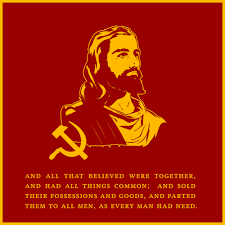
Even more to the point of the discussion at hand, it is evident that the idea of communism (or communalism) comes from the Bible itself. I’m thinking of two descriptions of life in the early Christian community that we find in the Acts of the Apostles. For instance,

Acts 2:44-45 says:

“All who believed were together and had all things in common; they would sell their possessions and goods and distribute the proceeds to all, as any had need.”

Acts 4:32–35 reads:

“All the believers were one in heart and mind. No one claimed that any of their possessions was their own, but they shared everything they had . . . And God’s grace was so powerfully at work in them all that there were no needy persons among them. For from time to time those who owned land or houses sold them, brought the money from the sales and put it at the apostles’ feet, and it was distributed to anyone who had need.”

Jesus’ identification with the poor and oppressed is also important for me. He said that whatever we do to the hungry, sick, ill-clad, thirsty, homeless, and imprisoned, we do to him. The words Matthew attributes to Jesus (in the only biblical description we have of the last judgment) are:

“The King will reply, ‘Truly I tell you, whatever you did for one of the least of these brothers and sisters of mine, you did for me.’ “Then he will say to those on his left, ‘Depart from me, you who are cursed, into the eternal fire prepared for the devil and his angels. For I was hungry, and you gave me nothing to eat, I was thirsty and you gave me nothing to drink, I was a stranger and you did not invite me in, I needed clothes and you did not clothe me, I was sick and in prison and you did not look after me.’ “They also will answer, ‘Lord, when did we see you hungry or thirsty or a stranger or needing clothes or sick or in prison, and did not help you?’ “He will reply, ‘Truly I tell you, whatever you did not do for one of the least of these, you did not do for me.’
There is much, much more to be said about this basic faith perspective. But for now, let that suffice.

Now for the second point about human rights:

• To repeat: no one can defend the obvious human rights abuses of Russia or China. They are clearly indefensible.
• In fact, they are as inexcusable as the similar abuses by the United States in countries which are or have been U.S. client states. I’m referring to Israel, Iraq, Afghanistan, Yemen, Vietnam, and countries throughout Latin America and Africa. In all the latter, it has not been unusual for freedom of press to be violated, for elections to be rigged (think Honduras just recently), for summary executions to be common, for journalists to be assassinated in large numbers, and for dissenters to be routinely imprisoned and tortured. Christians advocating social justice have been persecuted without mercy. (Recall that infamous Salvadoran right-wing slogan, “Be a patriot; kill a priest.”)
• Moreover, while we have been relatively free from such outrages on U.S. soil, the events of 9/11/01 have been used to justify restrictions of freedoms we have historically enjoyed. Here the reference is to wiretappings, e-mail confiscations, neighbors spying on neighbors, and other unconstitutional invasions of privacy that seem to violate the 4th Amendment of the Constitution. It is now even permissible for the nation’s head of state to identify the press as “the enemy of the people.”
• 9/11 has also been used to justify the clearly illegal invasion of at least one sovereign country under false pretenses (Iraq) with the resultant deaths of well over a million people (mostly civilians). Other countries have also been illegally attacked, e.g. Libya, Yemen and Somalia without due congressional authorization. 9/11 has further “justified” the establishment of “black sites” throughout the world, the “rendition” of prisoners to third countries for purposes of torture, innumerable (literally) arrests without charges and imprisonments without trial. It has even led to extrajudicial killings of U.S. citizens.

Such observations make the general point that when countries perceive themselves to be under attack, they implement policies both domestically and abroad that defenders of human rights correctly identify as repressive, cruel, criminal and even homicidal. Russia, China, and Cuba have been guilty of such policies. But so has the United States in supporting friendly regimes throughout the world and by implementing increasingly repressive policies here at home.

Now consider the pressures that led Russia, for example, to implement its own indefensible repression:

• As the most backward country in Europe, its people had suffered enormously under an extremely repressive Czarist regime. [Czarism, in fact, was the model of government that most Russians (including criminals like Stalin) had internalized.]
• Following its revolution, Russia was invaded by a vast coalition of forces (including the United States). It was forced to fight not only the invaders, but Czarist sympathizers and anti-communists within its own population.
• The country had twice been invaded by Germany through Poland and saw itself as needing a buffer from its implacable enemies to the west.
• Its people had fought heroically against German invaders and though suffering 20 million deaths and incredible infrastructure destruction, it managed to defeat the German army and largely be responsible for winning World War II.
• During the Cold War, Russia found itself under constant threat from western powers and especially from the United States, its CIA, and from NATO – as well as from internal enemies allied with the latter.

My only point in making such observations was not to defend Russia’s indefensible violations of human rights (nor China’s, nor Cuba’s); it was, rather, to make my central point about the efficiency of economies mixed in favor of the poor vs. those mixed in favor of the rich.

As shown by Russia (and even more evidently by China), economies mixed in favor of the poor develop much more quickly and efficiently than economies mixed in favor of the rich. While both Russia and China became superpowers in a very short time, the former European and U.S. colonies in Latin America, Africa, and South Asia have remained mired in colonial underdevelopment. The latter’s organizing principle of “comparative advantage” has proven ineffective in enriching them, since it locks them into positions of mere suppliers of raw materials to industrialized countries. No country has ever reached “developed” status by following such principle. In other words, Global South countries are still waiting for that wealth to “trickle down.”

So, readers shouldn’t mistake the argument made by Wolff and others. It was not to defend the indefensible. (Even Khrushchev and Gorbachev recognized and denounced the crimes of Josef Stalin.) The relevant point is about capitalism vs. socialism. It was to indicate that the vilification of socialism overlooks the achievements of that system despite (not because of) restrictions on human rights that are common to both systems in egregious ways that no humanist or follower of Jesus should be able to countenance.

My conclusion remains, then, that it is up to people of conscience (and especially people of faith) to oppose such restrictions and violations wherever we encounter them – but especially in our own system where our voices can be much more powerful than denunciations of the crimes attributable to “those others.”

My Interview on Rob Kall’s “Bottom-Up” Podcast/Radio Program

Two weeks ago, Rob Kall posted an interview with me on OpEdNews. It centered on my book, The Magic Glasses of Critical Thinking: seeing through alternative fact & fake news. I had great fun doing the show. Here it is.

A Very Sad Independence Day

Weeping Lady Liberty

The following reflection somehow seems appropriate for the 4th of July when everyone is celebrating our Founding Fathers and our great democratic tradition.

The piece comes out of a family discussion that took place about three weeks ago. In the exchange, I ended up characterizing the detainment facilities for refugees and migrants attempting to cross our borders as “concentration camps.” I was told in no uncertain terms that my comparison was inflammatory since it evoked inappropriate connections with Hitler’s extermination camps – an implied comparison that, for my conversation partners, was way “over the top.” We have no extermination camps, they said.

From there the conversation spun to more detailed comparisons of the United States to Hitler’s Third Reich and to what I and so many others perceive as a return of fascism, which I connected with capitalism. Once again, my observations were dismissed as wildly exaggerated, too general and jumping all over the place, bringing up issues not germane to the topic at hand. My references were to Iraq, Yemen, police brutality, xenophobia,

All of that drove me to compose the following essay more for myself than for anyone else — to clarify my own thought. To repeat, it seems appropriate for publication here on this 4th of July.

Hitler Redivivus:
How He Has Returned Triumphant in the Person of Donald Trump

Let me begin this piece on the contemporary return of fascism with an “easy essay” I wrote back in 1993. Today, the essay’s description of the triumph of “Hitlerism with Hitler” is proving far more prescient than I realized in the moment of its composition. Its form follows the spirit of Catholic Workers’ co-founder, Peter Maurin, who invented the poetic “easy essay” genre when he wrote for the Catholic Worker newspaper which he founded with Dorothy Day.

This particular imitation of Maurin’s style references Marge Schott, an infamous admirer of Adolph Hitler. Schott is the deceased owner of the Cincinnati Reds baseball team. She was a racist and collector of Nazi memorabilia. Besides disdaining some of her players as “nigger millionaires,” she once famously said that Hitler was originally “a good guy,” until he “went too far.”

As you’ll see, the essay is about Ms. Schott’s hero and how he and the system he embodied actually did win World War II and has reincarnated today in thinly disguised form. That is, Hitlerism with its fascism, concentration camps, and genocide have in this era of Donald Trump more evidently returned to our world than seemed possible to most 25 years ago when I first published my own easy essay.

For starters though, here’s the Maurin-inspired piece as I originally wrote it:

Hitler, Bonhoeffer, Jesus and Us
(An “Easy Essay” with apologies to the memory of Peter Maurin and thanks
to Marge Schott)

Following Germany’s defeat
in “the First Inter-Capitalist War,”
the system was in trouble in das Vaterland.
It also foundered world-wide
after the Crash of ‘29.
So, Joseph Stalin
convoked a Congress of Victory
to celebrate the death of capitalism
and the End of History —
in 1934.

Both Hitler and F.D.R.
tried to revive the corpse.
They enacted similar measures:
government funds to stimulate private sector production,
astronomically increased defense spending,
nationalization of some enterprises,
while carefully keeping most in the hands of private individuals.
To prevent workers from embracing communism,
both enacted social programs otherwise distasteful to the Ruling Class,
but necessary to preserve their system:
legalized unions, minimum wage, shortened work days, safety regulation, social security . . .

Roosevelt called it a “New Deal;”
Hitler’s term was “National Socialism.”
Roosevelt used worker discontent
with their jobs and bosses
to get elected four times.
Meanwhile, Hitler successfully directed worker rage
away from the Krupps and Bayers
and towards the usual scapegoats:
Jews, communists, gays, blacks, foreigners and Gypsies.

He admired the American extermination of “Indians”
and used that model of starvation and internment
to guide his own program for eliminating undesirables
by hunger and concentrated slaughter.
Hitler strictly controlled national unions,
thus relieving the worries of the German elite.
In all of this,
he received the support of mainline churches.
Pius XII even praised der Führer as
“an indispensable bulwark against communism.”

Dietrich Bonhoeffer and the German “Confessing Church”
resisted Hitler’s program
of social Darwinism, patriotism and persecution of the undeserving.
Confessing faithful were critical of “religion”
which combined anti-Semitism, white supremacy, patriotism and xenophobia
with selected elements of Christianity.
They insisted on allegiance
to Jesus alone
who stood in judgment over soil, fatherland, flag and blood.
They even urged Christian patriots
to pray for their country’s defeat in war.
Bonhoeffer participated in a plot to assassinate Hitler
and explored the promise of
Christianity without “religion.”

Hitler initially enjoyed great popularity
with the powerful
outside of Germany,
in Europe and America.
He did!
Then as baseball magnate and used car saleswoman, Marge Schott, put it,
“He went too far.”
His crime, however, was not gassing Jews,
but trying to subordinate his betters in the club
of white, European, capitalist patriarchs.
He thus evoked their ire
and the “Second Inter-Capitalist War.”

Following the carnage,
the industrialists in other countries
embraced Hitlerism without Hitler.
They made sure that communists, socialists and other “partisans”
who bravely resisted German occupation
did not come to political power,
but that those who had cooperated with Nazis did.

Today, the entrepreneurial classes
still support Nazis, whenever necessary.
The “Hitlers” they love have aliases
like D’Aubisson (El Salvador), Diem (Vietnam), Duvalier (Haiti), Franco (Spain),
Fujimori (Peru), Mobutu (Zaire), Montt (Guatemala), Noriega (Panama), Peron (Argentina), Pinochet (Chile), Pol Pot (Cambodia), Resa Palavi (Iran), Saddam Hussein (Iraq), Somoza (Nicaragua), Strossner (Paraguay), Suharto (Indonesia). . . .
The list is endless.

The global elite deflect worker hostility
away from themselves
towards communists, blacks, gays, immigrants and Muslims,
towards poor women who stay at home
and middle class women who leave home to work.
Today, Christians embrace social Darwinism
while vehemently rejecting evolution.
Standing on a ground of being
underpinning the world’s most prominent culture
of religious fundamentalism,
they long for Hoover,
and coalesce
with the right.

In all of this
is forgotten the Jesus of the New Testament
who was born a homeless person
to an unwed,
teenage mother,
was an immigrant in Egypt for a while,
came from the working poor,
was accused of being a drunkard,
a friend of sex workers,
irreligious,
possessed by demons
and condemned by the state
a victim of torture
and of capital punishment.

Does this make anyone wonder about Marge Schott,
the difference between Hitler’s system
and our own,
and also about “religion”
and how to be free of it,
about false Christs . . .
And who won that war anyway?

Fascism

Having summarized my general argument in that easy essay, the first point to be clarified is the nature of fascism. As I argue in my new book, The Magic Glasses of Critical Thinking: seeing through alternative fact and fake news, fascism is really a species of capitalism. In my book, I call it “capitalism in crisis.”

What I mean is, fascism is the form capitalism often assumes when the free market’s endemic dysfunctions (periodic downturns, creation of obscene wealth disparities, inability to address environmental pollution, labor unrest, etc.) endanger its very survival. In its fascistic form, the system morphs into a police state.

With such enforcement, fascism’s essence may be summarized in three points. It is (1) Police State capitalism, (2) that favors the culture’s elite, and (3) blames the system’s disfunctions on scapegoats – in Hitler’s case on communists, socialists, Jews, Gypsies, blacks, and the disabled.

That’s the 1930s form capitalism took not only in Germany, but in Italy, Spain, Portugal and elsewhere during the Great Depression following the systems worst crisis ever precipitated by the Stock Market Crash of 1929.

However, since pure capitalism does not really exist in unregulated, free-market form, it is not exactly accurate to describe fascism as a kind of capitalism. That is, especially since the Crash of ’29, to insure its survival, capitalism has had to adopt elements of socialism such as: social security, minimum wages, severe limits on income, rent control, unions, guaranteed health care, public schooling, food subsidies, creation of national parks, etc. Economists call such provisions combined with free markets, “mixed economies.”

To cope with the problems of the Great Depression, such accommodations with socialism became so common that it is now true to say that neither capitalism nor socialism in their pure forms exist today – if indeed they ever did. Instead, mixed economies are all we have in the world. All economies are mixtures of capitalism and socialism.

This, however, does not mean that all economies are the same. The crucial question distinguishing, for example, Hitler’s mixed economy from that of Franklin Roosevelt is: “Mixed in favor of whom?” Hitler’s economy was mixed in favor of blond, blue-eyed Arians. Roosevelt’s with its social security and high taxes on the wealthy was modestly mixed in favor of working classes.

Or to put it in more contemporary terms, “Mixed in favor of whom?” is the crucial question differentiating Cuba’s mixed economy from that of the United States. The United States economy is unabashedly mixed in favor of the wealthy on the theory that the abundance enjoyed by the rich will trickle down to the general population. Cuba’s on the contrary is mixed in favor of the working classes based on the observation that the system’s “trickle” is never enough to provide a decent standard of living for entire populations.

Fascism Today
Its Concentration Camps

The argument in my earlier quoted easy essay was that Hitler’s system, whatever we might call it, persisted following his presumed defeat in 1945. More specifically, in our own day, our country has been taken over by fascist criminals like Hitler. But, let’s be clear: this is not a new phenomenon begun with the presidency of Donald Trump. No, the take-over has been in process at least since the end of the Second Inter-Capitalist War in 1945.

In fact, the argument can be credibly made that our country was founded by such criminals. Using rationale supplied by John Locke, our Founding Fathers committed genocide against North America’s indigenous peoples, eventually confining them in concentration camps (called “reservations”). They employed the same logic to enslave workers kidnapped from Africa imprisoning them in labor camps (called “plantations”).

For Locke, who inspired Jefferson’s Declaration of Independence, the crucial and ironic pronouncement behind such operations was that “All men are created equal.” But note well that in his formulation, the statement had no liberating relevance for Native Americans, African slaves, women or propertyless whites. Instead, its expressed intention was to establish the right of imperialists like him and his cohorts to steal land and resources from the continent’s indigenous inhabitants.

Locke’s point (as explained in The Magic Glasses of Critical Thinking) was that just because the “Indians” were here first, they had no special claim on the lands they called home. That is, since (in Locke’s estimation) huge tracts were not being farmed as they would be in England, they were there for the taking by the Indians’ equals from Great Britain.

Locke said that a refusal by the Indians to recognize such equality amounted to a declaration of war against the British. So, the natives could be exterminated with abandon – a task our country’s great Indian Fighters took on with enthusiasm and relish creating a holocaust that killed millions.

Adolph Hitler himself took inspiration from the examples just cited. He liked the concept of concentration and work camps. He was expressly impressed by the efficiency of U.S. extermination of our continent’s First Peoples. It inspired him and evidently the minds behind contemporary concentration camps.

With all this in mind, it is no exaggeration to say that the camps are reincarnating today before our very eyes. Our government has set them up world-wide. They are so ubiquitous and normalized that they remain practically invisible. But consider their contemporary equivalents in:

• The U.S. prison-industrial complex itself for blacks, browns and poor whites transforming “Americans” into the most imprisoned population on the planet
• Guantanamo Bay for holding “terrorists” who after years of internment and torture have yet to be charged with crime and which Fuhrer Trump promises to fill to the brim
• Black Sites concealed throughout the world where kidnapped Muslims and others disappear without a trace and are tortured without mercy
• Fort Bliss (sic), a concentration camp for immigrant children
• Baby Prisons for infants as young as four months
• Detention centers for refugees from U.S. wars of aggression in Afghanistan, Iraq, Libya, Yemen and elsewhere
• Family prisons immigrant workers from Mexico and Central America as they await trials which can be postponed indefinitely
• The Gaza Strip, the world’s largest open-air prison for Muslim Palestinians, “the Jews’ Jews” – unconditionally endorsed by U.S. politicians of all stripes

Fascism Today
Its Genocides

In such hell-holes the criminals (often the guards) commit murders, rapes and inflict torture with impunity. Nonetheless, since Hitler, it is no longer permissible for such polite company to crudely incinerate victims in ovens or to poison them in gas chambers. (That would be too “inhumane” and reminiscent of the unspeakable.) So, today’s executioners murder and incinerate Muslims (today’s “Jews”), and others on site. (It saves the trouble and expense of packing them into box cars.)

In other words, the executioners travel to the victims’ countries of origin in the Middle East and Africa and do the dirty work there – often from 10,000 feet in the air, where the screams of incinerated Muslim children cannot be heard. They cremate their victims more humanely in the targets’ own homes with napalm and white phosphorous. Alternatively, “pilots” seated comfortably in their air-conditioned “theaters” send automated death squads (killer drones) to decapitate those suspected of evil thoughts. In the process, the system’s butchers have massacred millions far exceeding anything imagined by that little man with the toothbrush mustache:

• Already by 1978, John Stockwell, the highly decorated ex-CIA Station Chief in Angola, estimated that his agency’s “Secret Wars” had killed more than six million in its dirty wars against the world’s poor. In Stockwell’s own words, every one of those wars was illegal and “bloody and gory and beyond comprehension almost.”

• Add to that
o The hundreds of thousands slaughtered during the 1980s in El Salvador,
Guatemala, Nicaragua, and Honduras
o More than a million victims in the completely illegal war in Iraq
o Untold fatalities in Afghanistan, Libya, Syria, Ethiopia,
o The 10,000 already killed in Yemen, the poorest country in the Middle
East – with the numbers increasing each day from cholera and
intentionally-inflicted starvation

Again, the numbers are staggering – far beyond anything accomplished in Hitler’s death camps.

Meanwhile, at home, “Americans” are dissuaded from protest by a militarized skin-head police force of body-builders and thugs. “Dressed to kill” in their black or camouflaged flack suits, and anonymous under their helmets and behind polarized face-shields, they stand ready with batons, tasers, and AK47s – as well as employing surplus military tanks, and Humvees – to punish anyone who dares opposition.

Conclusion

Connect such apparently disparate issues – Hitler, concentration camps, extermination, the prison-industrial complex, U.S. wars of aggression, Stockwell’s calculation of 6 million victims, Guantanamo, torture, militarized police, Palestine, unpunished police killings of unarmed blacks, Black Lives Matter, black sites, Muslim bans, baby jails . . . – and one might well get accused of “changing the subject” or “jumping all over the place” or of being a negative alarmist.

But the truth is, the dots, though scattered, are there just waiting to be linked, just as they were in Germany during Hitler’s rise to power. As then, the basic connection is the crisis of capitalism as described in my earlier-shared easy essay. With that crisis becoming more evident each day, fascism’s arrival has been clearly signaled, though its concentration camps and holocausts have been effectively renamed and camouflaged. As a result of such stealth and rebranding, the system’s reappearance has passed almost without notice.

However, patriots like John Stockwell have seen it coming since 1978. More recently, so has Michael Moore. It’s high time for the rest of us to take note!

Think Critically about Syria, Skripal, and Building # 7 Before It’s Too Late: Apply “The 9/11 Principle”

Syria Crisis

What level of evidence of an opponent’s criminal state activity justifies sanctions, diplomatic expulsions, retaliatory bombings, conventional war or even the risk of nuclear war? The question finds urgent relevance amid unsubstantiated charges of chemical weapons use by the Assad government in Syria and in the light of wild accusations against Vladimir Putin of Russian responsibility for the poisoning of double-agent Sergei Skripal and his daughter Yulia.

In my new book, The Magic Glasses of Critical Thinking: seeing through alternative fact and fake news, I offer a whole series of criteria for answering questions of evidence and judgment of guilt.

“Magic Glasses” is a term coined by the late comedian and social activist, Dick Gregory for habitual critical perspective that refuses to go along with group-think imposed by American oligarchs and propagated by the mainstream media (MSM). For Gregory, critical thinking was like donning a pair of spectacles that reveal things as they truly are, not as the oligarchs and their publicists would have us see them.

Magic Glasses Cover

Chief among the criteria I offer in my own Magic Glasses is what might be called the “9/11 Principle.” It enjoys new relevance in the light of a recently-filed petition for a grand jury hearing about the true causes of the destruction of the 3 World Trade Center buildings on 9/11/01. The 54-page petition with 57 exhibits was submitted on April 8th by the Lawyers’ Committee for 9/11 Inquiry. The principle states that:

Since 9/11/01, any evidence for enemy-state wrongdoing (such as use of chemical weapons or alleged assassinations) must surpass the level of the evidence routinely dismissed by the U.S. government indicating that the World Trade Center destruction of 9/11/01 was the result of controlled demolition rather than of fires caused by planes crashing into the structures.

My 9/11 Principle and its implied relationship to Assad, Skripal and the attack on the World Trade Center is found in the final chapter of The Magic Glasses. There I attempt to appropriate Noam Chomsky’s propaganda model of mainstream media (MSM) which identifies its function as not that of seeking truth, but of defending government policy despite the facts.

In the case of designated enemies, Chomsky explains, merely circumstantial evidence, hearsay, and the work of discredited intelligence agencies is all that’s required to establish guilt and justify retaliation. Moreover, responsibility for the alleged misconduct will be attributed to the highest level possible.

This syndrome finds its most recent expression in the just mentioned cases of alleged Syrian use of chemical weapons, and in the Skripal poisonings. In both cases, long before the dust had settled, the Trump administration on the one hand, and Theresa May on the other quickly drew conclusions condemnatory of designated enemies (Syria in Trump’s case, and Russia in May’s) before standard criminal investigations were allowed to unfold. In each case, guilt was linked directly and immediately to the relevant head of state – Bashar Assad and Vladimir Putin.

Contrast such premature judgment with MSM coverage of alleged U.S. crimes. There smoking guns are always demanded. And then if the “gun” is found, responsibility for its use is routinely assigned to the lowest official available. Abu Ghraib represents a case in point. Crimes that were later traced to the oval office itself were originally presented as the work of a few low-ranking bad apples.

More to the point, consider the official story of 9/11. That Washington-sanctioned account has carried the day for more than 16 years despite problematic evidence ignored or dismissed by government investigators. That’s the evidence undergirding the case submitted by the Lawyers Committee for 9/11 Inquiry. It includes:

* The historical facts that no steel-framed building in the history of the world has ever fallen as the result of even the most intense fires burning in some cases for days on end.
” Yet three such buildings fell on a single day after a few hours of localized conflagration.
” World Trade Center Building #7 was not struck by aircraft; yet it too fell into its footprint like Building #1 and Building #2 in fewer than 10 seconds after a relatively few hours of fire.
” Larry Silverstein, the owner of WTC Building #7 is heard on tape admitting that he and an unnamed NYC fire official decided to issue the order to “pull” the building in question. Using the language of demolition engineers, where to “pull it” means to initiate the final demolition process, Silverstein says,

“I remember getting a call from the fire department commander telling me they were not sure they would be able to contain the fire. I said, ‘You know, we’ve had such terrible loss of life, maybe the smartest thing to do is just to pull it. And they made that decision to pull. Then we watched the building collapse.'”

* The scientific fact that Jet fuel (the medium responsible for ignition of the fires in question) cannot produce fires whose temperatures can cause steel to melt.
* The evidentiary fact that widespread traces of thermite explosives were found amid the wreckage of the collapsed WTC buildings.
* The procedural fact that thorough investigation of the WTC debris was prevented by an inexplicably hastened and immediate removal of crime scene evidence following the buildings’ destruction.

In the light of the differences between government and MSM treatment of alleged crimes of the U.S. government on the one hand and of designated enemies on the other, let me repeat my 9/11 principle. It states:

Since 9/11/01, any evidence for enemy-state wrongdoing (such as use of chemical weapons or alleged assassinations) must surpass the level of the evidence routinely dismissed by the U.S. government indicating that the World Trade Center destruction of 9/11/01 was the result of controlled demolition rather than of fires caused by planes crashing into the structures.

Please note that the principle does not take a position on the question of responsibility for the dastardly events of 9/11. Instead, it merely:

* Suggests that for the sake of fairness, balance, logic, and consistency, the same standards of behavior must be applied to designated enemies as that applied by U.S. officials to their own conduct. (This is Chomsky’s Principle of Universality that any child can understand.)
* Underlines the high bar set by authors of the official 9/11 story and of their disinterest in answering the still-open questions surrounding the event.
* Implies that no retaliation in the form of sanctions, bombings or (much less) declarations of war should ever take place in response to alleged crimes of designated enemies unless evidence exceeds that denied or rejected out of hand (as conspiracy theories) by proponents of the official story of the September 11th attacks.
* Means that belligerent responses to recent chemical weapons attacks or to alleged assassinations are virtually impossible to justify.
* Consequentially renders the question of war effectively moot.

In fact, no war justifications since the Second Inter-Capitalist War have met the standard set by the 9/11 principle. And even if the opponents of renewed 9/11 inquiry should block the initiative of the Lawyers Committee for 9/11 Inquiry, their very act of denial will only raise the bar the principle sets even higher.

By offering its Ten Rules similar to the 9/11 Principle, The Magic Glasses of Critical Thinking attempts to clarify issues such as those inspired by the Assad accusations and the Skripal case. It also is meant to spur practical conclusions including:

* Extreme skepticism of any governmental claims based on circumstantial evidence.
* Absolute refusal to endorse any retaliation towards Russia without an incontrovertible “smoking gun” established by an independent agency conducting thorough investigation and presenting its findings to the United Nations.
* Insistence that the evidence in question be concrete, undeniable, and as easy to recognize as a building falling into its own footprint in fewer than 10 seconds.
* Massive street demonstrations against the American and British oligarchs, “intelligence” agencies, and arms manufacturers whose financial interests are recklessly rushing the world towards nuclear annihilation.

I and my book are desperately appealing to the American public to put on Gregory’s magic glasses and see the fall of Building #7 as the prescient image of what the oligarchy is about to inflict on our homes, offices, schools, factories, businesses, hospitals, and churches.

Following Dick Gregory, we must see things as they are – and act accordingly before it’s too late.

Press Release: The Critical Thinking Manual Progressive Teachers Have Been Waiting For: My New Book

Magic Glasses Cover

Mike Rivage-Seul has just published the book progressive teachers have been waiting for to ground their post-secondary courses on critical thinking. Available on April 17th from Peter Lang Publishing, the book is called The Magic Glasses of Critical Thinking: seeing through alternative fact and fake news.

Rivage-Seul is an emeritus professor of peace and social justice studies at Berea College in Kentucky, where he taught for more than 40 years. He publishes a monthly column in the Lexington Herald-Leader.

His approach to critical thinking – to education itself – should be familiar to progressives. It starts from the position that the purpose of such process is not primarily to interpret the world, but to change it. Therefore, critical thinking and education should not be neutral. It should equip students with the tools they need for social activism.

Magic Glasses summarizes what Rivage-Seul considers the most important insights he gathered over his years of travel and study throughout Europe and especially in the Global South – specifically in Brazil, Nicaragua, Cuba, Costa Rica, Honduras, Mexico, Zimbabwe, South Africa, and India, as well as in Israel-Palestine.

“As you can tell by the title,” Mike says, “The Magic Glasses could hardly be timelier. The concept comes from the great comedian and social activist, Dick Gregory. He spoke of critical thinking as functioning like a set of spectacles. They confer special insight enabling their wearers to see things quite differently from what is considered ‘normal.’

“However, Gregory warns that the glasses come with three rules. The first is that once you put them on, you can never take them off. The second says that once you put them on, you can never see things the way everybody else does, but only as they truly are. And the third is that you can never force anyone else to wear them.”

In other words, Rivage-Seul’s book might be a dangerous read. For instance, he echoes Global South scholars by seeing sinister intent in the Declaration of Independence’s celebrated statement that “All men are created equal.” With those same scholars, he refers to World War II as the “Second Inter-Capitalist War,” and sees the United States as currently occupying the same global position that Adolph Hitler aspired to attain – with similar effect.

“I’ve been wearing Gregory’s magic glasses for years,” Mike says. “They’ve shaped my all my teaching and have often got students mad at me – at least at first. And you should read some of the comments my newspaper columns get! It’s all because I constantly apply the ten rules for critical thinking that my book explains.”

Those rules include: (1) Reject Neutrality, (2) Reflect Systemically, (3) Select Market (as the root of political differences), (4) Suspect Ideology, (5) Respect History, (6) Inspect Scientifically, (7) Connect with Your Deepest Self, (8) Quadra-sect Violence, (9) Detect Silences, and (10) Collect Conclusions.

As a result of employing those guidelines, Rivage-Seul understands U.S. history, terrorism, the renewed nuclear arms race, world hunger, trade agreements, immigration, Black Lives Matter, and other hot button issues in ways that end up being 180 degrees opposed to the mainstream.

“I’m in good company though,” Mike observes. “I’m trying to channel the spirit of the world’s great critical thinkers. Think about it. None – not Jesus, the Buddha, not Gandhi, Martin Luther King, Dorothy Day, Thomas Merton, or Helen Keller – was neutral. They weren’t worried about ‘balance’ or offending anyone. For them, speaking truth to power and living with the results were all that mattered.

“I’m hoping that my book falls into that tradition.”

That social activist tradition is indeed developed in The Magic Glasses. And each point is illustrated with movie clips from films such as Traffic, The Post, Avatar, Sausage Party, The Distinguished Gentleman, Good Will Hunting, American Sniper, Captain Phillips, American History X, War Dogs, Bulworth, and even with the Broadway musical, Hamilton.

In sum, The Magic Glasses of Critical Thinking represents and attempt to supply secondary and post-secondary teachers with a complete syllabus for a course on critical thinking that will help students radically revision their world in ways that inevitably challenge all of their preconceptions.

As such, Rivage-Seul’s book on critical thinking is not only the one progressives have been waiting for, it’s a page-turner as well. As Rob Kall, the editor-in-chief of OpEdNews puts it in his endorsement:

“I love this book. It’s brilliantly written by a very wise man who’s been serially enriched by spending time with some of the world’s greatest visionaries. And he shares what he learned from his conversations with them. The book is addictively readable. I started to skim the book to see if it was worth putting my time into and found I couldn’t stop reading. Michael Rivage-Seul brings sparkling vivacity to the potentially dry topic of critical thinking. As one who has interviewed hundreds of visionaries, I found this book to offer new perspectives and ways of seeing-which is what building critical thinking skills is all about. This book offers so much more than what its title, at first glance suggests. Have a taste and you, will like me, find yourself wanting to consume all the courses of this delicious meal.”