Yesterday, on “Democracy Now,” Amy Goodman reported good news for the poor countries of the Global South. In the news headline portion of her show , she said, “Cuba has pledged to donate 200 million doses of its COVID-19 vaccine to low-income countries in the Global South. The move was announced at talks hosted by the Progressive International and was heralded as a possible ‘historic turning point’ in the pandemic.”
You’d think that the announcement would be welcomed and celebrated everywhere and be given at least as much press coverage as the one-day protests in Cuba reported so breathlessly last November 15th. However, no such general celebration occurred. Even on “Democracy Now,” the story went undeveloped beyond the just-quoted headline. Meanwhile, in contrast to its hysteria over Cuban protests last fall, the U.S. government itself has been totally silent about this potentially game changing development.
Nevertheless, according to international health experts, Cuba’s achievement could make vaccinations much more available for example to 1.3 billion Africans whose continent has seen only 7% of its population receive even a single vaccination dose. (And this in contrast to 70% vaccination rates in richer countries.)
According to reports even on CNBC’s online source, the five Cuban vaccines in question:
Are a uniquely Cuban development among the former colonies
Have been administered in three doses to a higher percentage (86%) of Cuba’s 11 million people than in most of the world’s richest countries
Are not dependent on expensive mRNA technology using instead a “subunit protein” variety – like the Novavax vaccine
Are cheap to produce
Require no special refrigeration
Enjoy 90% effectiveness against all strains of COVID 19
Will have no patent restrictions on their recipes shared with low-income countries
Will be made available to them virtually at cost
Are a tribute to Cuba’s legendarily efficient health care system
Currently, Cuba’s prestigious biotech industry is awaiting approval for its vaccine developments from the World Health Organization. That approval is expected early this year. According to Helen Yaffee of the University of Glasgow, “. . . many countries and populations in the global south see the Cuban vaccine as their best hope for getting vaccinated by 2025.”
As for cost and distribution issues, John Kirk, professor of Latin American Studies at Dalhousie University in Nova Scotia added, “The objective of Cuba is not to make a fast buck, unlike the multinational drug corporations, but rather to keep the planet healthy.”
But in news cycles dominated by pharmaceutical corporations that refuse to waive intellectual property rights to their largely publicly funded products, such contrasting humanitarian consciousness goes mostly underpublicized and by such silence, denied.
Denial like that prevails despite the appeals for sharing vaccine recipes by the World Health Organization itself supported by civil society groups, trade unions, former world leaders, international medical charities, Nobel laureates and human rights organizations.
Part of the reparations due Cuba for 60 years of economic embargo and for silence about its achievements is to at last recognize its socialism as a force for global humanitarianism much more beneficial to the world than international capitalism.
Yesterday (December 15, 2021)
The world lost a great seer.
My wife, Peggy, and I
Lost a dear friend
And colleague
At Berea College
Too soon.

bell hooks was brilliant.
She lit up the world
And Jackson Street
No less
Just down from our place
There in Central Kentucky.

Countless times
She graced our kitchen table
Over 15 years together
Just the 3 of us
Breaking Peggy’s French bread
Or at larger gatherings
On special occasions.

bell introduced Berea
To Cornel West
In a living room soiree
I’ll not forget
And to Laverne Cox
And Emma Watson.
bell was a celebrity too
Beyond any of them
But you'd never know it.

Always up
For deep conversation
About issues,
Feminism for everyone
And liberation,
The sprite in her
Found yet more energy
For gossip and trash talk.
She was nothing
If not great fun.

“Let’s recite our favorite poems”
She’d suggest.
Or “talk about
Our romantic relationships,”
She’d grin
With that wicked twinkle
In her mischievous eyes.

And we’d obey.
We did!
Poems one after another.
And one night
At that kitchen table
In darkness
Relieved by candlelight
Eight or so grave professors
Bared secrets
About just that
Our romances!
Can you imagine?
Extraordinary and memorable.
And so she was.

bell showed it
In her books and lectures
That changed the world.
Didn’t they?
Didn't she?
They transformed
Berea College students,
And all who read and heard
Across the planet.
They changed me and Peggy.

More than anything however,
bell hooks was a seeker
With infinite energy
For prayer and meditation
And the goddess
Understood as Pure Love
Absolutely forgiving
Creator of a world
With room for everyone
Feminist or not
..
So, rest in peace
Dear friend,
And sister
Dear teacher
And prophet.
Dear author
And speaker,
Dear fellow traveler
And seeker.
Diminutive giant of a woman,
We love you,
Dearest bell.
We are grateful
For your gifts
And most of all,
For your
Rare goddess grace.
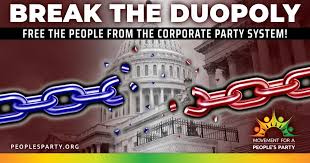
I’ve given up on the Democratic Party. For reasons that are listed below, I’ve drawn the conclusion that our country’s only hope is to support a 3rd party to contest the strangle hold the Democratic and White Party (aka the Republicans) have on a gridlocked national government.
Fact is, to this point I’ve cared more about getting Democrats elected than the Democrats themselves have. They currently control the White House, the Senate and the House, but still have allowed the White Party to rig elections (through gerrymandering and voter suppression laws) for at least the next decade. Democrats could stop this, but have decided not to.
I’ve had enough of that.
So, at this late stage of my life, I’ve decided to put my activist efforts into supporting The People’s Party. I’ve begun my campaign on its behalf by making the following proposal to a group of highly motivated seniors from New York and Connecticut whose company I’ve joined just recently.
See what you think. And if it makes sense to you, sign up for People’s Party membership and follow the suggestions below to get its candidates on the ballot where you live.
Proposal for Joining the People’s Party
GIVEN THAT:
The United States is a failed state.
Whose gridlocked political system daily shows itself incapable of the radical change demanded by rampant inequality, climate chaos and the threat of nuclear war,
Since practically speaking, it has become a single War Party state
Whose White Party and its almost indistinguishable “opposition” (the Democrats) have both been captured by Wall Street, the Military Industrial Complex, and by the health care, pharmaceutical, and fossil fuel industries – as well as by the gun lobby,
And whose corporate agendas (despite Democratic control of the presidency, House, and senate) have blocked legislation addressing issues touching the lives of ordinary people such as:
Medicare for all
$2000 stimulus checks (vs. Biden’s $1500)
$15 minimum wage
Cancellation of college debt
Free college tuition
Electoral reform
Passage of the PRO Act (protecting the right of workers to organize)
Immigration reform
Normalization of relations with Cuba
Stopping the war in Yemen
Etc., etc., etc.
All rendering the U.S. more fascist than democratic (i.e., a police state supporting corporate interests rather than those of “the people” while blaming national dysfunctions on the poor and powerless),
AND GIVEN THAT:
Democrats simply ignore progressives because the latter have nowhere else to go
Despite existence of an unmistakable national hunger for profound political change
Evidenced by the fact that
62% of Americans want a 3rd party (up from 57% just last September)
50% of Americans now identify as “Independent” and therefore constitute a de facto 3rd party left without meaningful representation
With only 25% identifying as Republican and 25% as Democrat.
AND GIVEN THAT:
The members of our Men’s Group feel great urgency to leave the world a better place
By using our various skills (organizational, activist, administrative, academic, inspirational, journalistic, artistic . . ..)
And the wisdom gathered from long experience-packed lives
Recently, a friend sent a response to my last posting on the Kyle Rittenhouse affair. My article had argued that the mainstream media (MSM) revealed its laziness, bias, and mendacity by misrepresenting the facts of Rittenhouse’s actions as well as of his trial.
In doing so, it led the public to believe that Rittenhouse lived in an Illinois location far distant from Kenosha Wisconsin, that he had “crossed state lines” with an illegal weapon, that the two persons he killed and the one he wounded were black, and that the decision of his nearly all-white jury was problematic in its blatant racism. None of those implications turned out to be true. My piece ended by urging caution in taking the MSM at its word.
Liberal Caution
My friend’s sympathetic response to all of that was to share a March 9th article from NEUROPSYCH. It was based on a book written by philosophy professor, Michael Patrick Lynch. The article was called “Is Social Media Killing Intellectual Humility?” It specifically cautioned liberals against “overestimating our knowledge of how the world works” based on what our favorite internet sources tell us.
The article’s bullet-pointed “takeaways” noted that:
Social media echo chambers have made us overconfident in our knowledge and abilities.
Social psychologists have shown that publicly committing to an opinion makes one less willing to change that position. So, readers should be careful about commitment before knowing all the facts.
To avoid a descent into epistemic arrogance and tribalism, we need to use social media with deep humility.
But We Know More than We Think
While I can agree with the direction of Dr. Lynch’s recommendations, the caution it urges can be counterproductive and silence protest. In fact, all of us know a lot more than we’re willing to admit. Moreover, Lynch’s observations do not really apply to his big question of “how the world works.” They apply instead to details of particular stories such as the Rittenhouse saga. That distinction is important.
Yes, it’s true that none of us (including our politicians and the MSM) can understand every detail of every story. However, that fact should not prevent us from adopting a position of skepticism, not about our own abilities to know the truth, but about the MSM and other establishment “thought leaders.”
That skepticism would have us recognize the simple fact that the MSM and our politicians are inveterate liars. After all, they are the keepers of an inherently unjust status quo. They arrogantly want to keep us “humble,” and distrustful of ourselves. They want to keep us from understanding and voicing our conclusions about “how the world works.”
How the World Works
In the spirit of Leonard Cohen, “Everybody Knows” that the world is arranged:
To overwhelmingly benefit the rich and powerful
Who run a system of white supremacy, imperialism, and war
And make the laws to keep that system in place
While applying them mercilessly to the poor and powerless
Aided by militarized law enforcement agencies that routinely lie, plant evidence, cover up malfeasance, commit perjury, and misinform juries.
Meanwhile those in charge avoid applying such laws to themselves and their friends
All the while pitting members of the working classes against one another as right-wing vs. left-wing, white against black, former immigrants vs. current ones, and straights against gays
But never, rich vs. poor, or employer vs. employees.
Increasingly, those in charge criminalize protest and often act as agents provocateurs to discredit those who exercise their First Amendment rights by rebelling against this intolerable situation.
Under such a system, the details of particular “stories” matter less than grasping the big picture that Dr. Lynch claimed to address.
This is particularly true of foreign affairs where defenders of imperialism, regime change, and neocolonial control are ALWAYS WRONG. Yes ALWAYS. That stark conclusion will be inevitably drawn not by the cautious one who needs to grasp every detail of particular imperial interventions. No. It will be understood best by those who grasp the background pattern behind virtually EVERY U.S. foreign intervention since the Second Inter-Capitalist War (1939-’45).
The invariable pattern is this:
Whenever any government of a former European or American colony tries to improve the lives of its poor majority
The U.S. will accuse it of being socialist, communist, or terrorist.
It will support local elite forces defending their own riches and privilege
While intervening on behalf of those local rich to fix elections, fund death squads, assassins, and paramilitaries
To thwart the programs in question and remove their proponents from positions of influence.
That is what the U.S. does in the world. It’s the pattern behind practically all its wars. The details are unvarying and nearly irrelevant. The pattern leads those concerned with social justice to a simple preliminary conclusion, “If the US. Is against them (e.g., Cuba, Venezuela, Nicaragua, China, Yemen, . . ..) they must be doing something right.
Conclusion
My own bottom line here is that adopting a position of what Dr. Lynch calls “humility” and self-doubt plays directly into the hands of the powers that be. It leads to adopting a typical “liberal” position of supposed neutrality that holds, for instance, that the government, the CIA, the FBI, the Supreme Court can (at least sometimes) be trusted to be similarly neutral. Such trust always ends up siding with the status quo.
In reality, none of the institutions just mentioned can be trusted. Their minions are not on our side. They are not our friends. It’s their job to lie to us and to misrepresent their real agenda in the world. And, very simply, that agenda is to keep the money and the power where it is.
Instead of humility, the liberals addressed by Dr. Lynch and the NEUROPSYCH article need boldness. That includes COMPLETE SKEPTICISM about anything the Powers that Be tell us – including, of course, the MSM.
Moreover, liberals-turned-radicals need our echo chambers. They encourage us, i.e., they give us courage to take a stand against the patterns endemic to the imperialism, racism, and white supremacy that govern our world. Though everybody knows those patterns subconsciously, they need to be identified and denounced out loud and without ceasing.
Yes, you and I know more than they want us to think. We already know how the world works.
Last week I got into an argument with a friend about the Kyle Rittenhouse trial. Even though my friend self-identifies as liberal, he’s quite a bit further to the right than I am, We don’t see eye to eye on many issues, the Rittenhouse trial included.
Rittenhouse, of course, was the 18-year-old who stood trial for killing two men and wounding another at a Black Lives Matter (BLM) protest in Kenosha, Wisconsin on August 20th, 2020. The trial ended last Friday with Rittenhouse found innocent of all charges leveled against him.
My friend had agreed with me that as a 17-year-old, Rittenhouse had no business inserting himself into the chaotic protests that turned into riots that night in Kenosha. We also agreed that despite its being legal, carrying an AR-15 into such a volatile situation should not be permitted to anyone – especially to a callow teenager. In my friend’s eyes, Rittenhouse certainly was no hero.
Yet, the trial verdict, he maintained, was correct. He said according to Wisconsin law, Rittenhouse’s life had been credibly threatened by the ones he shot. Besides, his attackers were related to Antifa and Black Lives Matter (BLM) — Marxist groups that routinely engage in riots, while condoning arson, vandalism, and other forms of property destruction.
In an act of political cowardice, local leaders, my friend insisted, had ordered the police to stand down as what CNN shamelessly called the “mostly peaceful protests” turned violent. That’s why business owners welcomed the aid of civilians like Rittenhouse to defend their threatened shops and stores.
Finally, according to my friend, the Rittenhouse trial had been falsely racialized by a coordinated mainstream media (MSM) effort. The whole incident, he said, had nothing to do with allegations of racism, especially since all four of the victims (Rittenhouse included) were white
I disagreed with many of the positions just reviewed – especially with the justification of the jury’s final verdict. After all, influenced by the prevailing MSM narrative, I was under the impression that Rittenhouse had gratuitously traveled all the way from Illinois with his assault weapon. I thought he had not only purchased his gun illegally but had broken the law by crossing state lines with it. I also thought Rittenhouse had chased down his victims and that after shooting them, he was simply allowed to go free by smiling police officers in riot gear.
My initial bone of contention with the jury’s verdict also involved the behavior of the presiding judge, Bruce Schroeder, At every turn he gave strong evidence of favoring Rittenhouse. For instance, the judge forbade prosecutors from referring to the ones Rittenhouse had killed as “victims.” However, they could be identified, he said, as “looters,” “rioters,” and “arsonists.” Dismayingly, Schroeder had also disallowed charges that the teenager’s possession of an assault rifle was illegal.
My argument with my friend caused me to do further research. To my surprise, I discovered he was right in much of what he said, and that under Wisconsin law Rittenhouse was indeed within his legal rights to shoot his victims in self-defense.
Still, however, I found myself disturbed by the entire affair and what it reveals about the law, the right to bear arms, and especially about the prejudices of the mainstream media.
Let me try to explain by first setting the general context of the Rittenhouse trial along with a brief review of the laws especially relevant to the case. I’ll then recount the sequence of events on the night of August 20th, 2020, as supported by video evidence. Finally, I’ll draw those conclusions I promised about what I think the Rittenhouse trial tells us about the current state of our country’s culture — and about me.
Context and Law
In order to understand the Rittenhouse trial, it helps, I think, to review its highly charged racial context as well as the legal elements that often went largely unreported in the MSM. The important factors include the following:
A long history of police violence directed specifically against black communities across the country.
The longstanding conviction within those communities (and outside it) that the resulting police shootings, arrests, convictions, and imprisonments are far out-of-proportion to the size of black populations in the United States
The August 23rd paralyzation of African American Jacob Blake by a white Kenosha police officer who shot Blake seven times in the back in the proximate presence of Blake’s three small children
The subsequent demonstrations in Kenosha and across the country
The participation of the Black Lives Matter organization in those demonstrations. (BLM is a broad-based movement encompassing many different philosophies and strategies all intent on responding defensively to police violence.)
The fact that many BLM members and sympathizers are white and that historically the law has treated such people in the same way it treats black people. (This suggests that the white skin color of Rittenhouse’s victims by no means removes racism from the story’s equation.)
Wisconsin gun law that allows underaged children to legally carry long barreled rifles
Wisconsin self-defense law that presumes innocence on the part of those claiming its protection, while placing a high-bar burden of proof on those contradicting self-defense claims.
The widely shared impression of prejudice given by the judge presiding over the Rittenhouse trial
The Sequence of Events
With that context in mind, consider the facts of the Rittenhouse case:
Though living In Illinois, Kyle Rittenhouse worked (as a lifeguard) in Kenosha, Wisconsin, a 20-minute drive from his Illinois home.
Even as a 17-year-old, Rittenhouse had from Wisconsin statute the legal right to carry his AR 15 into the Kenosha protests.
He was acting as a vigilante allegedly to protect the private property of local businesses in the town where he worked.
In a parking lot, where he claimed to have gone to extinguish fires set by protestors, Rittenhouse encountered Joseph Rosenbaum and Rosenbaum’s associate, Joshua Ziminski who was armed.
(Rosenbaum had earlier in the day been released from a psychiatric hospital. He had a history of violent outbursts and was under a restraining order separating him from his fiancé. The night in question, he was filmed pushing a flaming dumpster towards a gas station. When stopped by other protestors, he responded angrily in a threatening manner.)
In the parking lot, Rosenbaum challenged Rittenhouse and lunged towards him.
Rittenhouse turned and ran away pursued by Rosenbaum who threw at Rittenhouse a plastic bag filled with personal items belonging to Rosenbaum.
Rittenhouse stopped and turned around. He then resumed running from Rosenbaum.
Meanwhile, Ziminski fired a shot in the air. His was thus the first shot fired during this incident.
Still pursued by Rosenbaum, Rittenhouse fled into a parking area where he fired four shots at his pursuer fatally wounding him.
Rittenhouse circled back, looked at Rosenbaum’s body, and phoned his friend, Dominick Black.
Identified as an active shooter by an angry crowd, Rittenhouse ran from the scene.
He was hit in the head by one pursuer.
Afterwards, Rittenhouse kept running, but eventually fell.
An unidentified man tried to “jump kick” Rittenhouse, who then fired a shot.
Anthony Huber (a friend of Jacob Blake) then hit Rittenhouse with a skateboard and grabbed at his AR-15. Rittenhouse fired again killing Huber.
Gaige Grosskreutz (one of Rittenhouse’s pursuers) initially raised his hands before Rittenhouse who was lying on the ground pointing his AR 15 at his attackers.
He held fire.
Grosskreutz then lunged at Rittenhouse with his own handgun.
Rittenhouse shot Grosskreutz in his right arm.
The crowd backed off.
Rittenhouse got up and ran towards the police.
He appeared to surrender with his hands up.
The police however ignored him driving by at high speed.
Rittenhouse then got a ride home from his friend Dominick Black.
Rittenhouse’s mother subsequently drove her son to the local police station where in tears he turned himself in.
As reported on the Jimmy Dore Show, all of this is on video which one can see here.
Lessons Learned
As I said, the just-reviewed sequence of events set within the contextual factors cited lead me to conclude that the Rittenhouse trial was not falsely racialized. The question of race was part and parcel of the protest against police brutality in the case of Jacob Blake. Black Lives Matter protestors on the scene (both black and white) were there to protest such violence which they saw as racially motivated. Within that context, protestors had good reason to suspect that vigilantes like Kyle Rittenhouse represented the forces of white supremacy that gave rise to BLM itself.
I also conclude that the jury’s decision might have been technically correct, but it ended up highlighting the need for basic legal reform. It points up yet again the fact that U.S. gun laws are highly dangerous. To allow armed individuals (regardless of age) to take part in any public protest ipso facto courts disaster. Instead, anyone carrying a weapon under such circumstances should be immediately arrested and detained.
Even more specific to the Rittenhouse case, it seems that allowing individuals to create an unnecessarily dangerous situation and then to claim self-defense when the situation turns threatening against them personally is somehow contradictory.
Additionally, the whole incident calls attention to the need for drastic police reform, unfortunately termed “defunding the police.” Something is basically wrong when millions of taxpayer dollars spent on a highly militarized police force cannot produce public servants capable of maintaining order and of protecting peaceful protestors. Something is wrong when the beneficiaries of such funding are reduced to dependence on armed vigilantes to do their work.
Finally, the first amendment’s clear assertion of the right to freedom of speech, protest, and petition is at least as important a part of the Constitution as the political right’s tortured and overly broad interpretation of its “right to bear arms.” Yet, within our culture’s current crisis, protest against police violence and racism tends to be criminalized, while citizen possession of weapons of war is not only tolerated but celebrated.
Conclusion
My most important conclusion, however, has to do with the mainstream media and even with some alternative liberal sources. It has to do with me.
Certainly, the media in question did its readers and viewers no favor in its portrayal of the Rittenhouse trial and what led up to it. Reporting on the event exhibited for all to see the laziness, sheer negligence, and outright deception of such news agencies. They even allowed many in their audiences to draw the conclusion that the ones shot by Rittenhouse were black. Certainly, they convinced me that Rittenhouse had traveled “all the way from Illinois” carrying an illegally purchased firearm “across state lines.
Most painfully then, the Rittenhouse trial and my discussion with my friend brought to the surface my own laziness and excessive trust not only in The New York Times, and Washington Post, but in sources that share my preconceptions. The fact is, I try to stay on top of such important events. And yet my original interpretation of the trial just reviewed shows that I’ve not been vigilant enough.
Vigilance, suspicion, and caution then are what I most learned from the Rittenhouse trial. I also learned something important about the benefits of honest dialog with “the opposition.”
The other night, my wife Peggy and I were involved with friends from church in a conversation about borders. The question arose, because of immigration problems that have arisen throughout the world because of climate change and U.S. wars. I’m talking about the conflicts our government initiated in Central America during the 1980s, as well as the most recent campaigns in Afghanistan, Iraq, Syria, Lybia, Sudan, Somalia, Yemen, not to mention miscellaneous dronings, and the drug war in Mexico. Every one of those debacles has created thousands of refugees.
During our discussion of borders, the question became, “What would Jesus say about them?” Surely, we can’t just ignore demarcations between countries, can we?”
My response is, “Actually, we can. Not only that, but we have done so repeatedly.” In fact, when you think about it, borders turn out to be completely arbitrary, and the rich ignore them all the time. Only the rest of us are naïve enough to believe that lines on a map are somehow sacrosanct. It’s all a scam by the 1% to keep the world’s majority in line by creating captive labor forces.
Besides that, Jesus himself and the moral thrust of the Jewish tradition he represented by no means held borders inviolable when it came to immigrants, refugees, and asylum seekers.
Here’s what I mean:
Borders Are Arbitrary
In historical perspective, current demarcation lines dividing countries are totally artificial and changeable. Many of them, for instance in Africa and the Middle East, were drawn up in a field tent by basically ignorant imperial generals.
The colonial outsiders’ overriding interest was accessing the resources of the areas in question. So, they formed alliances with local chiefs, called them “kings” of their new “nations,” and drew those lines I mentioned describing the area the nouveau royalty would govern.
But the colonial conquerors did so without knowledge of traditional tribal habitats, shared languages, or blood connections between families their random lines separated. As a result, from the viewpoint of the groups divided, the problem with borders is not that people cross them, but that the borders cross peoples.
Closer to home, that ironic crossing phenomenon is best illustrated in the cases of Texas, California, New Mexico, Colorado, Arizona, and Utah. Before 1848, all those states were part of Mexico. Then following the Mexican-American War (1846-’48), the U.S. border crossed Mexicans in those new states and they suddenly became foreigners in what previously had been their own country.
In 1848, ordinary Mexicans viewed the entire process as highway robbery. As a result, their descendants often speak of contemporary Mexican migration to “America” as a Reconquista — a justified re-conquest of lands stolen from their forebears.
Nevertheless, 170 years later, U.S. presidents like Biden and Trump want to solidify America’s unlawful annexation of huge swaths of Mexico by laws and a wall to enforce this relatively new line of separation. The argument seems to be that borders are holy, have always been there, and that people who cross them are “illegals” and criminal. But that just raises questions about our rich confreres’ attitude towards the new lines drawn.
The Rich Disregard Borders
Fact is: The rich routinely disrespect borders in two principal ways, one juridically “legal” and the other completely otherwise.
For starters, so-called “legal” border crossings are claimed as a right by international corporations. According to its free enterprise principles, Wal-Mart, for example, has the right to set up shop wherever it wishes, regardless of any resulting impact on local merchants, farmers, or suppliers. Thus, capitalists claim license to cross into Mexico in pursuit of profit. They legalize their border crossing by signing agreements like NAFTA with their rich Mexican counterparts. The agreements exclude input from the huge populations of farmers, workers, and indigenous populations directly affected by the pacts in question.
In other words, workers (who are just as much a part of the capitalist equation as their employers) enjoy no similar entitlements. For them, borders are supposed to be inviolable, even though the boundaries create a captive labor force and prevent labor from imitating the rich by serving its own economic interests — by emigrating to wherever economic advantage dictates.
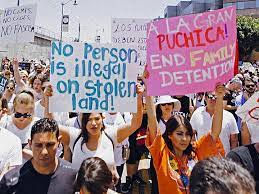
Workers everywhere intuitively recognize the double standard operative here. So, they defiantly cross borders without permission. That in large part is what we’re witnessing in immigration problems at our own borders and across the world’s map.
The other disrespect for borders on the part of the rich is more insidious. It takes the form of their own defiant transgression of international law by crossing borders to drop bombs on poor people they deem “terrorists” wherever and whenever they’re found, without formal declaration of war. (Imagine if poor countries claimed that same right vis a vis their wealthy counterparts, because they consider the wealthy’s bombing raids and drone operations themselves as “terrorism.”) Let’s face it: in the so-called “war on terror,” borders have become completely meaningless — for the rich.
Jesus & Borders
As for the attitude of Jesus towards borders? We don’t have to guess. The Bible’s main thrust centralizes the question. The basic moral injunction of the Jewish Testament is to welcome the stranger, along with caring for widows and orphans.
As a Jewish rabbi, Jesus is presented in Matthew’s gospel (Chapter 25) as doubling down on that traditional Hebrew command. I’m talking about the only description of the “last judgment” in the entire Christian Testament. There, Jesus is depicted as saying to people who sacralize borders, “Depart from me you cursed into the fire prepared for the devil and his angels . . . for I was a stranger, and you did not welcome me.”
Those are strong, strong words depicted as coming from”the Prince of Peace” and the one often remembered as “meek and mild.” At the very least, Matthew’s insistence on attributing them to the Master indicates the strength of Jesus’ teaching on the topic at hand. For him, it seems that borders were by no means sacrosanct in the face of human need.
Conclusion
The point is that we “Americans” need to re-examine our attitudes towards borders and border walls. Borders, after all, are not sacred to the rich. Never have been. So why should rich corporatists expect workers and refugees from their destructive and illegal border-crossings to respect boundaries the elite have drawn so arbitrarily and violated so cavalierly?
More and more I’ve been thinking of the United States as a “failed state.” We’re in need of that revolution Thomas Jefferson’s Declaration of Independence saw as necessary when a government fails to meet the needs of its people.
Wikipedia defines a failed state as “a political body that has disintegrated to a point where basic conditions and responsibilities of a sovereign government no longer function properly.”
To my mind, that definition fits our country exactly. Our government is absolutely gridlocked in terms of serving us. It can’t deal with minimum wage, healthcare, climate change, infrastructure, immigration, the threat of nuclear war, or voting rights.
Moreover, the U.S. president is a criminal. He routinely disobeys international law without a second thought. Think, for example, about his worldwide illegal drone assassination program. It amounts to a mechanized death squad – a gang of robot murderers. Mechanized or not, drone killers roaming the world like that completely contravene international law. That makes the president a criminal – a murderer.
But, of course, Mr. Biden not alone in such designation. As Noam Chomsky has pointed out, the same criminality has been embraced by all U.S. presidents going back at least to the end of World War II.
Do yourself a favor and listen to Chomsky’s words. He points out that since 1945, all 13 White House occupants have been indictable criminals. Each of them deserved imprisonment if not execution. As such, none of them enjoyed legitimacy.
On top of that, the Supreme Court is entirely dysfunctional too. I’m thinking in terms of rendering unbiased judgments. SCOTUS has been packed with right wing idealogues through a blatant process of hypocritical fraud. Two of them are credibly accused sexual predators. The ideology of those “justices” exactly mirrors that of the Republican Party, an organization that (again) Chomsky has nailed as “the most dangerous organization in the history of the world.”
The GOP merits that title, Chomsky says, because its climate change denial expresses a willingness “to destroy the prospects of human existence.”
By the way, with their tepid approach to climate change and their openness to nuclear war with China (shared of course with the Republicans) Democrats are not far behind their rivals. Such positions by the two major U.S. parties rob them ipso facto of any legitimacy.
That leaves ordinary citizens like you and me governed by . . . tyrants. Yes tyrants!
Remember the cry of our 18th century “founding fathers”: “Taxation without representation is tyranny.” Well, think about it: we’re all paying taxes, aren’t we? But tell the truth: do the people in Congress represent our interests?
I’d say not. Clearly not.
Think about our interests. According to polls, a clear majority of us want a minimum wage of $15; we want Medicare for all, forgiveness of college debt, free access to college for all who want it, increased environmental protection, an end to forever wars. We want affordable housing, renewal of the nation’s infrastructure, daycare, and freer access to voting. Americans want the rich to pay higher taxes.
Each of those is an important issue that affects our daily lives. But our representatives don’t care. Instead, they move in the opposite direction. They give their rich donors tax breaks, deregulation of businesses, and privatized public property and services. They unquestioningly increase the military budget at every opportunity. And they do so even though “our” nation already outspends the ten next highest spenders combined! But then when it comes times for the programs we want, there’s never enough money.
On the election front, I’m even convinced that the Democrats care less about defeating Republicans than I do! How else do you explain their impotent dysfunction before state laws whose undeniable purpose is to disenfranchise the Democratic base itself?
Laughably, the Dems defend their limp surrender on the grounds that the Senate parliamentarian won’t let them do otherwise! Meanwhile, every one of us knows that Republicans would never (have never) eschewed any tactic underhanded or overhanded that would advance the interests of their wealthy base. But Democrats can’t bring themselves to act similarly. They’re too high minded, they want us to believe, and too interested in (one-sided) bipartisanship to stoop as low as their rivals. Please!
Turns out, however, that the real Democratic base is the same as the Republicans’.
In any case, we’re left without representation.
See what I mean about “failed state?” Our government is completely illegitimate at all levels, presidential, senatorial, representational, and judicial.
Time for a revolution. As I’ve argued before, the January 6th folks might not have been that far off.
Since April 28th, the people of Colombia have virtually shut down the nation with repeated general strikes. For nearly three months, thousands have been in the streets all over the country demanding that its right- wing president, Ivan Duque, step down. They also want economic reforms, including higher wages, and increased taxes on the rich. Their demands include reduction in transportation fares and better health care.
And the response of the Colombian government? Absolute repression from its police and military including sexual assault, use of live ammunition (with 42 killed so far), deployment of tear gas, bashing in the heads of peaceful protestors, and even the criminalization of those who supply medical assistance to the wounded and food to activists in the street.
And what about the response of the U.S mainstream media (MSM), the president and “our” representatives in Congress? Given their outrage over comparatively minor protests in Cuba, surely, they’d express support for Colombians battered in the streets.
But no, there hasn’t been a peep out of them – no word of solidarity with demonstrators nor criticism of the hugely unpopular Colombian administration. No calls for regime change or U.S. intervention. Not even the beginnings of public conversation led by our intrepid MSM.
And then there’s the involvement of Colombian paramilitaries in the assassination of Haiti’s president just last week. Turns out that several of the well-financed assassins were from Colombia and had actually trained in the United States with ties to the CIA, DEA and U.S. military establishment.
Just imagine if the Haitian assassination had involved Cuba and Cubans. Imagine if the paramilitaries implicated had been trained in Russia or China?
What do you suppose would have been the response of our “leaders”?
Go even further . . . Ask yourself how the United States would have responded had a Washington Post reporter been killed and dismembered in Cuba as Jamal Khashoggi was in the Saudi Arabian embassy less than three years ago.
What if such a crime had occurred in a government office in Havana with the proven direct involvement of Cuban President Miguel Diaz Canel? Would the White House and Congress have responded as they did when Mohammed bin Salman (MBS), the Saudi Crown Prince (no democrat he), was shown to be directly responsible for Khashoggi’s butchering? Would our officials with their heart-wrenching concern for democracy and human rights in Cuba have thrown up their hands in helpless impotence as they did in the case of MBS?
We need no more than considerations like those to reveal the hypocrisy of the United States government, academic establishment and “free press.” They care not a whit about human rights, basic freedoms, democracy, or government repression – unless the alleged violations can be connected to a government that refuses to fulfill its expected role as vassal of the United States in service of its country’s rich and powerful strongly allied to their counterparts in “America.”
The exact opposite happens when any government (like Vietnam’s, Cuba’s, Venezuela’s, Nicaragua’s or China’s) shows concern for ordinary people – mothers and children, the houseless, the hungry, the sick, workers, and the elderly. Ditto when governments in question assert ownership and control over their own resources.
Such “regimes” are quickly marked for change. Regardless of their accomplishments, they’re dismissed as “socialists,” or “communists,” subversives or terrorists. So, the United States routinely interferes in their elections, finances demonstrations of the well-off (which are publicized by the media those same elite control), organizes paramilitaries as “freedom fighters,” and (if push comes to shove) invades the country to finish the job.
Until “Americans” are willing to recognize that shameful pattern, till we can look in the mirror and recognize that the United States is indeed the world’s greatest force for evil and the cause behind most of its conflicts, we’ll continue to naively buy “official stories” about the designated enemies of the rich and powerful. We’ll continue in our delusions about our country’s exceptional virtue, about U.S. consistency in supporting democracy, rights and freedoms.
In other words, we’ll continue to be patriotic. But we’ll have morphed into oppressors ourselves! Maybe we’re already there. I suspect we are.
A few days ago, I received a disturbing email blast from Lyle Roelofs, the president of Berea College (where I taught for 40 years). It was about recent “Events in Cuba.” The notice was upsetting because it reflected the one-sided narrative of the U.S. government and its subservient mass media.
This is not to vilify Berea’s president who is sincere and well-intentioned. It is however to demonstrate the effectiveness of U.S. anti-Cuban propaganda that would have even academicians think that “our” government has a leg to stand on in its denunciation of anti-democratic measures anywhere, of intolerance of any dissent, or of police attacks on peaceful protestors.
See for yourself. In his characteristic spirit of compassion, the president had written:
Dear Bereans
Many of you are aware of the ongoing unrest in Cuba as the country struggles with severe blackouts, a food shortage, high prices, lack of access to COVID-19 vaccinations as outbreaks increase, and an unstable economy. Residents of the island nation have taken to the streets to protest, filming conditions to share with the world. In response, the repressive government shut down the internet.
While we all care about the people of Cuba as our fellow human beings, a number of members of our immediate community have family ties there, as well, so our concern extends particularly to them in this worrisome time.
President Biden addressed the situation on Monday urging Cuban leaders to hear the people and address their needs rather than enriching themselves or trying to repress their human rights.
At Berea College, where one of our eight Great Commitments calls for us to create a democratic society, we align ourselves with the people of Cuba and echo the President’s sentiments. In a democratic society, organizations and the government can cooperate to address the sorts of critical problems currently being faced by Cubans, but which are found to a lesser extent elsewhere as well. For example, at Berea College our Grow Appalachia program combats food insecurity in Appalachia working to ensure community members have enough to eat and teaching them how to grow their own food.
Globally, the U.S. and Cuba are among the countries that signed the United Nations Declaration of Human Rights, a list of 30 rights that every human being is entitled to. The right to free speech and health are most relevant to the current events in Cuba. It is our hope that tensions will ease soon, the leadership there will work to provide food, access to vaccines, and make improvements to stabilize the country’s economy, and that this crisis will be an opportunity for improved relations with other countries, including our own, allowing urgently needed assistance to flow to the people of Cuba.
In solidarity with Cubans and Cuban-Americans,
Lyle Roelofs
What follows is my response in hopes that it might help Dr. Roelofs and the rest of us to be more cautious in accepting party lines about “official enemies” such as Cuba, Venezuela, Nicaragua, China, Russia. . .
Dear Lyle,
It was with rather eager anticipation that I opened your recently emailed note entitled “Events in Cuba.” Because of Berea’s commitment black, brown and impoverished communities, I thought your notice would express solidarity with virtually the entire world in its yearly demand that the United States lift the Cuban embargo (Cubans call it a “blockade”) especially in view of the COVID-19 pandemic.
Instead, I found your comments quite incomplete and misleading. Together they gave the erroneous impression that:
All Cubans (“residents of the island nation”) endorse the anti-government street demonstrations
That Cuban leadership is ignoring the COVID-19 pandemic
That the same leadership is resisting improved relations with other countries including the United States
That Cuba should combat the island’s food insecurity by teaching people “how to grow their own food”
That Cuba is out-of-step with the United Nations and its “Declaration of Human Rights” by specifically depriving its people of health care
That President Biden has satisfactorily “addressed the situation on Monday urging Cuban leaders to hear the people and address their needs rather than enriching themselves or trying to repress their human rights.”
Such commentary appears to simply repeat the U.S. official story about Cuba without even once mentioning:
Its development (unique in the former colonies) of several WHO-approved COVID-19 vaccines
The U.S. policy of blockading sale of syringes to Cuba thereby preventing the country from administering its own COVID-19 remedies
Cuba’s long-standing attempts to feed its own people by extensive, government sanctioned urban gardening projects and by environmental policies that make it arguably the greenest country in the hemisphere
The fact that similar demonstrations are happening all over the world including U.S. allies such as Brazil, South Africa, Haiti, Lebanon, Colombia, India, Ethiopia, Israel, Iraq, and Afghanistan (not to mention Black Lives Matter in the U.S. and the January 6th assault on the Capitol) — without comment on your part or emphasis in the mainstream media at large
The allied fact that “a number of members of our immediate community have family ties” in the countries just mentioned.
I am making these observations as a longtime friend of Cuba and (of course) Berea College. I have visited the island many times, never as a tourist, but always as an educator and researcher. In fact, the last course I taught at Berea (Summer 2014) had my wife Peggy and me leading another study tour of Cuba.
I have published many articles on Cuba including here and here about the country’s vaccine research and development. My daughter was treated for appendicitis while visiting Cuba two years ago. After spending five days in the hospital there, she was released virtually free of charge.
With Jose Gomariz (a Cubanist scholar, Jose Marti specialist, and former Berea College professor of Spanish) I once taught a Berea Short Term course at Havana’s Instituto de Historia de Cuba. The course was entitled “The African Diaspora in Cuba.” When I visited Cuba with the Greater Cincinnati Council of World Affairs, I was befriended by a family outspokenly and fearlessly critical of the Castro government. And in my many stints with the Latin American Studies Program of the Council for Christian Colleges and Universities, we took students to Cuba each semester to meet government officials, opposition forces, and diplomats at the U.S. Interests Section in Havana. In all, I’ve been there around a dozen times.
During the Fidel Castro years, I vividly recall a U.S. Interests Section spokeswoman revealingly lamenting the fact that Cuba (as she put it) did not hold presidential elections (thereby demonstrating her misunderstanding of Cuba’s electoral system). “As everybody knows,” she admitted, “he’d win hands down.”
What I’m suggesting is that there is much more to the Cuban story than we’re led to believe by United States propaganda against that beleaguered country.
By simply rehearsing the U.S. official story, Lyle, I suggest that (uncharacteristically) you are not helping the Berea community understand Cuba, its history, and the role of the U.S. in creating misery there, or what our government could do this very day to relieve it – namely lift the embargo and allow the import of syringes into the country.
It seems the U.S. Conference of Catholic Bishops (USCCB) can’t stop embarrassing itself.
No, I’m not referring this time to its incompetent mishandling and scandalous coverups of priest pedophiles. (By rights, those disgraces should themselves deprive the Conference of ALL claims to speak authoritatively on ANY matter having to do with sex.)
instead, I’m talking about the latest manifestation of the USCCB’s obsession with abortion.
As if we needed a reminder, its fixation with the matter came under harsh spotlight on June 18th when an overwhelming majority of the Bishops’ Conference decided to proceed with drafting a document whose bottom line would have them refusing communion to Joe Biden (and by extension to other pro-choice Catholic politicians).
The whole affair made evident first of all that the bishops are pronouncing on an issue far beyond their ken. Secondly, their action flies in the face of position adopted by Pope Francis himself. Thirdly, it aligns the bishops with the most extreme faction of the Republican Party. And finally, it is quite unbiblical and contradicts the teachings of Jesus and his expression of the Judeo-Christian prophetic tradition.
For thinking Catholics, all four points should be quite embarrassing. For others, it’s just one more reason to write off the Church as completely irrelevant.
Unsubstantiated Obsession with Abortion
The evident purpose of the Conference’s strategy is to advance repeal of Roe v Wade as if it were morally self-evident that (as they say) “abortion is murder.”
Of course, no such self-evidence exists. This is because the question of abortion’s morality turns on the issue of when specifically personal human life begins. And NO ONE knows for sure the answer to that question. Even the seminal Catholic theologian Thomas Aquinas (1225-1274) thought that personal life (“ensoulment”) for males began 40 days after conception and for females 80 days after conception. The church operated on that assumption for centuries.
Moreover, other religions variously identify the beginnings of personal life with the moment of quickening (usually 17-20 weeks after conception), with viability outside the womb, with actual emergence from the womb, or even (as with some Native Americans) with the “painting” of the child to distinguish it from the animals.
In view of such variation, to impose a single religion’s answer to the crucial question about the beginning of personal life disrespects those of other faiths and of no faith at all. It is therefore to violate the Constitution’s First Amendment which states that “Congress shall make no law respecting an establishment of religion or prohibiting the free exercise thereof. . .”
(And, by the way, the USCCB’s extreme position that specifically personal life begins when sperm fertilizes egg contradicts the “practice” of Nature itself. It ignores the fact that literally countless such fertilizations end in spontaneous abortions – suggesting that Nature itself (God?) is unconcerned with the issue.)
A Rejection of Pope Francis
The Catholic Bishops’ ham-handed power play also flies in the face of gentle advice from Pope Francis. Instead of confrontation and effective excommunication, the Pope urged “extensive and serene dialogue.”
The Conference position also contrasted sharply with Francis’ allies like Chicago’s Cardinal Blase Cupich and San Diego Bishop Robert McElroy. Both urged adoption of the pope’s approach, which McElroy described as speaking to Mr. Biden “in his humanity” and as “a man of Catholic faith striving to serve his nation and his God.” McElroy recommended encouragement of “our new President: by entering into a relationship of dialogue, not judgment; collaboration, not isolation; truth in charity, not harshness.”
However, USCCB disagreement with Francis goes much further. It is not simply an internecine squabble about arcane Catholic issues. Identifying abortion as “the preeminent priority” of the bishops’ conference highlights disagreement at the highest level of the Catholic Church about the essence of the faith. For Francis, the Church’s preeminent priority is social justice and a radical concern for “the lives of the poor, those already born, the destitute, the abandoned and the underprivileged.” His pro-life commitments extend far beyond abortion to climate justice, elimination of capital punishment, renunciation of war, and welcoming of immigrants.
Of course, all such concerns are rejected by Republican extremists with whom the USCCB ends up aligning itself.
Alignment with Extremists
Such alignment was noted recently by Washington Post opinion columnist E.J. Dionne Jr. Dionne pointed to a relevant Pew Research survey of last spring. It showed that even 44% of Republican Catholics agree with the 67% of American Catholics in general that Biden should be allowed to receive communion.
This means that in adopting their position on weaponizing communion, the U.S. bishops are identifying themselves with the most conservative elements of the Republican Party which, of course, has also made abortion a key culture wars issue.
This alignment means supporting election of Republicans whose climate change denial ends up favoring omnicide while claiming to prioritize unborn human life.
Moreover, Dionne correctly observes that the bishops’ position is an outlier in the Catholic world itself. Almost nowhere else is the abortion issue given the preeminence claimed by the USCCB. Its position would be unthinkable in most of Europe and Latin America.
UnbiblicalObsession with Abortion
Even though women have always practiced abortion, the Bible shows no concern for the issue; it is mentioned nowhere in its pages. Therefore, to make it the church’s “preeminent priority” over those articulated by the pope is questionable at the very least.
Moreover, seeking to remedy the practice of abortion by imposition of law flies in the face of the habitual antinomian postures of both Jesus and St. Paul. Neither was friendly towards legal statutes and their enforcers. Jesus routinely disobeyed Judaism’s most sacred (Sabbath) law. He famously asserted his indisputably humanist position that “The sabbath was made for human beings; human beings were not made for the sabbath” (Mark 2: 27).
For his part, Paul was so liberal in his interpretation of Jewish Testament law that he set it aside entirely – including dietary restrictions and even circumcision. It was futile, he said, to seek salvation in law – even in God’s law (e.g., Romans 7: 13-24).
By adopting such positions, both Jesus and Paul seemed to recognize that complicated issues of personal morality cannot be effectively imposed by law, force, or sanctions. Thus, the two most prominent foci of Christian Testament texts implicitly acknowledged the truism that human laws generally favor those who made them, viz., the wealthy and powerful – usually elderly males (and in our case, specifically white old men). Meanwhile, they militate against the interests of those without power or wealth and (in the case of abortion) seem to represent one more way of controlling women.
This is especially vexing for women, since the planet’s female citizens have had virtually no determining input regarding the content of laws that govern their reproductive processes.
The bottom line here is that law has no salvific power for friends of women or followers of Jesus.
Conclusion
Does any of this mean that church leaders should abandon the abortion issue? Not really.
It does however mean that leadership should recognize the fact that Roe v. Wade represents a reasonable resolution of the abortion question in a pluralistic society. It is an imperfect but even-handed compromise in a culture divided on fundamental questions concerning the beginnings of personal human life. It is reasonable that during the first trimester of pregnancy, the pregnant woman may herself decide about the termination of her pregnancy without legal consultation; that during the second trimester the state may regulate abortion to protect the health of its pregnant citizens, and that during the final three months of pregnancy, the state (in recognition of its obligation to protect the unborn) can accordingly forbid or otherwise condition pregnancy termination.
Meanwhile, the bishops and others seeking to lessen the number of abortions should use their influence to foster a welcoming atmosphere for all children. This would entail supporting measures that (among others) provide otherwise reluctant parents with:
The good example of Catholic practice
Preemptive sex education
Extensive prenatal care
Postpartum parental leave
Affordable childcare
Adequately paid jobs
Dignified housing
Safe abortion facilities
Only by adopting such pro-life positions can the USCCB hope to overcome the embarrassment that its patriarchal, legalistic and unbiblical alignment with the Republican Party has brought upon it and upon all Roman Catholics.






 About Things That Matter