I lead a charmed life. My life has been governed by what some New Age spiritual teachers call “The Law of Attraction.” Simply put, the Law states that like attracts like. It holds that what consumes one’s thoughts eventually manifests in one’s life.
So, what has consumed my thoughts and attention?
As a theologian, teacher, and world-traveler, they have been focused on understanding the world (and especially spirituality) from the underside – not from the usual viewpoint of the rich and powerful, but as experienced by the world’s colonized, but the poor and oppressed.
And what has that attracted to me?
Almost unbidden, it has brought me extraordinary experiences throughout the former colonial world and Global South. It has attracted extended sojourns in Brazil, Costa Rica, Nicaragua, Guatemala, Honduras, Cuba, Mexico, Zimbabwe, South Africa, India, Sri Lanka, and Israel-Palestine. Early on, during my graduate studies and their 5 years in Rome, I also found myself journeying throughout all the home countries of European colonizers in Italy, Great Britain, France, Spain, Austria, the Netherlands, and Germany.
At every stop, I’ve had the privilege of working with and engaging in conversation scholars and activists much more informed than me about the ins and outs of colonialism.
All of that has helped me understand colonialism for what it is – a system of robbery. In the form that has shaped the world, it has had white Europeans and their descendants (a very small fraction of the world’s population) roaming the planet and subduing its entirety for purposes of transferring its wealth and resources to the so-called “Mother Countries.” As a result of colonialism, white Europeans and their descendants has prospered; those they’ve colonized have largely been impoverished.
My current stop in this rather automatic Odyssey has brought me to Granada in Spain a country that happens to be governed by a socialist coalition. Coming from a right-wing country like the United States, that’s noteworthy. Whereas, of course, there is not even a Labor Party in the U.S., Spain happens to be run by a left-wing coalition between the Socialist Workers Party (PSOE) and an even further left anti-austerity party called PODEMOS (“Yes, We Can”).
For decades in this country, such development would have been undreamt of. This because Spain’s left-wing political shift follows hard upon a long period of extreme right-wing rule by the infamous Francisco Franco, who governed the country with an iron fist from 1936 to 1975.
Franco was a Fascist who allied himself with Hitler and Mussolini during World War II.
After the war, his anti-communism secured unwavering support for his regime from the United States which is always more friendly towards fascism than socialism.
To establish and maintain his power wielded on behalf of landowners, industrialists, and the Catholic Church, Franco slaughtered more than 200,000 Spanish workers, trade unionists, teachers, intellectuals, and others who sided with the country’s poor and disenfranchised.
Over the next few months, I want to find out more about that. I also want to get a better idea of what’s really happening here in Europe generally. To that end, I’ll be talking to as many people as I can about these matters.
In the short term, I anticipate that my principal dialog partner will be a language teacher I’ll be employing to help me recover my fluency in Spanish. I’ll keep you posted here.
The Queen Mary 2 by which Peggy and I made our way from NYC to South Hampton before traveling by plane to Madrid and then to Granada in Spain. Our stateroom was on the 11th deck, 2nd room aft.
If anyone’s paying attention, I must offer an apology for such a long gap between postings here. The fact is that for the past 10 days, I’ve been absolutely unable to post anything. The reason? Peggy and I have been in transit from the U.S. to Spain (Grenada), where we’ll be living for at least the next 2 or 3 months. There has also been a serious issue with COVID.
We’ve come to Spain at the invitation of our daughter and son-in-law who are here on a year-long sabbatical. We’re so grateful, since this gives us all that time to be with 5 of our 7 grandchildren.
Getting here was an adventure. For one thing, it involved a 7-night cruise on the Queen Mary 2 (QM2 pictured above). I never imagined my making such a voyage. I guess my face is still red from doing something so luxurious. (How do I square that, for instance, with my professed commitment to liberation theology? Oh well, as Walt Whitman said, “Do I contradict myself? Very well, then, I contradict myself.” Sigh.)
I must admit though that the cruise was wonderful for all the reasons you might suspect: non-stop sumptuous meals, people waiting on us hand and foot, top-class floor shows, dancing, music performances of various kinds in the ship’s many pubs, bars, and parlors, and long hours of silent contemplation of divine presence nowhere as clearly evidenced, I think, as in the ocean. (Someone has said, “The ocean doesn’t simply remind us of God. The ocean is God.” In some mysterious way, I think that’s true. We’ve all come from the water. About 60% of our bodies is water, even now.)
And while I can’t claim that all of that wasn’t fun, it also made me think guiltily about white privilege, colonialism, wealth disparities and the fast-approaching end of my own life.
Yes, almost all of the Queen Mary’s passengers were white. And almost all of the waitpersons were not. Most of the latter turned out to be from the Philippines. And their attitude reflected what colonists have always expected from “the white man’s burden”: “We exist to serve you. How can I make you more comfortable, sir? Can I get you anything else?”
Never, I’m sure, did it cross most of our minds that these “servants” had their own ambitions, romances, families, worries, contradictions, rich stories — and hidden resentments about “the master.”
Oblivious to all that, most of us passengers had the means necessary to have such a luxurious experience. Most of us were wealthy and old. At one point, it occurred to me that the QM2 resembled a floating nursing home with many of the voyagers using canes, walkers, and wheelchairs. The fact is that in 10-years time, few from among us will still be alive. So much for wealth, privilege, and colonialism. Then (as now) all that will matter is what that vast ocean embodies.
I got a sharp reminder of such mortal realities just after disembarking from the QM2 last Sunday. I came down with a devastating case of COVID 19.
I know; I know: what did I expect getting on a ship like that? As one of my friends asked long before our departure: “Do you know what your and Peggy’s favorite game must be? It’s probably Russian Roulette. That’s what you’re doing spending 7 nights on a ship during COVID! You’re toying with your lives!”
Well, my friend turned out to be right. And after a very long day of travel on Sunday, the malady kicked in big time. I literally thought I was going to die.
Thanks be to God, I didn’t of course. But before closing my eyes Sunday night, I did mumble to Peggy, “If I don’t make it through the night, honey, know that I love you and it’s been a good run.”
I even thought, “This would be an easy way to slip out, wouldn’t it? — except there’ll be all the difficulty involved in shipping my body back to the States. Too bad.”
My internal monologue continued, “But there’s still so much left for me to do.”
“And what would that be?” I asked myself.
“Nothing,” came my quick and honest reply. Nothing. And that was it. I felt surprisingly ready to go. I felt so tired.
Three days later, I’m still feeling exhausted. But here I am writing. So, I guess I’m out of the woods.
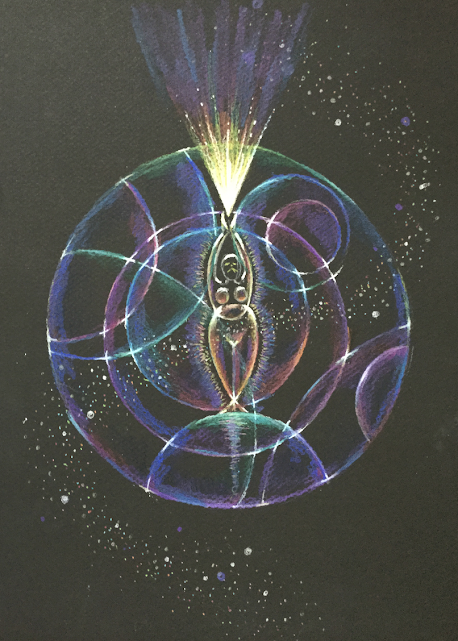
“Mother of the World” by my colleague, Meryl Ann Butler, Managing Editor of OpEdNews
I’m taking a chance here. At 82 years of age, I’m going to risk embarrassing myself by reconsidering the message and significance of what some consider to be “pornography,” i.e., the images of ordinary mature women found on the internet.
I’m going to propose that like their prehistoric, sculptured counterparts found throughout the ancient world, the images in question can lead us to more fully understand life and its purposes. Moreover, they can help liberate men especially from the toxic patriarchy that is responsible for our wars and the environmental omnicide produced by our economic systems.
I write as a man more deeply embedded in patriarchy than most. I was once a Roman Catholic priest who entered the seminary to embrace a life of celibacy at the age of 14. As such, I became profoundly integrated into perhaps the world’s most patriarchal system characterized by a largely unconscious misogyny and fear of women.
It was an exaggerated embodiment of the metasystem that afflicts the world in general. Like that overarching social arrangement, it told me that viewing the unclothed female form was somehow dangerous and sinful. Post-priesthood married life and reading feminist scholars has shown me it is not.
Here I’m not talking about Playboy or Penthouse, much less about degrading portrayals of young women and girls forced into the pornography trade, perhaps for the profit of others and/or for their own career advancement.
Still less am I referring to snuff films or misogynist portrayals of women in bondage, degrading situations or pain. All of those represent hideous abuses and exploitation of women for purposes of pleasing leering men devoid of appreciation or affection for women outside the pleasure the latter’s objectifications afford.
No, what I’m presenting as culturally and even theologically liberating are the willing displays of the female form by mothers and grandmothers of mature ages from middle age through the 90s. (Perhaps surprisingly to some, these can be accessed by the hundreds on the world-wide web.)
I’m going to suggest that these depictions may be seen as representing modern day equivalents of the oldest goddess images found virtually everywhere in the world’s most ancient archeological digs. Those representations with their prominent breasts, vulvas, and ochre paint (along with occasional inscriptions and accompanying mythology) call attention to what since prehistoric times have been recognized as mostly wordless texts revealing humankind’s fundamental relationship to the feminine aspect of the Divine.
Venus of Willendorf, Austria (Tinted in red ochre, ca. 30,000 BCE)
What I present here is inspired by the work of Monica Sjöö and Barbara Mor and their classic 1987 work, The Great Cosmic Mother: rediscovering the religion of the earth. Granted, the two authors often rail against pornography in the negative senses noted above (196, 328, 411, 383, 391-92). However, their treatment of the deep meanings revealed in specifically female processes associated with their unique physical characteristics suggest what I’m about to share.
The Central Significanceof the Clitoris
Undoubtedly, the most unique of the characteristics in question is the clitoris. As such, it is a fitting starting point for any reverent search for divine revelations contained in the wondrous feminine form. Beginning with the clitoris also obviates criticisms by some who might find here no more than transparent rationalization of the sexual pleasure that willingly unclothed female bodies inevitably provide.
Such suspicions, Sjöö and Mor suggest, reflect the traditional vilification of sexual pleasure fostered by the patriarchy which sees erotic sensations and the women who elicit them as dangerous threats to the “surplus repression” necessitated by the reigning economic system’s need to control an otherwise delightfully distracted workforce (as indicated by Marcuse in Eros and Civilization).
So, traditionally patriarchal repression has found it necessary to reject as unnatural any sexual pleasure outside the marriage context. Moreover, even within marital relations, sexual pleasure not open to conception of new life has been deemed sinful. Judgments like those require women to hide from all but their husbands their defining physical characteristics from their hair to their entire bodies in some extreme cases.
All of that is contradicted by the clitoris. As Sjöö and Mor emphasize, the clitoris is the only organ in the human anatomy whose exclusive function is the provision of sexual pleasure (4-5). This strongly suggests that sexual pleasure is built into the foundations of life itself.
Sjöö and Mor explain: “. . . there is profound psychological and institutional reluctance to face the repercussions of the fact that the female clitoris is the only organ in the human body whose purpose is exclusively that of erotic stimulation and release. What does this mean? It means that for the human female, alone among all earth’s life-forms, sexuality and reproduction are not inseparable” (4-5).
Yes, the clitoris reveals that sexual pleasure is not only natural and part of the cosmic order; it is to be welcomed and treasured. Despite what we’ve been taught by mainline churches and Puritan culture, sexual pleasure is a fundamental human right. It need not relate to reproduction of the species. This means, for example, that contraception makes perfect sense.
Other Female Revelations
Now consider further the rich text of the sacred female form as revealed in ancient statuary – and in what might be seen as their contemporary counterparts. Both media convey central disclosures by the Great Cosmic Mother about aspects of human life that patriarchy tragically ignores.
· Abundant Hair: For the ancients, hair was a symbol of cosmic power and clairvoyance (183). Famously in Greek mythology, Medusa‘s locks took the form of snakes, the ancient world’s symbol of surpassing female wisdom and divinity (57-62). Female tresses, much fuller than men’s, remind us of women’s correspondingly deeper wisdom and insights.
· Soft Flesh: The softer physical character of women’s bodies, usually less obviously muscular than those of men, directs attention away from externals to the true source of human strength – away from bulging muscles to something interior and unseen, which is perceived in all spiritual traditions as more sacred than externals. Put otherwise, while the tendency of patriarchal religion is to separate spirit and matter, matricentric worship of the Cosmic Mother does not (172). Feminine softness reveals women’s surpassing inner strength.
· Breasts: In virtually all cultures, female breasts have been a symbol of beauty, motherhood, and vitality. They were somehow considered the source of female identity. An inscription on an ancient goddess statue of dynastic Egypt even proclaims, “I have breasts, therefore I am” (161). As for displaying them, Sjöö and Mor observe, “In Crete, the uncovering of the breasts was a sacred gesture, symbolizing the nourishing lifestream of the mother” (213).
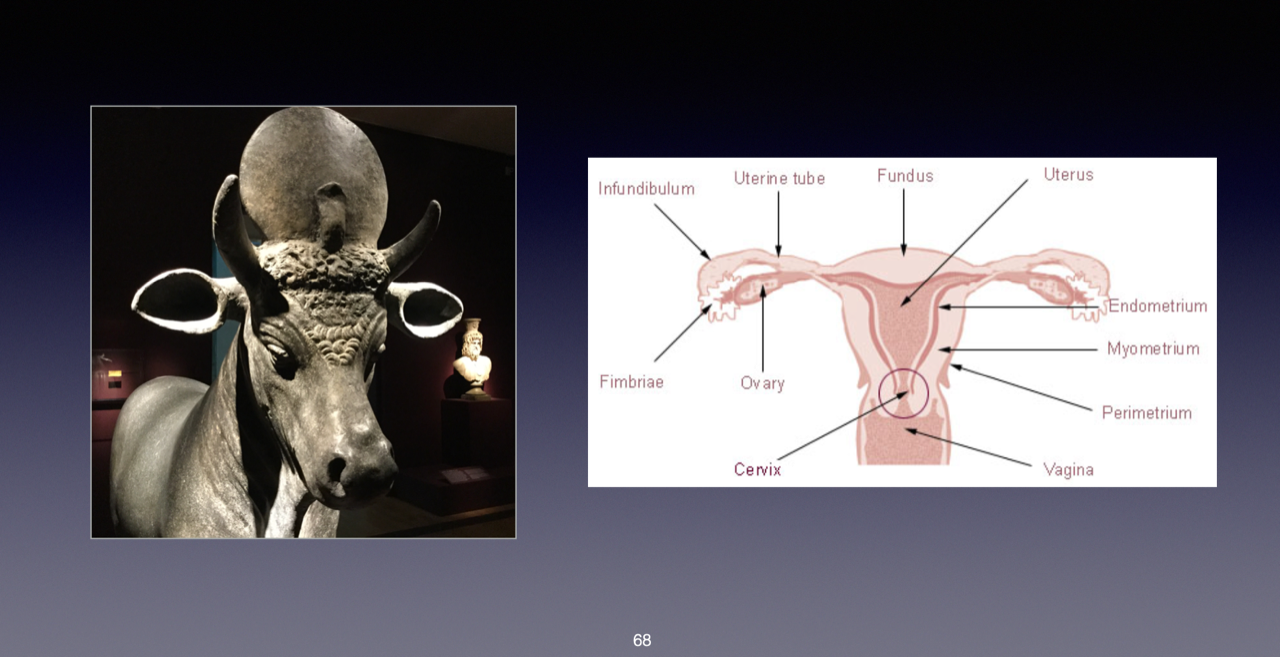
· Milk and Food: Astoundingly, female bodies are sources of food for the most vulnerable of the species. Sources of food! Milk, sacred cows, and bovine horns were always associated with women whose sharing of food symbolized the primordial act that makes all of us human (408). (The image below shows why.) It is no wonder then that for millennia women were regarded as incarnating the nourishment provided by Mother Earth herself.
Vulva: This female organ is especially hallowed because of its connection with first experiences of all five senses. As everyone’s gateway to the external world, it represents our first tactile experiences, the drawing of first breath, the initial experience of fragrance, and the birthed organism’s first taste (of blood). The vulva is also intimately associated with primal experiences of one’s own voice and that of one’s godlike mother. Additionally, the vulva’s appearance reminds every one of the paradisal pre-birth state of unity with Source where all needs were satisfied without effort or pain. No wonder the vulva’s attraction!
· Menses: In all ancient goddess cultures women’s monthly periods were honored as sacrosanct. They were times of withdrawal in the company of other women to menstrual huts where, relieved of their duties and the demands of husbands and children, women could meditate, pray together, sing, dance, and simply converse (186). More specifically, such periods provided time to celebrate the great mystery that women’s blood is liquid flesh (189). It is the very substance from which all human bodies are made. This makes women co-creators with the Great Cosmic Mother in ways that men can never be. Nothing in human creation could be more basic, holy, feminine, or divine than female menses.
· Connection with Lunar Cycles: Menstruation connects women with Mother Nature and her most basic processes in conscious and unconscious ways that are simply closed to men (189). Like the ocean and its tides, women’s bodies are governed by the moon and its phases. This means that women possess innate mostly intuitive wisdom inaccessible to men (183). For those paying attention, such knowledge of natural processes makes women especially sensitive to violations of the Divine Mother, because those transgressions deeply affect all women and mothers. When the Cosmic Mother is raped and despoiled, when the ocean is polluted, all women suffer the same fates whether or not they can articulately identify the transgressions involved. This suggests that women’s voices about environmental destruction should be given priority over men’s.
· Womb and Ovaries: These miraculous unseen organs speak volumes in special need of reading in an American culture that refuses to acknowledge what the female body expresses so clearly about questions of abortion. Wombs and ovaries tell us that life does not begin when sperm fertilizes egg. Instead, it is part of a 3.7-billion-year process that erupts continuously and prolifically in countless and infinite forms (including human varieties) most of which never reach full development recognizable as flowers, plants, specific animals, or human beings. The fact that worldwide billions of eggs go down the drain unfertilized each month, and that up to 50% of fertilized ova end up in miscarriages during the first 20 weeks of pregnancy reveals that creations of the Great Cosmic Mother are far more generous, abundant, plentiful, profligate and lavish than non-females can imagine. Women intuitively attuned to these facts, recognize the significance of this tremendous profligacy in ways inconceivable to men who can never experience ovulation, menstruation, conception, miscarriage – or abortion. It exposes the absurdity of the patriarchal approach to the beginning of personal life that, if taken seriously, turns the God of patriarchy into the abortionist par excellence!
Conclusion
The prehistoric images of the unclothed Great Cosmic Mother surely represent humanity’s first volumes of theology “written” for our preliterate ancestors. Wordlessly, the statues proclaim: “In this image you’ll find all you need to know about the divine. She is beautiful, wise (her hair), strong with inner strength beyond belief (soft flesh), the liquid source of our very bodies (menses), the producer of our first meals (her breasts), our way into the world and back to paradise (her vulva), the one who shows how to live harmoniously with nature (connection to the lunar cycles), and a cosmic co-creator.
Beyond that, men’s quasi-magic reaction to the very sight of the unclothed goddesses and the sexual interaction that sometimes follows provides evidence of the Cosmic Mother’s idea of human fulfillment and purpose – not consumption and accumulation, but ecstatic pleasure and joy simply from what the earth and human relationships provide.”
What could be more beautiful, simple — and salvific in a world obsessed with materialism and consumerism that is driving the species to omnicide? We need to return to the Great Cosmic Mother.
But what about the images of mature cyberspace women? Aren’t they pornographic?
It depends on how they’re viewed. If seen appreciatively as the acts of proud subjects rather than as demeaned objects, they can edify as representing sexually independent mothers and grandmothers acting for themselves and not primarily for men, profit, or in the service of cultural misogyny, and sexism. They communicate the same message as the statues found in Çatal Huyuk (in Turkey), in ancient Egypt and throughout the African continent.
They can be seen as proudly “bodying forth” the overlooked teachings of the Great Cosmic Mother viz., that:
“Pornography” is a construct of the twisted perspectives of toxic patriarchy. It does not even occur in more sane societal configurations.
Ordinary women owning and claiming their sexual power and independence are indeed goddesses, beautiful and inspiring.
Sexual pleasure is good. It is one of Life’s greatest gifts. It is everyone’s right to enjoy it in all its forms – including that provided and elicited by mature women subjects.
As incorporating spirit and flesh, the guidance of female wisdom is more grounded in Life and Nature than men’s. Female wisdom represents the leading edge of human consciousness.
Since the Great Cosmic Mother’s nourishment embodied in life’s original food producer (i.e., our mother) feeds us without charge or need to earn that gift, human economies would be more harmonious with the cosmic Design if they were similarly gift-based.
Nature’s cycles are mirrored in our sisters who remind us each month of the unity shared by all with the moon, ocean, tides, and seasons.
Life is so abundant, prolific, and lavish, that all of us (and women especially) are truly co-creators with our Great Source. Like the Cosmic Mother herself, women can choose which fertilized eggs to bring to term and which to terminate.
None of us (especially men) is ultimately in charge of Life’s super-generous processes which thankfully are beyond everyone’s understanding and control but are more fully understood by women.
Women deserve special honor as the gateway to life that points us back home to paradise lost.
Our world would be a better place if women as embodiments of the Great Cosmic Mother were in charge.
With all this in mind, it is possible to approach proudly unrobed mothers and grandmothers in the following spirit of appreciation and gratitude quite foreign to the unconscious misogyny which indoctrinated me so many years ago. I express that liberation in the verses I offer here with the hope that others might share the freedom they attempt to express:
Divine Images Lost and Found
Goddesses all
They are
Unfailing springs of rapt delight
Virgins, Mothers, wizened Crones
With tresses
Surpassing even
Samson’s might,
Sweet gentle eyes
Playful, smoldering, and mischievous,
Sensuous lips
Smiling wordlessly
While wondrously expressing
Our Mother’s cosmic purpose
Through soft flesh
Fulsome breasts,
And the Great Divide
Enticing
Between extended thighs
Calling
Vagrant children’s return
To origins lost
While inviting contemplation
Of her
And our (!)
Unfathomable mysteries within.
(Special thanks to Meryl Ann Butler, OpEdNews managing editor, for her marvelous editorial guidance in helping me formulate these thoughts whose shortcomings, of course, are mine, not hers.)
Thank God for the recent SCOTUS decision to effectively repeal Roe.
I say that not because I think the decision was correct. It wasn’t. I say it because Dobbs vs. Jackson has pinpointed the fundamental source of national polarization not only on the issue of abortion, but on climate change and war as well.
And that source was not correctly identified by Bill Clinton’s phrase (borrowed from James Carville) “it’s the economy, stupid.” Rather, the source of national polarization is not economics, politics, or constitutional law. It’s theology. Yes, theology! And until what passes for the “left” in this country takes that bull by the horns, it is doomed to impotence in the face of the religiously driven right-wing juggernaut that triumphed with Dobbs.
What that decision made clear is that the victorious “pro-life” position is based fundamentally on theological grounds that can only be described as patriarchal. Its foundations are abstract, divorced from life, and ignorant of the experience of those centrally involved in the question, viz., women.
Meanwhile, left-wing “pro-choicers” seem too “sophisticated” to respond in kind within an American context where people are basically religious and have been tricked into accepting mansplained theological reasoning about abortion. I mean, the left has proven strangely reluctant to engage its opponents on that powerful contested spiritual terrain.
What I’m arguing here is that the means for doing so is readily available in a highly developed feminist theology that is much more persuasive, older, comprehensive, and venerable than its more recently developed patriarchal counterpart. It’s the theology of the earth consistently embraced by our ancient ancestors and by indigenous people across the planet. (The latter btw, are not reluctant to address issues in theological terms.)
The theology in question has perhaps been best described by Monica Sjöö’s and Barbara Mor‘s splendid 500-page volume, The Great Cosmic Mother. It’s the religion of the earth explained there that can save the day for humanity and our planet.
To show what I mean, let me begin by sharing The Great Cosmic Mother’s contrast between matricentric and patriarchal religions in general. Secondly, I’ll compare matricentric insights about abortion with their patriarchal counterparts. Thirdly, I’ll show how those insights are essentially theological. My conclusion will suggest profound changes in the ways we speak about or ignore the spiritual dimensions of our lives.
The Religion of the Earth
By “The Religion of the Earth” Sjöö, Mor, and other feminist historians refer to the first religions of the human species which for 30,000 years centered on Goddess worship.
That’s right. Widespread archeological discoveries of detailed goddess statues indicate conclusively that the supreme gods who reigned for most of human history’s concern with religion have been female. Under such dispensation, wise women functioned as community leaders, priestesses, counsellors, midwives, and healers. For millennia, they were humankind’s principal decision-makers.
Accordingly, worship for those 30,000 years celebrated “Mother Earth” with her abundant life-giving powers, as well as natural processes influenced by the moon, ocean tides, and seasonal changes.
Such emphasis also centralized life mysteries unique to women and completely foreign to male experience – the menstrual cycle, conception, gestation, birthing, nursing, contraception, and abortion. Obviously, men have only second-hand knowledge of such processes that largely shape female experience so central to propagation of the species.
So, Goddess religions emphasized female autonomy, male discipleship, the unity of all creation and the knowledge and insight available through the uniquely feminine avenues just listed. Wisdom came to women as well through peer interaction, prayer, contemplation, meditation, ecstatic dance, music, chants, spells, rituals, and female intuition.
Patriarchal Religion
Then about 12,000 years ago (coincident with the development of agriculture) worship of the Great Cosmic Mother was gradually replaced by patriarchal religion. Particularly in the west, the reigning Father God came to replace Mother Earth and women’s “religion of the earth.” Patriarchal religion centered on law, animal and human sacrifice, logic, competition, war, and commercial exchange.
In its Judeo-Christian incarnation, the single Deity (Yahweh) was emphatically male. He replaced Mother Earth with her loving maternal instincts and mysterious natural cycles characterized by predictability, lavish abundance, prodigality, plenty, generosity, sharing, mercy, and forgiveness. Her place was taken by a patriarchal lawgiver and judge who condemned, punished, blamed, and tortured.
Even beyond that, women and their cosmic faith came to be vilified by the new religion as irrational, and as superstitious. Women spiritual leaders — those wise community leaders, priestesses, counsellors, midwives, and healers – fell from grace and were viciously persecuted by vindictive priests as witches and agents of evil spirits.
The religion of the earth with those wise priestesses was forced to go underground. But the patriarchal Inquisition and its Puritan counterparts hunted them down relentlessly – eventually killing as many as 9 million accused witches over a period of 300 years (1450-1750). Obviously, this “women’s holocaust” represented the most extreme attempts to control women and their bodies and to deny their traditional roles as expressions of the divine.
Under this new dispensation, celibate male priests within the Catholic Church (presumably without any experience of women’s sexuality) assumed the role of dictating a predominantly sex-based morality. In this context, the celibate clergy saw women as temptresses. Female bodies and wiles sinfully incited otherwise holy men reluctantly suppressing their own sexual urges and those of others both male and female.
In line with such blatant sexism, priests outlawed extra marital sexual pleasure. They declared that the only valid reason for sexual intercourse was the begetting of children. Consequently, women’s attempts to control their bodies, destinies, and family sizes through their traditional practices of contraception and abortion were classified as evil and warranting eternal punishment with everlasting torture. In particular, the traditional abortion practices of women’s earth religion came to be seen as criminal and even homicidal.
Goddess Religion & Abortion
And what were those practices? How were they justified? Though by no means the focus of their book, here is what Sjöö and Mor have to say about abortion:
Matricentric cultures considered life as a continuous divinely spiraled (vs. straight line) process with both repetitions and ascendent progress. It is a mystery from which human beings emerge.
For women-led societies, human life did not begin when sperm fertilized egg. In fact, in no way was life considered to emerge from humans. Instead, humans were thought to emerge from Life’s incredibly abundant, prodigal, and even wasteful profusion. [For instance, each month of their existence women who do not become pregnant send down the drain an egg with incredible life potential. Similarly, each male ejaculation “wastes” about 2 million sperm. Moreover, 10-20% of known pregnancies end in miscarriage – not to mention unknown pregnancies. Put otherwise, prodigality, abundance, and spontaneous abortion somehow constitute nature’s way (387).]
Amid such prodigality, the first law of matricentric cultures was that women must control their own bodies (200).
Consequently, questions of abortion were traditionally considered outside the realm of masculine competence. They were none of men’s business. This was because questions of pregnancy or nonpregnancy found no analogy within the experience of men who could never become pregnant, gestate fetuses, give birth, or have abortions (385).
Clearly, women in ancient times didn’t (as they still don’t) always want children.
So, under matricentric arrangements, female intuition decided the time to be pregnant or not as well as whether to bring pregnancies to term (385).
With women in charge of their bodies, they developed herbal contraceptives and abortifacients (200). [The earliest discovered recipes for abortion date from around 2700 BCE (203).]
During the time of Spanish colonization of the Americas, indigenous women even practiced abortion to rob the imperialists of “Indian” slave labor (206).
Tribes that practiced abortion and even infanticide (far from considering such practices homicidal) were instead convinced that the spirit of the dead child returned to the earth womb to await a new birth – when the time was right for its mother (201). As expressed by Sjöö and Mor, “What has come once – when the time is wrong – can come once again when the time is right” (388).
Patriarchy & Abortion
Now, contrast this matricentric approach to life and abortion with that of the rather newly arrived patriarchy. As described by the authors of The Great Cosmic Mother, celibate priests, and theologians, along with the male-dominated fields of philosophy and logic made the following highly theoretical and unproveable assumptions:
Morality is determined not by human experience or nature, but by sacred scripture, abstract logic, law and by mostly pre-scientific theology interpreted by those (often celibate and gynophobic) men particularly obsessed with questions related to sex (165).
Ultimately, decisions about pregnancy lie in the hands of an off-planet divine patriarch rather than in those of a female co-creator. A divine Chess Master above the earth decides when to “ensoul” or not a human zygote. (According to Thomas Aquinas, males received souls 40 days after conception; females, 40 days later than that.) The Great Patriarch’s decision is final in all cases.
On this understanding, women are seen as quasi machines or nests– receptive objects rather than actively contributing to the process as autonomous decision-making subjects (365).
History moves in a straight line. Far from being spiral in nature with repetitions along with ascendent progress, it has a beginning and an end.
Individual lives are similarly linear and unrepeatable.
Consequently, each fertilized egg represents from the moment of conception a unique individual, which if aborted is forever lost to the world, humanity, and history. Her or his God-determined destiny remains eternally frustrated.
Therefore, human interference in processes of pregnancy is immoral and (depending on the time of intervention) can even be considered murderous.
Theological Differences
As evident from the above side-by-side comparisons of matricentric and patriarchal approaches to abortion, resolution of the question at hand comes down to theologies describing the nature of God, the direction of history, and autonomous human individuality. None of these considerations is subject to definitive demonstration or proof. They are matters of faith.
Or as Sjöö and Mor put it: “The fundamentalist Protestant and Catholic anti-abortionists are following the ways and dictates of their God. The rudimentary question remains: Is their God the God?”
And where in a pluralistic society do atheists fit in – or citizens whose religious faith locates the beginning of personal life at the stage of viability outside the life support system provided by its mother’s body, or at a baby’s exit from the womb, or (as in some tribal cultures) after the child is painted to distinguish it from the animals?
Again, in a pluralistic culture, why privilege one unproveable faith- based interpretation over all those other ways of understanding the beginnings of personal life?
Sjöö and Mor argue that such questions of faith disappear if matters of pregnancy and abortion are understood within the context of the Great Cosmic Mother’s “religion of the earth.”
There, women whose very monthly processes mirror those of the seasons, moon phases, and tides, are granted overriding insights, intuitions, and understandings about their unique processes inaccessible to the men whose patriarchal pronouncements would explain, invalidate and govern them.
In specifically theological perspective, proponents of the reemergent goddess religion add: “If God is seen as female, the problem of abortion does not exist. The entire question of sex, pregnancy, birth control – and even abortion – undergoes an ontological somersault, a revolution of basic terms”
Conclusion
This article has been about abortion. It has argued that solving its dilemmas begins with recognizing their roots in patriarchy and patriarchy’s God.
The same argument could be made about climate change and the threat of nuclear war. In all three cases, the problem is the relatively recent arrival of a world governed by men (patriarchy).
Theologically speaking, man’s world has been grounded in the worship of a God divorced from life’s most basic processes. Fundamentally, patriarchy’s God is a war deity. He legislates, judges, condemns, and punishes. He is a God of fear. He has been used as a tool to persuade the politically, economically, and historically illiterate to endorse patriarchy’s omnicidal agenda.
[Think about it. It is men who run a world economy that is irreversibly destroying the planet. It is male politicians, generals, and CEOs (aided by the relatively few women admitted to their clubs) who have developed and currently threaten the world with nuclear destruction. It is men, not women who are the planet’s principal rapists, child abusers, mass shooters – and clergy. And the latter’s misogynist theology is unconsciously rooted in a 12,000-year-long battle against The Great Cosmic Mother.]
By contrast The Great Cosmic Mother herself embodies life’s rich abundance, generosity, extravagance, and prodigality. She welcomes humans as co-creators with Life’s Source. She is the Ground of life’s cycles and rhythms. Those rhythms assure that what has come once – when the time is wrong – can come once again when the time is right. The Great Cosmic Mother could never endorse her own matricide whether by climate change or war of any kind, nuclear or not.
And it is women spiritual leaders who are most in touch with her. These are the guides who must replace the male priests, pastors, imams, rabbis – and presidents. And (in American culture) they have names such as Louise Hay, Liz Theoharis, Caroline Myss, Monica Sjöö, Barbara Mor – and Marianne Williamson. Their theology is earthy, experiential, eminently practical, and expresses the insights of those whose lives are deeply connected with earth’s rhythms in ways the patriarchal order has proven incapable of understanding.
What I’m suggesting is that it is high time to overcome “sophisticated” reluctance to recognize such truths and leaders. It is far past time for churches to debunk the modern patriarchal God in favor of the ancient Great Cosmic Mother who frees from patriarchal laws, empowers humans as co-creators, forgives, appreciates, and rewards.
Fundamentally, our problems are not economic, political, or ideological. The left needs the courage to recognize and profess that faith. Only The Great Cosmic Mother can save us now.
Sorry, Mr. Clinton, it’s not the economy. It’s the theology.
Nancy Pelosi and Joe Biden belong in jail. In fact, any world leader who creates situations that make nuclear war possible, belongs in prison. Who gave them or anyone the right to threaten the future of our planet for any reason at all –but especially for no reason whatsoever?
Let me put that another way: Our elected officials have invented out of whole cloth an entirely avoidable crisis with China, a nuclear power. Out of the blue and for no compelling reason at all, they’ve decided to turn Tuesday August 2nd into what Australia’s Sky News described as possibly “the most dangerous day of this century.”
And why? Simply because they can – or they think they can!
They want to demonstrate their conviction that no one can tell U.S. officials what to do.
[What? Are these high school adolescents? No, they’re octogenarians! (Maybe that explains it.) In any case, their “reasoning” is worse than juvenile.]
Get this: they’re convinced that it’s worth risking your life, mine, and those of our grandchildren to make some inane schoolyard point: “No one’s gonna tell me what to do! I’ll show you, even if it kills us all!”
Let me repeat: because they’ve demonstrated such unmistakable immaturity – for nothing more than a public relations stunt – the instigators of this event (the Biden administration and Pelosi) have clearly displayed their stupidity, incompetence and unfitness to hold public office. As a Great Man once said, “Lock them up!”
Why Villainize China?
In fact, this whole villainization of China is puzzling beyond measure.
Why consider it an enemy at all? Think of what the Chinese have accomplished for humankind in an extraordinarily short time. Their system:
Has for the last 40 years experienced the fastest economic growth rate of any country in the world.
Is on track to displace the United States as the world’s premiere economy by the year 2030 if not before.
Has raised more than 800,000,000 people out extreme poverty – and in record time.
Has enabled Chinese families (almost 20%of the world’s population) to work decent jobs, feed their families, secure a good education, and enjoy health care, with ever rising expectations.
By prioritizing health care during a pandemic, has been far more successful in saving the lives of its citizens than the pitiful response of the United States, which prioritized profits over human life.
Over a period of merely 70 years, has reversed a situation where perhaps a million people each year were dying of starvation to one where life expectancy in China is now longer than that of U.S. citizens.
Through their Belt and Road Initiative has constructively engaged the developing world in coordinated efforts to eliminate international problems like hunger, climate change, and decrepit or non-existent infrastructure after centuries of debilitating colonialism and looting at the hands of Europe and the United States.
And yet, the United States treats China as though such accomplishments were somehow bad – as though joblessness, hunger, ignorance, sickness, short life expectancy, and narrow nationalism were preferable to decent jobs, ability to feed one’s family, access to higher education and health care, along with longevity, and foreign aid.
Democracy in China
Obviously, the Chinese people prefer life and prosperity over their opposites. In fact, according to the Pew Research Center, 85 percent of Chinese people in 2013 were satisfied with their government, while only 35 percent of Americans felt the same about their government.
But what about democracy? Am I somehow claiming that China is more democratic than the United States?
Yes, I am.
In fact, according to the report of longtime China resident Cyrus Janssen, that’s the way citizens in China (and Vietnam by the way) perceive their country. Janssen based his report on Denmark’s 2022 “Democracy Perception Index” (see video above). It’s the world’s largest annual study on how people in general perceive democracy.
According to that study, fewer than 50% of Americans feel that the U.S. is truly democratic. By contrast 81% of Chinese feel their country is democratic – and this even though China is a one-party state.
How can that be?
It’s simple. The Chinese people are evidently convinced that a government that meets the needs of its people is more democratic than one who holds periodic elections but ignores the popular will.
Moreover, according the “Democracy Perception Index,” only 5% of Chinese believe their country does not have free and open elections for offices below the country’s presidency.
China’s Problems
None of this is to say that China is somehow without its problems. Like any country – especially one with such a huge and culturally diverse population – China has problems. But lack of democracy, it seems, is not one of them.
Instead, China’s problems include:
Threats by the United States, a country with merely 4.6% of the world’s population whose policies indicate that it should be able to control the entire world including China which lies 7000 miles away from the U.S. mainland.
A Muslim problem which (unlike the United States) it addresses not by wars and bombing, but by efforts at development and re-education. (Say what you will about the latter, but it’s arguably more enlightened than the U.S. way of dealing with Muslims at home and abroad by waging its forever wars for the last two decades and more.)
Taiwan. There is no denying that Taipei and the secessionist tendencies of the ideological descendants of Chiang Kai-shek remain a problem. But in all of this, there are three simple facts to keep in mind: (1) according to three bilateral agreements solemnly signed by the United States and China (1972, 1979, and another in the 1980s) TAIWAN IS PART OF CHINA; (2) apart from the one created by Pelosi, THERE IS NO CRISIS IN TAIWAN, and (3) Without external interference CHINA AND TAIWAN SHOULD BE LEFT TO WORK OUT THEIR DIFFERENCES deliberately and diplomatically at their own pace.
Conclusion
So, how should (even self-serving) diplomats truly concerned with avoiding World War III have dealt with China’s objections to Pelosi’s visit – even if they wanted to portray China as somehow run by a dictatorial madman (which Xi Jinping is not)?
They should have said:
Pelosi’s intention in visiting Taiwan was completely innocuous meant only to strengthen economic and political ties with the island that the U.S. has always recognized not only as part of China, but as an important trading partner.
Moreover, the United States is committed not to opposing China, but to cooperating with its marvelous and unprecedented economic and social achievements.
Yet, China’s president irrationally has decided to turn this peaceful visit into an international incident that (again, irrationally) threatens the entire planet.
To prevent the prevalence of such unfounded irrationality and in the interests of world peace, the House Speaker has decided to postpone her visit until such time as cooler heads prevail.
With such explanation, maturity would have been demonstrated on the U.S. side. China’s president would experience no humiliation. And no face would be lost either side.
And finally, at least by any credible moral standard, Biden and Pelosi would have avoided condemnation as the schoolyard bullies and international criminals they are instead proving themselves to be.
As anyone can see, international diplomacy (at least for those concerned about your future, mine and that of our children and grandchildren) is not that hard.
I never thought I’d live to see something like the biblical battle of Armageddon unfold before my eyes. But it’s happening, I’m convinced, as we speak.
However, in this case, the field of battle is not the fabled Plain of Esdraelon. In this case, it is the entire country of Ukraine.
I put it that way because the war in Ukraine is far more than a conflict between Russia and NATO. It’s far more than a proxy war between the U.S. and its former Cold War foe. No, the Ukrainian conflict represents at the very least an opening salvo in the long-awaited definitive showdown between the world’s oppressed and those who have subjugated them for half a millennium and more.
In other words, (as even U.S. officials have agreed) the war in Ukraine is surely a proxy affair. But in this case, I’m arguing, Russia is a stand-in for the world’s oppressed. NATO on the other hand is an umbrella organization whose core comprises Europe’s and the New World’s traditional colonizers. It represents the oppressors. (Grasping that fact, as the poorer countries evidently have, explains why virtually the entire Global South has refused to get on board with NATO’s proxy war.)
I realize that no one is saying what I’ve just written. I realize too that at first glance saying so might seem outrageous. After all, the dominant and simplistic narrative, “Russia bad, NATO good” is carrying the day.
So, let me explain by first presenting my reasons for identifying Russia as the champion of the world’s oppressed. Then, I’ll describe NATO as a desperate union of former colonial powers losing its larcenous grip on the world. Finally, I’ll try to show how Armageddon in Ukraine holds the possibility of producing a new and better world order.
Russia as Champion of the Oppressed
But you might object, surely, you’re not saying that Russia can be classed with the oppressed Global South.
However, that’s exactly what I’m saying. And I’ll tell you why.
After its rise from its Czarist ashes in 1917, Russia used its version of socialism to become in record time a kind of superpower. As phoenix, it quickly transformed from Europe’s most backward nation into a worthy opponent of the United States and its European allies. The development of the USSR’s nuclear capabilities insured a level of invulnerability against direct attacks from the colonial powers in Europe and America.
Despite the revolution’s many mistakes, Russia’s example frightened beyond description the capitalist nations. Its success inspired revolutions throughout the latter’s vast colonial holdings in Africa, Latin America, and South Asia.
Capitalist panic increased exponentially when China’s socialist revolution colored red its 20% of the world’s population in 1949. The fear rose higher still in 1959 when socialism entered the sphere the United States claimed as its backyard in the form of Cuba’s successful revolt against U.S. hegemony – and even higher in 1979 when Nicaragua attempted to establish a socialist system within driving distance of U.S. borders.
Opposing all of this involved a 70-year Cold War intended to thwart the possibility of any other former colonies imitating Russia’s and China’s socialist triumphs which removed them so rapidly from the list of the world’s underdeveloped countries.
Thwarting worldwide socialist aspirations involved a familiar four-step pattern invariably implemented by the U.S. and its allies relative to their former colonial possessions: (1) install a puppet government by hook or crook, (2) equip that regime with police and military hardware to eliminate from society all communist and socialist elements, (3) rob the country blind of its valued assets and (4) repeat steps one and two as necessary should the proxy puppet decide to disobey imperial orders.
Well, long story short, here comes Russia’s reduction to Third World status for fully a quarter century.
That is, when the Soviet Union fell apart in 1991, the U.S. and other colonial powers quickly followed the above pattern. They (1) installed a puppet government – this time under the “leadership” of Boris Yeltsin. (2) They used Yeltsin to largely neutralize Russian communists already drastically weakened and discredited by the widely perceived failure of all things Marxist. (3) Yeltsin obediently did the puppeteers bidding reducing his country to Third World status by selling off Russia’s publicly owned assets at fire sale prices to invading capitalist opportunists. He thus left the Russian people with nothing while creating a whole new class of billionaire mafia oligarchs. Then, after Yeltsin drank himself out of his job, the west endorsed Vladimir Putin as a worthy replacement marionette. (So far, so good.) (4) However, when Putin unexpectedly proved less than reliable (like other puppets such as Manuel Noriega and Saddam Hussein) it became necessary to discredit and replace him. After all, he tried to tame the oligarch class and objected to NATO threats to the Russian independence he unacceptably sought to restore. So, the imperialists embarked on their tried-and-true regime change gambit.
That’s where the Ukraine War fits in. As Joe Biden admitted, NATO wants Putin out of office. And as Secretary of Defense, Lloyd Austin put it, “We want to see Russia weakened” (i.e., returned to its third world status as “a gas station masquerading as a country.”) And as John Bolton recently admitted, regime change is for the United States its standard outlaw operating procedure.
But unlike Third World victims of similar imperial thuggery, Putin would have none of it. Unlike those others, Russia had managed to retain credible means of defending itself. Its well-trained and expertly led military was still intact and it possessed the world’s largest stockpile of nuclear weapons. Moreover, all of Europe was dependent on that Russian gas station – as well as on its supply of grain and fertilizer. Putin had those aces up his sleeve. They distinguished him from his less advantaged Global South counterparts. So, he found himself willing and able to take on the oppressive west either directly or by proxy.
Additionally, even though he presents himself as an enemy of socialism, the clever leader of the largest country in the world allied himself with the planet’s most populous country which happens to be socialist. Of course, I’m referring to China. It too is a nuclear power and is armed to the teeth. After what it calls its “century of humiliation” by the west (1839-1949) China has vowed never again to experience such imperial subjugation, come what may.
According to Russia’s and China Declaration of a NEW WORLD ORDER (Feb. 4, 2022) the friendship between the two countries “knows no limit.” That means that capitalist Russia (with its socialist history and large communist party) has allied itself with its ally’s “socialism with Chinese characteristics.” Together they have pledged to establish a new era of sustainable development. In its service, they have specifically expressed their refusal to submit to U.S. hegemony. (I’ll return to this point later.)
NATO’s Union of Oppressors
Of course, the U.S. led NATO has been slow to understand the changed circumstances I’ve just described. Having performed their four-step tango in Ukraine, they’ve made the mistake of underestimating their Russian opponent. They’ve continued to treat it like some banana republic.
Explicitly attempting to throttle the Russian economy (to “make it scream” as Kissinger described the dance in Allende’s Chile) the western colonial powers have failed miserably.
Instead of making Putin’s economy shriek, their own economies are the ones suffering from the “mother of all sanction regimes” vaunted by Biden and company.
The sanctions have backfired in Europe and the United States with the recoil taking the form of general inflation and unacceptable price tags on fuel and food. It’s as if NATO members have sanctioned themselves.
Meanwhile, Russia’s economy remains relatively unaffected. As a result, NATO leaders are facing angry electorates in Great Britain, France, Italy, Germany, and America, while Putin’s popularity in Russia soars. Watch the political heads roll. Bojo has just resigned from Downing Street, hasn’t he? Macron has lost his majority. Italy’s Draghi will likely fall next. Then it will be Biden’s turn.
Who’s gloating now? Is that a satisfied smile I see crossing Mr. Putin’s face? Is that cheering sound in the background coming from the Global South as it finally witnesses their imperial oppressors getting their just deserts from their new champion?
The Emerging New World Order
Where all of this will likely lead is no mystery. The destination has already been envisioned in detail. It is an order that incorporates the west’s former colonies as respected partners rather than as objects of exploitation.
Towards that end, on February 4, less than three weeks before the onset of Russia’s “special military operation” in Ukraine, Russia and China issued a 12-page declaration with the mouthful title “Joint Statement of the Russian Federation and the People’s Republic of China on the International Relations Entering a New Era and the Global Sustainable Development.” (The declaration was largely ignored in western media.)
There, the combined superpower alliance (calling itself “the Sides”) directly challenged the United States. The statement’s parties minced no words in criticizing the expansion of NATO and similar military alliances (specifically, the one between the U.S., Australia, and Great Britain called AUKUS). The sides rejected such unions as remnants of the long-ended Cold War concealed under deceptive rhetoric about the spread of democracy.
The joint statement also proclaimed the strength of the two powers and their refusal to submit to U.S. hegemony. Towards defending themselves against that now defunct unipolar arrangement, they announced a new Russia-India-China East Asian Cooperation Association. It will include, they stated, mutual trade and defense provisions whose purpose is “peaceful and gradual development” across the planet without arms races or nuclear proliferation.
According to the Side’s declaration, such alliance should be seen by everyone as mutually beneficial. Therefore, the new Asian trade partnership and China’s Belt and Road Initiative should be encouraged and joined (not opposed) by the rest of the world. Their purpose after all is to help developing countries catch up with the developed world by prioritizing sustainable transport and fighting climate change.
As for democracy, the Russia-China joint declaration recognized that no one system fits every context. The validity of various systems (based on specific national and cultural contexts, histories, and traditions) should be recognized by all. According to the Sides, it is up to the people of individual countries (not outsiders) to judge whether their country is democratic. They further affirmed that outside interference in the name of foreign concepts of democracy and human rights only incites divisions within given countries and undermines local systems.
Finally, the Sides called for world peace founded on true multilateralism, mutual respect, peaceful coexistence, and win/win cooperation. The new order, they said, should be based on international solidarity rather than on artificial divisions, confrontation, and the law of the strongest. This means the end, they asserted, of international bullying, idiosyncratic “rules,” and arbitrary sanctions.
Instead, the Sides called for international relations governed by the United Nations and the World Trade Organization. Only under such predictable international governance, they said, can regionally balanced powers have a chance of being respected.
It should be no surprise then if the Global South welcomes the proposed new order and suspects that the war in Ukraine has its interests at heart.
Conclusion
In the light of what I’ve just shared, is it an exaggeration to describe the war in Ukraine as an Armageddon showdown? Perhaps. However, at the very least (and by the accounts of many) the war portends a shift in global power from unipolarity to multipolarity. And that can only be good.
Moreover, in Ukraine, we’re dealing with an agent of that shift that enjoys vital links not only with the Third World, but with world history and culture. All of us are hugely indebted to Russia which should be seen as an ally whose record identifies it as an irreplaceable beneficiary of humankind instead of a one-dimensional axis of evil.
Think of what Russia has conferred on us all by way of art, music, and politics. Think Chagall, Tolstoy, Dostoevsky, Pasternak, Stravinsky, Nureyev, and Pavlova. Think of Russia’s political accomplishments as the first nation in the world courageous enough to experiment with socialism as an alternative to capitalist exploitation. Despite its numerous inevitable, and lamentable errors, the new system demonstrated its power to lift an entire people out of misery in an extremely short time. Think of how its Great Patriotic War played the key role in the defeat of Nazism, though at the cost of 22 million deaths of its heroic people.
Though we might not be witnessing in Ukraine Armageddon’s final confrontation between good and evil, we’ve got to go beyond the official narrative of “Russia bad, NATO good.” It’s simply not true. The reality is much more complicated. NATO, I’m arguing is closer to bad, and Russia to good.
And we shouldn’t be surprised if the poorer nations see it that way.
Here’s a little experiment on my part — me sharing some thoughts about the world without writing them down. Just reflecting on life. Let me know if you think this is a good medium. More importantly, let me know your own thoughts on the topic I’m addressing. Thanks.
My 13-year-old granddaughter, Eva, has spent the first three weeks of her summer vacation at the famous arts camp in Interlochen, Michigan. She’s really enjoying her high-level introduction to writing poetry, autobiographical reflections, and fiction.
On this blog, I’ve written about Eva and our relationship several times — most revealingly, I think, in a poem I wrote to her on her 13th birthday.
I’m so proud of this young woman and cherish the conversations we share as we frequently take our exercise in morning walks. We always end up sitting by the Saugatuck River consuming treats from Starbucks.
In any case, Eva is a writer with ambitions to eventually pursue a degree in English with an emphasis on creative writing at Princeton (her father’s university) or Wellesley (her mother’s alma mater).
However, at this point, she’s just getting started though the instruction she’s received at Pierrepont School here in Westport, CT has been excellent. It has prepared her well for Interlochen.
During my nearly 14-year conversation with my granddaughter, Eva has evidenced more interest in creative prose rather than poetry. “Poetry’s just not my thing,” she’s told me more than once.
So, you can imagine my surprise when during the first week at Interlochen she waxed enthusiastic about her poetry classes. She shared with me her first sonnet. Its topic was to be some personal experience. Eva chose to write about witnessing the birth of her 4th brother, Sebastian 3 years ago.
Here’s what she wrote:
Sonnet:
I saw a new life come into the world

It was a magical experience;

A small red baby with his fingers curled,

His vision blurred and brain delirious.

It made my eyes shine with watery tears

And my body feel a sense of wonder;

His skin is as soft as small rabbit ears,

I whisper to my mom how I love her,

And how proud I am of her good effort.

She smiles at me and says it’s not the first

Also babies always make her head hurt;

But after the baby had bathed and nursed,

And to our fam’ly friends we said farewell

My mom let me name him, Sebastian Nels.
Over the next few days, I’ll share two other pieces Eva has written at Interlochen — one a personal reflection, the other a work of fiction.
Readings for 14th Sunday in Ordinary Time: Isaiah 66: 10-14C; Psalm 66: 1-7, 16, 20; Galatians 6: 14-18; Luke 10: 1-2, 17-20
You’ve all heard of the “Great Replacement Theory,” right?
It’s the analysis holding that white mostly Christian males have recently come to constitute an oppressed class. They are being “replaced” in the U.S. economy and culture by interlopers – immigrants, women, non-whites, and non-Christians. As a result, white Christian males suddenly find themselves unemployed or working in dead-end jobs for much lower wages than before.
Proliferation of the theory has led to widespread animus against the apparent replacers – non-males, immigrants, non-whites, and non-Christians.
Just another right-wing conspiracy theory, no?
Not really.
The Truth of Replacement
In fact, according to my favorite economist, Richard Wolff (see above video), there is more than a grain of truth in that way of thinking.
According to Wolff, the replacement theorists are correct: white Christian males have indeed experienced substitution by others in the neo-liberal order organized by capitalists over the last 40 years or so.
But the ones responsible for the tragedy are not immigrants, women, and non-Christian people of color. Instead, the fault is systemic. It lies with capitalism itself. That system’s pursuit of profit has capitalists freely choosing to substitute previously high-wage earners with robots, policies of offshoring, and (far less often) by employment of desperate immigrants.
And there’s more (something Professor Wolff doesn’t note). U.S. policies of imperialism and regime change themselves end up being all about replacement of people’s governments with pro-elite puppets. It has removed socialist leaning governments throughout the world (closest to home in Nicaragua, Honduras, and Guatemala) and put in their place regimes that favor rich landowners, multinational corporations, drug cartels and gangs. Such replacement has spawned generations of desperate impoverished peasants anxious for a better life even if it means leaving the homeland they love.
Actual imperialism then and regime change (along with the normal dynamics of capitalism) are not just about theory. They are long-standing practices of the United States.
Identifying others as the culprits purposely distracts from the real problem – deregulated capitalism as administered by our own government.
Today’s Readings
I bring that up in this Sunday’s homily because its readings (translated below) once again focus on the ways the biblical God favors the victims of empire and regime change – the very ones vilified by white Christian males who feel that their previously advantageous position in society is currently being usurped by those displaced workers who are overwhelmingly Christians too. The readings call people like us to re-identify our oppressors.
As suggested by Isaiah, the biblical psalmist, Paul, and Yeshua, the immigrants and refugees that our politicians want us to hate are exiles very like the ancient Hebrews in Babylon. They are the victims of the rich and powerful as were the Jews in Jesus’ day, when Rome occupied his homeland aided and abetted by the Temple clergy.
Put otherwise, today’s biblical selections say that the poorest and most vulnerable among us are God’s own people. The readings call us who live in the belly of the beast to acknowledge that hidden fact. Implicitly, they summon us to replace the true oppressor of white Christian males – the capitalist system itself – with a new order favoring the truly oppressed. Yeshua called that order the Kingdom of God.
Additionally, we’re asked to recognize that the homelands of Christian exiles and immigrants from Honduras, El Salvador, Guatemala, and Nicaragua are the very countries whose economies our government purposely and permanently crashed in the 1980s and subsequently.
Then, the Reagan and Bush I administrations used drug money to finance illegal wars that ended up killing hundreds of thousands while replacing governments and social movements whose primary beneficiaries would have been the parents of those at our borders today. The latter have been substituted by the drug lords we established and supported during the ‘80s and who today are doing the same things they did 40 years ago – marketing drugs while terrorizing and murdering the innocent. I’m talking about the generals and other military officers who are now the drug kingpins.
To repeat, it’s been that way from biblical times and before – rich foreigners oppressing poor locals for the benefit of the “Mother Country.” Listen to today’s readings. Or, rather, read them for yourself here. My “translations” follow:
IS 66:10-14c

These are the words
Of Isaiah’s prophecy
To exiles re-placed
By Powers
Foreign and domestic:
“Your time of desperation
Is nearly over.
You will soon
Rediscover a home
Like starving infants
Returned to
Their mother.
With hunger satisfied
And incredible
"Prosperity
Along with joy
And comfort, comfort, comfort
At last!”

PS 66: 1-7, 16, 20

Our liberator
From exile
So kind and powerful
Is the answer
To the prayers
Of replaced people
And a source of joy
For the whole
Human race
And all of creation.

No obstacle
Can impede
Our Great Parents' destiny
Of liberation
Joy and freedom
From oppression.

 GAL 6: 14-18

Yes, our true inheritance
Is an entirely
New World!
Where distinctions
Between rich and poor
Oppressor and oppressed
Are meaningless.

Anticipating
This New Order
Now
Will bring
Everyone
Compassion and peace.
However empires
Might crucify us
For this belief.

Nonetheless,
We are called to
Bear their torture
And scars
Gladly
As did Yeshua himself.

LK 10: 1-12, 17-20

Paul’s words
Agree with the Master
Who sent
Thirty-six pairs
Of “advance men”
And women
To announce
(Like Isaiah)
Liberation
From oppression
By powers imperial.
Like lambs among wolves
Like monks
With begging bowls,
They healed and proclaimed
God’s Great Cleanup
Of a world
Infested by demonic
Imperial oppressors.

And it worked!
Every one of those 72
Cast out evil spirits
Just like Yeshua.
(Despite powerful opposition
And crucifixion.)
Conclusion
Today’s readings should awaken those attracted by right-wing replacement theories. The selections call for a shift of blame for job loss and low wages from capitalism’s victims (both here and abroad) – from non-males, people of color, women, and immigrants. Instead, we’re reminded, blame for replacement belongs to the dysfunctional system that impoverishes all but the imperialists and regime change artists themselves.
In other words, the Great Replacer is the deregulated capitalist system of globalization that victimizes all concerned. The vilification of immigrants, people of color, and women is meant to distract us from that fact.
Today’s readings remind us that it has always been thus. Ancient Israel under the Babylonians and Yeshua’s Palestine under the Romans both had their governments replaced by imperialists. The result was predictable: impoverishment of empire’s victims, rebellion, and revolution.
In sum, the liturgy of the word for this 14th Sunday in ordinary time represents a prophetic reminder that imperialism and regime change despite their banal normalcy are not part of our Great Parents’ plan. The readings call us to join a band like Yeshua’s 72 emissaries who accepted, proclaimed, and lived according to the New Order the Master envisioned – a borderless world with no despised outgroups, but with room and abundance for everyone.
Like no other conflict in the lifetime of this octogenarian, Russia’s “Special Military Operation” in Ukraine is causing me to learn late lessons about warfare and its strategy. Yes, I’ve lived through the Second Intercapitalist War, the Korean conflict, Vietnam, and Iraq. However, I don’t ever remember getting so much information causing me to rethink the little I know about military theory, strategy, tactics, disparate narratives, and outrageous propaganda as in the case of Ukraine.
Such intense focus is at last teaching me obvious truisms about war (and btw the futility of throwing billions at problems that in every case just mentioned could have been resolved diplomatically and at virtually no cost).
It all reminds me of the discourse of the great Ivan Illich of Deschooling Society fame. There, Illich taught that beyond a certain point, education makes us stupid. Its specialization has the highly educated learning more and more about less and less till they end up knowing almost everything about practically nothing – and by extension, almost nothing about practically everything.
Illich drew similar conclusions about medicine – beyond a certain point of development, it makes us sicker. In hisMedical Nemesis, he wrote eloquently of iatrogenic diseases picked up from physicians and the ever more sophisticated treatments they administer in hospitals.
Likewise, developments in transportation have rendered us increasingly immobile (think traffic jams and high gas prices) and moved us further away from the most important people in our lives.
And, of course, computer technology has routinely impeded genuine human communication.
Relative to war in general and the Ukraine conflict in particular, Illich might urge us to understand that beyond a certain point, weapons of war (and bloated Pentagon budgets) make us far less safe than would even a policy of general disarmament. As illustrated in Ukraine and its threat of nuclear war, the weapons in question ultimately threaten the very existence of our species. General disarmament (or even unilateral disarmament) would be far safer, regardless of short-term disadvantages.
However, without even going that far, allow me to share some learnings sparked by the conflict at hand. Here are 20 lessons I’ve learned to this point:
Conclusions
War involves complex strategies beyond “Shock and Awe,” simply massing troops to advance on and overwhelm one’s enemies, dropping bombs on them, mounting artillery barrages, and kicking in doors.
Instead, standard military strategies include sophisticated elements such as “shaping the battlefield,” using feints and deceptions to fix enemy troops in place and taking time to fashion “cauldrons” to encircle opposing forces.
Warfare necessarily demands secrecy about intentions, strategies, tactics, and schedules. “Knowledge” is the enemy’s plans is often little more than guesswork or at best the product of inference and deduction.
Ignoring such concealment, propaganda to discredit Russia’s actions in Ukraine works like this: (1) Act as though you know exactly what Putin’s (secret) strategies and timetables are, (2) inflate that fictitious “knowledge” to levels impossible to achieve, and (3) declare the enemy’s efforts having failed when those unrealistic goals are not met.
In the case of Ukraine, intentional mischaracterization of or simple failure to understand Kremlin stratagems have led commentators to mistake e.g., Russia’s early “attack” on Kyiv as a blunderous failure.
However, it has arguably proven to be a brilliant effort to preliminarily shape the battlefield, fixing thousands of Ukrainian troops in place in the country’s western reaches thus rendering them incapable of reinforcing defenders of the real Russian focus in eastern Donbass conurbations.
On its own timeline and advancing slowly to preserve as many of its own troops as possible, the Russians are very deliberately and systematically defeating the Ukrainians on every front.
As for NATO’s counter moves. . .. Modern computerized weaponry is difficult to operate and maintain. It requires a long time to learn how to use and repair. When their highly trained operators and repairmen are wounded or killed, multi-million-dollar weapons become nothing but battlefield debris.
Heavy weapons systems in transport are also very vulnerable. They must be moved along roads, rail lines, and/or shipping lanes. They need to be stored before delivery. At every point of the supply chain, the systems in question can be attacked and destroyed.
Thus, logistics is important. Even in modern warfare, it is easier to defend close to home rather than far away.
Compared to Russia, NATO suppliers are disarmingly far away from Russia’s incursions into Ukraine – especially in the country’s eastern regions.
(By extension, neither is it a simple matter for the United States e.g., to militarily engage China over Taiwan, which is just off China’s shores, but more than 7000 miles from the U.S.
Simply put, China is beyond the military control of the United States.)
Ukraine is not Afghanistan. So, to expect that Russia will find “another Afghanistan” there is simplistic and (frankly) naive.
For one thing, Russia’s enemy in Ukraine is much more sophisticated than tribal peoples armed with AK47s, hiding in caves, and crammed in the cargo beds of Toyota pickups.
Ironically, this simple fact renders Russia’s better armed Ukrainian enemy far more vulnerable than tribal peoples in Afghanistan.
This is because (apart from those liabilities of massive, computerized weaponry) Ukrainians live in industrialized urban settings. Like us, they are completely dependent on oil, electricity, and computer technology – all of which are disabled with relative ease.
Unlike Afghanistan’s, Ukraine’s economy (and Russia’s too) is intimately connected with the rest of Europe’s and with the entire globe.
Hence, prolonged conflict in Ukraine unacceptably threatens the entire globalized system.
As a result, expecting the whole developed world to endure a Ukrainian war lasting years or decades all the while disrupting the lives of their own citizens is (again) patently naive.
Conclusion
In the light of Ivan Illich’s earlier noted truisms, here are half a dozen final and salutary bonus conclusions summarizing the thoughts just shared:
Illich’s suggestion was correct: beyond a certain point military sophistication becomes counterproductive in terms of world security, battlefield efficiency, and profligate expense.
The war in Ukraine is a case in point.
It also uncovers the related impotence of the United States itself and the foolhardiness of its over-expenditure on advanced weapons systems.
Additionally, the war reveals a similar impotence of the U.S. in a potential conflict with Russia or China and especially with Russia and China combined.
Russia’s overwhelming battlefield successes in Ukraine demonstrate that it has a highly trained and professional army led by generals schooled in the sophistications of modern warfare and informed by historical military precedent.