I have to be honest. In this election season, with all the attacks on Bernie, the support of “liberal” centrism, and defense of the status quo, I can’t help feeling discouraged – almost depressed.
My most recent source of near despair was a New York Times op-ed last Thursday by conservative columnist David Brooks. The piece was called “No, Not Sanders, Not Ever.”
Despite authorship by a conservative, it pretended to voice sympathetically the so-called “liberal” wisdom that Brooks claimed should prevail among Democrats. (Don’t you just love it when conservatives instruct liberals on how to be liberals and win elections?)
To begin with, Brooks openly red-baited the Senator from Vermont. He brazenly associated him with the Soviet Union’s slaughter of 20 million people, with mass executions and intentional famines. He connected Bernie with slavery, Cuba, Nicaragua, communism, Nazism, and Trumpian populism.
Meanwhile, he praised Hubert Humphrey, Ted Kennedy, and Elizabeth Warren, because as true liberals, they “worked within the system, negotiated and practiced the art of politics.” He heaped similar accolades on F.D.R. who unlike Sanders “did not think America was a force for ill in world affairs.” None of the above, Brooks said – not Humphrey, Kennedy, Warren or Franklin Roosevelt – thought or thinks that “the whole system is irredeemably corrupt.”
However, while reading Brooks’ attacks, I couldn’t help thinking: but what if Senator Sanders is right? What if the entire system is beyond the pale and liberalism simply doesn’t work? What if political opponents in the party of Trump and McConnell ensure that it doesn’t work by absolutely refusing to cooperate with Brooks’ liberals (as he put it) “in the traditional way: building coalitions, working within the constitutional system and crafting the sort of compromises you need in a complex, pluralistic society?” What if (as I’ve suggested elsewhere) the entire system been successfully seized in a coup d’état by nihilists, mobsters, pedophiles, and blackmailers – by the Republican Party which Noam Chomsky has identified as the most dangerous organization in the history of the world?
Finally, what if such suspicions about complete systemic breakdown are confirmed by the evidence including:
An entrenched level of wealth-inequality unprecedented since the Gilded Age
Capture of both parties (Republican and Democrat) by the nation’s richest 1%
The extreme politicization of the Supreme Court in favor of those same wealthy Elites
The Court’s Citizens United decision enabling billionaires to buy politicians (and the presidency itself!)
Resulting legal preference of corporate personalities over human persons
A two-tier legal system allowing the rich and powerful to perjure themselves, defy subpoenas, and/or receive light sentences for severe white-collar crimes, while harshly punishing the poor for relatively minor offenses
The triumph of the Military-Industrial Complex expressed in policies of permanent war
Climate-change denial and dismantling of environmental protection laws
The 75-year process of hollowing out Roosevelt’s New Deal and destruction of the labor movement
Rigging of the election process through voter suppression laws, gerrymandering, untrustworthy voting machines, and super-delegate arrangements
The consolidation of the mainstream media into a few corporate hands
The militarization of police forces too-often manned by trigger-happy jingoists, racists, xenophobes, homophobes, and misogynists
All-pervading systems of surveillance specifically geared to prevent rebellion
Doesn’t all of that (and so much more) describe a system that actually is irredeemable aside from complete revolution?
What I’m suggesting is that the Brooks piece and the evidence just advanced show how everything seems stacked against the naïve liberalism Brooks favors. Instead, the country’s condition cries out for radical reform. “America” has become a place where the injustices I’ve just listed seem baked into the structures of our lives. And the baking process involves laws that increasingly serve the elite and punish the rest of us.
(In fact, isn’t that what laws are? They are largely products of the rich and powerful concocted to ensure that they remain rich and powerful.)
When he says the system is corrupt, that’s what Bernie Sanders means. The changes required to make it less corrupt are common sense and involve structural and legal changes that would embody measures far more profound than even the Vermont senator proposes. I’m talking about small-“d” democratic steps such as the following:
Abolition of the Electoral College
Public funding of elections
Creation of a bi-partisan National Electoral Commission to oversee elections in all 50 states – all governed by the same rules and responsible for creating electoral districts
Automatic universal voter registration connected with one’s birthday
Establishment of a national holiday for quadrennial and biennial elections
Practical recognition of the fact that corporations are not people while restoring corporate tax levels to the 1968 level of 50%
Enforcement of a revitalized anti-trust regime to limit the size and power of corporations
Expanding Supreme Court membership to include an equal number of liberals and conservatives
Cutting the military budget by 40% to bring it in line with similar expenditures by other nations
Cessation of all current wars and withdrawal of U.S. forces from most (if not all) overseas locations
Redirection of the billions thus saved into a Green New Deal
Passage of laws to encourage formation of worker-directed cooperatives to compete on an equal playing field with private corporations
Commitment to the inviolability of international law as enforced by the United Nations
Withdrawal of support from countries (like Israel, Egypt, and Saudi Arabia) that refuse to conform to international law
De-criminalization of drug possession and de-privatization of all prisons
Now those steps are truly radical. They go to the heart of the matter which is lack of democracy here in the United States. Their mere listing reveals not only the corruption of the present system, but the deep law-enforced entrenchment of corporate power exercised by the nation’s rich and powerful.
No, Mr. Brooks, Bernie Sanders is not a dangerous man. And yes, absent his nomination, it will remain true that “the whole system is irredeemably corrupt.”
Bernie Sanders is actually quite moderate. The “remorseless class war” he addresses is a fact of life initiated by the 1%, not by Bernie. However, he represents a very small step towards winning that war.
They’re at it again – red-baiting Bernie Sanders. Because the senator from Vermont has (like President Obama) recognized the educational achievements of the Cuban Revolution, he’s being attacked as an apologist for brutal dictatorships everywhere. The syndrome played out in yesterday’s episode of “The View,” and last night in the South Carolina debate.
It’s all so tiresome – so 20th century, so chauvinistic.
It also contradicts my own personal experience of Cuba over many years of visiting the island, where Fidel Castro remains as revered as George Washington here in the United States. By most on the island, he’s considered the father of his country. (I remember a U.S. embassy official in Cuba lamenting to my students that if free and fair presidential elections were held there, Castro would win “hands down.”)
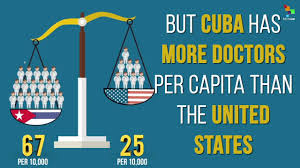
However, more recently still, such demonization of Cuba and Fidel Castro flies in the face of an experience my daughter and her husband had of the Cuban healthcare system just two weeks ago. I want to share that story with you. It sheds light not only on Cuba and Castro, but on Medicare for All.
But before I get to it, consider the attacks on Mr. Sanders.
Forbidden Thought
According to the simple-minded received wisdom here in the U.S., no one is allowed to tell the truth about a designated enemy. That is, you can’t say anything good about any government that refuses obedience to U.S. empire. And that’s true even if, like Cuba, the said government provides enviable education and childcare, or if health services are free there for everyone.
Meanwhile, to say anything bad about a “friend” – apartheid Israel for example – is absolutely forbidden. As an international outlaw, Israel can transgress UN resolutions against its illegal occupation of Palestinian territories. It can even kill with abandon peaceful protestors including Palestinian children, the elderly and disabled. However, to criticize it for doing so – to propose boycotting, divesting, or sanctioning Israel’s internationally proscribed occupation of Palestinian territories – is not only unacceptable but actually forbidden by law.
(In case you haven’t noticed: no debate participant has or will ever accuse anyone on stage of supporting a “brutal dictatorship” in Israel – or in Saudi Arabia, Egypt, Brazil, Honduras, Hungary, Turkey . . .)
I mean, instead of thinking critically or just recognizing undeniable facts, U.S. citizens and candidates for public office are virtually commanded to see and describe the world in terms of good/bad, black/white, friends/enemies, vendors/customers. To make even unsubtle distinctions in those regards is beyond the pale. In terms of electability, its’ the kiss of death.
To put it kindly, such thinking is not only simple-minded; it is childish. It’s insulting. It dumbs us all down and makes us stupid pawns of publicists and propagandists supporting reflexive U.S. ideology.
As a result of such stupidity, Bernie Sanders had to limit his “defense” of Fidel Castro to acknowledging the virtues of teaching people to read and write. He could easily have added points about free education through university level and praise for Cuba’s medical system that provides healthcare for everyone on the island – including visitors from other countries. However, to do so would have opened him to attacks alleging that his free college tuition and Medicare for All programs will inevitably lead to the Cubanization of America.
Not even Bernie Sanders has that much courage.
Healthcare in Cuba: A Recent Experience
And that brings me to the personal story I promised earlier. Just two weeks ago, it involved my daughter, Maggie, and her husband, Kerry as they led a weekend excursion to Cuba.
The junket was the payoff of a fund-raising project for our local Montessori school in Wilton, CT which our daughter’s five children have attended. At an auction held for its benefit, Maggie and Kerry had “sold” the trip to several parental teams. That was last fall.
So come early February, everyone went off to Cuba, even though Maggie was feeling poorly from the outset.
By the time the group arrived in Havana, our daughter was experiencing severe stomach pain that literally brought her to her knees. The next thing she knew, she was being whisked off in a cramped taxi to the Clinica Central Cira Garcia, Havana’s “hospital for tourists.”
There, admissions officials checked very carefully to see that Maggie and Kerry had the required health “insurance” which is included in the purchase price of airline tickets to the island. Then, following an x-ray, our daughter was informed that she was having an appendicitis attack and that an immediate operation was imperative.
The long and short of it is that the laparoscopic appendectomy took place, that hospital care was excellent, and that it cost her and her husband not a dime for the operation or for her five days in the hospital. (They were however charged $50 for each of the two nights Kerry stayed overnight there, and a few dollars for laundry.) In other words, the operation had been paid for by the airline ticket “insurance” which was really a tax on all travelers pooled to meet the cost of health emergencies like the one I just described.
The same procedure in the United States would have cost on average $33,000.
Conclusion
The point here is twofold. The first is that “Americans” need to exit the 20th century once and for all.
Cuba is not our enemy. In fact, it never was until U.S. policy (intolerant of people-friendly socialism) made it so. Moreover, Fidel Castro remains a hero to most Cubans and to most informed people in the Global South. His “repressive” policies were absolutely necessary to protect his country from actual U.S. invasion (e.g. the Bay of Pigs in 1961), from numerous CIA attempts to assassinate him, and from a 60-year long embargo intended to undermine Cuba’s economy, including its health and education programs.
To understand that point, think about our own country’s response to 9/11. Think about the Patriot Act, about resulting restrictions on travel, about Guantanamo, Abu Ghraib, imprisonment without trial, torture of suspected terrorists, and extra-judicial drone killings even of U.S. citizens. Think about the panopticon surveillance systems uncovered by Edward Snowden. Think about encouragement to inform on neighbors and others.
Were those responses to 9/11 brutal and repressive? No doubt, they appeared that way to their victims. But undeniably it’s what governments do under threat from external enemies and their internal agents. In that regard, the U.S. is no different from Cuba. George W. Bush, Trump – or Obama for that matter – are no different from Castro, except in their wider swath of brutality.
The second point is that Cuba’s social system as experienced by our daughter is unprecedented in the impoverished world of former colonies. No other victim of colonialism has been as committed to caring for its people, its children, or its environment as Cuba. But instead of being rewarded for such achievements, it is consistently vilified by U.S. politicians and a mainstream media stuck in Cold War thinking.
Thank God that the Sanders revolution invites us to leave all of that behind. His opponents should follow suit.
Recently, I spent two weeks in Tijuana working with Al Otro Lado (AOL). I’ve written about that experience here, here, and here.
AOL is a legal defense service for refugees seeking asylum mostly from gang-rule in Mexico and Central America. The emigrants want escape from countries whose police forces and allied power holders are controlled by ruthless drug rings whose only goal is accumulation of money and social dominance.
As I did my work helping clients fill out endless forms concocted by those who would illegally exclude them, everything seemed so hopeless. I wondered how those gangs achieved such power? Isn’t it a shame, I thought, that entire countries are now controlled by criminal mobs with names like “MS 13,” “Nueva Generacion,” and “18?” How sad for these people!
Then, during my flight home to Connecticut, I happened to watch the documentary “Where’s My Roy Cohn?” (WMRC). It introduced viewers to the dark and criminal mentor of Donald Trump.
On its face, the film illustrated the absolute corruption of the U.S. government as the unwavering servant of the elite as the only people who count. But in the light of my experience in Tijuana, it made me realize that our country too is literally controlled by shadowy gangs to an extent even worse than what’s happening south of our border. I mean, the United States of America now has the most prominent protege of Roy Cohn, an unabashed mafioso, actually sitting in the Oval Office! Both Cohn and, of course, his disciple turn out to be absolute nihilists without principle or any regard for truth.
The film made clear how both men tapped into a similar nihilist strain within huge numbers of Americans who identify with the Republican Party and ironically with the Catholic faith and Christian fundamentalism. Nonetheless, WMRC wasn’t explicit enough in probing either Cohn’s corruption, that of Donald Trump or of our reigning system’s complex of government, education, church and mainstream media.
It failed to show how the phenomena of Roy Cohn and Donald Trump represent mere surface indications of a profoundly anti-democratic coup d’état that has gradually unfolded in our country over the last 40 years. The actuality of this takeover was revealed most clearly in the recent impeachment proceedings. They provided a kind of last straw undeniably exhibiting how nihilist “Christians” have seized power in perhaps irreversible ways.
The Film
To see what I mean, begin by watching “Where’s my Roy Cohn?” for yourself. It not only details Cohn’s life as an infamous New York mafia consigliere. It also shows how he started his career in crime as the 23-year-old advisor of the equally villainous Senator Joseph McCarthy of Wisconsin. (McCarthy, of course was the force behind the nation-wide communist scare of the early 1950s.)
However, most importantly WMRC describes the film’s subject as the mentor of Donald Trump. By both their admissions, each recognized in the other a kindred spirit. Each used mafia and friends in high places (from Ronald Reagan to New York’s Cardinal Spellman) to enrich himself in terms of power and money. In the end, the alliance brought Trump to “the highest office in the land.”
To that point, here’s the way the film’s (highly accurate) preview-teaser reads: “Roy Cohn, a ruthless and unscrupulous lawyer and political power broker, found his 28-year career ranged from acting as chief counsel to Senator Joseph McCarthy’s Communist-hunting subcommittee to molding the career of a young Queens real estate developer named Donald Trump.”
In the course of the film, witnesses testify that Cohn taught Trump his basic approach to life. To wit: here are Cohn’s (and by extension, Donald Trump’s) implicit Ten Commandments. They also summarize the guiding principles of perhaps the majority of the most prominent politicians in the U.S. and across the world:
Value money as the highest good.
Manipulate the law to enhance personal wealth and privilege
Put your own interests above everyone else’s
Bully opponents mercilessly
Wrap yourself in the flag while you do so
Never admit wrong-doing or failure
When accused change the subject and make vigorous counteraccusation
Lie unceasingly with great confidence and bluster
Declare even the worst defeat a victory
Win at all costs
All of that was actually Cohn’s personal ethos. It worked for him throughout his life. It is reaping at least short-term benefits for Donald Trump as well. In fact, with Cohn as his mentor and as the man’s protege, Donald Trump would seem to merit all the adjectives on the film’s cover envelope: ruthless, unscrupulous, powerful, flamboyant, notorious, despicable . . .
Deeper Corruption
Unmentioned however in the film is Cohn’s connection with the very way our country (and the world) is run. It’s largely a blackmail game connected not merely with money and power, but with sex, pedophilia, blackmail and complete disregard for truth or moral principle. In fact, Whitney Webb’s four-part study of pedophile-racketeer, Jeffrey Epstein is called just that: “Government by Blackmail.”
And right at its heart, we find Trump mentor, Roy Cohn, listed prominently among figures like the Mafia kingpin Myer Lansky, and Lew Rosenstiel (of Schenley distilleries). For decades following World War II, they were real powers behind mayors, governors, congressmen, senators, presidents, and (yes) behind the world’s remaining kings and potentates, along with assorted church officials.
In fact, according to Webb, all during the ’70s and ’80s, Rosenstiel, Lansky’s close friend, regularly threw what his fourth wife (of five) called “blackmail parties.” The photos and recordings gathered there long kept Lansky out of trouble from the federal government. They also delivered entire cities to Mafia control in the post WWII era. In the end, Lansky blackmailed numerous top politicians, army officers, diplomats and police officials. He had photos of FBI director, J. Edgar Hoover in drag and performing homosexual acts.
Again, according to Webb’s research, Rosenstiel’s protegee and successor as blackmailer-in-chief was Roy Cohn himself who was closely associated with the Mafia bosses referenced prominently in “Where’s My Roy Cohn,” as well as with J. Edgar Hoover and the Reagan White House. (Nancy Reagan even phoned Cohn to thank him for enabling the election of her husband.)
Simultaneously, Cohn took on the central role in the blackmail pedophile hustle Lansky and Rosenstiel had started. As usual, its main targets were politicians often interacting with child “prostitutes.”
That was the real source of Cohn’s power. So were his dear friends in high places including (besides Clinton, the Reagans and Trump) Barbara Walters, Rupert Murdoch, Alan Dershowitz, Andy Warhol, Calvin Klein, Chuck Schumer, William Safire, William Buckley, William Casey, and top figures in the Catholic Church.
It’s those latter figures that connect Cohn’s pedophile ring as inherited by Jeffery Epstein even with the Church’s child abuse scandal. It directly involved the aforementioned “American pope,” Francis Cardinal “Mary” Spellman of New York, and Cardinal Theodore “Uncle Teddy” McCarrick of Washington D.C. Father Bruce Ritter’s Covenant House (a multi-million-dollar charity for homeless and run-away boys and girls) was also deeply implicated. In fact, when Ritter’s involvement in sex acts with his underage wards came to light, it was secular powers more than ecclesiastical forces that rallied to his defense.
Right-Wing Coup and Presidential Impeachment
All of that leads me back to where I started – to the right-wing coup d’état whose final straw debunked any pretense of democracy that may have been persuasive to some before impeachment proceedings put them completely to rest. “Where’s My Roy Cohn” showed the profound extent of the take-over in question – never far distanced from predominantly male sexual perversion.
Yes, we all know about such depravity within the Catholic Church – all the way up the chain of command. But the Cohn film along with the ancillary Epstein revelations it ignores reveal the centrality of that debauchery to standard operating procedure among government officials in the United States and across the world. It’s evidently what they do.
Am I exaggerating? Go back to the above list of Cohn’s and Epstein’s “friends.” See for yourself: they include presidents, princes, prelates, professors, pundits, pushers, and publishers. All of them have always had a lot to fear from the tapes and videos made by Cohn. But the same holds true for the ones confiscated from Epstein’s special safe, and from the still unpublished manifestoes of passengers on Epstein’s “Lolita Express” to the man’s “Orgy Island.” Additionally, there’s remains a lot to learn from the testimony of Epstein’s procurer, Ghislaine Maxwell. Inexplicably the latter remains at large and allegedly unlocatable by international agencies possessing the world’s most sophisticated technology.
In other words, what we know about connections between Cohn, Epstein, the Mafia, CIA, DOJ, White House, and church officials represent the mere tip of an iceberg whose continued submersion seems assiduously assured by the agencies involved, by Britain’s royals, and other powerful entities — all aided and abetted by an entirely cooperative MSM.
[And no: it’s not baseless “conspiracy reasoning” to implicate the deep state officials just mentioned – not in the face of Jeffrey Epstein’s mysterious “suicide” whose suspicious circumstances (within a specifically federal prison) include transgression of standard protocols for prisoners on suicide watch, missing surveillance tapes, sleeping guards, unexplained screams reported by fellow inmates as coming from Epstein’s cell, and lack of follow-up by the MSM.]
In other words, it’s not just that our country has been taken over by right-wing mobsters. No, it’s much more than that: our very world is run by gangsters, pedophiles, blackmailers, and their enablers – with Donald Trump its most recent and blatant evidentiary manifestation of anti-democratic policies.
Ignoring the rest of the world for a moment, consider what we’ve learned from the impeachment process about the extent of America’s de facto coup under Donald Trump whose criminal actions have gutted the Constitution of the United States at its core. Thus:
There no longer remains a separation of powers.
An indicted executive can control his own trial.
Subpoenas mean nothing to the reigning executive. By his decree alone, he can override summonses, forbidding those receiving them from appearing in court.
Impeachment “jurors” can embrace unmitigated bias with impunity announcing their judgment well before the trial’s commencement.
The presiding judge – even as he acknowledges the appearance of his court’s politicization – can with straight face permit a “trial” without evidence or witnesses.
Thus, prosecutors (i.e. the very House of Representatives) are left entirely impotent.
The hell of it is that these are all merely the latest developments in a criminal, unconstitutional, and anti-democratic process that has been in motion for nearly half a century. It has attacked the very pillars of democracy including the Supreme Court, Public Education, the mainstream media (MSM), and the Catholic Church – not to mention the Christian fundamentalists who constitute the heart of the Republican Party. It’s no wonder that Noam Chomsky has identified the latter as the most dangerous organization in the history of the world.
To be more specific, its “Christian” base hold firmly to tenets like the following that can only be described as “Cohnistic,” Trumpian, nihilistic, or (in religious terms) heretical:
There are no basic ethical principles (except that abortion is immoral).
Human life has no value except in its fetal stages.
The concept of truth is completely meaningless. This is because the public’s attention span and memory are so limited that repeated deceits make no lasting impression and will soon be forgotten.
The U.S. Constitution (except for the Second Amendment) is entirely insignificant.
There are two sets of laws, one for the elite and another for the rest of us.
As legal persons, corporations have more rights than living human beings.
International law applies only to U.S. enemies, never to the United States or its allies.
While the United States has the right to assassinate, bomb, drone, invade and occupy wherever it wishes, defense or retaliation against such aggression is criminal and liable to maximum punishment.
Conclusion
Do you see what I mean in describing our situation here in “America” as worse than our neighbors to the south?
It’s a truism to observe that whatever imperial governments – from Rome to Great Britain to our own – do abroad eventually returns to haunt them at home. My experience in Tijuana coupled with watching “Where’s My Roy Cohn” underlined the veracity of that terrible axiom. It all made me realize that our government has been taken over by cynical nihilists – and more than that by mobsters, pedophiles, blackmailers and heretical religious fanatics.
So, my take-away from border work in Tijuana is not only dismay, sadness, and despair for refugees at or border. It’s the same sentiments for ourselves.
With elections on the horizon, it’s also the question, what are we going to do about it? We have to determine which available candidate is freest from the sick contagion I’ve just described.
Today near the middle of my 80th year, I’m off to Tijuana to work for a couple of weeks with refugees and immigrants at the border. I mention my age not because I feel old, but because 80 used to seem ancient to me. Yes, I’ve done lots of these fact-finding trips before beginning with our family’s six months in Brazil during the military dictatorship there back in 1984. Then there were all those trips to revolutionary Nicaragua beginning the next year, and many visits to Cuba. This time around, I find myself wondering if my age will be a factor in the eyes of my co-workers.
In any case, this is the first in a series of daily reports I plan to make on this blog site. I want to take readers with me on this particular expedition of first-hand observation and discovery.
So, I’m now seated on Delta Flight 2685, in seat 23B on my way from New York’s JFK Airport to San Diego CA. It’s a 5 hour and 45-minute flight. I’ll stay overnight in San Diego’s Gaslight District. Then, tomorrow I’ll cross over into Tijuana, and begin work on Monday at 9:00 a.m.
My plan is to join forces with Al Otro Lado (AOL), a Tijuana-based social justice and legal services organization whose task is to help asylum-seekers in their quest to find refuge in the United States. I’m not sure what my function with the group will be. I might end up sweeping, washing floors, making beds, working in the kitchen, and serving meals. That would be fine. But I’m hoping my Spanish will be of some use. (For the past six weeks or so, I’ve been burnishing my skills in hour-long Skype sessions with a wonderful Spanish teacher in Cuernavaca.)
My main task however is to learn. I want to build on what I’ve gathered throughout my professional life as a theologian, researcher, teacher and habitual traveler to Global South stress points.
More specifically, my past observations (during those long stays in Mexico, Nicaragua, Guatemala, Costa Rica, Honduras, Brazil and Cuba) as well as my study with Global South thought leaders (especially in Costa Rica’s Departamento Ecumenico de Investigaciones and during my years teaching in an on-site Latin American Studies Program) have already taught me that today’s refugees are seeking escape from:
The effects of U.S. wars during the 1980s which destroyed families, church communities, businesses, towns, and entire countries. Those wars were aimed at keeping in power brutal dictators who served U.S. business interests such as Chiquita Banana. They were intended to prevent democracy from replacing the tyranny of Latin America’s wealthy classes allied with their counterparts across the U.S. border.
Gang violence inflicted on whole communities by the now decommissioned national soldiers and paramilitaries employed 40 years ago by the United States in South and Central America in the wars just referenced. [During the years of cooperation with the CIA and U.S. Army, those terrorists (that’s what they were) supported their illegal war efforts by deep involvement in drug trafficking – with CIA facilitation. Now, with the wars over, the former U.S. assets are simply continuing the work they learned all during those years of conflict – including the associated threats, bribes, kickbacks, death squads, assassinations, rapes, and torture.]
The devastating results of free trade pacts (like the North and Central American Free Trade Agreements – NAFTA and CAFTA) that have allowed the United States to e.g. dump cheap corn on the international market thus driving millions of small farmers off their land and into unemployment in big city slums.
The effects of climate change such as rising temperatures, hurricanes, floods, droughts, and forest fires, exacerbated by the entire Republican Party which insists not only on denying scientific fact, but on doubling down on the ecocide’s causes.
Domestic violence exacerbated by rampant unemployment (caused by those free trade deals) that has made mothers and their children absolutely desperate to escape the violent men in their lives.
Virtually none of those causes are explained to the American people. Instead, the multifaceted central role of the U.S. government and CIA in creating the crisis is completely overlooked as politicians and the mainstream media (MSM) ahistorically “explain” the problem in terms of freeloaders, drug dealers, rapists, gangbangers and general criminality.
Ignored as well is the undeniable moral obligation of the United States to make reparations by rebuilding the economies and infrastructures they’ve destroyed and by giving generous and easy asylum (not to mention jobs and cash payments) to the refugees manufactured in the process. WE ABSOLUTELY OWE THESE PEOPLE SHELTER, PROTECTION, AND RESTITUTION! THIS IS NOT A QUESTION OF CHARITY. WE ARE MORALLY OBLIGED!
As you can see, my project here is to help balance our MSM-cultivated ignorance by acquainting readers with actual refugees and immigrants and their full stories.
Most of us are scratching our heads over the magnitude of the Labor Party’s loss in last week’s election in the United Kingdom. The mainstream media (MSM) would have us believe that the Tory Party’s victory under Boris Johnson represents a massive rejection of left politics by the British working class.
However, that’s by no means the only conclusion possible. Indeed, it is entirely credible to conclude the opposite, viz. that last week’s vote was a resounding victory for the working class. That is, it represented their rejection of the very type of free trade pacts that have made lives miserable for wage earners across the planet.
It’s also possible to conclude that the British elections have issued to the world a clarion call to reform all free trade pacts while suggesting a clear direction for reform.
Let me explain.
The Elections and Brexit
To begin with, think about the elections and Brexit.
That, of course, is what the voting was about – Brexit (British withdrawal from the European Union). No other country has yet exhibited the courage needed to do so – not even Greece, despite the extreme austerity the EU has imposed upon it for years – and despite the promises of SYRIZA and the will of the people expressed in huge demonstrations and national referenda.
So, unlike the Greeks, the Brits set the stage for the actual exit of a member state from the European Union, which is the kind of free trade pact that has cursed working classes for more than 25 years.
Remember that: the EU is basically a free trade arrangement. Its central feature is its single market allowing its “four freedoms:” free movement of goods, services, capital, and people within EU borders.
The EU was formed in 1993. Its counterpart across the pond, NAFTA (The North American Free Trade Agreement) was signed a year later. Then came CAFTA (The Central American Free Trade Agreement) in 2004. As indicated, working classes have been suffering ever since not only from NAFTA and CAFTA but from EU austerity administered by unelected and therefore unaccountable bureaucrats headquartered in far-off Brussels.
With such hardship and lack of democratic control in mind, voters chose Johnson over Jeremy Corbyn. That’s because no one, including Corbyn and his Labor Party, was as clear as Johnson and his Tories about withdrawing from the EU come hell or high water.
On the other hand, Corbyn and Labor were not only relentlessly vilified by the country’s corporate media; they also remained ambivalent and split about Brexit. Together those factors proved fatal. The best the denigrated Laborites could do was to promise yet another referendum on the topic.
Clearly, that wasn’t enough. Evidently, the British were tired of the entire debate. As a result, Labor suffered the consequences. However, British laborers made the point that eluded their Greek counterparts: no more unelected decision-makers in Brussels, no more free trade agreements favoring capital over workers; no more neoliberal austerity, and no more unrestricted immigration to drive down wages.
Last week’s election results represented the Brits way of courageously joining the protests against neoliberal capitalism now taking place across the planet.
Free Trade and Immigration
Now, think about free trade agreements and that just-mentioned issue of immigration. Obviously, it has become a free trade sore point both here and in the United Kingdom. However, immigration pain has originated from opposite but intimately related sources.
Within the boundaries of the EU, the immigrant problem has stemmed from the earlier-listed “four freedoms,” while in North and Central America it comes precisely from the fact that only three of those freedoms are honored.
More specifically, the EU free trade arrangement recognizes that provision of goods and services essentially involves both capital and labor as roughly equal partners. Consequently, if a treaty allows free movement of capital across borders, justice and the logic of capitalism demands that it also permit similar liberty to labor which is as essential to the free market equation as capital. So, borders must be permeable to immigrants from one member-country to another.
This recognition has led to major relocations of population across frontiers that were closed in the pre-EU world. Movements of this sort have occurred with a vengeance in Great Britain, whose borders have long been open to immigrants from the country’s former colonies, e.g. India and Pakistan. Add to these the climate and war refugees who have also found refuge in Europe in general including Great Britain, and you’ll begin to understand why many there might blame their growing sense of lost national identity exclusively on the European Union. Boris Johnson has given effective voice to such discontent.
Similar unhappiness with the NAFTA and CAFTA has surfaced in North and Central America.
However, there the pinch of globalization is caused by closed rather than open borders.
That is, while NAFTA and CAFTA allow free movement of goods, services, and capital across the borders of the United States, Canada, Mexico, and the countries of Central America, they deny such freedom of movement to labor. Consequently, the agreements have at their disposal a captive labor force. So, while capital can go wherever it finds low wages, Mexican labor for instance cannot freely move to high wage areas in the United States or Canada. This has been a source of great frustration (and poverty) for workers under NAFTA and CAFTA.
As a result, Latinix workers have taken matters into their own hands. In what some have called a modern reconquista (a reconquering or reclaiming) of lands confiscated from Mexico in the middle of the 19th century, thousands of immigrants from Mexico and Central America have ignored one-sided laws prohibiting labor’s mobility. Regardless of the consciousness behind them, their actions implicitly insist that if capital is allowed to move freely across borders, so should labor be permitted cross-border transit.
Such economic rebels added to victims of climate change and of U.S. wars in Central America during the 1980s comprise the immigrant multitudes that President Trump has blamed for U.S. economic problems. In reality, they represent the collateral damage of free trade pacts as much as do their counterparts in the European Union.
(In other words, despite Trump’s assertions, it is right wing capitalists not liberals or progressives who insist on absolutely open southern borders – however, for themselves, but not for workers.)
Reforming Free Trade
So, what’s the answer to the EU, NAFTA, and CAFTA conundrums? Is it abandonment of free trade agreements altogether? Not necessarily. (And this brings us to the implications of reform involved in last week’s vote.)
In a word, the answer is DEMOCRACY.
That is, the defects of free trade agreements can only be remedied satisfactorily by democratizing them to protect jobs, cultures, and local social values.
To begin with, democracy demands that all stakeholders (not merely corporate representatives, lawyers, bureaucrats, and politicians) be present at the renegotiating conference table. This includes trade unionists, environmentalists, and groups representing the specific rights of indigenous peoples, women and children. All those affected must have equal voice and vote. Nothing else will work. Nothing else is just.
Yet, if all stakeholders have voice and vote, they will predictably complicate matters. (Democracy, remember, is messy.) Predictably, they’ll make demands that will radically restrain the freedoms of the corporations involved – even to the point of rendering unworkable the type of trade pacts we’ve come to know.
For instance, (and perhaps most crucially) workers in places not only like Greece and Italy, but in Mexico and Central America will require the same freedom their employers enjoy to move to where the money is. Developed world workers will demand compensation for their lost jobs. Everyone will vote for the unrestricted right to unionize. They’ll want seats on corporate boards of directors. At the same time, environmentalists will demand industrial technology that is clean and non-polluting. They’ll want waste and chemical dumps along with polluted rivers and aqua firs repaired.
Once again, meeting such demands requires profound democratic changes in common understandings of international trade arrangements. We can thank UK voters for suggesting that requirement in the clearest of terms.
Conclusion
Following Labor’s defeat in the UK, the corporate media and mainstream politicians have rushed in to announce the end of progressive programs like those advocated by Jeremy Corbyn and Bernie Sanders. For instance, Joe Biden argued that British Prime Minister Boris Johnson’s resounding victory should “warn Democrats against veering too far left in their fight to defeat President Donald Trump.”
Instead, thoughtful analysts should see the results of Great Britain’s electoral process as yet another instance of a world-wide rebellion against neoliberal capitalism. Bernie and Elizabeth Warren are essential elements of that insurgency.
True, voters have elected a Trump-like figure in Boris Johnson. And he will predictably immiserate the lives of wage earners even further. However, voters’ overriding intention was to reject EU membership once and for all. For them, one-sided free trade agreements that prioritize capital over labor are no longer acceptable.
Such unambiguous rejection of capitalism-as-we-know it, is now evident throughout the world – including at our border, where immigrants and refugees implicitly declare the system’s absolute failure in their own lives.
Our Y’s Men of Westport/Westin (CT) and its Current Affairs Discussion Group has decided that the focus of its next meeting will be Brexit (British exit from the European Union) and the future of NATO (the North Atlantic Treaty Organization).
The Y’s Men umbrellas a group of 400 or so retired men who meet weekly for fellowship and informative programs on community and national concerns. Its clever name comes from some association with the YMCA that has never been clearly explained to me.
In any case, one of the Y’s Men’s many subgroups meets bi-weekly to discuss world issues precisely like Brexit and NATO. That topic was chosen because at the time of its selection, NATO was holding its 70th anniversary meeting in London. Meanwhile, Great Britain was looking forward to a General Election on December 12th, which would once again centralize the Brexit issue.
In preparation for the meeting, the leader of the Current Affairs Group shared numerous articles with us. One was entitled “12 Questions about Brexit You Were Too Embarrassed to Ask.” Others were drawn mainly from the New York Times, the Washington Post, the Wall Street Journal, and The Economist. They detailed further information about Great Britain’s attempt to withdraw from the international trade agreement known as the European Union. Other articles asked the question whether or not NATO should or should not be dissolved.
As it turns out, both issues are intimately connected with questions of borders and immigration. After all, the European Union has virtually erased borders across the continent to facilitate what it terms its “four freedoms.” These include free movement of goods, services, capital, and people. Meanwhile NATO is also and obviously a multinational body. In fact, it treats member states as one. According to its central policy, an attack on any single member is considered an attack on all.
So, with those two issues in mind (borders and immigration) let me pose three questions related to Brexit and NATO. They are intended not only for Westport’s Y’s Men, but for thoughtful people in general.
Here are the questions:
Are you in favor of absolutely open borders for people?
Are you in favor of absolutely open borders for multinational corporations (MNCs) and/or military operations?
What’s the connection between Brexit and borders on the one hand and NATO on the other?
Open Borders for People
So, what about immigration and open borders? Should foreign workers be allowed to cross unrestrictedly from one country to another as they currently are under the European Union rubric?
To this question, I’m quite confident that most people’s initial answer would probably be “no.”
At least that’s what 52% of Great Britain’s voting population said last March when asked whether or not their country should remain within the European Union. By most accounts, disapproval of the Union’s policy of unrestricted immigration lay behind the votes of those approving exit from the EU.
That’s because open borders in Europe have led to massive relocations of population across frontiers that were closed in the pre-EU world. Such migrations especially intensified “foreign” presence in Great Britain whose borders had already long been open to immigrants from the country’s former colonies, e.g. India and Pakistan. Add to these the climate and war victims who have also found refuge in Europe in general including Great Britain, and you’ll begin to understand why many there might rashly blame their growing sense of lost national identity exclusively on the European Union. Boris Johnson has given voice to such discontent.
And all of that stands to reason, doesn’t it? That’s true even for those of us who (unlike the British) have not actually experienced free movement of people from one country to another. We can hardly imagine a world without passports, visas, or government control of entry or exit. It all sounds like a recipe for anarchy and chaos.
In our context, it would mean, for instance, that low wage workers could enter the United States and take our jobs. Our way of life would be completely upended. Our culture would be profoundly and unacceptably altered as well.
No, I’d venture to say that open borders are completely unacceptable to most of us. That’s why conservatives can get away with constantly ridiculing opponents of Mr. Trump’s border wall as advocating “open borders.” Life without borders simply doesn’t make sense. It’s clearly threatening to most Americans. And it’s largely the lived experience of open borders that has driven Great Britain out of the European Union.
Open Borders for MNCs
Yet despite our objections to free movement of people, most of us take for granted open borders for transnational corporations. We do and so does Mr. Trump! So, I’m quite confident in predicting that the answer of most Y’s Men to my second question would be “yes” — at least implicitly. “Yes, I approve of free movement of capital from one country to another. And yes, (in the case of NATO) I approve of attacks on other countries even though those forays pay no attention to borders.” Or (perhaps more accurately) the “wise” response might be: “Well, I’ve never thought about that.”
The latter response comes from the fact that on the face of it and for most of us, the movement of capital and of armies seems somehow harmlessly abstract and less devastating than the unrestricted movement of people. Moreover, we’re taught that treaties like the EU, NAFTA (North American Free Trade Agreement), CAFTA (Central American Free Trade Agreement) and the proposed TAFTA (Transatlantic Free Trade Area) are good for us because they create jobs. So, why not allow transnational companies like Exxon, Wal-Mart, Monsanto, Ford Motor, Kennecott Mining, Weyerhaeuser Lumber, Ralston Purina, and Del Monte to cross borders freely?
The answer to that query comes loud and clear especially from the Global South – from indigenous tribes, Mexicans, Hondurans, Guatemalans, or Salvadorans. They shout: “Free movement of capital is far more devastating to us than you’ve experienced in the European Union or imagine in North America. Free movement of capital destroys more jobs than it creates. It’s the main reason behind what you describe as your ‘immigration crisis.’”
Their evidence? Mom and Pop stores are driven out of business by Wal-Mart. Millions of campesino farmers are forced off their land when, for instance, Ralston Purina lobbyists persuade the U.S. government to dump subsidized corn on the Mexican market. The displaced farmers are forced off the land and driven into urban slums. Food consumption patterns are altered by McDonalds. Indigenous tribes have burial sites dug up and defiled by Exxon’s oil pipelines. Rain forests are cut down indiscriminately by Weyerhaeuser regardless of the impact on ecosystems and climate. Entire ways of living and interacting with nature and community are disrupted and thrown into chaos.
But that’s not the end of the devastation wreaked by the open borders most of us take for granted. NATO and its de facto leader, the U.S. military, demonstrate little to no respect for borders either. Think about it. Despite international laws to the contrary, those military entities claim the right to indiscriminately cross national frontiers to bomb and drone wherever they see fit — and without the required approval of the United Nations. In the recent past they’ve done so on a large scale in the former Yugoslavia, as well as in Afghanistan, Iraq, Libya, Syria, and Ethiopia. We don’t even know where they’re bombing; borders make no difference to them.
And the chaos produced by such disregard of borders is unbelievable. As its result, homes, schools, hospitals, churches, synagogues, mosques, stores, warehouses, factories, water, sewage, and communication systems lay in ruins across the planet.
The NATO Connection
But what’s the connection between all of this and NATO? The short answer is that a disbanded NATO represents a source of funding for remedying the just noted deficiencies of free trade agreements like the EU, NAFTA, CAFTA, and TAFTA.
To begin with, those defects can only be remedied satisfactorily by democratizing them to protect jobs, cultures, and local social values. And that will cost a lot of money. That’s because true reform demands that all stakeholders (not merely corporate representatives, lawyers, bureaucrats, and politicians) be present at the renegotiating conference table. This includes trade unionists, environmentalists, and groups representing the specific rights of indigenous peoples, women and children. All those affected must have equal voice and vote. Nothing else will work. Nothing else is just.
Yet, if all stakeholders have voice and vote, they will predictably complicate matters. (Democracy, remember, is messy.) Predictably, they’ll make demands that will radically restrain the freedoms of the corporations involved – even to the point of rendering unworkable the type of trade pacts we’ve come to know.
For instance, (and perhaps most crucially) workers in places not only like Greece and Italy, but in Mexico and Central America will require the same freedom their employers enjoy to move to where the money is. Developed world workers will demand compensation for their lost jobs. Everyone will vote for the unrestricted right to unionize. They’ll want seats on corporate boards of directors. At the same time, environmentalists will demand industrial technology that is clean and non-polluting. They’ll want waste and chemical dumps along with polluted rivers and aqua firs repaired. Those whose towns, homes, churches, schools, and hospitals have been destroyed by NATO wars will want them rebuilt. They’ll demand compensation for the needless deaths caused by the bombs, drones, planes, tanks, and military personnel employed in the service of corporate-friendly trade pacts.
Again, all of that will take money – lots of it!
And the source of the money should be NATO. It must be dissolved. And its annual funding must be diverted to meet the working class demands just listed.
After all, the organization has outlived its usefulness. Its enemies have disappeared. The Soviet Union (the very raison d’etre for NATO) vanished 30 years ago. Moreover, announcements that the Russians are coming once again and that a new Yellow Peril is on the horizon are nearly laughable.
In fact, when those threats are examined, they turn out to be only pale reflections of standard practices the United States has engaged in since the conclusion of the Second Inter-capitalist War.
Take Russia first. Its “crimes” include:
Interference in the 2016 U.S. elections
Alleged cyber-attacks
Dissemination of “fake news”
Aggression against the Ukraine
Annexation of Crimea
China’s alleged threat is represented by:
Its repression of democracy in Hong Kong
Its attempts to take over the world through its Belt and Road Initiative
“Stealing” intellectual property of U.S. corporations
Its jailing of Uighurs and other Muslim minorities
To repeat: “crimes” like those have been central (and on much larger scales) to United States policy for the past 75 years and more.
For instance, since 1823 under the Monroe Doctrine, the United States has routinely claimed the right to intervene militarily in its “backyard” (all of Latin America) whenever it perceives any undue foreign influence in the region. All during the 1980s, the U.S. invoked Monroe to counter Russian influence in Central America.
Yet, the U.S. insists that Russian military action in the Ukraine and Crimea (which arguably remain parts of Russia) is a threat to world peace. And this even though the new leadership in Ukraine promises to seek membership in NATO in clear violation of a 1990 agreement that the alliance would not expand eastward. In fact, NATO bases currently surround Russia. If the U.S. claims Monroe Doctrine protection for itself, logic demands honoring parallel claims by Russia.
Similarly, immediately following the fall of the Soviet Union, the United States interfered in the Russian electoral process to ensure that Boris Yeltsin would be elected president there. And U.S. interference in electoral processes world-wide is beyond dispute.
The bottom line here is that Russia is only doing in its backyard what the United States has long practiced in its own backyard and across the world.
The case is similar with the alleged Chinese threat. Remember, Hong Kong is not in China’s backyard; it is indisputably part of China itself. Moreover, if the U.S. and its NATO allies were implementing their own Belt and Road Initiative, they would be trumpeting it as an example of their generosity and openhanded foreign aid.
As for China’s alleged stealing of intellectual property . . . As Vijay Prashad has noted, such ownership is a fiction concocted by industrially developed countries to guarantee that their former colonies will remain in situations of extreme dependence and relative poverty. The concept of intellectual property ignores the essentially communal nature of human knowledge. For instance, concepts foundational to modern science (such as the links between the Vedic zero in the east and imaginary numbers in the west) are part of the world’s intellectual commons. To pretend otherwise itself constitutes an act of intellectual larceny.
In fact, reverse engineering has long been the backbone of industrial development everywhere in the world including the United States as it strove during the 19th century to catch up with its European competitors. It is inevitable that workers and states will attempt to understand and replicate rather than purchase the technology they are asked to operate.
Conclusion
With all of the foregoing said about trade agreements, military spending and the artificially manufactured threats posed by Russia and China, it now becomes possible to recognize that the Global North has no enemies. And in turn, that realization frees up huge caches of money already there, allocated, and set for diversion towards correcting the defects of so-called free trade agreements – even like the European Union.
The money’s to be found in the NATO budget; it’s also there in Pentagon allocations. (In fact, just last week, the U.S. Congress set aside more than $2 billion each day for military purposes, even though the prime reason for doing so has completely disappeared from the world stage.)
So, the answers to my original questions might well be these:
No: Immigrants should not be allowed to move unrestrictedly from one country to another
Unless that freedom is extended to MNCs. Or to reverse the assertion: MNCs should not be allowed to move unrestrictedly from one country to another unless labor is accorded the same freedom.
A disbanded and now pointless NATO can provide any funds necessary for democratizing otherwise one-sided trade pacts like the European Union, NAFTA, CAFTA, and TAFTA.
On November 21st, conservative pundit, David Brooks published a confusing op-ed in the New York Times entitled “The Revolt against Populism.” At least for this reader, it generated an overwhelming sense of information entanglement and of confusion about making sense of the world Brooks described.
I’m referring on the one hand to the welter of detail supplied in his enumeration of countries rebelling against populism. (How is one to know enough to make sense of all of that?) On the other hand, my reference is to Brooks’ all-encompassing use of the term “populism.” For him everyone from Xi Jinping to Donald Trump seems to fit into that category. How is that possible?
The purpose of this reflection is first of all to answer that question: how to make sense of the term “populism.” Its second purpose is to use that clarified term to offer a brief framework explaining the current worldwide rebellion unfolding before our eyes.
Begin with that last
point – the rebellion that Brooks describes as a revolt against populism. It’s
everywhere. As the author notes, demonstrations and street riots have erupted
in Hong Kong, Warsaw, Budapest, Istanbul and Moscow. Angry masses are currently
protesting in Pakistan, Indonesia, Saudi Arabia and Lebanon. Similar phenomena surface
in Latin America’s “Pink Tide,” particularly in Venezuela, Ecuador, Mexico, and
Bolivia. Brooks also includes the “Yellow Vests” in France, Brexit in Great
Britain, and Trumpism in the United States.
He might well have added venues like Algiers, Argentina, Egypt, Haiti, Puerto Rico, and Iraq. And then, of course, there are the permanent populist revolts entrenched in China (comprising 20% of the world’s population) and Cuba – not to mention ISIS and al-Qaeda. Finally, Brooks might also have included populist rebellion against climate change in our own country – e.g. Standing Rock, Extinction Rebellion, the Sunrise Movement, and School Strikes inspired by Greta Thunberg.
Yes, Brooks is right:
the world is in flames; it’s “unsteady and ready to blow.”
And what’s the cause of it all? Brooks gives two answers. For one, it’s a revolt against the revived and globalized form of laissez-faire capitalism that emerged after the fall of the Soviet Union 30 years ago. In the aftermath, with the Soviet Union in ruins, capitalist ideologues like Francis Fukuyama hastily declared the end of history and their own particular system definitively triumphant. As Margaret Thatcher put it there was no alternative.
However, far from being generally beneficial and inevitable, the emergent system of world-wide privatization, deregulated markets, and tax cuts for the rich alienated the masses. They experienced globalism as favoring a relatively small number of elites, while adversely impacting wage workers, rural populations and emerging middle classes. Neoliberalism proved to be culturally destructive as well.
In response to its austerity programs for the non-elite, people everywhere gravitated to populism. That’s the second explanation of the world’s turmoil identified by Brooks – a populism so ineffective that people are rebelling everywhere.
But it’s here that his deeper confusion appears. It comes from the author’s mixture of the term’s democratic meaning with neoliberalism’s undemocratic reaction precisely to that popular thrust. It comes from his refusal to face facts. In personal terms, Evo Morales Movement towards Socialism (MAS) represents a hugely effective populism; Donald Trump and the U.S. government is anti-populist.
To get what I mean, first of all consider the definition of populism itself. Wikipedia defines the term as “a political approach that strives to appeal to ordinary people who feel that their concerns are disregarded by established elite groups.”
Of course (using Maslow’s hierarchy), the primary concerns of the people everywhere are always the same: food, shelter, clothing, healthcare, education, dignified work, and just wages. Once those needs have been met, secondary concerns emerge such as freedom of religion, of press, and the rights to assemble and protest. According to that understanding, you might just as well define populism as democracy, and the title of Brooks’ article as “The Revolt against Democracy.”
Contrary to the impression conveyed by Brooks, that revolt is primarily embodied precisely in his beloved Establishment’s invariable reaction to the democratic aspirations just listed. It’s always the same: sanctions, regime change, coup d’états, assassinations, and outright war waged by proxy or by direct attack. Popular support for such anti-democratic tactics (insofar as they are even sought) is achieved by appealing to the economic self-interest of the elite and to the primal prejudices of “the base.”
Favorite reactionary anti-democratic themes invoke patriotism, religion, racism, homophobia, sexism, and xenophobia. Meanwhile, the genuine causes of popular misery – including unaffordable rents, inadequate wages, inescapable debt, widening gaps between rich and poor, privatized healthcare and education, a tattered social safety net, decaying or non-existent public transportation, ubiquitous political corruption, and endless war – are left unaddressed. To call such austerity measures “popular” simply muddies the waters making it more difficult to make sense of the world. And yet this is what Brooks and standard treatments of “populism” constantly imply and say.
Such sleight of hand enables mainstream pundits like David Brooks to falsely equate “populisms of the left” and “populisms of the right.” In the process, it empowers them to admit the failures of neoliberal capitalism, but to hastily add that leftwing populism is no better. As Brooks puts it: “But it’s also clear that when in power the populists can’t deliver goods. So now across the globe we’re seeing “a revolt against the populists themselves.” After all, Brooks claims, “Venezuela is an economic disaster” and in Bolivia “Evo Morales stands accused of trying to rig an election.”
However, Brooks’
declaration of populist failure doesn’t mention:
The crippling sanctions the United States has imposed on Venezuela
Nor those placed on China, Cuba (for more than 50 years!) and Nicaragua.
The fact that Morales’ populist policies in Bolivia had drastically raised the living standards of the country’s majority indigenous population
Or that those of populist Lula da Silva had done the same for the impoverished of Brazil
Or that China’s policies (with enormous popular support) have transformed it into the world’s most dynamic economic force lifting out of poverty fully 20% of the world’s population
Or that the latter’s “Belt and Road” foreign-aid initiative has made its political economy and populist policies the aspirational standard of the entire Global South – despite the contrary efforts of the U.S. and of the EU’s former colonial powers
Above all, Brooks’ overwhelming list and standardized false equivalency doesn’t recognize the historical pattern behind the explosive situation he describes. That pattern has the former colonial powers, and especially the United States, resisting democratic populism on every front. It does so according to the pattern which follows. Here is how I describe it in my recently publishedThe Magic Glasses of Critical Thinking: seeing through alternative fact & fake news:
Any country attempting to establish a populist economy favoring the poor majority
Will be accused of being illegitimate, communist, socialist, authoritarian, and/or a sponsor of terrorism.
It will be overthrown either directly by U.S. invasion
Or indirectly by right-wing (often terrorist) elements within the local population
To keep that country within the neoliberal orbit
So that the U.S. and its rich international allies might continue to use the country’s resources for its own enrichment
And for that of the local elite.
What I’m suggesting here is that historical pattern analysis just outlined goes much further towards pinpointing the original spark that has ignited the world’s conflagration and resulting disequilibrium than Brooks’ misleading description as a “Revolt against Populism.”
Underneath many, if not all of the revolts Brooks so overwhelmingly enumerates is the heavy hand of the United States and Europe’s displaced colonial powers. They are the consistently inveterate enemies of genuine populism concerned as it is with meeting basic human need. They are the advocates and sponsors of the world’s anti-democratic forces that have (with the help of establishment pundits like David Brooks) coopted the term to confuse us all.
In other words, there’s no need to be overwhelmed rather than inspired by the unfolding worldwide revolt against neoliberal austerity and laissez-faire capitalism. At least initially, it’s not necessary for us to know the details of every country’s history and political economy.
Instead, critical thinkers should simply remain cognizant of the nature of authentic populism and of the pattern just summarized. Then, when necessary, further reading and research can confirm or disconfirm the validity of the pattern’s particular application. In most cases, I predict, its heuristic value will be vindicated.
About a week ago, I wrote a piece about the fifth generation of cellular technology (5G). Then, as promised there, just this morning Westport’s Ys Men’s Global Issues group met to discuss the topic and the advisability of adopting 5G according to the “fast track” schedule advocated by the Trump administration and by telecom giants like Verizon and Sprint. An unprecedented number of men attended indicating the perceived importance of the issue. The resulting conversation was lively, passionate, and thought-provoking.
To begin with, there was general recognition that:
None of us (not even those identified as “experts”) knows from our own research a lot about 5G capability or threats.
We are therefore dependent on the word of scientists
But shouldn’t rely on biased “researchers” employed by the tech companies.
We don’t actually need an internet or phone service 100 times faster than the ones we now have. (More quickly downloaded movies and enhanced gambling options simply aren’t worth it.)
Since corporations and alliances between them and government have lied to us in the past (e.g. about asbestos, auto safety, tobacco and cigarettes, and climate change) we would do well to be skeptical about 5G’s mammoth advertising campaigns.
Nevertheless:
Discussants recognized a certain “technological imperative,” i.e. endorsement of the idea that if human beings can do something, they not only will, but somehow must do it.
Think of where we’d be, some said, if we listened to the Luddites, to those who feared introduction of electricity, or warned us about air travel causing our blood vessels to burst.
We may “need” 5G to protect us militarily from the Chinese or Russians who, if they develop it first, might use it against us to destroy our cities, collect our trade and military secrets, or control us in other ways.
Introduction of 5G promises untold numbers of jobs and profit stimulation for corporations and entrepreneurs.
In all, there seemed little concern about:
Health risks, which seemed to be dismissed by some as paranoid.
The horrendous implications of decimating or eliminating huge populations of bees.
Nineteen-eighty-four type surveillance and crowd control used against good citizens like us who might one day feel obliged to take to the streets to oppose minority control of our lives by our own government and by corporations – just as citizens are currently doing in so many places across the planet.
Along those lines, one member knowledgeable about the technical aspects of 5G, admitted that similar technology can indeed be used to disperse crowds, nearly boil the blood of protestors, and has been known to kill bee populations necessary for human food supply.
Questions to Ponder: Did Monday’s conversation reveal a deeply 20th century mode of thinking that for the sake of survival we must outgrow? That is, did it:
Demonstrate a 20th century conviction that imagines all international relations in terms of “us vs. them” – for example us against the Russians and Chinese – as though cooperation between nations is inherently impossible?
Abandon any idea that the world could be fundamentally different from what we now experience — that another world is possible?
Reflect a de facto willingness to commit suicide in the name of “progress” – as though we have no choice, capability, or responsibility of choosing differently?
Implicitly admit that perhaps such outmoded thinking condemns our children and grandchildren to a hopeless future, because old people like us (who, let’s face it, are now in control) cannot or will not think differently?
Trust excessively our own government, military and corporations?
Ignore the possibility that capitalism as we know has run its course?
Prove unwilling to imagine the superior efficiency of a centrally planned, but democratically controlled socio-political system organized cooperatively rather than competitively?
At the end of today’s meeting, one member acknowledged the interesting and productive nature of the conversation I’ve just capsulized. He suggested that our next meeting continue the thread. Although his proposal did not carry, all of us can be assured that we haven’t heard the last of this debate. For better or worse, we will eventually have to answer the “questions to ponder” indicated above.
Over the last year, since we’ve moved to Westport, CT, I’ve been an active member in a group of retired men. It’s somehow associated with the YMCA and is catchily called “The Ys Men.” Most of the members are former CEOs, lawyers, artists, scientists, academicians, small businessmen, local politicians, and otherwise smart people and community leaders. As such, they represent the epitome of community wise men.
The group has a membership of over 400. Over 200 of them
show up for weekly Thursday morning meetings, where we enjoy coffee, donuts, time
to meet and greet, and invariably have outstanding speakers. The Ys Men also
sponsor many activities including golf, a book club, tennis, bocce, pickle
ball, sailing, music appreciation (jazz and classical) and outings to
restaurants, theaters, museums, and sporting events. It’s great fun.
Since joining, I’ve been part of a Current Events Discussion
Group that meets every other Monday from 8:30 a.m. to 9:45. Usually about 50
men show up. We’ve unpacked issues like the war in Syria, China’s Belt and Road
initiative, France’s Yellow Vest movement, and developments in India and Turkey.
I always try to contribute to the discussion. At the end of each meeting,
participants suggest and vote on the topic for the gathering to follow.
Last week, I proposed that for the November 18th meeting, we discuss a film I had recently seen “5G Apocalypse: Extinction Event.” And my motion carried. So, in less than two weeks, we’ll discuss what I consider one of the most disturbing documentaries I’ve ever come across. You can access it here. What follows is the result of viewing the film several times and reading related material. It’s made me skeptical about the 5G rollout.
The Film Itself
“5G Apocalypse: Extinction Event” addresses the advent of
the Fifth Generation (5G) of cell phone technology, which it portrays not only
as a severe health threat, but as a menace to our freedom as citizens of a
constitutional democracy.
The documentary actually makes three arguments. The first is
that 5G technology even as presented by industry and government represents a severe
threat to human and environmental health. The second is that those same
representations are false; 5G technology emits not only supposedly harmless radio
waves, but undeniably harmful radar and microwaves far beyond acceptable levels.
The documentary’s third argument is that such emissions secretly generated from
s.m.a.r.t. products are ultimately weaponized for purposes of crowd-control –
to track people’s movements and subdue them in case of insurrection.
In developing those points, “Extinction Event” presents on the
one hand the pro-5G testimony of Federal Communications Commission chairperson,
Tom Wheeler, his successor, Ajit Pai, as well as other spokespersons from
corporations such as Verizon and Motorola. On the other hand, it offers damning
critique from a long array of scientists, military personnel, investigative
journalists, politicians, and activists calling attention to the extreme
dangers of 5G technology.
The Apparent Debate
As presented in the film, the proponents of the new
technology stand united in fast tracking its implementation. We are in a race,
they argue, with China, India, and the European Union for getting on top of
this latest communications phenomenon. If our competitors (especially Chinese)
prevail, it will mean we have ceded to foreigners the capacity to dominate the
globe not only economically, but politically.
However, if successful with their proposed rush to market,
Americans instead of the Chinese, Europeans, Indians or Russians will emerge in
the dominant position just referenced. But, according to Wheeler, Pai and
industry spokespersons, success hinges on the government suspending its
regulatory power and upon cutting through “red tape” that would otherwise
hinder the new technology’s rollout. Here “red tape” refers to delays caused by
human and environmental impact studies.
In other words, industry leaders’ haste to secure competitive advantage rules out any government oversight as well as public debate about health and surveillance implications of 5G. One advocate even suggests suspension of the Tenth Amendment of the U.S. Constitution, which assigns all (regulatory) powers to the states or people unless expressly delegated to the Federal Government.
In exchange for such laissez-faire measures, industry
representatives promise a utopian future of high-speed internet, enhanced global
connections – and billions of dollars in profit for the communications giants.
By way of contrast, critics of the new technology warn of an
impending apocalypse. Hundreds of peer-reviewed studies, they say, indicate
that 5G technology will:
Install cell towers and antennas at the rate of
250 per square mile exposing every inch of the earth to harmful radiation 100
times that of current exposure
Cause cellular stress, increased risk of cancer,
genetic damage, reproductive issues, memory loss, and Alzheimer’s syndrome
Threaten to kill pollinators such as bees and to
render the earth’s very soil infertile
Change the migratory patterns of birds
Make weather predictions more difficult
Dwarf the threat to human health represented by
tobacco and cigarettes
Of course, the cigarette analogy recalls for 5G resisters the power of harmful industries to hire and mobilize scientists, academicians and the mainstream media to advance “alternative facts” contradicting the alleged consensus of their counterparts. In the case of the 5G controversy, critics point out, such dissenting studies generally appear in the mainstream media alongside ads sponsored by Verizon, AT&T, and other phone giants with vested interests not only in this new technology, but in selling it to an unsuspecting public.
For instance, in May of this year, The New York Times published an article by William Broad entitled “Your 5G Phone Won’t Hurt You but Russia Wants You to Think Otherwise.” As its title indicates, the piece advanced a theory that 5G concerns are part of a Russian plot to secure advantage for their version of 5G technology in the global marketplace. Accordingly, Broad attacked RT America, the U.S-based TV news channel funded by the Russian government, as though it were the major source raising concerns about the dangers of 5G.
The Times report goes on to identify critics of 5G as “a few marginal opponents” who mistakenly identify radio waves as “radiations.” According to Broad, opposition criticism does not appear in reputable journals, but in “little-known reports, publications and self-published tracts, at times with copious notes of dubious significance.”
Broad, however, does not mention the contrary position divulged in The Scientific American. Much less does he reference the longest and most thorough study of the question performed by the National Toxicology Program which is run by the U.S. Department of Health and Human Services. After two years of investigation, the latter concluded that there is “some evidence” of adverse health effects caused by 2G and 3G cell phones. Presumably, 5G technology would provide further evidence.
Ignoring all of that, Broad argues that radio waves used in cell phones are relatively harmless. This is because they lie at the end of the electromagnetic spectrum directly opposite the harmful rays, such as ultraviolet and x-rays, which in high doses can indeed damage DNA and cause cancer.
In response, 5G critics argue that Broad’s rationale too easily dismisses not only serious studies, but also the undeniable fact that radio waves do in fact represent “radiation.” And while such emissions do come from radio waves at the more benign end of the electromagnetic spectrum, they are not without negative health effects – as already noted by Rudolf Steiner in 1924. Moreover, as emitted from portable phones and ubiquitous antennae, cell phone radiation takes place very close to phone users and is backed up by powerful micro and macro towers. As a result, there is a lot more cumulative radiation.
In fact, according to “5G Apocalypse,” international standards for acceptable levels of cell phone radiation are already in place. Cell phones need 0.2 billionths of a microwatt per centimeter squared to operate at all. At 0.05 microwatts per centimeter squared, psychologists have noted behavioral problems in children aged 8-17. The level of 0.1 already enters an area of “extreme concern.” At 4.0 billionths of a microwatt, cell phone users exhibit difficulties with memory and learning. Cellular DNA damage occurs at 6.0. Smart meters reach a level of 7.93 billionths of a microwatt per centimeter squared.
With all of this in mind, Switzerland, Luxemburg, and
Lichtenstein cap permissible levels at 9.5. The level is 10 in China, Poland,
and Russia. Nonetheless, the United States and Canada allow levels of 600-1000
microwatts per centimeter squared – i.e. tens of thousands of times higher than
those known to adversely affect human health.
In the end, Broad’s argument seems vulnerable to accusations of having selected its data from those industry studies whose conclusions (as noted in “5G Apocalypse”) differ sharply from non-industry research regarding the harmful effects of radio-frequency emissions. As pictured below, seventy percent of non-industry studies find radio-frequency radiation harmful. In contrast, 68% of industry studies find it harmless.
The Hidden Debate
But that’s not the end of the debate outlined in “5G
Apocalypse.” Far from it. Instead, there’s another dimension that is largely
ignored in the mainstream media. It involves deliberate falsification of the
nature of radiofrequency emissions from the proposed system along with sinister
intent on the part of government authorities.
To begin with, the 5G radiations in question do not issue
merely from relatively benign radio waves (which, as indicated above have their
own problems). They also include radar and intense microwaves expressly
intended for military operations against rebellious civilians.
In fact, the system’s technology is directly modeled on military
microwave counterparts originally intended for crowd control and psychological
warfare. As portrayed in “Extinction Event,” 5G technology enables all police operations
requiring an electromagnetic base to be executed with greatly increased
efficiency. This includes constant surveillance and crowd dispersal. The video even
goes so far as to describe 5G as a weapons system masquerading as a modern
efficiency technology.
As such, the film argues, 5G fits neatly into the military-industrial-complex (MIC) model that Dwight Eisenhower warned against as he left office in 1961. It embodies omnipresent weapon capability available to the MIC minority to control an otherwise unmanageable majority. The technology’s omnipresence promises to send signals from stoves, refrigerators, heating units, microwave ovens, computers and printers. In other words, signals will emanate from any s.m.a.r.t. device. According to “Extinction Event,” the latter acronym should stand for “secret military armament in residence technologies.”
Conclusion
So, how are we to interpret the 5G controversy? Are the opponents of the new technology simply Luddites who reflexively oppose all technological advance? Are they conspiracy theorists in tin foil hats? The telecommunications industry and mainstream media would have us think so.
Despite their efforts however, here’s what we know for
certain:
U.S. Government proponents of 5G technology (like the Trump administration’s FCC chairperson, Ajit Pai) have deep ties to telecommunications industry.
In view of its practice of incessant prevarications, the Trump administration has negative credibility.
Similarly, corporate America has been frequently caught in lies and cover-ups that endanger consumers (e.g. in relation to cigarettes and tobacco, climate change, and automobile safety).
For the sake of profit, huge corporations such as IBM, Bayer, Ford Motors, and AIG Insurance have shameful records of supporting the most virulent strain of fascism in Nazi Germany. Historically speaking, they routinely support repressive military regimes and place profits ahead of human freedom, democracy, and welfare.
Currently they and their counterparts have millions of dollars at their disposal to fund alternative research and sponsor unlimited articles and advertising to advance their agendas and discredit their critics.
Those critics have no such resources.
Besides all of that, we also know for certain that:
The improvement of the human condition
represented by 5G technology is marginal at best. The present speed of our computers
is actually quite adequate to meet human need.
“We” the people are not in competition with the
Chinese for 5G superiority.
Instead, it’s the telecommunications giants
whose bottom lines and quest for patents make it imperative for them to
win the race for 5G control.
No matter who wins that race, 5G technology (if
proven safe and beneficial) will eventually arrive for everyone on the planet
who can afford it.
Enough red flags have been raised by credible
scientific studies to justify further human and environmental impact studies by
qualified independent researchers.
A whole array of cautionary scientists,
activists, and political leaders are merely calling for slowing down the rush
into an unknown future. In the interests of protecting human health, their
grandchildren and the environment, they want further study.
Finally, those expressing caution point out that a safe alternative to 5G technology already exists. It takes the form of publicly financed fiber optics. Such alternative:
Buries the main source of harmful radiation
Requires very little energy per data packet.
Goes only where it is needed
As a result, offers a high level of privacy and
safety as opposed to more hackable, omnipresent 5G arrangements
Is ultra-reliable
Moreover, a publicly financed fiber-optic
alternative eliminates the market-driven “technological imperative” fueled by an
imagined race for patents and profit.
In the final analysis, that race is the only
reason for accelerating a process in dire need of further study and proper
oversight.
In summary, advocates of an accelerated, unregulated 5G
rollout make it sound like it’s a national imperative for “us” to beat the
Chinese in some race into a promising future that will somehow exclude us if
they get there first. However, history and the desire of telecommunication
giants to bypass environmental and human impact studies show that they are not
really concerned about our lives or those of our children and grandchildren,
much less of animals and plants. On the contrary, they care principally about
profit and are willing to sacrifice all the rest for a healthy bottom line. The
rest of us must face the fact that it’s not “us” but multinational corporations
like Verizon, Sprint, AT&T, Motorola, and T-Mobile who need to win their
race for patents and billions in profits.
Instead of all this great hurry, it’s better to slow down, do
the necessary study, take these momentous decisions out of the hands of
profiteers, and look before we leap.
People are scratching their heads over President Trump’s sudden decision to withdraw troops from the Kurdish area in northeastern Syria. In effect, American troops there had been acting as human shields against the designs of Turkish President, Recep Tayyip Erdogan, and his long-standing vendetta against the Kurdistan Workers’ Party (PKK) in Turkey and their Kurdish allies in Syria. Both have struggled for Kurdish rights and independence since 1979.
As well, American troops have guaranteed the stability of prison camps for terrorists in Northern Syria, where up to eleven thousand Muslim militants have been concentrated after the supposed defeat of ISIS in Syria. In the absence of U.S. troops, Erdogan now has free rein not only to decimate his Kurdish opponents, but to release those ISIS fighters who, he says, will help him defeat the PKK in Turkey.
But why this apparently impulsive decision on the part of President Trump ?
A number of reasons have been advanced to explain it, as well as to understand Turkey’s sudden aggressive action:
The United States is cultivating Turkey to become the dominant regional power rather than Iran.
The U.S. is tired of fighting the war in Syria that has cost billions of dollars.
Trump has business interests in Turkey where he’s building two Trump Towers. To protect those interests, he’s doing Erdogan a political and military favor.
According to Erdogan, he is simply attempting to create a “safe zone” for the relocation of 3.5 million Syrian refugees who have sought asylum in Turkey during the war in Syria.
As well, Turkey claims that the safe zone would destroy the terror corridor which the PKK and Kurdish-led Syrian Defense Forces have been trying to establish on Turkey’s southern border.
The U.S. isn’t really interested in defeating ISIS. On the contrary, it favors its revival in order to use it in regime-change wars, and to justify continuance of an endless “war on terror” – all in order to benefit the military-industrial complex.
In
the end, all of those “explanations” might have some credibility. No doubt, each
of them plays some part in creating the chaos that now reigns in Syria.
Nevertheless, U.S. history after World War II indicates that Tulsi Gabbard put her finger on the real reason for the events unfolding in Syria. I’m referring to her remark that the conflict in Syria represents an illegal regime-change war initiated by the United States. That is, absent U.S. efforts to unseat Syria’s president Bashar al-Assad, the current crisis would not exist. That she was onto something was indicated by the severe backlash she experienced from Hilary Clinton, a principal advocate of U.S. policy in Syria.
None of this means that without American intervention Syria would be care-free. On the contrary, its unprecedented climate-change drought and accompanying desertification have caused farmers to migrate to Syria’s large cities in turn leading to an unemployment crisis and civil unrest that beggar description. The drought and resulting state of emergency also created an opening and excuse for the U.S. to mount a campaign to remove Syria’s president from office.
But why specifically does the United States want al-Assad removed? As I’ve indicated elsewhere, the U.S. wants him out because he’s a Baathist, i.e. a Pan Arab socialist. And wherever the United States encounters socialism, Pan Arabism or Pan Africanism, it works for regime change, since such movements constitute a threat to America’s white supremacist, imperialist, capitalist patriarchy. Think of Iraq, Libya, Egypt, Honduras, Nicaragua, Cuba, Brazil, the former Yugoslavia, and a host of countries in Africa.
To implement its world-wide regime change strategy, America creates and/or employs local anti-government groups like the Mujahedeen in Afghanistan, the Contras in Nicaragua, or the Kurds in Syria. It continues to use “terrorist” forces like al-Qaeda as it did successfully in Afghanistan against the Russians. In the Syrian conflict, those forces were renamed and described as “moderate” for purposes of fighting ISIS – another U.S. creation this time unintentionally produced by its illegal invasion of Iraq in 2003. Meanwhile, America’s real quarry in Syria remained Bashar al-Assad.
As Chris Hedges has recently noted, the United States has no loyalty to such agents, and often drops them as soon as convenient once their services are no longer required. It vilifies them anew with their old names restored – al-Qaeda and ISIS.
Using such
forces, efforts to overthrow Assad (begun in 2013) have failed miserably. So,
the U.S. and Turkey have decided to give up on the Kurds, who in northeastern
Syria are also socialists. Additionally, they are allies of the Kurdish Workers’
Party (PKK), Erdogan’s archenemies in Turkey. In terms of socialism, the PKK’s
name says it all.
Put otherwise, in the face of our country’s regime change failure, Trump and Erdogan are trying to save the imperialist day by at least defeating the socialist Kurds in both Turkey and Syria. However, they have instead driven Syrian Kurds to seek protection from Bashar al-Assad. His troops have been welcomed as heroes in the Syrian northeast. And so have Russian support troops who represent the only legal foreign military presence in Syria, since they are there at the behest of the Syrian government.
The bottom line here is that the United States has no legal leg to stand on in Syria. It should leave the country entirely. In fact, its military should leave the Middle East altogether. The U.S. should instead sponsor diplomatic solutions to the mess it has created. There are no military solutions to any of the problems in the region.
While this does not mean completely abandoning the Middle East to its own devices, it does mean abandoning the use of force. Correspondingly, it entails seeking diplomatic solutions through the U.N. which was created precisely to avoid the kind of illegal, arbitrary military measures routinely implemented by U.S. presidents of both parties.
But to
prioritize diplomacy over war, the U.N.’s international law as well as U.S. legislation
must be respected. I’m referring to the international requirement that member
nations seek U.N. approval for initiating any military action not demanded as
immediate response to direct attack. Similarly, our own government must respect
the U.S. Constitution’s requirement that Congress (not the executive branch)
approve any acts of war by our nation.
In summary, while Trump’s reassignment of U.S. troops in Syria from protecting Kurds to protecting Syria’s northeaster oil fields may have been puzzling to those not paying attention, consummate insiders like Tulsi Gabbard, see the pattern. And it looks like serial regime change criminality.
What even Gabbard might not see is the pattern’s very raison d’etre. It’s that American leadership always becomes alarmed when any head of state on the one hand or anti-imperialist force on the other attempts to create a country where the interests of all (not just the elite) are served. When that happens, the “guilty” party will be subject to regime change measures of one kind or another. In the Middle East, that’s been the case with Baathists, Pan Arabs, Pan Africans, and now with the PKK. As Ozlem Goner has indicated, such indigenous entities typically cultivate democratic, non-patriarchal, anti-imperial, and gender-egalitarian structures.
To repeat: that invariably proves intolerable to the United States and its bought-and-paid-for clients. History since the Second Inter-Capitalist War has shown as much.
But you won’t read about this long-standing dynamic in the New York Times. Instead, you’ll find it in sources like Howard Zinn‘s A People’s History of the United States, in Eduardo Galeano‘s The Open Veins of Latin America, in Walter Rodney‘s How Europe Underdeveloped Africa, in Oliver Stone‘s and Peter Kuznick’s The Untold History of the United States, and in Vijay Prashad‘s The Poorer Nations: a Possible History of the Global South. I recommend all of them very highly.