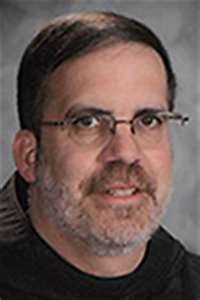
At the beginning of this month, Father John Stowe was installed as the new bishop of Lexington’s Roman Catholic diocese. As such he embodies the long reach of Pope Francis, who, in his Apostolic Exhortation, ‘The Joy of the Gospel” (JG) announced his determination to fundamentally reform the church.
There the pope said, “In this Exhortation, I wish to encourage the Christian faithful to embark upon . . . new paths for the Church’s journey in years to come” (JG 1). Francis called for “. . . conversion which cannot leave things as they presently are” (25).
Early returns indicate that in Bishop Stowe, Pope Francis has appointed a change agent like himself intent on implementing the pope’s program whose essence might be described as prioritizing the needs of the poor.
That prioritization was presaged even before Bishop Stowe’s official installation on May 5th. It was evident the night before at the vespers ceremony and reception at Christ the King Cathedral in Lexington, where the bishop-elect showed himself to be a master of symbolic communication.
In fact, the new bishop has sent at least seven clear signals that he and the pope are on the same page and that Lexingtonians can expect a welcome emphasis on social justice themes.
During the ceremony, then bishop-elect Stowe:
Announced a “new chapter” for the Catholic Church in Lexington. The phrase, which appears in the first paragraph of Francis’ “Joy of the Gospel,” was evidently chosen to indicate the bishop’s endorsement of the pope’s agenda.
Said that the new chapter would emphasize service of the poor. Yes, worship would also be prioritized, he promised. However, even liturgy could never ignore poverty in our midst.
Demonstrated that conviction by prioritizing Spanish (the language of so many of the poor among us) throughout the vespers liturgy – in readings, responsorials, and hymns. In his own remarks, then Bishop-elect Stowe spoke each paragraph first in English and then in Spanish translation. At other times, his initial thought came in Spanish followed immediately by an English translation.
Invoked the example of Jesus as the foundation for emphasizing service of the poor. Jesus himself was impoverished, the bishop said. He was an working man, a carpenter with dirty hands who enjoyed friendship with fishermen and sinners. He accompanied the oppressed and finished his life as a criminal on death row. The authenticity of Jesus’ resurrected presence was certified by display of his body wounded by imperial forces.
Specifically identified other excluded and marginalized groups as the focus of his ministry: overlooked Appalachians, refugees from the Congo, the sexually abused (a clear reference to the Church’s pedophilic scandal), and exploited workers. The church, Bishop Stowe said, must identify with brothers and sisters of that kind or “it isn’t much of a church.”
Outside the vespers introductory ceremony, it was disclosed that Bishop Stowe:
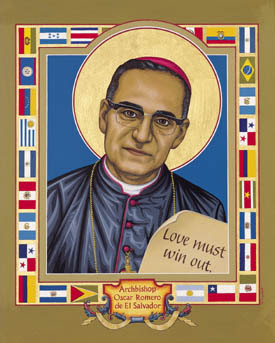
Has a special devotion to Oscar Romero, the martyred archbishop of El Salvador, who is considered the patron saint of liberation theology – which interprets Jesus’ gospel from the viewpoint of the poor and oppressed.
Has decided to abandon residence in the plush quarters of the episcopal mansion. Instead he’s locating among his confreres in a community of retired priests.
It is this last action, more than the others, that signals Bishop Stowe’s intention to channel Pope Francis for us not just in words, but in deeds and life-style.
These are seven good reasons to hope that the new bishop will indeed not “leave things as they presently are.”
(This is the second in a three-part series on our parish’s upcoming celebration of the beatification of San Oscar Romero which will take place on May 23rd. The event will be observed in Berea’s St. Clare’s parish on June 3rd, when our new bishop, John Stowe, will join us.)
In the previous installment of this mini-series inspired by the upcoming beatification of El Salvador’s Oscar Romero, I offered a thumb-nail sketch of the great archbishop’s life. Romero’s witness has been inspiring for many, including Lexington’s new bishop, John Stowe. (As I said, think of the thoughts that must have coursed through the bishop’s mind as he celebrated Mass recently at the very altar where Oscar Romero was shot. We look forward to his sharing those thoughts on June 3rd when he joins our local church to celebrate Monsignor Romero’s beatification.)
In fact, Monsignor Romero’s story should be encouraging to each of us because of its life-changing implications. It connects perfectly with the message of Pope Francis in his “Joy of .the Gospel.” Both tell us that political and spiritual transformation is not only possible; it is necessary to save our world.
First of all consider the example of Oscar Romero. His change was profound both politically and religiously. In both dimensions, he became a radical, like Jesus of Nazareth.
Remember, Monsignor Romero started out conservative in every sense of the word. To a large extent, that’s why he was appointed archbishop in 1977. Romero was considered safe. He was patriotic. He unquestioningly supported his country’s military. He looked on the widespread rebellion of the poor in El Salvador with great suspicion. He considered the would-be revolutionaries communist subversives.
And yet, the archbishop had this close friend on the opposite side of the political fence. He helped Romero grow. That friend was Rutilio Grande. Grande was a Jesuit who took very seriously his vow of poverty.
So the priest moved out of the parish rectory and lived with the poor in their barrio slums. He knew first-hand their struggles, their family break-downs, their unemployment, hunger, low wages, and harassment by local police. Those became his issues, his context for interpreting the Gospel of Jesus.
Even more, Grande knew the Salvadoran military’s strategy for defeating the country’s impoverished insurgents. It was simply this: kill everyone who might possibly be sympathetic to rebel forces. That meant targeting most of the country’s non-elite. It meant butchering many of their parish priests. For Rutilio Grande, the slogan of the White Hand death squad represented an everyday reality and threat: “Be a patriot; kill a priest.”
Eventually, of course, the White Hand killed Father Grande himself. It was his martyrdom that pushed Oscar Romero over the edge and radicalized him. He utterly abandoned his conservatism. He would later say, “When I looked at Rutilio lying there dead, I thought, ‘if they have killed him for doing what he did, then I too have to walk the same path.’” (The “they” Archbishop Romero referred to was his own government, its military, and their backers in the United States.)
So Archbishop Romero started listening to the poor. He attended their “biblical circles,” where peasants shared their thoughts about Sunday gospel readings. Once after listening to simple farmers sharing thoughts about “The Parable of the Sower,” the archbishop stood up without comment and walked away from the group. The local priest followed him and asked anxiously, “What’s the matter, Monsignor, did something offend you?”
“No,” the archbishop responded, “quite the opposite. It’s just that I think I’ve heard the Gospel of Jesus today for the first time.”
This is where Romero’s Other Gospel, Other Jesus, Other God comes in. The archbishop discovered that when poor people read the Bible, they see things that remain invisible for people like us who tend to be white, comfortable, patriarchal, and supportive of empire.
Jesus was none of those things, the archbishop realized. He was brown or black, poor, a victim of empire, and counter-culturally open to the viewpoints and experience of women. Those factors constituted the Master’s standpoint. They deeply influenced how he saw the world.
More specifically, Jesus stood on the same ground as El Salvador’s poor (and by extension, the poor of today’s Global South). He was conceived out of wedlock by a teenage mother. He was an immigrant in Egypt for a while. He was a working man with calloused hands and sweat-stained clothes. His friends, people said, were drunkards and prostitutes. Rabbis expelled Jesus from the synagogue, and thought he was diabolically possessed. Even his family thought he was insane. Jesus became a vagrant without visible means of support. He lived under an oppressive empire. Imperial authorities saw him as an insurgent and terrorist. He ended up a victim of torture and of capital punishment.
All those characteristics, Archbishop Romero realized, described Another Jesus that to him was far more compelling, inspiring and faithful to the gospels than the abstract and other-worldly Jesus elaborated in the theological texts that guided his doctoral studies in Rome.
So San Romero concluded that the poor knew Jesus more deeply and authentically than he ever could. (They had what scholars called a “hermeneutical privilege.”)
The Jesus of the Poor revealed that Other God who alone could save El Salvador. Fidelity to that same Jesus can save our world from the path to destruction we’ve embarked upon. (And this is where Pope Francis’ continuity with Romero’s vision comes in.)
Francis too has chosen to prioritize the experience and understanding of the world that belong to its poor. In doing so, he challenges our very idea of God. He evokes the Other God who alone can save us from the abyss.. For the pope, God is not neutral, but stands with the poor in their struggles against oppression. What does it mean, he asks implicitly, that God chose the poor, oppressed and despised as the primary site of his Self-revelation?
It means the poor of the world are God’s Chosen People. That answer has led Pope Francis to be the voice of the voiceless. And he does so even at risk of being called a communist. In this, he’s like Dom Helder Camara the late and sainted bishop of Recife in Brazil. Dom Helder said, “When I give food to the hungry, they call me a saint. When I ask why the hungry have no food, they call me a communist.”
Pope Francis does more than ask Dom Helder’s question. In his Apostolic Exhortation, “The Joy of the Gospel” (J.G.), he answers it. I’ll tell you what causes poverty, he says. It’s the reigning economic system that is homicidal (J.G. 53), and unjust at its roots (59). It’s allegiance to the “trickle down” ideology of the rich – a theory that has never worked (53). The world really belongs to the poor, the pope insists (57). The rich who refuse to return to the impoverished what is rightfully theirs are robbers and thieves (57). The rights of the poor take precedence over those of private property (189).
The pope’s choice to be the voice of the voiceless extends to the environment as well to impoverished humans. Watch for his encyclical on climate change to be published sometime next month. There he’ll surely give voice to the planet’s animals, plants, mountains, forests, rivers, and oceans. In the face of climate change, he warns us, “God always forgives. Human beings sometimes forgive. But nature never forgives.” So what’s the proper response to the challenges of Oscar Romero, Pope Francis, and (we hope) Bishop Stowe? As I see it, proper response entails:
Leaving behind the safety of contemporary Christianity’s conservative ways.
Committing to a path of parish renewal and personal faith development intent on acquainting ourselves with the biblical God of the poor.
Viewing the world and its conflicts from below – from the viewpoint of the Other Jesus embraced by Monsignor Romero – from that of unwed mothers like Miryam of Nazareth, of immigrants, the mentally unbalanced, sex workers, the homeless, insurgents, terrorists and those being water-boarded and executed by the state.
Recognizing that with 1.2 billion members world-wide, a Catholic Church attuned to the spirits of Oscar Romero and Pope Francis has unlimited potential for changing the world.
Embracing that change as our collective vocation.
Abandoning pet convictions that national allegiance, military action, and trickle-down theories will solve our world’s problems.
Embracing the Other Jesus of the poor
His Other God
And the Other World that Oscar Romero, Pope Francis, and Jesus proclaim as the very essence of God’s Kingdom.
Recently Zeynep Tufecki wrote in a New York Times op-ed that “The Machines Are Coming.” Hers was a warning about the devastating effect of technology on the job market. Machines have eliminated jobs across the board, she lamented – from secretarial positions to auto workers to medical diagnosticians and college professors.
Unlike Tufecki, I see this as good news — a promise of more free time and leisure.
In fact, many more jobs than Tufecki indicates might also be eliminated – and probably should be. Think weapons manufacture, the military itself, the advertising industry, call centers, insurance companies, fast food, and (above all!) Wall Street jobs connected with financial speculation. None of these occupations are truly necessary or even productive. Face it: they are mere busy work.
Still other jobs are on their way out. Remember what happened to Encyclopedia Britannica that didn’t see Wikipedia coming. Think of the music industry involuntarily “downsized” by file sharing.
And what about newspapers? They are currently in crisis because of the advent free news websites. They’ll soon be history. Similarly “distance learning” is having its own impact on higher education as bricks and mortar campuses sun-set whether or not their trustees see the coming train wreck.
Again, all of this can be good news.
Energy industries will be especially affected. According to Jeremy Rifkin in The Empathic Civilization, new technology will soon drive climate-changing oil and dirty coal out of business too.
This is not a pipe dream. Surplus energy can already be stored in hydrogen cells. And the energy produced will soon be shared person-to-person across a “smart grid.” Again, the model here is file-sharing.
The European Union’s ideal is to turn every building’s rooftop into a solar energy power plant.
Think of the jobs that will be eliminated as a result – including those required by the energy wars that will be rendered superfluous.
Of course, this doesn’t mean that there isn’t productive work crying out to be done. Green technologies in general and public transportation are obvious needs. The number of potential jobs connected with them is substantial. But there are not nearly enough green jobs to replace the ones that have been eliminated by technology and those that should be discarded because they are environmentally destructive and morally unsustainable.
The good news is that none of us has to work that hard unless we want to. Thanks to the new technology, we could work four-hour days or three-day weeks, or for only six months a year, or every other year. And with military spending reduced by 75%, we could still make a living wage — retiring by 40. And this is possible world-wide.
It is all now within our grasp. We just have to recognize that and get the subject on the political agenda.
No one needs to be reminded that we are entering the election season. I wonder what Hilary and Jeb think about all of this.
Last month Peggy and I had a prophet in our home: Gustavo Esteva.
No doubt, the seer would be shocked by my characterization. After all, Gustavo says he’s an atheist. He’s a harsh critic of the Catholic Church — and all religions for that matter.
Gustavo was once an IBM executive, and an official high-up in the Mexican government. At one time he was also a revolutionary guerrilla. Now he calls himself a de-professionalized intellectual and itinerant story-teller. He’s the founder of an alternative university (Unitierra). He has authored more than 30 books, among them Grassroots Postmodernismand Escaping Education.
But I stick with my assertion: he’s a prophet.
In the presence of someone like that, you can imagine the transcendent conversations we had around our dinner table each evening during his ten-day stopover in our home. Sometimes dear friends were there with us. At others, it was just Peggy and I. We talked of almost nothing else but politics, literature, spirituality and the direction of history.
Gustavo is from Oaxaca in Mexico.
Among his outstanding qualifications is his position as advisor to the Zapatista revolutionaries. Perhaps you remember them. They’re the Native Americans who on January 1, 1994 captured the imagination of Mexico (and many of us outside) when their lightly armed military forces occupied five Mexican towns around San Cristobal in the state of Chiapas.
They were protesting the implementation of the North American Free Trade Agreement (NAFTA), which they said spelled the death of their culture and way of life. Their courageous Indian Uprising made them instant international heroes. So did their eventual abandonment of armed struggle in favor of non-violent resistance.
On more than one occasion, Peggy and I have led students into Zapatista communities to experience their radically counter-cultural lives first hand.
According to the Zapatistas, women are leading the way they have embarked upon. In fact, 60% of their army commanders are women.
The importance of women’s leadership was the heart of the extraordinary convocation Gustavo gave at the beginning of his “scholar-in-residence” stint at Berea College. It was a theme to which he returned often during his many classes and lectures there. Women are leading the way, he said, into the “other world” that is not only possible but required if our planet is to survive.
Our threatened survival is where Gustavo started. He said our world stands in a position of unprecedented danger. It is threatened by climate chaos, oligarchical governments, tremendous wealth disparities, an economic system that simply doesn’t work, schools and communications media that propagandize rather than inform, and by an emerging and universal police state with its system of perpetual war that (suicidally) defends the status quo. Under the present world order, the line between governments, the military, the police and the judiciary on the one hand and the criminals and thugs on the other has completely disappeared. Not a pretty picture.
During his general convocation, Gustavo held us all spell-bound as he outlined the seven principles to guide us out of the morass just described. They represent the North Star that guides the Zapatista movement as Native Americans once again mark out the path to planetary survival. The Zapatista principles call into question our entire way of life.
Here they are as Gustavo explained them:
To serve others, not self. For Zapatistas, the goal of life is the common good, not the accumulation of money or power.
To represent, not supplant. The Zapatista model of revolution is not the seizure of power (supplanting one government with its mirror image), but the representation of the majority without reproducing old relationships of domination.
To construct, not destroy. The new order cannot be built upon violence.
To obey, not command. However, the Zapatista model of obedience is not that of servant to master or of soldier to comandante, but of mother to her infant child.
To convince, not to win. The Zapatista way centralizes respectful dialog based not primarily on logical argument, but supplementing logic with intuition derived from the experience of life.
To propose, not impose. Imposition represents the violence rejected by Zapatismo.
To go down, not up. For Zapatistas the geography of social discourse and action has changed. Old categories of left and right, conservative and liberal are no longer applicable. The new more relevant topography directs our gaze up and down, north and south – to recognize the gap between the one-percent and the rest of us.
Not surprisingly, not everyone welcomed that message of coöperation, non-violence, care and acceptance. During the Q&A following Gustavo’s principal address, a particularly articulate young man posed a question that must have been on the minds of many “exceptionalist Americans” in the audience.
“You’ve described a rather bleak world, Gustavo,” the young man said. “But surely you’re talking about a reality outside the United States. After all, here we enjoy extraordinary freedom and prosperity. That’s shown by the fact that so many foreigners are anxious to come here. Isn’t that true?”
Gustavo responded, “I have bad news for you, my friend. The United States you describe is fast disappearing, and is harder and harder to find. Your country with its pot-holed highways, homeless beggars, and falling bridges increasingly resembles what you call the Third World.
“And that’s the purpose of your politicians’ New World Order – to create a reality where we’re all racing to the bottom, while they enjoy the cream on top. Unfortunately, that cream is also fast evaporating. Soon the system benefitting the 1% will collapse entirely. (In fact it’s happening before our eyes.) There is simply no exception to the collapse I’ve described. To save ourselves we have no alternative to a complete change of guiding principles. The Zapatista principles I’ve just described and which centralize women’s ways of knowing show us the way.”
That’s the way real prophets talk. They’re usually right. This time however the warning is planetary and universal.
On Sunday the Lexington Herald Leader here in Kentucky published an apology by Washington Post blogger and MSNBC commentator, Jonathan Capehart. The article was entitled “Ferguson policing concerns valid, but ‘Hands-Up’ not based on truth.”
Capehart’s retraction of initial support for the “Hands-Up” movement was based on his reading of the Department of Justice (DOJ) investigation that “filled in the blanks, corrected the record and brought sunlight to dark places.” The report forced Capehart (an African-American) “to deal with uncomfortable truths: Brown never surrendered with his hands up, and Wilson was justified in shooting.”
According to the Wapo journalist, his conclusion was based on the DOJ’s “exhaustive interviews with witnesses, cross-checking their statements . . . ballistics, DNA evidence and results from three autopsies.” All of these showed that officer Wilson “knew about the theft of cigarillos from the convenience store and had a description of the suspects . . . Brown fought with the officer and tried to take his gun.”
Capehart’s general conclusion: “. . . we must never allow ourselves to march under the banner of a false narrative on behalf of someone who would otherwise offend our sense of right and wrong.”
Capehart’s conclusion is disturbing on at least three counts. It first of all ingenuously accepts the Department of Justice as a disinterested arbitrator. Secondly, it simply accepts the false conclusion that Officer Wilson had no alternative but to kill Michael Brown, shooting him six times. And thirdly, both Capehart’s article and the DOJ report reinforce the erroneous impression that police officers are under constant threat and so can be excused for their over-reactions.
Is the DOJ disinterested? Hardly – at least not if we keep the big picture in mind. Remember, there is an encroaching police state in our country defending the interests of the 1% against the rest of us. Under the aegis of the DOJ, increasingly militarized police forces have gradually assumed the role of occupying armies, especially in communities of color.
Moreover, in representing the elite, government agencies routinely lie to us. At what point do we conclude that they have lost credibility as disinterested investigators, and discard out of hand any claims that support the forces of DOJ-sponsored occupation?
However, even if we accept the Department’s report as endorsed by Jonathan Capehart, the question remains, did Officer Wilson have no alternative but to use deadly force on Michael Brown? Clearly the answer is no.
Wilson’s alternatives were at least three. He could have (1) stayed in his car and called for backup, (2) allowed Brown to “escape” and later arrest him (with suitable reinforcement) at Brown’s home which was known to the police, or (3) in the worst of circumstances, shot the unarmed Brown in the legs to wound rather than kill.
The fact that such alternatives did not occur to Wilson underscores the poor training of police in our country. Clearly all of them are instructed on how to use their deadly force weapons. Evidently however, they are not sufficiently trained on how and when not to use them.
As for the hazards of policing, it doesn’t even rank among our country’s ten most dangerous jobs. Those belong to loggers, fishermen, pilots, roofers, steel workers, garbage collectors, electricians, truck drivers, farmers, and construction workers.
That list puts into perspective the “I feared for my life” defense inevitably invoked by police allegedly mistaking wallets, pens, candy bars, and sandwiches for lethal weapons.
As retired NYPD detective, Graham Witherspoon puts it: if policemen are that afraid to put their lives in danger, they’ve chosen the wrong profession. It would be better, he said, to “go home to mommy,” and find some other line of work.
Ironically, Darren Wilson and his defenders are correct in their claim that he was “just doing his job.”
That’s exactly the problem: the job of the law enforcement in our emerging police state is now to intimidate, control, and kill with impunity rather than to “serve and protect.”
In uncritically endorsing the DOJ’s “occupying army” model of policing, Capehart leads us to support (in the blogger’s words) a force that “would otherwise offend our sense of right and wrong.”
I saw “Citizenfour” today. You can see it too. For your own good, please do. The film is live-streamed free here: https://thoughtmaybe.com/citizenfour/
“Citizenfour” won this year’s Academy Award for best documentary. Its director is Laura Poitras. The film is about whistleblower, Edward Snowden – the 31 year old CIA employee who two years ago leaked classified information from the National Security Agency (NSA).
The information revealed “America’s” massive world-wide spy system that Snowden saw as absolutely eviscerating U.S. constitutional protections against “unreasonable search and seizure.”
In case you’ve forgotten, the 4th Amendment of the Constitution reads as follows:
“The right of the people to be secure in their persons, houses, papers, and effects, against unreasonable searches and seizures, shall not be violated, and no warrants shall issue, but upon probable cause, supported by oath or affirmation, and particularly describing the place to be searched, and the persons or things to be seized.”
In contradiction to those words, Snowden’s revelations show that indeed “Big Brother” is watching us at all times. We are under constant surveillance. None of our e-mails or phone calls is secure. Telephones normally found in hotel rooms are routinely used as listening devices. All of our e-mail searches are monitored and recorded.
This means that citizens expressing disapproval of government policies are easily identified. So are our constitutionally protected efforts to organize against such policies. All of us are subject to blackmail and prosecution based on stories manufactured from “metadata” and texts gathered by our watchers.
Knowing full well that he would be hunted down and prosecuted (and possibly executed) for his leaks, Edward Snowden shared his information with Laura Poitras and with Guardian reporter, Glen Greenwald. Snowden fled to Russia where he was given temporary political asylum. “Citizenfour” is the upshot.
Of course, Snowden’s opponents say his revelations have endangered national security and that he is guilty of treasonous acts of espionage. In response, the former CIA contractor says the whole matter of government secrecy and surveillance needs full debate. So do extra-judicial killings in the world-wide drone assassination program. Security, Snowden implies, is less important than freedom, privacy, and the lives of innocents arbitrarily killed on mere suspicion of possibly one day harming U.S. citizens. Then there are those disturbing words in the Fourth Amendment. . . .
All of that made me think about today’s liturgy of the word. It’s all about obeying conscience rather than the written law. It’s all about another 30 something law-breaker who rejected absolute security in favor of opposing the authorities of his time. Think about the readings one-by-one.
The first (from the prophet Jeremiah) reminds us that God’s law is not primarily found on tablets of stone. It is inscribed on our hearts. Without invoking “God,” that’s the law Edward Snowden claims to follow – a law much higher than the 1917 Espionage Act invoked against him.
According to today’s responsorial psalm, a heart shaped by God’s law is good and merciful; it is compassionate, forgiving, and guilt-free. Laura Poitras’ film shows Snowden exhibiting all of those qualities. There is not a trace of self-seeking in any of his actions or statements – only concern for others victimized by the state.
It is that heart sensitive to God’s internal law that Jesus manifested. But, like Ed Snowden, it took him great pain to get to that place. Today’s second reading specifically mentions Jesus’ “loud cries and tears,” his anguished prayers and supplications.
Finally, today’s selection from the Gospel of John reiterates the call to follow Jesus, even as Snowden has without any specific reference to Jesus. Our reading has the Master say that “serving” him means walking the way of the cross. In other words, we must learn his same lessons about rejection that always follows hard upon adoption of Jesus’ counter-cultural “Way.”
A seed has to die before it can bear fruit, Jesus explains. That’s our Teacher’s metaphor about exchanging what the world calls “life,” for what John’s gospel calls “eternal life.”
As in contemporary “America,” the world’s utopian ideal enshrines perfect security – saving our lives at all costs, even if it means wholesale killing of others, even if it means surrendering the God-given freedom that makes us specifically human.
By contrast, Jesus’ Way enshrines compassion, service and forgiveness, even if it costs us our lives.
Ironically, Jesus explains, if we expend our resources on saving our lives, we will lose them. But if we reject security as our guiding principle, we’ll gain access to “eternal life” – access to God’s Kingdom, where God is King, not Caesar.
Mysteriously, today’s final reading instructs us against loving our lives. It actually says we should hate our life in this world. Edward Snowden shows what that injunction means. His courageous example calls us to oppose Big Brother, and to support Snowden’s own return to the United States – as a hero.
Be sure to see “Citizenfour.” It exemplifies today’s readings. It’s about opposing the values of “the world,” and about losing one’s life in favor of life’s fullness. It provides an example of a young man following the Law of God inscribed deep in our hearts. That’s our vocation.
“A Jesuit pope by the name of Francis sends you a Franciscan bishop trained by the Jesuits.”
Those were the words of Lexington, Kentucky’s new bishop, John Stowe, as he introduced himself at his first press conference last week.
The words came as a breath of fresh air to progressive Catholics in the Lexington Diocese. As a resident of that diocese, they came as a refreshing breeze to me.
In his opening statement, there was not a word about abortion, contraception, or gay marriage – the dreary, unvarying drum beat of doctrinal rigidity that has (in the pope’s words) turned the lives of Catholics into an endless “Lent without Easter.”
Instead, bishop-elect Stowe follows the lead of his boss who emphasizes the “Good News” of the Christian faith, and not right-wing doom and gloom. While not ignoring those other matters, Pope Francis (and, it seems, bishop-elect Stowe) would have Catholics engage the big issues such as the failure of corporate capitalism and its resulting wealth inequalities, wars, climate chaos, and particularly exclusion of those conservatives consider “outsiders.”
In his progressive stances, however, Lexington’s new appointee is not merely a disciple of Pope Francis. He also has a long personal history social activism, community organization, and inter-faith cooperation.
In his earlier posts in Ohio and Texas, the bishop-elect has been a consistent peace and social justice leader, and a critic of reactionary politics – especially as they affect immigrants.
Father Stowe recognizes, for instance, the parallels between the experience of today’s undocumented workers and that of his Italian grandmother who along with her compatriots were routinely called “WOPS,” or immigrants without papers.
More specifically, in 2006, when Fr. Stowe addressed the Mayor’s Congress on Immigration Reform in El Paso, Texas, he rejected the “Minuteman” and vigilante approach to border security. He criticized the U.S. Congress saying, “We shudder to imagine what the inscription on the Statue of Liberty might read if it had been erected by the current U.S. Congress.”
The bishop-elect is fluent in Spanish. His introductory conference featured a long paragraph in perfectly delivered in that language. I’m sure that gladdened the hearts of the growing Hispanic community in the Lexington diocese. Hispanics, Stowe says, (along with his Franciscan emphasis on service to the poor) have formed him as a priest and pastor.
In summarizing his priorities and agenda, Rev. Stowe said he will focus on worship and the service that inevitably flows, he said, out of meaningful liturgy. But like his papal mentor, he would do lots of listening before acting.
In all things, he would take Pope Francis as his inspiration and guide, and would follow his example. “I love Pope Francis,” he said, and will do whatever he asks.“
That augurs well for progressive Catholics, for the Lexington diocese, and for the Commonwealth in general.
Our parish (St. Clare’s in Berea, Kentucky) continues to be inspired by Pope Francis’ “Joy of the Gospel” (JG). Our pastor has embraced its letter and spirit. So has the growing number of parishioners attending Sunday evening discussions of the document during Lent.
All of that is significant, because (as in the church as a whole) there is a lot of discontent among us. It’s like the pope says at the beginning of apostolic exhortation: there believers are described as often “resentful, angry and listless” (JG 2).
Those are the sentiments that surfaced during discussion of “The Joy of the Gospel” last Sunday evening.
The spark that caused them to rise came from an unexpected source, our pastor himself. At one point in the meeting, he said, “I have a question: Why is our church losing people?”
Our jaws dropped. A door had finally swung open to meaningful discussion.
Our pastor identified three causes for parish attrition: (1) parishioners have not felt invited to truly participate in parish life; (2) many have moved away from our town, and (3) we’re just not a welcoming enough community.
Parishioners around the table offered alternative analyses that probed a bit deeper. They said: (1) our community lacks effective leadership; (2) liturgies are boring, lifeless, and lacking the “joy” centralized in the pope’s exhortation; (3) homilies are disconnected from the world, our lives, and from the day’s burning issues. In general the church is out-of-touch.
In the midst of the conversation, someone said, “If we want to know why we’re losing people, we should ask our children. Most of us brought them up in the church the way we were supposed to. We took them to Mass every Sunday, sent them to catechism classes (and even taught some of them ourselves); we introduced them to the sacraments. And now virtually none of them go to church. We must be doing something wrong. We should ask them why they’ve left.”
So that’s what I’m doing here. I’m asking any young people who read this blog, why have you left the church. Just a sentence or two will do, though longer responses are welcome. I’m asking parents why they think their children no longer “practice” the faith.
In the meantime, here are a few of my own thoughts:
A Church in Crisis!
Our church has fallen into deep depression.
Even our pastor asks
“Where have all the children gone?
Why are the pews empty?”
His question admits that
We no longer appeal to young people.
We have lost touch with the world
And its problems
Of poverty, systemic dysfunction,
War, Michael Browns, misogyny, and abysmal income gaps.
Last month The Atlantic headlined Graeme Wood’s article, “What Isis Really Wants and How to Stop It.” That article apparently set the tone for President Obama’s White House Summit on Countering Violent Terrorism (Feb. 18th).
Together the article and the Obama’s meeting gave rise to endless talk show discussions about radicalism and its causes. All reformulated the old 9/11 question, “Why do they hate us?”
Most expert answers missed the obvious historical response. They overlooked the basic law of cause and effect.
Instead, they focused on terrorist psychology.
According to the experts, many ISIS radicals are directionless youths without gainful employment. Others are adventure-seekers, or mentally ill psychopaths. Some radicals are medievalists with an unexplainable bias against the modern world. Most are products of bad religion and corrupt imams.
Ostensibly, the majority are easily influenced by Facebook advertising which ISIS rebels have mastered to an art form that somehow escapes the medium’s inventors.
What to do about such problems? The talk show whizzes weren’t sure. Most highlighted better advertising. We’ve got to improve our Facebook skills, they intoned.
Missed or downplayed in all the ruminations is the obvious. Why not ask Jihadi John?
Here’s what he said on YouTube as he pointed his knife at President Obama before beheading yet another victim dressed tellingly in an orange jumpsuit: “As your missiles continue to strike our people, our knives will continue to behead your people.”
Hmm. . . . Wouldn’t you say that’s pretty straight-forward? In a word, the man is talking about blowback. It’s as simple as that.
What causes radicalism? Let me count the ways: everything signified by Guantanamo orange jumpsuits, extra-judicial assassinations, drones hovering over towns terrorizing children, wedding parties whose revelers are suddenly turned into “bug splats,” U.S. soldiers urinating on the lifeless corpses of one’s parents, the work of reassembling body parts for purposes of identification after a U.S. bombing attack, the smell of human flesh incinerated by our napalm and white phosphorous.
The list goes on and on: Abu Grahib, Fallujah, Haditha, the Torture Report, support of dictators throughout the Arabian Peninsula, continued arming of Israel even after Netanyahu incinerated and dismembered more than 495 Muslim children in his latest “turkey shoot” in Gaza, Christian fundamentalists ignorantly crusading against Islam, racist cartoonists lampooning “the Prophet” when they can hardly spell his name, western industrialism destroying the planet by climate change.
Why do they hate us? It’s not rocket science, friends. It’s blowback. It’s what none of our leaders will say because curing the radicalism means drastically reforming U.S. policy.
It means ceasing to be the radical terrorist state “America” itself has become.
Recent YouTube videos have treated us to the sickening spectacle of police again shooting unarmed black and brown men – one with hands raised, the other lying on the ground. The one with raised hands was shot 17 times by police in Pasco, Washington. The one on the ground was shot 5 times by 3 Los Angeles police officers with several others standing nearby.
Couple that with what we know of Ferguson and our government’s donation of military equipment to local (even rural) police forces in the name of fighting terrorism, and there’s ample cause for concern about U.S. policing. The names Michael Brown, Eric Garner, Tamir Rice, and others, reveal the swift and easy transition from “protect and serve” to “harass and dominate.”
Why are trigger-happy police officers so easily excused by simple invocation of their favorite mantra, “I feared for my life”?
Is it that the officers caught on tape are essentially cowards? Dangerous situations emerge when fear-filled men are given license to kill unarmed people with raised hands, or those lying on the ground, even when the latter are surrounded by five or six men in blue with guns drawn. If the surrounding men were not uniformed, most of us would find their actions contemptible.
Of course, no one denies that policemen are on the whole good people and have very dangerous jobs. African-American and Hispanic communities themselves need and want good police in their neighborhoods, regardless of the officers’ skin color. And besides there are plenty of non-white officers on the Los Angeles and New York City police forces (though not on their Ferguson counterpart).
In any case, it is clear that there is something dreadfully wrong with police training. Obviously, their weapons instruction teaches them how to fire guns. It is evident however that officers need even more training about how to avoid firing those weapons. Backing off is not cowardly; neither is shooting to wound rather than kill.
As for the hazards of policing, it doesn’t even rank among our country’s ten most dangerous jobs. Those belong to loggers, fishermen, pilots, roofers, steel workers, garbage collectors, electricians, truck drivers, farmers, and construction workers.
That list puts into perspective the “I feared for my life” defense inevitably invoked by police allegedly mistaking wallets, pens, candy bars, and sandwiches for lethal weapons.
As retired NYPD detective, Graham Witherspoon puts it: if policemen are that afraid to put their lives in danger, they’ve chosen the wrong profession. It would be better, he said, to “go home to mommy,” and find some other line of work.