Readings for Pentecost Sunday: Acts 2: 1-11; Psalm 104: 1, 24-34; 1 Corinthians 12: 3b-7, 12-13; John 20: 19-23
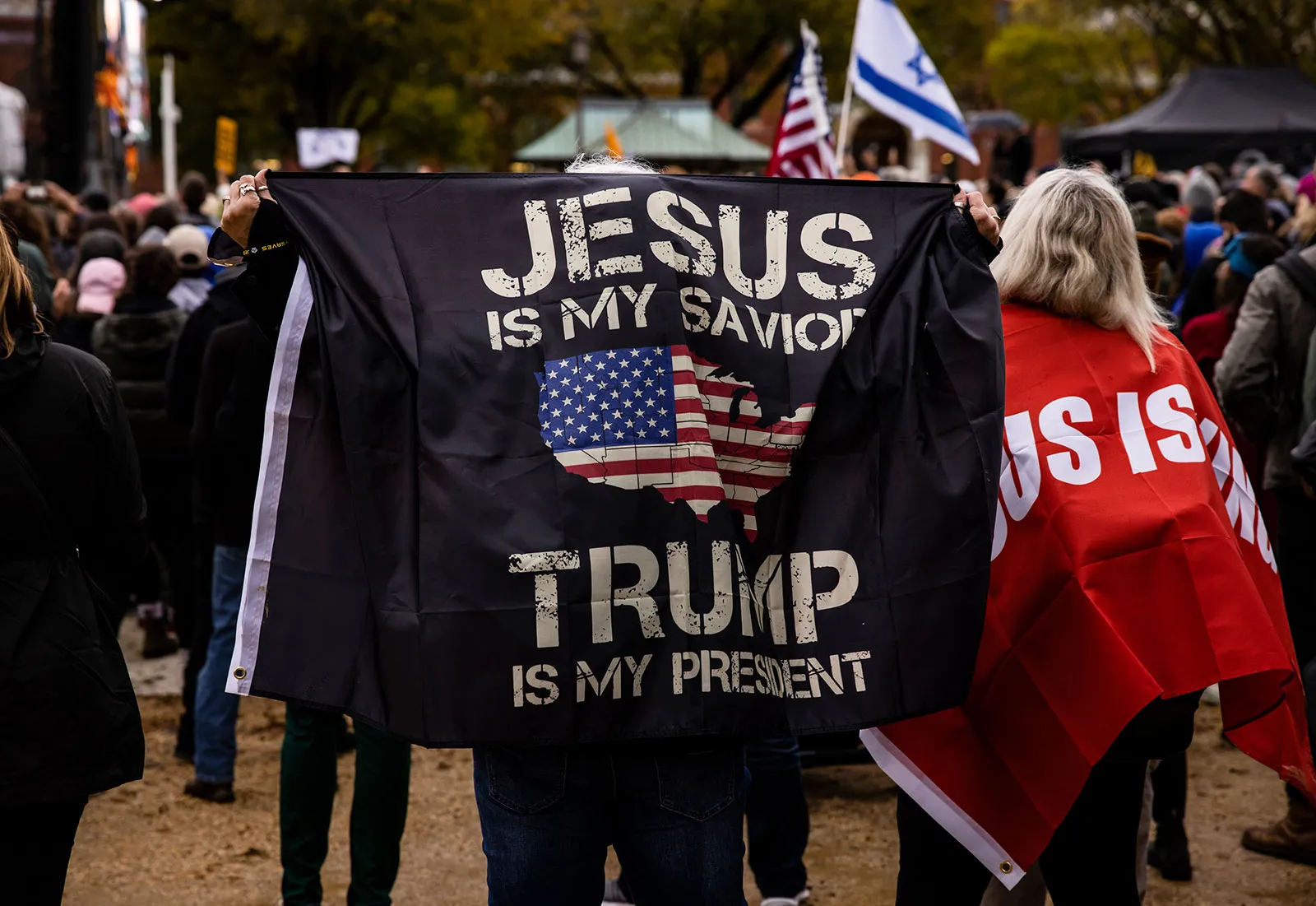
Last Sunday thousands gathered on the National Mall in a celebration blending Christianity, nationalism, military imagery, and devotion to Donald Trump. Crosses stood beside flags. Speakers praised America as a specially chosen nation. Calls for “strong borders,” “Christian values,” and “taking our country back” blended almost seamlessly with prayers and worship songs.
Watching it, I found myself thinking about today’s feast of Pentecost.
Because Pentecost presents us with a vision of God exactly opposite to the spirit of Christian nationalism.
Christian Nationalism
Christian nationalism tells us that our divine Creator belongs especially to one nation, one culture, one language, and one people. It imagines God as the protector of borders, armies, national destiny, and cultural purity. At its extremes, it turns Christianity into a religious justification for fear of outsiders, suspicion of immigrants, and hostility toward those judged foreign or threatening.
Pentecost says the very opposite.
The first reading from Acts could not be clearer. Luke almost overwhelms us with his list of peoples gathered in Jerusalem: “Parthians, Medes, Elamites, inhabitants of Mesopotamia, Judea and Cappadocia, Pontus and Asia…” The catalog continues almost tediously. But Luke’s purpose is deliberate. He wants us to understand something essential about the Holy Spirit.
The Spirit descends not upon one nation, but upon “devout Jews from every nation under heaven.”
And the miracle is not that everyone suddenly speaks the same language. The miracle is that each person hears the apostles “in his own native tongue.”
That detail matters enormously.
Pentecost vs. Empire
Empires always demand conformity. Political power typically insists on one approved language, one authorized culture, one acceptable version of reality. But at Pentecost, diversity (D.E.I.?) itself becomes the medium through which God speaks. The Spirit does not erase difference; the Spirit honors it.
Which means Pentecost stands as a direct challenge to much of what now passes for Christianity in the United States.
We are living through a period where immigrants are routinely described as invaders, criminals, parasites, and threats to civilization itself. Families fleeing violence or hunger are treated as enemies. Human beings seeking asylum are loaded onto airplanes in chains while politicians boast about deportation numbers to cheering crowds.
And all of this is increasingly wrapped in Christian language.
Crosses appear beside assault rifles. Bible verses are quoted at political rallies. Jesus is invoked to justify cruelty at the border and indifference toward refugees. The faith of the Sermon on the Mount is steadily transformed into a religion of walls, exclusion, punishment, and fear.
Pentecost vs. Locked Doors
Yet today’s Gospel begins with disciples hiding behind locked doors “for fear.”
That line may describe not only the apostles but our nation itself.
Fear locks doors. Fear builds walls. Fear turns strangers into enemies and neighbors into threats. Long before barriers are erected at borders, barriers are erected within hearts. We begin dividing humanity into “us” and “them,” the deserving and undeserving, the saved and the dangerous.
Then Jesus enters the room.
Notice what he does not say. He does not urge the disciples to protect themselves from foreigners. He does not call for the defense of traditional culture. He does not speak of national greatness or civilizational conflict.
He says simply: “Peace be with you.”
Then he breathes on them and says, “Receive the Holy Spirit.”
That image of breath is deeply important. In both Hebrew and Greek, the words for breath, wind, and spirit are intimately connected. The Spirit is the breath of God shared with humanity itself. In Genesis, God breathes into the earth creature and Adam becomes alive. Here in John’s Gospel, Jesus breathes once again, recreating humanity.
This means that every human being carries the same sacred breath. Not just Americans. Not just Christians. Not just people with passports or legal documents. Everyone.
That conviction lies at the center of biblical faith. Again and again Israel is reminded: “You yourselves were once strangers in Egypt.” The test of fidelity to God is never simply doctrinal correctness or patriotic fervor. It is always social practice. How are the vulnerable treated? How are outsiders welcomed? How are the poor regarded?
A Reversal of Babel
In terms of language, inclusion, equality, and understanding, Pentecost reverses Babel.
At Babel humanity united around domination and imperial ambition. The result was confusion and division. At Pentecost humanity rediscovers unity not through forced sameness but through mutual listening and understanding. The Spirit creates communion without demanding uniformity.
St. Paul expresses the same vision in today’s second reading: “There are different gifts but the same Spirit.” Different languages, different cultures, different histories — yet one body.
That understanding could hardly be further from the spirit now overtaking so much of American religion and politics with their denigration of diversity, equality, and inclusion.
Today Christianity is often reduced to tribal identity politics draped in religious symbols. The cross is wrapped in the national flag. Compassion is dismissed as weakness. Cruelty becomes strength. Public humiliation of migrants and refugees is treated as proof of political courage.
And those who seriously challenge such cruelty are quickly denounced.
In this context, think of Renee Goode and Alex Pretty. Their offense was their willingness to identify publicly with the excluded, the displaced, and the demonized. In response they have been ridiculed, attacked, and condemned — often by people who loudly proclaim themselves followers of Jesus.
That should not surprise us. The Spirit of Pentecost has always made respectable religion uncomfortable.
Because the Spirit exposes the contradiction between our worship and our politics. We pray “Come Holy Spirit” while supporting systems that degrade the foreigner, punish the poor, and normalize indifference toward suffering.
The Sequence we heard today may contain the most important prayer in the entire liturgy: “Bend the stubborn heart and will; melt the frozen, warm the chill.” For ours has become a frozen society.
We have grown numb to suffering on a massive scale. Migrants die of thirst in our deserts and drown in our seas. Families disappear into detention systems. Entire populations are bombed, displaced, or starved while much of the world watches passively. And most of us continue our ordinary routines scarcely disturbed.
Pentecost interrupts that numbness.
It insists that the foreigner speaks with a voice we are spiritually obligated to hear. It insists that God’s Spirit cannot be confined within national borders. It insists that no people are illegal in the eyes of the One in whom “we live and move and have our being.”
Of course, nations have the right to regulate immigration. Few would deny that. But Pentecost also makes clear that whenever fear, cruelty, and dehumanization become public policy, Christians are obligated to resist.
After all, Jesus himself entered history as a refugee child carried into Egypt by terrified parents fleeing political violence.
Today many who claim to follow him would likely report the Holy Family to immigration authorities.
That irony should stop us cold.
“Lord, send out your Spirit and renew the face of the earth,” we prayed in today’s psalm.
Conclusion
But renewal cannot happen while hearts remain locked behind doors of fear. The Spirit enters only when those doors are opened — when we finally recognize that the breath within ourselves is the same breath carried by the stranger, the refugee, the immigrant, and the excluded.
That is the real meaning of Pentecost. And it remains just as dangerous today as it was two thousand years ago.


Just a comment:
The Disciples met behind locked doors for fear of … Your recitation stops, however, the passage continues… “the Jews”. Leave the Jews out of it and insert “CROWD!” I have heard this passage referred to too many times when it comes to antisemitism.
Great narrative and comment – Thank You.
LikeLike
Thank you, William. The Catholic Church bears heavy responsibility for fostering anti-Semitism.
LikeLike