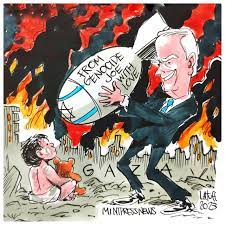
Apartheid Israel’s war in Gaza along with “Genocide Joe’s” unconditional support for the holocaust there have set me thinking not only about Israel’s settler colonialism, but about colonialism in general and resistance to its depredations. The rebellion is unfolding before our eyes without most of us even noticing it in those terms.
I mean, not only Gazans have risen against continued European and American control of their destinies. In practice, the insurrectionist impulse is shared by colonized people across the planet. They’re moving from empire’s periphery to imperial centers everywhere. It’s what our politicians call “the immigration crisis.”
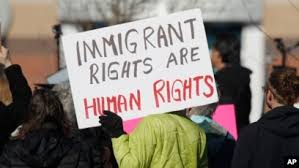
Consequently, I think it’s time to rethink and reframe what’s happening at our southern border. More than that, it’s time to reframe the question of immigration worldwide.
Let me try.
The Gazan rebellion has made me realize that planet-wide migration is not primarily a question of law, immigration reform, sacrosanct borders, and preventing the entrance “illegals” by walls and militarization of crossing points. Instead, it’s an issue of recognizing global population shifts from the Global South (Latin America, Africa, and South Asia) to the developed West for what they are:
A human rights movement (literally!) against artificial borders imposed by government’s representing the world’s white minority that comprises only about 12% of the global population, and yet insists on controlling the entire planet. (For instance, during the 19th century and afterwards, white Europeans arbitrarily created entire countries as part of their “divide and rule” policies in Africa, the Mideast, and elsewhere.)
An unprecedented rebellion against such exercise of white supremacy, control, and border determination.
A largely intuitive demand by workers that they be given the same rights as capital to move freely across borders
A kind of reconquista (reconquering) of geographical space stolen from ancestral peoples.
And even though few participants in the movement are aware of its historical significance and scale, the movement cannot be stopped. No matter what the white European and “American” elites might do, the migrants will keep coming.
That’s because the immigrants, refugees, and asylum seekers are implicitly operating from a largely unconscious grasp of the fact that the white European-American order is the root of the problem. The whole system has no moral ground to stand on. It conflicts with fundamental values that transcend and invalidate national borders.
Here my primary reference is to the UN Universal Declaration of Human Rights (UDHR).
In 1948, that Declaration recognized that human beings simply by virtue of having been born have inherent entitlements (yes entitlements!) that include rights to food, shelter, clothing, health care, education, meaningful work, a living wage, and to insured retirement at the end of their lives. That’s what The Declaration says.
And yet, the experience of the colonized is that whenever their governments have tried to implement policies to secure such rights for their people, the former colonizing powers [who btw form the core of the North Atlantic Treaty Organization (NATO)] under the leadership of the United States identify such governments as “communist.” They subject the offending authorities to regime change and to sanctions that work directly against the guarantees of the UN Declaration. The result is poverty, misery, hunger, unemployment, prison, torture, and death for millions of peasants, teachers, social workers, union organizers, and religious leaders.
Moreover, the white colonial elite have arrogated to themselves the supposed authority to unilaterally declare that the UDHR is only “aspirational.” For them it’s an abstract ideal that lacks the enforcement apparatus required for its implementation. [The U.S. has insured that the document will remain unenforceable by refusing to ratify the protocols guaranteeing its social provisions. In fact, it has withheld its ratification of the UDHR in general. Remember, it is a tiny minority of the world’s population (the whites) who impose such interpretation.]
Well, the current worldwide population shifts show that the globe’s non-white majority is no longer willing to recognize the authority of those who claim to be their betters. For the “invaders,” their human rights transcend the jurisdictional barriers erected on the whims of the white elite robber barons, bankers, lawyers, Wall Street tycoons, and their political appointees.
Again, nothing can stop the momentum of this drive — of this literal movement — for human rights. It’s a question of the world’s majority voting with their feet.
As for what to do about problems at our southern border . . .. The answer is relatively simple.
Sign off on the Declaration, including its “socialist” protocols.
Respect and promote the UDHR to enable and encourage Latin Americans to live free from want and fear without leaving their beloved homelands.
Accordingly, remove all sanctions from countries (like Cuba, Nicaragua, and Venezuela) that enact policies implementing the UDHR’s social justice protocols.
In general, stop interfering in the internal affairs of other countries.
Abandon regime-change aspirations.
Grant to labor the same rights that capital has to freely cross borders to where the money can be made. (Either that or restrict capital’s ability to cross borders with the same zeal applied to migrant workers.)
Divert the billions upon billions now spent at the border on walls and militarization of U.S. Customs and Border Protection to the rebuilding and repair of Latin American nations (such as Guatemala, El Salvador, and Honduras) for the catastrophic damages from “America’s” ruinous policies of the past and present.
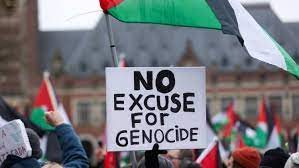
This past week, the world held its breath as South Africa’s top legal team pressed its case before the International Court of Justice (ICJ). The lawyers argued that the state of Israel is guilty of genocide by prosecuting its war against the people of Gaza.
On Thursday, the South Africans made their case in exquisite detail. It cited chapter and verse proving, the lawyers said, that Israel not only committed acts of genocide, but that according to its leaders’ own admissions, Israel did so with full genocidal intent.
On Friday the Israeli defense team gave their reply. It basically held that all of Israel’s actions including the deaths of 30,000 Palestinians (at least half of them children and women) are justified by the Hamas attacks of October 7th, 2023.
Final resolution of the case may take months or even years. Now however, we await the court’s preliminary directives.
Whatever those judgments and injunctions might be, the very fact that the world was forced to listen to the South African case against Israel represented a victory for the Palestinians and an education for the world at large – especially for the United States. That’s because the U.S. mainstream media (MSM) has largely excluded the Palestinian viewpoint from public awareness. In fact, to give sympathetic voice to the Palestinian perspective has been all but criminalized here.
Accordingly, since October 7th, Americans have been subjected to nonstop Israeli propaganda that presents the conflict in Gaza as though it began on October 7th — as though it was initiated without provocation by blood thirsty terrorists driven by irrational anti-Semitism.
So understood, that scenario gives to Israel the right to overlook international law and to follow a “morality” of revenge, collective punishment, ethnic cleansing, and even genocide. It is a “morality” completely supported by the United States.
The argument here is that such morality can have only highly disastrous effects.
To show what I mean, allow me to (1) summarize the case so eloquently argued by the South African legal team, (2) lay out Israel’s exceptionalist morality, (3) put the entire case in historical perspective, (4) apply Israel’s logic to that case, and (5) conclude with specific recommendations about legal responses to Israel’s policies.
South Africa’s Case
The case of the South African legal team was argued convincingly. It was founded on international law. The argument implied and/or specifically held that:
Illegal occupiers enjoy no right to self-defense.
Neither does any regime practicing apartheid. Apartheid is a war crime.
On the contrary, it is the illegally occupied who have the right of self-defense against their occupiers and any system of apartheid. That right includes taking up arms against the perpetrators in question.
No provocation, no matter how egregious justifies direct attacks on civilians.
In all cases, any response to terroristic attacks must observe the principle of proportionality. That is, Article 51 Section 6 of the UN Charter states that revenge attacks against civilian populations are strictly forbidden.
So are forced relocations of entire populations, deprivation of food and water to civilian populations, attacks on hospitals, medical personnel, schools, refugee camps, places of worship, and members of the press.
By ignoring such legal restrictions, the South African lawyers argued, Israel is guilty of genocide defined in law as “the deliberate killing of a large number of people from a particular nation or ethnic group with the aim of destroying that nation or group.” The lawyers bolstered their case with statements from Zionists all the way from soldiers in the Israeli Defense Force (IDF) to the country’s prime minister declaring their genocidal intentions.
Israel’s Syllogism of Genocide
In reply to the accusations just cited, Israeli lawyers laid out their case arguing that Israel’s right to self-defense justified all the actions listed by the South African barristers. The Israeli case and exceptionalist “morality” implies the quasi-syllogism immediately below:
Following unprovoked violent attacks on civilians by an enemy, the right to retaliate in self-defense overrides all moral principles and international law.
a) More specifically, it exempts the offended from all legal strictures against killing civilians including babies, infants, children, women, and the elderly in any way connected with attacks by the enemy in question.
b) In such cases, ethnic cleansing and genocide become morally justifiable.
2. But on October 7th, 2023, the Palestinian terrorist organization called Hamas violently attacked Israeli civilians near the Gaza border resulting in the deaths of more than 1000 Israelis (including many civilians) with over 2500 wounded.
3. Hence, according to the above-stated moral principle, Israel’s right to retaliate in self-defense overrides all other moral principles and international law. It exempts Israel from any legal strictures against killing civilians including babies, infants, children, women, and the elderly in any way connected with attacks by the enemy in question.
Such moral reasoning apparently makes sense to the political leaders of Israel and to most Israeli citizens. It also has been embraced by the political class of the United States, by its mainstream media (MSM), and by many U.S. citizens. For them, Israel’s right to self-defense reduces any talk of genocide (and of ceasefire) to anti-Semitism.
Arguably, this is because the relevant reasoning processes of those just mentioned begin on October 7th, 2023. Hamas struck first, they argue. It is therefore responsible for the violence now directed against it. Hamas has only itself to blame.
Historical Perspective
However, following Israeli logic, the situation changes, if the one’s thinking begins not on October 7th, 2023, but more than 100 years ago. That’s when European Jews supported by Great Britain committed what Pakistan’s UN envoy Munir Akram called the “original sin” in Palestine.
It was in 1917 that Great Britain exercising illegal imperial power issued its infamous Balfour Declaration. Without moral right and absent consultation of the indigenous of Palestine, the decree created a national home for Jewish Europeans from Russia, Poland, Lithuania, Latvia, Estonia, and other countries where they had a long history subjected to anti-Semitic pogroms and persecutions.
Of course, the indigenous of Palestine experienced the arrival of European settler colonists with the same sort of resentment and sporadic resistance that Native Americans experienced when white conquerors from Europe arrived on the shores of Abya Yala. The latter came with their religious prejudices too, every bit as strong as those of Zionist fundamentalists. Like the latter (as recalled by Enrique Dussel in his Invention of the Americas) the settler colonialists from Europe considered the indigenous “human animals.” As sub-humans, they automatically forfeited their resources to the civilized new arrivals with their “holy Catholic faith.” It granted them rights to the “new world” ratified by the pope himself, the very representative of God on earth.
Palestinian resentment and resistance were compounded in 1948, when following the horrors of Hitler’s Holocaust, European Jews flooded Palestine. The settler colonists destroyed 531 Palestinian towns and villages, stole the homes of their inhabitants, committed more than 70 massacres, and killed more than 15,000 Palestinians in the process.
It’s no wonder that the Palestinians remember the sequence of events as The Nakba (the Catastrophe). It’s also no wonder that Palestinians aided by key elements of the Arab world fought two wars of resistance in 1967 and 1973 as well as implementing two major campaigns of largely peaceful resistance (Intifadas) against the settler colonists from 1987-1993 and from 2000-2005.
To all this, Israel responded with overwhelming violence taking thousands of Palestinian lives. The most recent non-violent campaign, the Palestinian’s “Great March of Return” in 2018 saw 214 protestors (including 46 children) killed by Israeli sniper fire. More than 36,100 (including almost 9000 children) were also wounded. Virtually none of this received due attention in the U.S. MSM.
Noam Chomsky summarizes the atrocities just described using the Israeli phrase “mowing the lawn.” That refers to the Israeli practice (at least since 2005) of periodically invading, bombing, and imprisoning (often without charge) thousands of Palestinian civilians. Chomsky enumerates the steps as follows:
A truce accord between Israel and Hamas is established.
Hamas lives up to it.
Israel violates it.
Israel escalates the violation.
This elicits a Hamas response.
The reaction provides a pretext for what Israel calls “mowing the lawn” – i.e. one of its major periodic attacks on Palestinians.
Then comes the western propaganda: “Poor Israel is attacked by rockets. What can it do? They must defend themselves.”
If Hamas Followed Israel’s Moral Logic
Keeping in mind the history just recounted as well as Israel’s “moral” logic about self-defense and dispensation from observing international law and prohibitions against revenge, collective punishment, ethnic cleansing and even genocide, Hamas was perfectly within its rights to perpetrate its acts of violence on October 7th. In fact, those acts compared to Israel’s can be characterized as restrained and moderate.
In any case, following Israel’s logic, here’s how Hamas’ quasi-syllogism might run:
Following violent attacks on civilians by an enemy, the right to retaliate in self-defense overrides all moral principles and international law.
a) More specifically, it exempts the offended from all legal strictures against killing civilians including babies, infants, children, women, and the elderly in any way connected with attacks by the enemy in question.
b) In such cases, ethnic cleansing and genocide become morally justifiable.
2. But for the past 100 years and more, Israel has violently attacked Palestinians resulting in the deaths of thousands of Palestinian civilians with many other thousands wounded and maimed.
a) Hence, according to Israeli “moral principles,” Hamas’ right to retaliate in self-defense overrides all moral principles and international law.
b) More specifically, it exempts Hamas from any legal strictures against killing civilians including babies, infants, children, women, and the elderly in any way connected with attacks by the enemy in question.
3. And so, Hamas can claim the moral right to ethnically cleanse Israel of its entire population and to commit acts of genocide against it.
Conclusion
Of course, the point here is not to argue for the genocide of anyone. It is only to underline the absurdity and danger of Israel’s (and the United States’) blatant disregard of international law and common-sense morality.
It is also to make the point that Israel’s logic cuts both ways. If its attacks on Gazans are justified by Palestinian atrocities, Palestinian attacks on Israel are even more justifiable. That is, it might be argued that the Palestinians as victims of Israel’s “original sin” and repeated atrocities over the last 100 years have much more right to revenge than their colonial occupiers.
In any case, if Israel and its U.S. enablers are found guilty of genocide by the ICJ, the country’s leadership, and its weapons suppliers (including the U.S. President and Secretary of State) should be placed under arrest.
So should those identified as responsible for the planning and execution of Israel’s particularly egregious war crimes. All should be tried following the example of the post-World War II trials of Nazi war criminals at Nuremberg. Those convicted should be executed or given lengthy prison sentences as were the German war criminals found guilty during the Tribunal held from 1945-1948.
Happy New Year to everyone. The last four years (with COVID and all) have been rough.
Let’s hope that 2024 will be better, despite the continued war in Ukraine and the horrific and ongoing genocide in Gaza. But before I get to that, let me share a personal note about my own privileged life.
I’m writing from Clearwater Beach Florida, where Peggy and I arrived last Saturday (December 30th). Like so many retirees, we’re seeking refuge from winter weather, and we find Clearwater to our liking. For a fourth or fifth year, we’re renting in a 10-story high-rise condo complex on a beautiful beach comfortably far from the honky tonk part of this small town. We’re about a mile’s walk from a state park called “Honeymoon Island.”
As some may have noticed, my blogging has been spotty lately. That’s largely because I’ve been recovering from knee replacement surgery which I underwent on November 8th. Recovery has been rapid for me. In fact, my replaced left knee now feels better than my right knee, which I intend to undergo an identical procedure sometime in April.
Peggy also had a knee replaced – about five weeks before my procedure. So, we’ve been busy helping each other convalesce. You know what they say: “A couple that has surgery together. . ..”
So much for such medical issues that I find myself talking about much more than I should.
Now, what about this New Year?
Sorry: my reflections are not happy. In fact:
I even find it hard to say the words “Happy new year!”
Don’t you?
I can’t stop thinking about the thousands and thousands of children, women, and old people being mercilessly slaughtered by the genocidal Zionists.
Or about the one many now refer to as “Genocide Joe” for his arming and otherwise supporting the Israeli war criminals. Who could vote for such a demon?
More than 22,000 massacred so far.
Again, more than half children, women, and old people.
I dreamt about them last night.
I’m wondering why the Pope and other religious leaders have not been more outspoken denouncing apartheid Israel’s atrocities that include collective punishment, population transfer, starvation, water deprivation, unrelenting attacks on hospitals, ambulances, schools, UN facilities, and members of the press.
Every item on that list is a war crime.
Where in all of this is “Love your enemies,” “Do unto others as you would have them do unto you,” “Whatever you do to the least of my brethren, you do unto me”?
It’s such a disgrace. It makes me wonder about the value of religion at all.
I’m also scandalized by the way war has become such a central part of U.S. policy. It’s now a first resort instead of a last one. And somehow, we all accept that as normal.
I mean our “leaders” now talk casually about use of nuclear weapons, and about war with Iran and China.
What for?
No thought of diplomacy. It’s simply a lost art.
And what about the U.S. with 4.2% of the world’s population overriding the expressed desire of virtually the entire world to simply stop the killing in Gaza?
Reluctance to call for a cease fire? What’s that about?
And did you see that Brown University report that since 2001, the United States has been responsible for as many as 4.5-4.7 million deaths in the war zones it has created?
And that’s just since 2001. Millions and millions before that!
Are we and the other colonial powers any better than the Nazis?
It’s hard not to draw the conclusion that “our” government (like Israel’s) is simply a criminal enterprise much, much worse than any Mafia you care to imagine.
That’s our tax dollars at work.
That’s us!
That’s U.S.
The only hopeful thing I can think of in this desperate situation is that THE TRUTH IS COMING OUT:
We are not the world’s good guys.
Quite the opposite.
Now the whole world unmistakably sees us for who we are.
The undeniable evidence is there in the ruins of Gaza.
In those piles of dead Palestinian babies, their mothers, and grandparents.
We are exactly in the position to which Adolph Hitler aspired.
The irony is that our Zionist allies are now the genociders and so are we and the collective West.
Our country is genocidal.
We’re basically white European colonizers who believe in our racial superiority and with less than 15% of the world’s population want to control the other 85%.
It looks like Hitler won that war, doesn’t it?
Fanon‘s Wretched of the Earth are now rising up to reverse his victory.
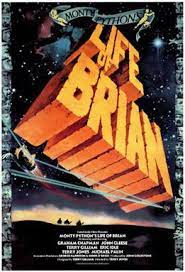
Over the Thanksgiving holiday, our family watched together one of our favorite films, “Life of Brian.”
It’s the comic story of Brian Cohen, a Jewish man born on the same night as Jesus of Nazareth in an adjoining stable. Like the historical Jesus (described for instance in books like Reza Aslan’sZealot), Brian becomes part of a political resistance movement intent on expelling Roman occupiers from the Jewish homeland.
Setting comedy aside, what struck me this time while watching the film were its undeniable and highly ironic echoes of the current struggle in Palestine between Jewish colonial settlers there and resistance movements such as Hamas, Hezbollah, and al Fatah. That’s because the movie successfully portrays the overbearing nature of Roman imperialism itself, the consequent resistance of Israel’s people, and the power of Rome’s “divide and rule” tactics bolstered by highly effective imperial propaganda.
I find the same techniques employed today in Israel’s struggle with Hamas. Like the Romans in the first century, the settler-colonial regime in Israel seeks to impose its will on indigenous Palestinians by overwhelming force of arms. The Zionists employ imperialism’s traditional “divide and rule” strategy. They also disseminate powerful propaganda that to this day convinces many of the benign nature of colonial robbery and oppression.
Let me show you what I mean.
The Life of Brian
As already indicated, “Life of Brian” portrays a biography that parallels in many ways the life of the prophet, Jesus of Nazareth. Both along with thousands of other Jewish insurgents suffered crucifixion under Rome’s cruel imperialism. (Remember, crucifixion was a form of capital punishment reserved for insurgents, revolutionaries, and related “terrorists.”)
Despite that threat, Brian decides to join one of the many Jewish resistance movements that characterized early first century Israel. Young and naïve, he seems unsure of his exact motivation. But it’s somehow connected with trying to impress a girl in the movement called Judith.
Because of his “success” in covering Jerusalem’s walls with anti-Roman graffiti, Brian soon finds himself gradually moving up in the ranks of The Jewish Resistance Front. He also becomes associated with resistance preachers who, like Jesus, find anti-Roman inspiration in Judaism’s religious traditions. People gradually come to regard him as a prophet.
Somewhat reluctantly fulfilling that role and after many narrow escapes from the pursuing Roman occupiers, Brian is finally arrested. In the end, he’s crucified like Jesus who, of course, found himself identified as a prophet as well.
Divide and Rule
In terms of understanding Roman and today’s Zionist imperialism, “Life of Brian” places high emphasis on Rome’s infamous tactics of “divide and rule.” This means setting resistance groups against one another, so that they end up identifying comrades in arms as enemies rather than their real oppressors, the foreign occupiers themselves. To the bemusement of the Roman occupiers, “The Jewish Resistance Front” finds itself at odds with “The People’s Front of Judea,” “The Front for Jewish Resistance,” and with “Jews against Roman Occupation.”
The effectiveness of “divide and rule” is portrayed in a key scene in “Life of Brian” where members of two opposition movements meet on their way to a kidnapping (a traditional resistance tactic employed even today by Hamas). In any case, the two groups end up fighting each other over whose idea it was to employ the tactic. Meanwhile the Roman military observes the encounter from afar– as if they were unaware of Rome’s deliberate complicity in sowing discord among resistance movements.
Similarly, “Life of Brian” portrays the complete effectiveness of propaganda both in our contemporary world and even among those suffering directly under foreign occupation. In the contemporary world, our schools portray Rome as somehow benign and beneficial to the occupied. In doing so, our teachers forget the telling words of the Briton insurgent, Calgacus (as recorded by Tacitus). Calgacus reportedly said “ubi solitudinem faciunt pacem appellant.” (They create a desert and call it peace.) The Romans were brutal.
According to “Life of Brian,” that propaganda’s effectiveness was accepted even by those directly experiencing the brutality. In one memorable scene, a resistance leader gives a speech whose central question asks, “What have the Romans ever done for us?”
In response the leader’s audience end up listing one after another, benefits such as sanitation, the aqueducts, education, safe streets, wine, and peace. In so doing, they put the leader to shame. He must admit such benefits of the Roman Empire.
Forgotten in all of this is that the benefits listed overwhelmingly belonged to the imperial center, Rome itself, and typically not to remote and “backward” provinces. The Romans weren’t interested in educating Jewish provincials. Any roads they built were meant to ensure quick passage by Roman Legions responding to outbreaks of Jewish rebellion.
Above all, Jews could hardly consider streets patrolled by Roman occupiers as somehow “safe.” Nor could they consider their occupiers as bringers of peace. Again, the Romans had no respect for Jewish life. Recall that in the end (70 CE) the Romans absolutely wiped Jerusalem and its temple off the map. They killed more than a million Jews and enslaved 97,000 more. Safe streets for Jews was not high on their list of priorities. What the Romans called peace was the tranquility of the graveyard.
Imperialism in Contemporary Israel
Figures like the ones just cited remind one of the brutalities of today’s Zionist occupiers of Palestinian territory. In a few short weeks since October 7, 2023, the settler-colonialists have slaughtered more than 14,000 Palestinians – half of them children, women, and the elderly.
At the same time, forgotten in all of this is the history of Israel’s “creation” of Hamas as a force against other Palestinian resistance movements such as Hezbollah and al Fatah. Yes, by all accounts, Hamas is a Zionist product. It represents their implementation of Rome’s infamous “divide and rule” strategy.
Similarly, Zionist propaganda has persuaded many beyond Palestine of the following absurdities, viz., that:
Zionists illegally occupying Palestinian territories have the right to self-defense. As illegal occupiers, they do not.
Meanwhile, those illegally occupied do not have the right to self-defense. UN Charter Article 51 says they do.
We should unquestioningly believe Zionist accounts of Hamas’ attacks on Jewish settlements on October 7th, 2023, even if the only sources of those accounts are Israeli officials who have repeatedly lied to us before.
The alleged brutalities of Hamas attacks nullify the application of international law forbidding population transfer, collective punishment, the bombing of hospitals, schools, and United Nations facilities.
Cutting off food, water, and electricity are legitimate military tactics.
All Palestinians (including babies and children) are somehow legitimate targets of Zionist bombs and artillery fire.
Conclusion
After watching Monty Python’s “Life of Brian,” the conclusion I’ve reached is that imperialism is imperialism. On the one hand, it is a system of robbery intended to transfer resources from resource-rich provinces to a resource-poor imperial centers such as Rome. As such, imperialism has no humanitarian intent.
On the other hand, imperialism (like Zionists in Palestine) establishes location in an area rich in resources (like the Middle East floating on its ocean of oil). In the latter case, the purpose is to protect the resource in question from control by those to whom the resource belongs (viz., the Arab nations).
The imperial tactics that ensure such resource transfer and control are those depicted in “Life of Brian.” They involve setting resistance movements against one another and spreading propaganda that has the rest of us (and even some of the colonized) believing that the oppressors are world benefactors, and that their indigenous opponents are somehow terrorists.
As I see it, “Life of Brian” should awaken viewers to such absurdities.
Simply put, empire is empire. Robbery is robbery. Propaganda is propaganda.
The film warns us: open your eyes; identify your real enemies; don’t believe the lies.
Yes, thank God for Hamas. At least that’s what I’m thinking. Hamas could be the unlikely agent of God’s revelation.
That Hamas possesses such agency seems likely in the light of the Judeo-Christian and Islamic traditions in general and in that of the liturgical readings for this Thirtieth Sunday in Ordinary Time. All three can enable discerning people of faith to see past western propaganda to what Hamas is actually up to. Hamas is lifting the veil to help us identify who’s responsible for most of the world’s problems. It’s the United States and Israel. Both represent brutal criminal enterprises.
That’s my two-point message for today. it’s one that we’d do well to let into our consciousness blinded by nonstop propaganda that hates Muslims and the poor, that hates non-whites, and those who dare to defend themselves against imperialists, colonialists, and racists.
So, don’t expect here the de rigueur denunciation of Hamas’ “atrocities.” In terms of freedom and justice for Palestine’s oppressed, that requirement is deceptively counterproductive. It creates a detestable false equivalency between the tactics of resistance fighters on the one hand and the infinitely worse barbarisms of their overlords on the other. Once again, it ends up justifying Israel’s slaughter of their concentration camp captives.
[By the way, Pakistan’s UN ambassador, Munir Akram, recently said something like that to the General Assembly. He refused to criticize Hamas unless Israel was also criticized as the root cause of the crisis in Israel-Palestine. But, of course, the U.S. and Israel refused to allow such critique. (Be sure to view Akram’s speech above.)]
No, my points for us living within a nearly impenetrable “veil of ignorance” are to affirm that (1) Hamas may well be the agent of God’s revelation, and (2) the scriptural traditions of the Judeo-Christian and Islamic traditions suggest that strongly.
Hamas
To begin with what do we know of Hamas? I mean, what do we really know that’s not filtered through western (i.e., through imperial and colonial) propaganda machines?
The answer is, “almost nothing!”
Think about it. What we know of Hamas comes from its inveterate enemies. It’s like getting information from the Nazis about Jews in the 1930s. And we fall for it every time. I think Goebbels said something about that.
In other words, our information about Hamas comes from proven compulsive liars (like the colonialist Benjamin Netanyahu, the imperialist Joe Biden, and their lackey press corps). Uniformly, they tell us:
Hamas cadres wantonly killed innocent young people spraying them down with machine gun bullets at a rave dance. (Nothing about crossfire.)
Unlike Apartheid-Israelis who hold more than a thousand Palestinians in custody (often without charge) Hamas has no right to take political prisoners.
After all, hostages and political prisoners are not the same.
Hamas militants even beheaded infants and children. Joe Biden said he saw the photos. (Later, his team “walked that back.”)
They raped women. (No evidence. Again, a claim “walked back.”)
Their rockets, not Apartheid-Israelis, destroyed a Gazan hospital. (Without investigation, Joe Biden believes that too – on the word of the highly principled Benjamin Netanyahu.)
They’re worthy of condemnation because they have chosen violence over the non-violent tactics so obviously favored by virtuous Apartheid-Israelis and Apartheid-Americans. [Nothing about Palestinians’ non-violent “Great March of Return” (2018), Apartheid-Israel’s brutal response killing hundreds, and the general lack of coverage in the west’s mainstream media.]
That’s what we know about Hamas. Am I right or wrong?
And every one of those allegations is a lie or at best a prevarication containing a tiny grain of truth. Every one of them!
I won’t waste my time or yours debunking them one-by-one. You can find that information elsewhere.
Instead, let me tell you briefly what we’re never told about Hamas. (You can find all this on Wikipedia):
To begin with, it is a political organization democratically elected by the people of Gaza in 2006.
It is also a religiously inspired social services collective that funds welfare projects helping people survive the hardships of hostile governments throughout the Middle East.
It represents a kind of Islamic theology of liberation that (in the name of the biblical and Koranic God of the poor) serves the impoverished and embraces the right to revolution recognized by Article 51 of the UN Charter.
For instance, in Gaza, Hamas provides food, water, medical and rent assistance for residents. It funds nurseries, schools, orphanages, soup kitchens, women’s activities, library services, and sporting clubs. That’s the foundation of its popular support.
And, of course, Hamas also has a powerful military wing to defend Gazans from the atrocities that Apartheid-Israelis have routinely inflicted on Palestinians for the last 70 years.
As such, according to international law, it enjoys the legitimacy accorded those resisting illegal occupation by foreign powers. (As illegal occupiers and aggressors, Apartheid-Israelis have no such corresponding rights.)
With all that in mind, Hamas atrocities turn out to be no different (except in their lesser severity) from those of the Apartheid-Israelis which preceded and followed upon them.
In the Palestinian case, they are acts of anger and vengeance for a whole series of brutalities inflicted upon them by their oppressors for the last 70 years. Those acts are far more understandable and justifiable than the acts of Apartheid-Israel that preceded and followed them.
Agent of Revelation
Moreover, (and this is a principal point in this homily) whatever you might think of its tactics today, Hamas is functioning as the agent of God’s revelation as articulated in this Sunday’s readings.
And here I’m using the word “revealing” in its etymological sense – removing the veil.
That is, (according to Scott Ritter ) Hamas has forced Apartheid-Israel and Apartheid-America to show their true colors. As a result, we finally see the blood drenched palette every day on our TVs. Simply put, the colonizer and its imperial sponsor have revealed themselves as brutal reincarnations of that other genocidal European force whose name can barely be printed in the mass media. Apartheid-Israel and Apartheid-America are revealing themselves to be racist, white supremacist, and N*zis.
According to Ritter, such revelation is what Hamas’ strategy is all about. They desperately realized that the settler invasions and occupations of Palestinian lands coupled with Israel’s Abraham Accords with surrounding Arab nations signaled a window closing on any hopes for an independent Palestinian state.
So, Hamas decided to force Israel’s and America’s brutal hands. They took up arms against their concentration camp captors. And the captors reacted in exactly the way Hamas knew they would – by bombing the concentration camp itself. Their keepers responded with wholesale slaughter of women and children – with obvious war crimes, ethnic cleansing, and outright genocide.
And the world finally noticed. The Hamas tactic worked. Everyone (outside the western bubble) now sees Israel and the United States for the criminal enterprises they are.
Both the latter claim to embrace the Judeo-Christian tradition. But nothing could be further from the truth. It’s all hypocrisy.
Just read today’s first selection from the Book of Exodus. It’s so short and to the point that I risk quoting its first paragraph verbatim here:
“Thus says the LORD: ‘You shall not molest or oppress an alien, for you were once aliens yourselves in the land of Egypt. You shall not wrong any widow or orphan. If ever you wrong them and they cry out to me, I will surely hear their cry. My wrath will flare up, and I will kill you with the sword; then your own wives will be widows, and your children orphans.’” (Ex 22:20-26).
And then there’s today’s Gospel selection from Matthew. Confronting the upperclass Pharisees and Sadducees whom the Jewish Yeshua saw as blaming the victims of the Romans (in the case of the Pharisees) and directly cooperating with their imperial oppressors (in the case of the Sadducees) he reminds them that they must love those they despised. “Love your neighbor as yourself,” he says.
Those words expressed the Christ’s mystic insight that all humans are one single entity. We are all equally “chosen.” We are more than brothers and sisters. Our neighbor is Our Self. In killing Palestinian women and children, elders, teachers, doctors, nurses, first responders – and Hamas supporters – we are committing suicide. We’re killing our common indwelling Spirit.
All that promises to become even more apparent as Israel’s genocide of Palestinians continues while the whole world is watching. The horrific revelation will continue.
Conclusion
So, yes, I’ll dare to say it: thank God for Hamas. Yes, it’s removing our veil of ignorance. In that sense, it is the agent of God’s re-veil-ation. The thousands and thousands Apartheid-Israel is executing before our eyes are martyrs reminiscent of the early Christians. They are revealers too.
The world’s poor, the Global majority living in the West’s former colonies and current neo-colonies see that more clearly than any of us. While Israel and the U.S. scandalously oppose a cease fire, the Global South (i.e., the world’s vast majority) supports it.
It’s far past the time for westerners like us join their chorus demanding that the criminal Apartheid-Israel state and its criminal American counterpart STOP THEIR CRIMINAL OPPRESSION.
Like Scott Ritter, I find myself praying for the complete defeat and humiliation of Apartheid-Israel — and of the United States on every front.
Readings for 29th Sunday in Ordinary Time:Isaiah 45: 1, 4-6; Psalm 96: 1-10; 1st Thessalonians 1: 1-5b; Matthew 22: 15-21
During Apartheid-Israel’s genocidal assault on Palestine, we’re privileged to be confronted each week with readings from the “holy books” of the Judeo-Christian tradition. Muslims of course also consider those sources as divinely revealed.
Since Apartheid-Zionists invoke that shared tradition to justify their policies, let’s examine them closely.
This week’s selections are particularly relevant to the current ongoing slaughter inflicted by Apartheid-Israel because they raise questions concerning God’s so-called “chosen,” and of their relation to imperialism and colonialism – all concepts that figure prominently in what’s unfolding today in Palestine.
The central idea in today’s readings is that those who side with empire cannot pretend to belong to Israel’s God. There can be no dual citizenship simultaneously in empire and God’s Kingdom.
That simple idea applies both to Apartheid-Zionists and their American supporters whose imperial identity and unconditional support for Zionism makes them Apartheid-Americans.
Instead, today’s readings reveal that it is non-Jews who because they liberate captives from empire, qualify as God’s “chosen” – even as messianic.
They are the ones who belong to the Kingdom proclaimed by the Jewish Prophet Yeshua whose program (as he put it) was to bring good news to the poor, sight to the blind, liberty to captives, and a Jubilee Year centralizing debt forgiveness (Luke 4: 18).. Being “chosen” was not a question of ethnicity, he said, but of doing the right thing in favor of the oppressed and poor.
Today’s Gospel selection from the Jewish Matthew is also strongly anti-imperial as well as anti-hypocritical. It deals with the question of paying taxes to Caesar.
Let me show you what I mean by (1) recounting the most relevant shocking facts unfolding in the Middle East while the whole world is watching; then (2) sharing my “translations” of the readings for this 29th Sunday in Ordinary Time; (3) pointing out their relevance for Apartheid-Israelis and their U.S. enablers as together they ethnically cleanse the Gaza Strip, and finally (4) drawing some conclusions about the entire situation.
Israel-Palestine Today
Thursday night U.S. President Joe Biden pledged unwavering, unconditional support of Apartheid-Israel.
Assuming his leadership of NATO colonial powers (against the rest of world opinion) he proclaimed that Apartheid-America is:
What holds the world together,
Is universally loved,
Exceptional,
Indispensable,
All-powerful,
And unconditionally allied with Apartheid-Israelis,
Who in the face of Hamas’ pure evil,
Are admirably strong and resilient.
The president made these claims just after having:
Claimed (without any investigation or citing any evidence) that Hamas (“the other team” as he put it) not Apartheid-Israel was the one responsible for the war crime of destroying a large Gazan hospital at the cost of at least 600 Palestinian lives, not to mention the seriously injured,
Rejected (according to Alexander Mercouris) proposals to empower an independent investigation into that claim,
Been slapped in the face by Arab leaders who refused to meet with a U.S. president.
Vetoed a UN Security Council proposal calling for a humanitarian pause in Apartheid-Israel’s bombing campaign which had already claimed 3000 Palestinian victims, more than half of whom were women and children.
In the face of such hypocrisy, Mr. Biden’s claims about Apartheid-America appear pathetic, out-of-touch, and almost laughable. The aging president appeared to “protest too much.”
But over-protest is what declining empires have always done. Before their fall, they routinely divinize themselves, claim omnipotence, and pretend to be interested in peace.
That’s what the Roman Empire did. Or as Tacitus put it: “They create a wasteland and call it peace.” Romans even minted coins identifying the counterpart of Mr. Biden – Mr. Caesar – as God himself.
Imperial subjects have always seen right through such idolatry, drivel, and tired slogans. In response, they laugh, or cry, or like Hamas kill those who sympathize with or cooperate with apartheidism and its imperial supporters.
In today’s Gospel selection, Yeshua takes the humorous approach. He tricks his opponents into admitting their own hypocrisy. Going against their own rules, they’re exposed as bearers of idolatrous images on the occupiers’ coins.
Let’s look at the readings. What follows are my “translations” in the light of the remarks I’ve just made. Check out the originals here to see if I got them right.
Today’s Readings
Isaiah 45: 1, 4-6

600 years before Jesus, the Christ,
The LORD chose a non-Israelite,
Cyrus, king of Persia,
As His Anointed!

Yes, He tapped Cyrus,
As his “Christ,”
Because that non-believer liberated
Israeli captives
From their Babylonian Captivity.

And this
Though Cyrus
Knew nothing of “The LORD,”
But merely did the right thing,
By freeing the enslaved.

This means that
The all-powerful
Divine Parent
Doesn’t care
About “nationalities”
Or nation states
About “Israel” or “Persia,”
But only about justice and liberation
Of the downtrodden!

Psalm 96: 1-10

For such holy Carelessness
Because the Divine One
Loves us all,
Regardless of our origins
Or intellectual beliefs,
We are all grateful and happy!

1st Thessalonians 1: 1-5b

For instance,
Paul’s community in Thessalonica
Found location in Greece,
Not Israel.
It housed both Jews and Gentiles.
Their identity was based
On commitment to peace,
And on faith expressed
By sharing solidarity
With the poor
Identified by Yeshua
As God’s favorites
And liberating them
As the whole point
Of his prophetic work.

Matthew 22: 15-21

Jeshua's opponents
The populist Pharisees
And Roman puppet Herodians
Knew nothing of
God’s universal love.
While denouncing idolatry,
They hypocritically
(And against their own law)
Carried Roman coins,
Identifying Caesar
(Not the Divine One)
As God.

So, the trickster Yeshua
Turned the tables on them all,
Charging
That such hypocrisy
Meant that they
Belonged to Caesar,
Not to God!

For Yeshua,
Paying taxes wasn’t the issue.
Religious hypocrisy was.

The irreverent
Construction worker
From nowheresville Nazareth
Was so funny,
And such a smart debater!
Conclusion
The title of this homily is meant to highlight what I’ve just said. It underlines the fact that no nation – not Israel, not our own, not anybody’s – deserves “unconditional support.”
That’s because nation states are just fictions. Think about it. They are devices used by the rich and powerful (who often have stolen “their” land from indigenous people) to artificially separate a single people for purposes of dividing, ruling, and self-enrichment by way of practices like the taxation Jesus refused to endorse. Here by “single people,” I’m talking about humanity itself.
As for the indigenous themselves, every tribe believes it was divinely chosen (and in some sense, I guess they are). All indigenous people believe that the land their ancestors originally inhabited is exceptional and directly given to them by some Divinity.
And of course, in the case of Israel-Palestine, Apartheid-Israelis are not “the indigenous” and never were. They arrived in Palestine in 1948. They were European colonizers from places like Poland, Romania, Hungary, Russia (and lately) from the United States. And as Chomsky points out, any ownership claims based on 2000-year-old religious mythology can have no serious political standing in the modern world. To claim otherwise borders on the superstitious and ridiculous.
Moreover, even Zionists’ Exodus traditions admit that more than 3000 years ago, invading Hebrews from Egypt took part of Palestine from indigenous Canaanites and others by force of arms. I’m referring to Hittites, Amorites, Perizzites, Hivites, Jebusites, Geshurites, Maacaathites, and Philistines. All of those represent the indigenous ancestors of the Palestinians whose presence in the Holy Land long predated the arrival of Hebrews.
The bottom line is, however, that In the end, God or Source, the Ground of Being, the Divine Mother, Truth, or Life Itself (however you understand Ultimate Reality) doesn’t give a damn about ethnicity or race or national identity – except when they are used by imperial agents to divide and rule.
In fact, the Holy Books of the Judeo -Christian tradition make that point again and again. Most of the Bible’s books record the infidelities of Israel’s leadership and God’s punishment for their routine infidelity. This morning’s readings are no different. Neither are the events unfolding in Apartheid-Israel today.
As I listen to the debate surrounding the awful events unfolding in Israel Palestine, I can understand how many are fooled by the one-sided pro-Israel propaganda circulated in the mass media and by their refusal to understand the Palestinian viewpoint. The media’s welter of misinformation and knee-jerk support for U.S. policy in the Middle East coupled with their implicit appeals to sentiments of revenge can be confusing even for the well-informed.
To clarify my own thinking, I feel compelled to express in writing what I think about the tragic drama as it unfolds.
So, for what it’s worth, please let me share my tentative conclusions. Perhaps they might help others formulate their own positions which, of course, may differ drastically from mine.
In any case, here are my tentative thoughts distilled into 25 points:
As a person of faith and a critical thinker, I can NEVER support empire.
That’s because I’ve come to realize that empire is a system of robbery whereby a militarily stronger nation imposes its will on a weaker nation for purposes of transferring the latter’s resources to the imperial center. That’s criminal.
Currently, the United States is the planet’s only empire.
As Martin Luther King said, it is the “world’s greatest purveyor of violence.” As such, it has NO moral right to render any judgments about the immorality of violence. None!
This means I cannot NEVER support the foreign policy of the United States. With less than 5% of the world’s population, it seeks to control the entire planet by the violence just mentioned as well as by a system of unequal trades, war, sanctions, regime change, and routine support of dictators. Again, all of that is criminal. It makes no moral sense to support U.S. empire.
By the means just mentioned and ever since the Second Intercapitalist War (WWII), the United States has exercised the same power Adolph Hitler sought in the decades of the ‘30s and ‘40s.
In that sense, it is a fascist regime that historically has supported fascists throughout the world. It NEVER supports the people its system has impoverished. It is ALWAYS on the side of the rich and powerful and instinctively opposes changes that serve the poor.
Today, Israel is an instrument of U.S. fascism. It represents the alter ego of the United States in the Middle East facilitating the U.S. control the sea of oil beneath land masses in the region – to benefit the already wealthy in their struggle against the poor majority.
In fact, Israel represents a colonial regime whose purposes at the local level are the same as imperialism’s at the macro level. [Remember, Israeli Jews are basically European invaders (from Poland, Russia, and other mostly European states housing the Jewish diaspora since their eviction from Palestine in the middle of the second century). European Jews invaded Palestine in 1948 and have since gradually stolen more and more land from the indigenous people of Palestine.]
This land theft has long been recognized and denounced by the international community, e.g., in UN Resolution 242.
But Israel (with full support from U.S. imperialists) has refused to obey international law.
Like its U.S. sponsor, Israel is therefore an international criminal nation.
It is also a state sponsor of terror within the borders of Palestine. It represents an apartheid regime MUCH WORSE than that of South Africa.
For nearly 100 years in the process of its land grabs, Israel has killed and maimed thousands of Palestine’s indigenous people including women and children with complete impunity and virtually without coverage by the mainstream media.
This has made the state of Israel the principal terrorist in the region.
In the face of its endless list of atrocities, any war crimes allegedly committed by indigenous resistance organizations (such as Hamas) pale by comparison.
Yes, Hamas represents an indigenous people resisting imperial and colonial oppression.
International law (e.g., Article 51 of the UN Charter) gives them the right to defend themselves by armed resistance, which necessarily entails killing their oppressors.
Yet the imperialists and colonialists (masquerading as advocates of non-violence!) predictably adopt the standard imperial practice of labeling as terrorists any who exercise their legal right to armed self-defense.
Their propaganda persuades the inattentive by isolating or even manufacturing atrocities by indigenous freedom fighters to illustrate the barbarity of the latter as if such acts were not faint shadows of their own greater atrocities committed over decades upon decades.
It’s all reminiscent of European colonialists in North America who in their “Declaration of Independence” described other indigenous resisters as “merciless Indian savages, whose warfare is an undistinguished destruction of all ages, sexes, and conditions.”
I oppose all this not only on the just noted grounds of historical understanding, but on that the Judeo-Christian tradition.
The latter is not neutral, but always takes the part of the poor and oppressed by exercising the Biblical God’s “preferential option for the poor” and its opposition to imperialism and colonialism.
This option is clearly demonstrated by the Divine’s incarnation as Yeshua of Nazareth, a poor person who lived under empire and who himself was executed as a terrorist and revolutionary by the Roman Empire).
None of this means that the current conflict in Israel-Palestine is irresolvable. Historically, both parties have more in common than what allegedly separates them. Both parties are Semites. Both have long histories of persecution by empire. This shared background opens the door to negotiation, resolution, and shared resistance to imperial designs.
Where have our national “leaders” been all these years? To judge by their statements concerning the current crisis in Israel-Palestine, they haven’t been following the news about Israeli-Jews’ treatment of Palestinians in the territories the former have illegally occupied for decades.
Are mainstream politicians unfamiliar with international law, with President Carter’s concept of apartheid in Israel-Palestine or of Gaza as the world’s largest open-air prison?
Or are they just completely dishonest?
Listen to what they’ve said in response to the recent massive expression of Palestinian resistance to Jewish-Israeli oppression. Listen to the Biden administration and even Volodymyr Zelensky.
Then consider what’s really happening in Israel-Palestine in both legal and moral perspective.
Our Leadership’s Comments
Once again, our “leaders” are talking about an “unprovoked” attack by a long-designated official enemy – in this case not Russia, but the Palestinians and Hamas “terrorists.” Leadership’s reactions are predictably ahistorical, contrary to international law, and (in the case of Zelensky) shockingly self-contradictory.
Here’s what the White House had to say: The U.S. “unequivocally condemns the unprovoked attacks by Hamas terrorists against Israeli civilians. . .. There is never any justification for terrorism. We stand firmly with the government and people of Israel and extend our condolences for the Israeli lives lost in these attacks. . ..”
Say what? “Unprovoked?” There’s that loaded, ahistorical word again. Historically speaking, such perception is even more short-sighted and historically ignorant than calling Russia’s invasion of Ukraine “unprovoked.”
Which brings us to Volodymyr Zelensky. Despite his objections to an outside force (Russia) invading a supposedly innocent Ukraine (which he insists has the right to defend itself) he sides with Israel. Yes, he sides with the invaders and illegal occupiers.
Zelensky says, “We in Ukraine have a special feeling about what has happened. Thousands of rockets in the Israeli sky… People killed just on the streets… Civilian cars shot through… Detainees being humiliated … Our position is crystal clear: anyone who causes terror and death anywhere on the planet must be held accountable. Today’s terrorist attack on Israel was well-planned, and the entire world knows which sponsors of terrorism could have endorsed and enabled its organization.”
Is the TV-comedian-turned-president trying to be funny? Does he not see that according to the logic of his perceptions, Palestine is like his Ukraine – a country invaded and occupied by foreigners in contravention of international law and in possession of the inalienable right to defend itself?
Imagine the West’s response if Ukraine’s repeated attempts to invade Russia and if its frequent drone attacks had the same effect in terms of lives lost and property damaged as the current Palestinian attacks on Jewish settlements. What do you think the response of Zelensky and the West would be? Would it be unqualified sympathy for Russia’s innocent women and children? Or would it be to blame Putin for the whole thing? I think everyone knows the answer to that one.
Legal Considerations
Now consider international law and the current crisis.
For nearly a century, Jews in Israel (with the full support of the United States) have stood in blatant contravention of the U.N. Charter and of the United Nations’ Resolution 242. By refusing to return illegally occupied territories to Palestinians, Israeli-Jews (including) many civilian “settlers” are international criminals — legitimate targets.
More specifically, recall Article 51 of the U.N. Charter. It reads: “Nothing in the present Charter shall impair the inherent right of individual or collective self-defense if an armed attack occurs against a Member of the United Nations, until the Security Council has taken measures necessary to maintain international peace and security.”
In other words, those living in territories illegally occupied by an invading force have the internationally sanctioned right to take up arms against the invaders. By attacking Israel and its aggressive civilian settlers, Palestinians are claiming their right to self-defense.
Besides all this and according to international law, Palestinian lands have been illegally occupied for decades. That’s what U.N. Resolution 242 says.
And it’s not just illegal occupation. Anyone paying attention knows that Israeli Defense Forces (IDF) kill and maim Palestinian children on a daily basis – with most westerners hardly raising an eyebrow.
And to repeat, it’s not just the Jewish-led government of Israel that has perpetrated violence and terrorism against Palestinians. Civilian Jewish settlers have been responsible as well. With the IDF standing by for their protection, they have evicted Palestinians from their homes, burnt their olive orchards to the ground, and have routinely shot and mutilated their children for years on end.
In fact, a proximate provocation of the current Palestinian uprising took the form of an attack just last month by Jewish settlers on the Al Aqsa mosque, one of Islam’s holiest sites. For Palestinians and the rest of the Arab world, this represents an extreme provocation.
Many Israeli-Jews are as guilty as their government.
Moral Considerations
Besides all this and in moral terms, international law does not indiscriminately condemn “violence.” Rather, it implicitly recognizes that all forms of “violence” are not equal. In fact, some are morally justified.
Morally speaking (and according to moralists like St. Oscar Romero of El Salvador and Dom Helder Camara of Brazil) the term has at least four principal levels. And to repeat, the current Palestinian form (as self-defense) is the only one that enjoys legal and moral justification:
The first form of violence is institutionalized, e.g., Israel’s illegal occupation of Palestinian territories. Violence here takes the form of border walls, check points, exclusion of Palestinians from access to work and healthcare, as well as police and IDF unpunished killings of women and children. This is the form condemned by the already-referenced U.N. Resolution 242.
The second form of violence resists the first. Again, this violence is approved by the just-cited Article 51 of the U.N. Charter. In fact, it is the only form of violence that has any chance of being justified.
The third expression of violence is the response of those defending illegal institutionalized violence. It is what Israeli Prime Minister Benjamin Netanyahu referred to when he promised that Israel will “return fire of a magnitude that the enemy has not known.” Obviously, such defense of the indefensible share’s the latter’s indefensibility.
The fourth type of violence is terroristic. In Israel-Palestine, it principally involves use of force against innocent civilians in order to dissuade them from resisting violence’s first form. In Israel, Jewish-Israeli government and its IDF are the main perpetrators here. They routinely impose overwhelming state violence. For every one Jewish-Israeli killed by Palestinians, Israel regularly and indiscriminately kills ten Palestinians.
To drive the point home: Palestinians are standing on firmer moral ground than the Jewish Israelis.
Conclusion
By the way, please don’t characterize what I’m writing here as somehow anti-Semitic. Rather, it has been the Israeli Jews who over nearly a century have practiced a hidden but virulent form of anti-Semitism. (Remember, Palestinian Arabs are Semites too.)
No, considerations just reviewed show that it is the Israeli Jews who practice the most virulent contemporary form of anti-Semitism. As the Palestinians themselves put it: They (the Palestinians) are the “Jews’ Jews.”
In other words, Israeli Jews’ apartheid practices are reminiscent of those of German N@zis from 1933 to 1945.
The man’s body has hardly been identified as Yevgeni Prigozhin’s, and already The Economist and virtually all western mainstream media already know who killed him.
Here’s The Economist’sheadline on the matter: “Prigozhin’s death shows that Russia is a mafia state. A healthy country uses justice to restore order. Mr. Putin uses violence instead.”
The follow-up elaborates: “As we published this editorial, it was not certain that Yevgeny Prigozhin’s private jet was shot down by Russian air-defences, or that the mutineer and mercenary boss was on board. But everyone believes that it was and that his death was a punishment of spectacular ruthlessness ordered by Russia’s president Vladimir Putin. And that is the way Mr. Putin likes it.”
Really? You mean we don’t know:
What caused Prigozhin’s jet to crash,
Or if Prigozhin was on board,
Yet, EVERYONE believes that the plane was shot down,
By order of the “ruthless” Vladimir Putin
Who The Economist somehow knows is pleased by the turn of events.
Yes, that’s what The Economist says.
And all that passes for sober analysis. Wow! No wonder Caitlin Johnstone can write with perfect logic that we westerners are “More Propagandized than Chinese People.”
Of course, until the completion of a proper investigation (that can take months), there are many other possibilities to explain this apparent final chapter in Prigozhin’s colorful life:
His plane might have crashed because of technical failures. Yes, that’s possible!
As a master of deception and disguises, Prigozhin might not have been on board. We will not know if he was until DNA tests have been completed.
And even then . . ..
Ukrainians might have brought the plane down,
Or the CIA in one of its covert operations,
Or disgruntled Russian military personnel,
Or unhappy Wagner minions
Or one of his many, many enemies other than Vladimir Putin.
Or the plane might have been shot down after misidentification by Russian air defenses,
Or. . ..
But even more importantly, using the standard of non-evidence embraced by The Economist to establish the mafioso nature of the Russian state, how are we to characterize our own “United” States in view of its much better documented assassinations and assassination attempts of heads of state and public figures such as:
President John F. Kennedy of the United States (1963)
That’s just the short list of “punishment of spectacular ruthlessness” allegedly ordered by “our” own government – again, on much sounder evidence than the absolutely pure speculation of the mainstream western press.
By The Economist’s and other mainstream media standards of proof (i.e., pure speculation), is ours then a “healthy country” that “uses justice to restore order?” Or is the U.S. a “mafia state” much worse than Russia?
Clearly, The Economist has once again shown beyond doubt that it is just another propaganda rag along with all those others who voice certainty about designated enemies long before evidence decides the case?
The rag’s yellow journalism underlines its own bias by ignoring much better reasons for identifying our own country as a criminal enterprise that makes Cosa Nostra seem benign by comparison.
I’ve just seen the surprise blockbuster movie “Sound of Freedom.”
It’s the story of Tim Ballard, the ex-CIA, and Homeland Security operative whose real-life crusade against child sex trafficking is the film’s subject.
The Angel Studio’s release on July 4th surprised everyone by far outgrossing “Indiana Jones,” even though “Sound of Freedom’s” budget was by comparison extremely low, and despite its depending on word of mouth for much of its publicity.
Like most viewers, I found the film exceptionally moving, its acting splendid, and its cinematography of the highest quality. I’m not surprised that some are even talking about Academy Awards.
(By the way, despite “liberal” criticisms, “Sound of Freedom” made no mention whatsoever of QAnon, conspiracy, Pizzagate, adrenochrome, or political parties either Democrat or Republican. There was no hint of any of that.)
Instead, “Sound of Freedom” straightforwardly focuses on one topic, child sex trafficking. It accordingly summarizes itself in six spare words: “God’s children are not for sale.” Others have expressed its imperative in just three: “Connect the dots.” The first summary reveals the film’s shocking content and (understated) faith perspective.
However, the film’s dot connection uncovers a suspiciously limited political perspective. Intentionally or not, its nearly invisible political viewpoint ends up subtly heroizing the CIA, Homeland Security, and the Colombian police, while vilifying “rebels” against the corrupt authority all three represent.
In what follows, let me show you what I mean by (1) briefly acknowledging the deplorable problem addressed by “Sound of Freedom,” (2) highlighting the film’s suspicious CIA connections, (3) its missing dots, and (4) suggesting the “Sound’s” promise for stimulating dialog across liberal-conservative divides.
Child Sex Trafficking
To begin with, the “Sound of Freedom” is so moving because it is factual, not fiction. It describes a huge problem it identifies as the fastest growing criminal enterprise the world has ever seen. In fact, child sex trafficking, it says, already grosses more money than international arms trafficking. Its annual income will soon surpass that of the worldwide drug trade.
Moreover, and as noted above, “Sound of Freedom’s” main protagonist is also real and highly admirable. As movingly portrayed by Jim Caviezel (of “Passion of the Christ” and “Count of Montecristo” fame), Tim Ballard joins the CIA and later Homeland Security as an act of patriotism following 9/11.
Significantly, Ballard’s fundamentalist Christian faith made him especially attractive to Homeland Security which, he says, preferred such commitment from its agents in the War on Terror.
Eventually, Ballard’s duties introduce him to the issue of child sex trafficking. It so hooks him that he ends up risking all to combat its evil. Months before qualifying for a lifetime CIA pension eventually worth millions, he decides to leave the agency when it identifies as unacceptable overreach his desire to continue “rescuing Honduran kids in Colombia.”
CIA Connections
Despite such idealistic motivations, “Sound of Freedom’s” links to the CIA and Homeland Security as well as those with apolitical Christian fundamentalism raised uncomfortable questions for me.
It has raised questions for others too though usually for reasons different from mine. As earlier noted, liberal critics have pointed out the film’s alleged connections with QAnon conspiracy theories. After all, they point out, its sponsors include arch-conservatives like Mel Gibson, Jordan Peterson, and Mexico’s Carlos Slim, one of the richest billionaires in the world.
As for its theological perspective, it’s worth pointing out that anti-liberation theology commentator, Glenn Beck, is one of the film’s principal sponsors. All of them – Beck, Gibson, and Peterson deny Christianity’s connection with social justice, limit its moral applications to the personal realm, are opponents of Pope Francis, and regret the reforms of the Second Vatican Council.
Moreover, “Sound of Freedom” overwhelmingly connects child sex trafficking to official enemies of the United States.
Perhaps most revealingly, it locates trafficking centers in Colombia and Honduras. Both of those countries have been headed by governments firmly supported and/or installed by the U.S. through regime change operations. By all accounts, their police and militaries are cesspools of corruption and brutality – far from the heroic law enforcement agencies portrayed in the film.
Additionally, “Sound of Freedom” offers no suggestion of well-documented U.S. government involvement in or toleration of underage sex trafficking. For instance, there’s not a word in the film about Jeffrey Epstein and his nefarious association with the CIA, with Israel’s Mossad, and prominent government leaders – much less about rampant pedophilia among Christians themselves.
With that in mind, Homeland Security’s post-9/11 preferred recruitment of certain types of Christians indicates a heavily ideological bias towards fundamentalist religion. As such, its understanding tends strongly to exclude comprehensive social and historical analysis of child sex trafficking in favor of moral and psychological explanations of individualized and gang-related behavior. It excludes structural criticisms of capitalism’s relationship to the issue as well as, for instance, the connections between such abuse and Christianity itself.
All that can remind the attentive viewer that “Sound of Freedom’s” story is not that far removed from the CIA and Homeland Security whose very business is to deceive the rest of us.
That for me raises the following question: Can an organization dedicated to lying on behalf of what Martin King described as the world’s “greatest purveyor of violence” be trusted to tell the whole truth about those its employers have designated as mortal enemies (i.e. “rebels” against U.S. client regimes)?
And does the film’s inspiring story represent yet another vehicle intended foster admiration of three-letter government agencies and to feed the hatred of “America’s” official enemies?
Supplying Missing Dots
My answer to both questions is “Quite likely.” That is, “Sound of Freedom” might well be seen as an elaborate attempt to whitewash and rehabilitate the CIA and Department of Homeland Security as well as to nurture antipathy towards “rebels” against U.S. puppet regimes.
The plan for doing so might run as follows:
Tap into an issue that will horrify any morally sensitive person, viz., child sex trafficking.
Causally connect that issue with America’s designated enemies,
Through a medium (Hollywood film narrative) that ignores Washington’s own well-established connection to the problem in question,
By distancing the film’s CIA protagonist from that agency and Homeland Security through his resignation from (but continued connections with) those agencies.
Favorably link the story with fundamentalist understandings of God and country,
While “connecting its dots” to the “real enemy” portrayed as left-wing forces in the Global South, and (in favorable reviews) public-school sex education programs, open borders, transgender therapies, and the gay pride slogan “We are coming for your children.”
And vilifying as trendily “woke” and conspiratorial those tying underage sex traffic to capitalism, the CIA, FBI, Homeland Security, world leaders, and church hierarchies.
Have film sponsors such as Glen Beck and Elon Musk buy out theaters to boost its box office ratings.
Stimulating Left-Right Dialog
To me, none of that seems farfetched. In fact, given:
CIA admissions about its elaborate psyop programs,
Its former director’s public confession about the agency’s routine practices of lying, cheating, and stealing,
As taught, he said, in “entire courses” instructing agents about the complexities of conspiracy and propaganda
it’s no stretch to imagine CIA sponsorship of “Sound of Freedom” to whitewash the agency’s deep involvement in “Government by (sexual) Blackmail” as well as in covering up the complicity of international elite in underage sex trafficking.
Conclusion
Be that as it may, at the very least, the undeniability of the child sex trafficking problem coupled with the outrage provoked by the “Sound of Freedom” provide fertile opportunity for conscious raising and dialog about politics and Christian faith across the political spectrum.
On the one hand, the coupling predisposes both conservatives and liberals to entertain the possibility that “our” government and those three-lettered agencies might be more directly involved in the issue than “Sound of Freedom” indicates.
On the other hand, the film opens the door to genuine conversations about the social justice dimensions of Christianity. Like it or not, and despite fundamentalist protestations to the contrary, child sex trafficking is a social justice issue. For instance, its director admits that he wants to “change the world.”
That is, the position that “God’s children are not for sale,” represents a statement about free market capitalism and about the social relevance of Christian faith.
Injunctions to “connect the dots” means connecting ALL THE DOTS even at the risk of accurately identifying the CIA’s undeniable role as a conspiracy theory machine.



 About Things That Matter