“Sausage Party”: A Surprising Anti-Capitalist Call to Revolution

sausage-party

What do you call an economic system where:

  • Everything is sexualized?
  • But sexuality is repressed?
  • Products are treated as people?
  • People are treated as commodities?
  • Theory promises the greatest happiness possible
  • But in reality devours those who believe it?

Of course, that system is the patriarchal sausage party called capitalism. And that’s exactly what’s satirized in the film by the same name. The computer-generated animated comedy is raunchy, sophomoric, scatological, irreverent, suggestive and filled with non-stop double entendre. At the same time, it is artistic in its imagery and creative in terms of its star-studded voice cast. Above all, “Sausage Party” is trenchantly critical of capitalism’s ideology and practice.

Here’s how its plot is summarized on-line by Violet LeVoit:

“A happy-go-lucky sausage (voiced by Seth Rogen) and his supermarket buddies including a hot dog bun (Kristen Wiig), a bagel (Edward Norton), a sausage (Michael Cera) and a taco (Salma Hayek) learn about the horror that awaits them when humans bring them home to chow down. Despite the hostility they get from other supermarket items . . . they embark on an existential adventure to escape from their edible fate. This raunchy animated comedy . . . holds the distinction of being the first R-rated computer animated feature.”

That’s the apparent tale. However, as it unfolds, the comedy reveals itself as an elaborate send up of capitalist theory that crumbles upon its entry into the real world.

Literally (and revealingly) set in a “Market,” “Sausage Party” cleverly presents products as people – or is it people as products?  Like characters reminiscent of Plato’s “Parable of the Cave,” hot dogs, buns, honey mustard, a damaged douche container, and every other super market product you can think of, have all been seduced by a theologized theory that promises a marvelous utopia awaiting them in the “real world” outside the realm where market’s theory is constantly celebrated as a gift from God.

However, like enthusiastic commodified workers hired by employers, the “chosen” soon realize a reality harshly at odds with the theory they’ve learned so well. What was supposed to fulfill actually devours them along with people from all over the world. Meanwhile the commodities’ all-white directors are stupid, dirty, unconscious, and unthinking materialists with no clue about the havoc they’re actually wreaking across the globe.

With all of this in mind, “Sausage Party” becomes a rich satire redolent not only of Plato’s Cave, but of other classic themes including The Journey, The Quest for Truth and Meaning, the Power of Popular Revolution, and the Supremacy of Love and Hope over Blame and Guilt.

It becomes the story of how commodified people come to the realization that their rulers are restricting, exploiting, and destroying them. They become conscious that the entire market system is necrophilic, because it is based on death itself. It employs highly theologized propaganda to induce guilt about perfectly natural impulses (like love and sex) that might otherwise encourage fellow-feeling and awaken rebellious tendencies.

Despite overwhelming obstacles and odds, the conscientized overcome the divide-and-rule distinctions their keepers have imposed. Men join forces with women, blacks with whites, Hispanics with Anglos, Jews with Arabs, gays with straights, and atheists with believers. They take up arms against their oppressors, overthrow the establishment replacing its chaos with an order based on free love and joy. (Sausage Party’s concluding sexual orgy is remarkable.)

In short, “Sausage Party” is about the power of love and natural instincts to destroy an artificial capitalist system based on deception, repression, guilt and tribalism.

For those reasons, the film is worth seeing. But leave the kids at home for this one.


“War Dogs”:  What Everybody Knows: War is All about the Money

war dogs

“What do you know about war? They’ll tell you it’s about patriotism, democracy . . . You want to know what it’s really about? War is an economy.”

That’s the way director, Todd Phillips’ “War Dogs” begins. It’s the (mostly true) tale of two bumbling stoners from Miami Beach who become wealthy arms dealers supplying weapons to the U.S. military and its allies in Iraq and Afghanistan.

The story line reminds us that money is the major reason for the endless wars the U.S has waged across the Muslim world since 9/11. It also reminds us of our moral duty to oppose the corrupt war system that is eminently reformable with a few simple measures – if for no other reason than saving money that is currently wasted.

To begin with, it’s true: war has nothing to do with patriotism, democracy or freedom. It’s simply good for the economy. In fact, war is the economy – or at least its heart where the military budget consumes 57% of the U.S. budget’s annual discretionary spending – $3.8 trillion to be exact. (That’s very nearly as much as the rest of the world combined spends on “defense.”)

In other words, our economy is dependent on blood sacrifice. Pope Francis said as much last September when he spoke to members of the U.S. Congress. He remarked, “Why are deadly weapons being sold to those who plan to inflict untold suffering on individuals and society? Sadly, the answer, as we all know, is simply for money – money that is soaked in blood.”

At the conclusion of “War Dogs,” Todd Phillips echoes the pope’s phrase, “as we all know.” For as the credits roll, Leonard Cohen sings his own “Everybody Knows.”

And what is it that everybody knows about war?  At some level, we all know that it has fundamentally corrupted our society. Our way of life is based on murder. Yet we refuse to put a stop to the killing. It’s as if we see no alternatives, though they’re staring us in the face.

We’ve become so inured to permanent mayhem that we rarely ponder what it all means for the defenseless poor of the world who (rather than the rich) habitually end up on the wrong end of the guns, bullets, drones, bombs, missiles, air planes, tanks and ships with which our government and U.S. corporations greedily supply the entire world.

For example, here’s what our war economy has meant for the people of Yemen the poorest country in the Middle East. (Their plight is barely reported in the U.S corporate media.) For the past year and a half, Yemen has been the target of bombs dropped by Saudi Arabia, the richest country in the Middle East, with the full support and cooperation of the United States, the richest country in the world. For the impoverished of Yemen this class war has meant:

  • 2,7 million Yemenis driven from their homes.
  • 7000 Yemenis killed – 3,000 of them civilians, including hundreds of children.
  • 30,000 Yemenis injured.

In the end however, “War Dogs” only hints at such disaster. It only suggests the profound corruption of the entire war system. That’s because its two twenty-something principals, Ephraim Diveroli (played by Jonah Hill) and David Packouz (Miles Teller) are only small-time bottom-feeders in a system that allows the two –  virtually without education or knowledge of the world – to secure a $3 million Pentagon contract for 100 million rounds of Ak47 ammunition for use in Afghanistan and the longest-running war in U.S. history. The bullets, of course, will be fired at poor people in Afghanistan.

The top-feeders in the system put Diveroli’s and Packouz’s profits to shame; by comparison, the latter come off like choir boys. The big guys are after much, much more.  Their corporate names include the Carlyle Group, Halliburton, Boeing and Motorola. Most recently, the personal names at the top are Bush, Cheney, and Obama. Their bald-faced corruption and indifference to human suffering is absolutely mind-boggling. It has:

  • $6.5 trillion (yes, “trillion” with a “T!”) gone entirely missing from the Pentagon budget without any explanation or even a single audit of the Defense Department over the past 20 years.
  • A father (and former U.S. president), George H.W. Bush, working for a defense-oriented firm (the Carlyle Group), while his son waged permanent war all over the world.
  • A vice president’s company (Halliburton) receiving $39.5 billion in federal war contracts without any bidding from competing firms.
  • A spokesperson for the sitting U.S. president defending the killings in Yemen by saying that the sale of weapons to Saudi Arabia would “positively impact the U.S economy and further advance the president’s commitment to create jobs by increasing exports.”

[Imagine if such words and/or practice were reported of a designated enemy like Russia, Korea, Venezuela or Cuba! Imagine a cynical system of war in those countries involving family members, government colleagues, business cronies, and revolving doors connecting presidencies, vice presidencies and defense industry offices. We’d have no trouble identifying it all as “corrupt” and “criminal” Yet somehow we can’t make the same designations when our own government (with our tax dollars!!) is involved.]

Yet that is exactly what “War Dogs” should invite thoughtful viewers to do. It should have us demanding:

  • The cessation of war against the Muslim’s world’s poor.
  • Audits of the Defense Department as rigorous as those monitoring welfare programs for the poor.
  • The nationalization of weapons manufacture to remove the profit motive from war.
  • A 50% cut in the nation’s military budget.
  • The investment of that 50% in rebuilding the homes of the poor destroyed by the U.S. military.
  • The opening of U.S. borders to refugees created by U.S. wars in Yemen, Syria, Libya, Iraq, Afghanistan, Somalia, and elsewhere.
  • The imposition of special war taxes to fund (and discourage) each additional war our country’s leaders choose to engage.
  • The centralizing of such recommendations in the upcoming presidential debates.

Each one of these proposals is not only anti-war; it is economically sound. Or as Diveroli explains to Packouz whose anti-war sentiment makes him initially demur at joining his friend in the gun-running business: This isn’t about being pro or anti-war . It’s about money. “This is . . . pro-money!” It’s about our tax money.

For Discussion: The Clearest Explanation of Marxism and Surplus Value I’ve Come Across

Whenever my adult children and I get together, we end up “discussing” current events such as the coming General Election, U.S. foreign policy, Black Lives Matter, or Cuba. And those discussions always lead to exchanges about alternatives to capitalism — especially socialism inspired by Karl Marx. On such occasions I end up defending those alternatives, and my dialog partners offer powerful counter-arguments.

I always come away from such events wishing I could be clearer in expressing my convictions. I’ve taught Marxism in the past. For a while, in a team-taught interdisciplinary course involving 15 Berea College faculty drawn from various disciplines (History, Philosophy, Physics, Biology, Economics . . .), I was asked to give the Karl Marx lecture to those colleagues and the entire B.C. sophomore class. The context was a course called “Religious and Historical Perspectives,” the best teaching (and learning) experience I’ve ever had.

There I wish I had been able to give something like the lecture I’ve pasted below. It’s given by Richard Wolff and it’s the clearest explanation of Marx’s theory of “surplus value” that I’ve come across.

Richard Wolff is emeritus professor of economics at the University of Massachusetts. He is a Marxist educated at Yale,Stanford and Harvard. He currently teaches at the New School in New York City. I am grateful to my good friend, John Capillo, who called him to my attention.

Please watch the video. If my children do, I know it will spark more enlightened conversation. I’m also hoping it will start discussion here among readers of this blog.

See what you think:

(Sunday Homily) “Citizenfour”: Keeping God’s Law through Civil Disobedience

Citizenfour

Readings for 5th Sunday of Lent: JER 31: 31-34; PS 51: 3-4, 12-15; JN 12: 20-33 http://usccb.org/bible/readings/032215-fifth-sunday-lent.cfm

I saw “Citizenfour” today. You can see it too. For your own good, please do. The film is live-streamed free here:  https://thoughtmaybe.com/citizenfour/

“Citizenfour” won this year’s Academy Award for best documentary. Its director is Laura Poitras. The film is about whistleblower, Edward Snowden – the 31 year old CIA employee who two years ago leaked classified information from the National Security Agency (NSA).

The information revealed “America’s” massive world-wide spy system that Snowden saw as absolutely eviscerating U.S. constitutional protections against “unreasonable search and seizure.”

In case you’ve forgotten, the 4th Amendment of the Constitution reads as follows:

“The right of the people to be secure in their persons, houses, papers, and effects, against unreasonable searches and seizures, shall not be violated, and no warrants shall issue, but upon probable cause, supported by oath or affirmation, and particularly describing the place to be searched, and the persons or things to be seized.”

In contradiction to those words, Snowden’s revelations show that indeed “Big Brother” is watching us at all times. We are under constant surveillance. None of our e-mails or phone calls is secure.  Telephones normally found in hotel rooms are routinely used as listening devices. All of our e-mail searches are monitored and recorded.

This means that citizens expressing disapproval of government policies are easily identified. So are our constitutionally protected efforts to organize against such policies. All of us are subject to blackmail and prosecution based on stories manufactured from “metadata” and texts gathered by our watchers.

Knowing full well that he would be hunted down and prosecuted (and possibly executed) for his leaks, Edward Snowden shared his information with Laura Poitras and with Guardian reporter, Glen Greenwald. Snowden fled to Russia where he was given temporary political asylum. “Citizenfour” is the upshot.

Of course, Snowden’s opponents say his revelations have endangered national security and that he is guilty of treasonous acts of espionage. In response, the former CIA contractor says the whole matter of government secrecy and surveillance needs full debate. So do extra-judicial killings in the world-wide drone assassination program. Security, Snowden implies, is less important than freedom, privacy, and the lives of innocents arbitrarily killed on mere suspicion of possibly one day harming U.S. citizens. Then there are those disturbing words in the Fourth Amendment. . . .

All of that made me think about today’s liturgy of the word. It’s all about obeying conscience rather than the written law. It’s all about another 30 something law-breaker who rejected absolute security in favor of opposing the authorities of his time.  Think about the readings one-by-one.

The first (from the prophet Jeremiah) reminds us that God’s law is not primarily found on tablets of stone. It is inscribed on our hearts. Without invoking “God,” that’s the law Edward Snowden claims to follow – a law much higher than the 1917 Espionage Act invoked against him.

According to today’s responsorial psalm, a heart shaped by God’s law is good and merciful; it is compassionate, forgiving, and guilt-free. Laura Poitras’ film shows Snowden exhibiting all of those qualities. There is not a trace of self-seeking in any of his actions or statements – only concern for others victimized by the state.

It is that heart sensitive to God’s internal law that Jesus manifested. But, like Ed Snowden, it took him great pain to get to that place. Today’s second reading specifically mentions Jesus’ “loud cries and tears,” his anguished prayers and supplications.

Finally, today’s selection from the Gospel of John reiterates the call to follow Jesus, even as Snowden has without any specific reference to Jesus.  Our reading has the Master say that “serving” him means walking the way of the cross. In other words, we must learn his same lessons about rejection that always follows hard upon adoption of Jesus’ counter-cultural “Way.”

A seed has to die before it can bear fruit, Jesus explains. That’s our Teacher’s metaphor about exchanging what the world calls “life,” for what John’s gospel calls “eternal life.”

As in contemporary “America,” the world’s utopian ideal enshrines perfect security – saving our lives at all costs, even if it means wholesale killing of others, even if it means surrendering the God-given freedom that makes us specifically human.

By contrast, Jesus’ Way enshrines compassion, service and forgiveness, even if it costs us our lives.

Ironically, Jesus explains, if we expend our resources on saving our lives, we will lose them. But if we reject security as our guiding principle, we’ll gain access to “eternal life” – access to God’s Kingdom, where God is King, not Caesar.

Mysteriously, today’s final reading instructs us against loving our lives. It actually says we should hate our life in this world. Edward Snowden shows what that injunction means. His courageous example calls us to oppose Big Brother, and to support Snowden’s own return to the United States – as a hero.

Be sure to see “Citizenfour.” It exemplifies today’s readings. It’s about opposing the values of “the world,” and about losing one’s life in favor of life’s fullness. It provides an example of a young man following the Law of God inscribed deep in our hearts. That’s our vocation.

(Sunday Homily) Why I Liked “American Sniper”

american-sniper

Readings for 3rd Sunday in ordinary time: DT 18: 15-20; PS 95: 1-2, 6-9; I COR 7: 32-35; MK 1: 21-28

Today’s readings are about resistance to oppression. They invite us to side with the oppressed and poor in their fight against world-class bullies – to understand the world from the viewpoint of the “unclean.” Seen from that perspective, “American Sniper” is full of insight. It calls us to think critically about whose side we are on in the endless wars our country wages.

The need to see reality “from below” is a major point of today’s first reading. There the message of Moses announcing liberation of the oppressed is presented as the criterion of prophetic truth. Those who teach like Moses (on behalf of the enslaved) should be listened to. False prophets with another message will be punished. This first reading from the Jewish tradition goes on to promise the advent of another prophet like Moses.

By virtue of its inclusion in the liturgy of the word, today’s gospel selection from the Christian tradition identifies Jesus as fulfilling the Mosaic promise. He not only astounds people by his authoritative way of speaking. His action on behalf of a man considered “unclean” demonstrates Jesus’ prophetic authenticity.

That insight was on my mind last week when I decided to see “American Sniper” for myself. I had read the reviews. I knew the criticisms. But I wondered what it would look like if I followed the suggestions of today’s readings and viewed the film “from below,” from an Iraqi perspective.

What I discovered was surprising.

Viewed from the underside of history, “American Sniper” was a tribute to the world’s poor and oppressed – especially to the heroic people of Iraq. That’s because “American Sniper” was about resisting bullies the way the Iraqis have since 2003.

That bully theme is not farfetched. It was announced in one of the film’s opening scenes.

There an adolescent Chris Kyle is instructed by his father about three ways of being in the world. Kyle, of course, is the film’s central character – the most lethal sniper in the history of the American military. He is believed to have killed 255 Iraqis in his 4 tours of duty. Many, it is certain, had their heads blown right off.

“You can be a wolf, a sheep, or a sheepdog” Kyle’s father tells him (in my paraphrase). “Wolves are bullies; they are cowards preying on the weak. Sheep are the naïve who simply go along, following the herd; they do nothing about bullies. They too are cowards. The way to deal with bullies” says Kyle’s father,” is to be a sheepdog and protect those the bully preys upon.

“I want you to be sheepdogs!” the elder Kyle shouts at his sons, “Don’t let the bullies have their way.”

Ironically, the rest of “American Sniper” shows how Chris Kyle entirely rejected his father’s advice, but also how Iraqi patriots unconsciously heeded it. They emerge in the film as the sheepdogs Kyle’s father admired.

For his part, Kyle joins a gang that specifically preys upon the weak for no good reason – simply because it can and because (as Kyle writes) it’s fun. Chris Kyle became a gangster bully.

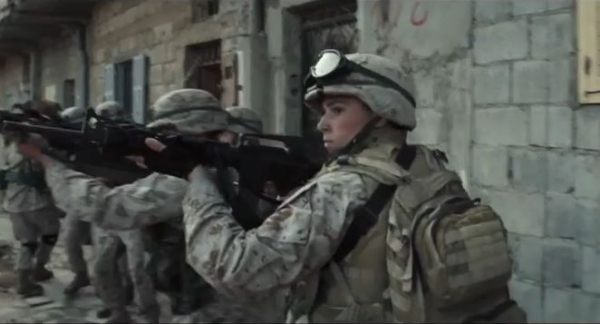
No, he didn’t join the “Crips” or “Bloods,” “Sharks” or “Jets.” He joined the “Seals.” And their destructive power was beyond belief. To begin with, their gang attire was fearful including matching helmets and boots, flak jackets, camouflage, wrap-around sunglasses, and night vision goggles. They had guns of all types, unlimited supplies of bullets, grenades, missile launchers, armored vehicles, helicopters, planes, and sophisticated communication devices. They prowled in menacing groups along the streets of Bagdad pointing guns at open windows and doors, pedestrians and drivers.

But it wasn’t easy for aspiring bullies to become Seals; doing so required absolute submission and humiliation. So as with all gangs, they had their initiation rites. These included merciless hazing and demeaning tests of endurance. Such rites of passage were accompanied by constant indoctrination that left initiates exhausted and absolutely malleable. In terms of today’s responsorial psalm, their hearts were sufficiently hardened for the inhuman tasks before them.

As a result, and with no knowledge whatever of their intended victims, Seals became convinced that anyone their superiors identified as “targets” were savages. They knew that because their indoctrinators told them so.  They knew nothing else about Iraq, Iraqis or their culture. And so, and like their Indian Fighter predecessors, Seals hated “savages” and wanted them all dead.

In other words, gang aspirants became servile and submissive sheep. They obeyed orders without question or understanding of context. (It’s the military way.) Seals stood ready to kill women, children, the elderly and disabled – anyone identified by their superiors or who threatened their mafia-like ethos of “family.” Protecting one’s “brothers” in crime became the justification of any slaughter. As a result of that brainwashing, Seals were entirely unable to see their “enemies” human beings.

Such identification was difficult for audiences of “American Sniper” as well. Nonetheless, Iraqi humanity inevitably surfaced for anyone remembering today’s readings about Moses and Jesus.  Those prophetic lenses revealed the Seals’ victims to be the successors of the poor and oppressed that both of those prophets came to rescue.

Think about the Iraqis for a minute.

Like their predecessors in Egypt, they were perfect targets for bullies. They had no army, no sophisticated weapons, no helicopters, planes or armored vehicles. They wore no uniforms or protective clothing. Apart from unemployed members of Iraq’s Republican Guard, almost none had formal military training.

Instead they were simple peasants, merchants, teachers, barbers and taxi drivers. They were fathers and mothers, children barely able to lift a grenade launcher, grandparents, friends and neighbors banding together as best they could to protect their homes, families from the ignorant, marauding invaders who proudly called themselves “The Seals.” Unable to show weapons in public (like their menacing occupiers), Iraqis hid them by day under floor boards in their homes.

Some were so desperate that they were willing to sacrifice themselves and their children to resist the Seal home-invaders. So they became suicide bombers. Others experimented with non-violent resistance. They were willing to share their tables with the barbarians from abroad, offering them food and shelter in hopes that kindness might win them over.

But no such luck.

So the majority resorted to defending themselves and each other with weapons – mostly captured or left over from previous Seal invasions (there have been many). What else were these brave patriots to do?

One of them became particularly admired. He had been a national hero, called Mustafa. In the story, this fictional character was an Olympic gold medal winner like the American’s Michael Phelps. But instead of resting on his laurels or using his status to protect himself from harm, he employed his skills as a sharp shooter to defend his people.

We can only imagine the pride that swelled the hearts of Iraqis when they heard how he inspired fear in the American bullies who constantly kicked in their doors, destroyed and looted their property, belittled their culture and faith, intimidated their children, frightened their elders, and demeaned their women.

In the end, Mustafa became a glorious martyr.

Again ironically, he was gunned down by his ignorant American counterpart. He was killed by the bully without a thought in his head who was in the game for fun, for the rush of battle, and to protect his relatively invulnerable “brothers” from the harm they deserved at the hands of the civilian victims they tormented.

In what can only be described as an act of self-loathing, that counterpart, Chris Kyle, takes careful aim and from a great and safe distance shoots a patriot he considers “savage,” because he mirrors so well his own bloody “work.”

It’s easy to vilify Chris Kyle. But he’s not to blame. He was no different from any other soldier serving in Iraq. He was no different from drone “pilots” operating from their air-conditioned “theaters” in Nevada or New Mexico. Sad to say, all of them are unwitting bullies and gangsters. They are brainwashed sheep.

Today’s readings are a reminder of all that. So is “American Sniper.”

Both call us to put ourselves in the shoes of those we are taught to hate.

Shockingly, they call us to change sides!

“The Interview”: Dumb and Dumber Do Regime Change

Interview

Recently I spent an hour and 52 minutes watching “The Interview.” I expected having to grit my teeth through nearly two hours of anti-communist propaganda. After all the film was produced by Sony whose CEO, Kaz Hirai, sits on the board of the CIA think-tank, the Rand Corporation. According to investigative journalist, Tim Shorrock, Sony directly consulted the CIA about the screenplay. Langley gave specific approval to “The Interview’s” graphic assassination scene.

Nevertheless, I justified the apparent waste of time on the grounds that the controversy surrounding “The Interview” had made it a cultural event not to be ignored. President Obama’s initial belligerent remarks about Pyongyang’s (completely unsubstantiated) hacking of Sony’s corporate data seemed hasty to say the least. They had made an international incident out of the release of this light-weight comedy.

North Korea’s response, of course, was predictable. Like Cuba, it has for decades been the object of CIA attempts at regime change and sanction. And the hair-brained method proposed in the film for disposal of President Kim Jong Un was completely reminiscent of past CIA attempts on world leaders like Fidel Castro. Moreover, President Obama’s pivot towards Asia, especially with Okinawa bases under threat of expulsion from Japan, has necessitated a high-profile enemy in the region. And North Korea conveniently fit the bill as enemy du jour. No wonder its leadership felt threatened by what they saw as yet another CIA plot to foment rebellion.

As it turned out, however, “The Interview” came across as a more effective send-up of U.S. culture, politics and the CIA than an indictment of North Korea. Whatever the intentions of its producers, its basic take-away was this: U.S. foreign policy is run by provincials who have no understanding of the regimes they routinely attempt to change. Much less do they grasp those regimes’ historical and political contexts.

In fact, the political understanding of the film’s dumb and dumber protagonists, Seth Rogen and James Franco, is summarized in a single slogan repeated throughout “The Interview,” “They hate us ‘cause they ain’t us.”  That’s it – a completely ignorant and self-congratulatory level of analysis whose depth rivals Bush 43’s explanation of 9/11, “They hate our freedom.”

However, contrary to their expectations, Rogen and Franco discover in Kim Jong Un (as portrayed in the film) someone totally like them. He’s a frat boy, shallow, insensitive and entirely obsessed with sex, drugs, and American celebrity culture.

Moreover Jong Un’s crimes mirror those of the CIA itself.  That is, according to the Langley, the North Korean president’s policies are reprehensible because they starve his people, keep them under constant surveillance, torture his enemies, and threaten the world with nuclear weapons. He therefore deserves to die.

But as North Korea’s “dear leader” himself points out in the film’s climactic interview, those are the very crimes of which the United States itself is guilty – but on a much larger scale. The Americans, he observes, are not just responsible for starting the Korean War. Their decades-long sanctions on the country along with their unrelenting policy of regime change have attempted to create famine throughout the northern part of the peninsula.

Jong Un might have added that the U.S. is one of the world’s most egregious actors when it comes to cyber-warfare and that NSA surveillance hacks into private communications across the globe not just in a single place.  The U.S. also maintains torture sites world-wide; it has more prisoners per capita than any other country (including North Korea). It is the only nation to have used nuclear weapons, and is in the process of modernizing its entire nuclear arsenal.

This means that the decision to kill Kim Jong Un represents a subconscious act of self-destruction. Its logic actually justifies attacks on the United States, whose crimes (once again) mirror and dwarf those of the “international criminal” destroyed at the film’s conclusion. This makes the assassination a kind of suicide by proxy – an expression of a death-wish.

What I’m suggesting is that the film’s (so far) overlooked message is this:  They don’t hate us ‘cause they ain’t us; they hate us because we are us. And attacking us is far more justifiable than any attack on North Korea.

All of that makes one wonder about Kaz Hirai. Might he not be a double agent? Perhaps he has cleverly tricked the CIA into approving a self-parody that unwittingly makes a laughing stock of the organization’s criminality and idiocy.

Such satire represents the essence of “The Interview,” whether that’s intended or not.

Sunday Homily: Academy Awards, “Gravity,” Lent, and Rebirth

gravity

Readings for First Sunday in Lent: GN 2:7-9, 3:1-7; PS 51: 3-6, 12-13, 17; ROM 5: 12-19; MT 4: 1-11. http://usccb.org/bible/readings/030914.cfm

Today is the first Sunday of Lent. A week ago, Hollywood presented its 2014 Academy Awards. Alfonso Cuaron’s “Gravity” won seven Oscars. I think his story and today’s reading about Jesus’ desert retreat are connected.

Lent actually started last Wednesday when many of us put ashes on our forehead to remind us of our approaching death. All of us, the ashes told us, come from the dirt and are rushing headlong towards the grave, whether we consider ourselves “believers” or not. Our world (at least for us as individuals) is ending. That’s simply a law of nature – as inescapable as gravity. It can’t be avoided. With time running out, Lent reminds us, the moment to change – to appropriate our basically divine nature – is now. Jesus’ vision quest in the desert shows the way.

So does “Gravity.” In fact, it’s possible to see the film as mirroring the experience of Jesus during his own “Lent” in the desert depicted in this morning’s gospel selection.

To begin with, both stories are completely symbolic. Both have their protagonists reliving the history of their people. Both show us the path to liberation. It leads from self-centeredness to God-consciousness. As such, both the account of Jesus in the desert and of Sandra Bullock’s character in “Gravity” represent summonses to either grow up here and now or suffer the consequences.

Think about “Gravity” in those terms. Here’s how the film’s publicity describes the plot:

“Director Alfonso Cuaron’s Gravity stars Sandra Bullock as Dr. Ryan Stone, a scientist on a space shuttle mission headed by astronaut Matt Kowalsky (George Clooney), a talkative, charismatic leader full of colorful stories that he shares with his crewmates as well as mission control. As the two are on a space walk, debris hits the area where they are working, and soon the pair finds themselves detached from their ship and stranded in space. While figuring out what steps they can take to save themselves, Stone grapples with a painful past that makes her consider giving up altogether.”

Without giving too much away, the film can be understood as mirroring the current plight of Mother Earth, the United States and the human species. It’s about our highly technological and artificial way of life and its inevitable destruction by the very laws of nature. It reminds unaware, “spaced out” people to “return home” and live in accordance with our true identity as earth creatures respectful of nature’s laws.

In “Gravity,” Sandra Bullock plays that spaced out American I mentioned. She’s an astronaut. As a medical engineer, she’s a trained healer whose job in NASA is to maintain a basically unsustainable way of life in outer space. To begin with, however she’s totally saddened and distracted by her personal problems. Specifically, she’s still in mourning for her lost daughter who died from an unexplained fall at the age of four. Interestingly, her daughter died conforming to the law of gravity which Dr. Stone’s “mission” requires her to defy.

The point is that Dr. Stone’s mission (like her daughter’s brief life) is doomed by inescapable natural laws. Entropy causes the systems she maintains to run down and demand periodic, extremely costly “missions” like the one she is on. At the same time inertia insures that the inevitable waste produced by the space enterprises will double back to seal the projects’ doom according to the law governing colliding bodies.

In that situation, Dr. Stone becomes the image of an alienated woman called by circumstances to wake up and accept her true divine nature as a healing goddess – as the embodiment of Mother Earth. As such she must return to the larger Divine Mother; she must return to earth and appropriate her own vocation to embody that Mother’s presence.

Think about it: the Bullock character is a “Stone” – the earthiest identification possible. She’s a doctor. She’s an astronaut. In all three identities, she’s out of her element. She’s floating in a weightless atmosphere that has caused her to deny her gravity-governed essence. In addition, like the earth itself, her oxygen supply is threatened. And that, of course, is painful and repulsive. Or as she herself puts it, “I hate space.”

“Gravity’s” story unfolds to display Dr. Stone’s healing efforts to reconnect with earth despite the obstacles working against her. In the process, like Jesus in today’s Gospel, she shows us all the way home from our own alienation and destructive way of life.

Dr. Stone’s way home involves not only using the personal tragedy of her daughter’s death to work in her favor. It also means crossing the Ganges and being blessed by the Buddha. She must also overcome her own ethnocentrism and xenophobia relative to her country’s designated “enemies” (the Russians and Chinese). Her return would have been impossible without an international space platform, a Russian Soyez module and a Chinese Shenzhou space capsule.

Finally, Dr. Stone needs to be “born again,” reliving the entire evolutionary process taking her through human astral origins to earth where she’s plunged into deep baptismal waters. With great effort, she throws off her old identity in the form of her astronaut’s survival gear. In the process, she encounters fish, amphibians and other pre-human life forms in the evolutionary chain. Finally freed of her past, on all fours, Dr. Stone emerges onto Eden’s shore. As a reborn Eve – as Mother Earth – she straightens up and walks forward into a new life. Her final words in the film are “Thank you.”

There’s a similar plot in today’s Gospel – lived out by Jesus, the carpenter from Nazareth. Like Dr. Stone in relation to “America,” Jesus reflects the experience of his Jewish compatriots. They passed forty years in the desert enduring temptation the whole time. Jesus in Matthew’s account passes forty days there. His response to temptation rescues and redeems the collective history of his similarly tempted people more than a thousand years earlier.

Jesus’ first temptation is ego-centric – to feed himself by turning stones into bread. His second temptation is ethnocentric – connected with the temple and the quasi-magical attributes accorded the structure by his Jewish contemporaries. Jesus’ final temptation is world-centric – to exercise dominion of “all the nations of the world.” By rejecting all three, Jesus symbolically achieves cosmic-consciousness. The story ends with his being ministered to by angels.

As in “Gravity,” Jesus’ vision quest in the desert maps out our Lenten path. It leads from self-centeredness to cosmic consciousness of unity with the One in whom we live and move and have our being. The path cannot be traveled without struggle. Its goal cannot be achieved without breaking free from selfishness, xenophobia, and the arrogance of life in an imperial center whose ways are unsustainable and far removed from its evolutionary roots. That’s the point of Lent’s prayerfulness, penance, fasting, and abstinence.

Practically speaking returning home during Lent – realizing our True Self being transformed like Jesus and Dr. Stone – might mean:

• Renewing our prayer life. Even unbelievers can do this. How? I recommend reading Eknath Easwaran’s Passage Meditation to find out. Yes, meditate each day during Lent. It will bring you into contact with your True Self. (And, I predict, you won’t stop at the end of 40 days – it’s that life-transforming.)
• Abstaining from fast food and reclaiming the kitchen. Leave behind for forty days the typically chemicalized, fatty, sugar-hyped American diet, and perhaps experiment with vegetarianism. That seems far more beneficial than traditional “fast and abstinence.”
• Shopping locally and refusing to set foot in any of the Big Boxes during Lent’s 40 days. Think of it as homage to Jesus’ counter-cultural resort to the desert or as Dr. Stone’s leaving behind that artificial life in outer space.
• To escape ethnocentrism and imperial sway,adopting as your news source OpEdNews and/or Al Jazzera rather than the New York Times.
• Resolving each day to actually respond to one of those many appeals we all receive to make phone calls and write letters to our “representatives” in Congress.
• In the “Comment” space below, share other suggestions.

Yes, it’s Lent once again. Like Dr. Ryan Stone, we faced up to our origins in dust last Ash Wednesday. A good Lent which leaves behind selfishness, ethnocentrism and allegiance to empire will also allow us to utter her sincere “Thank You” on Easter as we rise from our knees transformed.

Taking Pope Francis to the Movies: “The Wolf of Wall Street” (Film Review)

Wolf of Wall Street

A friend of mine says that if a picture is worth a thousand words, a good documentary film is worth a million. I agree, and would add that a great Hollywood drama directed by someone like Martin Scorsese and starring headliners like Leonardo DiCaprio might be worth two million or more.

Consider “The Wolf of Wall Street” as a case in point. It’s worth a library of dissertations on the dead-end and destructive nature of consumerism so recently criticized by Pope Francis in his Papal Exhortation, Evangelii Gaudium – the document intended to keynote his still-emerging reign as head of the Roman Catholic Church.

The pontiff’s publication distanced the pope and his church from the destructive emptiness of lives depicted in Scorsese’s “Wolf.” Pope Francis criticized consumerism based on the obscene accumulation of wealth without concern for the poor or the common good. He condemned “structures” that encourage such behavior. He turned a disapproving eye on education intended to domesticate rather than liberate the poor.

Such features of unfettered markets find lurid depiction in Scorsese’s film. There the over-the-top excesses of the Stratton-Oakmont investment firm amount to a send-up of the American Way of Life in general. At one point the film’s main protagonist, Jordan Belfort (played brilliantly by Leonardo DiCaprio) correctly makes Scorsese’s point, “Stratton-Oakmont is America” he proclaims. By this Belfort means his firm represents a vehicle of salvation for the poor. The film’s narrative suggests contrary conclusions.

“Wolf’s” story is simple. Ne’er-do-wells and petty crooks (DiCaprio and his friends) quickly make millions in the Penny Stock Market. They then use their money to fund frenzied lives of meaningless “work” and ultimately of crime and absolute debauchery with prostitutes, drugs and liquor.

The firm’s “work” consists in selling worthless paper products – stocks (of whose content they are often totally ignorant) – to gullible clients anxious to make a quick buck.

The firm’s crimes include “pump and dump” schemes which have them artificially inflating stock prices and then selling them quickly while leaving their bilked customers holding bags-full of depreciated investments. These quick profits are then laundered and deposited in the Swiss bank accounts that Wall Street wolves have long provided themselves to escape any social obligation or criminal charges for their irresponsible depredations.

All of this eventually leads to arrests. However, as a white collar criminal, DiCaprio’s character gets treated with kid gloves. He serves a three year sentence in a minimum security “country club” prison playing tennis and getting lots of r ‘n r.

On his release, recidivist Belfort doesn’t miss a beat. He simply resumes the very career he was hawking in an infomercial the day he was arrested – as a teacher of yet more get-rich-quick aspirants. Presumably they too seek millions by mirroring Belfort’s life of parasitism, debauchery and crime. The life is attractive because of its huge short-term payoffs. And Belfort’s example shows such felonies involve little risk to their perpetrators and absolutely no responsibility to others.

Through it all DiCaprio’s gang ridicule law, ethics, the poor, and those not devious enough to take advantage of economic, political and legal structures that facilitate plunder. In fact, the poor are virtually absent from Scorsese’s three-hour long parody.

The one person who perhaps falls into that category is celebrated at one of Belfort’s lewd and rowdy “staff meetings.” She’s singled out because she was smart enough to enrich herself by joining the Stratton-Oakmont project of fraud and deceit. In so doing she landed herself on what her mentor sees as his re-creation of Ellis Island – a zone of hope and liberation for the poor. Tearfully grateful, she too now has her limousine, yacht, and vacations in the Bahamas. What more could anyone ask?

Pope Francis answers that question. So do the divorces, addictions, insecurities and instances of child abuse in Scorsese’s film. Along with Pope Francis, they show that life and happiness are not about such self-seeking. But the pope goes further than Scorsese, boldly insisting that human life is about the common good and service of the poor. To facilitate such service, he asks for (no: he demands) fundamental change in the world that makes possible the get-rich-quick schemes like those characteristic of Wall Street and embodied in Stratford-Oakmont. More specifically Pope Francis calls for:

• Rejection of the free market model of development for combating poverty. Contrary to Jordan Belfort’s vision of a new Ellis Island, Stratton-Oakmont is not the solution to world poverty, inequality or violence. Rather, according to the pope such firms with their “trickle-down” ideologies represent the root of the problems in question.

• Centralization of ethics in the business world. Though not enumerated by Francis, the principles here are simple: Don’t lie; don’t steal, don’t engage in sexual conduct harmful to others; treat others as you would like to be treated; recognize that one reaps what he or she sows. These mandates recognized in all great religious traditions are not only routinely violated by the Belfort gang; they are ridiculed and their abuses flaunted. This, according to Pope Francis is the way of the world dominated as it is by consumerism and loosely regulated markets.

• Incorporation of the viewpoints of the poor in policy discussions – instead of treating the “little people” as freaks, instruments, nobodies and fools as in the Stratton-Oakmont boardroom discussion about using “midgets” for staff entertainment.

• Recognition of “education” like that offered by Jordan Belfort for what it is – a means of tranquilizing and domesticating the marginalized and otherwise excluded.

• Reformation of legal structures that facilitate the quick capital accumulation responsible for huge gaps between the rich and the poor. Reformations suggested both by Scorsese and Pope Francis include not only tighter regulation of stock exchanges and financial markets, but elimination of instruments such as Swiss bank accounts, and laws that coddle white collar mega-criminals while placing victimless petty “criminals” of color (such as those caught possessing crack cocaine) in maximum security facilities.

These are just a few of the directions Francis calls the world to follow.

“The Wolf of Wall Street” supports his call by illustrating its need in a picture worth much more than a million words.

Respecting Hard Evidence: 9/11, Pearl Harbor, JFK, and Edward Snowden

New Pearl Harbor

Recently, I watched “September 11: The New Pearl Harbor.” That’s Massimo Mazzucco’s documentary that 9/11 scholar, David Ray Griffin, has called “the film we’ve been waiting for.” It’s available gratis on the web, and I recommend it highly.

The amount of evidence the film offers to discredit the official story of 9/11 is overwhelming. It comes from eyewitnesses, government officials, and experts on aviation and explosives. It comes from architects, engineers and others in the scientific community.

Similarly persuasive are the historical details and personal testimonies Mazzucco offers to discredit the official line about the Old Pearl Harbor of December 7th, 1941.They too come from eyewitnesses and a whole array of insiders. Together they debunk the notion that the attack on the U.S. naval base in Hawaii came as a surprise. Instead, the evidence shows that Franklin Roosevelt and others allowed Pearl Harbor to happen in order to justify U.S. entry into World War II.

In the face of such evidence, the refusals of our educational system, the mainstream media, and U.S. politicians to reopen investigations into both the new and the old Pearl Harbors are simply amazing.

It’s enough to make one recall similar refusals concerning the assassination of John F. Kennedy in November of 1963. Instead, the media, politicians, and educators allow to stand an explanation that literally has bullets changing direction in ways that defy the laws of physics. The official explanation holds even though expert riflemen have repeatedly found themselves unable to duplicate the alleged marksmanship of Lee Harvey Oswald using the alleged assassination weapon.

As I write such words, I can almost hear what’s going through some readers’ minds. “Oh, I get it. You’re another one of those ‘conspiracy theorists.’ I’m sorry, but I don’t find the ‘evidence’ you’re citing persuasive. As Americans, we and our leaders have higher standards.”

Really? Consider the following:

• In 2003, the U.S. government insisted on invading Iraq because of its possession of “weapons of mass destruction.” When inspectors couldn’t find those weapons, their failure was characterized by the Bush administration as evidence of Saddam Hussein’s evil genius. Hussein was so insidious, they claimed, that he was able to hide masses of chemical and other weapons from very aggressive inspectors. The administration used such non-evidence-as-evidence to justify an invasion and war that has taken more than a million lives of innocent Iraqis. What’s that you say about high standards of proof?

• Last September President Obama was on the point of bombing Syria for its use of chemical weapons against insurgents whose ranks include al-Qaeda, the arch enemy of “America.” The evidence justifying Obama’s attack remained secret. Beyond that, when asked for justification, only purely circumstantial proof was offered. The chemical weapons in question, we were told, required launchers available only to the regime of Syrian president Bashar al-Assad. This means that for Mr. Obama, secret evidence and circumstantial proof were sufficient to justify bombings that would kill hundreds, if not thousands or even hundreds of thousands of innocent Syrians. And yet all those hundreds of serious, science-based questions about 9/11 and the Kennedy assassination remain . . . well, unanswered.

• Just last week, Senator John McCain of Arizona accused Edward Snowden of sharing U.S. secrets with Russia. “If you believe he didn’t, McCain said, “then you believe that pigs fly.” McCain’s incontrovertible evidence? Hmm. Maybe he thought his smart remark was enough. But we can’t be sure. He didn’t say. Perhaps he was going on his own experience when he was a prisoner of war in Vietnam. Did he reveal U.S. secrets to the Vietnamese? How else could he act as both judge and jury, and make his flying pigs deduction with such certainty? Logic? Is his evidence stronger than that allegedly requiring a reinvestigation of 9/11?

That last question makes my point.

When it’s a question of attacking enemies, the flimsiest of reasons, the thinnest of connections, simple implications, logical deductions, illogical conclusions, and circumstantial evidence are enough to justify mass murder of the innocent.

Imagine if the proof against Saddam Hussein or al-Assad had risen to the level of that advanced by 9/11 scientists and other scholars. In that case, I’d wager there’s not a person in the world who wouldn’t recognize the guilt of Washington’s designated enemies. The proof would be so overwhelming.

My conclusions:

• “9/11: The New Pearl Harbor” is compulsory viewing for those with the courage to think for themselves.
• We shouldn’t buy any further wars unless their justification transcends the level represented in that film and ridiculed as merely “conspiratorial” by our government and pundits.
• That is, evidence should go beyond the detail offered in Mazzucco’s five hour documentary.
• Moreover, any reasoning legitimizing future wars should evoke comparisons with and questions about 9/11, the level evidence there, and the reasons for ignoring its questions about the official story.
• In effect, such demands would preclude said future wars. In fact, no war in recent memory has been based on anything like the evidence and reasoning marshaled in “9/11: The New Pearl Harbor.”
• Even more concretely, we should ask John McCain about the basis for his statement about Edward Snowden and then judge the weight of his evidence by comparing it with that offered in Mazzucco’s film.

Do you see what I mean? What do you think?

“Captain Phillips”: Cavalry to the Rescue

captain-phillips-tom-hank

Prairie Schooners transporting goods across the plains are attacked by savage Indians. The cavalry comes to the rescue and slaughters the “tribals.” We all go home feeling safe and proud of our armed forces.

Mutatis mutandi, that’s the basic story of “Captain Phillips” starring Tom Hanks and the splendid Somali actor, Barkhad Abdl. Though familiar in basic plot-structure, the film spins a nonetheless gripping account of the 2009 piracy of the container ship, Maersk Alabama, on the open seas. The ship is waylaid by four Somali ex-fishermen turned pirates. The captain, Rich Phillips, is abducted by the bandits. The Navy Seals are called in. They kill the pirates, rescue the captain. And normalcy returns.

The inattentive will no doubt experience the simple catharsis afforded by such “action thrillers.” However, in the case of “Captain Phillips,” there is more to the story than good guys rescuing the innocent from the clutches of savages. In fact, the story, based on actual events occurring in 2009, has much to tell about globalization, national sovereignty, and the military-industrial complex.

Begin with globalization.

The back story of “Captain Phillips” demonstrates that we’re living through an era of buccaneer business, where multinational corporations act like lawless pirates. They roam the globe and operate where they will, regardless of international law, territorial waters, national boundaries, environmental impact, and the noxious effects their investments might have on local populations.

Somalia provides a case in point. There, overfishing by factory ships from Europe and the United States has left tribal fishermen without income. What fish escape the nets of the giant sea trawlers have been poisoned by toxic waste flushed from container ships off Somalia’s coast. Along with loss of income by local fishermen, plummeting living standards, and otherwise avoidable deaths from poverty and starvation are the predictable results.

This is where national sovereignty comes in.

In the absence of an effective national coastguard, such practices have forced locals to form citizens’ defense groups like the National Volunteer Coast Guard . Initially, these attacked the offending ships to drive them from Somalia’s territorial waters. Though characterized as “pirates” by western media, such groups enjoyed the support of Somalia’s affected population. According to a survey by Wardheer News, about 70% in Somalia’s coastal communities “strongly support[ed] the piracy as a form of national defense of the country’s territorial waters.”

Eventually, such “pirates” discovered that responding in kind to buccaneer businesses (represented by container ships) could itself replace lost revenue from fishing. Whether understood as such or not, “reparations” could in effect be seized by attacking ships on the open seas. There goods could be confiscated and hostages taken in return for large ransoms. Ensuing battles amounted to one highly financed buccaneer business competing against another more primitive, poorly financed counterpart.

Never mind limiting concepts such as open seas, territorial waters, international boundaries, or other legal considerations. From viewpoint of the impoverished “pirates,” if such limitations did not apply to their competitors, neither did they apply to them. It’s all “free enterprise” at its rawest – the law of the jungle, the Wild West, or of Cowboys vs. Indians. As Muse, the “captain” of the pirates attacking the Maersk Alabama put it, “No al-Qaeda here. This is just business.”

But then comes the overwhelming response from the military-industrial complex. Giving the lie to right-wing claims of independence from government, Maersk Shipping demonstrates the ability to call in the Navy Seals to protect its private enterprise operations. As portrayed in “Captain Phillips,” the White House itself is involved. After all, if private firms are threatened, “America’s” credibility is on the line.

Two cruiser ships, their crews of hundreds, several helicopters, and parachuting Seals are all employed to enforce the Law of the Sea on four impoverished “pirates.” This is a law whose rejection by the big-time pirates and their protectors was the root cause of the Somalis’ small-time piracy in the first place.

What to take away from all of this? Myths are powerful. And we should beware of their ability to blind us. Though Hollywood can no longer get away with enforcing such archetypes by portraying Indians as savages, it’s still free to do so with Muslim tribals. After all the West has already been won; there is no longer need to vilify “Indians.”

Muslim tribals are another story. Their resources are still up for grabs.