
I Go Overboard in Explaining How the Judeo-Christian Tradition = God’s Preferential Option for the Poor

[This is a second reflection on a pair of Zoom experiences I had last Monday. I reported the first here – some comments I made at a meeting of the Y’s Men of Westport. What I said and my insistence on saying it had me wondering about my role in the world during this third stage of my life. How much should I say? To what extent should I just shut up?

Today, I’m reporting on a Zoom meeting later that same day. It had me co-leading a Lenten discussion at our new church in Westport, CT. It was our third pre-Easter session devoted to examining controversial topics connected with our faith. Two weeks earlier, we had discussed miracles, their nature and possibility. A week later, the topic was healing. The topic last Monday was the question of “Jesus for the poor.”

Because of my interest in liberation theology and its signature “preferential option for the poor,” one of our two pastors had invited me to co-lead the discussion with him.

With the pastor’s consent, here’s the way I approached it.]

Introduction

The question of Jesus and poverty is fundamentally a religious question. And religion, of course, is a language. It marries words and concepts to a fundamentally ineffable (beyond words) experience that is open to all people. When that experience occurs in China, it comes out as Buddhism or Confucianism; when it happens in India, it’s expressed as Hinduism; when it happens in Arabia, it takes the form of Islam.

When the religious impulse finds words among the world’s poor and oppressed committed to improving their collective lives, it is expressed as the Judeo-Christian tradition. Yes, I mean that: the biblical tradition (virtually alone among the world’s great literature) thematically reflects the religious consciousness of awakened and impoverished victims of imperialism.  

More specifically, the Judeo-Christian tradition found its origin among slaves in pharaonic Egypt. Those slaves formed a people (called Hebrews or “rebels”) who retained their worship of a God favoring ex-slaves, widows, orphans, and resident foreigners throughout their history of domination by empires of various sorts – under Assyrians, Persians, Babylonians, Greeks and Romans.

The Tradition’s Foundational Story

That fact becomes clear when we consider the basic biblical story. According to virtually all mainstream scripture scholars, that narrative begins not with Adam and Eve in the garden, but with the liberation of a motley group of slaves of various ethnic identities. The story told to give them a sense of national unity runs as follows:
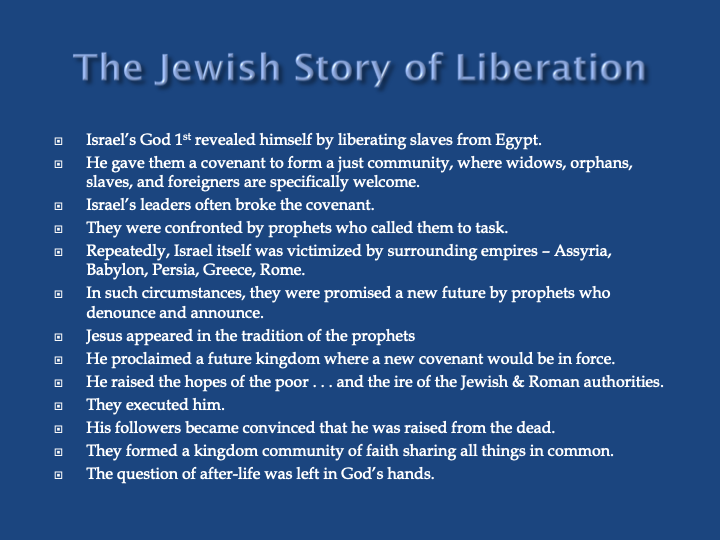
Jesus the Christ

Here it is important to note that Jesus appeared precisely in the prophetic tradition. His message represented a defense of the poor. This is abundantly clear from the program he articulated in Chapter 4 of Luke’s gospel:

Jesus’ program represented a reversal of the world’s values. Everything in God’s kingdom would be turned upside-down. According to Luke’s “Beatitudes,” the poor would be blessed, so would the hungry and thirsty along with those suffering persecutions. Meanwhile the rich would be condemned. “Woe to you rich,” Jesus is remembered as saying, “you’ve had your reward.” “Woe to you who laugh now, for you will soon be weeping.” In other words, Jesus’ understanding of God’s future entailed a complete reversal of the world’s social arrangement. As he put it, “The first would be last and the last would be first” (MT 20:16).

What’s more, the early Christian community’s interpretation of Jesus’ message underlined the entire tradition’s “preferential option for the poor.” In the first Christians’ efforts to follow the Master, they actually sold what they had and gave it to the poor. That way of life is reflected in three important passages from the Acts of the Apostles:
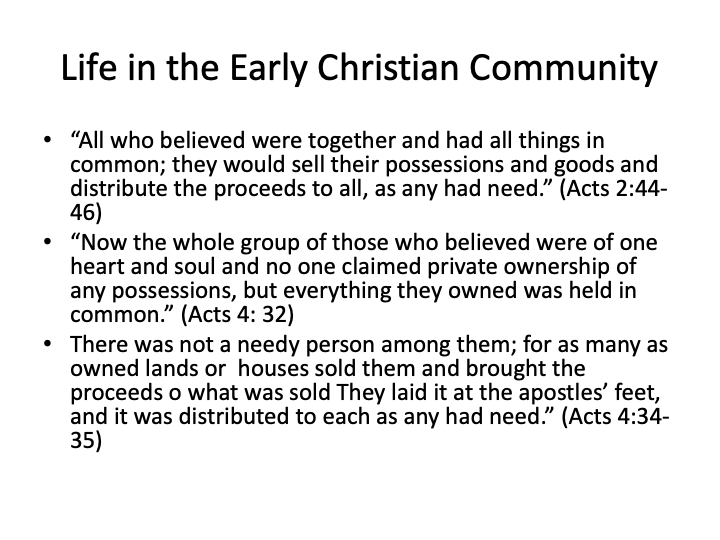
Jesus Romanized

With all of that in mind, you can see why the Christian message was so popular with slaves, the poor, with social outcasts. You can see how it inspired revolts as it spread throughout the Roman Empire. You can also understand why Rome became alarmed and famously ended up sponsoring all those persecutions which iconically fed so many Christians to lions and other beasts in the Colosseum. However, it was all to no avail – as Christianity continued to spread like wildfire.

So, at the beginning of the 4th century of our era, the emperor Constantine decided to co-op Christianity. But to do so, the new religion’s basic narrative had to be changed. It became Romanized and was effectively transformed into a Roman mystery cult.

Mystery cults worshipped gods like Mithra (whose feast day btw was Dec. 25th), Isis, Osiris, and the Great Mother God. Their stories had the god descend from heaven, die, rise from the dead and ascend to heaven from which s/he offered life everlasting to believers who ate the god’s body and drank the god’s blood under the forms of bread and wine.

In Christian form, the narrative supporting such belief was best expressed by St. Augustine in the 5th century. Drawing on stories in the book of Genesis and on statements found in Pauline writings, this is the story with which Augustine shaped and captivated Christian belief for the next 1500 years: 


Notice here how the story abstracts not only from the histories of Judea and Israel, but from Jesus’ message about the Kingdom of God and its Great Reversal in the here and now. Instead, everything is mythologized.

And that brings us to our discussion questions:

For Discussion

  1. What are your questions about the information in these slides?
  2. What surprised you about that information?
  3. What (if anything) do you find questionable or unacceptable about it?
  4. What are the implications of this approach to the bible and Jesus for your own faith?
  5. What are the implications of this approach for the Talmadge Hill Community Church?

My 1st & 2nd Mistakes

Of course, anyone reading what I’ve just presented can see that my first mistake was speaking too long and presenting too many new ideas for a 90-minute discussion. (My face is still bright red.)

My second mistake was even worse.

The slides I just presented had been shared beforehand with our group of about 20. And one member had done his homework. After expressing appreciation for my work, he went on to list in detail his points of disagreement. He began with his belief that the foundational story of the Judeo-Christian tradition was indeed found in Genesis, not Exodus. He went on to say that my presentation overlooked the crucial fact that Jesus is divine, the very Son of God, and that his words about poverty were meant to be taken in a spiritual rather than in a material sense.

In response, I should have kept silent. And if I chose to respond, I should have said, “I really appreciate your taking the time to express so well and clearly the most important points of the Augustinian story. What you’ve done sets us up perfectly for comparing the two basic biblical stories we’ve just reviewed. Does anyone else in the group have similar or different thoughts from the ones just expressed?”

That’s what I should have said.

However, instead (and forgetting all I’ve learned from 40 years of teaching this stuff) I attempted to respond point-by-point to the issues my friend had so well summarized.

Mine was such a bad decision that at one point, the pastor had to cut me off to give other people a chance. (As I said, my face is still a vivid crimson.)

Conclusion

I didn’t sleep well Monday night. I couldn’t help thinking, “When will I ever learn?” I even thought, “I’m getting too old to do this sort of thing. I think my days of teaching, public speaking, and playing leadership roles in church might be over. I’ve got to learn to say less and to stop trying to convince others about what I’ve learned over all my years of studying and dialoguing with Global South scholars. It’s all counterproductive.”

The next morning, however, things appeared a bit less dire. I received telephone calls of encouragement from the co-leading pastor and some others. Emails tried to console me. (But all of that almost made matters worse. It made me think, “They’re just trying to make me feel good. It must have been more awful than I thought.”)

The problem is that I still feel so passionate about rescuing the Jesus tradition from the irrelevance of its domestication by Augustine and subsequent theologians.

In a world of globalized poverty and exploitation, the life, words and teachings of the historical Jesus are too powerful to keep silent about. I’m just going to learn from this sobering, uncomfortable lesson and move on.

This is about something much bigger than my mistakes as a teacher.

At 80, Still Wondering Who I Am

Just yesterday, I had two experiences that made me wonder about myself. Even at the age of 80, I’m still questioning how I should present myself in this world that by all appearances is rushing headlong into terminal disaster? Am I being too outspoken? Should I temper what I say about politics and religion?

For me, those are constant questions. They arise not only in family conversations, but more publicly – e.g., in the context of a men’s group I’m part of in our new hometown, Westport Connecticut. My self-interrogations surface as well in the church that Peggy and are aspiring to enter. It’s the Talmadge Hill Community Church located in nearby Darien. In all three instances – family, the men’s group, and in church – I find myself wondering about transgressing the boundaries of polite discourse.

Today, let me first of all tell you about what happened yesterday with the men’s group. In a subsequent posting, I’ll share my questionable behavior in church – and then in my family.

The Y’s Men

In Westport, I’m a member of The Y’s Men. It’s a group of about 200 retired men, mostly Jewish and with backgrounds in international business, law, local government, and other administrative posts. The organization gets its cleverly ambiguous name from some distant association with the YMCA, which I can’t recall.

In any case, the Y’s Men meet every week and sponsor a myriad of activities that include (among other items) hiking, golf, sailing, a book club, and (before Covid) theater in New York City. I’m enjoying all of that. The Y’s Men are typically very bright and firm I their opinions.

That firmness takes center stage every other week, when a gathering of about 50 of us meet to discuss world issues. There, as we talk about matters such as China, 5G, the Middle East, and the Great Global Reset. In those contexts, the Y’s Men reveal themselves as basically patriotic, respectful of the military, and as “Americans” who understand their country as a splendid model honoring human rights, democracy and the rule of law.

I, of course, share none of those characteristics. Informed by social analysis reflected in liberation theology, my own tendencies have me looking at international affairs from the viewpoint of the world’s majority who are poor and under the jackboot of western imperialism led by the United States of America. As a result, I often find myself at odds with my fellow discussants.

U.S. Policy in the Middle East

This week was no exception. The announced topic is “Recalibrating US Policy with respect to Afghanistan, Iran and Saudi Arabia.” As usual, the conversation reflected the official position of the United States, viz. that “our” interests in recalibration are democracy and the protection of Israel from unreasonably hostile undemocratic forces represented principally by Iran, Islam, the Taliban, and Islamic terrorists.

For me, that position overlooked the provocative hostility of the U.S., Israel and Saudi Arabia towards Iran which is a major power in the area and whose interpretation of Islam has good reason for being defensively hostile towards foreign control of the Middle East. Consider the following:

  • Between 2010 and 2012, the intelligence agency (Mossad) of U.S. client Israel, assassinated four of Iran’s top nuclear scientists.
  • On January 3rd of 2020, the Trump administration itself assassinated Iran’s revered general, Qassim Soleimani, a national hero.
  • On November 11th, 2020, the Mossad also assassinated Mohsen Fakhrizadeh, yet another of the country’s leading nuclear scientists.
  • On May 8th, 2018, President Donald Trump unilaterally withdrew the United States from the internationally supported Joint Comprehensive Plan of Action (JCPOA) by which Iran had renounced alleged efforts to develop nuclear weapons. By all accounts, Iran had not violated the agreement.
  • Instead, the United States intensified economic sanctions on the country which increased Iran’s poverty rate by 11%.
  • The strengthening of sanctions persisted even during the Covid-19 global pandemic.

Despite such provocations, Iran has taken virtually no retaliatory measures either against Israel or the United States.

In the light of these facts, here’s what said at this week’s meeting:

What we’re calling a “reset” in the Middle East is really a recommitment to traditional U.S. anti-democratic policy there. It has us supporting not democracy, but client kings and potentates throughout the region particularly in Saudi Arabia as well as an apartheid regime in Israel. U.S. enemies here are Islamic nations who understand their religion as an affirmation of independence from outside control – independence from western imperialism and neo-colonialism. (For their part, the United States and its puppets call Islamic striving for independence “terrorism.”)  Of course, the point of that imperial control is what it’s always been, viz. transfer of resources. And in the middle east, the resource in question is oil. Nothing has changed. Nothing will change as long as our economy remains petroleum dependent.

My intervention was largely ignored. So, using other words, I reiterated the sentiment about three times more.

Too Insistent?

And that’s my point of self-questioning here.  Am I saying too much? Are my positions too radical? If so, are my efforts counterproductive in that they turn people against the very viewpoint I’m trying to share (that of the world’s poor, imperialized and silenced). Should I just shut up and listen?

Family members often caution me in the direction of such judicious silence.

Truthfully however, I find such restraint a species of self-betrayal. My role models – the people I find most admirable in the world – never bit their tongues in similar circumstances and even on the world stage. Their list is long and includes Gandhi, King, Rosa Parks, Fannie Lou Hamer, Malcolm X, Dorothy Day, William Barber II, Liz Theoharis, Naomi Klein, Cornel West, Jeremiah Wright, Chris Hedges, the Berrigan brothers, and the liberation theologians I’ve spent more than 50 years studying.    

Most of all, the list of such truth-tellers is headed by the great prophets of the Bible and by the one who has grasped and held my attention my entire life. I’m talking about Jesus the Christ.

I’ll explore that dimension of my outspokenness and self-doubt in my next posting.   

Pixar’s “Soul”: Profound Spiritual Wisdom from a Soulless Corporation

Isn’t it ironic that one of the most powerful businesses in the world, the Disney conglomerate, has ended up being one of our nation’s most effective spiritual teachers?

I mean, in Disney you have a typical heartless corporation that controls so much of our deceitful mainstream media and our superficial entertainment industry. Yet that very transnational firm has consistently produced popular art that calls viewers to introspection, identification with wildlife and nature, and to qualities of generosity, selflessness, and love.

I’m thinking of celebrated productions like “The Lion King,” “Beauty and the Beast,” and even “Bambi.” Arguably, such animated films issue more effective calls to spiritual values (especially to the young) than do most churches.

How that’s possible remains a mystery to me.  It’s probably because even Disney Productions discerns a deep hunger for meaning in audiences throughout the world. So, in its effort to enhance its bottom line, it acquires scripts authored by spiritually attuned writers. But that’s only a guess.

The Film

Nevertheless, that was probably the case with Disney’s latest issuance, “Soul” whose screenplay was written by Pete Docter, Mike Jones and Kemp Powers. It’s a charming, comedic yet penetrating probe into the meaning of life and death. Its depiction of the afterlife suggests characterization as a poor man’s version of Dante’s Divine Comedy. It has all the ingredients: a guided trip through the great beyond, a painful process of purgation, and finally arrival at peaceful beatitude.

(At this point, some might think it appropriate to give a “spoiler alert,” though that hardly seems necessary for a spiritually themed work like “Soul.” It’s not some cliffhanger. In any case, be forewarned.)

More specifically, as Disney’s first all-black production, “Soul” tells the story of Joe Gardner (Jamie Foxx), a frustrated middle school band teacher obsessed with jazz and landing his dream job of playing piano in a quartet headed by a diva saxophonist named Dorothea Williams.

Joe is himself an unappreciated musical genius as becomes evident every time his riffs transport him into the “Zone” of his prodigious brilliance. In his audition for the Williams quartet, the diva immediately recognizes Joe’s talent and hires him on the spot.

Joe is overjoyed. On his way home, he practically floats and dances down the streets of NYC. In his distracted oblivion he is narrowly missed by busses, cars, motorcycles and bikes. However, Joe himself doesn’t miss an open manhole, which swallows him up and apparently ends his life.

The next thing he knows, he’s is in the afterlife on his way towards the Bright Light invariably reported in the accounts of most near-death experiences (NDE). But possessed by his obsession with finally realizing his dream job, Joe refuses to die.

The Underworld

So, instead of escalating into the world of light, he’s returned to heaven’s underworld – a kind of limbo – a so-called “Youth Seminar” where unborn souls are prepared by the recently departed to enter into bodies on planet earth. There Joe is introduced to a rebellious unborn soul (Tina Fey) called #22 (seemingly because she was the 22nd soul ever created).

Despite its status as a truly “old soul,” #22 has remained unembodied for eons because she finds the prospect of life on earth boring. No mentor, no matter how prestigious – not Copernicus, Marie Antoinette, Abraham Lincoln, Karl Jung, George Orwell, Mother Theresa, or Muhammad Ali – has been able to successfully coax 22 to incarnate on the Milky Way’s “stinky rock,” where she knows that life is inevitably soul crushing.

Despite that history, Joe Gardner accepts the task of mentoring #22 in hopes that if successful, he might be allowed to return to earth and his dream gig. Joe is convinced that if he can help 22 find her passion – her Spark – then her fierce resistance to life on earth will dissolve.

So, acting like Dante’s Virgil, Joe leads 22 through the “Great Before.” She accompanies him as he reviews his own life and identifies jazz as the spark which had given his frustrated existence the modicum of meaning it’s had. From there the two travel through the Hall of Everything where Joe shows 22 her own life’s possibilities as a baker, fire fighter, artist, librarian, mathematician, gymnast, office worker, or astronaut. Not surprisingly, 22 remains unmoved.

However, it’s at this point that roles suddenly reverse as the unborn soul takes pity on Joe. He’s unlike any of her previous mentors, she says, because his life has been so sad and pathetic. Despite the fact that 22 can’t imagine why Joe wants so desperately to return to such pathos, she leads her mentor to the Zone – a state between the physical and spiritual – where he’s made to recall the times his music has induced a state of happiness and bliss.

From there, 22 takes Joe to the Realm of Lost Souls where she introduces him to “a guy I know” – a mad psychedelic captain, a self-described “mystic without borders.” Captain Moonwind (who doubles as a NYC sign spinner on the other side) helps lost souls find their way out of obsessions and anxieties that leave them disconnected from life. For instance, he once helped liberate a soulless hedge funder from his alienated labor. In the aftermath, the frustrated Wall Streeter completely trashes his obsessed, anxious and confining work environment while finally screaming “I’m alive! I’m alive!”

To the tune of Dylan’s “Subterranean Homesick Blues,” Moonwind ferries Joe and 22 across the Sea of Lost Souls. On the way, the captain tellingly instructs Joe that lost souls are not that different from those striving to live constantly in the Zone. In both cases, he warns, “When your joy becomes an obsession, you end up tragically disconnected from life.”

With the warning ringing in his ears, and after entering a deep state of meditation, Joe and 22 suddenly find themselves returned to earth – to the intensive care unit where Joe’s NDE began. He’s not dead after all. However, both Joe and 22 are surprised to find that they remain completely displaced. Joe’s personality is now located in the hospital’s therapy cat, Mr. Mittens. Meanwhile, 22 finds itself animating Joe’s just-revived body.

Desperate and confused, the two narrowly escape from intensive care and emerge onto NYC’s noisy, smelly and dirty streets. It’s in this Purgatorio that Joe resumes his role as 22’s Virgil. Trapped in the cat’s body, he is intent on leading his newly ensouled form to what he imagines as heaven – the Half Note Jazz Club where his platonic Beatrice (Dorothea Williams) awaits him impatiently.     

Purgatorio

On the way, 22 learns more about inhabiting Joe’s body. For the first time, she discovers the soul-purging joys of pizza; of simply walking, sky watching, taking a shower, tasting toothpaste, and of fitting into a comfortable old brown suit. She recognizes a kindred spirit in 12-year-old Connie, Joe’s gifted middle school trombonist who finds school stultifying.  When Connie expresses her boredom with school, 22 approvingly quotes her former mentor, George Orwell, “State-sponsored education is like the rattling of a stick inside a swill bucket.”

22 even revels in subway rudeness and in the talent of an underground street musician. Above all, 22 likes “jazzing” – spontaneous self-expression or any kind. 

Now Mr. Mittens is the one to object. “No,” he insists, jazz is a completely other category. “Music and life,” he says, “operate by very different rules.”

Undeterred, 22 continues jazzing during a visit to Joe’s neighborhood barbershop. There, with Mr. Mittens sitting in her lap, Dez the barber reveals the possibility of finding joy in a second-choice career even when one’s first choice has been frustrated. Despite his genius at cutting hair, Dez explains that he originally wanted to become a vet. However, since barber school was less expensive than training for veterinary medicine, Dez chose the former. But it’s made him “happy as a clam.”

The lesson is not lost on Mr. Mittens. His wide eyes tell that he’s thoughtfully considering his own life in the light of Dez’s revelation. Meanwhile he listens incredulously as 22 philosophizes free form while Dez cuts the hair on the head she’s now thinking with.

Everyone’s enthralled as she pontificates about “existing as a theoretical construct in a hypothetical waystation between life and death. . .  left wondering whether all this (obsessed and over-focused) living was really worth dying for.”

Then she responds smartly to Paul, a hip barbershop customer, who rips Joe for falling short of his dreams. 22 fires back, “He’s just criticizing me to make up for the pain of his own failed dreams.” Her barbershop audience laughs at Paul derisively.

Later, 22 ecstatically explains to Joe: Didn’t you see? “I was jazzing.”  

22’s jazzing continues through the next stage of Joe’s purgatory – an encounter with his mother who has constantly urged her son to abandon his musical ambitions in favor of steady employment with pension and health care.

Still encased in Joe’s body and tentatively coached by Mr. Mittens, 22 boldly responds on Joe’s behalf, “Mom, I’m just afraid that if I died today, then my life would have amounted to nothing.”

That particular jazz riff opens Mrs. Gardner’s heart. In tears, she embraces her son and tells him how proud she is of him. She adds that his deceased father would have been proud too. She even gives Joe his dad’s handsome wool suit to wear at the anticipated performance that evening.  (Joe’s father too had been a musician dependent for support on his wife’s real job as a seamstress. No wonder she was worried about Joe.)

Paradiso

Finally, Joe arrives at the Half Note Jazz Club. By now, with the help of Captain Moonwind and a brief return to the Great Before, the difference between Joe and 22 has been completely overcome. Joe’s come to realize that 22 is the same as his own unappropriated unborn soul.

Whole at last, Joe is now ready for his beatific vision. Imagining that it will happen on the Half-Note’s stage, Joe persuades Dorothea Williams to rehire him despite his late arrival at the jazz club.  Reluctantly, she acquiesces.

However, all doubts vanish as Joe gives the performance of his life thrilling everyone present including his mother and Ms. Williams herself. Amid the applause, Joe’s mother is heard shouting proudly, “That’s my son!”

Nonetheless in the aftermath, Joe remains strangely detached. In effect, he wonders aloud, “Is that all there is? I’ve been waiting for this my entire life. I thought it would be different.”

The diva explains, “You’ve been like a fish discontent with his water habitat because he’s been searching for the ocean. You’ve had what you’ve been looking for all your life. It’s what you live in, move in and where you have your being.”

With that, Joe’s penny finally drops. Now his life flashes before him summarized in the symbolic trinkets that awakened the soul of # 22:

  • A Metro pass
  • A pizza crust
  • A piece of a bagel whose other half had been thrown into the tip basket of that subway musician
  • The lollypop Dez the barber shared during the session in his “magic chair”
  • A spool of blue thread that Joe’s mother used to refashion his father’s wool suit
  • A seed from a maple tree brought by a gentle breeze into Joe’s waiting hand

Yes, Dorothea’s version of Beatrice was right: Joe’s had everything he’s needed right from the beginning – in his father’s sharing his passion for jazz, in fireworks over New York City, in the heat blowing from city street grates, in the taste of pecan pie, in the star filled sky . . .

So have we all.

Conclusion

Such “morals of the story” might strike some as typically Hollywood – trite truisms generated algorithmically by pretentious but ultimately soulless corporations interested only in easy pandering to the peasant gallery. However, conclusions of this sort overlook the fact that most preaching and motivational talks contain similar messages. Fact is: we need the reminders.

Nonetheless, the morals of “Soul” go far beyond what’s already been itemized. A more comprehensive catalog might include the following.

  • Life on planet earth need not be boring or meaningless.
  • Death is not our enemy, but a portal to profound insight and expanded awareness.
  • Animals from which we evolved (symbolized in Mr. Mittens) continue to guide us.
  • So do previous human incarnations (like 22’s George Orwell and Muhammed Ali) who somehow persist as our mentor guardian angels.
  • When our joys become obsessive, they disconnect us from life’s richness.
  • Even our “dream jobs” are comparatively insignificant – carried out in the equivalent of a small basement jazz club.
  • The same holds true for the heroes we idolize (like the self-important diva Dorothea Williams).
  • In the light of impending death, (if we’re lucky) consciousness of such relativity eventually dawns as we realize that wish fulfillment isn’t all it’s cracked up to be.
  • Instead, life is about overcoming separations – male from female, black from white, animal from human, body from soul.
  • It’s important “to jazz” and free flow at every opportunity; music and life both operate by the same rules.

These insights merit not only superficial review, but serious meditation by those whose spiritual hunger evokes them from sensitive writers like Docter, Jones and Powers despite their employment by Disney.

Do yourself a favor and see Pixar’s “Soul.” It will set you on the path of Dante, Virgil, Beatrice — and Joe Gardner.

Talkin’ Guitar Blues

This is the first song I ever played in public. That was back in 1965 when I was still in the seminary, a year before I was ordained. On our patron saint’s feast day, St. Columban’s Day (November 23rd), we always put on some kind of show. “Old timers” (far younger than I am now) would sing their favorite songs. I remember that our moral theology prof, Tom McElligott, would sing “Mick McGuire” every year. Well, believe it or not, on this particular St. Columban’s Day, I had the gall to perform this little ditty. Later on, it became my signature party piece. I’ve done it a million times. (Still can’t get it exactly right!)

QAnon Is Right: We’ve Become the Devil’s Christians

Readings for First Sunday of Lent: Dt. 26: 4-10; Ps. 91: 1-2; 10-15; Rom. 10: 8-13; Lk. 4: 1-13.

Today is the first Sunday of Lent – the annual 40-day process of repentance and purification leading up to Easter (April 4th).

The readings for this Sunday begin on a strong political note. In fact, the Gospel selection issues a powerful summons for all of us to divest of all loyalty to U.S. empire. It reminds us that unless we do so, we end up worshipping Satan instead of God (or Source or the Ground of Being, or the Great Mother) however we might imagine Her.

Put more starkly, the snippet from Luke’s account of Yeshua’s temptation in the desert confronts us with the fact that QAnon is unwittingly correct in saying that the world is run by a cabal of Satan worshippers. It’s governed by a gang best described by OpEdNews’ editor in chief, Rob Kall, as “the devil’s Christians.”

I mean, the readings identify the worship of Satan as a prerequisite for endorsing empire of any kind – be it Rome’s or that of the United States.

The story of Yeshua’s temptation makes it clear that the Master rejected all of that. Even more shocking: subsequent history shows that his “followers” embraced fervently what he rejected so unequivocally. As a result, those pretending to follow Yeshua have been worshipping Satan since at least the 4th century of our era.

To illustrate my point, consider first of all the extent of U.S. empire and secondly the narrative under consideration. Then draw your own conclusions.

U.S. Empire

The best source I’ve come across for detailing the current extent of U.S. empire is Daniel Immerwahr, a professor of history at Northwestern University. A few years ago, he published a book called How to Hide an Empire: A History of the Greater United States. It describes the actual extent of U.S. empire that remains hidden even, as Immerwahr notes, from PhD historians.

Begin with his description of the occult U.S. realm that so concerns him. Immerwahr traces its inauguration to the period immediately after our country’s founding. It was then that settlers incorporated territories seized (in clear violation of treaties) from Native Americans.

Then in 1845, the U.S. absorbed nearly half of Mexico – Texas first and then [after the Mexican American War (1846-’48)], what became Arizona, California, Colorado, Nevada, New Mexico, Utah and Wyoming. By the end of the 19th century, the U.S. had added Puerto Rico, the Philippines, Hawaii, Alaska, Guam, and Wake Island.

If we add to this the implications and actual invocation of the Monroe Doctrine (1823) in order to control the politics of Latin America, we can see forms of U.S. colonialism consistently extending throughout the western hemisphere.

Coups in Africa [e.g. Congo (1961), Ghana (1965), Angola (1970s), Chad (1982)] established U.S. hegemony there. Similar interventions in the Middle East (e.g., Iran in 1953) along with the establishment of Israel and Saudi Arabia as a U.S. proxies controlling political economy throughout their region established United States control there.

Factor in the 800 U.S. military bases peppered across the world and one’s understanding of our empire’s extent expands exponentially. (Immerwahr notes that Russia, by contrast has 9 such bases; the rest of the world has virtually 0).

To understand the sheer numbers involved, think of our continued military presence in South Korea (35,000 troops) Japan (40,000), and Germany (32,000). Besides this, of course, there are the active troops who daily kill civilians and destroy property in Afghanistan, Iraq, Libya, Syria, Somalia, and elsewhere. In total we’re told that there are about 165,000 troops deployed in 150 countries throughout the world – though, in the light of what I’ve just recounted, even that number seems vastly understated.

In any case, all of that describes an extensive, highly oppressive, and extremely violent American Empire. 

And our leaders are proud of it. Theodore Roosevelt and Woodrow Wilson thought of colonialism as marvelous. However, by the first decade of the 20th century, politicians became increasingly uncomfortable with “the ‘C’ word,” and exchanged references to colonies for the gentler euphemism, “territories.”

But whatever name we give it, the reality of U.S. empire stands in sharp contrast to today’s Gospel reading and its description of Yeshua’s basic proclamation with its negative judgment on empire and colonialism.

Yeshua Rejects Empire

As a prophet and actual victim of empire, Yeshua made his fundamental proclamation not about himself or about a new religion. Much less was it about the afterlife or “going to heaven.” Instead, Jesus proclaimed the “Kingdom of God.” That phrase referred to what the world would be like without empire – if Yahweh were king instead of Rome’s Caesar. In other words, “Kingdom of God” was a political image among a people unable and unwilling to distinguish between politics and religion.

According to Yeshua, everything would be reversed in God’s Kingdom. The world’s guiding principles would be changed. The first would be last; the last would be first (MT 20:16). The rich would weep, and the poor would laugh. Prostitutes and tax collectors would enter the Kingdom, while the priests and “holy people” – all of them collaborators with Rome – would find themselves excluded (MT 21:31). The world would belong not to the powerful, but to the “meek,” i.e., to the gentle, humble and non-violent (MT 5:5). It would be governed not by force and “power over” but by compassion and gift (i.e., sharing).

That basic message becomes apparent in Luke’s version of Jesus’ second temptation described in today’s Gospel episode. From a high vantage point, the devil shows Jesus all the kingdoms of the earth. Then he says,

“I shall give to you all this power and glory;
for it has been handed over to me,
and I may give it to whomever I wish.
All this will be yours, if you worship me.”

Notice what’s happening here. The devil shows Yeshua an empire infinitely larger than Rome’s – “all the kingdoms of the world.” Such empire, the devil claims, belongs to him: “It has been handed over to me.” This means that those who exercise imperial power do so because an evil spirit has chosen to share his possession with them: “I may give it to whomever I wish.” The implication here is that Rome (and whoever exercises empire) is the devil’s agent. Finally, the tempter underlines what all of this means: devil-worship is the single prerequisite for empire’s possession and exercise: “All this will be yours, if you worship me.”

However, Yeshua responds,

“It is written:
You shall worship the Lord, your God,
and him alone shall you serve.”

Here Yeshua quotes the Mosaic tradition summarized in Deuteronomy 26 to insist that empire and worship of Yahweh are incompatible. Put otherwise, at the very beginning of his public life, Yeshua declares his anti-imperial position in the strongest possible (i.e. scriptural) terms.

Christians Embrace of Empire

Now fast forward to the 4th century – 381 CE to be exact. In 313 Constantine’s Edict of Milan had removed from Christianity the stigma of being a forbidden cult. From 313 on, it was legal. By 325 Constantine had become so involved in the life of the Christian church that he himself convoked the Council of Nicaea to determine the identity of Yeshua. Who was he after all – merely a man, or was he a God pretending to be a man, or perhaps a man who became a God? Was he equal to Yahweh or subordinate to him? If he was God, did he have to defecate and urinate? Seriously, these were the questions!

However, my point is that by the early 4th century the emperor had a strong hand in determining the content of Christian theology. And as time passed, the imperial hand grew more influential by the day. In fact, by 381 under the emperor Theodosius, Christianity had become not just legal, but the official religion of the Roman Empire. As such its job was to attest that God (not the devil) had given empire to Rome in exchange for worshipping Yahweh (not the devil)!

By this process, the devil actually became the Christian God!

Conclusion

Do you get my point here? It’s the claim that in the 4th century, Rome presented church fathers with the same temptation that Yeshua experienced in the desert. But whereas the Great Master had refused empire as diabolical, the prevailing faction of 4th century church leadership embraced it as a gift from God. In so doing they also said “yes” to the devil worship as the necessary prerequisite to aspirations to control “all the kingdoms of the world.” Christians have been worshipping the devil ever since, while calling him “God.”

On the contrary, today’s readings insist that all the kingdoms of the world belong only to God. They are God’s Kingdom to be governed not by “power over,” not by dominion and taking, but by love and gift. Or in the words of Yeshua, the earth is meant to belong to those “meek” I mentioned – the gentle, humble, and non-violent.

Yet, as Dr. Immerwahr attests, those very people living in the West’s former colonies in Latin America, Africa, the Middle East, and South Asia are exactly the ones ceaselessly victimized by the empire historians have so well-hidden from our consciousness.

As described in Immerwahr’s How to Hide an Empire, colonialism and neo-colonialism are diabolic abominations in the eyes of Yeshua’s God. They represent nothing less than a system or robbery currently bent on confiscating the rich resources of the Global South. Authentic followers of Christ can never support such depredations.

The conclusion is inescapable. QAnon is right! The world is in fact run by a cabal of Satanists from the halls of the Vatican to the White House, to the Supreme Court and all those Christians who serve the interests of empire under the aegis of our nation’s armed services and the military-industrial complex. All of them have become the devil’s Christians.

On this First Sunday of Lent, we should pray sincerely and work tirelessly for the defeat of such an abominable system.

So Much to Be Upset About: A Cabin Fever Short List

Forgive me if Covid-19 isolation is finally getting to me. But (like many of you, I’m sure) I find there are just so many things to be upset about these days. So, let me relieve the pressure and mention just three: the attack on the capitol, U.S. Rep. Marjorie Taylor Greene (R Ga.), and the Super Bowl.

Capitol Attack

Did you see the film presented by the Democratic impeachment team last Tuesday? If not, click on the video above. I found that collage both disgusting and perversely empowering. On the disgusting side:

  • It was ultimate proof of white privilege, wasn’t it?
  • I mean, during BLM protests right-wing media and Republicans were outraged when some businesses were set on ablaze.
  • However, those same media along with those Republican officials – the very ones under attack during the insurrection – find excuses to downplay white supremacists ravaging the nation’s congress. Can you believe that?
  • Imagine if the insurrectionists were black, armed and destroying capitol property – roaming about looking for officials to kill.
  • Don’t tell me that a lot of black protestors wouldn’t have been shot.
  • We’d never hear the end of it.
  • For sure, police protection would have been much heavier. (If you’ve been to DC during protests, e.g., against the war in Iraq, you know the place is always absolutely crawling with cops lining the streets in phalanx dressed in heavy riot gear just waiting to pounce.)
  • Or what if the insurrectionists had been Muslims? We’d be bombing some poor country like Yemen right now in self-righteous response.
  • And what about all that money DC (and every other city in this great country of ours) spends on policing? You mean, they couldn’t prevent that fiasco?

Nonetheless, while disagreeing with its cause, I somehow felt rebelliously good about the insurrection.

  • It showed that revolution is possible — what it would look like if we followed the advice of Thomas Jefferson about regular citizen uprisings.
  • I loved the thought of Mitch McConnell and Nancy Pelosi (and Mike Pence!) hiding under their desks.
  • Their lives shouldn’t be threatened, but they do need to be afraid of us. They’re not. And disgracefully, beneficiaries of white privilege are the only ones at this historical juncture whom the system allows to intimidate irresponsible politicians.
  • I mean, Pelosi and McConnell are not our friends.
  • Neither are Biden and Harris.
  • And of course, neither is Trump.
  • None of them represents us; they exclusively represent their donors.
  • They won’t even consider universal health care during an actual pandemic. They refuse to keep campaign promises to increase the minimum wage to $15 and to send out $2000 (not $1400!) checks when so many have been out of work for nearly a year.
  • Yes, those were democratic campaign promises! It’s how they won Georgia.
  • They lied!
  • No wonder people are angry.

Marjorie Taylor-Greene

And don’t get me started about U.S. congresswoman Marjorie Taylor-Greene (R Ga).

  • So, she wants Obama executed?
  • She’s called for the murder of Nancy Pelosi – specifically with a bullet to the head?
  • Imagine if Ilhan Omar or Rashida Tlaib had said that about Mitch McConnell — a bullet to his head.
  • Even if you or I uttered such monstrosities, SWAT teams would be at our doors right now with battering rams.
  • But she’s allowed to continue serving as a government official.
  • Double standards, anyone?
  • White privilege?

The Super Bowl

And then there’s the Super Bowl with white people complaining about the NFL’s predominantly black workforce calling attention to wanton police murders of their unarmed racial counterparts.

  • Whites’ response to the reduced Super Bowl TV audience?  Too much mixture of politics and sports. “Get woke. Go broke,” they say.
  • They ask, “Why politicize a football game?”
  • Good, that’s what I say! In fact, I’ve been saying it for years.  I mean why play the National Anthem, “honor our troops,” and normalize war with special flyovers of air force weapons of mass destruction (aka fighter planes) at every major sports event you care to name? What’s the connection? I don’t get it. (Imagine if your boss had you stand for the National Anthem before work each day.)
  • At least Mark Cuban (owner of the Dallas Mavericks) is on the right page on this one. He’s decided to eliminate playing the “Star Spangled Banner” before any home games. Good idea, Mark. If everyone followed suit, it would save me from wondering whether to stand or not.
  • And thanks Colin Kaepernick!

Of course, my cabin fever list could go on and on. So could yours, I’m sure.

Amazon Workers to Vote on Unionization: Bezos Says He Can’t Afford It

Readings for 5th Sunday in Ordinary Time: Job 7: 1-7; Psalm 147: 1-6; 1 Cor. 9: 16-19, 22-23; Mark 1: 29-39.

Tomorrow, 6,000 Amazon warehouse workers in Alabama will vote on unionization. Of course, their decision will affect workers throughout Amazon’s mammoth enterprise – most of them non-white. The company employs 798,000 full-and part-time employees. In 2019, its net revenues were around $280.5 billion. Its CEO, Jeff Bezos, is himself worth about $184 billion. He’s the second richest man on the planet.

Work at Amazon

Despite company profits and the wealth of its chief, there’s good reason for the unionization drive including alienated labor resulting from:

  • Low pay: Recently, Amazon raised its wages to $15 per hour. It also extended to its workers a $2 per hour bonus for “heroic” service during the pandemic. However, the company has since removed that extra pay in the light of its claims that the pandemic’s severity has diminished. Amazon workers dispute that assertion, while maintaining that $15 per hour remains inadequate remuneration for their heavy workloads. And besides, Amazon workers’ unprecedentedly profitable production increases during the pandemic need due reward.
  • Intense surveillance of workers: Sophisticated AI technology tracks every move of each Amazon worker – to such an extent that those not meeting production goals can be threatened with imminent job termination by a robot without intervention from a human supervisor.
  • Union-busting: That same sort of technology makes sure that workers on break do not congregate for purposes of conversation related to union organizing. Those caught engaging in such exchanges have been summarily fired.
  • Wage theft: Last Tuesday, the Federal Trade Commission fined Amazon $61.7 million for actually stealing tips from Amazon’s Flex drivers over a two and a half-year period. Flex drivers are hourly workers who receive no benefits and use their own cars to make deliveries.
  • Dangerous working conditions: Work at Amazon is three times as dangerous as employment across the private sector and twice as dangerous as warehouse work in general. 911 records show that on the job mental episodes and even suicides are common in the Amazon workplace.  
  • PR to the contrary: The Amazon website proclaims that it supports the Black Lives Matter movement. However, according to Amazon’s largely non-white workforce, the items just listed tell another story.

Today’s Readings

I bring all of this up, because this Sunday’s readings suggest themes of work, overwork, and low pay.  They implicitly compare the alienated work of “hirelings” and “slaves” to that of the self-chosen pro bono work done by Yeshua and Paul in service of the poor. Both types of work are exhausting. But one is human, the other not.

What I’m driving at is reflected in my translations of these thoughtful readings about work. Please check out the originals here:

 
 Job 7: 1-7:
 Joining Job
 On his stinking POS
 Wage workers know
 That life is hard
 When a plague requires
 Months of misery
 Sleepless nights
 Overtime work
 And hopeless days
 That drain their lives
 And have them wondering
 If they’ll ever
 Smile again.
  
 Psalm 147: 1-6:
 Brokenhearted,
 Some look to “God”
 And still find words
 Of prayer,
 Praise and thanks
 That transform 
 Even bricklayers’ 
 Tattered blueprints
 Into transcendent plans
 Of infinite intelligence,
 Power, and wisdom
 That one day will find
 Bosses humiliated
 And poor workers 
 Finally earning 
 Their just wage.
  
 1 Cor. 9: 16-19, 22-23:
 Paul’s proud labor
 Was teaching
 Which he too found 
 Underpaid and driven
 As he gave hope to
 Those too poor to pay
 Just as his Master had
 In order to help them
 Regain that grin.
  
 Mark 1: 29-39:
 Yes, Jesus too 
 Worked hard
 As a day-laborer
 Become faith healer
 First of his friend’s 
 Feverish in-law
 And then 
 Of the insane
 And those afflicted
 With unnamed infection
 Of every type.
 Sustained by prayer
 At early dawn,
 He too soon returned 
 To his tireless grind
 As a selfless
 Pro bono physician
 Without borders.

Alienated Labor or Not

Do you see what’s happening in those readings?

The first one from the Book of Job indirectly reveals reluctant wage labor (a la Amazon) to be like sitting on top of Job’s famous pile of excrement (Job 2: 8-13). It’s pure drudgery. It’s slavery. Its misery leads to sleepless nights, and a shortened life entirely deprived of happiness.

By way of contrast, the second and third readings describe unalienated labor. In both the case of Paul and Yeshua, the work is completely exhausting and without monetary remuneration – but by their own choice. (The gospel reading’s description of a typical “day in the life” of Yeshua the Christ is actually quite detailed. It’s up in the early morning for prayer and then dealing with a constant stream of impoverished peasants seeking relief from diseases both mental and physical. Then it’s on to the next town for a round of the same – all without charge.)

Of course, the difference between the work Job’s text references and that of Yeshua and Paul is that the latter determined their own workload and pace of activity. They exhausted themselves because they freely chose to do so – not in the service of a distant wealthy slavedriver like Bezos, but in service to Life Itself.

Though union organizers don’t put it this way, that’s the ideal of the labor union movement – a humanized workplace, where workers have voice and some control over conditions in the place where they spend fully half of their waking hours.

As economists like Richard Wolff point out, an even more humanized workplace would be run entirely by workers. They’d determine for themselves every aspect of their workday – what to produce, where to produce it, the pace of work, and what to do with the profits. In such a cooperative there’d be no alienation, no intense surveillance, no dangerous working conditions, no underpayment or wage theft.

Conclusion

Naturally, all of us have to work. But exhausting labor too (like that of Yeshua and Paul) can bring a sense of joy and participation in creation of the universe like that described in today’s responsorial, Psalm 147.

Even work for Amazon could be dignified – absent the intense surveillance, constant race against the clock, low pay, and wage theft at the hands of one of the wealthiest companies in the world run by the globe’s second richest man. That sort of work can and does drive people over the edge even to the point of suicide.

The efforts by Alabama’s Amazon employees to unionize represent an attempt by wage earners to humanize all of that harshness. Within the capitalist system as we know it, unionization is the closest workers can get to escape slave-like conditions and completely alienated labor. The real humanization however would come from transforming the workplace into a cooperative where employees would be self-empowered.

As always, the call of today’s readings is to do what our faith tells us the Great Father-Mother God did: become human. In today’s instance that means humanizing the workplace. That means opposition to Amazon’s exploitation of workers. It implies support of unions everywhere. It suggests support of the co-op movement.