I know that listeners will find this hard to believe. However, what’s recorded in this chapter actually occurred during the 1997 meeting of our Global Affairs group with the director of Caritas in Havana. The translator rebelled just as depicted here.
(For earlier chapters of this novel, please just scroll down.)
This chapter reflects almost word-for-word an actual conversation among academics visiting Cuba with the organization Global Exchange during my first trip to the island. We stayed in the El Bosque Hotel as described in the chapter.
(Scroll down for previous chapters in this audio version of my book, The Pope, His Chamberlain, the Jinetera, and Fidel.)
This is chapter 3 in my audio novel The Pope, His Chamberlain, the Jinetera and Fidel. (I made a mistake yesterday entitling its uncorrected chapter “Chapter Three.” It was really chapter two.)
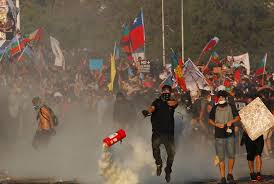
Protestors against the Pinochet regime during the Mass of John Paul II in Chile’s main soccer stadium
Comment
This is one of the chapters with firm grounding in reality. The pope’s nightmare is based on the report of what happened during his 1987 trip to Chile. In their biography (His Holiness: John Paul and the hidden history of our time) Carl Bernstein and Marco Politi described the papal Mass in the national soccer stadium as follows:
Pinochet staged a massive intervention using armored cars, jeeps, policemen with nightsticks and shields, water cannons, and tear gas to combat 700 demonstrators shouting slogans against the dictatorship and throwing stones at police stationed o the edge of the park. The demonstrators, who belonged to the extreme left-wing party Mir and to organizations of young dissidents allied with the Chilean Communist Party, were a tiny fraction of the 700,000 worshipers present at the mass. But the general wanted to make a point. Police charged demonstrators who were burning tires to shield themselves and crashed through the crowd of the faithful. Beneath the altar where the pope was celebrating mass, soldiers in jeeps cut circular swaths. Journalists, pilgrims, and priests who tried to block them were run over and injured. The tear gas fumes even reached the altar, where John Paul II, his eyes red and his throat burning, skipped whole sections of his homily on reconciliation, while his personal physician gave him water and salt to fight off the poisonous air.
“Love is stronger than hate!” shouoted John Paul II, while around him thousands of fear-stricken spectators cried out, “Save the pope!” Six hundred people were injured. All the political parties, including the socialists and Communists, denounced the actions of the security forces, calling their response a provocation. Cardinal Fresno and the president of the Chilean bishops conference, however, issued a communique identifying the police as the chief victims and blaming the demonstrators. It said the demonstrators had tried to prevent those in attendance from expressing their beliefs and had offended the pope. “We protest against this incredible assault, which meant blows and wounds to carabineros, papal guards, journalists, priests, and the faithful.” Not a word was said about police brutality, which had been witnessed by the entire international press corps.
Today, I begin a recording of a novel I wrote more than 20 years ago. At my current age of 81, I just want to get the book out in the public in some form while I still can. The novel is called The Pope, His Chamberlain, The Jinetera & Fidel.
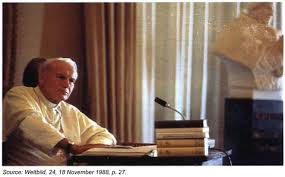
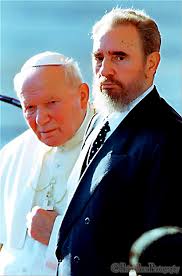
It’s a fictional story about Pope John Paul II’s actual 1997 trip to Cuba. I repeat: it’s a fictional story. So, don’t go accusing the sainted pope of the moral failing I place at the story’s center.
On the other hand, the tale was inspired by my own actual first journey to Cuba in the summer of 1996. It reflects what I learned there during a two-week stay under the auspices of the Greater Cincinnati Council of World Affairs – again, the first of many sojourns for me in the adopted home of Che Guevara and Assata Shakur. I’ve visited Cuba more than a dozen times since.
I originally wrote the book as a virtual vehicle for taking my friends and students to Cuba — to expose them to what I experienced during the 1990s “special period” there — and to clear up common misperceptions about life on the island. It was during the ’90s that U.S. sanctions coupled with the fall of the Soviet Union (and Cuba’s loss in the process of 85% of its trading partners) made life nearly unbearable for the Cuban people.
Today, something similar is transpiring for Cubans. The COVID-19 pandemic along with intensified U.S. sanctions have once again brought the tiny nation to its knees. (Hence the protests we’ve all heard so much about.) So, Cuba today is very similar to the Cuba of the last century’s final decade which is the novel’s setting.
The book’s relevance also stems from its indirect exposition of liberation theology, which I consider the most important theological development of the last 1500 years. Pope John Paul II was its foremost opponent. I’d like readers to come away with a better understanding of that theology and social movements it inspired.
Here’s my bottom line: though largely fictional, the descriptions I’ve portrayed here are true in that many of them reflect my own experience. In the introductions to relevant chapters, I’ll emphasize those non-fictional details.
In any case, I hope that you’ll enjoy to some degree what I’ll read here – a chapter more or less each day for the next month or so.
So, get ready. Here it is: the opening of The Pope, His Chamberlain, the Jinetera, and Fidel.
(By the way, as a work still in progress, the book begs for suggestions about improving or changing it. So feel free to offer advice.)
The Pope, His Chamberlain, the Jinetera, and Fidel: Prologue
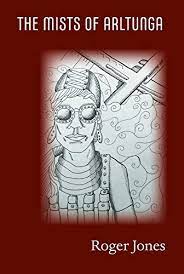
Two years ago, my good friend from Berea, Kentucky, Roger Jones published a thought-provoking extended parable about the current human condition shaped by post-modern capitalism. It’s a wonderfully insightful and artistically composed novel called The Mists of Arltunga. I highly recommend it.
Set In a mining camp (Arltunga) in central Australia 100 years ago, the story presciently portrays a world so polluted by chemical industries that the companies in question mine the foul-smelling air itself. They do so with glider air ships that draw behind them fine nets to capture jelly-like discharges from the open-pit mines below.
Of course, the putrid mists are also ingested by the mine workers whose nostrils and lungs end up hosting the foul emissions. They suffer and die accordingly.
But none of this matters to the chemical company’s absentee owner, nor to the mine overseer. The overriding concern of both is meeting production goals. To achieve those ends, the overseer browbeats his workers, alternatively threatens and sweet-talks them, punishes their shortcomings, and offers meaningless incentives. Worse still, he proves willing to kill troublemakers directly by using his pistol and covertly by provoking a fatal landslide by means of dynamite. He colludes with a competitor for purposes of controlling the workforces of both companies and of mutually enriching themselves.
In short, The Mists of Arltunga presents its mesmerized readers with a tale of unfettered capitalism that is both cautionary and actual.
But of course, (as in the real world) the most rebellious among the story’s exploited mineworkers take none of this lying down. Though they find themselves caught in a web of exploitation, they cannot initially free themselves. They’re impotent because employment in the mine represents their only source of sustenance without which they’d starve to death. Though the mine’s glider pilots can soar above it all for hours each day, they must eventually return to earth to eat the camp’s miserable gruel, turnips and thin soup. Eagles by day (an important metaphor in the book), they’re reduced to precariat slaves when they return to earth.
All of this holds true till one day a zeppelin from Perth crash lands with a deafening explosion and searing ball of flame near the mine site. All the vessel’s crew and passengers perish, except for the burnt and wounded daughter of Arltunga’s absentee owner. She’s saved by one of the mine’s glider-pilots who works in Arltunga alongside his father and younger brother. Unaware of the “sheila’s” true identity, both brothers immediately fall in love with her.
The girl, however, maintains a friendly but aloof distance from the pair. Under threat from the mine overseer, she is forced to conceal her true identity. She blends into the working community proving herself to be invaluable as a gardener and infirmary caregiver. Most surprisingly of all, she reveals herself as a competent glider pilot capable of flying with the best of the men.
A turning point comes when the camp overseer’s collusions with a competing mine operation come to light. It all involves the earlier-mentioned landslide, the resulting near-death experience of the mine owner’s daughter, and her abduction according to the plan of Arltunga’s mine overseer – again, the only character aware of the girl’s real name.
All of this catalyzes worker rebellion led by the story’s love-struck brothers. The climax involves a thrilling glider chase, another crash landing, and a surprising disclosure of hidden identities.
In the end, the revelations concluding The Mists of Arltunga point towards a mythic, parable-like and robust affirmation of the unity of the entire human family. They offer hope that acknowledgment of that single household can unite bosses and workers even altering the behavior of greedy absentee proprietors.
Do yourself a favor. Read Roger Jones’ splendid, hopeful and critical parable. Be inspired accordingly.