Sunday Homily: Jesus As Prophetic Bread of Life

Bread & Puppet’s rendition of El Salvador’s martyred archbishop, Oscar Romero

Readings for the 19th Sunday in Ordinary Time: I Kgs. 19:4-8; Eph. 4:30-5:2; Jn. 6:41-51

This Sunday’s readings are about prophets and bread.

They remind me of a recent visit my wife Peggy and I made to Glover Vermont’s Bread and Puppet Museum along with two of our eight grandchildren, Eva (age 15) and Orlando (12). The Museum presented the work of true prophets, Elka and Peter Schumann who, like today’s readings consistently connected prophecy with hard-to-chew bread. (Elka died two years ago at the age of 85).

The Schumann’s Prophetic Puppets

I’m sure many of you have heard of Bread and Puppet. The Schumanns founded that theater in 1963 as an act of political protest. Originally their issue was poor housing conditions in New York City. Since then, their giant puppets – some more than 20 feet high – have made spectacular appearances at protests, parades, and demonstrations everywhere.  

Over the years, Bread and Puppet’s focus expanded beyond housing concerns to include the Vietnam War, climate change, Nicaragua and the Contras, El Salvador, Archbishop Romero, liberation theology, Israel’s crimes in Palestine, and the general failure of capitalism. Every summer hundreds of volunteers have participated in the theater’s elaborate outdoor pageants highlighting those issues.

As a result, touring the museum last month and seeing hundreds of the Schumanns’ puppets represented a painful review of U.S. crimes over the past half century. Despite those sad reminders, the puppets also embodied an inspiring display of insight, creativity, commitment, joy, and courage. The Schumanns’ giant puppets have provided a truly prophetic deepening our collective consciousness.

The Schumann’s Nourishing Bread

However, the mammoth puppets were so stunning and arresting that it’s easy to forget the part that bread played in the Schumanns’ work. After all, the name of their company is Bread and Puppet.” (And homemade bread was served at all Theater performances.)

Elka Schumann herself made the connection in a 2001 film about her work. The documentary was produced by her daughter Tamar and DeeDee Halleck. Elka said:

“We have a grinder over there, and we grind the grain ourselves. And the bread is not at all like your supermarket bread. You really have to chew it. You really have to put some work into it. But then you get something very good for that. And when our theater is successful, we feel it’s the same way. You’ve got to think. It doesn’t like tell you everything. It’s not like Wonder Bread: It’s just like there it is, here’s the story, this is what it means. You’ve got to do some figuring yourself in the theater, in our theater. And if the play is successful, then at the end you probably feel it was worth the work.”

Elka’s words underline the essentials of good theater, good art, good religion. They don’t tell you everything. You must put in some work trying to figure out the message, to unpack it all. Good theater, good religion is not like eating white bread from Piggly Wiggly.

Jesus’ Bread

As mentioned earlier, that aspect of theater and faith is important to note this particular Sunday, since the day’s readings highlight the connections between bread, prophets, and the teachings of Yeshua, the construction worker from Nazareth who like the Schumanns’ puppets was truly larger than life.

What Jesus taught in his illustrative parables – in fact, what’s found throughout the Bible – challenges us to think and question our own lives, the values of our culture, and our too easy “understandings” of life and “God.” That’s what the Schumanns were doing too.

Think about the prodigal son, Jesus’ response to the woman about to be stoned for adultery, his dialog with Pontius Pilate about the nature of truth, and the issues raised by the fact that Jesus was executed as a rebel against Rome. Think about the prophet’s dying prayer for his enemies, his injunction to treat others as we would like to be treated, his “beatitudes'” centralizing purity of intention, poverty, gentleness, bereavement, imprisonment, mercy, peacemaking, and passion for justice. At every turn his words and deeds are challenging and (if you puzzle over them) difficult but rewarding to digest.

Understood in terms of rejecting Wonder Bread’s superficiality, all those elements in the accounts of Jesus’ words and deeds should give “Americans” pause. They should call into question the very notion of patriarchy, our worship of the rich, our wars against the world’s poor, our attitudes towards empire and capital punishment, as well as our very denial of truth’s possibility (which Gandhi boldly identified with God).

That sort of hard-to-chew bread forms the backdrop implied in today’s readings. See for yourself. Here are my “translations.” You could find the originals here to tell if I got them right.

I Kings 19: 4-8

Prophets are lonely people
Living on the edge of
Death and despair.
Elijah was no different.
He even prayed for death
On his way to Mt. Sinai.
Instead, generous Spirits
Fed him with bread and water
Twice!
He didn't have to eat again
For the remaining 40 days
Of his journey
To God's holy mountain.

Psalm 34: 2-9

Elijah's miraculous bread
Gave him a taste of
Life's Supreme Goodness
Directed especially
Towards the threatened
And afflicted poor.
The taste of bread
Replaces their shame
And distress
With joy and confidence
In Life's protective Source.

Ephesians 4: 30-5:2

So, Elijah
Should never have been sad.
In fact,
For those filled with God's Spirit
(And bread!)
There can be no room for sadness
Bitterness, fury, anger,
Shouting, reviling or malice.
There is space only for
Kindness, compassion,
Forgiveness and love
That mirror
Life's own abundance
And inherent generosity.

John 6: 42-51

John's community of faith
Identified Jesus' teaching
With the bread
That fed Elijah.
In fact,
They called Jesus himself
"The Bread of Heaven."
Consuming his teachings
Would strengthen them
For "the journey without distance"
(From heart to head).
This still upsets outsiders
Unable to overcome
Fundamentalist literalism
That yet confuses
The Bread of Life
With Wonder Bread,
And fairy tales
And spiritual nourishment
With gross cannibalism

Conclusion

When I was a kid, I actually liked Wonder Bread. In fact, I still kind of do. Don’t you? I mean it’s a bit sweet; it’s easy to chew; it’s a nice base for peanut butter and jelly, and it goes down easy. It’s comfort food. My well-intentioned mother fed it to me and my three siblings without a second thought. I ate it the same way.

But then most of us got more conscientious about what we put into our bodies. With Elka Schumann, we realized that Wonder Bread didn’t really nourish us. So, we turned to bread that (initially at least) was less familiar and that required more chewing and changing of taste-preferences – a bit more work – maybe not as strong as Elka’s bread, but more substantial nonetheless.

For many of us who have stuck with faith as a source of meaning, it’s been the same. We outgrew the beliefs that no longer nourished. We woke up to the fact that Jesus’ teachings need adult interpretation that demands thought and decision about those issues I mentioned earlier — patriarchy, grossly unequal wealth distribution, perpetual wars precisely against the world’s poor, empire, capital punishment, and about agnosticism concerning the Truth that parallels our denial of what we know to be genuine relative to the great issues of our day.

Instead, we’ve reduced “faith” to childish fairy tales that none of us can believe. We’ve made it into Wonder Bread. And this at a time in history when acceptance of life’s essential unity – proclaimed not only by Elijah and Jesus, but by all the world’s great religious traditions – is necessary for our species’ very survival.

In the words of John, the Evangelist, I’m trying to say we need the Bread of Heaven, the Bread of Life now more than ever. We don’t need comfort food.

Thank you, Elka and Peter Schumann for using your puppets and bread to drive that truth home.


The Elections, the Assassination Attempt: Such a Joke!

As they say, if it weren’t so tragic, it would be laughable. I mean, they’re trying to make us believe that the upcoming election is (once again!) “the most important in our lifetime.”

What a joke! Yesterday morning New York Times editors wrote about how “centrism works,” and how important it is to avoid “radicalisms” of both the left and the right – as if in this country ANY politician represents left radicalism.

Truth is, they’re all either center right or extreme right.  There is no “left” in this country.

None at all.

Face it: we’re governed by a Uni-Party. Everybody knows that. There’s hardly a sliver of daylight between Trump and (I guess) Harris. Certainly not between Biden and Trump. They’re all perpetrators of genocide. They’re all warmongers. All of them!

Oh, I suppose there’s some separation on the irrelevancies our system identifies as important: abortion, gay rights, immigration, and “wokeness” (whatever that means). Yes, in the face of genocide all those issues are trivial! Genocide eclipses everything else.

But the candidates won’t touch the real matter. Check out yesterday’s Times. They listed the issues facing Ms. Harris. Not a mention of the genocide in Gaza. Nothing about the war in Ukraine and why there are billions and billions and billions and billions and billions for that, but no money for what Americans really care about: higher wages, inflation reduction, universal healthcare, free college tuition, debt cancellation, climate change, low-cost public housing, or elimination of nuclear weapons.  Not a word.

Neither does anyone explain why Joe Biden is not up to campaigning, but he’s still president. It seems the old man’s still somehow “in charge,” though everyone knows that’s never been the case. Obviously, they’ve been lying about his mental capacities for years. (They didn’t just discover it during the Trump debate.) But they continued to lie about it till a few days ago!

And now they expect us to believe they’re telling the truth. Don’t worry: they really do care about us. And Genocide Joe is really a nice grandfatherly humanitarian. And that Kamala. You go, girl!!

Of course Biden’s a liar; always has been. He’s a murderer straight up. And so is Harris. – and all those old white men who repeatedly jumped to applaud Benjamin Netanyahu when he addressed Congress last week.  It’s all disgraceful.

 I can’t vote for any perpetrators of genocide. Which means I can’t participate in the upcoming election.

And as for assassination attempt on Donald Trump? Do you see the hypocrisy as the whole thing is swept under the rug?

I mean, Imagine if a major political opponent of Vladimir Putin were shot and wounded while campaigning on stage. There is no doubt that the IMMEDIATE conclusion of “our” MSM would be PUTIN DID IT.

No wait and see. No waiting for an independent investigation. Just ridicule of any call for an inquiry especially if it were carried out under the aegis of the Federal Security Service of the Russian Federation (FSB).

Such inquiry would be dismissed as a joke, since like its predecessor, the KGB, the FSB could never be trusted to reach truthful conclusions.

You KNOW that’s true, don’t you?

In fact, that’s what happened when a minor Russian political figure called Alexy Navalny (who in no way threatened Putin’s continued presidency) died in prison last February. No sooner was his death announced than a firm conclusion was drawn, Putin did it.

The same thing happened last August, when another of Putin’s opponents, Yevgeny Prigozhin died in a helicopter crash. The wreckage was still smoldering when the press identified President Putin as the one responsible.

But why do I bring that up?

It’s because over here, any public expressions of suspicions involving the Biden administration around the Trump shooting are automatically dismissed as conspiratorial – if they’re even mentioned.

Yes, we’re told, there were inexplicable lapses on the part of the Secret Service surrounding Mr. Trump. But virtually no one even hints that the Biden administration, the CIA, the FBI, or the Secret Service was behind it.

Do you think those agencies are somehow above and beyond such assassination attempts? Do you think we can trust them to investigate themselves? Remember what ex-CIA chief Mike Pompeo confessed (and laughed about it): “We lie; we cheat; we steal; we take entire courses about how to do it.”

But no, after every assassination attempt (John Kennedy, Robert Kennedy, George Wallace, Malcolm X, Medgar Evers, Ronald Reagan, Martin Luther King . . .) it’s the same story. No conspiracy or government involvement. Nothing to see here. Just a lone wolf and all kinds of unanswered questions in documents that won’t be released for another 50 years.

“But trust us: our three-letter agencies will get to the bottom of it. Just don’t worry your pretty little head about that.”

It’s all so corrupt. Such a joke. I just can’t take it seriously.

The Communist Manifesto (Translated for my 15-year-old Granddaughter and 12-year-old Grandson)

I’m currently in Northfield, Massachusetts where Peggy and I are spending the month of July with two of our grandchildren, Eva (15) and Orlando (12). Both are attending a summer session at Eva’s Northfield Mt. Hermon prep school. Eva is acting as a teaching associate for a beloved math instructor there as he teaches summer students pre-cal. Orlando is taking courses in physics and economics. In our spare time, we’re discussing “The Communist Manifesto,” and are planning an overview of the Bible.

To help with the former and to make discussion easier, I’ve done a rough “translation” of Marx and Engels’ “Communist Manifesto.” The basis for the translation below is a version of the text that sophomore students discussed at Berea College in a required course called “Religious and Historical Perspectives.” During my 40 years at Berea, I taught many sections of that two-semester “Great Books” course along with about 15 colleagues drawn from disciplines across the curriculum (each of whom had her or his own section). It was one of the best educational experiences of my life.

I want both Eva and Orlando to tackle the actual text before reading the summary. (I think it’s important for them to be able to claim having read the “Manifesto” which few of its critics can say for themselves.)

Please excuse any typos, obscurities of expression, and other faults in what follows. I pretty much dashed it off.

__________

The Communist Manifesto

In the revolutionary year of 1848, Karl Marx and his friend Friedrich Engels published “The Communist Manifesto.” Here’s what their declaration said:

The threat and fear of Communism has spread across Europe. Opposition to Communism has united everyone from the Pope himself to heads of state in Russia, France, Germany, and Italy.

In fact, virtually any opposition to the way things are is identified as “communist.”

Such universal opposition indicates that Communism has become a world “Power” on a par with the European “leaders” just mentioned. It also means that it’s high time that Communists should openly declare what they stand for.

So, Communists from across Europe have gathered in London to write and publish their Manifesto for all to read.

I

Bourgeois (town dwellers) and Proletarians (members of the working class)

The engine of historical change is class struggle.

That is, lower classes have always rebelled against their exploiters: e.g., slaves vs. their masters in the slave system, and serfs against their lords in the feudal system [an economic, political, and military arrangement where “serfs” (agricultural workers) were given land by their “lords” in exchange for their labor and military service)].

Modern bourgeois society (i.e., the “middle class” between royalty and agricultural workers) has given rise to brand new classes with severe tensions between them.

In fact, society is currently splitting into two camps hostile to one another, viz., the bourgeoisie and the proletariat (working class).

The bourgeoisie emerged from town dwellers (millers, miners, blacksmiths, furniture makers, shopkeepers, lawyers, politicians, clergy, etc.) who no longer were directly connected to agricultural life.

The discovery of America expanded this class to the “New World.”

Thus emerged a serious manufacturing system that overcame the power of guilds (closed associations of craftspeople and/or merchants).

A great leap forward occurred when the steam engine was invented (James Watt 1769). It gave rise to massive increases in production and the emergence of a factory system controlled by millionaires.  

The new system conjoined with European colonialism and advances in navigation and railroads sold products across the planet.

In this way the bourgeoisie accumulated enormous power displacing royalty as Europe’s dominant class. The bourgeoisie established governments that function as mere managers of those powerful manufacturing interests. The resulting laws serve the bourgeoisie not the proletariat.

Moreover, bourgeois culture has destroyed tradition and religious values, replacing them with naked self-interest and cash payment. Under the new system personal worth is determined by one’s degree of wealth. The concept of freedom is reduced to Free Trade.

As a result, non-capitalists (physicians, lawyers, priests, poets, scientists. . ..) have become a wage-laborers.

Bourgeois developments have also reduced families to mere cogs in their machine held together by concern for money.

Nonetheless, it must be acknowledged that the achievements of the bourgeoisie have surpassed even the pyramids of Egypt, the aqueducts of Rome, and the cathedrals of the middle ages.

Still, the bourgeois system cannot continue without constantly improving its means of production and without those improvements changing human relationships – thus sweeping aside even the most sacred traditional social relationships.

Neither can the system continue without expanding across the globe.

This latter development drives out of business local industries displacing their laborers and creating new wants satisfiable only by imports from foreign lands. Thus, nations across the globe can no longer be self-sufficient. There even arises a world literature as well.

This affects even the most backward and barbarous peoples where the attraction of mass-produced cheap products overcomes local resistance to foreign presence.

In the process, enormous cities are created which increasingly exert political, economic, and social control over the countryside. In this way, agrarian cultures become dependent on urbanized cultures. The East (like India and China) becomes dependent on the West (like England and other European colonial powers).

As means of production become centralized in fewer and fewer hands, so does world political power. Small provinces (with their separate laws and governments) disappear and nation states surface under one government and a unified code of laws.

More particularly, in scarcely 100 years the entire world has been transformed by chemistry applied to agriculture, by steam navigation, railways, electric telegraphs, and canalization of rivers. Entire forests have been cleared for growing food. All these developments have destroyed the remnants of feudal relationships.

Free competition has also put the bourgeoisie in charge not only of production and economics, but also of politics and law.

The bourgeoisie have unwittingly assumed the role of a sorcerer who has called up the powers of the nether world that he can no longer control. Thus, capitalist overproduction produces periodic depressions that threaten the existence of the bourgeoisie themselves. This gives rise to wars (i.e., attempts to destroy competitors’ machines and factories) and to intensified and more widespread colonialization (in search of new markets).

The result of all this is rebellion from below, whereby the weapons the bourgeoisie used in the service of their revolution against the royal classes are turned against the bourgeoisie itself.

To wit, bourgeois manufacturing processes have not only created the weapons that will bring about their own demise; they’ve also created an army that will use those weapons against them, viz., the proletariat which has developed step by step with the emergence of the bourgeoisie.  

Workers have become mere commodities (things to be bought and sold) subject to laws of supply and demand.

They’ve become extensions of the machines they tend without skill or understanding. As such, workers are completely interchangeable and receive wages sufficient only to keep body and soul together and to produce other workers. Machines and division of labor (i.e. the breakdown of the productive process into small, isolated operations) makes production rapid but increasingly meaningless and burdensome – a reality intensified by long workdays and the need to keep up with the intensified speed of machinery.

Crowded into ever-larger factories, workers are organized like soldiers and slaves of the capitalist, the bourgeois state, the foreman and the boss.

Machines with their independence from human physical strength have also made it possible for increasing numbers of women and children to enter the workforce – and keep wages low.

But that’s not the end of capitalist exploitation. As soon as workers leave the factory’s area of control, they fall under the control of other members of the bourgeoisie – the landlord, the shopkeeper, the pawnbroker, etc.

Similarly, the lower portions of the middle class (small tradespeople, shopkeeper, handicraftsmen, and peasants) all eventually lose their source of income and fall into the proletariat. They simply can’t compete with the low-cost products of their larger competitors. In the face of machines, their special skills become meaningless.

Workers’ rebellion against all this is first directed against the means of production themselves. In their efforts to restore the status they once held in the Middle Ages, laborers destroy the products they produce, smash the factories’ machines (“sabotage”}, and burn down the factories themselves.

Still, the bourgeoisie (the real enemies of the working class) succeed in persuading workers to fight their wars, i.e., to fight the enemies of the proletariat’s enemy (the bourgeoisie itself).

But as the size of the workforce increases and as everyone’s reduced to the same low-income level while the economy in general experiences increasingly frequent depressions and economic setbacks, the workers’ rebellious instincts turn more and more against the bourgeoisie itself. In practice, rebellion takes the form of workers’ unions (with strikes wherein the workers refuse to work unless their demands are met) and at times of riots.

The workers’ rebellion is enabled by improvements in means of communication (including railways) which transform local struggles into national ones.

England’s 10-hour bill represents an example of successful worker struggle despite many setbacks caused by divisions among the workers themselves.

However, the bourgeoisie experiences its own sources of tension – with the old aristocracy, with national competitors, and with the bourgeoisie of other countries. In such struggles, it is compelled to seek help from the proletariat. This requires education, raising the political awareness of the working class, and other measures which eventually can be turned against the bourgeoisie itself.

Additional elements of enlightenment and progress are supplied to the working class by the members of the ruling class that fall into the proletariat.

And finally, there are certain members of the ruling class that on principle and recognition of history’s direction leave their class loyalties behind and join the workers’ rebellion voluntarily.

Nonetheless, the proletariat remains the only truly revolutionary class.

The others – the small manufacturer, the shopkeeper, the craftsman, the farmer – fight the bourgeoisie to save their traditional positions in society. They are therefore conservative, not revolutionary. They are trying to return to a bygone age that will never return.

In all this, the “social scum” (the “lumpenproletariat”) at times joins the revolution. But they can easily be bribed by the bourgeoisie to be counterrevolutionary.

For the proletariat, bourgeois values around family, morality, religion, and law are just so many bourgeois prejudices invoked to advance the capitalist agenda of profit maximization.

Any class that achieves superiority will always attempt to restructure society in ways that will solidify its property holdings and position of control. For its part and to get the upper hand, the proletariat (who own nothing) must create a clean slate abolishing all forms of ruling class property.

Unlike previous historical movements (which were minority movements – i.e., of slave holders, royalty, and bourgeoisie), the proletarian revolution is that of the world’s immense majority. Its intention must therefore be to destroy the entire social structure which has been shaped by the minority to keep the majority in a subservient position.

At first, the proletariat must rebel against its own national bourgeoisie.

Whereas previous rising classes [serfs and small businesspeople (“petty bourgeoisie”)] rose with the progress of industry, today’s revolutionary class (the proletariat) sinks lower and lower into poverty as capitalism develops. This difference completely discredits the bourgeoisie and its laws.

Bourgeois rule depends for its continuance on increased capital accumulation. Such accumulation demands wage labor. In the process, the wages of workers are driven down by competition with other workers. Workers combat the downward trend in wages by forming the above-mentioned unions which will inevitably overthrow the capitalist class.

II

Proletarians & Communists

The Communists are not interested in setting up a political party separate from other workers’ parties. Their interests are international – those of the proletariat itself. The Communist agenda is the same as that of the whole international proletariat.

 As the most advanced and determined segment of the working class, the Party supplies a vision of the future, a sense of history, and guiding principles to the workers’ movement so understood.

Communist goals are (1) formation of the proletariat into a class (i.e., helping them develop class consciousness), (2) the overthrow of bourgeois supremacy, and (3) the attainment of political power by the proletariat.

Communist theory develops from an analysis of history and experience; it does not originate from the reflections of this or that philosopher.

Neither have the Communists originated the idea of abolishing existing property relationships.

For example, the French Revolution (1789-1799) abolished feudal property in favor of bourgeois property.

Property wise, the goal of Communism is not the abolition of property in general, but of bourgeois property (i.e., the means of production) based on the exploitation of the many by the few.

That’s Communist theory in a nutshell: abolition of private property. (i.e., private ownership of the means of production – factories, land, forests, etc.   

Communists do not seek the abolition of property belonging to the petty artisan or small farmer. The development of industry has already done away with such property.

Wage labor creates no property for the worker. Instead, it creates property for his or her exploiters.  

Capitalist success depends on the cooperation of whole societies.

It is a social power.

When capital is converted into community property it loses its class-character.

As for wage-labor . . ..

Minimum wage = what is necessary for workers to keep body and soul together.

Communist emphasis is on the present not on inheritances from the past. We are against the individuality, independence and freedom of the bourgeoisie. For the latter, freedom = free trade, free selling and buying.

Communists oppose free buying and selling, bourgeois conditions of production, and the bourgeoisie itself.

Are you scandalized by communist abolition of private property? It is already abolished for 9/10 of the population!

Yes, we intend to do away with your private property!

But, you ask, what about individuality?

Your question is really about bourgeois individuality.  It’s that individuality that must be swept away.

Abolition of private property is in no way about depriving people of the products of society. It’s about forbidding owners of such products to subjugate the labor of others.

But won’t abolition of private property make people lazy and reluctant to work?

In fact, it is the bourgeoisie that are reluctant to work. They are the lazy ones. “Work” for the bourgeoisie refers to the exploited activity of workers within the present system. Yes, workers are reluctant to continue doing that. In that sense, they are lazy.

The same is true of intellectual property identified by the bourgeoisie as “culture” (i.e. all the ways of life including arts, beliefs and institutions of a population that are passed down from generation to generation.) Class culture must disappear just as class property must vanish.

Bourgeois culture is nothing but the training of society’s majority to act like machines.

Bourgeois ideas like freedom, culture, and law are mechanisms for controlling the working class.

Like all previous forms of property and law (e.g., those belonging to slave and feudal, arrangements) bourgeois forms pretend to be natural and eternal.

And yes, the Communists do in fact propose abolition of the family as we know it. Don’t be shocked by that. The bourgeois family in question is based on private gain. Under capitalism, children are transformed into simple articles of commerce and instruments of labor. Additionally, capitalist production makes family practically impossible for the proletarians. It encourages public prostitution. It encourages the exploitation of children by their parents. Communists plead guilty to advocating the abolition of all those aberrations – child labor, public prostitution, and parental abuse.

The same holds true for education. Communists propose removing all ruling class influence from educational processes.

But what about bourgeois complaints that Communism introduces a “community of women?” Actually, it is capitalism, not Communism that reduces women to common property – to a pool of cheap labor whose members are nameless and without personality or individuality and whose purpose is to drive down all workers’ wages. At the same time, the bourgeoisie refuse to compensate women for their labor at home (begetting, feeding, clothing, educating, etc. their children so they too can contribute to the “community” of nameless ciphers in the pool of unemployed workers seeking a place in the industrial system.)

As for the bourgeoisie themselves. . .. As a class, they exhibit little aversion towards their dreaded “community of women.” They freely exchange wives through their divorce processes. They take great pleasure in seducing one another’s females. Routinely, they sexually exploit their employees. They frequent public prostitutes and anonymous females desperately displaying their bodies.    

 In short, “The Communists have no need to introduce community of women. It has existed almost from time immemorial.” (It’s part of the patriarchy.)

Similarly, Communists are accused of advocating the abolition of countries and nationalities.

Face it: proletarians are already people without countries. You cannot take from them what they do not have. The system treats them the same no matter where they live; it gives no value to country borders or nationalities. If workers do have a nationality, it is “proletarian.”

As workers recognize this fact, nation states will become less important and will vanish altogether under proletarian leadership. Thus, international conflict will eventually end.

Philosophical and religious objections to Communism are hardly worth noting.

History shows that human consciousness (along with human relationships) transforms along with changes in material circumstances. “THE RULING IDEAS OF EACH AGE HAVE EVER BEEN THE IDEAS OF THE RULING CLASS” (My caps.)

As means of production change, so do ideas. For example, with the dawn of 18th century “Enlightenment,” ideas about freedom of religion and conscience “merely gave expression to the sway of free competition within the domain of knowledge.”

The bourgeois concept of “eternally valid truths” is nothing but a reflection of the fact that class antagonisms (along with slightly modified versions of their supporting ideologies) have always characterized human history.

With the abolition of classes, such perceptions of “eternal verities” will also disappear.

The first step in revolution by the working class is to establish the latter as the ruling class – i.e., to win the battle of democracy (in the sense of government by the people). This entails employment of despotic measures to deprive bourgeois property owners of their property.

Towards that end, Communists advocate the following practical measures:

  1. Abolition of private ownership of land and the application of land rental to public benefit.
  2. A heavy progressive or graduated income tax.
  3. Abolition of all rights of inheritance.
  4. Confiscation of the property of all who flee from or rebel against the new order.
  5. Centralization of the banking system in the hands of the public as represented by the State.
  6. Similar centralization of all means of communication and transport in the hands of the public.
  7. State administration of factories, conversion of wastelands into farms, and general environmental development under State (i.e. public) administration.
  8. Excluding no one on principle from obligation to perform manual labor.
  9. Repopulation of the countryside to restore balance and absence of distinction between town and country.
  10. Public schooling for everyone. Elimination of child labor in its present form.

Once class distinctions have disappeared, and all means of production have been concentrated in public hands, the State will lose its political character (since “political power, properly so called is merely the organized power of one class for oppressing another”). The proletariat will thus abandon its dictatorship. “In place of the old bourgeois society, with its classes and class antagonisms, we shall have an association, in which the free development of each is the condition for the free development of all.”

IV

Position of the Communists in Relation to the Various Existing Opposition Parties

“The Communists everywhere (in France, Switzerland, Poland, Germany, etc.) support every revolutionary movement against the existing social and political order of things.”

Communist aims can only be secured by the forceable overthrow of all existing social conditions.

“Let the ruling classes tremble at a Communistic revolution. The proletarians have nothing to lose but their chains. They have a world to win.

“Working men of all countries, unite!”

Jesus’ Healing Action Tells Women To Disobey Men: Control Your Own Bodies

Readings for 13th Sunday in Ordinary Time: Wisdom 1:13-16, 2:23-24; Ps. 30:2, 4-6, 11-13; 2Cor. 8:7, 9, 13-16; Mk. 5:21-43

Last month my brilliant 15-year-old granddaughter shocked students in her high school freshman class by giving a speech about menstruation. Yes, menstruation! She called her talk “Bleeding in Silence: The Hidden Epidemic of Period Poverty.” (For those interested, I’ve pasted Eva’s words to the bottom of this posting.)

Eva’s speech was about how the patriarchal system fundamentally misunderstands how women’s bodies function. And in our man’s world, it’s women who pay the price for such ignorance. For instance, it influences the cost of “feminine hygiene products” and their availability while imposing unspoken prohibitions about even mentioning menstrual periods much less openly discussing and coping with them.

Eva’s presentation began with a video of interviews of male family members during a party over her school’s Easter break.  On camera, she simply asked us “What do you understand by the word ‘menstruation?” It was surprising how quickly inarticulate, seemingly embarrassed, and (let’s face it) ignorant our responses were, even by those who (like me) should know better.

A principal conclusion of Eva’s speech was that lamentably, men know very little about how female bodies work. Women, of course know much more. Moreover, this disparity has major social repercussions when overwhelmingly male state administrators in a completely patriarchal system impose legislation about what they barely understand. e.g., about abortion, contraception sex education, and easy and cheap access to those hygiene products.

For instance, relative to abortion, the legislation ignores the fact that 70-75% of fertilized eggs end up aborting spontaneously. They’re unceremoniously flushed down toilets across the world in the menstrual period immediately following fertilization. Yet, a recent decision by the Alabama Supreme Court holds that all those unknown and unrecognized embryos are somehow “children.” At least that’s the implication of the court’s determination that frozen embryos are babies. How offensive to common sense is that? How contrary to what every woman implicitly knows.

I bring all of that up on this Thirteenth Sunday in Ordinary Time because today’s selection from the Gospel of Mark centralizes a woman with a menstrual problem. It implies criticism of ignorant patriarchal laws regulating it, while strongly affirming a particular woman’s courageous decision to transgress those restrictions in favor of her own faith and common sense.

Jesus & Menstruation       

In short, today’s reading uses the issue of menstruation to show how Jesus favored women who spoke for themselves and courageously exercised their own initiative even in the face of specific patriarchal legislation forbidding such agency. It has him even curing and praising a woman who disobeys precisely misogynistic laws. He ends up prioritizing her needs over those of a young female who was a passive captive to the religious patriarchy. 

To make those points, Mark the evangelist creates what might be termed a “literary sandwich” – a “story within a story.” The device focuses on two kinds of females within the Jewish faith of Jesus’ day. In fact, Mark’s gospel is liberally sprinkled with doublets like the one just described. When they appear, both stories are meant to play off one another and illuminate each other.

In today’s doublet, we find two women. One is just entering puberty at the age of 12; the other has had a menstrual problem for the entire life span of the adolescent girl. (Today we’d call her condition a kind of menorrhagia.)

So, to begin with the number 12 is centralized. It’s a literary “marker” suggesting that the narrative has something to do with the twelve tribes of Israel – and in the early church, with the apostolic leadership of “the twelve.” The connection with Israel is confirmed by the fact that the 12-year-old in the story is the daughter of a synagogue official. As a man in a patriarchal culture, he can approach Jesus directly and speak for his daughter.

The other woman in the doublet has no man to speak for her; she must approach Jesus covertly and on her own. She comes from the opposite end of the socio-economic spectrum from the 12-year- old daughter of the synagogue leader.

The older woman is without honor. She is poor and penniless. Her menstrual problem has rendered her sterile, and so she’s considered technically dead by her faith community. Her condition has also excluded her from the synagogue. In the eyes of community leaders like Jairus (the petitioning father in the story) she is “unclean.” (Remember that according to Jewish law, all women were considered unclean during their monthly period. So, the woman in today’s drama is exceedingly unclean. She and all menstruating women were not to be touched.)  

All that means that Jairus as a synagogue leader is in effect the oppressor of the second woman. On top of that the older woman in the story has been humiliated and exploited by the male medical profession which has been ineffective in addressing her condition. In other words, the second woman is the victim of a misogynist religious system which saw the sacrificial blood of animals as valuable and pleasing in God’s eyes, but the blood of women as repulsively unclean.

Nonetheless, it is the bleeding woman who turns out to be the hero of the story. Her confidence in Jesus is so strong that she believes a mere touch of his garment will suffice to restore her to health, and that her action won’t even be noticed.

So, she reaches out and touches the Master. Doing so was extremely bold and highly disobedient to Jewish law, since her touch would have rendered Jesus himself unclean. She refuses to believe that.

So instead of being made unclean by the woman’s touch, Jesus’ being responds by exuding healing power, apparently without his even being aware. The woman is cured. Jesus asks, “Who touched me?” The disciples object, “What do you mean? Everybody’s touching you,” they say.

Finally, the unclean woman is identified. Jesus praises her faith and (significantly!) calls her “daughter.” So, what we end up finding in this literary doublet are two Jewish “daughters” – yet another point of comparison.

While Jesus is attending to the bleeding woman, the first daughter in the story apparently dies. Jesus insists on seeing her anyhow. When he observes that she is merely asleep, the bystanders laugh him to scorn. But Jesus is right. When he speaks to her in Aramaic, the girl awakens and is hungry. Everyone is astonished, and Jesus must remind them to feed her.

Mark’s Message for Us

What does all the comparison mean? The doublet represented in today’s Gospel addresses issues that couldn’t be more female – more feminist. The message here is that bold and active women unafraid of disobeying the religious or civil patriarchy in matters that women understand better than men. “Prioritize and act like the bleeding woman” is the message of today’s Gospel.

Could today’s gospel be telling us that bold and specifically feminist faith that sides with the poor and oppressed (like the hero of today’s Gospel) will be the salvation of us all who are moribund? Are women precisely as women today’s real faith leaders, rather than the elderly, white, out-of-touch men who overwhelmingly claim to lead in every sphere even those where women know far more.

Conclusion

Today’s Gospel suggests that it’s time for men to stop telling women how to be women – to stop pronouncing on issues of female sexuality whether it be menstruation, abortion, contraception, same-sex attractions, or whether women are called by God to the priesthood. Correspondingly, it’s time for women to disobey such male pronouncements, and to exercise leadership in accord with their common sense – in accord with women’s ways of knowing. Only that will save our national community which is currently sick unto death.

_______

Bleeding in Silence: The Hidden Epidemic of Period Poverty

By Eva Lehnerd Reilly

Whether they know the term or not, all women are necessarily aware of the realities of “Period Poverty.” Nonetheless, the concept remains completely foreign and even incomprehensible to most men. As a result, little is done to eliminate the problems the phrase represents. The phrase “Period Poverty” is defined as the lack of access to safe and hygienic menstrual products during monthly periods and accessibility to basic sanitation services or facilities as well as menstrual hygiene education.

Additionally, period poverty has social dimensions that include the stigmas surrounding this natural female process. To explain the problem, what follows will explore international dimensions of this issue, connect the phrase with patriarchy, misogyny and human rights and make recommendations for its elimination. This essay is arguing “Period Poverty” is a world health issue thus by refusing to acknowledge it we are proving that we still live in a society that is patriarchal, misogynist, and locked in an aggressive denial of the rights of women.

An International Problem 

This issue affects billions of people worldwide in ways including stigma, dependence on transnational companies producing the necessary hygienic products, and the lack of understanding and acknowledgement of the problem. Stigma is one of the largest problems surrounding period poverty. Many countries and people believe wildly untrue period-related information. According to the Korean Journal of Family Medicine, Nepal “continues to believe in dangerous, incorrect ideas, for example, using tampons causes women to lose their virginity, or handling food while menstruating causes it to spoil the food.

Social stigma on menstruation remains even in more advanced nations: in the United States, 58% of women are ashamed of having a period, and 51% of men believe that it is improper to discuss periods at work.” (Jaafar, Hafiz, et al., 2023). The fact that stigma is so present in all different circles around the world shows how grand an issue this is and how many people are affected by it.

This is also an economic issue because women are dependent on transnational companies. Global Research and Consulting Group Insights explains that: “Multiple countries in the world impose the ‘tampon tax’ on menstrual products, frequently targeted as ‘luxury goods.’ This categorization enhances the chances that economic disparities, limit access to period products, and perpetuates the view that they are not a ‘necessity.’”(Ricardo da Costa, 2023). This tax is implemented often in particularly lower-income, less developed countries but it is far from unique to developing countries. In fact, GRC found that the elimination of the “tampon tax” in California would likely reduce government revenue by 55 million dollars. This shows how women’s reliance on companies to provide basic hygiene products is problematic because the government is trying to make financial gains by providing resources that should never be charged for in the first place.

Probably the largest problem of them all is the lack of awareness and understanding surrounding period poverty and the menstrual cycle in general. A Plan International study found that one in five boys and young men think that periods should be kept a secret. Furthermore, they associate this term with words like ‘messy,’ ‘gross,’ and ‘embarrassing.’ This tells us that the taboos set in place by society are greatly affecting young people and discouraging them from learning and understanding this issue. This is leading to the rise of a new wave of sexism.

Periods and Patriarchy

The term “patriarchy” refers to social conditions ruled by fathers–or more generally by men. In 

The Creation of Patriarchy, Gerda Lerner determines that this comes from lessons taught in childhood. She says that the “absolute authority of a father over his children provided men with a conceptual dominance of dependency, due to the helplessness of youth.” (Lerner, 90). Relative to period poverty, this fundamental condition has led some women to joke that if male biology included menstruation, they would likely be excused from work days before and during the entire menses process, plus they would be given a week off to recover. Additionally, menstrual hygiene products would be low or no cost, not subject to taxation, and as available as toilet paper and paper hand towels in every washroom.

In our patriarchal society no such accommodations are available for more than half our nation’s population. That’s period poverty. However, this goes farther than just the patriarchy. The issue is also affected greatly by misogyny, a term meaning hatred of women. This is revealed in attitudes surrounding mood swings, jokes about periods and even dates back to religious texts calling women ‘unclean’ during this time.

Particularly, in the third Book of the Pentateuch or Torah, known as Leviticus, it states that a woman undergoing menstruation is perceived as unclean for seven days and whoever touches her shall be unclean until evening (Leviticus 15:19). This is simply outrageous and goes to show how our society is so deeply rooted in these feelings of hatred towards women and disgust towards natural occurrences.

Finally, access to period products is a human right. A human right is what belongs to human beings simply because of being human; it does not have to be earned, it is an entitlement. All women, simply because of being women, have menstrual periods. They therefore have rights connected with their inevitable circumstances. These include rights to free or very low-cost feminine hygiene products, widespread availability of such products and freedom from blame, ridicule, or penalty for time off for personal care during their periods. Now that we have established this, how can we fix this?

Practical Recommendations

The Journal of Global Health Reports found that 500 million people lack access to menstrual products and hygiene facilities and since half the population is female and over half of university students are female, this issue can no longer be ignored. Men need to be part of the solution. We need to all work together to ensure a positive and supportive environment that allows menstruating people to participate in all aspects of life (e.g., going to school/work, and sport). In a Plan International study of over 300 men, 49% said their education on periods was poor or non-existent and just under one third (32%) said that talking about periods made them feel uncomfortable, increasing to 53% in the youngest respondents aged 16-18 years. This shows that many people (men in particular) are not receiving adequate education leading to misinformation and increased stigma associated with menstruation.

The takeaway is that we are in desperate need of a far greater and earlier education about periods in schools. There are three things to note surrounding this being a world health issue: 1) Poor menstrual hygiene often causes physical health risks, 2) globally, 1.7 billion people live without basic sanitation services, 3) girls with disabilities disproportionately do not have access to the facilities and resources they need for proper menstrual hygiene. The former Chief of Water, Sanitation and Hygiene at UNICEF said it best: “Meeting the hygiene needs of all adolescent girls is a fundamental issue of human rights, dignity, and public health.” (Rodriguez, Global Citizen). With all that in mind, allow me to conclude my argument.

Here’s What I’d Say If President Biden Asked for a Tarot Card Reading about Gaza

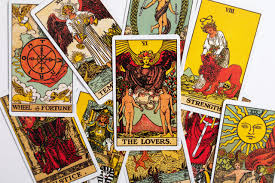
Recently, Rob Kall, the editor-in-chief of OpEdNews (where I’m a senior editor) asked me, “But what does one of your Tarot card readings look like?” It was a fair question. So I’ve decided to give an example of what I do according to the following procedure: (1) The querent (seeker) asks for a reading; (2) I do a spread with her questions in mind; (3) I write up the reading as fully as possible; (4) I email the reading to the querent; (5) we establish a SKYPE appointment where (6) we discuss the reading for an hour or so, (7) supplementing it whenever necessary with “clarifying cards” chosen by the querent in real time; (8) I send a final email summary of the entire interaction.

To show you what I mean, you’ll find below an example of one of my readings — this a fictitious one on behalf of President Joe Biden. It’s a spread responding to questions I imagine him asking about Gaza.

Dear Mr. President,

Thank you for your request for a Tarot reading about your dilemma in Gaza. I know you seek an answer from the cards hoping that they have access to the will of the Great Spirit that grounds all our lives. I for one am sure they do.

With that in mind, I take your question to be “What do I need to know about myself in relation to the ongoing conflict in Gaza? And what should I do?”

Seeking a response and using the World Spirit Tarot deck (based on the standard Rider-Waite-Smith deck, but much more dramatic) I did a “Celtic Cross” 10-card spread (see immediately below). Before beginning, I held the cards close to my heart. I reminded myself that the cards represent a marvelous packet of divine energy and light – and that you do as well, and so do I. Grounded in those convictions, I made the following invocation: “O, Great Spirit of Life, our Divine Mother and Father, let President Biden’s energy and light (channeled through me) meld with the energy and light of these cards so that the images chosen might reveal his current life’s situation and choices relative to Gaza. Let them show the deep unconscious source of the circumstances that concern him. Let them also reveal their more proximate and probably conscious source along with Mr. Biden’s present motivation, his immediate future, the relevant image he has of himself, the external influences on his life, his hopes and fears, and finally his destiny should he continue his present path.”

I then shuffled your questions into the cards and drew ten of them. This is the way they fell:

Before proceeding, please enlarge the spread and take a careful look at it to see what it says to you.

Now let me examine each card one-by-one. Before reading my interpretations, try to understand their meanings on your own.

  1. President Biden’s Present Situation in Gaza

What do you see in this card? It is the five of pentacles. Pentacles are concerned with material reality, with work, health, poverty, and wealth. Here I see you out in the cold.  You are isolated, and in a fetal position that contradicts your advanced age. Does your posture represent your deep desire to be born again – to change your position? In any case, you continue crouching outside a barred door with a golden handle you seem afraid to turn. The stained-glass pentacles behind you are arranged in a way that suggests spirituality and Kabbalah’s Tree of Life. It represents a summons to higher consciousness that contradicts the death and destruction so rampant in Gaza. Yet you seem to be shielding yourself from the Tree’s invitation. In fact, you’ve turned your back on it. Does the dark shadow behind the door represent your true self inviting you towards the golden horizon you fear to confront? Tell me, on which side of the barred door is freedom found? Who’s in prison here — you or the figure behind the door?

2, Challenges to the President’s Situation in Gaza

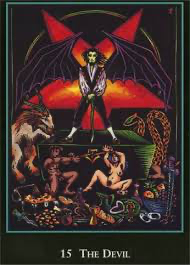
This is the 13th card in the Tarot’s collection of 22 Major Arcana (mystery) cards. The major arcana speak not merely of life’s changing circumstances, but of one’s character, one’s archetype. Sadly, this card suggests that an Evil Spirit has gotten hold of you, Mr. Biden. It may be what prevents you from opening the door to new life pictured in the previous card. The spirit in question is governed by base impulses (indicated by the serpent, goat, and the card’s inverted pentagram). It all supports a patriarchy that keep men and women frozen in hostile and defensive positions relative to one another. The reference may be to the IDF’s attacks on mothers and grandmothers deprived of their murdered children for the sake of power and the riches that lie strewn at the bottom of the card. The Evil Spirit depicted here is profoundly anti-woman. Does its appearance suggest a summons to honor the specifically female wisdom of martyred Gazan mothers, grandmothers and their children?

3. The Deep (probably unconscious) Roots of Mr. Biden’s Problem in Gaza

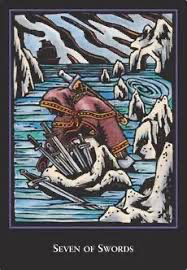
This is the Seven of Swords. Swords are about ideas and ideologies that control us. Sevens are about causal energies. This Seven of Swords shows you again isolated and out in the cold – this time waist deep in a freezing body of water with its dangerous whirlpools. Water, of course, is a feminine element. Swords are masculine. This card has you withdrawing your masculine swords from the feminine element. Relative to Gaza, the Seven of Swords asks you to recognize that ultimately (and unconsciously, I’m sure) the genocide you’re supporting there represents a war on women and their children. The card says, “Remove the swords (in the form of weapons and the ideologies behind their provision) from the hearts of Gazan mothers, grandmothers, their babies and children.” Such extraction means changing your ideas and the approach to Gaza your ideas support. There’s a suggestion of swapping military force for diplomacy here. Finally, this card communicates a sense of urgency. Do you see the dark ship in the card’s upper left corner? Your ship is coming in, Mr. Biden, but you’re ignoring it. The ship says your remaining time on earth is short. Drop the old ideas, change horizons, do what right despite ultimately irrelevant masculine concerns conditioned by false perceptions of “a man’s world.” Ultimately, it’s just the opposite. You’re waist deep in feminine energy!  

4. The Proximate Roots of Mr. Biden’s Gaza Dilemma

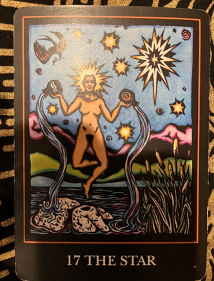
Another Major Arcana card. It is a card of hope and healing. Its female image dancing on the water reiterates the call to lift your head from the frigid waters of the previous card and scan the night skies for transcendent guidance. Miracles (like walking or dancing on water) are possible and within your grasp. The answer to your Gazan dilemma is mirrored in the sky’s celestial order – in healing rather than continuing support of war and destruction. Follow Bethlehem’s star of peace, not war.  

5. Mr. Biden’s Motivation vis a vis Gaza

Yet another Major Arcana card addressing your essence. This one is about a coming Judgement regarding your policies in Gaza. The card centralizes the Egyptian Hermanubis (god of judgment) weighing your destiny against the Feather of Truth. Surely it refers to history’s judgment of your presidency which by all accounts is being importantly and negatively shaped by your policy in Gaza. Will you be remembered as “Genocide Joe?” Surely, you don’t want that. The card also anticipates a more proximate judgment coming on November 5th.  If your driving motivation comes from your desire to be re-elected, the card suggests you must change policy in Gaza.  

6. President Biden’s Proximate Future Relative to Gaza

This card suggests that young people will determine your immediate future (in November). It is a “court card” that refers to important “Seekers” (young 20-somethings) among us. In the context of your Gaza dilemma, this card inevitably recalls the pro-Palestinian demonstrators on campuses throughout our country. They are determined to play a determinative part in your proximate destiny. Their attire in this card suggests Native American sensitivities to the ways of nature. It recalls peace pipes, and diplomatic discussions around a campfire. This is a call to diplomacy and dialog, to listening to your young constituents. Heed what young people are saying or else! That seems to be the message here. [BTW, please note that horse of the card’s Seeker has its hooves firmly rooted in the feminine element of water. The Seeker is calling attention to a mysterious Cup suspended above him. Cups are not about confrontations but about the creative relationships that women typically pursue more than men. Do you see a unifying theme here?]

7. Mr. Biden’s Image of Himself in This Situation

Here you are with your sword again, Mr. President. Surprisingly, the card says that despite your status as an octogenarian, you imagine yourself as somehow a contemporary of the Seekers pictured in the previous card. With sword aloft you’re riding a horse raring to charge into the future (framed by two rough pillars) despite the storm on the horizon. In the Gaza context, this card seems to say, “Take heed of that storm. Act your age. Back off from the trouble that inevitably lies ahead should you continue your sword-led charge.”   

8. The Context of Mr. Biden’s Gaza Situation

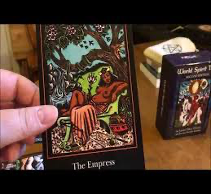
Another Major Arcana card – the Empress. Another reminder to change from male-led policies to those guided by feminine beauty and principles that should form the context of any Gazan policy – of any beneficially imperial order. And what might those principles be? The card says they are based on harmony with nature (signified by the Tree of Life sheltering above the empress). Similarly, the snake that appeared as a force of evil in the Devil Card now appears transformed into its traditional goddess meaning as a perpetual life force (since it repeatedly sheds its skin). The Empress’s own skin color reminds us that the world should be governed by its non-white majority rather than by white European colonialists. Her large breasts also signify a different kind of governance – this one by nurture, not destruction. This theme is continued in her shepherds crook and the unthreatening whip in the card’s foreground. Together, they suggest deemphasis of force in favor of gentle correction. And of course, the beautiful flowers and soaring birds, as well as the abundance of fruit all connect with sharing the earth’s cornucopia regulated by the scale of justice at the Empress’s feet. All of this relates to the ultimate feminine signified by flowing water. In summary, this card calls for a planet-wide change of context from masculine force to feminine gentleness, joy, and harmony with nature. What would that change of context look like in Gaza? The answer is largely up to you, Mr. President.  

9. Mr. Biden’s Hopes & Fears Relative to Gaza

This entire reading could hardly be more feminine. In Tarot all aces are about new beginnings and about unperceived potential. In the World Spirit Tarot deck we’re using, its aces consistently present us with the feminine yoni as a portal to life and new beginnings. And that’s what we have here. A feminine yoni, a portal to a new reality, where relationships (the essence of the suit of cups) are overflowing with life (water), not death (the reality in Gaza). I know, Mr. President, you’re hoping for something like that in Palestine. However, this card suggests you’re on the wrong track. What you’re doing is too male, too much based on force. This card calls you elsewhere. Enter its gentle female portal to New Life. Doing so will help you transcend your fears and offer hope to all of us.  

10. President Biden’s Destiny Relative to Gaza

Do you see what I meant about the feminine character of this entire Tarot reading? Look where we finish. Again, a yoni frame. Again, a fruitful goddess centralized. Again, a call to harmony with the world’s elements – fire in the lion, air in the eagle, water in the dolphin, and earth in the ox. This card asks you, Mr. President, to adopt a universal (rather than a narrow national) perspective. It says align with the forces of nature and the universe. Doing so will help you see beyond distorted views of “American Exceptionalism” and the destruction of the earth’s elements by use of modern weapons of war.  

Summary

Surely, I don’t need to again call attention to the female thrust of this reading. The cards are calling away from patriarchal, violent, and outdated thinking and action. The cards summon you away from a white colonial world towards one governed by the world’s non-white majority. They call you to empathy with Gazan mothers, grandmothers and their babies, children, and grandchildren. Another world is possible, Mr. Biden. And with your incoming ship on the horizon (along with the fast-approaching November elections) you haven’t much time left to change course. But (according to the cards) change course you must!

Tarot and Catholic Spirituality: Let Me Read Your Cards!

Believe it or not, even though I’m a Catholic liberation theologian, I’ve also become Tarot card reader. And this despite the teachings of my beloved meditation mentor, Eknath Easwaran, who always characterized Tarot as “Terror Cards.”

In fact (pace Sri Easwaran), it’s much more focused than that. I’m now using my ability to read Tarot as a fund-raising project for an impoverished women’s cooperative in Guanacaste, Costa Rica.

Let me address all that by first explaining my understanding of Tarot cards. Then I’ll show you how Tarot fits in with Catholic theology and my fund-raising project. Finally, I’ll issue an invitation to read your cards.     

My Introduction to Tarot

To begin with, I was introduced to Tarot during a year-long sabbatical that my family spent in Spain. There in Andalusia, I unexpectedly fell in with a group of street musicians and gypsies. Most of them made only five or ten dollars a day as buskers. As self-described troglodytes, they lived in caves without running water or electricity. They explained the cards and their interpretations to me in ways that made me drop my preconceptions and defensiveness.  If you’re interested, you can read about all that hereherehereherehere, and here.

In any case, I learned that Tarot cards represent a divinatory tool usually understood as helping “querents” (seekers) answer existential questions connected with work, relationships, anxieties, and what the future might hold. As expressed by Tarot master Joe Monteleone, those consulting the cards typically want to know about getting paid, getting laid, and staying unafraid, so they might reach a happy conclusion of their parade through life.

But as Monteleone insists, Tarot cards are about much more than getting paid, laid, overcoming what makes us afraid. In fact, the 78 cards of the Tarot deck represent a dynamic book about you, me, and anyone who opens the “book.” Tarot cards are dynamic because as packets of the universal energy filling the universe, they meld, tap into and blend with the energy packets of those reading and seeking guidance from the Tarot cards. Put otherwise, like the cards themselves, each of us is a bundle of energy that can select from the deck individual cards addressing our true identities and the granular circumstances of our lives.

Accordingly, the Tarot book is divided into chapters addressing the archetypes just mentioned, as well as spirit, relationships, thoughts, and our physical circumstances such as work, money, and health. All those elements come to light in suits of wands (for spirit and creativity), cups (for relationships), swords (for ideas), and coins (for physical circumstances). Additionally, a final chapter (called “court cards”) explores relationships with important others in our lives under images of pages, knights, kings, and queens.

As those images indicate, the relevant cards are replete with references to history, mythologies, sacred scriptures, astrology, and akashic records.     

Relative to all that, I’ve discovered that my background in the classics, history, poetry, and theology has prepared me well for reading Tarot cards. So, I’ve done it for family members and friends who have recognized (and have helped me see) my ability to interpret card meanings.

In fact, while still in Spain, I did so for two professional readers, who subsequently encouraged me to “go professional.” Since returning home, I’ve even read for my therapist (whom I consider my spiritual director), and she has very generously sent my way several “clients” for whom I’ve read on ZOOM and SKYPE.

[Oh, and recently during a three-month stay in Florida I read for many absolute strangers poolside at the Regatta Beach Club in Clearwater Beach. (Subsequently, however, I was informed by the Club’s authorities that such activity “for monetary gain” was forbidden.)]

What the authorities in Florida didn’t understand is that I’m forwarding ALL “monetary gain” to a women’s cooperative in Costa Rica. For clarification, here’ a flyer I’ve made to explain my project: https://acrobat.adobe.com/id/urn:aaid:sc:US:173ab9ae-7e78-406a-87e0-d8b16002fe46

As the flyer indicates, our (very poor) Costa Rican friends manufacture simple solar ovens and instruct their neighbors how to make them. They also maintain a large organic garden that provides food for themselves and their neighbors. (By the way, our friends in the co-op find themselves amused that I as a deinstitutionalized priest and theologian should be delving into the occult on their behalf.)

Theological Connections

It turns out, however, that no one should see any contradiction between Tarot cards, priesthood, and/or theology. That was brought home to me several months ago when I came across a book called Meditations on the Tarot: a journey into Christian Hermeticism. The book was published anonymously in 1985.

[By the way, the word “Hermeticism” refers to the teachings of Hermes Trismegistus, a reputed contemporary of Moses who lived 1600 years before Christ. Hermes explored the relations between human experience and the divine. Many have seen him as the wisest man who ever lived. It turns out that ancient Fathers (and Mothers) of the Christian Church have long explored connections between Hermes and the Judeo-Christian tradition. They are the Christian Hermeticists referred to in the title of Meditations on the Tarot.]

In any case, I found the enthusiastic endorsements on the book’s cover to be astounding.

They came from the Trappist abbot Thomas Keating (the colleague of Ken Wilber of Spiral Dynamics fame), from another Trappist Basil Pennington, as well as from the mystic and leader of the Christian ashram movement, Bede Griffiths. Even more surprisingly, the book’s afterword was penned by the great Catholic theologian and cardinal of the church, Hans Urs Von Balthasar.

The endorsements from all four men contained superlatives such as “the most extraordinary work I have ever read” (Pennington); “simply astonishing” (Griffiths), and “the greatest contribution to date toward the rediscovery and renewal of the Christian contemplative tradition of the Fathers of the Church and the High Middle Ages” (Keating). Cardinal Von Balthasar’s afterword praises the “formidable power of his (i.e. the anonymous author’s) spiritual vision.”

What surprised me about such testimony was not only that monks, mystics, theologians, and even a cardinal knew anything about Tarot cards at all, but that they knew them well and saw them as tools for spiritual growth.  My interest in reading cards had put me in good company indeed.

My Work as a Tarotista

So, I decided to become a card reader — a Tarotista. Here’s how I do it:

  • I receive a reading request in which the querent identifies the session’s focus (e.g., a relationship, a question about work, income, children, about a fork in life’s road, etc.)
  • We set a time to meet on SKYPE.
  • I ask the querent to hold her hand to her heart, while I press the tarot cards against my own heart and pray something like this: “O, Great Mother-Father let my sister’s energy and light (channeled through me) meld with the energy and light of these cards. Let the cards chosen reveal her current life’s situation, the deep unconscious source of her circumstances, the more proximate and probably conscious source, her present motivation, her immediate future, the image that she has of herself, the external influences on her life, her hopes and fears, and finally her destiny if she continues on her present path.”
  • I typically do a 10-card reading and we discuss it for an hour.
  • As suggested above and depending on the “spread” I use, the 10 cards in question usually identify (1) the querent’s present situation, (2) the challenges to that situation, (3) the situation’s deep (usually unconscious) roots, (4) it’s more proximate origins, (5) the querent’s true motivations for presenting the question, (6) what the immediate future holds, (7) the querent’s present image of herself, (8) the context influencing her question, (9) the querent’s hopes and fears, and (10) the outcome to be expected if the querent stays on her present path.
  • Finally, I write up a detailed summary and email it to the querent.

With good success, I’ve also simply:

  • Received a request with identification of the area of inquiry.
  • Done the prayerful reading ahead of time.
  • Emailed the reading to the querent.
  • Met with the querent online for a one-hour discussion.
  • Wrote up a summary of the entire process.

Conclusion

The summaries I’ve just mentioned are important, so that the querent might recall, review, and meditate upon the outcome of the Tarot reading.

The amount of time I invest in the process just described is approximately three hours. For this, I ask a donation of $100 for that women’s co-op. So far, I’ve been able to help them substantially.

So that’s my new endeavor. In future postings here. Next time I’ll give an example of my reading style by imagining that Joe Biden asked for a reading about Gaza.

The Fundamental Difference between the U.S. and China

Why is the United States so anti-Chinese? Why all this Sinophobia?   

It’s because of the basic difference between China and the U.S. that virtually none of our basically ignorant “leaders” — much less the mainstream media — seems to understand. Let me explain.

On the one hand, you have the United States. It’s leading a coalition of overwhelmingly white European colonialists who with less than 25% of the world’s population think they somehow have the right to control the entire world. In this context, the U.S. with 4.2% of the population considers itself the leader that can dictate terms to the other 95.8% of the world, including those Europeans whom it has successfully and surprisingly reduced to the status of obedient and subservient vassals.

In its position as world hegemon that alone emerged unscathed from the ravages of World War II (aka the second Intercapitalist war) the U.S. has decided to maintain control the world militarily. As a result, it annually invests more of its national treasure in war and preparation for war than the next nine countries combined (including China and Russia). A huge proportion of that treasure is spent on maintaining more than 750 military bases in more than 80 countries across the planet.

U.S. bases represent a key element in our country’s neo-colonial strategy aimed at controlling the Global Majority (i.e. former colonies) by regime-change interventions. These interventions have the United States removing from office any governments seeking to directly improve the lives of their citizens by redistributing income, or by providing healthcare, education, or other benefits and laws directly benefitting working classes rather than the wealthy and corporate interests. Since the 1950s, the world has witnessed such interventions in Iran, Guatemala, Korea, Vietnam, Cuba, Nicaragua, Iraq, Venezuela, Libya, and other locations too numerous to list here.

Yes, regime changes benefit the rich and powerful. However, in terms of directly benefitting you and me, those operations and the bases that support them contribute virtually nothing. Yes, they keep millions of military personnel off the streets as well as providing jobs for those working in weapons manufacturing plants. However, the bases and forever wars they stimulate are otherwise completely counterproductive.

For instance, over the past two years, Washington has spent $175 billion on its proxy war in Ukraine which according to Lloyd Austin is aimed at regime change in Russia. That means $175 billion not spent on universal healthcare, not funding college tuition, not providing improvements in infrastructure, not spent on highspeed rail or on mitigating the effects of climate change. All of us can see the results in our decaying urban centers with homeless beggars sleeping on sidewalks and in tents under our bridges.

In other words, overseas military bases are completely parasitic. They live off the rest of us devouring the nutrients that would otherwise sustain and improve our quality of life. Internationally, their purpose is to maintain “stability” in a world where power and wealth have since WWII been concentrated in the U.S. and Europe – the imperial countries that have controlled the world for the past half-millennium. It’s a world of billionaires on the one hand and grinding poverty on the other – especially in the former colonies.

Contrast this U.S. parasitism with the policies of China. As indicated above, China spends far less than the United States on its military. China maintains but a single military base outside its borders. It hasn’t fired a bullet beyond those confines over the last 40 years.

Instead of investing in bloodsucking military bases, China maintains what might be described as development nodes across the planet. Over the past decade and more, its “Belt and Road Initiative” has constructed highways, ports, electrical grids, and highspeed rail systems across Asia, Europe, Africa, and Latin America from Beijing to Tierra del Fuego. And those installations have vastly improved the lives of ordinary people wherever they appear – including those of the Chinese people themselves. As everyone knows, China was recently recognized by the United Nations as successfully raising more than 800,000 of its own citizens from extreme poverty.

What I’m describing here is the rebalancing of the world. Led by China, the planet’s majority is asserting the power that belongs to it in terms of population, which by the way is not white. China has about 18.5% of the world’s population; Africa has about the same; India has slightly more. All those non-white people are rebelling against the humiliation of control by the whites who have drawn completely arbitrary borders. That’s legendary in Africa and the Mid-East where colonizers in their tents drew lines on maps arbitrarily cutting up Africa and all that Mid-East desert land floating on a sea of oil. And they did so with virtually no knowledge of the countries, cultures, and populations they were dividing.

Accordingly, the non-white victims of such ignorance are currently refusing to honor such geographical restrictions. Under pressures from climate change (induced by the colonizers) and by the absolute decimation of western regime-change wars, the victims of such policies are relocating massively. And they won’t be stopped by walls, laws, or border patrols – and much less by ignorant nativist arguments. Yes, people of color are here to stay. Get used to it. Trump or no Trump, they will not be denied.

 It’s a new multi-polar world. It’s time has come. It is long overdue. My only fear is that the “leaders” of the collective west might find the loss of hegemony so threatening that they’ll decide to end the world by initiating a nuclear war. They’ve thought about this before. Remember “It’s better to be dead than red?”

Their new line seems to be: “It’s better to be dead than not in complete control.”

God help us!

My Granddaughter Eva Gives a Speech about Her Grandfather

Here’s a picture of Eva and me at Granada’s Alhambra, where nearly a year ago the two of us attended a Bob Dylan Concert.

This past year, my 15-year-old granddaughter Eva completed her freshman year at Northfield Mount. Hermon college-preparatory school in Gill, Massachusetts. She finished at the very top of her class. And even more impressively received an A+ in a Philosophy and Religion course where the teacher is famous for never giving an A grade. In any case, part of that course’s requirement was for students to give a concluding speech on the topic “Who Am I?” The written text had to contain three text references.

With Eva’s permission, I’m posting her speech because (to my surprise) it was about her grandfather — about me whom she’s always called “Baba.” Here’s what she said.

Who Am I?

Who am I? Everything you know about me can be traced back in some way or another to my grandfather, Baba. He always had way more faith in me than anyone else I know. Without him I would not be globally aware, I would not understand religion (particularly Christianity and Catholicism) the way I do, I would not have the public speaking and argumentative skills that I do and, in general, I would not be myself. He trusted eleven-year-old me with the economic systems and had me memorize definitions like: Capitalism is private ownership at the means of production, a free and open market and unlimited earnings. Or: Marxism is the philosophy of Karl Marx that states that capitalism necessarily exploits its workers, the workers will inevitably rebel and capitalism will be replaced with socialism which will evolve into communism. Basically, he taught me about the world. I owe my entire personality to him.

Ever since I was a toddler I have thought that he is just about the coolest person of all time. We played Candy Land and foosball and he never once noticed when I cheated! He gave second-grade me books to read like The Autobiography of Malcolm X and Howard Zinn’s A People’s History of the United States which made me feel smart and adult-like. We went on long walks through the neighborhood and I would scooter beside him to keep up. We still go on walks together to this day, though I ditched the scooter in about third grade. He has always treated me like my opinion matters equally to any adult. My relationship with him is probably the most meaningful thing in my life. It sounds weird to say an 84-year-old man is my best friend but it’s true.                                                                                                                                                           

When I first told my therapist about him and our relationship I remember so clearly she smiled grimly and said, “wow, it’s going to be awful for you when he dies.” I know it’s inevitable. Baba talks about it all the time. Unfortunately our walk goes by the cemetery which always brings that topic bubbling to the surface. I usually start crying. As the Stoics say, “we must appreciate that nature is an order transcending our efforts, and that [] [] death [is] to be respected.” (Samuelson 159). While I am not a Stoic, I agree that it’s important to be aware of the fact of death and respect it as an inevitable and important part of life because it’s part of being human. Part of loving is losing and part of joy is sadness. That doesn’t make it any easier.

For my 15th birthday, Baba was super excited about the present he had gotten me. He would not stop telling me that he had a surprise that I was going to love. The surprise? This yellow envelope. In it is a profile he wrote of his own mother, my great grandmother, and reading it was so impactful. It says that my great grandmother “retained a serenity which focused on the elements of life that do not change: God, family, domestic peacemaking, and optimism.” (Rivage-Seul 1). For some reason learning more of my history and imagining the generations before me was so powerful to me. I know that religion was a huge part of her life and my grandfather’s as well. Baba was a Catholic priest for ten years. As a non-religious person, I find this to be simply fascinating. Even though I don’t identify with Catholicism the way he does, because of him I appreciate theology and have a deep understanding of religion. Baba has taught me to agree with a lot of theological arguments like James Cone’s. For example, the idea that suffering is a profound theological problem and that “the more [] people struggled…the more they found in the cross the spiritual power to resist the violence they so often suffered” (Cone 22). These sorts of messages about liberation theology have been really influential to me and I know about them because of Baba.

Three weeks ago I found out that he was in the hospital. He was diagnosed with early sepsis. To say I was terrified would be the understatement of the world. I texted my grandmother at least three or four times a day asking how he was, I called him every evening to make sure he was doing alright. Luckily he’s doing incredibly right now. He is home and healthy. I absolutely cannot wait to see him again. The point is, though, I was seriously concerned for his health. For the first time I genuinely had to imagine what my life would be like if Baba weren’t with me every step of the way, supporting me, guiding and just being on my side. I hated it. 

Imagine losing an arm. You can technically live without it but your quality of life would decrease and you wouldn’t be the same person since that experience would be traumatic and painful. That, for me, is what losing Baba would be like. He is so crucial to my being. I need Baba the way I need my arms and legs. I need his support; I need to know he’s there for me and in my corner whenever I am upset or nervous. I am myself because of Baba. I am myself with Baba. Without Baba I am someone else. And I don’t like her.

I know he won’t always be around but because of that I don’t take him for granted. I don’t take anyone for granted. Thank you, Baba, for shaping your favorite granddaughter into the person she is.

U.S. Divide & Rule Strategy vs. China’s Unifying Belt & Road Initiative

Readings for Pentecost Sunday: Genesis 11: 1-9; Psalm 104: 1-2, 24, 35, 27-30; Romans 8: 22-27; Acts 2: 1-11.

Last week Russia’s Vladimir Putin got the red-carpet treatment when he and virtually his entire government leadership met with Xi Jingping and his governing counterparts for a two-day summit in Beijing.

The collective west was apoplectic in response.

What were these two villains up to? Surely, they’re conspiring to take over the world.

The Washington Post fretted about connections between Russia and China on the one hand and with Iran and North Korea on the other.

But of course, what transpired last week in China is far bigger than any of that. It’s not just a worrisome alliance between the countries just mentioned. Ultimately, it’s a question of pacts between China, Russia, and the entire Global South (aka the Global Majority) that’s now taking practical form in BRICS+. And the threat there is not primarily military. It’s economic.

It’s the fearful (to the west) specter of a world order of cooperation, mutual benefit, and majority rule replacing that of western neocolonial empire with its ancient “divide and rule” tactics.

In the context of this Pentecost Sunday homily, you might even call such replacement “spiritual,” “biblical,” or (yes) “Pentecostal.”

Let me show you what I mean by elucidating what the west can’t understand about Russia and China’s shared project, about the difference between that project and the one favored by the collective west, and finally about the connections between all of that and today’s readings for this Pentecost Sunday.

The Project of the Collective West 

What the collective west cannot understand about China is that its worldview is radically different from its own.

Especially since the Reagan-Thatcher era, the west has returned to the Hobbesian and social Darwinian superstition that human beings are primarily individuals constantly at one another’s throats.

They’ve become convinced that humans are basically selfish and locked in a “war of all against all.” Hence, “forever wars” are normal and the best we can do.

Westerners have also come to believe that government is somehow the enemy, that its size must be reduced to such an extent that it (as Grover Norquist said) can be drowned in a bathtub. This means that market regulation and taxation must be reduced to a minimum.

Even more importantly, the prevailing western belief system holds that its somehow natural and divinely ordained that just 4.2% of the world’s population (i.e. the United States) should run the world. White people are exceptional. In traditional terms, the DICTATORSHIP of the collective west’s bourgeoisie (of the G7) is part of the natural order.

As a result, any threat to such hegemony must be crushed.

Westerners take all that as self-evident truth forgetting that IT’S JUST A POINT OF VIEW – that btw happens to perfectly support huge wealth disparities and favorable profit margins of the military industrial complex. They forget that there are alternatives – other viewpoints that happen to be working far better than the positions just listed.

The Project of Russia and China

And that brings us back to Beijing.

China, Russia, and the Global Majority have a different approach to political economy. And virtually no one in the west gets it.    

And it is here that China leads the way. It is led by a workers’ party that as such seeks to replace the “divide and rule” dictatorship of the bourgeoisie with the leadership of working classes and their political representatives.

This simply means that the Chinese Communist Party (CCP} aspires to walk a fine line that prioritizes the welfare of the majority over that of corporations, billionaires, and of a state entirely beholden to their interests.  The CCP has the final word. It protects local currency. Without stifling private enterprise, it protects its majority from the dictatorship of the bourgeoisie.

Accordingly, the CCP for example easily exercises eminent domain to advance projects (e.g. high-speed rail) deemed necessary to serve the common good. The CCP recognizes and suppresses as “corruption” egregious exercise of power on the part of the billionaire classes.

In short, Chinese political theory rejects “divide and rule” in favor of common good, multi-polarity, national sovereignties, and international cooperation. It seeks a world with room for everyone, with abundance for all, and where independent nations trade freely for mutual benefit. It is a world governed by international law directed by the United Nations. That’s the vision of “socialism with Chinese characteristics.”

Pie in the sky, you say?

Not really. Witness China’s success in eliminating extreme poverty in record time. Witness the success of its Belt and Road initiative. Witness all the countries lining up to join BRICS +.

For China, the west’s “divide and rule” gives way to multipolarity and cooperation. In contrast to the United States’ forever wars and its 700 military bases throughout the world, China hasn’t fired a shot outside its borders in more than 40 years and has only one military base outside its borders.

Today’s Readings
And that brings us to the readings for this Pentecost Sunday. They too contrast “divide and rule” strategies with those of mutual understanding.

What follows are my “translations” of the readings. Check out the originals here to see if I’ve got them right.

Genesis 11: 1-9: So, you think the “divide and rule” principle came from the Romans? If so, you’re wrong. “Divide and rule” came from the mysterious “Powerful Ones” (the biblical Elohim) who once ruled this earth. Where they came from no one knows. Perhaps from another planet or from all those leagues under the sea. In any case, they were terribly threatened by the humans they needed to supply them with the beef, gold and young virgins. (Powerful Ones always seem to require those.) So, when the Elohim saw humans cooperating to build cities with skyscrapers reaching to the heavens, the Powerful Ones intervened. They somehow made it impossible for people to understand each other. Suddenly they were divided into incomprehensible language groups. Ever since, other Powerful Ones (yes, like the Romans and the “Americans”) have aggressively adopted their own “divide and rule” strategies. They invent borders along with cultural, religious, and racial identities to keep humans apart lest they discover the immense power of universal cooperation.

Psalm 104: 1-2, 24, 35, 27-30: Far from dividing humans, Yahweh’s Great Spirit wills a New Earth whose creatures share the same breath and live in complete harmony, not division. Yahweh’s earth provides abundance for all including food and every good thing imaginable. Everything belongs to humans as a gift from Yahweh. She is indeed to be praised.

Romans 8: 22-27: This abundant Spirit of God is on our side as we earthlings struggle to replace the results of the Powerful Ones’ “divide and rule” strategies with God’s New Earth and its abundance for all. That shared plenty is what we’re all hoping for even though it’s hard to see in this purposely divided world. Resist! Be strong! Believe! Hope! God’s New Earth is possible! Another world is on the horizon. It is necessary.

Acts 2: 1-11: Fifty days after Yeshua’s assassination, his Spirit of community replaced the Elohim’s “divide and rule” scheme. With the descent of Yeshua’s Spirit, all language barriers vanished. Parthians, Medes, and Elamites, inhabitants of Mesopotamia, Judea and Cappadocia, Pontus and Asia, Phrygia and Pamphylia, Egypt and the districts of Libya near Cyrene, as well as travelers from Rome, both Jews and converts to Judaism, Cretans and Arabs, all understood that they shared a single Spirit uniting them all. They vowed to resume building the City of God –TOGETHER.

Conclusion

Yes, today’s readings suggest that China, Russia, and the Global Majority represented by BRICS + are on the right track. The United States and the collective West are not.

If Planet Earth is to survive, something like China’s approach to government, national sovereignty, common good, abundance for all, international cooperation, and multipolarity must replace Hobbes, social darwinism, forever wars, minority dominance, and divide and rule.

Ironically, the CCP is closer to the spirit of Pentecost than the “Christian” west.

Normalizing Genocide

[Sorry for not publishing lately. I recently spent 4 days in the hospital dealing with some ill-effects from my recent knee replacement surgery. And while the new knee is doing great, I still find myself very tired from an unexpected infection and early sepsis.]

__________

You know, it might be my recent illness. But these days I can’t listen to the news without sobbing. Really.

Just the terms genocide, Raffa, Zionists, Israeli Occupation Forces (IOF), settler colonialism, apartheid, 2000-pound bombs (supplied using my tax dollars), and unrestricted infanticide are enough to make me cry.

And let’s be clear. This is not a war. It’s a genocide. And our president Genocide Joe Biden is at the heart of it along with that butcher, Bibi Netanyahu.

No, it’s not a war. The only army with its air force, tanks, and sophisticated weapons (including a nuclear arsenal) is the IOF. Hamas is a rag tag group of Palestinian freedom fighters armed with Kalashnikovs and protected by an elaborate tunnel system that Zionist butchers find impossible to penetrate.

And their completely justified resistance did not begin on October 7th. It was a response to nearly 100 years of slaughter and mayhem at the bloody hands of Israeli Neo-Nazis.

I keep imagining my grandchildren and their mothers suffering the way little Gazans are. Can you imagine watching them undergo amputations without benefit of anesthesia?  The Zionists evidently love it. They’re sadists.

Yes, they’re committing war crimes before our very eyes – using food and water as weapons, bombing hospitals and schools, administering collective punishment, executing hospital patients with their hands tied behind their backs, beheading some, and machine-gunning starving Palestinians waiting in line for food. When is all this going to stop?

Can you imagine the outcry if Russia performed such atrocities in Ukraine? We’d never hear the end of it. I mean the ICC without a moment’s hesitation issued an arrest warrant for Vladimir Putin for removing children from a war zone. Nothing of the sort for Netanyahu, much less for Genocide Joe. They both deserve to be hung the way Nazis were for the genocide they committed in those prison camps that were the precursors of Gaza, “the world’s largest open-air prison” – itself a concentration camp.

Thank God for student protestors at Colombia, Princeton, at the New School, and elsewhere. Shame on the administrators of those institutions for calling in the police to harass and arrest peaceful demonstrators. Such a disgrace to “higher education.”

And then there’s the Mainstream Media (MSM) normalizing it all. This morning’s New York Times published a lead article entitled “The Debate over Rafah.” In it they completely normalized genocide, presenting the dilemma facing Butcher Bibi and Genocide Joe. Here, they said, are the arguments on both sides of the question! There are good reasons for Israel to invade, and equally valid reasons not to. That is: there are good reasons for genocide and equally good reasons against.

Every word written in that vein should make anyone sick. We should all be in tears.