When “God on Our Side” Becomes Dangerous:Vance, the Pope, and the Many Faces of Violence

Not long ago, I wrote about what I called the “dangerous simplicity” of Pope Leo XIV’s claim that “God is never on the side of those who use violence.” At the time, the point may have seemed abstract—more a matter of theological nuance than urgent public concern.

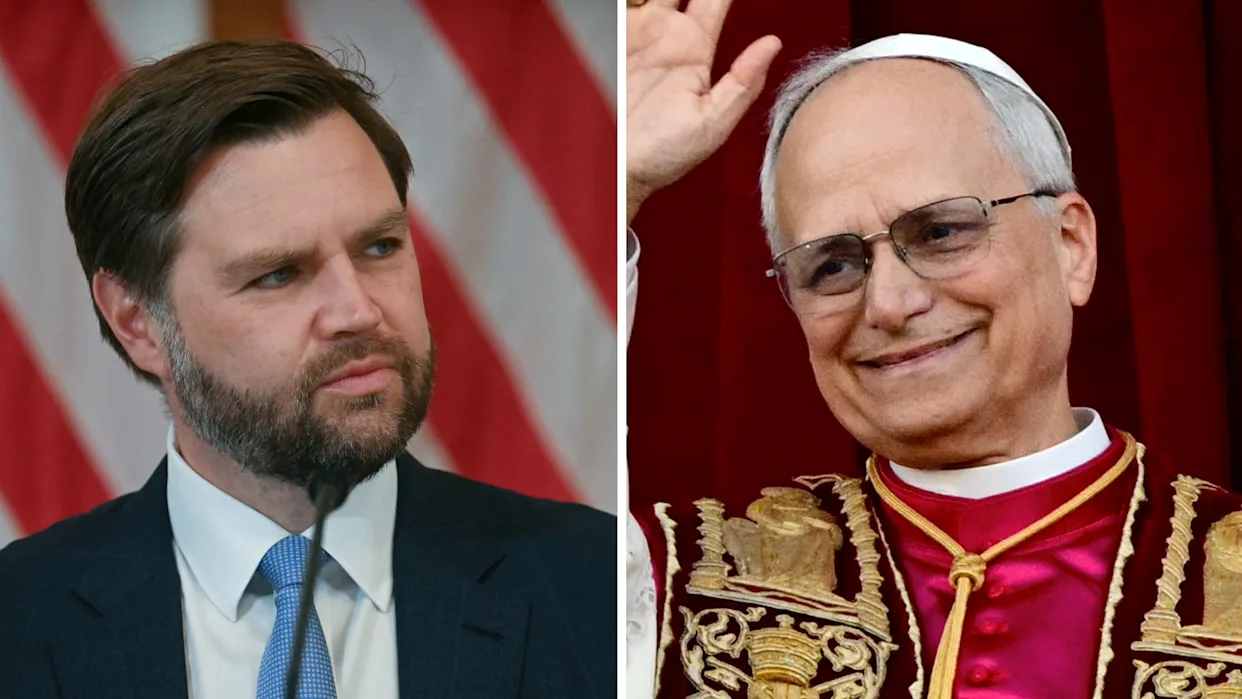
However, a recent exchange between JD Vance and Pope Leo XIV has brought the issue sharply into focus. In fact, somewhat ironically, Vance’s attempt to challenge the pope ends up illustrating exactly the point I was trying to make.

I mean, the JD Vance- Pope Leo disagreement has all the markings of a classic argument: one side appealing to moral clarity, the other to historical reality. But beneath the surface, something more revealing is happening.

In trying to correct the pope, Vance ironically ends up exposing a deeper truth about violence itself – even the violence directly involving vice-president himself and the United States foreign policy he supports.

The Vance-Leo Exchange

The pope’s statement about nonviolence is simple, even beautiful: “God is never on the side of those who use violence.” It sounds like something that ought to end the discussion. Who could be against that?

But Vance pushes back. He begins politely enough: “I like that the pope is an advocate for peace… I think that’s certainly one of his roles.” Then comes the challenge: “On the other hand, how can you say that God is never on the side of those who wield the sword?”

And then he goes straight to the example that almost always ends arguments: World War II.

“Was God on the side of the Americans who liberated France from the Nazis?” he asks. “Was God on the side of the Americans who liberated Holocaust camps and liberated those innocent people? I certainly think the answer is yes.”

The Conceptual Complication

Most people instinctively agree. It’s hard not to. The defeat of Nazism feels like the clearest possible case of justified violence. But that’s exactly where things get interesting.

Because once you admit that not all violence is the same, the pope’s simple statement starts to unravel. And that’s the point.

“Violence” isn’t one thing. It comes in different forms, and if we don’t distinguish between them, we end up confused or, worse, manipulated.

Start with what might be called structural violence. This is the kind most people don’t notice because it’s built into everyday life. It’s the violence of systems that quietly destroy people: poverty wages, lack of healthcare, racism, occupation, economic exploitation, colonialism, imperialism, and wars launched for power or profit. No bombs need to fall for this kind of violence to be deadly.

Then there is defensive violence. This is what Vance is talking about, whether he realizes it or not. It’s the violence used to resist oppression. When Palestinians revolt against settler colonialism, when Iranians resist a war of agression, that’s defensive violence. It’s visible, it’s messy, and it’s almost always condemned by those in power. But it’s also widely recognized as legitimate, even in international law.

Next comes repressive violence. This is what happens when those in power try to crush resistance and restore the unjust system. It comes wrapped in phrases like “law and order,” “security,” or “self-defense.” But its real aim is to keep things exactly as they are – to defend the status quo, illegal occupation, colonialism, unwarranted attacks. . ..

And finally, there is terroristic violence. This is the deliberate use of overwhelming force, fear, and destruction to achieve political goals. It is often associated with non-state actors, but historically it has been most devastatingly practiced by states themselves.

Once you see these distinctions, everything looks different.

The Nazi Example: Gaza & Iran

Take Vance’s World War II example. The Nazi regime embodied structural and terroristic violence on a massive scale. The Allied response can reasonably be understood as defensive violence aimed at stopping that destruction. So far, so good.

But now bring that same framework into the present.

Vance insists, “I certainly think the answer is yes” when asked if God was on the side of those who liberated the camps. Yet at the same time, he supports policies that many observers describe as enabling or excusing mass violence elsewhere. He also adds, almost as a safeguard, “And I agree, Jesus Christ certainly does not support genocide…”

The irony is hard to miss.

Because when it comes to Gaza, what many see is not defensive violence but something much closer to repressive and terroristic violence. Entire neighborhoods flattened. Civilians trapped. Children buried under rubble. These are not incidental side effects. They are the predictable outcomes of overwhelming force used in densely populated areas.

At the same time, those who resist are quickly labeled “terrorists,” regardless of the conditions that gave rise to their resistance. This is exactly how the language of violence gets turned upside down. Structural violence becomes invisible. Defensive violence becomes criminal. Repressive violence becomes “security.” And large-scale destruction becomes “self-defense.”

The same pattern appears in the escalating conflict with Iran, which critics describe as a “war of aggression.” In that case, what is being framed as preemptive defense can just as easily be seen as structural and repressive violence on a global scale. Once again, the categories matter.

Jesus & Nonviolence

This is where the pope’s statement, for all its appeal, begins to look less helpful. Saying that “God is never on the side of those who use violence” might inspire people in the abstract. But in the real world, it risks putting the enslaved and the enslaver, the occupier and the occupied, the bomber and the bombed, all in the same moral category.

That’s not clarity. That’s confusion.

And confusion, in matters like these, is dangerous.

There is another layer to this discussion that makes things even more complicated. Christians often speak of Jesus Christ as if he were simply “nonviolent.” But that description, taken without qualification, can mislead.

Jesus lived under Roman occupation, one of the most brutally efficient systems of structural and repressive violence the world has ever known. The authorities who executed him did not see him as harmless. They saw him as a threat. His message challenged the legitimacy of their power and exposed the injustice built into their system. So they executed him by crucifixion, a method of execution they reserved for rebels against the state.

To call him simply “nonviolent” risks stripping away that context. It can turn a figure who confronted empire into one who passively accepts it.

Conclusion

And that brings us back to a hard but necessary truth: appeals to “nonviolence” are often used selectively. They are frequently directed at those who are already suffering, while those who benefit from structural violence continue largely unchallenged.

That is why some have gone so far as to say that “nonviolence” can function as a kind of scam. Not because the ideal itself is worthless, but because it is so easily weaponized. The powerful celebrate their own violence as necessary or heroic. The resistance of their victims is condemned as dangerous or immoral.

In the end, the exchange between Vance and Pope Leo XIV doesn’t settle anything. Instead, it exposes the fault line.

Vance is right to challenge the idea that all violence is the same. His World War II example makes that clear. But he stops short of applying that insight consistently to the present.

The pope is right to insist that violence is morally perilous and cannot be casually justified. But his sweeping statement risks erasing distinctions that are essential for understanding what is actually happening in the world.

Between those two positions lies a more difficult path. It requires looking honestly at the different forms violence takes and asking, in each case, who is doing what to whom and why.

Only then does the question of where God stands begin to make any sense at all.

2nd Report From Rome: Will Leo Show The Courage of Bishop Budde?

Tomorrow morning at 6:00, Peggy and I will drive to Vatican Square with some new Roman friends to attend the inauguration of Pope Leo XIV. The ceremony will begin at 10:00. That means we’ll be there four hours ahead of time. The attempt to secure good seats promises a long morning.  

As you may recall, what Carl Jung called “synchronicity” has brought us to Rome at this precise time. Our ostensible purpose for being here was simply to spend three weeks with our son, daughter-in-law, and three small granddaughters (ages 5, 3, and 1). We wanted to spend as much time as possible getting to know the girls, whose parents’ foreign employment patterns would otherwise make that far more complicated.

However, my real synchronic purpose for being here, I’m convinced, is to reconnect me with my deep Catholic roots for purposes of final evaluation before transition into Life’s next dimension.

With that process in mind and at the age of 84, I feel overwhelmed by Rome’s beauty – its tree-lined streets, omnipresent sidewalk cafes, its lavish fountains, statuary, Renaissance paintings and churches, its operas and ballets. Today all that seems even more wonderful than it did more than half a century ago when I spent five years here (1967-’72) getting my doctoral degree in moral theology.

Those were magic years for me, when after spending my teenage and early adult years in a seminary hothouse, I finally began waking up to the real world. It all shook me to the core.

And here I’m not just thinking of personal growth experiences, but of the dawning of political awareness about the Vietnam War, the Civil Rights Movement, Women’s Liberation, and of Liberation Theology which I’ve come to understand as “critical faith theory.” (By that last phrase I mean understanding the way Christianity has been used by western colonial powers to enslave, brainwash, and justify repeated exterminations of Muslims, “witches,” Native Americans, kidnapped Africans, and colonized people across the planet.)

Along those lines, being here in Rome during the ongoing holocaust in Gaza makes me think of Pope Pius XII’s virtual silence on the Jewish Holocaust in the 1930s and ‘40s. It has me wondering if Leo XIV will follow in his shameful footsteps.

I mean, the new pope will have a golden opportunity to confront his fellow American Catholics undeniably responsible for the ongoing slaughter in Palestine. I’m referring to J.D. Vance, Marco Rubio, and possibly Joe Biden. It’s as if during the Holocaust, Pius XII had the chance to publicly confront Hitler or Goering.   

Will Leo use this golden opportunity to call them (and the absent Mr. Trump) to task the way the courageous Episcopal bishop Mariann Edgar Budde did when presented with a similar opportunity in the early days of the Trump administration? Recall that as the episcopal leader of 40,000 congregants in the D.C. area, Bishop Budde had Trump and Vance squirming in their seats as she pled for mercy on behalf of the immigrants, refugees, Palestinians, and others whom those key members of her audience show every evidence of despising.

Will the papal leader of 1.2 billion Catholics show similar courage tomorrow? Or will he take refuge in “safe” generalities, “diplomatic” bromides, and empty platitudes about “peace,” justice, and mercy?

My guess is that it will be the latter. But we’ll see.

Post-Election Thoughts on Trump Pro & Con

I’m not yet sure what to think about last Tuesday’s election results. Surprisingly, I find myself ambivalent and guardedly hopeful.

On the one hand, I feel strong foreboding about the Trump victory. I have nothing but painful memories of his last term. It was tough to wake up each day to the crudity, mendacity, stupidity, self-promotion, and sheer ignorance of the man. As a result, like many others, especially at the beginning, I experienced great relief returning to a kind of normalcy under Joe Biden.

But then as that “normalcy” kicked in, I found that horrifying too. Distressingly, there are those billions and billions and billions spent on a war in Ukraine whose reasons were impossible for me to understand. How was Ukraine our concern? I mean, most Americans can’t even find it on the map. Additionally, by all accounts its government is incredibly corrupt. Historically, it has been consistently associated with Nazism. Ukraine seemed far from our business, especially when we have so many problems at home.

I’m referring to huge income gaps between rich and poor, to decaying cities, roads and bridges, low minimum wage, lack of universal health care, college loan indebtedness, rampant homelessness, and incoherent immigration policy. Why did the Biden administration find it so easy to find billions for Ukraine, but not for us and our problems?

Then came the genocide in Gaza! At the very least, it revealed the hypocrisy of Democrats ostensibly concerned with women’s rights, and racism, but supplying weapons to kill mothers and their children in Gaza. Clearly the administration felt differently about Palestinian women and children than about their American or Ukrainian counterparts. Isn’t that sexism? Isn’t that racism? Isn’t it politically suicidal?

Mrs. Harris promised more of the same. During her ineffective campaign she repeatedly refused to distance herself from anything Genocide Joe continues to implement in the Middle East. Doesn’t that make her a genocider too? Of course it does!

But won’t Trump just give us more of the same as well? Probably. But maybe not.

So, to clarify my own ambivalence about Tuesday’s election results, I decided to make a list of Trump’s pros and cons. Here’s how it came out:

Trump’s Negatives

There are so many! But here’s the short list:

  • In general, he’s crude, superficial, and uninformed.
  • He’s a pathological liar, e.g., about immigrant crime rates and their eating pets.
  • His only true accomplishment during his first term was to give gratuitous tax breaks to the world’s richest people.
  • He totally mishandled the COVID 19 outbreak. As a result, more Americans died than citizens of any other developed country.
  • His punitive policies against Venezuela, Nicaragua, and Cuba have increased the immigration situation he decries.
  • More specifically, he repeatedly tried to overthrow the Venezuelan government ridiculously installing U.S. puppet Juan Guaido to replace Nicolas Maduro.
  • He’s a climate change denier
  • He’s a champion of the fossil fuel industry’s super polluters.
  • He exhibits no understanding of the dangers of nuclear war. (Remember his wondering “If we have nuclear weapons, why can’t we use them.”)
  • Like Biden and Harris, he’s anti-Palestinian and an enthusiastic supporter of Israel’s genocide.
  • He blames U.S. unemployment and low wages on immigrants and the Chinese rather than on the decisions of his capitalist friends to offshore American jobs.
  • He thinks that tariffs hurt the Chinese, when they are covert taxes on American consumers, while increasing inflation and funneling the surcharged money to Washington.
  • He’s disrespectful of women and has been convicted of rape by a jury of his peers
  • He was a friend of Jeffrey Epstein.
  • He encouraged the January 6, 2021, assault on our nation’s capital.
  • He’s likely to incorporate into his administration neanderthals like Mike Pompeo and Marco Rubio.

Trump’s Positives

Believe it or not, there are a few. Here’s the longest list I can think of:

  • Trump’s disliked and vilified by the Washington establishment and the mainstream media. (Indicating that he can’t be all that bad).
  • His landslide election has exposed widespread discontent with the economic and political status quo.
  • He’s a loose cannon. He and his MAGA followers form the closest thing to the third party that America requires.
  • His “party” has succeeded in uniting large swaths of previously hopelessly polarized population segments who somehow realize that they have more in common with each other than what drives them apart – including women, African Americans, and Hispanics.
  • He promises to incorporate into his administration anti-big-pharma, Robert F. Kennedy Jr., war critic, Tulsi Gabbard, and Putin interviewer Tucker Carlson.
  • He’s willing to negotiate an end to the Ukrainian war.
  • He’s highly skeptical of NATO.
  • His vice-president is J.D. Vance has been described by Robert Barnes as “the most war skeptical and pro-labor Republican office holder in the last 50 years.”
  • Beyond that and unlike the Biden administration, he’s proven willing to dialog and “deal” with America’s designated enemies including North Korea’s Kim Jong Un and Russia’s Vladimir Putin.
  • He promises to open sealed government documents (and their can of worms) on the JFK assassination.
  • And (most importantly) his election may drive neo-con Democrats to repudiate their efforts to out-Republican Republicans and to reappropriate their identity as Roosevelt New Dealers.  

Conclusion

Well, there you have it – the pros and cons of Trump’s triumph as I see it. What do you think? Am I being naïve and too optimistic? Am I whistling past the graveyard? Can you add to my lists? Do you care to refute my reasoning?