The Conversion of Pope Francis and “Why the New Pope Must Resign”

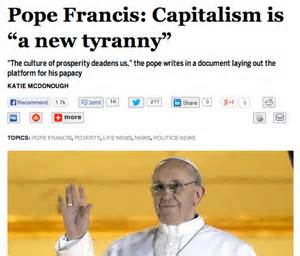
Francis Capitalism

“Why the New Pope Must Resign.” That was the title of an article I wrote just after the election of Pope Francis in 2013. In it I joined Argentina’s Horacio Verbitsky and others questioning the role of Jorge Bergoglio (aka Pope Francis) in Argentina’s “Dirty War” (1976-’83).

Since then, friends have asked me about that. “What do you think now – in the light of the fresh spirit of reform the pope has introduced – in the light of his tremendous popularity?  Surely you were mistaken in your original, hasty judgment.”

That’s the typical question and observation.

My answer has been that I’m delighted with Pope Francis and the direction his papacy has taken. Both his Apostolic Exhortation, The Joy of the Gospel, and especially his new eco-encyclical, Laudato Si’ are magnificent. Their criticisms of capitalism-as-we-know-it as the structural cause of world poverty and environmental destruction couldn’t be a clearer endorsement of a form of liberation theology that is both spiritually moving and politically engaged.

I’m glad the pope didn’t resign. Pope Francis is great.

But in response to my friends, I also add that the issue of Father Bergoglio’s involvement with the Dirty War is not resolved. Nor should it be ignored. Recalling its elements holds lessons for us – about the Roman Church’s history of supporting oppression, about whitewashed historiography, and most importantly, about the possibility of repentance and deep personal change.

Consider the first point, the Church supporting fascist oppression. It happened in Argentina during the Dirty War as it happened in Germany under Adolf Hitler.

When Bergoglio was Jesuit Provincial, he was accused of turning over to the army two of his Jesuit colleagues and former teachers, Fathers Orlando Yorio and Franz Jalics. Both had been pro-socialist clerics and members of the Third World Priests’ Movement (MSTM). Such membership was considered a capital crime by the country’s ruling junta.

Yorio and Jalics had been embroiled in a long-standing feud with their Provincial not so much about their MSTM affiliation, but about their activities in a slum community the two priests served and lived in. Bergoglio didn’t have much time for Jesuits in his province being associated with left-wing causes – nor for versions of liberation theology tainted with Marxist analysis.

Like John Paul II and his chief advisor Josef Ratzinger (later Benedict XVI), he preferred a strain of liberation theology that prioritized the poor, but apolitically without revolutionary aspirations. Bergoglio liked to call that strain the “Theology of the People.” It prioritized their reflections on the gospel, and popular devotion to images, novenas, etc. Other versions of liberation theology were too “ideological.”

After being arrested and tortured, both Yorio and Jalics accused Bergoglio of fingering them to the army.

Father Yorio died without retracting his accusation. Fr. Jalics at first didn’t want to discuss the matter, saying that he and Bergoglio had reconciled.

Beyond the case of Yorio and Jalics, there was that of Father Christian Von Wernich. He had been a police chaplain during the Dirty War. After its conclusion, during the process of national reconciliation, Von Wernich came under investigation for his direct roles in police tortures and murders.

In response, while Bergoglio was a member, the Argentine Bishops’ Conference protected Von Wernich by transferring him to Chile under an assumed name. That is, the Bishops Conference treated accusations of torture and murder in exactly the same way bishops throughout the world had often dealt with allegations of sexual abuse of children: transfer the offender and cover up the past.

So, the question becomes, was Jesuit Provincial Bergoglio, like the predominant leadership of the Argentine Catholic Church, somehow cooperative with the ruling junta?

This brings us to my second point about historiography.

In defense of the future Pope Francis (and of the church hierarchy in general), his biographer, Austen Ivereigh, offers explanations that end up sounding much like the defense of Pius XII vis-à-vis the Nazis and his failure intervene against the Holocaust. Ivereigh argues:

  1. When the military took over in 1976, Argentina (like Weimar Germany) was in a state of political and economic chaos.
  2. So virtually all segments of society welcomed the military take-over (as Germans and the German Catholic Church welcomed Adolf Hitler).
  3. The military’s brutal Dirty War was secretive about the extremity of its measures. (Fr. Bergoglio testified that it took him some time to realize what was happening.)
  4. So people like Bergoglio didn’t really know what was going on (just as Germans claim they didn’t know about the concentration camps and ovens).
  5. When he did find out (like Pius XII) Bergoglio “worked quietly” to help potential victims escape – while fulfilling his primary duty of protecting the Jesuits from suspicion, investigation and reprisals from the ruling junta.

As with Germany such reasons end up sounding like excuses that raise suspicions of cover-up and historical obscurantism. They evoke the following observations and questions:

  1. Bergoglio gives every indication of being on the same page with John Paul II and Josef Ratzinger who also largely “looked the other way” when confronted with evidence of government brutality in dealing with left-wing elements of the clergy and faithful, e.g. in Central America in general and in El Salvador and Nicaragua in particular.
  2. Bergoglio clearly shared their disdain for priests involved in politics.
  3. If (as Ivereigh suggests) Father Bergoglio was so well-connected and friendly with all factions (including government officials and military leaders on the one hand, and their opponents including MSTM members on the other) how could he not have at least suspected what was really happening?
  4. If Jalics had forgiven Bergoglio (as he originally had said) what had he forgiven?
  5. Why did Jalics apparently change his story a few days after Pope Francis’ election? On being repeatedly contacted by the media about the issue, Jalics said, “The fact is: Orlando Yorio and I were not denounced by Father Bergoglio.”
  6. Father Yorio offered no deathbed recantation of his charges against Bergoglio.

And that brings me to my final point about repentance and its significance for Catholics today.

As Ivereigh indicates, the prevailing method of dealing with such contradictions is to  reluctantly argue that Father Bergoglio perhaps did cooperate with the military – as did so many other churchmen in positions of authority during the Dirty War. However, in Bergoglio’s case, he also courageously helped many escape – at some risk to himself.

But then at some point, he underwent a kind of conversion and is now a progressive. At least at the administrative level, Bergoglio’s own testimony indicates that he experienced a profound conversion. He confesses that as a young Jesuit Provincial (he was only 36 when appointed), he was too headstrong, uncompromising and authoritarian.

Indications are, however, that the about-face went far beyond managerial style.

The exact turning point in the process remains unclear. It could have come after Bergoglio was virtually drummed out of the Jesuits by progressive elements which saw him as an impediment to the Society’s reform in the spirit of Vatican II.

Afterwards he spent two years in a kind of exile and deep introspection. Ivereigh reports that Bergoglio passed days hearing the confessions of simple shantytown poor people. He also spent hours in semi-depression, simply staring out his window. Colleagues worried that he was sick. Was it some type of breakdown?

Whatever the case, clear evidence reveals a subsequently changed man. Previously he was criticized by more liberal fellow Jesuits and others for failing to ask important questions about poverty. As they put it, “He’s great at ministering to the poor. But he never asks why they are poor.” (The criticism evoked the famous comment of Dom Helder Camara, the archbishop of Olinda and Recife in Brazil who said, “When I give food to the poor, they call me a saint. When I ask why the poor have no food, they call me a communist.”)

But as pope in Laudato Si’ Francis makes no bones about why the poor have no food, or jobs, or homes, or education. With observations worthy of the MSTM members he rejected, the pope says, all of those problems are connected by the invisible thread called deregulated capitalism. His encyclical says that poverty, environmental destruction and a whole host of other problems are caused by capitalism-as-we-know-it. (So, predictably and true to Dom Helder’s words, Rush Limbaugh and others call Pope Francis a communist.)

Evidence of radical theological change goes much further. Consider, for instance, that Francis has:

  • Surrounded himself with liberation theologian advisers concerned with history and structural analysis.
  • Rehabilitated and consulted pro-socialist theologians blacklisted by his two predecessors – most prominently among them Brazil’s Leonardo Boff.
  • Identified Marxism as similar to the teachings of the early church fathers, claimed Marxists as his friends, and referred to them as “closet Christians.”
  • Echoed Latin America’s liberation theology speaking of Christian faith as “revolutionary,” because it challenges “the tyranny of Mammon.”
  • Peppered both The Joy of the Gospel and Laudato Si’ with frequent uses of the loaded word “liberation” contrasting the deleterious effects of “liberation” of markets (from government control) with the liberation of peoples proclaimed in the Judeo-Christian tradition.
  • Has similarly made Medellin’s phrase “preferential option for the poor” the watchword of his papacy, even going so far as to identify it with “the gospel itself.”
  • Beatified the martyred Archbishop of El Salvador, Oscar Romero, who is considered the patron saint of liberation theology. (Romero did, by the way, confront the ruling military and lost his life as a result.)
  • Described the world’s dominant economic system as running “counter to the plan of Jesus.” He said the system now in place and Jesus’ hoped-for Kingdom of God have different aims.
  • Worked with the Obama administration to open doors to Cuba which for more than 50 years has struggled to construct an economic alternative to capitalism-as-we-know-it.
  • In keeping with the insights of liberation theology, the pope has turned working against capitalism-as-we-know-it into a moral issue. In Laudato Si’ he wrote: “working for just distribution of the fruits of the earth and human labor” – is a “moral obligation.” For Christians, he said, “it is a commandment.” Here the pope echoed what he said in The Joy of the Gospel where he identified the struggle for social justice and participation in political life as “a moral obligation that is “inescapable.”

All of this represents not only a personal conversion for Pope Francis, but a summons to his Church to follow in his footsteps.

What he has written in “The Joy of the Gospel” indicates that he recognizes in a Church the same crisis he underwent. It is out-of-touch and in need of a complete overhaul. “Everything must change,” he has said.

For too long, he has written, the Church has been mired in an authoritarian judgmental paradigm and in viewpoint-narrowness that has focused on important but non-essential matters foreign to the focus of Jesus’ proclamation of God’s Kingdom. So-called “pelvic issues” were of little concern to Christianity’s Great Master.

The pope implicitly calls Catholics resembling his former conservative, apolitical self to engage in the process of political, economic, and ideological change before it’s too late. Stop staring out the window at a world falling apart, he tells us. Emerge from denial and obstructionism and come to grips with climate chaos and changing the economic system that causes not only environmental destruction, but world hunger, poverty, high infant mortality, and war.

Those are statements Fathers Yorio and Jalics could fully endorse.

Our Granddaughter, Eva, Comes to God’s Rescue

Mike's Moons

While in Rome last July our family experienced a “private” tour of the Sistine Chapel. Our daughter, Maggie, had arranged it for us. “Private” meant we were able to jump the line when the Vatican Museum opened at 8:00 a.m.  So we and about a hundred other people had approximately an hour in the Chapel before the real crowds arrived. Our guide was a competent, vivacious, funny and energetic young Italian called Sara.

Before entering the museum Sara prepared us by showing printed images of what we were about to see. One was a Michelangelo detail of the creation of the sun and moon. One part showed a frontal human image of God creating the spheres of light. God is fully clothed as a 16th century gentleman.

Next to the frontal image is a view from behind. And God’s naked buttocks stand exposed. When Sara pointed that out with a reference to the two “moons” in the painting, everyone laughed at her joke.

However Eva, our six-year-old granddaughter would have none of it. She just frowned. She said emphatically with a pout, “I don’t think that’s funny.”

Now that was funny – and quite charming: Eva defending God’s dignity!

What Makes Great Art Great? The Matisse Chappelle du Rosaire de Vence

Matisse Chapel

While visiting the French Riviera to visit a generous donor to Peggy’s Women and Gender Studies Program, we ended up in the Chapelle du Rosaire in Vence designed by Henri Matisse. Our very warm host accompanied us there. Peggy and I were anxious to go, since experiencing the Matisse cut-out display at the New York Museum of Modern Art (MOMA) last winter.

A very able docent explained the chapel to our group of perhaps 30 people. The windows were very like the cut-outs we had admired in the MOMA..

Matisse Windows

The altar was made to resemble bread. Notice the painting of St. Dominic on the right.

Matisse Altar

The stations of the cross on the chapel’s back wall were spectacular – stark black and minimalist, each numbered.

Matisse Stations

Bright chasubles were displayed outside the chapel in a small museum.

Matisse chasuble

We learned that during an illness, while in his 80s, Matisse had advertised for a young, pretty nurse to care for him. The woman who won the job was quite plain, but also served (the docent told us) as Matisse’s “chaste model.” She later became a Dominican nun. And Matisse designed, built and adorned the chapel in her honor.

Matisse Sister

It was our great honor to absorb it all.

For me it all raised questions about art. What is it really? What is the nature of beauty? What does Matisse have to teach us about that?

What do you think?

Our Family Trip to France & Italy

Panzano

I’ve been off line for a while . . .

A week ago Peggy and I returned from almost three weeks in Europe. The two of us spent a couple of days in France, near Nice on the Cote d’Azur. Then it was on to Italy and Cinque Terre, where we had a marvelous time in Monterosso.

Next we travelled to Rome where we joined our daughter, Maggie, her husband, Kerry, and their four children – along with our son, Patrick, Peggy’s brother, Artie, his wife, Mary, and their three children, along with another niece. In all we were a group of 15 – 16 when a longtime friend of Maggie also joined us towards the end of our trip.

Our group spent three days in Rome. Afterwards we drove to Tuscany where we spent ten days in a villa in the little town of Panzano. (The photo above shows the villa where we stayed.) From there we did day trips to Florence and Pisa. But mostly we just enjoyed the unparalleled beauty, peace and quiet of the Chianti wine country.

Finally, Maggie and her family, Peggy and I spent three days on the beach on the island of Elba.

Throughout the magical days, we ate marvelous meals in restaurants of many kinds, as well as sumptuous repasts prepared by Maggie and Peggy at “home.”

It was all a wonderful experience.

But we’re all still recovering – I in more ways than one. Towards the end of our first day in Rome, I slipped and fell down three marble steps outside a restaurant where our large group ate its first meal together. I was wearing my Croc sandals and it had just rained. I felt like I was walking on ice. Just before I slipped, I was thinking, “I could easily fall down these stairs; I’d better be careful.”  Before I knew it, I was flat on my back. I jumped up right away though claiming that I was ok. That wasn’t exactly true.  Now, weeks later, my left shoulder is still sore, though the large black-and-blue mark that side of my body has finally disappeared.  I’m still not able to do my morning exercise routine as normal. But I’m lucky I didn’t break anything.

If most of this sounds wonderful, it’s because it was.

However, it’s important to keep things in perspective.

Here’s an exchange I overheard in Cinque Terre. Hot and sweaty, we had just disembarked from the ferry that takes tourists past all of Cinque Terre’s five villages scattered along the mountainside.

Husband: Remind me again why we’re doing this.

Wife: Yeah, why are we doing this?

Husband (frustrated and testy): Because we need to see the five villages!

Wife: Can you tell one from the other?

Personally, I could relate to the couple’s weariness, frustration and touristic overload. That kind of sight-seeing is not at all my cup of tea. I prefer what Peggy and I ended up for the next two days – vegging on the beach under big umbrellas.

(Next Posting: Visiting the Matisse Chapel in Vence)

How to Be Pro-Life and Not Just Pro-Birth

Joan Chittister

Recently, Benedictine Sister, Joan Chittister, grabbed some headlines when she took on the hypocrisy of the “pro-life” crowd.

She wrote,

“I do not believe that just because you’re opposed to abortion, that that makes you pro-life. In fact, I think in many cases, your morality is deeply lacking if all you want is a child born but not a child fed, not a child educated, not a child housed. And why would I think that you don’t? Because you don’t want any tax money to go there. That’s not pro-life. That’s pro-birth. We need a much broader conversation on what the morality of pro-life is.”

Sister Chittister’s point is well-taken. Being truly pro-life means joining reluctant mothers in the sacrifices they routinely make to see that their children are fed, properly housed and educated. So claiming to be pro-life while campaigning against food stamps, universal health care, Head Start, and subsidized housing is disingenuous to say the least. It also seems incompatible with defunding Planned Parenthood, our nation’s largest provider of sex education – probably the most effective, non-intrusive birth control measure of all.

And it’s significant that such reminders come from a woman. Women after all are the ones who primarily bear the burden imposed by the narrow pro-birth demands made mostly by men. Women alone are capable of bringing unwanted pregnancies to term. They are the ones who usually end up raising children as single parents.

Meanwhile, it is primarily men who insist that women fulfill responsibilities men themselves cannot fulfill on the one hand, and can easily evade on the other. The men include most prominently celibate Catholic clergy and an overwhelmingly male U.S. Congress. In biblical terms they are (to use Jesus’ words) “experts in the law” who “load people down with burdens they can hardly carry” and which the “experts” themselves “will not lift one finger” to lighten (LK 11:46). It’s no wonder so many women see pro-birthers as militants in a war against women.

But it’s even worse than that. If abortion is the crime they allege, pro-birthers are criminal accessories. They are co-abortionists. This is because their anti-life policies which deny reluctant mothers sex education, good jobs, decent wages, maternity leave, free child care, programs like Head Start, and subsidized food and housing create an anti-life culture. And that in turn drives desperate women to terminate unwanted pregnancies that will effectively impoverish them.

If lawmakers and religious leaders really care about life and want fewer abortions, they need to create a pro-life culture that invites bringing pregnancies to term. Most obviously, this means that it’s unjust for women to be left holding the bag. In particular it means:

  • Recognizing that the absolute prohibition of abortion endorsed by many Christians is not universally accepted.
  • Realizing that abortion as already restricted (to the first two trimesters) by the Roe v. Wade decision is about as much restriction as possible in such a pluralistic context.
  • In that light, having Christians adopt a prophetic, persuasive approach to limiting abortions rather than a legal coercive one.
  • This means that committed Christians would themselves refuse to abort unwanted fetuses, that they would support others in following suit, and (above all) that they’d promote pro-life measures across the board including anti-poverty legislation, but also advocating war resistance, elimination of capital punishment, and strict environmental protection legislation.
  • Supporting sex education programs like those offered by Planned Parenthood.
  • Changing the patriarchal teaching of the Catholic Church about birth control.

“Laudato Si’” and Its Preferential Option for the Poor (Part Three): the Guiding Principle for Restructuring the World Economy

option for poor

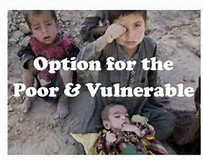
This is the last installment in a three-part series on Pope Francis’ new encyclical, Laudato Si’. It attempts to place in historical perspective what might well be the most important document yet produced in the 21st century. It also tries to explain the meaning and centrality of the encyclical’s guiding principle, its “preferential option for the poor.”  This third part addresses the meaning and centrality of that option.

In his critique of capitalism-as-we-know-it (reviewed in Part Two of this series), Pope Francis called explicitly for “structural change” in the world economy.  He said, “Let us not be afraid to say it: we want change, real change, structural change.”

But what “structural change” does the pope have in mind?

Evangelii Gaudium and Laudato Si’ offer the answer. Their “preferential option for the poor” provides the guiding principle and turns the present economic order exactly on its head. This implies that if the present order is possible, so is its opposite.

That is to say that the present neo-liberal order is structured according to a “preferential option for the rich.”  Its sponsoring question is how can we make sure that the banks, corporations, and 1% prosper? Economists explain such concern by various “trickle-down theories.”  If priority is accorded the welfare of the rich, the theorists say, the wealth produced will trickle down creating a “rising tide that lifts all boats.”  [The pope rejects such theories out-of-hand as historically disproven. In “Evangelii Gaudium” he even calls them homicidal (53), ineffective (54) and unjust at their roots (59).]

By way of contrast, the pope’s “preferential option for the poor” begins at the bottom of the economic pyramid. Its sponsoring question is how can we insure that farmers have land, that workers have jobs, and that everyone is decently housed?

Laudato Si’ goes even further. It expands moral concern beyond human beings to all forms of life. It asks how we can insure the survival of the planet in the face of global warming, water and air pollution, massive extinctions, disappearance of rainforests, wasted food, waste in general, uncontrolled urbanization, rampant crime and loss of human meaning.

None of this means abandoning market dynamics altogether.

It does mean, however, controlling them according to the principle some have expressed in the words, “as much market as possible and as much planning as necessary.” This means maximizing market forces, but controlling them as necessitated by prioritization of the needs of the poor including the environment – once again by the preferential option for the poor.

In practice this entails at least the following: governments (1) intervening in the marketplace to insure the rights of all to jobs with living wages, housing, education, and health care, along with land for small farmers, (2) similarly regulating market forces to protect the global environment and all life forms from the most primitive to the highest, and (3) thereafter turning economies over to carefully monitored and controlled market forces.

Impossible you say? Not at all. To repeat: if economies can be structured according to a preferential option for the rich, they can be restructured to prioritize the needs and rights of the poor and the environment.

That’s the Global South hope and conviction Laudato Si’ embodies: another world is indeed possible.

Conclusion   

Will Laudato Si’ have its desired effect? That, of course remains to the seen. However, it undeniably has in Pope Francis a powerful proponent.

That is, despite remaining Stalinist skepticism, Pope Francis might well be the most powerful man in the world. Certainly, he is the planet’s most influential moral leader. What empower him, of course, are not the military divisions in which Josef Stalin placed confidence, but his extraordinary consciousness of the unity of all creation expressed repeatedly in his every pronouncement and especially in his recent encyclical. What sets him apart from the Obamas and Putins of the world is his equally unusual courage, compassion, charisma, and credibility.

Additionally, the pope has surpassing constituency. He heads a community of 1.2 billion followers. And this does not even count the untold millions of non-Catholics who admire him and his thought leadership.

With such support, the powerful message of Laudato Si’, and his plans to bring that message to the U.N. and U.S. Congress in September, as well as to influence the Climate Summit in Paris next September, who knows what changes will result? Who knows how he will influence the U.S. general elections in 2016?

In other words, Francis may stand on the brink of surpassing the stature of Leo XIII and John Paul II in terms of changing the world.

Defenders of the old order are already shaking in their boots.

“Laudato Si’” and Its Preferential Option for the Poor (Part Two): Pope Francis’ Critique of Capitalism

Dung of Devil

This is the second installment in a three-part series on Pope Francis’ new encyclical, Laudato Si’. Overall, the series attempts to place in historical perspective what might well be the most important document yet produced in the 21st century. It also tries to explain the meaning and centrality of the encyclical’s guiding principle, its “preferential option for the poor.”  This second part addresses Pope Francis’ critique of capitalism-as-we-know-it.

Pope Francis’ Critique of Capitalism

The first entry in this series on Laudato Si contextualized the significance of its author’s origins in the Global South. It argued that till Francis, Catholic social teaching had largely focused on Western and Eastern Europe. The social pronouncements of Italian popes were largely concerned with the problems of Western Europe and the threatened loss of the working class to the allures of socialism and communism. Beginning with Leo XIII’s Rerum novarum, the Italians set the stage for the introduction of Europe’s extensive welfare state.

With the election of a Polish and subsequently of a German pope, papal focus shifted to Eastern Europe and the dethroning of communism there. Pope John Paul II and his right hand man, Josef Ratzinger (later to become Benedict XVI) cooperated with the Reagan administration (and specifically with the CIA’s William Casey) in facilitating the collapse of the Soviet Union.

With that demise achieved, it appeared to most that capitalism had won a definitive victory. Corporate globalization stood virtually unchallenged.

However, all of this changed with the ascent of Argentina’s Jorge Bergoglio to the papal throne in 2013. As the first pope from Latin America, Pope Francis has repeatedly called capitalism’s “final victory” into question. No longer focusing on Europe (western or eastern), he shifted focus to the Global South, to the poverty colonialism and unfettered capitalism had caused there.

He focused on connections between deregulated markets and the rape of the Earth Mother indigenous Catholics of the Andes called Pachamama. Without apology, he espoused a “preferential option for the poor,” and spoke clearly about the rejection of the neoliberal globalized order lionized by the corporate elite.

Such sentiments were nowhere more clearly expressed than in the speeches delivered by Pope Francis during his summer “homecoming” trip to Latin America. In written form, they were evident in his landmark encyclical on the environment, Laudato Si’ and in his Apostolic Exhortation, Evangelii Gaudium.

Addressing the World Meeting of Popular Movements in Santa Cruz, Bolivia, Francis traced today’s global problems back to their origins in European colonialism beginning in 1492. But he also identified new forms of colonialism exercised through corporations, loan agencies, “free trade” treaties, and imposition of “austerity measures.”

Such actors and policies subordinate states to outside powers which also exercise control through misguided policies ostensibly aimed at controlling drug trafficking, political corruption, and terrorism. More subtly, external powers colonize, destroy local cultures and foster cultural uniformity through communications monopolies, which the pope described as “ideological colonialism.”

“Let us say NO to forms of colonialism old and new,” he said.

The pope was completely outspoken. He went on to criticize capitalism-as-we-know-it as “an invisible thread” connecting problems of world poverty, worker exploitation, landlessness among farmers, homelessness, and destruction of the natural environment. That system imposes the mentality of profit at any price without concern for its impact on displaced peasants and workers or for its destructive effects on “Mother Earth.”

This is indeed capitalism-as-we-know-it.

The system, he said “is by now intolerable: farm workers find it intolerable, laborers find it intolerable, communities find it intolerable, peoples find it intolerable … The earth itself – our sister, Mother Earth, as Saint Francis would say – also finds it intolerable.”

Though some have criticized the pope for stepping outside his area of competence, his condemnation of the reigning economic system is specifically biblical, theological, and moral.

Like the prophets of the Jewish Testament, he identifies “the existing system” with idolatry, the most serious of biblical sins. In his strongest condemnation yet, Francis quoted the 4th century sage, Basil of Caesarea, calling today’s capitalism “the dung of the devil” – i.e. the excrement of evil personified. Stronger language can hardly be imagined.

Theologically, Francis echoed Latin America’s liberation theology speaking Christian faith as “revolutionary,” because it challenges “the tyranny of Mammon.” The existing system, the pope said, “runs counter to the plan of Jesus.” He said the system now in place and Jesus’ hoped-for Kingdom of God have different aims.

Morally, then, the pope called working against capitalism-as-we-know-it – “working for just distribution of the fruits of the earth and human labor” – a “moral obligation.” For Christians, he said, “it is a commandment.” Here the pope echoed what he said in “Evangelii Gaudium,” where he identified the struggle for social justice and participation in political life as “a moral obligation that is “inescapable.”

(Next installment: the “other world” Francis sees as possible)

A Baptismal Homily: Markandeya Lehnerd-Reilly, May You Be Like Markendeya, the Mystic; May We All Be

547185_10151150646285342_1926906639_n[1]

Last Friday (July 3rd), our family had the joy of baptizing our daughter’s and son-in-law’s fourth child, Markandeya Jackson Lehnerd Reilly. I had the privilege of performing the baptism – as I have for each of Maggie and Kerry’s children:  Eva (6 years old), Oscar (4), and Orlando (3). I performed the baptism (with its readings, songs, litany, profession of faith, and rich symbols of water, oil, fire, and new clothes) just off the dock in front of our house in Canadian Lakes, Michigan.

Twenty-five people (all relatives from Peggy’s side of the family) were present. The event was part of a mini-family reunion for Peggy’s siblings and their families. We were all together for about a week celebrating the Fourth of July.

It was great fun.

Here is a brief reflection I gave after reading about Jesus’ own baptism at the hands of his cousin, John,  as described in the first chapter of the Gospel of Mark:

Today we celebrate the baptism of Markandeya Lehnerd-Reilly. He has that name because he comes to us from India, where he spent his earliest moments of in utero life.

I first came across the name, Markandeya in the writings of my meditation teacher, Eknath Easwaran a native of the Kerala State in India – which many of us here visited not long ago.

Easwaran says that each morning, his grandmother – his spiritual teacher – would go to the temple for Morning Prayer and return with a flower. She’d put it behind her grandson’s ear and pray, “May you be like Markandeya.”

Markendeya is the legendary mystic from ancient India who achieved enlightenment at the age of 16.

Mystics, of course, are spiritual masters. They have realized that: (1) we all have within us a spark of the divine, (2) that spark can be realized (i.e. we can live from that place of divinity); (3) it’s the purpose of life to do so, and (4) once we’ve realized the divine within ourselves, we’ll see it in every other human being and in all of creation.

In any case, Markandeya was one of those mystics. His story goes like this: His parents longed for a child and prayed to God (under the name Shiva) for a son.

Their prayer was granted.

But they had a choice, they could either have a son who would be a great devotee of Shiva and live a short life, or have a less-devoted son who would live a long life. Markandeya’s parents chose the former. As a result, they were told their son would achieve enlightenment, but would die on his 16th birthday.

Markandeya, of course, became a great devotee of Shiva whose name he lisped from his very first days in his cradle. Early on he became enlightened – capable of reaching uncommon depths of meditative unity with the divine.

But then his 16th birthday came.  His parents tearfully told him of the conditions of his birth. Yama, the king of death would soon come for him. On hearing this, Markandeya sat down and entered into deep meditation.

Soon Yama came seeking his victim. But when he entered the room, Shiva rose up from within Markandeya. With one hand on the youth’s head and the other pointing his trident at Yama, he commanded, “Don’ you know that I am Mrityunjaya, the conqueror of death? You have no power over me or over those devoted to me. Markandeya will never die!  Be gone!”

Trembling like a leaf, Yama returned to the underworld.

Today we baptize Markandeya Lehnerd-Reilly. With baptism he enters the community of those who would follow another great mystic, Jesus the Christ. According to our faith, Jesus is our Mrityunjaya, the Great Conqueror of death. Death, we believe, has no dominion over Jesus or over us, his followers.

Jesus’ teaching included the mystical truths that, like him, we are all daughters and sons of God and that the Kingdom of God is within us. His disciple, Paul of Tarsus taught that we are all temples of the Holy Spirit – that Jesus’ Spirit lives within each of us. It is our purpose in life to be channels of the Holy Spirit and bring about the kingdom of God in this world.

Today we’re here to embrace that vocation on Markandeya’s behalf and to re-embrace it for ourselves.

So our prayer for this child today is that he might be like Jesus with whom he is identified in this baptismal ceremony.

May he be like Markandeya.

May we all be like Jesus and Markandeya.

St. Francis or Donald Trump? Pope Francis or the Frackers? You Decide.

donald trump

The lineaments of right-wing criticisms of Pope Francis’ new encyclical “Laudato Si’” are becoming clearer by the day. A critique by Ross Douthat’s appeared in the June 21st edition of the New York Times.

Two days later, David Brooks took his stab in the same newspaper, writing a column called “Fracking and the Franciscans.” The title of Brooks’ article introduced specifically spiritual note into the rebuttal of the pope’s letter. In effect, it asks us to decide between St. Francis’ approach to nature (the pope’s ideal) and that of the fracking industry. Brooks clearly prefers the latter.

More specifically, Brooks’ op-ed makes clear the exact point of diversion between the pope and his conservative critics. On the one hand, the pope is calling for a “bold cultural revolution” – a spiritual revolution – based on love and compassion for the earth and on a “preferential option for the poor.”

On the other hand, Francis’ critics see that as “unrealistic” (in Brooks’ words). They prefer working within the given political and economic framework. For them, a society based on “harnessed” greed and self-interest is better than one based on love and compassion for the poor. There is no need for spiritual change. In short, greed is good. As David Brooks says, “in the end, purity of heart backfires.”

Douthat had earlier moved in the same direction by disparaging what he saw as excessive negativity in the pope’s letter.  He accused the pope of overlooking the unprecedented reduction in global poverty that characterizes our era. Things are not as bad for the poor as the Holy Father would have it. No need to prioritize the interests of the world’s poor majority.

In arguing that way, the columnist overlooked not only the deceptive reasoning behind World Bank poverty measurements. He also ignored the pope’s broadened definition of poverty to include unparalleled impoverishment of the natural environment.

In Douthat’s eyes, the pontiff also errs by downplaying and even rejecting the remedial capabilities of market dynamics and technological innovation. Who knows, he argues, they might be sufficient to solve what the pope describes as an unprecedented crisis. Let’s wait and see.

That’s the conservative position: keep doing what we’re doing; things aren’t as bad as they say; who knows, they might work out in the end.

In his own column, David Brooks takes up that thread not only reiterating that the pope’s negativity overlooks the unprecedented reduction in poverty brought about by market forces, but adding that countries made rich by those same forces are less polluted than their poorer counterparts.

If we followed the pope’s reasoning, Brooks says, we’d all aspire to be poor like St. Francis. And where would that leave us? There’d be no “Asian Miracle,” no technology-based American energy revolution as exemplified in fracking. And don’t worry about fracking, Brooks assures us: the government EPA and the conservative Breakthrough Institute have certified that it produces no widespread harm to water supplies and actually represents “a net environmental plus.”

Face it, Brooks contends: history shows that short-term pollution leads to long-term growth and affluence. Again, the best social programs are based on harnessed greed and self-interest. In the end Franciscan purity of heart stifles progress and wealth accumulation.

So which is better a society based on love and compassion or one based on greed and self-interest? Who should be our guide – someone like St. Francis or Donald Trump? That is the question. At root it is a spiritual question.

Pope Francis has his answer. New York Times and its columnists have theirs.

Each of us as individuals and all of us as a community must decide.