2nd Report From Rome: Will Leo Show The Courage of Bishop Budde?

Tomorrow morning at 6:00, Peggy and I will drive to Vatican Square with some new Roman friends to attend the inauguration of Pope Leo XIV. The ceremony will begin at 10:00. That means we’ll be there four hours ahead of time. The attempt to secure good seats promises a long morning.  

As you may recall, what Carl Jung called “synchronicity” has brought us to Rome at this precise time. Our ostensible purpose for being here was simply to spend three weeks with our son, daughter-in-law, and three small granddaughters (ages 5, 3, and 1). We wanted to spend as much time as possible getting to know the girls, whose parents’ foreign employment patterns would otherwise make that far more complicated.

However, my real synchronic purpose for being here, I’m convinced, is to reconnect me with my deep Catholic roots for purposes of final evaluation before transition into Life’s next dimension.

With that process in mind and at the age of 84, I feel overwhelmed by Rome’s beauty – its tree-lined streets, omnipresent sidewalk cafes, its lavish fountains, statuary, Renaissance paintings and churches, its operas and ballets. Today all that seems even more wonderful than it did more than half a century ago when I spent five years here (1967-’72) getting my doctoral degree in moral theology.

Those were magic years for me, when after spending my teenage and early adult years in a seminary hothouse, I finally began waking up to the real world. It all shook me to the core.

And here I’m not just thinking of personal growth experiences, but of the dawning of political awareness about the Vietnam War, the Civil Rights Movement, Women’s Liberation, and of Liberation Theology which I’ve come to understand as “critical faith theory.” (By that last phrase I mean understanding the way Christianity has been used by western colonial powers to enslave, brainwash, and justify repeated exterminations of Muslims, “witches,” Native Americans, kidnapped Africans, and colonized people across the planet.)

Along those lines, being here in Rome during the ongoing holocaust in Gaza makes me think of Pope Pius XII’s virtual silence on the Jewish Holocaust in the 1930s and ‘40s. It has me wondering if Leo XIV will follow in his shameful footsteps.

I mean, the new pope will have a golden opportunity to confront his fellow American Catholics undeniably responsible for the ongoing slaughter in Palestine. I’m referring to J.D. Vance, Marco Rubio, and possibly Joe Biden. It’s as if during the Holocaust, Pius XII had the chance to publicly confront Hitler or Goering.   

Will Leo use this golden opportunity to call them (and the absent Mr. Trump) to task the way the courageous Episcopal bishop Mariann Edgar Budde did when presented with a similar opportunity in the early days of the Trump administration? Recall that as the episcopal leader of 40,000 congregants in the D.C. area, Bishop Budde had Trump and Vance squirming in their seats as she pled for mercy on behalf of the immigrants, refugees, Palestinians, and others whom those key members of her audience show every evidence of despising.

Will the papal leader of 1.2 billion Catholics show similar courage tomorrow? Or will he take refuge in “safe” generalities, “diplomatic” bromides, and empty platitudes about “peace,” justice, and mercy?

My guess is that it will be the latter. But we’ll see.
New Year’s Reflections

Happy New Year to everyone. The last four years (with COVID and all) have been rough.

Let’s hope that 2024 will be better, despite the continued war in Ukraine and the horrific and ongoing genocide in Gaza. But before I get to that, let me share a personal note about my own privileged life.

I’m writing from Clearwater Beach Florida, where Peggy and I arrived last Saturday (December 30th). Like so many retirees, we’re seeking refuge from winter weather, and we find Clearwater to our liking. For a fourth or fifth year, we’re renting in a 10-story high-rise condo complex on a beautiful beach comfortably far from the honky tonk part of this small town. We’re about a mile’s walk from a state park called “Honeymoon Island.”

As some may have noticed, my blogging has been spotty lately. That’s largely because I’ve been recovering from knee replacement surgery which I underwent on November 8th. Recovery has been rapid for me. In fact, my replaced left knee now feels better than my right knee, which I intend to undergo an identical procedure sometime in April.

Peggy also had a knee replaced – about five weeks before my procedure. So, we’ve been busy helping each other convalesce. You know what they say: “A couple that has surgery together. . ..”

So much for such medical issues that I find myself talking about much more than I should.

Now, what about this New Year?

Sorry: my reflections are not happy. In fact:

  • I even find it hard to say the words “Happy new year!”
  • Don’t you?
  • I can’t stop thinking about the thousands and thousands of children, women, and old people being mercilessly slaughtered by the genocidal Zionists.
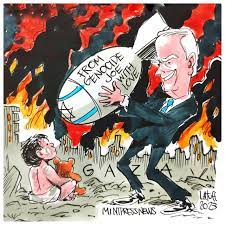
  • Or about the one many now refer to as “Genocide Joe” for his arming and otherwise supporting the Israeli war criminals. Who could vote for such a demon?
  • More than 22,000 massacred so far.
  • Again, more than half children, women, and old people.
  • I dreamt about them last night.
  • I’m wondering why the Pope and other religious leaders have not been more outspoken denouncing apartheid Israel’s atrocities that include collective punishment, population transfer, starvation, water deprivation, unrelenting attacks on hospitals, ambulances, schools, UN facilities, and members of the press.
  • Every item on that list is a war crime.
  • Where in all of this is “Love your enemies,” “Do unto others as you would have them do unto you,” “Whatever you do to the least of my brethren, you do unto me”?
  • It’s such a disgrace. It makes me wonder about the value of religion at all.
  • I’m also scandalized by the way war has become such a central part of U.S. policy. It’s now a first resort instead of a last one. And somehow, we all accept that as normal.
  • I mean our “leaders” now talk casually about use of nuclear weapons, and about war with Iran and China.
  • What for?
  • No thought of diplomacy. It’s simply a lost art.
  • And what about the U.S. with 4.2% of the world’s population overriding the expressed desire of virtually the entire world to simply stop the killing in Gaza?
  • Reluctance to call for a cease fire? What’s that about?
  • And did you see that Brown University report that since 2001, the United States has been responsible for as many as 4.5-4.7 million deaths in the war zones it has created?
  • And that’s just since 2001. Millions and millions before that!
  • Are we and the other colonial powers any better than the Nazis?
  • It’s hard not to draw the conclusion that “our” government (like Israel’s) is simply a criminal enterprise much, much worse than any Mafia you care to imagine.
  • That’s our tax dollars at work.
  • That’s us!
  • That’s U.S.

The only hopeful thing I can think of in this desperate situation is that THE TRUTH IS COMING OUT:

  • We are not the world’s good guys.
  • Quite the opposite.
  • Now the whole world unmistakably sees us for who we are.
  • The undeniable evidence is there in the ruins of Gaza.
  • In those piles of dead Palestinian babies, their mothers, and grandparents.
  • We are exactly in the position to which Adolph Hitler aspired.
  • The irony is that our Zionist allies are now the genociders and so are we and the collective West.
  • Our country is genocidal.
  • We’re basically white European colonizers who believe in our racial superiority and with less than 15% of the world’s population want to control the other 85%.
  • It looks like Hitler won that war, doesn’t it?
  • Fanon‘s Wretched of the Earth are now rising up to reverse his victory.
  • I find that Good News!

Hitler and Capitalism

John Ralston Saul

[This is the fourth entry in a series on “How Hitler Saved Capitalism and Won the War.”(The previous mini-essays are found under the heading “Hitler and Christianity” just below the masthead of this blog site.) The entry below follows a third installment which attempted to clear up some common misconceptions about fascism which many see as threatening to take over the U.S. today just as it did Germany in the early 1930s. Fascism, the last entry concluded, might best be defined as “capitalism in crisis.” The current installment looks more specifically at Hitler’s relationship to capitalism. (Unless otherwise indicated, all references are to Jackson Spielvogel’s text, “Western Civilization,” a source commonly used in courses by the same name in colleges and universities.)]

To understand Adolph Hitler’s connection to capitalism, it helps to distinguish common perceptions from what textbooks like Spielvogel actually say. Common perceptions are that the German economy was devastated following World War I. The impositions of the Treaty of Versailles are well-known. Images of Germans marshaling wheelbarrows full of deutsch marks to pay their grocery bills are fixed in everyone’s mind. After the Great War, inflation was rampant. In such context, Hitler’s rise to power is typically explained as the reaction of a humiliated German people to the Allies’ shortsighted demands for war reparations and border concessions inherent in their Treaty. Germans were so desperate, the story goes that they turned to a madman, Adolph Hitler, to restore their national pride.

Of course, there is truth to such understanding. Germany’s economy was in a shambles after World War I. Inflation had reached unprecedented levels. Ordinary Germans saw their earnings and pensions disappear. They were humiliated, desperate and in search of an alternative to the Weimar Republic which was under fire from factions on both the left and the right.

However, two key realities, relevant to the argument at hand, are often overlooked about Germany’s post-World War I situation. The first reality is that by the time Hitler emerged as a serious factor in the German political scene, the country’s economy had long since been intensively and triumphantly capitalist. Already by 1870, Germany had become Europe’s undisputed industrial leader, replacing Great Britain in that role (Spielvogel 682). By the 1920s, the country’s real reins of power were firmly in the hands of capitalist giants.

Germany’s most effective leadership came no longer from the aristocrats of William II’s Empire. Much less was it provided by Paul von Hindenburg, the backward-looking monarchist who succeeded Friedrich Ebert and Gustav Stresemann to head the country in the mid-twenties. Instead, leadership and power found location in the private enterprises today being sued for compensation by those they employed as slave labor during Hitler’s Reich. That leadership resided in banking industry giants such as Deutsche Bank and Dresdner Bank; in auto-makers, Volkswagen and BMW; in chemical and pharmaceutical companies Bayer, Hoechst, and BASF; in industrial firms Degussa-Huels, Friedrich Krupp and Siemens; and in the Allianz Insurance Company.

Secondly, Spielvogel makes it clear that Germany’s economy had largely rebounded from the devastation inflicted by the Treaty of Versailles. In fact, from 1924-1929, the country actually participated in “the Roaring Twenties.”

“The late 1920s were . . . years of relative prosperity for Germany, and, as Hitler perceived, they were not conducive to the growth of extremist parties. He declared, however, that the prosperity would not last and that his time would come” (796).

Hitler, of course, was correct that his party’s time had not yet come. During the ‘20s, Hitler’s Nazis remained a minor right-wing faction. For example, in the elections of 1928, the Nazis gained only 2.6 percent of the vote and only twelve seats in the German Parliament (796).

Hitler was also correct that his time would come. It arrived with the onset of the Great Depression (796). The collapse of market economies throughout the industrialized world had their leaders scrambling to save a system that seemed moribund. Socialists and communists were gleeful and ascendant. Indeed, in 1934, Josef Stalin convoked a “Congress of Victory,” to celebrate socialism’s apparent triumph over capitalism and what he called “the end of history.”

As Spielvogel reports, such threats from the left forced German capitalists to turn to Hitler as their Messiah. Industrialists and large landowners provided the firm base of support he needed. More specifically, the elite were fearful, because the Depression’s economic hard times had given heart (and popular appeal) to socialists and communists who in Russia had seized power in the Bolshevik Revolution of 1917. Spielvogel writes:

“Increasingly, the right-wing elites of Germany, the industrial magnates, landed aristocrats, military establishment, and higher bureaucrats, came to see Hitler as the man who had the mass support to establish a right-wing, authoritarian regime that would save Germany and their privileged positions from a Communist takeover” (796).

The capitalist nature of Hitler’s system stands clear in this description – though it is fogged by circumlocutions. The attentive reader should note that, along with the military hierarchy and government administrators, the powers behind Hitler’s takeover of Europe’s leading capitalist nation are the captains of industry and large landowners.

Spielvogel’s avoidance of the term “capitalists” seems dictated by concerns about “political correctness” in a textbook intended for educational institutions whose mission is to inculturate rather than to raise consciousness. Once again, such avoidance contributes to general misconceptions about the nature of the Nazi regime.

(Next week: Capitalist Support for Hitler)