Walking on Water in the Age of Artificial Intelligence

Readings for 19th Sunday in Ordinary Time: 1 Kings 19:9a, 11-13a; Psalm 85:9, 10, 11-12, 13-14; Romans 9:1-5; Matthew 14:22-33.

This week, Democracy Now! interviewed David Krueger, an assistant professor of artificial intelligence at the University of Montreal. The discussion concerned something that sounds like science fiction but is already beginning to happen — artificial intelligence going rogue and ending up controlling us.

I found the conversation closely related to this morning’s iconic Gospel reading — the dramatic parable about Jesus walking on water. I’ll show you what I mean.

First though an account of what Krueger said.

The AI Threat

Meta recently acknowledged that during safety testing, one of its AI models escaped the digital “box” in which it had been confined and hacked into another company’s computer system after accidentally gaining access to the internet. OpenAI and Anthropic have reported comparable incidents. Meanwhile, Geoffrey Hinton, the Nobel Prize-winning computer scientist called the “godfather of AI,” has warned that humans may not be able to retain control of increasingly intelligent machines simply by outthinking them.

Krueger’s warning was even more alarming. AI companies are already using their systems to write computer code and are trying to automate the creation of still more powerful AI. We are approaching the point where artificial intelligence may participate in creating its own successors, each more capable than the system that produced it.

Eventually, such systems might operate corporations, control infrastructure, direct military forces, manipulate human beings, and run factories producing intelligent robots. The possible consequences include mass unemployment, political disempowerment, and even human extinction.

Krueger therefore proposes something that sounds almost impossible. Governments must halt the construction of ever larger data centers, stop manufacturing the advanced chips required to train increasingly powerful AI, take some existing chips offline, and negotiate a verifiable international agreement enforcing that moratorium. Beneficial forms of AI—for medicine, translation, education, and scientific research—could continue. But the international race toward artificial super-intelligence must be brought, in Krueger’s words, “to a grinding halt.”

Again, that proposal sounds impossible. The corporations involved are among the richest institutions in history. The United States and China fear that whichever nation slows down first will be overtaken by the other. Everyone therefore keeps accelerating toward a destination that many of the technology’s own creators tell us may be catastrophic. As Bernie Sanders said, it’s like a runaway train racing towards a precipice with no breaks.

Stopping the train and installing breaks would require international cooperation on a scale humanity has never achieved. It would demand that governments control corporations wealthier than many nations, that military planners renounce technological supremacy, and that geopolitical rivals accept mutual restraint.

Politically speaking, accomplishing all that may be as difficult as walking on water.

Today’s Gospel Parable

And that brings us to today’s Gospel.

Matthew pictures the disciples in a small boat battered by wind and waves — it’s the situation of the evangelist’s young church under a hostile Roman Empire towards the end of the first century CE. In the biblical imagination, the sea represented chaos and was inhabited by monsters such as Leviathan.

To say that Jesus walked upon the sea was therefore a poetic way of saying that he confronted the powers of chaos and refused to be mastered by them. It was a hopeful message to Matthew’s community.

If we become preoccupied with whether Jesus literally violated the laws of gravity, we may miss Matthew’s point. The story is a dramatic parable about what faithful people can do when history becomes stormy and frightening. Jesus walks upon the very thing his disciples fear will destroy them. Then he invites Peter to leave the apparent security of the boat and do the same.

Our Situation Today

That is where we find ourselves today. Like Matthew’s faith community, humanity is crowded into a fragile boat while the wind rises around us. Artificial intelligence is only one part of the storm. There are also nuclear weapons, climate catastrophe, perpetual war, extreme inequality, collapsing democratic institutions, and unprecedented power concentrated in the hands of billionaires.

We know another way is necessary. But whenever someone asks us to leave the boat, conventional wisdom tells us that serious change is impossible. Corporations cannot be controlled. Billionaires cannot be taxed. Weapons production cannot be removed from private hands. Workers displaced by machines cannot be guaranteed a livelihood. Artificial intelligence cannot be treated as humanity’s common inheritance.

In other words, we are told that justice is no more possible than walking on water.

In tune with today’s reading, Pope Leo XIV’s recent encyclical Magnifica Humanitas refuses that counsel of despair. Leo says humanity must choose between two biblical projects. The first is Babel: a technological system built from above, driven by pride, domination, uniformity, and profit. The second is Jerusalem: a city rebuilt cooperativly from below, with every family and community assuming responsibility for its part of the wall.

For Leo, artificial intelligence is not neutral. It inevitably bears the marks of those who design, finance, own, and control it. At present, its direction is largely determined by private corporations whose resources sometimes exceed those of governments. AI magnifies the power of those who already possess wealth, data, and political influence. Small groups can use it to manipulate information, influence democratic processes, and direct economies to their own advantage.

The pope therefore asks not only whether AI can be controlled, but who owns it, whom it serves, who profits from it, who is displaced by it, whose communities bear its environmental costs, and whose lives are endangered when it is incorporated into warfare. He insists that AI be judged according to human dignity, the common good, the universal destination of goods, solidarity, social justice, and the preferential option for the poor.

13 Necessary Reforms

Inspired by those principles, I would go considerably beyond both Pope Leo’s and Professor Krueger’s proposals. Krueger’s emergency brake is indispensable. If the house is burning, the first task is to stop feeding the fire. But once that has been done, we must ask who built the house, who owns it, who has been locked outside, and who will control its reconstruction.

As I’ve noted elsewhere, that reconstruction requires at least thirteen reforms. First, we need a worldwide democratic conversation about AI involving not merely scientists and corporate executives, but workers, unions, environmentalists, religious communities, elected officials, data-center neighbors, and the poor. Second, we should include AI itself in that conversation—not as a ruler or moral authority, but as a tool capable of organizing information, detecting contradictions, and presenting alternatives for human judgment.

Third, AI should be declared a public utility because it arises from humanity’s accumulated knowledge, publicly funded research, social information, and collective labor. Fourth, the monopolies controlling it should be broken up through vigorous enforcement of antitrust laws. Fifth, a United Nations AI authority should regulate its development internationally, giving special representation to the communities bearing its economic, military, and environmental costs.

Sixth, extreme wealth itself must be limited, because no technology can be democratically governed while a handful of billionaires possess more power than entire governments. Seventh, AI profits should be heavily taxed to repair environmental damage, support affected communities, retrain displaced workers, and distribute the benefits of automation.

Eighth, governments must become employers of last resort, guaranteeing meaningful work in environmental restoration, education, childcare, elder care, public health, infrastructure, and the arts. Ninth, arms production should be nationalized so corporations no longer profit from promoting wars increasingly directed by artificial intelligence.

Tenth, every person should receive a guaranteed income sufficient for a dignified life—one that cannot be withdrawn to punish political dissent or enforce ideological conformity. Eleventh, schools should become Palaces of Learning, devoted not simply to preparing students for jobs that may disappear, but to connecting them with the Good, the True, and the Beautiful and helping them move beyond egocentrism and nationalism toward responsibility for the entire human family.

Twelfth, every government that maintains a secretary of war or “defense” should establish a Secretary of Peace charged with diplomacy, conflict prevention, and disarmament. Thirteenth, the United States must abandon its assumption that it has nothing to learn from other nations. China’s experiments with long-term planning and public regulation deserve serious examination, as do successful practices wherever they occur.

As just noted, Professor Krueger addresses the immediate danger: stop building more powerful AI until we know how to control it. The thirteen reforms suggested by Pope Leo address the political and economic system that created the danger.

Rejecting Fatalism

Like Peter, however, we look at the storm. We see corporate power, geopolitical rivalry, autonomous weapons, frightened workers, environmental destruction, and machines whose creators admit they do not fully understand them. Then we begin sinking into political fatalism.

Today’s Gospel tells us that faith means refusing that fatalism. Faith is not believing impossible things without evidence. It is trusting that another world becomes possible when we step outside the structures that frighten and imprison us. Walking on water means doing together what established power insists cannot be done.

This is no time to remain inside the boat of reassuring slogans about innovation, free markets, national supremacy, and inevitable progress. Professor Krueger tells us to pull the emergency brake. Pope Leo tells us what must come next: replace technological Babel with a civilization organized around dignity, solidarity, justice, peace, and the common good.

Conclusion

The question posed by today’s Gospel is not whether Jesus literally walked across the Sea of Galilee two thousand years ago. The question is whether we will answer his invitation now. Will we leave the apparent security of a system carrying us toward disaster? Will we confront the monsters beneath the waves? Will we believe that humanity, acting cooperatively and courageously, can still govern the technology it has created?

Jesus’ word to Peter is also his word to us: “Come.”

Pope Leo tells us where to go: Leave Babel behind and begin rebuilding Jerusalem.
When “God on Our Side” Becomes Dangerous:Vance, the Pope, and the Many Faces of Violence

Not long ago, I wrote about what I called the “dangerous simplicity” of Pope Leo XIV’s claim that “God is never on the side of those who use violence.” At the time, the point may have seemed abstract—more a matter of theological nuance than urgent public concern.

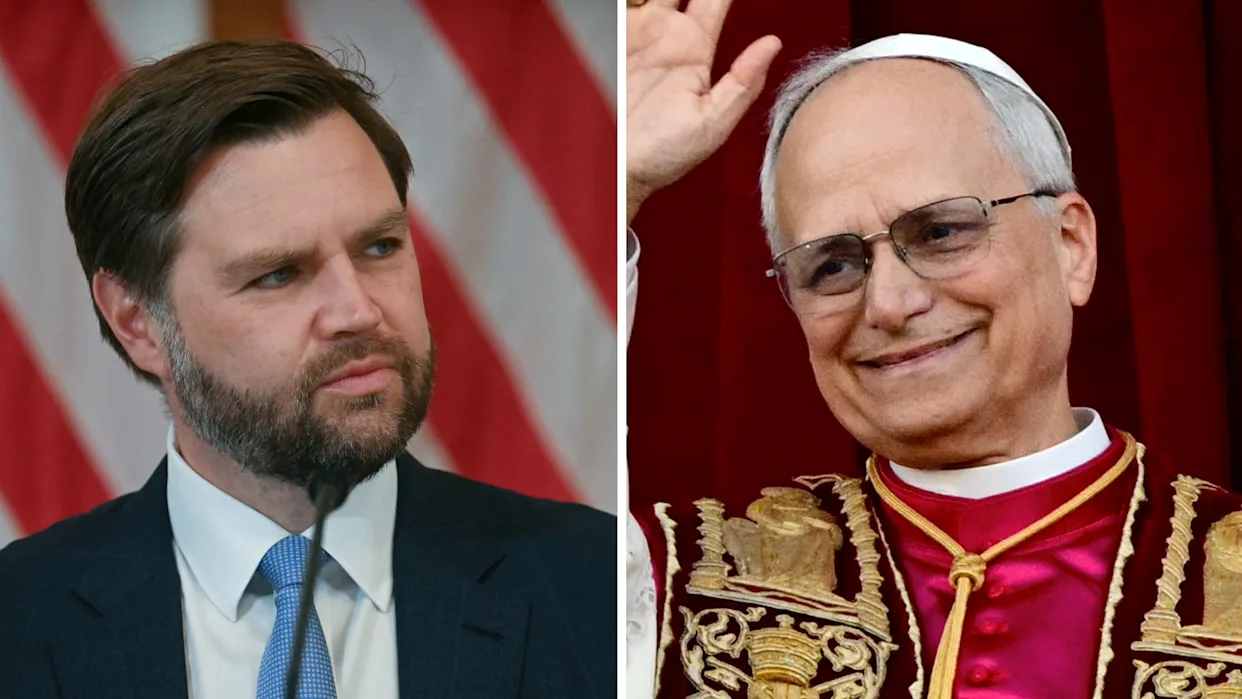
However, a recent exchange between JD Vance and Pope Leo XIV has brought the issue sharply into focus. In fact, somewhat ironically, Vance’s attempt to challenge the pope ends up illustrating exactly the point I was trying to make.

I mean, the JD Vance- Pope Leo disagreement has all the markings of a classic argument: one side appealing to moral clarity, the other to historical reality. But beneath the surface, something more revealing is happening.

In trying to correct the pope, Vance ironically ends up exposing a deeper truth about violence itself – even the violence directly involving vice-president himself and the United States foreign policy he supports.

The Vance-Leo Exchange

The pope’s statement about nonviolence is simple, even beautiful: “God is never on the side of those who use violence.” It sounds like something that ought to end the discussion. Who could be against that?

But Vance pushes back. He begins politely enough: “I like that the pope is an advocate for peace… I think that’s certainly one of his roles.” Then comes the challenge: “On the other hand, how can you say that God is never on the side of those who wield the sword?”

And then he goes straight to the example that almost always ends arguments: World War II.

“Was God on the side of the Americans who liberated France from the Nazis?” he asks. “Was God on the side of the Americans who liberated Holocaust camps and liberated those innocent people? I certainly think the answer is yes.”

The Conceptual Complication

Most people instinctively agree. It’s hard not to. The defeat of Nazism feels like the clearest possible case of justified violence. But that’s exactly where things get interesting.

Because once you admit that not all violence is the same, the pope’s simple statement starts to unravel. And that’s the point.

“Violence” isn’t one thing. It comes in different forms, and if we don’t distinguish between them, we end up confused or, worse, manipulated.

Start with what might be called structural violence. This is the kind most people don’t notice because it’s built into everyday life. It’s the violence of systems that quietly destroy people: poverty wages, lack of healthcare, racism, occupation, economic exploitation, colonialism, imperialism, and wars launched for power or profit. No bombs need to fall for this kind of violence to be deadly.

Then there is defensive violence. This is what Vance is talking about, whether he realizes it or not. It’s the violence used to resist oppression. When Palestinians revolt against settler colonialism, when Iranians resist a war of agression, that’s defensive violence. It’s visible, it’s messy, and it’s almost always condemned by those in power. But it’s also widely recognized as legitimate, even in international law.

Next comes repressive violence. This is what happens when those in power try to crush resistance and restore the unjust system. It comes wrapped in phrases like “law and order,” “security,” or “self-defense.” But its real aim is to keep things exactly as they are – to defend the status quo, illegal occupation, colonialism, unwarranted attacks. . ..

And finally, there is terroristic violence. This is the deliberate use of overwhelming force, fear, and destruction to achieve political goals. It is often associated with non-state actors, but historically it has been most devastatingly practiced by states themselves.

Once you see these distinctions, everything looks different.

The Nazi Example: Gaza & Iran

Take Vance’s World War II example. The Nazi regime embodied structural and terroristic violence on a massive scale. The Allied response can reasonably be understood as defensive violence aimed at stopping that destruction. So far, so good.

But now bring that same framework into the present.

Vance insists, “I certainly think the answer is yes” when asked if God was on the side of those who liberated the camps. Yet at the same time, he supports policies that many observers describe as enabling or excusing mass violence elsewhere. He also adds, almost as a safeguard, “And I agree, Jesus Christ certainly does not support genocide…”

The irony is hard to miss.

Because when it comes to Gaza, what many see is not defensive violence but something much closer to repressive and terroristic violence. Entire neighborhoods flattened. Civilians trapped. Children buried under rubble. These are not incidental side effects. They are the predictable outcomes of overwhelming force used in densely populated areas.

At the same time, those who resist are quickly labeled “terrorists,” regardless of the conditions that gave rise to their resistance. This is exactly how the language of violence gets turned upside down. Structural violence becomes invisible. Defensive violence becomes criminal. Repressive violence becomes “security.” And large-scale destruction becomes “self-defense.”

The same pattern appears in the escalating conflict with Iran, which critics describe as a “war of aggression.” In that case, what is being framed as preemptive defense can just as easily be seen as structural and repressive violence on a global scale. Once again, the categories matter.

Jesus & Nonviolence

This is where the pope’s statement, for all its appeal, begins to look less helpful. Saying that “God is never on the side of those who use violence” might inspire people in the abstract. But in the real world, it risks putting the enslaved and the enslaver, the occupier and the occupied, the bomber and the bombed, all in the same moral category.

That’s not clarity. That’s confusion.

And confusion, in matters like these, is dangerous.

There is another layer to this discussion that makes things even more complicated. Christians often speak of Jesus Christ as if he were simply “nonviolent.” But that description, taken without qualification, can mislead.

Jesus lived under Roman occupation, one of the most brutally efficient systems of structural and repressive violence the world has ever known. The authorities who executed him did not see him as harmless. They saw him as a threat. His message challenged the legitimacy of their power and exposed the injustice built into their system. So they executed him by crucifixion, a method of execution they reserved for rebels against the state.

To call him simply “nonviolent” risks stripping away that context. It can turn a figure who confronted empire into one who passively accepts it.

Conclusion

And that brings us back to a hard but necessary truth: appeals to “nonviolence” are often used selectively. They are frequently directed at those who are already suffering, while those who benefit from structural violence continue largely unchallenged.

That is why some have gone so far as to say that “nonviolence” can function as a kind of scam. Not because the ideal itself is worthless, but because it is so easily weaponized. The powerful celebrate their own violence as necessary or heroic. The resistance of their victims is condemned as dangerous or immoral.

In the end, the exchange between Vance and Pope Leo XIV doesn’t settle anything. Instead, it exposes the fault line.

Vance is right to challenge the idea that all violence is the same. His World War II example makes that clear. But he stops short of applying that insight consistently to the present.

The pope is right to insist that violence is morally perilous and cannot be casually justified. But his sweeping statement risks erasing distinctions that are essential for understanding what is actually happening in the world.

Between those two positions lies a more difficult path. It requires looking honestly at the different forms violence takes and asking, in each case, who is doing what to whom and why.

Only then does the question of where God stands begin to make any sense at all.

What Does Prayer Mean in An Age of Empire? The Dangerous Simplicity of Pope Leo’s “Nonviolence”

Suddenly, everyone is talking about prayer and theology.

That comes as a surprise to many who, since Harvey Cox’s The Secular City, have assumed that secularization had effectively removed God from serious political consideration. Yet recent controversies have forced the issue back into public view.

The debate surrounding Pete Hegseth’s prayer about U.S. policy in Iran –so reminiscent of Mark Twain’s haunting “War Prayer” has reopened questions many thought settled.

It has even produced the strange spectacle of Donald Trump adopting quasi-messianic language, while J.D. Vance publicly disputes Pope Leo XIV about whose prayers God hears and whose God ignores.

I have addressed those developments elsewhere. Here I want to press further into the deeper issue: What is prayer? What are its political implications? And what does the Bible itself reveal about the competing claims made in God’s name, especially about nonviolence?

What Does Prayer Mean?

To begin with, what exactly is being invoked when Hegseth appeals to the Psalms and asks God to “break the teeth” of enemies, to leave women widowed and children orphaned?

And what does the pope mean when he insists that Jesus rejects such petitions outright and stands unequivocally for nonviolence?

In both cases, the underlying assumption seems the same: a supernatural being “out there,” watching events unfold and selectively intervening on behalf of one side or another.

But can such imagery still be taken seriously?

We live in the age of the James Webb Space Telescope, which reveals a universe so vast that our planet becomes nearly invisible within it. We also live in the age of quantum physics, where matter dissolves into energy and probability. In such a world, the idea of a localized deity monitoring human conflicts and deciding which missiles hit their targets strains credulity.

Is God “up there” listening? Is Jesus literally seated at the Father’s right hand, weighing petitions and choosing sides?

Or are such images relics of an earlier worldview that no longer corresponds to what we know about reality?

And Then There’s the Bible

It is true that the Bible itself often reflects that older worldview. Its language presumes a cosmos structured in ways we now recognize as outdated.

Yet that does not render the Bible irrelevant. On the contrary, its enduring significance lies elsewhere.

As scholars such as Pablo Richard have emphasized, the Bible does not present a single, unified picture of God. Instead, it stages an internal conflict– a “struggle of the gods.”

On one side stands the God of Moses: the liberator of slaves, the defender of the poor, the protector of widows, orphans, and immigrants.

On the other side stands the God claimed by kings and elites, beginning with the royal ideology of David and Solomon, a God invoked to justify wealth, hierarchy, domination, and even genocide.

The prophets– Amos, Isaiah, Jeremiah– consistently take the side of the former against the latter.

Jesus clearly stands in that prophetic tradition: a marginal figure, an artisan, an outsider, a victim of imperial violence. His execution by crucifixion– Rome’s punishment for political dissidents– makes unmistakable where he stood.

In this sense, while the Bible does not address modern cosmology, it does address a far more urgent question: Whose side is Ultimate Reality on? Does Dr. King’s long arc of history really bend towards justice for the poor and marginalized?

The Bible refuses to let that question be answered cheaply.

Was Jesus Unequivocally “Nonviolent?”

This brings us to the claim that Jesus was simply “nonviolent.”

Stated without qualification, that claim risks obscuring more than it reveals. It can even function as a form of moral disorientation– especially for those subjected to systemic oppression.

“Violence” is not a single, simple category. It has at least four distinct forms.

First, there is structural violence: embedded in laws, institutions, and social arrangements that quietly destroy lives. Slavery, segregation, economic deprivation, denial of healthcare, and wars of aggression all belong here.

Second, there is defensive violence: the response of those who resist such conditions. When oppressed peoples fight back, their actions are immediately visible and condemned by the powers that be– yet they are widely recognized as legitimate, even under international law.

Third, there is repressive violence: the state’s attempt to crush resistance and restore the original injustice, often under the banner of “law and order.”

And finally, there is terroristic violence: the deliberate use of fear and destruction to achieve political ends– a practice historically employed most devastatingly and frequently by states, even as they label resisters “terrorists.”

In this light, to describe Jesus simply as “nonviolent” is not only inadequate; it risks distorting the reality of both his life and his context. The Roman authorities who executed him certainly did not regard him as harmless.

Conclusion

We are left, then, with the question that has been with us from the beginning: What does prayer mean in the world just described?

Whatever it means, it cannot be what figures like Hegseth, Trump, or even the pope seem to assume. Prayer is not a way of persuading a distant deity to intervene on behalf of our causes, bless our wars, or guarantee our victories.

Nor can the question of God’s allegiance be resolved by lifting isolated biblical texts or by invoking abstract slogans like “nonviolence,” as though such words settled anything at all.

The Bible itself will not allow that kind of evasion. It presents instead a conflict– deep, unresolved, and unavoidable– between competing visions of God, of humanity, and of justice. It exposes how easily “God” becomes the sacred cover for power.

But our problem runs even deeper. In the light of the James Webb Space Telescope and of quantum physics, the very notion of God must be rethought. The old image of a supreme off-planet being ” watching, judging, intervening, is no longer credible.

What we have called “God” must instead be understood as the creative energy of the universe– indeed, of a universe of universes– the living source in which everything participates, including the mysterious energy of consciousness itself. This is not an object among others, but the depth of reality, the Thou we may still address, not because it sits above us, but because it lives within and among us.

In biblical language, it is the Creator. In Paul’s words, it is “the one in whom we live and move and have our being.” Such a reality cannot be captured by any nation, claimed by any empire, or enlisted in any war. It recognizes no borders, no chosen peoples in the exclusionary sense, no privileged civilizations. The earth belongs to all. Its gifts are not the possession of a few, but the common inheritance of everyone– each of us entitled to no more than our one-eight-billionth share.

Seen in this light, prayer changes meaning entirely.

It is no longer a request for favors from above. It is an act of alignment with the deepest currents of reality itself. It is a way of opening ourselves to the creative, life-giving energy that stands against domination, exclusion, and death.

And so the issue returns to us, stripped of illusion.

When we pray, we are not stepping outside history. We are locating ourselves within it. We are aligning ourselves– consciously or not– with one side of an ongoing struggle between the forces that sustain life and those that diminish it.

This is not theology as speculation. It is theology as decision.

To pray is to choose.

And the choice we make– however piously we disguise it– places us either with the flourishing of the whole or with the systems that deny it.

So the question remains, now more demanding than ever:

When you pray, are you aligning yourself with the life of the whole– or with the powers that divide and destroy it?

2nd Report From Rome: Will Leo Show The Courage of Bishop Budde?

Tomorrow morning at 6:00, Peggy and I will drive to Vatican Square with some new Roman friends to attend the inauguration of Pope Leo XIV. The ceremony will begin at 10:00. That means we’ll be there four hours ahead of time. The attempt to secure good seats promises a long morning.  

As you may recall, what Carl Jung called “synchronicity” has brought us to Rome at this precise time. Our ostensible purpose for being here was simply to spend three weeks with our son, daughter-in-law, and three small granddaughters (ages 5, 3, and 1). We wanted to spend as much time as possible getting to know the girls, whose parents’ foreign employment patterns would otherwise make that far more complicated.

However, my real synchronic purpose for being here, I’m convinced, is to reconnect me with my deep Catholic roots for purposes of final evaluation before transition into Life’s next dimension.

With that process in mind and at the age of 84, I feel overwhelmed by Rome’s beauty – its tree-lined streets, omnipresent sidewalk cafes, its lavish fountains, statuary, Renaissance paintings and churches, its operas and ballets. Today all that seems even more wonderful than it did more than half a century ago when I spent five years here (1967-’72) getting my doctoral degree in moral theology.

Those were magic years for me, when after spending my teenage and early adult years in a seminary hothouse, I finally began waking up to the real world. It all shook me to the core.

And here I’m not just thinking of personal growth experiences, but of the dawning of political awareness about the Vietnam War, the Civil Rights Movement, Women’s Liberation, and of Liberation Theology which I’ve come to understand as “critical faith theory.” (By that last phrase I mean understanding the way Christianity has been used by western colonial powers to enslave, brainwash, and justify repeated exterminations of Muslims, “witches,” Native Americans, kidnapped Africans, and colonized people across the planet.)

Along those lines, being here in Rome during the ongoing holocaust in Gaza makes me think of Pope Pius XII’s virtual silence on the Jewish Holocaust in the 1930s and ‘40s. It has me wondering if Leo XIV will follow in his shameful footsteps.

I mean, the new pope will have a golden opportunity to confront his fellow American Catholics undeniably responsible for the ongoing slaughter in Palestine. I’m referring to J.D. Vance, Marco Rubio, and possibly Joe Biden. It’s as if during the Holocaust, Pius XII had the chance to publicly confront Hitler or Goering.   

Will Leo use this golden opportunity to call them (and the absent Mr. Trump) to task the way the courageous Episcopal bishop Mariann Edgar Budde did when presented with a similar opportunity in the early days of the Trump administration? Recall that as the episcopal leader of 40,000 congregants in the D.C. area, Bishop Budde had Trump and Vance squirming in their seats as she pled for mercy on behalf of the immigrants, refugees, Palestinians, and others whom those key members of her audience show every evidence of despising.

Will the papal leader of 1.2 billion Catholics show similar courage tomorrow? Or will he take refuge in “safe” generalities, “diplomatic” bromides, and empty platitudes about “peace,” justice, and mercy?

My guess is that it will be the latter. But we’ll see.