Most people do not read policy papers; they’d rather read stories That is not a failure of intelligence; it simply a description of how human beings learn, imagine, and change.
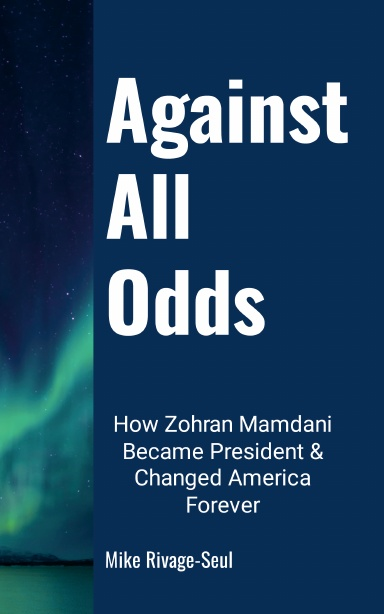
My novella, Against All Odds: How Zohran Mamdani Became President and Changed America Forever was written to complement the policy statements of the emerging Arc of Justice Alliance (AJA). The book is not a prediction, nor a legislative blueprint. It is a story — a civic fable — meant to explore how democratic renewal might feel, sound, and unfold if ordinary people followed the lead of politicians such as Zohran Mamdani.
The book grew out of decades of political reflection, organizing experience, and moral concern, and was developed in conversation with AI. That collaboration does not replace human judgment; it sharpens it, forcing questions of coherence, plausibility, and ethical consistency that policy language often evades.
What follows is the book’s opening chapter. It is offered here not as entertainment, but as an invitation: to introduce the book’s exploration of how power operates, how legitimacy erodes, and how moral imagination may be a prerequisite for democratic repair.
Excerpt from Against All Odds
Chapter One – The Bronx Spring
“Every revolution begins as a local rumor — until someone believes it might be true.”
— AJA Field Notes, 2025
The winter had been long in Queens. Gray salt crusted the curbs. Trains screamed overhead like mechanical prayers. And yet, beneath the cold concrete, some-thing was stirring — quiet, electric, alive.
They called it the Bronx Spring.
It began with a tenants’ strike in a decaying building off 31st Avenue — the kind of place where the rent doubled every two years while the heat failed every January. Young organizers — Somali, Bangladeshi, Dominican — went door to door with clipboards and conviction. And at the center of it all stood Zohran Mamdani, a man whose voice carried both the warmth of Queens and the cadence of Kampala, equal parts poetry and fire.
He wasn’t a mayor yet, or even thinking that far ahead. He was a state assembly-man still riding the E train to Albany twice a week, still sending midnight texts that began, “Comrades, one more thing…” But something in him — and around him — had shifted.
The city was tired of promises. And the Bronx, like the chorus of an old labor hymn, began to hum again. The night it truly began, the wind sliced through the corridors of the Queensbridge Houses.
Zohran was there, coat collar turned up, hands full of coffee and flyers. A woman named Amina opened her door just wide enough to see his face. Behind her, a child slept under a mural of the Virgin and Malcolm X.
“Another politician?” she asked.
“Not exactly,” he said. “I’m your neighbor.”
It wasn’t a line; it was true. He lived two blocks away.
That night, fifty tenants gathered in the laundry room to write what they called The People’s Demands: rent rollbacks, energy audits, legal aid for evictions. No one expected much. Not in a city where real estate and police unions ran the show. But when Zohran spoke, he didn’t sound like a candidate. He sounded like a possibility.
“Power,” he said, “isn’t what they hold in City Hall. It’s what we hold when we stop believing we’re alone.”
Days later, things began to move. Heat returned to the buildings. Landlords called emergency meetings. A city inspector — one who’d ignored complaints for years — appeared, clipboard trembling.
Something had changed.
Zohran’s small Astoria office became a nerve center — whiteboards, coffee cups, volunteers working until dawn. They mapped block-by-block networks of resistance.
They called it Reclaim the City. But within the movement, a quieter name began to circulate — The Arc of Justice Alliance.
It meant different things to different people: a moral trajectory, a bridge to something better, a plan for what democracy might still become. Late at night, Zoran wrote in his notebook: “If we can build one just block, we can build one just city. If we can build one just city, we can build one just nation.”
Power, even moral power, never goes unnoticed. In City Hall, consultants scoffed. The Post ran a headline: “Socialist Slum Preacher.” Developers whispered to their lobbyists. And in Washington, analysts began filing quiet memos about a charismatic legislator organizing “urban solidarity experiments” in Queens.
The movement was becoming visible. And visibility, in America, is a dangerous form of faith.
Spring came late that year. The cherry trees bloomed unevenly along Roosevelt Avenue, the air thick with rain and ambition. At a rally in Bryant Park, Mamdani stood beside bus drivers, sanitation workers, and students. The crowd wasn’t large, but it was awake — eyes bright, faces lifted toward something unseen but undeniable.
“Every generation,” he said, “faces a choice between cynicism and renewal. We stand tonight at the threshold of both.”
The words landed like prophecy.
By summer, the rumor would become a movement, the movement a campaign, and the campaign a city reborn in defiance of empire. But for now — on that cold evening in Queens, with the wind off the East River and the trains moaning overhead — it was still only a whisper, shared among the hopeful.
The Bronx Spring had begun.
Yet, even then, before anyone could name it, an odd tremor ran beneath the surface of public life — small bureaucratic stumbles, missing records, a strange silence from federal monitors who normally hovered over tenant disputes. It was as if the machinery of the old republic were developing hairline fractures no one yet saw.
Reflection
Stories do not replace policy.
But they often make policy thinkable.
If this excerpt resonates, it may be because it names something many people already sense: that power rests in an awakened electorate and that politicians like Zohran Mamdani can represent the future of our nation as the “Republic of Care” proposed by the Arc of Justice Alliance (AJA).
As noted above, Against All Odds is part of the broader work of the AJA, an effort dedicated to imagining and building democratic institutions rooted in care, accountability, and human dignity.
If you find value in this work, you are invited — never pressured — to support that effort. Purchasing the full book or donating helps sustain writing, organizing, and public education aimed at turning moral imagination into lived reality.
 About Things That Matter