China’s Example and the Need to Rethink Democracy Itself

More than a year ago, OpEdNews’ visionary editor-in-chief, Rob Kall, started a project called the Arc of Justice Alliance (AJA). Its original intent was to offer a progressive alternative to the Republican Project 2025. The latter’s goal is to reduce the federal government to a size (in the words of Republican operative Grover Norquist) that could be drowned in a bathtub.

The AJA agenda would rescue democracy from Norquist’s tub.

But what exactly might that mean in a political environment where the old slogans no longer persuade anyone. Frankly put, “defending democracy” sounds hollow when millions increasingly suspect that what we call democracy has already been purchased, managed, and stage-directed by forces far beyond ordinary citizens’ control.

What I intend to argue here is that if the AJA hopes to become more than another mildly progressive pressure group orbiting around a dying Democratic Party, it must become far more radical in addressing the fact that in terms of “democracy,” the United States is a failed state. It must reform to a system more closely resembling China’s “whole process democracy.”

A Failed Epstein State  

Facing America’s failure might be uncomfortable. However, the facts speak for themselves.  “Our” country is not governed primarily by its voters. Instead, it is run by what might best be called the Epstein Class.

By that phrase I do not mean only the disgraced financier Jeffrey Epstein himself. Epstein has become symbolic of something much larger — a transnational ruling network of billionaires, intelligence operatives, media owners, financiers, weapons contractors, corporate monopolists, and political fixers whose power transcends elections and party labels.

Others call this network the “Deep State.” But that term can become too vague or conspiratorial. “Epstein Class” points more directly to the fusion of wealth, secrecy, sexual compromise, surveillance, and political immunity characterizing elite power in late capitalism.

The point is not that every billionaire belongs to a secret cabal meeting in underground bunkers. The point is structural. Wealth itself has become sovereign. Under contemporary capitalism, money no longer merely influences politics. It governs politics.

This is why elections change so little.

Wars continue regardless of campaign promises. Wall Street remains untouchable. Pharmaceutical corporations write healthcare policy. Silicon Valley harvests personal data with almost no restraint. Intelligence agencies operate beyond meaningful democratic oversight. Billionaires evade taxes while homelessness explodes beneath the skyscrapers they own.

And yet we are constantly told we live in “the world’s greatest democracy.”

The AJA should challenge that phrase directly.

Because what if the central political issue of our time is not “democracy versus dictatorship,” but rather which class exercises dictatorship?

That was, of course, the insight of Karl Marx. Marx argued that every state ultimately serves one ruling class or another. Under capitalism, democratic institutions often mask what is essentially the dictatorship of wealth. We live under the dictatorship of the Epstein Class.

In America today that dictatorship increasingly stands exposed.

China’s Democracy

Ironically, this is where China enters the conversation in ways many Western progressives still fear to acknowledge.

Western media constantly portrays China as authoritarian. And certainly, the Chinese Communist Party exercises centralized authority in ways foreign to American political culture. But the deeper question is rarely asked: centralized authority on behalf of whom?

China’s defenders argue that the CCP, whatever its flaws, governs primarily in the interests of long-term national and collective development rather than in the interests of an unrestrained billionaire oligarchy.

One need not romanticize China to recognize the force of that claim.

Over the last forty years China has lifted hundreds of millions out of poverty, constructed immense infrastructure systems, expanded public transportation, modernized entire regions, and maintained long-range national planning capacities almost unimaginable in the contemporary United States.

Meanwhile America’s political system appears increasingly incapable of governing at all.

Bridges collapse. Infrastructure decays. Healthcare bankrupts families. Universities drown students in debt. Entire cities become unaffordable. And yet the billionaire class accumulates wealth on a scale previously unimaginable in human history.

This is why the AJA must begin questioning not simply particular policies, but the very definition of democracy itself.

China’s political system offers at least one important conceptual challenge through its notion of “whole-process democracy.”

Whole Process Democracy

To Western ears the phrase often sounds like propaganda. But its underlying critique of Western liberal democracy deserves serious attention.

Western democracies generally define democracy procedurally: elections, competing parties, free speech, and formal civil rights. Chinese political theory argues that such democracy is incomplete because it leaves economic power largely untouched.

What good is voting, Chinese critics ask, if billionaires own the media, shape public consciousness, finance political campaigns, dominate economic life, and effectively dictate policy no matter which party wins office?

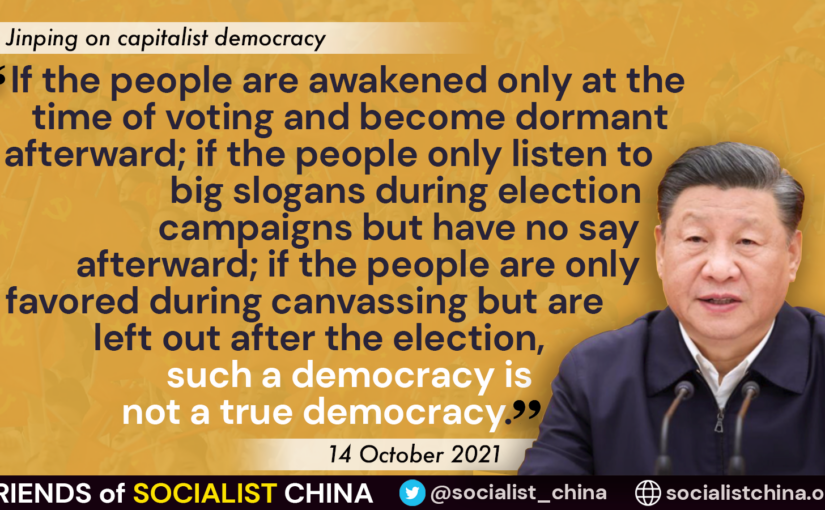
Chinese “whole-process democracy” proposes that democracy should involve continuous public participation throughout governance — consultation, planning, implementation, supervision, and evaluation — not merely occasional voting rituals.

Equally important, Chinese theorists insist democracy must be evaluated not only by procedures but by outcomes: poverty reduction, healthcare, infrastructure, education, housing, stability, and collective well-being. In other words, Chinese democracy is not procedural; it is consequentialist.

Again, one need not idealize China to recognize how devastating this critique becomes when applied to the United States.

Because by those standards, America’s democratic system increasingly looks dysfunctional and oligarchic.

The AJA should say this openly.

Practical Goals

Indeed, the Alliance should become one of the few organizations in the United States willing to demand a redefinition of democracy itself.

That redefinition would begin by acknowledging at least four realities.

  1. Democracy cannot exist where billionaires dominate the economy, media, intelligence structures, and political system simultaneously.
  2. The “free market” has evolved into a form of private tyranny insulated from democratic accountability.
  3. What Americans call “freedom” increasingly means freedom for oligarchs to exploit, speculate, surveil, monopolize, and destabilize society itself.
  4. A functioning democracy requires some form of permanent public authority strong enough to restrain oligarchic power.

This last point is especially difficult for Americans because our political culture has long distrusted centralized authority. Yet history increasingly suggests that Norquist’s bathtub and Project 2025 did not eliminate concentrated power. It merely transferred power into private hands.

Democracy w/ Chinese Characteristics

China’s concept of “socialism with Chinese characteristics” emerged precisely from this recognition. The “Chinese characteristics” refer not only to economics but to China’s deep civilizational traditions emphasizing social harmony, collective responsibility, long-term planning, and state obligation toward public welfare.

Influenced by centuries of Confucius and Confucian political philosophy, Chinese political culture traditionally viewed government not as a neutral referee between competing private interests, but as guardian of social balance and national continuity.

That outlook was reinforced by China’s traumatic “Century of Humiliation,” when foreign powers fragmented, occupied, and exploited the country. From the Chinese perspective, weak government invited chaos, colonization, and national disintegration.

Consequently, modern China developed a system combining market activity with strong state direction over finance, infrastructure, industrial policy, and long-term development.

In this, western critics see authoritarianism. Many Chinese citizens see protection against billionaire fragmentation and social collapse.

Conclusion

The AJA need not endorse every aspect of the Chinese model. But it should have the courage to learn from it.

At minimum, the Alliance should recognize that what presently exists in the United States is not genuine democracy but governance by the Epstein Class — a billionaire oligarchy shielded by intelligence systems, media control, campaign financing, and corporate monopolization.

And once that truth is acknowledged, new political possibilities emerge. Those possibilities include:

  1. Recognition that the real enemy of democracy is the Epstein Class that must be controlled and directed towards serving the rest of us.
  2. This means that democracy should no longer mean merely choosing between competing representatives of the same donor class every four years.
  3. Instead, it should mean collective power over finance, healthcare, media, technology, housing, infrastructure, and long-term social priorities.
  4. In summary, democracy should mean subordinating wealth to human need rather than subordinating human beings to wealth.

The bottom line here is that the central struggle of our century will not be between democracy and dictatorship at all. It is a contest between the dictatorship of billionaire capital and some new democratic form of collective public authority capable of restraining it.

If the Arc of Justice Alliance truly hopes to change America, it must become bold enough to say so. It must directly confront anti-Chinese propaganda and be willing to learn from Chinese experience.

How Zohran Mamdani Can Become President: (An Excerpt from My “Arc of Justice Alliance” Novella)

Most people do not read policy papers; they’d rather read stories That is not a failure of intelligence; it simply a description of how human beings learn, imagine, and change.

My novella, Against All Odds: How Zohran Mamdani Became President and Changed America Forever was written to complement the policy statements of the emerging Arc of Justice Alliance (AJA). The book is not a prediction, nor a legislative blueprint. It is a story — a civic fable — meant to explore how democratic renewal might feel, sound, and unfold if ordinary people followed the lead of politicians such as Zohran Mamdani.

The book grew out of decades of political reflection, organizing experience, and moral concern, and was developed in conversation with AI. That collaboration does not replace human judgment; it sharpens it, forcing questions of coherence, plausibility, and ethical consistency that policy language often evades.

What follows is the book’s opening chapter. It is offered here not as entertainment, but as an invitation: to introduce the book’s exploration of how power operates, how legitimacy erodes, and how moral imagination may be a prerequisite for democratic repair.


Excerpt from Against All Odds

Chapter One – The Bronx Spring

“Every revolution begins as a local rumor — until someone believes it might be true.”
— AJA Field Notes, 2025

The winter had been long in Queens. Gray salt crusted the curbs. Trains screamed overhead like mechanical prayers. And yet, beneath the cold concrete, some-thing was stirring — quiet, electric, alive.

They called it the Bronx Spring.

It began with a tenants’ strike in a decaying building off 31st Avenue — the kind of place where the rent doubled every two years while the heat failed every January. Young organizers — Somali, Bangladeshi, Dominican — went door to door with clipboards and conviction. And at the center of it all stood Zohran Mamdani, a man whose voice carried both the warmth of Queens and the cadence of Kampala, equal parts poetry and fire.

He wasn’t a mayor yet, or even thinking that far ahead. He was a state assembly-man still riding the E train to Albany twice a week, still sending midnight texts that began, “Comrades, one more thing…” But something in him — and around him — had shifted.

The city was tired of promises. And the Bronx, like the chorus of an old labor hymn, began to hum again. The night it truly began, the wind sliced through the corridors of the Queensbridge Houses.

Zohran was there, coat collar turned up, hands full of coffee and flyers. A woman named Amina opened her door just wide enough to see his face. Behind her, a child slept under a mural of the Virgin and Malcolm X.

“Another politician?” she asked.

“Not exactly,” he said. “I’m your neighbor.”

It wasn’t a line; it was true. He lived two blocks away.

That night, fifty tenants gathered in the laundry room to write what they called The People’s Demands: rent rollbacks, energy audits, legal aid for evictions. No one expected much. Not in a city where real estate and police unions ran the show. But when Zohran spoke, he didn’t sound like a candidate. He sounded like a possibility.

“Power,” he said, “isn’t what they hold in City Hall. It’s what we hold when we stop believing we’re alone.”

Days later, things began to move. Heat returned to the buildings. Landlords called emergency meetings. A city inspector — one who’d ignored complaints for years — appeared, clipboard trembling.

Something had changed.

Zohran’s small Astoria office became a nerve center — whiteboards, coffee cups, volunteers working until dawn. They mapped block-by-block networks of resistance.

They called it Reclaim the City. But within the movement, a quieter name began to circulate — The Arc of Justice Alliance.

It meant different things to different people: a moral trajectory, a bridge to something better, a plan for what democracy might still become. Late at night, Zoran wrote in his notebook: “If we can build one just block, we can build one just city. If we can build one just city, we can build one just nation.”

Power, even moral power, never goes unnoticed. In City Hall, consultants scoffed. The Post ran a headline: “Socialist Slum Preacher.” Developers whispered to their lobbyists. And in Washington, analysts began filing quiet memos about a charismatic legislator organizing “urban solidarity experiments” in Queens.

The movement was becoming visible. And visibility, in America, is a dangerous form of faith.

Spring came late that year. The cherry trees bloomed unevenly along Roosevelt Avenue, the air thick with rain and ambition. At a rally in Bryant Park, Mamdani stood beside bus drivers, sanitation workers, and students. The crowd wasn’t large, but it was awake — eyes bright, faces lifted toward something unseen but undeniable.

“Every generation,” he said, “faces a choice between cynicism and renewal. We stand tonight at the threshold of both.”

The words landed like prophecy.

By summer, the rumor would become a movement, the movement a campaign, and the campaign a city reborn in defiance of empire. But for now — on that cold evening in Queens, with the wind off the East River and the trains moaning overhead — it was still only a whisper, shared among the hopeful.

The Bronx Spring had begun.

Yet, even then, before anyone could name it, an odd tremor ran beneath the surface of public life — small bureaucratic stumbles, missing records, a strange silence from federal monitors who normally hovered over tenant disputes. It was as if the machinery of the old republic were developing hairline fractures no one yet saw.

Reflection

Stories do not replace policy.
But they often make policy thinkable.

If this excerpt resonates, it may be because it names something many people already sense: that power rests in an awakened electorate and that politicians like Zohran Mamdani can represent the future of our nation as the “Republic of Care” proposed by the Arc of Justice Alliance (AJA).

As noted above, Against All Odds is part of the broader work of the AJA, an effort dedicated to imagining and building democratic institutions rooted in care, accountability, and human dignity.

If you find value in this work, you are invited — never pressured — to support that effort. Purchasing the full book or donating helps sustain writing, organizing, and public education aimed at turning moral imagination into lived reality.

The Mamdani Lesson: Break Completely with the Billionaire Model

Over the past few months, I’ve found myself sitting at a rather surprising table — the Arc of Justice Alliance (AJA) planning committee. We’re charged with two enormous tasks: first, to craft a meaningful progressive response to the Right’s authoritarian blueprint, Project 2025. Second we’re to draft a counter-vision called Project 2029. It’s to be a path toward a People’s Republic grounded not in domination, but in justice, compassion, and democratic renewal.

For months now, we’ve been wrestling with the same dilemma: If the Republican establishment built a sprawling ecosystem of think tanks, media outlets, university programs, and religious platforms—funded by billionaires and designed to engineer public consciousness—shouldn’t we build a progressive version of the same? At one meeting after another, we even floated ideas about recruiting famous people to our cause and even of courting “friendly” billionaires like George Soros to bankroll a left-liberal infrastructure capable of matching the Right blow-for-blow.

But then something happened that, for me at least, broke the spell: Zohran Mamdani won the New York City mayoral race.

Let me underline what his victory represents. Here was a young candidate with 1% name recognition only a year ago. He faced opponents backed by unlimited money — super PACs, corporate donors, real-estate tycoons, the whole constellation of elite power determined to smother anything resembling a genuine democracy. And yet, he didn’t just challenge them; he defeated them. How? By mobilizing more than 100,000 volunteers, by conducting leadership trainings in living rooms and union halls, by knocking on one million doors, and by rallying ordinary New Yorkers around the elemental theme of affordability — the right of human beings to live with dignity in the communities they love.

Nothing flashy. Nothing overly intellectualized. No backroom deals.
Just democracy in its most radical, ancient sense: people talking to people.

His victory provided me with a moral awakening of sorts.

Because suddenly the entire strategy we’ve been discussing — building our own version of the Powell Memo machine — began to look not simply inadequate but morally compromised. If the way forward is through people, why would we imitate a model designed to sideline them? Why mimic the very structure that has delivered us a national government increasingly controlled by ignorant, degenerate, mafia types whose only qualifications seem to be cruelty, ignorance, and a willingness to auction off the country to the highest bidder?

If the fruit of the Right’s model is authoritarianism, why would we plant the same tree?

No. The Mamdani movement reveals the deeper truth:
Power does not flow down from billionaires or elites. It flows up from human beings who discover their own agency. As OpEdNews editor Rob Kall would say, “It’s Bottom-up.”

And so, I find myself convinced that Project 2029 cannot — must not — follow anything resembling the Republican strategy. We cannot organize a progressive future by begging for crumbs from oligarchs. Even “friendly” billionaires are not our allies; their worldview is too shaped by wealth to understand the soul of a democratic movement. Instead, what we need is a politics that speaks directly to the pain and hope of ordinary people:

  • Affordability
  • Green New Deal
  • Free college
  • Downsizing the military
  • Nuclear disarmament
  • Closing foreign military bases
  • High-speed rail
  • Universal healthcare

And this, not as technocratic bullet points, but as expressions of a moral vision rooted in the human right to live, learn, breathe, rest, and dream.

But this raises a practical question, the one our committee keeps circling back to: How do we build a movement capable of achieving such sweeping change without billionaire patrons? Here’s the blueprint that for me emerges when we take Mamdani’s victory seriously:

1. The Movement Must Be Member-Funded — Not Billionaire-Funded

If our goal is democratic empowerment, then our funding must come from the demos.
We need a dues-paying membership, millions strong, each giving what they can — $3, $5, $27. This is not naïve idealism. It is what built the civil rights movement, what sustained labor unions at their peak, and what fueled Bernie Sanders’ campaigns. Money raised from below transforms supporters into co-owners of the movement.

2. Build Leadership Schools, Not Think Tanks

The Right built think tanks to create obedient foot soldiers for oligarchy.
We need leadership academies to create authors of democracy.

Neighborhood leadership circles, online organizing schools, campus institutes for justice work, training hubs in churches and mosques — if Mamdani could train 100,000 volunteers in a single city, imagine what a nationwide network could accomplish.

3. Replace Media Propaganda with Relational Organizing

Fox News and right-wing radio work by isolating individuals and filling the void with fear.
Mamdani’s movement worked by connecting individuals — neighbor to neighbor.

Project 2029 should build a national relational organizing platform that links:

  • congregations,
  • tenant unions,
  • mutual aid groups,
  • environmental coalitions,
  • arts collectives,
  • campuses,
  • worker centers.

Democracy spreads best not through algorithms but through relationships.

4. Tell One Simple, Moral Story

Republicans have mastered messaging not because they are clever but because they are consistent. Mamdani was consistent too. His message didn’t wander through policy white papers; it hit the heart: “Everyone deserves to live here.”

Our message must be equally direct:
A nation where every person can live, learn, heal, and thrive without fear or exploitation.
Every program — healthcare, demilitarization, free college — reinforces that story.

5. The Ten-Thousand-Door Strategy, Scaled Nationally

If the Mamdani campaign knocked on a million doors in one city, Project 2029 should commit to knocking on fifty million nationwide. But these should not be transactional campaign knocks; they should be ongoing democratic conversations about housing, work, health, and climate.

Block by block, precinct by precinct, the country’s political imagination changes one kitchen-table talk at a time.

6. Activate the Spiritual and Artistic Imagination

As a theologian, teacher and former priest, I’ve spent my whole life insisting that politics has a spiritual dimension. The Right weaponized faith to defend hierarchy. We must reclaim it to defend justice. And we must bring artists into the center of our movement. The imagination is political terrain.

If we want new possibilities, we need new parables, new hymns, new murals, new metaphors of liberation.

7. Build Institutions That Answer to the Grassroots

To accomplish all this, we’ll need training centers, media platforms, and policy shops — but they must be governed by the movement itself, not by plutocratic trustees. Our institutions must function like worker cooperatives: democratic, transparent, and accountable to the base.

Conclusion: The Republic Is Waiting for Us

Zohran Mamdani’s victory is not an isolated event. It is a sign — a living reminder that ordinary people, organized, can defeat moneyed power. In that sense, his mayoral race is more than a political upset. It is a prophetic warning: if we cling to billionaire strategies, we will lose not only elections but our moral compass. But if we follow the path of radical democracy, we may yet redeem the American experiment.

Project 2029 must not be a mirror of Project 2025; it must be its antidote.

The future will not be built by oligarchs. It will be built by us — the many — knocking on doors, telling the truth, and refusing to surrender the idea that another world is possible. If 100,000 volunteers can change New York City, then millions can surely change America. And that is the real beginning of Project 2029.

A Day in the Life of Americans Observing the UN Declaration of Human Rights


Recently, at our Arc of Justice Alliance (AJA) meeting, the Planning Committee discussed what daily life in the U.S. would look like if the AJA vision were implemented and the United States actually lived up to the UN Universal Declaration of Human Rights (UDHR)? Here’s an answer provided by ChatGPT.


Morning Light

The sun rises over Dayton, Ohio, and the Thompson family’s house wakes up with it — lights brightening automatically, powered by rooftop solar panels. The air is fresh, the street is quiet, and not a single car rumbles by. Most people bike or hop the community tram these days.

Maria Thompson rolls out of bed around seven. She’s a nurse practitioner at a neighborhood health co-op. Her hours are flexible; her paycheck is guaranteed. No side hustles, no “gig economy,” no hustling just to survive.

She remembers her mom, back in the 2020s, juggling three part-time jobs with no health insurance and no savings. That world — the world of burnout and precarity — is gone. Work now comes with dignity, fair pay, and time to rest.

“No one should have to earn the right to live with dignity.”

Downstairs, her husband Daniel sips coffee and scrolls through the Public Knowledge Network. It’s news without ads or algorithms — funded by the community, not corporations. Since media reform followed Article 19 of the Universal Declaration of Human Rights, journalism stopped being a ratings game and started being a public service.

At the table, their kids, Lila (16) and Jordan (11), eat fruit and cereal from their weekly co-op basket. There are no food deserts anymore — local farms supply every community with fresh produce. Healthy food is a right, not a luxury.


Midday Work, Human Style

Maria bikes to the clinic along quiet, tree-lined streets. Fossil fuels are long gone; the city runs on clean energy owned by its residents. The air smells like rain and lilacs, not gasoline.

At work, Maria greets patients by name. No billing forms, no deductibles, no endless phone calls with insurance companies. Health care isn’t a privilege anymore — it’s a right.

She spends real time with people. One of her patients, an older man with diabetes, used to ration his meds before universal care took hold. Now he’s thriving. He thanks her — but it’s not the thank-you of desperation. It’s gratitude born of mutual respect.

Meanwhile, Daniel’s high school history class is buzzing. The topic today: Why did it take so long for America to treat human rights as real?

A student asks, “If the Declaration was written in 1948, why didn’t people just do it?”
Daniel smiles. “Because first,” he says, “we had to believe we deserved it.”

“The biggest revolution wasn’t political — it was psychological.”


Afternoon: The Culture of Care

At lunch, Daniel joins other teachers in the school garden, munching on sandwiches and talking about the next community project. Teachers work six-hour days now, and every job comes with paid time for family, creativity, or civic engagement.

Across town, Lila is at her art studio internship, painting a mural about climate recovery. Her school believes in learning through doing — part of Article 27’s promise that everyone has the right to participate in cultural life.

At the community center, Jordan and his friends build solar robots in the after-school program. When the seniors arrive for tea, the kids pause their project to help set up tables. It’s normal now — generations sharing space, stories, and laughter. Loneliness has dropped, community ties have grown, and life feels… connected.


Evening: Democracy in Real Life

Dinner at the Thompson home is simple but joyful: vegetable paella, salad, fresh bread. No one eats in a rush. They talk, laugh, argue a little — about the next Community Assembly.

The Assemblies happen every month. People from every neighborhood vote on local issues through secure digital platforms. It’s democracy that actually feels like participation, not just voting every four years.

“Democracy isn’t an event. It’s a daily habit.”

After dinner, they stream a short documentary about how the world came together to rebuild after the climate crisis. The voiceover reminds them: “The Universal Declaration of Human Rights was always a blueprint. It just took humanity seventy-five years to start building.”

Maria looks over at her family — fed, healthy, safe — and smiles. The dream didn’t die; it just took time to grow up.


Night: A Quiet Confidence

Later, Maria steps outside. The neighborhood glows softly under solar lamps. From the park, she hears music and laughter. She breathes deeply. The air is clean, the stars visible again.

Upstairs, Lila writes in her journal about becoming an environmental architect. She knows college will be free and open to everyone. Jordan’s reading a bedtime story about the first moon colony signing the Earth Charter.

Maria crawls into bed beside Daniel.
“Can you believe our grandparents lived without all this?” she whispers.
He grins. “They didn’t give up,” he says. “That’s why we have it.”

Outside, the world hums — steady, hopeful, human.

“When every person matters, everything changes.”


A New Normal

This isn’t a perfect world. Storms still come, people still disagree, and life still surprises. But the old fear — of losing your home, your job, your health, your future — is gone.

Now, human rights aren’t slogans. They’re the structure of everyday life.

Housing is guaranteed.
Healthcare is free.
Education is also free and lifts everyone.
Work supports, not consumes.
News informs, not divides.
Democracy belongs to all.

In this America, the extraordinary has become ordinary: breakfast with family, work with meaning, art without debt, democracy without despair.

The Thompsons aren’t special. They’re just people living in a country that finally remembered what the Declaration promised back in 1948:

“All human beings are born free and equal in dignity and rights.”

And this time, we meant it.