(Sunday Homily) Transforming Our Addiction to Child Sacrifice

child sacrifice 2

Readings for 2nd Sunday of Lent: GN 22: 1-2, 3A, 10-13, 15-18; PS 118: 10, 15-19; ROM 8: 31B-34; MK 9: 2-10

Question most Americans – perhaps the majority in this congregation – and they would profess pride to be able to sacrifice their sons and daughters to defend “American interests” even in far off places like Iraq and Afghanistan.

Question the Christians among us, and many would shed no tears over the innumerable children incinerated by our drones, napalm, and white phosphorous. Of course, we’d rather avoid such casualties, but collateral damage is collateral damage.

Question most of us benefitting from our present economic system. Tell us that it causes 30,000 children to die each day from perfectly preventable causes like starvation and diarrhea, and most will simply shrug. We accept such deaths as the inevitable cost of doing business. It’s preferable that children die rather than interfere with the out-workings of the global free market. (Even though it ends up giving 85 men as much wealth as the world’s 3.5 billion poorest.)

In other words, most of us – even the most “pro-life” among us – have little problem with most forms of child sacrifice. In fact, it’s not far off to say that most who identify themselves as pro-life are not really pro-life, but simply anti-abortion. Otherwise, child sacrifice is perfectly acceptable and even celebrated.

Today’s liturgy of the word (centering on the “transfigurations” of Abraham and Jesus) calls all of that into question.

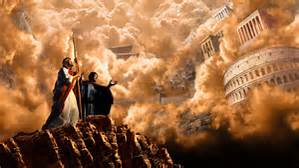
First of all, consider the familiar story of Abraham and Isaac, its rejection of child sacrifice, and how it transfigured or transformed the roots of Jewish faith.

At first glance, the text seems to praise the great patriarch for his readiness to plunge a knife into Isaac’s heart. It has God saying, “For now I know that your fear God, since you have not withheld your son, your only son from me.” It’s as though Abraham’s readiness to do violence to his son were a unique proof of his faith.

Such understanding however is to forget that in ancient Mesopotamia it was required of all parents to sacrifice their firstborn sons. So despite the text’s claim, there would have been nothing remarkable about Abraham’s willingness to sacrifice his son. Everyone in Abraham’s culture had that sort of primitive “faith.”

Scripture scholars conclude that the words just quoted (“For now I know that your fear God, since you have not withheld your son, your only son from me.”) represent an editorial addition inserted centuries after the reported event, when people no longer remembered the ancient and universal requirement of tribal gods to sacrifice the first-born of family and flock.

The editors were priests and scribes in service to Israel’s royal family. They adjusted the Abraham story to suit their employers’ needs for patriotic cannon-fodder. This explains the addition of the words indicating God’s pleasure at parents’ willingness to sacrifice their children.

In contrast to that textual adjustment, and as originally told, the Abraham-Isaac tale was about the ancient patriarch’s transfigured understanding of God. It was about his discovery of Yahweh as the God of Life who prohibited rather than required child sacrifice. [Note that even in this morning’s English translation, it is “God” (meaning Baal, the biblical name denoting foreign idols) who gives Abraham the order to sacrifice his son. But it is “the Lord” (meaning Yahweh, the God of Abraham) who tells the patriarch to stay his hand.]

So Abraham’s real merit is found not in his willingness to sacrifice his son, but in his unwillingness to do so.  In that sense, Abraham in this instance is like Yahweh, the non-violent God of life, who (Abraham discovers) never endorses child sacrifice. That realization should have transfigured Abrahamic faiths forever. Unfortunately, it did not.

Jesus carries on and expands Abraham’s insight.  He rejects violence of any type. He is the one who said: “love one another. Love your enemies. Forgive one another. Be compassionate. Be merciful. Seek God’s reign and God’s justice. Put away the sword. Rise and do not be afraid.”

Today’s gospel about Jesus’ “transfiguration” concludes with a voice directing us to “Listen to him.”

If we did, our world would indeed be transfigured. We would be transfigured – totally transformed.

What do you think is entailed in Jesus’ call – in Abraham’s call – to non-violence? How do we “listen to them?”

Discussion follows

(Sunday Homily) Pope Francis on Climate Change: Nature Never Forgives!

Francis creation

Readings for 1st Sunday of Lent: GN 9: 8-15; PS 25: 4-9; I PT 3: 18-22; MK 1: 12-15

Pope Francis is going to be a busy man this spring. In June he’ll publish his much-anticipated encyclical on climate change. He’ll then convoke a meeting of world religious leaders to discuss the topic. Presumably, they’ll endorse the encyclical’s main points.

Then in September, the pope will travel to New York to bring the message of those leaders to the United Nations. Afterwards, he’ll head off to D.C. to do the same before the U.S. Congress.

Clearly, the pope is a man on a mission. At the age of 78, he’s evidently experiencing a sense of urgency. He has a clear spiritual and practical vision for saving the world from impending disaster brought on by unregulated industrial capitalism and by a neo-liberal world order that he has rejected out of hand on more than one occasion during his brief reign as Supreme Pontiff.

The liturgy of the word for this first Sunday of Lent highlights the pope’s concern for the environment and calls us to become visionaries like him – and especially like the young prophet, Jesus of Nazareth, as depicted in today’s Gospel.

Take this morning’s first reading. Its focus, like the pope’s, is environmental destruction. Genesis, chapter nine gives the ending of the familiar story of Noah and his Ark.  There God makes a promise (3 times in fact) to Noah, his sons, their descendants, and (significantly) to the birds and animals, that he will never again destroy “all bodily creatures” by flood waters.

The Responsorial Psalm then reminds us that we can trust God’s word, because God, in the psalmist’s words, is compassionate, loving, kind, good, upright and just.

It’s that loving God whose Spirit in today’s gospel drives Jesus out to the desert for his “Lenten Retreat” – 40 days and nights of prayer and fasting. The Spirit sends him on a vision quest intimately connected with Pope Francis’ vision for the world’s future.

Recall the circumstances of Jesus’ quest. John the Baptizer has just baptized Jesus as one of his disciples. On emerging from the waters of the Jordan, Jesus receives a startling revelation about his true identity. A voice from heaven addresses him, “You are my beloved son,” it says.

Surprised and perhaps shaken by that revelation, Jesus retreats to the desert to determine what it all might mean. As I said, it’s a vision quest. And immediately the visions come – more heavenly voices, Satan, angels, and wild beasts.

All of these elements are important. They belong to Israel’s “apocalyptic” tradition – a highly political genre promising the overthrow of the nation’s imperial oppressors. Jesus’ visions call him to continue the work of John the Baptist, who, Mark informs us, has just been arrested. Jesus’ task is to announce the proximity of “God’s Kingdom.” It’s a world where God is king instead of Caesar. It’s a world like the one promised in the Book of Genesis.  There human beings live in complete harmony with their Heavenly Father/Mother, with one another, with animals, birds, fish, and plants.

That’s the vision Pope Francis will evoke in his upcoming encyclical. If his past statements are any guide, he’ll remind us that God may have promised not to destroy the earth by flood. But Mother Nature has given no such guarantee.

A month ago, on his flight to Manila, the pontiff told reporters, “God always forgives, we sometimes forgive, but when nature — creation — is mistreated, she never forgives!”

This Lent we would do well to ponder those words and to implement changes in our own spiritual, political and economic visions to prevent a disaster completely reminiscent of Noah’s familiar story.

What Lenten changes do you think most appropriate – for us as individuals and for our country?

Discussion follows

Reflections for the 5th Sunday in Ordinary Time: Jesus Becomes a “Low-life Scum”: So Should We!

leper

Readings for 5th Sunday in Ordinary Time: LV 13: 1-2, 44-46; PS 32: 1-2, 5, 11; I COR 10: 31-11:1; MK 1 40-45.

“Get out of here, you low life scum!” Those were the words U.S. Senator, John McCain, shouted at protestors two weeks ago when they confronted Henry Kissinger as a “war criminal.” The 91-year-old ex-Secretary of State had been invited to give testimony at a U.S. Senate hearing.

Those are pretty strong words – and perhaps justified, you might think, depending on your political persuasions.

However the point of bringing them up here is to highlight the deeper significance of Jesus’ curing a leper in today’s gospel. In Jesus’ day, lepers appearing in public would have merited Senator McCain’s disdain. Anybody would have felt justified shouting at them, “Get out of here, you low-life scum.” After all, the reigning morality of the day considered lepers not only sick, but morally degenerate. They must have committed some terrible sin to bring the disease upon themselves.

Today’s readings invite us to reject such superstitions. They highlight the radical nature of Jesus’ act of actually touching a man afflicted with one of the ancient world’s most feared diseases. They invite us to identify with those our culture tells us are “unclean.”

Begin by considering today’s first reading from the Book of Leviticus. It lays out the prescriptions of the Mosaic Law for dealing with skin diseases marked by “scabs, pustules and/or blotches.” Leviticus prescribes a priestly declaration designating the afflicted person as “unclean.” Thereafter “lepers” had to wear distinctive dress. They were forbidden to wear head covering that might disguise their affliction. They were to muffle their beards. If they happened upon apparently healthy people, lepers were to declare their status by shouting the warning, “unclean, unclean!” They were to be segregated from the community – banished “outside the camp.”

So in Israel’s ancient world, leprosy was painful physically, but even more so socially. Contracting the disease meant banishment from family, community, synagogue and temple. It made the diseased one “low-life scum” – totally ostracized. No one could touch a leper without themselves incurring the status of “unclean.”

However, today’s responsorial psalm says “no” to all of that. It reminds us that in God’s eyes, no one is scum.  God endorses no system of clean and unclean – no caste arrangement of insiders and outsiders. Instead, the psalmist has us singing, God wants only joy for the troubled. God takes away any fault, covers any sin, and completely removes guilt complexes. No room for ostracism there.

Lepers in Jesus’ day needed that kind of acceptance. (And so do we!) And complete acceptance is just what Jesus offers in today’s gospel. There he addresses not only a physical disease, but even more importantly the social ostracism and lack of compassion that the Master evidently found insufferable for anyone.

So just what is it that Jesus does?

A scum bag of a leper kneels before the working man from Nazareth. “If you wish, you can make me clean,” the poor man begs. The Compassionate Jesus is moved by the leper’s simplicity of faith. So he first gives him a healing touch.

But remember what I said about that: in doing so, Jesus deliberately contaminates himself! By that fateful act (right here in Chapter One of Mark’s Gospel) Jesus identifies with the lowest of the low in his culture. He makes himself an outsider. As a result, Mark informs us, Jesus afterwards could not enter any town openly. As “unclean,” he had to sneak around.

Jesus’ act of identification with “the least of the brethren” holds a powerful message for all of us. It invites us to embrace absolutely everyone as the Master did – even (and especially) those our culture rejects.

Remember how a few weeks ago, following the Charlie Hebdo massacre, mourners carried placards proclaiming, “Je suis Charlie!” (I am Charlie!)? Remember how in Ferguson following the police shooting of Mike Brown six months ago, mourners carried signs saying, “I am Michael Brown!”? Well, Jesus’ example calls us to go even further.

It tells us that we are one not only with the persons with whom we agree, but even with those our culture (and personal prejudices) tells us are somehow “unclean.” So, yes, we might gladly say, “Je suis Charlie!” but we are also the killers who shot up the Charlie Hebdo office. We might be proud to say, “I am Mike Brown.” But we are also his killer, Officer Darren Wilson.

John McCain is somehow the same as those protestors he called “low-life scum.”

Please remember that today at our liturgy’s “kiss of peace.” The person beside you, behind or in front of you might be on a completely different page politically, socially, or even religiously. But Jesus says “touch them;” embrace them; recognize them as your brother and sister – as yourself!

Then continue doing that all week – and beyond.

Mike Rivage-Seul

February 10, 2015


Mike Rivage-Seul is a former priest who in 1972-’73 served St. Clare’s parish. A liberation theologian, Mike  has been a member of St. Clare’s since then. He taught at Berea College for 40 years and was co-founder of its Peace & Social Justice Program. He blogs at   https://mikerivageseul.wordpress.com

(Sunday Homily) Ten Reasons for Hope in a Time of Despair: Empire Is Crumbling before Our Eyes

Syriza (SYRIZA Poster: http://keithpp)

Readings for 4th Sunday in Ordinary Time: JB 7: 1-4, 6-7; PS 147: 1-6; I COR 9: 16-19; 22-23; MK 1: 29-39 http://www.usccb.org/bible/readings/020815.cfm

Today’s liturgy of the word is about hope in a world wracked by despair. All of us are starved for such hope. In fact, discouragement and apparent powerlessness describe not only our personal consciousness but the larger zeitgeist that is the constant focus of these Sunday reflections dedicated to confronting the world with the Bible in one hand and the newspaper in the other. Today’s confrontation should help progressives realize that our times are actually changing for the better.

Think of the most recent historical roots of today’s despair – the way the world was just 20 years ago. As described recently by Andre Vitchek, it was an unbelievably hard time for opponents of empire.

Then think of how things are different today. It’s the difference between the condition of Job in this Sunday’s first reading, and the healing Jesus brought to the poor in today’s gospel selection.

Twenty years ago Russia was controlled by Boris Yeltsin, a boozy western puppet who betrayed his own people. Like Yeltsin, other heads of state throughout Eastern Europe joined their western counterparts in a shameless surrender to imperial interests. They were largely “led” by the offspring of the elites who preceded them. China 20 years ago was still under the spell of the free market reforms introduced by Deng Xiaoping. Meanwhile, Latin America reeling from decades of dictatorships imposed by the West had turned its economies over to neo-liberals trained in the Chicago School of Economics. The same was largely true of the Middle East and Africa. In those cases, dictators and the one-percenters were firmly in control. Christian vision of a kingdom where the earth belonged to everyone had been completely hijacked by religious fundamentalists and reactionaries including in his own way, the pope of Rome. All of this was largely hidden by both local and international mainstream media (MSM) which applauded dictatorships and plutocracies as “emerging democracies.”

Those were indeed hard times for anti-imperialists. I remember the despair. We were like Job in today’s first reading sitting on a dung heap lamenting the loss of hope enkindled by the Civil Rights and Anti-War movements of the ‘60s and ‘70s.

Remember Job? He too was the victim of an incredible series of misfortunes. They reduced him to a condition worse than poverty. Without warning, he lost all his wealth; his children died; he became terribly sick; and his reputation went entirely south.

Job is the image of us all 20 years ago. Like Job, progressives couldn’t be blamed for wondering if our situation could ever change.

Perhaps believers among us had forgotten the general hope offered in today’s responsorial psalm. It reminds us of the goodness of Life – the divine energy in which we live and move and have our being. (Some call that Energy, “God.”) The psalmist reminds us that time and history itself have a way of healing broken hearts.  Life has a way of supporting even the most devastated.  And (as Job’s case illustrates) it eventually topples even those who appear to live on top of the world. God is good, the Psalmist reminds us. God is gracious and wise beyond our wildest imaginings. God unifies the poor, even when they’re hopelessly fragmented by elite strategies of “divide and rule.”

Today’s gospel reading offers more particular hope.  It recounts the first acts of a prophet from and imperial backwater, Israel – Jesus, the carpenter-preacher from Nazareth, a “Nowheresville” if there ever was one.

There he encourages the downtrodden every bit as crushed as Job. He heals with a touch, an embrace, a smile, a kiss of the foot, a word of encouragement as the afflicted assemble before him to find health and hope and relief from their demons.  In other words, today’s gospel locates hope outside the political structure of the day, outside the realm of priests, lawyers, kings and emperors. It finds hope on the margins of empire.

And when you think of it, that’s where hope is to be found today. It’s not grounded in American presidents, in our imperial army, in the European Union, or in “foreign aid.” As I said, it’s not even reported in the mainstream media.

And yet the world is changing for the better right before our eyes. And the locus of change is on the margins – in the 50% of the world that has almost invisibly (for Americans) broken free of the imperial order that has governed the world since the end of World War II. Eventually the gains of that 50% will change us too.

Think of the progress I’m referring to. To even perceive it you have to step outside the powerful system of propaganda that envelops us all. Here are 10 signs of hope emerging from the margins. They have for years been signaled by J.W. Smith and his Institute for Economic Democracy:

  1. World-wide people have lost faith in the western model of mainstream media (the Great Wurlitzer” as Smith terms it). Most have awakened to the fact that it’s all lies. In Latin America, Russia, China, and Iran, the new media is not even “alternative” any longer. Its mission is exposing the crimes of the West, its Empire and client states. Its message couldn’t be more straight-forward: No more torture, rape or genocide.
  2. Russia has risen from the ashes and is confronting the Empire on all fronts. Vladimir Putin has emerged as the world’s most effective international leader and practitioner of diplomacy and independence from Empire.
  3. Russia and China are both returning to their socialist roots advancing policies far more humane than their western counterparts.
  4. In Greece the overwhelming victory of SYRIZA has threatened the neo-liberal order in the heart of the European Union. The party’s anti-austerity message is already being spread to Italy, Spain, and France.
  5. Latin America has broken free of the shackles of the Monroe Doctrine. Cuba, Venezuela, Ecuador, Bolivia, Nicaragua, Chile, Argentina, Uruguay and Brazil are all forging their own paths while cooperating with and supporting one another. All are moving closer to Russia and China.
  6. The BRICS countries (Brazil, Russia, India, China, and South Africa) themselves represent at least half the planet’s population. They are trading with each other in their own currencies now making themselves immune from western sanctions.
  7. On June 17th of this year, under BRICS leadership, 133 of the world’s 196 countries declared their intention to “destroy the New World Order” championed by western Empire.
  8. For those paying attention, even the ISIS barbarians are unwittingly serving the cause of peace by demonstrating the horror of wars instigated by the West. They behead on YouTube videos, while U.S. moviegoers cheer American Snipers who blow the heads off unsuspecting Iraqis defending their homes from Seals. ISIS barbarians set fire to prisoners with matches, while their U.S. counterparts use napalm and white phosphorous. The clash of barbarisms highlighted by ISIS promises to make pacifists of anyone capable of seeing parallels. (It’s up to progressives to make them apparent.)
  9. Even the U.S. president (the first ever influenced by liberation theology) sees parallels like the ones just referenced. He has criticized American exceptionalism by challenging his people to “remember that during the Crusades and the Inquisition, people committed terrible deeds in the name of Christ. In our home country, slavery and Jim Crow all too often was justified in the name of Christ.”
  10. The pope of Rome is attempting mightily to defeat Catholic fundamentalism and to turn 1/7 of the world’s population (i.e. 1.2 billion Catholics) in the direction of social justice and environmental protection as advocated by liberation theology.

None of these are “pie in the sky” hopes. They are simply facts known to the world outside our borders but hidden from us by the MSM.

Along with today’s liturgical readings, such changes should be cause for hope and encouragement. More than half the world has left Job’s dung heap. The world’s poor whom Jesus served and embodied are leading the way. The rest of us will join them soon.

(Sunday Homily) Pope Francis Calls for a Global Catholic Climate Movement

Italy Pope Epiphany

Readings for 1st Sunday in Ordinary Time: I SAM 3: 3B-10, 19; PS 40: 4, 7-10; I COR 6: 13C-15A, 17-20; JN 35-42

Recently Pope Francis has come in for some hard criticism from the U.S. right wing. It’s not just because of his rejection of free market capitalism, trickle-down theory, and huge income disparities between the rich and poor. It’s not just his openness to gays and divorcees, and his refusal to obsess about abortion and contraception.

Yes, all of these have undermined what conservatives have seen as a close alliance between the Catholic Church and their pet causes and thinking modes.

However, the straw breaking the back of reactionaries is the pope’s unequivocal warnings about climate change. They’ve gone apoplectic about his intention to publish an encyclical on the matter, and his plans to convoke a conference of religious leaders to address it. The pope’s expressed intention is to influence this year’s U.N. Paris Conference on Climate Change. All of that has raised the specter of a global Catholic climate change movement potentially mobilizing the world’s 1.2 billion members. Think about that for a minute!

In such context, Francis visit this week to the Philippines is extremely significant. The Philippines is not only the home of 80% Asia’s Catholics – more than 100 million. It is also the poster child for the devastation that climate change wreaks on the principal victims of global warming, the world’s poor. In 2013 the archipelago was raked by Typhoon Yolanda whose winds and floods killed more than 7000.

So the world listened when on his way to Manila Pope Francis was asked if climate change is “mostly due to the work of man and his lack of care for nature?” In reply, the pope said:

(F)or the greater part, it is man who gives a slap to nature continually, and we have to some degree become the owners of nature, of sister earth, of mother earth. I recall, and you have heard, what an old peasant once told me: God always forgives, we men forgive sometimes, but nature never forgives. If you give her a slap, she will give you one. I believe that we have exploited nature too much, deforestation, for example.

With words like those, the pope’s critics charge he is speaking beyond his expertise, which involves matters of “faith and morals.” But that’s just the point. The pope is making climate change a moral issue, a matter of ethics even more important than more “traditional” Catholic moral concerns about sex which after all presume the survival of the human species and the planet.

The pope’s critics also ignore, of course, that Francis bases his judgments not only on the testimony of 97% of all climate scientists, but on the research of the Pontifical Academy of Sciences. Its membership roster features the names of the world’s most respected scientists. These include Nobel laureates such as Ernest Rutherford, Max Planck, Otto Hahn, Niels Bohr, and Charles Hard Townes. The Academy’s current president is Werner Arber, himself a Nobel laureate, and the first Protestant to head the group.

But why such right-wing fury? It’s because like Naomi Klein, conservatives see the (for them) disastrous implications of addressing the issue. As announced in the title of Klein’s book, they sense that This Changes Everything. That is, taking on climate change as a moral issue undermines the political right’s program of market deregulation and continued extraction of non-renewable resources.

So pundits like First Things blogger, Maureen Mullarkey have given up on lip sticking the pope and are now in full attack mode. According to Mullarkey Pope Francis is simply “an ideologue and a meddlesome egoist. His clumsy intrusion into the Middle East and covert collusion with Obama over Cuba makes that clear. Megalomania sends him galloping into geopolitical—and now meteorological—thickets, sacralizing politics and bending theology to premature, intemperate policy endorsements.”

For Mullarkey, Pope Francis pretty much stinks.

And that brings me to today’s gospel reading. It’s all about stink – about what Pope Francis calls “the smell of the sheep.” Famously, you recall, the pontiff called on Catholic priests to live closer to the poor, to recognize them as God’s people and their welfare as the guideline for economic and social policy – to “take on,” he said, “the smell of the sheep.”

In other words, conservatives are suspicious of Pope Francis and are on the point of vilifying him because he smells too much like sheep — like the poor. He smells too much like Jesus.

Notice that in today’s gospel, John the Baptizer identifies Jesus as “the Lamb of God.” To begin with, the phrase reminds us of the tribal, Bedouin origin of the biblical “People of God.” Abraham, Isaac, and Jacob, and the great King David were all shepherds. They were primitive people close to the earth. They were tribalists. Jesus was a tribalist. According to John’s image, Jesus didn’t just smell like sheep; he was a sheep! He was in spades like his slave and Bedouin ancestors — like the poor people the pope is centralizing in his visit to the Philippines.

Pope Francis is a tribalist too. And he’s practicing what he preaches — both liberation theology’s “preferential option for the poor,” and the traditionally Catholic principle of subsidiarity. Once again, that means endorsing economic and environmental policy not on the basis of market dictates, but according to human decisions about values like the common good. Humane policy, the pope implies, originates not on Wall Street, but in places like the Philippines’ Tacloban City which was leveled by Typhoon Yolanda. It’s there that the pope’s itinerary reportedly has him dining in the shack of a hurricane victim. (Can you imagine a humble Catholic housewife setting her family table to include the pope?)

As our century’s most powerful illumined voice of conscience, Francis is using his bully pulpit to wake us up. We’re like Samuel in today’s first reading – fast asleep even before the Ark of the Covenant (a reminder of Israel’s enslaved and Bedouin past). But we fail to recognize the biblical tradition’s significance to our lives – its call to tribal values which unfailingly center on animals, human family, and Mother Earth. We fail to see the implications of Paul’s observation in today’s second reading that all human beings – especially the poor and outcast – are temples of God’s spirit. That’s our tradition! That same Spirit resides, the pope says, in the planet that he (like St. Francis himself) calls our Mother and Sister.

So what would a global Catholic climate movement look like? It would entail:

  • Waking up like the young prophet Samuel. Like him we’ve heard God’s call many times. But at last in Pope Francis, we have a thought-leader speaking in a voice the simplest of us can hear. It’s the voice of conscience. And like Eli it’s giving us the proper way to respond: “Speak Lord, for your servant is listening.”

A global Catholic climate movement further entails:

  • Rejection of corporation-based globalization which has us (over)consuming imported necessities that could be home-grown. (This involves lobbying against the Trans-Pacific Partnership.)
  • Joining the fight against fracking and projects like the XL Pipeline
  • Voting accordingly.
  • Urging the institutions we can influence (churches, universities, hospitals . . .) to divest from fossil fuel industries.
  • Adopting a “zero waste” policy in our homes and places of work.
  • Cultivating home gardens.
  • Adopting a vegetarian diet.
  • Educating ourselves about “green burial” and including plans for that in our “living wills.”

The list, of course, goes on. But you get the idea.

This stinkin’ pope is waking us up. He’s showing us the way. Thank God!

(Sunday Homily) The Torture Report: Cheney Channels King David in the Struggle over Historical Narrative

Cheney

Readings for 4th Sunday of Advent: 2nd SAM 7:1-5, 8-12, 14A, 16; PS 89: 2-5, 27-29; ROM 16: 25-27; LK 1: 21-38 http://usccb.org/bible/readings/122114.cfm

Strange that according to a poll last week, more than half the “American” people think torture is permissible. I say “strange” because nearly 80% of Americans consider themselves “Christian.” And Jesus himself was a victim of torture. On the other hand, can you imagine Jesus torturing anyone?

You’d think the similarities between the Romans’ treatment of Jesus and the “Americans’” treatment of countless innocent victims would make devout Christians less accepting of torture.  Maybe they’d oppose torture on principle, as a matter of faith.

Or perhaps it’s that they just agree with ex-VP, Dick Cheney. After all, he wouldn’t consider “torture” what the Romans’ enhanced interrogation techniques (EITs) did to  Jesus  – not the prolonged beating we all witnessed portrayed in Mel Gibson’s “The Passion of the Christ,” not the crowning with thorns, not forcing a beaten man to carry his own instrument of execution, not driving nails into his hands and feet, not leaving him for hours struggling for breath on a cross whose chief agony was bringing the victim to the point of asphyxiation (like waterboarding) and beyond.

According to Mr. Cheney, that punishment would have crossed the line to torture only at the point when death proved imminent. Unfortunately, as with untold (literally) victims of U.S. enhanced interrogation, that line was crossed in the case of Jesus.

But in the end, as supporters of U.S. Empire, “American” Christians probably understand and forgive what the Romans did. After all, like its U.S. counterpart, the Roman Empire was under siege on all sides. And the Jews were particularly rebellious. And Jesus (in Roman eyes) gave every indication of leading a rebellion. An empire’s got to do what an empire’s got to do – even if it means killing the innocent like Jesus.

I think however that there’s something more than compassion failure at work here.  The “more” is the power of propaganda. That’s something addressed in today’s liturgy of the word. There the author of 2nd Samuel whitewashes the brutal King David and turns him from something like a mafia don into a national hero. In today’s gospel selection, even the evangelist, Luke buys the distortion. He makes Jesus the successor of David.

I’ll get to that in a moment. But let me first finish with the torture document. You see, (as Glen Greenwald has pointed out) it’s no wonder that “Americans” can’t identify with the tortured much less connect them with Jesus.

That’s because since the Report’s release on December 9th, the mainstream media (MSM) has treated us to an endless parade of torturers and torture enablers explaining away the conclusions of the Senate’s years-long study.  We haven’t heard a word from the victims of torture or from the families of those whose sons and daughters were killed at the hands of sadistic representatives of our government.

The result of this one-sided silencing of the victims has been to rob them of their humanity – of their very existence.  Given the deafening silence, why would we feel compassion for people who don’t even exist? Out of sight, out of mind.

Imagine how better informed we’d be if on “Meet the Press” or somewhere Mr. Cheney had to defend his policies against his victims – many of whom, Greenwald reminds us (because he has interviewed them) are incredibly articulate. Perhaps the victims might suggest waterboarding the ex-VP to see if he really believes that practice doesn’t sink to the level of torture.

According to University of Wisconsin –Madison Professor Alfred McCoy (the author of Torture and Impunity) this erasure of victims is all part of a five-stage policy on the question of torture. After the Abu Ghraib scandal broke in 2004, the first step was identifying the low level perpetrators with “bad apples.” The second stage kept rumors of more widespread torture at bay in the name of national security. Thirdly, President Obama adopted the “let’s look forward, not backward” approach. Fourthly came the move to exonerate all those guilty of torture or enabling the practice. Finally we’ve reached the stage which emerged last week: vindication before the bar of history of all those connected with U.S. torture.

Again, that’s where the battle has been joined today; we’re struggling over historical narrative. This is the stage all empires come to eventually as their crimes inevitably come to light. It’s what we witness in today’s liturgy of the word and the white-washing of Israel’s King David. The example is instructive. It suggests practical responses to the Torture Report at both the level of faith and political action.

You see, there are really two separate king David traditions in the Bible. One presents the good David, the other, the bad. The good David is the one largely presented in I Chronicles 10:14-29:30. He also appears in today’s first reading from 2nd Samuel and in the responsorial psalm.

This David is pious, and wants to build a temple for God. According to the story, God is pleased, and rewards him with everything a king could want: victory over his enemies, immortal fame, prosperity for his people, thriving descendants, and a dynasty that will last forever.

Then there’s the bad David who begins to appear in I Samuel, chapter 16. This David is a murderous tyrant. He rebels against Saul, Israel’s first king. He’s a womanizer, a murderer and an object of popular hate.  Far from lasting forever, his dynasty ends with the death of his successor, Solomon. He’s the David whose death-bed instructions are worthy of any Mafia godfather. To Solomon he says, “Take care of my friends, Sol – and my enemies too (wink, wink). You know what I mean?” (IKGS 2: 1-9)

Besides that, the bad David bastardizes the Mosaic Covenant and its protection of widows, orphans, and resident aliens and turns it into a tool of the ruling classes – from Moses’ “I will be your God and you will be my people,” into David’s “You are my son, the king of Israel, and your dynasty will last forever.”

Of course, the bad David has been swallowed up by popular memory of its competing tradition. David is uniformly remembered by the majority of believers as the man “after God’s own heart.” As I said, in today’s familiar gospel selection, Luke falls into that trap. He makes Jesus (through his foster father, Joseph, no less) the successor of David. And this even though Jesus as portrayed by Luke is no friend of the Temple or of kings and emperors. Rather he is the friend of the beneficiaries of the Mosaic Covenant – the widows, orphans, aliens, prostitutes, tax collectors, lepers, Samaritans. His values do not include enemies (much less victory over them) or prosperity, fame, or everlasting dynasties.

Recognizing this struggle over which narrative will prevail sheds light on the Torture Report. It enables followers of the simple man from Nazareth to judge that the struggle even before the bar of biblical history has been won by the likes of Cheney and Bush. It has been won by the bad David.

Our conclusion: we must not allow that to happen as we fight over whose story should prevail concerning the latest revelations about the powerful organized crime syndicate known as the CIA.

So what should we do?  Our response should be at two levels.

At the level of faith believers should be exposed to the historical Jesus I’m attempting to present in these homilies. We neglect those powerful myths at our own peril. Even the uninformed can understand them.  This means that the Jesus’ story represents a powerful tool for raising consciousness about torture (and other issues of social justice).

It’s true that the MSM might not expose the story of the tortured to that 80% of “Americans” who claim to be Christian. However, if those with the responsibility for explaining the sacred texts assume that responsibility and do their homework, there’s no reason why those wishing to follow Jesus can’t understand that:

  • Jesus himself was a victim of torture at the hands of an empire very like the United States.
  • He taught universal love.
  • He was non-violent
  • He said he considers what’s done to the least of the human race as done to him.
  • He said we should love our enemies.

At the political level we should:

  • Urge outgoing senator Mark Udall (D Colorado) to use his senatorial privilege of unlimited free speech to release the entire unredacted torture document.
  • Pressure the media through phone calls and letters to the editor to present the other side of the torture story including interviews with torture victims and with the families of those whose sons and daughters, husbands and wives were killed under CIA torture.

(Sunday Homily) Usury More Clearly Contradicts God’s Law than Abortion!

Usury

Readings for 30th Sunday in ordinary time: EX 22: 20-26; PS 18: 2-4, 47, 51, I THES 1:5C-10; MT 22: 36-40. http://www.usccb.org/bible/readings/102614.cfm

Today’s readings raise the question of usury – a word we don’t often hear today, though its reality is part of the air we breathe.

Wikipedia defines usury as: “. . . the practice of making unethical or immoral monetary loans intended to unfairly enrich the lender. A loan may be considered usurious because of excessive or abusive interest rates or other factors, but according to some dictionaries, simply charging any interest at all can be considered usury.”

In the light of that definition, consider the following:

• Last Sunday’s New York Times editorial addressed President Obama’s proposal that interest rates on loans to veterans be capped at 36 percent. The editorial began by saying that “poor and working-class people across the country are being driven into poverty and default by deceptively packaged, usuriously priced loans.” The NYT editorial board argued that the 36 percent interest cap should be extended to all U.S. citizens. Thirty-six percent!

• The same editors reported a case where “. . . (A) South Carolina lender gave a service member a $1,615 title loan on a 13-year-old car and charged $15,613 in interest — an annual rate of 400 percent — without violating federal law.”

• Despite such surprises, Wednesday’s NYT edition ran another story headed “States Ease Interest Rate Laws that Protected Poor Borrowers.” It reported that lenders such as Citigroup, One Main, Springleaf, and the American Financial Services Association claim a need to increase interest rates on their poorest customers in order to keep their rates in line with their own increased business expenses for rent, electricity, and gasoline.

• Meanwhile the prime interest rate for bankers and corporate high rollers is 3.25 percent.

• Last June U.S. Senate Republicans shot down Elizabeth Warren’s Bank on Students Emergency Loan Refinancing Act. The bill would have allowed people with federal and private debt to refinance their loans at 3.86 percent. That would have given relief to more than 25 million borrowers owing $1.2 trillion in student loans. The GOP objected partly because the Refinancing Act would have created a new tax on millionaires to offset the lower interest rates.

The practices just described raise the question: how much interest can be charged before the rate becomes usurious? Today’s liturgy of the word suggests an answer.

Begin with a consideration of today’s gospel.

There Jesus is asked a question consistently addressed to rabbis and to wise persons in all traditions. “Which is the greatest of God’s commandments?”

The question is reminiscent of the familiar cartoon where the bedraggled seeker climbs up that mountain, confronts the guru sitting in front of his cave and asks him, “What’s the purpose of life?” That’s really the gist of the question presented to Jesus. What is life’s purpose?

Jesus’ response is not humorous as we’re always led to expect from those cartoons. His answer is not even surprising. Instead, it’s the standard one usually given by rabbis and wise people: “Look within,” he advises. “Find Ultimate Reality and devote yourself entirely to it. And then love that Reality’s every manifestation beginning with the people closest to you and finishing with the trees, soil, rocks, and cockroaches.”

That’s the meaning of Jesus’ response in today’s gospel. It mirrored perfectly the answer, for instance, of Rabbi Hillel, one of Jesus’ near contemporaries. Both of them said, “Love God with all your heart, mind, and spirit – and your neighbor as yourself. That’s the greatest commandment,” they agreed. “That’s the purpose of life. That summarizes all the content of humanity’s Holy Books. All the rest is commentary.”

We get a snippet of that commentary in today’s first reading from the Book of Exodus, which supplies practical content to the general answer about life’s purpose invariably given by the wise. (And it’s here that the business of interest enters the picture.) Today’s 16 line excerpt from Exodus focuses on two issues: (1) treatment of the most vulnerable in the community, and (2) prohibition of taking interest on loans. The two matters are intimately connected in a world where the poorest among us suffer from crushing debt as earlier described.

The reading says that loving God and neighbor means taking care of society’s most vulnerable – beginning with immigrants and including single mothers and street children. Reality decrees that mistreatment of people like that will bring karmic consequences and death by an invading enemy.

The reading goes on. When dealing with immigrants, remember you were once in their position. So treat them the way you would have liked your great-grandmother to have been treated when she arrived at Ellis Island from the Old Sod.

The second part of the Exodus reading addresses the most common instrument oppressors employ for mistreating society’s vulnerable. You guess it: it’s usury and debt.

You might have been surprised to read that God’s Covenantal Law as recorded in the Bible prohibits the taking of interest at all. The Law indicates that God considers usury (or any interest) sinful! It’s a form of “extortion,” Exodus says – meaning, as the dictionary explains, the “criminal offense of obtaining money, property, or services from a person, entity, or institution, through coercion.” The definition goes on to say that extortion is commonly practiced by organized crime.

For more than a millennium, moral theologians within the Church that developed following Jesus’ death agreed with our dictionary. Under pain of sin (as they put it), no interest could be charged on loans.

But then modern economists discovered the wonders of compound interest. That changed everything. Suddenly, charging interest became not only moral, but virtuous – including for Christians! Even the Vatican owns a bank whose underlying foundation is interest!

So times have indeed changed. Currently, moralists explain that the modern science of economics now understands what was not grasped in the ancient world of Exodus. So, morality had to change to keep up with the times and the advances of science. It’s a new world. (Hmm . . . . Does that same reasoning apply to matters such as homosexuality in relation to the insights of the modern science of psychology? And what about abortion and what modern medicine has disclosed about the beginnings of specifically personal life? After all, the Bible has this clear and strong teaching about prohibiting interest and says nothing at all about abortion.)

The suggestion here is that if we kept The Commandments as explained by Jesus and all the world’s great spiritual teachers:

• We’d prioritize concern for the welfare of immigrant children on our border, single moms in run-down neighborhoods, and street children everywhere. Their welfare, Jesus says, is identical with our own.

• We’d realize that the ability of immigrants, widows, and orphans to meet their transportation, rent and electricity bills is in God’s eyes more important than similar abilities on the part of Citigroup, One Main, Springleaf, or the American Financial Services Association.

• We probably wouldn’t support interest of any amount. (Certainly an interest rate of 36 percent would be out of the question, not to mention 400 percent.)

• At the very least, we’d demand that student loans would be refinanced at the prime rate.

• We probably wouldn’t support “capitalism” as we know it.

• We’d make usury as important a “Christian issue” as some make abortion.

• We’d hear about that from the pulpit, at least occasionally.

• We’d vote accordingly.

After all, an unmistakable critique of usury is actually found in the Bible. That’s not the case with abortion.

(Sunday Homily) Listen to ISIS and Stop Committing Suicide!

steven sotloff

Readings for 23rd Sunday in Ordinary Time: EZ 33: 7-9; PS 95: 1-2, 6-9; ROM 13: 8-10; MT 18: 15-20 http://usccb.org/bible/readings/090714.cfm.

We’ve met the enemy and it is us!

Indeed! Over the past number of weeks, we’ve been introduced to the Islamic State in Iraq and Syria (ISIS). Its militants seem to have somehow appeared from nowhere.

However, as Tom Engelhardt has pointed out, they actually represent the largely Sunni blowback from U.S. policies over the last 13 years. In fact, ISIS would not exist were it not for the United States.

Think about it. ISIS is the direct result of:

• The U.S. invasion of Afghanistan and its over-the-top, loosely-target response to 9/11.
• The 2003 criminal occupation and destruction of Iraq.
• The thoughtless dismantling of Saddam Hussein’s army with its largely Sunni command structure (which is now directing ISIS).
• The crimes of Abu Ghraib, Fallujah, Haditha, and other massacres perpetrated by barbaric elements in the U.S. military.
• The more than one million Iraqis who have lost their lost their lives as their country has been systematically pulverized by bombings, white phosphorous, and the nuclear waste called “depleted uranium.”
• Former President Bush and Vice President Cheney bragging about ordering the war crimes of water boarding and other forms of torture.
• U.S. soldiers urinating on the bodies of Iraqi insurgents and on copies of the Holy Koran.
• The horrors of the film clip, “Collateral Murder” released by Chelsey Manning.
• Drone strikes across the world in Afghanistan, Iraq, Pakistan, Somalia, Yemen and elsewhere routinely killing women and children, revelers at weddings and mourners at funerals.
• Blind U.S. support of Israel’s pogrom aimed at “the Jews’ Jews” concentrated in the world’s largest open-air prison camp called Gaza.

Such horrendous provocations make it entirely possible for ISIS leaders to echo the words solemnly intoned by President Obama last week in response to their movement’s brutal beheading of journalist Steven Sotloff. ISIS leaders might well have said:

“We will not be intimidated. Those who make the mistake of harming Muslims will learn that we will not forget and that our reach is long and that justice will be served . . . such horrific acts only unite us as movement. . . ISIS will continue to lead the battle against the kind of barbaric and empty vision that the United States represents. We will degrade their forces and destroy them completely.”

In fact, the whole ISIS phenomenon and the response it has evoked only illustrate the senselessness of any strategy of revenge and fatuous, doomed attempts to solve conflict by the unapologetic use of military first response to violence perpetrated against “Americans” or Muslims.

A different way of responding is outlined for followers of Jesus’ Way in today’s liturgy of the word. It might seem idealistic and perhaps even unrealistic in the face of ISIS. But give it a chance.

In today’s gospel reading, Matthew the Evangelist addresses the problem of conflict resolution. He emphasizes dialog not revenge and violence. In fact, he outlines four alternatives towards resolving disputes. He has Jesus say that if step one doesn’t work, move on to the subsequent strategies. The four alternatives include (1) healing conversation with one’s adversary, (2) arbitration with a mediator or two, (3) consultation with the entire community, and (4) shunning the offending party.

More specifically, Matthew has Jesus say, “If your brother sins against you, go and tell him his fault between you and him alone . . . If he does not listen, take one or two others along with you, so that ‘every fact may be established on the testimony of two or three witnesses.’ If he refuses to listen to them, tell the church. If he refuses to listen even to the church, then treat him as you would a Gentile or a tax collector.”

Obviously, these words did not come from Jesus himself. To begin with, there was no “church” at Jesus’ time. Jesus was thoroughly Jewish and a reformer of Judaism rather than the founder of some new religion or “church.”

It was different for Matthew who was writing for a community of specifically Jewish Christians some fifty years after Jesus’ death. By then, questions of community order within the emerging church had become prominent. So Matthew invents this saying of Jesus to deal with them.

Another reason for reaching this conclusion is the reference to treating a recalcitrant individual “as you would a Gentile or a tax collector.” This phrase reflects traditional Jewish avoidance of Gentiles and hatred of Roman collaborators. It runs counter to the practice of Jesus who time and again in the Gospels causes scandal by practicing table fellowship and community with the very people Matthew’s instruction indicates are outsiders to be shunned by believers.

Were Matthew following the Spirit of Jesus, the evangelist’s instructions for addressing conflict resolution might involve the following process: (1) private dialog with one’s adversary, (2) arbitration with a mediator or two, (3) consultation with the entire community, and (4) moving in with the offending party – or at least taking them out for dinner regularly.

In any case, the emphasis in Jesus’ own approach is communion, not shunning or refusal to talk. Nowhere does Jesus’ approach say that one should refuse meeting until the offending party stops offending. Much less does the process outlined include “if he refuses to listen, shoot him, cut his head off, or kill his family.”

“But,” you object, “The words attributed to Jesus in today’s gospel selection are about church order, not about international politics, much less the barbarity of a movement like ISIS. Jesus’ instruction, you might say, is about private disputes among Christians and are laughably impractical in the political sphere.

And that’s just my point. To repeat: Matthew’s account does not reflect the teaching or practice of Jesus. Jesus’ actual teaching was not confined to the private realm. His practice was highly political.

Eating with tax collectors, street walkers, lepers, Pharisees, Gentiles (including members of the Roman army) represented doing the unthinkable, the unexpected, the forbidden. . . . It meant crossing boundaries, breaking taboos, acting counter-culturally, and offending people on all sides of sizzling debates.

This is what the example of Jesus calls us to do even in the case of ISIS. Its emergence calls for departure from business as usual. It requires admission of guilt and responsibility on the part of the United States. It demands a complete reversal of “American” policy.

Today’s second reading from Paul’s letter to the Christian community at Rome puts a finer point on the reasons for such response on the part of those pretending to follow the teachings of Jesus.

Paul reminds us of Jesus’ summary of God’s law. He writes:

“Brothers and sisters: Owe nothing to anyone, except to love one another; for the one who loves another has fulfilled the law. The commandments, ‘You shall not commit adultery; you shall not kill; you shall not steal; you shall not covet,’ and whatever other commandment there may be, are summed up in this saying, namely, ‘You shall love your neighbor as yourself.’ Love does no evil to the neighbor;
hence, love is the fulfillment of the law.”

Emmanuel Levinas helps us understand that Jesus’ teaching on neighbor love is much more radical than commonly accepted. Loving your neighbor as yourself, Levinas says, does not mean “Love your neighbor because s/he is like you.” No, according to Levinas, it means, “Love your neighbor as yourself, because s/he is you.”

In other words, there is no meaningful distinction between you and any other human being you care to name – even if we call them “terrorists.” Moreover, if you shared the same history as your “enemy,” you would be doing exactly the same thing that currently enrages you. As a result, no killing can be justified. It is suicide. That’s the thrust of Jesus’ words: to kill the other is to kill yourself. Killing of any kind is suicide.

What does that mean for followers of Jesus’ way as we try to respond to the ISIS phenomenon? At least the following, I think:

• Facing the fact that the ONLY REASON for our Middle Eastern policy and wars is oil, and doing everything necessary to wean our lives away from dependence on fossil fuels.
• Realizing that we cannot expect politicians like President Obama to initiate any other policy than revenge as if the U.S. were principled, civilized, innocent, and pure before an enemy that is completely unlike us.
• Nonetheless demanding that our officials absolutely reverse course, recognize responsibility for the emergence of ISIS, and establish dialog with their leaders.
• Refusing to allow our children to serve in an armed force that commits ISIS-like crimes on a wholesale scale.
• Imagining what would happen if even a quarter of our country’s 160 million people who claim to be Christian refused the self-destruction the words of Jesus and Paul imply.

For Christ’s sake, do the unthinkable. Hard as it might be: listen to ISIS. Reverse course. Put a stop to our collective suicide!

Sunday Homily: The Ayatollah Was Correct: the U.S. IS “the Great Shaytan”

Ayatollah

During the 1979 Islamic revolution in Iran, the West became aware of Muslims’ profound mistrust of the United States. The Ayatollah Khomeini repeatedly referred to “America” as “the Great Satan.” Today’s liturgy of the word suggests that the Ayatollah’s reference was spot on. The United States is indeed the Great Satan leading the world astray with its beliefs for instance that limitless wealth brings happiness, that bombing can be a humanitarian act, and that “fearing for our lives” justifies killing others.

As we’ll see in today’s readings, such beliefs are ‘satanic” both in the eyes of Jesus and of the Great Prophet Mohammed. In the United States, their infernal results are on display in each morning’s headlines where:

• The rich and famous end their lives in despair
• The U.S. bombs and drones to save the Yazidis in Iraq (or Libyans in Libya, Afghans in Afghanistan, Ethiopians in Ethiopia . . .)
• Police killings are uniformly justified by the claim “I feared for my life.”

I raise the issue because the term “Satan” is prominent in today’s gospel reading. There Jesus uses it in contrast to his own beliefs about life’s divine purpose which turns out to be incompatible with dominant western beliefs. According to both Jesus and Mohammed, life’s purpose is not to accumulate riches. Nor is life rendered meaningful by killing others even to save one’s friends. Neither do Jesus’ followers have the mandate to protect their own lives at any cost. Quite the opposite!

What is life about then? Consider Jesus’ answer in this morning’s gospel reading.

There Jesus uses the epithet “Satan” to refer to the leader of his inner circle of twelve. In Jesus’ eyes, Peter merits the name because he misunderstands what life is for. That’s shown by the fisherman’s efforts to dissuade the Master from following his divine “prophetic script.” For Jesus, that pattern would require him to lose his life for speaking truth to power. As we’ll see, using such speech in an effort to change the world – to bring on God’s Kingdom – turns out to be central to Jesus’ understanding of life’s purpose.

In any case, like the prophet Jeremiah in today’s first reading, God’s spirit has put Jesus out of control. So, like Jeremiah, he feels compelled by an inner fire to speak the truth, whatever its cost. As the earlier prophet had put it, God’s truth “becomes like fire burning in my heart, imprisoned in my bones; I grow weary of holding it in; I cannot endure it.”

So in today’s reading Jesus “began to show his disciples that he must go to Jerusalem and suffer greatly from the elders, the chief priests and the scribes and be killed and on the third day be raised.”
Peter objects. “God forbid! This will never happen to you,” he says.

It’s then that Jesus replies: “Get behind me, Satan. You are an obstacle to me. You are thinking not as God does, but as human beings do.”

Hearing those words, most of us inevitably connect with images right out of Dante’s Divina Comedia – enhanced by subsequent satanic glosses to include a fire-red body, horns, cloven hooves, tail and pitchfork. But that wasn’t the image in Jesus’ mind.

Instead, Jesus was thinking in terms of the Hebrew tradition. There Satan was a member of God’s heavenly court. He was God’s prosecuting attorney who typically raised questions that Yahweh’s overwhelming goodness and generosity might otherwise obscure.

In Jewish tradition, Satan was a realist who believed that faith and prosperity go together. Take away prosperity and goodness and faith will disappear too.

That was the thrust of Satan’s bet with Yahweh that we find in the book of Job. Job is good and rich. God is proud of his servant’s devotion. Satan says, “Don’t be naïve. All of that will change if you simply remove your servant’s wealth, children, and health. Just watch and see.” The familiar story unfolds from there.

So when Jesus calls Peter “Satan,” he’s not really telling his friend to go to hell. No, he means what he says, “You are an obstacle to me. You are thinking not as God does, but as human beings do.” Human beings (like Satan) connect faith with prosperity. But in Jesus’ eyes, prosperity is not life’s overriding purpose. Neither is personal safety protected by violence.

But what does God really “think” about the purpose of life? Jesus words about saving and losing life provide a clue.

Jesus says, “Whoever wishes to come after me must deny himself, take up his cross, and follow me. For whoever wishes to save his life will lose it, but whoever loses his life for my sake will find it. What profit would there be for one to gain the whole world and forfeit his life? Or what can one give in exchange for his life?”

These are stunning words. They turn the world’s values upside down. They imply that God “thinks” that life’s purpose involves opposing empire. (Remember Rome reserved “taking up the cross” as a punishment for insurgents.) Life’s purpose entails self-denial, not self-gratification. It means holding life loosely, being prepared to surrender it “for justice’s sake” at any moment. It means preferring God’s Reign to possessing the entire world. It means returning kindness for evil, even if that means losing one’s own life as a result. Or as the psalmist puts it in today’s responsorial, “God’s kindness is a greater good than life itself.”

All such ideals run counter to the U.S. culture which Muslims find so threatening. They have become the ideals of the world which in today’s second reading Paul tells us to resist. “Do not conform yourselves to this age,” he writes, “But be transformed.” Only personal transformation, he adds, will enable your mind to discern what is good, pleasing and perfect in God’s eyes – even if it leads to the sacrifice of your own life.

As a Muslim who embraced the New Testament tradition, the Ayatollah Khomeini understood Jesus’ words. He saw that the order championed by the United States contradicts the basic values of Islam and the Judeo-Christian tradition about community, compassion and care for society’s most vulnerable.

So he viewed “America” as what Muslims call “Shaytan.” For Muslims Shaytan is not the devil either. Instead, he is “the Great Deceiver,” whose promises mislead, corrupt and immiserate those who believe them.

In fact, while promising peace, prosperity, and happiness, the West’s elevation of commercial values to a position of supremacy in the moral hierarchy could not be (in Muslim eyes) more deceptive and disastrous. Without care for society’s poor and vulnerable, commercial values lead to individualism, competition, war and unhappiness.

None of those represent God’s purposes for human beings.

Would that we Christians could embrace those teachings and stop our mindless pursuit of wealth, our belief that violence saves, and our cowardly conviction that anything is justified by “fear for our lives.”

As Paul says, the authentic teachings of Jesus challenge such conformity to “this age.” Who among us is willing to embrace such challenging truths?

(Sunday Homily) Jesus Comes Very Close to Rejecting a Palestinian Woman as a “B_tch”

Palestinian Woman

Readings for the 20th Sunday in Ordinary Time: IS 56:1, 6-7; PS 67: 2-3, 5, 6, 8; ROM 11: 13-15, 20-32; MT 15: 21-28. http://usccb.org/bible/readings/081714.cfm

“Have pity on me, Lord, Son of David! My daughter is tormented by a demon.” Those are the words that a woman remembered as “Syrophonecian” addressed to Jesus in today’s gospel reading.

Jesus responds by ignoring the woman at first and then by disrespectfully associating his petitioner with dogs – almost calling her a “b_tch.”

We’ll come back to that in a moment.

For now note that “Syrophonecian” meant the woman was not a Jew. She was a native or inhabitant of Phoenicia when it was part of the Roman province of Syria. She was living near the twin cities of Tyre and Sidon – a gentile or non-Jewish region of the Fertile Crescent where Matthew takes trouble to locate today’s episode.

That would have made Jesus’ petitioner what we call a “Palestinian” today. In other words, Matthew’s geographical note serves to remind us that the Jews never controlled all of their “Promised Land.” Instead, they always had to share it with “Palestinians” including Canaanites, Hittites, Amorites, Perizzites, Hivites, Jebusites, Geshurites, Maacaathites, and Philistines.

That in itself is significant in the light of Israel’s ongoing brutal war of extermination against Palestinians. There the State of Israel (with supporters often invoking biblical precedent) has adopted the one-state position that is bent claiming all of Palestine for itself. It relegates Palestinians to Bantustans in a particularly brutal Israeli version of apartheid and ethnic cleansing.

Were Jesus in Gaza today, millions of Palestinian parents could echo the poor mother’s petition in today’s’ gospel selection, “Have pity on me, Lord, Son of David! My daughter is tormented by a demon.” And the demon in Gaza’s case would be the State of Israel itself – the latest incarnation of the puppets of Empire whom Jesus opposed so strongly in his own day. [Recall that Palestine in Jesus day was controlled by Jewish puppets of Rome. (Jesus clashed with them again and again.) Today those who pull strings on the marionettes reside in Washington.]

The result is that in Gaza over the last five weeks, more than 2000 Palestinians have been slaughtered by the ones considering themselves God’s “chosen” – 25% of the victims being children, at least another 25%, women like the one called “Syrophoenician” and her demon-possessed daughter.

Daniel Ortega, the President of Nicaragua, recently applied the term “demon” appropriately. He said, “Prime Minister Netanyahu appears to be possessed by the devil, he needs Pope Francis to exorcise it, to become appeased.” Ortega wondered, “Why doesn’t anyone condemn or sanction the state of Israel?” In his opinion, Palestine is the victim of “madness” on the part of the Israeli leader, who seeks to “annihilate the Palestinian people.” Ortega meant that Israel is “committing genocide” in the Gaza Strip, a crime so “terrible that it is only comparable to the crimes of the Nazis,” he said.

You might have been surprised at Jesus’ response to the Syrophonecian woman. As I said, at first he gives no reply at all; he ignores the woman completely. If Matthew’s account is accurate, in his silence Jesus was showing himself to be captive to his own cultural norms. It was inconceivable in Hellenistic antiquity for a strange woman to directly approach a man the way the woman in this story did. Above all was it so for a gentile woman to directly address a Jewish man. In other words, Jesus’ silence was part of his “honor culture.”

But it gets worse. When the woman insists, Jesus implicitly calls her a “b_tch.” He says, “I have been sent for the lost children of Israel . . . it is not right to take the food of the children and throw it to the dogs.”

The reply seems out of character for Jesus, doesn’t it? In fact, such dissonance has led many to reject the saying as inauthentic. Whatever the case, Jesus’ reply only echoes the rabbinic saying of the time, “He who eats with idolaters is like one who eats with a dog.”

In other words, Jesus’ comparison stands in a long line of likening cultural outsiders to animals. Most recently, in the case of Gaza, Ayelet Shaked, a member of the Israeli Parliament, compared Palestinians like the woman in today’s gospel to snakes. She endorsed the killing of Palestinian women, like the petitioner in the story before us, calling their children not dogs, but “little snakes” worthy only of extermination.

Shaked said,

“Behind every terrorist stand dozens of men and women, without whom he could not engage in terrorism. They are all enemy combatants, and their blood shall be on all their heads. Now this also includes the mothers of the martyrs, who send them to hell with flowers and kisses. They should follow their sons, nothing would be more just. They should go, as should the physical homes in which they raised the snakes. Otherwise, more little snakes will be raised there.”

The woman in today’s gospel has a very different voice from Ayelet Shaked’s. She replies, “Please, Lord, for even the dogs eat the scraps that fall from the table of their masters.”

The witty reply astonishes Jesus. He exclaims, “O woman, great is your faith! Let it be done for you as you wish.” That is, the woman “converts” Jesus; he concedes her argument. The one the gospels present as the master of verbal riposte is vanquished by this simple Palestinian mom.

What does the interaction between Jesus and the woman called “Syrophonecian” mean for us today – in the context of Israel’s demonic attack on the Palestinian descendants of the woman in question? What does it mean for Gaza and for us who watch in helpless disgust?

I think it means that:

• The “faith” of the Syrophoenician woman was not “in Jesus” as the incarnation of God, but rather in the inclusivity of God’s love that extends beyond ethnic and religious differences.
• In that sense, she believed in the New Universal Order Jesus referred to as God’s Kingdom.
• More specifically, today’s gospel reading presents the woman as enlightening Jesus – as reminding him of the Kingdom’s complete inclusivity.
• In view of Jesus’ own “enlightenment” at the hands of this poor Palestinian woman, it is no longer possible to blindly identify “God’s People” with any particular state.
• I mean, the State of Israel as such does not represent the biblical God’s Chosen People.
• Today that honor (curse?) belongs to the Palestinians who, as good Muslims, share Jesus’ faith that God sides with the widows, orphans, immigrants and oppressed whatever nation they belong to.
• This means that in the case of Palestine, Jesus’ followers should be one the side of Palestinians rather than the Jewish State.
• Being on their side means petitioning the U.S. government to stop its demonic support of Israel which has moved even further from its identity as “People of God” than it had in Jesus’ day.

As always, this week’s readings invite us to break the chains of our cultural norms – just as Jesus was forced to by the Syrophonecian mother.