Everyone Likes a Good Joke: Jesus Makes Fun of Pharisaical Hypocrites (Sunday Homily)

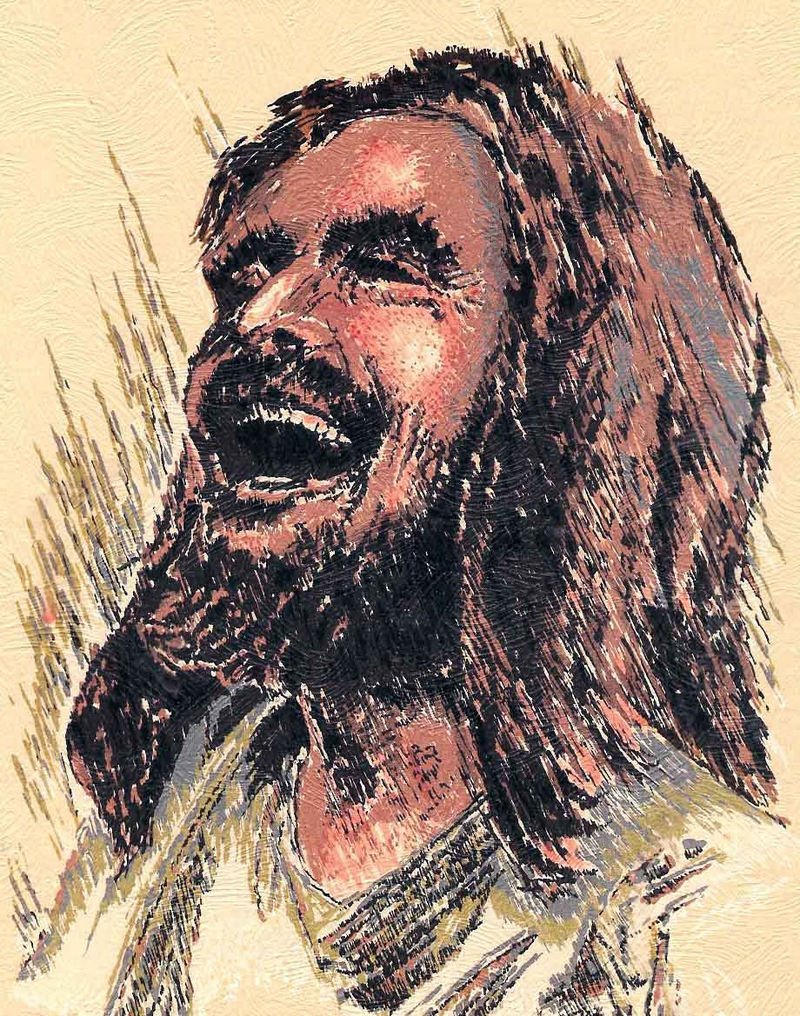
laughing Jesus

Readings for 22nd Sunday in Ordinary Time: SIR 3: 17-18, 20, 28-29; PS 68: 4-5, 6-7, 10-11; HEB 12: 18-19, 22-24A; LK 14: 1, 7-14.

In this morning’s gospel, Jesus finds himself invited for dinner to the home of a Pharisee. All present, Luke tells us, are watching Jesus closely. No doubt, they’re keeping an eye on his disciples too. And they don’t approve.

After all, like Jesus, his disciples are mere riff-raff. But at least Jesus is the reputed peasant-rabbi. Everyone’s talking about him. And investigating Jesus is the whole reason for this dinner. So for the moment at least, the Pharisees are willing to cut him some slack.

His hangers-on however are a different story. They’re rough. They smell of fish and sweat, and have no manners. And yet, as Jesus’ friends, they’ve been placed towards the head of the table in places of honor. Granted, they feel out of place, but for that very reason they are enjoying themselves tremendously. You can imagine their rough jokes and loud laughter.

Yes, the Pharisees are watching Jesus and his friends. But obviously, Jesus has been watching them as well. He knows they are expecting some words of wisdom. So . . . he tells them a joke. And the joke’s on them. It contains a sharp barb.

“Thanks for inviting us to this banquet,” Jesus begins. “Unaccustomed as we are . . .” He pauses and smiles. “That’s quite generous of you. After all, none of us can repay your kindness. We are homeless people, as you know. We’re unemployed too, so we are in no position to return your kindness.

The best I can do is offer you some wisdom. So let me tell you what I’ve been observing here.

“Evidently,” Jesus goes on, “it’s your custom to adopt the humility recommended in the biblical Book of Sirach. I can’t tell you how impressed I am; I’m edified by your piety. I mean, you have clearly taken to heart the words of the sage, Jesus ben Sirach – what he said about being humble, especially if we are ‘great’ as all of you are here, I’m sure.”

Jesus eyes his listeners. He can tell that they are waiting for the penny to drop. So he drops it.

“I can see that when you come into a place like this, you take the lowest place available.” With this, Jesus stands up bows his head, stoops his shoulders and slumps towards the lowest place at table. He laughs.

“That way,” the Master continues, “our host, of course, is obliged to publically invite you to a more honored position at table. ‘Friend,’ he’ll say, ‘come up higher, and sit in the place you’ve merited not down there with the unwashed and poor.’”

Now Jesus is standing. He throws out his chest and strides towards the seat right next to his pharisaical host. He chuckles again. “That enables you,” Jesus continues,” with great protestations of unworthiness, to take your ‘rightful’ place at table. Your stock has risen in everyone’s eyes.

“So congratulations are in order,” Jesus says. “All of you have learned your lessons well. You’ve just created a show, and have actually exalted yourself by pretending to be humble. In a sense, you’ve received your reward.”

Jesus is seated now and looking intently at everyone. Their mouths are open with shock.

“So here’s my wisdom, friends. . . . Your ‘humility’ is not what Sirach was recommending. In fact, it’s a form of pride and self-promotion.

“Instead, real humility is this: when you throw a party like this one, invite the poor, the lame and the blind, and then serve them. Place them at the head of your table and treat them as honored guests. People like that can’t or won’t repay you. But in fact, YOU OWE THEM.” Jesus fairly shouts those last three words.

“I’m telling you the truth,” he says. And humility is nothing but the truth.”

Jesus pauses, but he hasn’t finished yet. “You see, those belonging to what you consider the Great Unwashed are actually God’s favorite people. Recall what the psalmist said about them in Psalm 68. He said God is the Father of orphans; he’s the defender of widows, of prisoners, of the homeless, and of farmers without land.”

Jesus is quiet now; his smile is broad and friendly. He searches the faces of his table companions one-by-one.

Then he turns to his host and adds.

“To be fair, my friend, you yourself are on the right track. By inviting us today, you’ve shown that you already understand what I’ve been saying. As I say, none of us can repay you, and yet you’ve invited us to this abundant table. We are sincerely grateful.

“But don’t think that you’ve somehow performed an act of charity by your invitation. No, it’s an act of justice – of compensation to make up for what you have stolen from the poor by underpaying them and taxing them heavily. In supporting the poor and even the “lazy,” you are simply imitating our generous God.

“I mean the earth and its produce are all gifts from God. No one has earned them. No one owns them but the creator. If you have food, then, you are obliged to share it with the hungry – even with those unwilling to work. As difficult as it might be to understand, that’s simply the divine dispensation.

“The earth and the life it supports have been freely given to everyone – even to people like me and my friends who refuse to work and live from the alms of friends like you. No one deserves life or food more than anyone else. So in effect, you are obliged to do what you’ve done.

(Homilist’s note) None of this needs commentary from me.

What’s your commentary?

(Sunday Homily) Is God Speaking to Us through Our Muslim Sisters and Brothers?

Islam

Readings for 20th Sunday in Ordinary Time: Is. 66: 18-21; PS. 117: 1-2; HEB. 12: 5-7, 11-13; LK. 13: 22-30.

Messages from God can come from the most unlikely places – even from our enemies and those our culture considers inferior and evil. That’s the teaching I find in today’s liturgy of the word. There God speaks to Babylonians through Jews, and to Romans through Christians. This suggests to me that God might be evangelizing Americans today through Muslims.
_____
Consider our first reading from Isaiah.

Imagine yourself a Babylonian in the 6th century BCE. You belong to an empire – one of the most powerful nations the world has ever seen.

In 586 your people conquered a small insignificant nation called “Israel.” Its leaders have been taken captive, and for more than three generations (586-516) have remained prisoners of your country. They are your enemies. You despise them as inferior, superstitious and violent.

Now towards the end of the 6th century, one of their “holy men,” someone called “Isaiah,” claims that those captives, those refugees, those “fugitives” as Isaiah calls them, are agents of the single God of the Universe. They have been sent specifically to call you away from your polytheistic worship of your Gods, Anshar, Ea and Enlil, and to recognize that there is only one God. They call him Yahweh. This God has special care specifically for refugees, slaves and outcasts in general.

For you, recognizing that entails releasing the prisoners your government has held captive for so long.

Even more, Isaiah says you and your proud people are being called to actually worship that God of refugees, political prisoners, and slaves! That means putting their needs first, while subordinating your own.

As Babylonian, you find all of this incredible and obviously insane.
______
Now to grapple with today’s gospel selection from Luke, imagine that you are a Roman living towards the end of the 1st century CE.

You belong to an empire recognized to this day as the greatest the world has ever known. As with the Babylonians more than 500 years earlier, Palestine and its Jewish people are provincial possessions of the empire; they are your captives. Roman legions continue to occupy Palestine whose haughty people resist their occupiers at every turn.

“Jews are nothing but terrorists, every one of them,” you think.

Among the most infamous of those terrorists was a man called Jesus of Nazareth. You’ve learned that he was a Jewish peasant crucified by Rome about the year 30 CE. You’ve heard that a new kind of religion has formed around that so-called “martyr.” In fact, his followers acclaim him by a title belonging to the Roman emperor alone – Son of God. To you that sounds absolutely seditious.

In any case, this Jesus asserted that the God he called “father” was blind to people’s national origins. He told a parable (in today’s gospel) whose refrain from a thinly veiled God figure was, “I do not know where you are from.” Apparently Jesus meant that in God’s eyes no nation – not even Rome – is superior to any other.

You wonder, was Jesus blind? No nation superior to any other? Did Jesus not have eyes to see Rome’s power, its invincible army, and feats of engineering – the aqueducts, the roads, the splendid buildings and fountains?

According to Jesus, Israel itself is not above other nations in the eyes of God. Nor are his own followers better than anyone else. Even those who drank with him and shared meals with him could not on that account claim special status in God’s eyes.

In fact, the only “superiors” are what Jesus called “the least” – his kind of people: artisans, peasants, the unemployed, beggars, prostitutes, lepers, immigrants, women and children. As in today’s reading from Luke, Jesus calls these people “the last.” In God’s eyes, they are “the first,” he said. Meanwhile those who are first in the eyes of Rome, Israel, and even of his followers end up being outcasts.

Worse still, many Romans, especially slaves and criminals, are embracing this new religion. Some in the Empire’s capital city are already worrying that if not stopped, this worship of an executed criminal from a marginal imperial province might undermine the religion of the Roman Gods, Jupiter, Mithra and of the emperor himself.

How absurd, you think, that Romans could be schooled in matters theological by riff-raff, Jews, and terrorist sympathizers.
_____

Finally, imagine that you are an American today. Many think that your country is the proud successor of Babylon and Rome. In fact, the United States may have surpassed Rome’s greatness. Certainly, it has the most powerful military machine the world has ever known. It has the capacity to destroy the earth itself, should its leaders take that decision.

Some attribute America’s greatness to its embrace of the faith of Jesus of Nazareth and to its partnership with Israel, the biblical People of God. As a result the U.S. has become the light of the world, the “city on a hill that cannot be hidden” (Mt. 5: 14-16). America can do no wrong.

This is not to say that its leaders aren’t fallible. They make their share of mistakes and even commit crimes. Yes, they torture, support dictators across the planet, imprison a higher percentage of their citizens than anyone else, drop atomic bombs, even threaten the extinction of human life as we know it, and have declared a state of permanent war against virtually the entire world.

But as a nation, the United States, you continue to believe, is idealistic; it stands for democracy, freedom and equality. As a result, America continues to enjoy God’s special protection.

Nevertheless, there are those in your midst who say that none of this is true. They are like the descendants of Abraham, Isaac and Jacob living in 6th century Babylon. They are like the first Christians who refused allegiance to Rome. They are the foreigners found in U.S. prisons all around the world – in places like Guantanamo Bay and Abu Ghraib.

By and large, those prisoners, those (in Isaiah’s terms) “fugitives” and exiles share a religious faith (Islam) that is as difficult for most Americans to understand as it was for Babylonians to understand Jews or for Romans to understand Christians. The faith of those held captive by America today is largely the faith of poor people called “terrorists” by your government – just as were the Jews and early followers of Jesus.

However, closer examination shows that Allah is the same as the Jewish God, Yahweh. Moreover Muslims recognize Jesus as the greatest of God’s biblical agents.

With that in mind, you realize that Muslims routinely invoke their faith to resist U.S. imperial rule. And they are critical of the use of Judaism and Christianity to justify oppression of their brothers and sisters in Palestine, Iraq, Afghanistan, Pakistan, Yemen, Bahrain, Somalia, throughout the rest of Africa and elsewhere.

Could it be that these exiles, captives, fugitives, “terrorists,” might be your empire’s equivalents of 6th century Jews in relation to Babylon and of 1st century Christians vis-a-vis Rome? Could they possibly be God’s agents calling us Americans away from heartless imperialism and to the worship of the true God (even if called “Allah”)?

Are our Muslim captives reiterating the words of Jesus in this morning’s gospel: God is oblivious to people’s national origins and to physical ties to Jesus? The Master “does not know where we are from” even if we’ve shared table with him. It makes no difference if we’re Jews or Christians, Babylonians, Romans, Americans, or Muslims.

Only the treatment of “the least” is important in God’s eyes. And for us Americans, those “least,” those “last” happen to be the poor of the Islamic world against whom our government has declared permanent war. And what is their God’s demand? It’s simple: Stop the war on us and our religion!

Is their God – our God – trying to save us – and the planet from the crimes of American Empire?

The fates of Babylon and Rome hang over us all like Damocles’ sword.


Did Jesus Justify Armed Resistance to Roman Imperialism? What about Insurgent Resistance to U.S. Imperialism? (Sunday Homily)

Jesus-Said-Video-Preview.jpg

Readings for the 20th Sunday in Ordinary Time: JER 38: 4-10; PS 40: 2-4, 18; HEB 12:1-4; L 12: 49-53

Today’s gospel excerpt presents problems for any serious homilist. That’s because it introduces us to an apparently violent Jesus. It makes one wonder; why does the Church select such problematic passages for Sunday reading? What’s a pastor to make of them?

On the other hand, perhaps it’s all providential. That is, today’s gospel might unwittingly help us understand that even the best of imperialism’s victims (perhaps even Jesus) are drawn towards reactive, revolutionary, or self-defensive violence. After all, Jesus and his audiences were impoverished victims of Roman plunder. By the standards most Christians today accept, they had the right to defend themselves “by any means necessary.”

Here’s what I mean. Without apology, today’s reading from Luke has the ‘Prince of Peace” saying, “I have come to set the earth on fire, and how I wish it were already blazing . . . Do you think that I have come to establish peace on the earth?  No, I tell you, but rather division.”

In a parallel passage, Matthew’s version is even more direct. He has Jesus saying, “Do not suppose that I have come to bring peace to the earth. I did not come to bring peace, but a sword.”

Is that provocative enough for you?

What’s going on here? What happened to “Turn the other cheek,” and “Love your enemy?”

There are two main answers to the question. One is offered by Muslim New Testament scholar, Resa Aslan, the other by Jesus researcher, John Dominic Crossan. Aslan associates the shocking words attributed to Jesus in this morning’s gospel directly with Jesus himself. Crossan connects them with the evangelists, Luke and Matthew who evidently found Jesus’ nonviolent resistance (loving enemies, turning the other cheek) too difficult to swallow for people living under the jackboot of Roman imperialism.

For his part, Aslan points out that the only God Jesus knew and the sole God he worshipped was the God of Jewish scripture. That God was a “man of war” (Exodus 15:3). He repeatedly commands the wholesale slaughter of every foreign man, woman, and child who occupies the land of the Jews. He’s the “blood-spattered God of Abraham, and Moses, and Jacob, and Joshua (Isaiah 63:3). He is the God who “shatters the heads of his enemies” and who bids his warriors to bathe their feet in their blood and leave their corpses to be eaten by dogs (Psalms 68: 21-23). This is a God every bit as violent as any the Holy Koran has to offer.

For Aslan, Jesus’ words about turning the other cheek and loving enemies pertained only to members of the Jewish community. They had nothing to do with the presence of hated foreigners occupying and laying claim to ownership of Israel, which in Jewish eyes belonged only to God. Accordingly, Jesus words about his commitment to “the sword” expressed the hatred he shared with his compatriots for the Roman occupiers.

In other words, when it came to Roman imperialists, Jesus was not a pacifist. He issued no call for nonviolence or nonresistance. Quite the opposite.

John Dominic Crossan disagrees. For him the earliest layers of tradition (even the “Q” source in Matthew and Luke) reveal a champion of non-violent resistance. In fact, the Master’s earliest instructions to his disciples tell them to travel freely from town to town. But in doing so, they are to wear no sandals, carry no backpack, and no staff. He instructs: “Take nothing for the journey–no staff, no bag, no bread, no money, no extra shirt” (LK 9:3).

Crossan finds the prohibition against carrying a staff highly significant. The staff, of course, was a walking stick. However, it was also a defensive weapon against wild animals – and robbers.

So with this proscription Jesus seems to prohibit carrying any weapon – even a purely defensive one like the staff all travelers used.

Apparently, that was too much for the evangelist, Mark. Recall that he wrote the earliest of the canonical gospels we have – during or slightly before the Great Jewish Rebellion against Rome (66-70 CE). Matthew and Luke later copied and adapted his text for their own audiences – one Jewish (in the case of Matthew), the other gentile (in the case of Luke). Mark remembers Jesus’ directions like this: “He instructed them to take nothing but a staff for the journey–no bread, no bag, no money in their belts” (MK 6:8).

Notice that Mark differs from what Crossan identifies as the earliest Jesus traditions upon which Matthew and Luke depended. Instead of prohibiting carrying a staff, Mark’s Jesus identifies the staff as the only thing Jesus’ disciples are allowed to carry. Evidently, that seemed more sensible to a pragmatic Mark than the words Jesus probably spoke. I mean, everyone needs to at least protect themselves from violent others.

Matthew and Luke prove even more pragmatic. By the time we get to them (almost two generations after Jesus’ death and fifteen or twenty years after Mark), we find their Jesus commanding that his disciples carry, not just a staff, but a sword – an offensive, lethal weapon. Matthew even portrays Jesus’ right-hand-man, Peter, actually armed with a sword the night Jesus was arrested. Jesus has to tell him: “Put away your sword. Those who live by the sword will perish by the sword” (MT 26:52). (It makes one wonder if Peter was absent the day Jesus gave instruction about turning the other cheek and loving one’s enemies. Or is Aslan correct about Jesus’ militancy?)

In other words, on Crossan’s reading, it is the gospel authors, not Jesus himself, who subscribe to belief in the blood-spattered God of the Jewish Testament. Jesus’ God was the Forgiving One who recognized no one as enemy, and who (as his later actions showed) refused to defend himself. His dying words were about forgiving his executioners.

Crossan reasons that this more pacifist Jesus is probably the authentic one, precisely because his words (and actions) contradict so radically the Jewish tradition’s violent God.

So whose words do we encounter in today’s gospel? Can we attribute them to the historical Jesus or to his disciples who found themselves unable to accept the Master’s radical non-violence?

Whatever our answer, the shocking words we encounter today remind us that even people of great faith (Mark, Matthew, Luke – or perhaps even Jesus himself) despise imperial invaders. Their arming themselves and fighting revolutionary wars (like the 66-70 Uprising) are completely understandable.

In any case, by gospel (and Koranic?) standards such rebellion is more justified than the entirely unacceptable violence of imperial invasion.

Does any of this shed light on ISIS response to U.S. Middle Eastern invasions, bombings, torture centers and dronings? As a Christian, what would be your response if foreigners did in our country what U.S. soldiers and pilots are doing in Arabia? Would you be a non-violent resister as Crossan says Jesus was? Or would you take up arms – the way violent insurgents have done in Iraq, Afghanistan, Libya, Yemen, Ethiopia, and elsewhere?

Which Jesus do you follow? Can you understand religious people who in the face of United States imperialism say: “I have come to set the earth on fire, and how I wish it were already blazing . . . Do you think that I have come to establish peace on the earth?  No, I tell you, but rather division.”

Jesus Is Cutting Your Lawn! (Sunday Homily)

immigrant-jesus

Readings for 18th Sunday in Ordinary Time: Wis. 18: 6-9; Ps. 33: 1, 12, 18-20, 22; Heb. 11: 1-2, 8-19; Lk. 12: 32-48.

Today’s liturgy of the word invites us to consider the hot-button issue of immigration. The issue is contentious because conservatives in our country generally oppose immigration reform. More accurately, they tie changes in the legal status of immigrants to strengthening border security with Mexico and the building of walls along our southern border to keep undocumented immigrants out. Until such measures are foolproof, conservatives generally promise to oppose reform of immigration laws.

That’s ironic because Evangelical Christians make up the strongest component of the U.S. conservative party, the GOP. So the dominant attitude of that party on immigration ends up militating against American Christians’ brothers and sisters in faith. After all, according to a recent study by the Pew Research Center’s Forum on Religion & Public Life, an estimated 83 percent, or 9.2 million, of the 11.1 million people living in the United States illegally are Christians from Latin America and the Caribbean.

Our readings this morning call into question such exclusionary attitudes about immigration. They suggest that far from excluding immigrants, insisting on observance of law, and building walls to keep them out, Christian response to immigrants should take the form of welcoming, wealth-sharing and service.

Let me show you what I mean.

To begin with, today’s first passage from the Book of Wisdom underlines the point that the biblical People of God were all immigrants. They were unwanted strangers whose ancestors had come to Egypt to escape famine in Palestine. Remember those Bible stories of Joseph and his brothers? Read them again (Genesis 37-50). Those legends explain how the families of Jacob’s sons came to be enslaved in Egypt in the first place. As you no doubt recall, Joseph’s brothers sold him into Egyptian slavery.

However, in Egypt, Joseph landed on his feet and eventually became the Pharaoh’s Minister of Agriculture. That meant that when famine struck Joseph’s former homeland, his brothers were forced to come hats-in-hand to beg food from the very one they had betrayed. However, when they came into Joseph’s presence, his own brothers didn’t recognize him. In one of the most beautiful stories in all of world literature, the unrecognized Joseph finally discloses his true identity. Instead of punishing them for their betrayal, Joseph feeds his brothers and invites them to join him in Egypt.

In other words, Joseph’s response to immigrants and refugees was to recognize them as members of his own family and to welcome them “home.”

In today’s second reading, Paul digs further into Israel’s past only to find that Abraham himself (the original father of Israel) was himself an immigrant. He entered a land that God decided was to belong to Abraham and his descendants though the ones dwelling there didn’t share that secret understanding. (The Canaanites, of course, thought Canaan belonged to them.)

So Abraham and his sons were forced to live in poor housing – in tents, Paul recalls for us. All the while, however (like most immigrants) they dreamt of better lodging “with foundations.”

Meanwhile Yahweh saw to it that Abraham’s family grew prodigiously. They begat and begat until they seemed to everyone to be “as numerous as the stars of the sky;” they were as plentiful as grains of sand on the beach. Such legendary fertility eventually came to be seen as threatening and led one pharaoh to order the death of all of the Hebrew immigrant boys (Ex. 1:22). By Yahweh’s special intervention, Moses alone was saved from such genocidal population control.

Again, this was Israel’s God protecting immigrants as his chosen people. That’s the point today’s responsorial psalm underlines with its refrain, “Blessed the people the Lord has chosen to be his own.” Ironically those people were persecuted immigrants.

Then in today’s Gospel, Jesus presents a riddle about the identity of his faithful servants. Jesus asks, “Who, then, is the faithful and prudent steward whom the master will put in charge of his servants to distribute the food allowance at the proper time?” His answer has implications for immigration reform measures.

In any case, you can imagine a lengthy interchange between Jesus and his audience about his riddle. No doubt, some identified “faithful and prudent stewards” with those who kept the absolute letter of the law. Others probably cited the Jewish purity code and said fidelity meant keeping the bloodline pure; it meant keeping foreigners out of the Holy Land and preventing inter-marriage with gentiles. Still others may have responded in economic terms. For them the faithful and prudent steward was probably the one who defended Jewish livelihood by keeping foreigners from taking Jewish jobs.

Jesus’ own response is different. He replies in terms of generosity, as well as in terms of service with its “law of abundance.” Jesus also invokes the law of karma. God’s faithful servants are those who sell what they have and give it to the poor. They are not the ones who are served, but those who serve. Meanwhile those who mistreat God’s servants will reap what they sow.

Above all, notice that the emphasis in Jesus’ words today is on service. His riddle brings us entirely from the “upstairs” culture of dominance into the “downstairs” culture of servants. The steward is the head servant. He’s in charge of others, but his service consists in distributing food allowances to his fellow servants. Even the Master ends up serving. When he returns from the wedding, his servants don’t wait on him. Rather as an expression of gratitude, he brings them upstairs, sits them at table and waits on everyone! (How consoling is that?! The “law of abundance” says that what we receive in life is determined by our own generosity.)

Similarly, we can’t mistreat others without harming ourselves. The law of karma decrees that we reap what we sow. Jesus endorsed that law in today’s reading. More specifically Jesus says that those who mistreat God’s servants will find themselves similarly mistreated. Here Jesus gets quite graphic: to the degree that they beat others, they themselves will be beaten. Again, it’s the law of karma; and it’s inescapable.

What does Jesus’ riddle have to do with immigration? First of all, remember it’s told by a former immigrant. According to Matthew’s story, Jesus lived in Egypt when Mary and Joseph sought refuge from Herod’s infanticide. Yes, Matthew’s Jesus must have known first-hand the experience of being an unwanted immigrant. In Egypt he spoke with a Jewish accent. Or maybe his family didn’t even bother to learn Egyptian.

Remember too that the riddle about faithful servants is posed by the Jesus who identifies with “the least of the brethren.” He said that whatever we do to the least, he considers done to him. In terms of today’s considerations, does that mean that what we do to immigrants, we do to Jesus?

As for Jesus’ response to his own riddle, it reminds us to receive immigrants as we would our Master returning home – yes, as our Master, Jesus himself – the one who ends up serving us! Again, Jesus identifies with the least of our brothers and sisters.

Does that mean that Jesus appears to us today in our service industries and in the informal economy where immigrants work as our kids’ nannies, our house cleaners, as construction workers, hotel maids, and gardeners?

At this very moment might Jesus be out there cutting my lawn, roofing my house or cleaning my bathroom?

When our border guards beat “illegals” (and worse!) are they beating Jesus?

And what does that mean for their karma – and for ours?

Those are riddles worth discussing and solving!

The way we answer will determine the side we come down on in the immigration debate.
(Discussion follows)

Jesus and Abraham Call Us to Abandon the Bible’s “Psychopath in the Sky” (Sunday Homily)

Love Enemies

Readings for the 17th Sunday in Ordinary Time: Gn. 18:20-32; Ps. 138:1-3, 608; Col. 2:12-14; Lk. Ll:1-13.

Today’s readings about Abraham bargaining with God and about Jesus teaching his followers to pray raise some vital questions about God’s personality and existence. Abraham’s compassionate God seems to conflict with the warlike God who appears elsewhere in the Bible.

So who’s right? Should we be afraid of God? Or can we trust the very Ground of Our Being? Is God warlike and punitive or kind and forgiving? If he’s our “Daddy” (that’s what “Abba” means in Jesus’ prayer: “Our Daddy who transcends everything”) does our experience show him to be abusive or loving? Today’s readings help us wrestle with those questions. In fact, they call us to a holy atheism.

But before I get to that, let me frame my thoughts.

A few days ago, it was reported that an airstrike led by the United States in Syria killed more civilians than perished in the Bastille Day killing of 84 people in the city of Nice following a celebratory fireworks display.

But whereas the Nice slaughter evoked general consternation, sympathy, and compassion, the U.S. killings elicited very little public notice here. The general feeling seems to be that our killings of civilians are somehow tolerable because the strikes protect Americans from the terrorists actually targeted in what are described as wayward airstrikes.

That’s the logic our government has adopted as it represents our country where 78-85% of the population claims to follow the one who refused to defend himself and gave his life that others might live. The logic of most American Christians says that killing innocents – even children – is acceptable if it saves American lives. Apparently, that’s the American notion of salvation: better them than us.

However that way of thinking is not what’s endorsed in today’s liturgy of the word. (And here I come back to those questions I raised earlier about God’s personality and existence.) There in Sodom and Gomorrah, Yahweh refuses to punish the wicked even if it means that as few as 10 innocents would lose their lives in the process.

Better-us-than-them is not the logic of Jesus who in teaching his disciples to pray tells them that God is better than us. God gives bread to anyone who asks. Yahweh acts like a loving father. He forgives sin and gives his children what they ask for. In fact, God shares his Spirit of love and forgiveness – he shares Jesus’ spirit of self-sacrifice – with anyone who requests it.

Elsewhere, Jesus says something even more shocking. Yahweh doesn’t even prefer the good over the wicked, he says. He showers his blessings (not bombs!) on everyone. Or as Jesus himself put it, God makes the sun rise on the virtuous and the criminal; his rain benefits those we consider evil as well as those we classify as good (Mt. 5:45). We should learn from that God, Jesus says, and be as perfect like him (Mt. 5:48). In fact, we should consider no one “the enemy” not even those who threaten us and kill us even as Jesus was threatened and killed (Lk. 6: 27-36).

How different is that from the way most of us think and act? How different is that from the God we’ve been taught to believe in?

Yes, you might say, but what about those other passages in the Bible where God is fierce and genocidal? After all, the Great Flood must have killed many good people and even children. And God did that, didn’t he? What about his instructions (more than once) to kill everyone without distinction. For example the Book of Joshua records: “Thus Joshua struck all the land, the hill country and the Negev and the lowland and the slopes and all their kings. He left no survivor, but he utterly destroyed all who breathed, just as the LORD, the God of Israel, had commanded (Joshua 10:40). What about the Book of Revelation, which many Christians argue predicts God’s total destruction of the world? What about that violent, pitiless, threatening God? Is that the “Abba” of Jesus?

Good questions. They’re good because they make us face up to the fact that the Bible is ambiguous about God. No, let me put it more strongly. The Bible isn’t just ambiguous about God. It’s often plain wrong – at least If we adopt the perspective of Jesus and Abraham in today’s readings.

After all, Abraham’s God is not genocidal; Joshua’s is. Jesus’ God is not genocidal; Joshua’s is. Those Gods are not compatible. One of them must be false. Or as Jack Nelson Pallmeyer writes in his book Is Religion Killing Us? “Either God is a pathological killer or the Bible is sometimes wrong about God.”

Today’s readings show us that both Abraham and Jesus agree.

The Abraham story is about a man gradually rejecting Nelson’s Psychopath in the sky. Israel’s furthest back ancestor comes to realize that God is merciful, not punitive or cruel. Or as the psalmist puts it in today’s responsorial, God is kind, true, and responsive to prayer. God protects the weak and lowly and is distant from the powerful and haughty. In today’s reading from Genesis, we witness Abraham plodding slowly but surely towards that conclusion.

It’s the realization eventually adopted by Jesus: God is a kind father, not a war God. If Abraham’s God won’t tolerate killing 50 innocent people, nor 45, 40, 30, 20, or even 10, Jesus’ God is gentler still. That God won’t tolerate killing anybody – not even those threatening Jesus’ own life.

All of that should be highly comforting to us. It has implications for us, politically, personally and liturgically.

Politically it means that followers of Jesus should be outraged by anyone connecting Jesus with our country’s perpetual war since 9/11, 2001. A bombing program that kills the innocent with the targeted flies in the face of Abraham’s gradually-dawning insight about a merciful God. The war itself makes a complete mockery of Jesus’ total non-violence and the words of the prayer he taught us. Those supporting “America’s” “better them than us” attitude are atheists before Jesus’ God and the one depicted in the Abraham story.

Personally, what we’ve heard this morning should drive us towards an atheism of our own. It should cause us to review and renew our understandings of God. Impelled by today’s readings, we should cast as far from us as we can any inherited notions of a pathological, punishing, cruel, threatening and vindictive God. We need that holy atheism. Let’s pray for that gift together.

And that brings us to today’s liturgy. In effect, we’ve gathered around this table to hear God’s clarifying word, and symbolically act out the peaceful world that Jesus called “God’s Kingdom.” We’ve gathered around this table to break bread not only with each other, but emblematically with everyone in the world including those our culture considers enemies.

I mean if God is “Our Father,” everyone is our sister, everyone, our brother. It’s just that some couldn’t make it to our family’s table today. But they’re here in spirit; they’re present around this altar. They are Taliban and ISIS; they are Iraqis, Afghanis, Yemenis, and Somalis; they are Muslims and Jews; they include Edward Snowden and Tamir Rice. They include those children killed in U.S. bombing raids. They are you and I!

All of us are children of a loving God. Jesus’ “Lord’s Prayer” says that.

Now that’s something worth celebrating.

The Irrelevance of Religion in the Eyes of Jesus (Sunday Homily)

Good Sam Pic

Readings for 15th Sunday in Ordinary Time: DT. 30: 10-14; Ps. 69: 14, 17, 30-31, 34, 36-37; Col. 1: 15-20; Lk. 10: 25-37.

What do you think? Does God care about religion? Does She need it? Do we? Does She even care if we’re Christian, Muslim, Jew or atheist?

Today’s Gospel reading – the familiar parable of “The Good Samaritan – seems to answer “no” to all of those questions.

The tale addresses the problems of crime and violence and of proper human response. Surprisingly, the recommended response is not “religious” at all, but humanitarian. It is unadorned motherly compassion by a specifically irreligious actor.

Jesus makes that point by creating a fictional account where the hero is despicable in the eyes of his audience. He is a Samaritan. Meanwhile, the villains of the piece are religious leaders – a priest and a Levite (virulent enemies of the Goddess religions that biblical patriarchs detested). .

In Jesus’ time, Samaritans were social outcasts belonging to a group of renegade Jews who (by Jesus’ time) had been separated from the Jewish community for nearly 1000 years. They were seen as having polluted the Jewish bloodline by intermarrying with the country’s Assyrian conquerors about 700 years earlier. Female goddesses figured prominently in the religions of ancient Assyria.

As a result, Jewish priests and Levites considered Samaritans “unclean;” they were traitors, enemy-sympathizers, heretics and even atheists. They rejected Jewish understandings of the patriarchal Yahweh and the Temple worship that went along with them. For priests and Levites, Yahweh was interested in temple sacrifice and abstract law.

And yet the Good Samaritan is found to be more worthy, more pleasing in God’s eyes than the priest or Levite, who enjoyed great prestige among Jews as “men of God.”

Yes, Jesus prefers the Samaritan because his actions speak much louder than the religious orthodoxy of Israel’s holy men or than the word “Samaritan” would allow. The outcast expresses typically female compassion; so Jesus approves.

In this way, Jesus’ story calls his audience (and us!) to transcend socially prescribed categories, patriarchy, and even religion in dealing with problems of crime and violence. In fact, the crimes addressed in the parable are not primarily robbery and physical abuse. They are indifference, denial, and patriarchy’s religious hypocrisy.

The solution to such crimes along with robbery and violence is not found in religion, theology or temple sacrifices. It lies simply in compassionate action – in “being there” for victims.

As always, then, Jesus’ words invite us to reconsider our very understanding faith, and our favorite categories of “good” and “evil” — and the identity of God Herself.

Perhaps religion is not that important for followers of Jesus after all — nor to the Great Cosmic Mother..

How Biblical Studies Helped My Critical Thinking: Part Two (Personal Reflections Pt. XIII)

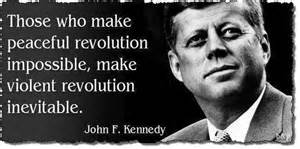
Kennedy

These last three weeks I’ve been trying to show how critical reading of biblical texts is connected to critical reading of every other text — including that of my own life. In all cases, “ideological suspicion” Is central.

It alerts readers to the fact that vested Interests tend to distort analysis — but mostly in conservative ways Intent on supporting the status quo. That’s the way as well with most extra-biblical texts like the mainstream media, best-sellers and school text books.

By way of contrast, readings issuing from the viewpoints of the socially-conscious dispossessed tend towards subversion of the status quo. That’s significant for Bible reading because (as I was saying last week) the Bible largely represents the memory of poor and oppressed communities. As such, books within the biblical cannon are nearly unique in history whose records normally preserve the memories of the rich and famous.

So with that in mind, here are twelve more conclusions I’ve drawn about the Bible. Notice the connections to politics and the very complex question of violence so pertinent in a world characterized by a permanent war against terrorism. Again, I present this second list of 12 conclusions to expose the way biblical studies have influenced my political leanings and the ideas that seem so strange to my adult children. .

  1. The experience of the socially activist poor and oppressed leads them to discover a liberating God in the Bible. He habitually overturns political, economic and social structures oppressive of people like themselves.
  1. In other words, the God of the Bible is not a neutral God. The biblical God is a class-biased God who has made a “preferential option for the poor.”  Similarly, Jesus is class-biased, not averse to making sweeping statements about “the poor” and “the rich” as groups without specific reference to individuals within those groups.
  1. Neither is the Bible a neutral text.  In fact, there are no neutral texts at all.  Any text, biblical or otherwise, either supports the status quo or it attempts to subvert it.  A text which does not subvert supports.  There is no third position.  By and large (though not universally) the biblical texts predominantly produced in situations of persecution, attempt to subvert the order of the world; they support God’s order often described in terms of “the reign of God.”  Once again, it is an order which as the antithesis of the world’s present order favoring the rich and powerful, favors instead the poor and oppressed.
  1. Similarly, there is no neutral exegesis of the sacred texts. Every reading is done by a person of a particular gender, race, nationality, and creed, with a particular personal history, and located in a given historical era.  Inevitably such readers possess more or less definite political commitments, and have predetermined understandings of the world.  Each of these elements as well as others inevitably bias his or her exegesis of the text. Each interpretation facilitates some insights but excludes others.  With this in mind, it is revealing to note that almost invariably respected mainstream exegesis has been done by rather comfortable white males of European background.  This means that the vast majority of believers, women, people of color, the poor, the illiterate, as well as Christians of the Third World have been left voiceless.  All of these have been forced to accept as normative well-off European, white, male biblical interpretations.  And once again, these interpretations almost universally have supported maintenance of white male euro-centric privilege.
  1. Today our Third World brothers and sisters are asking us to open ourselves to the levels of meaning they are discovering. They do not claim these are the only possible meanings; for clearly there are others.  Neither do they hold that those who make diametrically opposed interpretations are insincere; for such a claim would obviously be false.  They do, however, observe that these latter interpretations are extremely partial, for normally such readings take no note of their contradictory alternatives produced for example by unlearned people in the Third World.  Meanwhile, the exegesis of the poor and oppressed is normally more comprehensive, for it is well aware of the mainstream interpretation and usually spends a good deal of its time contesting such understandings as ideological.
  1. Meanings uncovered in this way lead to judgments about the structures of poverty and oppression experienced in the world, and to action towards changing those structures. Here the emphasis is on judgment of sinful structures rather than on sinful human beings.  For although personal sin is a painful reality, it is not up to Christians to judge how others stand in God’s eyes.  Nevertheless, God’s word can shed light on the human institutions which victimize both oppressed and oppressors by facilitating and often appearing to necessitate injustice.  An example of such an institution is international capitalism particularly as it impacts the Global South.  Institutions of this kind must be eliminated by Christian action in the world.
  1. Unfortunately, those who profit from the world’s sinful structures do not usually allow them to be changed willingly; instead their more frequent response to movements for change is one of extreme violence often directed towards the most vulnerable, children, the elderly, women, the sick.
  1. As a last resort, defense of these “least of the brethren” may demand that Christians take up arms and give their lives on behalf of the otherwise defenseless. Here other Christians, especially those outside the violent and threatening context in question must exercise extreme caution in judging such actions as contrary to the spirit of the Gospel.  This is especially true if those tempted to judgements of this type are among those whose taxes and/or silence enable their own  government to sponsor the violence which prompts assumption of arms in defense of the otherwise helpless.

21. Likewise criticism of Christians who take up arms in defense of “the least of the brethren” must be restrained since the Gospel is by no means clear consistent in its judgment about such action. In fact, historically speaking, most Christians who read the Bible in good faith have found that it does not require non-violent resistance.  A close reading of the biblical texts, and an examination of church history seems to reveal that highly contextualized considerations rather than some unchangeable principle of non-violent resistance have dictated the responses of Christians in situations of persecution.

  1. In addition, it must be admitted that not all violence is the same. There is a real difference between (a) the violence of the unprovoked attacker (This is clearly against Gospel teaching); (b) the violence of one defending himself or herself against unprovoked attack (This is less evidently against Christian belief); and (c) the violence employed in similar circumstances by one risking his or her own life in defense of the lives of the otherwise defenseless such as children or the elderly (Arguably this may represent a positive response to the Gospel).  To neglect such distinctions is to obscure questions of violence and non-violence.
  1. For these reasons, advocates of non-violence for others must humbly examine their consciences to see if their advocacy is not unwittingly supporting the interests of those oppressing the defenseless. Here it must be noted that most robbers and perpetrators of other forms of violence are quite enthusiastic supporters of “peace” which takes the form of non-violent response on the parts of their victims.  It should also be observed that in this case those upon whom the strategy of non-violence is so enthusiastically urged are the least able to defend themselves.  In fact, historically speaking, the poor and working classes of the world who for the most part are the victims of oppression, stand virtually without means of self-protection, having no armies of their own.  They are the only ones to whom both state and church authority have forbidden violence  as a legitimate means of defending their loved ones from their oppressors of the propertied classes who have huge armies and defense budgets at their disposal.
  1. Perhaps in view of all this, the most that some North American Christians can say is that they themselves are hearing a vocation to non-violent resistance, and that Christians in other very different situations  are being called to determine how best to defend the “least of the brethren.” in their own contexts.  No doubt some Christians there will choose to arm themselves on behalf of their families, friends and fellow citizens.  Others will choose non-violent resistance. Still others will choose a combination of the two approaches.   A great deal will depend on the context in question. Christians living in the U.S.A. must overcome the affliction of tolerating violence in service to U.S. corporate interests while condemning the violence of those who resist such oppression.  “I would assert that people who have not actively opposed the violence of the powerful against the poor, at some cost to themselves,” writes Philip Berryman, “have no moral authority to question the violence used by the poor.”  (Jack Nelson PallmeyerThe Politics of Compassion.”  Maryknoll, New York: Orbis Books 1986, 87.)

Realizations like the ones I’ve noted here — all of them faith-based have inclined me to:

  • Understand world events in ways that privilege the viewpoints of the  world’s poor.
  • Side with them in their conflicts with the rich and powerful.
  • Acquaint myself with the reasons for what the privileged habitually describe as the unprovoked “violence” of those they habitually oppress.
  • See that the violence of the rich and powerful dwarfs that of the poor they exploit.
  • Perceive that since World War II all of the U.S. wars have actually been fought against the world’s poor and oppressed to keep them in that condition.

Pope Francis: Please Write That Encyclical against War!

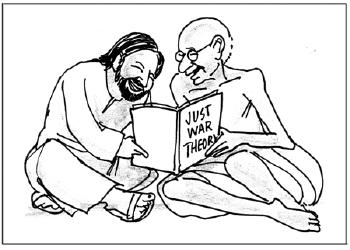
Just War

Readings for 6th Sunday after Easter: Acts 15:1-2, 22-29; Ps. 57: 2-3, 5, 6, 8; Rev. 21: 10-14; 22-23; Jn. 14: 23-29.

Last week, David Swanson, the author of War is a Lie shared an interview with the great Jesuit peace activist, John Dear. The latter had just returned from Rome where he participated in a conference convoked by Ghanaian Cardinal Peter Turkson. Cardinal Turkson authored first versions of Laudato Si’, Pope Francis’ landmark encyclical on the environment. He is often mentioned as a possible future pope.

Father John (who doesn’t like to be called “Father Dear”) reported the conference as “unprecedented.” That’s because activists, theoreticians, and scholars of Peace Studies ended by recommending (in a document over the signature of Cardinal Turkson) that Pope Francis publish another encyclical – this one repudiating the Church’s centuries-long endorsement of Just War Theory.

That theory, of course, lays out principles for judging whether or not a given armed conflict might be justified.

The Turkson document repudiated the idea that modern warfare might ever be justified. This is not only because of the terrible destruction caused by modern weaponry, but because, in fact, 90% of casualties of today’s wars end up being innocent civilians. For those reasons, the conference in Rome recommended that Pope Francis not only repudiate war itself, but discourage Catholics from participating in modern military forces.

Imagine what would happen if Pope Francis were to accept those recommendations – especially on top of his denunciations of capitalism-as-we-know-it, his firm embrace of environmentalism, and his statements about homosexuality (“Who am I to judge?”). Catholic radicals would love it, liberals would be inspired. Conservatives who often identify faith and the military would be shocked and scandalized.

Where would you come down?

Think about that question in the light of today’s readings. Think about what “radical,” “conservative” and “liberal” mean for us as individuals and community members in our faith tradition. How would Jesus be classified? What about Paul? What would they say about entirely rejecting the idea of just wars?

Today’s Liturgy of the Word gives us a clue. It presents us first of all with an example of a key conflict between religious conservatives and radicals within the first century infant church. Paul, Barnabas, Silas and Barnabas lead the radical-to-liberal wing. Peter and Jesus’ brother, James are the leaders of the conservatives.

Paul and his friends come from the gentile world. Their concern is to make Jesus both understandable and acceptable to non-Jews. For their audience, circumcision and dietary restrictions (like not eating pork) represent great obstacles to accepting Jesus’ “Way.”

On the other hand, Peter and Jesus’ brother, James, are Jews through and through. They remember the importance of full observance of the law within the Jewish tradition. They recalled for instance that during the second century Seleucid persecution of the Jews under Antiochus IV Epiphanes, many Jews gave their lives rather than eat forbidden foods. Faced with Paul and his colleagues, the conservative faction wondered: were those lives sacrificed in vain? And besides, circumcision was the identifying mark of Jewish manhood. What good follower of the biblical God set that all-important commandment aside?

The issue is so serious that it provoked a meeting of church leaders – what scholars call the “Council of Jerusalem.” Like Vatican II (1962-’65) it called together church leadership to discuss burning issues of the day and to make changes that responded effectively to what Gaudium et Spes called the “signs of the times.”

Today’s gospel reading implies that leaders could come together with confidence because of Jesus’ promise that his Holy Spirit would continue teaching the church even after he is gone. The Spirit would remind the church of what Jesus himself taught – and more besides.

According to today’s readings, it was the “more besides” that the Jerusalem conservatives were resisting. They didn’t deny, of course, that Jesus himself was a Jewish prophet. (It was Jesus’ prophetic radicalism that angered the Scribes and high priests.) Jesus frequently placed love and compassion above God’s most important commandment, the Sabbath law; he associated with the “unclean;” he even befriended and worked miracles for gentiles. Jesus was never bound by the letter of the law as were his conservative opponents.

At the same time however, Jesus was Jewish to the end. He had no intention of founding a new religion. He was a Jewish reformer. No one could deny that. Jesus didn’t revoke the Law. He simply gave it an enlightened, more humane interpretation. He himself had been circumcised!

It was with these understandings that the Council of Jerusalem convened. And according to Luke, the author of Acts, it was a battle royal. Luke says the meeting was filled with “dissension and debate.”

What we find in today’s first reading is the final decree of the Council of Jerusalem. Concerning circumcision, it says “never mind.” As for dietary restrictions, they could be ignored. The Council was concerned with not placing unbearable burdens on converts. In other words, it couldn’t have been less conservative. The Holy Spirit was leading them in the opposite direction.

The Council of Jerusalem is reputed to have happened no more than 30 years after the death of Jesus. But by the time John of Patmos writes his book of Revelation at the end of the first century, look where his church had come. His vision of the “New Jerusalem” which we read about in today’s second reading doesn’t even have a temple. Jerusalem without a temple?! The city is founded not on the 12 patriarchs of Israel, but on the 12 apostles. How radical is that!?

I suppose what I’m saying is that Christians shouldn’t be afraid of radical change in matters of faith. It’s our tradition – right from the beginning.

In fact, in today’s gospel, John has Jesus say specifically that we should not be agitated or fearful. Rather, our hearts should be filled with peace because of our reliance on the Holy Spirit. John’s Jesus teaches that the Spirit’s presence guarantees the community is moving in the right direction, even when the Spirit’s teachings shock and scandalize – as long as it’s moving towards Jesus’ compassion, love, and ease of burden. The guarantee remains even when the Spirit’s guidance seems to dilute what many consider essential – like circumcision, dietary laws and the Jerusalem Temple.

What “essentials” is the church being called to set aside today? Priestly celibacy? An all-male priesthood? Prohibition of contraception? Are any of these really essential?

And what about just war? Are John Dear and Cardinal Turkson right about its absolute unacceptability to followers of Jesus? Could Jesus ever endorse atomic bombs, drone strikes, cluster bombs, or any of today’s wars that end up claiming mostly civilian victims?

If we fear to say “No” to any of those questions, we should keep Jesus’ words in mind: “Don’t be afraid or agitated; the Holy Spirit guides.”

The bottom line: today’s readings teach that there is no future in timid conservatism. Instead we are called to Christian radicalism (or going to the root of things). The Holy Spirit is that root.

And so we can pray with confidence: “Holy Spirit, in our world racked by war, inspire Francis to write another encyclical. Let him surprise and shock us one more time. Wake us up as a community of faith! Move us towards compassion, love and ease of burden as you did the Jerusalem Council.

We believe that under your guidance, we can never go wrong!”

Biblical Study Helps Me Develop Critical Consciousness (Personal Reflections Pt. XII)

,


Biblical Criticism

Here are the first dozen of the twenty-four conclusions I’ve drawn after my years of biblical study. As the cartoon above indicates, what I gained from Eamonn O’Doherty at St. Columban’s  Major Seminary in Milton, MA was an introduction to the historical/critical approach to the Judeo-Christian tradition. It provided a foundation that was deepened and developed by the scholars I mentioned in my last posting.in this series.

The historical/critical approach acts as a corrective to misreadings that emerge from the naive literary/confessional approach that had previously been mine. I learned that the latter is too open to ideological manipulation at the hands of the dominant culture anxious to secure divine support for a status quo favoring the rich and powerful ruling classes..

Accordingly, those more conventional approaches must be treated, I realized, with “ideological suspicion” which methodically doubts the veracity of conventional interpretations.

Such doubt made me suspect of any interpretation issuing from the United States and Europe. There analysis tended to remain largely apolitical and by that very fact ended up supporting the socio-economic status quo.

That was not the case in the underdeveloped world. (I use that term deliberately. Latin America, Africa, and South Asia, I found, have been deliberately under-developed –robbed of their resources by over-developed nations.)

Scholars in the Global South saw clearly and articulated connections between the biblical texts and imperial exploitation. The texts of both the Jewish Testament and its Christian counterpart are unique in the ancient world in that they were largely produced by victims of imperialism at the hands of Egyptians, Assyrians, Babylonians, Persians, Greeks and Romans. To ignore that fact and to interpret them apolitically is to impoverish them and rob them of their critical power vis-a-vis contemporary imperialist situations.

I’m sure such remarks make it clear how the biblical studies I’ve pursued have sensitized me to the dark realities of empires and the intolerable situations they have produced in the past and continue to produce in the present.

In any case, the twelve conclusions I share here unveil my gradual progression towards critical consciousness engendered by biblical studies. As you’ll see, they inexorably become less general and more sharply political. Judge for yourself:

  1. For the Christian Bible reading is extremely important. In some sense, the Bible is the word of God. However its many separate texts were produced by very human authors concerned with addressing highly politicized situations.
  1. But living is more important still. After all, even in the Bible itself, life and history constitute the primary vehicle of God’s revelation. In fact, it was out of reflection on these basic elements that the sacred texts themselves arose.  In other words, the main purpose of the Bible is not preservation or study of tradition for its own sake, but to help believers make faith-full sense out of the lives they are actually living.
  1. Therefore, as important as it is, Bible reading for the believer is a secondary activity, carried on “after the sun goes down.” It illumines life’s primary activity and vocation, living itself.

Continue reading Biblical Study Helps Me Develop Critical Consciousness (Personal Reflections Pt. XII)

Waking Up To the Real Nature of the Bible (Personal Reflections Pt. X)

Merk

I don’t exactly remember what I thought about the Bible before beginning its formal study the year after receiving my B.A. in Philosophy (1961),

Ironically, although I had been in the seminary all those years (since 1954) the formal study of “religion” hadn’t at all been central in. the curriculum.

Yes, we attended Mass every day (and twice on Sundays). And there were all those daily chapel activities and devotions: morning and evening prayer, afternoon rosary, “visits” to the Blessed Sacrament before and after meals, nightly Benediction, conferences by the seminary spiritual director, etc. There were also those inspirational readings I mentioned accompanying breakfast and lunch in the “refectory.”

But formal study pretty much concentrated on languages (Latin, Greek, and French) and normal secular studies associated with high school, on the one hand, and on the other, college courses associated with a Philosophy Major.

So by the time I began the formal four year (and post-grad) theological curriculum (1962) my understanding of such matters, including the Bible was fairly uninformed. I’m sure I thought the Bible was the very word of God valid for all time.

That began to change with exposure to the teachings of Fathers Eamonn O’Doherty and Jack Moriarity, both of whom introduced us to modern scripture scholarship which emphasized the history behind the Hebrew and Christian Testaments. They introduced us to form criticism and redaction criticism as well.

Form criticism made us aware that the Bible is filled with various kinds of literature. Literary forms found there include myth, legend, debate, fiction, poetry, miracle stories, birth accounts, letters, apocalypse, annals of kings, law, riddles, jokes, parables, allegories, etc.  None of that, really, is history as we understand it. And if we read poetry, for instance, as if it were history we’ll commit huge interpretational errors.

Just realizing that can change one’s entire approach to the Bible. It did mine.

I remember sitting each day for classes in “Old” and “New” Testament in our aula maxima on the second floor or our Major Seminary on 1200 Brush Hill Road in Milton, MA. The entire student body – those about to be ordained, and the three classes behind them – took those classes together. There were probably sixty of us. So I found myself edified (and intimidated) by the good students among my elders whose questions and observations always seemed so sage, perceptive, and sometimes daring.

For a long time, I pretty much kept quiet. But the wheels were whirring at top speed inside my head. For a biblical literalist like me, it was all hard to swallow

For instance, I recall the day during our study of the Gospel of Luke that the penny dropped for me that the Three Wise Men never existed. It was all a “midrash,” we were told, on the part of the gospel’s author (whose real identity remains unknown). Midrashim, it turns out, are usually fictional stories meant to elucidate particular biblical texts or beliefs.

“Say what?” I thought. “The next thing you’ll be telling me is that the resurrection never happened.”

Well, that day never came – from the actual teachings of my Scripture Profs. But it sure did for me. So I remember one day screwing up the courage to ask Father Eamonn about it in class. I asked, “Is it possible, Father, that gospel stories about what’s called the ‘resurrection’ of Jesus were also simply creations of the early Christian community to reflect their gradually dawning consciousness that Jesus’ words were true: ‘Whatever you do to the least of my brethren, you do to me’ and ‘Wherever two or three are gathered in my name, I am there in their midst?’ In other words, might the resurrection, like the tale of the Three Wise Men also be a midrash?”

I awaited Father O’Doherty’s answer with bated breath. Perhaps my question wasn’t clear enough, I feared.

Well, the question was clear enough. Father O’Doherty paused a few moments. Then he responded: “No,” he said. And that was the end of it! He moved on.

Now that might give you the impression that Father Eamonn wasn’t a good teacher. Quite the contrary. I’m confident in saying that nearly all of my peers recall him as their most influential Prof during our four years of theological training. I agree with them. Eamonn imparted to us not only essential facts about the Bible, but an entire approach that stuck with us all.

In my case, his classes provided me better than any other a firm basis for what I would learn in Rome during my doctoral studies there (1967-’72). – and for what I internalized subsequently as I continued my studies with liberation theologians in Brazil, Costa Rica, Nicaragua and elsewhere in the  developing world. Of course, I’ll have more to say about that later.

But for now, I must tell you about Father O’Doherty’s teaching method. Again, it proved extremely effective. However, it’s not the sort of thing you’ll find in the best treatises on pedagogy.

The other day, I was looking at the basic primary source text we used in his New Testament classes.  It’s Augustinus Merk’s Novum Testamentum Graece Et Latine (pictured above). It’s the entire New Testament in its original language, Greek on one side of the page and Latin on the other. Originally published in 1948, its footnotes are filled with scholarly critical apparati. – mostly pointing up and evaluating variant readings of the Greek texts. I[n itself, that’s interesting. We were actually dealing with texts very close to the originals (none of which, it turns out, have survived. Instead all we have are copies of copies of bad copies. But that’s another story.)]

Besides the text itself, what was even more interesting to me were my notes in the margins of each page. Each was jam-packed with cursive scribblings in my smallest possible handwriting – so small, in fact, that I needed a magnifying glass to review some of them last week.

And that was evidence of Father O’Doherty’s teaching method. It involved (1) his lecturing to us each day reading mostly from his notes, (2) our transcribing notes as fast as we could, pausing occasionally for someone to ask questions, (3) Our transferring those notes into the margins of the relevant texts during out study periods, and (4) Recopying those detailed marginal notes onto exam papers in response to our teacher’s exam questions.

To me, in retrospect, that sounds pretty much like what the great Brazilian educator, Paulo Freire, excoriated as “Banking Education” – where teachers make deposits into the “accounts” of students who subsequently make withdrawals at exam time to purchase good grades.

But here’s the funny part: it worked! Father Eamonn wasn’t a particularly dynamic teacher. But what he taught us was so interesting and well-organized that we learned important lessons from a process that seems like pure regurgitation. Put that in your pedagogical pipe and smoke it!

Ask any of my peers. All of us love Eamonn. And we remain grateful to him to this day.

(Next Week: a full account of what I learned about the Bible over the years – in two dozen points)