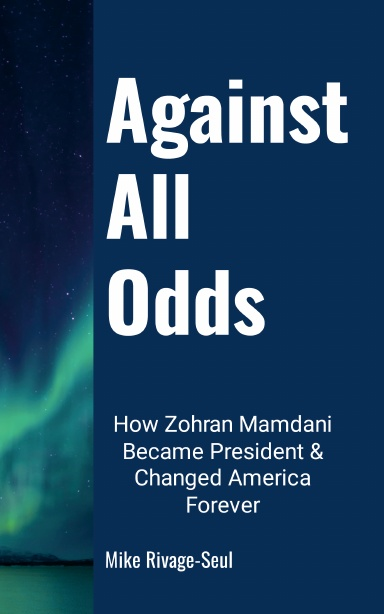
How Zohran Mamdani Can Become President: (An Excerpt from My “Arc of Justice Alliance” Novella)

Most people do not read policy papers; they’d rather read stories That is not a failure of intelligence; it simply a description of how human beings learn, imagine, and change.

My novella, Against All Odds: How Zohran Mamdani Became President and Changed America Forever was written to complement the policy statements of the emerging Arc of Justice Alliance (AJA). The book is not a prediction, nor a legislative blueprint. It is a story — a civic fable — meant to explore how democratic renewal might feel, sound, and unfold if ordinary people followed the lead of politicians such as Zohran Mamdani.

The book grew out of decades of political reflection, organizing experience, and moral concern, and was developed in conversation with AI. That collaboration does not replace human judgment; it sharpens it, forcing questions of coherence, plausibility, and ethical consistency that policy language often evades.

What follows is the book’s opening chapter. It is offered here not as entertainment, but as an invitation: to introduce the book’s exploration of how power operates, how legitimacy erodes, and how moral imagination may be a prerequisite for democratic repair.


Excerpt from Against All Odds

Chapter One – The Bronx Spring

“Every revolution begins as a local rumor — until someone believes it might be true.”
— AJA Field Notes, 2025

The winter had been long in Queens. Gray salt crusted the curbs. Trains screamed overhead like mechanical prayers. And yet, beneath the cold concrete, some-thing was stirring — quiet, electric, alive.

They called it the Bronx Spring.

It began with a tenants’ strike in a decaying building off 31st Avenue — the kind of place where the rent doubled every two years while the heat failed every January. Young organizers — Somali, Bangladeshi, Dominican — went door to door with clipboards and conviction. And at the center of it all stood Zohran Mamdani, a man whose voice carried both the warmth of Queens and the cadence of Kampala, equal parts poetry and fire.

He wasn’t a mayor yet, or even thinking that far ahead. He was a state assembly-man still riding the E train to Albany twice a week, still sending midnight texts that began, “Comrades, one more thing…” But something in him — and around him — had shifted.

The city was tired of promises. And the Bronx, like the chorus of an old labor hymn, began to hum again. The night it truly began, the wind sliced through the corridors of the Queensbridge Houses.

Zohran was there, coat collar turned up, hands full of coffee and flyers. A woman named Amina opened her door just wide enough to see his face. Behind her, a child slept under a mural of the Virgin and Malcolm X.

“Another politician?” she asked.

“Not exactly,” he said. “I’m your neighbor.”

It wasn’t a line; it was true. He lived two blocks away.

That night, fifty tenants gathered in the laundry room to write what they called The People’s Demands: rent rollbacks, energy audits, legal aid for evictions. No one expected much. Not in a city where real estate and police unions ran the show. But when Zohran spoke, he didn’t sound like a candidate. He sounded like a possibility.

“Power,” he said, “isn’t what they hold in City Hall. It’s what we hold when we stop believing we’re alone.”

Days later, things began to move. Heat returned to the buildings. Landlords called emergency meetings. A city inspector — one who’d ignored complaints for years — appeared, clipboard trembling.

Something had changed.

Zohran’s small Astoria office became a nerve center — whiteboards, coffee cups, volunteers working until dawn. They mapped block-by-block networks of resistance.

They called it Reclaim the City. But within the movement, a quieter name began to circulate — The Arc of Justice Alliance.

It meant different things to different people: a moral trajectory, a bridge to something better, a plan for what democracy might still become. Late at night, Zoran wrote in his notebook: “If we can build one just block, we can build one just city. If we can build one just city, we can build one just nation.”

Power, even moral power, never goes unnoticed. In City Hall, consultants scoffed. The Post ran a headline: “Socialist Slum Preacher.” Developers whispered to their lobbyists. And in Washington, analysts began filing quiet memos about a charismatic legislator organizing “urban solidarity experiments” in Queens.

The movement was becoming visible. And visibility, in America, is a dangerous form of faith.

Spring came late that year. The cherry trees bloomed unevenly along Roosevelt Avenue, the air thick with rain and ambition. At a rally in Bryant Park, Mamdani stood beside bus drivers, sanitation workers, and students. The crowd wasn’t large, but it was awake — eyes bright, faces lifted toward something unseen but undeniable.

“Every generation,” he said, “faces a choice between cynicism and renewal. We stand tonight at the threshold of both.”

The words landed like prophecy.

By summer, the rumor would become a movement, the movement a campaign, and the campaign a city reborn in defiance of empire. But for now — on that cold evening in Queens, with the wind off the East River and the trains moaning overhead — it was still only a whisper, shared among the hopeful.

The Bronx Spring had begun.

Yet, even then, before anyone could name it, an odd tremor ran beneath the surface of public life — small bureaucratic stumbles, missing records, a strange silence from federal monitors who normally hovered over tenant disputes. It was as if the machinery of the old republic were developing hairline fractures no one yet saw.

Reflection

Stories do not replace policy.
But they often make policy thinkable.

If this excerpt resonates, it may be because it names something many people already sense: that power rests in an awakened electorate and that politicians like Zohran Mamdani can represent the future of our nation as the “Republic of Care” proposed by the Arc of Justice Alliance (AJA).

As noted above, Against All Odds is part of the broader work of the AJA, an effort dedicated to imagining and building democratic institutions rooted in care, accountability, and human dignity.

If you find value in this work, you are invited — never pressured — to support that effort. Purchasing the full book or donating helps sustain writing, organizing, and public education aimed at turning moral imagination into lived reality.
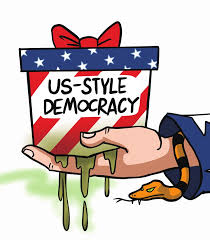
Ukraine: We’re Falling for CIA Lies Again!

I just can’t believe what’s happening before our eyes. I’m talking about Ukraine.

My disbelief is not related to Vladimir Putin’s relatively restrained assault on his beleaguered neighbor. Yes . . .“relatively restrained.”

(I see no need here to obscure my point by joining the chorus of Putin haters – just as there was none to join haters of Castro, Milosevic, Noriega, Chavez, Ortega, Maduro, Gaddafi, or the other innumerable “Emmanuel Goldsteins” identified as objects deserving of our de rigueur, periodic two minutes of hate.)

No, my disbelief is more about the fact that after being fooled in Vietnam, Iraq and elsewhere, so many Americans have been roped into somehow thinking anyone in this country has the moral authority to criticize any “war crimes” or perceived violations of “democracy” — as directed by the CIA!

In fact, by despicable U.S. standards, Putin is absolutely justified in his assault on Ukraine. By those criminal canons, Russia deserves its own Monroe Doctrine, its own buffer zone against a hostile and Russia-phobic NATO, its own sphere of influence. And unless we’re out in the street denouncing what “our” government routinely does and is currently doing in the world, we have no right to utter a syllable of protest about Mr. Putin. Not a single syllable!

War crimes? Are you kidding me? Think about those our current government is committing and supporting in Yemen, Afghanistan, Palestine, Libya, Somalia, and who knows where else. Think about its use of the cluster bombs it now decries. Think about its shooting contaminating nuclear waste at enemies du jour. Think about its use of agent orange and white phosphorous – both chemical weapons. Think about its rejection of World Court jurisdiction when there’s all those questions about U.S. war crimes.

All of that makes Putin’s gambit in Ukraine look absolutely statesman like. That’s compared (to take just one example) to U.S.routine “shock and awe” devastations. Putin’s crimes are nothing like the levelling of Iraq’s Fallujah.” Civilian casualties in Ukraine don’t even approach the million Muslims the U.S. military has slaughtered in Iraq alone – not to mention the million children who will die this year because of U.S. sanctions now operative in Afghanistan.]

Face it: our troops and government are out-and-out butchers compared with Putin’s.

That can’t be said too strongly.

And as for democracy, Putin’s system is no less democratic than ours. Are you aware of our new Jim Crow laws (supported by a criminally cooperative Supreme Court)? Think about how the system rigs elections to disenfranchise the poorest among us.

And you’re telling me that given the corruption legendarily involved in American electoral politics (with its interminable campaigns, demonstrably mendacious ads, gerrymandering, voter suppression, hackable voting machines, dark money, bribes in the form of “campaign contributions,” and the absolutely silly “politicians” that emerge to represent their donors – you’re telling me that we want Russia or China to follow suit?)

Please!

Our ignorance is not only blind, but arrogant!

Of course, Putin, like other heads of state in the capitalist world (the only one we’ve got), represents the rich elite. For that reason, as I’ve tried to show elsewhere (here, here, here, here, and here) his authority is no more legitimate than Joe Biden’s. Yes, that’s the hard truth:  if Putin’s authority is somehow de-legitimized, so is Biden’s.

Neither of them nor U.S. clients in Europe and throughout what is laughably called the “free world” cares a wit about people like you and me – much less about those with darker skins and emptier wallets.

With all of this in mind, think again about our collective stupidity. . ..

When was the last time you believed someone who told you that he makes a living by telling lies? You think you’re too smart for that, I’m sure.

But that’s what’s happening relative to Ukraine.

You know that, right?

I’m referring to the words of former CIA head, Mike Pompeo. Remember how he joked and bragged about that. He actually said, “We lied, we cheated, we stole all the time. We take entire courses about. . .. Ha, ha, ha!”

Well, the joke’s on us if we believe a single word coming out of Langley. In view of Pompeo’s words and reams of evidence supporting their truth, why would we ever think otherwise? Why would we ever not draw the conclusion, “If the CIA (or our government!) says ‘black,’ it’s definitely got to be ‘white.’”

Who wouldn’t draw the conclusion, “If the CIA’s involved on Ukraine’s side, Putin can’t be all that bad?”

That’s a serious question, because, of course, the CIA is deeply involved with the Ukrainian situation.

What I’m saying is that we’ve got to wake up. Sadly, this is the way the world works. “Great powers” – including Russia, China, and (in spades) the United States always act just the way Putin does — just the way U.S. presidents always have. If we accept borders and sovereign states, great powers, lesser powers, imperialism, and client states, this is what we have. Great powers (especially the United States) only selectively respect international law.

That’s the system that needs identification, rejection, and overthrow.

So, what’s called for is not rending our garments over the crimes of Vladimir Putin, but over those of our own government – of the entire capitalist system for that matter. Those are the ones we can do something about.

So, it’s time to shut up about Ukraine. Correlatively, it’s well past time to get out into the streets over our own war crimes and assaults on democracy not in a single country, but throughout the world and especially here at home.

Chapter 22: “Cuba’s More Christian & Democratic than the U.S.”

This is Chapter 22 of my novel, The Pope’s Secret.

Virtually all the lines spoken by Mr. Castro in this chapter are direct quotes from Fidel on Religion by Brazil’s Frei Betto who personally gave me permission to use those statements verbatim.

To read previous chapters of The Pope’s Secret, just scroll down.

Brexit: The UK Joins the World-Wide Rebellion against Neoliberalism

Most of us are scratching our heads over the magnitude of the Labor Party’s loss in last week’s election in the United Kingdom. The mainstream media (MSM) would have us believe that the Tory Party’s victory under Boris Johnson represents a massive rejection of left politics by the British working class.

However, that’s by no means the only conclusion possible. Indeed, it is entirely credible to conclude the opposite, viz. that last week’s vote was a resounding victory for the working class. That is, it represented their rejection of the very type of free trade pacts that have made lives miserable for wage earners across the planet.

It’s also possible to conclude that the British elections have issued to the world a clarion call to reform all free trade pacts while suggesting a clear direction for reform.    

Let me explain.

The Elections and Brexit

To begin with, think about the elections and Brexit. 

That, of course, is what the voting was about – Brexit (British withdrawal from the European Union). No other country has yet exhibited the courage needed to do so – not even Greece, despite the extreme austerity the EU has imposed upon it for years – and despite the promises of SYRIZA and the will of the people expressed in huge demonstrations and national referenda.

So, unlike the Greeks, the Brits set the stage for the actual exit of a member state from the European Union, which is the kind of free trade pact that has cursed working classes for more than 25 years.

Remember that: the EU is basically a free trade arrangement. Its central feature is its single market allowing its “four freedoms:” free movement of goods, services, capital, and people within EU borders.

The EU was formed in 1993. Its counterpart across the pond, NAFTA (The North American Free Trade Agreement) was signed a year later. Then came CAFTA (The Central American Free Trade Agreement) in 2004. As indicated, working classes have been suffering ever since not only from NAFTA and CAFTA but from EU austerity administered by unelected and therefore unaccountable bureaucrats headquartered in far-off Brussels.  

With such hardship and lack of democratic control in mind, voters chose Johnson over Jeremy Corbyn. That’s because no one, including Corbyn and his Labor Party, was as clear as Johnson and his Tories about withdrawing from the EU come hell or high water.

On the other hand, Corbyn and Labor were not only relentlessly vilified by the country’s corporate media; they also remained ambivalent and split about Brexit. Together those factors proved fatal. The best the denigrated Laborites could do was to promise yet another referendum on the topic.

Clearly, that wasn’t enough. Evidently, the British were tired of the entire debate. As a result, Labor suffered the consequences. However, British laborers made the point that eluded their Greek counterparts: no more unelected decision-makers in Brussels, no more free trade agreements favoring capital over workers; no more neoliberal austerity, and no more unrestricted immigration to drive down wages.

Last week’s election results represented the Brits way of courageously joining the protests against neoliberal capitalism now taking place across the planet.

Free Trade and Immigration

Now, think about free trade agreements and that just-mentioned issue of immigration. Obviously, it has become a free trade sore point both here and in the United Kingdom. However, immigration pain has originated from opposite but intimately related sources.  

Within the boundaries of the EU, the immigrant problem has stemmed from the earlier-listed “four freedoms,” while in North and Central America it comes precisely from the fact that only three of those freedoms are honored.

More specifically, the EU free trade arrangement recognizes that provision of goods and services essentially involves both capital and labor as roughly equal partners. Consequently, if a treaty allows free movement of capital across borders, justice and the logic of capitalism demands that it also permit similar liberty to labor which is as essential to the free market equation as capital. So, borders must be permeable to immigrants from one member-country to another.

This recognition has led to major relocations of population across frontiers that were closed in the pre-EU world. Movements of this sort have occurred with a vengeance in Great Britain, whose borders have long been open to immigrants from the country’s former colonies, e.g. India and Pakistan.  Add to these the climate and war refugees who have also found refuge in Europe in general including Great Britain, and you’ll begin to understand why many there might blame their growing sense of lost national identity exclusively on the European Union. Boris Johnson has given effective voice to such discontent.

Similar unhappiness with the NAFTA and CAFTA has surfaced in North and Central America.

However, there the pinch of globalization is caused by closed rather than open borders.

That is, while NAFTA and CAFTA allow free movement of goods, services, and capital across the borders of the United States, Canada, Mexico, and the countries of Central America, they deny such freedom of movement to labor. Consequently, the agreements have at their disposal a captive labor force. So, while capital can go wherever it finds low wages, Mexican labor for instance cannot freely move to high wage areas in the United States or Canada. This has been a source of great frustration (and poverty) for workers under NAFTA and CAFTA.

As a result, Latinix workers have taken matters into their own hands. In what some have called a modern reconquista (a reconquering or reclaiming) of lands confiscated from Mexico in the middle of the 19th century, thousands of immigrants from Mexico and Central America have ignored one-sided laws prohibiting labor’s mobility. Regardless of the consciousness behind them, their actions implicitly insist that if capital is allowed to move freely across borders, so should labor be permitted cross-border transit.

Such economic rebels added to victims of climate change and of U.S. wars in Central America during the 1980s comprise the immigrant multitudes that President Trump has blamed for U.S. economic problems. In reality, they represent the collateral damage of free trade pacts as much as do their counterparts in the European Union.

(In other words, despite Trump’s assertions, it is right wing capitalists not liberals or progressives who insist on absolutely open southern borders – however, for themselves, but not for workers.)

Reforming Free Trade

So, what’s the answer to the EU, NAFTA, and CAFTA conundrums? Is it abandonment of free trade agreements altogether?  Not necessarily. (And this brings us to the implications of reform involved in last week’s vote.)

In a word, the answer is DEMOCRACY.

That is, the defects of free trade agreements can only be remedied satisfactorily by democratizing them to protect jobs, cultures, and local social values.

To begin with, democracy demands that all stakeholders (not merely corporate representatives, lawyers, bureaucrats, and politicians) be present at the renegotiating conference table. This includes trade unionists, environmentalists, and groups representing the specific rights of indigenous peoples, women and children. All those affected must have equal voice and vote. Nothing else will work. Nothing else is just.

Yet, if all stakeholders have voice and vote, they will predictably complicate matters. (Democracy, remember, is messy.) Predictably, they’ll make demands that will radically restrain the freedoms of the corporations involved – even to the point of rendering unworkable the type of trade pacts we’ve come to know.

For instance, (and perhaps most crucially) workers in places not only like Greece and Italy, but in Mexico and Central America will require the same freedom their employers enjoy to move to where the money is. Developed world workers will demand compensation for their lost jobs. Everyone will vote for the unrestricted right to unionize. They’ll want seats on corporate boards of directors. At the same time, environmentalists will demand industrial technology that is clean and non-polluting. They’ll want waste and chemical dumps along with polluted rivers and aqua firs repaired.

Once again, meeting such demands requires profound democratic changes in common understandings of international trade arrangements. We can thank UK voters for suggesting that requirement in the clearest of terms.

Conclusion

Following Labor’s defeat in the UK, the corporate media and mainstream politicians have rushed in to announce the end of progressive programs like those advocated by Jeremy Corbyn and Bernie Sanders. For instance, Joe Biden argued that British Prime Minister Boris Johnson’s resounding victory should “warn Democrats against veering too far left in their fight to defeat President Donald Trump.”

Instead, thoughtful analysts should see the results of Great Britain’s electoral process as yet another instance of a world-wide rebellion against neoliberal capitalism. Bernie and Elizabeth Warren are essential elements of that insurgency.

True, voters have elected a Trump-like figure in Boris Johnson. And he will predictably immiserate the lives of wage earners even further. However, voters’ overriding intention was to reject EU membership once and for all. For them, one-sided free trade agreements that prioritize capital over labor are no longer acceptable.

Such unambiguous rejection of capitalism-as-we-know it, is now evident throughout the world – including at our border, where immigrants and refugees implicitly declare the system’s absolute failure in their own lives.