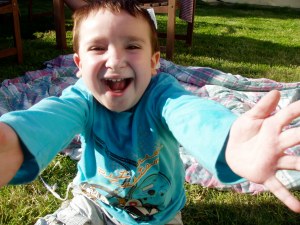
Alexander Kinne-Coyle
This morning’s post is the one I promised last Saturday. This meditation comes from Declan Coyle, a former colleague of mine in the Society of St. Columban, who was ordained in 1969. He later left the priesthood after living for years in slums and poor barrios in the Philippines and Taiwan. Here he reflects on what he and his family have learned from his youngest child, Alexander. Thank you, Declan, for allowing me to share this with my friends.
Alexander
Alexander has Mowat Wilson Syndronme. He cannot eat, walk or speak, and he is doubly incontinent but boy can he communicate.
He is unconditional Love … as near as we’ll ever get to it.
He doesn’t do the past. He doesn’t do the future.
He only does the present.
Here.
Now.
His simple message is always the same:
Be Here Now!
The essence of Zen.
You are only doing what you are doing.
“Chopping wood, drawing water!”
Not the mental noise of the thinking mind goaded into the future by the Ego that cannot live in the now with its victim stories: “how many more years will I have to chop this wood? Why do I always have to draw the water?” “Why is it always me?”
Alexander always invites us to be here now. Fully present. Fully alive. Awake. Aware. Alert.
As Rumi said, “the future and the past veil God from you. Burn both of them with fire.”
He brings all that “be fully present and live with joy in the now” stuff from the gospels alive.
“Take no thought for tomorrow …”
“Look at the flowers of the field how they bloom …”
“Don’t put your hand on the plough and look back … the negative past is a backpack full of manure … learn the life lessons and cut the backpack straps and live fully in the present …”
“Enter through the narrow gate of the now, the present moment …”
“By waiting and calm you will be saved, in quiet and trust your strength lies.” (Isaiah 30:15)
“Be still and know that I am God!”
“Come to me all you who labour and are overburdened and I will give you rest.” Mt. 11.28
“Unless you become like little children …”
Like the poet Rumi he says to us,
“Sell your cleverness and purchase bewilderment, awe and wonder!”
He is God’s gift to us, God, who as St John of the Cross said, hears “the silent language of love.”
Reminding us like Moby Dick author Herman Melville that, “silence is the one and only voice of God!”
Alexander shows us the pearl of great price right there in the centre of our being telling us not to try so hard.
Be one with life.
Go with the flow of life. Let go and let God.
A flower doesn’t work hard or try to bloom. It just does. The sun shines. No effort.
He is all about being here now.
Like the sun, all he wants to do is shine love into our lives even though the clouds of pain often cover his face.
Even then he’s reminding us that we are all children of the resurrection not the crucifixion.
When his laughter returns his constant reminder is to look at the crucifixion, that energy pattern of fear, but not to dwell on it. Not to make the victim-story our home. To look at the darkness, but to proclaim the light.
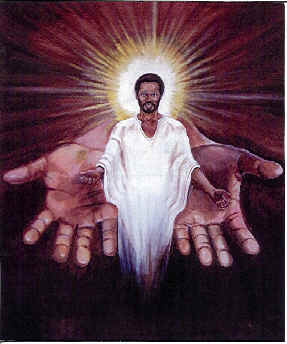
While we may look at the hands or the side on the Galilean carpenter and victim of abuse, the message is never the victim-story but rather the radical message of new life: “peace be with you, joy be with you!” Not the finger-pointing blaming, “will you look at what they did to me!”
Apart from the times Alexander is in pain, he is almost always smiling, waving and clapping his hands.
P.J. Cunningham saw him at the seafront in Bray one time waving at every single passerby and he said “he’s like a little pontiff!” That little royal or pontifical wave. He is not hard or tough. He is soft. But there is a huge strength in his softness.
Like the Tao Te Ching, Ch. 43:
“The softest thing in the universe overcomes the hardest thing in the universe.”
The ‘softest thing’ referred to is water. We see how, in the course of time, water can erode rock; how, without trouble, it disappears into the earth. Water looks soft, but really is very strong. Because it is silent and unpretentious, seems to have ‘no substance’, it achieves its purpose.
It is not worried about efficiency and profit. But eventually it is more successful than frantic work, because it is based on being.
Non-action tries to imitate this approach. It aims at being, not at producing immediate results. It does not make claims.
Chuang Tzu (300 BC) explains the same idea with reference to the art of target shooting.
“When an archer is shooting for nothing he has all his skill. If he shoots for a brass buckle he is already nervous.
If he shoots for a prize of gold he goes blind or sees two targets – he is out of his mind!
His skill has not changed. But the prize divides him. He cares now about winning.
He thinks more of winning than of shooting and the need to win drains him of power.”
His attachment to the outcome caused him to lose the present, the now, the moment. Process is lost in outcome addiction. The future fear-fuelled focus destroys the now. Fear replaces freedom and fun. Then the action in the now withers and shrivels and loses its free flowing power.
The poet T.S. Eliot captures the doing/being challenge in his poem “The Rock.”
“The endless cycle of idea and action,
Endless invention, endless experiment,
Brings knowledge of motion, but not stillness;
Knowledge of speech, but not silence;
Knowledge of words, but ignorance of the Word!”
Anthony De Mello says that despair is always five minutes ahead, never now. These great thinkers encourage us to “enjoy the precious present!”
D. H. Laurence said: “One’s actions ought to come out of an achieved stillness, not out of a mere rushing on.”
Alexander introduces us to the Being behind the Doing. The God of life behind all the action.
His presence invites us to slow down and step out from the fast pace of this world and reflect. To go receptive. To once again be here now. To allow ourselves to be guided, to be healed and to be loved by God. To dissolve resistance into an aware allowing.
Alexander is not under time pressure. He’s not working on his Ph.D. He teaches us what real love is all about. He shows us that we are not what we do (our work, our job, our title,) nor are we what we have, or even what other people think of us, our reputation. Rather than what we do, it’s who we are and who we become in his presence that matters.
The Chinese word for busy-ness or persistence is “knife” or “killing” and “heart!” When we’re busy we kill what the heart wants to achieve.
The heart wants to connect, to observe, to drink in, and to be aware and awake. But we’re too busy. We rush on past. Maybe tomorrow? We’re asleep.
“It is only with the heart that one sees rightly,” said the Little Prince.
“What is essential to the heart is invisible to the eye.”
Alexander is our “now” teacher. “Am I living well now? What is life teaching me now? What’s the best use of my time right now?”
Now is my gift.
The present has three meanings:
1. A gift.
2. Here.
3. Now.
Wisdom is knowing how to maximise the enjoyment of each moment. Being fully present enables people to give of their best and also to be able to receive the best that is on offer. Every day is a gift for those who really believe that every day is a gift.
When he looks at you, when he smiles, it’s as if he’s saying, “just fuel every moment with the best that’s in you now, and let fear and doubt go. Live out of love and freedom.”
There’s a story in the Orient about a monk who had a little bird on his shoulder who could see and foretell the future. Each morning the monk would ask the little bird, “Is today the day?” Meaning is today the day that I am going to die.
The bird would always reply, “no, but live as if it were.”
When Steve Jobs has his close encounter with life-threatening illness he resolved to live each day as if it were his last.
Being fully present answering the two great mystical questions:
“Where am I?”
“Here!”
“What time is it?”
“Now!”
If we cannot live in the now or discover Zen meditation washing the dishes or changing a dirty nappy there’s no way we’ll find in a cave on a mountain in Nepal or Tibet.
Alexander is our guru of “Being!” He is our master of power of now, the precious present. He is the ultimate cure for destination addiction or outcome addiction. He instinctively knows that the mountain of success is going to be very lonely if we don’t enjoy the climb, the view and the companionship on the way up.
It’s always the journey, never the destination.
He doesn’t label. He doesn’t judge. He doesn’t evaluate you and then decide how he’ll respond to you.
He lives in the unconditional love zone.
He has opened a portal to another world for us.
The world of ‘Being.’ So radically different from the world of doing, but also so root connected with the power of doing.
With Genevieve and Fionn, his brother and sister, when they were growing up, it was often the world of action and doing.
“Brush your teeth.”
“Do your homework.”
“Tidy your room.”
“Hurry up! Get ready!”
“Put away the dishes.”
“Come on! Let’s go … now!”
The doing is fine, but if that’s all there is then life is so so diminished.
With Alexander, when you touch him, hold him, cuddle him, smell him, put his cheek to your cheek, scratch his legs and get him laughing you enter the other portal into the world of Being.
He takes his mother Annette, and Genevieve, Fionn and Mary his friend and godmother, Hugh his godfather into this world of Being. Through that portal. That door. And they are always at their best in that space. Fully alive … here … now … in the moment with him.
As you look at, listen, touch or help him with this or that you are alert, still, completely present not wanting anything other than the moment as it is.
You are the Alertness, the Stillness, the Presence that is listening, looking touching … the Being behind the Doing.
The Loving Living God.
The kingdom inside.
Life to the full.
Joy pressed down, overflowing.
Holy Communion on a weekday.
Eucharistic thanksgiving.
Down in St Catherine’s in Newcastle where angels disguised as nurses and helpers look after him every morning and give him therapy sessions.
The children in his class are getting ready for Holy Communion next May. I asked him how he felt about that. He gave me that look as if to say, “Why should I take a bus to Bray when I’m already in Bray!”
When St. Francis said, “we must preach the gospel, but only if absolutely necessary use words,” he could have been talking about Alexander.
A slice of an apple pie has to be like the apple pie, like the source. Not like a slice of rhubarb pie. Exactly like the source.
Alexander is like a little slice of God. Just like the Source.
Blessing us with his presence all the time.
Reminding us of who we really are.
With him, you’ve entered another portal of life.
He lives what the monk Thick Nhat Hanh wrote about:
“Waking up in the morning, I smile
Twenty-four brand new hours before me
I vow to live fully in each moment
and look at all beings with the eyes of compassion.”
Alexander looks at us all with the eyes of compassion, with the eyes of joy, with the eyes of unconditional love. Never with the eyes of judgement. Never with the eyes of misery.
That’s how he enriches Annette, Genevieve, Fionn and Mary and all who come into his presence.
Last words to Dr Roisin Mulcahy from Bantry: “Children with special needs like Alexander … they soften the hard edges of society.”
Magic!
Here’s how Genevieve captured that magic in a poem she wrote about Alexander some years ago or as she playfully calls him Alexie Balexie Boo:
My Alex
At three minutes to midnight on December the 10th,
You were new to the world and took your first breath,
A gentle baby boy with wide-set eyes,
They sparkle when you’re happy and shine when you cry.
People often comment on your beautiful eyes,
their expressive colour, ever trusting, never shy.
You achieve what you do, you do what you can,
It’s hard to perform with Mowat Wilson syndrome.
Yet the ability to love, to “live in the now,” that’s pretty rare, but you know how.
Your happiness is special, the tint of your hair,
you’ve been sick a lot, and I’ll always be there.
The sounds of your chuckles are laughed with great taste,
It’s something I can’t describe,
it’s nothing I could paint.
Strangers are your friends, you stop, smile and wave,
What a beautiful little boy in that little walking frame.
My baby brother, Alexander,
I love you in every single way,
If it weren’t for you, would I still be the same person I am today?
I love to hug you and keep you very close,
It’s one of the things I love to do the most.
I’m proud to be your sister and also Fionn’s too,
Our beautiful baby brother, Alexie Balexie Boo.





![images16[1]](https://mikerivageseul.com/wp-content/uploads/2013/02/images161.jpg)
 About Things That Matter