Easter and Drone Warfare: Religious Leaders Deliver an Easter Message to President Obama

Happy Easter! Yes, today is Easter Sunday. Spring is here. We celebrate nature returned to life after a long dark winter. This is a time of physical rebirth that fills us with hope and optimism. It’s a time for planting gardens, cleaning house and just generally starting over.

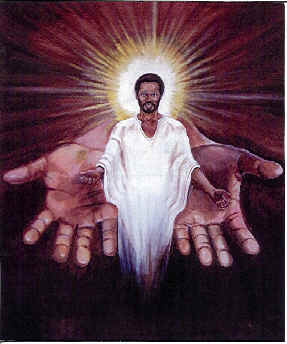
But today is not just (or even principally) about celebrating spring. Today’s focus is Yeshua returned to life after the tragic events of his arrest, rigged trials, torture, and execution. This is a time to celebrate spiritual rebirth and the fact that a new transformed life is possible not only for Yeshua of Nazareth, but for all of us as individuals, and as members of communities and nations.

Easter promises that all of us can enter God’s sphere and live new lives there as though we believed Yeshua’s words about treating others as we would like to be treated ourselves.

Resurrection in that sense means overcoming our fears of death. As Americans supposedly living in the “home of the brave,” we appear to be an especially timorous people. So we arm ourselves to the teeth and pass “Stand Your Ground” laws allowing us to shoot one another if we feel threatened by them. And these days we seem to be threatened by everyone – especially if they’re different in color, nationality, religion (especially Muslim), or sexual orientation. Truth be told: our lack of bravery borders on shameful cowardice.

In foreign policy our monumental American terror in the face of death has brought our “leaders” to implement a policy of remotely controlled death squads (drones). This means that from the comfort of air-conditioned “theaters” our brave drone “pilots” prowl about the world looking for suspected terrorists and “signature” targets. They patrol Iraq, Afghanistan, Pakistan, Ethiopia, and who knows where else looking for impoverished young men who meet the target profile. The victims are young, poor, and probably Muslim. They are carrying the very weapons we claim the right to bear; they are associates of or nearby others merely suspected of being terrorists.

So we bomb them – and any others who happen to be at hand including women, young children, the elderly and babies. We classify the casualties as “collateral damage.” Better that they die, we think, than that we endure the remote possibility of someday being attacked and deprived of life.

All of that seems terribly out-of-sync with the Christian faith 70-75% of us claim as our own. Yeshua had no fear of death. Or rather, he overcame his fear and endured torture and death on behalf of others. Saving his own life in favor of sacrificing others was not Yeshua’s Way. Quite the opposite.

Imagine if 70-75% of U.S. citizens refused to fight our unending wars simply because we claim to follow Yeshua’s Way. Imagine if we called upon our faith to demand that President Obama and CIA chief John Brennan stop the cowardly drone death squads. A faith like that would be worth embracing; it would make a difference.

In the film clip at the top of this post, religious leaders use the occasion of Easter to express such faith. Their words contrast sharply with the cowardly justifications fearfully mouthed by Obama and Brennan also centralized in the clip. As you watch our officials speak, see them as the fearful, timorous, cowardly bullies their words attempt to disguise.

How might we as believers add our voices to the call of our true leaders in this Easter invitation to rise with Yeshua to a new truly transformed way of life?

(Discussion follows)

Reading the Passion Narrative again for the First Time: The Origins of Submission to Authority and Anti-Semitism

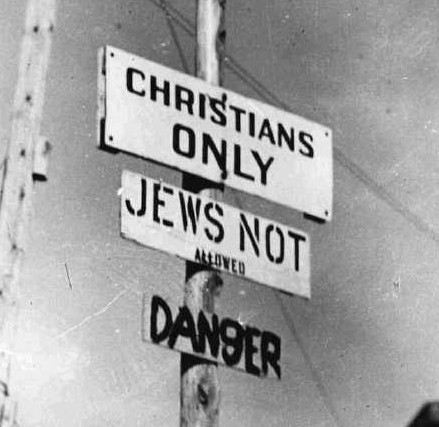
no-jews-allowed

Readings for Palm Sunday: http://www.usccb.org/bible/readings/032413.cfm

Since the beginning of Lent, I’ve been teaching a seminar on the historical Jesus. About twenty-five of us have come together each week to get closer to the Jesus who taught and served the poor in Palestine two millennia ago.

In that context, it’s nearly impossible for me not to read this Sunday’s Passion Narrative from Luke without applying what we’ve been learning at our group’s Wednesday night meetings. Doing so provides a fresh set of ears for understanding a familiar story as if hearing it for the first time. The result can in turn cause us to re-vision and re-conceptualize our lives as Jesus’ followers living under the sway of U.S. Empire.

As part of our seminar’s study, we’ve been watching excerpts the PBS video series “From Jesus to Christ.” It has helped us see that Jesus and his audiences were first and foremost Jews whose lives were shaped more than anything else by the Roman occupation of their homeland. As such, they weren’t waiting for a Roman-Greco “messiah” who, like the Sun God Mithra, would die and lead them to heaven. They were awaiting a Davidic messiah who would liberate them from the Romans.

Roman rule was especially odious for Jews. After all, they believed they had been given the land of Palestine by their God, Yahweh, whom Jews regarded as their land’s rightful sovereign. And yet, at the time of Jesus, Roman occupiers claimed that their emperor was god. In other words, the Palestine of Jesus’ day was blasphemously controlled by a foreign god. That was intolerable for Jews in general and for Jesus of Nazareth in particular.

So on this Palm Sunday, what do you think was on the minds of the crowds who Luke tells us lined the streets of Jerusalem to acclaim Jesus the Nazarene? Were they shouting “Hosanna! Hosanna!” (Save us! Save us!) because they thought Jesus was about to die and by his sacrificial death open the gates of heaven closed since Adam’s sin by a petulant God? Of course not. They were shouting for Jesus to save them from the Romans. They looked to him to play a key role in the Great Rebellion everyone knew about to take place against the hated Roman occupiers.

And what do you suppose was on Jesus’ mind? He was probably intending to take part in the rebellion just mentioned. It had been plotted by the Jews’ Zealot insurgency. Jesus words at the “Last Supper” show his anticipation that the events planned for Jerusalem might cause God’s Kingdom to dawn that very weekend.

At least Jesus’ Passover words show that something big was brewing for him – something on a par with the liberation from Egypt that had occurred more than 1000 years earlier. So over bread and wine he speaks of a “new covenant” to replace the old one the rebel Moses had mediated from Yahweh. After spending three years preaching about it, God’s Reign seemed so immediate to Jesus that he evidently thought it might dawn even before their next meal. He says “I will not drink wine with you again before the kingdom comes.”

So Jesus issues new and mysterious tactical orders. The advocate of simple living says “Whereas once I sent you out without money or a change of clothes, I’m telling you now to fill your wallet and pack a suitcase.” The non-violent one tells his friends to arm themselves. The courageous teacher of “the Twelve” warns darkly about intrigue, betrayal and denial by members of his innermost circle. Anticipation of all that causes such stress that Jesus eventually sweats blood over it.

Clearly Jesus had his differences with the Zealots. They were nationalists; he was inter-nationalist who was open to gentiles. The Zealots were violent; Jesus was not. And yet the Zealots and Jesus came together on their abhorrence of Roman presence in the Holy Land. They found common ground on the issues of debt forgiveness, non-payment of taxes to the occupiers, and of land reform. Within Jesus’ inner circle there was at least one Zealot (Simon). Indications might also implicate Peter, Judas, James, and John. And Jesus’ friends were armed when he is arrested. Whoever cut off the right ear of the high priest’s servant was used to wielding a sword – perhaps as a “sicarius” (the violent wing of the Zealots who specialized in knifing Roman soldiers).

But we’re getting ahead of our story. . . Following his triumphant entry into Jerusalem, Jesus soon found himself and his disciples inside the temple participating in what we’d call a “direct action” protest. They were demonstrating against the collaborative role the temple and its priesthood were fulfilling on behalf of the Romans.

As collaborators, the temple priests were serving a foreign god within the temple precincts. For Jesus that delegitimized the entire system. So, as John Dominic Crossan puts it, Jesus’ direct action was not so much a “cleansing” of the temple as the symbolic destruction of an institution that had completely lost its way.
It was this demonstration that represented the immediate cause of Jesus’ arrest and execution described so poignantly in today’s long gospel reading.

Following the temple demonstration, Jesus and his disciples became “wanted” men (Lk. 19:47). At first Jesus’ popularity affords him protection from the authorities (19:47-48). The people constantly surround him eager to hear Jesus’ words denouncing their treasonous “leaders” (20:9-19), about the issue of Roman taxation (20:20-25), the destruction of the temple (21:1-6), the coming war (21:20-24) and the imminence of God’s Kingdom (21:29-33). By night Jesus and his friends repair to their Garden of Olives hideout (21:37).

Eventually however, Jesus has to go underground. On Passover eve he sends out Peter and John to arrange for a safe-house to celebrate the feast I described earlier. The two disciples are to locate the “upper room.” They do so by exchanging a set of secret signs and passwords with a local comrade.

Then comes Jesus’ arrest. Judas has betrayed Jesus to collect the reward on Jesus’ head – 30 pieces of silver. The arrest is followed by a series of “trials” before the Jewish Council (the Sanhedrin), before Pilate and Herod. Eventually, Jesus is brought back to Pilate. There he’s tortured, condemned and executed between two other insurgents.

The trials point up an interesting and important difference between the Jesus of history and the political project of the author of Luke’s Gospel. In the past, we’ve been told the real charge against Jesus was blasphemy; the Jewish authorities were offended because Jesus claimed to be God. However, under Roman law, the Jewish leaders lacked authority to execute criminals. So they were forced to trump up political charges and involve the Romans who alone had the power to inflict capital punishment.

Clearly, however, this was not the case. As we saw last week with the woman taken in adultery, the Jews had the authority to execute people for religious crimes such as adultery or (in Jesus’ case, blasphemy). If Jesus had committed blasphemy, they could have stoned him using the Jewish form of execution.

Instead, Luke presents Jesus as hauled off to Pilate. And completely out-of-character, and after the presentation of clear-cut evidence that the Nazarene rabbi was “stirring up the people,” and despite Jesus’ own admission to crimes against the state (claiming to be a rival king), Pilate insists three times that the carpenter is innocent of capital crime. Such tolerance of rebellion contradicts what we know of Pilate as described for example by the Jewish historian Josephus.

Contradicting all of this as well, Crossan insists that Pilate had standing orders to execute anyone associated with lower class rebellion during the extremely volatile Passover festivities. In other words, there would have been no drawn-out trial.

What’s going on here? Two things.

First of all, like everyone else, Luke knew that Jesus had been crucified by the Romans. That was an inconvenient truth for Luke’s audience who around the year 85 CE (when Luke was writing) was desperately trying to reconcile with the Roman Empire which lumped the emerging Christian community with the Jews whom the Romans despised.

Luke’s account represents an attempt to create distance between Christians and Jews. So he creates an account that exonerates Pilate (and the Romans) from guilt for Jesus’ execution. Simultaneously, he lays the burden of blame for Jesus’ execution at the doorstep of Jewish authorities.

In this way, Luke made overtures of friendship towards Rome. He wasn’t worried about the Jews, since by the year 70 the Romans had destroyed Jerusalem and its temple along with more than a million of its inhabitants. After 70 Jewish Christians no longer represented the important factor they once were. Their leadership had been decapitated with the destruction of Jerusalem.

Relatedly, Jesus’ crucifixion would have meant that Rome perceived him as a rebel against the Empire. Luke is anxious to make the case that such perception was false. Rome had nothing to fear from Christians.
As we have seen in today’s readings, that assurance itself was untrue. It domesticated the Jesus of history who shines through even in Luke’s account when it is viewed contextually. That’s the vision we’ve been attempting grasp in the Historical Jesus Seminar.

And so what?

Well, if you wonder why Christians have lost their edge . . . if you wonder why they so easily succumb to empires (Roman, Nazi, U.S.) you’ve got your answer. It all starts here – in the gospels themselves – with the great cover-up of the rebel Jesus.

And if you wonder where the West’s and Hitler’s anti-Semitism came from . . .

Will the Next Pope Continue the War on Liberation Theology?

jesus on cross

With the resignation of Benedict XVI and the papal conclave in process, friends have asked me to say something about it all. My thought is simple. The success of any new papacy and the prospect of the Catholic Church rebounding from its worst crisis since the Reformation hinges on one thing more than any other: the attitude of the new pope and of church leadership in general to liberation theology.

Let me be clear on what I’m talking about. I understand liberation theology as “reflection on the following of Jesus of Nazareth from the viewpoint of those committed to the emancipation of the poor and oppressed.” The commitment in question brings to light social implications of the Judeo-Christian tradition – for creating a world with room for everyone, beginning with the poor – that remain opaque for those without such commitment.

Liberation theology in the sense just defined represents the most important theological development of the last nearly 1700 years. More than that, it is arguably the most important intellectual development of the last 150 years – dating back to the publication of the Communist Manifesto.

Popes and presidents have implicitly recognized that importance and power over the last 40 years and more. In fact that reaction has given form to the Roman Catholic Church itself under the last two popes. More than anything else liberation theology has also influenced U.S. politics for the last 30 years. It has literally shaped our world. Liberation theology is the reason behind the current spate of unending wars against the poor people of the world.

When I express such judgment to friends, they remain dubious and unbelieving. Their response not only reflects tone-deafness to the power of religious mythology, it also illustrates how short our memories are. We have trouble recalling what Chomsky calls the “first religious war of the 21st century” – less than forty years ago. That war was fought not against Islam, but against the Catholic Church in Latin America, precisely because of its adoption of liberation theology’s “preferential option for the poor.”

In Latin America, the Reagan administration and its successors correctly perceived the grassroots social power of liberation theology. In Central America they saw a threat to control of its “backyard.” So U.S. officials allied themselves with a conservative Polish pope in the Vatican, with reactionary Evangelicals in the United States to strangle the revolutions of the poor who found great hope in powerful liberationist interpretations of their religious traditions which had been traditionally used to keep them in their places.

The threat of liberation theology was perceived well before Reagan. Already in 1969, the Rockefeller Report had identified liberation theology as a threat to the national security of the United States. By 1987, the Latin American Military Chiefs of Staff meeting in conference in Mar del Plata, Argentina, devoted several pages of their final report to liberation theology and the threat it posed to regional stability. In between, in 1979 the first Santa Fe Document advised the incoming Reagan administration that it had to do something decisive about the threat posed by liberation theology. The administration heeded the advice, and responded both militarily and ideologically.

Reagan’s military strategy against liberation theology issued in that religious war Chomsky referenced. It was perceived as necessary because in 1969, the Conference of Latin American Bishops had together dared to affirm a “preferential option for the poor” as their official position.

To combat that commitment, the U.S. sponsored blood baths throughout Latin America. Many of us are well acquainted with the best-known martyrs: Camilo Torres, Archbishop Romero, the Salvadoran team of liberation theologians killed at San Salvador’s Central American University in 1989, and with the U.S. women religious murdered years earlier in that same country. And then the unending list of martyrs in this war against the Catholic Church – 200,000 in Guatemala, more than 100,000 in Nicaragua, 90,000 in El Salvador, and literally untold killings and disappearances in Honduras. In every case, the carnage was a response to social movements inspired by liberation theology. Again, as Chomsky points out, official U.S. military documents show that liberation theology was a major target of those wars. In fact within those same official documents, the Army boasts specifically about defeating liberation theology.

As for Reagan’s ideological response to liberation theology . . . . On his accession to power, CIA Psy-ops began funding conservative alternatives to liberation theology in Latin America and in the U.S. So did business concerns that saw the leftward drift of Latin America as a threat to their presence there. Domino’s Pizza and Coors Brewery were prominent among the cases in point.

As a result, evangelicals throughout the region grew rapidly in number, and the recipients of those funds in the United States increasingly identified with Republicans, the “hand that fed them.” So the television programs of Jerry Falwell, Pat Robertson, Jim and Tammy Baker, Jimmy Swaggart, and others were beamed into every poor barrio, población, and favela. Right wing churches sprang up everywhere feeding and expanding an already robust evangelical presence in areas once completely dominated by the Catholic Church. The message was always the same – a depoliticized version of Christianity whose central commitment involved accepting Jesus as one’s personal savior and rejecting communism including the type allegedly represented by the theology of liberation.

All of this points up the extreme importance of LT. In effect liberation theology was not only responsible for spiritual and political awakening throughout Latin America, it was also indirectly responsible for the rise of the religious right in the United States, and ultimately for the Tea Party. On the other side of the aisle, so to speak, we currently have in the White House the first U.S. president directly influenced by liberation theology. For 20 years, Barack Obama was part of the congregation of Jeremiah Wright – identified by James Cone, the father of black liberation theology, as the latter’s foremost contemporary embodiment.
This is why it is possible to identify liberation theology not only as the most important theological development of the last 1700 years, but as the West’s most important ideological development in the past 50 – perhaps the past 150 – years.

As for liberation theology’s contemporary importance, today’s religious right and the Tea Party would probably not exist today were it not for liberation theology. And the 2008 debate about liberation theology (i.e. about Jeremiah Wright) nearly derailed Obama’s run for the presidency. That is, liberation theology has been far more influential than most are willing to recognize. In a sense, it has shaped U.S.-Latin American relations for a half-century. It has changed the face of Protestantism in the United States.

Reagan’s ideological strategy against liberation theology also changed the Catholic Church. As indicated earlier, it involved allying himself with a conservative anti-communist Polish pope, John Paul II, who proved to be an inveterate enemy of liberation theology. The apparent agreement between the two was that John Paul would be silent about the war against Latin American Catholics, if Reagan would help him in the pope’s campaign against communism in Poland. Over his reign of over 20 years, John Paul was to gradually replace Latin America’s pro-liberation theology bishops with conservative pre-Vatican II types. He did this throughout the world – mostly in direct response to liberation theology.

Even more virulently set against liberation theology was John Paul’s lieutenant, Joseph Ratzinger, whom the pope appointed head of the Sacred Congregation for the Faith (formerly the Office of the Holy Inquisition). In that capacity, Ratzinger penned an official warning about liberation theology in 1985. Basically, it rejected the movement because of its association with Marxist analysis of third world poverty. Of course, Ratzinger succeeded John Paul II in the papacy. He’s the recently resigned Pope Benedict XVI. So the onslaught against liberation theology continues with no end in sight.

Sadly, Reagan’s two-front strategy worked. Revolutionary gains in El Salvador, Guatemala, and most prominently, in Nicaragua were halted and reversed. Militarily, the “Guatemala Solution” was the template. It entailed using military and paramilitary death squads to kill everyone remotely connected with guerrilla movements. According to the Reagan strategy, that included priests, nuns, lay catechists and ministers of the word influenced by liberation theology. The theological strategy worked as well. The slogan promulgated by the Salvadoran military said it all, “Be a patriot; kill a priest.”

But despite the carnage, and despite the claims of victory by the U.S. military, liberation theology remains alive and well in grass-roots movements for solidarity. And in general, social movements inspired by liberation theology bore fruit in the ‘70s and ‘80s. They continue to bear fruit today. More specifically, one can credibly say that apart from the theology of liberation it’s impossible to explicate Allende’s rise to power in 1973 or the triumph of the Sandinistas in 1979, or the power the FMLN in El Salvador had and continues to enjoy today. The Zapatista movement in Mexico is also intimately connected with liberation theology. Even more, without reference to liberation theology, it’s impossible to fully understand the rise of new left governments throughout Latin America. All of them are indebted to liberation theology and its power to motivate the grassroots.

That same power to motivate is evident in the ongoing “Arab spring.” There the power derives from the liberation currents undeniably present in Islam. In fact, as Gandhi saw in changing the face of India, similar currents are found in Hinduism. All of this indicates that liberation theology has at its roots elements found at the center of all the religions of the world. In this light, the world-wide offensive against Islam represents the latest phase of the now Thirty Years War against liberation theology under wherever form it may appear.

To be on the right side of history and to move the world towards God’s Kingdom, any new pope must call off the war against liberation theology and embrace it fully in word and action. Imagine how the world would change if he did!

Jesus’ Case for Non-Violent Resistance to Rome (Sunday Homily)

images16[1]

Readings for 3rd Sunday of Lent: Ex. 3:1-8A, 13-15; Ps. 103: 1-4, 6-8, 11; I Cor. 10:1-6, 10-12; Lk. 13: 1-9 http://www.usccb.org/bible/readings/030313-third-sunday-lent.cfm

I’m currently teaching a little Lenten seminar on the historical Jesus. Its central emphasis explores the context of Jesus life and words. The idea is that understanding that context will help us better interpret the gospel readings we encounter in church each Sunday. Our goal is to get closer to the meaning intended by the Four Evangelists and beyond that by the historical Jesus who stands behind the evangelists’ interpretations of the carpenter from Nazareth.

We’ve discovered that one of the criteria for identifying the authentic words and deeds of Jesus is the unconventionality of Jesus’ teaching. By all the accounts we find in the gospels, Jesus regularly scandalized and angered his straight-laced listeners – especially the professional rabbis, priests and scribes. So anything in the gospels that smacks of the scandalous has a point in its favor regarding the authenticity that concerns our seminar. By the same token, expressions of conventional wisdom are doubtfully authentic for that very reason.

With this in mind, there are at least two ways of interpreting today’s gospel reading from Luke. The more or less standard reading boils down to conventional wisdom. It’s what we usually hear from the pulpit. The other interpretation is truer to Jesus’ context. The difference between the two interpretations illustrates what we’re about in the seminar I mentioned. Contrasting the understandings also uncovers a strong challenge otherwise concealed in this more contextualized reading.

Before we get to that, consider the standard interpretation of this text. Jesus is asked about “the Galileans whose blood Pilate had mingled with the blood of their sacrifices.” Evidently, Roman soldiers had surprised some Galilean insurgents while the rebels were engaged in worship. The soldiers had slaughtered the men then and there. Jesus asks “Do you think that because these Galileans suffered in this way because they were greater sinners than all other Galileans?” Then he answers his own question, “By no means! But I tell you, if you do not repent, you will all perish as they did!”

Jesus continues his questioning. He asks,

“Or those eighteen people who were killed
when the tower at Siloam fell on them—
do you think they were more guilty
than everyone else who lived in Jerusalem?
By no means!
But I tell you, if you do not repent,
you will all perish as they did!”

Here interpreters unfamiliar with the historical context in question usually understand Jesus as referring to a random accident that was well-known in his time. A tower had fallen by chance and killed some innocents. It raised the familiar question, “Why do bad things happen to good people?”

In both cases, Jesus’ answer seems to be: bad things happen to good people because the people aren’t really good. The insurgents were guilty and deserved what they got. The same is true about the apparently innocent bystanders killed by the tower’s freak accident. Even more, Jesus seems to be saying, everyone is guilty and needs to repent or all will perish in the same way. “Repentance” is usually understood as more faithful observance of the 10 Commandments – especially those having to do with sex.

There are obvious problems with this interpretation. To begin with, the “wisdom” attributed to Jesus is nothing if not “conventional.” That in itself distances the explanation from the decidedly unconventional historical Jesus. Secondly, the standard interpretation ignores the political nature of this passage. It places in the same category of “acts of God” the accidental collapse of a tower on the one hand and the murder of Jewish patriots on the other. This equivalency has Jesus more or less endorsing Pilate as the agent of God’s punishment for the sins of the Galileans in question. Such endorsement and lack of political nuance is hard to imagine coming from the mouth of a Galilean Jew of the 1st century.

An explanation more faithful to Jesus’ context takes the topic of today’s readings to be violence, counter-violence and the need for non-violent resistance. According to this reading, Jesus’ words are not taken as an abstract statement about bad things happening to good people. His pronouncement doesn’t equate Pilate’s murder of innocents with the accidental collapse of a building. Instead the two incidents are seen as mirror images of each other. Together they warn about the cycle of violence Jesus sees as destroying his people. This approach contextualizes Jesus’ words and takes seriously the political intent of the news item shared with Jesus at the very outset. Luke tells us,

“Some people told Jesus about the Galileans
whose blood Pilate had mingled with the blood of their sacrifices.”

No doubt, this was not news to Jesus. Everyone in Galilee must have been talking about it. Some Galileans – people from Jesus’ own province – had been slaughtered by Roman soldiers while offering sacrifice. The opening words of today’s gospel were not meant to communicate news but to complain about the Roman occupiers. Those introducing the topic were looking for sympathy and agreement. Jesus does not disappoint.

Pilate, of course, would have claimed that his victims were insurgents against the Roman occupation; they were “guilty” as terrorists, he would have said. That was his official line. Jesus says, “Don’t believe it” – as if his audience were tempted to believe Roman lies. “Do you think they were guilty?” Jesus asks. “By no means,” he answers.

Here Jesus is agreeing with his Galilean compatriots. If the ones Pilate killed were terrorists, he says, so are all Galileans; we’re all guilty in Pilate’s eyes. None of us wants the Romans here, Jesus implies. After all, it wasn’t the Galileans who threw the first stone; it was Pilate and the Roman soldiers who did so by invading Israel’s sovereign territory.

But then Jesus suddenly takes another tack. He connects Pilate’s butchery with another headline of his day – an act of counter-violence taken by the “Zealot” forces Pilate was attempting to punish. (Zealots were the revolutionary force committed to ousting the Roman occupiers from Palestine.) Pilate’s action, Jesus suggests, started the cycle of violence that evoked a disaster at Siloam at a spot near the Fountain of Ezekias. Siloam was the location of a small arsenal, where the Romans kept their swords, shields, battering rams and other weapons.

According to Maria and Ignacio Lopez-Vigil, a group of Zealot insurgents had tried to dig a tunnel up to the tower with hopes of seizing the weapons and turning them against the Romans. But the tower’s foundation was already in a state of decay, and the tunnel caused the entire construction to suddenly collapse. The falling tower claimed the lives of several Galilean families who had built their houses near the arsenal.

Jesus point: Pilate is certainly a bloodthirsty man. None of us want him or his armies on our soil. However, those who return his violence with their own are bloodthirsty too. And if we don’t reform our ways we’ll all drown in a bloody deluge. Or as Jesus put it, “I tell you, if you do not repent, you will all perish as they did!”

And time is running short, he adds with his parable about a fig tree. The bloody deluge has been building for at least three years. We have maybe another twelve months before the chickens of the deadly cycle of violence come home to roost. Without repentance, without replacing violent resistance to Roman butchery with non-violent tactics, we’ll all be cut down like a barren fig tree. (Later on, remember, Jesus himself demonstrates the kind of non-violent direct action he had in mind, with his “cleansing” of Jerusalem’s temple.)

Jesus’ prediction of bloodbath, of course, eventually comes true, but not as soon as he thought. The Romans would defeat the Zealot uprising in the year 70, and definitively squash all Jewish rebellion in 132. Jesus was right however about the extent of the slaughter. It was horrific resulting in the deaths of more than a million Jews. Such disaster is inevitable, Jesus teaches for all who “live by the sword.”

What does all of this say to us today? The message is quite relevant. It says first of all that we must be careful about domesticating Jesus and the gospel. The standard interpretation of this passage has the effect of making us comfortable with empire as somehow the instrument of God. It is not. Instead, empire represents the systematized oppression of the poor and defenseless by the rich and powerful. That was true of Rome; it’s true of U.S. empire today. We’re still killing insurgents in their churches and mosques.

Secondly, this passage calls us to non-violence and warns us about where the cycle of violence will inevitably lead. Sandy Hook provides a window into the world created by the worship of guns. Another window is provided by Afghanistan and Iraq, Vietnam, Hiroshima, the Cold War, and the general impoverishment of our country and world brought on by so-called “defense” spending. All of it has us drowning in a deluge of blood. And it promises to get worse and eventually destroy us all. How much time do we have before our chickens come home to roost – three years, one year. . .?

Christians represent about 30% of the world’s inhabitants. There are more than 2 billion of us. Imagine the world we’d create if we insisted on following the call to non-violence represented by Jesus’ words in this morning’s gospel!

More Happiness in the Barrios than in the Suburbs

Moon-lightening

Here is a thoughtful comment on my posting of February 6th, “Why Bother with the Historical Jesus?” It’s authored by a friend of mine, Jim Cashman (photo above), who studied with me for three years at St. Columban’s Major Seminary in Milton, Massachusetts when I was there from 1961-1967. Jim was an exchange student from Ireland, where he was ordained in 1964. Like most of us from that era, he left the priesthood after the Great Awakening which followed the Second Vatican Council (1962-’65). Jim writes:

In my view if all we have is subjective and “bias” and hence doubtful history on Jesus, then the more digging one does, especially based on modern science, the better it is for us getting to the reality on Jesus. The Jesus uncovered by science is vastly superior to the faith or propaganda-based version. I have always been dubious about taking anything on faith. It leads to too many wars! What we seek is the truth not support for our environmental brainwashing.

The thing which I regard as above debate is the focal point of your blog. I’m referring to the nature or qualities of God. Factually we know so little about that – maybe nothing. Given that reality, it seems better not to think of Jesus as the son of god or of God being Jesus, but as simply reflecting the nature of God. That seems to be the important point you make. I never had any hang-up/special needs for the divinity of Jesus or the virginity/motherhood of God. I do not feel it is central to the Jesus message. It might be central to Catholicism, but not to understanding of the meaning of my life. Why the hell am I here?

What I find central is that Jesus (like many of the prophets), reflects the core nature of God and that is Love. I feel this Love is not what we think it is. It’s not charitable foundations or helping old folks like me cross the street?

Maybe as Paul hints we are not yet sufficiently evolved or “spiritual” to accept Jesus’ very simple revelation about the nature of God as Love. Now we known in part; then we shall know fully – even as we are fully known. From Krishna to Christ this is the common unifying thread of human development: giving without any payback or satisfaction!. All of this contradicts where we are in the world of greed, self interest and now the ultimate decadence – endless ‘shopping.’

If we all take from nature only enough for what we need, then the poor we could “always have with us” – as equals. Even with the little they have, the stats show there is more happiness in the barrios than in the suburbs.

The worst outcome we could have from the present move against the hypocrisy of Rome (and Washington) is that we achieve “renewal” and leave the real task – the search for truth, for another millennium.

Keep pushing out the boundaries, Mike; we are at the early stage of evolution. And in your downtime you might find this of interest:
http://archive.org/details/ACanticleForLiebowitz The irony like. “1984”, is chilling. Jim

PS – the “stream” may need some manual help in this dramatized audio edition.

Churches, Popes, Women, and the “V” Word (Sunday Homily)

thevaginamonologues[1]

Readings for 5th Sunday in Ordinary Time: Is. 6:1-2a, 3-8; Ps. 138: 1-5, 7-8; I Cor. 15: 1-11; Lk. 5: 1-11. http://www.usccb.org/bible/readings/021013.cfm

Have you ever seen Eve Ensler’s “Vagina Monologues?” A few years ago that series of dramatic readings was presented at Berea College where I taught for 37 years. The readings were as provocative as the play’s title. All of them reflect the unique experience of being woman that most of us Christian males find so difficult to understand, especially after so many years of brain-washing at the hands of predominantly male clergies.

Significantly, Ensler refers to that particular churchly indoctrination in the prologue to her text. There she quotes Gloria Steinem who recalls:

“In the sixties, while I was doing research in the Library of Congress, I found a little known treatise about the history of religious architecture which blithely stated a thesis, as it were known by everybody, to the effect that the traditional shape of most patriarchal buildings of worship imitates the female body. Thus, there is an external entrance and another internal one, the labia majora and the labia minora; there is a vaginal central nave, which leads to the altar; there are two curved ovarian structures on either side; and finally, in the sacred center is the altar or uterus, where the great miracle takes place: men give birth.

“Though this comparison was new for me, it opened my eyes with a shock. Of course, I thought. The central ceremony of the patriarchal religions is nothing else but the ceremony in which men take control of the “yoni” power of creation by giving birth symbolically. It is no wonder that male religious leaders state so often that we human beings are born in sin … because we are born from female tummies. Only by obeying the rules of the patriarchy can we be “reborn” through men. It is no wonder that priests and pastors decked out in long vestments sprinkle our heads with a fluid that mimics the waters of birth. It is no wonder that they give us new names and promise us we will be reborn in eternal life. It is no wonder that the male priesthood attempts to keep women far removed from the altar, just as we are kept far removed from control of our own powers of reproduction. Whether symbolic or real, everything is aimed at controlling the power that resides in the female body.”

Talk about provocative! Here Ms. Steinem is claiming that creative power is focused chiefly in the female body, though men obviously have an ancillary role in the begetting of life. Because their role is so obviously secondary, a primary male purpose in organized religion, Ms. Steinem says, is for men to alienate or steal the vastly superior womanly power of life and to control it – against women themselves.

Patriarchal religion accomplishes its task by dressing men up like women. It has them sprinkling their congregations with the waters of birth introducing them to “eternal life.” This form of life is held to be more important than physical life, and male pastors claim to control it to the exclusion of women. The prerequisite for women’s access to life eternal is that they adopt the rules of the exclusively male priesthood especially those connected with female powers of reproduction centered in the woman’s body whose architecture the male priestly domain of church actually mimics.

I bring all of that up because today’s liturgy of the word is so obviously male-centered in a very misleading way. Together with Ms. Steinem’s reflections, the readings of the day suggest why someone like our present Pope Benedict XVI along with Christian pastors of many denominations participate so enthusiastically in what has been called a 21st century “War on Women” and why the pope is so afraid of women priests.

Female priests might inspire women to recognize their inherent superiority over men in terms of centrality to the life processes (both physical and spiritual) that the patriarchy struggles so mightily to control. If women were allowed the leadership that their biology suggests, what would become of the male-centered church – of the male-centered world?

Today’s liturgy of the word tries to keep us from asking such questions. It begins with a description of God in highly masculine terms centered in the macho realm of palace and court. God is depicted as “king.” He (sic!) is “Lord.” He inspires fear and awe. He dwells in a smoke-filled room surrounded by all the trappings of power and might. Like the prophet Isaiah, those who appear before him feel small and ashamed of the very words that come from their lips.

This, of course, is the image of God we’ve been offered from the cradle. (Can you imagine how different we’d feel personally, ecclesiastically, nationally and internationally if the familiar image of God were a mother nursing her child? Would you feel any different towards such a Mother God? – Remember, it’s all just symbolism. And the image of God that’s come to dominate arises from one of the most patriarchal traditions in the history of the world.)

The male-centeredness of today’s readings continues in the selection from Paul’s first letter to Christians living in Corinth. It’s a key passage because Paul is trying to establish his identity as an “apostle,” even though he never met Jesus personally. Paul bases his claim on the fact that Jesus appeared to him just as he did to the other apostles. So he says “Remember what I preached to you:” Christ died for our sins. He was buried and raised on the third day. He appeared to the 12, then to 500 “brothers” at once, then to all of the apostles, and finally to Paul himself.

There is so much interesting in this summary of Paul’s preaching. What, for instance, happened to Jesus’ words and deeds? Paul’s gospel begins with Jesus’ death! What about Jesus’ life which revealed the character of God as compassionate and “womb like?” (See Marcus Borg, Meeting Jesus again for the First Time, chapter 3.)

However, even more to the point is Paul’s omission of the fact that according to ALL of the accounts of Jesus’ resurrection appearances in the canonical gospels, Jesus’ first appearances were to women, not to men!! (Remember Jesus’ appearance to Mary Magdalene in John 20:1-18?) Using Paul’s logic, doesn’t that establish the primacy of women in the church – and in the priesthood? The misogynistic Paul doesn’t want to go near that question. And neither does the equally misogynistic Pope Benedict XVI.

And then we have today’s gospel selection from Luke. It’s the call of the first apostles. According to Luke, Peter, James, and John are the first to follow Jesus. That leaves us with the usual impression that Jesus called only men.

Omitted from our vision is the fact that according to Luke himself (8:3) there were “many women” taking an active part in the Jesus Movement. Besides Jesus’ mother Mary, we know the names of some of them: Mary Magdalene, several other Marys, Suzanne, Salome, Martha and Mary of Bethany, Joanna. . And the roles of these women weren’t confined to preparing food and washing clothes.

In the first Christian communities, men and women met and worshiped together. Both men and women preached the message of Jesus with the same authority, and both men and women presided at the celebration in remembrance of their crucified Master. Like the men, the women had representation and decision-making power in the communities as priests and bishops.

That was even true of the communities of Paul. Paul himself taught that “In Christ there is no male or female” (Galatians 3,28). With this claim he legitimized the active participation of women in the first Christian communities. Also, he makes emphatic mention of many women in his letters and lavishly praises their work. For example, he mentions by name the deaconess Phoebe (Romans 16,1), Junia (Romans 16,7), Prisca, Julia, Evodia and Sintece, all of whom he called his “collaborators” (Philippians 4,2). He also mentions Claudia, Trifena, Trifosa, Prisca, Lyida, Tiatira and Nympha of Laodicea. Of the 28 persons to whom Paul accords special praise in his letters to the early churches, 10 are women!

All of that changed in the 4th century, when Christianity lost its soul and became the official religion of the Roman Empire. Then Christianity adopted for good the courtly vision today’s first reading affirmed: macho-kings, courts, palaces, smoke-filled rooms, men dressed like women, denigration of women’s bodies, men trying desperately to affirm their superiority against all the evidence of biology, life’s processes, Jesus’ own example, and women’s traditional roles as nourishers, healers and spiritual counselors.

Let’s talk about how women might take back those roles both in church and in politics. How do we “get to” someone as closed as Benedict XVI? How do we get to our bishops and priests? How do we get to our own acquiescence to the misogyny of our church and culture?
(Discussion follows)

Why Bother with the Historical Jesus?

I’m about to offer a Lenten course on the historical Jesus to the members of my faith communities – to my fellow parishioners at St. Clare’s Catholic Church in Berea, Kentucky, and to an “Ecumenical Table” fellowship I attend.

A course on the historical Jesus? A friend of mine asked why. After all, everyone knows we can’t know much about the Jesus of history. Virtually all we have for sources are the highly subjective gospels produced by several Christian communities long after Jesus had died. And close examination of those gospels show them to be unreliable in terms of modern ideas about history. At best they’re propaganda intended to win converts to Christianity. They contain lots of made-up stories and words attributed to Jesus long after the fact. If that’s all we have, how can we really say anything about the Jesus of history? And what does it matter?

Many highly credentialed and very credible scholars have seconded my friend’s skepticism. Theologians as weighty as Rudolf Bultmann and Karl Barth have said in effect “fagedaboudit.” It’s not for nothing that St. Paul concentrated on Jesus’ death, resurrection and glorification “at the right hand of the Father.” And he was writing less than 20 years after Jesus’ death. For Bultmann and Barth (and it seems for Paul) that’s all Christians have to know. Jesus words and deeds actually matter very little.

Still, others have disagreed – most notably the four canonical evangelists (Mark, Matthew, Luke, and John) and the authors of more than 20 “gospels” discovered since the middle of the 20thcentury at the Dead Sea and Nag Hammadi in Palestine. They found it necessary to record what Jesus said and did.

Modern scholars on a par with Barth and Bultmann have followed suit. Albert Schweitzer, liberation theologians, and members of the Jesus Seminar have insisted that it’s necessary and possible to know what Jesus said and did. He after all (and not what later believers made of him) was the definitive Symbol of God. His every word and action is full of meaning in terms of revealing God’s identity. In that sense, Jesus is not God. Rather God is Jesus. Without the historical revelation of what Jesus said and did, we would have very little idea of who God is.

In order to know what Jesus revealed, it is therefore necessary to decipher the symbols of God that Jesus’ words and deeds provide. And besides, the Judeo-Christian tradition as a whole claims to be historical. It’s not mythological like Greco-Roman religious systems. So the historical Jesus is important as a final criterion of faith. We impoverish that faith by relying merely on Jesus’ death, resurrection and glorification as related by Paul and others.

Not only is it necessary to know what Jesus said and did in order to know the fullness of revelation of God that Christians find in him. It is also possible to do so – at least according to “Jesus scholars.” They have developed an elaborate set of criteria for separating the events of Jesus life that surely took place from those made up by the early Christian community. Similarly, their standards help readers identify what Jesus actually said from the words that early Christians put into Jesus’ mouth.

Chief among such criteria is the standard of “embarrassment.” That means that events and sayings that would have caused embarrassment to the early Christian community must have happened, otherwise early believers wouldn’t have recorded them. The crucifixion of Jesus is a case in point. And so is his baptism at the hands of John the Baptist – as well as his association with outcasts and “unclean” sinners. Jesus’ baptism gives the impression that John was superior to Jesus. His crucifixion was a huge stumbling block for those trying to convince people that he was the Messiah. Nobody would have made up such events from whole cloth. They were too embarrassing.

Still doubts remain about the historical Jesus – as they do by the way for all historical characters and events all of which become obscured by rumor, myth, falsehood, and the agenda of those writing the “history.”

What we can know a great deal about is Jesus’ historical context. In fact knowledge of Jesus’ context is knowledge about him. Take for instance the work of forensic archeologists. They can tell us what the people of Jesus time and place looked like – something none of the gospels offer. Forensic archeologists tell us that he stood about 5’1 and weighted about 110 pounds, and looked like this:

SON OF GOD

Not like this:

th[7] (2)

The bottom line here (and in the course I’ll offer) is that the work of the Jesus Seminar and others involved in quests for the historical Jesus is extremely helpful, but not crucial. What is crucial is to read the gospels we have with as much knowledge of context as we can. The gospel reading that results is called “historical literal.” It takes the gospels at their word keeping in mind what we can know of the author’s intentions, literary strategy, theology, and context (social, political, economic, religious . . .).

Reading the gospels with such new knowledge in mind yields an extraordinary picture of an individual the likes of whom mainstream history routinely ignores, denigrates and erases from the collective memory — a poor man who inspired other poor people to realize that they meant a lot more to God than their rich and powerful contemporaries.

“What if Jesus Had Been a Republican?” (Twenty-Second Sunday in Ordinary Time)

Today’s Readings: Dt. 4:1-2, 6-8; Ps. 15:2-5; Jas. 1:17-18, 21b-22, 27; Mk. 7:1-8, 14-15, 21-23

Tikkun Magazine (the Israeli-American quarterly published by Rabbi Michael Lerner) recently published an article called “What if Jesus Had Been a Republican?” It rewrote three well-known Christian Testament scriptures to reflect the world vision and morality of the Republican Party. The piece was reproduced on the news and analysis website “AlterNet.” (Here’s the reference http://www.alternet.org/belief/what-if-jesus-had-been-republican?paging=off).

The first rewritten episode was entitled “The Lazy Paralytic.” It was about the paralyzed man whose friends removed roof tiles on a home to bring him into Jesus’ presence, when the Master was otherwise inaccessible because of the large crowds around him. The revised story has Jesus saying to the paralytic, “Can’t you take care of your own health problems? I’m sure that your family can care for you, or maybe the synagogue can help out.” . . . . What would happen if I provided access to free health care for everyone? That would mean that people would not only get lazy and entitled, but they would take advantage of the system. Besides, look at me: I’m healthy. And you know why? Because I worked hard for my money, and took care of myself.”

The second rewritten episode was called “The Very Poorly Prepared Crowd.” It re-imagined the feeding of 5000 people usually understood as the “Miracle of the Loaves and Fishes.” Only this time there was no feeding. Jesus says that would make the improvident crowd too dependent on authority figures like himself. People would never learn to think ahead and the lesson of self-sufficiency would be lost. So applying the principle of “tough love,” Jesus eats one loaf and one fish himself and gives the remaining four loaves and one fish to his twelve apostles.

Even more to our readings’ main point this morning, the reformulated story of “The Rich and Therefore Blessed Young Man,” has a rich man kneeling before Jesus to ask, “What must I do to inherit eternal life?” When Jesus learns that the man has been born into wealth and privilege, Jesus’ admiration knows no bounds. However, he says, one thing is lacking in terms of God’s kingdom: “A bigger house in a gated community in Tiberias. Buy that and you will have a treasure indeed. And make sure you get a stone countertop for the kitchen. Those are really nice.” Jesus’ disciples are scandalized by all of this and ask, “But Lord,” they said, “what about the passages in both the Law and the Prophets that tell us to care for widows and orphans, for the poor, for the sick, for the refugee? What about the many passages in the Scriptures about justice?” 7. “Those are just metaphors,” said Jesus. “Don’t take everything so literally.”

I point you towards those rewritten parables not only because they made me laugh, or because we saw the Republicans in action at their convention last week, but because the last rewrite I mentioned is closely related to this morning’s readings. Those readings remind us of how religion, and specifically the person and words of Jesus can be distorted to reflect what Jesus calls “human traditions” rather than “God’s commandments.”

Today’s first reading from the Book of Deuteronomy reminds us of what the heart of God’s commandments actually was. The Deuteronomy reading shows Moses preparing the ex-slaves just escaped from Egypt for a law that centralizes social justice and care for the orphans, widows, (and immigrants).  The Law of Moses was about setting up a community where what we today would call social structures protected society’s most vulnerable. Its Jubilee statute made provision for the periodic cancelling of debt and the return of land and homes to those who had lost them to the bankers.  The Mosaic Law even forbade charging interest itself – as the words of today’s responsorial psalm remind us. In fact, up until the late Middle Ages, when capitalism began to emerge, charging interest on loans was considered immoral and contrary to Scripture. But then, of course, the Tikkun Jesus would remind us, “Don’t take everything so literally.”

Today’s second reading from the Letter of James’ stands firmly in the Mosaic tradition and defines religion in terms of specific acts directed towards the poor. In fact, James definition of pure and undefiled religion consists entirely in taking care of the orphans and widows in their affliction.  That definition reflects the very attitude of Jesus himself. Recall that in Matthew 25 – our only unambiguous account of the final judgment – the entire affair is based on specific acts of compassion, even though those performing the acts were utterly unconscious of any spiritual motivation. Jesus welcomes into his Father’s kingdom those who fed the hungry, gave drink to the thirsty, welcomed the immigrant, clothed the naked, and visited the sick and imprisoned. Those who don’t do such things are condemned.

What I’m saying is that in James’ following of Jesus we find a definition of religion that is not only down to earth and practical, but calls for day-in and day-out embrace of society’s marginalized rather than leaving them to fend for themselves. James’ words, like those of Jesus, challenge us all to self-criticism about our own neglect of the poor and those at risk. The implication here is that God is not happy with us when our only response to poverty is “tough love” instead of the hands-on compassion and involvement Jesus demanded and exemplified.

However since James’ time – and especially after the 4th century, when Christianity became the official religion of the Roman Empire, Christian faith became more abstract, intellectualized and (in terms of today’s Gospel reading) Pharisaic. Essentially “true religion” was transformed into simply believing things about Jesus rather than imitating him as healer, feeder, and champion of the poor. Since the fourth century, Christians are those who believe in God, the virgin birth, the miracles of Jesus, and his resurrection. Unlike Jesus’ words about the hungry and thirsty, none of those beliefs directly ask believers to be any different from others except inside their heads.

That leaves true believers free to act like the Pharisees Jesus confronts in today’s Gospel. So believers condemn “those others” who don’t see things as we do. Religion then becomes a cause of separation rather than of unity. This is especially true when the life choices of “those others” differ from those of believers. So the essence of Christianity becomes condemning the poor as “lazy.” Christians condemn Muslims as terrorists. Straight people condemn gays as immoral. Celibate men condemn married people for practicing contraception. And believers well beyond the age of child bearing condemn “those others” for resorting to abortion. Conservatives condemn liberals for not thinking as they do. Liberals do the same thing to conservatives. In virtually none of those cases is anything asked of the condemners except scorn and contempt for “those others.” It’s the others who must change, not us!

In today’s Gospel selection, Jesus calls us away from that kind of self-centered complacency to self-criticism. That’s the first step in identifying and changing the elements all of us find within ourselves that deprive us of compassion for others – especially for the widows, orphans and immigrants. The elements Jesus names as enemies of compassion sound like a description of the cultural values we “Americans” celebrate: greed, envy, arrogance, deceit, licentiousness – and the murder (as in wars) necessary to keep “our” stuff.

Taking the example of Jesus “more literally” calls us to the type of humility and personal transformation that recognizes our very selves in those we have been taught to despise as unworthy. The simple understanding of religion espoused by Moses, Jesus and James reminds us that its “pure and undefiled” form calls us to community, to seeing ourselves in “the least” – to our own humanization.

Here I recall a relevant sign I saw at a political rally I once attended. The sign reminded me of James’ doctrine-less definition of religion. It read simply “Do what God did: become human.”

That’s the essence of our Christian faith.

_____

Don’t miss Monday’s second installment of the series on Mary Magdalene