Jesus Is Not God!

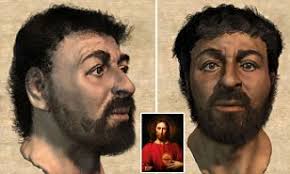
Forensic archeologists say that the historical Jesus looked like this. He was not white and stood about 5 feet tall and weighed about 110 pounds.

Last night we had another meeting of our church’s Lenten series discussing controverted questions of faith. So far, we’ve discussed (1) miracles, (2) healing, (3) Jesus and the poor, (4) the tension between American and Christian identities, and (5) what happens after death. Next week, we’ll address the question of resurrection. It’s all been interesting and at times quite inspiring to interact with more than a dozen gifted and earnest fellow seekers in a very admirable faith community.

However (if you recall), a couple of weeks ago when I was asked to lead the session on Jesus and the Poor, I got “hooked” into defending (at inappropriate length) the centrality of the biblical “preferential option for the poor” as the heart of Christianity. The one who hooked me is a very friendly, intelligent, articulate, and sincere church member whose faith convictions are undeniably robust. I admire him greatly.  

Nevertheless, during last evening’s meeting, it almost happened again. I mean, I was tempted to respond that same interlocutor rather than biting my tongue regarding a revisitation of our topic of two weeks ago about Jesus’ identity. (Remember, last night’s topic was to be what happens after death.)

Instead, my friend in the evening’s opening remark said something like the following: “We’re supposed to be Christians here discussing our faith. But the readings we’ve shared not only this week but two weeks ago, depart quite radically from central Christian beliefs. For instance, this evening’s reading is by Marcus Borg who sees Jesus is nothing more than a prophet. In this, he agrees with Judaism and Islam both of which of course honor Jesus – but as a mere religious genius, not as the Christ or as God. Christian faith on the other hand holds emphatically that Jesus is God, that he is indeed the expected Christ (Messiah). Without those beliefs, you’re simply not a Christian.”

As I said, I had other ideas, but bit my tongue.

However, here’s what I wanted to say in response (but thankfully did not):

Jesus is not God

Following the great Jesuit theologian, Roger Haight, I’ve come to believe that Jesus is not God. Instead, I believe that God is Jesus.

The distinction is not merely semantic. Saying that “Jesus is God” presumes that we know what the term “God” means. But that term, of course, has always been entirely problematic. What exactly is content? Answers to that query are legendarily diverse.

The problem is not only perennial, but in the case of Jesus is compounded by the ironic fact that the identification of Jesus as “God” took place under the aegis of the Roman Empire at the Council of Nicaea in 325. The irony stemmed from the fact that the Council was summoned by the Constantine, the emperor of Rome which had executed the prophet Jesus as an insurgent.

So, Constantine’s own problem was how to transform a rebel against Rome into a God (Deus was the Latin term) not only acceptable to, but supportive of his empire. His conundrum was how to transform Jesus into the son of a God whom worshippers of Zeus could understand.

[By the way, I hope you can see the significance of the similarity in terms Deus and Zeus. Its single consonant variation suggests that the Romans (who knew nothing of the Jewish God, Yahweh) couldn’t help but transform God into a thunder-bold throwing Zeus and Jesus into Zeus’ favorite son Apollo. In practice, no other understandings were possible for them!]

With all of this in mind, remember that Nicaea’s mandate was to answer questions like the following about the identity of Jesus:

  • Was he simply a man, a prophet?
  • Was he simply a god?
  • Was he a man who became a god?
  • Was he a god pretending to be a man?

In Constantine’s 4th century, there were “heresies” that represented each of these viewpoints.

But Nicaea’s answer to such questions was different. It stated that: Jesus was a divine being who was fully Deus/Zeus and fully man as well. The Council however left it for future theologians to explain exactly how that combination was possible.

[In my opinion, no one ever successfully did that. Marcus Borg, I think, came closest by holding that Jesus was fully human before his “resurrection” (however we might interpret that term) and fully God afterwards.]

In any case, throughout history Christians themselves have in practice resolved the fully God/fully human dilemma by emphasizing Jesus’ God dimension while neglecting almost entirely his humanity. Practically speaking, Christians have never truly endorsed Jesus’ humanity.

God Is Jesus

And that’s where the importance of holding that “God is Jesus” surfaces. On the one hand, the formulation recognizes the problematic nature of the term “God.” On the other, it resolves the dilemma by pointing to the Jesus of history to reveal the meaning of the term Deus. Look at the human Jesus, it says, and you’ll better understand the meaning of the word God.

And what do we find when we look at Jesus while bracketing official understandings of God as Zeus and Jesus as Apollo? The answer is entirely surprising and turns official theologies on their heads.

As revealed in Jesus, God shows up as the champion not of imperial majesties, but of slaves escaped from those same imperial majesties. More specifically, God’s embodiment (incarnation) is found in a man actually oppressed, not championed by empire. He is a peasant, the son of an unwed teenage mother, a refugee in Egypt, an enemy of the religious establishment, the leader of a poor people’s movement, a victim of torture and of capital punishment.

According to Christian faith, that’s who Jesus is; that’s who God is – found in the poor, the oppressed, in the torture chamber, on death row. . .

The fact that God chose to reveal God’s self as such is what is meant by the Bible’s “preferential option for the poor.”

Jesus is the Christ

All of this is intimately linked with my church friend’s insistence that Jesus is the Christ, the messiah.  Here too we must remember that “Christ” is not a Roman term; it is entirely Jewish and has specific Jewish meaning impossible to understand apart from its cultural context.

As Jesus-scholar, Reza Aslan, reminds us, the term “Christ” had one meaning and one meaning only for Jews: the Christ was (1) a descendent of Judah’s King David who would (2) reestablish David’s kingdom (3) in a once again sovereign state. And reestablishing sovereignty necessarily meant disestablishing Rome’s kingdom which occupied 1st century Palestine where Jesus lived.

Of course, the Romans understood that. Consequently, they executed Jesus precisely as an insurgent – along with the untold others in the same historical period who made the same messianic claim. Such was the point of the titulus, “King of the Jews” that the Roman procurator, Pontius Pilate insisted be displayed over Jesus’ head as he hung dying on his cross – the instrument of torture and death reserved for insurgents against the Roman empire (John 19:22). The titulus proclaimed the charges against the executed. Jesus’ crime was proclaiming himself “King of the Jews.”

So, historically speaking, claiming that Jesus is the Christ or messiah is a highly political statement. It signifies belief in Jesus as the quintessential opponent of empire and its inevitable oppression of God’s chosen – the poor and oppressed.

Conclusion

I’m glad I didn’t try to say all of that at last night’s meeting. Still, I’m happy for the evocation of such thoughts by my brother in faith at our Talmadge Hill Community Church.

It all reminded me of what I first learned at a memorable lecture by Passionist scripture scholar, Barnabas Ahern back in 1965 (when I was just 25 years old). Ahern’s topic was the historical Jesus. He inspired me to confront the fact that christians (myself included) tend to believe with all our hearts that Jesus is God, while at the same time paying only lip service to Jesus’ humanity. Ever since then, I resolved to avoid that mistake myself.

In fact, I was so impressed by what Fr. Ahern said that the very next day I wrote out from memory the scholar’s entire talk which has since then played a central role in driving me to internalize modern scripture scholarship about the humanity of the historical Jesus.

It has led me to Roger Haight’s formulation that Jesus is not God, but God is Jesus.

With Reza Aslan’s help, I’ve also come to grasp the revolutionary meaning the terms “Christ” and “Messiah” must have had for 1st century Jews. Then writers such as Marcus Borg have helped me understand the post-resurrection process by which the human Jesus himself appropriated his divine nature – human before his resurrection, divine afterwards.

And that entire sequence of lessons has immeasurably enriched my own faith and enabled me to share their insights.

Thank you, my brothers and teachers Barnabas, Roger, Reza and Marcus.

Controlling History’s Narrative: Who Speaks for God Today?

Rev. Jeremiah Wright

Readings for 4th Sunday in Ordinary Time: Deuteronomy 18: 15-20; Psalm 95: 1-9; I Corinthians; 7: 32-35; Mark 1: 21-28

Today’s readings once again raise the central biblical question of prophets and prophecy.

We should read them carefully remembering that prophets are not fortune tellers focused on the future. They were and today remain social critics focused on present injustices committed against the original beneficiaries of Life’s covenant with Moses – the poor and oppressed (widows, orphans, and resident aliens). Insofar as they predict the future, the prophets’ threat is usually that neglect of the poor will lead to national tragedy.

 Yeshua the Christ, of course, appeared in the prophetic tradition which is always confused by the fact that the Great Mother’s spokespersons are inevitably contradicted by their fake counterparts. This Sunday’s readings highlight that point.

 Prophets Then

I was reminded of all this last week during a Zoom “Talk Back” responding to our pastor’s Sunday sermon on the fictional story of the prophet Jonah. That tale was centralized a week ago in the liturgy of the word. Towards the end, the pastor herself asked the question, “Who today is speaking the harsh truth that the Book of Jonah expressed?”

(As we saw last week the little Jonah parable (only 48 verses) is about a reluctant prophet who eventually has to face the fact that those imagining themselves to be the People of God (Israel) were quite the opposite. Meanwhile those whom Israel viewed as their corrupt enemies (Assyrians) were more responsive to God’s word.

In my own response to our pastor’s question, I observed “That would be like our hearing during the Cold War that Russians (communists) were more on God’s side than Americans. Today, it would be like being told the same thing about the Chinese or Muslims, or (worse still) al-Qaeda and other terrorist groups.”

Yes, that’s the way the Book of Jonah would have been heard in the middle of the 8th century BCE – as the Assyrian hordes massed on Israel’s borders ready to descend on “God’s People.” Eventually, they’d come (as Lord Byron would put it) “like the wolf on the fold.” They’d destroy the Northern Kingdom and take large masses of its people off to the Assyrian capital, Nineveh – as slaves. The book of Jonah dares to identify Assyrians as godly.

Imagine if some prophetic preacher today actually echoed Jonah saying, “You American exceptionalists believe that you’re especially pleasing to God. The exact opposite is true. In fact, your designated ‘enemies,’ Muslims, the Russians, the Chinese, and those you imagine as terrorists are actually God’s favorites.”

How hard would that be for Americans to hear?

Prophets Now

But (to answer our pastor’s question directly) there actually have been and are religious prophets among us who have said such things and who are saying them today. I’m thinking of Malcolm X, Martin Luther King, Jeremiah Wright, William Barber II, the Rev. Liz Theoharis, Dorothy Day, and even Pope Francis. Here’s what they’ve said in the name of God:

  • Malcolm X: “I’m not standing here speaking to you as an American, or a patriot, or a flag-saluter, or a flag-waver — no, not I. I’m speaking as a victim of this American system. And I see America through the eyes of the victim. I don’t see any American dream; I see an American nightmare.”
  • Martin Luther King: The United States is “the greatest purveyor of violence in the world today.”
  • Jeremiah Wright: “When it came to treating her citizens of African descent fairly, America failed. . . The government gives them the drugs, builds bigger prisons, passes a three-strike law and then wants us to sing “God Bless America“. No, no, no, not God Bless America. God damn America. . . as she tries to act like she is God, and she is supreme”
  • William Barber II: “. . . I, too, am an atheist. . . if we were talking about the God who hates poor people, immigrants, and gay folks, I don’t believe in that God either.” 
  • Liz Theoharis: “Jesus led a poor people’s campaign.”
  • Dorothy Day: “Our problems stem from our acceptance of this filthy rotten system.”
  • Pope Francis: “This system is by now intolerable: Farmers find it intolerable; laborers find it intolerable; communities find it intolerable; people find it intolerable.”

Those are not voices most of us are accustomed to hearing as representative of a Christian message that has been completely dominated by right-wingers who have effectively silenced the political voice of the one Christians pretend to recognize as the greatest of all prophets. They silence Yeshua’s authentic voice by focusing exclusively on the fiction of American Exceptionalism and on personal “salvation.”   

The Prophet Yeshua

Instead, the very life of Yeshua the Christ was highly political from start to finish. He literally embodied God’s prioritization of the needs of the poor while specifically condemning the rich and powerful of his day. That’s why he had to be assassinated at a very young age — same as Malcolm, Martin Luther King, Fred Hampton. . .

Think of it this way: Isn’t it true that Christian belief holds that Yeshua was the fullest revelation of God? If so, isn’t it therefore significant that the revelation site supposedly chosen by God was a poor man from the working class? Isn’t it theologically meaningful that he was born out-of-wedlock to a teenage mother (LK 1:34), was houseless at birth (LK 2:7), experienced immigrant status as an asylum seeker (MT 2: 13-15), traveled with a band of young people who had no visible means of support, was thought insane by his mother and close relatives (MK 3:21), was identified as a terrorist by the most powerful nation then on earth, and finished a victim of its torture and capital punishment?

I’d say that believers should find all of that extremely revealing.  

Moreover, the highly political Yeshua is reported to have made radical statements about wealth and poverty, e.g.:

  • “The Spirit of the Lord is on me, because he has anointed me to proclaim good news to the poor. He has sent me to proclaim freedom for the prisoners and recovery of sight for the blind, to set the oppressed free, to proclaim the year of the Lord’s favor” (Luke 4:16-22)
  • “Blessed are you poor, yours is the Kingdom of God” (Luke 6:20).
  • “Woe to you rich, you have had your reward” (Luke 6:24).
  • “It is easier for a camel to pass through the eye of a needle than for a rich man to enter the Kingdom of God” (Matthew 19:24).
  • “So therefore, whoever of you does not renounce all that he has cannot be my disciple” (Luke 14:33)
  • “If you want to be whole, go and sell your possessions and give to the poor, and you will have treasure in heaven; and come, follow me” (Matthew 19:21).

Still more, his followers took their teacher literally as they practiced a kind of primitive communism:

  • “All the believers were together and had everything in common. They sold property and possessions to give to anyone who had need” (Acts 2: 44-47).
  • Now the full number of those who believed were of one heart and soul, and no one said that any of the things that belonged to him was his own, but they had everything in common” (Acts 2: 32).

All of that identifies Yeshua as a great prophet in the tradition of Moses, the liberator of slaves in Egypt, of Amos who defended the poor and criticized the rich, of Karl Marx, the last of the great Jewish prophets, and of the contemporary troublemakers listed above.

Today’s Readings

Keep all of that in mind as you review today’s liturgy of the word which centralizes the question, “Who are the true prophets among us?” What follows are my “translations.” You can find the originals here to see if I’ve got them right.

 
 Deuteronomy 18: 15-20:
 More than 500 years
 After the Great Prophet’s Death
 Moses was remembered
 As predicting the advent
 Of another Great One
 For a people deathly afraid
 Of hearing God’s voice directly.
 Problem was:
 There’d be false prophets too
 Claiming to speak 
 In the name of Yahweh,
 But actually representing 
 False gods
 Whom, if listened to
 Would bring to believers
 Severe punishment. 
 (Hmm.
 Where does that leave us?)
  
 Psalm 95: 1-9
 It leaves us confused
 And in danger
 Of letting our own self-interest
 Harden our hearts
 To the authentic voice
 Of our loving Mother-Father God
 Our firm refuge
 Benefactor and guide.
 Her wonderful handiwork
 In creation itself
 Reveals more
 Than any prophet’s words.
 So, believe and embrace
 What you see
 With your own eyes.
 
 I Corinthians 7: 32-35
 The case of St. Paul
 Illustrates our confusion
 About what to believe – 
 What our eyes tell us
 Or the words 
 Of an anxious 
 Celibate prophet
 Like Paul
 Who’s been interpreted 
 To say that
 Eros is somehow “improper”
 And a huge “distraction”
 For anyone serious
 About what’s truly important.
 (For, doesn’t Life Itself teach
 That Eros is
 A primary source
 Of God’s revelation
 About the nature of Life
 And Love?)
  
 Mark 1: 21-28
 Jesus, on the other hand
 Had no such reservations.
 His followers believed
 Him to be the Great Prophet
 Predicted by Moses.
 He taught astonishing truths
 With authority and certainty
 Unlike the temple scribes
 (And the doubt-filled Paul).
 He terrified unclean spirits
 While delighting
 The (married) women and men
 Who hung on his every word.  

Conclusion

The disparity between the nationalistic and exclusively personal understandings of the prophet Yeshua on the one hand and the highly political nature of his life and discourse on the other is extremely important to confront.

That’s because (as Caitlin Johnstone has recently reminded us) those who control cultural narratives control the world. And no narrative is more important to history’s control than the religious one we’ve just considered. That’s because religious faith addresses life’s most fundamental questions – the ones so thrillingly addressed by the prophets we’ve considered here: about the nature of life; our relations with one another, human connections with the environment, about foreigners, power, love, money, and justice.

I’ll even venture to say that religious story supplies the popular “philosophy” of most people in the world. It organizes their experiences. They might not know much about history, economics, or political parties, but they know what they’ve been told about the Bible, the Bhagavad-Gita, or the Holy Koran.

To ignore this truism is tragically to surrender an essential tool of social justice to its enemies. On the other hand, exposing the radical social justice character of the Judeo-Christian narrative while challenging its domestication by false prophets represents an essential element of any attempts to shape the world by controlling its narrative.

Even completely secular social justice warriors should take note.

Don’t Listen to Blinken: China’s System Is More Just Than Ours

Readings for the 3rd Sunday in Ordinary Time: Jonah 3: 1-5, 10; Psalm 25: 4-9, I Corinthians 7: 29-31; Mark 1: 14-20.

The liturgical readings for this Sunday are about designated enemies often being readier to recognize and respond to divine wisdom than are believers who consider themselves God’s People.

Accordingly, the selections present the mind-blowing discovery of the reluctant chauvinist prophet Jonah (he of belly-of-the-whale fame) alongside the habitual people-centered attitude of the courageous universalist prophet Yeshua the Christ. Together, the readings’ call is to open ourselves to the wisdom and goodness of despised foreigners and the non-elite.

That theme (explained below) reminds me of China and its bipartisan vilification by U.S. politicians and mainstream media. Like the Ninevites in today’s first reading, China has gradually and unquestionably become the enemy du jour as described not only by outgoing Secretary of State, Mike Pompeo but by his incoming counterpart, Antony Blinken.

The Case of China

Like Jonah’s assessment of Nineveh, neither can say a good word about China, even though (according to western polls) its government enjoys something like 90% approval by the Chinese people. (Furthermore, according to Dorinda Elliot of the China Institute, rather than diminishing its popularity, the government’s success in dealing with Covid-19 has made it more popular than ever.)  

Still, on his way out the State Department door, Mr. Pompeo denounced China not only for stealing western intellectual property, but for its policies on Muslims and ethnic minorities in its western Xinjiang region. According to Pompeo, those policies constitute “crimes against humanity” and “genocide.”   

In his testimony before the U.S. Senate, Antony Blinken fully agreed with Pompeo’s assessment. Both painted China as an enemy rather than a hugely successful competitor with whom our country might well cooperate and from whom we might learn. Relative to crimes against humanity, both Pompeo and Blinken ignore the facts that their own country’s policies:

  • Continue to kill Muslims every day in Palestine, Iraq, Afghanistan, Libya, Syria, Yemen, and Somalia
  • Imprison and torture them in Guantanamo and other black sites
  • Have done so for nearly 20 years
  • While maintaining concentration camps and baby jails for immigrants and asylum seekers on its southern border.

Despite all of that, Mr. Blinken had the temerity to criticize China’s use of reeducation camps as its particular method of dealing with Muslim terrorist threats rather than “our” method of endless wars, bombings and drone strikes. (In Iraq’s illegal war, such have taken the lives of more than 1 million people — with no official mention of genocide or crimes against humanity.)

Moreover, Pompeo’s and Blinken’s denunciations ignore the facts that China’s system of political economy has (in Jonah’s terms) “repented.” It has self-consciously departed from the inefficient and destructive ways of capitalism-as-we-know-it. Yes, China’s way involves a large free-market sector. But a huge part of its economy is under direct government control. The results of that combination have been astoundingly successful.

Moreover, according to economist Richard Wolff, accusations against China’s alleged stealing of intellectual property are nonsensical. According to Wolff, the transfer of intellectual property was part and parcel of the bargain long since struck between U.S. companies and the Chinese government when those companies were given access to Chinese labor and the country’s markets. On China’s part, the understanding was: we give you access to our market and cheap labor; you share profits with us and give us the right to reverse engineer your technology. It was an at least implied quid pro quo agreement that everyone understood.

The result was the Chinese Way that enjoys huge success not only internationally, but domestically. According to Bloomberg News, the Chinese economy is set to grow by 2.5 percent this fiscal year, despite the ravages of Covid-19.

In other words, Chinese “repentance,” its unprecedentedly rapid response (in just over 40 years) to the needs of its people, has saved it from the destruction our version of capitalism has arguably made inevitable for us. Like the prophet, Jonah, our politicians and business elite don’t want to hear any of that.

Today’s Readings

As I’ve been saying here, all of this is closely connected with today’s readings. In the first selection, the Spirit of Life sends Jonah to learn from Nineveh, Israel’s archenemy. He’s completely surprised to discover that the Ninevites, like China, are more responsive to the way of Yahweh than Jonah’s own people.

Similarly, in today’s Gospel selection, Jesus departs entirely from conventional wisdom. He selects illiterate workmen (rather than temple priests or members of his country’s elite) as recruiters for his Kingdom of God Movement bent on creating a world governed by divine principle rather than Caesar’s brute force.

Here’s the way I translate today’s readings about the superior ways of those (like China) whom we routinely despise as foreign and inferior. You can find their original forms here to see if I’ve got them right.    

 Jonah 3: 1-5, 10
 The reluctant prophet Jonah
 Braved Nineveh’s
 Hostile urban jungle
 To announce Yahweh’s
 Urgent call
 For Israel’s Great Enemy
 To change its entire
 Unjust system.
 To the patriotic prophet’s
 Great chagrin
 The enemy listened
 Changed completely
 And transformed
 Its destructive way
 In just 40 days!

 Psalm 25: 4-9
 So, Great Mother-Father
 Teach us the way
 Of the Ninevites.
 For the enemy’s
 Path of justice
 Humility, love
 Kindness, good
 Truth and compassion
 Is your way too.

 I Corinthians 7: 29-31
 Our time for such willing
 Social transformation
 Is quickly running out.
 Choosing it
 Is more important
 Than sex,
 Our little trials
 And triumphs
 Our trinkets
 And work.
 But actually,
 Our Great Father-Mother’s
 Drastically New World
 Is inevitable.

 Mark 1: 14-20
 Yeshua recognized
 That inevitability
 After conservative forces
 Arrested his mentor,
 The Great prophet,
 John the Baptist.
 Ordinary workers
 With simple names like
 Simon, Andrew,
 James and John
 Saw it too.
 So, they left everything:
 Work and companions
 Father and mother,
 Wives and lovers
 To join Yeshua’s
 Working class movement
 For the sake of
 Good News
 To laborers like themselves
 About the Great Mother-Father’s
 In-breaking New Order. 

Conclusion

Like Yahweh in the days of Jonah and Jesus centuries later, the Spirit of Life today is calling us in so many ways to repent and imitate the equivalents of Jonah’s Ninevites. Like Paul in Corinth, the Great Mother-Father tells us that the time is short. Climate chaos itself underlines that urgent message. Our task is more important than anything our culture presents as essential.

China’s example of repentance, its departure from capitalism-as-we-know-it, its construction of an economy based above all on meeting the needs of its huge population represents a path forward – if not for imitation, for inspiration and instruction.

It tells us that we must reorient away from profits and wealth for the few towards the creation of a society with room for everyone and abundance for all – just what the working man, Yeshua, demonstrated in his choice of working-class people to introduce the Kingdom’s new heaven and new earth.   

We’re called today to listen to the prophets of such unconventional wisdom rather than to Pompeo and Blinken’s misdirection.

David and Solomon’s Crime Family Was No Better than Trump’s

Readings for the 4th Sunday of Advent: 2 Samuel 7: 1-5, 8B-12, 14A, 16; Psalms 89: 2-5, 27, 29; Romans 16: 25-27; Luke 1: 38

In terms of teaching theology and elucidating the Bible, I’m happy for our nation’s experience of Donald Trump. Otherwise, not so much.

The reason for my contentment is Mr. Trump’s blatant exploitation of religion and his ability to persuade so many people of faith that he is a man of God. Think of his now infamous Bible posing in front of DC’s St. John’s Church after having police clear the area of Black Lives Matter protesters.  

The event clearly illustrated a perennial religious dynamic that is essential for critical thinkers to understand. I’m referring to what Chilean scripture scholar, Pablo Richard, calls the “battle of the gods.”

The Battle of the Gods

The combat in question pits the God of the rich against the God of the poor. Specific to our readings on this fourth Sunday of Advent, it sets the God of Moses against the God of King David’s crime family. Yes, his crime family.

To begin with, the God of the poor set free a motley group of slaves from Egypt and instituted Moses’ order that favored them rather than their Egyptian slavers. Its “preferential option” prioritized the interests of widows, orphans, and resident non-Hebrews living in Israel. Covenant law eventually forgave the debts of impoverished Hebrews every fifty years. In the process, it disadvantaged landlords and bankers. It made no provision for reestablishing the royal class that had made the lives of slaves so miserable in Egyptian captivity.

Then about a thousand years before the birth of Yeshua, all of that changed. Israel’s upper classes decided to reinstitute an order reminiscent of Egypt. It had the rich lording power over the poor, taxing them heavily, instituting forced labor, and sending Israel’s young men to fight and die in gratuitous wars of conquest as conscripts in a standing army.

Saul was Israel’s first king. He was succeeded by King David and then by his son, Solomon. Both father and son were ruthless womanizers committed to increasing their own wealth and power at the expense of the poor. Theirs was truly a crime family masquerading as God’s beloved appointees.

Family dysfunctions included internecine murders and wars, incestuous rape (2nd Samuel 13) and lasting vendettas. David’s deathbed will and testament was worthy of any Mafia don (I Kings 2: 2-12). However, to achieve the power for which they thirsted, both David and Solomon had to convince their subjects that they were indeed men of God.

That called for fabricated visions and assurances from the divine. Both David and Solomon assisted by their court prophets and scribes enthusiastically obliged. And so, David made sure it was recorded that he was a man “after God’s own heart” (I Samuel 13:14). Meanwhile, Solomon’s own court historians portrayed him as the wisest man who ever lived (I Kings 3: 11-15).

Central to the ruse was a reframing of Moses’ Sinai Covenant to favor the newly emergent royalty and their hangers-on rather than the poor. That’s what we find in this Sunday’s first reading from 2nd Samuel. There, David and his court prophet, Nathan, conspire to change the beneficiaries of the Mosaic Covenant from the poor and oppressed to the royals. In this way, the covenant becomes not a divine promise to protect widows and orphans, but to assure a lasting dynasty for David’s crime family. Put otherwise, the Covenant of Moses was replaced by the Covenant of David.

The great prophets of Judah and Israel rebelled against such palace distortions of faith.

Some tried to work within the new system holding kings’ feet to the fire, reminding them of their obligations towards the weak and vulnerable. Others gave up on the royals and called them out for their self-serving cruelty and corruption.

The great prophets celebrated during this advent season, John the Baptist and his disciple Yeshua of Nazareth, fell into the latter category. They had no use for the royals, the temple priests, their lawyers and apologists. They reserved special abhorrence for their country’s Roman occupiers.

Evidently, Yeshua inherited all of that from his mother, Miryam. She and her husband, Yosef, gave all of their children revolutionary names (Matthew 13: 55-56). Yeshua was named after the great liberator Joshua. The evangelist called “Luke” recorded Miryam as singing a fierce revolutionary song calling for the dethronement of the rich and mighty everywhere (Luke 1: 46-55).

All of that is reflected in today’s readings. What follows are my “translations.” You can find them here to see if I got them right.

Readings for 4th Sunday of Advent   

2 Samuel 7: 1-5, 8B-12, 14A, 16: The wily King David conspired with his court prophet, Nathan to persuade their people that God was on his side. The strategy was to build a magnificent temple (actually about the size of a middling parish church today) and then to claim a well-publicized “vision.” There, according to Nathan’s testimony, David’s battlefield accomplishments would be celebrated by God himself. But even more importantly, his country’s constitution (called “The Covenant”) would be subtly changed from centering on the welfare of widows, orphans, and immigrants, to assuring that David’s crime family would stay in power forever. 

Psalms 89: 2-5, 27, 29: The arrangement was then celebrated in song (Psalm 89) praising the goodness of God for establishing David’s throne “for all generations.”

Romans 16: 25-27: Paul’s allegiance, however, was not to any earthly king, but to what Yeshua proclaimed as the Kingdom of God. It embraced the welfare of “all nations.” Following Yeshua, Paul’s understanding re-established the pre-Davidic Covenant (favoring those widows, orphans, and immigrants) which David’s Covenant (in its hijacked form) had attempted to replace.

Luke 1: 38: Vaguely following the example of David, Luke’s early church made up a visionary tale about Yeshua’s very conception. There, the angel Gabriel secures Mary’s permission to have the Holy Spirit impregnate her. The resulting child will be great, the angel said, and (like David) initiate a kingdom to which “there will be no end.” However, Yeshua’s New Covenant would once again centralize not the royal class, but Yahweh’s beloved widows, orphans, and immigrants. As Mary would say beginning eight verses later (LK 1: 46-55), it would “take down the mighty from their thrones and exalt the humble.” So much for palace crime family conspiracies.

Conclusion

So, portraying the Trumps, or Bushes, or Clintons or Kennedys or Obamas as “crime families” is not at all far-fetched or somehow unchristian. On the contrary, insofar as any of them neglect the poor – the widows, orphans, immigrants, asylum seekers, or victims of their wars – they are just that. They’re like the criminal family of David and Solomon.

Yes, they go to church, invoke God’s blessings on America at the end of every formal speech, and even attend “prayer breakfasts.” But like David and Solomon (and most of the kings portrayed in the Bible), they are really in bed with the rich and powerful, with the bankers and corporate heads, and with compliant pastors, priests and court prophet equivalents. At best, they are completely disinterested in the spiritual descendants of Egypt’s slaves. At worst, they are actual enemies of workers, widows, orphans, immigrants as well as of those who side with the unemployed, houseless, and those without medical care.

In summary, this fourth Sunday of Advent provides a stark reminder to critical thinking people of faith. It tells us not to be seduced by Bible-waving presidents or by pastors who endorse them and their God of the rich.

Neither Yeshua whose birthday we are about to celebrate nor his cousin John nor his revolutionary mother had anything to do with that God. Before him, they were all complete atheists. So should we be.

Their God was the God of Moses, not of David. Their God was precisely the one rejected by the rich and the powerful – the One who Miryam said “puts down the mighty from their thrones and exalts the humble,” who “fills the hungry with good things, while the rich he sends empty away” (Luke 1: 53). 

The First Sunday of Advent: Pope Francis’ Covid-19 Reflection

Readings for the First Sunday of Advent: Isaiah 63: 16B-17, 19B; 64: 2-7; Psalm 80: 2-3, 15-16, 18-19; I Corinthians 1: 3-9; Mark 13: 33-37

Last week, Pope Francis wrote a beautiful Covid-19 reflection in the New York Times (NYT).

He recalled how the pandemic’s unsung heroes reminded him of his own brush with death when he was just 21 years old.  At that tender age, he was hospitalized with a pulmonary infection that ultimately cost him part of a lung.

At the height of his crisis, two nuns working as nurses in his Argentine hospital ignored doctors’ prescriptions and doubled the dosage of penicillin and streptomycin in one case and increased his pain killers on the other. Their courage in doing so, the Pope is convinced, saved his life.

Generous, courageous souls like the two religious sisters who helped him then have reemerged, Francis noted, during the pandemic. They’re the “saints next door.” They’ve saved innumerable lives as nurses, doctors, caregivers. They’re the essential workers who in many countries have regularly been applauded at doorsteps and windows with genuine gratitude and awe.

The selflessness of such heroes has sometimes cost them their lives. But many among those champions sacrificed freely knowing as Francis put it, that “it is better to live a shorter life serving others than a longer one resisting that call.” They represent the antibodies to an infection among us far more dangerous than Covid 19 – the virus of indifference.

Writing pointedly in the premiere U.S. newspaper, Francis identified that more dangerous virus with governments that have not put the well-being of their people first. Instead, they have “shrugged off the painful evidence of mounting deaths.” They’ve pandered to groups opposing travel restrictions, social distancing and facemasks as if such measures constitute “some kind of political assault on autonomy or personal freedom!” Francis said that worship of that kind of liberty has become for many a kind of ideology obstructing all understandings of common good.

In Francis’ view, such selfish shortsightedness shows that Covid-19 is merely one of the pandemics currently afflicting our planet. Hunger, violence and climate change are others. All of them lack perspective and generosity.

Responding effectively means attuning our sensibilities to the pain of others who have been deprived of life’s basic needs – work, food, housing and human dignity. Responding means recognizing that we’re never saved alone; we are bound by human solidarity and reciprocity.

Reading the pope’s words, I couldn’t help thinking of parallels between them and our readings for the first Sunday of Advent. Together, they call us to reverse course – to wake up from our collective stupor to the presence of what some call God in the neighbors, heroes and martyrs whom Francis’ words identify so poignantly.

What follow are my “translations” of the readings in question. Please check the originals here to see if I’ve got them right.      

 Isaiah 63: 16B-17, 19B; 64: 2-7

 We have lost our way;
 We’ve hardened our hearts;
 We no longer even know
 What faithfulness means.
 We feel somehow unclean,
 Polluted and aimless.
 Yet, we long to see more deeply
 To reality’s very heart
 As never before.
 Reunion with You, Divine Mother
 Is what we ultimately crave –
 To be refashioned
 As if we were clay
 In your lovely hands.
 
 Psalm 80: 2-3, 15-16, 18-19

 So, please show us your face.
 Save us from ourselves.
 Strengthen us.
 Bring us home.
 Demonstrate again
 Your care for us
 As a shepherd guarding her flock,
 As a gardener tending her vine.

 I Corinthians 1: 3-9

 Oh, wait
 You’ve already done that
 Haven’t you?
 You’ve answered our prayer
 In Yeshua, the Christ.
 His loving kindness
 And revolutionary teachings
 Bring clarity, insight
 And serene understanding.
 They restore
 Meaning to our communal lives.
 
 Mark 13: 33-37

 Above all
 (Like the Buddha)
 Yeshua commanded us
 To wake up
 To see
 What sleepers miss:
 Constant divine manifestations
 At our very doorstep
 When we expect
 Them least
 Morning, noon and night. 

What We Do to the Least: The Most Political Sunday Readings of the Year!

Readings for the Solemnity of Our Lord Jesus Christ, King of the Universe: EZ 34: 11-12, 15-17; PS 23: 1-3, 5-6; I COR 15: 20-26, 28; MT 25: 31-46. 

This Sunday’s readings raise the central political question of our day: what is the purpose of government? Is it simply to protect the private property of the well-to-do? Or is it to sponsor programs to directly help the poor who (unlike their rich counterparts) cannot on their own afford adequate food, shelter, clothing, health care, and education – even if they are working full-time?

For the last forty years or so, the former view has carried the day in the U.S. So it has become fashionable and politically correct even (especially?) for Christians to advocate depriving the poor of health care to help them achieve the American Dream, “ennobling” the unemployed by removing their benefits, criminalizing sharing food with the poor, and “punishing” perpetrators of victimless crimes by routinely placing them in solitary confinement.

Currently, the idea that government’s task is to help corporations even it means hurting the poor, elderly, and newly arrived has been incarnated in Washington’s response to Covid-19. It has amounted to a giant give-away to billionaires including the president’s own family. Today’s poor, middle class and future generations will pick up the tab for that particular wealth redistribution upward.

Today’s readings reject all of that. And they do so on a specifically political liturgical day – the commemoration of the “Solemnity of Our Lord Jesus Christ, King of the Universe.” Yes, this is a political liturgy if ever there was one. It’s all about “Lords” and “Kings” and how they should govern in favor of the poor. It’s about a new political order presided over by an unlikely monarch – a king who was executed as a terrorist by the imperial power of his day. I’m referring, of course, to the worker-rebel, Jesus the poor carpenter from Nazareth.

Today’s readings promise that the rebel – the “terrorist” – Jesus will institute an order utterly different from Rome’s. That order recognizes the divine nature of immigrants, dumpster-divers, those whose water has been ruined by fracking and pipelines, the ragged, imprisoned, sick, homeless, and those (like Jesus) on death row. Jesus called it the “Kingdom of God.” It’s what we celebrate on this “Solemnity of Jesus Christ King of the Universe.”

(Btw: in the eyes of Jesus’ executioners, today’s commemoration would be as unlikely as some future world celebrating the “Solemnity of Osama bin Laden, King of the Universe.” Think about that for a minute!)

In any case, our readings delineate the parameters of God’s new universal political order. To get from here to there, they call governments to prioritize the needs of the poor and those without public power. Failing to do so will bring destruction for the selfish leaders themselves and for the self-serving political mess they inevitably cultivate.

Our first selection gets quite specific about that mess. There the prophet Ezekiel addresses the political corruption Lord Acton saw as inevitable for leaders with absolute power. Ezekiel’s context is the southern kingdom of Judah in the 6th century BCE. It found itself under immediate threat from neighboring Babylon (Iraq). In those circumstances, the prophet words use a powerful traditional image (God as shepherd) to inveigh against Israel’s pretentious potentates. In God’s eyes, they were supposed to be shepherds caring for their country’s least well-off.  Instead, they cared only for themselves. Here’s what Ezekiel says in the lines immediately preceding today’s first lesson:

“Woe to you shepherds of Israel who only take care of yourselves! . . . But you do not take care of the flock. You have not strengthened the weak or healed the sick or bound up the injured. You have not brought back the strays or searched for the lost. You have ruled them harshly and brutally.”

In other words, according to Ezekiel’s biblical vision, government’s job is to address the needs of the weak, the sick and the injured. It is to tenderly and gently bring back the wayward instead of punishing them harshly and brutally.

A great reversal is coming, Ezekiel warns. The leaders’ selfishness will bring about their utter destruction at the hands of Babylon.

On the other hand, Judah’s poor will be saved. That’s because God is on their side, not that of their greedy rulers. This is the message of today’s responsorial psalm – the familiar and beloved Psalm 23 (“The Lord is my shepherd. . . “) It reminds us that the poor (not their sleek and fat overlords) are God’s “sheep.”  To the poor God offers what biblical government should: nothing but goodness and kindness each and every day. Completely fulfilling their needs, the divine shepherd provides guidance, shelter, rest, refreshing water, and abundant food. Over and over today’s refrain had us singing “There is nothing I shall want.” In the psalmist’s eyes, that’s God’s will for everyone – elimination of want. And so, the task of government leaders (as shepherds of God’s flock) is to eradicate poverty and need.

The over-all goal is fullness of life for everyone. That’s Paul’s message in today’s second reading.  It’s as if all of humanity were reborn in Jesus. And that means, Paul says, the destruction of “every sovereignty, every authority, every power” that supports the old necrophiliac order of empire and its love affair with plutocracy, war and death instead of life for God’s poor.

And that brings us to this Sunday’s culminating and absolutely transcendent gospel reading. It’s shocking – the most articulate vision Jesus offers us of the basis for judging whether our lives have been worthwhile – whether we have “saved our souls.” The determining point is not whether we’ve accepted Jesus as our personal savior. In fact, the saved in the scene Jesus creates are confused, because their salvific acts had nothing to do with Jesus. So, they ask innocently, “Lord, when did we see you hungry and feed you, or thirsty and give you drink?  When did we see you a stranger and welcome you, or naked and clothe you?  When did we see you ill or in prison, and visit you?”

Jesus’ response? “Amen, I say to you, whatever you did for one of the least brothers of mine, you did for me.”

But more than personal salvation is addressed here. Jesus homage to Ezekiel’s sheep and shepherd imagery reminds us of judgment’s political dimension. So does Jesus’ reference to the judge (presumably himself) as “king.” And then there’s the church itself which centralizes this climactic scene precisely on this Solemnity of Jesus Christ King of the Universe. All three elements say quite clearly that “final judgment” is not simply a question of personal salvation, but of judgment upon nations and kingdoms as well. To reiterate: in Matthew’s account, the final judgment centralizes the political.

And what’s the basis for the judgment on both scores? How are we judged as persons and societies? The answer: on the basis of how we treated the immigrants, the hungry, ill-clad, sick, and imprisoned.

On that basis, Jesus’ attitude towards the United States as earlier described ought to be quite clear. It’s the same as Ezekiel’s when he predicted the destruction of Israel at the hands of Iraq:

“Depart from me, you accursed, into the eternal fire prepared for the devil and his angels. For I was hungry and you gave me no food, I was thirsty and you gave me no drink, a stranger and you gave me no welcome, naked and you gave me no clothing, ill and in prison, and you did not care for me.”

Ironically enough, that “fire prepared for the devil and his angels” is today embodied in the west coast’s raging fires kindled by our mistreatment of Mother Nature – whom we routinely submit to the most horrendous form elder abuse.

Referencing his own text, Ezekiel might say, “You read it here first.”

Jesus & Rent Strikes: Violent or Non-Violent?

Readings for 27th Sunday in Ordinary Time: Isaiah 5: 1-7; Psalm 80: 9-20; Philemon 4: 6-9; Matthew 21:33-43

During the COVID-19 hiatus, I watched in its entirety Ken Burns’ and Lynn Novick’s PBS production “The Vietnam War.” The series has ten episodes, each about an hour and a half long.

I bring it up because the viewing experience has relevance to this morning’s Gospel reading which describes resistance to a landlord system similar to the one that provoked Vietnam’s peasantry to take up arms.

Closer to home, the parable is also relevant to our current Corona Virus context, where unemployed renters will soon be required either to pay their rents or risk eviction. Their dilemma, like those of Jesus’ audience 2000 years ago is whether to pay those rents or to join a general rent strike. Additionally, Jesus asks to what extent citizen violence might be justified as a strategic option as they resist paying rent.

Ironically, both the Burns and Novick film series and this morning’s gospel obscure the questions just posed. The producers of “The Vietnam War” avoid the rent question altogether. As for Matthew the evangelist, he completely allegorizes Jesus’ parable to similarly obscure its central question about absentee landlordism, rent strikes, and the role of violence in social change.

Vietnam & Rent Strikes

Let’s begin with Burns and Novick. The official story they tell is that of a geopolitical struggle between China and Russia on the one hand and the U.S. and France on the other. So, the film’s narrative is dominated by maps depicting huge swaths of geography (China and Russia) looming menacingly over Vietnam. The maps indicate that Vietnam along with the rest of “French” Indochina (including Laos and Cambodia) were threatened by monolithic communist takeover.

U.S. officials one after another describe their alarming “domino theory” contending that if Vietnam were “lost” to communism, so would Laos, Cambodia, Korea, Japan, the Philippines and the rest of Far East. It wouldn’t be long before Ho Chi Minh’s forces would be landing in Hawaii and then in California.

So, viewers are asked to believe that in the footage showing huge numbers of Vietnamese civilians (including the elderly, women and children) moving equipment, building bridges, and ferrying supplies, we are simply witnessing mindless agents of China and Russia. The Vietnamese were somehow persuaded to risk their lives (four million of them were killed in the conflict) to advance the totalitarian cause of Sino-Soviet world conquest.

As John Pilger and others have written, that simply doesn’t stand to reason. For one thing, there was no monolithic alliance between Russia and China. Any semblance of that lay in ruins between the years 1960 and 1989.

That is, for the Vietnamese, what they call “The American War” (1960-75) could not have been fought on behalf of China or Russia. Rather, the conflict represented a struggle against colonial rule by French and American forces. It was also fought against a rent system that had peasants paying predatory tribute to absentee landlords. The latter were holed up in Saigon along with other beneficiaries of deteriorating colonial arrangements including its dysfunctional army, government officials, and participants in the supporting infrastructure.

Meanwhile, outside of Saigon, the peasants’ revolutionary army (the Viet Cong) defended farmers against rent collection. They had the peasantry stop traveling to Saigon to pay their land fees. This, they said, would force representatives of the landlord class to venture out into territory controlled by the Viet Cong to collect their money or in-kind revenue. And there in the countryside they would be duly slaughtered.

In other words, patriotism and the peasants’ immediate economic interest, not geo-political considerations, provided their main motivations for resistance to a colonial rental system that had long exploited them and caused their families to starve.

Jesus & Rent Strikes

All of this has relevance to this morning’s Gospel episode where Jesus tells a story that parallels the situation I’ve just described. Jesus and his audience too were living under an imperial system not unlike Vietnam’s. The Romans controlled Palestine using tactics highly similar to those of the French and Americans in Indochina. The system’s administrators, armies, police, and hangers-on were all holed up in Jerusalem protected by Roman legions.

Meanwhile, absentee administrators and landlords kept the province’s peasants impoverished by exacting rent and taxes that the farmers detested. The latter resisted accordingly – at times in Israel’s history forming armies of resistance similar to the Viet Cong. One of those militias was known as the Zealots.

In any case, the parable centralized in this morning’s gospel has Jesus problematizing a situation of violent peasant conflict over rent collection. In so doing, Jesus, no doubt, provoked a spirited discussion among his listeners about colonialism, landlordism, and about violent vs. non-violent resistance.

Jesus’ story goes that an absentee landlord has rented out his vineyard. Peasants are resisting payment. So, the man in the Big House sends out no doubt well-armed rent collectors. After the first ones are murdered by the farmers, he sends out what was probably a small army of “enforcers.” But the peasants successfully defeat them too. Eventually, the landlord gets more serious. His own son heads up a collection force probably much larger and better armed than its predecessors. But surprisingly, the renters wipe them out as well. They assume ownership of the land in question presumably under some ancient version of the revolutionary slogan “Land to the tiller.”

That said, the Master articulates the problem that certainly provoked spirited discussion in his audience. “What will happen,” Jesus asks, “to the revolutionaries demonized as ‘wicked’ by the landowning class?”

No doubt, some in Jesus audience would say they weren’t “wicked” at all, but heroic champions of the exploited. They would applaud their armed resistance. Others though joining the applause, might point out that the peasant victory would be short-lived and doomed.

These more cautious discussants would hold that the better-armed and trained forces of the landowners and their Roman sponsors would eventually prevail with disastrous results for the entire province of Palestine. Accordingly, they might advise nonviolent resistance to the system in question. (There were, by the way, at least three such forms of nonaggressive struggle in Jesus’ first century context.)

It is unlikely that any in Jesus’ audience would defend the imperial status quo the way Matthew’s allegorized retelling of the parable seems to do. Fifty years after Jesus death the anonymous Jewish author called by that name even goes so far as to imply identification of the absentee landlord with God and the landlord’s son with Jesus himself. Such identification would have been possible around the year 80 or 85 when the Gospel of “Matthew” was written following the utter defeat of Jesus’ people by the Romans in the year 70.  That same identification would, of course, have been abhorrent to Jesus listeners and thus impossible in the Master’s revolutionary context.

Considerations like these – about the similarities in revolutionary situations separated by 2000 years – might help viewers better understand the causes of the Vietnam War and other conflicts even closer to our own day. Clearly, I find those causes obscured in the Burns and Novick documentary despite its very evident artistic merits.

Conclusions

Several conclusions suggest themselves from the considerations just advanced. They have to do with Jesus himself, with rent, and with considerations of violent vs. non-violent resistance.

First of all, Jesus:

  • As originally told, Jesus’ parables weren’t nice little five-minute vignettes. They were meant to stimulate long lively discussions as indicated in this morning’s reflection.
  • As thought provocateur, Jesus was wildly popular among peasants and the dispossessed on the one hand and hated by the religious-political establishment and occupying Romans on the other, not because of one-dimensional religious teachings, but because he constantly connected his people’s faith with issues like land reform, workers’ wages, debt and rent.
  • Those are the same connections that put religious leaders in danger and in early graves today, whether they’re Jewish, Christian, or Muslim.

Secondly, rent:

  • According to Jesus’ teaching, land reform, wages, and rent were more matters of faith than what we term “going to church” or saying the right words about God, the Bible, sexual behavior, or “thoughts and prayers.”
  • For the dispossessed including basically conservative peasant farmers (in ancient Palestine, Vietnam, or in the United States) such local issues are what lead to revolutionary action, not geopolitical considerations.
  • That is, like politics, all revolutions are local and center on issues of exploitation involving food, shelter, and dignity.

Thirdly, violence:

  • High rents imposed on poor people are an egregious form of violence.
  • Even violent resistance to such deprivation of the fundamental human right to shelter and subsistence is entirely justifiable as self-defense.
  • The U.S. Founding Fathers said something like that.
  • However (as indicated by the “more cautious discussants” referenced above) such secondary violence can be counterproductive in terms of the absolute destruction wreaked in response by state and empire.
  • Ironically too, the propaganda arms of state, empire, and church (including someone like Matthew the evangelist) excel at lastingly branding justifiable violence by the poor and oppressed as (to use Matthew’s word) “wicked.”

Finally, the very least people of faith can do today is to support rent strikers and to help others understand motivations for violent response in places like Vietnam, Lexington and Concord – or the streets of New York today. Equating state and imperial violence with the self-defense and counterattacks of the poor represents a false equivalency. Thoughtful people of faith must reject it.

Unforgetting the Past: The Karmic Roots of U.S. Border Problems

Readings for the 24th Sunday in Ordinary Time: Sirach 27: 30-28:7; Psalm 103: 1-4, 9-12; Romans 14: 7-9; Matthew 18: 21-35. 

This week’s readings are about forgetting and unforgetting. They emphasize our tendencies to remember, rehearse and perversely treasure wrongs done to us, while denying, ignoring or dismissing those we’ve done to others. The wrongs in question can be both personal and/or political.

For today, let’s leave aside the myriad personal grievances we all nurse.  

Instead, let me focus on political resentments and point out that this week’s selections are especially relevant to an interview many of us may have seen last week on Amy Goodman’s Democracy Now. The telecast spent time with Salvadoran journalist Roberto Lovato who has just published his own memoir called Unforgetting: A Memoir of Family, Migration, Gangs, and Revolution in the Americas.

Problems at the Border

In tune with our readings, the book addresses the topic of our collective amnesia about the true causes of immigration problems and their uncomfortable cure. In Lovato’s case, both remembering and forgetting connect more than four decades of destructive U.S. policy in Central America with the refugees and asylum seekers at our southern border mostly from El Salvador, Guatemala and Honduras. Those three countries, Lovato pointedly recalls, were absolutely destroyed by counter-insurgency wars that go all the way back to 1932.

Without “unforgetting” those disasters, the author insists, we can understand neither the border crisis nor the gang phenomenon that causes it.

To begin with, Lovato reminds us why almost no one outside El Salvador remembers “la matanza” of ‘32. Instead, that massacre along with its more recent reprise at El Mozote in 1981, have been shoved down our Orwellian memory hole by the U.S. and Salvadoran states whose very job is to destroy records and manufacture the mass amnesia that afflicts American culture.  

Similarly, very few of us connect our contemporary border crisis with U.S. Central American policy during the 1980s. Virtually no one links the Central American policies of the Carter, Reagan, Bush I, Clinton, Bush II, Obama, and Trump administrations to immigrant prisons and baby jails.   

Nonetheless, on Lovato’s analysis, the connections are there for the rescue.  La matanza, he says, was one of the most violent episodes “in world history in terms of the numbers of people killed per day, per week, in a concentrated place.” The massacre at the hands of a U.S. supported military government killed thousands upon thousands of mostly indigenous Salvadorans.

As for El Mozote, some can still remember that horrendous U.S. crime where nearly 1000 unarmed Salvadoran villagers were slaughtered by U.S.-trained forces.

In fact, El Mazote encapsulates the entire disaster of American policy towards Central America foreshadowed in la matanza and resumed with a vengeance all during the 1980s. Under its aegis, entire towns were destroyed; homes were set ablaze and jobs destroyed; families were decimated; sons and husbands were killed; wives and daughters were systematically raped; union leaders, social workers, and teachers along with liberationist priests and nuns were assassinated without pity.

Disgracefully, much of the destruction was financed by CIA operations that flew narcotics from Central America to Florida and carried guns and ammunition back to U.S.-supported terrorist troops in Salvador, Guatemala, and Honduras – not to mention the Contras in Nicaragua. 

And of course, in the aftermath the militarily decommissioned terrorists continued their lucrative involvement with narcotics. They became the drug gang kingpins and foot soldiers who in turn have driven so many families northward.

All of that, Lovato repeats, must be “unforgetted” if we North Americans are to have any hope of solving our problems of immigration, gangs, drugs, and social justice. Our country owes extensive reparation to Central Americans.      

Today’s Readings

So, with all of that in mind, please consider this Sunday’s selections. On the one hand, they centralize the divine amnesia of Jesus’ Great Father-Mother God regarding our personal and communal shortcomings that some refer to as “sin.” On the other hand, our Divine Parents’ compassionate forgetfulness is contrasted with our own petty preoccupation with the way we imagine others have somehow done us wrong.

Sirach, the Psalmist, Paul, and Jesus all remind us of how easily we forget the way we’ve abused “strangers” (like those at our border) whom the Master identified as our very sisters and brothers. Ironically, unforgetting them is the karmic key to our own forgiveness and liberation.

In any case, what follow are my “translations” of today’s biblical excerpts. You can find the originals here to see if I’ve got them right. 

Sirach 27: 30-28:7: Karma is a Law of the Universe. LIFE will treat you as you treat your neighbor. If you’re vengeful, you’ll inevitably experience others’ revenge. If you’re always angry, life will seem cruel. But if you’re forgiving, Life itself will forgive you. So, forget about your own fictitious wounds. Instead practice forgetful mercy, forgiveness, and compassion. After all, life is short. Vendettas will mean nothing to you on your deathbed.

Psalm 103: 1-4, 9-12: Our Divine Mother herself sets the example. She is patient, forgiving, kind, generous and compassionate. She doesn’t remember any of our faults – not even grave “sins” we fear may have destroyed our lives. Far, far from such guilt, it’s as if she never witnessed our shortcomings at all.

Romans 14: 7-9:  Practicing such forgetfulness, none of us will have anything at all to fear from death which will simply be surrender to the One in whom we have always lived and moved and had our being. This is what Jesus himself showed us by the example of his own life.

Matthew 18: 21-35: When Peter asked him about the limits of forgiveness, Jesus said there are none at all. “Or maybe” (he joked) “you can stop forgiving after the 490th time – but be sure to keep track, Peter, as I know you will. Don’t let yourself go over 500.” (He said that with a gentle smile.) “In any case, remember what Sirach said about karma. If you’re generous to others, Life will treat you kindly; If not, you’re creating your own tragic misfortune – and that of your entire family. It’s you, not God who creates your inevitable destiny.”

Conclusion

Yes, Karma is a law of the universe. All the world’s great spiritual traditions teach that simple profound truth. What we do to others will eventually come back to haunt us. There’s no getting around it.

The problems experienced at our borders are simply blowback from our country’s own criminal missteps in the world. While we imagine that we’re threatened and wronged by those at our border, simple unforgetting reminds us that we’re actually the ones who have victimized the ones seeking refuge and asylum. Actually, we have nothing at all to forgive them. Instead, we owe them enormous repair.

No, it’s the ones at our border who have so much to forgive us. So far, they’ve been generous in doing so – well beyond the 500-mark specified by Jesus. Both our karmic liability and our debt of gratitude to our southern siblings are huge.

We’re indebted to Roberto Lovato for helping us unforget all of that.

Beware: Conspiracy Theorists May Be Prophetically Correct

Readings for the 22nd Sunday in Ordinary Time: Jeremiah 20: 7-9; Psalm 63: 2-9; Romans 12: 1-2; Matthew 16:21-27

This Sunday’s readings are about truth, the world’s rejection of the same, and about the truth-teller’s willingness to take the consequences – even if they entail loss of one’s life.

The readings are extremely relevant to our moment in history. There, the current occupant of the White House has from day one (and before) challenged conventional ideas about truth itself. His administration popularized the phrases “fake news” and “alternative facts.” The Washington Post alleges that in less than one year, the chief executive told more than 2000 lies.

In the meantime, sources like QAnon have spread right-wing conspiracy theories that have many scratching their heads about what to believe. For instance, are Q’s assertions true that:

  • Antifa is a sworn enemy of Black Lives Matter (BLM)?
  • BLM itself is funded and controlled by George Soros and left-wing think tanks?
  • President Obama is really a Muslim?
  • Kamala Harris is ineligible to be POTUS?
  • Sandy Hook was a false flag event staged to justify disarming U.S. citizens?
  • Prominent Democrats have run a child-trafficking ring out of a D.C. pizzeria (“Pizzagate”)?
  • The entire world is run by a Satan-worshipping child sex-trafficking organization?

In the context of COVID-19, beliefs are widespread that:

  • COVID-19 is a fake “pLandemic” orchestrated by a “deep state” to eliminate democracy and reset the economy even more in favor of the rich.
  • Dr. Anthony Fauci is a key player in starting the pLandemic – to make billions for himself.
  • But the ultimate goal is to set up a New World Order under a single government.
  • Face masks and social distancing are means to deprive unsuspecting citizens of their civil liberties.

Debate Among OpEd Editors

With all of that in mind, a lively debate has erupted for the past couple of weeks among OpEdNews senior editors. It was sparked by an editorial penned by the website’s editor-in-chief (EIC), Rob Kall. Rob has taken a courageously firm editorial stance against articles that reflect the right-wing talking points of view just listed. According to Rob, they’re all “bad guy” theories. Moreover, the uncritical use of right-wing talking points and language (e.g. “deep state,” “pLandemic,” and “New World Order”) only serve to boost and promote right wing messaging. The EIC wrote, “When you use the language of the enemy, you help the enemy . . . So, stop using their language.”

For me, Rob’s stance makes a lot of sense. But I can also see how others (excluding the senior editors) might label it just another example of “cancel culture?” Are we to cancel well-written and well-documented articles because of their conspiratorial language?

More importantly (at least in the context of this Sunday homily) can we get away with classifying those we disagree with as “bad guys” or as “the enemy?”

[Believe me, I ask that question with some trepidation. I’m uncomfortable with the theories listed above. Many of them (not all – see below) seem outrageous. Most often, I think of Donald Trump and his cohorts as “the enemy” – as “bad guys.”]

Today’s Readings

However, such reflections bring me back to this Sunday’s readings and their faith underpinnings. All of the readings underwrite truth alternatives severely in conflict with unquestioned cultural convictions. They point to the embrace of those who hold “unacceptable” opinions.

And it’s not just the Judeo-Christian tradition I’m talking about. Instead, I’m referencing all the non-dual spiritualities that find home in all the world’s Great Religions. In their mystical forms, they all agree that there’s no distinction between us and those we’re tempted to “other” as bad guys and enemies. Despite our understandable antipathies, none of them is cancelable any more than we would like to be.

Even more familiarly, Jesus the Christ recommended loving “your neighbor as yourself” (i.e. because she or he is yourself). That’s because (as Marianne Williamson puts it) “There is really only one of us here.” Ken Wilber comes close to saying the same thing when he observes (uncomfortably for me!) that given their level of consciousness, everyone is right — at least partially. And then there’s Deepak Chopra who says everyone’s doing the best they can.

Again, with all of that in mind imagine, for instance, how Donald Trump or QAnon partisans would relate to today’s readings. Please check out the originals for yourself here to see what I mean. My “translations” run as follows:

Jeremiah 20: 7-9: Life is deceptive. When I explain how, everyone laughs and makes fun of me. Yet, despite my resolutions to stop talking, I cannot remain silent about the violence and outrages that no one else seems to see. My compulsion to tell the truth is like an out-of-control fire burning inside me.

Psalm 63: 2-9: In fact, truth-seeking is synonymous with my thirst for Life Itself. It’s like rain falling on parched soil. It involves an encounter with the Force that some call “God.” That meeting is what life itself is about. Hence despite rejection by the world, speaking truth is more satisfying than a rich banquet. It’s like water for my scorched soul.  

Romans 12: 1-2: So, sisters and brothers, be willing to endure rejection for your stubborn non-conformity – for your commitment to the true, the good, and the beautiful – for your enlightenment. No other way of life is worth living.

Matthew 16:21-27: Commitment to truth always brings some type of martyrdom. Jesus saw that clearly. However, he refused to be dissuaded from following his prophetic script – even by his closest friend. “STFU,” he told Peter in no uncertain terms. “You too,” he said, “and anyone wishing to follow me must be willing to endure even capital punishment. Yes, opposing the lies of church and state is more important than life itself.” 

The Unresolved OpEd Debate

So, if life is so mysterious and even deceptive, if our faith demands nonconformity and taking the heat for unpopular opposition to church and state, if transcendent truth really lies 180 degrees opposite of routinely accepted cultural bromides, what are we to do about “bad guys,” “enemies,” and their apparently wild conspiracy theories?

First of all, we must recognize that bad guys indeed exist. There are criminals in the world and the worst of them reside not behind bars, but behind desks in D.C., in state capitals, and on Wall Street. It may even be that CIA or NSA operatives are behind the more outlandish conspiracy theories in question.  Clearly, many of these perps belong in jail. And most of us look forward to the day of their incarceration.

Secondly, however, we must recognize that the bad guys are emphatically not the people writing for OpEdNews. In Ken Wilber’s terms, those persuaded by the earlier-referenced theories might simply be coming from mindsets Wilber calls “egocentric” or “ethnocentric.” These are not negative terms; all of us, even if we’ve transitioned to “world-centric” or even “cosmic-centric” levels, have passed through those stages (no one can avoid them). In other words, following the thread I’m trying to develop here, and given their stage of evolutionary development, these people are right and are doing the best they can.   

Thirdly (and most uncomfortably for me), it may be that the so-called “conspiracy theorists” are objectively correct or at least partially so. Here I’m thinking specifically about a video interview of Sasha Stone I posted on OEN a few weeks ago. There Stone (who sometimes appears angry and even unhinged) does endorse that claim that the world is run by a cabal of pedophiles and Satan worshippers. More importantly however, he’s endorsed in that position by Robert David Steele, an ex-CIA officer, who seems perfectly sane, objective, and entirely rational. Steele claims that 22,000 children are kidnapped and “disappear” every year into an underworld of pedophilia and Satan worship. That conclusion is supported by an entire panel of sober scholars and jurists belonging to Stone’s International Tribunal for Natural Justice.

What is one to think about all that – especially given what’s been revealed in the Jeffrey Epstein/Ghislaine Maxwell saga? Is that merely the tip of an iceberg?

Conclusion

Given the thrust of today’s readings (and even discounting them if you prefer) it could very well be possible that the conspiracy theorists now under threat of cancellation from OEN pages might be right – or at least partially so. With the readings’ recommendations of nonconformity and prophetic resistance ringing in my ears, here’s where I see that they might well be on the right path:

  • By his outrageous lies, Donald Trump has clearly pulled the curtain back from our culture’s ethnocentric prevarications. As the very incarnation of egocentrism, he has rendered untenable all claims to American exceptionalism. In that sense, he himself is a great (though completely unconscious) prophet.
  • Secretary of State and former CIA director, Mike Pompeo, has been even more explicit in his admissions about our government’s systemic lies. Pompeo’s predecessor under President Reagan, William Casey was more honest still. He said, “We’ll know our disinformation program is complete when everything the American public believes is false.” (Think about that! How can we trust anything our government says?)
  • Trump, Pompeo, Casey and the revision of American history stimulated by their policies have shown that all of us have been duped about our country’s foundations and “noble traditions.” Most of it is fake.
  • Consequently, everyone should presume without contrary smoking gun evidence that our politicians (and mass media, church leaders, scientists and educators) are lying, though often unconsciously.
  • NOTHING is immune from such well-founded skepticism – including COVID-19, mask wearing, and social distancing.
  • Moreover, the Epstein/Maxwell saga coupled with the worldwide pedophilia scandal within the Roman Catholic Church and the massive profits gained from child pornography have all revealed the centrality of child sexual abuse that few previously suspected. (As Robert David Steele puts it: the five pillars of U.S. policy are guns, gold, cash, drugs, and child trafficking.)
  • Those same revelations have demonstrated that our country’s ruling class (and the world’s!) are corrupt to the bone. NOTHING – no crime, no degeneracy – is beyond them. The swamp is deep and fetid.
  • Joe Biden and the Democrats will be no better than Mr. Trump in draining that swamp. They have no interest in doing so.

Of course, I could go on with my list. However, the point is that there is more overlap than one might think between the convictions of those on the right and progressive readers and contributors to OEN. As uncomfortable as it might be, leftists must not cancel, but rather dialog with “the enemy” and seriously investigate their claims.

Jesus Confers Power on the Poor to Unlock Empire’s “Gates of Hell”

Readings for 21 Sunday in Ordinary Time: Isaiah 22: 19-23; Psalm 138: 1-8; Romans 11: 33-36; Matthew 16: 13-20

Of course, you’re all following the news, I know. It’s so discouraging, isn’t it? Portland, Gaza, Syria, Yemen, and U.S. support for all that violence.

It all reflects such one-dimensional thinking. It gives the impression that in the eyes of public officials from the militarized cop in the street to the POTUS himself, the only solutions to social problems are found in shooting, tear gas, torture, and Hell Fire Missiles? In sum, “solutions” uniformly involve locking the poor and people of color behind “the Gates of Hell” centralized in today’s Gospel reading.

Gates of Hell Locked by the Rich

In every case, diplomacy, social reform, and negotiation seem out of the question. In fact, diplomacy has become a vanished art. Who needs it? After all, those damn “others” – be they Black Lives Matter demonstrators in Portland, Houthis in Yemen, or Palestinians in Gaza – can’t possibly have legitimate grievances. They simply must be brought to heel by force – shooting, bombing, and killing their children and youth. We’re made to believe that alternatives such as dialog and working out problems by negotiation and compromise are signs of weakness. So, violence is the first resort, never the last. It’s the order of the day in a world ruled by machismo, revenge, violence, and the law of the strongest.

When we’re not bombing, we’re building walls with locked gates. Our “gated communities” and locked doors wall us off from unsightly ghettos and the realities of the world’s poor mostly non-white majority. Better to build a wall along the Mexican border and then lock the gates, throw away the key and pretend that such barriers solve the problem of farmers and their children driven off their land by globalization, poverty and gangs. Better to justify it all by invoking the Ultimate White Privilege: “I feared for my life!” (Whites are the only ones who can get away with that one.)

Today’s Readings

All that brings us to today’s Liturgy of the Word. It’s about God’s interest in matters like those just enumerated – about politics, oppression and the liberation of non-white people like Jesus, Houthis, Palestinians, and residents of Chicago’s south side. It’s about breaking bonds and opening the gates of hell so that every Inferno can be transformed into the Kingdom of God. It’s about refusing to be discouraged even though the flow of history makes Jesus’ prayer, “Thy Kingdom come” seem like an impossible dream.

Start with today’s first reading. There the prophet Isaiah has God telling a courtier named Shabna to step down in favor of a man called Eliakim. Little is known about either one. The reason for including the reading today is apparently to establish today’s central point that God is concerned with the world of politics, and that (despite appearances) God is ultimately in charge of what happens in that sphere. There can be no separation of politics and religion in the divine dispensation.

The responsorial psalm continues the “this worldly” theme set by the first reading. It had us all singing “Lord, your love is eternal. Forsake not the work of your hands.” Once again, emphasis on “the work of God’s hands” reminds us of God’s commitment to this world – including ghettos, those living under endless bombing campaigns in Gaza and Yemen, and rich people like Mr. Trump and Saudi Princes making life unbearable for the world’s largely non-white poor. The psalm goes on to praise Yahweh for divine kindness, truthfulness, encouragement of the weak, care for the impoverished, and God’s alienation from their proud oppressors – again all connected with life here and now.

Then in today’s Gospel selection, we find a reprise of the very reading we shared just two months ago on the “Solemnity of St. Peter and Paul.” We practically know this passage by heart.

The reading centers on three titles associated with Jesus of Nazareth – Son of Man, Son of God, and Christ. All three names are politically loaded – in favor of the poor rather than the privileged and powerful.

Jesus asks his friends, “Who is the Son of Man in history and for us today?” (Scripture scholars remind us that the “Son of Man” is a figure from the Book of Daniel. He is the judge of all those who oppress the People of God whether they’re Egyptians, Assyrians, Babylonians, Medes, Persians, Greeks or Romans. He is “the human one” as opposed to a series of monstrous imperial beasts which the author of Daniel sees arising from the sea against God’s poor.)

So, Jesus’ question boils down to this: who do you think has taken the strongest stand against Israel’s oppressors? Jesus’ friends mention the obvious heroes, Elijah and Jeremiah. But in the end, they settle on a contemporary political prisoner in King Herod’s version of Abu Ghraib. He’s John the Baptist who was Jesus’ mentor. (According to Jesus, John was the greatest of all the prophets of Israel (MT 11:11). He’s the Son of Man, they say.

Having set that anti-imperial tone, Jesus then asks the question, “What about me? Who do you say that I am?” No question could be more central for any of us pretending to follow the Teacher from Nazareth. How we answer determines the character of the path we walk as Jesus’ would-be disciples in a world filled with Portlands, Yemens, Gazas, Hell Fire Missiles and militarized cops. Our answer determines whose side we are on – that of Mr. Trump or with the innocent victims of U.S. bellicosity.

Matthew makes sure we won’t miss the political nature of the question. So, he locates its asking in Caesarea Philippi – a city Herod obsequiously named for his powerful Roman patron. Herod had commemorated the occasion by minting a coin stamped with the emperor’s countenance and identifying him as “the Son of God.” Caesar was also called “the Christ,” God’s anointed. Good Jews saw all of that as idolatry.

So, Peter’s answer, “You are the Christ, the Son of the Living God” has the effect of delegitimizing Caesar and his empire. It’s also a swipe at King Herod. Peter’s response couldn’t be more political. Jesus, not Caesar is king, God’s anointed, the Son of God.

Neither could Peter’s words be more spiritually meaningful and heartening for those of us discouraged by events in those places afflicted by permanent U.S. belligerence.

Gates of Hell Unlocked by the Poor

The encouragement is found in Jesus rejoinder about the “gates of hell” and the “keys of the kingdom.” Jesus says, “Blessed are you, Simon son of Jonah . . . I will give you the keys of the kingdom of heaven . . . whatever you bind on earth will be bound in heaven, and whatever you loose on earth will be loosed in heaven.”

What powerful words of encouragement! They say that the world’s ultimate decision-makers are poor people like the fisherman, Peter, and like the rest of Jesus’ followers – the beggars, prostitutes, and victims of Roman imperialism. It’s what they decide — what they bind on earth — that reflects God’s divine order. History is on their side, not on that of the apparently invincible.

For those who would join Jesus on “The Way” to God’s Kingdom, Jesus’ words disclose the very key to life’s meaning. In effect, Jesus says, “Here’s the key to opening ‘the gates of hell’ and transforming life’s Infernos into God’s kingdom: all our actions – even apparent failures like my coming crucifixion – have cosmic significance. Don’t be discouraged even when the agents of hell end up killing me – as they inevitably will.”

Conclusion

In other words, we may not be able to see the effect of resisting empire and its bloody agents in the short term. But each act has its effect. God’s Kingdom will finally come. That’s our faith! It’s what gives meaning to our lives of resistance.

In today’s second reading, Paul elaborates the point. He says it’s not always apparent what God is up to in the world. After all, the ways of Transcendent Reality are deep and beyond comprehension – even by the wisest human beings. We may not be able to see God’s (political and personal) purposes at close range. But ultimately their inscrutable wisdom will become apparent (ROM 11: 33-36).

Or as Martin Luther King put it: “The arc of the moral universe is long, but it bends towards justice.”

All of us need to embrace that wisdom, refuse discouragement and continue doing what we can to resist the forces of empire and unlock those “Gates of Hell.” We may not live to see them swing open. But they will. That’s our faith.