Jesus Confers Power on the Poor to Unlock Empire’s “Gates of Hell”

Readings for 21 Sunday in Ordinary Time: Isaiah 22: 19-23; Psalm 138: 1-8; Romans 11: 33-36; Matthew 16: 13-20

Of course, you’re all following the news, I know. It’s so discouraging, isn’t it? Portland, Gaza, Syria, Yemen, and U.S. support for all that violence.

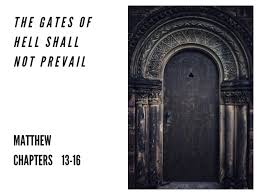
It all reflects such one-dimensional thinking. It gives the impression that in the eyes of public officials from the militarized cop in the street to the POTUS himself, the only solutions to social problems are found in shooting, tear gas, torture, and Hell Fire Missiles? In sum, “solutions” uniformly involve locking the poor and people of color behind “the Gates of Hell” centralized in today’s Gospel reading.

Gates of Hell Locked by the Rich

In every case, diplomacy, social reform, and negotiation seem out of the question. In fact, diplomacy has become a vanished art. Who needs it? After all, those damn “others” – be they Black Lives Matter demonstrators in Portland, Houthis in Yemen, or Palestinians in Gaza – can’t possibly have legitimate grievances. They simply must be brought to heel by force – shooting, bombing, and killing their children and youth. We’re made to believe that alternatives such as dialog and working out problems by negotiation and compromise are signs of weakness. So, violence is the first resort, never the last. It’s the order of the day in a world ruled by machismo, revenge, violence, and the law of the strongest.

When we’re not bombing, we’re building walls with locked gates. Our “gated communities” and locked doors wall us off from unsightly ghettos and the realities of the world’s poor mostly non-white majority. Better to build a wall along the Mexican border and then lock the gates, throw away the key and pretend that such barriers solve the problem of farmers and their children driven off their land by globalization, poverty and gangs. Better to justify it all by invoking the Ultimate White Privilege: “I feared for my life!” (Whites are the only ones who can get away with that one.)

Today’s Readings

All that brings us to today’s Liturgy of the Word. It’s about God’s interest in matters like those just enumerated – about politics, oppression and the liberation of non-white people like Jesus, Houthis, Palestinians, and residents of Chicago’s south side. It’s about breaking bonds and opening the gates of hell so that every Inferno can be transformed into the Kingdom of God. It’s about refusing to be discouraged even though the flow of history makes Jesus’ prayer, “Thy Kingdom come” seem like an impossible dream.

Start with today’s first reading. There the prophet Isaiah has God telling a courtier named Shabna to step down in favor of a man called Eliakim. Little is known about either one. The reason for including the reading today is apparently to establish today’s central point that God is concerned with the world of politics, and that (despite appearances) God is ultimately in charge of what happens in that sphere. There can be no separation of politics and religion in the divine dispensation.

The responsorial psalm continues the “this worldly” theme set by the first reading. It had us all singing “Lord, your love is eternal. Forsake not the work of your hands.” Once again, emphasis on “the work of God’s hands” reminds us of God’s commitment to this world – including ghettos, those living under endless bombing campaigns in Gaza and Yemen, and rich people like Mr. Trump and Saudi Princes making life unbearable for the world’s largely non-white poor. The psalm goes on to praise Yahweh for divine kindness, truthfulness, encouragement of the weak, care for the impoverished, and God’s alienation from their proud oppressors – again all connected with life here and now.

Then in today’s Gospel selection, we find a reprise of the very reading we shared just two months ago on the “Solemnity of St. Peter and Paul.” We practically know this passage by heart.

The reading centers on three titles associated with Jesus of Nazareth – Son of Man, Son of God, and Christ. All three names are politically loaded – in favor of the poor rather than the privileged and powerful.

Jesus asks his friends, “Who is the Son of Man in history and for us today?” (Scripture scholars remind us that the “Son of Man” is a figure from the Book of Daniel. He is the judge of all those who oppress the People of God whether they’re Egyptians, Assyrians, Babylonians, Medes, Persians, Greeks or Romans. He is “the human one” as opposed to a series of monstrous imperial beasts which the author of Daniel sees arising from the sea against God’s poor.)

So, Jesus’ question boils down to this: who do you think has taken the strongest stand against Israel’s oppressors? Jesus’ friends mention the obvious heroes, Elijah and Jeremiah. But in the end, they settle on a contemporary political prisoner in King Herod’s version of Abu Ghraib. He’s John the Baptist who was Jesus’ mentor. (According to Jesus, John was the greatest of all the prophets of Israel (MT 11:11). He’s the Son of Man, they say.

Having set that anti-imperial tone, Jesus then asks the question, “What about me? Who do you say that I am?” No question could be more central for any of us pretending to follow the Teacher from Nazareth. How we answer determines the character of the path we walk as Jesus’ would-be disciples in a world filled with Portlands, Yemens, Gazas, Hell Fire Missiles and militarized cops. Our answer determines whose side we are on – that of Mr. Trump or with the innocent victims of U.S. bellicosity.

Matthew makes sure we won’t miss the political nature of the question. So, he locates its asking in Caesarea Philippi – a city Herod obsequiously named for his powerful Roman patron. Herod had commemorated the occasion by minting a coin stamped with the emperor’s countenance and identifying him as “the Son of God.” Caesar was also called “the Christ,” God’s anointed. Good Jews saw all of that as idolatry.

So, Peter’s answer, “You are the Christ, the Son of the Living God” has the effect of delegitimizing Caesar and his empire. It’s also a swipe at King Herod. Peter’s response couldn’t be more political. Jesus, not Caesar is king, God’s anointed, the Son of God.

Neither could Peter’s words be more spiritually meaningful and heartening for those of us discouraged by events in those places afflicted by permanent U.S. belligerence.

Gates of Hell Unlocked by the Poor

The encouragement is found in Jesus rejoinder about the “gates of hell” and the “keys of the kingdom.” Jesus says, “Blessed are you, Simon son of Jonah . . . I will give you the keys of the kingdom of heaven . . . whatever you bind on earth will be bound in heaven, and whatever you loose on earth will be loosed in heaven.”

What powerful words of encouragement! They say that the world’s ultimate decision-makers are poor people like the fisherman, Peter, and like the rest of Jesus’ followers – the beggars, prostitutes, and victims of Roman imperialism. It’s what they decide — what they bind on earth — that reflects God’s divine order. History is on their side, not on that of the apparently invincible.

For those who would join Jesus on “The Way” to God’s Kingdom, Jesus’ words disclose the very key to life’s meaning. In effect, Jesus says, “Here’s the key to opening ‘the gates of hell’ and transforming life’s Infernos into God’s kingdom: all our actions – even apparent failures like my coming crucifixion – have cosmic significance. Don’t be discouraged even when the agents of hell end up killing me – as they inevitably will.”

Conclusion

In other words, we may not be able to see the effect of resisting empire and its bloody agents in the short term. But each act has its effect. God’s Kingdom will finally come. That’s our faith! It’s what gives meaning to our lives of resistance.

In today’s second reading, Paul elaborates the point. He says it’s not always apparent what God is up to in the world. After all, the ways of Transcendent Reality are deep and beyond comprehension – even by the wisest human beings. We may not be able to see God’s (political and personal) purposes at close range. But ultimately their inscrutable wisdom will become apparent (ROM 11: 33-36).

Or as Martin Luther King put it: “The arc of the moral universe is long, but it bends towards justice.”

All of us need to embrace that wisdom, refuse discouragement and continue doing what we can to resist the forces of empire and unlock those “Gates of Hell.” We may not live to see them swing open. But they will. That’s our faith.

U.S. Wars on Muslims Continue Even During CV-19 & BLM Uprisings

Readings for the 16th Sunday in Ordinary Time: Wisdom 12: 13, 16-19; Psalms 86: 5-6, 9-10, 15-16; Romans 8: 26-27; Matthew 13: 24-43

Despite what you might hear in church today, this Sunday’s liturgy of the word is not about the end of the world and the condemned spending eternity in endless fire. So, don’t be confused by the words Matthew puts in Jesus’ mouth about an afterlife filled with “weeping and gnashing of teeth.”

No, today’s readings are much more relevant than that. They’re actually about non-violent resistance in a context of imperial aggression and war. They suggest that Americans withdraw our support for the U.S. military and from Washington’s policy of state terrorism against impoverished Muslims in the Middle East. (Need I remind us that even during the Covid-19 crisis and Black Lives Matter uprising, U.S. wars against Muslims continue unabated?)

At the same time, the day’s three parables attributed to Jesus also imply a message for Middle Eastern followers of Mohammed. Today, as the principal victims of (U.S.) imperialism, Muslims are the closest analogue to the Judeo-Christian understanding of “People of God.” So, all three readings call followers of Islam [which recognizes Isa (Jesus) as the second greatest of the prophets (after Mohammed and before Abraham)] to lay down their arms in favor of Jesus’ own non-violent resistance.

Today’s Readings

To get my meaning, begin by considering my translations of today’s exceptionally beautiful readings. As usual, you’re advised to check the originals here to see if I’ve got them right:

Wisdom 13: 13, 16-19: Our Divine Mother loves all her creatures, even unbelievers. She condemns no one. Her love is the source of justice, easy forgiveness and of human courage. Consequently, the truly powerful on earth are also merciful, lenient, gentle and kind. None of us should worry about our “sins.” They are all forgiven.

Psalms 86: 5-6, 9-10, 15-16: Yes, our Divine Mother is good, understanding and kind. So, in time of trouble, we should feel confident asking for her help. She’s the One we’re all looking for. Deep down, we all want to be like her – forgiving, graceful, patient, gentle and faithful. At our profoundest level, we are!

Romans 8: 26-27: In fact, our Mother is there even for those who don’t know how to pray. Weak, painful groanings are enough. She knows what they mean. She knows we’re trying to do our best.

Matthew 13: 24-43: Our Mother’s world is like a garden sown with radiantly beautiful flowers of all kinds and colors. However, the spiritually unevolved sow weeds of hatred and violence to ruin that splendid paradise. Don’t resist them in kind. That only makes matters worse. Instead, just tend the flowers. Our compassionate Mother will do the rest. Her power is everywhere like yeast in a loaf of bread. That knowledge should give us courage to exercise similar gentle influence everywhere.

Jesus & Nonviolent Resistance

I hope you’re able to see the call to non-violence contained in those selections. They implicitly address all victims of aggression by Americans, today’s ruling empire. This means the selections are most relevant to the Muslim community and the question whether or not (as people of The Book) they should resist their oppressors in kind – i.e. with extreme violence.

That is, Jesus’ parable of the weeds planted by an enemy in a landlord’s field can be read as addressing the Roman occupation forces encumbering Israel during Jesus’ lifetime. [According to John Dominic Crossan, Matthew’s allegorizing of Jesus’ parable – making it about the end of the world – is more reflective of the situation of the Jewish diaspora (following the destruction of Jerusalem in 70 CE) than of the actual revolutionary situation of Jesus’ own day.]

In Jesus’ occupied Israel, the suffocating Roman presence (like our own country’s in the Middle East) was as unwelcome, alien, and destructive as weeds in a garden or field.

The question was how to deal with such odious foreign occupation. Like ISIS and others today, Zealot revolutionaries had their answer: Uproot the weeds here and now. Take up arms; assassinate Romans and their collaborators; drive them out mercilessly. Be as cruel and vicious as the Romans.

Jesus’ response was different. As a non-violent revolutionary, he could surely understand such apocalyptic energy. After all, much of his teaching expressed sympathy to the Zealot cause including land reform, debt forgiveness, and expulsion of the hated Roman occupation forces. Many scripture scholars even identify possibly five members of Jesus’ inner circle as Zealots themselves.

But Jesus’ Parable of the Weeds is more prudent and sensitive to civilian casualties than the strategy of the impatient Zealots – or that of ISIS.

When the landlord’s workers ask, “Should we uproot the weeds?” Jesus’ landlord answers: “No, if you pull up the weeds you might uproot the wheat along with them.”

In other words, Jesus agrees with El Salvador’s Oscar Romero and with Brazil’s Dom Helder Camara that revolutionary violence, though understandable (and justifiable on the grounds of just war theory), is imprudent at the very least.

This is because when faced with a vicious, overwhelmingly armed oppressor (like the United States) resistance inevitably leads to state terrorism – to the war crime of collective punishment impacting women, children, the elderly and disabled. At the very least, that’s why Jesus eschews Zealot violence.

Conclusions for Muslims

How then are Muslims to respond to increasing American domination of the Middle East since the dissolution of the Ottoman Empire?

Jesus’ answer? Be like mustard plant, he says. Be like yeast in flour. Both puzzling recommendations are relevant not just to Muslim victims of United States imperialism, but to Christians in our country who wish to dissent from their government’s policies of endless war.

First of all, think of the puzzlement that must have struck Jesus’ listeners. Jews didn’t have much use for yeast. They preferred unleavened bread. Neither would any farmer sow mustard seeds in her field or garden. The mustard plant was like kudzu – itself a kind of weed that eventually can take over entire fields and mountainsides while choking out other plants, weeds or not. The mustard plant was unstoppable.

So, Jesus is saying:

* The Romans are enemy weeds in your garden.
* Don’t try to uproot them by force.
* That will only lead to slaughter of the innocent.
* Rather, become weeds yourselves in Rome’s “garden.” Be like the mustard plant which is much more powerful than ordinary Roman (or U.S.) weeds.
* Resist the Romans by embodying the Spirit of God that is slow to anger, good, forgiving, abounding in kindness.
* Only imitation of Wisdom’s God can defeat the evil of imperialism – or any evil for that matter.

Conclusions for Christians

What does that mean for Christians wishing to express solidarity with our Muslim brothers and sisters against their cruel “Christian” oppressors? At least the following:

* Reject U.S. militarism in general as counterproductive, since fully 90% of the casualties it inflicts in war are civilians.
* Be instead like the yeast a homemaker puts into 60 pounds of flour, “infecting” the greater culture by non-violent resistance rather than “supporting our troops.”
* Recognize and take sides with the real victims of terrorism – those plagued by U.S. policies of aggressive wars and regime-change – i.e. of state terrorism.
* Lobby against absurd proposals to increase U.S. military spending, when already “our” country spends more on “defense” than the next ten countries combined.

* Refuse to honor the military and dissuade your children and grandchildren from entering that corrupt and corrupting gang of outlaws.

Surely Jesus’ Way of non-violent resistance, forgiveness and love of enemies will strike many (non-believers and believers alike) as unrealistic. But according to the faith we Christians (and Muslims) pretend to embrace, Jesus’ Way is God’s way.

But then perhaps we Christians think we’re smarter and more realistic than Jesus — or our Divine Mother?

What do you think?

(African) American Exceptionalism: The Case for Black Supremacy

Readings for 13th Sunday in Ordinary Time: 2 KINGS 4: 8-11, 14-16A; PSALM 89: 2-3, 16-19; ROMANS 6: 3-4, 8-11; MATTHEW 10: 37-42

Today’s first reading from the Jewish Testament’s Second Book of Kings sets the tone for this Sunday’s reflection. It is about a privileged woman (from biblical Shunem) who is given a new lease on life by creating a room “upstairs” for a prophetic presence and voice. Doing so brings her new life beyond anything she had dared hope for.

Her situation taken in conjunction with our day’s other readings can be understood as calling us all to clear space in our minds for recognizing our own inner prophets. Currently, that means attuning our consciousness to the oracular nature of the shouts and denunciations raised in our streets. The black voices resonating there are far more perceptive and informed – more prophetic – than anything we hear from white politicians and talking heads on TV. In effect, the tumult in the streets calls us to recognize the truth of black supremacy.

To see what I mean, let’s think about prophecy as referenced in today’s liturgy of the word. Then consider the analytical advantage native to the truly exceptional among us (our African American sisters and brothers). Finally, let’s entertain suggestions for creating suitable space in the upper reaches of our minds for black prophets who possess the power to change our nation’s collective life.

Prophetism  

The reading about the Shunamite woman comes from the part of 2nd Kings that details the words and deeds of the great prophet Elijah and his successor Elisha. For our purposes today, those details are not important.

What is important is to rethink the category of prophet. Most lump the term together with something like fortune teller. They think prophets are primarily concerned with the future.

But that’s where they’re wrong. Biblical prophets were not principally concerned with the future. They were not fortune tellers. Instead, they were understood as spokespersons for God. Though some functioned as court advisors, most were primarily defenders of the poor and oppressed – the real “chosen people” of Israel’s God throughout the Jewish Testament.

As such, prophets had their eyes firmly fixed on the present. Their task was twofold. It was first of all to denounce and secondly to announce. Prophetic denunciation targeted kings, rich landowners, bankers, the royal classes in general, and temple officials. The habitual crime of the well-off was their systemic exploitation of poor peasants and laborers, and those forced into debt peonage. In fact, if you examine the parables of Jesus, you’ll find most of them addressing the situations of such people. Yes, Jesus appeared in the prophetic tradition.

The second prophetic task was to announce a new future for the oppressed. For the prophets, another world was possible. Another God was possible. Jesus called that other world “the kingdom of God.” The phrase and its parabolic descriptions in stories like the Prodigal Son and Good Samaritan captured what the world would be like if God were king instead of Caesar.

That God was “Father” to the poor, their “Good Shepherd,” the Great Liberator of people like those Jesus himself befriended – prostitutes, beggars, insurgents, lepers, foreigners, drunkards, the hungry and thirsty, social outcasts, children, and repentant tax collectors.

Besides being a prophet, Jesus himself was a poor man – a day laborer (not a priest or rabbi) who had been an immigrant in Egypt as a child. From the beginning of his public life, he was under surveillance and investigation by the authorities. They identified him as a terrorist and subversive. He finished as a victim of state torture and capital punishment.

All of that means that (according to Christian faith) God chose the socially marginalized and rejected as the vehicle for revealing the true meaning and purpose of human life. It’s as if (according to divine epistemology) the poor are somehow more connected with Life itself.      

African American Exceptionalism

What could that mean for our actual world that’s now on fire with insurrection?  And here, let me emphasize that I’m not just referring to Minneapolis, but to the rebellions that Twin City has evoked across the country and across the planet. Does it all suggest that African Americans know more than the rest of us? Does it suggest that as a people, they’re more perceptive – more prophetic – than the rest of us?

Cuba’s great poet and historian Roberto Fernandez Retamar thought so.

I remember 20 years ago when he addressed my class (about half of them African American) when we were in Havana for a month studying “The African Diaspora in Cuba.”

In his riveting presentation, he described the descendants of African slaves as the world’s most exceptional people. They are, he said, the strongest, most beautiful and most intelligent humans on earth.

Professor Retamar reasoned as follows:

  • Slave traders in Africa began by selecting the sturdiest, best looking and smartest specimens to sell to their slaver counterparts in the New World. (It’s the way the market works.)
  • On the Middle Passage to distribution points like Cuba, up to half of those so carefully selected perished; only the strongest survived.
  • Then on auction blocks in places like Charleston and New Orleans, none but those with the best characteristics and strongest bodies were again selected by discerning slave buyers. (They examined teeth, hair and limbs as if the slave wares were horses.)
  • Only the best and brightest of those so purchased survived the harsh conditions of slavery to reproduce and have their offspring once again culled and selected.
  • The repetition of such processes for 300 years produced the super-race of people that continues to exhibit admirably courageous survival characteristics to this very day. Despite all the obstacles, they’re the authors of the unparalleled moral achievements embodied in slave rebellions, the abolitionist movement, and in civil rights struggles – the most spiritually-grounded, inspiring and influential causes in the history of the world.
  • Moreover, African American achievements in the arts, especially in music including spirituals, jazz, rock ‘n’ roll, and hip-hop rank with the highest contributions that westerners have made to world culture. The black community’s tremendous athletic achievements are second to none.

Yes, Dr. Retamar concluded, the African diaspora represents the best and brightest of the human race. They are the most beautiful, strongest and smartest of humans. Their wise and perceptive prophetic presence is based on an American experience that is truly exceptional. It has much to teach us about what blacks are especially privy to – about the nature of Life Itself and the unending struggle for justice.

Today’s Readings

With all of that in mind, please reread today’s liturgical selections. As I said, they’re about making room for prophets (like Elisha and the ones in our streets) in the upper reaches of our minds. What follows are my “translations” of the readings. You can read the originals here to see if I got them right.

2 KINGS 4: 8-11, 14-16A: Despite obstacles of wealth and power, even the privileged can make room for prophets who speak for the poor. But to do so, the rich must carefully create space in the upper reaches of their clouded minds. “Up on the Roof,” they should cultivate quiet, rest, and space for reading and enlightenment. Such provision will free their inner prophet and yield new and unexpectedly welcome life.

PSALM 89: 2-3, 16-19: So, repair to your own “upper room” every day and there discover transcendent security, strength, joy, fidelity, and commitment to God’s justice. Doing so will even confer ability to discern political leaders who exhibit such qualities.

ROMANS 6: 3-4, 8-11: In fact, the whole point of following Jesus the Christ is to die to the comfortable but misleading wisdom of the world and rise to God’s new life as exemplified in the poor man, Yeshua. That life is lived entirely for justice despite the world’s threats.

MATTHEW 10: 37-42: Notwithstanding such intimidations then, be open to prophetic voices. Depart from familial truisms even as taught by your parents and (ironically) as accepted by successfully indoctrinated children. Such departures represent the only way to find your True Self. But be forewarned: the state will incriminate and crucify you even for giving a cup of cold water to thirsty oppressed people. Do it anyway and learn to live with the resulting fulfillment and happiness.

Conclusion

Today, we are called to imitate the Shunamite woman who welcomed the prophet Elisha.

She prepared space for him, and provided him with a bed, table, chair, and lamp. She welcomed him to her dining room, fed him, and made him feel at home.

Today’s liturgy of the word calls us to do something similar. It suggests that we use this time of COVID-19 respite to make room for our inner prophet who turns out to be black and (because of a unique experience of oppression) is especially insightful and aligned with the divine purposes of the universe.

This is the time to figuratively enter that space in our attic, to turn on its lamp, to meditate and read something like Howard Zinn’s People’s History of the United States. While we’re at it, we might watch something like “The Help,” “Malcolm X,” “Amistad,” or “Glory.”

Today’s readings (and our very times) call us to rethink everything, turn it upside down, see it with new eyes, and perhaps recognize the truth of black supremacy.

Face It: America’s God Is Violence

Readings for Trinity Sunday: Exodus 34: 4B-6, 8-9; Daniel 3: 52-56; 2nd Corinthians 13: 11-13; John 3: 16-18

You’ll never convince me that theology is unimportant or irrelevant to politics.

Early last week, President Trump had Lafayette Park cleared of protestors for a Bible-waving photo-op in front of St. John’s Church. Evidently, his specifically theological point was to assure everyone that God is somehow on his side and that of the DC police in their fight with the peaceful protestors he called “thugs” and “terrorists.” The president implied that God supports his and the cops ham-handed attempts to quell the general uprising sparked throughout the country (and the world) by the brutal murder of George Floyd, yet another unarmed black man executed by the police state Mr. Trump now heads.

The presidential photo-op underscored not only the tone-deaf cynicism of the current occupant of the White House. It highlighted as well, the identity of the three-personed God he and his white “Christian” supporters actually worship. It’s not the God of Jesus.

I bring that up, because today is Trinity Sunday – a day that calls attention to the mysterious Christian belief that almost no one can coherently explain. It’s the faith that there are three persons in one God: Father, Son, and Holy Spirit.

Today in these remarks, I’m setting aside any concern with obscure, esoteric explanations of that rich mystery so often trivialized into some sort of mathematical problem. (It has been well explained most recently by Richard Rohr in his The Divine Dance. Highly recommended.)

My point instead is to redirect its understanding in a more immediate way intimately connected with what’s happening now in our city streets. It is to explore the mysteries of the real Trinity that we Americans actually worship. It’s a divinity Americans call on to solve any problem you might imagine.  I’m talking about the deity called Violence. Yes, as what Dr. King called “the greatest purveyor of violence in the world,” our nation worships Violence Itself.

Our reverence for this quasi-divine being is revealed in our vicious cultures of police and military so evident in our cities these days. It’s revealed in our worship of guns, in our “defense” budgets, in our films, and in the wars our nation more than any other on the planet initiates and sustains throughout the world.    

Like the traditional Trinity, our God of Violence also has three manifestations. There is Violence the Father, Violence the Son, and Violence the Evil Spirit. Let me try to explain.

Trinitarian Violence

Violence the Father: This is the invisible power that shapes all of our lives. Sociologists refer to his domain in terms of “structural violence.”  He is the creator of every society’s status quo – the form of mayhem that begets most of its other manifestations. This violent divinity is the one in whom we Americans live and move and have our being; he’s like the air we breathe; we don’t even notice his presence. Yet our simple participation in the world-as-we-know-it transforms us into his votaries.

Worldwide, this is the God who allows 15,000 children to die each day of absolutely preventable poverty and hunger. Most commonly, they are victimized by ailments as simple as diarrhea caused by contaminated water. But all those children die at our system’s hand just as surely and predictably as if executioners put guns to their heads and pulled the trigger 15,000 times every 24 hours. The God of the status quo endorses every shot.

Violence the Father also underwrites ghettoes, decrepit schools, food deserts, and structural unemployment. He makes sure drinking water is contaminated by lead, that borders are closed to refugees and asylum seekers, and that the air in poor communities is unbreathable.

For the police, he’s the patron of “qualified immunity.” That’s the legal doctrine that encourages law enforcement crime. In practice, it guarantees that police will never be convicted of any crime unless their attorneys prove unable to turn up a single cop anywhere in the world who wouldn’t have acted similarly in a similar situation. What a joke!

Americans love Violence the Father. We’re convinced his order is the best human beings can achieve. After all, we live in “the greatest country in the world.” [We say that with a straight face, even though (if we opened our eyes) we would see clearly that other better countries are all over the map. However, our fundamentalist religious brainwashing masquerading as “patriotism” just won’t let us go there.]

Violence the Son: This is the second person of the unholy trinity worshipped throughout America. Violence the Son is the offspring of the Father – his only (i.e. inevitably) begotten son. He embodies the self-defensive, but ultimately auto-destructive response of perhaps 5% of the protestors in our streets during these days of rage and rebellion. They are the marginalized, despised and brutalized who have abandoned hope of systemic reform by going through the channels. They’ve given up on Dr. King’s and on Jesus’ non-violent resistance.  

If the truth be told, many of them are heroic by standards widespread in our country, where precious few subscribe to non-violence. Often, these devotees consider themselves spiritual descendants of the U.S. Founding Fathers. Remember how those sometime heroes bravely defended the right to take up arms against any government or police force that denies rights to life, liberty and the pursuit of happiness. In their Declaration of Independence, the founders wrote “. . . whenever any form of government becomes destructive of these ends, it is the right of the people to alter or to abolish it, and to institute a new government. . .”

Yet, the attitude of these followers of Violence the Son, though apparently heroic, is self-destructive. That’s because it inevitably incurs a response from the militarized state that is overwhelming and absolutely destructive. It’s that response of police brutality that has horrified us all over the past ten days. It’s the third-level violence — that of the Unholy Spirit.  

Violence the Evil Spirit:

This is the spirit of fear, racism, vengeance, and false patriotism that inspires police and military over-response to the small number of protestors who worship Violence the Son. And, as I just said, the response in question is devastating. Worldwide, this Spirit routinely leads the United States to mercilessly slaughter any who dare raise a fist against first-level structural crimes inspired by Violence the Father. Think of the hundreds of thousands butchered throughout Central America during the 1980s, when the U.S. crushed peasant response to U.S. neocolonialism, regime change, torture and assassination in Guatemala, Nicaragua, El Salvador, and Honduras.

But closer to home, think of last week’s spectacles of police cars running over those exercising their Second Amendment rights.  We all saw those committed to “protect and serve” instead slashing tires, tear gassing, pepper spraying, and tasering peaceful protestors. We saw them crack open the head of a 75-year-old man in Buffalo. As agents provocateurs, they smashed windows, set fire to police cars, and left piles of bricks strategically placed for use by activists inclined to throw them.

It’s at the altar of this evil spirit that the NYPD worships along with other infamous blue-clad gangsters throughout the country.  By their actions, they’ve revealed the truth of Frank Serpico’s telling description of New York City police. Ten percent of them, he said, are honest. Ten percent are absolutely corrupt. And the other 80% wish they weren’t. In other words, 90% of our nation’s police forces are proving themselves to be brutally crooked especially towards people of color. And virtually all of them are committed to protecting each other’s backs no matter what. And that means that virtually all of them are liars and criminals.

And why not? They all worship our trinity’s third person – the Spirit of Violence itself.

Conclusion

Yes, what I’m saying is that almost all of us end up offering incense not to Christianity’s Holy Trinity of Father, Son, and Holy Spirit. Instead, the God most of us worship is Violence pure and simple. In fact, most in our country would laugh in your face if you suggested adopting and implementing Jesus’ words about love and forgiveness of enemies. No, we prefer to hate and kill them – in the name of God. For most of us, anger and violence are stronger and more realistic than any ethic endorsed by the one honored in that church Mr. Trump used as a prop. As a people, Americans love Violence.

Today’s Trinity Sunday observance and the teachings of Jesus in general call us away from all that. They ask us to repudiate our idolatry of Violence – Father, Son and Evil Spirit – and to join peaceful protestors all over the world – in the Holy Spirit of Jesus himself. That Spirit remains 180 degrees opposed to our country’s allegiance to the status quo and its violent police state Trinity.

Cuba’s Response to the Coronavirus Is Far More Enlightened Than Ours

Readings for 4th Sunday of Lent: 1 Samuel 16: 6-7, 10-13A; Psalm 23: 1-6; Ephesians 5: 8-14; John 9: 1-41

This week’s liturgy of the word centralizes the concepts of blindness and darkness on the one hand and vision and light on the other. The constellation of readings is extremely relevant to our situation during this election season and time of Coronavirus.

Taken together, they claim that in the end, the processes of the Loving Universe (aka God) differ sharply from the choices of “the world.”  While the world chooses the rich and powerful to lead, God chooses the least. What the world calls “seeing” is really blindness enshrouded in darkness.  What it calls blindness is deeply perceptive and surrounded in light.

I’ll get to those readings in a minute. But before I do, consider their relevance to our culture’s own highly cultivated blindness.

On Our Blindness

Yes: from birth we’re taught to deny what’s staring us all in the face. We’re actually trained to be blind by our parents, culture, teachers and holy men. That imposed condition is exhibited today as we confront the world’s current pandemic crisis brought on by the Coronavirus.

Think of how our politicians both Republican and Democrat want us to deny what we’ve all seen with our own eyes.

Begin with the Republicans and Mr. Trump. (This is quite amusing.) Mr. Trump actually wants us to believe that he deserves a grade of “A” for dealing with the crisis that surfaced last December and which he ridiculed, belittled, and mocked all the way up until last week. Despite that clear record, the man’s dared to say, “This is a pandemic. I felt it was a pandemic long before it was called a pandemic.”

What?

Then there was Joe Biden’s admonition last week that we all close our eyes to the achievements of the Cuban revolution. This man was shocked and appalled by Bernie Sanders recognition regarding Cuba that “. . . (I)t’s simply unfair to say everything is bad.”

“No,” Biden insisted, since Cuba is a “brutal dictatorship,” it’s somehow wrong to recognize the truth acknowledged even by the vice president’s own mentor (Barack Obama). Obama said, “The United States recognizes progress that Cuba has made as a nation, its enormous achievements in education and in health care.” Biden doesn’t want us to see any of that.

But there’s more – even apart from the arguable fact that for nearly 20 years, the most brutal human rights violations in Cuba have been carried out by the United States in its heinous hellhole known as Guantanamo Bay.

Cuba’s Enlightened Humanity

The “more” is that Cuba is exhibiting much greater humanity and skill in dealing with the Coronavirus than is the United States. That is, even in this time of pandemic, “we” not only refuse to lift sanctions on Cuba, Iran, Venezuela, and the other countries we’re punishing for crimes very similar to our own and even surpassed by “friends” such as Israel, Saudi Arabia, Brazil and the Philippines. We’re actually intensifying the sanctions in the case of Iran while it’s an epicenter of the coronavirus pandemic. Evidently, for our leaders, there’s no recognition of human solidarity that transcends political considerations. They want us to forget that we’re all in this together – to be blind.

Meanwhile, Cuba has given docking privileges to a British cruise ship (and medical treatment to its passengers and crew) after those same privileges were refused elsewhere – even by Great Britain’s former colonies. Cuban authorities gave permission, they said, out of “humanitarian concerns” and the need for “a shared effort to confront and stop the spread of the pandemic.”

But Cuba’s response to the Coronavirus goes far beyond a one-off act of compassion. The country’s entire healthcare system is better equipped than ours for dealing with recurring epidemics like COVID-19, SARS, MERS, Ebola, Zika, and flu. And it’s not just a question of a Caribbean version of Medicare for All.

No, Cuba has a whole army of doctors to care not only for its own people, but also stands ready to respond to crises outside its borders. And it has done so repeatedly – even during the COVID-19 pandemic. The country also offers free medical education to students from the United States, provided they pledge themselves to serve their local communities on their return home. Moreover, every barrio in the country has a doctor known by name, because she makes house calls!

Add to this Cuba’s highly developed system of urban and community gardens, its use of animal-intensive rather than carbon-intensive plowing, and its generally low-carbon economy, and you’ll see why it’s better equipped than we are to deal with food shortages caused by a breakdown of the commercial supply chain during emergencies like the one we’re now experiencing.

Then there’s the Cuban education system vilified here as propagandistic – as though ours were not. Besides the exemplary literacy program implemented at their revolution’s outset, Cubans study colonialism, imperialism, and the way capitalism works to cause, profit from and exacerbate inevitable human disasters like pandemics, hurricanes, world hunger, and climate change. The 60-year blockade and quarantine imposed on the island along with the presence of the Guantanamo Bay prison camp provide teachers with close-to-home illustrations of capitalism’s brutality. Meanwhile, our version of schooling (even at doctoral levels) never touches such matters. So, whose system is propagandistic?

The bottom line here is that far from being a brutal dictatorship, Cuba presents us with a model of response not only to COVID-19, but to healthcare in general, climate change, and education. It’s just that we’ve been made so blind by our political “leaders,” teachers, and priests that we cannot see it.   

Today’s Readings

With all of that in mind, consider today’s liturgical readings and what they have to say about seeing, insight, and light on the one hand blindness, superficiality and darkness on the other. Again, the selections could hardly be more relevant in this election season and time of COVID-19. Here are my “translations” of the texts. Once again, I urge you to read them for yourself here.

1 Samuel 16: 1B, 6-7, 10-13A

The Spirit of Life chooses national leadership from the least in the working class: The prophet Samuel was a great seer gifted with divine insight. Sent to the home of Jesse in Bethlehem, he sought Israel’s new King not from among the wealthy, but from a herdsman’s seven sons. However, his sharp prophetic perception found none of them worthy. “Have you no other son?” the prophet asked. “Well,” Jesse said, “David, my youngest is out in the field tending the sheep. But surely, he can’t be . . .” “Bring him to me,” the prophet growled. So, the youngest entered, red-faced and handsome. Seeing with God’s eyes, Samuel proclaimed, “This indeed is God’s chosen.” He then anointed David’s head with oil. And God’s Spirit rushed in upon the unsuspecting youth.   

Psalm 23: 1-6

We can trust such choices by the Great Spirit: This is true because ultimately the Holy Spirit is humanity’s shepherd; there is nothing, then, to fear. She has created for us peaceful pastures near gentle refreshing waters. She is our guide and encouragement even in moments of darkness when we are overwhelmed by threatening circumstances. Her spirit nourishes us and protects us from all enemies and has done so throughout our entire lives. Who could ask for more?

Ephesians 5: 8-14

Trusting the insights of seers like Jesus confers salvific vision: Thanks to the enlightened Jesus (and other seers), our once darkened lives are now filled with light, goodness, justice and truth. We can finally see! In fact, we can become light itself. So, when shameful evil comes into our presence, it is exposed as such; it is transformed into light and quite disappears. Seeing with enlightened eyes is like awaking from a deep sleep or even rising from the dead.  

John 9: 1-41

An illustration of how Jesus, his example and teaching can cure our blindness: As Light of the World, Jesus demonstrated the very meaning of enlightenment, when he met a beggar who was blind from birth (a metaphor for each of us). Living in blind darkness, Jesus said, is not the result of sin, but is part and parcel of the human condition. Escaping such shared handicap means overcoming the “wisdom” of the crowd, parental formation and religion itself. It means making choices based on personal experience of divine insight and then following Jesus (or some other enlightened avatar).

Conclusion

Wow! What clear direction at this crucial time! Seeing with God’s eyes reveals a world 180 degrees opposite the one endorsed by our culture, politicians, and even most church leaders. One hundred-eighty degrees!! If they say white, think black. If they say true, think lie. If they say peace, think war. We will not go far wrong adopting the working principle that our leaders lie whenever they move their lips. And that’s the truth.

Specifically, at this time of national choice and raging pandemic, the readings suggest that all of us are blind and zombie-like; we’re the walking dead. We can’t see what’s staring us in the face.

  • Contradicting today’s first reading, we reject worker-friendly leadership in favor of billionaires and corporate lackeys.
  • Blind as we are, we’re easily convinced by serial liars like Trump and Biden that up is down and that greed is good.
  • We actually still believe that even after Vietnam, Iraq, Fallujah, Abu Ghraib, Guantanamo, Yemen, prison camps and baby jails on our southern border – after alliances with the likes of Bolsonaro, Duterte, MBS, Netanyahu . . . — we can still lecture the world about our need to combat “brutal dictatorships.”
  • We still believe that our election system – even after retention of the Electoral College, Citizens United, gerrymandering, voter suppression, hackable voting machines, and mile-long lines on election days – is still somehow the world’s gold standard for democracy.
  •  Above all, we still impossibly believe that capitalism is at all capable of functioning effectively at times of crisis like the ones we’re facing now. (Here in mid-March, it can’t even produce Coronavirus test kits equivalent to what China’s been using since December!) Somehow the belief in capitalism’s superiority persists even when the record shows that in time of war, natural disaster, and predictable systemic failures, we always resort to socialism. In fact, the rich demand it! That’s because socialism is less rigid and more efficient!
  • In the case of Cuba, we can’t even recognize that a poor socialist country, oppressed and impoverished by 60 years of U.S. quarantine and blockade has shown itself more flexible, generous and humane than its uber-rich capitalist neighbor to the north.

Could we be more blind?  

“Going for Broke”: The Maximalism of Jesus, Bernie Sanders & the Green New Deal

Readings for the Second Sunday of Lent: Genesis 12: 1-4A; Psalms 33: 4-5, 18-22; 2nd Timothy 1: 8b-10; Matthew 17: 1-9

The sudden revival of Joe Biden’s candidacy on Super Tuesday represents a victory for cautious centrists in the Democratic Party. They’re afraid of Bernie Sanders and his self-proclaimed revolution on behalf of the working class, low income earners, and the environment threatened by the devastations of climate change. They fear Sanders strategy of “Going for Broke.”

That strategy came in for criticism a few days ago from Paul Krugman in his New York Times op-ed called precisely that: “Bernie Sanders Is Going for Broke: Is maximalism the best political strategy?”

In the light of today’s liturgical readings for this Second Sunday of Lent, the phrase “going for broke” has special meaning. The day’s Gospel selection recounts the familiar story of Jesus’ “Transfiguration,” where on a high mountain, the Master’s appearance is transformed (enlightened) before three of his apostles as he dialogs there with Moses and Elijah. Today, I’d like to give that dramatic parable a unique spin and explain it in historical context — as liberation theologians might. I’ll retell the story in terms of Jesus establishing a go for broke strategy for himself and his followers on their paths of faith.

Before I get to that, however, consider Krugman’s rejection of that approach.

Krugman’ Rejection of Maximalism

The jumping off point for his criticism of “maximalism” was a Sanders ad centralizing Barack Obama’s praise for the Vermont senator over the years. Krugman argued that such association is disingenuous since (in Krugman’s words) Sanders’ approach is a “go for broke maximalism” as opposed to Obamism which the columnist described as accepting “incremental, half-a-loaf-is-better-than-none politics.”

Echoing traditionalist appeals for gradualism in the face of the Civil Rights and Women’s Suffragist movements (not to mention Republican talking points), Krugman alleged, that Sanders’ maximalism is unrealistic. After all, it includes “complete elimination of private health insurance and a vast expansion of government programs that would require major tax increases on the middle class as well as the wealthy.” And Sanders would do all of this, the columnist argued, on the theory that it would win over white working-class constituents and bring a surge of new voters.

Krugman concluded “unfortunately, no evidence supports this political theory.”

Apart from the fact that Sanders’ strategy actually does find historical precedent in Roosevelt’s New Deal in the 1930s (as Krugman himself argued on “Democracy Now” a week earlier), the columnist’s words ignore the fact that only a “go for broke” strategy can save the planet at this moment of climate emergency.

Simply put, the planet cannot endure another four years of Bidenesque gradualism (much less of Trumpian denial). Instead, the required strategy is what Sanders and progressive Democrats have proposed as the Green New Deal, which Biden, Krugman, and establishment incrementalists studiously ignore.

Jesus’ Embrace of Maximalism

This Sunday’s Gospel reading announces Jesus’ strategy of maximalism in the face of his people’s unprecedented crisis in the early years of the first century. (Actually, however, Jesus’ crisis is dwarfed by the one the entire human race faces today.)

Be that as it may, consider Jesus’ maximalism. Today’s reading finds the young carpenter from Nazareth on his way to Jerusalem, where he knows something extremely risky is about to happen. Yet he’s determined to be part of it. The risky action has to do with the temple and the collaboration of its leaders with the Roman Empire.

The temple has become worse than irrelevant to the situation of Jesus’ people living under Roman oppression. What happens there not only ignores Jewish political reality. The temple leadership has become the most important Jewish ally of the oppressing power. And Jesus has decided to address that intolerable situation despite inevitable risks of failure.

Everyone knows that a big demonstration against the Romans is planned in Jerusalem for the weekend of Passover. There’ll be chanting mobs. The slogans are already set. “Hosanna, hosanna, in the highest” will be one chant. Another will be “Hosanna to the Son of David!” “Hosanna” is the key word here. It means “save us!” (The Romans won’t notice that the real meaning is “Save us from the Romans.” “Restore an independent Israel – like David’s kingdom!”) It was all very political.

Jesus has heard that one of the main organizers of the demonstration is the guerrilla Zealot called Barabbas. Barabbas doesn’t call what’s planned a “demonstration.” He prefers the term “The Uprising” or “the Insurrection” (Mk. 15:6-8).

Barabbas has a following as enthusiastic as that of Jesus. After all, Barabbas is a “sicarius” – a guerrilla whose solemn mission is to assassinate Roman soldiers and their Jewish collaborators. His courage has made him a hero to the crowds. (Scripture scholar, John Dominic Crossan compares him to the Mel Gibson character in “The Patriot.”)

Jesus’ assigned part in the demonstration will be to attack the Temple and symbolically destroy it. He plans to enter the temple with his friends and disrupt business as usual. They’ll all loudly denounce the moneychangers whose business exploits the poor. They’ll turn over their tables.

As a proponent of non-violence, Jesus and his band are thinking not in Barabbas’ terms of “uprising,” but of forcing God’s hand to bring in the Lord’s “Kingdom” to replace Roman domination. Passover, the Jewish holiday of national independence could not be a more appropriate time for the planned demonstration. Jesus is thinking in terms of “Exodus,” Israel’s founding act of rebellion.

And yet, this peasant from Galilee (even like Paul Krugman and establishment Democrats) is troubled by it all. What if the plan doesn’t work and God’s Kingdom doesn’t dawn this Passover? What if the Romans succeed in doing what they’ve always done in response to uprisings and demonstrations? Pilate’s standing order to deal with lower class disturbances is simply to arrest everyone involved and crucify them all as terrorists. Why would it be different this time?

So before setting out for Jerusalem, Jesus takes his three closest friends and ascends a mountain for a long night of prayer. He’s seeking reassurance before the single most important act of his life. As usual, Peter, James and John soon fall fast asleep. True to form they are uncomprehending and dull.

However, while the lazy fall into unconsciousness, the ever alert and thoughtful Jesus has a vision. Moses appears to him, and so does Elijah. (Together they represent the entire Jewish scriptural testament – the law and the prophets.) This means that on this mountain of prayer, Jesus considers his contemplated path in the light of his people’s entire tradition.

According to the Jews’ credal summary in Deuteronomy 26, their whole national story centered on the Exodus. Fittingly then, Jesus, Moses, and Elijah “discuss” what is about to take place in Jerusalem. Or as Luke puts it, “And behold, two men were conversing with him, Moses and Elijah, who appeared in glory and spoke of his exodus that he was going to accomplish in Jerusalem.” Jesus’ Exodus!!

It is easy to imagine Moses’ part in the conversation. That would be to remind Jesus of the chances Moses took when he led the original Exodus from Egypt. That might have failed too. Nevertheless . . .

Elijah’s part was likely to recall for Jesus the “prophet script” that all prophets must follow. That script has God’s spokespersons speaking truth to power and suffering the inevitable consequences.

Elijah reminds Jesus: So what if Barabbas and those following the path of violence are defeated again? So what if Jesus’ non-violent direct action in the temple fails to bring in the Kingdom? So what if Jesus is arrested and crucified? That’s just the cost of doing prophetic business. Despite appearances to the contrary, Jesus’ faithful God will somehow triumph in the end.

Conclusion

Is there a message for us here as Bernie Sanders (the most honest politician our country has produced in generations) calls us towards a maximalist response to a world-wide crisis so much worse than the one that faced Jesus’ people under Roman domination?

I think there is.

Today’s readings tell us that God’s People are not to be led by frightened little men who place security and their own careers above compassion for the poor, the oppressed, and Mother Nature Herself. Faith is not primarily about cooperating with denialists, settling for half-a-loaf or about gradualism advocated by the rich and their comfortable allies. The crisis facing the human race is unprecedented. It calls for maximalism far beyond what Krugman criticizes in Sanders. At the very least, it calls for a Green New Deal, which Krugman could not even bring himself to mention.

No: faith is not at all about gradualism. It’s about risk on behalf of God’s creation and the poor, who will suffer most from the ravages of climate change.

Yes, Mr. Krugman, there are people like you and Mrs. Biden who say they are concerned, but who cancel out such claims by fearful, self-defeating caution and cowardly willingness to sacrifice even the lives of their children and grandchildren for a near-term, more-of-the-same future. There, Mr. Biden has promised his corporate supporters, “Nothing fundamental will change.”

Such people cannot claim to be followers of the prophetic Jesus of Nazareth. In our present crisis, those of us who do are called to adopt nothing short of the maximalism Paul Krugman fears.

On Joining John the Baptist in Rebellion against the Religious Establishment – and the Republican Party

dangerous

Readings for Second Sunday of Advent: IS 11: 1-10; PS 72: 1-2, 7-8, 12-13; ROM 15: 4-9; MT 3: 1-12

“The meaning of the Incarnation is this: In Jesus Christ, God hits the streets. And preparing for that is the meaning of Advent.” (Jim Wallis. “Advent in 2016: Not Normal, Not Now, Not to Come.”)

__________

Three years ago I published a review of James Patterson’s novel, Woman of God. It continues to get clicks – perhaps more than anything I’ve published on my blog.  I think that’s because so many of us find ourselves searching for a richer, more relevant church experience that connects with the extraordinarily dangerous times we’re living in. They have in fact been shaped by “the most dangerous organization in the history of the world.”

Woman of God is the story of Brigid Fitzgerald, a medical doctor who though female, becomes a priest and candidate for the papacy.

Brigid and her husband (also a dissident priest) decide to form their own Catholic parish. They do so because of the studied irrelevance of the Catholic Church to pressing problems of the real world. The two call their congregation the “Jesus, Mary and Joseph (JMJ) Church.” They insist on remaining Catholics not allowing their opponents to drum them out of the church as just another break-away Protestant sect.

The JMJ Church spreads rapidly, largely because it connects Jesus’ Gospel with issues of peace and social justice. And though vilified by her local bishop and physically threatened by right wing Catholics, Brigid eventually becomes widely celebrated and is summoned to Rome not for condemnation, but papal approval.

I couldn’t help thinking of Woman of God as I read today’s liturgy of the word this Second Sunday of Advent. Like the JMJ Church, the first two readings along with the responsorial psalm emphasize the connection between faith and social justice.

Then in today’s Gospel, the prophet, John the Baptist, like Brigid Fitzgerald, initiates an alternative community of faith far from the temple in the desert wilderness. John’s credibility leads “all Jerusalem and Judea” to see him as a prophet. In fact, (as John Dominic Crossan has pointed out) John becomes for the Jewish grassroots their de facto alternative “High Priest.”

To see what I mean, consider that first selection from the prophet Isaiah. It directly links faith with justice for the poor, oppressed and marginalized. In Isaiah’s day (like our own) they were typically ignored. By way of contrast, Isaiah’s concept of justice consists precisely in judging the poor and oppressed fairly and not according to anti-poor prejudice – in Isaiah’s words, not by “appearance or hearsay.”  (A clearer statement against contemporary police and/or government profiling can hardly be imagined.)

Not only that, but according to the prophet, treating the poor justly is the key to peace between humans and with nature. Centralizing their needs rather than those of the rich produces a utopian wonderland where all of us live in complete harmony with nature and with other human beings. In Isaiah’s poetic reality, lions, lambs, and calves play together. Leopards and goats, cows and bears, little babies and deadly snakes experience no threat from each other. (This is the prophetic vision of the relationship between humans and nature – not exploitation and destruction, but harmony and mutual respect.)

Most surprising of all, even believers (Jews) and non-believers (gentiles) are at peace. Today’s excerpt from Paul’s Letter to the Romans seconds this point. He tells his correspondents to “welcome one another” – including gentiles – i.e. those the Jewish community normally considered enemies. (That would be like telling us today to welcome Muslims as brothers and sisters whom God loves as much as any of us.)

Today’s responsorial psalm reinforces the idea of peace flowing from justice meted out to the “least.” As Psalm 72 was sung, we all responded, “Justice shall flourish in his time, and fullness of peace forever.” And again, the justice in question has the poor as its object. The psalmist praises a God and a government (king) who “rescue the poor and afflicted when they cry out” – who “save the lives of the poor.”

In his own time, the lack of the justice celebrated in today’s first three readings infuriates Jesus’ cousin, John the Baptist. His disgust forces him out of the temple and into the desert. It has him excoriating the religious leaders of his day as a “brood of vipers.”

Unmistakably clothed as a prophet – in garments that absolutely repudiate the “sacred garb” of his effete opponents – John lambasts the Scribal Establishment which had normalized relationships with the brutal occupation forces of Rome. As opposition high priest, John promises a religious renewal that will lead to a new Exodus – this time from the power of Rome and its religious collaborators.

I hope you can see as I do the parallels between the context of John’s preaching and our own. We live in a culture where those in charge contravene our faith by openly slandering the poor and marginalized celebrated in today’s readings as especially dear to God.

I mean, following the elections of 2016, all the levers of power (the presidency, the Supreme Court, the House and Senate) found themselves in the hands of billionaires and their friends – the 1% that the Occupy Movement identified so accurately eight years ago. Ironically that richest 1% has succeeded in scapegoating the country’s poorest 1% (immigrants) as a major cause of our country’s problems. Moreover, they equally vilify other poor and marginalized people: the impoverished in general, brown and black-skinned people, women, the LGBTQ community, environmentalists, protestors and anyone who exposes the crimes of the billionaire class.

As a result, we entered a period of unprecedented national darkness that still promises to rival that of Germany, 1933-1945. Until the mid-term elections of last year, virtually everything was controlled by the single organization Noam Chomsky calls “the most dangerous in the history of the world.”

More dangerous than the Nazis? Yes, Chomsky insists. Hitler did not have the power to destroy the planet by nuclear war. Hitler ruled Germany before climate change threatened innumerable species, Mother Earth herself, and continued human existence. And yet the entire Republican Party denies that the problem even exists! Yes, it is the most dangerous organization in the history of the world.

And despite all of that, there’s not a peep about it from the pulpit. People keep going to Mass as though the most important upcoming event is the arrival of St. Nicholas at the parish potluck – or the Christmas bazaar.

So, what should we do in the face of such disconnect?

How about following the example of John the Baptist, Brigid Fitzgerald and her husband?

This would entail:

  • Admitting that present forms of church are hopelessly disconnected from the unprecedented tragedy and threat represented by the accession to power of anti-poor climate change deniers.
  • Publicly moving out of our local church building.
  • Perhaps, opening a store front JMJ Catholic church on the Main Street Jim Wallis referred to in his article referenced above.
  • Empowering faithful women in the JMJ community to preach and celebrate the Eucharist.

Objectors will say:

  • We have no authority to do this.
  • It’s better to continue our reform efforts from within.
  • This will only cause division in our church.
  • The status quo really doesn’t bother me, because I use the quiet provided by Sunday Mass to facilitate my own prayer life.
  • (If, like me, you’re of a certain age) I’m too old for such radical disruption of my life.

To such objections John the Baptist might reply:

  • “I had no official authority to start my desert community of resistance and reform. In fact, I was identified by the authorities as an enemy of the state. Eventually they cut off my head. So don’t expect approval.”
  • Reform from within? “I gave up on that early on. So did my cousin, Jesus. Both of us operated outside the temple system which we criticized harshly.”
  • Division in our faith communities? “That didn’t bother me either. Can you get much more divisive or polarizing than calling religious leaders a ‘brood of vipers’?”
  • Withdrawing into personal prayer? “The spiritual masters in my Essene community convinced me that prayer and meditation are essential elements undergirding prophetic action. However, pietism is useless unless it leads to the kind of witness I gave and risk I took on the banks of the Jordan.”
  • Too old? “Again, my Essene mysticism would not permit me to identify with the physical as if I were primarily a body with a soul. The truth is that we are first of all ageless spirits who happen to inhabit temporary bodies. The imperative for action is no less incumbent on older people than on the young. Hell, the elders criticized me for being too young to oppose them. I was barely 30 when they killed me.”

As Jim Wallis has intimated, the specter of John the Baptist should haunt us this second Sunday of Advent and drive our faith communities onto Main Street. These unprecedented times call for radical response outside the sacred precincts and independent of the sleepwalkers awaiting the arrival of St. Nicholas.

Pope Francis Calls Possession of Nuclear Weapons Sinful

Readings for First Sunday of Advent: IS 2:1-5; PS 122:1-9; ROM 13: 11-14; PS 85:8; MT 24: 37-44

Last weekend, Pope Francis outright condemned the manufacture and possession of nuclear weapons. (I’ll bet you didn’t notice that in the mainstream media.)

The pope did so during his visit to Hiroshima and Nagasaki, where he met with survivors of the two Japanese cities which were virtually wiped off the map when atomic bombs were dropped on them in 1945. The weapons of unprecedented mass destruction killed more than 200,000 people in matters of minutes.

During his remarks, Pope Francis said, “A world without nuclear weapons is possible and necessary. . .  The use of atomic energy for the purpose of war is immoral, just as the possessing of nuclear weapons is immoral . . .”

The pope’s visit and sharp condemnation could not come at a more opportune time either historically or liturgically (on this First Sunday of Advent). Historically, they follow hard upon the conviction of the Kings Bay Plowshares 7, a group of seven Catholic peace activists who in April of last year entered the Kings Bay Naval Submarine Base in Georgia to symbolically destroy the nuclear weapons housed there. (Kings Bay harbors at least six nuclear ballistic missile submarines. Each of them carries 20 Trident missiles.)

The Seven included Liz McAlister, the wife of deceased peace activist Phil Berrigan, as well as Martha Hennesy, the granddaughter of Dorothy Day, the legendary co-founder of the Catholic Worker Movement.  

As I pointed out a couple of weeks ago, the group’s own “weapons” for accomplishing their task were hammers, crime scene tape, and baby bottles containing their own blood. Once inside, they splashed their blood on the walls of the base’s administration building. They used their hammers to “destroy” the nosecone of one of the Trident missiles. They also posted a formal indictment of the U.S. government charging it with crimes against peace.

At their trial the activists had planned to mount a “necessity defense.”  However, the presiding judge forbade them to cite their religious motivations. That nullified their planned argument that their “crime” was morally necessary to prevent the far greater catastrophe of a nuclear war.

The Seven had also planned to present Daniel Ellsberg as an expert witness to articulate that defense. All of us recall Ellsberg as the most famous whistle blower in U.S. history. In 1971, he risked a lifetime behind bars when he leaked the famous Pentagon Papers that revealed Washington’s hidden strategy behind the Vietnam War. His recent book The Doomsday Machine: confessions of a nuclear war planner details his work as a Defense Department analyst and nuclear weapons strategist.

However, Ellsberg too was forbidden to testify. Had he done so, he would have argued that the Seven were faithfully following the prophet Isaiah’s command to “beat swords into plowshares” (IS 2:4).

(By the way, with the judge’s restrictions in place, the Plowshares 7 were convicted of conspiracy. On their sentencing within 90 days, the activists will face more than 20 years in prison.)

All of this – Pope Francis’ words about the sinfulness of nuclear weapons manufacture and possession as well as the conviction of the Plowshares 7 – is relevant to this Sunday’s liturgy of the word and historically relevant in the way just explained. That’s because today’s first reading contains those words from the prophet Isaiah.

Contradicting his people’s earlier understanding of God as a “Man of War,” Isaiah’s words describe divine opposition to all war and a fortiori, of course, to nuclear war. They envision a precisely enlightened human future when the people of the world will “beat their swords into plowshares and their spears into pruning hooks,” and where “one nation shall not raise the sword against another.”

Then in today’s Gospel reading from the 24th chapter of Matthew’s Gospel, Jesus (like the Buddha before him) calls his followers to simply wake up rather than prepare for war against their Roman occupiers led by a violent “Son of Man.” As Matthew’s readers will discover in his 25th chapter, “waking up” means recognizing Christ’s presence in the “least of the brethren.” Jesus implies that such recognition precludes war of any kind and (again a fortiori) nuclear war.

To get what I mean, please read for yourself today’s biblical selections. You can find them here. Despite their obscurity (especially in today’s apocalyptic Gospel passage), you’ll see that they’re about waking up and renunciation of war. At least that’s what I see in them, as you can tell from my “translations” immediately below:  

IS 2:1-5

For the prophet Isaiah,
Jerusalem and its Temple
Called people everywhere
To lift their gaze
Above the world’s
Hills and highest mountains
To the realm of peace and light
He believed possible.
To get there, he said,
Disarm and demilitarize.
Transform all
Weapons of mass destruction
Until they look like
Hoes and shovels,
Tractors and cultivators.
 
PS 122: 1-9
 
Yes, it’s possible to turn this world
Into a house of worship –
A City of Peace –
Where all human beings
Enjoy the prosperity
That disarmament makes possible.
That’s the key to reconciliation and happiness.
 
ROM 13: 11-14
 
St. Paul calls us to wake up!
Only our selfishness,
He says,
Prevents the advent
Of that other peaceful world.
So, don’t be deceived, he said,
By the world’s empty promises
Of fulfillment by (Christmas) consumption
And militarization.
Instead, seek that other world first
And everything else you need
Will follow automatically.
 
PS 85:8
 
Lord, please show us
How to get from here to there!
 
MT 24: 37-44
 
Jesus warned his friends
About using violence
To achieve peace.
They hoped that
Daniel’s “Son of Man”
Would dethrone imperial Rome
By force of arms.
“Be careful what you wish for,”
Jesus cautioned.
“Your hoped-for apocalypse
Will recall the devastation
Of Noah’s Flood.
Civilian casualties
Will run at 50% —
Killing innocent
Men and women alike
(Just as at Hiroshima
And Nagasaki).
True change however
Comes from disarmament
(as Isaiah taught)
And from extreme wakefulness
(as the Buddha instructed).
Pray then for blessed insomnia!
Wake up
To the signs of the time!”

Don’t you agree that Pope Francis is wonderful? His faithful following of Jesus and of St. Francis of Assisi has led him to call things by their right names. Nuclear war is sinful, he has said unmistakably. Possessing nuclear weapons is immoral. Catholics and the entire world need to take those words to heart and act upon them.

The Plowshares Seven show us what such open-hearted action means. The Seven are willing to go to prison for enacting the logical consequence of the words of Pope Francis and of Jesus in a world cursed by nuclear weapons.

But few are paying attention. Few take notice. Since Francis’ words weren’t about abortion, homosexuality, or refusing communion to politicians, the pope’s words of condemnation received little attention in the mainstream media. Moreover, those words seemed pointed sharply at the U.S. which alone has ever used nuclear weapons and possesses more of them than any nation on earth. And who among us (much less, among the corporate media) is willing to endure such condemnation?

Fewest of all among us are willing to take seriously the challenge of the Plowshares 7. Who among us is willing to do prison time for the sake of following the prophetic ones who identified disarmament, wakefulness and enlightenment as the only effective path to happiness and peace?

Advent is the time for entertaining those questions. What are your answers? What are mine?

(Discussion follows)   

Marianne Williamson, Reparations & Restorative Justice

Readings for 31st Sunday in Ordinary Time: WIS 11:22-12:2; PS 145:1-2, 8-9, 10-11, 13, 14; 2 THES 1:11-2:2; JN 3:16; LK 1:1-10

Today’s readings for the 31st Sunday in Ordinary Time bring up questions of restorative justice and reparations for the harm we may have caused others as individuals and as Americans.

The day’s main focus is the familiar story of the tax collector Zacchaeus.  This very wealthy man was inspired by Jesus to give half of his possessions to the poor and to restore to those he had defrauded four times as much as he had embezzled.

Zacchaeus’ example makes me think of Marianne Williamson’s campaign for president which has made reparations a central plank in her platform.  

Of course, Marianne’s reparations focus is the African American community. But her rationale for it suggests something far beyond race relations within the United States.  It intimates as well reparations to victims of U.S. foreign policy and to Mother Nature herself.

Let me explain and then show how the explanation is related to this day’s readings.

To begin with, yes, I’m still supporting Marianne Williamson for president.  She is the only candidate who confronts us with the undeniable truth that Americans need a fundamental change in consciousness if we are to address the unprecedented problems currently facing humankind.

That’s what Marianne means by “miracles” — changes in fundamental perceptions. That was also central to Jesus’ proclamation about the Kingdom of God. We must think differently about the world and act accordingly.

So, it’s not a question of merely tweaking the reigning economic system or of reviving Roosevelt’s New Deal. What we need is an entirely new world vision that operates from the premise that everything we see is completely upside down. Reality stands 180 degrees away from what our culture tells us. All of it. If our culture says “black,” we should think “white.” If it says “good,” we should think “bad.” If it says “peace,” we should know they’re getting us ready for another war.

Instead, we are all one – women, men, children, immigrants, refugees, animals, plants, and the very air we breathe. That’s the basis of Marianne Williamson’s candidacy. There are no foreigners, no sacrosanct borders – no America First. In fact, the United States must take 100% responsibility for the world’s ills.  

My decision to continue my support of Marianne Williamson was reinforced by listening to a campaign speech she gave at Yale University last week.

There she made the following points that she has always centralized in her approach to politics and to simply living as an evolved human being in our troubled world. Notice how they echo today’s Gospel themes, reparations and restorative justice:

  1. We all know that until we identify and address the root of our problems in our personal, family, and community relationships, we’ll never truly solve those problems.
  2. However, what is true in our personal lives also applies to our nation, because nations are simply groups of individuals.
  3. As Americans, we have been unwilling to face up to the harm caused by slavery, Jim Crow, and segregation on the one hand and to the resulting wealth accumulation in the white community on the other.
  4. The same holds true for U.S. foreign policy which has been based on colonialism and neocolonialism which are simply euphemisms for forcefully transferring wealth from the Global South to the Global North.
  5. Such transfer-by-force has been destructive not only to people but to the natural environment destroyed by industrialized agriculture, rainforest destruction, overfishing, and massive waste disposal in what’s been called the Third World.
  6. We thus owe reparations to African Americans, to the Global South, and to Mother Nature.
  7. Marianne’s presidency would have us directly confront those problems as the sine qua non for solving our national dilemmas, world poverty, and impending climate catastrophe.

Now, those are truly radical positions (in the etymological sense of that term). No other candidate – not even Bernie or Elizabeth Warren – addresses them at the level of consciousness emphasized by Marianne Williamson.

So, think about that and Marianne’s position on reparations and restorative justice as you read the selections included in this Sunday’s liturgy of the word. You’ll find them here. They all invite us to radically transformed ideas of God, ourselves and of those we live with – particularly on the other side of the street, on the other side of the tracks and on the other side of the world.  (Note that the first reading is from the Book of Wisdom which imagines God’s Spirit as female.) What follows are my reading’s “translations.” Please check for yourself to see if I’ve got them right:

 WIS 11:22-12:2

The Real Master
Of the Universe
Is immense
And intense
In her presence
In everything
And everyone.
To her
Our “sins” and addictions
Are trivial.
They mean nothing
In her vast
Scheme of things
Where all people
Are loved and cherished
Just as they are –
As God created them.
“Repentance”
Means rejecting
False guilt
And “wickedness”
While repairing
The hurts
We’ve inevitably inflicted
On others.
 
PS 145:1-2, 8-9, 10-11, 13, 14
 
Where God is recognized
As Love
Her name
Is constantly extolled.
She is lovely herself
And merciful
Never angry
But kind and compassionate
Always.
So, set aside
“Fear of the Lord”
And embrace your Queen
Who keeps her word,
Does nothing harmful
And favors her
Heavily burdened
And (necessarily) fallen
Children.
 
2 THES 1:11-2:2
 
Rabbi Paul’s
Constant prayer for us
Is that we might be
Like his teacher, Jesus
Who recognized
Everyone and everything
As lovable
And full of grace.
In fact,
Jesus is among us
Each day
Whenever we gather
Together
And not merely in some
Far distant future
As false teachers say.
 
JN 3:16
 
Yes, our wise Queen
Has given us Jesus
Who showed us Life
In its fullest form
That we might live
Happily ever after
 
LK 1:1-10
 
Zacchaeus,
The rich exploiter
Of his own people,
Was a tiny man
In more ways than one,
But as an example
Of repentance and reparation.
He rose above the crowd
To see Jesus differently.
Imagine his surprise
(And the anger
Of his victims)
When Jesus
Saw him differently
And invited himself for dinner.
The result?
Zacchaeus grew
Into a giant
On the spot
Giving half his possessions
To the poor
And paying
Four times
His extortions!
Four times!!
How’s that
For reparations?

I hope you can see the connection between those readings and Marianne Williamson’s emphasis on reparations for slavery and restorative justice for resources stolen in a system of unequal trades identified in the Global South as neocolonialism. The readings (and especially the example of Zacchaeus) show that such policies based on a clear moral sense of justice should represent the twin pillars of domestic and foreign policy.

No other candidate has identified those pillars with the clarity and conviction of Marianne Williamson. In the end, no other candidate — and very few spiritual leaders of any stripe — challenge us to rethink our entire understanding of life.

According to Williamson and Jesus, life, truth, and our health as a nation are to be found in exactly the opposite direction from that indicated by the reigning ideology.

Sunday’s Readings “Translated”

Here are my “translations” of the liturgical readings for the 26th Sunday in ordinary time. As we’ll see more explicitly in my Sunday Homily, they provide a virtual catechism of liberation theology, which I consider the most important theological development of the last 1500 years.

AM 6:1A, 4-7
 
The Spirt of Life informs us that:
Complacent “religious” people
Are in for a sad surprise.
They might be enjoying
Their “Sleep Number” mattresses
And Lazy Boy chairs;
While gorging on Wagyu Beef
And meats
No one else can afford;
They might be attending
A-list concerts
And drinking Chateau Lafite
While reeking of Chanel Grand Extrait.
But the world’s on fire!
And its flames will soon consume
Even the decadent lifestyles
Of the super-rich.
 
 
PS 146: 7, 8-9, 9-10
 
For the poor,
There’s a certain Schadenfreude
In all of this.
For God’s future assures
Downfall for the rich
While promising
Justice for the oppressed
Rich food for those now hungry
And liberation for the imprisoned.
The obtuse will see,
We’re told.
The overworked
Will be relieved.
Immigrants and refugees
Will be safe at last.
Children born out of wed-lock
And abandoned women
Will finally know peace.
 
1 TM 6:11-16
 
So, be of good heart.
Despite appearances,
That golden future awaits
Those who live like Jesus.
He was so committed
To the poor
To justice, non-violence
Patience and love
That the imperialized world
Could not stand it.
Nevertheless, his powerful
Christ-consciousness
(That you btw have promised
To live by)
Will bring the world
A completely new order
And enlightenment beyond
Our wildest imaginings.
 
2 COR 8:9
 
In fact, Jesus accomplished
All of that
By becoming a poor man
Not a rich one
So that we might know
Where true wealth lies
And live accordingly.
 
LK 16: 19-31
 
Jesus illustrates
His meaning
With the story
(Told to the complacent believers)
Of poor Lazarus
Who often begged
From a rich man.
But soon had Dives
Begging from him
And experiencing
The awful frustration
Of unbridgeable gaps
In consumption
And in ability
To communicate
The desperation
And torment,
Of hunger and thirst
Even if revealed
By a ghost from the other side.