Sunday Homily: Jesus Rejects Money and Work: He Embraces ‘Back to Nature’ Abundance

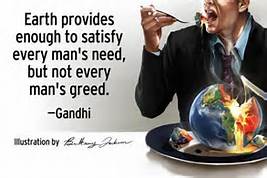
Gandhi Greed

Readings for 8th Sunday in Ordinary Time: IS 49:14-15; PS 62: 2-3, 6-9; I COR 4: 1-5; MT 6: 24-34. http://usccb.org/bible/readings/030214.cfm

Today’s liturgy of the word raises the question of work and money – always two difficult elements of life for those claiming to follow Jesus’ Way. They’re difficult because both occupy so much of our attention and lives that they can distract us from what’s really important – what Jesus calls “the kingdom of God.” Consequently, in this morning’s Gospel selection, Jesus tells us to back off from both money and work while opening ourselves to the abundance of God’s Kingdom.

For American workaholics, that’s surprising. It’s especially challenging for those who love to attack “the undeserving poor” – that is, workers empowered by government programs even like the Affordable Health Care Act. (I’ll get to that in a minute.)

About money Jesus directly compares the worship of God with the common attitude Americans adopt towards money – or as Jesus puts it, “Mammon” (the name for an idol). It’s impossible, Jesus says, to make money the focus of your life while claiming to serve God. In fact money can make us hate God. But that’s not the surprising part.

What is surprising is that Jesus’ claim comes very close to saying that loving God should make us hate money. That seems to be the meaning of his words recorded in today’s selection from Matthew. Jesus says, “No one can serve two masters. He will either hate one and love the other, or be devoted to one and despise the other. You cannot serve God and mammon.”

In other words, there’s a choice to be made here: serve God or money; hate and despise money or hate and despise God. No one can have it both ways. The text seems to bear that reading, don’t you think?

Of course Jesus’ pronouncement will lead many to “clarify” his words to mean don’t be attached to money. It’s the service of money – it’s making money your master – they would explain, that causes hatred of God.

Okay. But who among us (even financiers, banksters and hedge fund managers) would claim to serve money even though they spend all their waking hours scheming about it. Who would admit that they’re attached to money, or have made it their master? Even those 85 individuals proud of owning as much as half the human race would probably deny that they “serve” money or that it’s their master. (And if they’re right, we can stop our discussion right here!)

On the other hand, those wishing to have it both ways might go further. They might invoke “nature.” They might point out we obviously can’t do without money; it’s a product of nature (human nature) they might say. Some might even argue we can’t even do without capitalism and its drive to “maximize profit.” Capitalism and profit maximization simply represent the inescapable way the world works. They are reflections of the natural order. If they allow 85 people to own more than half the world, so be it. That’s simply natural. (Please hold that thought.)

Such talk about nature brings us to my second point – Jesus’ attitude towards work and those who choose not to. Here he definitely has a “back to nature” approach. And once again, it’s surprising. Jesus is not talking about the naturalness of competition or of the law of supply and demand.

In today’s reading from Matthew’s version of the Sermon on the Mount, Jesus says clearly that the natural order not only minimizes the importance of money (at the very least); it also minimizes the importance of work. “Look at the birds of the air,” Jesus says, “they don’t sow or reap or store food in barns.” Or “Consider the lilies of the field. They neither toil nor spin.” Learn from them both. Follow their example.

Say what? Is Jesus intention here to discourage work itself? (Talk about contradicting “American” values!) It’s easy to draw that conclusion, I think. After all, he seems to be saying don’t sow or reap or store products in warehouses. Don’t toil or spin. It’s a short step from there to saying, “Don’t work!”

Besides that, Jesus seems to have lived out that latter implication. I mean as an able-bodied 30-something, he left his job as a carpenter to wander from village to village in Palestine philosophizing and apparently living on hand-outs. On the road, he had no home and must have sought shelter from friends. Moreover, he got rough fishermen to leave their nets and follow his example of what appears to be idleness as far as economic productivity is concerned.

In fact, Republicans today would clearly regard Jesus and his apostles as examples of the idle undeserving poor – not to say bums – living off the donations of hard working people. I mean, does that contradict our Protestant Work Ethic, or what?

And that brings me to that Obamacare business.

Did you follow last month’s flap over the Congressional Budget Office’s Report on jobs and President Obama’s Affordable Health Care Act (ACA)? It said that the ACA would induce 2.5 million people to leave work. They’d escape “job lock” – i.e. the inability to leave employment because doing so would lose them health coverage.

All hell broke loose.

When Paul Ryan (R-Wis) heard that, hypocrisy demanded that he and his Republican cronies reverse their position on “job lock.” Formerly they were against it. In fact a couple of years ago, Ryan said,”[The] key question that ought to be addressed in any healthcare reform legislation is, are we going to continue job-lock or are we going to allow individuals more choice and portability to fit the 21st century workforce?”

Now, however, since freedom from “job lock” represented a boon of the ACA, Ryan and the Republicans had changed their tune. They quickly became opponents of “more choice and portability.” Having realized that Obamacare will not eliminate jobs, but increase worker freedom to change jobs or leave the workforce altogether, GOP spokespersons were forced to readopt their familiar tack of demonizing empowered workers and the poor.

This meant that mothers and fathers leaving coveted jobs at McDonalds or as greeters in Wal-Mart to spend more time with their families were characterized as slackers and lazy. According to Ryan, such people lose respect for “the dignity of work.” They were worthy of their traditional rank among Republicans’ favorite target, the undeserving poor. (Never mind that Ryan has done everything he can to undermine labor’s dignity – but that’s another story.)

The point is that Jesus and his sainted friends were not only among the undeserving poor, they flaunted it. They recognized that according to God’s natural order, the world belongs to all creatures including the birds and flowers. If its resources were shared according to Jesus’ Kingdom values, there’d be enough for everyone – just as there was for birds and flowers in Jesus’ day.

So in minimizing the importance of money and praising freedom from work, Jesus was not being unrealistic or some starry-eyed hippy. Instead (as always) he was proclaiming the Kingdom of God. In God’s order, he insisted, there is abundance for everyone – or as Gandhi said enough for everyone’s need, but not for their greed.

Realizing the reality of God’s and nature’s abundance – and not giving in to the world’s myth of scarcity, overwork, and focus on money – should give workers and those not belonging to Ryan’s 1% courage to demand what is their birthright.

That natural condition is a life without worry about making ends meet and with enough leisure to enjoy life just like the birds and flowers.

Sunday Homily: Richard Dawkins’ 14 Commandments Can Save Our World

Law

Readings for 6th Sunday in Ordinary Time: SIR 15: 15-20; PS 119: 1-2, 4-5, 17-18, 33-34; I Cor 2: 6-10; MT 5: 17-37. http://usccb.org/bible/readings/021614.cfm

The emphasis in today’s liturgy of the word is on the wonders of God’s law. “Keep the commandments; no one has a license to sin,” the first reading from Sirach intones. “Walk blamelessly in God’s law; observe its decrees; delight in its wonder,” sings the psalmist in today’s responsorial. And then in today’s Gospel reading Jesus presents himself as the defender of even the least of the commandments. Break the least, he says, and you’ll be least in God’s Kingdom.

On hearing all of this, most of us probably raise our eyebrows in disbelief. “Wonder of God’s law? What wonder?” one might ask. “My experience of what’s called ‘God’s law’ is entirely negative. When I hear references to the Ten Commandments I think of repressed Bible-thumpers wanting the Commandments posted on school walls and enshrined on lawns before every courthouse.”

And it’s true: negative reaction to talk of God’s Law and the Ten Commandments is completely understandable. From childhood we’ve had “The 10 Commandments,” “sin” and “punishment” shoved down our throats by authority figures intent on controlling the most intimate details of our lives. From the time we were children, and especially as adolescents and young adults “God’s Law” seemed to militate against everything we really wanted to do – especially in the area of sexuality.

However, a close reading of today’s texts show how misplaced such reactions are. All of them (and especially Jesus’ words) suggest that “God’s Law” is not something posted on a classroom wall or on a plaque in front of a government building. It’s not written in stone either. Instead, it’s enshrined deep in the human heart. And human happiness is impossible without observing that law which in its essence is no different from nature’s law.

Because God’s Law reflects nature’s order, the texts suggest how important it is for us to come to agreement about moral and ethical behavior if we truly want peace in the world. The U.N. has realized that and has sponsored research into the content of what it terms “a universal ethic.” According to the U.N., there are just four basic “commandments”: (1) Don’t kill; (2) Don’t rape; (3) Don’t lie, and (4) Don’t steal.

People as diverse as Roman Catholic (but suspended) theologian, Hans Kung and professional atheist Richard Dawkins agree but go further in what seem to me very helpful ways.

In fact, at the age of 85, Kung has dedicated the last part of his career to peacemaking by building bridges between religions whose differences are so often the cause or pretext for violent conflict. Kung works on the four principles that (1) International peace is impossible without peace between religions; (2) there can be no inter-religious peace without inter-religious dialog; (3) there can be no inter-religious dialog without agreement about a global ethic, and (4) our world cannot survive without such an ethic that is universally accepted.

So in terms of “God’s law,” what do all major religions agree about? The Golden rule is the point of convergence.

Christianity puts it this way: “All things whatsoever ye would that men should do to you, do ye so to them; for this is the law and the prophets” (Mt. 7:1). In Confucianism the same statute is expressed in these terms, “Do not do to others what you would not like yourself. Then there will be no resentment against you, either in the family or in the state” (Analects 12:2). Buddhism’s version runs, “Hurt not others in ways that you yourself would find hurtful” (Udana-Varga 5,1). Hinduism agrees in these words, “This is the sum of duty; do naught unto others what you would not have them do unto you” (Mahabharata . 5, 1517). Islam’s expression is, “No one of you is a believer until he desires for his brother that which he desires for himself (Sunnah). In Taoism the same law finds this formulation: “Regard your neighbor’s gain as your gain, and your neighbor’s loss as your own loss” (Tai Shang Kan Yin P’ien). Zoroastrianism says, “That nature alone is good which refrains from doing to another whatsoever is not good for itself” (Dadisten-I-dinik, 94,5). Judaism says, “What is hateful to you do not do to your fellowman; this is the entire law; all the rest is commentary” (Talmud, Shabbat 3id).

Even Richard Dawkins, perhaps the world’s most famous atheist endorses the Golden Rule. In formulating his own Ten Commandments, he leads off with his own version of that principle. Here are Dawkins’ “Ten Commandments:”

1. Do not do to others what you would not want them to do to you
2. In all things, strive to cause no harm
3. Treat your fellow human beings, your fellow living things, and the world in general with love, honesty, faithfulness and respect.
4. Do not overlook evil or shrink from administering justice, but always be ready to forgive wrongdoing freely admitted and honestly regretted.
5. Live life with a sense of joy and wonder
6. Always seek to be learning something new
7. Test all things; always check your ideas against the facts, and be ready to discard even a cherished belief if it does not conform to them.
8. Never seek to censor or cut yourself off from dissent; always respect the right of others to disagree with you.
9. Form independent opinions on the basis of your own reason and experience; do not allow yourself to be led blindly by others.
10. Question everything

Dawkins also has something to say about that fraught area of sexuality I mentioned earlier. He adds four additional statutes:

1. Enjoy your own sexual life (as long as it does not harm to others), and let others enjoy their sexual lives in private according to their own inclinations which in any case are none of your business.
2. Don’t discriminate against or oppress anyone because of their sex, race or (insofar as possible) species.
3. Don’t indoctrinate your children. Teach them to think for themselves, how to weigh evidence, and how to disagree with you.
4. Respect the future beyond the temporal limits of your own life.

Now those laws are “delightful,” many would agree. They make sense because they reflect human nature and nature’s laws.

Imagine the world we’d create if we joined our brothers and sisters in all those religions I referenced and promoted Dawkins commandments with the same vigor the Bible thumpers promote their repressed interpretations of the Ten Commandments.

Kung is right: we might witness an out-breaking of peace.

Sunday Homily: The Hypocrisy of Reagan’s “City on a Hill”

City on Hill

Readings for the 5th Sunday in Ordinary Time: IS 58: 7-10; PS 112: 4-9; I COR 2: 1-5; MT 5: 13-16. http://usccb.org/bible/readings/020914.cfm

Today’s readings are about the nature of the light emanating from a shining “City on a Hill.” Jesus introduces that imagery specifically in today’s Gospel selection. In doing so, he alludes to the words of the prophet Isaiah (today’s first reading) which describe the City’s characteristics.

However most Americans don’t primarily associate the City on a Hill image with Jesus, much less with Isaiah. In fact, most cannot hear the phrase without thinking of former U.S. President Ronald Reagan. In Reagan’s mouth, “City on a Hill” became a quintessential expression of American Exceptionalism. As such Reagan’s usage exemplifies how Republicans have hijacked and distorted Christian discourse.

Reagan however didn’t coin the City’s connection to “America.” John Winthrop, the Puritan leader of the Massachusetts Bay Colony, had already done that in 1630. Standing on the deck of the flagship Arbella Winthrop told his shipmates, “We must always consider that we shall be as a city upon a hill—the eyes of all people are upon us.”

Then in 1961 J.F. Kennedy quoted Winthrop’s words specifically as the new president addressed the General Court of Massachusetts. Kennedy added “. . . (W)e are setting out upon a voyage in 1961 no less hazardous than that undertaken by the Arbella in 1630. We are committing ourselves to tasks of statecraft no less fantastic than that of governing the Massachusetts Bay Colony, beset as it was then by terror without and disorder within.”

After Reagan, Gary Bauer, the president of the Family Research Council, attempted to borrow some of the Reagan thunder by using his idol’s words. Bauer repeatedly used the “City on a Hill” metaphor as he attempted unsuccessfully to secure the Republican presidential nomination in 1999. Before him in 1997, Reagan’s adopted son, Michael, had already written a book about his father entitled The City on a Hill: Fulfilling Ronald Reagan’s Vision for America.

As for Reagan himself, here’s what he said about the image in his farewell speech to the nation in 1989:

“…I’ve spoken of the shining city all my political life, but I don’t know if I ever quite communicated what I saw when I said it. But in my mind it was a tall proud city built on rocks stronger than oceans, wind-swept, God-blessed, and teeming with people of all kinds living in harmony and peace, a city with free ports that hummed with commerce and creativity, and if there had to be city walls, the walls had doors and the doors were open to anyone with the will and the heart to get here. That’s how I saw it and see it still . . .”

These words show that Reagan’s image of the “City on the Hill” is one of pride, strength, harmony, peace, open markets and free immigration – all of it specially blessed by God. Noble ideals all. . . .

Nonetheless President Reagan’s policies proved questionably coincident with his words and especially with the biblical ideals expressed in today’s readings.

Think about those ideals.

In the selection from Isaiah, the prophet says the City on the Hill shines because its inhabitants:
• Share bread with the hungry.
• Protect the oppressed and remove oppression from their midst.
• Shelter the homeless.
• Clothe the naked.
• Remove from their midst accusation and malicious speech.

The Responsorial psalm seconds all of that, adding that the hilltop city’s just citizens:
• Lend (without interest).
• Give lavishly to the poor.

In today’s selection from Paul’s letter to the church in Corinth, the apostle himself identifies with the weak and fearful, not those who are “wise” according to the standards of the world. Paul goes on to contrast the world’s logic with what elsewhere he calls the foolishness of Jesus’ Spirit – which chose to identify with those on death row (I COR 1:23).

Finally, today’s Gospel reading has Jesus refer specifically to the “City on a hill” and the light that causes it to shine. Once again, it’s the “light” described by Isaiah – sharing bread, shelter, clothing, and money with the hungry, homeless, naked, impoverished and oppressed.

All of this has little to do with President Reagan’s version of an exceptionally blessed America. In fact, during his term in office Reagan:

• Consistently stigmatized the poor. (Reagan often told the story of a “welfare queen” in Chicago who turned out to be a figment of his speech writers’ imaginations. According to the story, she drove a Cadillac and had cheated the government of $150,000 using 80 aliases, 30 addresses, a dozen social security cards and four fictional dead husbands. Once again, all of that was a lie.)
• Halved the budget for public housing.
• Closed shelters for the mentally ill.
• In so doing, created an epidemic of homelessness virtually unknown since the Great Depression.
• Spent the entire decade of the 1980s supporting oppressive governments Central America – specifically in Nicaragua, El Salvador, Guatemala, and Honduras.
• Oversaw the repeal of the Fairness Doctrine in 1987, thus opening the publicly owned radio airwaves to dominance by privately financed right wing programs whose bread and butter soon became the “false accusations” and “malicious speech” Isaiah saw as incongruous with the light Jesus subsequently saw as characterizing the City on the Hill.
• Inspired his self-proclaimed acolytes (in our own day) to introduce savage reductions in Food Stamp programs for the hungry, and elimination of unemployment benefits.

And that’s the short list of the horrors of the “Reagan Revolution.” None of it has anything to do with Jesus’ vision of a City on a Hill. Rather Reagan policies fly directly in the face of that vision.

The point is that the right wing in this country (personified in Ronald Reagan) has hypocritically identified itself as somehow “Christian” while turning that tradition squarely on its head.

Progressives are missing the boat by surrendering to that hijacking of Jesus’ meaning and message, when in reality that message supports their cause, not that of their reactionary opponents.

It’s high time for progressives to go on the offensive by recognizing and employing the power of myth and image so successfully manipulated by the religious right.

Sunday Homily: What Is Our Vocation: To Remain in the Church or Seek Mystical Enlightenment?

cleansing-of-the-temple

Readings for the feast of the Presentation of the Lord: MAL 3: 1-4; PS 24: 7-10; HEB 2: 14-18; LK 2: 22-48. http://usccb.org/bible/readings/020214.cfm

Today is the feast of the Presentation of the Lord. It recalls the day when the infant Jesus entered Jerusalem’s temple for the first time. Jesus’ presentation began a relationship with the temple and its priesthood that was difficult at best.

This first entrance however was dominated by the simple faith of his impoverished parents. They came offering the sacrifice of the poor – two pigeons or turtle doves.

However all was not smooth even that day. In effect, two elderly fortune tellers, Simeon and Anna, confront Jesus’ parents and predict that trouble lay ahead for Jesus and them.

But that would be long in the future – after (as today’s gospel selection concludes) Jesus matured and advanced in wisdom. Some even say he traveled to India, absorbed the sub-continent’s ancient wisdom, and came back Enlightened.

In any case, by the time of Jesus’ final visit to the temple, he was fully at odds with its priesthood and talked openly about the temple’s destruction – almost as if he relished the thought.

All of this might be reminiscent of our own relationships with the church. Many of us were baptized as infants – introduced to the faith by simple parents.

But then we too advanced in age and wisdom – even to the point where today we might find ourselves at odds with the church and its priests.

Could it be that this is the human vocation – to be loyal church members until (like Jesus) we realize our religion’s hypocrisy, its cooperation with oppression and its need of reform? Where does it leave us vis-a-vis the church? Are we called to step outside its boundaries and embrace mystical enlightenment? Or is our vocation to remain within as outspoken critics? Can the two options be combined?

I try to capture those thoughts and questions in the following attempt at poetic reflection of today’s readings from Malachi, I Corinthians, and Matthew’s Gospel.

I

The prophet Malachi said this day would come!
The Lord would send his messenger to scorch the Temple and its worthless priests.
It would hurt, Malachi warned.
In the presence of God’s anointed,
Those faithless “holy men” would feel their world was melting –
As if they were melting like gold or silver in a refiner’s cauldron,
As if caustic lye were thrown in their hypocritical faces.
Ha!
Then those unworthy priests
Would finally be forced to do
Something pleasing to God.
Let them all go to hell!

II

The prophet Malachi said this day would come!
And here it is at last.
Or so it seems.
But what’s this?
The promised messenger is a poor child
Wrapped in a blanket patched and smelling of baby urine.
His parents with simple uncomprehending faith
Offer the bored priest
Two pigeons or a pair of doves
(I forget which).
The priest hardly notices either.
But he performs his magic rite
And rattles by rote the hackneyed phrases.
He would find the notion laughable that he or his temple
Might have anything to fear from . . .
“What’s this child’s name?” he asks.
“Yeshua ben Joseph,” his father stutters
In tones of humble deference.

III

You see,
That’s the trouble with priests.
Their fulsome selves cannot see
What’s before their eyes,
And clear to everyone else:
Their days are numbered.
And so are the Temple’s – and mosques’ and churches’.
Malachi predicted it.
Yeshua would see to it.
(More below.)

IV

Nonetheless, the Elders, Simeon and Anna see.
Ah, yes!
They are Seers.
Gaunt and bony from years of prayer and long fasts
These elders, recognize in Yeshua
The one Malachi had foretold.
“Now is not the time,” the hoary Simeon intones.
“But the day will surely arrive
When this child will polarize everyone in Israel
Including these wicked priests.”
The prophet’s words startle the rough peasant woman from Nazareth.
“He’ll be a matricide,” the fortune teller warns her.
“He’ll cut you to the quick.”
Anna the widowed prophetess
Echoes Simeon’s threatening words.
Yeshua’s parents tremble with fear.

V

What kind of child have you sired?
Miryam later asks her husband
(half joking)
On the highway home from Jerusalem.
Joseph smiles.
He simply shrugs
And shakes his shaggy peasant’s head.
They walk on in silence.

But Yeshua bides his time
Learning justice from his father
And patience from Miryam.
Some say he journeyed to Egypt
Or India
To study Wakefulness
And Light.
“You have a nice boy,”
The village matrons say to Miryam,
While she ponders Simeon’s words
And waits for the other shoe to drop.

VI

And drop it does – more than a quarter century later!
Jesus returns to the Temple
This time with whip in calloused hand.
He realizes (as the psalmist says today)
That even Herod’s Magnificent Shrine
Is too small for God – or for him.
“All churches are robbers’ dens!”
Jesus shouts.
So the workman lashes out left and right
At those who exploit
Simple peasants like the pair who raised him.
Yeshua despises the priests.
“This Temple,” he says, “will be reduced to rubble.
And good riddance!
These charlatans traffic in your fear of death?
Free yourselves from their superstition
And temple!
Dare to live
With your own thoughts!”

Miryam’s spirit sinks as she hears such words.
Simeon’s sword has begun to cleave her mother’s heart.
“My son has lost his faith,”
She fears.

The priests know Yeshua has lost their faith
And corrupts the crowds
Who hang on his every word.
They conspire to destroy him
As an atheist and blasphemer.

VII

Perhaps that’s our vocation too,
Don’t you see?
As followers of Jesus
To come to the temple
(Or not !)
To present ourselves there
As fullers and refiners
As atheists, blasphemers
In the eyes of a too credulous world
Scared out of its wits
By pretentious ignorant priests and televangelists
Who (as the author of “Hebrews” says)
Traffic in our fear of death.

Instead,
Believe the psalmist’s words:
God’s bigger than that
And so is Jesus.

So must we be!

Sunday Homily: Pope Francis on Wealth Redistribution

85

Readings for 3rd Sunday in Ordinary Time: IS 8: 23-9:3; PS 27: 1, 4, 13-14; I COR 1: 10-13, 17; MT 4: 12=23 http://usccb.org/bible/readings/012614.cfm

According to an Oxfam report released last Monday (Jan. 20th), the 85 richest people in the world now have as much wealth as the world’s 3.6 billion poorest people – i.e. as much as half the planet’s entire population. Eighty-five people!

The report’s publication makes clear the importance of Pope Francis’ recent Apostolic Exhortation, “Evangelii Gaudium” (E.G.). That’s because the pope’s “Joy of the Gospel” specifically addresses the injustices of income inequalities.

The Oxfam report also reveals as fatuous a recently advanced defense of vast wealth differentials in the very terms the pope criticizes. (I’m referring to David Brooks’ New York Times column – see below.) Oxfam’s report also makes relevant the readings in today’s liturgy of the word. They address inequality by reflecting the mentality of the poor and Jesus’ commitment to the working class in first century Palestine’s social context of obscene differences in wealth between rich and poor.

Before looking at those readings, I wonder what you think of that Oxfam statistic. Once again, the richest 85 people in the world have as much wealth as the poorest 3.6 billion – the poorest half of our planet’s population.

Personally, I find that shocking and almost unfathomable. Yet the New York Times’ David Brooks says inequality is not the problem. As a powerful apologist for the rich, Brooks alleges that only those locked into a “primitive zero-sum mentality” would believe that the poor are poor because the rich have too much of the earth’s resources.

The economic pie is continually expanding, Brooks implies. So even though good jobs have been off-shored, and Wall Street bonuses are indefensible, the problem of inequality cannot be solved by wealth redistribution schemes or raises in the minimum wage. Instead, the real solution is to educate the poor – furnishing them with the cultural attitudes and job skills necessary to lift them from poverty caused by single parent families, school drop-outs, and the resulting generations-long culture of poverty.

Brooks’ argument is hackneyed. And in its familiarity, it illustrates the fallacies about poverty commonly subscribed to by the rich. Those approaches nearly always embrace a version of trickle-down theory. They find poverty’s solution in reforming the poor and educating them for the hi-tech jobs that will emancipate them from poverty. Mainstream intellectuals reject measures like minimum wage increases and higher taxes on the rich as “populist” and as introducing class-conflict themes that are dangerous and counterproductive.

It is such dodges by the rich that were specifically rejected by Pope Francis in Evangelii Gaudium. There the pope says unmistakably that extreme wealth on the one hand and abysmal poverty on the other are interconnected. In fact, he accuses the powerful of actually “feeding upon” the powerless (E.G. #53). They’re eating them up! Francis also rejects out of hand the trickle-down mentality behind Brooks’ observations. The pope classifies Brooks’ reference to a “primitive zero-sum mentality” as itself being “crude and naïve.”

In fact, what the pope actually says about trickle-down theories can’t be repeated too often. He writes: “In this context some people continue to defend trickle-down theories . . . This opinion which has never been confirmed by the facts, expresses a crude and naïve trust in the goodness of those wielding economic power . . . Meanwhile the excluded are still waiting.”

Pope Francis also scraps apologetics like those Brooks employs when he essentially blames the poor for their poverty and would save them by “education.” Here Francis’ specific words are: ”Some simply content themselves with blaming the poor and the poorer countries themselves for their troubles; indulging in unwarranted generalizations, they claim that the solution is an “education” that would tranquilize them, making them tame and harmless.”

Pope Francis’ words bring a startling reminder to would-be Christians that economic questions – considerations of social justice and equality – are central to Christian faith. Francis’ words sensitize us to a reality that presents itself to believers every Sunday if we’re attentive enough to perceive the socio-economic dimensions in each week’s readings.

Today’s readings once again offer a case in point. The first selection comes from the prophet Isaiah. It recalls a time when Israel had been released from painful exile and enslavement by ancient Babylon (modern day Iraq). According to Isaiah, exile was a time of anguish, darkness, gloom and distress – the pain inevitably experienced by the exploited then and now. Liberation from slavery’s “rod and yoke” changed all of that. Darkness and gloom were replaced by light, joy and rejoicing.

Significantly for the topic at hand (inequality and its remedies) the prophet uses two poor people’s images to describe the change. The joy of the liberated was like that of peasants reaping the fields at harvest time. Now, however, the harvested crop would belong to them, not to idle landlords. In this new situation reaping the fields presaged a time when hunger would be replaced by feasting.

Even more to the point, according to Isaiah, the joy of those liberated from Babylon was like the ecstasy of rebels dividing spoils after The Revolution – when the wealth of their oppressors was finally redistributed to those who had worked so long producing that wealth in exchange for nothing but “rod and yoke.”

In other words, the reading from Isaiah refers to a time of plenty and of wealth redistribution – always the dream of the poor and dispossessed – a dream, Pope Francis reminds us, that is also the Dream of God.

It was a dream shared by Jesus. He called his revolutionary vision the “Kingdom of God.” In today’s reading from Matthew, we see the working man from Nazareth recruiting those who would help organize the poor around that concept. Matthew presents Jesus as selecting comrades like himself – from the working class. His initial selections are the poor illiterate fishermen Simon, Andrew, James and John. They would accompany him and learn from him as he confronted his culture’s rich elite – the temple priests, rich landlords (again the temple priests), and collaborators with Roman occupation forces.

Reza Aslan tells us that Jesus did all of this in a context of extreme economic inequality. Aslan writes of “the chasm between the starving and indebted poor toiling in the countryside and the wealthy provincial class ruling in Jerusalem . . . .” He describes a Jesus who as a tekton (a Greek word meaning Jack of all trades) worked daily rebuilding the opulent city of Sepphoris, the capital of Galilee, an hour’s walk from his village of Nazareth. “Six days a week,” Aslan writes, “from sunup to sundown, Jesus would have toiled in the royal city, building palatial houses for the Jewish aristocracy during the day, returning to his crumbling mud-brick home at night. He would have witnessed for himself the rapidly expanding divide between the absurdly rich and the indebted poor.”

No doubt that experience sensitized Jesus to the plight of those who shared his social location. Like others he knew, Jesus was convinced that the situation was unsustainable. As Aslan puts it, “There was a feeling particularly among the peasants and pious poor, that the present order was coming to an end, that a new and divinely inspired order was about to reveal itself. The Kingdom of God was at hand. Everyone was talking about it.”

Jesus made it the point of his work as a community organizer par excellence to focus on the advent of God’s kingdom. In today’s Gospel, Matthew says, “Jesus went throughout Galilee, teaching in their synagogues and proclaiming the good news of the kingdom and curing every disease and every sickness among the people.”

And in proclaiming and working for the kingdom, Jesus did not shy away from statements that might be seen as engendering class conflict. “Blessed are you poor,” he said, “for yours is the Kingdom of God” (LK 6:20). “Woe to you rich, you have had your reward” (LK 6:24). “How hard it is for the rich to enter the kingdom of God” (MT 19: 16-24). All of these statements show consciousness of class struggle.

So what are we to do about income inequalities? In 1998, a UN Development Report called for a tax of 4% on the world’s richest 225 people. The report said that such a tax (6% less than the traditional tithe) would provide enough resources to feed, clothe, house, cure and educate the entire Third World.

To the wealthy, such taxation is unthinkable. As a result, 30,000 children die of absolutely preventable starvation each day.

In the eyes of Pope Francis – in the eyes of Jesus, I’m sure – tolerating such needless deaths is sinful and runs entirely contrary to any pretensions of those identifying themselves as “pro-life.”

No, Mr. Brooks, we can’t ignore the connections between extreme wealth and abysmal poverty. Wealth must somehow be redistributed. We have the word of Oxfam and the UN on that. We have the word of Pope Francis and of Jesus too.

Sunday Homily: Pope Francis’ “New Song” – Seven Points You May Have Missed in “Evangelii Gaudium”

Francis Singing

Readings for Second Sunday in Ordinary Time: IS 49: 3, 5-6; PS 40: 2, 4, 7-10; I COR 1: 1-3; JN 1: 29-34 http://usccb.org/bible/readings/011914.cfm

What will Pope Francis do next? Since his election nine month ago, he seems to be in the news on a daily basis.

We all know, for instance, that he was Time Magazine’s “Person of the Year.” And just last week, the New York Times ran two substantial articles on him. “He has already transformed the tone of the papacy,” one of those articles said, “confessing himself a sinner, declaring ‘Who am I to judge?’ when asked about gays, and kneeling to wash the feet of inmates, including Muslims.”

The article went on to describe the reforms the pope is making in the Vatican. He has disempowered influential conservatives favored by his predecessor, Benedict XVI. The demoted include American Cardinal Raymond L. Burke, and Italian Cardinal Mauro Piacenza, along with Archbishop Guido Pozzo. Such reactionaries have been replaced with Francis’ allies like Secretary of State Pietro Parolin whom the pope listed among those he will make a cardinal in February.

Even more broadly, the Times described the pope’s employment of six Jesuit “spies” to assess and report on various Vatican offices. That’s making Roman apparatchiks very nervous. As a result, job insecurity has become the order of the day in Vatican City, where clerical careerists , the Times said, have responded like sulking teenagers plugging in their headphones, retiring to their rooms, and hoping the storm will pass them by.

Another Times report last week detailed Pope Francis’ recent appointments to the College of Cardinals. The Parolin appointment notwithstanding, the nominations represent a departure from tradition in that the majority of the 19 new cardinals will come from Latin America, Africa, and Asia instead of Italy and Europe. The appointees promise to change the tone of the consistory the pope plans to convene at the end of next month where discussions will begin about decentralizing church decision-making processes and about pastoral responses to changes in family structure including questions of divorce and homosexuality.

Couple last week’s moves with last September’s hugely successful mass demonstration in St. Peter’s against the bombing of Syria, with his denunciation of free market capitalism, under-regulated financial speculation, and “murderous” world-wide income inequality, and you have a worthy successor to John XXIII, the soon-to-be-canonized Great Reformer who convened the Second Vatican Council (1962-’65).

Put otherwise, in a very short time, Pope Francis has made his own the words of today’s responsorial psalm, “The Lord has put a new song in my mouth.” The song the pope is singing takes the emphasis off formal religion – what the responsorial calls the “sacrifice and offerings.” That’s not what God wants, the psalmist says. Instead God’s desire is “a people that hear and obey” — specifically the law of justice that God has placed in the heart of all human beings whether they think of themselves as believers or not . So far, the pope’s actions show that he agrees.

In terms of today’s gospel reading – a continued reflection on last Sunday’s account of Jesus’ baptism – it’s as if we’re witnessing the descent of the Holy Spirit upon a man determined to follow in the footsteps of Jesus of Nazareth.

Like Jesus, Francis has made a “preferential option for the poor.” He’s signaled justice for the oppressed as the overriding theme of his papacy. He has completely rejected war as a solution to any of the world’s problems. This pope is no hawk or friend of hawks — or of the rich who advocate free market solutions to problems of poverty and its attendant hunger and disease. For him, terrorism is blowback for injustice.

As most of us know, all of this is clearly explained in Francis’ “Evangelii Gaudium” whose significance in terms of church reform cannot be overstated. But there are some important aspects of the pope’s exhortation that may have escaped notice. Let me name just seven that have special connection with today’s liturgical readings and their emphasis on peace, justice and the Spirit of God. (Parenthetical numbers refer to the relevant sections in the papal document.):

• “Evangelii Gaudium” is not trivial. The pope writes “In this exhortation my intention is to map out the path for the church to follow in the immediate future” (2).So the pope’s concern for the poor and rejection of war are not simply expressions of his idiosyncratic aspirations. They represent attitudes and actions he expects the church and Roman Catholics to adopt.

• As the Huffington Post has put it, “Evangelii Gaudium” also represents a “remarkable about-face” relative to liberation theology. Significantly, the pope met with Gustavo Gutierrez, the doyen of liberation theology, last September. Gutierrez’s themes are found throughout the pope’s Exhortation – the “preferential option for the poor” (198, 199), the affirmation of “popular piety” (122-126), the historical perspective (54), social analysis uncovering unfettered capitalism as homicidal (53, 57), and recognition of “structural sin” (59, 202). . . .

• The Exhortation’s position on private ownership is much more radical than many have acknowledged so far. The pope actually states that the goods of the earth belong to the poor, not simply to those who can pay for them. Quoting “an ancient sage,” the pope says “The goods we possess don’t really belong to us but to the poor” (57). Can you imagine a stronger rejection of capitalism’s understanding of private property?

• In general, the Papal Exhortation is friendly towards theologians. This also represents an about-face from his immediate predecessor who routinely investigated, warned, condemned and silenced theologians – 106 of them by Matthew Fox’s count. By contrast, Pope Francis values the role of theologians whatever categories of reason they might use – even, one might conclude, if the categories are Marxist. Consider the suggestion in these words: “When certain categories of reason and the sciences are taken up into the proclamation of the message, these categories then become tools of evangelization; water is changed into wine. Whatever is taken up is not just redeemed, but becomes an instrument of the Spirit for enlightening and renewing the world. . . The church . . . appreciates and encourages the charism of theologians.”

• The pope’s appreciation of theologians means that “Evangelii Gaudium” holds promise for women and the campaign for women’s ordination – despite its specific rejection of women priests (104). This is because virtually no theologians or scripture scholars find credible the reasons advanced for restricting ordination to males. Even the pope’s Exhortation suggests the contrary. No sooner does he reject women priests than he falls into the traditional language of “holy mother church” (e.g. 139). The pope writes “. . . the church is a mother, and . . . preaches in the same way that a mother speaks to her child.” Do you detect the dissonance here – of males alone being allowed to speak as women?? Sooner or later that penny will drop.

• The pope’s promotion of the “sensus fidei” (119) holds similar promise for changes in church teaching on contraception. According to the pope, “God furnishes the totality of the faithful with an instinct of faith – sensus fidei – which helps them to discern what is truly of God.” For theologians, sensus fidei means that when the bishops, theologians and laity agree on a matter of faith or morals, their agreement represents the work of the Holy Spirit. On the question of contraception, previous popes have cut the laity and theologians out of the equation entirely. In the spirit of Vatican II, the pope’s words promise to include them once again. Theologians and laity overwhelmingly agree that church prohibition of artificial contraception needs change.

• In his Exhortation, the pope shifts away from just war theory to complete pacifism (239). He devotes a whole section to the rejection of war (98-101). Moreover, he identifies inequality as the cause of violence and war. He writes, “Inequality eventually engenders a violence which recourse to arms cannot and never will be able to resolve . . . weapons and violence rather than providing solutions, create new and more serious conflicts” (60). What if the world’s 1.2 billion Roman Catholics took the pope’s words to heart?

All of this represents the work of the Holy Spirit – the same Spirit that today’s reading from John’s gospel describes as descending upon the just-baptized Jesus. John the Baptist describes Jesus as the gentle “Lamb of God.” The Spirit is pictured as a dove – the symbol of peace.

Like John the Baptist on Jordan’s banks, Pope Francis is calling the faithful to “Behold the Lamb of God” imitating Jesus’ identification with the poor and his gentle non-violence.

Celebrating the International Jesus (Epiphany Sunday Homily)

magi_02

Readings for Epiphany Sunday: Is. 60:1-6; Ps. 72: 1-2, 7-8, 10-11, 12-13; Eph. 3:2-3a, 5-6; Mt. 2: 1-12 http://www.usccb.org/bible/readings/010613.cfm

Human growth is a wonderful thing, isn’t it? Our bodies change and develop whether we like it or not. Cells replace themselves constantly giving each of us an entirely new body every seven years. Yet even though we might not be able to recognize ourselves in our baby pictures, we know there is somehow deep continuity between the infant we were and the person we saw in the mirror this morning when we were brushing our teeth.

That continuity is intimately connected with self-consciousness. It develops too. We no longer think of ourselves or of the world the way we did when we were children. Then everything seemed much simpler. We were the most important individuals in the world; the whole thing seemed to revolve around us. God was up there in heaven. We belonged to his church – the only true one that existed. Our parents loved us. The policeman was our friend. The United States was unquestionably an agent for good in the world. . . . Now we might not be so sure of any of those formerly self-evident truths.

That’s because we’ve grown intellectually and spiritually – at least to a degree. Developmental psychologists tell us that the normal growth progression is from a self-centered consciousness to an ethno-centric consciousness to a world-centric awareness and possibly to a cosmic-centered understanding of reality. The ego-centric child truly does believe the world revolves around him or her. That’s normal. Then comes the stage of ethno-centrism. Here horizons expand to include one’s God, family, school, community, race, and country. At this stage, it seems as though those elements constitute the center of the universe. (Many people get stuck at this stage. They never grow out of it. They’re even willing to kill other people to defend the superiority of the particular groups to which they belong.)

Many people however reach the stage of world-centrism. Here they realize that all of us are indeed created equal. God loves everyone – Christians, Jews, Muslims, Buddhists, Hindus, and atheists. S/he equally loves women and men, gay and straight. Ultimately, one is not American or Mexican, but a citizen of the world. That’s world-centered consciousness. And that understanding is what’s celebrated today on this feast of Epiphany.

The word epiphany means the appearance or manifestation of God. Today’s feast recalls the time when wise men from the East recognized in Jesus the long-awaited manifestation of God announced in today’s reading from the prophet Isaiah. He and today’s responsorial Psalm 72 tell us a great deal about that God. S/he’s not what ethno-centric believers expected or even wanted.

That’s why Herod “and all Jerusalem with him” were “troubled” when they unexpectedly met the travelers who were seeking the world-centric and cosmic-centered manifestation of God that Isaiah had foreseen. The God Herod and the Jerusalem establishment knew and loved favored Jews, the Hebrew language, and the Holy Land. He was pleased by Jewish customs and worship marked by animal sacrifice and lots of blood. So they were “troubled” when the foreigners came seeking the Palestinian address of a newborn king. The kings claimed that the very cosmos (the Star!) had revealed God’s Self to them even though they were not Jews. Evidently, the wise men had cosmic-centered consciousness. They realized God not only transcended themselves and their countries, but planet earth itself. All creation somehow spoke of God.

The prophet Isaiah, Psalm 72, and Paul’s letter to the Ephesians agree with the Wise Men. All of them speak of a Divine Being who is universal, not belonging to a particular nation or religion. This God is recognizable and intelligible to all nations regardless of their language or culture. The Divine One brings light to the thick darkness which causes us to limit God to privileged nations, races, and classes. The universal God brings peace and justice and champions of the poor, oppressed, lowly and afflicted. The newly manifested deity leads the rich (like the three kings) to redistribute their wealth to the poor (like Jesus and his peasant parents). This God wants all to have their fair share.

Matthew’s story says that Jesus manifested such a God. Jesus was the complete revelation of the God of peace and social justice – a world-centered, a cosmic-centered God.

Herod’s and Jerusalem’s response? Kill him! A universal God like that threatened Jerusalem’s Temple and priesthood. The Epiphany meant that such a God was not to be found there exclusively. This God would not be tied down to time or place. What then would become of priestly status, temple treasure, the Jerusalem tourism industry?

Epiphany also threatened Herod’s position. Recognizing a divinity who led the rich to transfer their treasure to the poor threatened class divisions. A God on the side of the poor would embolden the lazy and unclean to rebel against those who used religion to keep the under-classes in line and resigned to their lot in life.

No, there could only be one solution: ignore the Star’s cosmic message, present a friendly world-centered face to these stupid foreigners, derive the crucial information from them, and then kill off as many impoverished babies as possible hoping in the process to stop God’s threatening, unacceptable Self-disclosure.

Symbolically (and lamentably), Herod’s and Jerusalem’s response to the “troubling” world-centered and cosmic-consciousness of the Eastern wise men mirrors that of our culture and church. Both keep us at the stage of childish ego-centrism – or at best, at the stage of ethno-centrism, which makes us see the other and the other’s God as somehow foreign and threatening. Both culture and faith prevent our inner child from growing up. Ironically, that’s a kind of infanticide. It’s a form of psychological murder that freezes us at immature stages of consciousness and so prevents us from developing along the lines celebrated in today’s feast of Epiphany.

Epiphany calls us to wake up – to grow up and to return home as the Magi did “by another way” that was not the way of ethno-centrism, wealth, power-over or cooperation with kings, priests and empire.

What Then Can We Do? New Year’s Resolutions in the light of Jesus’ ‘Nobodiness’ (Sunday Homily)

resolution 1

Readings for “Holy Family Sunday”: SIR 3: 2-6, 12-14; PS 123: 1-5; COL 3: 12-21; MT 2: 13-15, 19-23. http://usccb.org/bible/readings/122913.cfm

Last week, a very good friend of mine wrote an appreciative note on this blog site. He said, “I’ve been stimulated by reading your blogs. They all call us to action, but how to act?”

On the last Sunday of the year – the feast of the Holy Family – the question invites reflections on New Year’s resolutions. The feast itself and today’s liturgy of the word help us by reminding us of Jesus’ “family values.” They were those of immigrants and political refugees. In that light, please allow me to suggest a few resolutions – and to invite readers to follow suit.

Let me begin by telling you about my friend. He’s a meditator and has always shown serious concern about social justice. He’s among the first to take the part of the disadvantaged and has given the rest of us good example in terms of sharing his resources with the poor. So I felt like writing back, “Just continue doing what you’re doing.”

Continue leading quietly by good example. Keep up your work for “Habitat for Humanity,” Stay the course helping that local undocumented family pay for their home. Knock on doors at election time – as you and I have done together in the past. Keep bothering Mitch McConnell and Rand Paul (our senators in Kentucky) with those phone calls I know you already make. Should they decide to throw their hats into the ring, support the candidacies of Elizabeth Warren, Bernie Sanders, or Jill Stein.

And above all, stick to your discipline of meditation with that group of like-minded people meeting each morning at 8:00 in Union Church. In fact, meditating together for peace and social justice might well be the most powerful thing you do in terms of following the path of the Enlightened Jesus which is the intended focus of my blogs and these Sunday homilies.

All of that might not seem like a lot to those (like my friend) specifically attempting to follow Jesus. I mean all of us would like to do more – something more spectacular that would yield immediate measurable results that we and everyone else would recognize as efficacious. We’d like to save the planet, eliminate poverty, and, bring about world peace.

But we can’t. That’s because in the end, we’re nobodies, and seem discouragingly powerless in the face of the evils of capitalism and militarism recently identified by Pope Francis as the principal causes of our world’s problems. Nonetheless, though their accompanying ideologies of greed and violence run entirely counter to gospel values, they’ve somehow been adopted by “Christians” as the way of Jesus. And that in itself, I know, is discouraging.

Jesus, I believe would find it so as well. He rebelled against the organized religion of his day. But strangely (like us) he seemed unable to do much about it. For instance, today’s gospel selection from Matthew portrays Jesus and his family as quintessentially powerless – as political refugees and immigrants. How much power do people like that have to change the world?

Jesus’ powerlessness and “nobodiness” is also evident from considering the long silent years he spent with his “Holy Family,” during what tradition calls his “hidden life.” As an adult, the former political refugee seemed impotent before the evils that continue to afflict our world.

Think about it. According to received interpretations, Jesus was the full embodiment of God. Presumably, then, he had infinite power at his disposal. His world was as filled with problems as ours. There was Roman imperialism and the occupation of Palestine with its brutality, torture, rape, exploitation and oppression. There was political corruption among Jesus’ own people as the leaders of his time climbed into bed with the Romans. There was extreme poverty alongside obscene wealth. There was religious corruption. There was disease and ignorance.

And yet as far as the record is concerned, this embodiment of God did nothing – until he was 30 years old, and then only for a year or possibly 3. For 97% of his life, Jesus did absolutely nothing that we know of!

Why? Do you think it might have been because, like us, he could do nothing significant about all those problems? And even towards the end, as a young 30-something, when he did finally emerge as a more or less public figure, what did he really do?

Yes, he was an activist. He sought justice for the poor and oppressed. He spoke some inspiring words, healed a few people, and worked some miracles that his contemporaries dismissed as parlor tricks. He provoked the authorities in a temple demonstration for religious purity and social justice, was arrested, tortured and executed as an insurrectionist.

But that was pretty much it as far as his “public life” was concerned. Afterwards, the world more or less continued as it had before his arrival.

I somehow find comfort in Jesus’ “nobodiness.” It offers solace to our own little lives and their apparent lack of meaning. In the end, we’re nobodies – all of us. That’s what death makes apparent as we lose our physical form and minds and all that we worked for. We’re nobodies. Few will remember us or think of us after we’re gone. We’re born, get married, have children, buy and sell a few items, and then die. What then became of all our hopes and dreams? What does it all mean?

Perhaps Jesus’ hidden life with Mary and Joseph assures us that it’s all O.K.; it’s all good. Maybe “that’s life” – what it’s about? We’re all called to be open, faceless channels that disclose the presence of God in our very ordinary lives with their personal limitations as far as the big picture is concerned. We’re called to rise above such limitations or rather to use them to express the unbounded love of an apparently powerless God to those around us – especially to our family members who might not even understand.

We’re called to do our best and leave the rest in God’s hands. To be more specific, accepting that reality of our human condition and doing our best in 2014 might include:

• In general, identifying (as Jesus’ family did) with the interests of political refugees and immigrants.
• Stopping our habit of looking to people at the top to solve our world’s problems.
• Considering vegetarianism as a measure against cruelty to animals on factory farms.
• Growing a garden and canning food.
• And/or signing up for local subscription agriculture deliveries.
• Going solar in every way possible.
• Staying out of the “big boxes” as much as we can.
• Being ready and willing to pay higher taxes and live closer to the ground after the world economy collapses when the effects of climate chaos catch up with us.
• Lobbying for an increase in the minimum wage and to increase Social Security benefits.
• Ceasing to support and honor the U.S. military. (Given U.S. wars of aggression and world projection of imperial force, work in the military does not constitute “right livelihood.”)
• Agitating in our local faith communities for the adoption of a liberation theology perspective like that recently articulated by Pope Francis in his exhortation, “Evangelii Gaudium.”

So what do you think?

What do you consider the most powerful action we might take to advance Jesus’ (and so many others’) program of justice, healing, and peace?

Please share your suggestions below.

Mary’s “Virginity” and the Problem of Military Rape (Sunday Homily)

Rape

Readings for 4th Sunday in Advent: IS 7:10-14; PS 24 1-6;ROM 1: 1-7; MT 1: 18-24. http://usccb.org/bible/readings/122213.cfm

As we know, rape in the military is a huge problem. According to Amy Ziering’s award-winning film, “The Invisible War,” more than 20% of female veterans have been sexually assaulted while serving in the armed forces. In 2009 alone, more than 3200 cases were documented. But since 80% of such instances go unreported, the figure is closer to 16,000.

My question is: if U.S. soldiers are raping and otherwise sexually assaulting their colleagues with such regularity, what do you suppose they’re doing to “enemy” women? What do you suppose the figure is there?

From time immemorial, of course, rape has been used as a weapon of war. It’s a classic way of asserting power over the enemy by defiling the ones they cherish and are expected to protect. Raping their women humiliates enemy men.

Clearly, we have no trouble recognizing rape as an enemy strategy. But what about our servicemen in relation to the “ragheads” and “gooks” they’ve been taught to objectify, hate and despise?

The evidence is that it’s part of their indoctrination too. Years ago, I remember reading in our local paper of how scandalized one of our Kentucky congressmen was when he visited a military base and heard jogging servicemen chanting, “Burn, rape, pillage, kill. . . .” Note the second word in the chant. Why is it there? Is it meaningless in practice?

And then, of course, there’s the logic introduced earlier. If U.S. soldiers rape servicewomen with such abandon, what about those despised women in (most recently) Afghanistan and Iraq?

All of that is relevant to today’s liturgy of the word because of its emphasis on Jesus’ “virgin birth,” and a persistent tradition that Jesus’ conception was the result of rape by a Roman soldier. What if that tradition were true? Would that make the story less inspiring or more? I’d choose the latter – especially in the light of the questions I’ve just raised.

Let me explain simply by offering some background for today’s reading from Matthew along with a reference to the selection from Isaiah traditionally seen as a prophecy of Jesus’ virginal conception.

To get from here to there, try to understand the situation of Joseph and Mary as young marrieds in a context of imperial aggression. They’re a teenage couple; they are poor and living in an occupied country. Joseph is a jack-of-all-trades – that’s what the Greek word we translate as “carpenter” meant in first century Palestine. Like everyone from his class, he was unemployed most of the time. But he’d fix your leaking roof if you hired him. When he could, he’d harvest grapes and wheat for local landlords.

And he was probably deeply involved with the local insurgency against Roman occupation. (Nearly every impoverished patriot is in such situations.) Additionally, the only commentary we have on Joseph’s character is Matthew’s single word “just.” He was a just man. (By the way, his son, James – the one who headed the Jerusalem church following his brother’s death – was also known as “James the just.”) In the Hebrew culture of Jesus’ day, justice meant taking the side of the powerless. It appears to have been a central value Joseph passed on to his children.

As resisters, Joseph’s kind would have been considered terrorists by the Romans. In fact, the very year in which Jesus was likely born (6 BCE) Galilee’s countryside would have been crawling with Roman soldiers fighting against people like Jesus’ supposed father. The occupiers were busy laying siege to the city of Sepphoris, the capital of Galilee – a mere hour’s walk from Joseph’s village.

There the insurgency had taken a decisive stand against Rome’s puppet, King Herod. And like Americans in Iraq’s Fallujah, the Romans were determined to make an example of the city by laying it waste utterly. Before their final offensive, that involved night raids, kicking in doors, and raping young Jewish girls. To repeat, all forces of occupation – even our own today – know the drill.

In any case, according to that persistent tradition about her “virginity,” that’s where Mary came in. She was a young teenager about 12 or 14. Although (as Matthew’s gospel tells it) she eventually became Joseph’s “dream girl,” she was probably linked with him by the village matchmaker perhaps when they were both still toddlers. They had not yet begun to live together, because they were probably waiting for Mary to come officially “of age” – able to bear children.

Be that as it may, Mary suddenly finds herself pregnant out of wedlock. Can you imagine her worry? Innumerable teenage girls can relate to her panic – and disgrace. Obviously, Mary did not want to be just another of her community’s “virgins.” [That’s what (behind their hands) local matrons called unwed mothers.]

According to the story, Joseph too shared Mary’s disgrace and embarrassment. He wanted a divorce (i.e. release from his commitment to marry). And he probably demanded it with the anger and recrimination that are inevitably associated with the dreaded “d” word.

Joseph’s anger, suspicion, and thoughts about divorce may also have come from his hatred of the Romans. (And here comes that persistent tradition about Mary’s “virginity.”) It even remembers the rapist’s name. According to Celsus’ “True Doctrines” written about 178 C.E., the rapist was called “Panthera.” That was also the name of one of the Roman legions involved in that siege of Sepphoris.

Such suspicious circumstances around Jesus’ questionable conception also find some support in John’s gospel, where Jesus is called a “Samaritan” (8:48). That was a harsh term equivalent to our “bastard.” Additionally, Mark refers to Jesus simply as “Son of Mary” (6:3) – a quite unusual reference in a culture where children were identified by their father’s name.

And then (once again) even Matthew’s term “parthenos” (virgin) to refer to Mary was often connected with children of unknown paternity. Such offspring were disparagingly called “virgins’ kids.”

With all of that in mind, and if Celsus’ tradition has merit, it’s easy to understand how the thought of taking up with a girl defiled by a Roman “pig” (what Jews called the occupiers) probably turned Joseph’s stomach. No wonder he wanted a divorce.

That is, if the tradition has merit . . . . You see, we can take our pick here. (And that brings me to the point about the historical veracity of the stories around Jesus’ birth.) All of the traditions are entirely questionable as far as historical fact is concerned.

For instance, the familiar account of Jesus’ virgin birth is found only in two of the canonical gospels (Matthew and Luke). Mark and John make no mention of it. That means that they either didn’t know about the tradition, or Mark and John didn’t think it important enough to include. (By the way, if Jesus’ conception was as miraculous as we’ve always been taught, how likely is either of those alternatives?)

And then there’s that business – recounted in today’s first reading – about Isaiah’s supposed prediction of Jesus’ virginal conception. Matthew takes Isaiah’s words completely out of context.

Actually, Isaiah’s not referring to Jesus at all, but to his own time more than 500 years earlier. And the Hebrew term he uses is not the equivalent of “virgin.” That’s a mistranslation. The word the prophet employs simply means “young girl.” Isaiah’s prediction is that a “young girl” of his own time will conceive. The prophet’s words had nothing to do with Jesus or virgin birth.

The point here is we’re not dealing with “history” in the story of Jesus’ virgin birth. Instead we’re confronted with a miraculous “birth story,” – a literary genre that characterizes accounts of virtually all “Great Men” in the ancient world. Its point is that God’s Spirit entered into Jesus from the very outset – long, long before his actual birth.

In that light, historically speaking, rape is a much more likely explanation of Jesus’ conception than intervention by the Holy Spirit. Think about it. That’s simply a fact.

How then was Jesus begotten? If Joseph was his father, we understand how Jesus was so concerned with social justice. And through this pre-birth story we can hear (once again!) a summons to learn from Joseph the way Jesus and his brother James did. It’s also a reason for re-evaluating our culture’s drumbeat of indoctrination against “terrorists.” As Pope Francis has recently said, if we’re not concerned with justice for the poor, we can’t pretend to be following Jesus’ way.

If Panthera humiliated Jesus’ mother (and Joseph), and Jesus was the product of rape – and if rape is an inevitable strategy of war – then that’s an additional reason for pressuring the U.S. military to aggressively investigate and punish perpetrators of military rape. It’s also a reason for refusing to honor the U.S. military in general, for opposing war, working for peace, and appreciating Jesus’ solidarity with the poorest of the poor.

Once again, as Pope Francis would have it, If we’re not resisting war and working for peace, our observation of this Christmas season is pure theater and sham.

The Hypocrisy of Treating Jesus with “Tough Love”: Here’s a Riddle for You . . . (Sunday Homily)

the least

Readings for Third Sunday of Advent: IS 35: 1-6A, 10; PS 146: 6-10; JAS 5: 7-10; MT 11: 2-11 http://usccb.org/bible/readings/121513.cfm

Recently, Mary Shaw contributed a well-received article to the pages if OpEdNews (my favorite online news source). The article was called “American Hunger and the Christian Right.” There Ms. Shaw pointed to the irony of predominant elements within the GOP adopting as their two main goals cutting social services such as Food Stamps and eliminating labor unions while at the same time calling themselves “Christian.” In Ms, Shaw’s analysis, such inconsistency does not jibe with the personal poverty of Jesus himself, or his concern for the poor manifested in mass feedings on more than one occasion.

In the light of today’s liturgy of the word, I would go even further and argue that the GOP position flies in the face of the entire Judeo-Christian tradition expressing (as it does) God’s special concern for the poor and oppressed.

In that macro-context, the “tough love” concept of the Christian right is actually a slap in the face to Jesus himself. That’s because (once again) in today’s readings, the recipients of God’s special concern turn out to be (in Jesus’ words in our gospel reading) not only “the least,” but in their collectivity, the very Jesus whom our sisters and brothers on the right aspire to accept as their personal Lord and Savior.

The vehicle for today’s version emphasizing Jesus’ identification with the poor is a riddle. It’s found at the very end of that reading from Matthew. Matthew has Jesus posing it by saying:
1. John the Baptist is the greatest person ever born.
2. Yet the least in the Kingdom of God is greater than John.

That leaves us with the question: How can this be? How can “the least” be greater than the one identified by Jesus himself not only as the foremost prophet of the Jewish Testament, but the greatest human being who ever lived?

In the context of Matthew’s gospel, the answer is the following:
1. Jesus is the one far greater than John. (As the Baptist admitted in last week’s reading from Matthew, John was not even worthy to loosen the straps on Jesus’ sandals.)
2. But Jesus identified himself with “the least.” Recall that in his parable of the last judgment (Matthew 25), Jesus says, “Whatever you did to the least of my brethren, you did to me.”
3. Therefore the “least” as identified with “the greatest” (Jesus) is greater than John and should be treated that way – as Jesus himself.

Riddle solved. The rest of today’s liturgy adds the details as it develops the theme: recognize the least as God’s favorites – as Jesus himself – and treat them as the most important people in the world.

And who are these “least?” According to Isaiah in today’s first reading, they are the blind, deaf, lame, and mute. They are foreigners living in exile. The psalmist in today’s responsorial, widens the list by adding the oppressed, hungry, imprisoned, and immigrants. He includes single moms (widows) and their children.

In today’s gospel selection, Jesus recapitulates the list. For him “the least” (who are greater than John) include the imprisoned (like John himself sitting on Herod’s death row). They are (once again) the lame, the deaf, the mute, and lepers. They even include the dead who are raised to life by Jesus.

Do we need any more evidence to support the claim of God’s “preferential option for the poor?”

Does the Christian Right believe the teaching contained in Jesus’ riddle? Do they really advocate treating him with “tough love?”

Not when you put it that way, Jesus!