Readings for 19th Sunday in Ordinary Time: WIS 18:6-9; PS 33 1,12, 18-19, 20-22; HEB 11: 1-2, 8-19; MT 24:42A, 44; LK 12: 32-48
Despite their apparent obscurity, this week’s readings should be powerful and encouraging for people of faith. They are about faith that enables followers of Jesus to see what remains opaque to a purblind world.
By definition faith cannot adjust to what the world takes for granted. It is commitment to what materialists cannot see – to what the mainstream denies. After all, the world’s normalcy exalts individualism, money-grubbing, meaningless entertainment, oppression of “the othered,” endless war, and the never-satisfied quest for pleasure, power, profit, and prestige.
Faith, on the other hand, believes in a world that remains
unseen by the dominant culture. It’s the world as it comes from the hand of
God: beautiful, simple, loving, forgiving, and belonging to everyone.
As a result, people of faith are called to stand with those
our dominant culture rejects. In “America,” that means standing with the poor
and homeless, with immigrants, Muslims, people of color, LGBTTQQIAAP humans,
socialists, communists, environmentalists, and social justice warriors. .
. That’s the short list, today’s
readings suggest, of those who are favored by God.
Put more simply, faith realizes that all of us are one. All
are children of God. All creatures from smallest to greatest are loved by God.
It’s that simple. It cannot be said too often. That’s why some of us formally celebrate
creation’s oneness each week with others who share our simple outlook. That’s
why the world’s spiritual teachers of all faiths insist that each day must
begin with some spiritual discipline (such as meditation or centering prayer).
Such quiet time reminds practitioners that we do not belong to this world.
That’s why Jesus told us to “pray always.”
There is nothing more important than living from the truth that all creation is one. NOTHING! That faith alone can save our world from the impending disaster sadly looming on our near horizon in the form of nuclear war and climate disaster.
But it is so hard to swim against the stream, isn’t it? It’s
exhausting. After all, we’re surrounded by daily events that contradict it at
every turn. Everything in our world conspires to tell us that we’re atomized
individuals hostile to everyone unlike us. Think of the daily mass shootings,
endless sanctions of designated enemies, obvious public lies, redefinitions of
truth, police brutality, worship of money, resources absolutely wasted on war, and
the distortions of God and religion for selfish purposes. Think of our belief
that our country, the principal cause of the world’s problems, is somehow
special, exceptional, and favored by God. Nothing could be further from the
truth.
Thank God for Sacred Scripture that calls us back to Center.
(That’s the beautiful thing about the Bible – almost alone in ancient western
tradition it represents the consciousness and voice of the poor, rather than those
of kings, generals, and court prophets.)
In any case, and for what they’re worth, here are my “translations” of this week’s readings as they’d be understood by their authors who were themselves marginalized people surrounded by Great Powers intent on exploiting and even obliterating them. Please read them for yourself here. At first, and in their original form, they might strike you as obscure. However, read thoughtfully, they are powerful. So, here’s what I take them to say in these dark times. See if you agree.
 WIS 18:6-9 (A reflection on Israel’s Exodus)

 Our tradition is that of
 An enslaved people
 Exhibiting the meaning
 Of faith
 As courageous commitment
 To an unseen glorious future
 Where the mighty
 Are dethroned
 And brought to justice
 While the exploited
 Are exalted
 As God’s own people.

 PS 33: 1, 12, 18-19, 20-22 (Blessed are the people God has chosen to be his own)

 Yes, God’s Chosen People
 Are the famished
 And those threated
 By death.
 They are driven by
 A divine Life Force
 Calling them
 To struggle for justice.
 The Force is kind
 And protective
 Of the oppressed.

 HEB 11: 1-2, 8-19 (Follow the example of our forebears)

 In fact,
 Faith is a verb,
 An active commitment
 By the hopeless poor
 To a just future
 That the world
 Cannot even see.
 It’s what our ancient ancestors
 Lived by
 Giving them hope
 Even when they were
 Only a few immigrants
 Among a hostile
 Foreign people
 Fearful that the poor
 Unbelievably fertile “invaders”
 Would eventually outnumber
 And replace them.

 MT 24: 42A, 44 (Don’t give up the fight)

 So, wake up!
 God’s future will dawn
 Just when the World’s saying
 “That can never happen.”

 LK 12: 32-48 (These readings are meant for everyone)

 Yes, we might be small in number
 And it might take a long time,
 But we are the agents
 God has chosen
 To bring about
 Our Master’s future
 Where money’s not important,
 The rich serve the poor,
 The thieves are thwarted,
 And empires overthrown
 By true humanists,
 Yes, humanists
 Like Jesus
 And us!
Readings for 17th Sunday in Ordinary Time: GN 18:20-32; PS 138: 1-8; COL 2:12-14; LK 11:1-13
Today’s readings are about the role of prayer in changing
consciousness. On this topic, they share with us the understandings of Abraham,
the Psalmist (sometimes called David), Paul of Tarsus, John the Baptist, and
Jesus himself.
As you’ll see immediately below, all of the readings address
changing our ideas about God from the One who punishes and kills to a merciful
Father who wants us to be happy. The readings are about God’s mercy towards
enemies and kindness to strangers. They’re about persistence, generosity,
abundance, about sharing bread, eggs, and fish – and about debt forgiveness. As
always, in a Christian context, they explain the New World Order that Jesus
called the Kingdom of God.
In this (over-long) election season, I can’t help but make
the connection between those readings about prayer and its mind-changing power
on the one hand, and the candidacy of Marianne Williamson on the other. That’s
because Marianne is the most prayerful spiritual leader I’ve come across in my
lifetime of engagement with theology and with people attempting to connect with
the Reality that some still call “God.” As such, Marianne’s candidacy credibly
promises to change world consciousness from one dominated by fear and
necrophilia to one characterized by forgiveness and reverence for life. I’ll
explain how in a minute.
Today’s Readings
However, before I get to that, here are my “translations” of today’s readings about the miraculous power of prayer even as exemplified by Ms. Williamson and the great biblical figures just mentioned. Please check here to see if they coincide with your own understandings:
 GN 18: 20-32

 Sheik Abraham,
 The product
 Of bedouin violence,
 Comes gradually to understand
 That Yahweh listens
 To prayers
 On behalf of innocents
 Otherwise lost
 As collateral damage
 In mayhem
 Inspired by
 Tribal lust
 For war.

 PS 138: 1-8

 Yahweh, then,
 Is not vengeful
 But kind and truthful,
 Close to the lowly
 And far from the proud
 Protecting his petitioners
 And saving them
 From those who
 Would do them harm.

 Col 2: 12-14

 Thank you, Jesus,
 For freeing us from
 The world’s lie
 That we are condemned
 By a necrophilic God
 And morbid legal system
 Instead of freed
 By One
 Who forgives
 And offers us
 An entirely new
 Way of Life."


 LK 11: 1-13

 To get there,
 Jesus taught his friends
 The prayer of his mentor,
 John the Baptist:
 “May God’s Kingdom
 Come soon
 With its abundant daily bread
 And the same mercy
 (And debt forgiveness!)
 That Abraham
 Came to understand.”
 In God’s New Order,
 And despite human reluctance
 (And the midnight hour)
 Bread, eggs and fish
 Will be shared
 Even with inconvenient
 And rudely persistent visitors
 In God’s Holy Spirit
 That enables it all.
The Marianne Connection
Those readings about prayer evoke reflections on the candidacy of Marianne Williamson. As I was saying, I’ve never come across a person who so naturally, easily, and comfortably prays. Unabashedly, she invokes miracles one after another – just what we need in these troubled times.
But please note this: for Marianne Williamson, “miracles” do
not refer to woo-woo magic events “out there” contrary to the laws of nature.
Instead, they are profound interior changes in consciousness just like the one
experienced by Abraham in that reading from Genesis.
And change in consciousness is precisely what we need in
these times of overriding threat from systems-induced climate chaos, from
nuclear war, and from the underlying fears and insecurities fostered by
“leaders” such as Donald Trump, Boris Johnson, Manuel Duterte, Jair Bolsonaro
and the other fascist heads of state.
With those monsters in mind, I’m driven to imagine how a
Marianne Williamson presidency would change planetary (yes planetary!) thinking
from processes governed by fear embodied in those men, by (mostly state)
terrorism – a specifically fear-inducing tactic – to one governed by love and
reverence for life.
The miraculous change intimately connected to today’s topic of prayer, would go something like this:
On Marianne’s accession to the presidency (actually, long before), the entire world would scour her books for clues to her real identity – just as they did with President Obama’s Dreams from My Father and with Mr. Trump’s The Art of the Deal.
Some would read Marianne’s spiritual guidebook, A Course in Miracles (ACIM) or (more likely) what Marianne describes as her ACIM CliffsNotes, A Return to Love.
Others would even take up the daily discipline described in ACIM’s volume II, A Workbook for Students.
In any case, the resulting analysis, commentary and direct experience would get people everywhere discussing ACIM’s basic ideas with the same fervor currently given to Mr. Trump’s “fake news” and “alternative fact.” Those ACIM ideas hold that:
Our world of fear-induced violence is a completely human fabrication making Americans in particular (as Chris Hedges puts it) “the most illusioned people on earth.”
No one is actually attacking us. Instead, according to Marianne’s analysis, most of the world’s violence is induced by an economic system that financially rewards human destruction fostered by the Military Industrial Complex, Big Pharma, and Big Oil. In other words, capitalism-as-we-know-it is our enemy including its ideological defenses.
The way out of the resulting morass is forgiveness. That is, we must realize that the ones our culture habitually blames are actually innocent. Our problems are not caused by immigrants, non-whites, LGBTQQIAs, not by the Russians, Chinese, North Koreans, Syrians, Libyans, Somalis, Iraqis, Iranians, Yemenis . . . Forgiveness means accepting the fact that all of those just mentioned are not only our sisters and brothers. THEY ARE OURSELVES. Or as ACIM puts it, “There is really only one of us here.”
Such forgiveness leads to atonement – to At-One-Ment, i.e. to specific policies reflecting the unity that exists between human beings and between humans and nature. Policies include reparations to the descendants of African slaves, to Native Americans, and to countries whose economies and cultures have been destroyed by imperialist wars encouraged by capitalism-as-we-know-it. Atonement with Mother Nature includes a Green New Deal.
Conclusion
When Marianne Williamson is asked about her inexperience as a politician, she invariably invokes Franklin Roosevelt who said that the primary role of the presidency is not governmental management, but moral leadership. In fact, once elected, presidents can turn over day-to-day policy management to carefully chosen experts in each relevant field.
Moreover, the policies in question will end up virtually the same under any of the Democratic candidates all of whom claim to be “progressive.” They’ll all hire similar technocrats to implement Medicare for All, the Green New Deal, $15.00 minimum wage, and forgiveness of college loans. Except for Marianne and Tulsi Gabbard, with their emphasis on peace-building and military disengagement, all the candidates promise to support the same tired U.S. foreign policy.
Besides such crucial peace-building emphasis, what really separates
the twenty or so candidates are their character, credibility, and personal
values that will enable them to change the national and international conversation.
In a perverse way, Donald Trump has actually demonstrated the importance of character traits in the oval office. Think about it. In Trump we have a nihilist of questionable intellectual competence, completely without moral principle and with virtually no understanding of policy, how Washington runs, or even of basic history or geography.
And yet, Trump has changed the tenor of the national and international conversation more profoundly than any formally educated nihilist philosopher possibly could. He has literally reshaped the world by giving courage to fascists, racists, homophobes and misogynists of all stripes everywhere in the world.
What our liturgical readings for the day suggest (at least to me) is that Marianne Williamson’s life-long commitment to prayerful change in consciousness equips her better than anyone else not simply to return the world to normality after the Trump disaster. She can do more than that. She can move the entire world to the unprecedentedly deeper level of consciousness that our times and impending disasters require.
Marianne’s mindset represents what’s really required to implement the values of love, forgiveness, generosity and at-one-ment that we’ve read about today. They are precisely the values required by our desperate times. Implementing those values world-wide is the profound miracle a Williamson presidency could bring about.
Readings for the 16th Sunday in Ordinary Time: Gn. 18: 1-10A; Ps. 15: 2-5; Col. 1: 24-28; Lk. 10: 38-42.
This week’s Gospel reading is fun. It’s about work and relaxation.
It contains Good News for workers that contrasts sharply with the attitude of
their employers.
The reading has Jesus and his closest companion, Mary Magdalen, exemplifying the Master’s habitual attitude towards work which is exactly what American capitalists condemn as laziness. Its take-away: forget Martha’s overwork. Instead, be more like Jester Jesus and Lazy Mary.
I’ll explain that in a minute. But before I do, let me offer an amusing reminder of our culture’s deification of work. It came a couple weeks ago in a Fox News interview with Donald Luskin, the CEO of Trend Macrolytics, a prominent Wall Street consulting firm. As such, it’s his job to forecast market trends and offer stock market advice to institutional investors. I imagine he spends his day making phone calls, having three-martini luncheon meetings with clients, or maybe advising them on the golf course or in a luxury suite at the local baseball stadium. For him, that’s work. It ultimately ends in pressing computer keys to implement his momentous decisions to “buy” or “sell.” Whew!
In any case, Luskin was asked on Fox about a recent report showing
that retirement is becoming a thing of the past. In fact, nearly one in four
Americans will never have enough money to quit the daily grind. When asked if
he found the trend worrisome, Luskin said it didn’t concern him personally. On
the contrary, and employing theological language, the man actually called it a “blessing”
and a “miracle” that people have been relieved of the burden of retirement that
workers had to endure in less fortunate times.
He said:
“It doesn’t worry me personally. I guess I’m one of those people who plans never to retire. I mean, I’ve got to tell you, what do people do when they retire? You know, how do you spend a day? I mean, is bowling that interesting? Is fishing that interesting? I mean, I happen to love my work. Why do I want to stop it? You know, it’s not like it hurts. Why would I stop it? This is great. What a great country where we have the opportunity to keep working. What a miracle where our lives are long enough and we’re healthy enough and mentally alert enough, so we don’t have to retire like generations before us. This is a great blessing. You should embrace it.”
Such words need very little comment. What do retired people do? Are you serious? How about: what you always wanted to do but couldn’t while working two or three meaningless jobs involving physical activity, danger, heavy lifting or boring repetitious tasks for clueless employers like Luskin himself. How about: volunteering for Habitat, working for Marianne Williamson‘s campaign (with its commitment to changed political consciousness); how about spending time with your spouse and grandchildren? How about traveling, reading, writing poetry, listening to or playing music, making love, taking naps, meditating, playing checkers or chess, hiking, learning a new skill, painting – and yes, bowling or fishing.
What Luskin reflects is our entire culture that locates “real life” in the shop or market place. In fact, we’re taught to prize overwork. This is especially true of “American” culture where unlike our European counterparts, we spend an average of three hours per week more on the job. That adds up to something like a month more of work each year than our European sisters and brothers. Most important, Americans take fewer (and shorter) vacations. The average American takes off fewer than six weeks a year; the average Frenchman almost 12. Swedes take the longest vacations – 16 ½ weeks per year.
Today’s
gospel reading from Luke urges us to correct our tendency to overwork before
it’s too late. In doing so, it directs our attention to the counter-cultural
nature of Jesus’ teachings about how we should spend our days.
Yes, Jesus was extremely counter-cultural even about work. We shouldn’t forget that. As Deepak Chopra points out (in his The Third Jesus), the Sermon on the Mount, which captures the essence of Jesus’ wisdom, has him explicitly telling his disciples not to earn a living, save money, plan ahead or worry about the future. He actually does! Read it for yourself.
And did
you notice the description of the “Just Person” in today’s responsorial psalm?
Man or woman, they harm no one, do not slander, speak ill of no one, and refuse
to accept bribes. All of that raises no eyebrow. We yawn: none of that seems
particularly counter-cultural.
But how about, “They lend not money at usury?” Could anything be further from the work Mr. Luskin idealizes? Yes, lending at interest is considered robbery and is forbidden in the Bible. [What if all Christians (and Jews) kept that commandment? Our world with its economy based on credit and interest, would be entirely different.]
More to the day’s point: the world would also be different – our lives would not be the same – if we acted like Mary instead of Martha.
The
misdirection of traditional sermons obscures that possibility. Customarily
homilists understand the story of Martha and Mary in a strictly spiritual
sense. Their commentaries use the two sisters to compare the active and the
contemplative lives – as though poor Martha stood for lay people having to wait
on others with no time for prayer like the more otherworldly Mary. Martha’s
sister “choses the better part” like a contemplative “religious” eschewing “the
world of work” and spending their time pondering the spiritual teachings of
Jesus and living a life rapt in prayer and contemplation.
I used to think that too
– until I read Un Tal Jesus (“A
Certain Jesus”) written by Maria Lopez Vigil and her brother, Jose Ignacio.
(The book has been translated into English under the title Just Jesus.) The authors are Cuban and now live in
Nicaragua. Maria is a former nun; Jose Ignacio, a former priest.
Together
the Lopez-Vigils created a series of radio programs broadcast all over Latin
America. The shows dramatized the four gospels and presented a very human Jesus
– the one who emerges from recent scholarship on the historical Jesus.
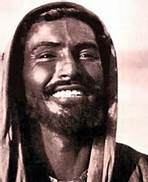
In Un Tal Jesus, Jesus is black, has a winning smile, and
a very down-to-earth sense of humor. (The photo at the top of this blog entry
shows Jesus as depicted in the Lopez-Vigil’s book.) The human Jesus portrayed
in that radio series scandalized many and inspired even more throughout the
Latin world and beyond.
As the
Lopez-Vigils envision it, today’s episode takes place in a Bethany tavern owned
by Lazarus, the brother of Martha and Mary. It’s a place of eating, drinking
and lodging for travelers. It’s a place of laughter, joking, over-eating and
drunkenness. And Jesus is right there in the middle of it all.
Passover
is approaching, and the inn is full of pilgrims. It’s steamy, noisy, and loud.
Martha is on the job, waiting on tables and controlling the rest of the staff.
Meanwhile Mary (whom scholars increasingly identify with Mary Magdalene, Jesus
closest female companion) is distracted by conversation with Jesus, who is
bantering with his friends.
And
what are they talking about? Religion? God? Spirituality? No, they’re joking.
Jesus is posing riddle after riddle. And Mary finds it completely entertaining.
In part, their dialog goes like this:
Jesus: What’s as small as a
mouse but it guards the house like a lion. One, two, three: Guess what it is!
Mary: Small as a rat…and…it’s a key! I guessed it, I guessed it!
Jesus: Listen to this one: It’s as small as a nut, has no feet but can climb a
mountain.
Mary: Wait… a nut going up the mountain…a snail!…Ha, ha, ha, tell me another
one!
Jesus: You won’t guess this one right. Listen well: It has no bones, it is
never quiet, with edges sharper than scissors.
Mary: It has no bones… I don’t know…
Jesus: It’s your tongue, Mary, which never rests!
Well,
Mary and Jesus might have found that sort of patter entertaining, but Martha
did not. She’s in charge of the inn and is worried about her guests waiting
impatiently for their food while bread is burning in the oven. So, she makes
her complaint to Jesus: “Stop your chatter and let my sister do her job!” It’s
then that Jesus makes that remark about Mary’s choosing the better part. She’s
chosen socializing and play over work.
Does
that scandalize you – Jesus distancing himself from work? Well, it seems
completely consistent with what I said about Jesus earlier. It coincides with
his general approach to work, money, profit, saving, and anxiety about the
future.
What
difference would it make in our own lives if we accepted that message:
socializing, community, and fun are more important than the work people like
Donald Luskin would have us devote our entire lives to?
What difference would it make in our culture if, in a context of underpaid labor and long hours on the job we elected candidates advocating “spreading the work around,” spreading the money around, shortening the work week, and affording us more time with friends and family, eating, drinking, joking, and playing?
That’s the message of today’s Gospel reading: we need more free time, more vacations, and assured dignified retirement.
Wake up, Mr. Luskin! Wake up, American workers: You have nothing to lose but your chains.
P.S. Here’s the actual interview with Donald Luskin along with commentary by TYT‘s John Iadarola
Today’s Gospel selection, the familiar story of the Good
Samaritan, couldn’t be timelier.
It’s read at a juncture in American history, where a Christian acting specifically according to the teaching of Jesus’ parable faces 20 years in prison. His crime? He provided food, water, lodging and hospitality to people whom the Trump administration would rather see die of thirst and exposure, because the president considers them sub-human.
I’m talking about Dr. Scott Warren (pictured above), a humanitarian aid volunteer and immigration rights activist. For years, he has worked with an organization called No More Deaths (NMD). Its members leave water jugs, clothing, and medical supplies for refugees and immigrants crossing the Sonoran Desert in southern Arizona. Warren and NMD also keep track of the numerous cadavers they find there and have filmed U.S. border agents emptying more than 3000 NMD water jugs in their clear effort to create more deaths by dehydration. In fact, those border agents are the sadistic executioners who staff Mr. Trump’s concentration camp system. (Watch what they do in this film clip. Doesn’t their sadism remind you of the Nazis we’ve all seen in all those WWII movies?)
Coincidently, I guess, and soon after filming the murderers, Warren was arrested and tried for aiding two undocumented migrants. A hung jury failed to convict him. However, the Trump administration wants the man retried – again, for the crime of obeying Jesus’ mandate in today’s reading. (In fact, most reports of Warren’s case specifically invoke the imagery of “the Good Samaritan.”) His second trial will take place in November.
The sad irony is that so many of Trump’s supporters consider
themselves Christians. Their single “Christian” issue seems to be abortion
about which Jesus and the Bible in general says absolutely nothing. Nothing at
all! And yet, when someone obeys Jesus’ clear and unambiguous teaching as in today’s
Gospel, they want Jesus’ follower punished to the full extent of the law whose
essence Moses describes as Love in today’s first reading.
It’s like what happened in Germany after Hitler came to power. There, the birthplace of Luther and his Reformation, Christians not only enthusiastically approved of der Fuhrer; they worked in his concentration camps. And then (as Elie Wiesel puts it) after cremating Jews all week, they went to confession on Saturday and received communion on Sunday. They could do so, because, mirroring Trump’s attitude towards immigrants, they believed Jews were sub-human.
That’s the same attitude Jews themselves in Jesus’ day had towards Samaritans. They were considered enemies of the state, because their ancestors back in the 8th century BCE, intermarried with Assyrian occupiers of the Jewish homeland. Intermarriage rendered Samaritans unclean. They were as sub-human as Trump’s immigrants or Hitler’s Jews.
So Jesus’ making a Samaritan the hero of his challenging
parable, and contrasting the outcast’s compassion with the “couldn’t-care-less”
attitude of professional holy men – the priest and the Levite – connects directly
with the hypocrisy of Christians, the Trump administration, and those border
agents all of whom have criminalized the fundamental human right of
immigration.
No; I’m wrong: they’ve actually criminalized God’s law of love as described throughout today’s liturgical readings. Read them for yourself here. In any case, what follows is my “translation” of their main ideas:
 DT 30: 10-14

 The Great Liberator, Moses
 Exhorted the former slaves
 To return to LOVE
 The most obvious, uncomplicated
 Reality
 In the world.

 PS 69: 14, 17, 30-31, 33-34, 36, 37

 Love is all we need
 From Life Itself.
 It is always kind
 And helpful
 Overflowing with gifts
 And ready to protect
 The poor, the imprisoned,
 The exiled,
 And those in pain.
 Yes: All we need is Love.

 COL 1:15-20

 Jesus, the Christ
 Shows what Love means –
 That absolutely everything
 Was created for Love,
 The bond, the glue
 That holds us all together
 In complete at-one-ment
 Transforming the human race
 Into a single body
 Despite resistance
 And crucifixion
 By a hostile world.

 LK 10: 25-37

 For Jesus (like Moses)
 Love of God and Neighbor
 Is the only law
 Promising fullness of life.
 The two laws are one.
 Being “neighbor”
 Means rejecting
 The ignorance of
 Professional holy men
 And politicians,
 Adopting instead
 The compassion of
 The very minorities
 We’re taught to hate
 Who provide
 Health care, transportation,
 Lodging, mercy
 Follow-up,
 And money,
 For those they have every reason
 To hate.
 That’s what it means
 To love Our very Self!
Moses was right: Love is really all we need. It couldn’t be
clearer. Jesus was right: Love is God’s only law. There is no other.
Trump, his followers and agents are wrong. They are criminal.
Or as the Master put it in another place (MT 10:42) “And whoever gives one of these little ones even a cup of cold water because he is a disciple, truly, I say to you, he will by no means lose his reward.”
Readings for 14th Sunday in Ordinary Time: IS 66:10-14C; PS 66: 1-7, 16, 20; GAL 6: 14-18; LK 10: 1-12, 17-20.
The theme of today’s liturgy of the word is exile and deliverance
from captivity. In its light, I can’t help thinking of all those refugees at
our southern border and of Marianne Williamson’s wise and unique response in
last week’s second Democratic Debate.
According to our readings, the immigrants and refugees our politicians want us to hate are exiles like the ancient Hebrews in Babylon. They are the victims of the rich and powerful as were the Jews in Jesus’ day, when Rome occupied his homeland aided and abetted by the Temple clergy. That is, today’s biblical selections say that the poorest and most vulnerable among us are God’s own people.
Yet incredibly, the richest and most invulnerable at the top of our contemporary social order – the very ones who crashed our economy, looted our common treasury, and escaped unscathed with the handouts we ourselves provided – somehow want us to believe that the poor exiles from their beloved homes in Central America are the cause of all our problems.
But remember: the home lands of these exiles from Honduras, El Salvador, Guatemala, and Nicaragua are the very countries whose economies our government purposely and permanently crashed in the 1980s. Then, the Reagan and Bush I administrations used drug money to finance illegal wars that ended up killing hundreds of thousands and replacing governments and social movements whose primary beneficiaries would have been the parents of those at our borders today. The latter are victims of the drug lords we established and supported during the ‘80s and who today are doing the same things they did 40 years ago – marketing drugs while terrorizing and murdering the innocent. I’m talking about the generals and other military officers who are now the drug kingpins.
That’s the point Marianne Williamson tried to make at the first Democratic debate. But no one picked it up. None of the other candidates elaborated on Ms. Williamson’s observation that today’s immigration “crisis” amounts to our government’s reaping what it sowed. The other candidates still haven’t seconded Marianne’s point. Instead, they and their interlocutors remain stuck in the same old, same old. They mouth the standard political platitudes while ignoring the shameful history that explains today’s headlines.
It’s been that way from biblical times and before – rich foreigners oppressing poor locals. Listen to today’s readings. Or, rather, read them for yourself. Here are my “translations.”
IS 66:10-14c

 These are the words
 Of Isaiah’s prophecy
 To all in captivity
 By Powers
 Foreign and domestic:
 “Your time of desperation
 Is nearly over.
 You will soon
 Return home
 Like starving infants
 To Mother-Jerusalem.
 With hunger satisfied
 And prosperity
 Incredible
 Along with joy
 And comfort, comfort, comfort
 At last!”

 PS 66: 1-7, 16, 20

 Our liberator
 From exile
 So kind and powerful
 Is the answer
 To the prayers
 Of captive people
 And a source of joy
 For the whole
 Human race
 And all of creation.
 No obstacle
 Can impede
 God’s destiny
 Of liberation
 Joy and freedom
 From oppression.

 GAL 6: 14-18

 Yes, our destiny
 Is an entirely
 New World!
 Where the world’s distinctions
 Are meaningless.
 Acting accordingly
 Now
 Will bring
 Everyone
 Compassion and peace.
 However,
 The World
 Crucifies us
 For this belief.
 Nonetheless,
 We’re called to
 Bear its torture
 And scars
 Gladly
 As Jesus did.

 LK 10: 1-12, 17-20

 Paul’s words
 Agree with Jesus
 Who sent
 Thirty-six pairs
 Of “advance men”
 And women
 To announce
 (Like Isaiah)
 Liberation
 From oppression
 By powers imperial.
 Like lambs among wolves
 Like monks
 With begging bowls,
 They healed and proclaimed
 God’s Great Cleanup
 Of a world
 Infested by demonic
 Imperial oppressors.
 And it worked!
 Every one of those 72
 Cast out evil spirits
 Just like Jesus.
 (Despite powerful opposition
 And crucifixion.)
Some have ridiculed Marianne's debate performance. However, that only shows how our country thought-leaders have become tone-deaf to biblical values. They consider them ludicrous.

 For me, that only signals the necessity of doubling-down on support for the only one in the crowded Democratic field who courageously insists on the values embedded in today's readings which identify the keys for solving the problems caused by "experienced" politicians. As Marianne says, those keys are love and forgiveness precisely for and of those the rich and powerful vilify.
Readings for the 13th Sunday in Ordinary Time: I KGS 19: 16 B, 19-21; PS 16: 1, 2, 5, 7-11; GAL 5: 1, 13-18; I SM 3:9; JN 6: 68C; LK9: 51-62
So, we all watched Thursday’s debate in which Marianne Williamson finally participated and showed the country who she is. And she was magnificent. She demonstrated what her spiritual guidebook, A Course in Miracles calls a refusal to be insane. She embodied that still small voice of conscience – the voice for God – that today’s liturgy of the word distinguishes from the world’s madness.
To begin with consider the madness we witnessed Thursday night. It was a perfect reflection of our insane country, of our insane world, of our insane electoral system. There they were: ten of our presumably best and brightest aspiring to occupy what we’re told is the most powerful office in the world. They shouted, talked over their opponents, self-promoted, bragged, and put their opponents down. They offered complicated “plans” that no one (including themselves) seemed to understand. They ignored the rules of the game, recited canned talking points, and generally made fools of themselves – and of viewers vainly seeking sincerity, genuine leadership and real answers. Except for that brief exchange about busing between Kamala Harris and Joe Biden, it was mostly embarrassing.
And then there
were the so-called moderators who allowed the circus to spin so completely out
of control. They issued stern warnings about time limits, frequently set them
strictly at “thirty seconds,” but then proceeded to allow speakers to go on for
three minutes or more. The celebrity hosts were completely arbitrary in addressing
their questions unevenly. They repeatedly questioned some of the candidates and
ignored others.
Meanwhile,
there was Marianne Williamson off in the corner almost completely out of sight
and generally ignored by the hosts. When they finally deigned to notice her
polite attempts to contribute, no one seemed to know what to do with her comments.
There was never any follow-up or request for clarification. Instead, what she
said seemed completely drowned out by the evening’s “excitement,” noise, general
chaos, and imperative to change topics. It was as if she were speaking a
foreign language. I mean, how do you respond to that “still small voice of
conscience” that says:
Immigration problems should be understood in historical context; their roots are found in U.S. policy in Central America especially during the 1980s. Such comment invites further discussion. None took place.
Removing children from their parents’ arms is kidnapping; putting preschoolers in concentration camps is child abuse. Such crimes should be treated accordingly. What retribution did Marianne have in mind? The question went unasked.
Health care “solutions” should address environmental questions about chemicals in our foods, water, and air that make Americans sick. The response: “My next question for Vice-President Biden is . . .”
Government programs should be expressions of love, not fear.
As
expected, the pundits who afterwards declared “winners” and “losers,” generally
put Marianne in the latter category. Their criteria for that judgment were just
what you’d expect: Who was louder? Who was more aggressive, more interruptive? Who
spoke for more minutes? Who more effectively transgressed the debate “rules”
and thereby showed leadership and dominance?
None of this could be further from the spiritual principles Marianne Williamson has espoused for the last 40 years. That spirituality, like Elijah’s, Elisha’s, Paul’s, and Jesus’ in today’s liturgical readings holds that the problems that plague our world have simple answers that have nothing to do with bombast, filibusters, or spectacle. However, the world rejects out of hand the solutions of that still-small-voice of conscience as unrealistic and “out there” in the realm of the irrelevant and impractical. Such blind dismissal is what Paul in today’s reading calls “flesh;” it’s what Jesus elsewhere rejects as “worldly.”
So, in an
effort to put Thursday’s debate in perspective, let me begin by describing where
Marianne is coming from; then I’ll get to the relevant readings.
A
Course in Miracles
For more than forty years, the foundation of Marianne Williamson’s life and teachings has been A Course in Miracles (ACIM). It’s a three-volume work (a text, 365 daily exercises, and a manual for teachers) that was allegedly (and reluctantly) channeled by Helen Schucman, a Columbia University psychologist and atheist in the three or four years leading up to 1975, the year of the trilogy’s publication. It has since sold millions of copies. Williamson has described ACIM as “basic Christian mysticism.”
The book’s
a tough read – certainly not for everyone, though Williamson insists that
something like its daily spiritual discipline (a key term for her) is necessary
for living a fully human life bent on serving God rather than self. Its guiding
prayer is “Where would you have me go? What would you have me do? What would
you have me say, and to whom?”
Even
tougher than the cryptic text itself is putting into practice the spiritual
exercises in Volume II whose entire point is “a complete reversal of thought.” According
to ACIM’s constant reminders, we are all prisoners in a cell like Plato’s Cave,
where everything the world tells us is exactly the opposite of God’s truth.
To counter such deception, A Course in Miracles has the rare disciple (possessing the discipline to persevere) systematically deconstruct her world. It begins by identifying normal objects like a lamp or desk and helping the student realize that what s/he takes for granted is entirely questionable. Or as Lesson One puts it: “Nothing I see in this room [on this street, from this window, in this place] means anything.” The point is to liberate the ACIM practitioner from all preconceptions and from the illusory dreams the world foists upon us from birth. Those illusions, dreams and nightmares are guided by fear, which, the course teaches, is the opposite of love. In fact, ACIM teaches that fear and love are the only two energetic forces in the entire universe. “Miracles” for A Course in Miracles are changes in perception – a paradigm shift – from fear to love. For Marianne, Donald Trump’s worldview is based primarily on fear; her’s is based on love (which means action based on the recognition of creation’s unity).
According
to Williamson’s guide, time, space, and separation of humans into separate
entities are all entirely illusory. Such distinctions are dreams that cause all
the world’s nightmares, including all the topics addressed in Thursday’s debate.
For instance:
The
illusion of time has us all living in past and future while ignoring the
present – the only moment that actually exists, has ever existed, or where true
happiness can be found. This means, for example, that inspirational figures
like Jesus are literally alive NOW just as they were (according to time’s illusion)
2000 years ago. His Holy Spirit is a present reality.
The
dream of space has us taking too seriously human-made distinctions like borders
between countries. Yes, they are useful for organizing commerce and travel. But
the world as God created it belongs to everyone. It’s a complete aberration and
childish to close off borders as inviolable and to proudly proclaim that “From
now on, it’s only going to be America first, America first!”
Similarly,
the dream of separation between humans has us convinced that “we” are here in
North America, while refugees are down there at our southern border. According
to ACIM however, “There is really only one of us here.” This means that I am female,
male, white, black, brown, straight, gay, trans, old and young. And so are you.
Others are not simply our sisters and brothers; they are us! What we do to
them, we do to ourselves.
With such
clarifications in mind, the solution to the world’s problems are readily
available and far easier to understand than complicated health care systems or
carbon trading. The solutions are forgiveness and atonement. But for ACIM,
forgiveness does not mean overlooking another’s sins and generously choosing
not to punish them. It means first of all realizing that sin itself is an
illusion. It is an archery term for a human mistake – for missing the mark –
something every one of us does.
Forgiveness,
then, amounts to nothing more than realizing that truth and acting accordingly –
as though the forgiven one were our Self (because s/he is!). In a world of
complete deception, it means accepting the truth that the ones our culture
blames – like immigrants, refugees, people of color, the poor, Muslims, and members
of the LGBTQQIA community – are not only completely innocent. Accepting them as
our very Self represents the source of our personal and political salvation.
In this
light then, prisons (for particularly dangerous people) become re-education
centers for rehabilitation, not punishment. This means that even pathological
criminals like Trump, Pence, Pompeo, and Bolton can helpfully be sequestered
for a while and then returned to society as reformed, productive people. (I
know that’s hard to believe; but it could happen!)
Yes, for
Williamson, the goal of it all (of life itself!) is atonement – At-One-Ment – practical
realization of a world with room for everyone with illusory distinctions either
ignored, or played with, or celebrated in the spirit of party and game. Practically
speaking, atonement looks like reparations not only to the descendants of
African slaves, but to countries we have destroyed like those Marianne
referenced in Central America – but also like Iraq, Afghanistan, Iran, Cuba,
and a host of others. Instead of dropping bombs on them or applying sanctions,
we should, in effect, be showering them with schools, hospitals,
infrastructure, technological assistance, and money. It’s all part of the
reparations due.
Imagine
what that kind of foreign policy would accomplish and how much cheaper it would
be than the trillions we’re now wasting on weapons and war.
As her
books, Healing the Soul of America and A Politics of Love show, Williamson
stood ready to share such convictions last Thursday night. But she was never
asked. And we’re all poorer as a result.
Today’s
Readings
So how is all of that related to this Sunday’s readings? They’re about the contrast between the world’s wisdom – its way of debating, judging, condemning, and praising – and God’s way of interacting with one another and with creation itself. Check out the readings for yourself here and see what you think. My “translations” follow to clarify their cumulative point:
I KGS 19:16B, 19-21

 We are called
 To be prophets
 Like Elijah
 And his disciple-successor
 Elisha
 A wealthy farmer
 Who understood
 That God’s call
 Required renouncing
 Everything the world
 Holds dear:
 Family, possessions,
 And independence
 In order to
 Comfort the afflicted
 Afflict the comfortable
 And feed the hungry.

 PS 16: 1-2, 5, 7-8, 9-10, 11

 For what ultimately
 Belongs to us
 Is not
 The world’s
 Corruption and condemnation
 But the God
 We deeply are
 Who is our very
 Food and drink,
 The ability to see
 Even amidst
 The world’s darkness,
 The source of calm,
 Gladness, and health
 Who shows
 The path to life,
 Joy, and unending delight.


 GAL 5: 1, 13-18

 As Elisha realized:
 World and Spirit
 Are completely opposed.
 Paul terms
 Those worldly values
 “Flesh.”
 It demands
 Slavery and consumption
 Of one another!
 What God values
 Is Christ’s “Spirit.”
 Demanding
 Nothing more
 Than love
 Of the other
 Who is
 (Believe it or not)
 Our very Self.

 I SM 3:9, JN 6: 68C

 Deep down
 We know
 All of this
 Is true.

 LK 9: 51-62

 Jesus did too.
 So, on the way
 To ultimate destiny
 He rejected
 The world’s spirit
 Of xenophobia, revenge,
 Ethnocentrism –
 And Hell-Fire missiles.
 Instead, he identified with
 The homeless,
 With life, not death,
 And with the Spirit
 Of Elisha
 Who also
 Left plow and oxen
 For the sake of
 God’s reign.
Conclusion
Please think about those readings in the light of what we witnessed on the debate stage a few nights ago. The other candidates represented what Paul calls “flesh” – you know: the world’s wisdom and way of doing things involving corruption, condemnation, devouring one’s opponent, xenophobia, and addiction to those Hellfire missiles. Meanwhile Marianne seemed bemused by it all. Her few thoughtful remarks said far more than the ones filibustering, pointlessly arguing, self-promoting.
As she says herself, Ms. Williamson is not in this campaign to run against anyone. She’s there to run with her fellow Democrats and to help Americans decide which candidate is best.
I think that candidate is Marianne. She deserves better consideration and a closer hearing than she received on Thursday. Like Elijah, Elisha, Jesus, and Paul, she is a voice for our Deepest Self. She was the winner.
On this Trinity Sunday, Marianne Williamson’s basic approach to our national problems reminds me of traditional trinitarian doctrine. I mean, when I was a kid in catechism class, the mystery of the Holy Trinity seemed like one of those word-problems I found so difficult in arithmetic. I wondered, how can there be three divine persons in one God? Was it 3+ 1= 1? Or was it 3 ÷ 1 = 1? I was confused.
Williamson’s basic approach to politics presents a similar quandary. Her basic math problem is: How can we solve our myriad national problems? There seem to be so many. However, like what I heard in catechism class, her solution remains theological. But it goes like this 1+1+1+1+1+1+1+1+1+1+1+1 = One.
What she means is that we really have only a single problem. It’s extremely personal, but at the same time very political and highly theological. It’s our relationship with God (though we might with good reason reject that particular word as culturally debased). Williamson observes that (whatever name we might prefer) until we get our God-problem straightened out, all those other difficulties will continue to plague us and threaten our very survival.
That simple but profound spiritual insight is what distinguishes Williamson from other Democratic candidates for president. It’s that ecumenical, all-inclusive spirituality that separates her from Republican Christianists. Specifically, it calls us to profoundly correct our perception of reality from that of the “world” based on fear and greed to a divine perception based on love and compassion.
Think, for instance, about our endless political troubles. Internationally, they’re based on the conviction that we are surrounded by enemies radically different from us. They are so threatening that we must spend billions each day — yes, nearly $2 billion every 24 hours — to protect ourselves against the likes of Russia, China, North Korea, Syria, Yemen(!), ISIS, Iran, Iraq, Afghanistan, Venezuela, Nicaragua, Cuba, and against immigrants and refugees from Guatemala, Honduras, El Salvador, and Mexico.
Domestically, politicians want us to think that we’re threatened
not only by all those foreigners, immigrants and refugees, but by what the
Clintons once termed “super-predators” who tend to be black or brown,
by LGBTQQIA individuals, and by poor people in general. That’s why we end up
imprisoning a greater percentage of our population than any other country —
and that doesn’t even include the immigrants and refugees in our border
concentration camps and baby jails, or those in the black sites (sic!) we
maintain across the globe.
No wonder we anesthetize ourselves to forget it all. So, we consume
drugs like guns, alcohol, pot, amphetamines, other pharmaceuticals, tobacco,
our iPhones, pornography, spectator sports, snacking, comfort food, and TV
binges. That’s quite a list, don’t you think? Each item creates its own problem
in the personal and familial spheres. It’s a never-ending cycle of
threat-fear-denial and escape. And it’s all-encompassing.
However, according to Williamson, all of that — the guns, wars, fear of “the other,” and narcotization of all sorts — are simply means of side-stepping our only real problem: God.
And that’s what’s centralized in today’s Solemnity of the Most Holy Trinity. The day’s readings call us to face the nature of God straight-on. And it has nothing to do with catechism math. Neither, according to today’s biblical selections, is God what we’ve been taught. God is not a judge, punisher, and torturer. Instead, the passages selected for this Solemnity of the Most Holy Trinity invite us to appreciate divine goodness and love for all of humankind, and to use those insights to reduce our countless problems to merely one.
Consider today’s readings. (Please read them for yourself here.)
They describe for us the three-fold nature of the One we find so problematic.
As depicted in the graphic above, she is Mother (Wisdom), Father (Creator), and
Child (as revealed in Jesus the Christ). Here’s my “translation” of
this Trinity Sunday’s readings specifically about the nature of God:
PRV 8:22-31
God as Wisdom Itself
Is embodied in all the world.
As feminine and Mother
She is like a skilled craftswoman
Who set the very foundations of the earth
And shores of the seas
All in a spirit of playfulness
Finding special delight in the human race.
PS 8: 4-9
Which is amazingly loved
By the Creator-Father
For whom
All human beings are like angels
Glorious and honorable
Caretakers and rulers of
Wild and domesticated animals
Birds and sea creatures
And whose traditions across the earth
Have always recognized
And loved
The Reality of God.
ROM 5: 1-4
It is that universally-shared faith
That gives human existence
Worth and value
Making possible
Peace among nations
Giving us hope
But putting us at odds with “the
world”
Which punishes us for our faith
(contradicting, as it does
The world’s fear-full “wisdom”).
But the world’s opposition
Only strengthens
Our sensitivity to
The Holy Spirit of Jesus.
JN 16: 11-15
Who offers
A guiding vision of the future
Expressed in teachings
About humankind’s fundamental
Unity with God
And each other.
Do you see how owning and interiorizing that single trinitarian vision of Mother, Father, and Child holds potential for dissolving our countless problems? The earth belongs to all of us who constitute a single family. Each angelic member is loved by God who as our Female-Male Parent has filled all with the very Spirit of Jesus. His fundamental teaching is to love God with all our heart and our neighbor as our self. That means we need to recognize that those whom we fear as enemies and foreigners are our very Self. Or, as Marianne Williamson puts it, “There is really only one of us here.”
According to Williamson, interiorizing that insight and expressing
it in our personal, familial, social, spiritual and political lives would
absolutely eliminate every single problem I listed earlier.
So how do we get from here to such problem-free existence? That’s where Williamson descends from the sublime to the nitty-gritty. Unlike some others who’ve qualified for the first presidential debate, she’s signed Cenk Uygur’s TYT Progressive Pledge. (You can sign it here.) Watch how she responds to Uygur’s questions:
Yes, I know, that sounds very similar to Bernie Sanders and Elizabeth Warren. However, Marianne’s distinguishing edge is her insistence on calling for the change in spiritual consciousness that is necessary to effect redirection of U.S. policies. In that sense, she’s far more progressive than anyone else in the field.
Opponents and the media, of course, will smile and condescendingly
pat her on the head and say, “Oh, that’s very sweet, Marianne, but quite
naive. Your approach will never work in the dog-eat-dog world we live in.”
However, along with Jesus and countless others whom we profess to admire, Williamson reminds us that it is precisely the “world’s” patronizing approach that is not working. That “realism” has brought us to the brink of atomic, biological, climatic, demographic, and economic annihilation (and as Crossan says, that’s only up to “e” in the alphabet!).
What remains unimplemented on a broad scale is the explicitly spiritual approach of Jesus, Gandhi, of Quakers in the Abolitionist and Women’s Suffragist Movements, of the Baptist preacher Martin Luther King, of Catholic priests like the Berrigan brothers, and of Dorothy Day and the Catholic Workers .
Along with today’s readings, all those spiritually inspired and deeply politicized figures agree with Marianne Williamson: We have only one problem; it’s about family; it’s about correcting our relationship with our Mother and Father in the Holy Trinity of which all humans are an integral part. Williamson is right: we have only one problem; there is really only one of us here. We are infinitely closer than brothers and sisters. Her presidency will move us towards a practical realization of that vision.
Readings for Pentecost Sunday: ACTS 2: 1-11; PS 104: 1, 24, 29-30, 34; I COR 12: 3B-7, 12-13; ROM 8: 8-17; JN 20: 19-23
Today is Pentecost Sunday. Fifty days after Easter, it
celebrates the day that followers of Jesus decided to overcome their fears and
form a community to carry on Jesus work of introducing what he called the
Kingdom of God as an alternative to Rome’s Kingdom of Caesar.
Whether the realization dawned on Easter day itself (as in
today’s Gospel reading from John) or 50 days later (as described in the first
reading from the Acts of the Apostles), today’s celebration reminds us that
Jesus’ Spirit stands 180 degrees opposed to that of empire – the spirit of the
world. That’s because Jesus’ Spirit is embodied in the victims of empire’s
torture and capital punishment. It recognizes the poor rather than the rich as the
bearers of peace, joy, and prosperity. That’s what John means by recalling that
before conferring his Spirit of Peace, Jesus “showed them his hands and his
side.” That’s what today’s Sequence means when it identifies Jesus Spirit as
the “Father of the poor.”
During this election season, I cannot help connecting those Pentecostal insights to Marianne Williamson. That’s because alone among Democratic presidential candidates, she specifically recognizes the incompatibility between Jesus’ teaching that prioritizes love and forgiveness and the spirit that governs our world characterized by fear, greed, lies, and violence. For Williamson, such opposition remains a spiritual truism, whether we connect it with Jesus, Moses, Mohammed, Krishna, the Buddha, or simply with LIFE or NATURE. Acknowledging that, Williamson’s candidacy is calling for a national change of consciousness from fear and greed to one driven by love and compassion.
Yes, she dares to do that with great specificity! And her
wisdom and sincerity in doing so can hardly be questioned. In fact, we know
more about Marianne Williamson, her philosophy, spirituality, and the workings
of her mind than any other candidate. That’s because she’s spent, more than 30
years talking about nothing else. It’s all part of the public record. She’s
used her spirituality (what today’s liturgy identifies with the Spirit of
Jesus) to help individuals, couples, and congregations reach depths of critical
thinking that even progressives might consider far too radical. For instance,
she holds that:
We live imprisoned in a deceptive world much like Plato’s Cave.
There, what the world presents as truth is 180 degrees opposite of the truth of God (though no one need use that historically debased term).
The world’s truth is governed by fear and greed.
It identifies the “other” (e.g., poor people, Muslims, immigrants, refugees, non-whites, Iran, Russia, Venezuela, North Korea, ISIS) as the cause of our problems, while “we” are innocent.
The fact is none of those just listed is our enemy. All of us are more than brothers and sisters; in fact, there is really no meaningful distinction between us. What we do to them, we do to ourselves.
As a result, God’s ultimate truth is governed by love and compassion and by the realization that all humans are ultimately innocent.
That’s true even of Donald Trump, John Bolton, and Mike Pompeo. Though they are sociopaths who need to be removed from office and to face the consequences of their crimes, they too are performing the spiritual service of revealing as never before the corruption of the prevailing system that deceitfully serves the rich rather than the rest of us.
Insights like those have been among Marianne Williamson’s guiding convictions for more than 30 years. And at least since 1998 and the publication of her Healing the Soul of America, she has scandalized many of her would-be followers by connecting her profound spirituality to deeply radical politics. In that book, she predicted the rise of a force like Donald Trump if the “higher consciousness community” and the rest of us failed to make similar connections. The title (and content!) of her latest book, The Politics of Love, doubles down on the radicalness of her analysis.
Imagine governing our country and the world according to the
Spirit described in today’s readings. They are crystal-clear in their
contradiction of what we’ve been led to accept as normal and unavoidable in the
realm of politics. Review the readings for yourself. They tell us that Christ’s
Spirit:
Is international; it loves equally people of all nations (Acts 2: 1-11)
Is abundantly creative and universal involving not just human beings, but all of creation (PS 104: 1, 24, 29-30, 31, 34)
Refuses to recognize religious distinctions, e.g. between Jews and “pagan” Greeks (ICOR 12: 3B-7, 12-13)
Embodies wisdom, understanding, counsel, fortitude, knowledge, and joy (Special Pentecostal Sequence)
Recognizes forgiveness as the key to peace (JN 20: 19-23)
Isn’t it true that most Americans, who describe themselves
as somehow “Christian,” would find the convictions just listed as unrealistic
or even suicidal if applied to politics?
But, of course, those ideals have never been tried. And, according to Williamson, that’s just the point. Failure to apply the spiritual insights advocated by Jesus and those other spiritual avatars have led us to our present impasse. That “realism,” she observes, is what’s really suicidal. It’s destroying our planet and threatening us with nuclear holocaust. For Williamson, making America great again means following a radically different path. It means following the example of Quaker-inspired abolitionists, of the similarly motivated suffragettes, of the Baptist preacher Martin Luther King, of war-resisters like the Catholic priests Phil and Daniel Berrigan, of Dorothy Day and Mohandas Gandhi. Those figures and the tradition they represent constitute the truly “great” part of the American tradition.
To put it bluntly, Marianne Williamson, like the feast of Pentecost itself, is asking Americans to overcome their fears and form the beloved human community envisioned by Jesus, King and those others. But to do so, she says, we must completely reject everything empire values as true and worthy. Instead, Williamson invites us to recognize solidarity with those empire actually despises. Russians, Chinese, Iranians, Venezuelans, Syrians, North Koreans, Muslims, immigrants, the poor in general, even ISIS fighters, and especially the world’s children are beloved by God. Rather than rejection, wars, dronings and sanctions, they deserve respect and inclusion in any negotiations that affect them. At the same time, those actually in power are often thieves, sociopaths and criminals. They deserve compassion but must be treated accordingly. All of that encapsulates the radicalness of Marianne Williamson’s approach to politics. It also encapsulates the Spirit of Jesus – his ultimate gift celebrated this Pentecost Sunday. Is that too radical, even for Christians, even for progressives? The alternative, Williamson reminds us, is just not working out.
Stephen Executed before Paul Falls asleep Envisioning God’s Kingdom While forgiving the ignorant Who cover their ears Against hearing The Human One Who substitutes God’s Reign Of compassion and love For religion’s insatiable Blood thirst.
PS 97: 1-2, 6,7,9
Yes, Jesus’ Kingdom rests Not on executioners’ haste To throw the first stone But on justice Joy and gladness For everyone It confers judgment Revealing The emptiness of Everything Killers venerate.
REV 22:12-14, 16-17, 20
May God’s Kingdom come! Even amid roadside missiles and martyrs’ gore. Hear the urgency! “Come, come, come, come, come, come” Six times over: Come Alpha and Omega First and Last Beginning and End Root and branch Starlight and Bride Water and Life.
JN 17: 20-16
It’s about Unity The Master assures Five times he says: One, one, one, one, one We are Close like Jesus and Abba. Foundationally coherent With them, Stephen, Paul And those myopic men Throwing rocks Powerful enough To awaken Prophet’s rage To know, know, know, know, know, know (Count them!) That God and We are One Rendering stones and blood Impotent To destroy Shared unity At divine core.
It’s Memorial weekend already – the unofficial beginning of summer, 2019. As usual, it’s a day when our country celebrates war and its heroes. That’s simply the American way of commemorating every patriotic occasion.
Appropriately however, this weekend’s liturgy of the word introduces a note of dissent. It centralizes peace as the content of Jesus last will and testament. In so doing, it implicitly contrasts Jesus’ concept of peace with that of Rome or any empire for that matter. The Roman Tacitus described his country’s understanding with the famous aphorism: “They create a desert and call it peace.” For me, Tacitus’ description applies just as well to the United States.
With that in mind, it also seems appropriate to connect
Memorial Day, the peace Jesus advocated and the presidential candidacy of
Marianne Williamson. I say “appropriate” this time because Williamson is the
only candidate in the crowded Democratic field who thematically centralizes the
need for change of specifically spiritual consciousness about all things
political – including matters of war and peace. Her attitude on those issues corresponds
closely with that of Jesus as expressed in today’s Gospel reading.
Marianne Williamson
and Peace
To begin with, Williamson is a harsh critic of the Pentagon
and the policy of perpetual war into which our country has increasingly fallen
since the Second Inter-Capitalist War (1939-’45) and especially since 9/11/01.
In fewer than 100 years, she points out, the real driving
force behind United States military posture has become the interests of Lockheed
Martin, Raytheon, Boeing and other defense contractors. That has Americans, for
instance, buying one hundred B-21 stealth bombers each costing $550 million and
each capable of carrying thermonuclear weapons. That’s $55 billion in total.
Such investment, Williamson says, is completely
over-the-top. Why 100 planes of that type? At the very least, it all seems
completely out-of-proportion to the danger posed by our perceived terrorist enemy.
Terrorists belong to no particular state. Very often they are home-grown. In
any case, their hit-and-run attacks cannot be effectively answered with
wholesale bombing, much less with nuclear weapons. Williamson writes:
“America today is like
the British Red Coats during the Revolutionary War – standing abreast in a straight
line waiting for someone to yell ‘Fire!’ while American colonists were hiding
behind trees like the early guerrilla fighters that they were. Our entire
notion of national security is like something out of another century.”
Instead of such waste and without neglecting legitimate
defense concerns, Williamson calls for effective recognition of the soul force
of peace building. She wants established a US Department of Peace that would
make peace-creation a central goal of national policy, both foreign and
domestic. It would use resources like
those now wasted on those B-21s to support diplomatic efforts with those currently
villainized in order to justify purchase of overpriced weapons systems.
Peace building would reconstruct the cities that US policy
has destroyed. It would support educational opportunities for children, expand
economic prospects for women, and in general alleviate human suffering across
the planet. “That would be the moral thing to do,” Williamson says. “That would
be the loving thing to do. And that would be the smart thing to do.” In summary
she says, “The best way to create a more peaceful world is to treat people with
greater compassion.”
Jesus and Peace
Williamson’s approach to peace-building is in sync with
Jesus last will and testament expressed in today’s liturgy of the word. There
he says: My peace I leave with you. My peace I give you. Not as the world
(meaning Rome) gives, do I give.”
Jesus words and ultimate fate remind us that Rome’s policies
created terrorists no less predictably than our own country’s way of creating “peace.”
It led the empire to identify Jesus as a terrorist and execute him accordingly.
Jesus, I’m sure, must have hated Rome. Like all his Jewish
contemporaries, he must have despised Rome’s imperial presence in Palestine –
especially since it was headed by a man who considered himself God, Savior,
Lord, and Prince of Peace. Scholars remind us that empire was the most
significant factor shaping Jesus’ life. We know for a fact that he opposed it
vigorously – especially its local collaborators personified in the Jewish high
priesthood of his day, along with the scribes, Pharisees and Jewish high court.
However, his resistance was non-violent.
Yes, Jesus’ peace is not what the world calls peace. It’s not Roman peace which was imposed by means of war. Rome’s, like the Pentagon’s, was peace through victory – always supported by Roman religion. In fact, as scripture scholar John Dominic Crossan, puts it in God and Empire: Jesus against Rome then and now, the exact sequence was religion – war – victory – peace. Sound familiar?
By contrast, the
peace Jesus bequeathed had nothing to do with Rome or empire in general. His
peace is brought not by victory, but by justice – especially for the poor. His
was not peace through victory, but peace through justice. As I noted last week,
that point was made in the programmatic sermon the Master gave in Nazareth at
the beginning of his public life. These are the words with which he described
his very purpose: “The Spirit of the Lord in on me, because he has anointed me
to preach good news to the poor. He has sent me to proclaim deliverance to the
captives and recovery of sight to the blind, to release the oppressed, to
proclaim the year of the Lord’s favor (LK 4: 17-19).
Jesus was about serving the poor, releasing the imprisoned,
caring for the disabled, liberating the enslaved, and ending debt servitude.
His peace had nothing to do with victory as the world understands it – as Rome
understood it or as the United States does. The sequence of Jesus’ gift to the
world was religion – nonviolence – justice – peace.
Conclusion
And that’s what Marianne Williamson’s national defense program
is about as well. It entails a spiritual conversion that takes its cue as well from
Gandhi, and Martin Luther King. It also takes heed of Republican Dwight
Eisenhower’s warning about the dangers of the military-industrial complex.
Williamson’s program would:
Have our country live within its means
Emphasize peace building rather than war-making
Rather than bombs and drones, it would rain down rebuilt homes,
schools, hospitals, factories, temples, mosques and churches on the enemies
created by our imperial philosophy of peace through victory
And to those who say that all of that won’t work or that it’s
totally unrealistic, Williamson is fond of responding, “And how’s that realism
working out for you?” In fact, it’s creating more terrorists and mayhem while
simultaneously destroying the planet.
We’ve got to try something different. And that means national spiritual conversion. It’s in that call for repentance, transformation and restorative justice that the campaigns of Jesus and Marianne Williamson coincide. And that coincidence has nothing to do with memorializing, much less glorifying our country’s ceaseless imperial wars.
(By the way, Marianne has not only achieved the 65,000 unique donors required for her to appear in the debates with other presidential candidates. As well, she has surpassed the minimum 1% support in 3 separate national polls. Nate Silver has identified her as a major candidate.)







 About Things That Matter