Pentecost and the Sin of Christian Nationalism

Readings for Pentecost Sunday: Acts 2: 1-11; Psalm 104: 1, 24-34; 1 Corinthians 12: 3b-7, 12-13; John 20: 19-23

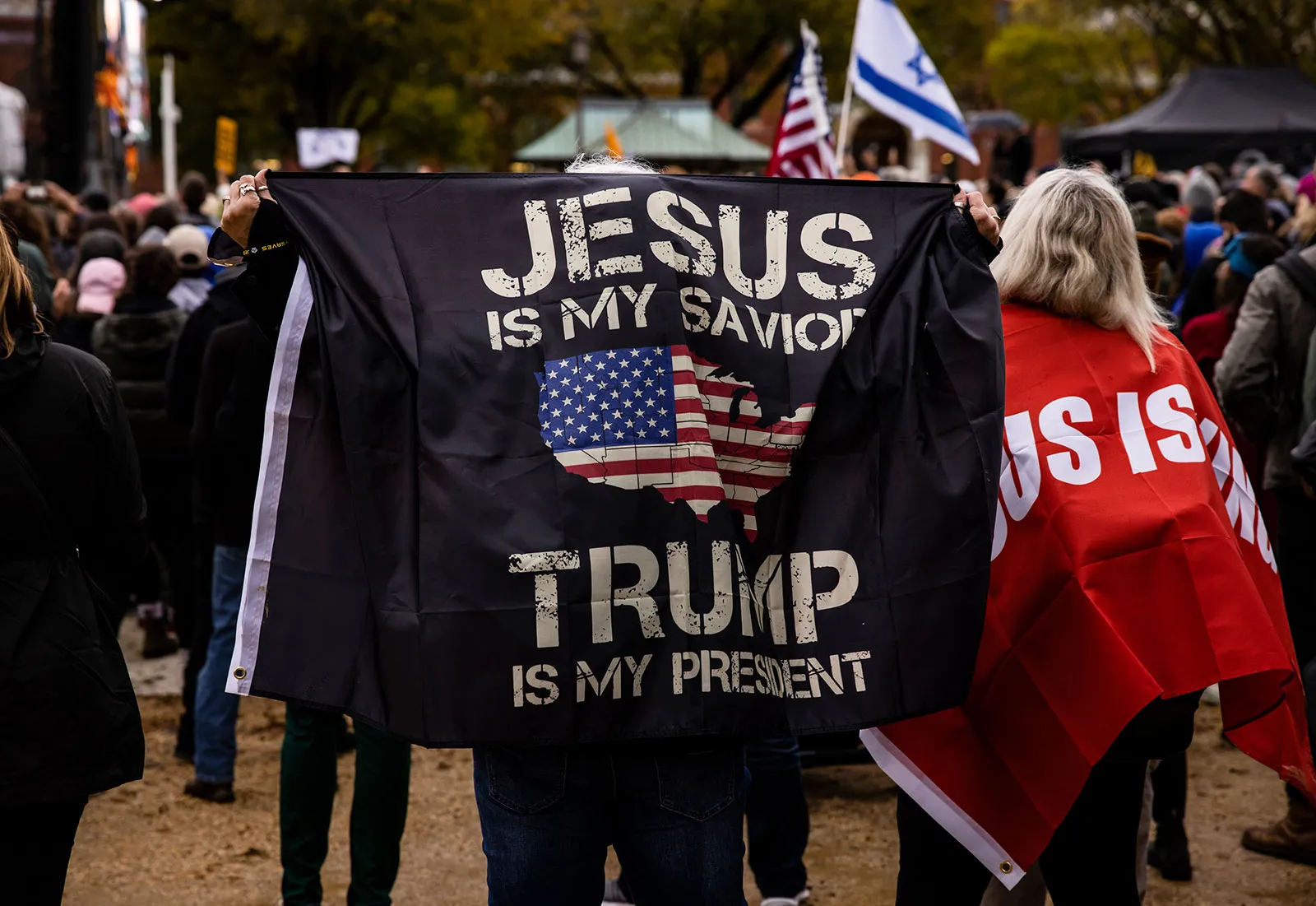
Last Sunday thousands gathered on the National Mall in a celebration blending Christianity, nationalism, military imagery, and devotion to Donald Trump. Crosses stood beside flags. Speakers praised America as a specially chosen nation. Calls for “strong borders,” “Christian values,” and “taking our country back” blended almost seamlessly with prayers and worship songs.

Watching it, I found myself thinking about today’s feast of Pentecost.

Because Pentecost presents us with a vision of God exactly opposite to the spirit of Christian nationalism.

Christian Nationalism

Christian nationalism tells us that our divine Creator belongs especially to one nation, one culture, one language, and one people. It imagines God as the protector of borders, armies, national destiny, and cultural purity. At its extremes, it turns Christianity into a religious justification for fear of outsiders, suspicion of immigrants, and hostility toward those judged foreign or threatening.

Pentecost says the very opposite.

The first reading from Acts could not be clearer. Luke almost overwhelms us with his list of peoples gathered in Jerusalem: “Parthians, Medes, Elamites, inhabitants of Mesopotamia, Judea and Cappadocia, Pontus and Asia…” The catalog continues almost tediously. But Luke’s purpose is deliberate. He wants us to understand something essential about the Holy Spirit.

The Spirit descends not upon one nation, but upon “devout Jews from every nation under heaven.”

And the miracle is not that everyone suddenly speaks the same language. The miracle is that each person hears the apostles “in his own native tongue.”

That detail matters enormously.

Pentecost vs. Empire

Empires always demand conformity. Political power typically insists on one approved language, one authorized culture, one acceptable version of reality. But at Pentecost, diversity (D.E.I.?) itself becomes the medium through which God speaks. The Spirit does not erase difference; the Spirit honors it.

Which means Pentecost stands as a direct challenge to much of what now passes for Christianity in the United States.

We are living through a period where immigrants are routinely described as invaders, criminals, parasites, and threats to civilization itself. Families fleeing violence or hunger are treated as enemies. Human beings seeking asylum are loaded onto airplanes in chains while politicians boast about deportation numbers to cheering crowds.

And all of this is increasingly wrapped in Christian language.

Crosses appear beside assault rifles. Bible verses are quoted at political rallies. Jesus is invoked to justify cruelty at the border and indifference toward refugees. The faith of the Sermon on the Mount is steadily transformed into a religion of walls, exclusion, punishment, and fear.

Pentecost vs. Locked Doors

Yet today’s Gospel begins with disciples hiding behind locked doors “for fear.”

That line may describe not only the apostles but our nation itself.

Fear locks doors. Fear builds walls. Fear turns strangers into enemies and neighbors into threats. Long before barriers are erected at borders, barriers are erected within hearts. We begin dividing humanity into “us” and “them,” the deserving and undeserving, the saved and the dangerous.

Then Jesus enters the room.

Notice what he does not say. He does not urge the disciples to protect themselves from foreigners. He does not call for the defense of traditional culture. He does not speak of national greatness or civilizational conflict.

He says simply: “Peace be with you.”

Then he breathes on them and says, “Receive the Holy Spirit.”

That image of breath is deeply important. In both Hebrew and Greek, the words for breath, wind, and spirit are intimately connected. The Spirit is the breath of God shared with humanity itself. In Genesis, God breathes into the earth creature and Adam becomes alive. Here in John’s Gospel, Jesus breathes once again, recreating humanity.

This means that every human being carries the same sacred breath. Not just Americans. Not just Christians. Not just people with passports or legal documents. Everyone.

That conviction lies at the center of biblical faith. Again and again Israel is reminded: “You yourselves were once strangers in Egypt.” The test of fidelity to God is never simply doctrinal correctness or patriotic fervor. It is always social practice. How are the vulnerable treated? How are outsiders welcomed? How are the poor regarded?

A Reversal of Babel

In terms of language, inclusion, equality, and understanding, Pentecost reverses Babel.

At Babel humanity united around domination and imperial ambition. The result was confusion and division. At Pentecost humanity rediscovers unity not through forced sameness but through mutual listening and understanding. The Spirit creates communion without demanding uniformity.

St. Paul expresses the same vision in today’s second reading: “There are different gifts but the same Spirit.” Different languages, different cultures, different histories — yet one body.

That understanding could hardly be further from the spirit now overtaking so much of American religion and politics with their denigration of diversity, equality, and inclusion.

Today Christianity is often reduced to tribal identity politics draped in religious symbols. The cross is wrapped in the national flag. Compassion is dismissed as weakness. Cruelty becomes strength. Public humiliation of migrants and refugees is treated as proof of political courage.

And those who seriously challenge such cruelty are quickly denounced.

In this context, think of Renee Goode and Alex Pretty. Their offense was their willingness to identify publicly with the excluded, the displaced, and the demonized. In response they have been ridiculed, attacked, and condemned — often by people who loudly proclaim themselves followers of Jesus.

That should not surprise us. The Spirit of Pentecost has always made respectable religion uncomfortable.

Because the Spirit exposes the contradiction between our worship and our politics. We pray “Come Holy Spirit” while supporting systems that degrade the foreigner, punish the poor, and normalize indifference toward suffering.

The Sequence we heard today may contain the most important prayer in the entire liturgy: “Bend the stubborn heart and will; melt the frozen, warm the chill.” For ours has become a frozen society.

We have grown numb to suffering on a massive scale. Migrants die of thirst in our deserts and drown in our seas. Families disappear into detention systems. Entire populations are bombed, displaced, or starved while much of the world watches passively. And most of us continue our ordinary routines scarcely disturbed.

Pentecost interrupts that numbness.

It insists that the foreigner speaks with a voice we are spiritually obligated to hear. It insists that God’s Spirit cannot be confined within national borders. It insists that no people are illegal in the eyes of the One in whom “we live and move and have our being.”

Of course, nations have the right to regulate immigration. Few would deny that. But Pentecost also makes clear that whenever fear, cruelty, and dehumanization become public policy, Christians are obligated to resist.

After all, Jesus himself entered history as a refugee child carried into Egypt by terrified parents fleeing political violence.

Today many who claim to follow him would likely report the Holy Family to immigration authorities.

That irony should stop us cold.

“Lord, send out your Spirit and renew the face of the earth,” we prayed in today’s psalm.

Conclusion

But renewal cannot happen while hearts remain locked behind doors of fear. The Spirit enters only when those doors are opened — when we finally recognize that the breath within ourselves is the same breath carried by the stranger, the refugee, the immigrant, and the excluded.

That is the real meaning of Pentecost. And it remains just as dangerous today as it was two thousand years ago.

Trinity Sunday: Making Sense of the Threes in our Lives

Readings: Psalm 33: 4-6, 9, 18-20, 22; Deuteronomy 4: 32-34; 39-40; Romans 8:14-17; Matthew 28: 16-20

What a difference a week makes!  Last week, Pentecost Sunday, everything seemed so easy. The disciples received Jesus’ Spirit in the Upper Room. Peter spoke to the crowds in Jerusalem. He proclaimed at the top of his voice that God’s Spirit belongs to everyone. Barriers of gender, language, culture, class, and religion were irrelevant.

What good news and how simple! You and I are vessels of the Holy Spirit; we can channel Jesus’ Spirit any time we choose. We are the way God appears in the world. Treat yourself as God; treat others as God and “be saved” – not in some afterlife, but here and now. Everyone understood Peter’s message whether they spoke Hebrew or not. It was the message of Jesus.

But alas, this week seems to reverse all that simplicity. It’s “Trinity Sunday.” And what can you say about that?  The doctrine is so complex: The Father, Son, and Spirit are One God, but three persons. Jesus is one divine person with two natures (one divine, one human). Through the “hypostatic union,” Jesus is “consubstantial” with the Father and the Holy Spirit.  Dick Vitale would say “Headache City!”

To repeat, no one understands it. And do you know why? Because it really doesn’t make sense – at least to us in the 21st century.  To be charitable, it may have meant something to a very few people in the 4th century. But it sounds like gibberish to us – and probably always has to most people. So do the “clarifications” offered by church councils and theologians. For instance, this is how the Second Council of Constantinople (in the 6th century) shed light on the way Jesus fit into the Holy Trinity:

. . . the union of the two natures in Christ is achieved “according to the hypostasis” (kathypostasin) of the divine Word, or “by synthesis” (kata synthesin), so that from the moment of the incarnation there was in Jesus Christ a single hypostasis/person (subject, autos), of both the divine nature and the human nature, which remains whole and distinct from the divine in the “synthesis” or “composition”.

Aren’t you happy they cleared up the confusion? What we find in a statement like that are theologians who take themselves too seriously. Even worse, they are people who have lost sensitivity to the language of faith which is always the language of metaphor. The fact is, every statement about God is metaphor. “Person” is metaphor; “Father” is metaphor; so are “Son,” “Spirit,” and “Word of God.”  All of that constitutes beautifully imaginative language trying to express the various ways human beings experience the One who is Transcendent and completely beyond the power of words to describe.

Jesus understood metaphor and he kept things simple. More than anything else, he called himself the “Son of Man.” “Son of Man” simply means “human being.” Jesus thought of himself as a human being. You can hardly get more basic than that. By calling himself the “Son of Man” again and again, Jesus emphasized that he is the same as we are. What’s true of him is true of us. “Son of Man” was an expression of solidarity with us.   

If that’s the fact, “Son of Man” makes Jesus’ other title “Son of God” terrifically important for us. I mean besides referring to himself as “the human one,” Jesus apparently also referred to himself as the “Son of God.” So if Jesus is the exemplary “human being” (like us, as Paul said, in all things but sin) and if he’s also the “Son of God,” that seems to mean that all of us are sons and daughters of God just as he was.

It was as if Jesus said: (1) I am a human being like you in every way; (2) You are a human being like me in every way; (3) I am the son of God; (4) Draw your own conclusions. . . . Or better yet, Jesus drew the conclusion for us: Every human being is a son or daughter of God just as I, the human one, am.

But all of that almost sounds blasphemous, doesn’t it? Jesus is God. You are God. I am God. Evidently, theologians from the 2nd century on saw blasphemy there too. So they went into denial and constructed an incomprehensible doctrine of the Holy Trinity to explain how Jesus could be uniquely God who prayed to his Father who is God and sent his Spirit who is also God – all without there being three Gods. Trinity gibberish is the result.

And yet . . .  and yet, there is something “three” about our experience of God – about our experience of life – something that shouldn’t be lost. Think about it. Our initial experience of life is three. There is our father, our mother, and us. That’s our first experience of trinity – and of God.

Besides that, all of reality just in terms of language is described in terms of three. Our verbs are conjugated as 1st person, 2nd person, and 3rd – I (or we), you, and it (or they).  Anything we talk about is addressed either as 1st, 2nd, or 3rd person. And that includes God. We can talk about God in the 3rd person as St. Paul does when he says “God is love.” Or we can address God in the 2nd person, as we do in prayer, “O God, please help me.” Or we can speak of God in the 1st person as they say Jesus did when he said, “I and the Father are one.”

The fact is that Christians are very good at 3rd person language about God. We talk about God in the 3rd person all the time in homilies like this one. We’re also quite at home using 2nd person references. We do that when we pray, when we address God as “thou” or “You.”  But Christianity’s not very good at 1st person references. We have a hard time – even after Pentecost – acknowledging the divine within us and speaking as Jesus did about our unity with “the Father.”

That’s where we can learn from other faiths. Hindus, for instance, excel at recognizing the divine within each human being.

I remember when I was studying for my doctorate in theology in Rome forty some years ago. I was in a seminar at an international theologate. Aspiring theologians from all over the world sat around that seminar table at the Anselmianum, one of my alma maters in “the holy city.” We were discussing the Trinity and Jesus’ identity as God’s unique Son. One of my colleagues, a priest from Kerala State in India, raised a question that made a profound impact on me. He said, “How are we in India to express Jesus’ supposed uniqueness as the God-Human Being?  In our culture, everyone is believed to be a God-Human Being?” Obviously, I’ve never forgotten that question. It made me wonder: If you translated Hindu concept for concept so it could be understood in the West, would it come out Christianity. And vice-versa.

But even apart from that, the young priest-theologian’s question made me realize how rich Hinduism is in its grasp of what Christians profess to believe. God is present within each of us and in everything we encounter. We can and should act accordingly.

I’d even go so far as to say that Hindu belief in 300 million Gods – yes, 300 million – is more understandable and helpful than the Christian doctrine that there are three persons in one God. The meaning of the Hindu belief is that there are about a million manifestations of God for each day of the year – 300 million for 365 days. It means that if we were really attuned to God, we’d see God’s presence everywhere in every moment of every day.

That sounds a lot like the message of Pentecost; we are temples of Jesus’ Holy Spirit. God is the one in whom we live and move and have our being.

That’s the real message of Trinity Sunday as well.

Preparing for Pentecost’s Enlightenment

Our readings for this Sixth Sunday of Easter are preparing us for Pentecost Sunday two weeks from today. That’s the day the church specifically celebrates the presence of Jesus Spirit in the world. It’s a Spirit that remains 180 degrees opposed to the world’s prevailing spirit of competition, violence, misogyny, and alienation from creation. The world’s is a spirit of fear and control that has nothing to do with what is finally important in life.

To all of that, today’s readings juxtapose Jesus’ own Spirit as one of healing, joy, and common good.

It recognizes human family, cooperation, non-violence, and respect for Mother Earth as the foundational elements of our lives.

Here’s the way I translate today’s readings (For the sake of comparison, you can find the originals here.): 

ACTS 8: 5-8, 14-17: It was care for others – psychological and physical healing – that caused people to pay attention to early presentations of Jesus’ New Way. It was life inspired by a Spirit of Wholeness that acknowledged the unity of all creation. The laying on of hands brought together symbolically and in reality, the left and right hemispheres of each person’s brain; yes, it made them whole and happy.

PSALMS 66: 1-3, 4-5, 6-7, 16, 26: Such joy is God’s will for everyone everywhere on earth. It comes inevitably when we open our eyes to the beauty of creation and our ears to the songs it sings. But more than anything, joy comes from the miraculous liberation of the oppressed (as when former slaves crossed the Reed Sea). Our God is so kind and merciful.

1 PETER 3: 15-18: So, if anyone asks you why you’re so happy, tell them gently that it’s because you’ve discovered the Christ within yourself and within everyone you meet. Of course, most won’t believe you. They might even try to harm you. But remember, that’s the way they treated our great Master. Be assured that your non-violent response will eventually lead even violent opponents to embrace Jesus’ Spirit too.

JOHN 14: 15-21: In his last will and testament, Jesus promised that those who recognize the Christ present within themselves and everyone else will live by a truth 180 degrees opposite the “truth” of the world. The Truth of the Christ, he said, confers vision to perceive what’s invisible to worldly “wisdom” – the very presence of the divine in every human being. It enables them to recognize themselves (and the Christ) in everyone they meet.

Marianne Williamson: The Most Radical Candidate

Readings for Pentecost Sunday: ACTS 2: 1-11; PS 104: 1, 24, 29-30, 34; I COR 12: 3B-7, 12-13; ROM 8: 8-17; JN 20: 19-23

Today is Pentecost Sunday. Fifty days after Easter, it celebrates the day that followers of Jesus decided to overcome their fears and form a community to carry on Jesus work of introducing what he called the Kingdom of God as an alternative to Rome’s Kingdom of Caesar.

Whether the realization dawned on Easter day itself (as in today’s Gospel reading from John) or 50 days later (as described in the first reading from the Acts of the Apostles), today’s celebration reminds us that Jesus’ Spirit stands 180 degrees opposed to that of empire – the spirit of the world. That’s because Jesus’ Spirit is embodied in the victims of empire’s torture and capital punishment. It recognizes the poor rather than the rich as the bearers of peace, joy, and prosperity. That’s what John means by recalling that before conferring his Spirit of Peace, Jesus “showed them his hands and his side.” That’s what today’s Sequence means when it identifies Jesus Spirit as the “Father of the poor.”  

During this election season, I cannot help connecting those Pentecostal insights to Marianne Williamson. That’s because alone among Democratic presidential candidates, she specifically recognizes the incompatibility between Jesus’ teaching that prioritizes love and forgiveness and the spirit that governs our world characterized by fear, greed, lies, and violence. For Williamson, such opposition remains a spiritual truism, whether we connect it with Jesus, Moses, Mohammed, Krishna, the Buddha, or simply with LIFE or NATURE. Acknowledging that, Williamson’s candidacy is calling for a national change of consciousness from fear and greed to one driven by love and compassion.

Yes, she dares to do that with great specificity! And her wisdom and sincerity in doing so can hardly be questioned. In fact, we know more about Marianne Williamson, her philosophy, spirituality, and the workings of her mind than any other candidate. That’s because she’s spent, more than 30 years talking about nothing else. It’s all part of the public record. She’s used her spirituality (what today’s liturgy identifies with the Spirit of Jesus) to help individuals, couples, and congregations reach depths of critical thinking that even progressives might consider far too radical. For instance, she holds that:

  • We live imprisoned in a deceptive world much like Plato’s Cave.
  • There, what the world presents as truth is 180 degrees opposite of the truth of God (though no one need use that historically debased term).
  • The world’s truth is governed by fear and greed.
  • It identifies the “other” (e.g., poor people, Muslims, immigrants, refugees, non-whites, Iran, Russia, Venezuela, North Korea, ISIS) as the cause of our problems, while “we” are innocent.
  • The fact is none of those just listed is our enemy. All of us are more than brothers and sisters; in fact, there is really no meaningful distinction between us. What we do to them, we do to ourselves.
  • As a result, God’s ultimate truth is governed by love and compassion and by the realization that all humans are ultimately innocent.
  • That’s true even of Donald Trump, John Bolton, and Mike Pompeo. Though they are sociopaths who need to be removed from office and to face the consequences of their crimes, they too are performing the spiritual service of revealing as never before the corruption of the prevailing system that deceitfully serves the rich rather than the rest of us.

Insights like those have been among Marianne Williamson’s guiding convictions for more than 30 years.  And at least since 1998 and the publication of her Healing the Soul of America, she has scandalized many of her would-be followers by connecting her profound spirituality to deeply radical politics. In that book, she predicted the rise of a force like Donald Trump if the “higher consciousness community” and the rest of us failed to make similar connections. The title (and content!) of her latest book, The Politics of Love, doubles down on the radicalness of her analysis.

Imagine governing our country and the world according to the Spirit described in today’s readings. They are crystal-clear in their contradiction of what we’ve been led to accept as normal and unavoidable in the realm of politics. Review the readings for yourself. They tell us that Christ’s Spirit:

  • Is international; it loves equally people of all nations (Acts 2: 1-11)
  • Is abundantly creative and universal involving not just human beings, but all of creation (PS 104: 1, 24, 29-30, 31, 34)
  • Refuses to recognize religious distinctions, e.g. between Jews and “pagan” Greeks (ICOR 12: 3B-7, 12-13)
  • Embodies wisdom, understanding, counsel, fortitude, knowledge, and joy (Special Pentecostal Sequence)
  • Recognizes forgiveness as the key to peace (JN 20: 19-23)

Isn’t it true that most Americans, who describe themselves as somehow “Christian,” would find the convictions just listed as unrealistic or even suicidal if applied to politics?

But, of course, those ideals have never been tried. And, according to Williamson, that’s just the point. Failure to apply the spiritual insights advocated by Jesus and those other spiritual avatars have led us to our present impasse. That “realism,” she observes, is what’s really suicidal. It’s destroying our planet and threatening us with nuclear holocaust. For Williamson, making America great again means following a radically different path. It means following the example of Quaker-inspired abolitionists, of the similarly motivated suffragettes, of the Baptist preacher Martin Luther King, of war-resisters like the Catholic priests Phil and Daniel Berrigan, of Dorothy Day and Mohandas Gandhi. Those figures and the tradition they represent constitute the truly “great” part of the American tradition. 

To put it bluntly, Marianne Williamson, like the feast of Pentecost itself, is asking Americans to overcome their fears and form the beloved human community envisioned by Jesus, King and those others. But to do so, she says, we must completely reject everything empire values as true and worthy. Instead, Williamson invites us to recognize solidarity with those empire actually despises. Russians, Chinese, Iranians, Venezuelans, Syrians, North Koreans, Muslims, immigrants, the poor in general, even ISIS fighters, and especially the world’s children are beloved by God. Rather than rejection, wars, dronings and sanctions, they deserve respect and inclusion in any negotiations that affect them. At the same time, those actually in power are often thieves, sociopaths and criminals. They deserve compassion but must be treated accordingly. All of that encapsulates the radicalness of Marianne Williamson’s approach to politics. It also encapsulates the Spirit of Jesus – his ultimate gift celebrated this Pentecost Sunday. Is that too radical, even for Christians, even for progressives?  The alternative, Williamson reminds us, is just not working out.