Abram’s Self-Butchering God (Sunday Homily)

imagesCA1FKCW5

Readings for 2nd Sunday of Lent: Gn. 15:5-12, 17-18; Ps. 27:1, 7-9, 13-14; Phil. 3:17-4:1; Lk. M9:28B-36. http://www.usccb.org/bible/readings/022413.cfm

For the last several months I’ve been involved with an alternative faith community in central Kentucky. It calls itself the “Ecumenical Table.” It’s composed of people like me who for one reason or another find ourselves dissatisfied with our local church experiences.

In my own case, I find Sunday experiences in my Catholic parish irrelevant to my life and disconnected from reality in general. Here we are living in a world of rampant violence, widespread addictions, permanent war, torture, climate change, drone attacks on the innocent, and rather complete cultural disintegration, and yet in church none of these problems is even mentioned.

We pretend to be following the example of a Martyr who opposed empire and religious hypocrisy on the one hand, and who literally identified with the tortured and victims of capital punishment on the other. And still we carry on as though that Martyr, Jesus of Nazareth, was somehow like white bourgeois Americans and blessed our addiction to imperial overconsumption and violence. I find that painful to endure.

And so I find myself following the hallowed example of religious protesters (Protestants) over the last 2000 years, and looking for something better. Actually, I find myself following the example of the Jewish Testament’s Abram, and that of Jesus himself as he’s pictured in today’s gospel account of his transfiguration. Abram was himself looking for something better. And in today’s reading, he receives assurance that the One in whom we live and move and have our being would lead him there. For his part, Jesus of Nazareth, received reassurance in today’s gospel episode that his life as professional troublemaker was on the right track. Let me explain. . . .

Abram was an ancient sheik, who turned out to be the furthest back ancestor the Jews could remember. He originally lived in ancient Babylon but felt called to move off to the west, to start over, find a new homeland, and start a new independent tribe. He somehow felt that God was calling him to do all these things. Problem was, Abram was already advanced in years and his wife, Sarah, was beyond menopause. Still, he felt that God was promising him a large family – a tribe whose people would be as numerous as the stars of the heavens.

In today’s readings, Abram evidently feels time is running out on God’s promise. The sheik is looking for reassurance. It comes in the form of a dream. The dream answers his question: how trustworthy is God? How far can you trust an agreement – a covenant – with this God who has promised him a large family? Can God be trusted to guide Abram as he starts over and begins a new life?

Abram’s question makes this tribal pastoralist dream of the most solemn human covenant he knew of – the “Covenant of Pieces.” According to tribal practice, when an inferior made an important agreement with a patron – say to transfer property, do work, fight a battle, or repay a debt – he had to go through an extremely graphic pledge ritual. The ceremony involved sacrificing animals from the client’s flock (in today’s reading a mature heifer, she goat and a ram along with a turtle dove and a pigeon). The inferior was to split the animals in two, and align the carcasses in rows so that they formed a path with one half the heifer’s carcass on the left and the other on the right, and the same with the she goat and ram. Then with the patron holding his hand, the client was to solemnly walk between the carcasses taking note of their dead rotting state, their putrid smell, and of the vultures flying overhead.

All of this was a reminder of the power the client was handing over to his patron. He was saying in effect, if I don’t keep my pledge, I’m giving you permission to do this to me and to my family. You can butcher us all and leave us to rot in the sun. That’s a pretty serious commitment. Sheik Abram could think of nothing more solemn, reassuring or binding.

So his dream which at first glance seems so strange and confusing to us was extremely comforting to him as a tribal pastoralist. It had God (in the form of fire and smoke) playing the role of client to Abram. God was performing the “pieces” ritual in Abram’s presence by running the gauntlet formed by rotting meat. That is if God did not keep his word, God was willing to be butchered! This, of course, could never happen. So the dream meant God could never not keep God’s word. A God willing to be butchered rather than break his word? Reassuring indeed!

Jesus obtains similarly strong reassurance from Abram’s Servant God in today’s reading from Luke. The young carpenter is on his way to Jerusalem. And something extremely risky is about to happen there. He’s determined to be part of it. The risky action has to do with the temple and Jesus’ dissatisfaction with what routinely happens there. (It was not unlike the dissatisfaction with church that I referenced earlier.)

The temple has become worse than irrelevant to the situation of his people living under Roman oppression. What happens there not only ignores Jewish political reality. The temple leadership has become the most important Jewish collaborator of the oppressing power. And Jesus has decided to address that intolerable situation.

Everyone knows that a big demonstration against the Romans is planned in Jerusalem for the weekend of Passover. There’ll be chanting mobs. The slogans are already set. “Hosanna, hosanna, in the highest” will be one chant. Another will be “Hosanna to the Son of David!” “Hosanna” is the key word here. It means “save us!” The Romans won’t notice that the real meaning is “Save us from the Romans.” “Restore an independent Israel – like David’s kingdom!”

Jesus has heard that one of the main organizers of the demonstration is the guerrilla Zealot called Barabbas. Barabbas doesn’t call what’s planned a “demonstration.” He prefers the term “The Uprising” or “ the Insurrection” (Mk. 15). Barabbas has a following as enthusiastic as that of Jesus. After all, Barabbas is a “sicarius” – a guerrilla whose solemn mission is to assassinate Roman soldiers. His courage has made him a hero to the crowds. (John Dominic Cross compares him to the Mel Gibson character in “The Patriot.”)

Jesus’ assigned part in the demonstration will be to attack the Temple and symbolically destroy it. He plans to enter the temple with his friends and disrupt business as usual. They’ll all shout at the money-changers whose business exploits the poor. They’ll turn over their tables. As a proponent of non-violence, they’re thinking not in Barabbas’ terms of “uprising,” but of forcing God’s hand to bring in the Lord’s “Kingdom” to replace Roman domination. Passover, the Jewish holiday of national independence could not be a more appropriate time for the planned event. Jesus is thinking in terms of “Exodus.”

And yet, this peasant from Galilee is troubled by it all. What if the plan doesn’t work and God’s Kingdom doesn’t dawn this Passover? What if the Romans succeed in doing what they’ve always done in response to uprisings and demonstrations? Pilate’s standing order to deal with lower class disturbances is simply to arrest everyone involved and crucify them all as terrorists. Why would it be different this time? Like Abram before him, Jesus has doubts.

So before setting out for Jerusalem, he takes his three closest friends and ascends a mountain for a long night of prayer. He’s seeking reassurance before the single most important act in his life. As usual, Peter, James and John soon fall fast asleep. True to form they are uncomprehending and dull.

However, while the lazy fall into unconsciousness, the ever-alert and thoughtful Jesus has a vision. Moses appears to him, and so does Elijah. (Together they represent the entire Jewish scriptural testament – the law and the prophets.) This means that on this mountain of prayer, Jesus considers his contemplated path in the light of his people’s entire tradition.

Last week, we saw in the reading from Deuteronomy 26, that tradition centered on the Exodus. Fittingly then, Jesus, Moses, and Elijah “discuss” what is about to take place in Jerusalem. Or as Luke puts it, “And behold, two men were conversing with him, Moses and Elijah, who appeared in glory and spoke of his exodus that he was going to accomplish in Jerusalem.” Jesus Exodus!

It is easy to imagine Moses’ part in the conversation. That would be to remind Jesus of the chances Moses took when he led the original Exodus from Egypt. That might have failed too. Elijah’s part was likely to recall for Jesus the “prophet script” that all prophets must follow. That script has God’s spokespersons speaking truth to power and suffering the inevitable consequences. Elijah reminds Jesus: So what if Barabbas and those following the path of violence are defeated again? So what if Jesus’ non-violent direct action in the temple fails to bring in the Kingdom? So what if Jesus is arrested and crucified? That’s just the cost of doing prophetic business. Despite appearances to the contrary, Abram’s faithful God will somehow triumph in the end.

Is there a message here for us – in the experience of Abram and of Jesus, both of them seeking reassurance as they embark on risky paths in response to a compassionate Servant God? Is there hidden meaning for those of us who like Abram are seeking a new home and “church” community blessed by a God who would rather die than be unfaithful? Is there a message here for followers of the Nazarene rabbi who cannot separate worship and political commitment and activism?

Those are the kind of questions Christians should ask and discuss around Ecumenical Tables everywhere on this Second Sunday of Lent.

(Discussion follows)

Churches, Popes, Women, and the “V” Word (Sunday Homily)

thevaginamonologues[1]

Readings for 5th Sunday in Ordinary Time: Is. 6:1-2a, 3-8; Ps. 138: 1-5, 7-8; I Cor. 15: 1-11; Lk. 5: 1-11. http://www.usccb.org/bible/readings/021013.cfm

Have you ever seen Eve Ensler’s “Vagina Monologues?” A few years ago that series of dramatic readings was presented at Berea College where I taught for 37 years. The readings were as provocative as the play’s title. All of them reflect the unique experience of being woman that most of us Christian males find so difficult to understand, especially after so many years of brain-washing at the hands of predominantly male clergies.

Significantly, Ensler refers to that particular churchly indoctrination in the prologue to her text. There she quotes Gloria Steinem who recalls:

“In the sixties, while I was doing research in the Library of Congress, I found a little known treatise about the history of religious architecture which blithely stated a thesis, as it were known by everybody, to the effect that the traditional shape of most patriarchal buildings of worship imitates the female body. Thus, there is an external entrance and another internal one, the labia majora and the labia minora; there is a vaginal central nave, which leads to the altar; there are two curved ovarian structures on either side; and finally, in the sacred center is the altar or uterus, where the great miracle takes place: men give birth.

“Though this comparison was new for me, it opened my eyes with a shock. Of course, I thought. The central ceremony of the patriarchal religions is nothing else but the ceremony in which men take control of the “yoni” power of creation by giving birth symbolically. It is no wonder that male religious leaders state so often that we human beings are born in sin … because we are born from female tummies. Only by obeying the rules of the patriarchy can we be “reborn” through men. It is no wonder that priests and pastors decked out in long vestments sprinkle our heads with a fluid that mimics the waters of birth. It is no wonder that they give us new names and promise us we will be reborn in eternal life. It is no wonder that the male priesthood attempts to keep women far removed from the altar, just as we are kept far removed from control of our own powers of reproduction. Whether symbolic or real, everything is aimed at controlling the power that resides in the female body.”

Talk about provocative! Here Ms. Steinem is claiming that creative power is focused chiefly in the female body, though men obviously have an ancillary role in the begetting of life. Because their role is so obviously secondary, a primary male purpose in organized religion, Ms. Steinem says, is for men to alienate or steal the vastly superior womanly power of life and to control it – against women themselves.

Patriarchal religion accomplishes its task by dressing men up like women. It has them sprinkling their congregations with the waters of birth introducing them to “eternal life.” This form of life is held to be more important than physical life, and male pastors claim to control it to the exclusion of women. The prerequisite for women’s access to life eternal is that they adopt the rules of the exclusively male priesthood especially those connected with female powers of reproduction centered in the woman’s body whose architecture the male priestly domain of church actually mimics.

I bring all of that up because today’s liturgy of the word is so obviously male-centered in a very misleading way. Together with Ms. Steinem’s reflections, the readings of the day suggest why someone like our present Pope Benedict XVI along with Christian pastors of many denominations participate so enthusiastically in what has been called a 21st century “War on Women” and why the pope is so afraid of women priests.

Female priests might inspire women to recognize their inherent superiority over men in terms of centrality to the life processes (both physical and spiritual) that the patriarchy struggles so mightily to control. If women were allowed the leadership that their biology suggests, what would become of the male-centered church – of the male-centered world?

Today’s liturgy of the word tries to keep us from asking such questions. It begins with a description of God in highly masculine terms centered in the macho realm of palace and court. God is depicted as “king.” He (sic!) is “Lord.” He inspires fear and awe. He dwells in a smoke-filled room surrounded by all the trappings of power and might. Like the prophet Isaiah, those who appear before him feel small and ashamed of the very words that come from their lips.

This, of course, is the image of God we’ve been offered from the cradle. (Can you imagine how different we’d feel personally, ecclesiastically, nationally and internationally if the familiar image of God were a mother nursing her child? Would you feel any different towards such a Mother God? – Remember, it’s all just symbolism. And the image of God that’s come to dominate arises from one of the most patriarchal traditions in the history of the world.)

The male-centeredness of today’s readings continues in the selection from Paul’s first letter to Christians living in Corinth. It’s a key passage because Paul is trying to establish his identity as an “apostle,” even though he never met Jesus personally. Paul bases his claim on the fact that Jesus appeared to him just as he did to the other apostles. So he says “Remember what I preached to you:” Christ died for our sins. He was buried and raised on the third day. He appeared to the 12, then to 500 “brothers” at once, then to all of the apostles, and finally to Paul himself.

There is so much interesting in this summary of Paul’s preaching. What, for instance, happened to Jesus’ words and deeds? Paul’s gospel begins with Jesus’ death! What about Jesus’ life which revealed the character of God as compassionate and “womb like?” (See Marcus Borg, Meeting Jesus again for the First Time, chapter 3.)

However, even more to the point is Paul’s omission of the fact that according to ALL of the accounts of Jesus’ resurrection appearances in the canonical gospels, Jesus’ first appearances were to women, not to men!! (Remember Jesus’ appearance to Mary Magdalene in John 20:1-18?) Using Paul’s logic, doesn’t that establish the primacy of women in the church – and in the priesthood? The misogynistic Paul doesn’t want to go near that question. And neither does the equally misogynistic Pope Benedict XVI.

And then we have today’s gospel selection from Luke. It’s the call of the first apostles. According to Luke, Peter, James, and John are the first to follow Jesus. That leaves us with the usual impression that Jesus called only men.

Omitted from our vision is the fact that according to Luke himself (8:3) there were “many women” taking an active part in the Jesus Movement. Besides Jesus’ mother Mary, we know the names of some of them: Mary Magdalene, several other Marys, Suzanne, Salome, Martha and Mary of Bethany, Joanna. . And the roles of these women weren’t confined to preparing food and washing clothes.

In the first Christian communities, men and women met and worshiped together. Both men and women preached the message of Jesus with the same authority, and both men and women presided at the celebration in remembrance of their crucified Master. Like the men, the women had representation and decision-making power in the communities as priests and bishops.

That was even true of the communities of Paul. Paul himself taught that “In Christ there is no male or female” (Galatians 3,28). With this claim he legitimized the active participation of women in the first Christian communities. Also, he makes emphatic mention of many women in his letters and lavishly praises their work. For example, he mentions by name the deaconess Phoebe (Romans 16,1), Junia (Romans 16,7), Prisca, Julia, Evodia and Sintece, all of whom he called his “collaborators” (Philippians 4,2). He also mentions Claudia, Trifena, Trifosa, Prisca, Lyida, Tiatira and Nympha of Laodicea. Of the 28 persons to whom Paul accords special praise in his letters to the early churches, 10 are women!

All of that changed in the 4th century, when Christianity lost its soul and became the official religion of the Roman Empire. Then Christianity adopted for good the courtly vision today’s first reading affirmed: macho-kings, courts, palaces, smoke-filled rooms, men dressed like women, denigration of women’s bodies, men trying desperately to affirm their superiority against all the evidence of biology, life’s processes, Jesus’ own example, and women’s traditional roles as nourishers, healers and spiritual counselors.

Let’s talk about how women might take back those roles both in church and in politics. How do we “get to” someone as closed as Benedict XVI? How do we get to our bishops and priests? How do we get to our own acquiescence to the misogyny of our church and culture?
(Discussion follows)

Marx and Jesus: The Trouble with Prophets

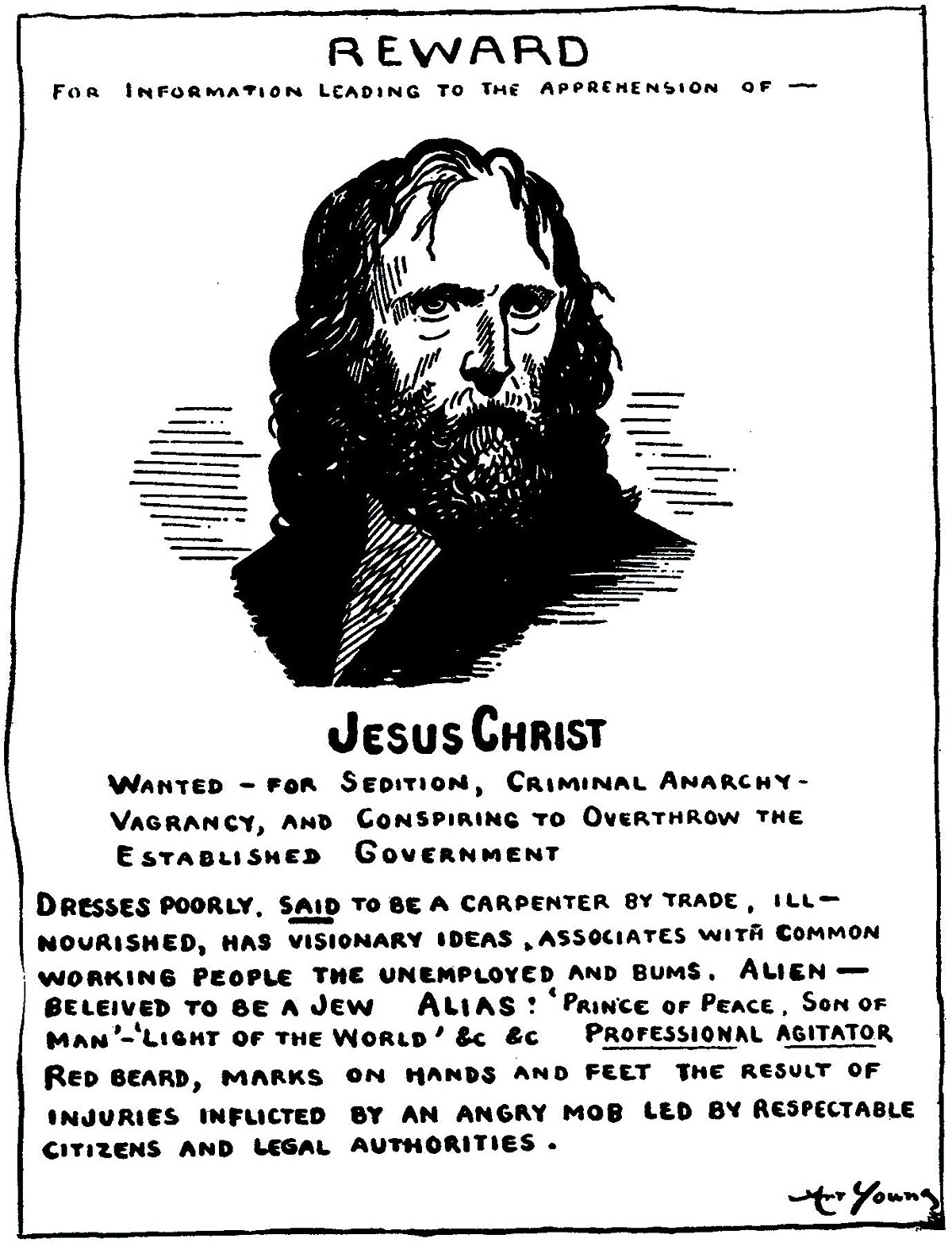
00-art-young-jesus-wanted-poster-he-stirreth-up-the-people-1913

Readings for 4th Sunday in Ordinary Time: Jer. 1: 4-5, 17-19; Ps. 71: 1-6, 15-17; I Cor. 12: 31-13; Lk. 4: 21-30 http://www.usccb.org/bible/readings/020313.cfm

I remember when my ideas about prophecy changed – when I really began to understand the term’s implications. I was a graduate student in Rome – already a priest – and completing my doctoral studies at the Academia Alfonsiana on the Via Merulana there in the “Holy City.” I was taking a class in I’ve forgotten what. But my professor (a German Redemptorist as I recall) got my attention during one of his lectures by referring to Karl Marx as “the last of the great Jewish prophets.” That was in 1970 at the height of the Cold War, and I had been reading Marx and about the then-flourishing Marxist-Christian dialog. I realized that my professor was right.

Marx of course was a Jew like Jesus, and Jeremiah who are centralized in today’s liturgy of the word. Like them, Marx was totally absorbed by questions of social justice for the poor and exploited. He was pretty much penniless, like most prophets, and spent his time thinking, writing, speaking, and organizing workers against exploitive employers. He was also highly critical of organized religion and its idols.

Marx’s insight (shared with the biblical prophets) was to realize that both Judaism and Christianity worshipped idols more often than the God of Israel. And by that he meant “gods” who not only justified an oppressive status quo, but who anesthetized the workers and unemployed to the fact that they were indeed oppressed by the capitalist system. Marx called such idols “the gods of heaven.”

We’re all familiar with what he meant. These idols are worshipped each Sunday – usually from 11:00 to 12:00 in what a theologian friend of mine used to call the “be kind to God hour.” You can encounter the “gods of heaven” any day at any hour on Cable television’s Channel 3 or in most Catholic Churches any Sunday morning. “God” there is concerned with correct worship, with bows, genuflections, and with correct terms such as “consubstantial,” “chalice,” “with thy spirit,” “under my roof” and so on. The stories or mythology upholding such idols have to do with “Jesus as your personal savior,” with “going to heaven,” and with avoiding hell.

Marx was also critical of what he called the “gods of earth.” They’re what people worship all those days and hours when they’re not in church. They include Capitalism, “America,” Nationalism, National Defense, Homeland Security, the Military, Money, and Profit. The issues of this God focus on sexuality: contraception, abortion, and same-sex marriage. This God is a War God – always on the side of “America.” He’s celebrated in songs like “The Battle Hymn of the Republic” and “Proud to Be an American.” He is the protector of “religious freedom” understood as privileging Christianity over other faiths while preserving tax exemptions worth billions each year. He blesses the bishops’ “Fortnight for Freedom” concerned as it is with protecting such benefits.

Marx’s prophetic work made him extremely popular with working classes. It was not uncommon for a worker to request that he be buried with a copy of “The Communist Manifesto” placed on his chest.

At the same time, Marx was vilified as the devil himself by factory owners, businessmen, bankers, and the professors and politicians representing their interests. Defenseless against such “education,” most of us have accepted such defamation of this last of the great Jewish prophets.

You see, that’s the trouble with prophets like Marx, Jesus and Jeremiah. They have to take on the “powers and principalities” of their cultures. They must swim against the torrential stream of public opinion.

In today’s first reading, Jeremiah is informed of his lot. But he must “man-up,” he’s told. He must steel himself to confront the “whole land,” along with kings and princes, priests and people. All of these, he’s warned, will fight against him. Nevertheless, God will make of Jeremiah a ‘fortified city,” a “pillar of iron,” and a “wall of brass.”

I suppose God followed through on those promises. But that didn’t prevent Jeremiah from being imprisoned, tortured, and left for dead.

Of course, the same thing happened to Jesus from the beginning to the end of his public ministry. He was vilified, demonized (literally!) and defamed.

That process begins for Jesus in today’s selection from Chapter 4 of Luke’s gospel. As we saw last week, he returns to his hometown of Nazareth and criticizes his neighbors’ narrow nationalism. In today’s episode his neighbors try to kill him. Later on, of course, Jesus goes more public. Like Jeremiah, he takes on his nation’s priests and scribes, princes and king. Ultimately his words and deeds threaten the Roman Empire itself which classifies him as a terrorist. Together those powers and principalities (national and international) not only defame Jesus the way Jeremiah and Marx were defamed; they actually kill him just as so many prophets have been killed from John the Baptist and Paul to Martin Luther King and Gandhi.

All of them – Jesus, Jeremiah, Gandhi, King, Paul and Marx – followed the same “prophetic script” whose inevitable directive prescribes that no prophet is accepted in her or his native place. It’s easy to see why. It’s because their “native place” bears the brunt of their prophetic words.

Meanwhile, it’s easier for outsiders to recognize prophets. The “outsiders” who concerned Jesus were the uneducated, poor, and unclean. However, even those seem to turn against him this morning. It’s unlikely that there were any rich or powerful resident in Nazareth – a place scripture scholar Ched Myers describes as “Nowheresville.”

Few of us are rich and powerful. Yet we’ve been schooled by those entities to reject prophets who speak in our name and defend our interests – those belonging to our “native land” to use the words of this morning’s gospel. It’s as though we’re looking at reality in that “darkened mirror” Paul wrote about in today’s excerpt from his letter to Corinth. The darkened mirror not only turns things backward, but it’s smudged with the fingerprints and dirt of ignorant and/or perverse propagandists.

The trouble – the trouble with prophets – is that most of us have bought into all that anti-prophet propaganda. So we hate Karl Marx without realizing that he’s on our side and speaks for us. We honor the Martin Luther King who has been reduced to a “dreamer,” but not the MLK who described the United States as the most violent and destructive country in the world. We don’t remember the King who was slandered as a communist and encouraged to commit suicide by the FBI and the COINTELPRO program.

We’re willing to stand by while Wikileaks journalist Julian Assange is persecuted by the governments of Great Britain and the United States. We presume that Bradley Manning is guilty of treason because our government, (despite its record of lies and heinous crimes) says so. We wonder what all the fuss is about Aaron Swartz.

These are the prophets of our time who, like Jesus, do not find a sympathetic hearing in their native place. It might be time to embrace them as our own and see what difference that makes in the way we look at the world and our country. The examples of Jeremiah, Jesus, and Paul — and the hopes of the world’s poor and victims of U.S. wars — beg us to do so.

Jesus as Self-Hating Jew!

Readings for Third Sunday in Ordinary Time: NEH 8; 2-6, 8-10; Ps. 19: 8-10, 15; I Cor. 12: 12-30; Lk. 1:1-4; 4: 14-21 http://www.usccb.org/bible/readings/012713.cfm

Last week I published an editorial on my blog site that was picked up by the Lexington Herald-Leader (http://www.kentucky.com/2013/01/19/2482073/ky-voices-the-chosen-people-are.html) and by OpEdNews (http://www.opednews.com/articles/Unconditional-Support-for-by-Mike-Rivage-Seul-130118-813.html.) It was about Chuck Hegel and the criticism he has endured from the American Israel Public Affairs Committee (AIPAC) and people like Elliot Abrams, the former Undersecretary of State for Human Rights in the Reagan administration.

Hegel had been nominated for Secretary of Defense by President Obama. Abrams and the others had criticized the nominee for being insufficiently supportive of Israel and therefore unfit for the “Sec Def” position. Hegel’s critics were looking for “unconditional support” for Israel, and didn’t find it in President Obama’s candidate. Their criticism was so effective that Hegel has since been forced to apologize for his past criticisms of the Jewish-Zionist Lobby.

Many Christians probably felt vindicated by Hegel’s groveling before his Jewish critics. After all, they might reason, Israel is God’s Chosen People; they deserve unconditional support.

However, today’s liturgy of the word underlines the point I tried to make in my op-ed: the phrase “God’s Chosen People” does not primarily refer to a national entity, but to the poor and oppressed.

Biblically speaking, it is true that Israel did fit that profile at the time of its origin – in Egyptian slavery (13th century B.C.E.) – and later during its captivity in Babylon (6th century B.C.E.). They were oppressed as well as when Israel was under the control of the Assyrians (8th century), Persians (6th century), Greeks (2nd century), and Romans (1st century). Then, precisely as oppressed, they were the object of God’s special love and protection.

At Mt. Zion, Moses enshrined in the law protection of people like them – slaves, widows,orphans, immigrants, the imprisoned, and the poor.

That’s the Law that the scribe, Ezra is recorded as reading to the people for hours in today’s first reading. They had just returned from exile in Babylon. For them “The Law” (the first five books of the Bible) was a source of joy and strength. After all, those books recounted what for Jews was the liberation of all liberations – from Egypt under the leadership of the great rebel hero, Moses. With Ezra in charge, they were celebrating the end of a long and painful experience in the geographical area that is now “Iraq.” Ezra reminded the assembled people that in their return to the Promised Land, they were experiencing Exodus all over again. Indeed, he said, it was a time for celebration – eating rich meats and drinking sweet drinks.

Today’s second and third readings pick up on Ezra’s theme – that God favors the poor and oppressed. However both Jesus and Paul do so emphasizing the point that Yahweh’s favored ones are not always Jews. When Jesus said that in his hometown synagogue, it enraged his former neighbors. (Their response reminds me of Elliot Abrams and the AIPAC demanding “unconditional support” for Israel.)

By the way, did you notice the strangeness of the reading from Luke’s gospel today? It starts out with the very first verses of Luke, verses 1-4. There the evangelist announces his intention – to carefully draw on the oral traditions of eyewitnesses and present an orderly researched account of what Jesus said and did.

But then the reading suddenly jumps ahead to Luke chapter 4 and presents Jesus’ preaching in his hometown synagogue in Nazareth. That gives the impression that Jesus’ first significant act was that Nazareth sermon. Perhaps it was – since Luke’s “infancy narratives” belong more to the realm of poetic imagination than of history.

Today’s reading also leaves out the response of those who heard Jesus’ words in Nazareth. (And that’s where the theme of “chosen people” becomes relevant.) Verses 22-30 tell us that the Nazarenes were outraged by Jesus’ implied criticism of Jews and his openness to non-Jews. After all, he had charged that prophets like Elijah and Elisha found more receptivity to their work in Lebanon (Sidon) and Syria than they found among Jews in Israel.

“Who does this guy think he is?” the Nazarenes asked indignantly. “We know his family; he’s nothing special. Yet here he is speaking critically about his own people! He must be one of those ‘self-hating Jews’.” Luke says Jesus’ hometown citizens were so outraged that they tried to kill him. (Chuck Hegel is in good company!)

Jesus’ words before the Nazarene’s attempted assassination do not merely underline the identity of God’s chosen as the poor and oppressed rather than exclusively the Jews. The words are also central in terms of Luke’s definition of Jesus’ entire project. In fact they connect that project with God’s very identity as described throughout the Jewish Testament particularly by the prophet Isaiah whose words Jesus quotes: “The Spirit of the Lord is upon me, because he has anointed me to bring good news to the poor. He has sent me to proclaim release to the captives and recovery of sight to the blind.”

Did you notice the importance of the word “because?” It absolutely identifies the “Spirit of the Lord” with Ezra’s good news to the poor about release from captivity and recovery of sight? Jesus is saying we know that “The Spirit of the Lord is upon” him because he brings good news to the poor, those in captivity and the blind. Jesus goes on to say that his commitment to the poor is what will define his entire mission. (The implication here is that anyone who brings good news to the poor, those in captivity and the blind embodies the Spirit of God.)

Today’s excerpt from Paul’s letter to the Greeks in Corinth continues that theme of Isaiah, Ezra, and Jesus. Only Paul does so in terms of a familiar yet powerful metaphor – what he calls the “Body of Christ” enlivened by the “One Spirit” of God. For Paul followers of Jesus constitute the way the Master is present today long after Jesus’ death. As that presence, we are Jesus’ hands, feet, eyes, ears, and tongue. And Paul specifically says it makes no difference whether one is Jew or Greek, slave or free, male or female.

What does make a difference though is one’s social standing. Paul goes out of his way to say that the “less honorable” and the “less presentable” in Christ’s body are to be more honored and cared for than the more presentable and more honorable according to the standards of the world. The weaker parts, he says are somehow “more necessary” than the stronger parts. This could hardly be a clearer reference to the poor and those who are normally neglected and looked down upon. Here Paul is following the thrust of Jesus’ words and deeds by turning the social order upside-down. The poor and oppressed come first in God’s order.

Today’s readings are calling us to grow out of our nationalism that understands Jews or Americans as God’s favorites. They call us to become citizens of the world – or in Jesus’ words to be cured of our blindness.

He wants us to finally see, the readings suggest, that the Jews as such are not God’s people. Neither are Americans. In God’s eyes, (despite the protests of our politicians and talking heads) our country is not the greatest in the world. For in the body of Christ there is neither Jew nor Greek, American, Afghani, Iraqi or Cuban.

Instead, true followers of Christ recognize that our allegiance belongs to the Body of Christ. This means that our care should be showered on the widows, orphans, undocumented immigrants, beggars, and social outcasts – LGBTQs, victims of AIDS, mothers on welfare, and on Mother Earth herself. These are the poor and oppressed. These are God’s people.

Our presence at this Eucharist represents our pledge to put the needs of those groups and individuals before our own.

Given the numbers of those who claim to be Christian, if we followed through on that pledge, how drastically different our world would be! Don’t you agree?

Returning Home by “Another Way” (Not Herod’s or the Priests’)

Readings for Epiphany Sunday: Is. 60:1-6; Ps. 72: 1-2, 7-8, 10-11, 12-13; Eph. 3:2-3a, 5-6; Mt. 2: 1-12 http://www.usccb.org/bible/readings/010613.cfm

Today we celebrate the feast of Epiphany. The word epiphany means the appearance or manifestation of God. Today’s feast recalls the time when wise men from the East traveled through Palestine seeking the long-awaited manifestation of God announced in today’s reading from the prophet Isaiah. He and today’s responsorial Psalm 72 tell us a great deal about that God. S/he’s not what small-minded believers expected or even wanted.

That’s why Herod “and all Jerusalem with him” were “troubled” when they unexpectedly met the travelers who were seeking a manifestation of the universal God that Isaiah had foreseen. The God Herod and the Jerusalem establishment knew and loved was nationalistic favoring Jews, the Hebrew language, and the Holy Land. He was pleased by Jewish customs and worship marked by animal sacrifice and lots of blood. So the nationalists were “troubled” when the universalists came seeking the Palestinian address of a newborn king transcending boundaries of all kinds. The wise men claimed that the very cosmos (the Star!) had revealed God’s Self to them even though they were not Jews. Evidently, they realized God not only transcended themselves and their countries, but planet earth itself. All creation somehow spoke of God to everyone who would listen.

The prophet Isaiah, Psalm 72, and Paul’s letter to the Ephesians agree with the wise men. All of them speak of a Divine Being who is universal, not belonging to a particular nation or religion. Recall what today’s reading said: This God is recognizable and intelligible to all nations regardless of their language or culture. The Divine One brings light to the thick darkness which causes us to limit God to privileged nations, races, and classes. The universal God brings peace and justice and champions of the poor, oppressed, lowly and afflicted. The newly manifested deity leads the rich (like the three kings) to redistribute their wealth to the poor (like Jesus and his peasant parents). This God wants all to have their fair share.

Matthew’s story says that Jesus manifested such a God. Jesus was the complete revelation of the God of peace and social justice – a world-centered, a cosmic-centered God.

Herod’s and Jerusalem’s response? Kill him! A universal God like that threatened Jerusalem’s Temple and priesthood. The Epiphany meant that such a God was not to be found there exclusively. This God would not be tied down to time or place. What then would become of priestly status, temple treasure, the Jerusalem tourism industry?
Epiphany also threatened Herod’s position. Recognizing a divinity who led the rich to transfer their treasure to the poor threatened class divisions too. A God on the side of the poor would embolden the lazy and unclean to rebel against those who used religion to keep the under-classes in line and resigned to their lot in life.

No, for Herod and his allies there could only be one solution: ignore the Star’s cosmic message, present a friendly ecumenical face to these stupid foreigners, derive the crucial information from them, and then kill off as many impoverished babies as possible hoping in the process to stop God’s threatening, unacceptable Self-disclosure.

Symbolically (and lamentably), Herod’s and Jerusalem’s response to the “troubling” universalist consciousness of the Eastern wise men mirrors that of our culture and church. Both keep us at the stage of childish ego-centrism – or at best, at the stage of nationalism, which makes us see the other and the other’s understanding of God as somehow foreign and threatening. Both culture and faith prevent us from growing up. Ironically, that’s a kind of infanticide. It’s a form of psychological murder that freezes us at immature stages of consciousness and so prevents us from developing along the lines celebrated in today’s feast of Epiphany.

Epiphany calls us to wake up – to grow up and to return home as the Magi did “by another way” that was not the way of nationalism, wealth, power-over or cooperation with kings, priests and empire.

The Dysfunctional Holy Family

Readings for Holy Family Sunday: Sir. 3: 2-6, 12-14; Ps. 128: 1-5; Col. 3: 12-21; Lk. 2: 41-52 http://usccb.org/bible/readings/123012.cfm

Today is the feast of the Holy Family. We’re used to thinking of it as a cozy group of 3, Jesus, Mary and Joseph living in ideal circumstances, the way we picture them in our nativity crib scenes. Or we imagine Jesus’ early life as we find it depicted in medieval paintings of the carpenter Joseph’s workshop. There we often find a loving haloed and elderly foster-father instructing Jesus in his trade while Mary smiles in the background.

However, if we take seriously the “infancy narratives” coming from Matthew and Luke, we must draw the conclusion that Jesus’ home life was more complicated than that. You might even say that it was “troubled” right from the beginning. So for the moment, let’s suspend disbelief surrounding the historicity of the narratives about Jesus’ early years. Let’s try instead to unpack the stories at face value. Doing so, I think, shows them to be quite relevant to our own experiences – especially to that of our family dysfunctions and to our own experiences of being no one, without face, identity, or power before the world’s problems.

To begin with, think about Jesus’ family, the focus of today’s liturgy of the word.  It wasn’t perfect. The holy family was larger than we’re accustomed to imagine. Joseph and Mary probably had 7 or 8 children. According to the gospels, Jesus’ brothers’ names were James, Joseph, Judas, and Simon. Jesus is also said to have had at least 2 unnamed sisters. On the one hand, a large family like that would have been helpful to peasant farmers, if Mary and Joseph had any land. On the other hand, a family of 9 or 10 people would have been hard to maintain for rural peasants living in a backwater like Nazareth. It is likely then that hunger and struggling to make ends meet was a major part of Jesus’ early experience.

Jesus’ country was also war-torn at the time when he was born, and that certainly impacted his family. At approximately the moment of his conception, the Romans had razed the city of Sepphoris, located just an hour’s walk from Nazareth. Sepphoris was the capital of Galilee where Nazareth was located. Galilee was a hotbed of resistance to Rome’s occupation of Palestine. And a rebellion had erupted in Sepphoris about the year 4 BCE. That meant that the countryside would have been crawling with Roman soldiers at the time of Jesus’ conception. Inevitably, many young Jewish girls would have been raped by the occupying forces. Some see that fact as lending credence to an anti-Christian tradition claiming that Jesus was the product of rape of Jesus’ mother, Mary by a Roman soldier called Panthera.

In any case, Mary’s out-of-wedlock pregnancy would have raised many eyebrows in the rural village of Nazareth. Town gossips would have snickered and talked behind their hands about the young girl’s “virginal conception.” We know for certain that Mary’s mysterious pregnancy put Joseph in crisis. According to tradition, he suspected she had been unfaithful and thought her condition reason enough to break off their engagement. We also know that Mary chose to leave town “in haste” and travel to the hill country of Judah to her Cousin Elizabeth’s home – possibly to get some distance from small village talk.

Once that problem was resolved, the holy family’s troubles continued.  There was the matter of Jesus’ homelessness at the time of his birth. For the occasion, Joseph and Mary had to make do with a filthy stable with all of its animal droppings, noises, smells, vermin, rodents and cold.

And things got worse after that. The story goes that the local king Herod ordered an infanticide of all children under the age of 2 in the area surrounding the place of Jesus’ birth.  For Mary and Joseph, avoiding such unspeakable violence meant fleeing to Egypt in the middle of the night. It also meant trying to survive as immigrants in that far-off country – not speaking the language or knowing the customs, or feeling at home among those prejudiced against foreigners.

Once back in Palestine, things apparently settled down. However, the episode in today’s gospel reveals tension in the holy family that will resurface later in the gospels.

“The Finding in the Temple” is a coming of age story. At the age of 13, all Jewish boys would accompany their parents for the first time as a “genuine Israelite.” Each would then become a man, “one who goes up to the temple.” In Jesus’ time, the 13th year was anticipated by a year as a kind of preparation for the “big step” into adulthood.  Coming from a place like Nazareth, the boy from the country would have been dazzled by the splendor of the Temple with its colonnades, precious woods, unending polished steps, gold and silver candelabra. It would have been easy for him to wander away with other boys and become lost in it all.

His parents find him, we are told, easily conversing with learned men from the city whose manners, accents and clothing would have been intimidating to Jesus’ simple parents. And yet here was the country boy Jesus astounding the city people with the incisiveness of his questions and the wisdom of his answers. No doubt, the rural parents waited till they were out of earshot of their “betters” till they gave Jesus the dressing down they thought he deserved. The scolding may have lasted the entire three-day journey back to Nazareth.

His parents, we’re told in this morning’s reading, did not understand their son. We find out later on that the lack of understanding continued. At one point in Mark’s gospel, his mother and his siblings are described as thinking Jesus was out of his mind (Mk. 3: 34-35). This led to a formal estrangement between Jesus and his family. He more or less disowned them. When Jesus was told that his family has come to rescue him from his madness, he said in effect, “My mother – my family? That’s not who those people are. Instead, you (the outcasts, beggars, insurrectionists, prostitutes, unemployed, and ne’er do wells, who were his companions) – you are my real family, my real people.”

And yet today’s gospel concludes that Jesus went back to Nazareth with them. He advanced, Luke tells us in age and wisdom and grace before God and his neighbors. And that’s it. We hear no more about him for 20 years or so. He disappears. He becomes nobody.

And that brings me to the other part of today’s reflection – being a nobody. What does Jesus’ disappearance, his “hidden life,” tell us about the human condition?  According to our faith, Jesus was the full embodiment of God. Presumably, then, he had infinite power at his disposal. His world was as filled with problems as ours. There was Roman imperialism and the occupation of Palestine with its brutality, torture, rape, exploitation and oppression. There was political corruption among Jesus’ own people as the leaders of his time climbed into bed with the Romans. There was extreme poverty alongside obscene wealth. There was religious corruption. There was disease and ignorance.  And yet as far as the record is concerned, this embodiment of God did nothing.  For 97% of his life, Jesus did absolutely nothing!

Why? Do you think it might have been because, like us, he could do nothing significant about all those problems? And even when around the age of 30 he did finally emerge as a more or less public figure, what did he really do? He spoke some inspiring words, healed a few people, and worked some miracles that his contemporaries dismissed as parlor tricks. He provoked the authorities in a temple demonstration for religious purity and social justice, was arrested, tortured and executed as an insurrectionist.  That was pretty much it as far as his “public life” was concerned. Afterwards, the world pretty much continued as it had before his arrival.

I somehow find comfort in both Jesus’ family dysfunctions and in his “nobodiness.”  None of our families are perfect. Unexpected pregnancies, suspicions and jealousies dividing couples, financial struggles, problems with neighbors and gossip, displacement, lost and alienated children – it all seems about par for the course. I’m not even sure that Mary and Joseph didn’t wonder at times where they went wrong. There was a lot for them to process in their pillow talk as they saw their son hanging out with the wrong crowd, apparently losing his faith, and then getting into political problems they didn’t understand. My God, he finally ended up on death row! The black sheep of the family . . . .

And then there are our own little lives and their apparent lack of meaning. In the end, we’re nobodies, all of us. That’s what death makes apparent as we lose our physical form and minds and all that we worked for. We’re nobodies.  Few will remember us or think of us after we’re gone. We’re born, get married, have children, buy and sell a few items, and then die. And what became of all our hopes and dreams? What does it all mean?

Does it mean that it’s all O.K.; it’s all good? Does it mean “that’s life” – what it’s about? In fact, our vocation is to be precisely nobody instead of constantly striving to be Somebody. In the end, death discloses the truth about our vocation. It is the same as Jesus’ vocation. And that is to be open, faceless channels that disclose the presence of God in our very ordinary lives with their family dysfunctions and personal failures. It is to rise above such limitations or rather to use them to express the unbounded love of an apparently powerless God to those around us – especially to our family members who might not even understand.

Homily for the Fourth Sunday of Advent Based on Lk. 1:24-39 (?)

(For this week’s homily, I’ve invited my good friend and resigned priest, John Capillo to share his thoughts. In his formal priestly days John worked in the archdiocese of Brooklyn in New York, and in El Salvador. A prophet and  father of  four grown children, John has spent his informal priestly days in public service — most notably working for the Kentucky Environmental Foundation. He is a wonderful teacher, and has often visited my classes and those of my bride, Peggy. I know you will love his words below.)

Mary set out
and traveled to the hill country in haste
to a town of Judah,
where she entered the house of Zechariah
and greeted Elizabeth.

Recall the previous scene in Luke.  Who is this Mary who sets off?  What is her state of mind?

She has been greeted by the angel Gabriel

who tells her that she is favored,

and that the LORD is with her.

She is troubled.

Let’s let her talk.


“What does it mean that the LORD is with  me?

I do not understand the greeting,

What do you mean I am favored?”

And the angel’s lines:

“Don’t be afraid,

you are not alone,

you are loved.

And I want to tell you something,

Sit down.

Breathe deeply,

Stay calm

Remember.   You are loved.”


And then the bomb shell,

blowing up all plans and status and expectations:

“You are to conceive and give birth to a son who will be great,

the Son of the Most High

A king like David,

who will reign forever.”


“Whoa.  Back up a bit. Let me think this through.

You are saying that I am favored and I am going to become pregnant?

But I am only betrothed to Joseph and if I am judged to be pregnant out of wedlock I can be stoned.

Am I hearing you correctly?

And I am to have a son who will be a king like David, complete with sword and shield, going off to war?

And he will reign over the House of Judah which is now reigned over by the Romans, and contested by the Zealots?

And who did you say you were, a messenger from God?

Maybe I am nuts, seeing visions, hearing voices.”


And in an understatement that lives with lack of understanding, she says,

“How can this be?

You gotta be kidding?

Do you know who you are talking to?

I am a young girl who does not even have a husband, and in this world that is no small potatoes.”


But the story goes on.

The angel says,

“Oh, I did not tell you how this is going to work, how you are going to explain this to

to your mother who raised you to be a good girl

to your father, who has this betrothal deal with Joseph,

to Joseph, who is expecting a wife who is a virgin,

to the priests who will be ready to stone you,

to the governor, who will see your son as a pretender to the throne,

and to the Empire, that now rules and with an iron fist.

Just tell them that the Holy Spirit has come upon you, and the power of the MOST high will over shadowed you, and your son will be the Son of GOD.’


And Mary’s response?

‘Wow! You are not kidding around.  This is the whole enchilada.  And you think that I can pull this off.

And the only explanation that I get is that the Holy Spirit will come upon me and the power of the most high will overshadow me.

And you are waiting for an answer?

OK,

I accept.

I hope my mother understands that I made this decision because I had a vision and heard voices

I will hope my father is not ripping mad.

I hope that Joseph will still have me,

God knows what I will do about the governor and the Empire

and I will deal with this kingship thing and swords and overthrowing when the time comes.

Are you sure that you understand that you are dealing with a little poor kid from the wrong side of the tracks of a runt of a city in no-where’s-ville. I am not trying to give you any lip about this, but just to let you know.

But if you are for real, I am game.  I suppose you will get back to me about the details.

Oh and you say Elizabeth is pregnant, old barren Elizabeth. And that because nothing is impossible with God,

I gotta get up there and talk to her about all this.”


And so we start today’s episode.


Mary goes right away to Elizabeth’s.  It is a woman thing.

And Elizabeth is all excited,

filled with the Holy Spirit.

And her baby is jumping up and down,

gleefully,

in her womb.

And Elizabeth says,

all excited,

full of anima,

speaking like one possessed,

“Blessed are you who believed,

you who took the promptings as real,

who trusted her intuition,

who trusted her muse, her logos, her inner voice.

What a joy it is to know that you are willing to take what you heard out for a spin;

willing to step off the edge

to go with the flow

to glide in the air

to dance in the back room,

to put aside the fearfulness that her mother has,

to defy the anger that her father has ,

to test the love that Joseph has,

to stand up to the priests, the governor, the Empire

all because you saw a vision and heard voices.

You are one special person, and one great friend.

Give me a hug, squirt.”


That’s the miracle.  That’s the call. We are up to it, aren’t we?

John the Baptist’s Desert Revival and Pope John XXIII’s Aggiornamento

Third Sunday of Advent Readings: Zep. 3: 4-18a; Is. 12: 2-6; Phil. 4: 4-7; Lk. 3: 10-18.  http://www.usccb.org/bible/readings/121612.cfm

The lead article in the November 11th edition of our diocesan newspaper, Crossroads, published a sermon by the bishop of our Lexington diocese, Ronald W. Gainer. It had been given on Saturday November 3rd at the Cathedral of Christ the King in Lexington – the Saturday before the General Election. Bishop Gainer called attention to a new and “dangerous, corrosive change . . . at work in the soul of our nation.”  “In recent decades,” the bishop said, “forces are working overtime . . . to eliminate religion and God from the nation’s soul.” According to Bishop Gainer, those forces ignore the consistency of the Church’s moral teaching over the centuries – about “the sacredness of every human life.” Those teachings recognize certain acts as “intrinsically evil.” These include “abortion, euthanasia, assisted suicide and embryonic stem cell research. Being against the intrinsically evil means standing up for the sanctity of marriage between one man and one woman, the God-given right to freedom of religion, and against the evil of racism. There is nothing wrong with being a single-issue voter, the bishop emphasized; and abortion is the pivotal single issue for Catholics. The bishop concluded that political “candidates who refuse to oppose the evils he listed or who actively support them disqualify themselves from receiving Catholics’ support in the voting booth.”

Curiously, Bishop Gainer’s list of “intrinsic evils” did not include priests raping children. As a result, his remarks came off as out-of-touch, triumphalistic, self-serving, dishonest, and tired. We had heard it all before: “They’re wrong; we have never erred. ‘They’ are persecuting us. Only one issue is important, abortion. Vote Republican, even if that means economic disaster for the poor at home or abroad” (e.g., in the wars and drone strikes which also went unmentioned in the bishop’s remarks).

______

A little over a month ago, I attended the concluding Mass at the “Call to Action Conference” (CTA) in the Grand Ballroom of the Galt House in Louisville, Kentucky. CTA is the annual meeting of progressive Catholics who are trying to follow the spirit of the Second Vatican Council. (Vatican II set an agenda of church renewal and reform when the world’s Catholic bishops met in Rome from 1962-1965.) About 1000 people were present at CTA’s concluding liturgy. It reminded me of what spirited worship is like. Our good friend, John Wright Rios was the music leader with a group he assembled of about 15 instrumentalists and singers. There were drums, guitars, piano, trumpet and dancing. Hymns were in English and in Spanish with words projected on four large flat screens. The liturgy featured women in prominent roles, including three of the five concelebrants. Sister Simone Campbell of “Nuns on the bus” fame and who had spoken at last summer’s Democratic Convention gave the homily. What she said was insightful, inspiring, funny, and challenging. It made me see what the church is missing by insisting on an all-male, highly in-bred clergy. Sister Campbell spoke of the deep-seated divisions in our country and the need for universal love even of our enemies. She addressed the spiritual poverty and hunger experienced by all of us including leaders in the church, in politics, in our schools and universities. Poverty and hunger of body and spirit was the focus of Jesus’ work as described in the gospels. The church needs more Jesus, she said, and less triumphalism and pride.

______

Today’s readings are about religious revival and about the renewed recognition of God’s presence in our midst. In the first and third reading, the message is delivered by severe critics of temple worship – Zephaniah and John the Baptist. Zephaniah was a religious reformer from the seventh century BCE (just before the Babylonian Exile). He was known as the champion of “the poor of the land” (2:3; 3:12), and a fierce critic of Assyrian imperialism and the adoption of Assyrian religious ideology by Israel’s ruling elite. He accused the priests of his day of abandoning Yahweh in favor of Baal and Astarte. The outspoken Zephaniah threatened to drive out the priests and cleanse the temple by force.

Then in today’s gospel, John the Baptist picks up Zephaniah’s theme more than five hundred years later. Luke pictures John at the Jordan River – far from Jerusalem’s temple and its priesthood. John is leading a religious revival in the desert – the place of Israel’s birth long before there was any temple. Like Zephaniah, John is a layman. And his words to the religious leadership are harsh. In Luke’s verses immediately preceding today’s excerpt, he calls the crowd a “brood of vipers.” Matthew’s version is more specific. He says that curse was hurled at the Sadducees and Pharisees, the religious leadership of the day. According to John, they are snakes in the grass.

John contrasts the failed leadership of these men with God’s leadership present in the person of Jesus of Nazareth. Jesus, of course, turns out not to be a priest or rabbi either, but a workingman from Nazareth. Yet according to John, Jesus is more powerful and more worthy than John himself. As a lay leader, Jesus will bring not only the Holy Spirit, but a cleansing fire. He will separate the wheat from the chaff – what is essential from what is not – what is nourishing from what is not – the kernel of truth from its encasements. Those shells are now outdated, John says. We are about to enter a new era. Chaff, John declares, is good for nothing but burning in the hottest fire imaginable. He calls the crowds to the kernel of truth: share their surplus with the poor.

This year we celebrate the fiftieth anniversary of the Second Vatican Council.  It was a movement of reform and revival in the spirit of Zephaniah and John the Baptist. Pope John XXIII was the 1960s embodiment of their prophetic tradition. He summoned that meeting of the world’s bishops and used the word aggiornamento to describe the Council’s project. Aggiornamento meant updating.

Pope John’s vision was one of church revival and reform that connected Jesus with the actual lives and problems of people and the world – especially the poor. Those lives are characterized by either unemployment or overwork, by low wages, poverty, over-priced healthcare, misogyny, racism, inaccessible education, scant prospect of retirement, and by the train of evils introduced by climate change, inflated “defense” budgets and wars largely initiated by the United States.

Today’s readings suggest that serving the world (the church’s mission as identified by Vatican II) involves addressing those problems – the kernel instead of the chaff. Doing so leaves no place for triumphalism, infallibility or wallowing in self-pity about how the church is being mistreated and misunderstood by a hostile world. It does however mean trying to address the very good reasons the world might have for being hostile.

Neither is service of the world advanced by focusing on matters (as important as they might be) far removed from daily life. Identifying Christianity with opposition to stem cell research, gay marriage, contraception, and revoking Roe v. Wade is old and tired. It’s a form of denial that distracts from Jesus’ essential concern for the poor and their problems. It is to mistake chaff for wheat. So is silence about the church’s checkered past, its fallibility, errors, crimes against humanity, and scandals as prominent as priests’ rape of children.

“Call to Action”  attempts to recapture the spirit of Vatican II, separate wheat from chaff, and address the “signs of the times.” The “prayers of the faithful” following Sr. Campbell’s homily addressed war, poverty, climate change and the other problems I’ve just mentioned. The response of the people was not the usual “Lord, hear our prayer,” but “Aggiornamento!”

Let that be our response to Zephaniah, John the Baptist, and Jesus today. Aggiornamento!

What might aggiornamento mean for us today?

(Discussion follows)

Urinating on Corpses and Burning Holy Books

Readings for 33rd Sunday in Ordinary Time : Dn. 12: 1-3; Ps. 16:5, 8-11; Heb. 10:11-14; Mk. 13:24-3 http://usccb.org/bible/readings/111812.cfm

In January of this year six U.S. soldiers had themselves videotaped while they urinated on Taliban corpses in Afghanistan. In a separate incident three other soldiers started widespread riots after they publicly burned copies of the Holy Koran. Then in September the posting of an on-line film depicting the Prophet Mohammed as a deviant terrorist was blamed for other anti-US protests throughout the Muslim world costing the lives of a U.S. ambassador and three staff workers.

_____

In the year 168 C.E., the Greek emperor, Antiochus IV Epiphanes  invaded Palestine and devastated Jerusalem. He hated Judaism and defiled the Jerusalem Temple by offering a pig on its altar. He also erected an altar to Jupiter in the Temple.  Patriotic Jews called it “the abomination of desolation.” While occupying Palestine, Antiochus also destroyed all the copies of Scripture he could find, and made it a capital offense to possess such manuscripts. It was against Antiochus IV and the Greek occupation of Palestine that the Bible’s Book of Daniel (excerpted in today’s first reading) was written.

­_____

On September 8th of the year 70 of the Common Era, after a six-month siege, the Roman Emperor Titus, with four Roman legions finally captured the city of Jerusalem from its Zealot defenders. Moving from house to house, the Romans destroyed everything within reach, including the City’s Temple. Palestine would not again belong to the Jews until 1947. It was the destruction of Jerusalem by the Romans that Jesus predicts in today’s Gospel excerpt from Mark.

_____

Today’s liturgy of the word is shaped by apocalyptical writings – from the Book of Daniel in the first instance, and from Mark, chapter 13 in the second. The writings speak of wars and rumors of wars, of unprecedented suffering for all of humankind, of false messiahs and false prophets, and of the “Son of Man” coming on clouds of glory to render a final judgment.

Most of us think of such writing as describing the end of the world. And why not? That thinking is fostered and exploited by a whole industry of evangelical preachers like John Hagee who appear regularly on our television screens. The approach is foundational to the publishing success of the Left Behind series of books by Tim LaHaye and Jerry B. Jenkins.

A unifying thread throughout all such understandings of apocalypse is their idea of God, who turns out to be a pathological killer. That is, the mayhem and disaster depicted in apocalypse becomes something God does to the world and the human race to bring history to a close. According to the preachers and books I’ve just mentioned, apocalypse describes a final battle between Good and Evil. The battle will be fought in the Middle East on the Plain of Armageddon. Two billion people will die as a result – including 2/3 of the Jewish people.  The remaining 1/3 will be converted to Christianity because God’s final violent revelation will be so awe-inspiring and convincing. A “Rapture” will then occur, taking all faithful followers of Christ into heaven, while leaving behind the rest of humanity for a period of “tribulation.” In all of this, God is the principal actor. As an angry father, he is finally taking his revenge for the disobedience and lack of faith of his ungrateful children – whom he loves!

Problem is: all of that is dead wrong and blasphemous in  terms of the God of love revealed by Jesus. The Rapture story, for instance, appeared for the first time only in the 19th century. In fact, apocalypse is not about the end of the world. It is about the end of empire – the Greek Empire of Antiochus IV Epiphanes in the case of Daniel, and the Roman Empire in the case of Mark. The mayhem and unprecedented suffering referenced in both readings is not something God does to the world, but what empire routinely does to people, their bodies, souls and spirits, as well as to the natural environment.

Because it has ever been so with empire, today’s excerpt from Mark calls for a complete end to the politics of violence and domination. That meant obeying the command of Jesus to reject empire, but also to refuse alignment with Zealot nationalists. As the Romans under Titus approached Jerusalem between 66 and 70, Zealot recruiters traveled throughout Palestine calling on Jewish patriots to defend their homeland by joining guerrilla forces. Jesus’ counsel instead was for his followers to flee to the mountains (Mark 13:14-16). They were to do so not out of cowardice, but from apocalyptic conviction that God’s order of justice could not be established by the sword. Obeying Jesus’ direction meant that Christians were not only threatened by Romans but by Jews who accused Jesus’ followers of treason.

How should those readings affect us today whose Commanders-in-Chief repeat the crimes of the Seleucid Antiochus IV and the Roman Titus – both of whom thought of themselves as doing God’s work in destroying what they despised as a superstitious, primitive, tribal, and terrorist religion? (Yes, that’s what they thought of Judaism!) How should the readings affect us whose soldiers destroy holy sites, burn holy books and desecrate corpses just as their Roman counterparts did?

Today’s readings recommend that we adopt an apocalyptic vision. That means refusing to defend the present order and allowing it to collapse. It means total rejection of U.S. imperial ambitions and practices. It means refusing to treat as heroes those who advance the policies of destruction and desecration inevitably intertwined with imperial ambition. It means letting go of the privileges and way of life that depends on foreign conquest and vilification as “terrorists” of patriots defending their countries from invasion by U.S. forces. It means determining what all of that might signify in terms of our consumption patterns and lifestyles, and supporting one another in the counter-cultural decisions such brainstorming will evoke.

So in a sense, apocalypse is about the end of the world. The entire Jewish universe was anchored in the temple. Its defilement by the Greek Antiochus IV, its complete destruction by the Roman Titus seemed like the end of the world to the Jews. The threat of westernizing the Arab world might seem that way to the occupied Muslim world today.  And the end of the American Way of Life premised on resource wars under cover of a “war on terrorism” might strike us as the end of everything we hold dear.

However, the apocalyptic message of hope is that the passage of empire and nationalism is not really the end. Instead it represents an opportunity for a new beginning. In the words Mark put in Jesus’ mouth this morning, “Do not be alarmed . . . This is but the beginning of the birth-pangs.”

How might we support one another in letting go of imperialism, nationalism and the lifestyles dependent on them?

(Discussion follows)

“Widow’s Mite” or “Don’t Put That Money in the Collection Plate!”

Readings for 32nd Sunday in Ordinary Time: IKgs. 17: 10-16; Ps. 146:7-10; Heb. 9: 24-28; Mk. 12: 38-44 http://www.usccb.org/bible/readings/111112.cfm

In the election season just passed, some politicians were pushing for a “flat tax.” They called attention to the “unfairness” of a tax system which has rich people paying more than everyone else. The asked, why not tax everyone the same?  That would be fair. Today’s gospel reading says something about that idea of fairness.

_____

About a month ago, the great theologian and spiritual teacher, Matthew Fox, passed through our town in Berea, Kentucky. Matt is an ex-Dominican priest who was forced by Pope Benedict XVI to leave the Dominicans and to cease publishing. Fox’s crime, like that of more than a hundred theologians in the past twenty years, was being too energetic in teasing out the implications of the Second Vatican Council for the world we actually live in. According to Matthew Fox, the anti-Vatican II stance of present church leadership places the present pope (and the one who preceded him) in schism. It’s the duty of Catholics, Fox says, to withhold financial support from the church until popes and bishops once again embrace the official teaching of the church, which remains the doctrine of Vatican II. Today’s gospel reading also says something about that.

_____

The gospel reading just referred to is the familiar story of “The Widow’s Mite.” Jesus and his friends are visiting Jerusalem for the Passover Feast during the final week of his life. They are in the Temple. On the previous day, they had all taken part in (and perhaps led) a demonstration there against the temple priesthood and its thievery from the poor. I’m talking about Jesus’ famous “cleansing of the temple.” Soon the temple priesthood and scribal establishment will offer a reward of thirty pieces of silver for information leading to Jesus’ arrest. Judas will soon find himself seriously considering collecting that reward.

In the meantime, Jesus continues instructing his disciples on the corruption of the Temple System. In the episode before us, he takes a position, Mark says, “opposite” the temple treasury. The treasury was the place where Jews paid the tithe required by the law as interpreted by the priesthood Jesus despises. It was a “flat tax” applying the same to rich and poor.

Ever class-conscious, Mark points out that “many rich people” somehow made it clear to all that they were putting in large sums. Then a poor widow came along and furtively put in a penny. Jesus calls attention to the contrast: “large sums” vs. “two small copper coins, which are worth a penny.”

“It’s all relative,” Jesus says.  “Truly I tell you, this poor widow has put in more than all those who are contributing to the treasury. For all of them have contributed out of their abundance; but she out of her poverty has put in everything she had, all she had to live on.” Jesus then leaves the temple in disgust.

There are two ways for homilists to explain this incident in the context of today’s Liturgy of the Word. Remember, it began with a reading from I Kings and its story of the great prophet Elijah and the widow of Zarephath.

Elijah was hungry. He encountered a single mom gathering sticks to make a fire to eat her last meal with her son. They were starving, and she had only a handful of flour and a few drops of oil to make some bread before she and her son would die of hunger. The prophet asks that instead she make him some food. Obediently, she does so. And strange to say, after feeding Elijah, the widow discovers that her flour and oil never run out. She somehow has an endless supply. She and her son are saved.

Then in today’s second reading, Jesus is contrasted with the temple priesthood. The temple priests, the author of Hebrews says, were required to repeatedly offer sacrifices in the Temple year after year. In contrast, Jesus entered the heavenly “Holy of Holies” but once, offering there not the blood of bulls and lambs, but his own blood. Jesus is the true high priest.

The standard way of treating these readings would run like this: (1) The widow of Zarephath gave the Holy Man all she had to live on and was materially rewarded as a result; (2) the widow in the Temple donated to the temple priests “all she had to live on” and was rewarded with Jesus’ praise; (3) follow the examples of the widow feeding Elijah and the widow giving her “mite;” (4) donate generously to your priest (a successor of the Great High Priest in Hebrews) and you will be richly rewarded either here, in heaven, or in both places.

That’s a standard treatment we have all heard. However, it has severe problems. To begin with, it ignores the liturgical response to the Elijah story taken from Psalm 146. That excerpt from Psalms sets a back-drop for the entire Liturgy of the Word and provides a key for interpreting not only today’s readings, but the entire Bible. The psalm reminds us that the poor are God’s Chosen People. God’s concern for the poor is not with their generosity towards God but with God’s securing justice for them. As the psalm says, God gives food to the hungry, sets captives free, gives sight to the blind, protects immigrants, and sustains the children of single moms. God loves those concerned with justice for the poor, the Psalm says. God loves prophets like Elijah and Jesus. On the other hand, God thwarts the ways of the wicked – those who, like the scribes and high priests, exploit God’s favored poor.

All of that represents a “red thread” running through the entire Judeo-Christian tradition. It offers us a key for interpreting the story of Elijah as well. It changes the emphasis of the story from the widow’s generosity, to God’s provision of food for the hungry and God’s concern for the children of single mothers.

With that key in mind, we are alerted to circumstances in today’s gospel story that summon us to interpret it differently from the standard treatment.

We are reminded that the episode takes place in an elaborate context of Jesus’ assault on the temple system. In effect, the context is Jesus’ symbolic destruction of the temple itself. Yes, there was that “cleansing” I referenced. But there was also Jesus’ prediction of the deconstruction of the building itself. “Not one stone will be left here upon another; all will be thrown down” (13:1-2). Then there was that strange incident of Jesus cursing a fruitless fig tree as he was entering the temple precincts (11:12-14; 20-24).  The fig tree was the symbol of Israel. Here again Jesus pronounces a judgment on an entire system that had become corrupt and forgetful of the poor who are so central to God’s concern.

That judgment is extended in Jesus’ teaching immediately before the episode of the widow’s mite.  Again, Jesus takes a position “opposed” to the temple treasury and says, “Beware of the scribes . . . They devour widows’ houses and for the sake of appearance say long prayers.” As scripture scholar, Ched Myers points out, Jesus was probably referring to the practice of turning over to scribes the estates of deceased husbands. The surviving wives were considered incapable of administering a man’s affairs. For his troubles, the scribe-trustee was given a percentage of the estate. Understandably fraud and embezzlement were common. In this way, religion masked thievery from society’s most vulnerable.

With Jesus’ accusation ringing in their ears, a case-in-point, a poor widow, arrives on the scene. She pays her tithe – the flat tax – and leaves penniless. Jesus can take no more. He leaves the temple in disgust.

According to this second interpretation, Jesus is not praising the generosity of the widow. Instead, he is condemning the scribes, the priests, the temple and their system of flat taxation. Jesus’ words about the widow represent the culminating point in his unrelenting campaign against hypocrisy and exploitation of the poor by the religious and political leadership of his day.

We would do well to keep today’s gospel in mind when evaluating “Christian” politicians calling for a “flat tax” in the name of the “fairness” of taxing everyone at the same rate.

We would do well to keep today’s gospel in mind – and the example and words of Matthew Fox –  when the collection plate passes in front of us on Sunday or when our pre-Vatican II priest urges us to follow the example he finds in the story of the widow’s mite.