Jesus Is Cutting Your Lawn! (Sunday Homily)

immigrant-jesus

Readings for 18th Sunday in Ordinary Time: Wis. 18: 6-9; Ps. 33: 1, 12, 18-20, 22; Heb. 11: 1-2, 8-19; Lk. 12: 32-48.

Today’s liturgy of the word invites us to consider the hot-button issue of immigration. The issue is contentious because conservatives in our country generally oppose immigration reform. More accurately, they tie changes in the legal status of immigrants to strengthening border security with Mexico and the building of walls along our southern border to keep undocumented immigrants out. Until such measures are foolproof, conservatives generally promise to oppose reform of immigration laws.

That’s ironic because Evangelical Christians make up the strongest component of the U.S. conservative party, the GOP. So the dominant attitude of that party on immigration ends up militating against American Christians’ brothers and sisters in faith. After all, according to a recent study by the Pew Research Center’s Forum on Religion & Public Life, an estimated 83 percent, or 9.2 million, of the 11.1 million people living in the United States illegally are Christians from Latin America and the Caribbean.

Our readings this morning call into question such exclusionary attitudes about immigration. They suggest that far from excluding immigrants, insisting on observance of law, and building walls to keep them out, Christian response to immigrants should take the form of welcoming, wealth-sharing and service.

Let me show you what I mean.

To begin with, today’s first passage from the Book of Wisdom underlines the point that the biblical People of God were all immigrants. They were unwanted strangers whose ancestors had come to Egypt to escape famine in Palestine. Remember those Bible stories of Joseph and his brothers? Read them again (Genesis 37-50). Those legends explain how the families of Jacob’s sons came to be enslaved in Egypt in the first place. As you no doubt recall, Joseph’s brothers sold him into Egyptian slavery.

However, in Egypt, Joseph landed on his feet and eventually became the Pharaoh’s Minister of Agriculture. That meant that when famine struck Joseph’s former homeland, his brothers were forced to come hats-in-hand to beg food from the very one they had betrayed. However, when they came into Joseph’s presence, his own brothers didn’t recognize him. In one of the most beautiful stories in all of world literature, the unrecognized Joseph finally discloses his true identity. Instead of punishing them for their betrayal, Joseph feeds his brothers and invites them to join him in Egypt.

In other words, Joseph’s response to immigrants and refugees was to recognize them as members of his own family and to welcome them “home.”

In today’s second reading, Paul digs further into Israel’s past only to find that Abraham himself (the original father of Israel) was himself an immigrant. He entered a land that God decided was to belong to Abraham and his descendants though the ones dwelling there didn’t share that secret understanding. (The Canaanites, of course, thought Canaan belonged to them.)

So Abraham and his sons were forced to live in poor housing – in tents, Paul recalls for us. All the while, however (like most immigrants) they dreamt of better lodging “with foundations.”

Meanwhile Yahweh saw to it that Abraham’s family grew prodigiously. They begat and begat until they seemed to everyone to be “as numerous as the stars of the sky;” they were as plentiful as grains of sand on the beach. Such legendary fertility eventually came to be seen as threatening and led one pharaoh to order the death of all of the Hebrew immigrant boys (Ex. 1:22). By Yahweh’s special intervention, Moses alone was saved from such genocidal population control.

Again, this was Israel’s God protecting immigrants as his chosen people. That’s the point today’s responsorial psalm underlines with its refrain, “Blessed the people the Lord has chosen to be his own.” Ironically those people were persecuted immigrants.

Then in today’s Gospel, Jesus presents a riddle about the identity of his faithful servants. Jesus asks, “Who, then, is the faithful and prudent steward whom the master will put in charge of his servants to distribute the food allowance at the proper time?” His answer has implications for immigration reform measures.

In any case, you can imagine a lengthy interchange between Jesus and his audience about his riddle. No doubt, some identified “faithful and prudent stewards” with those who kept the absolute letter of the law. Others probably cited the Jewish purity code and said fidelity meant keeping the bloodline pure; it meant keeping foreigners out of the Holy Land and preventing inter-marriage with gentiles. Still others may have responded in economic terms. For them the faithful and prudent steward was probably the one who defended Jewish livelihood by keeping foreigners from taking Jewish jobs.

Jesus’ own response is different. He replies in terms of generosity, as well as in terms of service with its “law of abundance.” Jesus also invokes the law of karma. God’s faithful servants are those who sell what they have and give it to the poor. They are not the ones who are served, but those who serve. Meanwhile those who mistreat God’s servants will reap what they sow.

Above all, notice that the emphasis in Jesus’ words today is on service. His riddle brings us entirely from the “upstairs” culture of dominance into the “downstairs” culture of servants. The steward is the head servant. He’s in charge of others, but his service consists in distributing food allowances to his fellow servants. Even the Master ends up serving. When he returns from the wedding, his servants don’t wait on him. Rather as an expression of gratitude, he brings them upstairs, sits them at table and waits on everyone! (How consoling is that?! The “law of abundance” says that what we receive in life is determined by our own generosity.)

Similarly, we can’t mistreat others without harming ourselves. The law of karma decrees that we reap what we sow. Jesus endorsed that law in today’s reading. More specifically Jesus says that those who mistreat God’s servants will find themselves similarly mistreated. Here Jesus gets quite graphic: to the degree that they beat others, they themselves will be beaten. Again, it’s the law of karma; and it’s inescapable.

What does Jesus’ riddle have to do with immigration? First of all, remember it’s told by a former immigrant. According to Matthew’s story, Jesus lived in Egypt when Mary and Joseph sought refuge from Herod’s infanticide. Yes, Matthew’s Jesus must have known first-hand the experience of being an unwanted immigrant. In Egypt he spoke with a Jewish accent. Or maybe his family didn’t even bother to learn Egyptian.

Remember too that the riddle about faithful servants is posed by the Jesus who identifies with “the least of the brethren.” He said that whatever we do to the least, he considers done to him. In terms of today’s considerations, does that mean that what we do to immigrants, we do to Jesus?

As for Jesus’ response to his own riddle, it reminds us to receive immigrants as we would our Master returning home – yes, as our Master, Jesus himself – the one who ends up serving us! Again, Jesus identifies with the least of our brothers and sisters.

Does that mean that Jesus appears to us today in our service industries and in the informal economy where immigrants work as our kids’ nannies, our house cleaners, as construction workers, hotel maids, and gardeners?

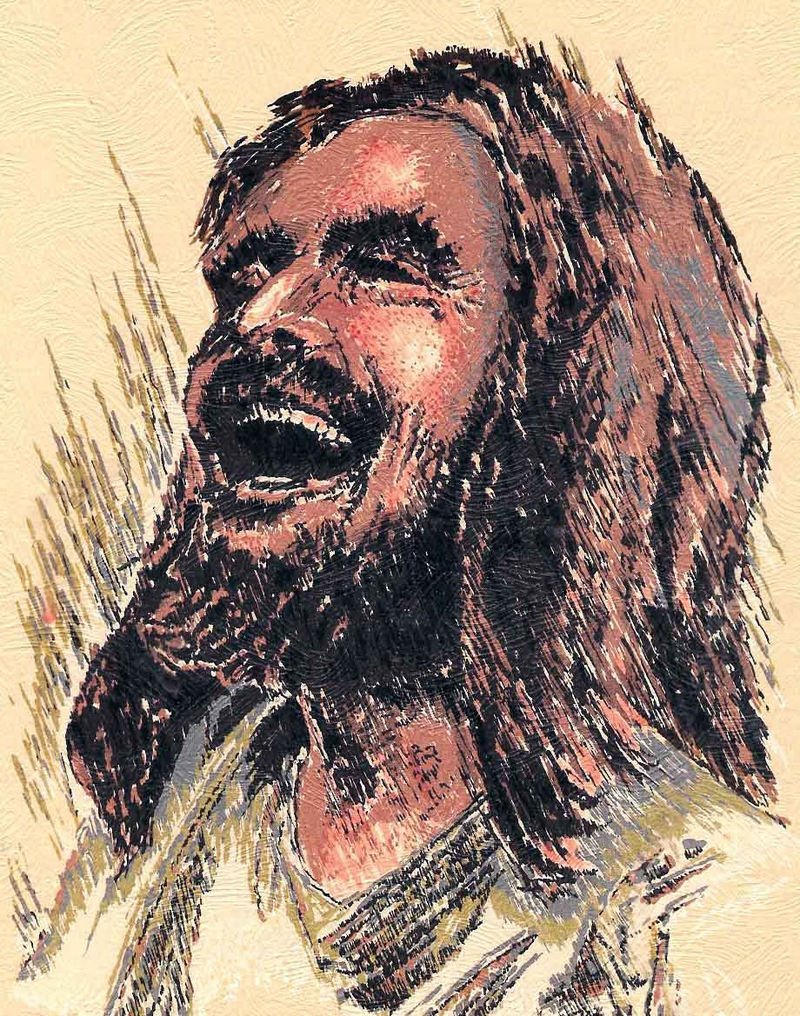
At this very moment might Jesus be out there cutting my lawn, roofing my house or cleaning my bathroom?

When our border guards beat “illegals” (and worse!) are they beating Jesus?

And what does that mean for their karma – and for ours?

Those are riddles worth discussing and solving!

The way we answer will determine the side we come down on in the immigration debate.
(Discussion follows)

Jesus and Abraham Call Us to Abandon the Bible’s “Psychopath in the Sky” (Sunday Homily)

Love Enemies

Readings for the 17th Sunday in Ordinary Time: Gn. 18:20-32; Ps. 138:1-3, 608; Col. 2:12-14; Lk. Ll:1-13.

Today’s readings about Abraham bargaining with God and about Jesus teaching his followers to pray raise some vital questions about God’s personality and existence. Abraham’s compassionate God seems to conflict with the warlike God who appears elsewhere in the Bible.

So who’s right? Should we be afraid of God? Or can we trust the very Ground of Our Being? Is God warlike and punitive or kind and forgiving? If he’s our “Daddy” (that’s what “Abba” means in Jesus’ prayer: “Our Daddy who transcends everything”) does our experience show him to be abusive or loving? Today’s readings help us wrestle with those questions. In fact, they call us to a holy atheism.

But before I get to that, let me frame my thoughts.

A few days ago, it was reported that an airstrike led by the United States in Syria killed more civilians than perished in the Bastille Day killing of 84 people in the city of Nice following a celebratory fireworks display.

But whereas the Nice slaughter evoked general consternation, sympathy, and compassion, the U.S. killings elicited very little public notice here. The general feeling seems to be that our killings of civilians are somehow tolerable because the strikes protect Americans from the terrorists actually targeted in what are described as wayward airstrikes.

That’s the logic our government has adopted as it represents our country where 78-85% of the population claims to follow the one who refused to defend himself and gave his life that others might live. The logic of most American Christians says that killing innocents – even children – is acceptable if it saves American lives. Apparently, that’s the American notion of salvation: better them than us.

However that way of thinking is not what’s endorsed in today’s liturgy of the word. (And here I come back to those questions I raised earlier about God’s personality and existence.) There in Sodom and Gomorrah, Yahweh refuses to punish the wicked even if it means that as few as 10 innocents would lose their lives in the process.

Better-us-than-them is not the logic of Jesus who in teaching his disciples to pray tells them that God is better than us. God gives bread to anyone who asks. Yahweh acts like a loving father. He forgives sin and gives his children what they ask for. In fact, God shares his Spirit of love and forgiveness – he shares Jesus’ spirit of self-sacrifice – with anyone who requests it.

Elsewhere, Jesus says something even more shocking. Yahweh doesn’t even prefer the good over the wicked, he says. He showers his blessings (not bombs!) on everyone. Or as Jesus himself put it, God makes the sun rise on the virtuous and the criminal; his rain benefits those we consider evil as well as those we classify as good (Mt. 5:45). We should learn from that God, Jesus says, and be as perfect like him (Mt. 5:48). In fact, we should consider no one “the enemy” not even those who threaten us and kill us even as Jesus was threatened and killed (Lk. 6: 27-36).

How different is that from the way most of us think and act? How different is that from the God we’ve been taught to believe in?

Yes, you might say, but what about those other passages in the Bible where God is fierce and genocidal? After all, the Great Flood must have killed many good people and even children. And God did that, didn’t he? What about his instructions (more than once) to kill everyone without distinction. For example the Book of Joshua records: “Thus Joshua struck all the land, the hill country and the Negev and the lowland and the slopes and all their kings. He left no survivor, but he utterly destroyed all who breathed, just as the LORD, the God of Israel, had commanded (Joshua 10:40). What about the Book of Revelation, which many Christians argue predicts God’s total destruction of the world? What about that violent, pitiless, threatening God? Is that the “Abba” of Jesus?

Good questions. They’re good because they make us face up to the fact that the Bible is ambiguous about God. No, let me put it more strongly. The Bible isn’t just ambiguous about God. It’s often plain wrong – at least If we adopt the perspective of Jesus and Abraham in today’s readings.

After all, Abraham’s God is not genocidal; Joshua’s is. Jesus’ God is not genocidal; Joshua’s is. Those Gods are not compatible. One of them must be false. Or as Jack Nelson Pallmeyer writes in his book Is Religion Killing Us? “Either God is a pathological killer or the Bible is sometimes wrong about God.”

Today’s readings show us that both Abraham and Jesus agree.

The Abraham story is about a man gradually rejecting Nelson’s Psychopath in the sky. Israel’s furthest back ancestor comes to realize that God is merciful, not punitive or cruel. Or as the psalmist puts it in today’s responsorial, God is kind, true, and responsive to prayer. God protects the weak and lowly and is distant from the powerful and haughty. In today’s reading from Genesis, we witness Abraham plodding slowly but surely towards that conclusion.

It’s the realization eventually adopted by Jesus: God is a kind father, not a war God. If Abraham’s God won’t tolerate killing 50 innocent people, nor 45, 40, 30, 20, or even 10, Jesus’ God is gentler still. That God won’t tolerate killing anybody – not even those threatening Jesus’ own life.

All of that should be highly comforting to us. It has implications for us, politically, personally and liturgically.

Politically it means that followers of Jesus should be outraged by anyone connecting Jesus with our country’s perpetual war since 9/11, 2001. A bombing program that kills the innocent with the targeted flies in the face of Abraham’s gradually-dawning insight about a merciful God. The war itself makes a complete mockery of Jesus’ total non-violence and the words of the prayer he taught us. Those supporting “America’s” “better them than us” attitude are atheists before Jesus’ God and the one depicted in the Abraham story.

Personally, what we’ve heard this morning should drive us towards an atheism of our own. It should cause us to review and renew our understandings of God. Impelled by today’s readings, we should cast as far from us as we can any inherited notions of a pathological, punishing, cruel, threatening and vindictive God. We need that holy atheism. Let’s pray for that gift together.

And that brings us to today’s liturgy. In effect, we’ve gathered around this table to hear God’s clarifying word, and symbolically act out the peaceful world that Jesus called “God’s Kingdom.” We’ve gathered around this table to break bread not only with each other, but emblematically with everyone in the world including those our culture considers enemies.

I mean if God is “Our Father,” everyone is our sister, everyone, our brother. It’s just that some couldn’t make it to our family’s table today. But they’re here in spirit; they’re present around this altar. They are Taliban and ISIS; they are Iraqis, Afghanis, Yemenis, and Somalis; they are Muslims and Jews; they include Edward Snowden and Tamir Rice. They include those children killed in U.S. bombing raids. They are you and I!

All of us are children of a loving God. Jesus’ “Lord’s Prayer” says that.

Now that’s something worth celebrating.

The Irrelevance of Religion in the Eyes of Jesus (Sunday Homily)

Good Sam Pic

Readings for 15th Sunday in Ordinary Time: DT. 30: 10-14; Ps. 69: 14, 17, 30-31, 34, 36-37; Col. 1: 15-20; Lk. 10: 25-37.

What do you think? Does God care about religion? Does She need it? Do we? Does She even care if we’re Christian, Muslim, Jew or atheist?

Today’s Gospel reading – the familiar parable of “The Good Samaritan – seems to answer “no” to all of those questions.

The tale addresses the problems of crime and violence and of proper human response. Surprisingly, the recommended response is not “religious” at all, but humanitarian. It is unadorned motherly compassion by a specifically irreligious actor.

Jesus makes that point by creating a fictional account where the hero is despicable in the eyes of his audience. He is a Samaritan. Meanwhile, the villains of the piece are religious leaders – a priest and a Levite (virulent enemies of the Goddess religions that biblical patriarchs detested). .

In Jesus’ time, Samaritans were social outcasts belonging to a group of renegade Jews who (by Jesus’ time) had been separated from the Jewish community for nearly 1000 years. They were seen as having polluted the Jewish bloodline by intermarrying with the country’s Assyrian conquerors about 700 years earlier. Female goddesses figured prominently in the religions of ancient Assyria.

As a result, Jewish priests and Levites considered Samaritans “unclean;” they were traitors, enemy-sympathizers, heretics and even atheists. They rejected Jewish understandings of the patriarchal Yahweh and the Temple worship that went along with them. For priests and Levites, Yahweh was interested in temple sacrifice and abstract law.

And yet the Good Samaritan is found to be more worthy, more pleasing in God’s eyes than the priest or Levite, who enjoyed great prestige among Jews as “men of God.”

Yes, Jesus prefers the Samaritan because his actions speak much louder than the religious orthodoxy of Israel’s holy men or than the word “Samaritan” would allow. The outcast expresses typically female compassion; so Jesus approves.

In this way, Jesus’ story calls his audience (and us!) to transcend socially prescribed categories, patriarchy, and even religion in dealing with problems of crime and violence. In fact, the crimes addressed in the parable are not primarily robbery and physical abuse. They are indifference, denial, and patriarchy’s religious hypocrisy.

The solution to such crimes along with robbery and violence is not found in religion, theology or temple sacrifices. It lies simply in compassionate action – in “being there” for victims.

As always, then, Jesus’ words invite us to reconsider our very understanding faith, and our favorite categories of “good” and “evil” — and the identity of God Herself.

Perhaps religion is not that important for followers of Jesus after all — nor to the Great Cosmic Mother..

Would Jesus Celebrate Independence Day?

Jesus Revolutionary

 Readings for 14th Sunday in Ordinary Time: Is. 66: 10-14c; Ps. 66: 1-7, 16, 20; Gal. 6: 14-15; Lk. 10: 1-12, 17.

Sometimes I wonder if I’m on the right path. Do you ever think that about yourself? I’m talking about wondering if your whole “take” on the world is somehow off base.

My own self-questioning has been intensified by my blogging over the last 15 months. For instance I recently wrote a piece on why I refused to celebrate the 4th of July. My thesis was that the U.S. has lost its way, turned the Constitution into a dead letter, and made its claims to democracy meaningless. We are rapidly moving, I said, in the direction of Nazi Germany. All of that is contrary to the Spirit of 1776. So there’s no point in celebrating Independence Day as if Edward Snowden and Chelsea Manning didn’t exist.

One person kind enough to comment said she lost all respect for me as a result of what I had written. Others have told me that my message is just a poor man’s left-wing version of the ideological nonsense spouted by Sean Hannity and Rush Limbaugh. Even people close to me have referred to what I write as diatribes, screeds, and rants. I hope that’s not true.

What is true is that as a theologian, I’m attempting to write “About Things That Matter” (as my blog title puts it) from a self-consciously progressive (i.e. non-conservative) perspective – or rather from a theological perspective that recognizes that following Jesus is counter-cultural and requires a “preferential option for the poor” — not the option for the rich that “America” and its right wing versions of Christianity embrace.

I adopt this position in a national context that I recognize as anti-gospel – materialistic, individualistic, extremely violent, and pleasure-oriented. Or as my meditation teacherEknath Easwaran says, our culture refuses to recognize that we are fundamentally spiritual beings united by the divine core we all share. At heart, we are 99% the same in a culture that tells us we’re 100% unique. Jesus’ values are not the American values of profit, pleasure, power, and prestige.

Instead what Yeshua held as important is centered around the Kingdom of God – a this-worldly reality that turns the values of this world on their head. The Kingdom embodies a utopian vision that prioritizes the welfare of the poor and understands that the extreme wealth Americans admire is a sure sign that those who possess it have somehow robbed others of their due.

As a possessor of extreme wealth myself (on a world-scale) each time I read the gospels – or the newspaper – I feel extreme discomfort. In other words, it’s Jesus’ Gospel that makes me think I’m on the wrong track. But it’s not the one critics have in mind when they suggest I temper my positions.

Instead, consideration of Jesus’ words and deeds convince me that I’m not radical enough. I do not yet occupy a position on the political spectrum respectful enough of the poor. I’ve forgotten that life outside God’s Kingdom (“Jerusalem”) is “Exile” in God’s eyes (as today’s first reading recalls). The liberation from slavery referenced in this morning’s responsorial psalm has lost its central place in my spirituality.

Our culture might say, that by all this I mean that I’m not far enough “left.” Be that as it may. The truth is that insofar as my daily life doesn’t reflect Jesus’ utopian values, I should feel uncomfortable.

Today’s second and third readings reinforce my discomfort. They highlight the conflict between the values of Jesus and those of “the world” – of American culture in our case. In fact, the world finds it hard to understand Jesus’ real followers at all. And why not? For all practical purposes, our culture denies the very existence and /or relevance of spirituality to everyday life – at least outside the realm of the personal.

In today’s excerpt from his Letter to Galatia, Paul says the world considers the Christian life not even worth living. That’s what Paul means when he says that in Christ he is crucified to the world (i.e. in the world’s opinion). He means that as far as the world is concerned, he as a follower of Jesus is already dead because of his rebellion against the values of Rome. Crucifixion, after all, was the form of torture and capital punishment reserved for insurgents against the Empire.

But then Paul turns that perception on its head. He writes that his accusers are wrong. In reality, it is life lived according to Roman values that is not worth living. Paul says, “As far as I’m concerned, the world has been crucified.” He means that what Rome considers life is really death – a dead end. It constitutes rebellion against God’s Kingdom, the antithesis of Rome.

In today’s Gospel selection Jesus describes the lifestyle of those committed to God’s Kingdom. He sends out 72 community organizers to work on behalf of the Kingdom giving specific instructions on how to conduct themselves. They are to travel in pairs, not as individuals. (Companionship is evidently important to Jesus.) Theirs is to be a message of peace. “Let your first words be ‘peace’ in any location you frequent,” he says. He tells his followers to travel without money, suitcase or even shoes. He urges them to live poorly moving in with hospitable families and developing deep relationships there (not moving from house to house). They are to earn their bread by curing illness and preaching the inevitability of God’s Kingdom which the world routinely rejects as unrealistic.

Jesus’ followers are to spread the word that the world can be different. God should be in charge, not Caesar. Empire is evil in God’s eyes. So peace should replace anger and violence; health should supplant sickness; shared food and drink should eliminate hunger. Those are Jesus’ Kingdom values.

And the world rejects them. Not only that, Jesus’ “lambs among wolves” imagery recognizes that the world embodies an aggressive hostility towards followers of Jesus. It would devour them – so different are its values from the Master’s.

So maybe it shouldn’t surprise any of us when we’re accused of being extreme – as communists or utopians or hippies – if we’re attempting to adopt the values of Jesus.

After all, they thought Jesus was crazy. They thought he had lost his faith. They considered him a terrorist and an insurgent.

Then in the fourth century, Rome co-opted Jesus’ message. Ever since then, we’ve tamed the Master.

As our culture would have it, Jesus would have no trouble celebrating July 4th.

Am I mistaken?

Jesus’ Response to Terrorism vs. Ours (Sunday Homily)

Cross

Readings for 12th Sunday in Ordinary Time: ZEC. 12:10-11; 13:1; Ps. 63: 2=6, 8-9; Gal. 3: 26-29; Lk. 9:18-24

Why are we Christians so afraid of own deaths while at the same time so indifferent to the horrors we inflict on innocent others? Our attitude stands sharply condemned in today’s Liturgy of the Word.

To begin with, think about our nationwide hysteria to the horrendous massacre in the Orlando nightclub last week. Contrast that understandable reaction with our collective yawn in the face of the American bombing of the Doctors without Borders trauma hospital in Kunduz, Afghanistan in October of last year. The attack killed at least 30 people, including 13 medical staff, 10 patients and 7 unidentified people.

And Kunduz was not an isolated incident. Orlando-gauge tragedies are a daily phenomenon under completely illegal U.S. drone and bombing campaigns that kill far more innocent civilians than so-called “combatants.”

But there are no Hands across the Continents movements for the victims of our government’s terrorism. Rather there is hardly any notice in the mainstream media or awareness by U.S. citizens – no teddy bears, shrines, candles, and love notes. Just excuses on the part of the killers.

And even Christians go along with the too-familiar process as though supporting such mayhem were not only patriotic, but in accord with our faith.

All of that reveals a near obsession with saving our own lives at the expense of others – just the opposite of what’s required of believers in today’s Gospel reading.

There Luke tells us that Jesus has just emerged from a period of solitary prayer. That experience has evidently brought the Master face-to-face with his fundamental God-identity – an identity Paul tells us in the second reading, is shared by all of us who are, the apostle reminds us, “children of God” just like Jesus. Since we exist “in Christ,” Paul implies, we can learn something from the experience of Jesus and from the attitudes he expressed in his words and actions. We should be able to see ourselves “in Christ.”

In any case, Jesus has just encountered the God within. According to the responsorial from Psalm 63, that God is not only powerful and glorious, but our ultimate source of help, support, and joy in life’s greatest difficulties. For that God each of us should be thirsting, the Psalmist says, like parched ground for water. In fact, God’s kindness is more valuable than life itself. Or as the psalmist puts it, God’s kindness is “a greater good than life.” This seems to mean that it’s more important for believers to be kind (i.e. non-violent) than to survive.

With those insights in mind, Jesus decides to share them with his disciples. So he asks a leading question about identity: “Who do the crowds say that I am?” (Jesus really wants his friends to face who they are!) The disciples have a ready response. After all, everyone is talking about Jesus. “Some say you are John the Baptist returned from the dead,” they say. “Others say you are Elijah or one of the prophets come back to life.”

“But who do you say I am?” Jesus insists.

Peter speaks for the others. “You are God’s anointed,” he says – “the Messiah.”

Jesus knows what Peter has in mind. For a Jew living under the Roman jackboot, “Messiah” could mean only one thing – the leader of The War against Rome.

So Jesus says, “Don’t call me that! I am not the Christ you imagine! No, I’m a human being like the rest of you.

“Yes, I’m as much against the Roman enemy as you are.” Like the ‘Son of Man’ in the Book of Daniel, I reject all the enemies of our people in the name of Yahweh our God. I am a patriot just like you – and the prophet Daniel. But rather than use violence to conquer our enemies, I am willing to lose my life even if it means crucifixion at the hands of Rome. They cannot kill my real Self; I will rise again and again despite the way they terrorize us all. In the final analysis the God within all of us cannot be defeated.

“And there’s more. All of you must all be prepared to follow my example – even if it means rejection by the religious establishment and a cross imposed by our foreign enemies. In fact, I tell you all, anyone who tries to save his or her life will lose it.

“Don’t you realize that by killing others, you are killing your Self? You are murdering the God within. But those who follow my example of non-violent resistance will actually save their Selves. They will preserve their in-born unity with the divine core shared by all of God’s children. Don’t be afraid to follow my example of non-violent resistance. You will emerge victorious in the end.”

That, I think, is what Jesus means in this morning’s gospel with his talk about losing life and saving it = with his words about denying self and carrying one’s cross. Suffering, terrorism, and even national enslavement are not the end of the world.

Yes, even national enslavement! The prophet Zachariah makes that point in today’s first reading. Writing at the end of the 6th century BCE, he addresses an Israel defeated and enslaved in Babylon for more than 50 years. They survived, he reminds them. And somehow they’re better off than before. They’ve been purified as if by a gushing fountain.

Of course, the attack in Orlando portends nothing like national defeat by “terrorists.” Such threats to our homeland are remote and relatively insignificant. Americans are more likely to be hit by lightning or killed in an auto accident than by a terrorist attack.

Instead, it is our country’s response to terrorism that threatens us with defeat – responses like the massacre in Kunduz and the killing of civilians in drone attacks. According to Jesus and Zachariah, accepting life’s lessons administered by a foreign enemy might even lead to national purification.

Paradoxically, however, doomed efforts to save our lives through violence will bring about the end we so fearfully seek to avoid.

As Jesus himself put it: “. . . those who want to save their life will lose it, and those who lose their life for my sake (that is, as a result of living ‘in Christ’) will save it.”

Jesus’ instruction today makes it incumbent on all of us to resist our country’s unending wars and state-sponsored terrorism.

Was Mary Magdalene the First Pope? (Sunday Homily)

hieros gamos

Readings for the eleventh Sunday in Ordinary Time: 2SM 12:7-10, 13; PS 32: 1-2, 5, 7, 11; GAL 2: 16, 19-21; LK 7: 36-8:3

As much as we love Pope Francis, many of us have been disappointed by his consistent refusal to consider ordaining women to the Catholic priesthood. In the light of such irritating consistency, the pope would do well to reconsider today’s Gospel reading.

I say that because it offers a compelling argument not merely admitting women to the priesthood, but to the highest office in the church – the papacy itself. It does so by presenting Mary Magdalene as performing an undeniably priestly function far beyond any recorded of Yeshua’s apostles. Doing so brings to mind the Master’s supreme elevation of Mary Magdalene found in patriarchally-suppressed sources outside the canonical Gospels. There Yeshua designates Mary as superior even to Peter.

Consider the episode Luke records.

Yeshua has been invited to the house of a Pharisee for dinner. For Jews Pharisees were defenders of the father-rule system the Church and Pope Francis have made their own. But in this case, the “host” proves to be inhospitable in terms of Jewish custom. He obviously sees the carpenter from Nazareth and his uncouth fisherman friends as riff-raff. He omits giving them the traditional greeting, and doesn’t even offer them water to wash their feet. Evidently he considers the band from Nazareth unclean – dirty people who won’t even know the difference.

Then the hero of the story appears to set things right. She’s a woman whose gender relegated her to unquestionably second class status. She is Mary of Bethany (whom scholars identify with Mary Magdalene). And she does something extraordinary. She does what Nathan the prophet recalled in today’s first reading that he did for David. She anoints Yeshua as the Christos – the Christ, designating (and making) him God’s chosen one. This is the priestly act I referred to earlier.

Mary’s act is absolutely extraordinary. Remember, the term “Christos” (or Christ) itself means “anointed.” And in the gospels there is only one anointing of Yeshua the Christ. And, as we see, it occurs at the hands of Mary Magdalene, not of some male priest. In other words, the Magdalene in today’s gospel acts as prophet and priestess on a level arguably above Nathan’s role recalled in today’s reading from 2nd Samuel.

And there’s more. The Magdalene appears in public with her head uncovered and hair flowing – a condition appropriate for a woman of Yeshua’s time only in the presence of her husband. And besides anointing Yeshua, she performs what can only be described as an extremely intimate act. She continually kisses his feet with her lips and washes them with tears of love.

But how could a woman perform such an act? Why would Yeshua allow it? After all, according to Jewish law, women were not even permitted to say ritual prayers at home, much less perform religious rites of such central import as identification and anointment of the Christ.

That is, not according to Jewish law. . . However, according to universally recognized pre-patriarchal traditions, such election by a priestess was not only permitted but essential for any sacred king. There according to the rite of hieros gamos or sacred marriage, the priestess would anoint the priest-king. By virtue of her act (often consummated by ritual sex), the anointed would be flooded with power of the god. Conversely, without the power conferred by the woman, the king would remain powerless and have no knowledge of himself or of the gods. These facts would have been evident to Yeshua’s contemporaries.

Why has this history and the prophetic role of Mary Magdalene in identifying (and consecrating) the Christ been hidden from us all these years? Feminist scholars tell us that patriarchal misogyny – anti-woman sentiment – is the answer.

And negativity towards women is written all over today’s excerpt from Luke’s Gospel. There the evangelist emphasizes the sinfulness of the Magdalene as that of the other women in Yeshua’s company.

Luke describes Mary as “a sinful woman in the city,” and “a sinner.” He has Yeshua tell those seated at table that “many sins have been forgiven her,” and say to the woman, “Your sins are forgiven.” So we won’t miss the point, Luke gratuitously describes Mary Magdalene as the one “from whom seven demons had been cast out.” And finally, women in Yeshua’s company are described as formerly sick and possessed.

Nevertheless, Luke feels compelled to note what everyone in his community would have known: women like the Magdalene and Joanna and Susanna and the “many others” who followed Yeshua were financial supporters of Yeshua and “The Twelve.”

But Luke reveals no corresponding negativity towards the male leaders of the early church. He doesn’t call the apostles “free-loaders.” Neither does he parallel his description of the women as sinners by recalling that one of the 12, Peter, was identified with Satan himself by Yeshua. Nor does he recall that a key apostle, Judas, actually betrayed Yeshua or that all of the twelve but one (unlike the Master’s women followers) abandoned him in his hour of greatest need. Instead, Luke simply mentions “the twelve,” who by the evangelist’s omissions are implicitly contrasted with the “sinful” women.

Above all, Luke omits the description of Mary Magdalene which we find in the church-suppressed Gospel of Thomas. There she is described as “the apostle of apostles” – no doubt because of her key role in identifying and anointing Yeshua as the “Christos,” and because she was the one to whom the resurrected Yeshua appeared before showing himself to any of “the twelve.”

In fact the Gospel of Thomas says explicitly:

“. . . the companion of the Savior is Mary Magdalene. But Christ loved here more than all the disciples, and used to kiss her often on her mouth. The rest of the disciples were offended . . . They said to him, “Why do you love her more than all of us?’”

Here the word for “companion” is koinonos which refers to a consort of a sexual nature. Moreover in other suppressed writings, Magdalene emerges as Yeshua’s star pupil and the center of his attention. He praises her as “one whose heart is raised to the kingdom of heaven more than all thy brethren.” He predicts that she “will tower over all my disciples and over all men who shall receive the mysteries.” Additionally, following Yeshua’s ascension, it is Magdalene who comes to the fore to encourage the disheartened apostles to man-up and get on with the business of understanding and living out the teachings of the Master.

These words and the Magdalene’s functioning as prophet and priest should be extremely meaningful for contemporary women – and patriarchs blind to women’s leadership in the early church. They highlight the way at least one female disciple of extraordinary talent and charisma was not only marginalized but denigrated in the patriarchal church right from the beginning. And that denigration has continued in church circles and beyond to our very day.

Put otherwise, besides shedding light on the distant past, today’s readings expose the extreme weakness of contemporary ecclesiastical “fathers” in their exclusion of women from the priesthood and from other forms of church leadership. They also uncover the perversity of their other anti-woman pronouncements regarding topics such as contraception, abortion, and women’s rights in general.

In short today’s liturgy of the word helps us see beyond the “official story” to discern the fact that female leadership in the Christian community is nothing new. It is the males – the ones we call “father” – who are the interlopers and charlatans.

Clearly, Pope Francis, should change his mind on women’s ordination.

Pope Francis, Donald Trump and the Revelation of Pentecost (Sunday Homily)

Trump & Frank

Readings for Pentecost Sunday: ACTS 5: 2-11; PS 104: 1, 24, 29-31, 34; 1COR 12: 3B-7, 12-13; JN 20: 19-23.

So who do you think is more outspoken, Donald Trump or Pope Francis? Which one should followers of Jesus listen to?

That question was sharpened a few weeks ago, when Pope Francis implied that Donald Trump is not a Christian. Responding to a reporter’s question, the pontiff lit up the internet when he said about Trump, “Anyone, whoever he is, who only wants to build walls and not bridges is not a Christian.” Francis added, “Vote, don’t vote, I won’t meddle. But I simply say, if he says those things, this man is not a Christian.”

The pope’s comment came at the end of Francis’ six-day trip to Mexico. There he celebrated Mass with 300,000 faithful in attendance near the Mexican-U.S. border. He used the occasion to decry the “human tragedy” of worldwide migrations of people fleeing violence, war and the effects of climate change. The pope’s analysis, of course, conflicts with Mr. Trump’s who sees immigrants as rapists, drug-dealers, and terrorists.

Francis’ comments drew a quick response from The Donald. He called the pope’s charges outrageous and accused him of being a pawn of the Mexican government.

While Francis’ words were surprising and the response predictable, both provide occasion for a Pentecost reflection on what it means to be a baptized and confirmed Christian in a world awash with refugees from U.S. bombings and the effects of neo-liberal overconsumption.

That’s because the emphasis in today’s readings is precisely on internationalism. The Kingdom of God, the readings tell us, has no borders. It is open to everyone regardless of nationality, race, occupation or gender. Moreover, the Kingdom of God is a matter of this world – of the Body of Christ.  It is not about some disembodied reality up in the sky.

That twofold message starts with today’s opening reading from the Acts of the Apostles with all those strange identity references that readers usually stumble over. Jews, we are told who were present on that first Pentecost were “Parthians, Medes, and Elamites, inhabitants of Mesopotamia, Judea and Cappadocia, Pontus and Asia, Phrygia and Pamphylia, Egypt and the districts of Libya near Cyrene, as well as travelers from Rome, both Jews and converts to Judaism, Cretans and Arabs.”

Then in today’s second reading, Paul goes even further. God’s Kingdom, he says, isn’t just for Jews. In fact in God’s eyes national distinctions, economic status, and gender identity have been erased for those who accept the Gift of God’s Spirit. Paul writes: “For in one Spirit we were all baptized into one body, whether Jews or Greeks, slaves or free persons, and we were all given to drink of one Spirit.” Elsewhere (Galatians 3:28) he puts it even more directly: “There is neither Jew nor Gentile, neither slave nor free, nor is there male and female, for you are all one in Christ Jesus.”

Paul’s message was a consistent theme in the life of Jesus. He healed and forgave, loved and taught Jews, Gentiles, Samaritans, street walkers, lepers, tax collectors, and even on occasion members of the Roman occupying forces.

Notice too Paul’s words about “body” insert the reception of Jesus’ Spirit into the earthly realm of real life and politics. True, Paul speaks of “spiritual gifts,” but he even more emphatically insists that those gifts must be “manifest” in “service” meant to “benefit” others. We are members of Christ’s “Body,” Paul tells us. That is, we are all somehow living “in Christ” – in God, we might say. The question is, do we recognize that reality or not?

In today’s Gospel, Jesus reminds us more specifically where in the world we encounter his embodied spirit. It happens first of all in the community of peacemakers. Jesus’ first words after his resurrection are about peace. “Peace be with you,” he says.  Then he immediately shows his pierced hands and side to his friends. In doing so he seems to remind his followers that he will forever be found in the victims of war and imperialism. That includes refugees from imperialist wars and excess consumption as well as in victims of torture and capital punishment like Jesus himself.

Is such understanding of Pentecost too political? Donald Trump might think so. Pope Francis does not. Francis himself has pointed out that Aristotle was correct in saying that human beings are political animals. So to be branded “political” is to have one’s humanity recognized. The pope said he is proud to be branded political.

So would-be followers of Jesus are presented with a choice on this particular Pentecost.  Are we to follow Pope Francis or Donald Trump? The choice is ours.

More accurately, do we recognize that we are living not “in America,” but “in Christ?”  Do we recognize (as John Oxenham put it more than 100 years ago) that

1 In Christ there is no east or west,
in him no south or north,
but one great fellowship of love
throughout the whole wide earth.

2 In Christ shall true hearts everywhere
their high communion find;
his service is the golden cord
close-binding humankind.

3 Join hands, disciples of the faith,
whate’er your race may be.
All children of the living God
are surely kin to me.

Ascension Sunday: What’s The Purpose of Christianity? (Sunday Homily)

Ascension

Readings for Ascension Sunday: Acts 1: 1-11; Ps. 47: 2-3, 6-9; Eph. 1: 17-23; Lk. 24: 48-53

This is Ascension Sunday. For us Catholics, it used to be “Ascension Thursday.” It was a “holy day of obligation.” That phrase meant that Catholics were obliged to attend Mass on Thursday just as they were on Sunday. To miss Mass on such a day was to commit a “mortal sin.” And that meant that if you died before “going to confession,” you would be condemned to hell for all eternity.

So until the years following the Second Vatican Council (1962-1965) Catholics would fill their churches on Ascension Thursday in the same numbers (and under the same threat) that made them come to Mass on Sundays. That’s hard to imagine today.

I suppose that difficulty is responsible for the transfer of the commemoration of Jesus’ “ascension into heaven” from Thursday to Sunday. I mean it wasn’t that the church changed its teaching about “holy days of obligation.” It didn’t. Catholics simply voted with their feet. They stopped believing that God would send them to hell for missing Mass on Ascension Thursday or the feast of the Blessed Virgin’s Assumption (August 15th), or All Saints Day (November 1st) or on any of the other “holy days.” Church once a week was about as much as the hierarchy could expect.

But even there, Catholics stopped believing that God would punish them for missing Mass on Sunday. So these days they more easily attend to other matters on Sunday too. They set up an early tee time or go for a hike in the woods. Afterwards they cut the lawn or go shopping at Wal-Mart. That kind of “servile work on Sundays” or shopping used to be forbidden “under pain of sin” as well. And once again, it isn’t church teaching that has changed. Catholics have just decided that the teachings don’t make sense anymore, and have stopped observing them.

And apparently they do so in good conscience. So you won’t find them running to confession after missing Mass or working and shopping on Sunday. In fact, that’s another way Catholics have voted with their feet. For all practical purposes, they’ve stopped believing in Confession – and largely in many of the mortal sins they were told would send them to hell – like practicing contraception or even getting a divorce.

I remember Saturday evenings when I was a kid (and later on when I was a priest). People would line up from 4:00-6:00, and then from 7:00 -9:00 to “go to Confession.” And the traffic would be steady; the lines were long. No more! In fact, I personally can’t remember the last time I went to confession. And no priests today sit in the confessional box on Saturday afternoons and evenings waiting for penitents to present themselves.

What I’m saying is that the last fifty years have witnessed a tremendous change in faith – at least among Catholics. Our old faith has gone the way of St. Christopher and St. Philomena and “limbo” all of which have been officially decertified since Vatican II.

In fact, since then the whole purpose of being a Catholic (Christianity) has become questioned at the grassroots level. More and more of our children abandon a faith that often seems fantastic, childish and out-of-touch. Was Jesus really about going to heaven and avoiding hell? Or is faith about trying to follow the “Way” of Jesus in this life with a view to making the world more habitable for and hospitable to actually living human beings?

That question is centralized in today’s liturgy of the word. There the attentive reader can discern a conflict brewing. On the one side there’s textual evidence of belief within the early church that following Jesus entails focus on justice in this world – on the kingdom. And on the other side there are the seeds of those ideas that it’s all about the promise of “heaven” with the threat of hell at least implicit. The problem is that the narrative in today’s liturgy of the word is mixed with its alternative.

According the story about following Jesus as a matter of this-worldly justice, the risen Master spent the 40 days following his resurrection instructing his disciples specifically about “the Kingdom.” For Jews that meant discourse about what the world would be like if God were king instead of Caesar. Jesus’ teaching must have been strong. I mean why else in Jesus’ final minutes with his friends, and after 40 days of instruction about the kingdom would they pose the question, “Is it now that you’ll restore the kingdom to Israel?” That’s a political and revolutionary question about driving the Romans out of the country.

Moreover Jesus doesn’t disabuse his friends of their notion as though they didn’t get his point. Instead he replies in effect, “Don’t ask about precise times; just go back to Jerusalem and wait for my Spirit to come.” That Spirit will “clothe you in justice,” he tells them. Then he takes his leave.

Presently two men clothed in white (the color of martyrdom) tell the disciples to stop looking up to heaven as if Jesus were there. He’s not to be found “up there,” they seem to say. Jesus will soon be found “down here.” There’s going to be a Second Coming. Jesus will complete the project his crucifixion cut short – restoring Israel’s kingdom. So the disciples who are Jews who think they’ve found the Messiah in Jesus return in joy to Jerusalem and (as good Jews) spend most of their time in the Temple praising God, and waiting to be “clothed in Jesus’ Spirit” of liberation from Roman rule.

The other story (which historically has swallowed up the first) emphasizes God “up there,” and our going to him after death. It’s woven into the fabric of today’s readings too. Here Jesus doesn’t finally discourse about God’s kingdom, but about “the forgiveness of sin.” After doing so, he’s lifted up into the sky. There Paul tells his readers in Ephesus, he’s enthroned at the Father’s right hand surrounded by angelic “Thrones” and “Dominions.” This Jesus has founded a “church,” – a new religion; and he is the head of the church, which is his body.

This is the story that emerged when Paul tried to make Jesus relevant to gentiles – to non-Jews who were part of the Roman Empire, and who couldn’t relate to a messiah bent on replacing Rome with a world order characterized by God’s justice for a captive people. So it gradually turned Jesus into a “salvation messiah” familiar to Romans. This messiah offered happiness beyond the grave rather than liberation from empire. It centralized a Jesus whose morality reflected the ethic of empire: “obey or be punished.” That’s the ethic we Catholics grew up with and that former and would-be believers find increasingly incredible, and increasingly irrelevant to our 21st century world.

Would all of that incredibility and irrelevance change if the world’s 2.1 billion Christians (about 1/3 of the world’s total population) adopted the this-worldly Jesus as its own instead of the Jesus “up there?” That is, would it change if Christians stopped looking up to heaven and focused instead on the historical Jesus so concerned with God’s New World Order of justice for the poor and rejection of empire?

Imagine if believers uncompromisingly opposed empire and its excesses – if what set them apart was their refusal to fight in empires wars or serve its interests. How different – and more peaceful – our world would be!

A sensitive discerning reading of today’s liturgy of the word, a sensitive and critical understanding of Jesus’ “ascension” presents us with that challenge. How should we respond?

(Discussion follows.)

Dan Berrigan: in Memoriam

Dan Berrigan Resist

I just spent the last hour in tears. The occasion was a tribute to Dan Berrigan on Democracy Now (the best daily news program available).  The saintly Jesuit poet, peace activist and prolific author died on Saturday. He was about to celebrate his 95th birthday this week. What a giant!

Father Berrigan stands with Dorothy Day and Thomas Merton as the most powerful U.S. prophets and social justice activists or our era. They along with Martin Luther King are the true saints of our time.

All of them changed the way Americans approach issues of war and peace. In particular they changed the Catholic Church – challenging it to reverse 1700 years of belligerence and unquestioning support of imperial war, and to follow instead the clear teachings of Jesus the Christ.

Dan Berrigan not only wrote and spoke in ways that uncomfortably juxtaposed the Gospel of Jesus with United States imperialism; he also walked the walk – literally. He marched, spoke out, carried signs, and was arrested more times than he could remember. He spent years in prison, and staged creative protests against the Pentagon and the arms industry.

During the Vietnam War, Berrigan and other activists raided the Selective Service offices in Catonsville MD. They removed nearly 400 files from the place, and burned them with homemade napalm in the adjoining parking lot. They justified the act saying it was better to burn paper than children’s bodies.

Berrigan knew first-hand what he was talking about.  In 1968 he traveled to North Vietnam with historian, Howard Zinn. They had set out on an ultimately successful mission to free three U.S. airmen captured by the Vietnamese. In the process, he saw the burn wounds of children and the elderly scorched by the liquid fire that pursued them relentlessly even in their underground bunkers. He experienced war’s realities as he huddled there with the children and elderly during terroristic bombing raids by his own country.

On another occasion, Dan along with his brother Phil and other “Plowshares” members entered the General Electric nuclear arms plant in King of Prussia PA. There they found an (as yet unarmed) missile and used hammers to beat its nosecone to smithereens. They said they were following the injunction of the prophet Isaiah to turn swords into plowshares (IS 2:4).

I knew Father Berrigan personally. He spent a fall with us here in Berea in the mid-‘80s. His brother, Phil, visited Berea College more than once in connection with a wonderful course called “The Christian Faith in the Modern World.” Imagine actually conversing with saints like that!

I remember how enthusiastic Dan was in supporting the work of the “Berea Interfaith Task Force for Peace.” We were busy at the time with the Nuclear Freeze Movement and with resisting U.S. wars in Central America, especially in Nicaragua.

He met with us regularly – on at least one occasion, in Peggy’s and my home in Buffalo Holler in Rockcastle County. We have a snapshot of him there in our family album. He’s seated on our deck, eating from a paper plate with a bottle of beer on the floor beside his chair.

Another photo shows him standing up in protest with the rest of us at the Bluegrass Army Depot in Richmond Kentucky.  (The Depot holds WWII ordnance – mustard gas and chemical weapons still awaiting demolition.) We had infiltrated a patriotic celebration there.

Our Task Force had entered the facility with protest signs folded up under our shirts. We stood up to display them in the middle of a triumphant speech by one of the generals. Mine read “US out of Nicaragua!” Dan’s message was printed on his tee shirt. When he removed his outer shirt, everyone could see it.  “Stop the Arms Race!” it said.

One of my most memorable Ash Wednesdays came when Dan was here. In his humble understated way he celebrated a thoughtful Mass to begin the season of Lent. It reminded our packed church of St. Clare’s about the ashes created and left behind by brutal U.S. bombing campaigns and unending wars. He called us to repent by refusing our support of such conflicts.

I attended a class Dan taught three times a week during his semester at Berea. It analyzed the Book of Revelation written by John of Patmos – an otherwise unknown author who had been exiled to the Island of Patmos in the Aegean Sea by the Roman Emperor, Domitian at the end of the first century CE. Like Father Berrigan, the book’s author, “John the Revelator,” was a political prisoner. His crime was that of prophecy – of speaking truth to power. So Father Berrigan claimed a kind of “hermeneutical privilege” in dealing with the Book of Revelation. He said his exegesis was a matter of “one jailbird to another.”

I recall driving Dan to the Bluegrass Airport in Lexington the day he left us. Always on task, Father Berrigan spoke about the similarities between Israel’s occupation of Palestine and the apartheid system still flourishing in South Africa. “All these ‘settler societies,’” he said, “operate in the same brutal ways.” Sadly, his words remain true to this day.

In my early days of working at Berea College, I was privileged to give three lectures a year to the entire sophomore class assembled in Phelps-Stokes Chapel along with my colleagues, their teachers.  The context was a two-semester, primary-source survey course called “Religious and Historical Perspectives.” ( I loved the course. It taught me more than any other academic experience in my life.) My lectures were on Jesus (in the fall), on Marx (in the middle of the spring semester), and on Harvey Cox’s The Secular City (the last presentation of the year).

I remember centralizing Dan Berrigan in my Secular City talk.  I held him up (as I still do) as an example of what the great Jewish prophets, Jesus of Nazareth and Karl Marx, have to tell us about Christians’ relationship to the realities Harvey Cox described in his book.  I recalled Father Berrigan being arrested after spending four months underground resisting relentless pursuit by J. Edgar Hoover and the F.B.I.

Dan’s hands were handcuffed in front of him, I recalled. And he was asked by a reporter if he had anything to say before going off to Danbury State Prison. Father Berrigan gave a one-word response. He held up his handcuffed hands and made a peace sign. He said simply: “Resist!”  That’s his message to us today!

Thank you, Father Berrigan, for having the courage to resist and for challenging us so consistently to do the same. May we follow your prophetic example.

Pope Francis: Please Write That Encyclical against War!

Just War

Readings for 6th Sunday after Easter: Acts 15:1-2, 22-29; Ps. 57: 2-3, 5, 6, 8; Rev. 21: 10-14; 22-23; Jn. 14: 23-29.

Last week, David Swanson, the author of War is a Lie shared an interview with the great Jesuit peace activist, John Dear. The latter had just returned from Rome where he participated in a conference convoked by Ghanaian Cardinal Peter Turkson. Cardinal Turkson authored first versions of Laudato Si’, Pope Francis’ landmark encyclical on the environment. He is often mentioned as a possible future pope.

Father John (who doesn’t like to be called “Father Dear”) reported the conference as “unprecedented.” That’s because activists, theoreticians, and scholars of Peace Studies ended by recommending (in a document over the signature of Cardinal Turkson) that Pope Francis publish another encyclical – this one repudiating the Church’s centuries-long endorsement of Just War Theory.

That theory, of course, lays out principles for judging whether or not a given armed conflict might be justified.

The Turkson document repudiated the idea that modern warfare might ever be justified. This is not only because of the terrible destruction caused by modern weaponry, but because, in fact, 90% of casualties of today’s wars end up being innocent civilians. For those reasons, the conference in Rome recommended that Pope Francis not only repudiate war itself, but discourage Catholics from participating in modern military forces.

Imagine what would happen if Pope Francis were to accept those recommendations – especially on top of his denunciations of capitalism-as-we-know-it, his firm embrace of environmentalism, and his statements about homosexuality (“Who am I to judge?”). Catholic radicals would love it, liberals would be inspired. Conservatives who often identify faith and the military would be shocked and scandalized.

Where would you come down?

Think about that question in the light of today’s readings. Think about what “radical,” “conservative” and “liberal” mean for us as individuals and community members in our faith tradition. How would Jesus be classified? What about Paul? What would they say about entirely rejecting the idea of just wars?

Today’s Liturgy of the Word gives us a clue. It presents us first of all with an example of a key conflict between religious conservatives and radicals within the first century infant church. Paul, Barnabas, Silas and Barnabas lead the radical-to-liberal wing. Peter and Jesus’ brother, James are the leaders of the conservatives.

Paul and his friends come from the gentile world. Their concern is to make Jesus both understandable and acceptable to non-Jews. For their audience, circumcision and dietary restrictions (like not eating pork) represent great obstacles to accepting Jesus’ “Way.”

On the other hand, Peter and Jesus’ brother, James, are Jews through and through. They remember the importance of full observance of the law within the Jewish tradition. They recalled for instance that during the second century Seleucid persecution of the Jews under Antiochus IV Epiphanes, many Jews gave their lives rather than eat forbidden foods. Faced with Paul and his colleagues, the conservative faction wondered: were those lives sacrificed in vain? And besides, circumcision was the identifying mark of Jewish manhood. What good follower of the biblical God set that all-important commandment aside?

The issue is so serious that it provoked a meeting of church leaders – what scholars call the “Council of Jerusalem.” Like Vatican II (1962-’65) it called together church leadership to discuss burning issues of the day and to make changes that responded effectively to what Gaudium et Spes called the “signs of the times.”

Today’s gospel reading implies that leaders could come together with confidence because of Jesus’ promise that his Holy Spirit would continue teaching the church even after he is gone. The Spirit would remind the church of what Jesus himself taught – and more besides.

According to today’s readings, it was the “more besides” that the Jerusalem conservatives were resisting. They didn’t deny, of course, that Jesus himself was a Jewish prophet. (It was Jesus’ prophetic radicalism that angered the Scribes and high priests.) Jesus frequently placed love and compassion above God’s most important commandment, the Sabbath law; he associated with the “unclean;” he even befriended and worked miracles for gentiles. Jesus was never bound by the letter of the law as were his conservative opponents.

At the same time however, Jesus was Jewish to the end. He had no intention of founding a new religion. He was a Jewish reformer. No one could deny that. Jesus didn’t revoke the Law. He simply gave it an enlightened, more humane interpretation. He himself had been circumcised!

It was with these understandings that the Council of Jerusalem convened. And according to Luke, the author of Acts, it was a battle royal. Luke says the meeting was filled with “dissension and debate.”

What we find in today’s first reading is the final decree of the Council of Jerusalem. Concerning circumcision, it says “never mind.” As for dietary restrictions, they could be ignored. The Council was concerned with not placing unbearable burdens on converts. In other words, it couldn’t have been less conservative. The Holy Spirit was leading them in the opposite direction.

The Council of Jerusalem is reputed to have happened no more than 30 years after the death of Jesus. But by the time John of Patmos writes his book of Revelation at the end of the first century, look where his church had come. His vision of the “New Jerusalem” which we read about in today’s second reading doesn’t even have a temple. Jerusalem without a temple?! The city is founded not on the 12 patriarchs of Israel, but on the 12 apostles. How radical is that!?

I suppose what I’m saying is that Christians shouldn’t be afraid of radical change in matters of faith. It’s our tradition – right from the beginning.

In fact, in today’s gospel, John has Jesus say specifically that we should not be agitated or fearful. Rather, our hearts should be filled with peace because of our reliance on the Holy Spirit. John’s Jesus teaches that the Spirit’s presence guarantees the community is moving in the right direction, even when the Spirit’s teachings shock and scandalize – as long as it’s moving towards Jesus’ compassion, love, and ease of burden. The guarantee remains even when the Spirit’s guidance seems to dilute what many consider essential – like circumcision, dietary laws and the Jerusalem Temple.

What “essentials” is the church being called to set aside today? Priestly celibacy? An all-male priesthood? Prohibition of contraception? Are any of these really essential?

And what about just war? Are John Dear and Cardinal Turkson right about its absolute unacceptability to followers of Jesus? Could Jesus ever endorse atomic bombs, drone strikes, cluster bombs, or any of today’s wars that end up claiming mostly civilian victims?

If we fear to say “No” to any of those questions, we should keep Jesus’ words in mind: “Don’t be afraid or agitated; the Holy Spirit guides.”

The bottom line: today’s readings teach that there is no future in timid conservatism. Instead we are called to Christian radicalism (or going to the root of things). The Holy Spirit is that root.

And so we can pray with confidence: “Holy Spirit, in our world racked by war, inspire Francis to write another encyclical. Let him surprise and shock us one more time. Wake us up as a community of faith! Move us towards compassion, love and ease of burden as you did the Jerusalem Council.

We believe that under your guidance, we can never go wrong!”