How Hitler Won the Second Inter-Capitalist War

Hitlerganolaguerra

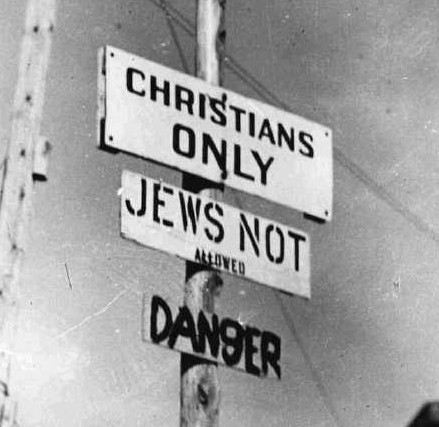
This is an “easy essay” (in the spirit of Peter Maurin’s contributions to “The Catholic Worker”). It is a follow-up to Monday’s posting about Dietrich Bonhoeffer and the Nazis’ reincarnation in today’s United States. It explains how Hitler actually prevailed in World War II (the Second inter-capitalist war). The “essay” references Marge Schott, the then-owner of the Cincinnati Reds, who in 1996 famously said that “Hitler was good in the beginning, but went too far.” The caption under the picture above reads in Spanish: “Hitler Won the War”

Following Germany’s defeat
in “the First Inter-Capitalist War,”
the system was in trouble in “das Vaterland.”
It also foundered world-wide
after the Crash of ‘29.
So Joseph Stalin
convoked a Congress of Victory
to celebrate the death of capitalism
and the End of History —
in 1934.

Both Hitler and F.D.R.
tried to revive the corpse.
They enacted similar measures:
government funds to stimulate private sector production,
astronomically increased defense spending,
nationalization of some enterprises,
while carefully keeping most in the hands of private individuals.
To prevent workers from embracing communism,
both enacted social programs otherwise distasteful to the Ruling Class,
but necessary to preserve their system:
legalized unions, minimum wage, shortened work days, safety regulation, social security . . .
Roosevelt called it a “New Deal;”
Hitler’s term was “National Socialism.”
Roosevelt used worker discontent
with their jobs and bosses
to get elected four times.
Meanwhile, Hitler successfully directed worker rage
away from the Krupps and Bayers
and towards the usual scapegoats:
Jews, communists, gays, blacks, foreigners and Gypsies.
He admired the American extermination of “Indians”
and used that model of starvation and internment
to guide his own program for eliminating undesirables
by hunger and concentrated slaughter.
Hitler strictly controlled national unions,
thus relieving the worries of the German elite.
In all of this,
he received the support of mainline churches.
Pius XII even praised der Führer as
“an indispensable bulwark against the Russians.”

Dietrich Bonhoeffer and the German “Confessing Church”
resisted Hitler’s program
of social Darwinism, patriotism and persecution of the undeserving.
Confessing faithful were critical of “religion”
which combined anti-Semitism, white supremacy, patriotism and xenophobia
with selected elements of Christianity.
They insisted on allegiance
to Jesus alone
who stood in judgment over soil, fatherland, flag and blood.
They even urged Christian patriots
to pray for their country’s defeat in war.
Bonhoeffer participated in a plot to assassinate Hitler
and explored the promise of
Christianity without “religion.”

Hitler initially enjoyed great popularity
with the powerful
outside of Germany,
in Europe and America.
He did!
Then as baseball magnate and used car saleswoman, Marge Schott, put it,
“He went too far.”
His crime, however, was not gassing Jews,
but trying to subordinate his betters in the club
of white, European, capitalist patriarchs.
He thus evoked their ire
and the “Second Inter-Capitalist War.”

Following the carnage,
the industrialists in other countries
embraced Hitlerism without Hitler.
They made sure that communists, socialists and other “partisans”
who bravely resisted German occupation
did not come to political power,
but that those who had cooperated with Nazis did.

Today, the entrepreneurial classes
still support Nazis, whenever necessary.
The “Hitlers” they championed have aliases
like D’Aubisson (El Salvador), Diem (Vietnam), Duvalier (Haiti), Franco (Spain),
Fujimori (Peru), Mobutu (Zaire), Montt (Guatemala), Noriega (Panama), Peron (Argentina),
Pinochet (Chile), Resa Palavi (Iran), Saddam Hussein (Iraq), Somoza (Nicaragua), Strossner
(Paraguay), Suharto (Indonesia). . . .
The list is endless.
The global elite deflect worker hostility
away from themselves
towards communists, blacks, gays, immigrants and Muslims,
towards poor women who stay at home
and middle class women who leave home to work.
Today, Christians embrace social Darwinism
while vehemently rejecting evolution.
Standing on a ground of being
underpinning the world’s most prominent culture
of religious fundamentalism,
they long for Hoover,
and coalesce
with the right.

In all of this
is forgotten the Jesus of the Christian Testament
who was born a homeless person
to an unwed,
teenage mother,
was an immigrant in Egypt for a while,
came from the working poor,
was accused of being a drunkard,
a friend of sex workers,
irreligious,
possessed by demons
and condemned by the state
a victim of torture
and of capital punishment.

Does this make anyone wonder about Marge Schott,
the difference between Hitler’s system
and our own,
and also about “religion”
and how to be free of it,
about false Christs . . . .
And who won that war anyway?

Abram’s Self-Butchering God (Sunday Homily)

imagesCA1FKCW5

Readings for 2nd Sunday of Lent: Gn. 15:5-12, 17-18; Ps. 27:1, 7-9, 13-14; Phil. 3:17-4:1; Lk. M9:28B-36. http://www.usccb.org/bible/readings/022413.cfm

For the last several months I’ve been involved with an alternative faith community in central Kentucky. It calls itself the “Ecumenical Table.” It’s composed of people like me who for one reason or another find ourselves dissatisfied with our local church experiences.

In my own case, I find Sunday experiences in my Catholic parish irrelevant to my life and disconnected from reality in general. Here we are living in a world of rampant violence, widespread addictions, permanent war, torture, climate change, drone attacks on the innocent, and rather complete cultural disintegration, and yet in church none of these problems is even mentioned.

We pretend to be following the example of a Martyr who opposed empire and religious hypocrisy on the one hand, and who literally identified with the tortured and victims of capital punishment on the other. And still we carry on as though that Martyr, Jesus of Nazareth, was somehow like white bourgeois Americans and blessed our addiction to imperial overconsumption and violence. I find that painful to endure.

And so I find myself following the hallowed example of religious protesters (Protestants) over the last 2000 years, and looking for something better. Actually, I find myself following the example of the Jewish Testament’s Abram, and that of Jesus himself as he’s pictured in today’s gospel account of his transfiguration. Abram was himself looking for something better. And in today’s reading, he receives assurance that the One in whom we live and move and have our being would lead him there. For his part, Jesus of Nazareth, received reassurance in today’s gospel episode that his life as professional troublemaker was on the right track. Let me explain. . . .

Abram was an ancient sheik, who turned out to be the furthest back ancestor the Jews could remember. He originally lived in ancient Babylon but felt called to move off to the west, to start over, find a new homeland, and start a new independent tribe. He somehow felt that God was calling him to do all these things. Problem was, Abram was already advanced in years and his wife, Sarah, was beyond menopause. Still, he felt that God was promising him a large family – a tribe whose people would be as numerous as the stars of the heavens.

In today’s readings, Abram evidently feels time is running out on God’s promise. The sheik is looking for reassurance. It comes in the form of a dream. The dream answers his question: how trustworthy is God? How far can you trust an agreement – a covenant – with this God who has promised him a large family? Can God be trusted to guide Abram as he starts over and begins a new life?

Abram’s question makes this tribal pastoralist dream of the most solemn human covenant he knew of – the “Covenant of Pieces.” According to tribal practice, when an inferior made an important agreement with a patron – say to transfer property, do work, fight a battle, or repay a debt – he had to go through an extremely graphic pledge ritual. The ceremony involved sacrificing animals from the client’s flock (in today’s reading a mature heifer, she goat and a ram along with a turtle dove and a pigeon). The inferior was to split the animals in two, and align the carcasses in rows so that they formed a path with one half the heifer’s carcass on the left and the other on the right, and the same with the she goat and ram. Then with the patron holding his hand, the client was to solemnly walk between the carcasses taking note of their dead rotting state, their putrid smell, and of the vultures flying overhead.

All of this was a reminder of the power the client was handing over to his patron. He was saying in effect, if I don’t keep my pledge, I’m giving you permission to do this to me and to my family. You can butcher us all and leave us to rot in the sun. That’s a pretty serious commitment. Sheik Abram could think of nothing more solemn, reassuring or binding.

So his dream which at first glance seems so strange and confusing to us was extremely comforting to him as a tribal pastoralist. It had God (in the form of fire and smoke) playing the role of client to Abram. God was performing the “pieces” ritual in Abram’s presence by running the gauntlet formed by rotting meat. That is if God did not keep his word, God was willing to be butchered! This, of course, could never happen. So the dream meant God could never not keep God’s word. A God willing to be butchered rather than break his word? Reassuring indeed!

Jesus obtains similarly strong reassurance from Abram’s Servant God in today’s reading from Luke. The young carpenter is on his way to Jerusalem. And something extremely risky is about to happen there. He’s determined to be part of it. The risky action has to do with the temple and Jesus’ dissatisfaction with what routinely happens there. (It was not unlike the dissatisfaction with church that I referenced earlier.)

The temple has become worse than irrelevant to the situation of his people living under Roman oppression. What happens there not only ignores Jewish political reality. The temple leadership has become the most important Jewish collaborator of the oppressing power. And Jesus has decided to address that intolerable situation.

Everyone knows that a big demonstration against the Romans is planned in Jerusalem for the weekend of Passover. There’ll be chanting mobs. The slogans are already set. “Hosanna, hosanna, in the highest” will be one chant. Another will be “Hosanna to the Son of David!” “Hosanna” is the key word here. It means “save us!” The Romans won’t notice that the real meaning is “Save us from the Romans.” “Restore an independent Israel – like David’s kingdom!”

Jesus has heard that one of the main organizers of the demonstration is the guerrilla Zealot called Barabbas. Barabbas doesn’t call what’s planned a “demonstration.” He prefers the term “The Uprising” or “ the Insurrection” (Mk. 15). Barabbas has a following as enthusiastic as that of Jesus. After all, Barabbas is a “sicarius” – a guerrilla whose solemn mission is to assassinate Roman soldiers. His courage has made him a hero to the crowds. (John Dominic Cross compares him to the Mel Gibson character in “The Patriot.”)

Jesus’ assigned part in the demonstration will be to attack the Temple and symbolically destroy it. He plans to enter the temple with his friends and disrupt business as usual. They’ll all shout at the money-changers whose business exploits the poor. They’ll turn over their tables. As a proponent of non-violence, they’re thinking not in Barabbas’ terms of “uprising,” but of forcing God’s hand to bring in the Lord’s “Kingdom” to replace Roman domination. Passover, the Jewish holiday of national independence could not be a more appropriate time for the planned event. Jesus is thinking in terms of “Exodus.”

And yet, this peasant from Galilee is troubled by it all. What if the plan doesn’t work and God’s Kingdom doesn’t dawn this Passover? What if the Romans succeed in doing what they’ve always done in response to uprisings and demonstrations? Pilate’s standing order to deal with lower class disturbances is simply to arrest everyone involved and crucify them all as terrorists. Why would it be different this time? Like Abram before him, Jesus has doubts.

So before setting out for Jerusalem, he takes his three closest friends and ascends a mountain for a long night of prayer. He’s seeking reassurance before the single most important act in his life. As usual, Peter, James and John soon fall fast asleep. True to form they are uncomprehending and dull.

However, while the lazy fall into unconsciousness, the ever-alert and thoughtful Jesus has a vision. Moses appears to him, and so does Elijah. (Together they represent the entire Jewish scriptural testament – the law and the prophets.) This means that on this mountain of prayer, Jesus considers his contemplated path in the light of his people’s entire tradition.

Last week, we saw in the reading from Deuteronomy 26, that tradition centered on the Exodus. Fittingly then, Jesus, Moses, and Elijah “discuss” what is about to take place in Jerusalem. Or as Luke puts it, “And behold, two men were conversing with him, Moses and Elijah, who appeared in glory and spoke of his exodus that he was going to accomplish in Jerusalem.” Jesus Exodus!

It is easy to imagine Moses’ part in the conversation. That would be to remind Jesus of the chances Moses took when he led the original Exodus from Egypt. That might have failed too. Elijah’s part was likely to recall for Jesus the “prophet script” that all prophets must follow. That script has God’s spokespersons speaking truth to power and suffering the inevitable consequences. Elijah reminds Jesus: So what if Barabbas and those following the path of violence are defeated again? So what if Jesus’ non-violent direct action in the temple fails to bring in the Kingdom? So what if Jesus is arrested and crucified? That’s just the cost of doing prophetic business. Despite appearances to the contrary, Abram’s faithful God will somehow triumph in the end.

Is there a message here for us – in the experience of Abram and of Jesus, both of them seeking reassurance as they embark on risky paths in response to a compassionate Servant God? Is there hidden meaning for those of us who like Abram are seeking a new home and “church” community blessed by a God who would rather die than be unfaithful? Is there a message here for followers of the Nazarene rabbi who cannot separate worship and political commitment and activism?

Those are the kind of questions Christians should ask and discuss around Ecumenical Tables everywhere on this Second Sunday of Lent.

(Discussion follows)

Christians Have Been Worshipping the Devil for Millennia: Lent calls us to change Gods

Empires[1]

Readings for First Sunday of Lent: Dt. 26: 4-10; Ps. 91: 1-2; 10-15; Rom. 10: 8-13; Lk. 4: 1-13. http://www.usccb.org/bible/readings/021713.cfm

Today is the first Sunday of Lent. Lent is a time of renewal – of getting back to basics – to asking questions about what we really believe and what God we truly worship. Today’s liturgy of the word helps us to do both. Deuteronomy 26 directs us to the authentic faith of Jesus – in the God who liberates the enslaved. Today’s reading from Luke’s Gospel calls us to worship that God rather than devil – the evil one that our culture and church (!) have been worshipping for centuries – ever since they first embraced imperialism in the 4th century C.E. Let me explain.

Start with that reading from Deuteronomy 26. It’s a key text if we want to understand the God in whom Jesus placed his faith. Jesus, remember, was a Jew, not a Christian. And Deuteronomy 26 provides us with the creedal statement that the Jewish Jesus accepted as did all Jews of his time. I mean, for them, Deuteronomy 26 functioned much like our Nicene Creed does for us each Sunday. It was a reminder of their basic belief. As such, it can be summarized in the passage’s seven points:

1. Our father (Abraham) was a wandering Aramean (a Syrian).
2. “Abraham” (i.e. his descendents) went down into Egypt.
3. There we became a great people.
4. But the Egyptians enslaved us.
5. We cried out to our God, Yahweh, who raised up the rebel prophet, Moses.
6. He led us out of Egypt, across the sea, through the desert, and to this land “flowing with milk and honey.”
7. This land is our gift from Yahweh; Thanks be to God!

That’s it! That was the faith that Jesus, the Jewish prophet, inherited from his ancestors. It was a tribal faith centered on the ownership of a God-given piece of land (Palestine) which (despite its dryness and desert character) the descendents of Jacob saw as rich and productive (flowing with milk and honey).

Notice that this Jewish faith had nothing to do with an afterlife, heaven or hell. (In fact, belief in the afterlife was a very late development among the Jews; it didn’t emerge even for debate until about 200 years before Jesus’ birth.) Instead, as among all hunter-gatherers, herds people and agriculturalists, Jewish faith was centered on land. Obviously then, it had little tolerance for colonial military forces like the Assyrians, Babylonians, Persians, Greeks or Romans all of whom at various times occupied Palestine. Colonialism and foreign occupation contradicted Jewish faith in a fundamental way. It was intolerable.

That was true for Jesus too. As a prophet, his fundamental proclamation was not about himself or about a new religion. Much less was it about the after-life or “going to heaven.” Instead, Jesus proclaimed the “Kingdom of God.” That phrase referred to what the world would be like without empire – if Yahweh were king instead of Rome’s Caesar. In other words, “Kingdom of God” was a political image among a people unable and unwilling to distinguish between politics and religion.

In God’s Kingdom, everything would be reversed and guiding principles would be changed. The first would be last; the last would be first. The rich would weep, and the poor would laugh. Prostitutes and tax collectors would enter the Kingdom, while the priests and “holy people” – all of them collaborators with Rome – would find themselves excluded. The world would belong not to the powerful, but to the “meek,” i.e. to the gentle, humble and non-violent. It would be governed not by force and “power over” but by compassion and gift (i.e. sharing).

The creedal account of Deuteronomy 26 sets the stage for today’s gospel narrative about Jesus’ temptations in the desert. (And it’s here that the devil-worship connected with empire enters the picture. Listen closely.) In a context of Roman occupation, Luke’s account raises the question of whom to worship. The choice he presents is stark: one can worship the devil the author of empire or Yahweh, the opponent of imperial power of all types.

That clear choice becomes apparent in Luke’s version of Jesus’ second temptation. From a high vantage point, the devil shows Jesus all the kingdoms of the earth. Then he says,

“I shall give to you all this power and glory;
for it has been handed over to me,
and I may give it to whomever I wish.
All this will be yours, if you worship me.”

Notice what’s happening here. The devil shows Jesus an empire infinitely larger than Rome’s – “all the kingdoms of the world.” Such empire, the devil claims, belongs to him: “It has been handed over to me.” This means that those who exercise imperial power do so because the devil has chosen to share his possession with them: “I may give it to whomever I wish.” The implication here is that Rome (and whoever exercises empire) is the devil’s agent. Finally, the tempter underlines what all of this means: devil-worship is the single prerequisite for empire’s possession and exercise: “All this will be yours, if you worship me.”

But Jesus responds,
“It is written:
You shall worship the Lord, your God,
and him alone shall you serve.”

Here Jesus quotes the Mosaic tradition summarized in Deuteronomy 26 to insist that empire and worship of Yahweh are incompatible. Put otherwise, at the beginning of his public life, Jesus declares his anti-imperial position in the strongest possible (i.e. scriptural) terms.

Now fast forward to the 4th century – 381 CE to be exact. In 313 Constantine’s Edict of Milan had removed from Christianity the stigma of being a forbidden cult. From 313 on, it was legal. By 325 Constantine had become so involved in the life of the Christian church that he himself convoked the Council of Nicaea to determine the identity of Jesus. Who was Jesus after all – merely a man, or was he a God pretending to be a man, or perhaps a man who became a God? Was he equal to Yahweh or subordinate to him? If he was God, did he have to defecate and urinate? These were the questions.

However, my point is that by the early 4th century the emperor had a strong hand in determining the content of Christian theology. And as time passed, the imperial hand grew more influential by the day. In fact, by 381 under the emperor Theodosius Christianity had become not just legal, but the official religion of the Roman Empire. As such its job was to attest that God (not the devil) had given empire to Rome in exchange for worshipping him (not the devil)!

Do you get my point here? It’s the claim that in the 4th century, Rome presented church fathers with the same temptation that Jesus experienced in the desert. But whereas Jesus had refused empire as diabolical, the prevailing faction of 4th century church leadership embraced it as a gift from God. In so doing they also said “yes” to the devil worship as the necessary prerequisite to aspirations to control “all the kingdoms of the world.” Christians have been worshipping the devil ever since, while calling him “God.”

No, today’s readings insist: all the kingdoms of the world belong only to God. They are God’s Kingdom to be governed not by “power over,” not by dominion and taking, but by love and gift which leave people like the liberated daughters and sons of Abraham free to live in control of their own God-given piece of earth. Or in the words of Jesus, the earth is meant to belong to those “meek” I mentioned – the gentle, humble, and non-violent.

All of this has implications for us as would-be followers of Jesus and as citizens of a country whose “leaders” (supported by their “Christian” counterparts) increasingly embrace empire as the inevitable and fitting destiny of the United States.

In fact, in 2003, then vice-president, Dick Cheney sent out a Christmas card on which was inscribed the words, “And if a sparrow cannot fall to the ground without His notice, is it probable that an empire can rise without His aid?” Cheney’s implication was that the United States is God’s new chosen people. Empire as practiced by the United States represents God’s will.

Instead, today’s Liturgy of the Word tells us the opposite. Empires arise only with the devil’s aid.

Does this mean that faithful followers of Jesus must pray for the defeat of the United States in its imperial conquests? Must we discourage our sons and daughters from joining the military?
(Discussion follows)

Lenten Reflection: The Ash Wednesday after the Pope’s Resignation

ash-wednesday-1[1]

Well, it’s Lent. Today is Ash Wednesday. My question is what does that mean for activists who are aspiring to follow in the footsteps of the great prophet, dissident, teacher of unconventional wisdom, story-teller, mystic, and movement founder, Yeshua of Nazareth?

The question is obscured by long centuries of covering up those identities in favor of Jesus’ overwhelming identification as “Son of God.” That title swallows up all the rest and makes it difficult, if not impossible to engage in what Thomas a Kempis called “The Imitation of Christ.”

But for the moment, suppose we set aside “Jesus the Christ,” and concentrate on that man his mother named Yeshua. He lived in a time not unlike our own, in a province occupied by an empire similar to ours. He found such occupation unbearable, and devoted his public life to replacing the “Pax Romana” with what he called the “Kingdom of God.” There the world would be governed not by Roman jackboots, or by the law of the strongest, but by compassion and gift – even towards those his culture saw as undeserving.

The latter was “Good News” for the poor and oppressed among whom he found himself and his friends – laborers, working girls, beggars, lepers infected with a disease not unlike AIDS, and those fortunate enough to have government work as toll gatherers. He ate with such people. He drank wine with them. Some said he got drunk with them. He defended such friends in public. And he harshly criticized their oppressors, beginning with his religion’s equivalents of popes, bishops, priests, ministers, and TV evangelists. “Woe to you rich!” he said. “White-washed tombs!” he called the religious “leaders.”

What does it mean to follow such an activist and champion of the poor this Ash Wednesday February 13, 2013?

I would say it means first of all to ask that question and to pray humbly for an answer.

Other questions for this Lent: Does following Jesus mean taking a public stance against empire and “church” as he did? Does it mean praying for the defeat of U.S. imperial forces wherever they wage their wars of expansion and aggression? Does it mean discouraging our daughters and sons from participating in a disgrace-full military? Does it mean leaving our churches which have become the white-washed tombs of a God who through failed church leadership has lost credibility and the vital capacity to effectively summon us beyond our nationalism, militarism, and addiction to guns and violence? Does it mean lobbying, making phone calls on behalf of and generally supporting those our culture finds undeserving and “unclean?”

Does it mean for Catholics that we somehow make our voices heard all the way to Rome demanding that any new pope save the church from itself by rejecting the anti-Vatican II schismatic tendencies of the last two popes, healing the wounds of the pedophilia crisis, reversing the disaster of “Humanae Vitae’s” prohibition of contraception, allowing women to become priests, eliminating mandatory celibacy as a prerequisite for ordination, and recognizing and honoring the contributions of Catholic women like the members of the Leadership Conference of Women Religious (LCWR)?

Yes, I think, it means all of those things. But Lent also calls for self-purification from the spirit that arrogantly locates all the world’s evils “out there” in “those people.” In its wisdom, the grassroots church of Hildegard of Bingen, Francis of Assisi and St. Clare, of Daniel and Phil Berrigan, Dorothy Day, Martin Luther King, Oscar Romero, Ignacio Ellacuria, Jean Donovan, and Matthew Fox calls us to deepen our interior lives for purposes of sharpening our discernment about how to contribute towards replacing empire with God’s Kingdom. All of those saints, remember, were condemned by the hierarchy just the way Yeshua was in his own day.

Six weeks is a relatively long time for the purification necessary to eliminate undesirable patterns in our lives and to replace them with habits exemplified in the lives of the saints I’ve just mentioned. It’s plenty of time for working on our addictions to the pursuit of pleasure, profit, power, and prestige. Each of us knows what behaviors in our own lives are associated with those categories. So it’s time to get to work.

As for myself . . . besides using this period for training my senses, I intend to recommit myself with renewed fervor to my daily practice of meditation, my mantram (“Yeshua, Yeshua”), spiritual reading, slowing down, one-pointed attention, spiritual companionship, and putting the needs of others first – the eight-point program outlined by Eknath Easwaran in his book Passage Meditation. I’m going to keep a spiritual journal this Lent to make sure I stay focused.

I’m also joining some friends of mine in a resolution to give up church for Lent. We’re doing so in favor of a six week experiment with an “Ecumenical Table” — a lay-led liturgical gathering often featuring a woman as homilist and Eucharistic Prayer leader. Though some in the group will also continue to attend their normal churches, the experiment may help us discern how to finally cope with the white-washed tombs of God I mentioned earlier.

And then there’s our parish Lenten Program I’ll be facilitating. It’s called “The Quest of the Historical Jesus: from Jesus to Christ.” It will be devoted to discovering the carpenter Yeshua behind the Jesus Christ of the gospels. In the light of our discoveries, we’ll unpack the liturgical readings for the following Sunday in hopes of making those Lenten liturgies more meaningful and challenging.

Additionally, my wife Peggy and I will also be working hard on our communication and have decided to devote significant time each evening to listening to each other in a loving respectful way.

In these ways I hope to pass my most fruitful Lent ever, to be truly able to rise with Yeshua to a new level of Kingdom-commitment on Easter Sunday.

More Happiness in the Barrios than in the Suburbs

Moon-lightening

Here is a thoughtful comment on my posting of February 6th, “Why Bother with the Historical Jesus?” It’s authored by a friend of mine, Jim Cashman (photo above), who studied with me for three years at St. Columban’s Major Seminary in Milton, Massachusetts when I was there from 1961-1967. Jim was an exchange student from Ireland, where he was ordained in 1964. Like most of us from that era, he left the priesthood after the Great Awakening which followed the Second Vatican Council (1962-’65). Jim writes:

In my view if all we have is subjective and “bias” and hence doubtful history on Jesus, then the more digging one does, especially based on modern science, the better it is for us getting to the reality on Jesus. The Jesus uncovered by science is vastly superior to the faith or propaganda-based version. I have always been dubious about taking anything on faith. It leads to too many wars! What we seek is the truth not support for our environmental brainwashing.

The thing which I regard as above debate is the focal point of your blog. I’m referring to the nature or qualities of God. Factually we know so little about that – maybe nothing. Given that reality, it seems better not to think of Jesus as the son of god or of God being Jesus, but as simply reflecting the nature of God. That seems to be the important point you make. I never had any hang-up/special needs for the divinity of Jesus or the virginity/motherhood of God. I do not feel it is central to the Jesus message. It might be central to Catholicism, but not to understanding of the meaning of my life. Why the hell am I here?

What I find central is that Jesus (like many of the prophets), reflects the core nature of God and that is Love. I feel this Love is not what we think it is. It’s not charitable foundations or helping old folks like me cross the street?

Maybe as Paul hints we are not yet sufficiently evolved or “spiritual” to accept Jesus’ very simple revelation about the nature of God as Love. Now we known in part; then we shall know fully – even as we are fully known. From Krishna to Christ this is the common unifying thread of human development: giving without any payback or satisfaction!. All of this contradicts where we are in the world of greed, self interest and now the ultimate decadence – endless ‘shopping.’

If we all take from nature only enough for what we need, then the poor we could “always have with us” – as equals. Even with the little they have, the stats show there is more happiness in the barrios than in the suburbs.

The worst outcome we could have from the present move against the hypocrisy of Rome (and Washington) is that we achieve “renewal” and leave the real task – the search for truth, for another millennium.

Keep pushing out the boundaries, Mike; we are at the early stage of evolution. And in your downtime you might find this of interest:
http://archive.org/details/ACanticleForLiebowitz The irony like. “1984”, is chilling. Jim

PS – the “stream” may need some manual help in this dramatized audio edition.

Why Bother with the Historical Jesus?

I’m about to offer a Lenten course on the historical Jesus to the members of my faith communities – to my fellow parishioners at St. Clare’s Catholic Church in Berea, Kentucky, and to an “Ecumenical Table” fellowship I attend.

A course on the historical Jesus? A friend of mine asked why. After all, everyone knows we can’t know much about the Jesus of history. Virtually all we have for sources are the highly subjective gospels produced by several Christian communities long after Jesus had died. And close examination of those gospels show them to be unreliable in terms of modern ideas about history. At best they’re propaganda intended to win converts to Christianity. They contain lots of made-up stories and words attributed to Jesus long after the fact. If that’s all we have, how can we really say anything about the Jesus of history? And what does it matter?

Many highly credentialed and very credible scholars have seconded my friend’s skepticism. Theologians as weighty as Rudolf Bultmann and Karl Barth have said in effect “fagedaboudit.” It’s not for nothing that St. Paul concentrated on Jesus’ death, resurrection and glorification “at the right hand of the Father.” And he was writing less than 20 years after Jesus’ death. For Bultmann and Barth (and it seems for Paul) that’s all Christians have to know. Jesus words and deeds actually matter very little.

Still, others have disagreed – most notably the four canonical evangelists (Mark, Matthew, Luke, and John) and the authors of more than 20 “gospels” discovered since the middle of the 20thcentury at the Dead Sea and Nag Hammadi in Palestine. They found it necessary to record what Jesus said and did.

Modern scholars on a par with Barth and Bultmann have followed suit. Albert Schweitzer, liberation theologians, and members of the Jesus Seminar have insisted that it’s necessary and possible to know what Jesus said and did. He after all (and not what later believers made of him) was the definitive Symbol of God. His every word and action is full of meaning in terms of revealing God’s identity. In that sense, Jesus is not God. Rather God is Jesus. Without the historical revelation of what Jesus said and did, we would have very little idea of who God is.

In order to know what Jesus revealed, it is therefore necessary to decipher the symbols of God that Jesus’ words and deeds provide. And besides, the Judeo-Christian tradition as a whole claims to be historical. It’s not mythological like Greco-Roman religious systems. So the historical Jesus is important as a final criterion of faith. We impoverish that faith by relying merely on Jesus’ death, resurrection and glorification as related by Paul and others.

Not only is it necessary to know what Jesus said and did in order to know the fullness of revelation of God that Christians find in him. It is also possible to do so – at least according to “Jesus scholars.” They have developed an elaborate set of criteria for separating the events of Jesus life that surely took place from those made up by the early Christian community. Similarly, their standards help readers identify what Jesus actually said from the words that early Christians put into Jesus’ mouth.

Chief among such criteria is the standard of “embarrassment.” That means that events and sayings that would have caused embarrassment to the early Christian community must have happened, otherwise early believers wouldn’t have recorded them. The crucifixion of Jesus is a case in point. And so is his baptism at the hands of John the Baptist – as well as his association with outcasts and “unclean” sinners. Jesus’ baptism gives the impression that John was superior to Jesus. His crucifixion was a huge stumbling block for those trying to convince people that he was the Messiah. Nobody would have made up such events from whole cloth. They were too embarrassing.

Still doubts remain about the historical Jesus – as they do by the way for all historical characters and events all of which become obscured by rumor, myth, falsehood, and the agenda of those writing the “history.”

What we can know a great deal about is Jesus’ historical context. In fact knowledge of Jesus’ context is knowledge about him. Take for instance the work of forensic archeologists. They can tell us what the people of Jesus time and place looked like – something none of the gospels offer. Forensic archeologists tell us that he stood about 5’1 and weighted about 110 pounds, and looked like this:

SON OF GOD

Not like this:

th[7] (2)

The bottom line here (and in the course I’ll offer) is that the work of the Jesus Seminar and others involved in quests for the historical Jesus is extremely helpful, but not crucial. What is crucial is to read the gospels we have with as much knowledge of context as we can. The gospel reading that results is called “historical literal.” It takes the gospels at their word keeping in mind what we can know of the author’s intentions, literary strategy, theology, and context (social, political, economic, religious . . .).

Reading the gospels with such new knowledge in mind yields an extraordinary picture of an individual the likes of whom mainstream history routinely ignores, denigrates and erases from the collective memory — a poor man who inspired other poor people to realize that they meant a lot more to God than their rich and powerful contemporaries.

Marx and Jesus: The Trouble with Prophets

00-art-young-jesus-wanted-poster-he-stirreth-up-the-people-1913

Readings for 4th Sunday in Ordinary Time: Jer. 1: 4-5, 17-19; Ps. 71: 1-6, 15-17; I Cor. 12: 31-13; Lk. 4: 21-30 http://www.usccb.org/bible/readings/020313.cfm

I remember when my ideas about prophecy changed – when I really began to understand the term’s implications. I was a graduate student in Rome – already a priest – and completing my doctoral studies at the Academia Alfonsiana on the Via Merulana there in the “Holy City.” I was taking a class in I’ve forgotten what. But my professor (a German Redemptorist as I recall) got my attention during one of his lectures by referring to Karl Marx as “the last of the great Jewish prophets.” That was in 1970 at the height of the Cold War, and I had been reading Marx and about the then-flourishing Marxist-Christian dialog. I realized that my professor was right.

Marx of course was a Jew like Jesus, and Jeremiah who are centralized in today’s liturgy of the word. Like them, Marx was totally absorbed by questions of social justice for the poor and exploited. He was pretty much penniless, like most prophets, and spent his time thinking, writing, speaking, and organizing workers against exploitive employers. He was also highly critical of organized religion and its idols.

Marx’s insight (shared with the biblical prophets) was to realize that both Judaism and Christianity worshipped idols more often than the God of Israel. And by that he meant “gods” who not only justified an oppressive status quo, but who anesthetized the workers and unemployed to the fact that they were indeed oppressed by the capitalist system. Marx called such idols “the gods of heaven.”

We’re all familiar with what he meant. These idols are worshipped each Sunday – usually from 11:00 to 12:00 in what a theologian friend of mine used to call the “be kind to God hour.” You can encounter the “gods of heaven” any day at any hour on Cable television’s Channel 3 or in most Catholic Churches any Sunday morning. “God” there is concerned with correct worship, with bows, genuflections, and with correct terms such as “consubstantial,” “chalice,” “with thy spirit,” “under my roof” and so on. The stories or mythology upholding such idols have to do with “Jesus as your personal savior,” with “going to heaven,” and with avoiding hell.

Marx was also critical of what he called the “gods of earth.” They’re what people worship all those days and hours when they’re not in church. They include Capitalism, “America,” Nationalism, National Defense, Homeland Security, the Military, Money, and Profit. The issues of this God focus on sexuality: contraception, abortion, and same-sex marriage. This God is a War God – always on the side of “America.” He’s celebrated in songs like “The Battle Hymn of the Republic” and “Proud to Be an American.” He is the protector of “religious freedom” understood as privileging Christianity over other faiths while preserving tax exemptions worth billions each year. He blesses the bishops’ “Fortnight for Freedom” concerned as it is with protecting such benefits.

Marx’s prophetic work made him extremely popular with working classes. It was not uncommon for a worker to request that he be buried with a copy of “The Communist Manifesto” placed on his chest.

At the same time, Marx was vilified as the devil himself by factory owners, businessmen, bankers, and the professors and politicians representing their interests. Defenseless against such “education,” most of us have accepted such defamation of this last of the great Jewish prophets.

You see, that’s the trouble with prophets like Marx, Jesus and Jeremiah. They have to take on the “powers and principalities” of their cultures. They must swim against the torrential stream of public opinion.

In today’s first reading, Jeremiah is informed of his lot. But he must “man-up,” he’s told. He must steel himself to confront the “whole land,” along with kings and princes, priests and people. All of these, he’s warned, will fight against him. Nevertheless, God will make of Jeremiah a ‘fortified city,” a “pillar of iron,” and a “wall of brass.”

I suppose God followed through on those promises. But that didn’t prevent Jeremiah from being imprisoned, tortured, and left for dead.

Of course, the same thing happened to Jesus from the beginning to the end of his public ministry. He was vilified, demonized (literally!) and defamed.

That process begins for Jesus in today’s selection from Chapter 4 of Luke’s gospel. As we saw last week, he returns to his hometown of Nazareth and criticizes his neighbors’ narrow nationalism. In today’s episode his neighbors try to kill him. Later on, of course, Jesus goes more public. Like Jeremiah, he takes on his nation’s priests and scribes, princes and king. Ultimately his words and deeds threaten the Roman Empire itself which classifies him as a terrorist. Together those powers and principalities (national and international) not only defame Jesus the way Jeremiah and Marx were defamed; they actually kill him just as so many prophets have been killed from John the Baptist and Paul to Martin Luther King and Gandhi.

All of them – Jesus, Jeremiah, Gandhi, King, Paul and Marx – followed the same “prophetic script” whose inevitable directive prescribes that no prophet is accepted in her or his native place. It’s easy to see why. It’s because their “native place” bears the brunt of their prophetic words.

Meanwhile, it’s easier for outsiders to recognize prophets. The “outsiders” who concerned Jesus were the uneducated, poor, and unclean. However, even those seem to turn against him this morning. It’s unlikely that there were any rich or powerful resident in Nazareth – a place scripture scholar Ched Myers describes as “Nowheresville.”

Few of us are rich and powerful. Yet we’ve been schooled by those entities to reject prophets who speak in our name and defend our interests – those belonging to our “native land” to use the words of this morning’s gospel. It’s as though we’re looking at reality in that “darkened mirror” Paul wrote about in today’s excerpt from his letter to Corinth. The darkened mirror not only turns things backward, but it’s smudged with the fingerprints and dirt of ignorant and/or perverse propagandists.

The trouble – the trouble with prophets – is that most of us have bought into all that anti-prophet propaganda. So we hate Karl Marx without realizing that he’s on our side and speaks for us. We honor the Martin Luther King who has been reduced to a “dreamer,” but not the MLK who described the United States as the most violent and destructive country in the world. We don’t remember the King who was slandered as a communist and encouraged to commit suicide by the FBI and the COINTELPRO program.

We’re willing to stand by while Wikileaks journalist Julian Assange is persecuted by the governments of Great Britain and the United States. We presume that Bradley Manning is guilty of treason because our government, (despite its record of lies and heinous crimes) says so. We wonder what all the fuss is about Aaron Swartz.

These are the prophets of our time who, like Jesus, do not find a sympathetic hearing in their native place. It might be time to embrace them as our own and see what difference that makes in the way we look at the world and our country. The examples of Jeremiah, Jesus, and Paul — and the hopes of the world’s poor and victims of U.S. wars — beg us to do so.

Be Like Jesus: Break the Commandments!

Since last Sunday and a sermon I heard about Ezra reading “the law” to the people for hours, I’ve been thinking about Jesus and the law. Chief among my reflections is the one that sees Jesus as anything but the stickler for the law that Christians have made him out to be. Neither is God primarily concerned with “keeping the commandments.” Rather, as God’s Symbol, Jesus revealed a God of compassion, not the angry punisher we’ve been schooled to believe in. Let me explain.

To begin with, we often confuse the Jewish meaning of The Law with laws. “The Law” refers to the Pentateuch – the first five books of the Jewish Testament: Genesis, Exodus, Leviticus, Numbers, and Deuteronomy. Those books tell the story of Israel’s foundation with the focus on the account of the liberation from Egypt under the leadership of the rebel hero, Moses. Those readings reveal a God whose main interest is in liberating an enslaved people from oppression by the rich and powerful.

So when the priest-scribe, Ezra, read the Law to the people in last Sunday’s selection from Nehemiah (8:2-6, 8-10), he was telling them the basic story of Israel’s foundation – something they had apparently become foggy about during their more than fifty years of exile in Babylon (586-531 BCE). He was reminding them that they had been enslaved much more cruelly in Egypt than they had in Babylon.

Their oppression in both instances should have reminded them of The Law’s basic thrust – viz. Do not forget where you came from! As a result of such memory, the inheritors of the Mosaic tradition were to take care of slaves, widows, orphans, resident aliens, and “the poor” in general – people like themselves. “The Law” was a call to freedom and compassion – not to guilt, shame and judgment of others.

Over the years, however, especially under the tutelage of the priestly classes, understanding of “The Law” shifted from the myth of Israel’s origins to strict rules and regulations. These were also contained in the first five books of the Jewish Testament, but were not as central as the Exodus story. The regulations had multiplied over the more than a thousand years between their supposed formulation and the life of Jesus.

And by Jesus’ time the professional religious classes of priests, scribes, and lawyers had virtually identified being a good Jew with observance of the legal codes of the lawyers and priests. If you kept the laws, you were a good Jew and “clean.” If you did not (or could not) you were “unclean” and excommunicated. People were considered unclean because of their occupations (e.g. tax collectors, shepherds, and prostitutes). They could also become “unclean” for touching a corpse or, in the case of women, by simply experiencing their menstrual periods.

What I’m saying is that by Jesus’ time, Jewish laws had become burdensome and oppressive. They had assumed disproportionate importance over the story of Israel’s beginnings. They were interpreted as calling community members to invidious judgments rather than to compassion.

This is where “the Prophets” came in. Together “The Law and the Prophets” comprised the Jewish Testament I’ve been referring to. The prophets were people like Elias, Jeremiah, Isaiah, Amos, John the Baptist – and Jesus. They represented a counterbalance to legalistic interpretations of scripture.

When the prophets spoke of the Law, they were referring more than anything to the story of God’s compassion for oppressed people. That’s what Jesus meant when he said “I have come not to abolish the Law or the prophets but to fulfill them (Mt. 5:17). In fact, the prophetic task by and large was to call Israel back to its origins. The prophets (and Jesus in particular) harshly criticized the priestly classes and their legalist allies for giving too much import to the laws as opposed to Israel’s great Myth of Origin — the The Law.

So Jesus got into great trouble with the lawyers and priests for breaking the laws in the name of The Law. Especially galling to the religious leaders of his day was Jesus’ willingness to put compassion ahead of the Law of Laws, Sabbath observance. He even put that law in its place by giving it a completely humanist interpretation: “The Sabbath was made for human beings; human beings were not made for the Sabbath” (Mk. 2: 27).

That’s what I mean by urging “Be like Jesus: break the Commandments!” I mean we should be humanistic and put compassion above the legalisms we’ve come to identify as Christianity.

Jesus as Self-Hating Jew!

Readings for Third Sunday in Ordinary Time: NEH 8; 2-6, 8-10; Ps. 19: 8-10, 15; I Cor. 12: 12-30; Lk. 1:1-4; 4: 14-21 http://www.usccb.org/bible/readings/012713.cfm

Last week I published an editorial on my blog site that was picked up by the Lexington Herald-Leader (http://www.kentucky.com/2013/01/19/2482073/ky-voices-the-chosen-people-are.html) and by OpEdNews (http://www.opednews.com/articles/Unconditional-Support-for-by-Mike-Rivage-Seul-130118-813.html.) It was about Chuck Hegel and the criticism he has endured from the American Israel Public Affairs Committee (AIPAC) and people like Elliot Abrams, the former Undersecretary of State for Human Rights in the Reagan administration.

Hegel had been nominated for Secretary of Defense by President Obama. Abrams and the others had criticized the nominee for being insufficiently supportive of Israel and therefore unfit for the “Sec Def” position. Hegel’s critics were looking for “unconditional support” for Israel, and didn’t find it in President Obama’s candidate. Their criticism was so effective that Hegel has since been forced to apologize for his past criticisms of the Jewish-Zionist Lobby.

Many Christians probably felt vindicated by Hegel’s groveling before his Jewish critics. After all, they might reason, Israel is God’s Chosen People; they deserve unconditional support.

However, today’s liturgy of the word underlines the point I tried to make in my op-ed: the phrase “God’s Chosen People” does not primarily refer to a national entity, but to the poor and oppressed.

Biblically speaking, it is true that Israel did fit that profile at the time of its origin – in Egyptian slavery (13th century B.C.E.) – and later during its captivity in Babylon (6th century B.C.E.). They were oppressed as well as when Israel was under the control of the Assyrians (8th century), Persians (6th century), Greeks (2nd century), and Romans (1st century). Then, precisely as oppressed, they were the object of God’s special love and protection.

At Mt. Zion, Moses enshrined in the law protection of people like them – slaves, widows,orphans, immigrants, the imprisoned, and the poor.

That’s the Law that the scribe, Ezra is recorded as reading to the people for hours in today’s first reading. They had just returned from exile in Babylon. For them “The Law” (the first five books of the Bible) was a source of joy and strength. After all, those books recounted what for Jews was the liberation of all liberations – from Egypt under the leadership of the great rebel hero, Moses. With Ezra in charge, they were celebrating the end of a long and painful experience in the geographical area that is now “Iraq.” Ezra reminded the assembled people that in their return to the Promised Land, they were experiencing Exodus all over again. Indeed, he said, it was a time for celebration – eating rich meats and drinking sweet drinks.

Today’s second and third readings pick up on Ezra’s theme – that God favors the poor and oppressed. However both Jesus and Paul do so emphasizing the point that Yahweh’s favored ones are not always Jews. When Jesus said that in his hometown synagogue, it enraged his former neighbors. (Their response reminds me of Elliot Abrams and the AIPAC demanding “unconditional support” for Israel.)

By the way, did you notice the strangeness of the reading from Luke’s gospel today? It starts out with the very first verses of Luke, verses 1-4. There the evangelist announces his intention – to carefully draw on the oral traditions of eyewitnesses and present an orderly researched account of what Jesus said and did.

But then the reading suddenly jumps ahead to Luke chapter 4 and presents Jesus’ preaching in his hometown synagogue in Nazareth. That gives the impression that Jesus’ first significant act was that Nazareth sermon. Perhaps it was – since Luke’s “infancy narratives” belong more to the realm of poetic imagination than of history.

Today’s reading also leaves out the response of those who heard Jesus’ words in Nazareth. (And that’s where the theme of “chosen people” becomes relevant.) Verses 22-30 tell us that the Nazarenes were outraged by Jesus’ implied criticism of Jews and his openness to non-Jews. After all, he had charged that prophets like Elijah and Elisha found more receptivity to their work in Lebanon (Sidon) and Syria than they found among Jews in Israel.

“Who does this guy think he is?” the Nazarenes asked indignantly. “We know his family; he’s nothing special. Yet here he is speaking critically about his own people! He must be one of those ‘self-hating Jews’.” Luke says Jesus’ hometown citizens were so outraged that they tried to kill him. (Chuck Hegel is in good company!)

Jesus’ words before the Nazarene’s attempted assassination do not merely underline the identity of God’s chosen as the poor and oppressed rather than exclusively the Jews. The words are also central in terms of Luke’s definition of Jesus’ entire project. In fact they connect that project with God’s very identity as described throughout the Jewish Testament particularly by the prophet Isaiah whose words Jesus quotes: “The Spirit of the Lord is upon me, because he has anointed me to bring good news to the poor. He has sent me to proclaim release to the captives and recovery of sight to the blind.”

Did you notice the importance of the word “because?” It absolutely identifies the “Spirit of the Lord” with Ezra’s good news to the poor about release from captivity and recovery of sight? Jesus is saying we know that “The Spirit of the Lord is upon” him because he brings good news to the poor, those in captivity and the blind. Jesus goes on to say that his commitment to the poor is what will define his entire mission. (The implication here is that anyone who brings good news to the poor, those in captivity and the blind embodies the Spirit of God.)

Today’s excerpt from Paul’s letter to the Greeks in Corinth continues that theme of Isaiah, Ezra, and Jesus. Only Paul does so in terms of a familiar yet powerful metaphor – what he calls the “Body of Christ” enlivened by the “One Spirit” of God. For Paul followers of Jesus constitute the way the Master is present today long after Jesus’ death. As that presence, we are Jesus’ hands, feet, eyes, ears, and tongue. And Paul specifically says it makes no difference whether one is Jew or Greek, slave or free, male or female.

What does make a difference though is one’s social standing. Paul goes out of his way to say that the “less honorable” and the “less presentable” in Christ’s body are to be more honored and cared for than the more presentable and more honorable according to the standards of the world. The weaker parts, he says are somehow “more necessary” than the stronger parts. This could hardly be a clearer reference to the poor and those who are normally neglected and looked down upon. Here Paul is following the thrust of Jesus’ words and deeds by turning the social order upside-down. The poor and oppressed come first in God’s order.

Today’s readings are calling us to grow out of our nationalism that understands Jews or Americans as God’s favorites. They call us to become citizens of the world – or in Jesus’ words to be cured of our blindness.

He wants us to finally see, the readings suggest, that the Jews as such are not God’s people. Neither are Americans. In God’s eyes, (despite the protests of our politicians and talking heads) our country is not the greatest in the world. For in the body of Christ there is neither Jew nor Greek, American, Afghani, Iraqi or Cuban.

Instead, true followers of Christ recognize that our allegiance belongs to the Body of Christ. This means that our care should be showered on the widows, orphans, undocumented immigrants, beggars, and social outcasts – LGBTQs, victims of AIDS, mothers on welfare, and on Mother Earth herself. These are the poor and oppressed. These are God’s people.

Our presence at this Eucharist represents our pledge to put the needs of those groups and individuals before our own.

Given the numbers of those who claim to be Christian, if we followed through on that pledge, how drastically different our world would be! Don’t you agree?

Unconditional Support for Israel? Even God Couldn’t Pass that Test!

Bible

In last week’s debate about Chuck Hegel’s nomination for Secretary of Defense, the phrase “unconditional support for Israel” surfaced as the expressed or implied criterion for Senate approval of nominee Hegel. Individuals like Elliot Abrams and organizations such as the American-Israel Public Affairs Committee (AIPAC) implicitly used that criterion to criticize the nominee for failing to offer such support despite Mr. Hegel’s unblemished record of voting for Israel’s interests. In doing so the AIPAC and its allies were evidently hoping to find receptive ears in the conservative Christian community which typically constitutes Israel’s strongest support-group on the grounds that the Jews are God’s “Chosen People.”

However, even passing acquaintance with the Bible shows that God himself (sic) never offered “unconditional support” of Israel, nor did the prophets, or Jesus of Nazareth. In fact, the Bible’s stories are largely accounts of Israel’s infidelities, of prophetic criticism of those failures, of their severe punishment by God. (Prophets, of course, were routinely denounced, persecuted, and killed for not offering unconditional support to the Jewish state.)

Usually divine punishment came in response to neglect and mistreatment of those who arguably represent God’s real “chosen people,” viz. the poor and oppressed – the widows, orphans, and resident immigrants. In fact, it might be argued that the Jews were God’s chosen people only insofar as they made up a paradigm of the poor and oppressed when Jacob’s descendents were enslaved in Egypt and exiles in Babylon. Given that understanding, the Palestinians today far better fit the profile of “chosen people” than do Zionist Jews.

Imagine the changes that would take place in U.S. domestic and international politics if Christians adopted the understanding of chosen people as the country’s and world’s poor and oppressed. Imagine if they demanded that nominees for Secretary of Defense or of President (!) show evidence of unconditional support for inner city children, the homeless, LGBTQs, AIDS victims, and the billions on our planet living on less than $2 a day. Imagine if they recognized Mother Earth herself as oppressed by U.S. consumption patterns and demanded the reforms necessary for her unconditional support.

If Christians made such demands (as we should), our country, our world would be an immeasurably better place. Because we do not, but concentrate instead on a nationalistic understanding of chosen people, Christians end up aggravating the world’s problems rather than pointing the way to solutions.

It’s time to change, read the Bible through the eyes of the poor and oppressed, and make demands accordingly.