On Joining John the Baptist in Rebellion against the Religious Establishment – and Trumpism (Sunday Homily)

dangerous

Readings for Second Sunday of Advent: IS 11: 1-10; PS 72: 1-2, 7-8, 12-13; ROM 15: 4-9; MT 3: 1-12

“The meaning of the Incarnation is this: In Jesus Christ, God hits the streets. And preparing for that is the meaning of Advent.” (Jim Wallis. “Advent in 2016: Not Normal, Not Now, Not to Come.”)

__________

A few days ago I published a review of James Patterson’s novel, Woman of God. It’s the story of Brigid Fitzgerald, a medical doctor who though female, becomes a priest and candidate for the papacy.

Brigid and her husband (also a dissident priest) decide to form their own Catholic parish. They do so because of the studied irrelevance of the Catholic Church to pressing problems of the real world. The two call their congregation the “Jesus, Mary and Joseph (JMJ) Church.” They insist on remaining Catholics not allowing their opponents to drum them out of the church as just another break-away Protestant sect.

The JMJ Church spreads rapidly, largely because it connects Jesus’ Gospel with issues of peace and social justice. And though vilified by her local bishop and physically threatened by right wing Catholics, Brigid eventually becomes widely celebrated and is summoned to Rome not for condemnation, but papal approval.

I couldn’t help thinking of Woman of God as I read today’s liturgy of the word this Second Sunday of Advent. Like the JMJ Church, the first two readings along with the responsorial psalm emphasize the connection between faith and social justice.

Then in today’s Gospel, the prophet, John the Baptist, like Brigid Fitzgerald, initiates an alternative community of faith far from the temple in the desert wilderness. John’s credibility leads “all Jerusalem and Judea” to see him as a prophet. In fact, (as John Dominic Crossan has pointed out) John becomes for the Jewish grassroots their de facto alternative “High Priest.”

To see what I mean, consider that first selection from the prophet Isaiah. It directly links faith with justice for the poor, oppressed and marginalized. In Isaiah’s day (like our own) they were typically ignored. By way of contrast, Isaiah’s concept of justice consists precisely in judging the poor and oppressed fairly and not according to anti-poor prejudice – in Isaiah’s words, not by “appearance or hearsay.”  (A clearer statement against contemporary police and/or government profiling can hardly be imagined.)

Not only that, but according to the prophet, treating the poor justly is the key to peace between humans and with nature. Centralizing their needs rather than those of the rich produces a utopian wonderland where all of us live in complete harmony with nature and with other human beings. In Isaiah’s poetic reality, lions, lambs, and calves play together. Leopards and goats, cows and bears, little babies and deadly snakes experience no threat from each other. (This is the prophetic vision of the relationship between humans and nature – not exploitation and destruction, but harmony and mutual respect.)

Most surprising of all, even believers (Jews) and non-believers (gentiles) are at peace. Today’s excerpt from Paul’s Letter to the Romans seconds this point. He tells his correspondents to “welcome one another” – including gentiles – i.e. those the Jewish community normally considered enemies. (That would be like telling us today to welcome Muslims as brothers and sisters whom God loves as much as any of us.)

Today’s responsorial psalm reinforces the idea of peace flowing from justice meted out to the “least.” As Psalm 72 was sung, we all responded, “Justice shall flourish in his time, and fullness of peace forever.” And again, the justice in question has the poor as its object. The psalmist praises a God and a government (king) who “rescue the poor and afflicted when they cry out” – who “save the lives of the poor.”

In his own time, the lack of the justice celebrated in today’s first three readings infuriates Jesus’ cousin, John the Baptist. His disgust forces him out of the temple and into the desert. It has him excoriating the religious leaders of his day as a “brood of vipers.”

Unmistakably clothed as a prophet – in garments that absolutely repudiate the “sacred garb” of his effete opponents – John lambasts the Scribal Establishment which had normalized relationships with the brutal occupation forces of Rome. As opposition high priest, John promises a religious renewal that will lead to a new Exodus – this time from the power of Rome and its religious collaborators.

I hope you can see as I do the parallels between the context of John’s preaching and our own. We live in a culture where those in charge contravene our faith by openly slandering the poor and marginalized celebrated in today’s readings as especially dear to God. I mean since November 8th, all the levers of power (the presidency, the Supreme Court, the House and Senate) find themselves in the hands of billionaires and their friends – the 1% that the Occupy Movement identified so accurately five years ago. Ironically that richest 1% has succeeded in scapegoating the country’s poorest 1% (immigrants) as a major cause of our country’s problems. Moreover, they equally vilify other poor and marginalized people: the impoverished in general, brown and black-skinned people, women, the LGBTQ community, environmentalists, protestors and anyone who exposes the crimes of the billionaire class.

As a result, we are about to enter a period of unprecedented national darkness that promises to rival that of Germany, 1933-1945. For at least the next four years our country will be controlled by an organization Noam Chomsky calls “the most dangerous in the history of the world.”

More dangerous than the Nazis? Yes, Chomsky insists. Hitler did not have the power to destroy the planet by nuclear war. Hitler ruled Germany before climate change threatened innumerable species, Mother Earth herself, and continued human existence. And yet the entire Republican Party denies that the problem even exists! Yes, it is the most dangerous organization in the history of the world.

And despite all of that, there’s not a peep about it from the pulpit. People keep going to Mass as though the most important upcoming event is the arrival of St. Nicholas at the parish potluck – or the Christmas bazaar.

So what should we do in the face of such disconnect?

How about following the example of John the Baptist, Brigid Fitzgerald and her husband?

This would entail:

  • Admitting that present forms of church are hopelessly disconnected from the unprecedented tragedy and threat represented by the accession to power of anti-poor climate change deniers.
  • Publicly moving out of our local church building.
  • Perhaps, opening a store front JMJ Catholic church on the Main Street Jim Wallis referred to in his article referenced above.
  • Inviting former Catholics, college students, and other disaffected church members to join.
  • Publishing the invitation in local newspapers.
  • Meeting in the store front for Eucharist each Sunday at the very times the local church celebrates Mass.
  • Empowering faithful women in the JMJ community to preach and celebrate the Eucharist.
  • Gathering in the storefront on Wednesday evenings for prayer and to plan the week’s acts of resistance to Trumpism in all of its manifestations.
  • Using those premises as a sanctuary for the bottom 1% threatened by ICE and police.

Objectors will say:

  • We have no authority to do this.
  • It’s better to continue our reform efforts from within.
  • This will only cause division in our church.
  • The status quo really doesn’t bother me, because I use the quiet provided by Sunday Mass to facilitate my own prayer life.
  • (If, like me, you’re of a certain age) I’m too old for such radical disruption of my life.

To such objections John the Baptist might reply:

  • “I had no official authority to start my desert community of resistance and reform. In fact, I was identified by the authorities as an enemy of the state. Eventually they cut off my head. So don’t expect approval.”
  • Reform from within? “I gave up on that early on. So did my cousin, Jesus. Both of us operated outside the temple system which we criticized harshly.”
  • Division in our faith communities? “That didn’t bother me either. Can you get much more divisive or polarizing than calling religious leaders a ‘brood of vipers’?”
  • Withdrawing into personal prayer? “The spiritual masters in my Essene community convinced me that prayer and meditation are essential elements undergirding prophetic action. However, pietism is useless unless it leads to the kind of witness I gave and risk I took on the banks of the Jordan.”
  • Too old? “Again, my Essene mysticism would not permit me to identify with the physical as if I were primarily a body with a soul. The truth is that we are first of all ageless spirits who happen to inhabit temporary bodies. The imperative for action is no less incumbent on older people than on the young. Hell, the elders criticized me for being too young to oppose them. I was barely 30 when they killed me.”

Again, as Jim Wallis has intimated, the specter of John the Baptist should haunt us this second Sunday of Advent, and drive our faith communities onto Main Street. These unprecedented times call for radical response outside the sacred precincts and independent of the sleepwalkers awaiting the arrival of St. Nicholas.


Colin Kaepernick as Heretical Prodigal Son (a Sunday Homily)

kaepernick-homily

San Francisco 49ers quarterback, Colin Kaepernick, shocked us all recently by refusing to stand up for the singing of “The Star-Spangled Banner” before football games. His bold action seems intimately connected with Andre Gide’s daring reinterpretation of Jesus’ parable of The Prodigal Son which is centralized in today’s liturgy of the word.

To begin with, think about the reasons for Kaepernick’s action and the response it has evoked. Explaining himself, the Pro Bowl quarterback said, “I am not going to stand up to show pride in a flag for a country that oppresses black people and people of color. To me, this is bigger than football and it would be selfish on my part to look the other way. There are bodies in the street and people getting paid leave and getting away with murder.”

In effect Kaepernick was supporting the Black Lives Matter movement (BLM). He was pointing out the fact that from the African-American point of view we don’t actually live in anything like “the land of the free and the home of the brave.”

Instead our homeland is a place where African-Americans are still not as free as white people, and where most of us are scared out of our wits. White people walk around frightened of terrorists, black men, immigrants, Muslims, and a whole host of ailments whose remedies Big Pharma hawks to us incessantly through our computers and flat screens. Free and Brave? Not so much.

By sitting down during the singing of the National Anthem Kaepernick was symbolically calling attention to that contradiction. He was separating himself from the comfort of his patriarchal home dominated by the false consciousness of American exceptionalism, machismo, militarism, and knee-jerk jingoism.

All of reminds me of the hero of The Prodigal Son story retold in today’s liturgy of the word. (We’ll return to Kaepernick in a moment.) No, I’m not talking about the father of the so-called prodigal. Instead, I’m referring to the central character in Andre Gide’s version of today’s over-familiar tale.

Here’ I’m taking my cue from John Dominic Crossan’s book The Power of Parable: how fiction by Jesus became fiction about JesusThere Crossan suggests challenging Luke’s parable as excessively patriarchal. After all, the story is about a bad boy who realizes the error of his ways and returns home to daddy and daddy’s patriarchy with its familiar rules, prohibitions, and tried and true ways of doing things.

But what if the story were about escaping the confines of a falsely-secure patriarchal reality. What if prodigal left home and never looked back? Would he have been better off? Would we be better off by not following his example as described today by Luke – by instead separating from the patriarchy, its worship of power, violence, and patriotism and never looking back? Would we be freer and braver by following the example of Colin Kaepernick?

The French intellectual Andre Gide actually asked such questions back in 1907 when he wrote “The Return of the Prodigal Son.” In his version, Gide expands the cast of the parable’s characters to five, instead of the usual three. Gide adds the father’s wife and a younger son. The latter, bookish and introspective, becomes the story’s central figure who escapes his father’s walled estate never to return.

According to Crossan, Gide tells his version of Jesus’ parable through a series of dialogs between the returned prodigal and his father, his older brother, his mother, and lastly, his younger brother. In his dialog, the father reveals that the older brother is really in charge of the father’s household. According to daddy, the brother is extremely conservative. He’s convinced that there is no life outside the walls of the family compound. This is the way most people live.

Then the mother comes forward. She tells the prodigal about his younger brother. “He reads too much,” she says, and . . . often perches on the highest tree in the garden from which, you remember, the country can be seen above the walls.” One can’t help detect in the mother’s words a foreboding (or is it a suppressed hope) that her youngest son might go over the wall and never come back.

And that’s exactly what the younger son decides to do. In his own dialog with the returned prodigal, he shares his plan to leave home that very night. But he will do so, he says, penniless – without an inheritance like the one his now-returned brother so famously squandered.

“It’s better that way,” the prodigal tells his younger sibling. “Yes leave. Forget your family, and never come back.” He adds wistfully, “You are taking with you all my hopes.”

Gide’s version of Jesus’ parable returns us to Colin Kaepernick, and how in these pivotal times he has followed the youngest son in Gide’s parable as he goes over the wall into the unfamiliar realm of uncertainty, danger, and creative possibility.

Echoing the younger son’s lack of material concern, Kaepernick has said, “I am not looking for approval. I have to stand up for people that are oppressed. … If they take football away, my endorsements from me, I know that I stood up for what is right.”

In response to Kaepernick’s audacity, patriarchal authority figures came out of the woodwork not only to denounce his point about cops killing unarmed black people, but to connect his protest with patriotism and the military.

“Many have given their lives defending the freedom and justice the flag stands for,” they all repeated. “Kaepernick is slapping all those brave service men and women in the face. If he doesn’t like it here, let him move to Cuba, Venezuela, North Korea or Russia. Then he’ll come to his senses.”

The shrillness of such reaction, suggests that the powers that be might be deathly afraid themselves – afraid that the rest of us might see Kaepernick’s point and start following his example.

What if we all suddenly grasped the BLM message. What if we realized that our military isn’t really defending us from anything, but instead is at the service of international corporations intent on stealing the resources of poor countries especially these days in the Middle East?  What if we started reading and discussing General Smedley Butler’s War Is a Racket? What if we drew obvious conclusions from Fallujah, Haditha, Abu Ghraib, and the fact that the Pentagon can’t account for $6.5 trillion of our tax money?

Such realizations might force many of us to remain seated during the pre-game rituals that reek so much of patriarchal machismo and pure propaganda. And that might lead to political rebellion, refusal to pay taxes, and formation of parties representing alternatives to Democrats and Republicans.

In other words, Colin Kaepernick has taken a small step. But because of his courage we’re all better off, and our country’s false reality is correspondingly weakened.

Imagine football fans all over the country wearing their Kaepernick jerseys and refusing to stand for “The Star-Spangled Banner.” That would be a start towards those other more radical measures I mentioned

Did Jesus Justify Armed Resistance to Roman Imperialism? What about Insurgent Resistance to U.S. Imperialism? (Sunday Homily)

Jesus-Said-Video-Preview.jpg

Readings for the 20th Sunday in Ordinary Time: JER 38: 4-10; PS 40: 2-4, 18; HEB 12:1-4; L 12: 49-53

Today’s gospel excerpt presents problems for any serious homilist. That’s because it introduces us to an apparently violent Jesus. It makes one wonder; why does the Church select such problematic passages for Sunday reading? What’s a pastor to make of them?

On the other hand, perhaps it’s all providential. That is, today’s gospel might unwittingly help us understand that even the best of imperialism’s victims (perhaps even Jesus) are drawn towards reactive, revolutionary, or self-defensive violence. After all, Jesus and his audiences were impoverished victims of Roman plunder. By the standards most Christians today accept, they had the right to defend themselves “by any means necessary.”

Here’s what I mean. Without apology, today’s reading from Luke has the ‘Prince of Peace” saying, “I have come to set the earth on fire, and how I wish it were already blazing . . . Do you think that I have come to establish peace on the earth?  No, I tell you, but rather division.”

In a parallel passage, Matthew’s version is even more direct. He has Jesus saying, “Do not suppose that I have come to bring peace to the earth. I did not come to bring peace, but a sword.”

Is that provocative enough for you?

What’s going on here? What happened to “Turn the other cheek,” and “Love your enemy?”

There are two main answers to the question. One is offered by Muslim New Testament scholar, Resa Aslan, the other by Jesus researcher, John Dominic Crossan. Aslan associates the shocking words attributed to Jesus in this morning’s gospel directly with Jesus himself. Crossan connects them with the evangelists, Luke and Matthew who evidently found Jesus’ nonviolent resistance (loving enemies, turning the other cheek) too difficult to swallow for people living under the jackboot of Roman imperialism.

For his part, Aslan points out that the only God Jesus knew and the sole God he worshipped was the God of Jewish scripture. That God was a “man of war” (Exodus 15:3). He repeatedly commands the wholesale slaughter of every foreign man, woman, and child who occupies the land of the Jews. He’s the “blood-spattered God of Abraham, and Moses, and Jacob, and Joshua (Isaiah 63:3). He is the God who “shatters the heads of his enemies” and who bids his warriors to bathe their feet in their blood and leave their corpses to be eaten by dogs (Psalms 68: 21-23). This is a God every bit as violent as any the Holy Koran has to offer.

For Aslan, Jesus’ words about turning the other cheek and loving enemies pertained only to members of the Jewish community. They had nothing to do with the presence of hated foreigners occupying and laying claim to ownership of Israel, which in Jewish eyes belonged only to God. Accordingly, Jesus words about his commitment to “the sword” expressed the hatred he shared with his compatriots for the Roman occupiers.

In other words, when it came to Roman imperialists, Jesus was not a pacifist. He issued no call for nonviolence or nonresistance. Quite the opposite.

John Dominic Crossan disagrees. For him the earliest layers of tradition (even the “Q” source in Matthew and Luke) reveal a champion of non-violent resistance. In fact, the Master’s earliest instructions to his disciples tell them to travel freely from town to town. But in doing so, they are to wear no sandals, carry no backpack, and no staff. He instructs: “Take nothing for the journey–no staff, no bag, no bread, no money, no extra shirt” (LK 9:3).

Crossan finds the prohibition against carrying a staff highly significant. The staff, of course, was a walking stick. However, it was also a defensive weapon against wild animals – and robbers.

So with this proscription Jesus seems to prohibit carrying any weapon – even a purely defensive one like the staff all travelers used.

Apparently, that was too much for the evangelist, Mark. Recall that he wrote the earliest of the canonical gospels we have – during or slightly before the Great Jewish Rebellion against Rome (66-70 CE). Matthew and Luke later copied and adapted his text for their own audiences – one Jewish (in the case of Matthew), the other gentile (in the case of Luke). Mark remembers Jesus’ directions like this: “He instructed them to take nothing but a staff for the journey–no bread, no bag, no money in their belts” (MK 6:8).

Notice that Mark differs from what Crossan identifies as the earliest Jesus traditions upon which Matthew and Luke depended. Instead of prohibiting carrying a staff, Mark’s Jesus identifies the staff as the only thing Jesus’ disciples are allowed to carry. Evidently, that seemed more sensible to a pragmatic Mark than the words Jesus probably spoke. I mean, everyone needs to at least protect themselves from violent others.

Matthew and Luke prove even more pragmatic. By the time we get to them (almost two generations after Jesus’ death and fifteen or twenty years after Mark), we find their Jesus commanding that his disciples carry, not just a staff, but a sword – an offensive, lethal weapon. Matthew even portrays Jesus’ right-hand-man, Peter, actually armed with a sword the night Jesus was arrested. Jesus has to tell him: “Put away your sword. Those who live by the sword will perish by the sword” (MT 26:52). (It makes one wonder if Peter was absent the day Jesus gave instruction about turning the other cheek and loving one’s enemies. Or is Aslan correct about Jesus’ militancy?)

In other words, on Crossan’s reading, it is the gospel authors, not Jesus himself, who subscribe to belief in the blood-spattered God of the Jewish Testament. Jesus’ God was the Forgiving One who recognized no one as enemy, and who (as his later actions showed) refused to defend himself. His dying words were about forgiving his executioners.

Crossan reasons that this more pacifist Jesus is probably the authentic one, precisely because his words (and actions) contradict so radically the Jewish tradition’s violent God.

So whose words do we encounter in today’s gospel? Can we attribute them to the historical Jesus or to his disciples who found themselves unable to accept the Master’s radical non-violence?

Whatever our answer, the shocking words we encounter today remind us that even people of great faith (Mark, Matthew, Luke – or perhaps even Jesus himself) despise imperial invaders. Their arming themselves and fighting revolutionary wars (like the 66-70 Uprising) are completely understandable.

In any case, by gospel (and Koranic?) standards such rebellion is more justified than the entirely unacceptable violence of imperial invasion.

Does any of this shed light on ISIS response to U.S. Middle Eastern invasions, bombings, torture centers and dronings? As a Christian, what would be your response if foreigners did in our country what U.S. soldiers and pilots are doing in Arabia? Would you be a non-violent resister as Crossan says Jesus was? Or would you take up arms – the way violent insurgents have done in Iraq, Afghanistan, Libya, Yemen, Ethiopia, and elsewhere?

Which Jesus do you follow? Can you understand religious people who in the face of United States imperialism say: “I have come to set the earth on fire, and how I wish it were already blazing . . . Do you think that I have come to establish peace on the earth?  No, I tell you, but rather division.”

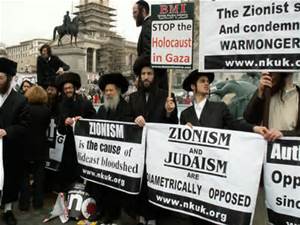
(Sunday Homily) Zionists Are Weeds in the Garden of Palestine

Zionists

The entire world stands aghast at the cruelty of Israel’s vicious and illegal collective punishment of Palestinian civilians for the perceived “crimes” of Hamas – the group of Palestinian resisters committed to the expulsion of illegal Zionist occupiers from the Palestinian homeland.

Today’s liturgy of the word implores the Zionists to abandon their butchery.

It also challenges Christians to denounce such ethnic cleansing and to withdraw the last vestiges of support for a group that more resembles their former Nazi persecutors than the “People of God” celebrated in the Hebrew Bible.

At the same time, today’s readings support rabbi Michael Lerner in cautioning Hamas against its policy of violent resistance. Though many of us would agree that Hamas’ tactics are understandable and often justified by principles of self-defense, today’s Gospel reading identifies them as counterproductive and ultimately harmful to the very people Hamas seeks to defend.

Instead, Jesus suggests that violent resistance should be replaced by greater reliance on more subtle and patient strategies. Such strategies are reflected in the three basic themes of today’s readings. They emphasize (1) the power of God expressed in leniency and forgiveness, (2) the futility of violent response to unwanted foreign presence, and (3) resistance that takes the form of patient trust that God’s forgiving power will prevail. In succession, the themes suggest challenges for Jewish Zionists, Palestinians, and Christians.

Begin with the first reading from the Jewish Testament’s Book of Wisdom. It is particularly relevant to Zionist Jews. The reading says explicitly that God’s power is not expressed in violence but in leniency to all, Jew and non-Jew alike.

That theme is repeated in today’s responsorial psalm with equal relevance to Zionists. There God is described as belonging to all nations. The divine Spirit, as Paul insists in today’s second reading, dwells within all humans regardless of nationality. It is slow to anger, good, forgiving, abounding in kindness.

From this, Jewish wisdom insists that the “People of God” must in turn be kind, lenient and forgiving to all – presumably even to their worst enemies. There is no room here for exceptions involving the indigenous tribal people of Palestine.

The second theme of today’s liturgy enjoys direct relevance to contemporary Palestinians. Whether they are Muslims or Christians (and many are Christians), they also recognize the Bible as the Word of God. I point to Palestinian relevance because this second theme addresses the question of resisting illegal occupation.

That is, Jesus’ parable of the weeds planted by an enemy in a landlord’s field can be read as addressing the Roman occupation forces encumbering Israel during Jesus’ lifetime. [According to John Dominic Crossan, Matthew’s allegorizing of Jesus’ parable – making it about the end of the world – is more reflective of the situation of the Jewish diaspora (following the destruction of Jerusalem in 70 CE) than of the actual revolutionary situation of Jesus’ own day.]

In occupied Israel, the suffocating Roman presence was as unwelcome, alien, and destructive as weeds in a garden or field. It was like the presence of basically European Zionist colonizers who have encumbered Palestinian land since their colonial invasion in 1948.

The question was how to deal with such odious foreign presence. Zealot revolutionaries had their answer: Uproot the weeds here and now. Take up arms; assassinate Romans and their collaborators; drive them out mercilessly. Be as cruel and vicious as the Romans.

Jesus’ response was different. As a non-violent revolutionary, he could surely understand the more apocalyptic strategy. After all, much of his teaching expressed sympathy to the Zealot cause which included land reform, debt forgiveness, and expulsion of the hated Roman occupation forces. Many scripture scholars even identify possibly five members of Jesus’ inner circle as Zealots themselves.

But Jesus’ Parable of the Weeds is more prudent and sensitive to civilian casualties than the strategy of the impatient Zealots – or that of Hamas.

When the landlord’s workers ask, “Should we uproot the weeds?” Jesus’ landlord answers: “No, if you pull up the weeds you might uproot the wheat along with them.”

In other words, Jesus agrees with El Salvador’s Oscar Romero and with Brazil’s Dom Helder Camara that revolutionary violence, though understandable (and justifiable on the grounds of just war theory), is imprudent at the very least.

This is because when faced with a vicious, overwhelmingly armed oppressor (like the Zionist state) resistance inevitably leads to state terrorism – to the war crime of collective punishment impacting women, children, the elderly and disabled. At the very least, that’s why Jesus eschews Zealot violence.

How then respond to illegal occupation like Rome’s in the 1st century or Israel’s over the last more than 60 years?

Jesus’ response? Be like mustard plant, he says. Be like yeast in flour. Both puzzling recommendations are relevant not only to Palestinians, but to Christians who wish to help their brothers and sisters in Palestine against the Zionists-turned-Nazis.

First of all think of the puzzlement that must have struck Jesus’ listeners. Jews didn’t have much use for yeast. They preferred unleavened bread. Neither would any farmer sow mustard seeds in her field or garden. The mustard plant was like kudzu – itself a kind of weed that eventually can take over entire fields and mountainsides while choking out other plants weeds or not. The mustard plant was unstoppable.

So Jesus is saying:

 * The Romans are weeds in your garden.
 * Don’t try to uproot them.
 * That will only lead to slaughter of the innocent.
 * Rather become weeds yourselves – like the mustard plant which is much more powerful than simple Roman (or Zionist) weeds.
 * Resist the Romans by embodying the Spirit of God that is slow to anger, good, forgiving, abounding in kindness.
 * Only imitation of Wisdom’s God can defeat the evil of imperialism.

What does that mean for Christians wishing to express solidarity with Palestinians against their cruel oppressors? At least the following:

 * Reject U.S. militarism in general as counterproductive, since fully 90% of the casualties it inflicts in war are civilians.
 * To bring about change, be instead like the yeast a homemaker puts into 60 pounds of flour, “infecting” the greater culture by non-violent resistance rather than seeking to destroy enemies.
 * Recognize the Zionists for what they are: an outlaw European “settler society” illegally occupying Palestinian land.
 * Take sides with Palestine’s indigenous tribal People.
 * Recognize them for what they are: “the Jews’ Jews” – treated by Zionists in the same way the Nazis treated Jews in Germany.
 * Petition the U.S. government to withdraw its support of Israel (more than one million dollars per day) unless the Zionists obey UN Resolution 242 and abandon the occupied territory while tearing down the odious Wall of Shame protecting the illegal Zionist settlements.
 * Support boycotts of Israel’s products by not buying them and by urging our churches and places of business to do the same.

Surely Jesus’ Way of non-violent resistance, forgiveness and love of enemies will strike many (non-believers and believers alike) as unrealistic. But according to the faith we Christians pretend to embrace, Jesus’ Way is God’s way.

But then perhaps we think we’re smarter and more realistic than Jesus — or God?

A Pope and a Pimp Went into St. Peter’s to Pray (Sunday Homily)

Pharisee_and_the_Publican
Readings for 30th Sunday in Ordinary Time: SIR 35: 12-14, 11-18; PS 34: 2=3, 17=18, 19, 28; 2 TM 4: 6-8, 16-18; LK 18: 9-14. http://usccb.org/bible/readings/102713.cfm

“A pope and a pimp went into St. Peter’s to Pray.” That’s the way scripture scholar, John Dominic Crossan, conveys the shock that must have been felt by Jesus’ audience when he opened this morning’s gospel parable by even joining the words “Pharisee” and “tax collector” in the same sentence. It’s like putting “pope” and “pimp” together. It jars the ear. And why would a pimp be praying at all?

Nevertheless, Jesus begins: “A Pharisee and a tax collector went up to the Temple to pray.” Customarily homilists use this parable to reinforce conventional wisdom about pride and humility. The Pharisee was proud, they say. The tax collector was humble. Be like the tax collector.

I however think there’s something much more challenging and fundamental going on in this parable. The focus of Jesus’ story is not pride vs. humility. It’s about rejecting the Pharisee’s conventional morality. The parable even calls us to scrap conventional wisdom about pride and humility.

More positively, the story is a summons to enter God’s Kingdom by identifying with the poor and despised. It also explains why the conventionally good simply cannot enter the Kingdom of God.

Let me explain.

Think in terms of popes and pimps. Popes are generally respected people. They’re religious leaders. Wherever they go, crowds flock around them just to get a glimpse, a blessing, or possibly even a smile or touch.

Pharisees in Jesus’s time enjoyed similar respect with the common people. Pharisees were religious teachers and textbook examples of conventional morality. They usually did what the one in today’s gospel said he did. They kept the law. The Pharisee in today’s reading was probably right; chances are he wasn’t like most people.

Generally Pharisees, were not greedy, dishonest, or adulterers. Or as their exemplar in Luke put it, he was not like the tax collector alongside him in the Temple. Pharisees gave tithes on all they possessed – to help with Temple upkeep.

On the other hand, tax collectors in Jesus’ day were notorious crooks. Like pimps, they were usually despised. Tax collectors were typically dishonest and greedy. They were adulterers too. They took advantage of their power by extorting widows unable to pay in money into paying in kind.

In other words, the Pharisee’s prayer was correct on all counts.

But, we might ask, what about the tax collector’s prayer: “O God, be merciful to me, a sinner?” A beautiful prayer, no?

Don’t be so quick to say “yes.”

Notice that this tax collector doesn’t repent. He doesn’t say, like the tax collector Zacchaeus in Luke’s very next chapter, “Look, half of my possessions, Lord, I will give to the poor; and if I have defrauded anyone of anything, I will pay back four times as much (LK 19:8). There is no sign of repentance or of willingness to change his profession on the part of this particular crook.

And yet Jesus concludes his parable by saying: ”I tell you, the latter (i.e. the tax collector) went home justified, not the former. . .” Why?

I think the rest of today’s liturgy of the word supplies an answer.

Look at those readings again. They’re all about God’s partiality towards the poor, oppressed, orphans, widows and the lowly – those who need God’s special protection, because the culture at large tends to write them off or ignore them. Typically, they’re the ones conventionality classifies as deviant. The Jewish morality of Jesus time called them all “unclean.”

However all of them – even the worst – were especially dear to Jesus’ heart. And this not because they were “virtuous,” but simply because of their social location. Elsewhere, Jesus specifically includes tax collectors (and prostitutes) in that group. In MT 21: 38-42, he tells the Pharisees, “Prostitutes and tax collectors will enter God’s Kingdom before you religious professionals.”

More specifically, in this morning’s first reading, Sirach says that the poor, oppressed, orphans, widows and the lowly are the ones Yahweh fittingly pays attention to. That same theme appears in the refrain we all sang together in today’s responsorial psalm, “The Lord hears the cry of the poor.”

As a result, those who simply belong to that category – the poor and oppressed – are “justified” in virtue of their social (non) status. The word “justified” means “made just” – or fit to enter God’s Kingdom where justice is the order of the day.

Similarly justified are the non-poor who imitate Sirach’s “God of Justice” by conscious identification with those considered “sinners” by the prevailing culture. Those who humble themselves in that way are like Sirach’s “God of justice” who hears the cry of the oppressed, the wail of the orphan, the prayer of the lowly. Or (again) as our responsorial psalm put it today: “The Lord hears the cry of the poor.”

But why would a good person like the Pharisee be excluded from God’s Kingdom? Does God somehow bar his entry? I don’t think so. God’s Kingdom is for everyone.

Rather it was because men like the Pharisee in the temple don’t really want to enter that place of GREAT REVERSAL, where the first are last, the rich are poor, the poor are rich, and where (as I said) prostitutes and tax collectors are rewarded.

The Pharisee excludes himself! In fact, the temple’s holy people wanted nothing to do with the people they considered “unclean.” In other words, it was impossible for Pharisees and the Temple Establishment to conceive of a Kingdom open to the unclean. And even if there was such a Kingdom, these purists didn’t want to be there.

Let’s put that in terms we can understand in our culture.

Usually rich white people don’t want to live next door to poor people or in the same neighborhood with black people – especially if those in question aren’t rich like them.

Imagine God’s Kingdom in terms of the ghetto. Rich white people don’t want to be there.

But ironically, according to this morning’s readings – according to Jesus – the “undesirables” who live there are the ones to whom the Kingdom of God belongs. They are the favorites of the God who Sirach says is “not unduly partial to the weak.” Rather God is fittingly partial to them as the Sirach reading itself and the rest of today’s liturgy of the word make perfectly clear!

This means that any separation from God’s chosen poor amounts to excluding oneself from the Kingdom white Christians spend so much time obsessing about.

So today’s readings are much more radical than usually understood. The parable of the Pharisee and the tax collector – of the pope and the pimp in St. Peter’s – is not an affirmation of conventional morality. It rejects such ethnocentric hypocrisy! Jesus’ parable is not even about approving conventional wisdom concerning pride and humility.

As always with Jesus’ teachings, it is about the Kingdom of God – about those who belong and those who exclude themselves.

In practice, this realization suggests for starters that:

• It’s no badge of honor to subscribe to conventional morality or conventional wisdom.
• Christians are called to be counter-cultural – more in solidarity with those we associate with pimps than with popes.
• For “Americans” this means discounting middle class morality and (white) “family values” as criteria of faith.
• According to Jesus, by itself such conformity actually excludes one from participation in God’s promised future.
• Instead authentic faith means living a life of solidarity with the poor – making their issues our own.
• Hence Christians should be in the forefront of movements on behalf of the poor.
• For example, rather than joining “devout Catholics” like Paul Ryan in leading crusades to cut back food stamp programs, we should be applying pressure to expand them.
• The same holds true for public housing, Medicaid, Social Security, and voting rights.

On Not Returning to Daddy: Heretical Reflections on the Prodigal Son (Sunday Homily)

Chelsea Manning

Readings for 24th Sunday in Ordinary Time: EX 32: 7-11, 13-14; PS 51: 3-4, 12-13, 19; ITM 1: 12-17; LK 15: 1-32. http://usccb.org/bible/readings/091513.cfm

A few weeks ago, Chelsea Manning (formerly known as Bradley Manning) was sentenced to 35 years in prison for blowing the whistle on the U.S. military and the officials who run it. In her job in Military Intelligence, Ms. Manning came across thousands of documents and videos exposing war crimes routinely committed by U.S. troops and their superiors. She released more than 700,000 of those documents in the hope that they would start a national dialog about the morality of the War on Terror. For her trouble, Ms. Manning was tortured for months. Following a court martial, she has been imprisoned instead of the criminals she reported.
_____

Last May, Edward Snowden, a data analyst working for Booz Allen Hamilton, the National Security Agency and the CIA, released a trove of documents revealing that the U.S. government has been spying on all U.S. citizens. Those spying on us have been secretly reading our e-mails and recording our phone conversations.

Such intrusion stands in blatant violation of the Fourth Amendment of the U.S. constitution which reads: “The right of the people to be secure in their persons, houses, papers, and effects, against unreasonable searches and seizures, shall not be violated, and no warrants shall issue, but upon probable cause, supported by oath or affirmation, and particularly describing the place to be searched, and the persons or things to be seized.”

Mr. Snowden released the documents to start a national conversation about the justification for secretly suspending such constitutional guarantees. For his trouble, he was threatened with arrest and imprisonment by the very agents whose alleged crimes he was exposing. Mr. Snowden is now living in Russia where he has been given temporary political asylum. His asylum has largely been justified by the fear that if returned to the U.S. he would suffer the torture and mistreatment inflicted on Chelsea Manning.
_____

Please keep the Manning and Snowden cases in mind as we reflect on today’s gospel selection.
_____

Didn’t we just recently read the Parable of the Prodigal Son at Mass?

I checked.

Well, yes, if you count the 4th Sunday of Lent less than six months ago. In fact, this famous story repeats so many times in our Liturgies of the Word that most of us know it nearly by heart.

Personally, I must confess a bit of boredom with the tale. It even crossed my mind to skip a homily this week, and simply refer my readers back to last Lent’s reflections.

But on second thought, allow me to take another shot at it with the Manning and Snowden cases as background. This time I’ll take my cue from John Dominic Crossan’s book The Power of Parable: how fiction by Jesus became fiction about Jesus. There Crossan suggests challenging Luke’s parable as excessively patriarchal. After all, the story is about a bad boy who realizes the error of his ways and returns home to daddy and daddy’s patriarchy with its familiar rules, prohibitions, and tried and true ways of doing things.

But what if the prodigal left home and never looked back? Would he have been better off? Would we be better off by not following his example as described today by Luke – by instead separating from the patriarchy and never looking back?

The French intellectual Andre Gide actually asked that question back in 1907 when he wrote “The Return of the Prodigal Son.” In his version, Gide expands the cast of the parable’s characters to five, instead of the usual three. Gide adds the father’s wife and a younger son. The latter, bookish and introspective, becomes the story’s central figure who escapes his father’s walled estate never to return.

According to Crossan, Gide tells his version of Jesus’ parable through a series of dialogs between the returned prodigal and his father, his older brother, his mother, and lastly, his younger brother. In his dialog, the father reveals that the older brother is really in charge of the father’s household. According to daddy, the brother is extremely conservative. He’s convinced that there is no life outside the walls of the family compound. It’s the older son who must be obeyed there.

For his part, the older brother, reinforces what the father said. “I am his sole interpreter,” the elder son claims, “and whoever would understand the father must listen to me.” In other words, the elder brother has owned the authority which the father has surrendered to him. (Doesn’t that sound a lot like the male hierarchy’s claims within the church in relation to the Bible? It’s also reminiscent of our government’s position regarding the Constitution. Our president’s interpretation is the only valid one.)

Then the mother comes forward. She tells the prodigal about his younger brother. “He reads too much,” she says, and . . . often perches on the highest tree in the garden from which, you remember, the country can be seen above the walls.” One can’t help detect in the mother’s words a foreboding (or is it a suppressed hope) that her youngest son might go over the wall and never come back.

And that’s exactly what the younger son decides to do. In his dialog with the returned prodigal, he shares his plan to leave home that very night. But he will do so, he says, penniless – without an inheritance like the one his now-returned brother so famously squandered.

“It’s better that way,” the prodigal tells his younger sibling. “Yes leave. Forget your family, and never come back.” He adds wistfully, “You are taking with you all my hopes.”

The younger son turns for the door. His brother cautions him, “Be careful on the steps . . .”

Gide’s version of Jesus’ parable makes me think of Chelsea Manning and Edward Snowden, and how in these pivotal times they have followed the youngest son in Gide’s parable as he goes over the wall into the unfamiliar realm of uncertainty, danger, and creative possibility.

In both cases, making that move required great courage. It meant escaping the safety and comfort that the confines of the patriarchy provide. Today Chelsea Manning sits in Leavenworth Prison in a far different “America” than the one she was trying to save. Snowden lives in exile in Russia without any hope of return to the country he too was attempting to help. In Manning’s case, leaving the father’s estate even meant transcending the patriarchy’s strict boundaries around sexual identity.

Because of the courage of Manning and Snowden we’re all better off and the patriarchy is weakened.

What does all of this mean for us as we reconsider Jesus’ overly-familiar parable in the light of Gide’s retelling? I think it might mean that we must:

• Be courageous and think for ourselves even about values seemingly endorsed by Jesus.
• See that patriarchy and male values of power, prestige, profit, individualism, competition, violence and war represent the roots of our world’s problems.
• Recognize that comfort in “our father’s house” is not good for us, our children or the planet.
• Do all we can to reject the patriarchy and its values and never look back
• Value people like Mr. Snowden and Ms. Manning as exemplary heroes showing us that it is indeed possible to leave “Our Father’s House” and its values for the sake of God’s Kingdom or however Snowden and Manning might understand the new reality to which they summon us.
• Appreciate the symbolic importance of Chelsea Manning’s rejection of military machismo in favor of the feminine world and its values of inclusion, community, and cooperation.
• Admit that our male-dominated church is a central part of the reigning system of patriarchal dominance along with its exclusively male understandings of God as Father. Act accordingly.
• Always be careful on the steps.

Jesus Would Have Supported al Qaeda Sooner than the U.S.! (Sunday Homily)

jesus  terrorist

Readings for 23rd Sunday in Ordinary Time: WIS 9:13-18B; PS 90: 3-6, 12-14, 17; PHMN 9-10, 12-17; LK 14: 25-33. http://usccb.org/bible/readings/090813.cfm

Did you have trouble with today’s gospel reading? I did. Frankly, it makes me wonder about Jesus’ attitude towards violence and armed attempts to overthrow foreign occupation forces like the Roman legions in Palestine – or American armed forces in Afghanistan or their authoritarian clients in Israel, Egypt, Bahrain, Yemen and elsewhere.

I wonder: whose side would Jesus be on in today’s War on Terrorism? I doubt it would be “ours.” Certainly, Jesus was not on the side of Rome. Instead, he was clearly sympathetic to Rome’s armed opponents. That makes me suspect that he would also have sided with those our own government deems “terrorists.”

What do you suppose that means for us and our politics?

Before answering, think about Jesus’ words in today’s selection from Luke. There Jesus is not telling us to love our enemies. He’s saying that we must hate! Yes he is. And the objects of our hatred must be our family members, down to our spouses and children. According to Jesus, we must even hate our own lives!

That’s pretty outspoken, hyperbolic, radical and edgy. In fact, his words make clear why the Romans and their Jewish collaborators in the Temple would have seen Jesus as an insurgent and terrorist. In any case, he was surely not the apolitical, domesticated preacher tradition later made him. He was not blissfully unaware of or uncaring about the searing resentment his people shared about Rome’s occupation of the land whose only sovereign in their eyes was Yahweh.

Yet Jesus’ words today also make it clear that he was not a violent revolutionary like the many other “messiahs” who sprang up in his 1st century context. As Reza Aslan points out, Jesus was not like Theudas, Hezekiah the bandit chief, Judas the Galilean, Menahem, Simon son of Giora, Simon son of Kochba and the rest.

Still today’s gospel makes it clear that there was genuine cause for concern about Jesus and his followers among the Romans and their Jewish clients in the Temple.

To begin with there were those “great crowds” Luke describes as following Jesus everywhere. In revolutionary situations, masses of people thronging about a charismatic troublemaker are reason for serious concern. According to U.S. standards under American Empire, it’s enough for local armed men in suspect locations to merely assemble to justify their being droned. And, of course, we know that at least some of Jesus’ disciples were armed (MK 14:43-52). Presumably others in the “large crowds” carried weapons as well. They would not have been viewed any more kindly by Roman occupation forces than their U.S. equivalents.

Then, listen to Jesus’ rhetoric as recorded by Luke. There’s all that talk about hating everyone near and dear to us that I already mentioned. That’s the second time we’ve encountered such language from the Prince of Peace in the last few weeks. Remember what we read a month ago about his coming not as a peacemaker, but to create division between children, their parents and in-laws? In MT 10:34 Jesus even said specifically that he had come to bring the sword. “I come not to bring peace” he said, “but to bring a sword.” If he actually said those words, how do you think they would have been understood by Roman and Temple authorities?

However, Jesus’ most dangerous statement this morning is the one about willingness to be crucified in order to qualify as his disciple. In occupied Palestine, those words had nothing to do with patiently bearing life’s inconveniences. No, in Jesus’ context, they could only be about opposing Rome and its Jewish collaborators.

Again, it is Aslan who reminds us that crucifixion was the mode of torture and execution the Romans reserved for insurgents. So in a Palestine where rebels were crucified almost every day (sometimes hundreds at a time), Jesus’ words could mean only one thing: his followers must join him in opposing Roman occupation of their Holy Land and in doing so virtually seal their fates.

But then comes the non-violent “catch.” Opposition to imperial occupation of the homeland might be the duty of every patriotic Jew, Jesus implies. But that doesn’t necessarily mean violent opposition. Calculate well, Jesus says – like a man building a tower. Realize whom we are opposing. We’re talking about Rome. Its legions can mobilize 20,000 well trained and heavily armed troops on a moment’s notice. At best we have less than half that number. To avoid suicide, we must “sue for peace” like a wise king threatened by a superior force. In other words Jesus counsels a prudent non-violence to avoid a bloodbath.

Bishop Oscar Romero made a similar recommendation to the revolutionary forces of El Salvador (the FMLN) in the 1970s. He said he could surely sympathize with the anger of the FMLN towards the United States and its puppet regime in El Salvador. He could understand why peasant farmers might see violent revolution as their only option in fighting brutal forces of “order” which wantonly tortured and murdered women, children, and the elderly, along with teachers, social workers, union organizers, priests, nuns, and other resisters.

No doubt Romero would say the same today about young Egyptians opposing the U.S.-supported military dictators in their own country, or about similar insurgents in the U.S.-controlled countries I’ve already mentioned.

But, Romero said, such violence is suicidal in the face of the billions in arms supplied such forces of oppression by the United States. Better to resist non-violently. At least then, the inevitable ensuing bloodbath (the modern equivalent of crucifixion) will be smaller in scope.

In 1st century Palestine, Jesus was not the only one employing such non-violent reasoning. According to John Dominic Crossan in his book, The Power of Parable, strong non-violent movements of resistance to Rome characterized Jesus’ context.

These movements were sandwiched between two epochs of extremely bloody opposition to Rome. The first occurred exactly in the year of Jesus’ birth, 4 BCE. That was the year the Roman client, Herod the Great, died. Jewish freedom fighters seized upon the resulting leadership vacuum as an opportunity to rise up against Herod’s Roman patrons. Jewish insurgents captured the city of Sephoris, the capital of Galilee. In response, the Romans razed the city to the ground and killed everyone who might be associated with the rebellion. Jesus’ family in nearby Nazareth was lucky to escape.

The second period of extremely violent resistance to Rome occurred about 40 years after Jesus’ crucifixion – just before the gospels of Mark, Matthew and Luke were composed. This time the Jews rose up against the Roman occupiers throughout Palestine. The Roman response? They utterly sacked Jerusalem itself, destroying its temple, and killing virtually all those who had heard Jesus’ words and witnessed his deeds.

In between those fierce chapters, Crossan says, there was a period of non-violent resistance to Rome. That’s when Jesus traversed Palestine and spoke so memorably about God’s Kingdom. According to Crossan, Jesus’ era represented a period of “massive, well-organized, unarmed, nonviolent resistance against Rome.”

That’s the probable context for Jesus’ shocking words this morning.

There’s so much more that could be said about all of this. To fill in the blanks, read Crossan’s book, along with Aslan’s Zealot, which recently topped the New York Times Best Seller list.

For today it’s sufficient to note the implications of Jesus’ shocking words. Personally, I’m so glad the church makes us face them. They show that Jesus was far more complex regarding violence than he’s usually made out to be. These difficult readings open a conversation that would otherwise be unthinkable.

Going forward, the conversation might well address the following questions:

• What difficulties do we have with realizing that Jesus situation vis-à-vis Rome was extremely similar to that of today’s “terrorists” vis-à-vis the United States and that Jesus himself was considered a terrorist?
• Is the “War on Terror” a real war or merely empire once again defending its right to plunder, torture, and kill with impunity?
• How is it that U.S. citizens end up supporting massive U.S. violence against “terrorists,” but that we find the latter’s much less injurious response (like the “Boston Marathon Massacre”) so horrendous?
• Put otherwise, how is it that U.S. citizens generally support the wars of their country which Martin Luther King described as “the greatest purveyor of violence in the world today,” while demanding pacifism on the parts of those whom the U.S. attacks.
• Do the ones our government calls “terrorists” have the right to defend themselves against what Edward Herman has termed the “wholesale terror” of the U.S. and its allies? (See his book, The Real Terror Network.)
• Which terrorists do we support – our government and its brutal military or their victims?

What other questions do the readings raise – for you?

How about my reflections?

(Discussion follows)

When the Government Turns Criminal: Edward Snowden and the Good Samaritan (Sunday Homily)

Snowden

Readings for 15th Sunday in Ordinary Time: DT. 30: 10-14; Ps. 69: 14, 17, 30-31, 34, 36-37; Col. 1: 15-20; Lk. 10: 25-37. http://www.usccb.org/bible/readings/071413.cfm

In his recent book about the parables of Jesus (The Power of Parable: How Fiction by Jesus Became Fiction about Jesus), John Dominic Crossan poses the question: What happens to your world when the “best” people act badly and only the “worst” do what is right?

That scenario seems to be playing itself out in the case of Edward Snowden.

Snowden, you recall, is the NSA contractor and CIA employee who last month disclosed a vast secret program of U.S. government spying on its own citizens and on individuals, corporations, and governments throughout the world.

The program (Prism by name) seems to violate the Fourth Amendment of the U.S. Constitution which reads: “The right of the people to be secure in their persons, houses, papers, and effects, against unreasonable searches and seizures, shall not be violated, and no Warrants shall issue, but upon probable cause, supported by Oath or affirmation, and particularly describing the place to be searched, and the persons or things to be seized.”

Snowden made his disclosures three months after James Clapper, the Director of U.S. intelligence had denied its existence in testimony (under oath) before the Senate Committee overseeing the U.S. intelligence program. Snowden’s disclosures also followed hot on the heels of President Obama’s publically expressed concern that China was illegally spying on the U.S. in exactly the same way (though on a smaller scale) that the U.S. turns out to have been spying on China and its own allies.

For his troubles in exposing such lies, hypocrisy, and violations of the Constitution, Snowden himself has been designated a spy, traitor, and enemy of the United States – categories applied to its worst enemies. As a pariah in his own country, he has fled the United States and sought asylum in various countries including China, Russia, Cuba, Nicaragua, Venezuela, Ecuador, and Bolivia. Snowden (and human rights organizations such as Amnesty International) alleges that if extradited to the U.S. he is unlikely to receive a fair trial, but instead to be tortured and indefinitely imprisoned like other whistleblowers such as Bradley Manning.

All of the countries just mentioned have histories less-than-friendly to U.S. interests, which they have each described as criminally imperialistic. Other “good” countries such as France and Germany have (under great pressure from the United States) refused Snowden asylum.

Meanwhile, James Clapper has not been charged with perjury, and President Obama has managed to deflect attention away from constitutional violations to the search for the fugitive Snowden.

In other words, the Snowden Affair presents us with a “Spy,” “Traitor,” and “Terrorist Sympathizer” obeying his conscience in his exposure of government crime. He has done the right thing. Meanwhile, the President of the United States, himself a constitutional lawyer, has been caught violating the Constitution, and the Director of Intelligence has been exposed as a perjurer. And on top of that, friendly countries often lauded by the United States as models of democracy refuse to respect International Law governing asylum seekers. Only the “bad countries” are willing to honor that law.

In this situation, the question Crossan posed earlier finds uncomfortable relevance: “What happens to your world if a story records that your “best” people act badly and only your “worst” person acts well?”

As I said, Crossan asks that question in the section of his book commenting on “The Good Samaritan” which is the focus of the gospel selection in today’s Liturgy of the Word.

The parable, of course, is very familiar. Almost all of us know it nearly by heart. Typically sermons find its point in simply calling us to be “follow the Samaritan’s example, treat everyone as your neighbor, and help those you find in trouble.”

That’s a good point, of course. But Jesus’ own intention went beyond simply providing an example of a good neighbor. More profoundly, it focused on the hypocrisy of “the good” and the virtues of designated enemies. As such, the story calls us to transcend those socially prescribed categories and look at actions rather than words of both the “good” and “bad.”

More specifically, the hero of Jesus’ story is a Samaritan. According hero status to such a person would be unthinkable for Jesus’ listeners. After all, Samaritans were social outcasts belonging to a group of renegade Jews who (by Jesus’ time) had been separated from the Jewish community for nearly 1000 years. They had also polluted the Jewish bloodline by intermarrying with the country’s Assyrian conquerors about 700 years earlier.

Jews considered Samaritans “unclean;” they were traitors, enemy-sympathizers, heretics and even atheists. They rejected Jewish understandings of Yahweh and the Temple worship that went along with it.

And yet in the story, Jesus finds the Samaritan to be more worthy, more pleasing in God’s eyes than the priest or Levite. That’s because the Samaritan’s actions speak much louder than the word “Samaritan” would allow. He is compassionate; so Jesus approves.

In the meantime, the priest and the Levite lack compassion. Their actions condemn them.

They say that slightly more than 50% of the American people think Edward Snowden is a traitor and spy. And this despite the fact that his accusers have advanced no evidence to that effect – and despite polls that indicate a solid majority believing that the government’s surveillance program is objectionable if not clearly unconstitutional.

Today’s parable invites us to reconsider – not just Snowden, but our very understanding of the world and its categories of “good” and “evil.”

Perhaps we’re looking for the real criminals, traitors, spies, and terrorists in exactly the wrong places.

Jesus before Pilate: His heroic refusal to name names

Readings for “Christ the King:” Dn. 7:13-14; Ps. 93:1-5; Rv. 1:5-8; Jn. 18:33b-37 http://www.usccb.org/bible/readings/112512.cfm

This is the feast of Christ the King. In today’s gospel reading, Jesus declares his kingship during his interrogation before the Roman governor, Pontius Pilate. Standard interpretations of the scene (such as in Mel Gibson’s “The Passion of the Christ”) present Pilate as a spiritually sensitive seeker.  It seems that Pilate had some appreciation of Jesus’ innocence and was trying desperately to free him from the rabid hatred of his Jewish adversaries.

So Pilate’s questioning of Jesus takes on a theological tone. His questions though arrogant are intellectual almost gentle and respectful. They seem sparked by genuine curiosity. Pilate asks, “Are you the king of the Jews?” In the end Pilate ponders the imponderable, “What is truth?”

The standard account goes on to say that only his personal weakness causes the Roman procurator to have Jesus scourged – to appease the fanatical Jewish leaders demanding Jesus’ blood. Yes, he was weak, but in the end the Jews were the ones principally responsible for Jesus’ death.

That’s the familiar picture: Pilate the intellectual, spiritually sensitive, looking for a way to set Jesus free, but too weak to assert his authority in the face of powerful and hateful Jewish leaders.

Problem is, the picture is profoundly at odds with the historical record. It also ignores the real reason representatives of empire engage in interrogation. As for the procurator’s personal character, Philo, Flavius Josephus, and Tacitus, tell us that Pontius Pilate was an absolutely brutal man. He had no fear of Jewish leaders. He despised them. In fact he took pains to provoke them. For instance, he knew the Jewish prohibition against idolatry and the making images, and yet he routinely paraded through the streets of Jerusalem statues of the Roman emperor who claimed to be a God. On several occasions, Pilate had his soldiers enter the Jerusalem Temple itself provocatively profaning it by their very presence.

No, Pilate was brutal. And his questioning of Jesus in today’s gospel had nothing to do with theological interest. He cared not at all for Jesus or establishing innocence. Quite the opposite. Pilate was just doing his job. If the questioning actually took place at all (and it’s doubtful that it did), it was at the hands of an imperial administrator doing what administrators do in all such circumstances from first century Jerusalem to twenty-first century Kabul. They arrest, interrogate, torture, and execute.

After all, Pilate had in his presence a man identified by local informants as a terrorist. In fact, this one (like innumerable others Pilate had questioned) claimed to be King of the Jews – obviously an insane “rival” to Caesar. What a laugh – an uneducated laborer from Nazareth!  So Pilate would have been all about arresting this “militant,” interrogating him for information about accomplices, torturing him when the initial interrogation failed, and then butchering the fool.

Moreover Jesus’ silence before Pilate had nothing to do with humility. It was instead about Jesus’ refusal to name his accomplices. So the torture began. To humiliate him, the soldiers stripped him naked – again, standard operating procedure then and now. For the soldiers this was fun.  No doubt they made crude jokes about Jews and circumcision. (Do you hear echoes of Abu Ghraib here?)

Still Jesus said nothing. So they beat him nearly to death. Thirty-nine lashes (almost no one survived that). And yet Jesus refused to name names. So they gave him the “crown of thorns” treatment. It was like water-boarding today. Still nothing – no names. It was entirely heroic on Jesus’ part.

Then they applied the final torture – the “third degree” following the first two: the scourging and “crown of thorns.” This was the ultimate torment reserved for insurrectionists – crucifixion. They’d send a detachment of soldiers to copy down any final disclosures. But Jesus said nothing to help them. His silence and acceptance of suffering and death literally saved his friends. They had been disloyal to him, explicitly denied him; they had been cowardly and weak. They had sinned against Jesus. Yet he gave his life for them. His friends would never forget that. Jesus’ heroic death saved them from their sins. It saved them from Pilate.

However, the truth is that Pilate was probably not aware of any of this. He was used to applying the third degree. The record shows he had crucified literally thousands in his time. A lot of them had claimed to be messiahs sent from God.  For him executing such delusionaries was no big deal. In fact, scripture scholar John Dominic Crossan suggests that Pilate took no notice at all of Jesus. The whole world was not watching, Crossan says. Jesus wasn’t even a blip on Pilate’s screen. The “trial before Pilate” was probably pro forma at best – possibly even a fabrication of the early church to shift blame for Jesus’ death from the Romans to the Jews. After all, by the time John wrote his gospel in the final decade of the first century, Christians were anxious to court favor with Rome. In the meantime, they had been excommunicated from Judaism, and had nothing to lose by alienating Jews.

Strange then that we should be celebrating Jesus as a king today who became a victim of torture and extra-judicial capital punishment. But that’s really the point. I mean our faith tells us that Jesus was the kind of king who reigns in the Kingdom of God where everything is turned upside-down.  Jesus’ kingdom, God’s Kingdom, is truly not of this world. For instance, Jesus says, its citizens don’t respond to violence the way empire or the kingdoms of this world do. Its ethic is not an eye for an eye and a tooth for a tooth. Or as Jesus put it, “If my kingdom were of this world, my followers would be fighting to keep me from being handed over . . . .“  No, in the Kingdom of God non-violence reigns. And in his behavior before Pilate, Jesus himself shows the way.

As for the personal character of Jesus’ kingship . . .  God’s head of state is not what at all what the world expected. In the eyes of Roman imperialists, Jesus represented the dregs of humanity. He was a Jew – a people the Romans despised. He was poor and probably illiterate. He was unemployed and traveled about with slackers who had given up gainful employment. At least one of his companions (Simon the Zealot) was a self-declared insurrectionist. Jesus was known as a glutton, drunkard and companion of sex workers. And he was irreligious. The holy men of his own people had excommunicated him and accused him of being possessed by the devil.  Some king indeed!

And yet, according to today’s first reading from the Book of Daniel, this king as “Son of Man” will stand in judgment over all the world’s empires from the Egyptians to the Romans and beyond. According to today’s reading from Hebrews, Jesus’ blood is his “Red Badge of Courage.” It will be his ID card when he returns to judge and destroy the empires that routinely kill people like him. Paradoxically however, what destroys the empires in question is Jesus’ non-violence, his refusal to name names, his followers’ refusal to employ violence even to save their king, his own acceptance of death rather than retaliate.

What a mystery that is! And how difficult it is for us to accept and live by Jesus’ radical non-violence. We so believe in violence, force, guns, and bombs. However until we accept non-violence, we will, like everyone else, continue making this world a version of hell rather than of God’s kingdom.

How can we reverse our belief in violence and embrace Jesus’ alternative? What does non-violence look like in our families, in the workplace, in politics and economics?

(Discussion follows.)

Modern Scripture Scholarship and Its Search for the Jesus of History

What I call “modern scripture scholarship” refers to the essentially inter-disciplinary approach to the Bible that has developed over the last 400 years. To me it seems nearly criminal that the nature and results of this intense and fruitful study has been kept secret and not shared with the “faithful in the pews” who are perfectly capable of understanding its processes and conclusions.

In fact, not sharing this secret has driven many thinking people away from the church as they reject as fantastic and unbelievable the understandings of faith they accepted as children, but which seem incompatible with what they know about science and the world in general.

As our inroad to understanding this topic, let’s examine the distinction it makes between the Jesus of history and Jesus the Christ. “Jesus of history” refers to the prophet who was directly experienced by his community in Palestine for a short period around 30 C.E. (Common Era). “Jesus the Christ” refers to the identity Jesus assumed in the faith of the early Christian community, especially between the time of Jesus’ death (between 31 and 33) and the Council of Nicaea (325 C.E.), when Jesus’ identity as the unique Son of God was defined. As we will see, the Jesus of history is quite different from the Jesus of faith. (By the way, there is a wonderful PBS film series on this topic that I highly recommend, “From Jesus to Christ:” http://www.pbs.org/wgbh/pages/frontline/shows/religion/)

For starters, let’s try to understand how modern scholars got to the distinction between the Jesus of history and the Jesus of faith. It all began with the 17th century’s initiation of the Scientific Revolution. Galileo Galilei’s “Letter to the Grand Duchess Christina” set the tone. The letter responded to criticisms from the Vatican’s Holy Office of the Inquisition advanced in 1616 charging that Galileo’s theory of a heliocentric universe was “absurd in philosophy, formally heretical, and expressly contrary to scripture.”

In his response, the great astronomer argued that God is revealed in two ways, in Sacred Scripture and in nature. Sacred Scripture was written for simple folk, he said. Its statements are often ambiguous and metaphorical. They cannot be taken literally in every case. Even St. Jerome, Thomas Aquinas, and other master theologians, Galileo said, had recognized such truisms centuries earlier; they were not literalists. Galileo further reasoned that since it is frequently so difficult to ascertain the exact meaning of biblical passages, one must often resort to God’s revelation in nature to determine the truth. When God’s written word conflicts with natural revelation, the latter is to prevail, because it is clearer and less ambiguous.

Key milestones in subsequent biblical studies include the following (If some of the historical references are unclear, don’t worry, it’s not necessary to “get” them all; they are included here only for the sake of completeness):

–          17th century: Thomas Hobbes, Benedict Spinoza, and Richard Simon question the Mosaic authorship of the Pentateuch (the first five books of the Jewish Testament).

–          18th century: The “higher criticism” movement emerges. “Higher” biblical criticism dealt with issues of authorship and original intent, and with literary forms and their meaning. It is contrasted with “lower criticism” which confined itself to close examination and comparison of texts.

–          18th century: Herman Samuel Reimarus applies critical methodology to the Christian Testament. He concludes that very little is incontrovertibly factual.

–          1870s: Julius Wellhausen examines the Bible as a human document.

–          19th century: Albert Schweitzer, David Strauss, Ernest Renan, Johannes Weiss and others embark on the “Quest of the Historical Jesus.”

–          1893: Pope Leo XIII condemns higher criticism in “Providentissimus Deus.” He establishes the Pontifical Biblical Commission.

–          1940s: Joachim Jeremias and C.H. Dodd identify layers in the Christian Testament attributable to (1) Jesus, (2) the gospel authors, and (3) the early church.

–          1943: Pope Pius XII endorses the new biblical scholarship (“textual criticism”) in “Divino Afflante Spiritu.”

–          1st half of 20th Century: Protestant theological giants, Karl Barth and Rudolph Bultmann conclude that the quest of the historical Jesus had reached a dead end. Almost nothing can be known of the historical Jesus, they claimed. They and their followers concentrate their analysis and theology on 1st century post-resurrection proclamations about Jesus (kerygma).

–           1945: Apocryphal gospels (i.e. gospels other than Mark, Matthew, Luke and John) are discovered at Nag Hammadi (Upper Egypt).

–          1948-1956: Discovery of Dead Sea Scrolls in Palestine.

–          1970s: Discovery of Gnostic Gospels in a cave in Egypt. The texts date from the 2nd century.

–          1965: Second Vatican Council publishes its Dogmatic Constitution on Divine Revelation (“Dei Verbum”) embracing interpretations of Scripture that centralize the original author’s context and intent.

–          1968: The Latin American Bishops’ Conference meeting in Medellin, Colombia adopts liberation theology’s “preferential option for the poor” as a central tool for interpreting Sacred Scripture and as a guiding commitment for church practice.

–          1990s: Robert Funk, John Dominic Crossan, Marcus Borg, and other members of “The Jesus Seminar” develop criteria for identifying the actual words of Jesus as opposed to the inventions of the gospel authors and/or the early church including: (1) multiple attestation from independent sources;  (2) dissimilarity i.e. words or deeds attributed to Jesus that would be embarrassing to the early church [e.g. Jesus’ baptism at the hands of John and (especially) the crucifixion]; (3) coherence with acts or statements otherwise identified as authentically attributable to Jesus; (4) Semitisms; (5) sitz im leben (context) reflecting the circumstances of Jesus rather than of the early church, and (6) vividness of description.

Next Week: the significance of the events in the above timeline (P.S. I would love it if readers would submit questions concerning any of this. It would give me direction for future posts on this topic.)