Donald Trump: International Terrorist, Lunatic & Hypocrite

Trump @ UN

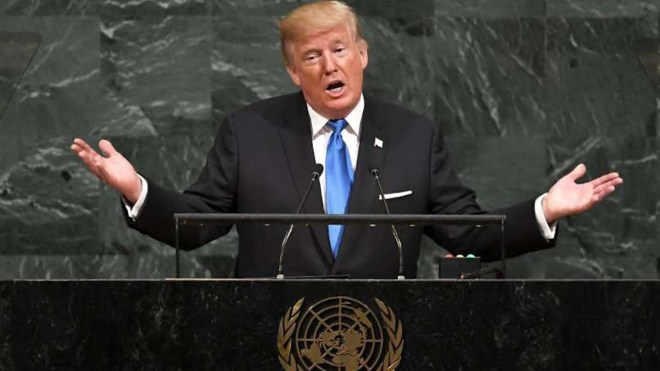
On Tuesday, (September 19th), Donald Trump delivered his first address to the United Nations. As we all know, the 42-minute speech included an unprecedented denunciation of North Korea. The president’s words were clearly aimed at intimidating not only the leadership of that country, but its impoverished population as well.

Besides blatant terrorism, there are two words for such intimidation.  One of them is absolute lunacy. The other is shameless hypocrisy.

But take terrorism first and foremost. According to the Federal Bureau of Investigation’s definition terrorism is a federal crime embracing any act “calculated to influence or affect the conduct of government by intimidation or coercion, or to retaliate against government conduct.” By his own admission, that was the very raison d’etre of Mr. Trump’s threats: to get North Korea to stop its nuclear weapons program and to retaliate for its weapons’ testing.

In his terroristic diatribe, the president claimed the right to “completely destroy” North Korea, a tiny country of 25 million on the edge of starvation. Such genocide would accomplish in an instant a holocaust at least four times as great as that perpetrated by Adolf Hitler.

Imagine being a citizen of North Korea and hearing the U.S. president’s bombast. Would you be terrified? Imagine if you were living in South Korea, as 35,000 U.S. military personnel do. Imagine if you were living in nearby Japan, where more than 40,000 U.S troops and their families are stationed. You’d be terrified.

And none of this is to mention Japanese and South Korean populations themselves, who happen to live in a region that is home to half the world’s population as well as to its largest militaries and most prosperous economies. The entire world should be petrified.

However, from the North Korean perspective, the speech represents only the latest in an endless line of such provocations long resisted by Pyongyang. The first, of course, was the Korean War itself which between 1950 and 1953 flattened the country and took nearly two million Korean lives. After that, North Korea has been the subject of endless sanctions and the target of annual war games that rehearse the country’s invasion, the decapitation of its leadership, and that actually drop dummy nuclear bombs.

Nevertheless, the Kim Jong Un regime has gone through the process of non-violent resistance. It has repeatedly presented its case to the U.N., but to no avail. Moreover, the country’s leadership has expressed a willingness to consider freezing its nuclear weapons program in exchange for a freeze on such military maneuvers on its border. The response of the United States has been complete rebuff.

No wonder Mr. Kim has defaulted to developing his nuclear weapons program. He needs no reminder of the fate of Saddam Hussein and Muammar Gaddafi who terminated their similar projects under U.S. threat.

In other words, though claiming that “all options are on the table,” dialog about Mr. Kim’s non-violent alternatives to nuclear war apparently is not. Rather than talk, Mr. Trump evidently prefers bombing – even nuclear bombing – in an area of the world that hosts 83 U.S. bases, and where authorities estimate that even a conventional artillery barrage from the North would kill 64,000 in the first three hours.

Besides terrorism, there are only those other two words for describing such violence –absolute lunacy and shameless hypocrisy. The lunacy is easy to see, and needs no elaboration. The evidence increasingly shows that we are currently governed by a madman. There is no other description for someone willing to kill 25 million people rather than dialog or compromise.

As for the hypocrisy . . . how can the only country ever to use nuclear weapons, and which is in the process of completely modernizing its nuclear arsenal demand that another country discontinue its nuclear program? Even a child can understand the contradiction of demanding that others do what the demanders themselves refuse to accomplish.

(Sunday Homily) North Korea: Jesus’ Plan for De-escalation

Kim Jong-un

Readings for 23rd Sunday in Ordinary Time: EZ 33: 7-9; PS 95: 1-2, 6-9; ROM 13: 8-10; MT 18: 15-20 http://usccb.org/bible/readings/091017.cfm.

“Meet the Press” and other news programs were abuzz last Sunday over the apparent testing of a hydrogen bomb by North Korea. In the aftermath, President Trump not only threatened nuclear war with North Korea (again!). He also harshly criticized South Korea for proposing to engage its neighbor in diplomatic talks. The president tweeted that such proposals would be fruitless, since North Korea “understands only one thing.”

So rather than talk, the president evidently prefers bombing – nuclear bombing – in an area of the world that is home to half the world’s population as well as to its largest militaries and most prosperous economies. He’s threatening nuclear war in a region that hosts 83 U.S. bases, and where authorities estimate that even a conventional artillery barrage from the North would kill 64,000 (including South Koreans and U.S. military personnel) in the first three hours.

Meanwhile, Kim Jong-un, of North Korea (like Trumps admired “friends,” for example General Sisi of Egypt, the Saudi princes, and Rodrigo Duterte of the Philippines) is, no doubt a repressive dictator who cares little for human rights. However, his development of nuclear weapons and repeated shows of force are not unreasonable. After all, he is exquisitely aware of what happened to Saddam Hussein and Muamar Gaddafi after they stopped similar programs. Like all North Koreans, he recalls his people’s history that saw his country invaded and flattened by the United States during the Korean War which cost 1,316,579 North Korean lives.

Even now, President Kim also feels that his country is encircled and under severe U.S. threat and provocation. Consider how we would feel if North Korea (or Russia or China) had 83 bases in Mexico, if its ships were constantly patrolling in the Gulf of Mexico, or if it were regularly dropping mock nuclear weapons on D.C. What would Washington do under such circumstances? Yet, mutatis mutandis, the United States has been provoking North Korea in exactly these ways for years.

What then would be a proper response to North Korea’s counter-threats?

Today’s liturgy of the word gives specific directions. There, Matthew the Evangelist addresses the problem of conflict resolution. He emphasizes dialog not revenge and violence. In fact, he outlines four alternatives towards resolving disputes even like the one between the United States and North Korea. He has Jesus say that if step one doesn’t work, move on to the subsequent strategies. The four alternatives include (1) healing conversation with one’s adversary, (2) arbitration with a mediator or two, (3) consultation with the entire community, and (4) shunning the offending party.

More specifically, Matthew has Jesus say, “If your brother sins against you, go and tell him his fault between you and him alone . . . If he does not listen, take one or two others along with you, so that ‘every fact may be established on the testimony of two or three witnesses.’ If he refuses to listen to them, tell the church. If he refuses to listen even to the church, then treat him as you would a Gentile or a tax collector.”

Obviously, these words did not come from Jesus himself. To begin with, there was no “church” at Jesus’ time. Jesus was thoroughly Jewish and a reformer of Judaism rather than the founder of some new religion or “church.”

It was different for Matthew who was writing for a community of specifically Jewish Christians some fifty years after Jesus’ death. By then, questions of community order within the emerging church had become prominent. So Matthew invents this saying of Jesus to deal with them.

Another reason for reaching this conclusion is the reference to treating a recalcitrant individual “as you would a Gentile or a tax collector.” This phrase reflects traditional Jewish avoidance of Gentiles and hatred of Roman collaborators. It runs counter to the practice of Jesus who time and again in the Gospels causes scandal by practicing table fellowship and community with the very people Matthew’s instruction indicates are outsiders to be shunned by believers.

Were Matthew following the Spirit of Jesus, the evangelist’s instructions for addressing conflict resolution might involve the following process: (1) private dialog with one’s adversary, (2) arbitration with a mediator or two, (3) consultation with the entire community, and (4) moving in with the offending party – or at least taking them out for dinner regularly.

In any case, the emphasis in Jesus’ own approach is communion, not shunning or refusal to talk. Nowhere does Jesus’ approach say that one should refuse meeting until the offending party stops offending. Much less does the process outlined include “if he refuses to listen, kill him and his entire people.”

“But,” you object, “The words attributed to Jesus in today’s gospel selection are about church order, not about international politics, much less the irrationality embodied in Kim Jong-un. Jesus’ instruction, you might say, is about private disputes among Christians and are laughably impractical in the political sphere.

And that’s just my point. To repeat: Matthew’s account does not reflect the teaching or practice of Jesus. Jesus’ actual teaching was not confined to the private realm. His practice was highly political.

Eating with tax collectors, street walkers, lepers, Pharisees, Gentiles (including members of the Roman army) represented doing the unthinkable, the unexpected, the forbidden. . .  It meant crossing boundaries, breaking taboos, acting counter-culturally, and offending people on all sides of sizzling debates.

This is what the example of Jesus calls us to do even in the case of North Korea. Its emergence calls for departure from business as usual. It requires admission of guilt and responsibility on the part of the United States. It demands a complete reversal of “American” policy.

Today’s second reading from Paul’s letter to the Christian community at Rome puts a finer point on the reasons for such response on the part of those pretending to follow the teachings of Jesus.

Paul reminds us of Jesus’ summary of God’s law. He writes:

“Brothers and sisters: Owe nothing to anyone, except to love one another; for the one who loves another has fulfilled the law. The commandments, ‘You shall not commit adultery; you shall not kill; you shall not steal; you shall not covet,’ and whatever other commandment there may be, are summed up in this saying, namely, ‘You shall love your neighbor as yourself.’ Love does no evil to the neighbor; hence, love is the fulfillment of the law.”

Emmanuel Levinas helps us understand that Jesus’ teaching on neighbor love is much more radical than commonly accepted. Loving your neighbor as yourself, Levinas says, does not mean “Love your neighbor because s/he is like you.” No, according to Levinas, it means, “Love your neighbor as yourself, because s/he is you.”

In other words, there is no meaningful distinction between you and any other human being you care to name – even if we call them “communists” or “terrorists.” Moreover, if you shared the same history as your “enemy,” you would be doing exactly the same thing that currently enrages you. As a result, no killing can be justified. It is suicide. That’s the thrust of Jesus’ words: to kill the other is to kill yourself. Killing of any kind is suicide.

What does that mean for followers of Jesus’ way in relation to North Korea? At least the following, I think:

  • Recognize and publicize North Korea’s willingness to enter dialog about a “freeze for a freeze.” That’s a reference to Kim Jong-un’s apparent willingness to halt development of his nuclear weapons program in exchange for the U.S. halting its war games off the North Korean coast and for stopping deployment of the THADD (terminal high-altitude area defense) anti-missile system in South Korea.
  • Actually enter into such dialog.
  • Freeze the U.S. nuclear weapons modernization program.
  • Discourage our children from serving in our country’s armed force that threatens the world with nuclear destruction.
  • Imagine what would happen if even a quarter of our country’s 160 million people who claim to be Christian refused the self-destruction the words of Jesus and Paul imply.

For Christ’s sake, Mr. Trump, do the unthinkable. Hard as it might be: repent. Listen to North Korea. Reverse course. How dare you threaten collective suicide!

“The Interview”: Dumb and Dumber Do Regime Change

Interview

Recently I spent an hour and 52 minutes watching “The Interview.” I expected having to grit my teeth through nearly two hours of anti-communist propaganda. After all the film was produced by Sony whose CEO, Kaz Hirai, sits on the board of the CIA think-tank, the Rand Corporation. According to investigative journalist, Tim Shorrock, Sony directly consulted the CIA about the screenplay. Langley gave specific approval to “The Interview’s” graphic assassination scene.

Nevertheless, I justified the apparent waste of time on the grounds that the controversy surrounding “The Interview” had made it a cultural event not to be ignored. President Obama’s initial belligerent remarks about Pyongyang’s (completely unsubstantiated) hacking of Sony’s corporate data seemed hasty to say the least. They had made an international incident out of the release of this light-weight comedy.

North Korea’s response, of course, was predictable. Like Cuba, it has for decades been the object of CIA attempts at regime change and sanction. And the hair-brained method proposed in the film for disposal of President Kim Jong Un was completely reminiscent of past CIA attempts on world leaders like Fidel Castro. Moreover, President Obama’s pivot towards Asia, especially with Okinawa bases under threat of expulsion from Japan, has necessitated a high-profile enemy in the region. And North Korea conveniently fit the bill as enemy du jour. No wonder its leadership felt threatened by what they saw as yet another CIA plot to foment rebellion.

As it turned out, however, “The Interview” came across as a more effective send-up of U.S. culture, politics and the CIA than an indictment of North Korea. Whatever the intentions of its producers, its basic take-away was this: U.S. foreign policy is run by provincials who have no understanding of the regimes they routinely attempt to change. Much less do they grasp those regimes’ historical and political contexts.

In fact, the political understanding of the film’s dumb and dumber protagonists, Seth Rogen and James Franco, is summarized in a single slogan repeated throughout “The Interview,” “They hate us ‘cause they ain’t us.”  That’s it – a completely ignorant and self-congratulatory level of analysis whose depth rivals Bush 43’s explanation of 9/11, “They hate our freedom.”

However, contrary to their expectations, Rogen and Franco discover in Kim Jong Un (as portrayed in the film) someone totally like them. He’s a frat boy, shallow, insensitive and entirely obsessed with sex, drugs, and American celebrity culture.

Moreover Jong Un’s crimes mirror those of the CIA itself.  That is, according to the Langley, the North Korean president’s policies are reprehensible because they starve his people, keep them under constant surveillance, torture his enemies, and threaten the world with nuclear weapons. He therefore deserves to die.

But as North Korea’s “dear leader” himself points out in the film’s climactic interview, those are the very crimes of which the United States itself is guilty – but on a much larger scale. The Americans, he observes, are not just responsible for starting the Korean War. Their decades-long sanctions on the country along with their unrelenting policy of regime change have attempted to create famine throughout the northern part of the peninsula.

Jong Un might have added that the U.S. is one of the world’s most egregious actors when it comes to cyber-warfare and that NSA surveillance hacks into private communications across the globe not just in a single place.  The U.S. also maintains torture sites world-wide; it has more prisoners per capita than any other country (including North Korea). It is the only nation to have used nuclear weapons, and is in the process of modernizing its entire nuclear arsenal.

This means that the decision to kill Kim Jong Un represents a subconscious act of self-destruction. Its logic actually justifies attacks on the United States, whose crimes (once again) mirror and dwarf those of the “international criminal” destroyed at the film’s conclusion. This makes the assassination a kind of suicide by proxy – an expression of a death-wish.

What I’m suggesting is that the film’s (so far) overlooked message is this:  They don’t hate us ‘cause they ain’t us; they hate us because we are us. And attacking us is far more justifiable than any attack on North Korea.

All of that makes one wonder about Kaz Hirai. Might he not be a double agent? Perhaps he has cleverly tricked the CIA into approving a self-parody that unwittingly makes a laughing stock of the organization’s criminality and idiocy.

Such satire represents the essence of “The Interview,” whether that’s intended or not.