Just so you know, and as if you care, here’s why I haven’t been posting much lately. I’ve just had my second knee replacement (last Tuesday – 4 days ago).
Happily, the recovery process is going even better than the first which occurred five months ago. I’m already walking without a cane. And the pain is under control without use of opioids.
But, of course, that doesn’t mean that I haven’t been thinking about what’s happening in our world. Like you, I’m horrified by Gaza, the genocide unfolding there; Ukraine, what’s happening in the South China Sea; identification of Russia, China, and Iran as our mortal enemies; D.C.’s absence of any diplomacy whatsoever, and its complete reliance on force, regime change, and terrorism . . .. That’s just a short list of concerns.
And the hell of it is that the United States is ultimately responsible for all of it. ALL OF IT!! As Dr. King put it, the U.S. remains “the world’s greatest purveyor of violence.” If our country fell off the map tomorrow, the world would be so much better off.
Think about it . . .. We have 4.2% of the world’ population; China has 18.5%; India slightly more; Africa too. Then there’s Latin America, and South Asia. And yet despite being an extreme minority, “we” claim the right to rule the entire world, to fill it with weapons, and to maintain more than 800 military bases across the planet. It’s racism. It’s arrogance. It’s criminal.
Meanwhile I’ve heard that the rest of the world’s countries combined have 70 bases outside their national boundaries. China has like one! It hasn’t fired a bullet outside its national territory in the last 40 years. Yet, our “leaders” want us to believe the China is somehow our enemy and the aggressor.
It’s enough to make sick anyone with a pulse and functioning conscience.
And now they’re talking about winnable nuclear war! Are they completely crazy? Of course they are. They’ll kill us all. And lest there be any doubt, I’m talking about the ancient white men who are making catastrophic decisions about our grandchildren’s (lack of) future.
Do they have grandchildren? Do they love them at all? Are they completely nuts?
And I don’t see it getting any better. How can it? For instance, our choice next November is between Genocide Joe and Dumb Donald Trump. Dimwit incompetents! Neither of them and virtually none of our politicians are in the same intellectual and diplomatic league as Putin or Xi. Jinping.
The truth is that our system of government is completely outmoded. It just doesn’t work. It’s frozen. It can’t do anything about the real issues except make them worse. I’m talking about global warming, the threat of nuclear war, genocide unfolding before our eyes, and improving the lives of ordinary people.
They don’t care!
Instead, they focus on what in the large scheme of things are ultimately non-issues: immigration, abortion, appropriate bathrooms, the war in Ukraine (which they provoked). Billions and billions for war, while “Americans” live under bridges and are imprisoned at rates that dwarf those of China or Russia.
What, after all, is Ukraine to us? I don’t get the obsession.
Have you seen our subways? Have you seen theirs? China has more than 25,000 miles of high- speed rail in country and have built hundreds of thousands of railway miles elsewhere. We have virtually none.
Their economies are growing and prospering. Their leaders have approval ratings north of 80%. And we’re stuck with Genocide Joe and Dumb Donald whose plans for making America great are to exclude immigrants like our great grandparents. Yeah, that will fix it all, I’m sure!
And get over it; there’s no question here about democracy vs. authoritarianism. We have two parties. That’s just one more than one. And both are in the hip pockets of the 1%. It’s a “uniparty” completely dedicated to the welfare of the politicians’ donors. They care NOTHING about us. Don’t be fooled.
Vote accordingly! There’s no future in what we have.
Here’s a video I made fully 9 months ago — at the end of July — about the Ukraine War. It elaborates the argument that I centralize in the homily below.
Readings for the 3rd Sunday of Easter: ACTS 2, 14, 22-33; PSALM 16:1-11; 1 PETER 1: 17-21; LUKE 24: 13-25
Our celebration of the resurrection myth, and of Life’s unlimited powers and possibilities continues for a third week. It invites thoughtful people to scan the list of contemporary events to identify where resurrection might be happening – where death is being defeated by Life’s overwhelming force.
With that in mind, today’s readings for this Third Sunday of the Resurrection suggest that we embrace resurrection as an unexpected new world order arising unperceived before our very eyes.
Could it be that it is surfacing at the hands of Russia, China., and other BRICS Plus nations?
That emerging order can remind attentive truth seekers that movement towards the entirely new and seemingly “impossible” arrangement that Yeshua referred to as the Kingdom of God is not only possible, but necessary. It’s required to draw our species back from the brink of annihilation habitually fostered by a necrophilic United States with its cult of bombing, sanctions, and threats of total annihilation.
Though it might be hard to endure, please let me show you what I mean.
U.S. As Enemy of Humankind
To begin with, resurrection calls us to face death. And in the context, I’m suggesting, we must face the fact that the entity most responsible for plunging the world towards omnicide is our own country.
The Sandinista hymn of the 1980s expressed that clearly when it denounced Yankee imperialism as the “enemy of humankind.”
With that shocking phrase, the Sandinistas were only echoing what in 1967 Martin Luther King had said about the U.S. when he identified it (not the Russians or the Chinese) as the world’s “greatest purveyor of violence.”
Even closer to our own time is Vijay Prashad’s description of NATO (of course headed by the United States) as the “machine that destroys humanity.”
Careful thought makes it difficult to deny the truth of such denunciations:
“We” are the most belligerent country in the world maintaining about 750 military bases across the planet – about 3 times as many as all other countries combined.
“Our” war budget is similarly unprecedented, outlandish, and grossly inflated to more than $2 billion per day.
“We” are the ones responsible for wars in Korea, Vietnam, Afghanistan, Iraq, Libya, Syria, Somalia, Yemen, Ukraine, and who know where else?
Besides all of that and on an unprecedented scale, “we” have intervened militarily and wantonly changed regimes across the planet for more than a century, especially where the regimes in question have tried to improve the lives of ordinary people rather than the bottom lines of American corporations.
“Our” country is the only one that has ever actually used nuclear weapons and has repeatedly and unilaterally opted out of arms control agreements.
With just 4.6% of the world’s population, the United States aspires to control countries like Russia, China, India, and the whole continent of Africa whose populations (not counting the rest of the Global South) total more than half the world’s inhabitants.
“America” is historically the world’s greatest polluter and is even responsible in large measure for environmental degradation in the Global South (including China), where U.S. corporations have largely relocated for the last forty years.
In summary, the U.S. has worked hard to ensure that it possesses the same control of the world that Hitler coveted for capitalist Germany.
Accordingly, it is easy to see how victims of such policies might well see the U.S. as the greatest purveyor of violence, as the enemy of humankind, and as heading a belligerent organization well characterized as the machine that destroys humanity.
Today’s Readings
Such stark realizations no doubt weigh heavy on the minds of once-proud “Americans” – if they even let them in. We might be like the two disciples in today’s Gospel reading. Like Americans with the historical consciousness just rehearsed, the two were sad and discouraged. For them, all seemed lost. They could think and talk of nothing else but their disappointment about Yeshua’s crucifixion and their frustrated hopes and convictions that he was the messiah their people had hoped would liberate them from Rome’s oppression.
But then amid their sad commiserations, the risen Yeshua somehow joins them. Improbably, the two men don’t recognize him. So, they recount the tale of their dashed hopes for the stranger’s benefit.
But then by breaking bread with them, Yeshua gets his friends to see the truth of what I said earlier – that death must precede resurrection. The old must die, he says, before the ultimately new can arise. Death and resurrection manifested in bread sharing are part of Life’s process – part of the divine “prophetic script.”
For us, and according to that blueprint, death of “America’s” preeminence must precede the New Life our world absolutely requires.
Hope from Russia & China
Still, prophetic script or not, if you’re like me, you remain discouraged by the awful realization of what our country has become. But where’s the resurrection hope to be found?
Strange to say, I see it in two great movements taking place before our eyes – one that’s violent with Russia as its protagonist, the other that’s non-violent and headed by China.
“What?” you might object. How can Russia’s invasion of Ukraine have anything to do with resurrection? The same might be asked about China and its authoritarianism we’ve heard so much about.
Though we might not be able to see the Ukraine War as “resurrectional” (Let me coin that word!) – as changing the world for the better, our brothers and sisters in the Global South can. That’s especially true if they adopt liberation theology’s understanding of “violence.”
You see, according to Global South church leaders like archbishops Dom Helder Camara and El Salvador’s St. Oscar Romero, all violence is not the same. Much of it isn’t even recognized as such. And a great deal of what we do denounce as violence is justified self-defense. For instance, most don’t even recognize international sanctions as violent. But they are. They kill hundreds of thousands.
Neither do mainstream commentators see regime change policies and coups as violence. But they are, especially when regimes that would prevent starvation are replaced by business-friendly governments concerned only with corporate profits.
According to this kind of analysis, Russia’s action in Ukraine is justified self-defense. It’s defense against a U.S.-led NATO’s attempts (since 1990) to reduce Russia to the vassal-like status of the west’s traditional colonies.
It’s no stretch to say that Russia’s resounding “NO” to NATO represents what most Global South countries would choose to shout at NATO if they had Russia’s military might. Arguably, that’s why so many from what we used to call the Third World refuse to condemn Putin or Moscow.
As for China’s non-violent movement towards the “other world” required by our times. . .. It’s enough to point out that China hasn’t bombed anyone in more than 40 years. Instead of dropping bombs on the poor, in effect its Belt and Road Initiative drops schools, roads, ports, high speed railroads, and other infrastructure on them. Like the risen Christ, it “breaks bread” as a sign of God’s presence. It has eliminated extreme poverty for almost one billion of the world’s starving. No wonder Latin America, Africa, and South Asia embrace Beijing and reject DC.
Conclusion
Let me hasten to conclude that I’d be among the first to admit that any war, self-defensive or not, can only be justified as a last resort. And it should justifiably shock anyone to find an alleged follower of the risen Christ lending anything like approval to armed conflict.
But then, it’s also true that most would-be Christians (me included) are emphatically not pacifists. Are you? They (we) fight wars against fellow Christians all the time – as exemplified in Ukraine itself.
However, in attempting to justify violence, one must ask several crucial questions as explained in today’s Sunday reflection. We must ask what kind of violence are we talking about?
Is it largely unperceived structural violence like that embodied in NATO, the machine that destroys humanity?
Is it the violence of self-defense as seems the case in Russia’s refusal (on behalf of the world habitually bullied by the U.S.) to submit to humiliating and suicidal surrender to the 4% attempting to impose its will on everyone else?
Is it the reactionary violence of that 4% to the second level of violence (expressed e.g., by the U.S. arming and advising Ukrainian proxies) to punish Russia’s “NO”?
Or is it the violence of state terrorism represented by all those wars and policies of regime change implemented on weaker (mostly non-white) nations over decades upon decades by the United States?
Of these, only the second level of violence can (reluctantly) be justified in any way.
Ironically, however, the other three are routinely accepted (even by people of faith). Meanwhile, the second level is usually vilified as somehow violating imperialism’s sacrosanct “rules-based order.”
The suggestion here has been that recognizing and accepting the distinctions just explained have something basic to do with resurrection. So does “breaking bread” with the hungry as a sign of resurrection and God’s presence. It’s all about the experience of death to old necrophilic practices and beliefs while recognizing newness of life and new world orders as unlikely manifestations of the risen Christ.
It’s easy for any of us to lose our way in “the fog of war.” I’m sure you agree. After all, most of us aren’t experts in matters Ukrainian. What do we know?
One way of dealing with such mystification is to remember some elementary principles and truisms that apply to all cases of international conflict including Ukraine and far beyond.
Let me review 20 of them. See if these help:
The United States (not Russia, China, or ISIS) is the world’s “greatest purveyor of violence.” Martin Luther King made that identification. By all measures (including weapons sales, “defense” budgets and involvement in ongoing wars), it remains true today. This realization might be enough to raise suspicions about “our” government’s position on Ukraine.
Might does not make right. A military force powerful enough to impose its will on weaker opponents is no indication of who’s right. This, of course applies to the United States as well as to Russia.
International laws should never be disobeyed. This principle the United States applies to its enemies (such as Russia in the Ukraine) but rarely to itself.
Wars are illegal unless they follow UN protocols. Please note that nearly every (if not all) of the myriad “American” wars since the end of the Second Inter-capitalist war have been illegal according to this standard.
Everyone is equal before the law. Obviously,, legal double standards are morally repugnant. For instance, the United States can’t deny the authority of the World Court when it’s invoked against itself and then turn around and invoke its authority against an “enemy” like Putin.
It is not logically permitted to lecture others to “Do as I say, not as I do.” In other words, law breakers lose moral authority to lecture others about the virtue of law abidingness. Every child can grasp this rule.
People in glass houses shouldn’t throw stones. The U.S. cannot condemn Vladimir Putin for his actions in Ukraine, when it’s doing and has done worse things in Yugoslavia, Afghanistan, Iraq, Libya, Syria, Somalia, and Yemen.
What’s good for the goose is good for the gander. If the United States can invoke its “Monroe Doctrine” to protect its Latin American “backyard,” a similar right must be extended to Russia and its perceived need for a buffer zone around its borders.
The one who delivers the first punch can’t prevent a counterpunch by claiming “Two wrongs don’t make a right.” I’ve even heard State Department officials adopt this defense when U.S. crimes are compared to those of designated enemies. [“Well, are you telling me that two wrongs make a right?” (Please don’t hit me back!)]
“Whataboutism” should be cultivated. It’s simply the informed art of making connections. That’s what I’m trying to do with this piece.
Without making connections, the world cannot be understood. We lurch from one crisis to another with no ability to understand.
Borders, nationality, and race are creations of the elite to control the rest of us. Imperialists have used these fictions throughout the history of colonialism. All three, borders, superstitions about national allegiance and the illusion of race have been used to divide, conquer, and rule — to know whom to bomb, to collect taxes, and create captive workforces forbidden to cross imaginary lines to better their lives. (To illustrate, imagine if there were no enforceable border line between Russia and Ukraine. How would Putin know whom to attack? Would there even be a Putin?}
Cultivate a long memory. This is another way of expressing the truism that those who forget history are bound to repeat its errors as we’re seeing with the coalescing dangers of yet another European war.
Follow the money. Because NATO requires its members to increase their “defense” expenditures, the military-industrial complex benefits from each additional affiliate. Could that be a factor in the campaign to increase NATO’s membership — including in Ukraine?
Follow the oil. Decommissioning the Nord Stream pipelines from Russia to Europe means new markets for U.S. liquified natural gas. Hmm. . ..
The CIA, the U.S. government, and the media which unquestioningly report their claims cannot be trusted. After all, CIA boss, Mike Pompeo admitted “We lie, we cheat, we steal all the time. In fact, we take entire courses. . ..” (See below, point # 20.)
If the U.S. favors a national leader, he’s probably a puppet or subservient client. This applies to U.S. creations such as Venezuela’s Juan Guaido and (on this principle) like Volodymyr Zelenskyy
If the U.S. opposes a national leader, he’s usually doing something right.The leader in question is probably somehow interfering with U.S. claims to world hegemony. Certainly Putin is doing that.
Non-white lives matter too – just as much as Europeans’ or Americans’. Again, it’s amazing how we’re led to clutch our pearls at the sight of thousands of Europeans (“who look and live like us”) as victims of war and as refugees while ignoring the far higher number of refugees and war casualties “we” produce every day among black and brown people.
Fool me once, shame on you; fool me twice, shame on me. Another Great Man (remember him?) tried to say that but failed. I wonder why he didn’t seem to understand. Do we?
Can you think of other applicable principles? If so, please share them.
Welcome to Episode 21 in this series called “A Course in Miracles for Social Justice Warriors.” My name is Mike Rivage-Seul, and I’m your host on this podcast.
Today we’ll focus on Lesson 13 of ACIM’s Workbook for Students. Its main idea is summarized in these words, “A meaningless world engenders fear.” That is, today’s lesson expands Lesson 12’s insight that “I am upset because I see a meaningless world.” Today’s instruction identifies the specific emotion aroused by meaninglessness. The emotion in question is fear.
Before we turn to that notion, let me remind you of our podcast’s general approach to A Course in Miracles. As I pointed out in episodes 3 and 4, we’re interpreting ACIM as though it was written primarily for U.S. citizens living in the belly of the U.S. empire that is the latest iteration of global domination embodied, for instance in Rome and the British Empire.
A Course in Miracle’s Historical context, authorship, language, and literary genre makes that clear. The voice of Jesus in ACIM is not the voice of the historical Jesus, but of a Christ addressing well-educated, well-to-do Americans far removed from the poor, uneducated, and mostly illiterate victims of empire the Jewish master addressed in the first century of our era. As well see later in much greater detail, ACIM calls Americans away from imperial values of individualism, competition, separation, domination, and patriarchy.
With that said, let’s turn our attention specifically to Lesson 13. It reminds us that the cause of our fear is our country’s loss of meaning. To repeat: Lesson 13’s main idea is “A meaningless world engenders fear.”
Such expression insists that although our national anthem identifies “America” as “the home of the brave,” we are in reality an extremely fearful people. In fact, ours is better described as “the home of the frightened.”
Today’s lesson 13 calls ACIM students to come to grips with the most profound reason for our fear. It’s because the meaning stories we were raised on have disintegrated before our eyes leaving us with a meaningless world. Understandably, we find that extremely unnerving.
As we’ve seen before, we once thought that:
Our country is the greatest in the world
We’re a Christian nation
God is on our side
We live in a democracy
Our politicians represent “the people”
Our wars are just
Our armed forces are invincible
Our soldiers are heroic
Law enforcement protects and serves us
None of these formerly self-evident statements any longer proves convincing:
As Dr. King pointed out, far from being the “greatest” in terms of virtue and goodness, our country is instead the world’s “greatest purveyor of violence.” As such, it is the root cause of most of the world’s problems.
This means that the God of Jesus is not our God; we are therefore not his followers; we are not “Christian.”
God is not on our side; we are not divinely favored. Instead, America is more like the Roman Empire responsible for the execution of Yeshua of Nazareth.
Neither is the United States a democracy. In fact, it never was. As Federalist Paper # 10 makes clear, the Founding Fathers specifically rejected democracy in favor of a republic where (as John Jay put it) “Those who own the country ought to govern it.”
And Jay’s imperative has been obeyed throughout U.S. history. This truism has been unmistakably underlined in the Citizens United SCOTUS decision. Its aftermath shows that politicians represent their donors rather than “the people.” (This is why a coal baron like Joe Manchin can defy the will of West Virginians on issues they overwhelmingly favor like Medicare for all, a $15.00 minimum wage, pharmaceutical pricing, family leave, and college debt forgiveness.
As for our wars being just, think about the lies that got us into Vietnam, Iraq, and Afghanistan.
Those same conflicts give the lie to convictions about the heroism of service in the U.S. military, whose personnel General Smedley Butler (already in the 1930s) implied are no better than brainwashed Mafia foot soldiers.
And just try to convince any black people you know that the police protect and serve them. Most would laugh in your face, if they didn’t burst into tears.
As pointed out in Lesson 12, A Course in Miracles itself can also engender fear. That’s because its relentless insistence that our favorite convictions (like those just mentioned) are 180 degrees opposite those of the divine order, can be extremely disorienting.
In the words of today’s lesson, “Recognition of meaninglessness arouses intense anxiety in all the separated ones” – that is, in everyone who sees herself or himself in competition and strife with fellow human beings. And that includes most of us.
And just whom is it that we Americans see ourselves in competition with? Largely, it’s with the poor, but ultimately, it’s with God.
Competition with the poor is evinced by that fact that (at least since the end of the Second Inter-capitalist War) ALL our wars have been fought against the impoverished identified as terrorists, communists, Muslims, and (as a Great Man once put it) “bad hombres.” (On this, please view the speech of the highly decorated ex-CIA operative John Stockwell.)
The real crime of the poor, however, is simply their poverty. It makes us afraid that they’ll rise and take our stuff [which our ancestors – and current wars – have taken from them (e.g., from Native Americans, from 250 years of enslaved Africans, in wars over oil, markets, water, raw materials etc.)].
Lesson 13 goes even further, however. It’s not only the poor we fear. It’s God we’re afraid of because (as the lesson puts it) “we think we’re in competition with God.” That is, we’re afraid of God whose primary function (we’re taught) is to legislate, judge, condemn, and punish. We’re afraid of this oppositional God. We might even say that he turns out to be not only our competitor, but an abusive enemy who threatens us all with eternal torture.
No wonder we’re upset. No wonder we’re all afraid. No wonder that we find all that questionable if not downright meaningless.
Lesson 13 asks us to face that discordant music. Again, it says, “A meaningless world engenders fear.”
Accordingly, the lesson asks us to spend 3 or 4 periods of no more than a minute each doing the following: “With eyes closed, repeat today’s idea to yourself. Then open your eyes and look about you slowly saying: ‘I am looking at a meaningless world.’ Repeat this statement to yourself as you look about. Then close your eyes and conclude with: ‘A meaningless world engenders fear because I think I am in competition with God.’”
As usual, I’ll fulfill this assignment today as well. Remember that specifically as North American inhabitants of empire, we are at this point in The Course attempting to clear our minds of common misconceptions that have encumbered and polluted our consciousness. With that uncomfortable task foremost in my mind, this is Mike Rivage-Seul wishing you well and God’s abundant blessings.
Black Lives Matter may represent the largest social movement in American history. So, it has a lot of powerful very scared.
Over the Memorial Day weekend, I had a couple of discouraging encounters with “liberal” opponents of Black Lives Matter. They had vague issues with the organization’s “funding,” “corruption,” “hypocrisy,” and “policy” such as defunding the police.
In one case, circumstances forced me to listen to a podcast of the type just mentioned. It was extremely critical of BLM – all in the name of independent thinking, balance, fairness, neutrality, and self-criticism. However, the liberals in question had no alternative to BLM. And so, in effect, they had joined forces with the right wing and status quo which gladly embrace such “fair-minded” liberals to keep blacks and browns in their place.
The syndrome is familiar. Any successful progressive organization or leader will be subject to such denigrations, personal attacks, “revelations,” and throwing the baby out with the bathwater. They did it to King; they did it to Gandhi; they did it to Jesus. It’s all an ancient right-wing strategy defending the putrid way things are.
Progressives have got to decide which side we’re on. Are we on the side of the victims of white supremacy or not? (And yes, contrary to the official story, there are victims in this world — victims of “our” policy!)
The truth is that if we’re not with BLM, we are against it. Why give and comfort to the fascists and make the perfect the enemy of the good?
Instead, support BLM. Join William Barber and Liz Theoharis in their Poor People’s Campaign.
What on earth are Joe Manchin and Kyrsten Sinema thinking by resisting the voting reforms of HR1 and the Pro Act? They’re allowing Republicans to fix all future elections. Face it: Manchin and Sinema are really Republicans. Contrary to post-election happy talk, the Democrats really don’t have control of the Senate. Manchin and Sinema should be primaried.
What we studied as U.S. history in school was in reality Confederate history – no true account of slavery, labor movements, women’s struggle for the vote, or indigenous slaughter.
And those Confederate statues? Imagine what we’d think if Germany celebrated Nazism like that — statues of Hitler, Goering, Himmler, Eichmann. . . You won’t find monuments like those in Germany, but you will find their equivalents all over this great country of ours.
And what’s with all this anti-Russian and anti-Chinese propaganda? Everything nefarious that happens especially in the fields of “cyber-attacks,” Covid-19, and election improprieties is “potentially” linked to China or Russia (and “reportedly” to their governments). Where’s the evidence? Don’t be fooled. It’s all CIA B.S.
Never forget what CIA head, Mike Pompeo, said about the CIA. He admitted that they lie, cheat, and steal all they time. The CIA offers its spooks entire courses on the topics. The CIA and its agents are not our friends. Never were.
Neither is the U.S. military. We shouldn’t be proud of it. Never forget what MLK said about our country. “It’s the greatest purveyor of violence in the world.” Should we be proud that our children are part of such a gang? Yes, it’s a huge gang.
At last count, “we’re” now fighting seven wars (Iraq, Afghanistan, Syria, Libya, Niger, Yemen, Somalia – and who knows where else?). Do any of us care? The people under our bombing attacks do.
Tell me: is it better to deal with terrorism by killing alleged terrorists in those countries just mentioned (along with their children) or with re-education camps like the ones our “leaders” are so outraged about in Northwest China? (Actually, we know nothing about those camps.) Think about that.
“We” maintain 800 military bases throughout the world. Do you know how many extra-territorial bases China has? One! One!!
We drop bombs on Muslims every day. China hasn’t dropped a bomb on another country in more than 40 years.
Why was apartheid in South Africa despicable, but not in Israel-Palestine?
The U.S. of A is exactly in the position that Hitler aspired to gain in the 1930s. We control the world by military might.
And long before Hitler, we had already sponsored our own Holocaust (slaughtering more than 100 million indigenous here). It started centuries before Hitler’s atrocious but small by comparison carnage.
Sad to say: it seems the world would be better off in so many ways without the U.S.of A.
Does the evidence show that the Sandinistas may well have been right in identifying us Yankees as the “enemy of mankind?”
Readings for Third Sunday of Easter: Acts 3: 15, 17-18; PS 4: 2, 4, 7-9; I JN 2: 1-5A; LK 34: 24-32; LK 24: 35-48
On April 4th, 1967, Martin Luther King famously called the United States “the greatest purveyor of violence in the world.” That was in his “Beyond Vietnam: a Time to Break Silence.” Delivered at New York’s Riverside Church, it was perhaps his greatest, most courageous speech. King’s words are worth reading again.
Despite the fact that U.S. soldiers had killed more than two million Vietnamese, (and would kill another million before the war’s end), King was excoriated as a traitor. Even the African-American community quickly distanced itself from their champion because of his strong words.
To this day, King’s speech is largely ignored as the daring truth-teller has been successfully transformed into a harmless dreamer – an achievement beyond the wildest dreams of the prophet’s arch-enemy, the FBI’s J. Edgar Hoover who considered King a communist.
One wonders what Rev. King would say about the U.S. today. For despite what the mainstream media tells us about ISIS, the U.S. remains exactly what Dr. King called it. It’s still the greatest purveyor of violence in the world – even more so. By comparison, ISIS is a pacifist organization.
Face it: absent the United States, the world would surely be a much better place. Even President Obama identified the rise of ISIS (our contemporary bete noire) as the direct result of the unlawful and mendacious invasion of Iraq in 2003. That act of supreme aggression (in the U.N.’s terms) is alone responsible for the deaths of well more than one million people.
And this is not even to mention the fact that our country is fighting poor people throughout the world – in Iraq, Afghanistan, Pakistan, Yemen, Somalia, Libya, Syria, and who knows where else? “Americans” claim the right to assassinate without trial anyone anywhere – even U.S. citizens – simply on suspicion of falling into the amorphous category of “terrorist.”
Can you imagine the terror any of us would experience if enemy drones constantly hovered overhead poised to strike family members or friends because some “pilot” six thousand miles away might judge one of our weddings to be a terrorist gathering? Can you imagine picking up the severed heads and scorched bodies of little children and their mothers for purposes of identification following such terrorist attacks? This is the reality of our day. Again by comparison ISIS beheadings are completely overshadowed.
I bring all of this up because of the Risen Lord’s insistence on peace in today’s gospel reading. As in last week‘s episode about Doubting Thomas, the Risen Christ’s first words to his disciples breathless from their meeting with him on the Road to Emmaus are “Peace be with you.”
Last week in their own homilies about that greeting, I’m sure that pastors everywhere throughout our Great Country were quick to point out that the peace of Christ is not merely absence of war; it is about the interior peace that passes understanding.
Their observation was, of course, correct. However, reality in the belly of the beast – the world’s greatest purveyor of violence – suggests that such comfort is out-of-place. We need to be reminded that inner tranquility is impossible for citizens of a terrorist nation. Rather than giving us comfort, pastors should be telling us that the peace of the risen Christ is not merely about peace of mind and spirit; IT IS ABOUT ABSENCE OF WAR.
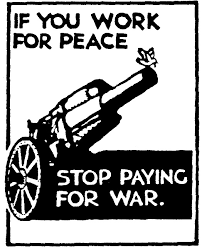
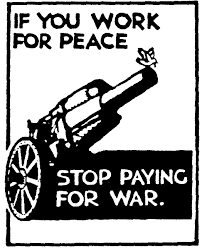
So instead of comforting us, Jesus’ words of greeting should cut us to the heart. They should remind us of our obligation in faith to own our identity as the Peace Church Jesus’ words suggest. More specifically, as Christian tax payers (having performed the annual IRS ritual last week) we should be organizing a nation-wide tax resistance effort that refuses to pay the 40% of IRS levies that go to the military. While it is absolutely heroic for individuals to refuse, there is safety and strength in numbers.
So an ecumenical movement to transform Christian churches into a unified peace movement of tax resistance should start today. All of us need to write letters to Pope Francis begging him to call his constituency to tax resistance – to call the UN and the U.S. Congress to stop the aggression.
Once again: there can be no interior peace for terrorists. And Dr. King was right: Americans remain the world’s greatest terrorists. We are traitors to the Risen Christ!
Focusing on a utopian interior peace while butchering children across the globe is simply obscene.
Readings for 4th Sunday in Ordinary Time: Deuteronomy 18: 15-20; Psalm 95: 1-9; I Corinthians; 7: 32-35; Mark 1: 21-28
Today’s readings once again raise the central biblical question of prophets and prophecy.
We should read them carefully remembering that prophets are not fortune tellers focused on the future. They were and today remain social critics focused on present injustices committed against the original beneficiaries of Life’s covenant with Moses – the poor and oppressed (widows, orphans, and resident aliens). Insofar as they predict the future, the prophets’ threat is usually that neglect of the poor will lead to national tragedy.
Yeshua the Christ, of course, appeared in the prophetic tradition which is always confused by the fact that the Great Mother’s spokespersons are inevitably contradicted by their fake counterparts. This Sunday’s readings highlight that point.
Prophets Then
I was reminded of all this last week during a Zoom “Talk Back” responding to our pastor’s Sunday sermon on the fictional story of the prophet Jonah. That tale was centralized a week ago in the liturgy of the word. Towards the end, the pastor herself asked the question, “Who today is speaking the harsh truth that the Book of Jonah expressed?”
(As we saw last week the little Jonah parable (only 48 verses) is about a reluctant prophet who eventually has to face the fact that those imagining themselves to be the People of God (Israel) were quite the opposite. Meanwhile those whom Israel viewed as their corrupt enemies (Assyrians) were more responsive to God’s word.
In my own response to our pastor’s question, I observed “That would be like our hearing during the Cold War that Russians (communists) were more on God’s side than Americans. Today, it would be like being told the same thing about the Chinese or Muslims, or (worse still) al-Qaeda and other terrorist groups.”
Yes, that’s the way the Book of Jonah would have been heard in the middle of the 8th century BCE – as the Assyrian hordes massed on Israel’s borders ready to descend on “God’s People.” Eventually, they’d come (as Lord Byron would put it) “like the wolf on the fold.” They’d destroy the Northern Kingdom and take large masses of its people off to the Assyrian capital, Nineveh – as slaves. The book of Jonah dares to identify Assyrians as godly.
Imagine if some prophetic preacher today actually echoed Jonah saying, “You American exceptionalists believe that you’re especially pleasing to God. The exact opposite is true. In fact, your designated ‘enemies,’ Muslims, the Russians, the Chinese, and those you imagine as terrorists are actually God’s favorites.”
How hard would that be for Americans to hear?
Prophets Now
But (to answer our pastor’s question directly) there actually have been and are religious prophets among us who have said such things and who are saying them today. I’m thinking of Malcolm X, Martin Luther King, Jeremiah Wright, William Barber II, the Rev. Liz Theoharis, Dorothy Day, and even Pope Francis. Here’s what they’ve said in the name of God:
Malcolm X: “I’m not standing here speaking to you as an American, or a patriot, or a flag-saluter, or a flag-waver — no, not I. I’m speaking as a victim of this American system. And I see America through the eyes of the victim. I don’t see any American dream; I see an American nightmare.”
Martin Luther King: The United States is “the greatest purveyor of violence in the world today.”
Jeremiah Wright: “When it came to treating her citizens of African descent fairly, America failed. . . The government gives them the drugs, builds bigger prisons, passes a three-strike law and then wants us to sing “God Bless America“. No, no, no, not God Bless America. God damn America. . . as she tries to act like she is God, and she is supreme”
William Barber II: “. . . I, too, am an atheist. . . if we were talking about the God who hates poor people, immigrants, and gay folks, I don’t believe in that God either.”
Liz Theoharis: “Jesus led a poor people’s campaign.”
Dorothy Day: “Our problems stem from our acceptance of this filthy rotten system.”
Pope Francis: “This system is by now intolerable: Farmers find it intolerable; laborers find it intolerable; communities find it intolerable; people find it intolerable.”
Those are not voices most of us are accustomed to hearing as representative of a Christian message that has been completely dominated by right-wingers who have effectively silenced the political voice of the one Christians pretend to recognize as the greatest of all prophets. They silence Yeshua’s authentic voice by focusing exclusively on the fiction of American Exceptionalism and on personal “salvation.”
The Prophet Yeshua
Instead, the very life of Yeshua the Christ was highly political from start to finish. He literally embodied God’s prioritization of the needs of the poor while specifically condemning the rich and powerful of his day. That’s why he had to be assassinated at a very young age — same as Malcolm, Martin Luther King, Fred Hampton. . .
Think of it this way: Isn’t it true that Christian belief holds that Yeshua was the fullest revelation of God? If so, isn’t it therefore significant that the revelation site supposedly chosen by God was a poor man from the working class? Isn’t it theologically meaningful that he was born out-of-wedlock to a teenage mother (LK 1:34), was houseless at birth (LK 2:7), experienced immigrant status as an asylum seeker (MT 2: 13-15), traveled with a band of young people who had no visible means of support, was thought insane by his mother and close relatives (MK 3:21), was identified as a terrorist by the most powerful nation then on earth, and finished a victim of its torture and capital punishment?
I’d say that believers should find all of that extremely revealing.
Moreover, the highly political Yeshua is reported to have made radical statements about wealth and poverty, e.g.:
“The Spirit of the Lord is on me, because he has anointed me to proclaim good news to the poor. He has sent me to proclaim freedom for the prisoners and recovery of sight for the blind, to set the oppressed free, to proclaim the year of the Lord’s favor” (Luke 4:16-22)
“Blessed are you poor, yours is the Kingdom of God” (Luke 6:20).
“Woe to you rich, you have had your reward” (Luke 6:24).
“It is easier for a camel to pass through the eye of a needle than for a rich man to enter the Kingdom of God” (Matthew 19:24).
“So therefore, whoever of you does not renounce all that he has cannot be my disciple” (Luke 14:33)
“If you want to be whole, go and sell your possessions and give to the poor, and you will have treasure in heaven; and come, follow me” (Matthew 19:21).
Still more, his followers took their teacher literally as they practiced a kind of primitive communism:
“All the believers were together and had everything in common. They sold property and possessions to give to anyone who had need” (Acts 2: 44-47).
“Now the full number of those who believed were of one heart and soul, and no one said that any of the things that belonged to him was his own, but they had everything in common” (Acts 2: 32).
All of that identifies Yeshua as a great prophet in the tradition of Moses, the liberator of slaves in Egypt, of Amos who defended the poor and criticized the rich, of Karl Marx, the last of the great Jewish prophets, and of the contemporary troublemakers listed above.
Today’s Readings
Keep all of that in mind as you review today’s liturgy of the word which centralizes the question, “Who are the true prophets among us?” What follows are my “translations.” You can find the originals here to see if I’ve got them right.
 Deuteronomy 18: 15-20:
 More than 500 years
 After the Great Prophet’s Death
 Moses was remembered
 As predicting the advent
 Of another Great One
 For a people deathly afraid
 Of hearing God’s voice directly.
 Problem was:
 There’d be false prophets too
 Claiming to speak
 In the name of Yahweh,
 But actually representing
 False gods
 Whom, if listened to
 Would bring to believers
 Severe punishment.
 (Hmm.
 Where does that leave us?)

 Psalm 95: 1-9
 It leaves us confused
 And in danger
 Of letting our own self-interest
 Harden our hearts
 To the authentic voice
 Of our loving Mother-Father God
 Our firm refuge
 Benefactor and guide.
 Her wonderful handiwork
 In creation itself
 Reveals more
 Than any prophet’s words.
 So, believe and embrace
 What you see
 With your own eyes.

 I Corinthians 7: 32-35
 The case of St. Paul
 Illustrates our confusion
 About what to believe –
 What our eyes tell us
 Or the words
 Of an anxious
 Celibate prophet
 Like Paul
 Who’s been interpreted
 To say that
 Eros is somehow “improper”
 And a huge “distraction”
 For anyone serious
 About what’s truly important.
 (For, doesn’t Life Itself teach
 That Eros is
 A primary source
 Of God’s revelation
 About the nature of Life
 And Love?)

 Mark 1: 21-28
 Jesus, on the other hand
 Had no such reservations.
 His followers believed
 Him to be the Great Prophet
 Predicted by Moses.
 He taught astonishing truths
 With authority and certainty
 Unlike the temple scribes
 (And the doubt-filled Paul).
 He terrified unclean spirits
 While delighting
 The (married) women and men
 Who hung on his every word.
Conclusion
The disparity between the nationalistic and exclusively personal understandings of the prophet Yeshua on the one hand and the highly political nature of his life and discourse on the other is extremely important to confront.
That’s because (as Caitlin Johnstone has recently reminded us) those who control cultural narratives control the world. And no narrative is more important to history’s control than the religious one we’ve just considered. That’s because religious faith addresses life’s most fundamental questions – the ones so thrillingly addressed by the prophets we’ve considered here: about the nature of life; our relations with one another, human connections with the environment, about foreigners, power, love, money, and justice.
I’ll even venture to say that religious story supplies the popular “philosophy” of most people in the world. It organizes their experiences. They might not know much about history, economics, or political parties, but they know what they’ve been told about the Bible, the Bhagavad-Gita, or the Holy Koran.
To ignore this truism is tragically to surrender an essential tool of social justice to its enemies. On the other hand, exposing the radical social justice character of the Judeo-Christian narrative while challenging its domestication by false prophets represents an essential element of any attempts to shape the world by controlling its narrative.
Even completely secular social justice warriors should take note.
Here in Connecticut, where we’ve been living these last three years, the non-denominational church that Peggy and I are aspiring to join is sponsoring a six-month “mindfulness dialog” on “Reimagining Religion.” About a dozen people are participating under the leadership of Danny Martin, a former Catholic priest and Thomas Berry scholar.
So far, I’ve found the whole experience both inspiring and a bit troubling. As I’ll explain below, the inspiration comes from a very thoughtful mindfulness dialog process itself. The trouble comes from the tendency of the process to overlook the proverbial elephant in the room in terms of contemporary political realities. Those realities have an imperial United States of America assuming exactly the international dominance to which Adolph Hitler aspired almost a century ago. In the prophetic spirit of the Judeo-Christian tradition, such development cannot be ignored or given second place by those wrestling with religion’s significance.
The Mindfulness Approach
To begin with, our approach to reimagining religion has three phases, connecting, exploring, and discovering:
Connecting involves our trying to pinpoint the human experiences that give rise to the religious impulse.
Exploring has us discussing that experience in the light of relevant texts such as poetry, essays or sacred scripture drawn from various traditions.
Discovering means answering the question, “What then must we do?”
In the connecting phase, we’re combing through our lives in terms of experiences of mystery, beauty, love, and oneness with nature. These, we’re finding, put many in the presence of the “mysterium tremendum” that evokes awe, reverence, adoration – and religious responses involving story and ritual.
The exploring stage has most turning to poetry and non-Christian texts in search of meaningful story. Participants seem to share the conviction that we need a “new story” to replace the one most of us have rejected. The latter was based on belief in an old white man in the sky. He evicted our first parents from their original paradise. He then sent his divine son to redeem sinful humankind so we might gain heaven and avoid hell. We need a better story; we all seem to agree.
As for discovery. . . Our whole experience has us thinking more deeply about changes in our lives based on loving family members and neighbors precisely as ourselves (because in some real sense they truly are us) and on reverence for nature.
That Troubling Elephant
My reservations about our approach so far concern our apparent reluctance to address what strikes me as the main God-related experience facing humankind today (at least in terms of the Judeo-Christian tradition).
That experience involves the worldwide oppression of the former colonies and their resulting experience of poverty, hunger, environmental destruction and war. That entire syndrome directly involves people like us, since our country, the United States of America, is principally responsible for the oppression just referenced. In the words of Martin Luther King, we are the “greatest purveyor of violence in the world.”
To ignore such realities is analogous to German Christians in the 1930s overlooking the rise of fascism with its imperial ambitions and immediate persecution of communists, socialists, Jews, people of color, Roma, homosexuals, the disabled and immigrants. I can imagine the irrelevance of German Christians in 1933 gathering in a church basement to discuss reimagining religion. How would we judge them in that context if they focused primarily on their interior and interpersonal lives while Germany was ablaze and about to set the world itself on fire?
Of course, not all German Christians did that. In fact, in the face of fascism’s rise and Hitler’s establishment of his Third Reich, Dietrich Bonhoeffer’s Confessing Church took on a project very like our own. As a result, just before his execution by the Nazis (for participating in a plot to assassinate der Fuhrer) Bonhoeffer in his Letters and Papers from Prison, advocated imagining “Christianity without religion.” That is, he wanted to reappropriate the faith of Moses and Jesus without the traditional trappings, rituals and language that narcoticized and blinded believers to the socio-political reality staring them square in the face.
The New Old Story
To my mind and in our analogous context, “connecting” should mean coming to grips with America’s role in creating the world that our system of political economy, neo-colonial ambitions, environmental devastation and militarism has set on fire. That in itself requires deep and serious study and discussion. It’s time to revisit official and competing stories of American history.
Then, “exploring” means linking the resulting new understandings with the authentic biblical narrative as revealed by modern scripture scholarship. Its relevance to the global circumstances I’m describing here is exceedingly clear. That’s because modern scholarship shows that the essence of the Judeo-Christian tradition does not centralize increasingly inapt Genesis mythologies. Instead, it tells a story of oppression and liberation that runs as follows:
Israel’s God first revealed himself by liberating slaves from Egypt.
He gave them a covenant to form a just community where widows, orphans, slaves and foreigners would be especially welcome.
Israel’s leaders often broke the covenant.
They were confronted by prophets who called them to task.
Repeatedly, Israel itself was victimized by surrounding empires – Assyria, Babylon, Persia, Greece, and Rome.
In such circumstances, they were promised a new future by prophets who denounced mistreatment of the poor and announced a new future of deliverance from imperialism.
Jesus appeared in the tradition of the prophets.
He proclaimed a future kingdom where a new covenant would be in force.
His teachings on God’s Kingdom described a world where God would be king instead of Caesar.
He thus raised the hopes of the poor and the ire of the Jewish and Roman authorities.
So, they executed him.
His followers became convinced that he was somehow raised from the dead.
They formed a Kingdom community of faith, sharing all things in common.
Questions of the afterlife were left in God’s hands.
In the light of this narrative, answering the question “What then must we do?” takes on highly political and threateningly controversial features that few outside the former colonies are willing to address. That’s because most even there who drew the obvious political conclusions about opposing empire have been assassinated by the current imperial power that is absolutely intolerant of anti-imperial faith.
A Reimagined Creed
In the light of truths like the foregoing, in Jesus against Christianity, Jack Nelson-Pallmeyer calls for reimagining fundamental Christian professions of faith such as the Apostles Creed. In concentrating on Jesus’ birth and resurrection, he says, they fail to honor the thrust of Jesus’ life towards resistance to domination systems, and identification with the poor and outcast.
But what forms would a reimagined creed take? Below are printed two responses to that question – the familiar Apostles Creed on the one hand and a reimagined form on the other. Personally, I find that the latter contributes mightily to our task of reimagining religion.
 The Apostles'Creed

 I believe in God, the Father almighty,
 Creator of heaven and earth, and in Jesus
 Christ, His only Son, Our Lord, who was
 conceived by the Holy Ghost, born of the
 Virgin Mary, suffer under Pontius Pilate,
 was crucified, died and was buried.  He descended
 into hell; the third day he arose again from
 the dead.  He ascended into heaven, sits at the
 right hand of God, the Father almighty; from
 thence he will come to judge the living and the
 dead. I believe in the Holy Ghost, the holy
 Catholic church, the communion of saints, the
 forgiveness of sin, the resurrection of the
 body, and in life everlasting.  Amen.

 A Reimagined Creed

 We believe in humankind
 and in a world in which
 it is good to live for all people
 in love, justice, brotherhood and peace.
 We must continually act out these beliefs.
 We are inspired to do so, because we believe
 in Jesus of Nazareth
 and we wish to orient our lives to him.
 In so doing, we believe that we
 are drawn into the mysterious relationship
 with the One, whom he called his father.
 Because of our belief in Jesus
 we make no claims to exclusivity.
 We shall work together with others
 for a better world.
 We believe in the community of the faithful,
 and in our task to be the salt of the earth
 and the light of the world.
 But all of this in humility
 Carrying our cross every day.
 And we believe in the resurrection
 whatever it may mean. Amen.
Conclusion
Whenever I think of it, I’m drawn to the conclusion that my entire adult life has been devoted to reimagining religion. I was encouraged in that endeavor by my study and teaching of Dietrich Bonhoeffer’s life and works. Whether we’re aware of it or not, Bonhoeffer’s represents the kind of prophetic faith our CT church group is trying to reimagine.
At the same time, I bear in mind the words and example of an outspoken mentor of mine during my graduate studies in Rome so many years ago. His name was Dan McGinn. Dan was about 15 years older than me. By his example, he taught me how to celebrate the Eucharist spontaneously and without written text.
In any case, Dan always said that if he were ever made bishop (There was absolutely no chance of that!) his episcopal motto under his coat of arms would read “No more bullshit.”
I’m tempted to recommend adopting Dan’s motto for ourselves as our church group tries to reimagine religion. While not exactly B.S., our traditional forms of belief (even the Apostles’ Creed) have been rejected as such by much of our world. Hence the relevance of our task.
What I’m suggesting here is that reappropriating the biblical story cited above and reformulating our creed accordingly would go a long way towards the culturally imperative assignment of making our faith relevant to the undeniable resurgence of fascism in our contemporary context.
Just in case readers might have forgotten: my project in this series of reflections on the occasion of my 80th birthday is to illustrate Richard Rohr’s observation about human growth in terms of the “three boxes” into which, he says, everyone’s personal growth trajectory more or less fits. According to Rohr, if we’re lucky, the first part of life is characterized by order, the second by disorder, and the third by reorder. In those terms, I’ve been very lucky.
I’ve tried to illustrate that luck in previous entries in this series. There I briefly described how I mostly benefitted from a highly ordered life starting in a very Catholic household with loving parents. Those years included nine years of education in St. Viator’s Catholic school on Chicago’s northwest side. Then, I shipped off at the age of 14 for a monk-like, highly regulated existence in a seminary preparing teenagers for a life of celibacy and service to God. In St. Columban’s minor seminary in Silver Creek, New York, we were already being shaped to convert what we understood as pagans in foreign missions like Korea, the Philippines, Burma, and Japan.
So far, my story has taken me from my family home in Chicago and subsequently in Warrenville, Illinois to that seminary in Silver Creek. From there I attended a corresponding college seminary in Milton, Massachusetts. I then completed a novitiate-like “spiritual year” in Bristol, Rhode Island. That was followed by four years of “graduate” scripture and theological studies back in Milton. Then finally, following my ordination in 1966, I completed my formal education with five years of doctoral studies in Rome, Italy. By then, I was 32 years old.
When I left my story off, I was in the middle of telling about those halcyon years in Rome.
My hope is that sharing such reflections might help me better understand my own journey as I enter my ninth decade. In the process, it would be wonderful if readers would also be stimulated to similarly examine their own transitions from order to disorder and hopefully to the ongoing process of reorder.
In any case, I want this particular blog entry to help me (and anyone mildly interested) better understand my own political development. Recounting its story will stretch me far beyond Rome to most of western Europe. It will then take me to more than 40 years of teaching (and learning!) at Berea College in rural Appalachia. Sabbaticals and other travel opportunities sponsored by Berea ended up peppering my journey with subsequent long stopovers in Brazil, Nicaragua, Costa Rica, Guatemala, Honduras, Zimbabwe, South Africa, Israel, Jordan, Egypt, India and Cuba. At each of those stops, I learned political lessons that have informed and shaped my life. I’ve been lucky indeed.
But let me begin at the beginning.
My parents were basically apolitical. As a truck driver, my father was a Teamster Union member, but he never betrayed any corresponding political consciousness. (I just remember that he didn’t like paying union dues.) My mother sometimes spoke of her preference to “vote for the man, not the party.” Together, both mom and dad claimed to be Independents rather than Democrats or Republicans. However, their leanings were clearly towards the GOP.
Apart from that, my first recollection of a significant political thought came when I was a freshman in the high school seminary (1954-’55). We were off at some sort of day of recollection at a nearby rival seminary. And older priest (I’ll bet he was about 50!) was onstage giving a keynote address. In its course, the old man remarked for some reason that the dropping of atomic bombs on Hiroshima and Nagasaki (a decade earlier) amounted to the most heinous crime in human history.
I was completely shocked. At the time the McCarthy hearings were in full swing. Anti-communism was in the air. I wondered, “Why would a priest say something so unamerican? Was he perhaps a communist? Surely no priest could be a communist.”
My question was framed like that because at the time, anti-communism was in the very air all Americans breathed. After every Mass, we all offered specially mandated extra prayers “for the conversion of Russia.”
The sentiment invaded our minor seminary with a vengeance. The Columban Fathers had just been expelled from China by the 1949 Communist revolution. So “Old China Hands” returning from “fields afar” addressed us frequently about their experiences with such evil incarnate. They told us that the communists hated the Virgin Mary and her rosary. That was enough for any of us. Nothing could be eviler than that.
I remember that during one study hall on May 2, 1957, one of my most admired teachers who was monitoring the session came by my desk and whispered, “A great man died today.” He was referring to Wisconsin Senator Joseph McCarthy.
Politically speaking, that was the world I grew up in. I had no idea what communism was other than an anti-God, anti-Mary worldwide conspiracy by absolutely evil people.
Again, cut off as we were from the news and unexposed to any historical information other than that conveyed in standard (boring) history books, no wonder my political formation was so narrow. Everyone’s was.
It was also no wonder that when I cast my first ballot for U.S. president (1964), I voted for Barry Goldwater. I did so not only because of strict “American” indoctrination, but also because I greatly admired my mother’s brother, my uncle Ben. Of all my relatives, I thought he had the most respectable job. He worked in some capacity at Chicago’s First National Bank; he went to work in suit and tie each day. [Everyone on my father’s side of the family were laborers – brick layers, bartenders, plumbers and general construction workers. One of them was a bookie. (I remember him showing us one day his basement with a whole array of phones connected with his work.)]
So, in my desire to be more informed and sophisticated politically – more like Uncle Ben – I had long conversations with him about issues of the day. He steered me towards the Republicans and criticism of the Civil Rights Movement and Vietnam War resistance.
For instance, in 1967, when Martin Luther King voiced his searing criticism of U.S. aggression in southeast Asia, I thought, “It might be well and good for him to speak about civil rights for blacks, but now he’s gone too far. What does he know about foreign policy and Vietnam?”
That was the state of my political consciousness when I went off to Rome at the age of 27.
And that’s precisely when political disorder set in to complement the theological disorder I’ve already described.
(Next time: the particulars of political disorder)
Readings for Trinity Sunday: Exodus 34: 4B-6, 8-9; Daniel 3: 52-56; 2nd Corinthians 13: 11-13; John 3: 16-18
You’ll never convince me that theology is unimportant or irrelevant to politics.
Early last week, President Trump had Lafayette Park cleared of protestors for a Bible-waving photo-op in front of St. John’s Church. Evidently, his specifically theological point was to assure everyone that God is somehow on his side and that of the DC police in their fight with the peaceful protestors he called “thugs” and “terrorists.” The president implied that God supports his and the cops ham-handed attempts to quell the general uprising sparked throughout the country (and the world) by the brutal murder of George Floyd, yet another unarmed black man executed by the police state Mr. Trump now heads.
The presidential photo-op underscored not only the tone-deaf cynicism of the current occupant of the White House. It highlighted as well, the identity of the three-personed God he and his white “Christian” supporters actually worship. It’s not the God of Jesus.
I bring that up, because today is Trinity Sunday – a day that calls attention to the mysterious Christian belief that almost no one can coherently explain. It’s the faith that there are three persons in one God: Father, Son, and Holy Spirit.
Today in these remarks, I’m setting aside any concern with obscure, esoteric explanations of that rich mystery so often trivialized into some sort of mathematical problem. (It has been well explained most recently by Richard Rohr in his The Divine Dance. Highly recommended.)
My point instead is to redirect its understanding in a more immediate way intimately connected with what’s happening now in our city streets. It is to explore the mysteries of the real Trinity that we Americans actually worship. It’s a divinity Americans call on to solve any problem you might imagine. I’m talking about the deity called Violence. Yes, as what Dr. King called “the greatest purveyor of violence in the world,” our nation worships Violence Itself.
Our reverence for this quasi-divine being is revealed in our vicious cultures of police and military so evident in our cities these days. It’s revealed in our worship of guns, in our “defense” budgets, in our films, and in the wars our nation more than any other on the planet initiates and sustains throughout the world.
Like the traditional Trinity, our God of Violence also has three manifestations. There is Violence the Father, Violence the Son, and Violence the Evil Spirit. Let me try to explain.
Trinitarian Violence
Violence the Father: This is the invisible power that shapes all of our lives. Sociologists refer to his domain in terms of “structural violence.” He is the creator of every society’s status quo – the form of mayhem that begets most of its other manifestations. This violent divinity is the one in whom we Americans live and move and have our being; he’s like the air we breathe; we don’t even notice his presence. Yet our simple participation in the world-as-we-know-it transforms us into his votaries.
Worldwide, this is the God who allows 15,000 children to die each day of absolutely preventable poverty and hunger. Most commonly, they are victimized by ailments as simple as diarrhea caused by contaminated water. But all those children die at our system’s hand just as surely and predictably as if executioners put guns to their heads and pulled the trigger 15,000 times every 24 hours. The God of the status quo endorses every shot.
Violence the Father also underwrites ghettoes, decrepit schools, food deserts, and structural unemployment. He makes sure drinking water is contaminated by lead, that borders are closed to refugees and asylum seekers, and that the air in poor communities is unbreathable.
For the police, he’s the patron of “qualified immunity.” That’s the legal doctrine that encourages law enforcement crime. In practice, it guarantees that police will never be convicted of any crime unless their attorneys prove unable to turn up a single cop anywhere in the world who wouldn’t have acted similarly in a similar situation. What a joke!
Americans love Violence the Father. We’re convinced his order is the best human beings can achieve. After all, we live in “the greatest country in the world.” [We say that with a straight face, even though (if we opened our eyes) we would see clearly that other better countries are all over the map. However, our fundamentalist religious brainwashing masquerading as “patriotism” just won’t let us go there.]
Violence the Son: This is the second person of the unholy trinity worshipped throughout America. Violence the Son is the offspring of the Father – his only (i.e. inevitably) begotten son. He embodies the self-defensive, but ultimately auto-destructive response of perhaps 5% of the protestors in our streets during these days of rage and rebellion. They are the marginalized, despised and brutalized who have abandoned hope of systemic reform by going through the channels. They’ve given up on Dr. King’s and on Jesus’ non-violent resistance.
If the truth be told, many of them are heroic by standards widespread in our country, where precious few subscribe to non-violence. Often, these devotees consider themselves spiritual descendants of the U.S. Founding Fathers. Remember how those sometime heroes bravely defended the right to take up arms against any government or police force that denies rights to life, liberty and the pursuit of happiness. In their Declaration of Independence, the founders wrote “. . . whenever any form of government becomes destructive of these ends, it is the right of the people to alter or to abolish it, and to institute a new government. . .”
Yet, the attitude of these followers of Violence the Son, though apparently heroic, is self-destructive. That’s because it inevitably incurs a response from the militarized state that is overwhelming and absolutely destructive. It’s that response of police brutality that has horrified us all over the past ten days. It’s the third-level violence — that of the Unholy Spirit.
Violence the Evil Spirit:
This is the spirit of fear, racism, vengeance, and false patriotism that inspires police and military over-response to the small number of protestors who worship Violence the Son. And, as I just said, the response in question is devastating. Worldwide, this Spirit routinely leads the United States to mercilessly slaughter any who dare raise a fist against first-level structural crimes inspired by Violence the Father. Think of the hundreds of thousands butchered throughout Central America during the 1980s, when the U.S. crushed peasant response to U.S. neocolonialism, regime change, torture and assassination in Guatemala, Nicaragua, El Salvador, and Honduras.
But closer to home, think of last week’s spectacles of police cars running over those exercising their Second Amendment rights. We all saw those committed to “protect and serve” instead slashing tires, tear gassing, pepper spraying, and tasering peaceful protestors. We saw them crack open the head of a 75-year-old man in Buffalo. As agents provocateurs, they smashed windows, set fire to police cars, and left piles of bricks strategically placed for use by activists inclined to throw them.
It’s at the altar of this evil spirit that the NYPD worships along with other infamous blue-clad gangsters throughout the country. By their actions, they’ve revealed the truth of Frank Serpico’s telling description of New York City police. Ten percent of them, he said, are honest. Ten percent are absolutely corrupt. And the other 80% wish they weren’t. In other words, 90% of our nation’s police forces are proving themselves to be brutally crooked especially towards people of color. And virtually all of them are committed to protecting each other’s backs no matter what. And that means that virtually all of them are liars and criminals.
And why not? They all worship our trinity’s third person – the Spirit of Violence itself.
Conclusion
Yes, what I’m saying is that almost all of us end up offering incense not to Christianity’s Holy Trinity of Father, Son, and Holy Spirit. Instead, the God most of us worship is Violence pure and simple. In fact, most in our country would laugh in your face if you suggested adopting and implementing Jesus’ words about love and forgiveness of enemies. No, we prefer to hate and kill them – in the name of God. For most of us, anger and violence are stronger and more realistic than any ethic endorsed by the one honored in that church Mr. Trump used as a prop. As a people, Americans love Violence.
Today’s Trinity Sunday observance and the teachings of Jesus in general call us away from all that. They ask us to repudiate our idolatry of Violence – Father, Son and Evil Spirit – and to join peaceful protestors all over the world – in the Holy Spirit of Jesus himself. That Spirit remains 180 degrees opposed to our country’s allegiance to the status quo and its violent police state Trinity.




 About Things That Matter