The U.S. & Israel: Cancers on the Planet

Let’s face it squarely: the United States and Zionist Israel function today as cancers on the body of our planet. Like malignant growths, they spread violence, exploitation, and environmental destruction far beyond their borders. If the earth is to heal, these cancers must be confronted, contained, and ultimately transformed— perhaps not in some apocalyptic purge, but healed through justice, repentance, and the dismantling of imperial systems that have long held humanity hostage.

That may sound harsh. But look at the evidence. Both nations operate as neo-colonial powers whose survival depends on domination—economic, military, and ideological. They perpetuate a global apartheid that privileges a small minority of largely white elites while oppressing and dispossessing the majority of the world’s people. Their leaders speak the language of democracy and freedom while practicing the politics of theft and genocide.

Israel has become a settler-colonial project rooted in dispossession and sustained by U.S. complicity. It violates international law with impunity, massacres civilians under the guise of “self-defense,” and treats the Palestinian people as less than human. The result is genocide—a twenty-first-century repetition of the very atrocities the world once swore “never again” to allow.

Former CIA analyst Larry Johnson recently observed that Israel’s behavior could easily provoke a war with Iran, a conflict that might finally expose the illegitimacy of Israel’s apartheid state. Though one might pray for peace, it is difficult not to hope for Israel’s utter defeat in its conflict with Iran. The world would be far better off if the Zionist state of Israel did not exist at all.

The same holds true for the United States—Israel’s patron and enabler. The U.S. is guilty of the same imperial arrogance. As economist Jeffrey Sachs reminds us, there is scarcely a conflict anywhere on the globe that cannot be traced back to Washington, London, Paris, Berlin, or Brussels—the old colonial capitals still trying to govern a postcolonial world. Together, they represent barely twelve percent of humanity, yet they presume to dictate the fate of the remaining eighty-eight percent.

Instead of acknowledging their centuries of plunder and offering reparations to the Global South, these powers double down on their arrogance. When formerly colonized nations begin to cooperate for mutual development through alliances such as BRICS or the Shanghai Cooperation Organization, the West responds not with support but with sanctions, propaganda, and threats. The message is clear: independence will not be tolerated; self-determination will be punished. The Global South’s neocolonial status and resulting poverty must continue for the benefit of “the developed world.”

Consider the behavior of U.S. presidents—Republican and Democrat alike—who behave less like diplomats than emperors. Donald Trump exemplified this imperial mentality, issuing demands and threats as if the world were his personal fiefdom. He ordered the execution of alleged drug traffickers in Caribbean waters without trial or evidence. He commanded Vladimir Putin to agree to an unconditional ceasefire in Ukraine, as though Russia were a vassal state. He even demanded that Brazilian President Lula da Silva drop charges against Jair Bolsonaro, the far-right politician accused of attempting a coup.

This is not diplomacy; it is imperial arrogance in its purest form. As Sachs notes, such behavior stems from a toxic blend of stupidity, historical amnesia, and contempt for international law. The U.S., with only 4.2% of the world’s population, continues to imagine it has the divine right to rule the remaining 95.8%. Its military planners openly speak of “full spectrum dominance”—the ambition to control every domain of warfare, from land and sea to air, space, and cyberspace. No other nation on earth — not Russia, not China, not Iran — articulates such a strategy. It is a uniquely American pathology.

Yet history has moved on. The world of 2025 is not the world of 1945. The United States no longer holds uncontested military or economic supremacy. The unipolar moment is over, and multipolar reality has arrived. China has surpassed the U.S. economically and possesses a formidable military that no Western coalition could hope to subdue. Numerous countries now possess nuclear weapons, making large-scale invasions suicidal. Pentagon war games repeatedly reach the same conclusion: in any conventional conflict with China, the United States would lose.

Nor can the U.S. claim superiority in Europe’s proxy war against Russia. The conflict in Ukraine has revealed that the combined military might of NATO—supposedly the greatest alliance in history—cannot defeat Russia on its own borders. Despite unprecedented aid and intelligence sharing, Western powers have been humbled by a nation they long dismissed as backward and fragile. Like David against Goliath, Russia has exposed the limits of Western militarism and the hollowness of its propaganda.

Meanwhile, the rise of digital communication has shattered the West’s monopoly over information. Once, Washington and London could script the global narrative through newspapers, Hollywood, and network television. Today, social media and independent journalism allow the world’s majority to challenge those narratives in real time. The lies that once justified wars and coups are now exposed within hours. The empire’s ideological armor is cracking.

And yet, the rulers of the old order refuse to accept this new reality. They continue to act as though history has not moved on, as though the colonial empires of yesterday still command obedience. They’ve not gotten the memo that humanity has entered a new era—one in which power is shifting toward the Global South, and the earth itself demands a politics rooted in balance rather than domination.

What is at stake is nothing less than planetary survival. The cancers of imperialism and Zionism threaten not only justice but the ecological stability of the planet. Endless war, fossil-fueled militarism, and corporate greed are devouring the biosphere. The U.S. Pentagon is the single largest institutional consumer of oil on earth. Israel’s occupation of Palestine includes the theft of scarce water resources. Together, these systems of domination represent metastasizing tumors that drain the life force of our shared home.

But cancers, as any doctor will tell you, can be treated. The cure begins with truth-telling—with naming the disease for what it is. It continues with radical surgery: dismantling military bases, ending illegal occupations, canceling debts, and redistributing resources to repair centuries of exploitation. And finally, healing requires transformation: the emergence of a new consciousness that recognizes the oneness of humanity and the sacredness of the earth.

These are the issues voters should insist be addressed. These are the issues both Republicans and Democrats avoid.

The era of empire is ending, whether Washington and Tel Aviv acknowledge it or not. The world is awakening to a different vision of civilization—one based on cooperation rather than conquest, on justice rather than greed. If the United States and Israel wish to survive, they must abandon their imperial pretensions and join the human community as equal members, not self-appointed masters.

For the good of the planet—for the sake of life itself—it’s time to stop pretending that the cancers of empire can coexist with the health of the earth. Healing requires courage, repentance, and a willingness to imagine another way of being in the world. The future belongs not to the empires of the past, but to those who choose life, solidarity, and planetary wholeness.

So Far, The World Is Better Off with Trump!

I never thought I would find myself writing these words. But I think the world is far better off with Trump as our president than with Genocide Joe Biden.

There I said it. I do so under the threat of great personal detriment. I mean, I can hardly voice such opinion in polite progressive company.  I can’t even say so in my own family.

So, at the risk of complete isolation, let me try to explain myself.

I think the world’s better off with Trump because a head of state should at least be sui compos mentis. Clearly, Joe Biden was not. By most accounts, Jake Sullivan has been running the country for the last four years. Secondly, Trump is better because he’s backing us off from nuclear war with the Russians. Joe wouldn’t even talk with them.  Thirdly, whatever we might think of his words about real estate in Gaza, the Donald has introduced a cease fire there. It seems to be holding. Fourthly, President Trump shows promise of dismantling the CIA and FBI. That has no downside as far as I can see. And finally, and perhaps most surprisingly, he’s unifying the country around the issue of truth-telling. I mean it. Let me explain.

Trump’s Not Senile

I can hardly believe the Democrats knew Joe Biden was mentally over the hill from the first day of his administration. And yet after four years, they were willing to run him out there for a second term, when everybody knew he could scarcely tell up from down.

How cynical is that? How disrespectful to voters! How anti-democratic!

Thank God for the first presidential debate that showed the old man mired in an advanced condition of senility.

As such, his defining issues became:

  • Billions and billions and billions for Ukraine, Ukraine, Ukraine. (Trump stopped that right quick.)
  • His inability to do anything about a ceasefire in Gaza. (Trump turned that around even before he was sworn in.)
  • Unstinting cooperation in the genocide of Palestinians. (We have yet to see Trump’s final policy here, though his words and supply of 2000 pound bombs are not promising.)
  • Maintaining U.S. hegemony at all costs.

Those are the issues that obsessed and defined Genocide Joe – Ukraine, Gaza, genocide itself, and refusal to recognize that we live in a multipolar world. Little else he did really counts.   

Trump Talks Russian

In sharp contrast to Biden’s foolishness, Donald Trump has agreed to peace talks with our proxy adversary in Ukraine. That war could have been entirely avoided had Biden even acknowledged reading and had he responded to Mr. Putin’s peace proposal in December of 2021. However, preferring war to diplomacy, he chose not to.

Shortly afterwards, the war could have been stopped in its tracks had Biden not (through Boris Johnson’s nefarious graces) effectively voided the peace agreement between Russia and Ukraine initialed by both belligerents in March of 2022. Instead, the old man again chose war that so far has exacted more than a million casualties.

In other words, Biden’s version of diplomacy was refusal to even talk with Putin.

Donald Trump has reversed all of that. Simple man that he is, Trump evidently realizes what all of us teach our children – make up with those you’ve been fighting with. Talk with your “enemies.”  Try to see things from their point of view. No good parent would instruct them otherwise.

Diplomacy is as simple as that. Its exercise under Donald Trump has made the world a safer place.

Ceasefire in Gaza

So far, Trump’s policy in Gaza has made Palestinians safer as well.

The whole sequence of events since Trump’s diplomatic intervention illustrates the point. Since then, the whole world has witnessed:

  • Thousands upon thousands of Palestinians returning “home.”
  • The Zionist-caused rubble of their homes, schools, hospitals, libraries, mosques, and churches.
  • The uncovering of untold numbers of friends, relatives, doctors, nurses, and teachers buried and uncounted under the rubble raising the number of Palestinians indiscriminately killed to well over 100.000 – more than half women, children, and the elderly.
  • The survival of Hamas fighters still proud, well-armed, and undefeated by Israel’s genocidal attacks.
  • The testimony of Hamas prisoners about humane treatment on the part of their captors.
  • The contrasting emaciated and evidently tortured bodies of Zionist prisoners released by the Zionists.

None of this has been good for Israel’s image in the world. Instead, it’s made the world aware of the justice of the Palestinian cause.

To repeat, all of that makes Palestinians safer. It has also shown President Trump’s policy in Israel to be better than Mr. Biden’s, at least so far.

Today, Palestinians are better off under Trump.

Dismantling the CIA

And then there’s Mr. Trump’s appointment of Tulsi Gabbard to oversee the country’s 18 spy organizations. Those agencies spy on us! They engage in regime change operations. According to ex-CIA director, Mike Pompeo, they lie, they cheat, they steal all the time. They take entire courses on how to do so. Pompeo was proud of that. He thought it was a big joke.

But ask Julian Assange. Ask Chelsea Manning. Ask Edward Snowden. It’s not a joke.

Tulsi Gabbard realizes all of that. In Senate testimony, she refused to identify Snowden as a traitor.

Clearly, she has the “intelligence” establishment quaking in their boots.

That makes all of us better off.

Conclusion Bringing Us All Together

Recently, I saw a YouTube discussion between leftist comedian Jimmy Dore and progressive journalist Matt Taibbi. Dore raised a question about climate change. He confessed that in view of all the lies that have infected the scientific community (and American public life in general) he was for the first time having doubts about climate change. Was its threat being overblown?

In response, Taibbi admitted that the exposure of so many lies conveyed by politicians, clergymen, journalists, and university researchers had him wondering too. “I’m ashamed to say so,” he said in effect, “but all of that has me wondering about beliefs I’ve taken for granted over the last 30 years of my life.”

The exchange between Dore and Taibbi made me realize that even the falsehoods conveyed by the Liar in Chief currently manning the White House has important benefits.

On all segments of the political spectrum, it has us wondering about truth. We no longer trust those claiming to be truth tellers. We no longer trust the “fact checkers.” They’ve all been shown to be liars.

Regardless of where we stand on politics or climate change, that’s a hugely important point for Americans to realize and agree to. Thank you for bringing us together, Mr. Trump.

Normalizing Genocide

[Sorry for not publishing lately. I recently spent 4 days in the hospital dealing with some ill-effects from my recent knee replacement surgery. And while the new knee is doing great, I still find myself very tired from an unexpected infection and early sepsis.]

__________

You know, it might be my recent illness. But these days I can’t listen to the news without sobbing. Really.

Just the terms genocide, Raffa, Zionists, Israeli Occupation Forces (IOF), settler colonialism, apartheid, 2000-pound bombs (supplied using my tax dollars), and unrestricted infanticide are enough to make me cry.

And let’s be clear. This is not a war. It’s a genocide. And our president Genocide Joe Biden is at the heart of it along with that butcher, Bibi Netanyahu.

No, it’s not a war. The only army with its air force, tanks, and sophisticated weapons (including a nuclear arsenal) is the IOF. Hamas is a rag tag group of Palestinian freedom fighters armed with Kalashnikovs and protected by an elaborate tunnel system that Zionist butchers find impossible to penetrate.

And their completely justified resistance did not begin on October 7th. It was a response to nearly 100 years of slaughter and mayhem at the bloody hands of Israeli Neo-Nazis.

I keep imagining my grandchildren and their mothers suffering the way little Gazans are. Can you imagine watching them undergo amputations without benefit of anesthesia?  The Zionists evidently love it. They’re sadists.

Yes, they’re committing war crimes before our very eyes – using food and water as weapons, bombing hospitals and schools, administering collective punishment, executing hospital patients with their hands tied behind their backs, beheading some, and machine-gunning starving Palestinians waiting in line for food. When is all this going to stop?

Can you imagine the outcry if Russia performed such atrocities in Ukraine? We’d never hear the end of it. I mean the ICC without a moment’s hesitation issued an arrest warrant for Vladimir Putin for removing children from a war zone. Nothing of the sort for Netanyahu, much less for Genocide Joe. They both deserve to be hung the way Nazis were for the genocide they committed in those prison camps that were the precursors of Gaza, “the world’s largest open-air prison” – itself a concentration camp.

Thank God for student protestors at Colombia, Princeton, at the New School, and elsewhere. Shame on the administrators of those institutions for calling in the police to harass and arrest peaceful demonstrators. Such a disgrace to “higher education.”

And then there’s the Mainstream Media (MSM) normalizing it all. This morning’s New York Times published a lead article entitled “The Debate over Rafah.” In it they completely normalized genocide, presenting the dilemma facing Butcher Bibi and Genocide Joe. Here, they said, are the arguments on both sides of the question! There are good reasons for Israel to invade, and equally valid reasons not to. That is: there are good reasons for genocide and equally good reasons against.

Every word written in that vein should make anyone sick. We should all be in tears.

In Defense of Higher Education: How To Address Genocidal Congress-members

As a life-long academic, I’m still smarting from watching Minouche Shafik, the president of Columbia University, being bullied during her nearly four-hour testimony before the Republican-led Committee on Education and the Workforce.

The House committee was convened to uncover anti-Semitism on U.S. campuses in the context of students protesting the genocide taking place before our eyes in Gaza and on the West Bank.

It was embarrassing to see President Minouche Shafik grovel before congress-members who evidently know nothing about higher education. Adopting her best baby fundie voice and attitude, she squirmed, smiled, and assured her interrogators that student “mobs” protesting Zionist genocide would be duly restricted and professors exposing students to Palestinian history and viewpoints would be fired.  

Previously, the committee exuding full redolence of the McCarthy era, had been successful in forcing the resignations of the presidents of Harvard and the University of Pennsylvania. The resignations resulted from the women’s alleged failures to restrict student demonstrations on their campuses against the slaughter taking place in Palestine over the past six months.

Evidently, the intention in grilling president Shafik was to add a third victim to their list of forced presidential resignations. 

 While my disappointment with the Colombia president was real, my heart went out to the poor woman. She seemed intimidated, anxious to please, fawning, and frankly fearful of losing her job.

Imagine having to answer questions like the one posed by Representative Lisa McClain (R Michigan). She demanded a “yes or no” answer to her question: “Are mobs shouting, ‘From the river to the sea, Palestine will be free,’ or ‘long live the infanttada (sic)’ – are those antisemitic comments. Yes or no?

In response, poor Ms. Shafik was at a complete loss for words.

She shouldn’t have been.

As an academic, she should have had the wherewithal to say, “Ms. McClain, that’s not a yes or no question. It’s like the old saw, “’Yes or no, are you still beating your wife?’ Or like my asking you, ‘Tell me, yes or no, are you still accepting bribes from the military-industrial complex.’ I mean, it’s either a trick gotcha question or (with all due respect) an ignorant one. The answer is complicated.

“For example, Benjamin Netanyahu has endorsed the slogan ‘From the river to the sea’ to define Israel’s ambitions in Palestine. Yes, he has. You can Google it. Was Netanyahu’s (as you put it) an anti-Semitic comment? Remember the Palestinians are Semites too. Or perhaps you’ve forgotten that.”

“Do you see the complications I’m talking about?’

And as for your questions about Intifada. . .. (And by the way, it’s pronounced ‘in-teh-fah-dah’ not ‘infant-tah-dah’) Do you know what the word means? Yes or no, do you?

“In case you don’t, let me tell you it refers to aggressive nonviolent resistance to illegal Zionist occupation of Gaza, the West Bank, and East Jerusalem by the apartheid Israeli government. You can Google that too.

“And even if such protests turned violent, are you familiar with Article 51of the UN Charter? Yes or no.

“I can see by your hesitation, that perhaps you don’t. So let me inform you that Article 51 gives the right to those in illegally occupied territories to use violence against their occupiers.”

It would have been fun to see Ms. McClain squirm a bit and to hear her comments.

Can’t be done, you say?

Yes, it can.

Left-wing member of the British Parliament George Galloway showed how. In 2005 he testified before the Senate Permanent Subcommittee on Investigations. He had been accused of making a questionable oil deal on behalf of his campaign to end the Iraq war. Had the deal included a kick-back to the then villain of the hour, Iraq’s Saddam Hussein? Yes or no.

Here’s a shortened version of how he addressed his questioners. (It’s also worth reviewing his entire 48-minute statement): 

Had President Shafik adopted George Galloway’s confidence and tone, she would have said something like this:

“Honorable congress-members, thank you for inviting me here today and offering me opportunity to defend the University of Colombia and  its students from the slander, calumny, and outright lies endorsed by this committee. Let me assure you that Colombia University today under my leadership is the same institution of higher learning that its proud history has always shown it to be. In that tradition, we have a first-class faculty that has been vetted, constantly peer-reviewed, and evaluated, and held to the highest standards. Those standards require professors in every discipline to introduce students to all sides of every debate. There can no limits to topics addressed. Absolutely none. So, for you to summon me here under accusations that a topic or point of view forbidden by the state has been addressed, discussed, or expressed by members of our faculty is frankly insulting. It is also insulting for you to demand that I dismiss Columbia faculty members on the mere accusation of their engaging in speech forbidden by the state. We have rules and procedures at Colombia that restrict such precipitous termination without hearings and deliberation by faculty commissions. That is, your demands reveal a profound misunderstanding of the function and democratic procedures governing higher education. Similarly, your evident desire to prevent students from taking sides with the victims of genocide now unfolding in Gaza flies in the face of our university’s valued tradition of freedom of expression, and of our nation’s Constitution which guarantees freedom of speech and the right of petition. In this committee, you seem unaware that more than 34,000 Gazans (fully half of them children and their mothers) have been slaughtered by the Zionists over the last six months before our very eyes. At Colombia, we are proud that our students can recognize such genocide and reject the very crimes that you, are aiding and abetting. I mean, everyone here who has voted to supply the Zionists with arms is guilty of genocide. Shame on you all! Your participation in that crime reveals this present reincarnation of McCarthyism for what it is. This hearing is nothing more than a smokescreen to divert public attention from your crimes and from those of Zionist apartheid settler-colonialists. Again, I thank you for the opportunity to set the record straight.”

Yes, Ms. Shafik could have responded just as George Galloway did. That she didn’t shows how not only our representatives and the mass media have become agents of state propaganda. So has higher education.

(Sunday Homily) The ‘Gates of Hell’ from Ferguson to Gaza

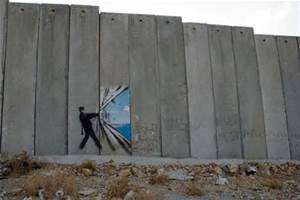
Wall Palestine

Readings for 21st Sunday in Ordinary time: IS 22: 19-23; PS 138:1-3, 6,8; ROM 11: 33-36; MT 16: 13-28. http://usccb.org/bible/readings/082414.cfm

Of course, you’re all following the news, I know. It’s so discouraging, isn’t it? Ferguson, Gaza, Iraq, and (now) Syria – again. . . .

It all reflects such one-dimensional thinking. I mean it gives the impression that in the eyes of public officials from the militarized cop in the street to the POTUS himself, the only solutions to social problems are found in shooting, tear gas, torture, and Hell Fire Missiles? Solving social problems requires locking people of color behind “the Gates of Hell” referenced by Jesus in today’s Gospel reading.

In every case, diplomacy and negotiation seem out of the question. In fact, it’s a vanished art. Who needs it? After all, those damn “others” – be they African Americans in occupied Ferguson, Palestinians in Gaza’s mammoth concentration camp, or the ISIS militants – can’t possibly have legitimate grievances. They simply must be brought to heel by force – shooting, bombing, and killing their children and youth. We’re made to believe that alternatives such as dialog and working out problems by discussion and compromise are signs of weakness. So violence is the first resort. It’s the order of the day in a world ruled by machismo, revenge, violence, and the law of the strongest.

When we’re not bombing, we’re building walls with locked gates. Our “gated communities” and locked doors wall us off from unsightly ghettos and the realities of the world’s poor mostly non-white majority. Better to confine Palestinians in fenced off open-air concentration camps like Gaza, where there’s literally no exit. Then from time to time you “mow the lawn,” i.e. shoot the non-Jews like fish in a barrel – even though most of them are children, women, and aged people.

Better to build a wall along the Mexican border and then lock the gates, throw away the key and pretend that such barriers solve the problem of farmers and their children driven off their land by globalization, poverty and gangs. Better to justify it all by invoking the Ultimate White Privilege: “I feared for my life!” (We whites are the only ones who can get away with that one.)

All that brings us to today’s Liturgy of the Word. It’s about God’s interest in matters like those just enumerated – about politics, oppression and the liberation of non-white people like Jesus, Gazans and residents of Ferguson, Missouri. It’s about breaking bonds and opening the gates of hell so that every Inferno can be transformed into the Kingdom of God. It’s about refusing to be discouraged even though the flow of history make Jesus’ prayer, “They Kingdom come” seem like an impossible dream.

Start with today’s first reading. There the prophet Isaiah has God telling a courtier named Shabna to step down in favor of a man called Eliakim. Little is known about either one. The reason for including the reading today is apparently to establish today’s central point that God is concerned with the world of politics, and that God is ultimately in charge of what happens in that sphere. There can be no separation of politics and religion in the divine dispensation.

The responsorial psalm continues the “this worldly” theme set by the first reading. It had us all singing “Lord, your love is eternal. Forsake not the work of your hands.” Once again, emphasis on “the work of God’s hands” reminds us of God’s commitment to this world – including ghettos, the Gazan concentration camp, and rich people making life unbearable for the world’s largely non-white poor. The psalm goes on to praise Yahweh for divine kindness, truthfulness, encouragement of the weak, care for the impoverished, and God’s alienation from their proud oppressors – again all connected with life here and now.

Then in today’s Gospel selection, we find a reprise of the very reading we shared last June 27th (just two months ago on the “Solemnity of St. Peter and Paul”). We practically know this passage by heart.

The reading centers on three titles associated with Jesus of Nazareth – Son of Man, Son of God, and Christ. All three names are politically loaded – in favor of the poor rather than the privileged and powerful.

Jesus asks his friends, “Who is the Son of Man in history and for us today?” (Scripture scholars remind us that the “Son of Man” is a figure from the Book of Daniel. He is the judge of all those who oppress the People of God whether they’re Egyptians, Assyrians, Babylonians, Medes, Persians, Greeks or Romans. He is “the human one” as opposed to a series of monstrous imperial beasts which the author of Daniel sees arising from the sea against God’s poor.)

So Jesus’ question boils down to this: who do you think has taken the strongest stand against Israel’s oppressors? Jesus’ friends mention the obvious heroes, Elijah and Jeremiah. But in the end, they settle on a contemporary political prisoner in King Herod’s version of Abu Ghraib. He’s John the Baptist who was Jesus’ mentor. (According to Jesus, John was the greatest of all the prophets of Israel.) He’s the Son of Man, they say.

Having set that anti-imperial tone, Jesus then asks the question, “What about me? Who do you say that I am?” No question could be more central for any of us pretending to follow the Teacher from Nazareth. How we answer determines the character of the path we walk as Jesus’ would-be disciples in a world filled with Fergusons, Gazas, Hell Fire Missiles and militarized cops. Our answer determines whose side we are on – that of Messrs. Netanyahu, Obama and Officer Wilson or of the Palestinians, Iraqis and Michael Brown.

Matthew makes sure we won’t miss the political nature of the question. So he locates its asking in Caesarea Philippi – a city Herod obsequiously named for his powerful Roman patron. Herod had commemorated the occasion by minting a coin stamped with the emperor’s countenance and identifying him as “the Son of God.” Caesar was also called “the Christ,” God’s anointed. Good Jews saw all of that as idolatry.

So Peter’s answer, “You are the Christ, the Son of the Living God” has the effect of delegitimizing Caesar and his empire. It’s also a swipe at King Herod. Peter’s response couldn’t be more political. Jesus, not Caesar is king, God’s anointed, the Son of God.

Neither could Peter’s words be more spiritually meaningful and heartening for those of us discouraged by events in Ferguson, Gaza, Iraq, and Syria.

The encouragement is found in Jesus rejoinder about the “gates of hell” and the “keys of the kingdom.” Jesus says, “Blessed are you, Simon son of Jonah . . . I will give you the keys of the kingdom of heaven . . . whatever you bind on earth will be bound in heaven, and whatever you loose on earth will be loosed in heaven.”

What powerful words of encouragement! For those who would join Jesus on “The Way” to God’s Kingdom, they disclose the very key to life’s meaning. In effect, Jesus says, “Here’s the key to opening ‘the gates of hell’ and transforming life’s Infernos into God’s kingdom: all our actions – even apparent failures like my coming crucifixion – have cosmic significance. Don’t be discouraged even when the agents of hell end up killing me – as they inevitably will.”

In other words, we may not be able to see the effect of resisting empire and its bloody agents in the short term. But each act has its effect. God’s Kingdom will come.

In today’s second reading, Paul elaborates the point. He said it’s not always apparent what God is doing in the world. After all, the ways of Transcendent Reality are deep and beyond comprehension – even by the wisest human beings. We may not be able to see God’s (political) purposes at close range. But ultimately their inscrutable wisdom will become apparent (ROM 11: 33-36).

Or as Martin Luther King put it: “The arc of the moral universe is long, but it bends towards justice.”

All of us need to embrace that wisdom, refuse discouragement and continue doing what we can to resist the forces of empire and unlock those “Gates of Hell.”

(Sunday Homily) Jesus Comes Very Close to Rejecting a Palestinian Woman as a “B_tch”

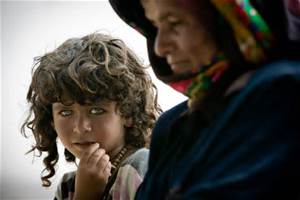
Palestinian Woman

Readings for the 20th Sunday in Ordinary Time: IS 56:1, 6-7; PS 67: 2-3, 5, 6, 8; ROM 11: 13-15, 20-32; MT 15: 21-28. http://usccb.org/bible/readings/081714.cfm

“Have pity on me, Lord, Son of David! My daughter is tormented by a demon.” Those are the words that a woman remembered as “Syrophonecian” addressed to Jesus in today’s gospel reading.

Jesus responds by ignoring the woman at first and then by disrespectfully associating his petitioner with dogs – almost calling her a “b_tch.”

We’ll come back to that in a moment.

For now note that “Syrophonecian” meant the woman was not a Jew. She was a native or inhabitant of Phoenicia when it was part of the Roman province of Syria. She was living near the twin cities of Tyre and Sidon – a gentile or non-Jewish region of the Fertile Crescent where Matthew takes trouble to locate today’s episode.

That would have made Jesus’ petitioner what we call a “Palestinian” today. In other words, Matthew’s geographical note serves to remind us that the Jews never controlled all of their “Promised Land.” Instead, they always had to share it with “Palestinians” including Canaanites, Hittites, Amorites, Perizzites, Hivites, Jebusites, Geshurites, Maacaathites, and Philistines.

That in itself is significant in the light of Israel’s ongoing brutal war of extermination against Palestinians. There the State of Israel (with supporters often invoking biblical precedent) has adopted the one-state position that is bent claiming all of Palestine for itself. It relegates Palestinians to Bantustans in a particularly brutal Israeli version of apartheid and ethnic cleansing.

Were Jesus in Gaza today, millions of Palestinian parents could echo the poor mother’s petition in today’s’ gospel selection, “Have pity on me, Lord, Son of David! My daughter is tormented by a demon.” And the demon in Gaza’s case would be the State of Israel itself – the latest incarnation of the puppets of Empire whom Jesus opposed so strongly in his own day. [Recall that Palestine in Jesus day was controlled by Jewish puppets of Rome. (Jesus clashed with them again and again.) Today those who pull strings on the marionettes reside in Washington.]

The result is that in Gaza over the last five weeks, more than 2000 Palestinians have been slaughtered by the ones considering themselves God’s “chosen” – 25% of the victims being children, at least another 25%, women like the one called “Syrophoenician” and her demon-possessed daughter.

Daniel Ortega, the President of Nicaragua, recently applied the term “demon” appropriately. He said, “Prime Minister Netanyahu appears to be possessed by the devil, he needs Pope Francis to exorcise it, to become appeased.” Ortega wondered, “Why doesn’t anyone condemn or sanction the state of Israel?” In his opinion, Palestine is the victim of “madness” on the part of the Israeli leader, who seeks to “annihilate the Palestinian people.” Ortega meant that Israel is “committing genocide” in the Gaza Strip, a crime so “terrible that it is only comparable to the crimes of the Nazis,” he said.

You might have been surprised at Jesus’ response to the Syrophonecian woman. As I said, at first he gives no reply at all; he ignores the woman completely. If Matthew’s account is accurate, in his silence Jesus was showing himself to be captive to his own cultural norms. It was inconceivable in Hellenistic antiquity for a strange woman to directly approach a man the way the woman in this story did. Above all was it so for a gentile woman to directly address a Jewish man. In other words, Jesus’ silence was part of his “honor culture.”

But it gets worse. When the woman insists, Jesus implicitly calls her a “b_tch.” He says, “I have been sent for the lost children of Israel . . . it is not right to take the food of the children and throw it to the dogs.”

The reply seems out of character for Jesus, doesn’t it? In fact, such dissonance has led many to reject the saying as inauthentic. Whatever the case, Jesus’ reply only echoes the rabbinic saying of the time, “He who eats with idolaters is like one who eats with a dog.”

In other words, Jesus’ comparison stands in a long line of likening cultural outsiders to animals. Most recently, in the case of Gaza, Ayelet Shaked, a member of the Israeli Parliament, compared Palestinians like the woman in today’s gospel to snakes. She endorsed the killing of Palestinian women, like the petitioner in the story before us, calling their children not dogs, but “little snakes” worthy only of extermination.

Shaked said,

“Behind every terrorist stand dozens of men and women, without whom he could not engage in terrorism. They are all enemy combatants, and their blood shall be on all their heads. Now this also includes the mothers of the martyrs, who send them to hell with flowers and kisses. They should follow their sons, nothing would be more just. They should go, as should the physical homes in which they raised the snakes. Otherwise, more little snakes will be raised there.”

The woman in today’s gospel has a very different voice from Ayelet Shaked’s. She replies, “Please, Lord, for even the dogs eat the scraps that fall from the table of their masters.”

The witty reply astonishes Jesus. He exclaims, “O woman, great is your faith! Let it be done for you as you wish.” That is, the woman “converts” Jesus; he concedes her argument. The one the gospels present as the master of verbal riposte is vanquished by this simple Palestinian mom.

What does the interaction between Jesus and the woman called “Syrophonecian” mean for us today – in the context of Israel’s demonic attack on the Palestinian descendants of the woman in question? What does it mean for Gaza and for us who watch in helpless disgust?

I think it means that:

• The “faith” of the Syrophoenician woman was not “in Jesus” as the incarnation of God, but rather in the inclusivity of God’s love that extends beyond ethnic and religious differences.
• In that sense, she believed in the New Universal Order Jesus referred to as God’s Kingdom.
• More specifically, today’s gospel reading presents the woman as enlightening Jesus – as reminding him of the Kingdom’s complete inclusivity.
• In view of Jesus’ own “enlightenment” at the hands of this poor Palestinian woman, it is no longer possible to blindly identify “God’s People” with any particular state.
• I mean, the State of Israel as such does not represent the biblical God’s Chosen People.
• Today that honor (curse?) belongs to the Palestinians who, as good Muslims, share Jesus’ faith that God sides with the widows, orphans, immigrants and oppressed whatever nation they belong to.
• This means that in the case of Palestine, Jesus’ followers should be one the side of Palestinians rather than the Jewish State.
• Being on their side means petitioning the U.S. government to stop its demonic support of Israel which has moved even further from its identity as “People of God” than it had in Jesus’ day.

As always, this week’s readings invite us to break the chains of our cultural norms – just as Jesus was forced to by the Syrophonecian mother.

Mike Silenced by the AIPAC: A Case Study of Zionist Control of Media and “Peace Groups”

AIPAC

Peggy and I are in San Miguel de Allende, Mexico. We’re here to give papers at the “Moving beyond Capitalism” conference of the Center for Global Justice (CGJ). I’m honored to be part of a panel with Rabbi Michael Lerner (editor of Tikkun Magazine, the Jewish left-progressive quarterly). My job will be to present the Palestinian viewpoint on the conflict with Israel.

Frankly, there’s only one reason I’ve been invited. It’s because of a crisis I created in San Miguel eight years ago when I spoke on the same topic. It nearly brought the end of the Center for Global Justice. It even threatened my job at Berea College.

The whole incident illustrates the way even small-time publications and good-willed advocates of social justice can be intimidated and silenced by champions of Zionism. The incident represents a summons to such agents to break the silence and speak the truth regardless of Zionist bullying and threats.

You see in 2006, Peggy and I were working with the CGJ directing a summer intern project for students from the U.S., Mexico and Cuba. Out of the blue, one week the program chair of the local Unitarian Universalist (U.U.) meeting asked me to speak at their Sunday gathering. I had done that in several places before and accepted without a second thought. The invitation came specifically because of my connection with the Center for Global Justice.

“Why do you want me to speak about?” I asked the organizer.

“Anything you want,” she replied.

“Well, I speak on conflicting understandings of Jesus,” I said. “As a liberation theologian, I like that topic.”

“Oh no,” came the immediate reply. “The last time someone spoke on Jesus we were all bored to tears. Can you talk about something else?”

That gave me pause. . . . But I had just returned from a three week trip to Israel sponsored by Berea College where I taught for 36 years. So I said, “How about sharing observations from my recent trip to Israel?”

“That sounds great,” the program chair said. “Let’s call your talk, ‘A Report from Israel.’”

I agreed, prepared my remarks, and delivered them the next Sunday. My thesis was clear and unambiguous. “The real terrorists in Israel, I said, “are the Jewish Zionists who run the country.” I didn’t consider my basically historical argument particularly original or shocking. Chomsky and others had been making it for years.

What I didn’t realize was that almost everyone in my audience was Jewish. (I didn’t even know about San Miguel’s large Jewish population – mostly “snowbirds” from New York City.) Nonetheless, my remarks that Sunday stimulated an engrossing extended discussion. Everyone was respectful, and the enthusiastic conversation even spilled over beyond the allotted time.

Immediately afterwards, during breakfast in the U.U. center, one of the founders of the CGJ said, “That was great, Mike. You really ought to put all of that down on paper. You can publish it as an article in San Miguel’s weekly English newspaper, Atencion. They give us column space there each week.”

“Great,” I said. (I already had the talk written out.) I sent it into Atencion and it was published about a month later. By then I was back in the states teaching at Berea.

I’ll never forget what followed: all hell broke loose:

• A barrage of angry letters flooded the Atencion pages for the next two weeks and more.
• As a result, Atencion threatened to cancel the CGJ’s weekly column.
• San Miguel’s Bibliotheca talked about ending the CGJ’s access to meeting space there.
• My article was removed from Atencion’s archives and (I think) from the archives of the Center for Global Justice.
• Someone from the AIPAC (American-Israeli Public Affairs Committee) phoned my provost at Berea College reporting me for my inflammatory article, asking whether I really taught there and if my credentials were genuine.
• The CGJ’s leadership was forced to do some back-pedaling distancing itself from me and my remarks.
• They lit candles of reconciliation at a subsequent U.U. meeting begging forgiveness from the community and absolution for that mad man from Berea.
• The guiding assumption in all of this was that my argument was patently false.

In other words, an article that should have stimulated discussion of its thesis (with CGJ activists leading the way as a voice for the voiceless) was met instead with denial and apology.

However, the ongoing slaughter of Palestinians in Gaza only confirms my original thesis. So let me repeat it here: the real terrorists in Israel are the Jewish Zionists. I’ll go even further and say that in the present phase of the conflict between Jews and Palestinians, the Jews have little or no right to claim they are acting in self-defense. They are clearly the aggressors guilty of extreme war crimes.

This time I base that argument on helpful analytic distinctions concerning “violence” commonly made be liberation theologians in general and by Palestinian liberation theologians in particular. I interviewed the latter back in 2006 at the Sabeel
Ecumenical Center for Liberation Theology in Jerusalem.

I’ll explain the relevant distinctions in the second part of this posting. For now my points are these:

• Zionist defenders are afraid of open discussion of the conflict in Palestine.
• Zionist media control extends far beyond The New York Times.
• It even blacks out Palestinian viewpoints in small-time publications like San Miguel de Allende’s Atencion.
• It threatens academic integrity as well attempting to reach into classrooms like my own at Berea College.
• It even intimidates well-meaning and highly informed activists like those at the CGJ.

My conclusion for now: the media and even would-be “radicals” need to own their power in fearlessly denouncing the war crimes of Israel’s Zionists which will be discussed in the article following this one: “The Conflict in Israel: the Perspective of Palestinian Liberation Theology.”

(Sunday Homily) Zionists Are Weeds in the Garden of Palestine

Zionists

The entire world stands aghast at the cruelty of Israel’s vicious and illegal collective punishment of Palestinian civilians for the perceived “crimes” of Hamas – the group of Palestinian resisters committed to the expulsion of illegal Zionist occupiers from the Palestinian homeland.

Today’s liturgy of the word implores the Zionists to abandon their butchery.

It also challenges Christians to denounce such ethnic cleansing and to withdraw the last vestiges of support for a group that more resembles their former Nazi persecutors than the “People of God” celebrated in the Hebrew Bible.

At the same time, today’s readings support rabbi Michael Lerner in cautioning Hamas against its policy of violent resistance. Though many of us would agree that Hamas’ tactics are understandable and often justified by principles of self-defense, today’s Gospel reading identifies them as counterproductive and ultimately harmful to the very people Hamas seeks to defend.

Instead, Jesus suggests that violent resistance should be replaced by greater reliance on more subtle and patient strategies. Such strategies are reflected in the three basic themes of today’s readings. They emphasize (1) the power of God expressed in leniency and forgiveness, (2) the futility of violent response to unwanted foreign presence, and (3) resistance that takes the form of patient trust that God’s forgiving power will prevail. In succession, the themes suggest challenges for Jewish Zionists, Palestinians, and Christians.

Begin with the first reading from the Jewish Testament’s Book of Wisdom. It is particularly relevant to Zionist Jews. The reading says explicitly that God’s power is not expressed in violence but in leniency to all, Jew and non-Jew alike.

That theme is repeated in today’s responsorial psalm with equal relevance to Zionists. There God is described as belonging to all nations. The divine Spirit, as Paul insists in today’s second reading, dwells within all humans regardless of nationality. It is slow to anger, good, forgiving, abounding in kindness.

From this, Jewish wisdom insists that the “People of God” must in turn be kind, lenient and forgiving to all – presumably even to their worst enemies. There is no room here for exceptions involving the indigenous tribal people of Palestine.

The second theme of today’s liturgy enjoys direct relevance to contemporary Palestinians. Whether they are Muslims or Christians (and many are Christians), they also recognize the Bible as the Word of God. I point to Palestinian relevance because this second theme addresses the question of resisting illegal occupation.

That is, Jesus’ parable of the weeds planted by an enemy in a landlord’s field can be read as addressing the Roman occupation forces encumbering Israel during Jesus’ lifetime. [According to John Dominic Crossan, Matthew’s allegorizing of Jesus’ parable – making it about the end of the world – is more reflective of the situation of the Jewish diaspora (following the destruction of Jerusalem in 70 CE) than of the actual revolutionary situation of Jesus’ own day.]

In occupied Israel, the suffocating Roman presence was as unwelcome, alien, and destructive as weeds in a garden or field. It was like the presence of basically European Zionist colonizers who have encumbered Palestinian land since their colonial invasion in 1948.

The question was how to deal with such odious foreign presence. Zealot revolutionaries had their answer: Uproot the weeds here and now. Take up arms; assassinate Romans and their collaborators; drive them out mercilessly. Be as cruel and vicious as the Romans.

Jesus’ response was different. As a non-violent revolutionary, he could surely understand the more apocalyptic strategy. After all, much of his teaching expressed sympathy to the Zealot cause which included land reform, debt forgiveness, and expulsion of the hated Roman occupation forces. Many scripture scholars even identify possibly five members of Jesus’ inner circle as Zealots themselves.

But Jesus’ Parable of the Weeds is more prudent and sensitive to civilian casualties than the strategy of the impatient Zealots – or that of Hamas.

When the landlord’s workers ask, “Should we uproot the weeds?” Jesus’ landlord answers: “No, if you pull up the weeds you might uproot the wheat along with them.”

In other words, Jesus agrees with El Salvador’s Oscar Romero and with Brazil’s Dom Helder Camara that revolutionary violence, though understandable (and justifiable on the grounds of just war theory), is imprudent at the very least.

This is because when faced with a vicious, overwhelmingly armed oppressor (like the Zionist state) resistance inevitably leads to state terrorism – to the war crime of collective punishment impacting women, children, the elderly and disabled. At the very least, that’s why Jesus eschews Zealot violence.

How then respond to illegal occupation like Rome’s in the 1st century or Israel’s over the last more than 60 years?

Jesus’ response? Be like mustard plant, he says. Be like yeast in flour. Both puzzling recommendations are relevant not only to Palestinians, but to Christians who wish to help their brothers and sisters in Palestine against the Zionists-turned-Nazis.

First of all think of the puzzlement that must have struck Jesus’ listeners. Jews didn’t have much use for yeast. They preferred unleavened bread. Neither would any farmer sow mustard seeds in her field or garden. The mustard plant was like kudzu – itself a kind of weed that eventually can take over entire fields and mountainsides while choking out other plants weeds or not. The mustard plant was unstoppable.

So Jesus is saying:

 * The Romans are weeds in your garden.
 * Don’t try to uproot them.
 * That will only lead to slaughter of the innocent.
 * Rather become weeds yourselves – like the mustard plant which is much more powerful than simple Roman (or Zionist) weeds.
 * Resist the Romans by embodying the Spirit of God that is slow to anger, good, forgiving, abounding in kindness.
 * Only imitation of Wisdom’s God can defeat the evil of imperialism.

What does that mean for Christians wishing to express solidarity with Palestinians against their cruel oppressors? At least the following:

 * Reject U.S. militarism in general as counterproductive, since fully 90% of the casualties it inflicts in war are civilians.
 * To bring about change, be instead like the yeast a homemaker puts into 60 pounds of flour, “infecting” the greater culture by non-violent resistance rather than seeking to destroy enemies.
 * Recognize the Zionists for what they are: an outlaw European “settler society” illegally occupying Palestinian land.
 * Take sides with Palestine’s indigenous tribal People.
 * Recognize them for what they are: “the Jews’ Jews” – treated by Zionists in the same way the Nazis treated Jews in Germany.
 * Petition the U.S. government to withdraw its support of Israel (more than one million dollars per day) unless the Zionists obey UN Resolution 242 and abandon the occupied territory while tearing down the odious Wall of Shame protecting the illegal Zionist settlements.
 * Support boycotts of Israel’s products by not buying them and by urging our churches and places of business to do the same.

Surely Jesus’ Way of non-violent resistance, forgiveness and love of enemies will strike many (non-believers and believers alike) as unrealistic. But according to the faith we Christians pretend to embrace, Jesus’ Way is God’s way.

But then perhaps we think we’re smarter and more realistic than Jesus — or God?

Portrait of the Historical Jesus

(This is the seventh in a series of “mini-classes” on the historical Jesus. Together the pieces are intended to assist those who wish to “dig deeper” into the scholarly foundations of postmodern faith and to understand the methodology behind the postings on the blog site.)

Keeping in mind previous installments of this series (and especially the “principle of analogy” in its positive and negative meanings), the historical Jesus who emerges from contemporary Jesus scholarship looks something like the following.

He was a Galilean peasant from an extremely poor background.  He was born in Nazareth of Galilee, a community perhaps as small as two dozen families. He was the son of Mary and Joseph conceived and born in the same way all humans are.

Nothing is known of Jesus’ life before something like the age of 30, except for a few legends often associated in the ancient world with “Great Men.” The first “historical” event in the gospels is Jesus baptism by John the Baptist. There according to legend, Jesus received a “divine revelation” regarding his vocation to continue the movement started by John the Baptist and cut short by John’s execution at the hands of Galilean King Herod. In that sense Jesus became a movement founder in the tradition of John and the prophets. However his movement was not to found a new religion but to reform Judaism.

Jesus was himself a prophet, in Israel’s long tradition of holy men and women defending the widows, orphans, and immigrants. Jesus also became a great faith healer, an extraordinary teacher, and a mystic. Jesus’ mysticism endowed him with a high degree of God-consciousness that told him of his capacity to appropriate the divine nature that is essence of being human. His roles as prophet and movement founder are what got Jesus into trouble with Rome.

Jesus’ prophetic message was not about himself, but about the Kingdom of God whose dawning he (and his immediate followers) mistakenly thought would occur in their own generation. As understood by Jesus, the Kingdom of God referred to what the world would be like if God were king instead of Caesar. In God’s social organization, everything would be turned upside-down. The first would be last; the last would be first. The poor would laugh, and the rich would weep.  As such the kingdom was good news for the poor (“anawim” in the Jewish Testament). That news said that God was on their side.  It was in no way about the rich who are “poor in spirit.” In fact, the only way for the rich to enter the kingdom was for them to adopt the perspective of the poor, support them in their struggle against oppression, and to share their own wealth with the indigent.

In their efforts on behalf of God’s order, Jesus and his movement were involved with resistance to the Roman occupation of Palestine.  Nazareth’s geographical location and revolutionary context would also have brought Jesus into contact with Zealots. These were guerrilla rebels, assassins of Roman soldiers, and kidnappers whose campaign against the Roman occupiers championed a plan of agrarian reform and cancellation of debts based on the Mosaic Jubilee Year and Year of Grace. Jesus’ own program was certainly in agreement with the Zealots on many of these issues, especially his proclamation of a Year of Grace with its debt forgiveness, liberation of slaves, and return of properties to their original owners. This agreement would have attracted Zealot sympathizers to his movement. For instance, Simon “the Zealot” certainly belonged to the resistance movement (Lk. 6:15). Judas was also probably a Zealot. Additionally, Peter’s nickname “Bar Jona,” and the aliases of James and John (“Boanerges”) are seen by some as code names associated with the guerrilla movement.

Many women were prominent in the Jesus movement. Among them the foremost was Mary Magdalene, often defamed by jealous opponents (even among Jesus’ apostles) as a prostitute.  In reality, she was extremely close to Jesus, and may even have been his wife.

Jesus was not born to die according to some divine plan. Rather, he was killed by the Romans because of the revolutionary implications of his basic proclamation that the Kingdom of God was near or that “another world is possible.” Such revolutionary implications became especially clear to the Roman authorities after Jesus took part in a massive protest demonstration in the Jerusalem Temple against Jewish money changers, merchants and others seen as exploiters of their own people and/or as collaborators with the Roman occupiers. This “direct action” led to the Romans offering a reward for information leading to Jesus’ arrest. Soon Judas accepted that offer, and Jesus was captured in his garden hideout.  The Romans executed him with two other insurgents by means of crucifixion, a form of torture and death reserved for revolutionaries.

The resurrection experience of the early Christian community was also rooted in insurrection.  That is, the idea of immortality drew on the Book of Maccabees.  In the aftermath of the Maccabees’ rebellion against the Greek occupiers of Palestine, the mother of the Maccabees insisted that her sons could not die – that they were immortal. Similarly, the idea of Jesus’ resurrection began with women, not with Paul or Peter.  The women followers of Jesus refused to reconcile themselves to the death of Jesus. They were the first to recognize the truth of Jesus’ words, “Wherever two or three are gathered in my name, there am I in their midst,” and “Whatever you do to the least of the brethren, you do to me.”  Jesus, the women saw, had risen in the community of believers.

Though Jesus’ message was about the imminent arrival of a new social order in which God would be king instead of Caesar, his identity was changed by John and Paul in the Christian Testament. The titles emphasized there (“Lord,” “Christ,” “Son of God,” “Heavenly King”) raised the human Jesus to divine levels none of his followers perceived before the Easter event.

However the greatest transformation in the crucial passage “from Jesus to Christ” came in the 4th century, when the emperor, Constantine, attempted to harmonize Christianity with Roman religion, specifically with the cult of Mithra, the Sun God. In fact, there is much truth to the position that Constantine was the actual founder of the Church. He was the one who called the Council of Nicaea in 325. And Nicaea was responsible for canonizing an understanding of Jesus that was more Mithric than Christian.

That is the “Nicene Creed” ratified in 325 focused on Jesus’ life before his birth, and his life after death. The “middle” the part about his identification with and good news to the poor was left out. It was the Creed’s middle and the historical Jesus that were rescued by the movement called liberation theology.

Next week: Step Two in the Development of the Early Christian Tradition — The Resurrection

Step One in the Five-Step Development of the Christian Tradition: The Human Jesus

(This is the sixth in a series of “mini-classes” on the historical Jesus. Together the pieces are intended to assist those who wish to “dig deeper” into the scholarly foundations of postmodern faith and to understand the methodology behind the postings on the blog site.)

Through the application of the method described so far in this series, the story of Jesus takes on an intensely human character unfamiliar to most. Such unfamiliarity especially arises when the principle of analogy comes into play. As already indicated, that principle holds that: We must not ordinarily expect to have happened in the past what is assumed or proven to be impossible in the present. The application of this largely negative standard leads scholars to explain away the miraculous in the ancient world in general and in the Bible in particular. In the Christian Testament, the principle is applied to reported events from the virgin birth to the resurrection, with events like the feeding of the 5000 and raising of Lazarus in between.

But there’s also a positive side to the principle of analogy. This positive side is especially important for uncovering the often neglected political and economic dimensions of Jesus’ life.  In its positive formulation I would express the principle of analogy in the following words: We must ordinarily expect to have happened in the past what routinely happens to human beings in the present.  Put otherwise, at their most basic levels human beings are highly similar across time and place. This similarity includes the interaction between the rich and the poor, and between oppressors and the oppressed.

That is, apart from local collaborators, the colonized usually resent the presence of occupation forces in their country. Workers generally resent being underpaid and exploited. They are critical of the rich whose extravagant lifestyle peasants perceive as based on their underpayment. They find interesting and can easily relate to those who criticize the rich and foreign occupiers and to descriptions of a future where such oppression is absent. Meanwhile the rich and powerful find such criticism threatening and normally try to suppress it if it mobilizes the masses.

The application of the principle of analogy in this positive meaning allows (especially politically committed Third World) scholars to connect the alleged words and deeds of Jesus to circumstances of Roman imperialism and first century Palestinian poverty, and to draw conclusions about the historical Jesus that do not generally occur to those living outside circumstances of imperial oppression. Such conclusions based on the principle of analogy assume that Roman imperialism was the most significant element of life in first century Palestine. That imperialism must therefore be kept prominently in mind when analyzing texts within the Christian Testament.

It is at this point that something called the “hermeneutical privilege of the poor” comes to the fore. The adjective “hermeneutical” refers to interpretation – of texts or of life itself. “Hermeneutical privilege of the poor” means that people living in circumstances of poverty similar to those of Jesus and his friends – especially under the violent realities of imperialism or neo-imperialism – often have a better understanding of texts about those circumstances than do those living more comfortably. Today’s uneducated poor might even have a better understanding than contemporary intellectuals and scholars.

To be more concrete . . . . We know that Palestine was a province occupied by the Romans. The rich Sadducees, the temple’s establishment of priests, lawyers, and scribes, as well as the court of Herod in Galilee were collaborators with the Romans. Jesus came from the Galilee, a section of Palestine that was a hotbed of resistance to Rome and of resentment against Jews collaborating with the occupiers. Jesus was born around the year (4 BCE) when the Romans finally destroyed Sepphoris, the capital of the Galilee. Sepphoris was located just 3.7 miles from his home in Nazareth – less than an hour’s walk. In that year of uprising, rebellion, and slaughter, Jesus’ parents gave him a revolutionary name – Yesua (=Joshua) the general who conquered the land of Canaan now occupied by Rome. Jesus’ brothers also bore significant names in terms of Jewish nationalism and ownership claims to Palestine. James was named after Jacob, the last of Israel’s three great patriarchs. Joses bore the name of Joseph, Jacob’s favorite son.  Simon (= Simeon) and Jude (= Judah) both were named after fathers of one of Israel’s 12 tribes.

On top of that, Jesus’ Mother, Miryam, is remembered by the evangelist Luke as a woman of revolutionary conviction. In her “Magnificat” poem (1:46-55), she praises the God of Israel as one who “has scattered the proud . . . brought down the powerful from their thrones . . . lifted up the lowly . . . filled the hungry with good things . . . and sent the rich away empty.”

In the light of such circumstances, and given Jesus’ evident commitment to the poor, it becomes highly likely that Jesus not merely shared the anti-Roman and anti-Jewish establishment sentiments of his family and neighbors. It also becomes likely that Jesus’ family was involved in the Jewish resistance at the very time of Jesus’ birth. After all, circumstances like the siege of a nearby town by foreign occupiers generally find everyone local somehow involved. (In fact, occupiers routinely assume such involvement and retaliate accordingly, both then and now.)

And there’s more.  The fact that nearby Sepphoris was under siege in 4 BCE carries implications about Jesus own conception.  It means that the surrounding territory including Nazareth must have been crawling with Roman soldiers at that time. Under such circumstances, the principle of analogy tells us that many Jewish girls would have been raped by those soldiers. After all, rape is a standard strategy for occupiers in all wars from first-century Sepphoris to twenty-first century Kabul. This realization makes more interesting the tradition that surfaced in the 2nd century with the pagan author Celsus. He alleged that Jesus’ “virginal” conception was the result of Miryam being raped by a Roman soldier called Panthera. (By the way, according to scripture scholar Ignacio Lopez-Vigil, the term “virgin” was snidely applied in first century Palestine to unwed mothers and victims of rape.)

(Step one will be continued next Monday)