Starting a House Church: A Faith-Inspired Response to Trumpism (First in a series of four)

barth

Recently, I surprised friends and readers of this blog by announcing plans to “re-appropriate my priesthood” and start a house church. It would be a faith-based response, I said, to Trumpism and its planetary threat. The community, I hoped, would mobilize the spiritual power that in fact dwarfs the U.S. presidency and the president’s capacity as Commander-in-Chief of the mightiest military in the history of the world.

Some of my former priest-colleagues wondered, “Why on earth would you want to do that?”

After all, the church is for all practical purposes dead and the priesthood along with it.

And good riddance. By and large, the church remains sexist, religiously fundamentalist, and arguably the most conservative force on the face of the earth.

“And there’s more,” they said.  “Virtually no one believes in priestly powers any more. According to Catholic faith, it all hangs on two quasi-magical endowments that priests alone allegedly have to: (1) transform bread and wine into the literal body and blood of Christ, and (2) forgive mortal sins that would otherwise send their perpetrators to hell. Few who think about it take such beliefs seriously any more. The others are just coasting along in thoughtless denial. Their children however perceive the nonsense and are jumping the sinking ship in droves. That’s why if ‘former Catholics’ were an actual denomination, they would constitute the third largest church in the United States.

“Moreover, Catholics are virtually indistinguishable from Protestants (or non-believers for that matter) in their life-styles and political positions. They even practice birth control in exactly the same percentages as other Americans. It’s a similar case with divorce and same-sex relationships. And many Catholics vote Republican, despite papal social teachings on social justice, the environment, and war.

“So what’s the point of the Catholic Church with its anachronistic priesthood? It has become a mere social club – good for keeping old friendships alive, but little more. Most of its committees, sodalities, youth and men’s groups are self-serving. Do-gooders could easily find other organizations elsewhere to satisfy their passion for social change – without having to fight resistant Catholic fundamentalists in the process.”

To be frank, I find such objections persuasive.  Despite the best efforts of Pope Francis, the church seems more dead than alive. For all practical purposes, it whistles past the crises that characterize our age. The Sunday Masses I attend completely ignore the unprecedented contemporary context of threats from nuclear war, climate change, racism and sexism.

And yet, I remain firm in my intention to proceed with the house church. That’s because despite the institutional church’s having lost its way, I still find in my faith a source of spiritual strength and political resistance that for me is irreplaceable.

I intend to start a house church also because the objections just mentioned overlook the fact that Catholic Church pews also seat resisters like me. There are people whose faith has been shaped by the reforms of the Second Vatican Council. In the spirit of the conciliar document, “The Church in the Modern World,” their faith engages them not only with world events, but with one another.

For instance, in my own community, a group of more than 20 has met regularly over the past two or three decades as our church’s Peace and Social Justice Committee. Our gatherings often find us reflecting on liturgical readings. Discussions connect them with political organizing, welcoming refugees, war-resistance, the environmental crisis, and with the needs of local unemployed and impoverished families. Work with Habitat for Humanity has been a constant commitment.

I’m loathe to let such relationships and commitments go. At the same time, I’m convinced there has to be a better, more focused, more regular and consistent way of harnessing the deep faith the 20 or so of us share, especially in the face of Trumpism. To repeat: we’re in an unprecedented situation that calls for an unprecedented response.

I’m convinced that the best response is to experiment with house church Sunday liturgies that would bring our sub-community and others together on a weekly basis to reflect, pray, break bread, and plan creative acts of resistance. The liturgies will take place on Saturday evenings (i.e. on the Sabbath) and thus allow those wishing to attend Mass in our church the next morning, to do so.

In the end, my reasons for starting a house church are rooted in history and theology – in post-Vatican II understandings of church, of Eucharist, and of priesthood. A changed understanding of each – more in accord with the leadership of Pope Francis gives hope and direction.

I will try to explain what I mean in subsequent postings over the next three weeks.

Catholic Action vs. Trumpism: An Invitation to an Alternative Weekly Mass[1]

lords-supper

As indicated in earlier postings (here and here), the ascension of Donald Trump and his group of billionaire confidants to national leadership calls people of faith in general and Catholics in particular to adopt extraordinary and vigorous responses to the grave threat their ascent signifies.

This posting represents one such response. Its call is especially urgent in the light of the fact that the Trump administration and Republicans in general embody what Noam Chomsky has termed “the most dangerous organization in the history of the world.” Their unanimous climate-change denial accords them the title. In fact, they not only deny the human causality of climate chaos, they plan to proceed full speed ahead with the practices (oil and gas drilling and fracking) that our planet’s finest minds identify as its causes. The Republicans (with the Democrats not far behind) are leading us all like lemmings to the precipice of planetary destruction and the end of human life as we know it.

This is no exaggeration.  As Pope Francis has written so eloquently:

“Doomsday predictions can no longer be met with irony or disdain. We may well be           leaving to coming generations debris, desolation and filth. The pace of consumption, waste and environmental change has so stretched the planet’s capacity that our contemporary lifestyle, unsustainable as it is, can only precipitate catastrophes, such as those which even now periodically occur in different areas of the world. The effects of the present imbalance can only be reduced by our decisive action here and now. We need to reflect on our accountability before those who will have to endure the dire consequences.” (Laudato Si’ 161).

It is clear that despite Francis’ strong words, “decisive action” in the face of Trumpism’s climate-change denial and other destructive policies has no chance of issuing from the diocesan Catholic Church nor from our local Catholic community in Berea. So the invitation here is to Catholics and other people of faith to create an alternative (or, if you will, a complementary) community of faith to celebrate a house-church Mass each week. Its liturgy will be characterized by sharp awareness of the unique political context we are now entering. Each will be followed by discussions planning direct action against Trumpism in all of its forms.[2]

The Mass will be simple and prayerful. It will take place on Saturday evenings in a home (Peggy’s and mine to begin with). Together we will sing some inspiring songs, reflect on the week’s liturgical readings in the light of the Church’s rich social justice tradition, and break bread eucharistically before sharing a pot-luck supper. Each meeting will incorporate planning for specific acts of resistance.

The first convening of this alternative community will take place on Saturday, January 21st, the day after Mr. Trump’s inauguration which is scheduled for January 20th. Here are the details:

Berea’s Weekly Alternative Home-Church Mass

Place: 404 Jackson St.

Time: 5:00-7:00

The Mass:

  • Welcome (5:00)
  • Singing, opening prayers, & Liturgy of the Word (5:00-5:45)
  • Eucharist (around the dining room table) & Pot Luck (5:45-6:45)
  • Planning the week’s direct action (6:45-7:00)
  • 7:00 (promptly): Dismissal

Beginnings, no doubt, will be small and modest. But we should not be discouraged. Ideas about how to proceed more inspiringly will surely develop as all group members share their suggestions.

[1] Starting next Tuesday, I will start a 4-part series here explaining the history and theology behind home liturgies including an explanation of current theologies of the Eucharist and “Real Presence.”

[2] For those who remember: The faith community envisioned here might be thought of as a more spiritually-focused Berea Inter-Faith Task Force for Peace.

On Re-appropriating My Priesthood


Ordination[1]

I’m so appalled at the prospect of a Donald Trump presidency and the threats it poses to everyone and everything I care about:  the environment and climate chaos, avoidance of nuclear war, victims of torture and false imprisonment, Muslims, drone attacks, wealth disparities, women’s reproductive rights, people of color, the LGBT community, our public school system, the right to privacy, human rights in general, labor unions – my children and my grandchildren.

In fact, as I’ve written recently, a Trump presidency portends the dawning of a Fourth Reich, where the victims of incineration will be not only Jews, but all of us, as the White House teems with climate change deniers whose policies threaten all species and the continuity of human life itself.

So the question is, what can we do about it? What talent does each of us have to respond to Trumpism? As parents and grandparents, teachers, writers, counsellors, school board officials, musicians, public speakers, church members, and public citizens, what does each of us have to offer these unprecedentedly dangerous times.

My own answer is my priesthood.

Only gradually and reluctantly have I come to that conclusion. After all, 40 years ago I exited the Catholic priesthood, got married and raised a family of three outstanding children. I remained active in my local church. And as a professor at Berea College and associate of Costa Rica’s Ecumenical Research Institute (DEI), I continued my role as a theologian with a doctoral degree from Rome’s Academia Alfonsiana. For years I taught in a Latin American Studies Program that took students to Nicaragua, Guatemala, and Cuba. In those capacities, I wrote books and articles and offered courses connected with liberation theology.  However, I resigned myself to my role as lay person – a member of the church’s “loyal opposition.”

And the opposition was absolutely called for. Over the years I’ve found myself dismayed as two consecutive regressive popes (John Paul II and Benedict XV) waged a vicious campaign against liberation theology and systematically removed from the hierarchy and Catholic seminaries progressives and theologians like me. The result over the two generations has been the production of a largely reactionary Catholic clergy who long for the good old days before the Second Vatican Council (1962-’65).

So as a lay person, I’ve often found myself sitting passively in my pew while rebelling internally against the reintroduction into the Catholic liturgy Latinisms and even Latin itself. I’ve listened uncomfortably to well-intentioned priests offer ill-prepared pious platitudes in their homilies rather than reflections connected with the historical Jesus and his relationship to the problems that householders like me face in our private and public lives. And, to speak truly, I was blaming them unfairly. After all, how could they possibly offer what their retrenched seminary training prevented them from receiving?

Still, it struck me as ironic that hundreds of people in my parish come together for about 2 hours each Sunday to reflect on their most dearly held (Gospel) values, but come away having barely tapped into the unlimited power for changing their personal lives and the world itself that those values supply. What a waste, I thought – not only for the parishioners directly involved, but for the world.

Then came a breath of fresh air reminiscent of Pope John XXIII’s famous “opening of windows” more than 50 years ago. Argentina’s Jorge Bergoglio became Pope Francis – a man intent on recovering the spirit of Vatican II. Deeply influenced by the liberation theology his predecessors had warred against, he published “The Joy of the Gospel” (J.G.) and then his eco-encyclical, Laudato Si’ (L.S.). Both publications were bolstered by unprecedentedly honest and refreshing public statements. (Who can forget his question about homosexuality: “Who am I to judge?”)  Francis not only called the church to profound reform; he called the world itself to a “bold cultural revolution.”

As for church reform, Francis called for a “new chapter” in the history of the Catholic Church and for the Church to embark on a “new path” (J.G. 1, 25) on which things cannot be left as they presently are (25). He called for new ways of relating to God, for new narratives and new paradigms (74). He wanted new customs, ways of doing things, new times, schedules, and language (27) — with emphasis on better prepared and delivered homilies (135-159).

Despite (lamentably) continuing to exclude women from the priesthood, the pope ordered the church to expand their roles in church life.  He recognized women as generally more sensitive, intuitive, and otherwise skilled than men (103, 104).

Clearly, then, the pope was speaking (as he said) not primarily to pastors and bishops, but to everyone (33). Decisions about change, he said, should be guided by the principle of decentralization (16, 32). They should be made at the parish level, because parishes are more flexible than Rome or the local chancery, and more sensitive to the specific needs of local people (28). The inventiveness of local communities should not be restrained, he said, but limited only by the openness and creativity of the pastor and local community (28). Such decisions should be respected by local bishops (31).

As for connecting the gospel with world issues, Pope Francis identified the struggle for social justice as “a moral obligation” that is “inescapable” (220, 258). He saw “each and every human right” (including education, health care, and “above all” employment and a just wage) as intimately connected with “defense of unborn life” (192, 213). He also completely rejected war as incapable of combatting violence caused by “exclusion and inequality in society and between peoples” (59). Pope Francis rejected unfettered markets and the “trickle down” ideologies as homicidal (53), ineffective (54), and unjust at their roots (59).

In Laudato Si’ the pope issued an urgent call to the Church and the world to address issues connected with human-caused climate chaos.  In this the entire encyclical (see my book, Understanding Laudato Si’: a Discussion Guide) might be seen as a complete rejection of Trumpism and of the entire Republican Party’s denial of that problem.

So, once again: what to do about it?

Experience shows that the anti-Vatican II clergy resistant to Pope Francis remains incapable of responding either to the latter’s Apostolic Exhortation (J.G.) or to his eco-encyclical (L.S.). Much less has it demonstrated a willingness to address the issues of political-economy, racism, sexism, homophobia, xenophobia, war, torture, etc.  raised by the emergence of Trumpism. (Once again, it is wrong to blame the clergy for this. Their training has made effective response impossible.)

So I’ve decided to do something about it myself. I’ve decided to reactivate my priesthood.

Honestly, I have to admit that the process of doing so began about 5 years ago following my retirement after 40 years of teaching at Berea College. It was then that I set goals for myself. One of them was an ill-formed, vague resolve to “reclaim my priesthood.”

As a preliminary step, I started a blog. Its center piece was the publication of a “Sunday Homily” each week. The reflections tried to connect world events, personal, and family problems with each Sunday’s liturgical readings.

Eventually, my homilies were picked up by OpEdNews – a completely secular progressive news source run by a Jewish editor. Over the years, I’ve published more than 200 such homilies covering Catholic lectionary readings for all three liturgical cycles. The result has been the creation of a kind of cyber community of readers that averages 1600 views of each reflection every week.

Now, in view of the crisis of Trumpism, I’ve decided that my contribution to resistance will be to translate that cyber community into a real-time assembly of faith. It will actually attempt do something to implement Pope Francis’ summons to church reform, and address in particular issues connected with climate chaos.

What I’m proposing is not a Protestant or even an ecumenical gathering. Rather my call is to an alternative Catholic “parish” in my town. Of course, this is not unusual; most towns of any size have more than one Catholic parish. Though specifically Catholic, all people will be welcome – Catholics, Protestants, atheists . . . In particular, “drop-outs” from our local community of faith are encouraged to join.

I imagine the gathering will be very simple – nothing of a show or performance. Rather, people will gather in my home (to begin with). We’ll sing or chant for a while, read the week’s liturgical selections, and share reflections. Afterwards we’ll gather at the dining room table for a brief Eucharistic breaking of bread followed immediately by a pot-luck meal. The week’s meeting will conclude with a planning session outlining activities for the coming week to resist the inroads of Trumpism.

All of this reminds me of the activities of Dietrich Bonhoeffer’s “Confessing Church” in the 1930s when Lutherans and others decided they had to do something to resist Hitler’s fascism. What I’m proposing here is an analogue, where people of faith call on their tradition to confront fascism’s re-emergence.

I’m convinced that only resistance fortified by deep faith can effectively combat that reincarnation. And even if only two or three join me in this proposal, I’m determined to go through with it. After all Jesus did say: “Wherever two or three are gathered in my name, I am there in their midst” (MT 18:20).

Christmas Is Blasphemy: Put Mithra Back in Christmas!

mithra

Last year at this time, two very different religious leaders – one considered left of center, the other a fundamentalist preacher – converged in agreement about the meaninglessness of Christmas. They both concurred: except as a secular winter festival, Christmas is religiously meaningless.

On the left, Pope Francis called the Christian world’s upcoming Christmas celebration a “charade.” He said there’d be parties, gift exchanges, and family gatherings in the name of celebrating Jesus’ birth, but it would all be absurd pretense.

That’s what charade means: an absurd pretense intended to create a pleasant or respectable appearance.

And the pope was right. Starting around Thanksgiving, so-called Christians pretend to honor “the Prince of Peace” – the one who took no one’s life, but sacrificed his own rather than take up arms — who was himself a political refugee – conceived out-of-wedlock – brown-skinned, poor, and living under imperial occupation – the one who would be a victim of torture and capital punishment – who was all the things that good Christian supporters of Donald Trump and of the U.S. War on Terror hate and despise.

That’s right. our culture despises Jesus and all he really stands for.

And that’s where the fundamentalist preacher comes in.  He agrees with the pope – well kind of.

About the same time Pope Francis was talking charade, Rev. Joshua Feuerstein, denounced Starbucks for hating Jesus. The good reverend was outraged by the coffee giant’s holiday cups which display no specific reference to Jesus. That’s a sign, Feuerstein said, that Starbucks agrees with the movement to remove Christ from Christmas. Starbucks hates Jesus. So let’s boycott Starbucks!

On the one hand, could anything be more absurd? The world is burning. Our way of life is destroying God’s creation. Our country is waging war against the poor everywhere – in Afghanistan, Iraq, Libya, Yemen, Somalia . . . We supply weapons to all sides in the endless war our “leaders” have declared. And our man was worried about Starbucks’ drinking cup! He denounced Starbucks for simply recognizing what is: Jesus has long since been removed from Christmas.

On the other hand, there was wisdom in Rev. Feuerstein’s accusations. And it’s not just Starbucks that “hates Jesus;” it’s our entire culture – including our churches. In that sense, Feuerstein agrees with Francis. However, hating Jesus has nothing to do with coffee cups. As I said, it means despising those Jesus identified with in the Gospel of Matthew (25:31-46) – the poor immigrant refugee from our endless bombing campaigns, the hungry street person, the homeless beggar, the imprisoned desperado, the coatless person we pass on our way into Starbucks.

So what to do to avoid making this Christmas an empty charade?

We can start by recognizing that Christmas is a winter festival and nothing more. Every culture has them. They are times for ice sculptures, bright lights, reunions with family, for feasting, drinking, parties and exchanges of gifts. All of that distracts us from the oncoming season’s dark and cold – and from our destruction of God’s planet.

That’s the way it was in ancient Rome too. Rome had its Saturnalia. In fact, December 25th was the birthday of the Sun God, Mithra, who was a favorite with Roman legionnaires. In that sense, Mithra’s birthday was a military holiday – a celebration of empire and its wars. Our militarized culture should be at home with that.

So let’s end the charade. Have fun.  Eat, drink, and be merry. That’s what winter festivals are about. But forget the blasphemy of associating Jesus with any of it.

Raise your Starbuck’s cup and toast a happy feast of Mithra!

James Patterson’s “Woman of God”: Its Call to Reform the Catholic Church from Below

woman-of-god-image

James Patterson surprised me recently by publishing a book about the Catholic Church and faith. Usually, of course, Paterson deals with the world and adventures of ex-F.B.I. agent Alex Cross. There Patterson’s fiction revolves around spies, the C.I.A., terrorists, murder and general mayhem.

So I was intrigued when I came across Woman of God. I was even more surprised to find it addressing the problem of reform in the Catholic Church. In fact, the book might be seen as a parable – if we understand parable as a fictional story inviting its audience to conversion and action. The action in question is transformation of the Catholic Church independent of established church authority.

Woman of God traces the life of Brigid Fitzgerald, a not particularly religious physician, whose first assignment takes her to Africa’s Sudan. There horrendous experiences with grinding poverty, terrorist attacks, battlefield operations and dying children drive her to rediscover her long-abandoned faith.

The book is filled with prayers and mystical reflections about the unity of creation and of humankind. It also details Brigid’s series of romantic relationships and marriages that all end tragically. As a result, I sometimes thought I was reading one of those Christian romances where each and every plot turn is cloyingly related to God, faith and prayer.

But Patterson somehow pulls this one off.

With her faith deepening with every chapter, Brigid’s second marriage joins her with a progressive Catholic priest. Together they start the Jesus, Mary and Joseph (JMJ) Catholic Church. It offers an alternative to the local parish, but stubbornly continues to identify as Catholic, even over the objections and threats of the local bishop. Eventually, Brigid herself becomes a priest – ordained by a dissident prelate.

Gradually JMJ becomes a movement that spreads across the United States. So does Brigid’s fame as a married female cleric. Accordingly, she receives threats from conservative Catholics and accolades from almost everyone else. A final seal of approval comes from the pope himself, when Brigid (and her daughter) are summoned to Rome to meet the Holy Father. When he eventually dies, there is even speculation that Brigid herself might be chosen pope.

The connections between Woman of God and bottom-up reform of the Catholic Church are obvious – especially in the light of prospects that threaten the very continuity of human life on our planet. As parable, the book calls committed Catholics to actually do something by way of resistance that calls upon the Church’s long (a neglected) social justice tradition. it’s time, the story suggests, to start a JMJ church of our own.  Committed Catholics must become the change Pope Francis called for in his landmark Apostolic Exhortation, The Joy of the Gospel.

Chris Hedges’ recent article on the state of our country intimates something similar. We’re living in circumstances that parallel events in 1933 Germany, he says. As Hedges argues, all of our institutions – government, military, police, media outlets, schools and universities, churches and synagogues – have been too long silent. We’ve simply gone along with their own gradual corruption. When it’s all over, we’ll stand there scratching our heads and wondering how we could have let it all happen.

Regarding the role of churches, Hedges predicts we will ask:

“Where were the great moral and religious truth tellers? Why did they use the language of identity politics as a substitute for the language of social justice? Why did they refuse to condemn as heretics those on the Christian right, which fused the symbols of the state with those of the Christian religion? Why did they collaborate with the evil of corporate capitalism? Why did they retreat into churches and synagogues, establishing exclusive social clubs, rather than fight the injustice outside their doors? Why did they abandon the poor? Why did they replace prophetic demands for justice with cloying political correctness and personal piety?”

Chris Hedges suggests that only a deeply engaged spirituality focusing on social justice can save Catholics from repeating the “go-along-to-get-along” mistakes they committed under Nazism. We need the U.S. equivalent of Dietrich Bonhoeffer’s Confessing Church. We need a JMJ community that will make its business resistance of all forms of Trumpism in the name of Jesus’ God.

Recall what Bonhoeffer, Pastor Niemoller, Karl Barth and others did when Adolf Hitler came to power. They saw their churches silent at best, and at their worst actually cooperating with Hitler by giving him their blessings. So they started their “Confessing Church.” Originally the movement concentrated on ecclesiastical threats from Hitler. Later however those foci broadened to embrace persecuted Jews. In the face of concentration camp atrocities, its members ended up asking

“Why does the church do nothing? Why does it allow unspeakable injustice to occur? … What shall we one day answer to the question, where is thy brother Abel? The only answer that will be left to us, as well as to the Confessing Church, is the answer of Cain. (“Am I my brother’s keeper?” Genesis 4:9)

Catholics should make the Confessing Church’s question our own as Nazism has morphed into the contemporary Alt-right. In the face of its current unprecedented threat, corresponding action is required that works every day for the defeat of the neo-fascism Trumpism represents. And the Catholic Church with its unparalleled social teaching (recently expanded by Pope Francis’ Laudato Si’) offers us the guidance we need to shape the responses of a present-day Confessing Church.

Following the parabolic example of Brigid Fitzgerald and her JMJ Church, here’s what we might do:

  • Admit that in most cases, present forms of church are hopelessly disconnected from the unprecedented tragedy and threat represented by the accession to power of the Neo-Fascist Alt-Right.
  • Recognize the power of the Catholic tradition as expressed by Pope Francis as he addresses climate change, environmental destruction, income inequalities, racism, xenophobia, and interminable wars.
  • Publicly move out of our local church building.
  • Open store front JMJ Catholic churches with names such as “St. Francis’ Catholic Church of Resistance.”
  • Invite former Catholics, college students, and other disaffected church members to join.
  • Publish the invitation in local newspapers.
  • Meet in the store front for Eucharist each Sunday at the very times the local church celebrates Mass.
  • Empower faithful women in the JMJ community to preach and celebrate the Eucharist.
  • Gather in the storefront on Wednesday evenings to plan the week’s acts of resistance to Trumpism in all of its manifestations.

Certainly there will come objections from sincere Catholics. They will say:

  • We have no authority to do this.
  • It’s better to continue our reform efforts from within.
  • This will only cause division in our church.
  • The status quo really doesn’t bother me, because I use the quiet provided by Sunday Mass to facilitate my own prayer life.
  • (If, like me, you’re of a certain age) I’m too old for such radical disruption of my life.

To such objections Brigid Fitzgerald might reply:

  • As baptized Catholics, we have all the authority we need. Given the unprecedented threats we face, none of us can wait for top-down leadership to address them adequately. (This was the conclusion of the Confessing Church.)
  • Reform from within? Remember: some of us are operating in churches where announcements deemed “too political” are forbidden. Some parishes don’t even have Peace and Social Justice Committees.
  • Division in our churches? The divisions that already exists are precisely the problem. Papering over such fissures actually prevents even naming the problem of Trumpism.
  • Withdrawing into personal prayer? The times will not allow us the luxury of such pietism in the face of a threat that is truly planetary.
  • Too old? Christian faith will not allow us to identify with the physical as if we were primarily bodies with souls. Our spirits are ageless. The truth is that we are primarily ageless spirits who happen to inhabit temporary bodies. The imperative for action is no less incumbent on older people than on the young. Moreover, the JMJ movement promises to invite energetic college students (and others) to join us as leaders in our community.

This is not time for those with experience to step back and relax. Like Brigid Fitzgerald our experiences have caused us to mature. They have made us wise. That wisdom tells us that time is running out – for us personally, for our children and grandchildren, and for the planet itself. These unprecedented times call for radical response.

Thank you, James Patterson for your parable and its summons to Catholics. It remains for us to respond.

The November Elections, Pope Francis, and the Catholic Vote

romneyryan

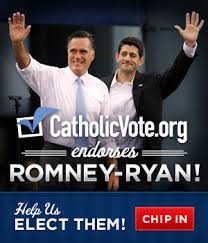
On September 6th, the Washington Post published a report called “White Catholics Struggle to Get on Board the Trump Train.” The article’s assumption was that obviously Caucasian Catholics are expected to vote Republican. However, the report noted, some are having second thoughts in the light of the Trump candidacy – presumably because of his waffling on the issue of abortion.

Unexplainably, the Post article completely ignored the overall progressive thrust of Pope Francis’ teaching and the un-Republican influence it might be having on Catholic voters. Instead, it bolstered its “of course” assumption about Catholics voting Republican by puzzling over the fact that four years ago Catholics who attended Mass at least once a month favored Mitt Romney by 38 points. This year, Donald Trump’s lead among such Catholics has shrunk to 17 points..

True, the WaPo article did suggest that Pope Francis might have something to do with the trends it described. After all, Francis had explicitly intimated that Mr. Trump was unchristian for intending to build a wall along the U.S.-Mexican border. Followers of Jesus, Francis said, build bridges, not walls. In response Trump dismissed the pope as “very political.”

However, the Post completely ignored the issues of climate change, a world economy based on arms manufacture, capital punishment, and world-wide income disparities – Pope Francis’ signature issues that he himself highlighted in his speech last year to the U.S. Congress.

The Post carried on as if that speech and the pope’s landmark encyclical on climate change had never occurred. It was as though the Church were still mired in the reactionary era of John Paul II and Benedict XVI, when Catholics seemed obsessed with one issue alone: abortion without connecting it (as Francis has done) to problems of poverty, war, environmental destruction, and an overwhelmingly punitive “justice” system.

So how should Catholics vote who are tuned into Pope Francis’ more comprehensive moral concerns? According to the pope’s eco-encyclical, his Apostolic Exhortation, The Joy of the Gospel, and his address to the U.S. Congress, Catholics should vote:

  • Against climate change deniers and for those who share the pope’s climate concerns.
  • Against champions of dirty fossil fuels and in favor of those supporting alternative, renewable energy sources.
  • Against those who would exclude refugees from finding shelter in the United States and in favor of those advocating sanctuary.
  • Against those who favor arms sales abroad and in favor of proponents of divestment from the arms industry.
  • Against champions of capital punishment and in favor of those calling for its abolition.
  • Against those proposing tax cuts for the wealthy and in favor of increased redistributive taxes on their incomes.
  • Against those whose answers to global terrorism are war, bombing, and drone assassinations, and in favor of those who offer legal and diplomatic solutions to the problem of national security.
  • Against those who are selective in their “pro-life” advocacy, and for those who connect respect for life not just with abortion, but with providing care for unwanted children brought to term, with clean energy, environmental protection, universal health care, investment in public education, and opposition to capital punishment and war.

In the run-up to the elections, these are the issues Catholics should quiz Ms. Clinton and Mr. Trump about – as well as candidates for other public offices.

“War Dogs”:  What Everybody Knows: War is All about the Money

war dogs

“What do you know about war? They’ll tell you it’s about patriotism, democracy . . . You want to know what it’s really about? War is an economy.”

That’s the way director, Todd Phillips’ “War Dogs” begins. It’s the (mostly true) tale of two bumbling stoners from Miami Beach who become wealthy arms dealers supplying weapons to the U.S. military and its allies in Iraq and Afghanistan.

The story line reminds us that money is the major reason for the endless wars the U.S has waged across the Muslim world since 9/11. It also reminds us of our moral duty to oppose the corrupt war system that is eminently reformable with a few simple measures – if for no other reason than saving money that is currently wasted.

To begin with, it’s true: war has nothing to do with patriotism, democracy or freedom. It’s simply good for the economy. In fact, war is the economy – or at least its heart where the military budget consumes 57% of the U.S. budget’s annual discretionary spending – $3.8 trillion to be exact. (That’s very nearly as much as the rest of the world combined spends on “defense.”)

In other words, our economy is dependent on blood sacrifice. Pope Francis said as much last September when he spoke to members of the U.S. Congress. He remarked, “Why are deadly weapons being sold to those who plan to inflict untold suffering on individuals and society? Sadly, the answer, as we all know, is simply for money – money that is soaked in blood.”

At the conclusion of “War Dogs,” Todd Phillips echoes the pope’s phrase, “as we all know.” For as the credits roll, Leonard Cohen sings his own “Everybody Knows.”

And what is it that everybody knows about war?  At some level, we all know that it has fundamentally corrupted our society. Our way of life is based on murder. Yet we refuse to put a stop to the killing. It’s as if we see no alternatives, though they’re staring us in the face.

We’ve become so inured to permanent mayhem that we rarely ponder what it all means for the defenseless poor of the world who (rather than the rich) habitually end up on the wrong end of the guns, bullets, drones, bombs, missiles, air planes, tanks and ships with which our government and U.S. corporations greedily supply the entire world.

For example, here’s what our war economy has meant for the people of Yemen the poorest country in the Middle East. (Their plight is barely reported in the U.S corporate media.) For the past year and a half, Yemen has been the target of bombs dropped by Saudi Arabia, the richest country in the Middle East, with the full support and cooperation of the United States, the richest country in the world. For the impoverished of Yemen this class war has meant:

  • 2,7 million Yemenis driven from their homes.
  • 7000 Yemenis killed – 3,000 of them civilians, including hundreds of children.
  • 30,000 Yemenis injured.

In the end however, “War Dogs” only hints at such disaster. It only suggests the profound corruption of the entire war system. That’s because its two twenty-something principals, Ephraim Diveroli (played by Jonah Hill) and David Packouz (Miles Teller) are only small-time bottom-feeders in a system that allows the two –  virtually without education or knowledge of the world – to secure a $3 million Pentagon contract for 100 million rounds of Ak47 ammunition for use in Afghanistan and the longest-running war in U.S. history. The bullets, of course, will be fired at poor people in Afghanistan.

The top-feeders in the system put Diveroli’s and Packouz’s profits to shame; by comparison, the latter come off like choir boys. The big guys are after much, much more.  Their corporate names include the Carlyle Group, Halliburton, Boeing and Motorola. Most recently, the personal names at the top are Bush, Cheney, and Obama. Their bald-faced corruption and indifference to human suffering is absolutely mind-boggling. It has:

  • $6.5 trillion (yes, “trillion” with a “T!”) gone entirely missing from the Pentagon budget without any explanation or even a single audit of the Defense Department over the past 20 years.
  • A father (and former U.S. president), George H.W. Bush, working for a defense-oriented firm (the Carlyle Group), while his son waged permanent war all over the world.
  • A vice president’s company (Halliburton) receiving $39.5 billion in federal war contracts without any bidding from competing firms.
  • A spokesperson for the sitting U.S. president defending the killings in Yemen by saying that the sale of weapons to Saudi Arabia would “positively impact the U.S economy and further advance the president’s commitment to create jobs by increasing exports.”

[Imagine if such words and/or practice were reported of a designated enemy like Russia, Korea, Venezuela or Cuba! Imagine a cynical system of war in those countries involving family members, government colleagues, business cronies, and revolving doors connecting presidencies, vice presidencies and defense industry offices. We’d have no trouble identifying it all as “corrupt” and “criminal” Yet somehow we can’t make the same designations when our own government (with our tax dollars!!) is involved.]

Yet that is exactly what “War Dogs” should invite thoughtful viewers to do. It should have us demanding:

  • The cessation of war against the Muslim’s world’s poor.
  • Audits of the Defense Department as rigorous as those monitoring welfare programs for the poor.
  • The nationalization of weapons manufacture to remove the profit motive from war.
  • A 50% cut in the nation’s military budget.
  • The investment of that 50% in rebuilding the homes of the poor destroyed by the U.S. military.
  • The opening of U.S. borders to refugees created by U.S. wars in Yemen, Syria, Libya, Iraq, Afghanistan, Somalia, and elsewhere.
  • The imposition of special war taxes to fund (and discourage) each additional war our country’s leaders choose to engage.
  • The centralizing of such recommendations in the upcoming presidential debates.

Each one of these proposals is not only anti-war; it is economically sound. Or as Diveroli explains to Packouz whose anti-war sentiment makes him initially demur at joining his friend in the gun-running business: This isn’t about being pro or anti-war . It’s about money. “This is . . . pro-money!” It’s about our tax money.

Is Pope Francis a Positive Force or a Dangerous Illusion?

Francis wolf

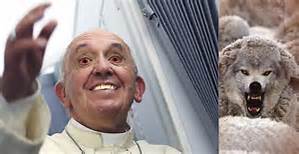
A good friend of mine recently shared a link from the Real News Network that deserves a response. It was an interview with Chris Hedges criticizing Pope Francis for not being radical enough in his denunciation of capitalism and imperialism. The award-winning journalist gave the impression that the pope should have denounced both as such and offered alternatives.

I was surprised by Hedges’ remarks. That’s because my personal assessment is that the pope actually has done all three. He has been scathing in his denunciation of capitalism; he has denounced colonial imperialism, and has offered clear alternatives to capitalism-as-we-know-it. The pope did so during his” homecoming” trip through Latin America late last summer, during his subsequent six-day trip to the United States, and especially in his landmark encyclical, Laudato Si’ (LS).

On his Latin American tour, Pope Francis’ was quite direct in his denunciation of capitalism and imperial colonialism.

For instance, addressing the World Meeting of Popular Movements in Santa Cruz, Bolivia, Francis traced today’s global problems back to their origins in European colonialism beginning in 1492. But he also identified new forms of colonialism exercised through corporations, loan agencies, “free trade” treaties, and imposition of “austerity measures.”

Such actors and policies, he said, subordinate states to outside powers which also exercise control through misguided measures ostensibly aimed at controlling drug trafficking, political corruption, and terrorism. More subtly, external powers colonize, destroy local cultures and foster cultural uniformity through communications monopolies, which the pope described as “ideological colonialism.”

“Let us say NO to forms of colonialism old and new,” he said.

Still in Latin America, the pope went on to criticize capitalism-as-we-know-it as “an invisible thread” connecting problems of world poverty, worker exploitation, landlessness among farmers, homelessness, and destruction of the natural environment. That system imposes the mentality of profit at any price without concern for its impact on displaced peasants and workers or for its destructive effects on “Mother Earth.”

The system, he said “is by now intolerable: farm workers find it intolerable, laborers find it intolerable, communities find it intolerable, peoples find it intolerable … The earth itself – our sister, Mother Earth, as Saint Francis would say – also finds it intolerable.”

For me, all of that represents not only criticism of imperialism, but of the free market system.

Then during his visit to the United States, Pope Francis offered an extremely harsh denunciation of capitalism itself. There he in effect referred to economic system we know as “filthy,” “rotten,” and “putrid.” He called the Wall Street speculators “hypocrites.” Moreover, the pope directly confronted the members of his audience by calling the system they represented “the greatest purveyor of violence” in the world today. And he implied that  the politicians seated before him were a bunch of gangsters.

Even Chris Hedges may have missed all of that, because the polite, soft-spoken, and gentle pontiff was a gracious enough guest to say none of those things directly. He did so instead by offering Dorothy Day, Martin Luther King and Thomas Merton as embodiments of our country’s greatest values.

It was Dorothy Day who is remembered as saying, “We need to overthrow . . . this rotten, decadent, putrid industrial capitalist system which breeds such suffering in the whited sepulcher of New York.”

It was King who called the United States itself, “the greatest purveyor of violence in the world today.”

And it was Thomas Merton, the apostle of non-violence, who classified U.S. politicians and military leaders among the world’s gangsters when he said, “The world is full of great criminals with enormous power, and they are in a death struggle with each other. It is a huge gang battle . . .”

Moreover, Pope Francis did not leave his audience merely reeling from such heavy blows un-complemented by clear systemic alternatives to the filthy rotten arrangement he addressed. Instead, the pontiff called for a deep restructuring of capitalism-as-we-know-it. This would involve turning the present system’s preferential option for the rich precisely on its head, replacing it with his favorite guideline, the “preferential option for the poor.” Even more particularly, restructuring would require a central international legislative body endowed with power to override national economic practices judged to be environmentally unsound.

Both recommendations are found clearly stated in Laudato Si’ which the pope cited in his congressional address (LS 53, 173-175). Surprisingly, both have already been implemented world-wide.

To begin with, the New Deal, the Great Society and (even more so) Europe’s introduction of the welfare state already represent arrangements which forefronted the needs of the working classes and poor. The reform measures were at the very least strong gestures towards economies mixed in favor of the poor rather than of the Wall Street rich. Such reforms demonstrated that another economic order is indeed possible.

As for the world body with power to enforce environmental legislation, the World Trade Organization (WTO) already has it, though perversely in its present form. According to the provisions of the North American Free Trade Agreement (and of the proposed Trans-Pacific Partnership), multinational corporations (MNCs) now have the power to sue before the WTO and invalidate U.S. environmental protection standards if those laws can be shown to diminish a corporation’s expected profits.

What the pope is proposing is an international body that turns the WTOs mandate upside-down.  The body the pope proposes would have binding power to protect the environment from the depredations of MNCs – i.e. is to eliminate their profits if they result from environmental destruction.

So I respectfully suggest that Chris Hedges is mistaken when he says Pope Francis has pulled his punches. The pontiff has been quite specific in offering alternatives to the system he has so sharply critized. As an honored guest, he gently delivered knock-out blows clearly observable to attentive listeners.

It remains for prophets like Hedges and others to highlight and reinforce them and in this way to advance us towards the Other World Pope Francis would convince skeptics is possible.


Was Mary Magdalene the First Pope? (Sunday Homily)

hieros gamos

Readings for the eleventh Sunday in Ordinary Time: 2SM 12:7-10, 13; PS 32: 1-2, 5, 7, 11; GAL 2: 16, 19-21; LK 7: 36-8:3

As much as we love Pope Francis, many of us have been disappointed by his consistent refusal to consider ordaining women to the Catholic priesthood. In the light of such irritating consistency, the pope would do well to reconsider today’s Gospel reading.

I say that because it offers a compelling argument not merely admitting women to the priesthood, but to the highest office in the church – the papacy itself. It does so by presenting Mary Magdalene as performing an undeniably priestly function far beyond any recorded of Yeshua’s apostles. Doing so brings to mind the Master’s supreme elevation of Mary Magdalene found in patriarchally-suppressed sources outside the canonical Gospels. There Yeshua designates Mary as superior even to Peter.

Consider the episode Luke records.

Yeshua has been invited to the house of a Pharisee for dinner. For Jews Pharisees were defenders of the father-rule system the Church and Pope Francis have made their own. But in this case, the “host” proves to be inhospitable in terms of Jewish custom. He obviously sees the carpenter from Nazareth and his uncouth fisherman friends as riff-raff. He omits giving them the traditional greeting, and doesn’t even offer them water to wash their feet. Evidently he considers the band from Nazareth unclean – dirty people who won’t even know the difference.

Then the hero of the story appears to set things right. She’s a woman whose gender relegated her to unquestionably second class status. She is Mary of Bethany (whom scholars identify with Mary Magdalene). And she does something extraordinary. She does what Nathan the prophet recalled in today’s first reading that he did for David. She anoints Yeshua as the Christos – the Christ, designating (and making) him God’s chosen one. This is the priestly act I referred to earlier.

Mary’s act is absolutely extraordinary. Remember, the term “Christos” (or Christ) itself means “anointed.” And in the gospels there is only one anointing of Yeshua the Christ. And, as we see, it occurs at the hands of Mary Magdalene, not of some male priest. In other words, the Magdalene in today’s gospel acts as prophet and priestess on a level arguably above Nathan’s role recalled in today’s reading from 2nd Samuel.

And there’s more. The Magdalene appears in public with her head uncovered and hair flowing – a condition appropriate for a woman of Yeshua’s time only in the presence of her husband. And besides anointing Yeshua, she performs what can only be described as an extremely intimate act. She continually kisses his feet with her lips and washes them with tears of love.

But how could a woman perform such an act? Why would Yeshua allow it? After all, according to Jewish law, women were not even permitted to say ritual prayers at home, much less perform religious rites of such central import as identification and anointment of the Christ.

That is, not according to Jewish law. . . However, according to universally recognized pre-patriarchal traditions, such election by a priestess was not only permitted but essential for any sacred king. There according to the rite of hieros gamos or sacred marriage, the priestess would anoint the priest-king. By virtue of her act (often consummated by ritual sex), the anointed would be flooded with power of the god. Conversely, without the power conferred by the woman, the king would remain powerless and have no knowledge of himself or of the gods. These facts would have been evident to Yeshua’s contemporaries.

Why has this history and the prophetic role of Mary Magdalene in identifying (and consecrating) the Christ been hidden from us all these years? Feminist scholars tell us that patriarchal misogyny – anti-woman sentiment – is the answer.

And negativity towards women is written all over today’s excerpt from Luke’s Gospel. There the evangelist emphasizes the sinfulness of the Magdalene as that of the other women in Yeshua’s company.

Luke describes Mary as “a sinful woman in the city,” and “a sinner.” He has Yeshua tell those seated at table that “many sins have been forgiven her,” and say to the woman, “Your sins are forgiven.” So we won’t miss the point, Luke gratuitously describes Mary Magdalene as the one “from whom seven demons had been cast out.” And finally, women in Yeshua’s company are described as formerly sick and possessed.

Nevertheless, Luke feels compelled to note what everyone in his community would have known: women like the Magdalene and Joanna and Susanna and the “many others” who followed Yeshua were financial supporters of Yeshua and “The Twelve.”

But Luke reveals no corresponding negativity towards the male leaders of the early church. He doesn’t call the apostles “free-loaders.” Neither does he parallel his description of the women as sinners by recalling that one of the 12, Peter, was identified with Satan himself by Yeshua. Nor does he recall that a key apostle, Judas, actually betrayed Yeshua or that all of the twelve but one (unlike the Master’s women followers) abandoned him in his hour of greatest need. Instead, Luke simply mentions “the twelve,” who by the evangelist’s omissions are implicitly contrasted with the “sinful” women.

Above all, Luke omits the description of Mary Magdalene which we find in the church-suppressed Gospel of Thomas. There she is described as “the apostle of apostles” – no doubt because of her key role in identifying and anointing Yeshua as the “Christos,” and because she was the one to whom the resurrected Yeshua appeared before showing himself to any of “the twelve.”

In fact the Gospel of Thomas says explicitly:

“. . . the companion of the Savior is Mary Magdalene. But Christ loved here more than all the disciples, and used to kiss her often on her mouth. The rest of the disciples were offended . . . They said to him, “Why do you love her more than all of us?’”

Here the word for “companion” is koinonos which refers to a consort of a sexual nature. Moreover in other suppressed writings, Magdalene emerges as Yeshua’s star pupil and the center of his attention. He praises her as “one whose heart is raised to the kingdom of heaven more than all thy brethren.” He predicts that she “will tower over all my disciples and over all men who shall receive the mysteries.” Additionally, following Yeshua’s ascension, it is Magdalene who comes to the fore to encourage the disheartened apostles to man-up and get on with the business of understanding and living out the teachings of the Master.

These words and the Magdalene’s functioning as prophet and priest should be extremely meaningful for contemporary women – and patriarchs blind to women’s leadership in the early church. They highlight the way at least one female disciple of extraordinary talent and charisma was not only marginalized but denigrated in the patriarchal church right from the beginning. And that denigration has continued in church circles and beyond to our very day.

Put otherwise, besides shedding light on the distant past, today’s readings expose the extreme weakness of contemporary ecclesiastical “fathers” in their exclusion of women from the priesthood and from other forms of church leadership. They also uncover the perversity of their other anti-woman pronouncements regarding topics such as contraception, abortion, and women’s rights in general.

In short today’s liturgy of the word helps us see beyond the “official story” to discern the fact that female leadership in the Christian community is nothing new. It is the males – the ones we call “father” – who are the interlopers and charlatans.

Clearly, Pope Francis, should change his mind on women’s ordination.

Pope Francis, Donald Trump and the Revelation of Pentecost (Sunday Homily)

Trump & Frank

Readings for Pentecost Sunday: ACTS 5: 2-11; PS 104: 1, 24, 29-31, 34; 1COR 12: 3B-7, 12-13; JN 20: 19-23.

So who do you think is more outspoken, Donald Trump or Pope Francis? Which one should followers of Jesus listen to?

That question was sharpened a few weeks ago, when Pope Francis implied that Donald Trump is not a Christian. Responding to a reporter’s question, the pontiff lit up the internet when he said about Trump, “Anyone, whoever he is, who only wants to build walls and not bridges is not a Christian.” Francis added, “Vote, don’t vote, I won’t meddle. But I simply say, if he says those things, this man is not a Christian.”

The pope’s comment came at the end of Francis’ six-day trip to Mexico. There he celebrated Mass with 300,000 faithful in attendance near the Mexican-U.S. border. He used the occasion to decry the “human tragedy” of worldwide migrations of people fleeing violence, war and the effects of climate change. The pope’s analysis, of course, conflicts with Mr. Trump’s who sees immigrants as rapists, drug-dealers, and terrorists.

Francis’ comments drew a quick response from The Donald. He called the pope’s charges outrageous and accused him of being a pawn of the Mexican government.

While Francis’ words were surprising and the response predictable, both provide occasion for a Pentecost reflection on what it means to be a baptized and confirmed Christian in a world awash with refugees from U.S. bombings and the effects of neo-liberal overconsumption.

That’s because the emphasis in today’s readings is precisely on internationalism. The Kingdom of God, the readings tell us, has no borders. It is open to everyone regardless of nationality, race, occupation or gender. Moreover, the Kingdom of God is a matter of this world – of the Body of Christ.  It is not about some disembodied reality up in the sky.

That twofold message starts with today’s opening reading from the Acts of the Apostles with all those strange identity references that readers usually stumble over. Jews, we are told who were present on that first Pentecost were “Parthians, Medes, and Elamites, inhabitants of Mesopotamia, Judea and Cappadocia, Pontus and Asia, Phrygia and Pamphylia, Egypt and the districts of Libya near Cyrene, as well as travelers from Rome, both Jews and converts to Judaism, Cretans and Arabs.”

Then in today’s second reading, Paul goes even further. God’s Kingdom, he says, isn’t just for Jews. In fact in God’s eyes national distinctions, economic status, and gender identity have been erased for those who accept the Gift of God’s Spirit. Paul writes: “For in one Spirit we were all baptized into one body, whether Jews or Greeks, slaves or free persons, and we were all given to drink of one Spirit.” Elsewhere (Galatians 3:28) he puts it even more directly: “There is neither Jew nor Gentile, neither slave nor free, nor is there male and female, for you are all one in Christ Jesus.”

Paul’s message was a consistent theme in the life of Jesus. He healed and forgave, loved and taught Jews, Gentiles, Samaritans, street walkers, lepers, tax collectors, and even on occasion members of the Roman occupying forces.

Notice too Paul’s words about “body” insert the reception of Jesus’ Spirit into the earthly realm of real life and politics. True, Paul speaks of “spiritual gifts,” but he even more emphatically insists that those gifts must be “manifest” in “service” meant to “benefit” others. We are members of Christ’s “Body,” Paul tells us. That is, we are all somehow living “in Christ” – in God, we might say. The question is, do we recognize that reality or not?

In today’s Gospel, Jesus reminds us more specifically where in the world we encounter his embodied spirit. It happens first of all in the community of peacemakers. Jesus’ first words after his resurrection are about peace. “Peace be with you,” he says.  Then he immediately shows his pierced hands and side to his friends. In doing so he seems to remind his followers that he will forever be found in the victims of war and imperialism. That includes refugees from imperialist wars and excess consumption as well as in victims of torture and capital punishment like Jesus himself.

Is such understanding of Pentecost too political? Donald Trump might think so. Pope Francis does not. Francis himself has pointed out that Aristotle was correct in saying that human beings are political animals. So to be branded “political” is to have one’s humanity recognized. The pope said he is proud to be branded political.

So would-be followers of Jesus are presented with a choice on this particular Pentecost.  Are we to follow Pope Francis or Donald Trump? The choice is ours.

More accurately, do we recognize that we are living not “in America,” but “in Christ?”  Do we recognize (as John Oxenham put it more than 100 years ago) that

1 In Christ there is no east or west,
in him no south or north,
but one great fellowship of love
throughout the whole wide earth.

2 In Christ shall true hearts everywhere
their high communion find;
his service is the golden cord
close-binding humankind.

3 Join hands, disciples of the faith,
whate’er your race may be.
All children of the living God
are surely kin to me.