Billionaires Threaten a Hostile Takeover of the Catholic Church

Readings for 6th Sunday in Ordinary Time: JER 17:5-8; PS 1: 1-5; I COR 15: 12, 16-20; LK 6: 17, 20-21;

There’s a plot going on to neutralize Pope Francis. Even worse, it’s about neutralizing Jesus and his “preferential option for the poor” that has dominated our liturgical readings for the past several weeks.

This week’s readings are no exception. In fact, in today’s Gospel selection, that option for the poor receives its starkest expression so far. There, Luke the evangelist has Jesus say clearly that the poor are the object of God’s special favor, while the rich are not. In Luke’s version of the Sermon on the Mount, Jesus speaks frankly: “You poor are blessed.” He tells the rich just as clearly, “you are cursed.” And he does so for no other apparent reason than that the objects of Jesus’ blessing and cursing are poor and rich respectively.

Before I get to that, let me say a word about the plot I just mentioned.

What I’m talking about was reported in January’s Sojourner’s Magazine – the progressive Christian Evangelical monthly published by Jim Wallis. It all appeared there in a piece authored by Tom Roberts, the executive editor of the National Catholic Reporter. The article was entitled “How Right-Wing Billionaires Are Attempting a Hostile Takeover of the Catholic Church.”

There, Roberts described an aggressive project to establish what I would call an ecclesiastical “shadow administration” bent on usurping the authority of the church’s U.S. Conference of Catholic Bishops (USCCB). The undertaking is “financed by the Koch brothers, by Domino Pizza founder Thomas Monaghan, and a slew of other billionaires linked to the Knights of Columbus and conservative Catholic Cardinals – all of whom enjoy favor with Breitbart’s Steve Bannon and the Trump administration.

Seeking to replicate the rise of the Evangelical right in the 1980s, the group advocates a Catholic version of the prosperity gospel described by Roberts as “a hybrid of traditional pieties wrapped in American-style excess and positioned most conspicuously in service of free-market capitalism.” It is “. . . ‘in your face Catholicism’ . . . often expressed amid multi-course meals followed by wine and cigar receptions, private cocktail parties for the especially privileged, traditional Catholic devotionals, Mass said in Latin for those so inclined, ‘patriotic rosary’ sessions that include readings from George Washington and Robert E. Lee, and the occasional break for a round of golf.”

Doctrinally, the goal is to bury more deeply than ever what many have called “the best kept secret of the Catholic Church,” viz. its progressive social teachings. Since Pope Leo XIII’s 1891 encyclical, Rerum Novarum, those teachings have repeatedly criticized the abuses of both capitalism and socialism while advocating workers’ rights, labor unions, fair wages, social security, and (especially with Pope Francis) care for the earth in the face of human-caused climate chaos.

The billionaire cabal in question finds especially offensive not just Francis’ emphasis on social justice themes, but the 1983 pastoral by the USCCB questioning the morality of modern warfare and of nuclear weapons. They resent above all the bishops’ 1986 letter entitled “Economic Justice for All” which disagreed specifically with the economic policies of the group’s great hero, Ronald Reagan.

In place of such teachings, the billionaires in question think that the Catholic social narrative should focus exclusively on sexual issues: abortion, contraception, gay rights, and the rights of divorced and remarried people within the Catholic Church. They want the church to be more celebratory of individualism, entrepreneurship, and of free market fixes for society’s problems. Their goal is to shrink government in general and diminish its services to the poor and marginalized in particular.

Doesn’t that sound completely like the Republican agenda?

And with the Catholic Church currently weakened and reeling from its sex-abuse scandals, the billionaire conspirators are convinced that the time is completely ripe for their hostile takeover.

But could anything be further from the teachings of Jesus which a few weeks ago, our Gospel reading summarized as “good news to the poor?”

There, Jesus announced his program with the following words: “The Spirit of the Lord is upon me, because he has anointed me to bring glad tidings to the poor. He has sent me to proclaim liberty to captives and recovery of sight to the blind, to let the oppressed go free, and to proclaim a year acceptable to the Lord.”

This was a proclamation of a new order (what Jesus called “the Kingdom of God”) directed towards improving the lot of the poor, the imprisoned, the ill and oppressed. It was the proclamation of the Jewish “Jubilee Year,” where debts would be forgiven, slaves freed, and wealth redistributed.

Now in today’s Gospel reading, the Master expresses the same sentiment, only this time in even a more in-your-face manner. Here, it’s worth quoting the words Luke attributes to Jesus.

“Blessed are you who are poor,
for the kingdom of God is yours.
Blessed are you who are now hungry,
for you will be satisfied.
Blessed are you who are now weeping,
for you will laugh.
Blessed are you when people hate you,
and when they exclude and insult you,
and denounce your name as evil
on account of the Son of Man . . .
But woe to you who are rich,
for you have received your consolation.
Woe to you who are filled now,
for you will be hungry.
Woe to you who laugh now,
for you will grieve and weep.
Woe to you when all speak well of you,
for their ancestors treated the false
prophets in this way.”

Shocking words – all of them, don’t you agree? They are part of the great reversal in the new order proclaimed by Jesus. There, the values of the world will be turned on their heads. The poor will be in charge. They will have food to eat. Laughter will replace their tears.

But the rich will experience great misery (woe).  That’s because they have been led astray by false prophets like those cardinals participating in the billionaire hostile takeover of the Catholic Church. Those fake prophets console the super-rich with honeyed words about their specialness

But according to Luke’s Jesus, the rich may be enjoying those multi-course meals, private cocktail parties, cigar receptions and rounds of golf now. But when the Kingdom’s new order comes, they will find themselves hungry. They may be laughing now, but then they will weep and cry. Their false prophets may praise them now but come the new order, the wealthy will be cursed as the most wretched of men.

Obviously, Jesus’ teaching contradicts our culture’s worship of the rich. We think of the rich as heroic entrepreneurs. Jesus sees them as worthless wretches. We see the poor as losers. Jesus sees them as objects of God’s special favor.

In other words, Jesus turns our thinking upside down. As Marianne Williamson puts it: Jesus’ truth (God’s truth) is 180 degrees opposed to what our culture values and teaches.

That realization should be Christians’ fundamental guide in reading the news and thinking about world events. It should be the confident guide of our activist efforts.

Everything is the opposite of what our culture claims!

Don’t Buy What Israel’s Selling: Support BDS

Readings for Third Sunday in Ordinary Time: NEH 8; 2-6, 8-10; Ps. 19: 8-10, 15; I Cor. 12: 12-30; Lk. 1:1-4; 4: 14-21 

In these days of rising right-wing fascism, a dangerous religious alliance has emerged. I’m talking about the supportive relationship between Christian Evangelicals and Israeli Zionists. For many, the basis of the support is the belief that Israel represents God’s Chosen People.

However, today’s liturgy of the word suggests something quite different for Christians honoring the Bible as God’s word. It underlines the point that the phrase “God’s Chosen People” does not primarily refer to a national entity, but to the poor and oppressed in general. It even implies that in our present historical context, the phrase “God’s Chosen” applies more aptly to the Palestinians than to the Zionists who kill Palestinians on a daily basis – without the least objection from our government or from most U.S. Christians. (In fact, since last March, Zionist soldiers have shot with impunity peaceful protestors in Gaza. They’ve killed more than 200 and wounded more than 18,000 — with many crippled for life — since the Palestinian rallies around the “Great March of Return” started on March 30th.)

Right now, this point about the identity of God’s People needs to be underlined because so many religiously-motivated people, and legislators in particular have taken such a strong stance against the Boycott Divest and Sanction Movement (BDS) that activists have directed against Israel to stop the slaughter in Gaza, which has been described as the world’s largest open-air prison camp. The conviction behind the divestment campaign is that a Zionist version of apartheid rivals South Africa’s hated system that economic boycotts, divestment and sanctions helped to bring down in 1994. (President Jimmy Carter’s book on the topic, Peace Not Apartheid, supports that conviction. So do the words I’ll soon quote of Dr. Martin Luther King.)

However, in response, anti-BDS legislators in Congress and in 26 of our states have proposed and/or passed legislation forbidding support of the movement. Anti-BDS legislation prohibits government investments, for example, in companies or in pension funds that support BDS. In some cases, anti-BDS laws even require employees (e.g. public-school teachers) to, in effect, pledge allegiance to Israel despite its genocidal policies.

Nonetheless, (as I said earlier) today’s liturgy of the word calls all of that into question.

Biblically speaking, it’s true that Israel did fit the “God’s Chosen” profile at the time of its origin – in Egyptian slavery (13th century B.C.E.) – and later during its captivity in Babylon (6th century B.C.E.). As poor and oppressed, they were “chosen” as well as when Israel was under the control of the Assyrians (8th century), Persians (6th century), Greeks (2nd century), and Romans (1st century). In all those instances, precisely as oppressed, Israel was the paradigmatic object of the biblical God’s special love and protection. In fact, at Mt. Zion, Moses enshrined in Israel’s law protection of people like them – slaves, widows, orphans, immigrants, the imprisoned, and the poor.

That’s the Law that the scribe, Ezra is remembered as reading to the people for hours in today’s first reading. They had just returned from exile in Babylon. For them “The Law” (the first five books of the Jewish Testament) was a source of joy and strength. After all, those books recounted what for Jews was the liberation of all liberations – from Egypt under the leadership of the great rebel hero, Moses. Now in the 6th century BCE, with Ezra in charge, they were celebrating the end of a long and painful Babylonian Captivity in the geographical area that is now “Iraq.” Ezra reminded the assembled people that in their return to the Promised Land, they were experiencing Exodus all over again. Indeed, he said, it was a time for celebration – for eating, as he put it, rich meats and drinking sweet drinks.

Today’s second and third readings pick up on Ezra’s theme – that God favors the poor and oppressed. However, both Jesus and Paul do so emphasizing the point that Yahweh’s favored ones are not always Jews.

When Jesus said that in his hometown synagogue (in the verses immediately following today’s excerpt), it enraged his former neighbors. “Who does this guy think he is?” the Nazarenes asked indignantly. “We know his family; he’s nothing special. Yet here he is speaking critically about his own people! He must be one of those ‘self-hating Jews’.” Luke says Jesus’ hometown citizens were so outraged that they tried to kill him.

Jesus’ words before the Nazarene’s attempted assassination do not merely underline the identity of God’s chosen as the poor and oppressed rather than exclusively the Jews. The words are also central in terms of Luke’s definition of Jesus’ entire project. In fact, they connect that project with God’s very identity as described throughout the Jewish Testament particularly by the prophet Isaiah whose words Jesus quotes: “The Spirit of the Lord is upon me, because he has anointed me to bring good news to the poor. He has sent me to proclaim release to the captives and recovery of sight to the blind.”

Did you notice the importance of the word “because?” It absolutely identifies the “Spirit of the Lord” with Ezra’s good news to the poor about release from captivity and recovery of sight. Jesus is saying we know that “The Spirit of the Lord is upon” him because he brings good news to the poor, those in captivity and the blind. Jesus goes on to say that his commitment to the poor is what will define his entire mission.

Today’s excerpt from Paul’s letter to the Greeks in Corinth continues that theme of Isaiah, Ezra, and Jesus. Only Paul does so in terms of a familiar yet powerful metaphor – what he calls the “Body of Christ” enlivened by the “One Spirit” of God. For Paul followers of Jesus constitute the way the Master is present today long after Jesus’ death. As that presence, we are Jesus’ hands, feet, eyes, ears, and tongue. And elsewhere Paul specifically says it makes no difference whether one is Jew or Greek, slave or free, male or female (GAL 3:28-29).

What does make a difference though is one’s social standing. Paul goes out of his way to say that the “less honorable” and the “less presentable” in Christ’s body are to be more honored and cared for than the more presentable and more honorable according to the standards of the world. The weaker parts, he says are somehow “more necessary” than the stronger parts. This could hardly be a clearer reference to the poor and those who are normally neglected and looked down upon. Here Paul is following the thrust of Jesus’ words and deeds by turning the social order upside-down. The poor and oppressed come first in God’s order.

Today, part of that revolutionary inversion is recognizing that Zionists have nothing positive to do with God’s preferences. Quite the contrary: as the Palestinians’ oppressors, they are the imperial analogues of the Egyptians, Babylonians – and yes, fascists – who persecute God’s Chosen.

Meanwhile, because they side with the poor to whom Jesus brought Good News, the BDS activists stand with Jesus – and Gandhi and Martin Luther King.

With last week’s MLK celebrations still fresh in our minds, and with today’s readings ringing in our ears, we do well to recall Dr. King’s words spoken on December 7th, 1964 – just days before he received the Nobel Peace Prize in Oslo. In a major address in London, he said,

“If the United Kingdom and the United States decided tomorrow morning not to buy South African goods, not to buy South African gold, to put an embargo on oil, if our investors and capitalists would withdraw their support for that racial tyranny that we find there, then apartheid would be brought to an end. Then the majority of South Africans of all races could at last build the shared society they desire.”

King’s words (and those of Jesus, Paul, and Ezra in today’s readings) are as true in relation to Zionist Israel as ever they were of South Africa. Today, the Palestinians not the Zionists are God’s chosen and should be treated as such.

The Salvation of Our Country and Church Comes from Iranians and Mexican Immigrants (Sunday Homily)

Readings for 4th Sunday in Lent: 2CHR 36:14-16, 19-24; PS 137:1-6; EPH 2:4-10; JN 3: 14-21

NAFTA

Today’s liturgy of the word reminds us to look for salvation in unexpected places. In fact, it strongly suggests that the very ones our culture despises, and our church relegates to second class status have been chosen by God to save us. Specifically, I’m talking about Iranians relative to our country and Latin Americans in relation to the church.

Take Iranians first. (They are called “Persians” in today’s first reading.) There, one of them (King Cyrus) is identified in Chronicles as Judah’s “messiah” or anointed. The identification is given even though Cyrus was not a Jew, but an adherent of Zoroastrianism, a religion even more foreign to Judaism than Islam. Yet according to Chronicles, this Iranian king was God’s servant chosen to end Judah’s long exile in Babylon (modern day Iraq). That’s what I mean by salvation coming from an unexpected place.

Then in the second reading from Ephesians, Paul refers to Jesus of Nazareth in those same Cyrusian terms. Jesus is the Christ, God’s anointed, Paul says – and an unlikely “Christ” at that. After all, the Nazarene was the son of an unwed teenage mother; an refugee-immigrant in Egypt at the beginning of his life; a working stiff rather than a priest or scholar; possessed by the devil (according to the religious establishment); a drunkard and whore-monger according to those same sources; an enemy of the temple and state; and a victim of torture and of capital punishment in the form reserved for terrorists. Nevertheless, just as Cyrus brought Judah back from their 70 year-long exile in Babylon, Paul says, Jesus, the executed criminal, brought all of us back from the metaphorical death caused by living according to the deathly standards of the world. In Paul’s eyes, those standards obscure the gifts of God by convincing us that we have to earn life rather than accepting everything as God’s gift. Or as Paul puts it: “salvation is not the result of works,” but of God’s graciousness.

That graciousness (John the evangelist reminds us in today’s Gospel reading) is unending; it covers all the bases, has no exceptions and lasts forever. It turns each of us into Christs – into God’s only son (or daughter) – into saviors of the world. In other words, each one of us is the unlikeliest Christ of all.

O.K. each of today’s readings tell us to look for salvation in unexpected places – even within ourselves. But what are we post-moderns to understand by “salvation” itself? Think about it. The answer should be clear both in terms of country and church. In both spheres our condition can only be described as absolutely desperate and in need of deliverance.

Politically, we’re currently like lemmings rushing headlong towards the final precipice. Under the aegis of the organization Noam Chomsky calls “the most dangerous in the history of the world,” our Republican “leaders” are in denial about the greatest peril the human race has ever faced. Here I’m referring to climate chaos that threatens to deprive our grandchildren and even us and our children of the most basic necessities of life.

Besides that, our rulers insist on developing nuclear arsenals whose destructive power boggles the mind. And they seem extremely anxious to unleash them. The U.S. commander in chief has gone so far as to wonder aloud, “If we have nuclear weapons, why can’t we use them?” If we’re not looking for salvation from all of that, we must be asleep entirely.

And as for faith . . . My own Christian community, the Catholic Church, it is in dire need of salvation too. It is crumbling before our eyes.

My parish in Berea, Kentucky is a case in point. There we’ve had a series of restorationist pastors hell-bent on reinstating the pre-Vatican II order I grew up in during the 1940s and ’50s.
Clericalism is their watchword and guiding vision. Outside the sanctuary, they wear birettas and cassocks. While celebrating Mass they seem rule-bound, uncreative, unthoughtful, and totally oblivious not only to the reforms of the Second Vatican Council, but to Pope Francis’ more recent summons to radical change as described in his Apostolic Exhortation, The Joy of the Gospel (JG), and in his eco-encyclical, Laudato Si’ (LS).

As a result of such backwardness, church numbers are dwindling drastically. Parishioners I’ve seen at Mass every Sunday over my 46 years at St. Clare’s have gone missing. Alternatively, and like my own children, they have joined the ranks of the second largest denomination in the country – Former Catholics. Loyal progressives in my parish are at their wits’ end wondering how to cope with leadership tone-deaf to their desperate voices.

My own response has been to recognize what theologian and church historian, Figueroa Deck has identified as the “sleeping giant” of Latino Catholicism. That has me attending our parish’s Hispanic Mass at 11:00, rather than the increasingly reactionary and Euro-centric Anglo Mass at 9:00. I “go to the eleven o’clock” not only to escape the deadly retrogression of 9:00 a.m. antiquarianism, but in subconscious recognition, I think, of the fact that our Hispanic parishioners represent the cutting, salvific edge of the Catholic Church.

For decades now, the Latin American Church has embodied Catholicism’s most vital element.That’s personified in Pope Francis himself, our first Latin American pontiff, who I’m told is rejected by our current parish leadership – the same way Washington rejects Latin American immigrants.

Francis, of course, comes from Argentina. He’s followed the lead of Latin American theologians of liberation with his adoption of Jesus’ own “preferential option for the poor.” That entails recognition that the poor (including, most prominently, our immigrant population) know more about the world than our rich leaders – or even than us in more comfortable classes.

I mean, immigrants possess a version of what W.E.B. Dubois called “double consciousness,” while the rest of us see only one side of what’s occurring before our eyes. On the one hand, the daily observation of the undocumented (as our motel cleaners, nannies, gardeners, construction workers, and fellow parishioners) tells them what it means to be a white American. On the other, they know intimately the experience of exclusion by those same whites.

Immigrants know how the economy works for whites, and how it excludes browns and blacks. They know that rich capitalists and their money enjoy absolute freedom to cross borders, regardless of the negative impacts such mobility might (and does!) have on Global South economies. At least subconsciously, migrant workers recognize the simultaneous contradiction of their being excluded from such mobility, despite the fact that labor is an even more important part of the economic equation than capital. So even though the law (created by the rich) forbids them, immigrants vote with their feet to claim the rights the system unjustly denies them. Our “immigration problems” are the result.

The double consciousness of immigrants can be salvific for the church. If its expressions are heeded, they can save the church. As expressed by our Hispanic Pope Francis, the undocumented in our midst call us to a church where (in the words of The Joy of the Gospel) we cannot leave things as they presently are” (JG 25), but must include new ways of relating to God, new narratives and new paradigms (74).

Similarly, in the world of politics, Iranians (the descendants of Chronicles’ Cyrus the Great) inspired this time by Islam are calling us to changes in foreign policy. They implore us to just leave them (and their oil) alone. Ironically, their desire is that they be liberated from a kind of Babylonian captivity that places them under the jackboot of the United States and (still more ironically) Israel.

What I’m suggesting is that the descendants of Cyrus are still God’s instrument of our salvation. So in our present desperate context, are marginalized Catholic immigrants whose presence reminds us of Pope Francis’ wisdom and of the penetrating understanding of life that comes from refugees and the immigrants our government’s free trade policies create on the one hand, while refusing them sanctuary on the other.

Both bring us the new ways of relating to God, the new narratives and the new paradigms salvation requires.

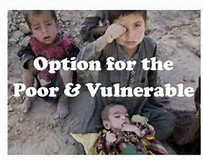
“Laudato Si’” and Its Preferential Option for the Poor (Part Three): the Guiding Principle for Restructuring the World Economy

option for poor

This is the last installment in a three-part series on Pope Francis’ new encyclical, Laudato Si’. It attempts to place in historical perspective what might well be the most important document yet produced in the 21st century. It also tries to explain the meaning and centrality of the encyclical’s guiding principle, its “preferential option for the poor.”  This third part addresses the meaning and centrality of that option.

In his critique of capitalism-as-we-know-it (reviewed in Part Two of this series), Pope Francis called explicitly for “structural change” in the world economy.  He said, “Let us not be afraid to say it: we want change, real change, structural change.”

But what “structural change” does the pope have in mind?

Evangelii Gaudium and Laudato Si’ offer the answer. Their “preferential option for the poor” provides the guiding principle and turns the present economic order exactly on its head. This implies that if the present order is possible, so is its opposite.

That is to say that the present neo-liberal order is structured according to a “preferential option for the rich.”  Its sponsoring question is how can we make sure that the banks, corporations, and 1% prosper? Economists explain such concern by various “trickle-down theories.”  If priority is accorded the welfare of the rich, the theorists say, the wealth produced will trickle down creating a “rising tide that lifts all boats.”  [The pope rejects such theories out-of-hand as historically disproven. In “Evangelii Gaudium” he even calls them homicidal (53), ineffective (54) and unjust at their roots (59).]

By way of contrast, the pope’s “preferential option for the poor” begins at the bottom of the economic pyramid. Its sponsoring question is how can we insure that farmers have land, that workers have jobs, and that everyone is decently housed?

Laudato Si’ goes even further. It expands moral concern beyond human beings to all forms of life. It asks how we can insure the survival of the planet in the face of global warming, water and air pollution, massive extinctions, disappearance of rainforests, wasted food, waste in general, uncontrolled urbanization, rampant crime and loss of human meaning.

None of this means abandoning market dynamics altogether.

It does mean, however, controlling them according to the principle some have expressed in the words, “as much market as possible and as much planning as necessary.” This means maximizing market forces, but controlling them as necessitated by prioritization of the needs of the poor including the environment – once again by the preferential option for the poor.

In practice this entails at least the following: governments (1) intervening in the marketplace to insure the rights of all to jobs with living wages, housing, education, and health care, along with land for small farmers, (2) similarly regulating market forces to protect the global environment and all life forms from the most primitive to the highest, and (3) thereafter turning economies over to carefully monitored and controlled market forces.

Impossible you say? Not at all. To repeat: if economies can be structured according to a preferential option for the rich, they can be restructured to prioritize the needs and rights of the poor and the environment.

That’s the Global South hope and conviction Laudato Si’ embodies: another world is indeed possible.

Conclusion   

Will Laudato Si’ have its desired effect? That, of course remains to the seen. However, it undeniably has in Pope Francis a powerful proponent.

That is, despite remaining Stalinist skepticism, Pope Francis might well be the most powerful man in the world. Certainly, he is the planet’s most influential moral leader. What empower him, of course, are not the military divisions in which Josef Stalin placed confidence, but his extraordinary consciousness of the unity of all creation expressed repeatedly in his every pronouncement and especially in his recent encyclical. What sets him apart from the Obamas and Putins of the world is his equally unusual courage, compassion, charisma, and credibility.

Additionally, the pope has surpassing constituency. He heads a community of 1.2 billion followers. And this does not even count the untold millions of non-Catholics who admire him and his thought leadership.

With such support, the powerful message of Laudato Si’, and his plans to bring that message to the U.N. and U.S. Congress in September, as well as to influence the Climate Summit in Paris next September, who knows what changes will result? Who knows how he will influence the U.S. general elections in 2016?

In other words, Francis may stand on the brink of surpassing the stature of Leo XIII and John Paul II in terms of changing the world.

Defenders of the old order are already shaking in their boots.

Pope Francis, “Evangelii Gaudium,” and the Catholic Vote

catholicvote

For the last 30 years the religious right (both Protestant and Catholic) has been telling us that Christian values should influence the way we vote. What will they say now that Pope Francis has called 1.2 billion Roman Catholics to move beyond obsessions with sex – abortion, contraception, and same-sex marriage?

How will they respond to his demands in his recent Pastoral Exhortation (Evangelii Gaudium) to centralize instead issues of poverty and the huge income gaps between the haves and have-nots? How will they answer the pope’s call to recognize the futility of directing billions towards a doomed “War on Terrorism” rather than correcting the structural injustices that cause such violence in the first place? What about his suggestion that those billions would be better invested in meeting human rights to food, health and education? (Yes, they are human rights according to the pope!)

All of that puts the Republicans and their fellow-travelers on the spot. After all, they have been the voting booth beneficiaries of obsession with sexual issues. They are the champion privatization, deregulated markets, and huge tax breaks for the rich. They oppose universal health care, investing money in public education, increasing the minimum wage, supporting labor unions, Food Stamp programs, and even Social Security financed by workers’ own savings. Republicans are the “tough on terrorism” bunch who (unlike the pope) attribute such violence to “hatred of our freedom,” rather than to blowback for the injustices of global capitalism.

According to the pope, such right-wing attitudes represent the very causes not only of world hunger and poverty, but of violence and terrorism. Only by interfering in the out-workings of the free market – by regulation (such as Glass-Steagal or the Tobin Tax), redirecting defense spending towards social programs (such as Medicare, Medicaid, Food Stamps), by increasing the minimum wage, and taxing the rich, – can such problems be solved.

In other words, it’s not possible this time to say “Oh, yes, we all know that good Catholics are expected to give generously to their favorite charities.” That’s not sufficient, Pope Francis asserts. No, the pope has faulted not lack of charitable giving, but the free enterprise system itself for causing the problems of global poverty and hunger as well as those of terrorism and war.

For years at election time, both the political and religious right has inundated us with directions about voting based on what the pope has identified as sexual obsessions.

It will be most interesting to observe any change in tone or direction in the upcoming general election.

Will we now be directed towards voting Democratic – for Hillary? Or will our Christian “leaders” be even more heedful of Pope Francis’ direction and urge voting instead for consumer protectionist Elizabeth Warren, for Socialist Bernie Sanders – or the Green Party candidate?

In red state Kentucky, we anxiously await direction from Mr. McConnell and Lexington’s Bishop Gainer.

“What if Jesus Had Been a Republican?” (Twenty-Second Sunday in Ordinary Time)

Today’s Readings: Dt. 4:1-2, 6-8; Ps. 15:2-5; Jas. 1:17-18, 21b-22, 27; Mk. 7:1-8, 14-15, 21-23

Tikkun Magazine (the Israeli-American quarterly published by Rabbi Michael Lerner) recently published an article called “What if Jesus Had Been a Republican?” It rewrote three well-known Christian Testament scriptures to reflect the world vision and morality of the Republican Party. The piece was reproduced on the news and analysis website “AlterNet.” (Here’s the reference http://www.alternet.org/belief/what-if-jesus-had-been-republican?paging=off).

The first rewritten episode was entitled “The Lazy Paralytic.” It was about the paralyzed man whose friends removed roof tiles on a home to bring him into Jesus’ presence, when the Master was otherwise inaccessible because of the large crowds around him. The revised story has Jesus saying to the paralytic, “Can’t you take care of your own health problems? I’m sure that your family can care for you, or maybe the synagogue can help out.” . . . . What would happen if I provided access to free health care for everyone? That would mean that people would not only get lazy and entitled, but they would take advantage of the system. Besides, look at me: I’m healthy. And you know why? Because I worked hard for my money, and took care of myself.”

The second rewritten episode was called “The Very Poorly Prepared Crowd.” It re-imagined the feeding of 5000 people usually understood as the “Miracle of the Loaves and Fishes.” Only this time there was no feeding. Jesus says that would make the improvident crowd too dependent on authority figures like himself. People would never learn to think ahead and the lesson of self-sufficiency would be lost. So applying the principle of “tough love,” Jesus eats one loaf and one fish himself and gives the remaining four loaves and one fish to his twelve apostles.

Even more to our readings’ main point this morning, the reformulated story of “The Rich and Therefore Blessed Young Man,” has a rich man kneeling before Jesus to ask, “What must I do to inherit eternal life?” When Jesus learns that the man has been born into wealth and privilege, Jesus’ admiration knows no bounds. However, he says, one thing is lacking in terms of God’s kingdom: “A bigger house in a gated community in Tiberias. Buy that and you will have a treasure indeed. And make sure you get a stone countertop for the kitchen. Those are really nice.” Jesus’ disciples are scandalized by all of this and ask, “But Lord,” they said, “what about the passages in both the Law and the Prophets that tell us to care for widows and orphans, for the poor, for the sick, for the refugee? What about the many passages in the Scriptures about justice?” 7. “Those are just metaphors,” said Jesus. “Don’t take everything so literally.”

I point you towards those rewritten parables not only because they made me laugh, or because we saw the Republicans in action at their convention last week, but because the last rewrite I mentioned is closely related to this morning’s readings. Those readings remind us of how religion, and specifically the person and words of Jesus can be distorted to reflect what Jesus calls “human traditions” rather than “God’s commandments.”

Today’s first reading from the Book of Deuteronomy reminds us of what the heart of God’s commandments actually was. The Deuteronomy reading shows Moses preparing the ex-slaves just escaped from Egypt for a law that centralizes social justice and care for the orphans, widows, (and immigrants).  The Law of Moses was about setting up a community where what we today would call social structures protected society’s most vulnerable. Its Jubilee statute made provision for the periodic cancelling of debt and the return of land and homes to those who had lost them to the bankers.  The Mosaic Law even forbade charging interest itself – as the words of today’s responsorial psalm remind us. In fact, up until the late Middle Ages, when capitalism began to emerge, charging interest on loans was considered immoral and contrary to Scripture. But then, of course, the Tikkun Jesus would remind us, “Don’t take everything so literally.”

Today’s second reading from the Letter of James’ stands firmly in the Mosaic tradition and defines religion in terms of specific acts directed towards the poor. In fact, James definition of pure and undefiled religion consists entirely in taking care of the orphans and widows in their affliction.  That definition reflects the very attitude of Jesus himself. Recall that in Matthew 25 – our only unambiguous account of the final judgment – the entire affair is based on specific acts of compassion, even though those performing the acts were utterly unconscious of any spiritual motivation. Jesus welcomes into his Father’s kingdom those who fed the hungry, gave drink to the thirsty, welcomed the immigrant, clothed the naked, and visited the sick and imprisoned. Those who don’t do such things are condemned.

What I’m saying is that in James’ following of Jesus we find a definition of religion that is not only down to earth and practical, but calls for day-in and day-out embrace of society’s marginalized rather than leaving them to fend for themselves. James’ words, like those of Jesus, challenge us all to self-criticism about our own neglect of the poor and those at risk. The implication here is that God is not happy with us when our only response to poverty is “tough love” instead of the hands-on compassion and involvement Jesus demanded and exemplified.

However since James’ time – and especially after the 4th century, when Christianity became the official religion of the Roman Empire, Christian faith became more abstract, intellectualized and (in terms of today’s Gospel reading) Pharisaic. Essentially “true religion” was transformed into simply believing things about Jesus rather than imitating him as healer, feeder, and champion of the poor. Since the fourth century, Christians are those who believe in God, the virgin birth, the miracles of Jesus, and his resurrection. Unlike Jesus’ words about the hungry and thirsty, none of those beliefs directly ask believers to be any different from others except inside their heads.

That leaves true believers free to act like the Pharisees Jesus confronts in today’s Gospel. So believers condemn “those others” who don’t see things as we do. Religion then becomes a cause of separation rather than of unity. This is especially true when the life choices of “those others” differ from those of believers. So the essence of Christianity becomes condemning the poor as “lazy.” Christians condemn Muslims as terrorists. Straight people condemn gays as immoral. Celibate men condemn married people for practicing contraception. And believers well beyond the age of child bearing condemn “those others” for resorting to abortion. Conservatives condemn liberals for not thinking as they do. Liberals do the same thing to conservatives. In virtually none of those cases is anything asked of the condemners except scorn and contempt for “those others.” It’s the others who must change, not us!

In today’s Gospel selection, Jesus calls us away from that kind of self-centered complacency to self-criticism. That’s the first step in identifying and changing the elements all of us find within ourselves that deprive us of compassion for others – especially for the widows, orphans and immigrants. The elements Jesus names as enemies of compassion sound like a description of the cultural values we “Americans” celebrate: greed, envy, arrogance, deceit, licentiousness – and the murder (as in wars) necessary to keep “our” stuff.

Taking the example of Jesus “more literally” calls us to the type of humility and personal transformation that recognizes our very selves in those we have been taught to despise as unworthy. The simple understanding of religion espoused by Moses, Jesus and James reminds us that its “pure and undefiled” form calls us to community, to seeing ourselves in “the least” – to our own humanization.

Here I recall a relevant sign I saw at a political rally I once attended. The sign reminded me of James’ doctrine-less definition of religion. It read simply “Do what God did: become human.”

That’s the essence of our Christian faith.

_____

Don’t miss Monday’s second installment of the series on Mary Magdalene