Democracy isn’t about elections every four years. It’s about serving the majority—and by that standard, the U.S. is failing while China succeeds.
The ongoing dismantling of the American state under the Trump regime and the Republican blueprint known as Project 2025 does not represent an aberration or a temporary descent into madness. It represents the logical fruition of a political system structurally incapable of governing itself for the long term.
Trump merely makes visible what has long been true: the United States lacks the institutional continuity, political discipline, and moral orientation required to compete with societies capable of sustained planning. In that sense, America is not “falling behind.” It is revealing its nature and vulnerabilities . And that identity increasingly resembles what we once condescendingly labeled the Third World.
To grasp why, we must abandon the illusion that the United States is governed by a coherent state. It is not. It is governed by a revolving door of factions, donors, ideologues, lobbyists, and media spectacles that swing wildly every four to eight years, undoing whatever fragile policy coherence preceded them. Distrust of government is elevated to a civic virtue; sabotage is rebranded as freedom; long-term planning is treated as a threat rather than a necessity.
China operates on the opposite principle. It is governed by a permanent coordinating institution—the Chinese Communist Party—that does not dissolve after elections or permit private plutocrats to hollow out the state when their profits are threatened. One may object to its ideology or criticize its methods, but one cannot deny its structural advantage: it governs continuously. It plans in ten-, fifteen-, and twenty-five-year increments. It treats infrastructure, education, energy, and industrial policy as matters of national survival, not ideological fashion.
That single fact—the presence or absence of a permanent governing authority capable of subordinating private wealth to public purpose—explains nearly everything that follows.
Project 2025 throws the American contrast into stark relief. Its animating impulse is not reform but eradication. Get rid of government. Gut regulatory agencies. Purge the civil service. Replace professional competence with ideological loyalty. Distrust science. Abandon climate research. Defund education and public health. Criminalize critical thought—especially Black, feminist, Indigenous, or Hispanic history—on the grounds that such inquiry undermines patriotism. Schools, in this vision, are meant to produce obedience, not understanding.
Energy policy under this regime borders on parody. Halt solar and wind development. Dismiss climate science as a hoax. Revive “beautiful clean coal,” as if atmospheric chemistry were a branding exercise. Withdraw from international climate agreements.
Meanwhile, China dominates global solar manufacturing, battery technology, rare-earth processing, and electric transportation—not because it is morally superior, but because it decided decades ago that energy transition was inevitable and acted accordingly.
The same pattern appears elsewhere. Arms-control treaties painstakingly negotiated over generations are abandoned on impulse. Nuclear safeguards are weakened. Diplomacy gives way to bullying. Alliances are treated as protection rackets. Institutions created after World War II to stabilize a fragile global order are mocked, hollowed out, or discarded.
Then the pendulum swings. Democrats return to power and timidly attempt to repair the damage. Agencies are restaffed. Climate policy is resurrected. Treaties are reentered. Education funding is restored.
But everyone knows the clock is already ticking. In four or eight years, the reversal will be reversed again. Businesses hesitate. Allies hedge. Long-term investment stalls. Why plan for a future that may be ideologically illegal after the next election?
This is paralysis disguised as democracy.
The only policies that survive these oscillations are those serving the rich and powerful: permanent war, regime change abroad, an ever-expanding military budget, corporate bailouts, and surveillance systems untouched by austerity. On these matters there is bipartisan consensus, because these are the interests of the class that actually governs the United States.
China, meanwhile, continues to move forward—not because it is benevolent, but because it is coherent. High-speed rail networks span the country. Ports, airports, and logistics hubs are built in record time. Universities expand. Technical education is prioritized. Poverty is treated as a social problem to be solved, not a moral failing to be punished.
The results are not theoretical. China has earned repeated recognition from the United Nations for lifting roughly 800 million people out of extreme poverty since the late 1970s—an achievement without historical precedent. This figure appears consistently in UN Development Programme and World Bank assessments. No amount of ideological hostility can erase that record.
Equally striking is the question of legitimacy. Contrary to Western assumptions, governance in China does not rely solely on repression. Long-running surveys conducted by Harvard University’s Ash Center for Democratic Governance—tracking Chinese public opinion over more than a decade—show consistently high and rising levels of public satisfaction with the national government, often exceeding 90 percent approval.
Compare this with the United States. Pew Research Center and Gallup polling over the past two decades reveal historic lows in trust toward the federal government, with confidence often hovering below 25 percent. Majorities of Americans report believing that elected officials do not care what people like them think, that government serves special interests, and that the political system is fundamentally broken. Decreasing numbers of Americans vote regularly, yet feel powerless. Chinese citizens vote for local officials and report that the permanent national system works.
This forces an uncomfortable question: what do we actually mean by democracy?
If democracy is reduced to the ritual of elections every two to four years—elections dominated by money, media manipulation, and structural exclusion—then the United States qualifies. But if democracy is understood more substantively, as governance that serves the material needs and long-term well-being of the majority, then the American claim collapses. By the testimony of citizens themselves—the people most closely involved—the United States fails at this task. China, by the same measure, succeeds.
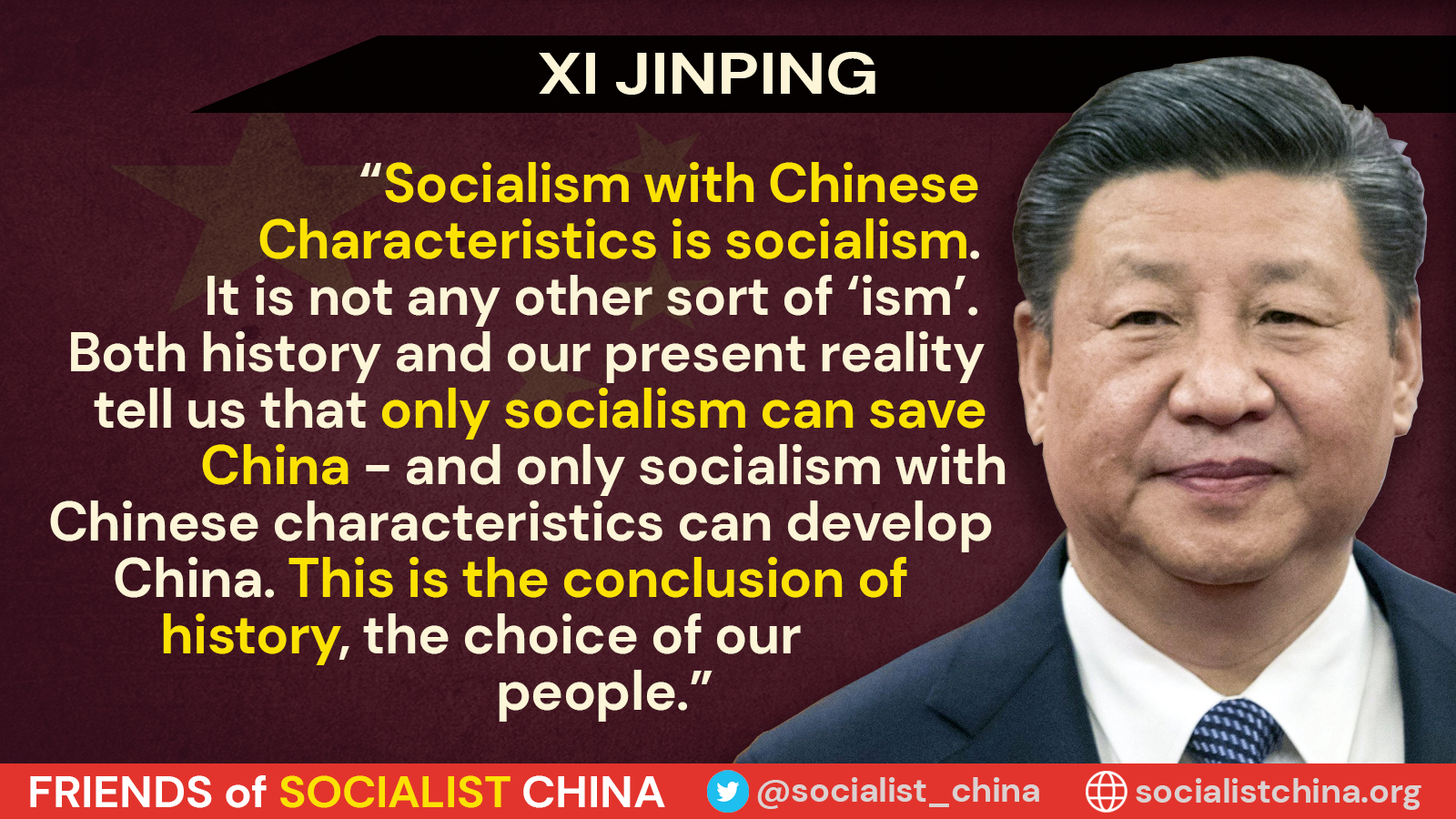
This does not mean China is socialist in any classical sense. “Socialism with Chinese characteristics” might more accurately be described as capitalism with Chinese characteristics: a hybrid system that tolerates markets while refusing to surrender political authority to them. The crucial word is authority. The Chinese state asserts the right to govern. The American state apologizes for its existence.
Ironically, the United States would need something like its own version of “socialism with American characteristics” to survive: a system that subordinates finance to production, treats health care and education as public goods, plans energy transitions over decades, and insulates core institutions from electoral whiplash. But such a transformation would require exactly what the American system cannot produce: permanent and irreversible investments in national health care, education, climate measures, nuclear disarmament, rent control, day care, labor unions, and wages that keep up with inflation.
Project 2025 is not the cause of American decline. It is the confession. It openly declares that the American right no longer believes in governing—only in dismantling. And because the system permits such nihilism to recur endlessly, because it contains no mechanism for enforcing continuity in the public interest, decline is not merely possible. It is inevitable.
The tragedy is not that China may surpass the United States. Civilizations rise and fall. That is history. The tragedy is that America is choosing decline in the name of freedom while hollowing out the very capacities that make freedom meaningful. A society that cannot plan, cannot remember, and cannot serve its people is not free.
It is merely ungoverned.
And ungoverned societies, no matter how wealthy they once were, eventually come to resemble the Third World they once presumed to lecture.

 About Things That Matter