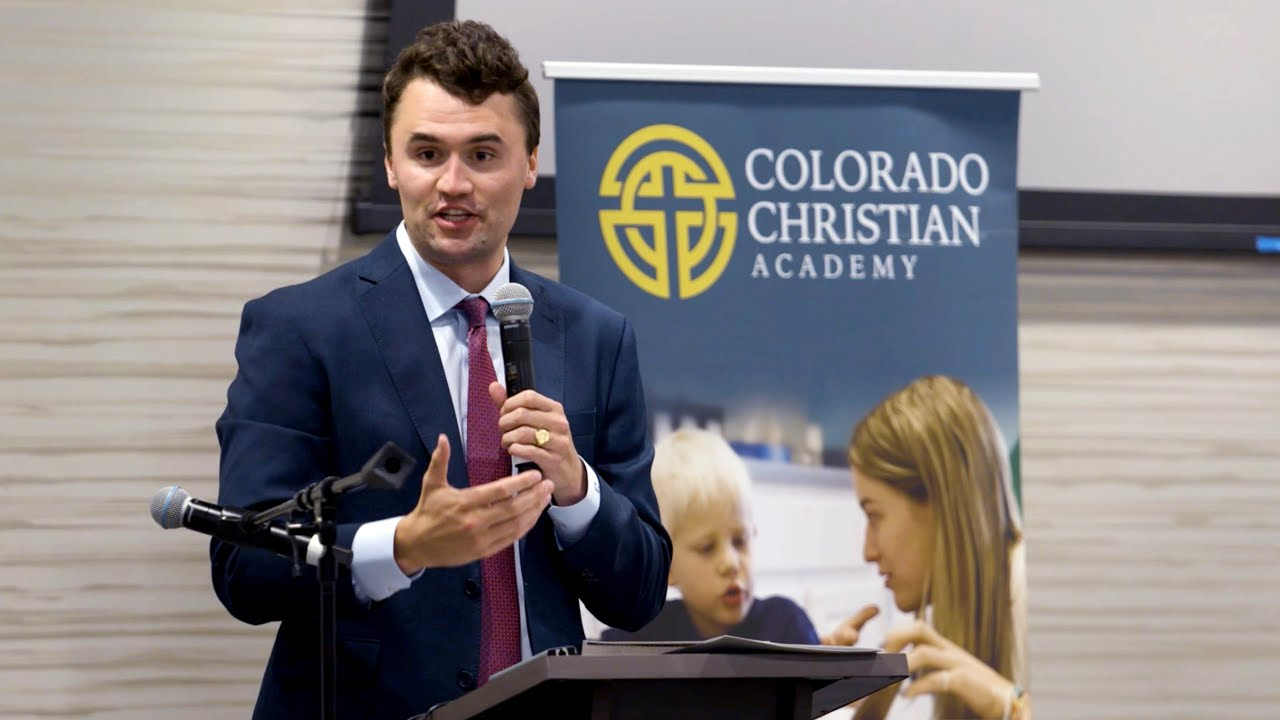
Me and Charlie Kirk

The more I watch Charlie Kirk’s “debates” with college students, the more compassion I feel for him. He strikes me as a brilliant but frightened young man—haunted, as I once was, by a God of fear and judgment. Like Charlie, I once believed in that God until I reached roughly the same age he was when he died at just thirty-one.

That “biblical” God, as I was taught, was the almighty creator, lawgiver, judge, and punisher—the terrifying being who condemned sinners to eternal torment for disobedience. Who wouldn’t be afraid of such a deity? Certainly not me. Like Charlie, I accepted it all.

My education—spanning from kindergarten in 1945 to my doctoral studies in Rome in 1972—was entirely within the Catholic Church. Nuns and priests trained me in one of the most traditional, patriarchal institutions in the world. They taught that there was “no salvation outside the Church.” It was our duty to convert the “pagans.”

So I spent thirteen years in seminaries preparing to be a missionary in Asia—China, Korea, Burma, Japan. Then came five more years of doctoral study in theology. The indoctrination could hardly have been deeper.

Like Charlie Kirk’s brand of fundamentalism, my Catholic formation fostered a deep suspicion of science and “secular” knowledge. Pope Pius IX’s Syllabus of Errors (1864) had warned against modern thought. From it emerged the apologetic mindset that shaped both of us—a defensive “us versus them” posture toward the modern world. Apologetics gave us tidy answers to every challenge: “If they say this, you say that.” Charlie mastered it. So did I. We both found it airtight, logical, and comforting.

Our politics flowed from the same worldview. My Catholic mentors, like Charlie’s conservative allies, saw communism as evil incarnate. When Senator Joseph McCarthy died, one of my seminary teachers told me, “A great man died today.” At twenty-two, I cast my first vote for Barry Goldwater.

And yet, even in that enclosed world, the “bad ideas” we feared had a way of slipping in. Despite my resistance, studying Latin and Greek classics, French and English literature, and Church history began to unsettle my certainty. Questions emerged about morality, colonialism, the Crusades, and the value of other faiths. I fought those doubts—but they persisted.

When the Second Vatican Council (1962–65) finally opened the Church to modernity, I was among the last to let go of my conservative instincts. I loved the Latin Mass, the vestments, and the comforting clarity of dogma. Like Charlie, I thought the Bible was literally dictated by God through chosen “transcribers”—Moses, David, Solomon, Matthew, Mark, Luke, and John.

But my four years of pre-ordination Scripture study shattered that illusion. Doctoral work confirmed it: The Bible isn’t a single book. It’s a diverse library written by many flawed human beings over a thousand years. They used different names for God and often disagreed about divine commands.

The Bible contains myth, legend, poetry, law, prophecy, fiction, and coded “apocalyptic” literature—resistance writings against empire, not predictions of the end of the world. I still remember my shock learning that Matthew’s “three wise men” story was midrash, not history. To treat all of it as literal fact is to miss its deeper truth.

Even so, like Charlie, I continue to believe the Bible is true—not in every detail, but in its moral and spiritual essence. As one of my friends says, “The Bible is true, and some of it even happened.” Its central story is not Adam and Eve’s fall, but the Exodus—the liberation of slaves. That story reveals the Bible’s real heart: what scholars call “God’s preferential option for the poor.”

The Bible sides with the enslaved, the widow, the orphan, the immigrant—the victims of empire. In fact, it may be the only ancient text written almost entirely by people conquered by Egyptians, Assyrians, Persians, Greeks, and Romans. Its truth is that followers of Jesus are called to stand with the oppressed.

I wish Charlie Kirk had lived long enough to encounter that truth. I believe his integrity might have led him toward it. But he dropped out of college after one semester, calling higher education a scam and a waste of time. He thought it was too expensive and too slow—a mere credentialing machine for good jobs.

To him, studying literature, history, or biblical scholarship in college was pointless. Worse, he saw such studies as dangerous, because they exposed students to the “bad ideas” that challenge inherited faith.

That, I think, is the crux of the problem. For both Charlie and my younger self, religion was the one realm where childhood knowledge was considered complete and unchangeable. Questioning it was betrayal. It’s as if a student of arithmetic said, “I know all about addition and subtraction—don’t confuse me with algebra or calculus.”

But algebra and calculus exist. They expand mathematical truth. And in the same way, modern biblical scholarship and scientific discovery expand our understanding of faith. History, psychology, sociology, and biology all reveal new dimensions of reality. Dismissing them out of fear is not faith—it’s denial.

I know, because I lived that denial for years. So when I watch Charlie Kirk confronting the questions of college students, I feel compassion. I see a man of goodwill trapped in a theology of fear. My heart goes out to him—and to all conservative Christians whose terror of change and of God narrows their vision to biblical literalism and political reaction.

Faith can be so much larger than that.
It can liberate, not confine.
It can open hearts instead of closing them.

That’s the lesson Charlie Kirk never got the chance to learn.

The Only Prayers Worth Saying

I don’t like to pray out loud. Never have. And this despite having been a priest years ago.

Praying in public is too much like a performance. Everyone’s expecting something eloquent, insightful, and inspiring. For me, such showmanship is not what prayer is about.

Rather, and as Yeshua instructed, prayer is something one does in secret (Matthew 6:5-7). It should be as close to wordless as one can get.

In fact, as I see it, there are only two prayers worth voicing. They go together. And while both are extremely brief and unpretentious, they are extremely liberating.

The first is “Hasa Diga Eebowai.” The second is simply “Thank You.”

Allow me to contrast the two prayers and the gods they envision while adding a note about the importance of doing so.  

Hasa Diga Eebowai

The first prayer might shock you. It was originally explained in the delightful Broadway musical, “The Book of Mormon.” It was addressed to the traditional god preached by missionaries not only of Mormon faith, but of Christian faith in general.

That’s the familiar patriarchal god who is law giver, judge, condemner, punisher, and torturer. He’s the god (let’s be honest!) we fear and hate – you know, the one who stands ready to drown most of us in an eternal lake of fire for the simple crime of being human. He’s the one we all need to be saved from.

That Great Patriarch in the sky is the one that the professionally religious have often taught punishes an evil world with war, hunger, sickness, plagues such as AIDS, along with horrific “religious” customs such as female circumcision.

To him Hasa Diga Eebowai!

If you’ve seen “The Book of Mormon,” you know how to translate that.

Eebowai,” the Ugandan chief explained to the twenty-something Mormon ‘elders,’ (watch the above video) “is our name for God. And ‘Hasa Diga means ‘f*ck you!’ So, I guess ‘Hasa Diga Eebowai’ means ‘F*ck you, God!’”

Yes, f*ck that punishing god described above!

What a powerful, liberating prayer! Let me say it again: Hasa Diga Eebowai!

I mean, we need to be liberated from that pseudo-divinity who’s so bent on punishment and inhibiting our growth especially around human sexuality.

Where did that execrable deity come from?

The Origin & Power of Eebowai

His origin might be traced to St. Augustine. Remember, he was the bishop of Hippo in Africa.in the early 5th century – a powerful ideolog and writer about the human condition. As “Doctor of the Church,” Augustine’s influence remains incalculable. Until quite recently (and to some extent still), any theological treatise had to square its proposal with Augustine.

But what did he teach?

In his Confessions, he found the origins of sin in the human body. That carnal mass, he explained, (particularly in its sexual dimension) was evil and eternally at war with the spiritual soul.

As his doctrine came to be developed, any pleasure taken in sexual thoughts, words, or deeds outside the bond of marriage were mortally sinful. And unless confessed and absolved by an ordained priest, they would merit eternal consignment to that horrible lake of fire.

In the ensuing Catholic tradition, even married couples had to be careful about sex. Since seeking sexual pleasure for itself was culpable, every act of intercourse even by the sacramentally married had to be open to the exclusively god-defined purpose of coitus, viz., the begetting of children. Thus, any kind of artificial contraception was outlawed. Frustrating the divine purpose of intercourse would plunge married couples into that fiery lake as well.      

Think about what all of that meant.

For one thing, it meant that the second strongest impulse of human beings (after self-preservation) had to be suppressed, controlled, and worried about as a threat and source of punishment and guilt. The centrality of the sexual drive insured that everyone would at some time (and usually quite frequently) commit an associated “mortal sin” (i.e., a sin meriting eternal punishment in hell).

For another, the criminalization of sexuality endowed the Catholic Church and its priests with inestimable power. The latter’s’ words of absolution given or withheld could open or close the gates of heaven. Anyone guilty of “mortal sin” and who died without priestly absolution (or its spiritual equivalent – a nearly impossible prayer expressing perfect, disinterested love of God) would end up forever tortured.

Some might say that the priest’s greatest “power” came from the belief that his words could transform bread and wine into the very body and blood of Christ. Socially, however, the priest’s main significance came from belief in the power he exercised over the gates of heaven and hell.

That capacity made him a necessary factor in every believer’s life.

[By the way, when Catholics stopped going to confession (gradually and spontaneously after the Second Vatican Council, 1962-1965) priests suddenly lost the status that the sacrament of Penance (Confession) gave them. They were left without the function that most justified their existence.]

Yes, F*ck that God! He is no God at all, but a figment of Augustine’s tortured and fevered imagination.

A Contrasting Beneficent God      

How then speak of God in what Lutheran theologian and martyr (under the Nazis) Dietrich Bonhoeffer called “a world come of age?” How do those who still recognize the spiritual dimensions of life as primary talk of God when the very word has lost positive meaning for so many?

Here we can be comparatively brief – almost silent.

We could speak of Ultimate Reality, the Ground of Being, Life’s Deepest Mystery, Source, Divine Mother, Great Spirit, or simply of Nature with a capital “N?”

For me however, the most meaningful reference to the divine is to imagine God (as does spiritual teacher Niel Donald Walsch) as the sum total of all the energy in the universe and in the universe of universes. That would seem harmonious with the discoveries of quantum physics, which sees everything ultimately composed of energy and light.

The totality in question would include the that of evolution, love, and consciousness. It would include every one of us as manifestations of God. As conscious, the Energy in question could be addressed as “Thou.” We could also refer to it as our authentic Self.

That’s the God worthy of the second prayer I mentioned earlier. The only prayer to utter in such divine presence (of which each of us is a manifestation) is Thank you! Thank you! Thank you!

Conclusion

Why does any of this matter?

It matters first because most of us have been terribly damaged by Eebowai. We need to be saved from that God. We need capacity to look him straight in the eye and say Hasa Diga.

Do that right now. It’s very liberating.

Second, those of us who are convinced that we are basically spiritual beings need alternative, credible, and viable concepts and language to give voice to our convictions. We require another God to replace Eebowai. And yes, another God is possible. Or better put: another God is necessary.

That emerging God would have us set aside Augustine’s reasoning that was seized on and manipulated by a clerical class that deprived us of dominion over our bodies, our sexuality, our reason, and autonomy. We need liberation from all of that.

We need Ultimate Reality, the Ground of Being, Life’s Deepest Mystery, Source, Divine Mother, Great Spirit, and/or simply Nature with a capital “N?”

Whatever words we use, the autonomously spiritual among us need one we can look in the eye and say sincerely, “Thank you. Thank you. Thank you.” In the end, it’s the only prayer we need.

In Memoriam: Dan McGinn

I got word that a very important person in my life died on March 6th. His name is Fr. Dan McGinn. Like me, he was a member of the Society of St. Columban. Dan was 15 years older than me. He came from Council Bluffs, Iowa. Before I met him, he had been a missionary in Japan for seven years. I studied with him in Rome from 1968 through 1972.

Dan and I hit it off as soon as he arrived at Corso Trieste 57, my second year in Rome. There, while I was studying moral theology at the Academia Alfonsiana, he worked in the Vatican – at the Secretariat for Non-Christians.

Dan usually sat directly across from me at our long dining room table, where the 20 or so men stationed with us in Rome ate three times each day. Three of us were Yanks, the others were Micks, Aussies, Brits and New Zealanders.

It was there that we all had such lively and memorable conversations about our studies, the church, theology, politics, and world events in general. Dan usually took great delight in playing the provocateur. The resulting discussions were intense. In fact, I’ve never experienced anything as consistently stimulating since those heady days following the Second Vatican Council (1962-’65).

Dan used to say that if he ever became a bishop (fat chance!), he’d do the expected and adopt an episcopal coat of arms for himself. He never described the shape of the shield he’d design.

But he was clear about the motto he’d have emblazoned on the banner below it. It would read, he said, “No More Bullshit!”

That was the kind of priest Dan was. He was a rebel. And, I guess, so was I. In many ways, I wanted to be like Dan. I considered him my mentor.

More than anything else, he taught me how to say Mass. I remember the first time I concelebrated with him in our chapel at the Columban house. There were probably five of us participating, and Dan had the lead role. He astonished me. He made the whole thing up.

No reading of prayers. No following the prescribed and inviolable eucharistic scripts. Instead, everything was ad-lib. For instance, even at the consecration – the most sacred part of the Mass – Dan said something like: “On the night before he died, Jesus was there in the Upper Room eating supper with his friends. He took a piece of bread and broke it like this (Dan broke the host) and asked them, ‘Do you see how I’m breaking this bread? This is the way my body will be broken for you. Yes, I love you all that much. This is my body which will be given up for you.’”  The form varied each time Dan said it.

It all struck me as so natural – as the way the Mass must have been celebrated before the Roman obsessive-compulsives established such complete control. I resolved then and there that I’d celebrate my Masses like Dan from then on. And that’s what I did.

Even when I got back to the states and worked in Kentucky for the Christian Appalachian Project (CAP), that’s the way I celebrated Mass. And, like me, most of the people in the parishes I served there found it all so natural, very meaningful and completely acceptable. Even now, I marvel that I got away with that.

Dan also helped me when (towards the end of my time in Rome) I found myself re-evaluating my decision to remain a priest. I broke the news to him during a retreat we were on together at the Mundo Migliore Center at Roca di Papa on the edge of Rome. I remember walking together and discussing my “crisis,” and Dan’s advising that it might be a good idea for me to do a year of discernment before taking a final decision. I followed his advice and spent that year I just mentioned working in central Kentucky with the Christian Appalachian Project.

After I finally left the active priesthood and was working at Berea College, I spoke with Dan a few times on the phone. He told me once that he thought President G.W. Bush was “absolutely the worst we’ve ever had.” (At the time, of course, neither of us knew it could go down-hill a lot  further.)

During those years, I also got on Dan’s mailing list for the poetic political commentary he wrote on what amounted to his blog. Then, at the reunions the Columbans held every three years or so at their former seminary-turned-retirement-home in Bristol Rhode Island, I visited Dan each time I attended – once with my wife, Peggy. At one point he was volunteering as a docent at a local museum.

My last encounter with Dan McGinn came last summer during our most recent Columban reunion. By then he was confined to a nursing home. He no longer remembered me, nor our time in Rome. I found that both sad and threatening. He had been so bright, so engaged, so witty and daring. I admired him so.

With that deep admiration, dear Dan, I send you off. Thank you for your friendship and for being such a good priest. Thank you for teaching me how to celebrate Mass. Thank you for your kind guidance. Know that I’ve tried to adopt your motto as my own. I’m trying to remain, like you – committed to a “no more bullshit” life. You succeeded at that for sure! Thanks again.

Sunday Homily: “Lazarus come forth!” Pope Francis Brings Jesus Back to Life

Lazarus

Readings for the Fifth Sunday of Lent: EZ 37: 12-14; PS 130: 1-8; ROM 8:8-11; JN 11: 1-45 http://usccb.org/bible/readings/040614.cfm

A few weeks ago, Fortune Magazine identified Pope Francis as first among the World’s “Fifty Best Leaders.” President Obama did not even make the list. Bono and President Clinton were among the top ten.

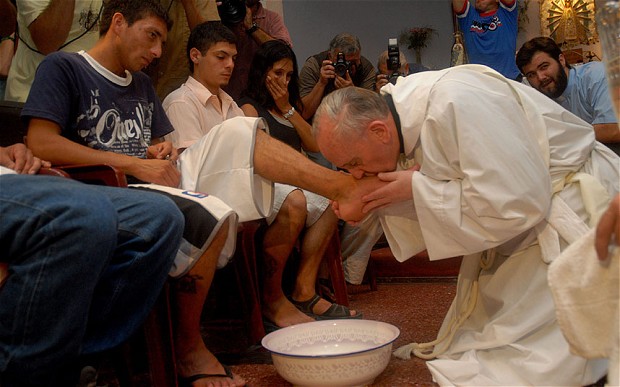
Whatever the magazine’s reasons for selecting the pope, it’s clear that the “Francis Effect,” is real. Seventy-seven percent of Catholics say they have increased their church donations since the new pope took office. Francis has brought the Catholic Church back from the dead. More importantly, he has returned to life the Jesus of the gospels whom conservatives have long since hijacked and buried – the very one our world’s poor majority needs as never before.

That’s relevant this fifth Sunday of Lent where our readings have Ezekiel coining the highly political metaphor of God’s “raising the dead” to refer to Israel’s impending liberation from its own despair during its Babylonian Captivity. Ezekiel’s metaphor reappears in today’s gospel reading where John the evangelist’s presents his familiar parable about Jesus raising Lazarus from the grave where Jesus’ friend lay moldering for more than three days.

Consider the hopelessness of Ezekiel’s Israel. His sixth century was the saddest of times – the era of his nation’s Great Exile. The Hebrews had been defeated and humiliated by Babylon (modern day Iraq). Its leaders and a large portion of its populace had been abducted to that enemy state. The exiles felt as if they had been slaughtered culturally. They were far from home, controlled by foreign masters, and apparently abandoned by God.

But the prophet Ezekiel did not share his people’s general despair. So in an effort to regenerate hope, he coined the idea of resurrection. Ezekiel loved that concept. [Recall his Vision of Dry Bones (EZ 7: 1-14).] For Ezekiel resurrection was a political metaphor that promised a new vital future despite appearances to the contrary. Israel, he said, would be liberated from Babylon, return home and experience rebirth. They would come back to life.

In his Apostolic Exhortation, The Joy of the Gospel (JG), Pope Francis embraces not only Ezekiel’s spirit, but that of Jesus raising Lazarus from the dead. To repeat, he actually revivifies Jesus and the Gospel. The pope does so by rescuing them both from conservative forces whose version of Christianity has held center stage for the last 35 years. It’s the version, the pope strongly implies, that has metaphorically killed the Jesus of the Gospels, who proclaimed the imminent arrival of God’s Kingdom which belongs to the poor, not to the rich whom the conservatives prioritize.

Like Ezekiel, Jesus made his proclamation when all appearances indicated that Israel was dead. It was entirely under the heel of Roman jackboots and there seemed no escape. Yet Jesus described a horizon of hope that enlivened the spirits of the poor who were crushed by the Romans and by their rich Jewish collaborators who headed the temple establishment.

In such dire straits, Jesus proclaimed a new future where everything would be turned upside down. He said audacious things. In God’s realm, he insisted, the poor would be in charge. The last would be first, and the first would be last. The rich would be poor and the poor would be well–fed and prosperous. The powerless and gentle would have the earth for their possession. Jesus’ unemployed and famished audiences couldn’t hear enough of that!

So he elaborated. He told parable after parable – all about the kingdom and its unstoppable power. It was like leaven in bread – unseen but universally active and transforming. It was like the mustard seed – a weed that sprouted up everywhere impervious to eradication efforts. It was like a precious pearl discovered in the ash bin – like a coin a poor woman loses and then rediscovers. His metaphors, similes and parables were powerful.

To repeat, Pope Francis strongly implies that socio-economic conservatism has murdered the Jesus I’ve just described. It has done so by its “preferential option for the rich.” It embraces free-market capitalism, trickle-down theory, and cut-backs in health care, education, and anti-poverty programs. Conservatives complement such horrors with huge tax-breaks for the country’s 1%. All of this is was chillingly represented last week by “devout Catholic,” Paul Ryan whose budget promised to sock it to the poor and middle class, while enriching military industrialists along with his affluent friends.

The Joy of the Gospel makes it clear that no one can support policies like Ryan’s and claim at the same time to be a follower of Jesus.

In other words, Ryan and the pope are on completely different pages. While conservatives have buried the Gospel Jesus, Pope Francis calls him back to life. He stands before Jesus’ grave and shouts “Come Forth!” Even Fortune Magazine recognizes the resulting miracle.

Consider the Pope’s anti-conservative incantation that brings Jesus back to life. It runs like this:

• Wealth does not belong to the rich, but to the world’s poor (JG 57, 184).

• But the world economy as now structured concentrates wealth among an ever-shrinking minority of the rich (56).

• Wealth must therefore be redistributed (189, 204,215).

• Such redistribution must take place by government intervention in the free market, which (in contradiction to failed “trickle-down” theory) cannot by itself eliminate poverty (54).

• The rich who are unwilling to redistribute wealth to its true owners (the poor) are thieves (57, 189).

• More than that, they are murderers, since the world economy as presently configured is homicidal (58).

• This is a question of being pro-life (213).

• Favoring life certainly includes concern for the unborn (213).

• But “. . . defense of the unborn is closely linked to the defense of each and every other human right” (213).

• Human rights include the right to food and shelter, education, health care, employment , and a just wage (191, 192)

• Respecting human rights involves renunciation of war and preparation for war (60).

• It also connects with environmental stewardship – defense of soil, insects, birds, fish, and the seas (215).

And so the tomb opens. And a Jesus who has been buried more than three decades stumbles out. And in doing so, he renews the faith of so many of us who had given up on the church.

Our faith is renewed because we recognize in Francis’ Jesus the embodiment of one of life’s fundamental truths: utopian visions of the good and true and beautiful can never be killed, even though they might appear lifeless and be pronounced dead by those who once loved them.

What should we do as a result of encountering the Jesus Francis has resurrected?

• Be bold in appropriating the vision of Pope Francis that is not at all idiosyncratic within the Catholic tradition. In fact, it represents the authentic teaching of the Catholic Church from Leo XIII to Vatican II and was even articulated by John Paul II and Benedict XVI.

• Accordingly and courageously incorporate into progressive political discourse the language and powerful ideas of the Judeo-Christian tradition. It can move people today just as it did in the times of Ezekiel and Jesus.

• Join Francis in refusing to cede the field of religion to the reactionary forces of neo-liberal conservatism.

• Expose that conservatism for the destructive fraud it is.

• More particularly, expose Paul Ryan and other Bible thumping Republicans as the heretics they are as they defend the interests of the rich and starve the poor in the name of the Gospel.

• Insist that our pastors get on board with Pope Francis in universalizing his pro-life vision to foreground issues of hunger, war and peace, capital punishment, full employment, universal health care, affordable housing, environmental protection. . . .

Francis reminds us that united with our neighbors, we too, the People of God, possess the power to raise the dead.

So as we stand before the grave of God, the church, and Jesus, let’s echo the pope’s cry: “Jesus, come forth!”

The Church’s Disastrous Domestication of Jesus (Sunday Homily)

King of the Universe

Readings for the feast of “Our Lord Jesus Christ, King of the Universe”: 2 SM 5: 1-3, PS 122: 1-5; COL 1: 12-20; LK 23: 35-43. http://usccb.org/bible/readings/112413.cfm

Today the Catholic Church celebrates the feast of “Our Lord Jesus Christ, King of the Universe.” The contrast between the feast’s grandiose title and the readings prescribed for the occasion illustrate a basic reason behind the irrelevance of the church (and Jesus) to the post-modern world. It’s irrelevant to the social and economic transformations necessary to redeem the church’s overwhelmingly Third World membership from globalized oppression.

The contrast I’m referring to involves the great makeover of Jesus of Nazareth changing him from the leader of an anti-imperial revolutionary movement into a pillar of the exploitative status quo.

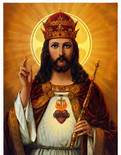
Let me put it this way: through 4th century sleight of hand, the Jesus who sided with the poor and those oppressed by empire – the one who promised a new heaven and earth belonging to the simple and poor, and who was executed as a terrorist by Rome – was made to switch sides. He was co-opted and domesticated – kicked upstairs into the royal class. He became not only a patron of the Roman Empire, but a “king” complete with crown, purple robes, scepter and fawning courtiers.

Following that transformation, kings and popes (now themselves transformed into gaudy temporal rulers) claimed to govern by divine right on behalf of Jesus as his representatives and vicars. In this way, the poor and oppressed (who then and now constitute the world’s majority) lost their paradigmatic leader, example and advocate. Jesus became instead a key part of the apparatus oppressing them.

Reza Aslan’s recent best-seller, Zealot, attempts to rescue the revolutionary historical Jesus from the distortions of the royal classes just mentioned. Aslan connects his salvage project specifically with today’s account of Jesus’ crucifixion in Luke, Chapter 23. In doing so, the author pays particular attention to Jesus’ cross, to the Roman inscription identifying Jesus as “King of the Jews,” and to the dialog between Jesus and the two “thieves” presented as sharing his fate.

According to Aslan, all three – cross, inscription and dialog – mark Jesus as a dangerous revolutionary “terrorist” rather than a domesticated upholder of the given order. That terrorist remains as threatening to today’s dominant empire, the U.S.A., as he was to imperial Rome. So he continues to be erased from history and by “feasts” like today that mask his true identity.

Take the cross first. It was the mode of execution reserved primarily for insurrectionists against the Roman occupation of Palestine. The fact that Jesus was crucified indicates that the Romans believed him to be a revolutionary terrorist. How could it have been otherwise, Aslan asks? After all, Jesus was widely considered the “messiah” – i.e. as the one, like David in today’s first reading, expected to lead “The War” against Israel’s oppressors.

Moreover, he proclaimed the “Kingdom of God,” a highly politicized metaphor which could only be understood as an alternative to Roman rule. It would return Israel, Jesus himself promised, to Yahweh’s governance and accord primacy to the poor and marginalized. The Romans drew logical conclusions. Put otherwise, the Roman cross itself provides bloody testimony to the radical threat the empire saw personified in Jesus.

That threat was made specific in the inscription the Romans placed over the head of the crucified Jesus. It read, “King of the Jews.”

Typically, those words are interpreted as a cruel joke by the Roman procurator, Pontius Pilate – as if he were simply poking fun at those who saw Jesus as the worthy successor of Israel’s beloved King David.

However, according to Reza Aslan, nothing humorous was intended by the inscription. Instead it was a titulus. Every victim of crucifixion had one – a statement of the reason for his execution. The motive for Jesus’ crucifixion was the same as for the many others among his contemporaries who were executed for the same crime: aspiring to replace Roman rule with home rule – with an Israel governed by Jews instead of Romans. The titulus on Jesus’ cross, along with the cross itself identify him as the antithesis of what he eventually became, a Roman tool.

And then there are those two thieves. Aslan says they weren’t “thieves” at all. That’s a mistranslation, he points out. A better translation of the Greek word, lestai , would be “bandits” – the common designation in the first century for insurrectionists. And there probably weren’t just two others crucified the day Jesus was assassinated. There may have been a dozen or more.

And, no, the whole world wasn’t watching either. As scripture scholar John Dominic Crossan observes, Jesus would have represented hardly a blip on the screen of Pontius Pilate. And Jews would have averted their eyes from the spectacle depicted in this morning’s gospel. They wouldn’t want to see “one more good Jew” suffering the fate of so many heroic patriots.

In this context the dialog between Jesus and two of the terrorists crucified with him takes on great significance. Actually, it documents the beginning of the process I described of changing Jesus’ image from insurrectionist to depoliticized teacher.

Think about it. Luke’s account of Jesus’ words and deeds was first penned about the year 85 or 90 – 20 years or so after the Roman-Jewish War (66-70 C.E.). By then the Romans had utterly defeated the Jews, destroyed Jerusalem and its temple as well as slaughtered the city’s population including practically all of the eyewitnesses of Jesus’ messianic campaign. Virtually the only Christians left standing were foreigners – gentiles living in population centers like Rome, Alexandria and Antioch. Few of these had any understanding of or sympathy for Judaism much less for Jewish politics and its liberation movements.

Besides that, in the war’s aftermath, both Jews and Christians sought to distance themselves from the socio-political expectations that had brought on the disaster of the Jewish War. So Judaism tried to transform itself from a Temple-centered religion to one focused on the local synagogue and rabbinic teaching – both overwhelmingly concerned with simply preserving the culture and identity of a people in diaspora.

For their part, Christians became anxious to show the Roman world that it had nothing to fear from their membership.

One way of doing that was to distance the dying Jesus from the Jewish insurgents and their terrorist actions against their oppressors. So in Luke’s death-bed dialog among three crucified revolutionaries, one of the terrorists admits that Jesus is “under the same sentence” as he and his comrade in arms. Given what Aslan said about crucifixion, that fact was undeniable. All three had been sentenced as insurrectionists.

But now comes the distancing between Jesus and Israel’s liberation movements. Luke has the “good thief” (read good terrorist) say, “. . . indeed we have been condemned justly, for the sentence we received corresponds to our crimes, but this man has done nothing criminal.”

In other words, Luke (writing for a post-war Roman audience) dismisses insurrection as “criminal,” and removes Jesus from association with such crime – a fact endorsed, Luke asserts, by insiders like the honest lestai crucified with Jesus. Luke’s message to Rome: the killing of Jesus was a terrible mistake; he meant no harm to Rome. And neither do we, his followers.

Loss of the radical revolutionary Jesus is not a trivial matter in terms of Christianity relevance to a world ruled by a nation that styles itself as Rome’s worthy successor. Like its ancient archetype, the U.S. (and a majority of first-world Christians) found the historical Jesus so threatening, that it determined that Jesus’ followers deserved the same fate as their crucified Master. For this we have the evidence of the war that the U.S. fought against liberation theology when it first emerged following the conclusion of the Second Vatican Council (1963-65).

Liberation theology committed the unforgiveable sin represented by this homily. It was guilty of connecting the Jesus of history described by scholars like Aslan to post-colonial independence movements and struggles against the neo-colonialism spearheaded by the U.S. and its oligarchical clients in the Third World.

In that struggle Pope John Paul II and his henchman, Josef Ratzinger, threw in their lot with a neo-imperial Ronald Reagan. It was deja-vu all over again: Reagan as Pilate and J.P.II and Ratzinger as the temple priesthood. It was the deja-vu of the church melding its interests with Rome towards the end of the 4th century.

More specifically, the two reactionary popes looked the other way and actively supported Reagan’s policies that assassinated hundreds of thousands of Christians (200,000 in Guatemala alone!) who found the radical Jesus threateningly relevant to their struggles in Latin America, Africa, and South Asia.

To balance liberation theology’s threat, Reagan patronized Evangelical Christians who eventually morphed into the Tea Party. It finds Aslan’s understanding of Jesus anathema. Meanwhile, John Paul II and Ratzinger “cleaned house,” eliminating every single progressive bishop from the hierarchy and transforming seminaries into hot houses to nurture a pre-Vatican II reactionary clergy.

Recently Pope Francis delivered a long-winded, very general and content-less speech to the National Council of Bishops in Brazil. That group used to head a church that was a hot-bed of liberation theology I’ve been describing here. The term was never mentioned in the new pope’s remarks. Instead, he presented John Paul II and Pope Ratzinger as champions of Vatican II.

He’ll have to do better than that to fulfill his aspiration towards making the church relevant to the poor he professes to care so much about.

He’ll have to confess the Church’s sins against liberation theology and revive the cult of the historical Jesus – instead of the depoliticized imperial “King of the Universe” today’s feast calls to mind.

Dives & Lazarus: a liberation theology catechism (Sunday Homily)

Lazarus

Readings for the 26th Sunday in Ordinary Time: AM 6: 1A, 4-7; PS 146: 7-10; ITM 6: 11-16; LK 16: 19-31 http://usccb.org/bible/readings/092913.cfm

Today’s liturgy of the word provides us with a catechism of liberation theology – Christianity’s most important theological development in the last 1500 years, and the West’s most important social movement of the last 150 years.

I have come to those conclusions over a period of more than forty years studying liberation theology. My interest began in Rome during my graduate studies there, 1967 through 1972. There I first heard Peru’s Gustavo Gutierrez speak. (Fr. Gutierrez is considered the father of liberation theology.)

Subsequently I read Gutierrez’s book, A Theology of Liberation (1971) and was completely taken by it. Reading the book gave me the feeling that I was hearing Jesus’ Gospel for the very first time.

You might ask, what is liberation theology? To answer that question fully, please look at my blog entries under the “liberation theology” button. I’ve written a series on the question. In my blogs, you’ll find that I always define it in a single sentence. Liberation theology is reflection on the following of Christ from the viewpoint of the world’s poor and oppressed. That’s the class of people to which Jesus himself belonged. They constituted the majority of his first followers.

When read from their viewpoint, accounts of Jesus’ words and deeds – the entire Bible for that matter – take on depths of meaning and relevance to our contemporary world that are otherwise inaccessible to people like us who live in the heart of the wealthy world. From the viewpoint of the poor, God passes from being a neutral observer of earth’s injustices to an active participant with the poor as they struggle for justice here on earth. Jesus becomes the personification of that divine commitment to the oppressed. After all, he was poor and oppressed himself. The Roman Empire and its Temple priest collaborators saw to that.

My interest in liberation theology deepened as my teaching career developed at Berea College in Kentucky from 1974 to 2010. There I was encouraged to continue my study of liberation theology. So I spent extended periods in Brazil, Nicaragua, Costa Rica, Honduras, Guatemala, Cuba, Mexico, Zimbabwe, South Africa, India and elsewhere studying under liberation theologians, dialoging and publishing with them. The poor in all of those countries were suffering from the aggression the United States directed against them.

Meanwhile at Berea, I found the conclusions of liberation theologians validated by the college’s very fine scripture scholars. They had almost no acquaintance with liberation theology, and yet what they were teaching perfectly harmonized with its central tenets. It’s just that they stopped short of drawing what seemed to me the obvious political conclusions from their work.

More specifically, Berea’s scholars identified the Exodus (Yahweh’s liberation of slaves from Egypt) as God’s original and paradigmatic revelation. The whole tradition began there, not in the Garden of Eden. Moreover, the Jewish prophetic tradition emphasized what we now call “social justice.” Even more, Jesus of Nazareth appeared in the prophetic tradition, not as a priest or king. Jesus directed his “ministry” to the poor and outcasts. The Gospel of Luke (4: 18-19) has Jesus describing his program in the following words:

“The Spirit of the Lord is upon me, because he has anointed me to bring good news to the poor. He has sent me to proclaim release to the captives and recovery of sight to the blind, to let the oppressed go free, and to proclaim the year of the Lord’s favor.”

After his death, Jesus’ followers continued along those lines. They lived communally, having sold all their worldly possessions and distributed the proceeds to the poor.

All of that finds vivid expression in today’s liturgy of the word. As I said, it’s a kind of catechism of liberation theology. The reading from Amos the prophet describes the sin that most offends God – wealth disparity in the face of extreme poverty. Amos decries a “wanton revelry” on the part of the wealthy that sounds like the “American Way of Life” or the “Lives of the Rich and Famous” that we Americans find so fascinating. The prophet describes a rich class that lives like King David himself – in luxurious houses, overeating, drinking wine by the bowlful, and generally ignoring “the collapse of Joseph,” i.e. the poverty of their country’s most destitute. For that, Amos says, the rich will ultimately suffer. All their wealth will be confiscated and they will be driven into shameful exile.

In railing against the rich and defending the poor, Amos was calling Judah back to the worship of Yahweh whose attributes are described in today’s responsorial psalm. There God is depicted as loving the just and thwarting the ways of the wicked. The psalm describes Yahweh as securing justice for the oppressed, giving food to the hungry, and setting captives free. He gives sight to the blind and protects resident aliens, single mothers and their children.

Then today’s excerpt from 1st Timothy outlines the characteristics of those who worship that God by following in Jesus’ footsteps. They keep the commandment which is to do unto others as we would have them do unto us. According to St. Paul, that means pursuing justice and living with devotion, faith, love, patience, and gentleness.

Finally, the gospel selection from Luke chapter 16 dramatizes the sinful relationship between rich and poor and the destinies awaiting both. Luke tells the story of the rich man and “St. Lazarus” who is honored by the poor throughout Latin America.

It is significant that Lazarus is given a name in Jesus’ parable. Usually we know the names of the rich, while it is the poor that remain anonymous. Here matters are reversed. To remedy this anomaly, tradition has assigned the wealthy man a name. He’s called Dives, which is simply the Latin word for rich man.

For his part, Lazarus is quintessentially poor, hungry, and lacking medical care. His sores are open and the only attention they receive are from dogs that lick his wounds. Meanwhile, Dives seems completely unaware of Lazarus’ presence, though the beggar is standing at his very doorstep. Within the sight of Lazarus, the wealthy one stuffs himself with food to such a degree that the scraps falling from his table would be enough to nourish the poor beggar. But not even those crumbs are shared. How could Dives share? He doesn’t even know that Lazarus exists.

So the two men die, and things are evened out. The rich man goes to hell. We’re not told why. Within the limits of the story, it seems simply for the crime of being rich and unconsciously blind to the presence of the poor. For his part, Lazarus goes to the “bosom of Abraham,” the original Hebrew patriarch.

Lazarus is rewarded. Again, we’re not told why. Within the story, it seems simply because he was poor and Yahweh is partial to the poor, just as he was to the slaves God intervened to save when they were starving in Egypt.

Seated with Abraham, Lazarus feasts and feasts at the eternal banquet hungry people imagine heaven to be. Dives however is consumed by flame in the afterlife. Fire, of course, is the traditional symbol of God’s presence, or purification, and of punishment. This seems to suggest that after death, both Dives and Lazarus find themselves in the presence of God. However what Lazarus experiences as joyful, Dives experiences as tormenting.

And why? Simply, it seems, because Dives was rich, and Lazarus was poor.

Does the parable tell us that what awaits us all after death is a reversal of the economic conditions in which we now find ourselves? The first will be last; the last first. The rich will be poor, and the poor will be rich. That in itself is highly thought-provoking.

In any case, Yahweh is presented as champion of the poor in this parable, just as in the reading from Amos, in today’s responsorial psalm, and in Paul’s letter to Timothy. And according to liberation theologians, that’s the central characteristic of God throughout the Judeo-Christian tradition. God is on the side of the poor and hates obscene wealth disparity.

You can well imagine how such insight inspired the poor and oppressed throughout the world when it emerged as “liberation theology” following the Second Vatican Council. Poor people everywhere (and especially in Latin America) took courage and were inspired to demand social justice from the rich who had been ignoring them in the New World since the arrival of Columbus 500 years earlier. In fact, Liberation theology motivated social movements more powerfully than any thought current since the publication of the Communist Manifesto in 1848.

And that’s why the reigning empire, the United States of America took action against liberation theology. It initiated what Noam Chomsky calls “the first religious war of the 21st century.” It was a war of the United States against the Catholic Church in Latin America – yes against the Catholic Church. The war killed hundreds of thousands of priests, nuns, lay catechists, social workers, union organizers, students, teachers, and journalists along with ordinary farmers and workers.

Today’s liturgy of the word reminds us not to let the United States have the final word. We are called to divest ourselves of our wealth and to take notice of St. Lazarus at our gates. God is on the side of the poor, not of the rich.

Pope Francis, Summon a Council: It’s Our Tradition!

Francis I

Readings for 6th Sunday after Easter: Acts 15:1-2, 22-29; Ps. 57: 2-3, 5, 6, 8; Rev. 21: 10-14; 22-23; Jn. 14: 23-29. http://www.usccb.org/bible/readings/050513.cfm

Last year was the 50th anniversary of the convocation of the Second Vatican Council. The Catholic Church is still reeling from that earth-shaking event. Conservatives often consider it a huge mistake. They want to return to the Latin Mass, to women’s head-coverings in church, to weekly confessions and communion placed by the priest on the communicant’s outstretched tongue.

Liberals too are disappointed by Vatican II. It didn’t nearly go far enough, they say. It should have eliminated priestly celibacy and the all-male clergy. The church should have divested itself of the Vatican Bank, sold its art treasures and given the proceeds to the poor. The Council’s teaching on collegiality should have decentralized church bureaucracy and made lay-leadership more prominent. The prohibition of contraception should have been changed.

Into which of those camps do you fall? As a church member, do you consider yourself conservative or liberal? Today’s liturgy of the word provokes the question. It reveals a church which at its very beginning surrendered itself to extreme liberalism – or should I say to the “radicalism” of Jesus’ Spirit?

Think about those terms for a minute in the light of today’s readings. Think about what “conservative” and “liberal” mean for us as individuals and community members in our faith tradition. Think of the Holy Spirit as “radical” – something believers are rooted in.

According to every great tradition (Christian or otherwise), the spiritual life – human life itself – is about change, about transformation. Change is the point. We are called to grow. Growth involves transformation. At the biological level, we’re told that all of our cells change every seven years. That means that at my stage in life, I’ve already gone through more than ten bodies! If I tried to keep my body from changing, I would die.

At the personal, psychic and intellectual levels we’re called to change as well. As St. Paul puts it, when we were children, it was appropriate to think, speak and act as children (I Cor. 13:11). But as adults, we’re called to something more. If we don’t change, we can never become who we’re meant to be.

Even institutions must change to survive. That’s true in the realm of politics, economics, and religion. Jesus’ followers found no exemption from this rule of life – of evolution; as community members they had to change or die. In other words, at the end of the day, strategies of conservatism are doomed for Christians as well as for everyone else.

It’s easy to sympathize with conservatives however. I spent much of my life in that category. As such, my concern was simply to preserve what is essential. I saw liberals as being too free with the unchangeable. Like other conservatives I accused them of throwing out the baby with the bath water.

Nonetheless, in today’s liturgy of the word, we get an idea of how difficult it is to determine which is which –baby or bath water. That is, in our readings, we are faced an example of a key conflict between religious conservatives and liberals within the first century infant church. Paul, Barnabas, Silas and Barsabas lead the liberal wing. Peter and Jesus’ brother, James are the leaders of the conservatives.

Paul and his friends come from the gentile world. Their concern is to make Jesus both understandable and acceptable to non-Jews. For their audience, circumcision and dietary restrictions (like not eating pork) represent great obstacles to accepting Jesus’ “Way.”

On the other hand, Peter and Jesus’ brother, James, are Jews through and through. They remember the importance of full observance of the law within the Jewish tradition. They recalled for instance that during the second century Seleucid persecution of the Jews under Antiochus IV Epiphanes, many Jews gave their lives rather than eat forbidden foods. Faced with Paul and his colleagues, the conservative faction wondered: were those lives sacrificed in vain? And besides, circumcision was the identifying mark of Jewish manhood. What good follower of the biblical God set that all-important commandment aside?

The issue is so serious that it provoked a meeting of church leaders – what scholars call the “Council of Jerusalem.” Like Vatican II (1962-’65) it called together church leadership to discuss burning issues of the day and to make changes that responded effectively to what Gaudium et Spes called the “signs of the times.”

Today’s gospel reading implies that leaders could come together with confidence because of Jesus’ promise that his Holy Spirit would continue teaching the church even after he is gone. The Spirit would remind the church of what Jesus himself taught – and more besides.

According to today’s readings, it was the “more besides” that the Jerusalem conservatives were resisting. They didn’t deny, of course, that Jesus himself was a religious liberal. (It was Jesus’ liberalism that angered the Scribes and high priests.) Jesus frequently placed love and compassion above God’s most important commandment, the Sabbath law; he associated with the “unclean;” he even befriended and worked miracles for gentiles. Jesus was never bound by the letter of the law as were his conservative opponents.

At the same time however, Jesus was Jewish to the end. He had no intention of founding a new religion. He was a Jewish reformer. No one could deny that. Jesus didn’t revoke the Law. He simply gave it an enlightened, more humane, more liberal interpretation. He himself had been circumcised!

It was with these understandings that the Council of Jerusalem convened. And according to Luke, the author of Acts, it was a battle royal. Luke says the meeting (like Vatican II) was filled with “dissension and debate.”

What we find in today’s first reading is the final decree of the Council of Jerusalem. Concerning circumcision, it says “never mind.” As for dietary restrictions, fagedaboutit. The Council was concerned with not placing unbearable burdens on converts. In other words, it couldn’t have been more liberal. It could not have been less conservative.

The Council of Jerusalem is reputed to have happened no more than 30 years after the death of Jesus. But by the time John of Patmos writes his book of Revelation at the end of the first century, look where his church had come. His vision of the “New Jerusalem” which we read about in today’s second reading doesn’t even have a temple. Jerusalem without a temple?! The city is founded not on the 12 patriarchs of Israel, but on the 12 apostles. How liberal is that!?

I suppose what I’m saying is that Christians shouldn’t be afraid of change. It’s our tradition – right from the beginning. In fact, in today’s gospel, John has Jesus say specifically that we should not be agitated or fearful. Rather, our hearts should be filled with peace because of our reliance on the Holy Spirit. John’s Jesus teaches that the Spirit’s presence guarantees the community is moving in the right direction, even when the Spirit’s teachings shock and scandalize – as long as it’s moving towards Jesus’ compassion, love, and ease of burden. The guarantee remains even when the Spirit’s guidance seems to dilute what many consider essential – like circumcision, dietary laws and the Jerusalem Temple.

What “essentials” is the church being called to set aside today? Priestly celibacy? An all-male priesthood? Prohibition of contraception? Are any of these really essential?

The question is as unnerving for the church as it is for us as individuals. But the answer is always the same: “Don’t be afraid or agitated; the Holy Spirit guides.”

Think about it: at the personal level, after ten changes of body and innumerable psychic growth spurts and changes of mind, what remains that allows me to identify with that child they tell me I was in my baby pictures? The bath water has been thrown out virtually every day. But somehow I’m able to say “I” remain. Who is that “I?”

Once again, today’s gospel leads us to believe that the answer is the indwelling Holy Spirit herself who continually leads us into the new and unforeseen – but without that “fear or agitation.” That unifying, enlightened Spirit is the same in me as She is in you.

The bottom line: today’s readings teach that there is no future in timid conservatism. Instead we are called to extreme liberalism. And that liberalism actually translates to Jesus-like radicalism (or going to the root of things). The Holy Spirit is that root.

And so we can pray with confidence: “Holy Spirit, in the present crisis of your church, inspire Francis I to call us together once again. Convene a Council. Surprise us. Shock us one more time. Wake us up! Move us towards compassion, love and ease of burden as you did the Jerusalem Council. We believe that under your guidance, we can never go wrong!

John the Baptist’s Desert Revival and Pope John XXIII’s Aggiornamento

Third Sunday of Advent Readings: Zep. 3: 4-18a; Is. 12: 2-6; Phil. 4: 4-7; Lk. 3: 10-18.  http://www.usccb.org/bible/readings/121612.cfm

The lead article in the November 11th edition of our diocesan newspaper, Crossroads, published a sermon by the bishop of our Lexington diocese, Ronald W. Gainer. It had been given on Saturday November 3rd at the Cathedral of Christ the King in Lexington – the Saturday before the General Election. Bishop Gainer called attention to a new and “dangerous, corrosive change . . . at work in the soul of our nation.”  “In recent decades,” the bishop said, “forces are working overtime . . . to eliminate religion and God from the nation’s soul.” According to Bishop Gainer, those forces ignore the consistency of the Church’s moral teaching over the centuries – about “the sacredness of every human life.” Those teachings recognize certain acts as “intrinsically evil.” These include “abortion, euthanasia, assisted suicide and embryonic stem cell research. Being against the intrinsically evil means standing up for the sanctity of marriage between one man and one woman, the God-given right to freedom of religion, and against the evil of racism. There is nothing wrong with being a single-issue voter, the bishop emphasized; and abortion is the pivotal single issue for Catholics. The bishop concluded that political “candidates who refuse to oppose the evils he listed or who actively support them disqualify themselves from receiving Catholics’ support in the voting booth.”

Curiously, Bishop Gainer’s list of “intrinsic evils” did not include priests raping children. As a result, his remarks came off as out-of-touch, triumphalistic, self-serving, dishonest, and tired. We had heard it all before: “They’re wrong; we have never erred. ‘They’ are persecuting us. Only one issue is important, abortion. Vote Republican, even if that means economic disaster for the poor at home or abroad” (e.g., in the wars and drone strikes which also went unmentioned in the bishop’s remarks).

______

A little over a month ago, I attended the concluding Mass at the “Call to Action Conference” (CTA) in the Grand Ballroom of the Galt House in Louisville, Kentucky. CTA is the annual meeting of progressive Catholics who are trying to follow the spirit of the Second Vatican Council. (Vatican II set an agenda of church renewal and reform when the world’s Catholic bishops met in Rome from 1962-1965.) About 1000 people were present at CTA’s concluding liturgy. It reminded me of what spirited worship is like. Our good friend, John Wright Rios was the music leader with a group he assembled of about 15 instrumentalists and singers. There were drums, guitars, piano, trumpet and dancing. Hymns were in English and in Spanish with words projected on four large flat screens. The liturgy featured women in prominent roles, including three of the five concelebrants. Sister Simone Campbell of “Nuns on the bus” fame and who had spoken at last summer’s Democratic Convention gave the homily. What she said was insightful, inspiring, funny, and challenging. It made me see what the church is missing by insisting on an all-male, highly in-bred clergy. Sister Campbell spoke of the deep-seated divisions in our country and the need for universal love even of our enemies. She addressed the spiritual poverty and hunger experienced by all of us including leaders in the church, in politics, in our schools and universities. Poverty and hunger of body and spirit was the focus of Jesus’ work as described in the gospels. The church needs more Jesus, she said, and less triumphalism and pride.

______

Today’s readings are about religious revival and about the renewed recognition of God’s presence in our midst. In the first and third reading, the message is delivered by severe critics of temple worship – Zephaniah and John the Baptist. Zephaniah was a religious reformer from the seventh century BCE (just before the Babylonian Exile). He was known as the champion of “the poor of the land” (2:3; 3:12), and a fierce critic of Assyrian imperialism and the adoption of Assyrian religious ideology by Israel’s ruling elite. He accused the priests of his day of abandoning Yahweh in favor of Baal and Astarte. The outspoken Zephaniah threatened to drive out the priests and cleanse the temple by force.

Then in today’s gospel, John the Baptist picks up Zephaniah’s theme more than five hundred years later. Luke pictures John at the Jordan River – far from Jerusalem’s temple and its priesthood. John is leading a religious revival in the desert – the place of Israel’s birth long before there was any temple. Like Zephaniah, John is a layman. And his words to the religious leadership are harsh. In Luke’s verses immediately preceding today’s excerpt, he calls the crowd a “brood of vipers.” Matthew’s version is more specific. He says that curse was hurled at the Sadducees and Pharisees, the religious leadership of the day. According to John, they are snakes in the grass.

John contrasts the failed leadership of these men with God’s leadership present in the person of Jesus of Nazareth. Jesus, of course, turns out not to be a priest or rabbi either, but a workingman from Nazareth. Yet according to John, Jesus is more powerful and more worthy than John himself. As a lay leader, Jesus will bring not only the Holy Spirit, but a cleansing fire. He will separate the wheat from the chaff – what is essential from what is not – what is nourishing from what is not – the kernel of truth from its encasements. Those shells are now outdated, John says. We are about to enter a new era. Chaff, John declares, is good for nothing but burning in the hottest fire imaginable. He calls the crowds to the kernel of truth: share their surplus with the poor.

This year we celebrate the fiftieth anniversary of the Second Vatican Council.  It was a movement of reform and revival in the spirit of Zephaniah and John the Baptist. Pope John XXIII was the 1960s embodiment of their prophetic tradition. He summoned that meeting of the world’s bishops and used the word aggiornamento to describe the Council’s project. Aggiornamento meant updating.

Pope John’s vision was one of church revival and reform that connected Jesus with the actual lives and problems of people and the world – especially the poor. Those lives are characterized by either unemployment or overwork, by low wages, poverty, over-priced healthcare, misogyny, racism, inaccessible education, scant prospect of retirement, and by the train of evils introduced by climate change, inflated “defense” budgets and wars largely initiated by the United States.

Today’s readings suggest that serving the world (the church’s mission as identified by Vatican II) involves addressing those problems – the kernel instead of the chaff. Doing so leaves no place for triumphalism, infallibility or wallowing in self-pity about how the church is being mistreated and misunderstood by a hostile world. It does however mean trying to address the very good reasons the world might have for being hostile.

Neither is service of the world advanced by focusing on matters (as important as they might be) far removed from daily life. Identifying Christianity with opposition to stem cell research, gay marriage, contraception, and revoking Roe v. Wade is old and tired. It’s a form of denial that distracts from Jesus’ essential concern for the poor and their problems. It is to mistake chaff for wheat. So is silence about the church’s checkered past, its fallibility, errors, crimes against humanity, and scandals as prominent as priests’ rape of children.

“Call to Action”  attempts to recapture the spirit of Vatican II, separate wheat from chaff, and address the “signs of the times.” The “prayers of the faithful” following Sr. Campbell’s homily addressed war, poverty, climate change and the other problems I’ve just mentioned. The response of the people was not the usual “Lord, hear our prayer,” but “Aggiornamento!”

Let that be our response to Zephaniah, John the Baptist, and Jesus today. Aggiornamento!

What might aggiornamento mean for us today?

(Discussion follows)

“Widow’s Mite” or “Don’t Put That Money in the Collection Plate!”

Readings for 32nd Sunday in Ordinary Time: IKgs. 17: 10-16; Ps. 146:7-10; Heb. 9: 24-28; Mk. 12: 38-44 http://www.usccb.org/bible/readings/111112.cfm

In the election season just passed, some politicians were pushing for a “flat tax.” They called attention to the “unfairness” of a tax system which has rich people paying more than everyone else. The asked, why not tax everyone the same?  That would be fair. Today’s gospel reading says something about that idea of fairness.

_____

About a month ago, the great theologian and spiritual teacher, Matthew Fox, passed through our town in Berea, Kentucky. Matt is an ex-Dominican priest who was forced by Pope Benedict XVI to leave the Dominicans and to cease publishing. Fox’s crime, like that of more than a hundred theologians in the past twenty years, was being too energetic in teasing out the implications of the Second Vatican Council for the world we actually live in. According to Matthew Fox, the anti-Vatican II stance of present church leadership places the present pope (and the one who preceded him) in schism. It’s the duty of Catholics, Fox says, to withhold financial support from the church until popes and bishops once again embrace the official teaching of the church, which remains the doctrine of Vatican II. Today’s gospel reading also says something about that.

_____

The gospel reading just referred to is the familiar story of “The Widow’s Mite.” Jesus and his friends are visiting Jerusalem for the Passover Feast during the final week of his life. They are in the Temple. On the previous day, they had all taken part in (and perhaps led) a demonstration there against the temple priesthood and its thievery from the poor. I’m talking about Jesus’ famous “cleansing of the temple.” Soon the temple priesthood and scribal establishment will offer a reward of thirty pieces of silver for information leading to Jesus’ arrest. Judas will soon find himself seriously considering collecting that reward.

In the meantime, Jesus continues instructing his disciples on the corruption of the Temple System. In the episode before us, he takes a position, Mark says, “opposite” the temple treasury. The treasury was the place where Jews paid the tithe required by the law as interpreted by the priesthood Jesus despises. It was a “flat tax” applying the same to rich and poor.

Ever class-conscious, Mark points out that “many rich people” somehow made it clear to all that they were putting in large sums. Then a poor widow came along and furtively put in a penny. Jesus calls attention to the contrast: “large sums” vs. “two small copper coins, which are worth a penny.”

“It’s all relative,” Jesus says.  “Truly I tell you, this poor widow has put in more than all those who are contributing to the treasury. For all of them have contributed out of their abundance; but she out of her poverty has put in everything she had, all she had to live on.” Jesus then leaves the temple in disgust.

There are two ways for homilists to explain this incident in the context of today’s Liturgy of the Word. Remember, it began with a reading from I Kings and its story of the great prophet Elijah and the widow of Zarephath.

Elijah was hungry. He encountered a single mom gathering sticks to make a fire to eat her last meal with her son. They were starving, and she had only a handful of flour and a few drops of oil to make some bread before she and her son would die of hunger. The prophet asks that instead she make him some food. Obediently, she does so. And strange to say, after feeding Elijah, the widow discovers that her flour and oil never run out. She somehow has an endless supply. She and her son are saved.

Then in today’s second reading, Jesus is contrasted with the temple priesthood. The temple priests, the author of Hebrews says, were required to repeatedly offer sacrifices in the Temple year after year. In contrast, Jesus entered the heavenly “Holy of Holies” but once, offering there not the blood of bulls and lambs, but his own blood. Jesus is the true high priest.

The standard way of treating these readings would run like this: (1) The widow of Zarephath gave the Holy Man all she had to live on and was materially rewarded as a result; (2) the widow in the Temple donated to the temple priests “all she had to live on” and was rewarded with Jesus’ praise; (3) follow the examples of the widow feeding Elijah and the widow giving her “mite;” (4) donate generously to your priest (a successor of the Great High Priest in Hebrews) and you will be richly rewarded either here, in heaven, or in both places.

That’s a standard treatment we have all heard. However, it has severe problems. To begin with, it ignores the liturgical response to the Elijah story taken from Psalm 146. That excerpt from Psalms sets a back-drop for the entire Liturgy of the Word and provides a key for interpreting not only today’s readings, but the entire Bible. The psalm reminds us that the poor are God’s Chosen People. God’s concern for the poor is not with their generosity towards God but with God’s securing justice for them. As the psalm says, God gives food to the hungry, sets captives free, gives sight to the blind, protects immigrants, and sustains the children of single moms. God loves those concerned with justice for the poor, the Psalm says. God loves prophets like Elijah and Jesus. On the other hand, God thwarts the ways of the wicked – those who, like the scribes and high priests, exploit God’s favored poor.

All of that represents a “red thread” running through the entire Judeo-Christian tradition. It offers us a key for interpreting the story of Elijah as well. It changes the emphasis of the story from the widow’s generosity, to God’s provision of food for the hungry and God’s concern for the children of single mothers.

With that key in mind, we are alerted to circumstances in today’s gospel story that summon us to interpret it differently from the standard treatment.

We are reminded that the episode takes place in an elaborate context of Jesus’ assault on the temple system. In effect, the context is Jesus’ symbolic destruction of the temple itself. Yes, there was that “cleansing” I referenced. But there was also Jesus’ prediction of the deconstruction of the building itself. “Not one stone will be left here upon another; all will be thrown down” (13:1-2). Then there was that strange incident of Jesus cursing a fruitless fig tree as he was entering the temple precincts (11:12-14; 20-24).  The fig tree was the symbol of Israel. Here again Jesus pronounces a judgment on an entire system that had become corrupt and forgetful of the poor who are so central to God’s concern.

That judgment is extended in Jesus’ teaching immediately before the episode of the widow’s mite.  Again, Jesus takes a position “opposed” to the temple treasury and says, “Beware of the scribes . . . They devour widows’ houses and for the sake of appearance say long prayers.” As scripture scholar, Ched Myers points out, Jesus was probably referring to the practice of turning over to scribes the estates of deceased husbands. The surviving wives were considered incapable of administering a man’s affairs. For his troubles, the scribe-trustee was given a percentage of the estate. Understandably fraud and embezzlement were common. In this way, religion masked thievery from society’s most vulnerable.

With Jesus’ accusation ringing in their ears, a case-in-point, a poor widow, arrives on the scene. She pays her tithe – the flat tax – and leaves penniless. Jesus can take no more. He leaves the temple in disgust.

According to this second interpretation, Jesus is not praising the generosity of the widow. Instead, he is condemning the scribes, the priests, the temple and their system of flat taxation. Jesus’ words about the widow represent the culminating point in his unrelenting campaign against hypocrisy and exploitation of the poor by the religious and political leadership of his day.

We would do well to keep today’s gospel in mind when evaluating “Christian” politicians calling for a “flat tax” in the name of the “fairness” of taxing everyone at the same rate.

We would do well to keep today’s gospel in mind – and the example and words of Matthew Fox –  when the collection plate passes in front of us on Sunday or when our pre-Vatican II priest urges us to follow the example he finds in the story of the widow’s mite.